Kyle McMartin: pcspkr? that s like flickr, right?
 two words^W^Wone command.
# echo blacklist pcspkr >/etc/modprobe.d/blacklist-pcspkr
That is all.
two words^W^Wone command.
# echo blacklist pcspkr >/etc/modprobe.d/blacklist-pcspkr
That is all.









 More coming when I can find the time to convert them to jpg
I was in Boston last week for FUDcon F11. As usual, despite bringing several tonnes of camera gear, I couldn t be bothered to pull it out aside from a few (terrible) casual shots. But hey, I m not big on being spontaneous. Anyway, the two hackfest days were really productive (as were the days I managed to make it out to the Red Hat office.) Although sadly we didn t make it into MIT for the Sunday hackfest day, due to the weather and the Sunday bus schedule in Arlington.
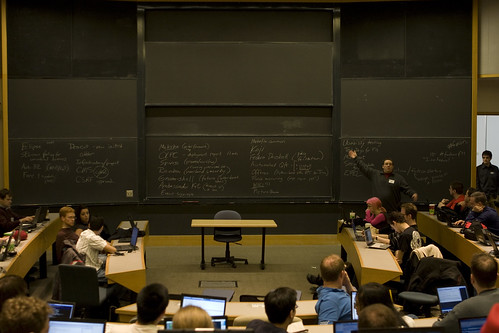 Instead of DaveJ doing his usual what s going on in the kernel for F$next I pitched that session and Dave held a session on dracut, he and Jeremy s new framework for building initramfs. My session was well attended and got a lot of questions about various things like the new drivers/staging policy (though, that s a post for another time.)
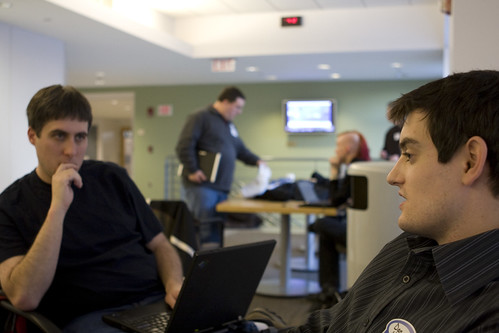 The rest of the time was productively spent poking at updates for the kernel for F9 and F10, rebasing them to 2.6.28, and poking at 2.6.29-rc1 for rawhide. This meant btrfs, while not ready for your critical data, was in mainline! After pushing out the new build, I spent most of the weekend doing some btrfs testing, and pushing out a new btrfsprogs build. Once they were composed into rawhide, I believe Fedora became the first to ship the mainline working btrfs in a distro.
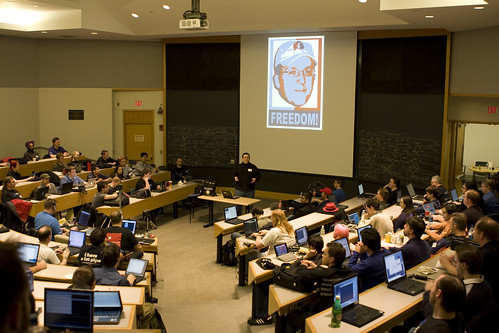 All said, it was a fairly productive weekend, and FUDPub on Saturday night was a great chance to catch up with a bunch of my coworkers who I rarely get to see. I kind of wish I had bothered to set up an umbrella and get some decent shots of my friends, colleagues and coworkers having a raucous good time, but oh well, there s always next release.
off-topic
 The monthly board meeting of SPI will take place on irc.oftc.net #spi tonight (Wed 21 Jan) at 20:00 UTC. Members may have seen that the meeting announcement is delayed because the secretary has been ill and it seems that none of the other board members has stepped in to take over. I think the only new associated project currently under discussion is waiting for a legal opinion, so your guess about the meeting contents is probably as good as mine.
My guesses: there will probably be a treasurer s report; Martin Zobel-Helas has been filling in the gaps in the 2007-8 minutes, so there ll be two or three sets for approval; the secretary may report on website redevelopment progress; Privoxy might have taken up the offer of associated project status from the SPI December 2008 meeting; and there might be a report on Tux4Kids trademarks.
Watch the comments below this article for a link to the summary when posted.
 My own perception of the debacle about the end-user who decided to cancel her college enrollment because she could not get Microsoft products to install on Ubuntu is three folds:
 (Apologies in advance for the shameless plug.) It s possibly a little late to talk about new year s resolutions, but if anyone is a Facebook user and has given up smoking (or plans to), you might be interested in Quitclock.
 My brother Alastair is a health editor for the Bupa private health insurance company, and thought of this neat project which was implemented by my housemate Martin Kleppman, and announced at new year. It helps you keep track of how long since you ve smoked, how much money you ve saved, lets you and your friends know how you re doing, and has health tips about the improvements that you can expect from your new-found abstinence. I m not a smoker but hopefully someone will find it useful.
 It s been a while now since the 2008 Summer of Code ended. This year, twelve (?) projects were selected. That s twelve students working full time on a Debian-related project during the summer.
The Google Summer of Code has sometimes been criticized in the past for having a poor student-developer retention rate inside the host projects. One of the goals of the program has always been to bring new people to budding or established free software organizations and it s a pity that some would leave the project as soon as the program ends.
On the other end, poor integration of created code within the project leads to work that is hard to merge in, or worse, doesn t get merged in at all. That s a waste of time and resources and a probably cause of global warming as well.
Hopefully, it s not always the case. Some people choose to stay committed within the organization in the long-term. Useful code gets merged in and pushed to the public.
I am going to give a talk about this at FOSDEM (go to FOSDEM!) so I m giving you a little preview. I need your help to collect information for my talk. As you know, information is always hard to come by with these kinds of projects so anything can be useful.
Without further ado, let s have a look at the cast of the Debian Google Summer of Code 2008:
Netconf, a network configuration management system
Presentation
Netconf is a network configuration management system designed with modern network infrastructures and the needs of roaming users in mind. It is a personal project of Martin Krafft that he started in 2007. He did some presentations about it that you can find on the dev website.
The project proposal was introduced by the mentor. The work was mainly about completing the roadmap items for version 1.0. Most of the design was done and code fleshed out.
The stated goal was to have netconf ready for lenny. Martin noted that due to lack of regular free time, he couldn t reach that goal by himself.
Student
Jonathan Roes was a computer science graduate student from the University of North Carolina at Charlotte. He had programming experience as a hobby for a long time and wrote some free games and libraries for the Nintendo DS and some proprietary webapps.
He submitted a few little patches in mid-march right after the publication of accepted mentoring organizations and went on to work from mid-may to mid-august. He wrote a lot of code right into the trunk since the whole project was a prototype.
Result
The last commit by Jonathan was also the last to date in the main netconf git repository. No further progress has been made and obviously netconf didn t get into lenny.
I couldn t find any further public involvement of Jonathan within Debian.
The ultimate Debian database, all things Debian in a SQL database
Presentation
The Ultimate Debian database wants to reunite all Debian data sources in a SQL database
The project was mentored by Lucas Nussbaum and co-mentored by Stefano Zacchiroli and Marc HE Brockschmidt. The project proposal was introduced by Lucas.
Student
Christian Neronus Von Essen is.. well, there wasn t much information readily available on him.
Result
The whole project is coded up and working well with a whole bunch of data sources. There will be a talk at FOSDEM about this so I ll leave it to Lucas to talk about it in detail.
I couldn t find any further public involvement of Christian within Debian.
Security-beta, a beta testing for Debian security updates
Presentation
The task is to improve the quality assurance process for security updates by providing a public security update beta test program in addition to the existing QA done for security updates. During the preparation of security updates, there s an inherent delay between the initial upload of the fixed packages and the time until the packages have been built on porter machines. This time gap will be used for a new security update beta program.
The project was supposed to be mentored by Moritz M hlenhoff.
Student
The project was supposed to be done by Nico Nion Golde. He is studying computer sciences at the Technical University of Berlin. He s also a DD.
Result
There s no nothing. Nico, what happened ? And obviously, he s still developing for Debian.
Debgraph, a generic infrastructure for the development of packages management tools
Presentation
In a large software ecosystem such as Debian Linux, there is the potential for dependencies among software packages to create complex management and technical problems. For example, dependency loops (cycles) in which a package directly or indirectly depends on itself can confuse package management tools as they determine the proper order of package installation. debgraph helps developers to solve this problem by enabling generic queries (e.g., Give me all the nodes that depend on package X ) against the graph of packages and thus automating much of the manual labor that is typically involved in resolving dependency problems.
The project was mentored by Robert Lemmen, who introduced the project proposal. The project was already started and the C++ code foundation was done by the time it was proposed.
Student
The project was executed by Adam Jensen, research assistant in the Software Engineering and Network Systems Laboratory at Michigan State University.
Result
Adam maintained a blog about his progress and finished ahead of schedule. However, the resulting work seems to be unused, which is a pity since the code could be used within other programs (package managers?).
I couldn t find any further public involvement of Adam within Debian.
 FOSDEM is a 2-day weekend of insanity. 218 talks this year; if you
want to understand exactly how insane that is, have a look at
the schedule
grid. There are 19 rooms where events are held; possibly more, since
I understand not every devroom has sent in its schedule yet.
Might be hard for people to make a choice that way, I guess.
Now there're supposed to be abstracts of each talk on the FOSDEM
website, but reading them all can be quite tedius. In an effort to help,
at least for the Debian devroom, here's the schedule for our devroom
with a bit of explanation of what it's about. Note that this is mainly
aimed at people not familiar with Debian; those who are should
probably understand it enough by looking at the titles.
Saturday:
13:00 - 14:00: 'Outside broadcast on a budget - the DebConf video
team and DVswitch'. DVswitch is the software used to create those excellent
Debian videos. The best ones yet, IMO, are the ones of Debconf8.
Check them out. There's nothing Debian-specific about DVswitch, except
that it was written by Debian people. It's a great way to do live
Internet .ogg streaming by using nothing more than DV cams, Firewire,
and plain old Ethernet.
14:00 - 15:00: 'Ultimate Debian Database: datamining Debian made
easy!'. UDD is a SQL database containing a shitload of data related to
Debian, and which should allow easy datamining. Hence the title. This
probably won't be of any interest to people who are not either a Debian
Developer or a statistician, but I might be mistaken.
15:00 - 16:00: 'Introducing DDE, Debian Data Export'. This is a new
project Enrico came up with, and which is related to the same subject as
the previous talk. I don't know much more beyond what's in the abstract.
However, given the fact that Enrico is going to be doing this talk, it
can't be bad. Seriously.
16:00 - 17:00: 'The Debian status quo on the Openmoko Neo
Freerunner'. Yup, Debian runs on the OpenMoko, and has done so since
Debconf8, last august. This talk should give some more insight; if you
have an OpenMoko, this definately is for you.
17:00 - 17:30: 'Running Debian on Inexpensive Network Storage
Devices'. I've been running Debian on a Thecus
N2100 for a few years now, and it's great. There are more options,
however, and Martin does most of the hard work related to these devices.
He's done a similar talk on the two previous FOSDEMs (go check out the
videos), and this one will mainly be an update on what's going to be new
in Lenny.
17:30 - 18:15: 'Grid Computing with Debian, Globus and ARC'. These
guys are a group of academics from three different universities who've
been doing grid computing (i.e., something like 'SETI@Home', but then
somewhat different) with Debian and some other technologies. They'll be
explaining how, exactly. I don't know much about this talk; it could be
great, or it could fail miserably. I guess we'll see.
18:15 - 19:00: 'What does the DPL do?'. This is really firmly
targetted at Debian people. If you're not in the least interested in how
Debian does things, you'll be bored.
Sunday
09:15 - 10:00: 'The state of Virtualization in Debian'. If you're a
Debian user interested in virtualization, this talk is for you. Henning
will explain what virtualization options exist in the upcoming 'Lenny'
release, and how to use them.
10:00 - 11:00: 'TDebs'. This might not be too interesting to you
unless you happen to be involved in Debian infrastructure. TDebs don't
exist yet, but will sometime soon; Neil will be explaining how, why, and
what.
11:00 - 12:00: 'Internationalization in Debian: How to improve
further?' If you're interested in i18n, this is probably for you.
12:00 - 13:00: 'The Common Debian Build System (CDBS)'. CDBS is one
way to build a Debian package. This is probably only of interest to
Debian people.
13:00 - 14:00: 'Release management in Debian - can we do better?'.
Frans isn't a member of the release team, but has some criticism on how
they function. He intends to present his arguments in order to start a
discussion. This is Debian internal kitchery, really.
14:00 - 15:00: 'Lenny - the road to release'. Neil is a
member of the release team, and is going to explain how we got to the
current state. I hope he'll also explain why we still haven't
released. I guess we'll see :-)
15:00 - 16:00: 'The long road to KDE4 in Debian'. Um, yeah. I'm not a
KDE guy, but I understand some other people are. In any case, might be
an interesting talk even if you don't use Debian, since I understand it
will look at some of the new features in KDE (and how they relate to
packaging).
16:00 - 17:00: 'Debian and Google Summer of Code 2008: wrap-up and
insights'. I guess Leslie
will be there. The speaker was a student working on Debian during this
year's SoC, and he will present what's been accomplished.
There, that's it. Now my only hope is that there'll be many people
attending. If previous editions are any indication, however, that won't
be a problem.
 After my previous failed attempt at installing Carbide C++[1] to allow me to develop stuff for Nokia E71 (i.e. Symbian), recently I have been digging up the internet on information on how to develop directly in Linux.
 Ok, so here s my obligatory Hello Planet Debian and I m now a Debian Developer post.
So, yeah, I m now a Debian Developer - and have a shiny new email address. For those of you considering going through the NM process, or already going through it - don t give up hope, you ll get there eventually!
Thanks to all those who ve helped me along the way.
In other news, I ve been meaning to blog about a couple of sites for a while now.
First of all, is Feedbooks.com - a nifty little site with lots of ebooks to download. Including a lot of the classics. You can also publish books on there, but I haven t got round to it yet. This is currently my homepage on my eeePC. I ve setup the custom PDF to be a good size for the eeePC (152mmx91mm, 10px font, 5mm all borders) and have been reading some of the Doctor Who books on there (and actually not finding it that uncomfortable curling up in bed with.
The next site is Stack Overflow - I ve mentioned this briefly before, but it s a great site. A community driven Programming Q+A site. Kind of hard to describe, but go have a look, you ll soon get the gist of it!
Anyway, I think it s time to head to bed for me!
 We added Debian
support for the HP Media Vault mv2120 this summer and it works very
well. While this NAS device is easily available in the US, I have
unfortunately not been able to find it in Europe so far, which obviously
limits the number of people who will run Debian on it. Yesterday I learnt
that the mv2120 is sold in Europe under the name HP Media Vault Pro mv5020
(GX666AA). I found some shops in the UK that sell the mv5020 but I assume
it's also available in other parts of Europe.
 Some weeks ago I bought myself an e-book reader, Sony Reader PRS 505. It is a really cool gadget, and as I usually read a lot of stuff in my computer, it is somehow an investment in my eyes. I decided on this one because the support for Linux is quite well, through the unofficial Free Software project Calibre.
Calibre is primarily an e-book cataloging program: it manages your e-book collection for you, and it is designed around the concept of the logical book (i.e. a single entry in the database that may correspond to ebooks in several formats). It also upports conversion from a dozen different ebook formats to LRF and EPUB. A graphical interface to the conversion software can be accessed easily by just clicking the Convert E-books button. A lot of input formats are supported: MOBI, LIT, PRC, EPUB, ODT, HTML, CBR, CBZ, RTF, TXT, PDF and LRS.
After some weeks of work, Martin Pitt and I have finished the packages for Debian and Ubuntu, which are right now waiting in the Debian NEW Queue. You can temporarily get them from here, compiled for Debian SID AMD64, but of course you can build them for your platform, or wait until they enter Debian.
After a rather hectic holiday season, I returned momentarily to pending Geode X.org driver issues. The current status:
 I wanted to report a success story with
topgit which is a rather new patch queue
managment extension for git. If that sounds like
gibberish to you, this is probably not the blog entry you are looking
for.
Some time ago I decided to migrate the debian packaging of
bibutils to topgit. This is
not a very complicated package, with 7 quilt patches applied to
upstream source. Since I don't have any experience to go on, I decided
to follow Martin 'madduck' Krafft's suggestion
for workflow.
It all looks a bit complicated (madduck will be the first to agree),
but it forced me to think about which patches were intended to go
upstream and which were not. At the end of the conversion I had 4
patches that were cleanly based on upstream, and (perhaps most
importantly for lazy people like me), I could send them upstream with
tg mail. I did that, and a few days later, Chris Putnam sent me a
new upstream release incorporating all of those patches. Of course, now I have
to package this new upstream release :-).
The astute reader might complain that this is more about me developing
half-decent workflow, and Chris being a great guy, than about any
specific tool. That may be true, but one thing I have discovered
since I started using git is that tools that encourage good workflow
are very nice. Actually, before I started using git, I didn't even use
the word workflow. So I just wanted to give a public thank you to
pasky for writing topgit and to madduck for pushing it into debian,
and thinking about debian packaging with topgit.
 Init Seven has once again
established themselves high on my ranking of awesome service
providers. After battling and
not resolving the problems with crap nVidia hardware, I was
ready to return the
server to Transtec, despite having invested a full day of work
into it. Having a machine in a rack across town, with the looming
danger of simple network traffic taking out the network card along
with the bridged IPMI remote console (thus requiring me to head out
to the colocation centre each time there was a problem) was just
not going to justify the expense for the server.
Init Seven connected a second switch port to my VLAN, which now
allows me to hook the IPMI card directly to the LAN. This does not
solve the problem with the sub-zero-quality crap manufactured by
nVidia, but at least it makes it possible to resurrect the machine
remotely, until the problem
with the hardware has been addressed and dealt with by the
forcedeth driver. And if that is not possible (due to nVidia pile
of shit), then the last option is a separate network card attached
to the riser card slot.
In related news: Transtec was
quick to proxy to the Supermicro s support (the motherboard
manufacturer), and within a few hours, I had a newer
forcedeth.c file. I compiled the driver, which seemed
to handle larger packets just fine at first. Unfortunately, just as
my hopes were up, the problems came back even with the driver
from Supermicro. Back to start, do not collect any money.
Regardless, I ve been impressed by Transtec s support level so
far. Yes, I did purchase a five year express warranty extension,
but it wasn t very expensive, definitely nowhere near the price for
a real SLA. And yet, my requests to date have each been answered
within a day at most, including such extravagant things as them
providing doanloadable floppy images of the BIOS update, which
Supermicro only distributes as Windows .exe file.
Now if only they (and everyone else) would stop shipping nVidia
hardware
NP:
AC/DC: Dirty Deeds Done Dirt Cheap
If you re looking to set up a business in Zurich but lack an
idea, here s one almost guaranteed to be successful or well, at
least it fills a niche:
Healthy home-order food. I d be your first customer, and quite a
regular one too, if you delivered to my door freshly cooked,
(ethnically) diverse meals with lots of vegetables, at
reasonable prices, of course.
I m happy to cook fancy dishes for guests, but cooking for the
purpose of having something enjoyable to eat alone is just not my
thing at all. I sometimes wish it were
And before you wonder about my quest for healthy foods: yes, I
wouldn t mind losing a bit of weight, but I am certainly not crazy
about it. It s more that I ve simply developed a strong liking for
vegetables, and quite like not suffering from a heavy stomach after
a meal.
NP:
AC/DC: Ballbreaker
With yesterday's release of version 2.11.0 of the X.org driver for the Geode GX2/LX, a whole cycle was wrapped up for many of the developers involved:
$ A=1
$ B=A
$ echo $ $B
bash: $ $B : bad substitution
$ echo $ !B
1
$ eval echo \$$B
1
Next.
