Search Results: "Dirk Eddelbuettel"

14 April 2017

Dirk Eddelbuettel: RcppArmadillo 0.7.800.2.0

armadillo image A new RcppArmadillo version 0.7.800.2.0 is now on CRAN. Armadillo is a powerful and expressive C++ template library for linear algebra aiming towards a good balance between speed and ease of use with a syntax deliberately close to a Matlab. RcppArmadillo integrates this library with the R environment and language--and is widely used by (currently) 318 other packages on CRAN -- an increase of 20 just since the last CRAN release of 0.7.600.1.0 in December! Changes in this release relative to the previous CRAN release are as follows:

Changes in RcppArmadillo version 0.7.800.2.0 (2017-04-12)
  • Upgraded to Armadillo release 7.800.2 (Rogue State Redux)
    • The Armadillo license changed to Apache License 2.0
  • The DESCRIPTION file now mentions the Apache License 2.0, as well as the former MPL2 license used for earlier releases.
  • A new file init.c was added with calls to R_registerRoutines() and R_useDynamicSymbols()
  • Symbol registration is enabled in useDynLib
  • The fastLm example was updated

Courtesy of CRANberries, there is a diffstat report. More detailed information is on the RcppArmadillo page. Questions, comments etc should go to the rcpp-devel mailing list off the R-Forge page.

This post by Dirk Eddelbuettel originated on his Thinking inside the box blog. Please report excessive re-aggregation in third-party for-profit settings.

8 April 2017

Dirk Eddelbuettel: #4: Simpler shoulders()

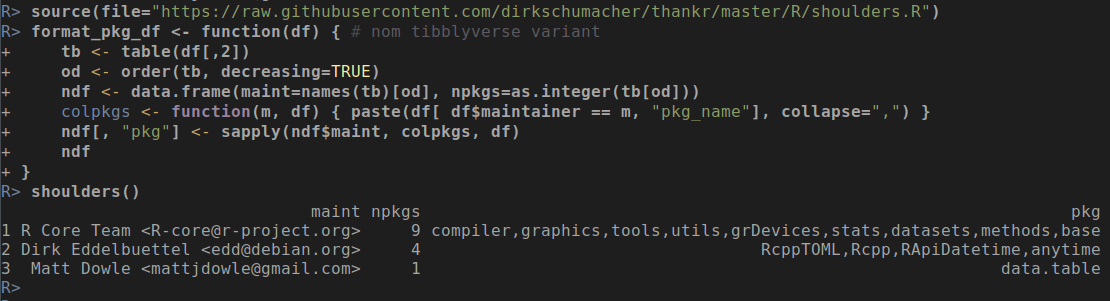
Welcome to the fourth post in the repulsively random R ramblings series, or R4 for short. My twitter feed was buzzing about a nice (and as yet unpublished, ie not-on-CRAN) package thankr by Dirk Schumacher which compiles a list of packages (ordered by maintainer count) for your current session (or installation or ...) with a view towards saying thank you to those whose packages we rely upon. Very nice indeed. I had a quick look and run it twice ... and had a reaction of ewwww, really? as running it twice gave different results as on the second instance a boatload of tibblyverse packages appeared. Because apparently kids these day can only slice data that has been tidied or something. So I had another quick look ... and put together an alternative version using just base R (as there was only one subfunction that needed reworking):
source(file="https://raw.githubusercontent.com/dirkschumacher/thankr/master/R/shoulders.R")
format_pkg_df <- function(df)   # non-tibblyverse variant
    tb <- table(df[,2])
    od <- order(tb, decreasing=TRUE)
    ndf <- data.frame(maint=names(tb)[od], npkgs=as.integer(tb[od]))
    colpkgs <- function(m, df)   paste(df[ df$maintainer == m, "pkg_name"], collapse=",")  
    ndf[, "pkg"] <- sapply(ndf$maint, colpkgs, df)
    ndf
 
A nice side benefit is that the function is now free of external dependencies (besides, of course, base R). Running this in the ESS session I had open gives:
R> shoulders()  ## by Dirk Schumacher, with small modifications
                               maint npkgs                                                                 pkg
1 R Core Team <R-core@r-project.org>     9 compiler,graphics,tools,utils,grDevices,stats,datasets,methods,base
2 Dirk Eddelbuettel <edd@debian.org>     4                                  RcppTOML,Rcpp,RApiDatetime,anytime
3  Matt Dowle <mattjdowle@gmail.com>     1                                                          data.table
R> 
and for good measure a screenshot is below:
I think we need a catchy moniker for R work using good old base R. SoberVerse? GrumbyOldFolksR? PlainOldR? Better suggestions welcome. Edit on 2017-04-09: And by now Dirk Schumacher fixed that little bug in thankr which was at the start of this. His shoulders() function is now free of side effects, and thankr is now a clean micropackage free of external depends from any verse, be it tiddly or grumpy. I look forward to seeing it on CRAN soon!

This post by Dirk Eddelbuettel originated on his Thinking inside the box blog. Please report excessive re-aggregation in third-party for-profit settings.

7 April 2017

Dirk Eddelbuettel: #3: Follow R-devel

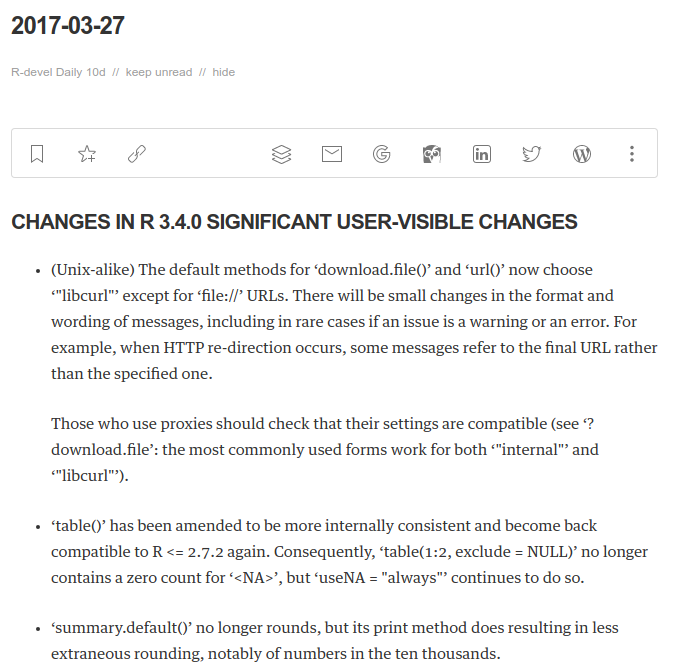
Welcome to the third post in the rarely relevant R recommendation series, or R4 for short. Today will be brief, but of some importance. In order to know where R is going next, few places provide a better vantage point than the actual ongoing development. A few years ago, I mentioned to Duncan Murdoch how straightforward the setup of my CRANberries feed (and site) was. After all, static blog compilers converting textual input to html, rss feed and whatnot have been around for fifteen years (though they keep getting reinvented). He took this to heart and built the (not too pretty) R-devel daily site (which also uses a fancy diff tool as it shows changes in NEWS) as well as a more general description of all available sub-feeds. I follow this mostly through blog aggregations -- Google Reader in its day, now Feedly. A screenshot is below just to show that it doesn't have to be ugly just because it is on them intertubes:
This shows a particularly useful day when R-devel folded into the new branch for what will be the R 3.4.0 release come April 21. The list of upcoming changes is truly impressive and quite comprehensive -- and the package registration helper, focus of posts #1 and #2 here, is but one of these many changes. One function I learned about that day is tools::CRAN_package_db(), a helper to get a single (large) data.frame with all package DESCRIPTION information. Very handy. Others may have noticed that CRAN repos now have a new top-level file PACKAGES.rds and this function does indeed just fetch it--which you could do with a similar one-liner in R-release as well. Still very handy. But do read about changes in R-devel and hence upcoming changes in R 3.4.0. Lots of good things coming our way.

This post by Dirk Eddelbuettel originated on his Thinking inside the box blog. Please report excessive re-aggregation in third-party for-profit settings.

3 April 2017

Dirk Eddelbuettel: RApiDatetime 0.0.3

A brown bag bug fix release 0.0.3 of RApiDatetime is now on CRAN. RApiDatetime provides six entry points for C-level functions of the R API for Date and Datetime calculations. The functions asPOSIXlt and asPOSIXct convert between long and compact datetime representation, formatPOSIXlt and Rstrptime convert to and from character strings, and POSIXlt2D and D2POSIXlt convert between Date and POSIXlt datetime. These six functions are all fairly essential and useful, but not one of them was previously exported by R. I left two undefined variables in calls in the exported header file; this only become an issue once I actually tried accessing the API from another package as I am now doing in anytime.

Changes in RApiDatetime version 0.0.3 (2017-04-02)
  • Correct two simple copy-and-paste errors in RApiDatetime.h
  • Also enable registration in useDynLib, and explicitly export known and documented R access functions provided for testing

Courtesy of CRANberries, there is a comparison to the previous release. More information is on the rapidatetime page. For questions or comments please use the issue tracker off the GitHub repo.

This post by Dirk Eddelbuettel originated on his Thinking inside the box blog. Please report excessive re-aggregation in third-party for-profit settings.

31 March 2017

Dirk Eddelbuettel: #2: Even Easier Package Registration

Welcome to the second post in rambling random R recommendation series, or R4 for short. Two days ago I posted the initial (actual) post. It provided context for why we need package registration entries (tl;dr: because R CMD check now tests for it, and because it The Right Thing to do, see documentation in the posts). I also showed how generating such a file src/init.c was essentially free as all it took was single call to a new helper function added to R-devel by Brian Ripley and Kurt Hornik. Now, to actually use R-devel you obviously need to have it accessible. There are a myriad of ways to achieve that: just compile it locally as I have done for years, use a Docker image as I showed in the post -- or be creative with eg Travis or win-builder both of which give you access to R-devel if you're clever about it. But as no good deed goes unpunished, I was of course told off today for showing a Docker example as Docker was not "Easy". I think the formal answer to that is baloney. But we leave that aside, and promise to discuss setting up Docker at another time. R is after all ... just R. So below please find a script you can save as, say, ~/bin/pnrrs.r. And calling it---even with R-release---will generate the same code snippet as I showed via Docker. Call it a one-off backport of the new helper function -- with a half-life of a few weeks at best as we will have R 3.4.0 as default in just a few weeks. The script will then reduce to just the final line as the code will be present with R 3.4.0.
#!/usr/bin/r
library(tools)
.find_calls_in_package_code <- tools:::.find_calls_in_package_code
.read_description <- tools:::.read_description
## all what follows is from R-devel aka R 3.4.0 to be
package_ff_call_db <- function(dir)  
    ## A few packages such as CDM use base::.Call
    ff_call_names <- c(".C", ".Call", ".Fortran", ".External",
                       "base::.C", "base::.Call",
                       "base::.Fortran", "base::.External")
    predicate <- function(e)  
        (length(e) > 1L) &&
            !is.na(match(deparse(e[[1L]]), ff_call_names))
     
    calls <- .find_calls_in_package_code(dir,
                                         predicate = predicate,
                                         recursive = TRUE)
    calls <- unlist(Filter(length, calls))
    if(!length(calls)) return(NULL)
    attr(calls, "dir") <- dir
    calls
 
native_routine_registration_db_from_ff_call_db <- function(calls, dir = NULL, character_only = TRUE)  
    if(!length(calls)) return(NULL)
    ff_call_names <- c(".C", ".Call", ".Fortran", ".External")
    ff_call_args <- lapply(ff_call_names,
                           function(e) args(get(e, baseenv())))
    names(ff_call_args) <- ff_call_names
    ff_call_args_names <-
        lapply(lapply(ff_call_args,
                      function(e) names(formals(e))), setdiff,
               "...")
    if(is.null(dir))
        dir <- attr(calls, "dir")
    package <- # drop name
        as.vector(.read_description(file.path(dir, "DESCRIPTION"))["Package"])
    symbols <- character()
    nrdb <-
        lapply(calls,
               function(e)  
                   if (startsWith(deparse(e[[1L]]), "base::"))
                       e[[1L]] <- e[[1L]][3L]
                   ## First figure out whether ff calls had '...'.
                   pos <- which(unlist(Map(identical,
                                           lapply(e, as.character),
                                           "...")))
                   ## Then match the call with '...' dropped.
                   ## Note that only .NAME could be given by name or
                   ## positionally (the other ff interface named
                   ## arguments come after '...').
                   if(length(pos)) e <- e[-pos]
                   ## drop calls with only ...
                   if(length(e) < 2L) return(NULL)
                   cname <- as.character(e[[1L]])
                   ## The help says
                   ##
                   ## '.NAME' is always matched to the first argument
                   ## supplied (which should not be named).
                   ##
                   ## But some people do (Geneland ...).
                   nm <- names(e); nm[2L] <- ""; names(e) <- nm
                   e <- match.call(ff_call_args[[cname]], e)
                   ## Only keep ff calls where .NAME is character
                   ## or (optionally) a name.
                   s <- e[[".NAME"]]
                   if(is.name(s))  
                       s <- deparse(s)[1L]
                       if(character_only)  
                           symbols <<- c(symbols, s)
                           return(NULL)
                        
                     else if(is.character(s))  
                       s <- s[1L]
                     else   ## expressions
                       symbols <<- c(symbols, deparse(s))
                       return(NULL)
                    
                   ## Drop the ones where PACKAGE gives a different
                   ## package. Ignore those which are not char strings.
                   if(!is.null(p <- e[["PACKAGE"]]) &&
                      is.character(p) && !identical(p, package))
                       return(NULL)
                   n <- if(length(pos))  
                            ## Cannot determine the number of args: use
                            ## -1 which might be ok for .External().
                            -1L
                          else  
                            sum(is.na(match(names(e),
                                            ff_call_args_names[[cname]]))) - 1L
                         
                   ## Could perhaps also record whether 's' was a symbol
                   ## or a character string ...
                   cbind(cname, s, n)
                )
    nrdb <- do.call(rbind, nrdb)
    nrdb <- as.data.frame(unique(nrdb), stringsAsFactors = FALSE)
    if(NROW(nrdb) == 0L   length(nrdb) != 3L)
        stop("no native symbols were extracted")
    nrdb[, 3L] <- as.numeric(nrdb[, 3L])
    nrdb <- nrdb[order(nrdb[, 1L], nrdb[, 2L], nrdb[, 3L]), ]
    nms <- nrdb[, "s"]
    dups <- unique(nms[duplicated(nms)])
    ## Now get the namespace info for the package.
    info <- parseNamespaceFile(basename(dir), dirname(dir))
    ## Could have ff calls with symbols imported from other packages:
    ## try dropping these eventually.
    imports <- info$imports
    imports <- imports[lengths(imports) == 2L]
    imports <- unlist(lapply(imports,  [[ , 2L))
    info <- info$nativeRoutines[[package]]
    ## Adjust native routine names for explicit remapping or
    ## namespace .fixes.
    if(length(symnames <- info$symbolNames))  
        ind <- match(nrdb[, 2L], names(symnames), nomatch = 0L)
        nrdb[ind > 0L, 2L] <- symnames[ind]
      else if(!character_only &&
              any((fixes <- info$registrationFixes) != ""))  
        ## There are packages which have not used the fixes, e.g. utf8latex
        ## fixes[1L] is a prefix, fixes[2L] is an undocumented suffix
        nrdb[, 2L] <- sub(paste0("^", fixes[1L]), "", nrdb[, 2L])
        if(nzchar(fixes[2L]))
            nrdb[, 2L] <- sub(paste0(fixes[2L]), "$", "", nrdb[, 2L])
     
    ## See above.
    if(any(ind <- !is.na(match(nrdb[, 2L], imports))))
        nrdb <- nrdb[!ind, , drop = FALSE]
    ## Fortran entry points are mapped to l/case
    dotF <- nrdb$cname == ".Fortran"
    nrdb[dotF, "s"] <- tolower(nrdb[dotF, "s"])
    attr(nrdb, "package") <- package
    attr(nrdb, "duplicates") <- dups
    attr(nrdb, "symbols") <- unique(symbols)
    nrdb
 
format_native_routine_registration_db_for_skeleton <- function(nrdb, align = TRUE, include_declarations = FALSE)  
    if(!length(nrdb))
        return(character())
    fmt1 <- function(x, n)  
        c(if(align)  
              paste(format(sprintf("     \"%s\",", x[, 1L])),
                    format(sprintf(if(n == "Fortran")
                                       "(DL_FUNC) &F77_NAME(%s),"
                                   else
                                       "(DL_FUNC) &%s,",
                                   x[, 1L])),
                    format(sprintf("%d ,", x[, 2L]),
                           justify = "right"))
            else  
              sprintf(if(n == "Fortran")
                          "     \"%s\", (DL_FUNC) &F77_NAME(%s), %d ,"
                      else
                          "     \"%s\", (DL_FUNC) &%s, %d ,",
                      x[, 1L],
                      x[, 1L],
                      x[, 2L])
           ,
          "     NULL, NULL, 0 ")
     
    package <- attr(nrdb, "package")
    dups <- attr(nrdb, "duplicates")
    symbols <- attr(nrdb, "symbols")
    nrdb <- split(nrdb[, -1L, drop = FALSE],
                  factor(nrdb[, 1L],
                         levels =
                             c(".C", ".Call", ".Fortran", ".External")))
    has <- vapply(nrdb, NROW, 0L) > 0L
    nms <- names(nrdb)
    entries <- substring(nms, 2L)
    blocks <- Map(function(x, n)  
                      c(sprintf("static const R_%sMethodDef %sEntries[] =  ",
                                n, n),
                        fmt1(x, n),
                        " ;",
                        "")
                   ,
                  nrdb[has],
                  entries[has])
    decls <- c(
        "/* FIXME: ",
        "   Add declarations for the native routines registered below.",
        "*/")
    if(include_declarations)  
        decls <- c(
            "/* FIXME: ",
            "   Check these declarations against the C/Fortran source code.",
            "*/",
            if(NROW(y <- nrdb$.C))  
                 args <- sapply(y$n, function(n) if(n >= 0)
                                paste(rep("void *", n), collapse=", ")
                                else "/* FIXME */")
                c("", "/* .C calls */",
                  paste0("extern void ", y$s, "(", args, ");"))
            ,
            if(NROW(y <- nrdb$.Call))  
                args <- sapply(y$n, function(n) if(n >= 0)
                               paste(rep("SEXP", n), collapse=", ")
                               else "/* FIXME */")
               c("", "/* .Call calls */",
                  paste0("extern SEXP ", y$s, "(", args, ");"))
             ,
            if(NROW(y <- nrdb$.Fortran))  
                 args <- sapply(y$n, function(n) if(n >= 0)
                                paste(rep("void *", n), collapse=", ")
                                else "/* FIXME */")
                c("", "/* .Fortran calls */",
                  paste0("extern void F77_NAME(", y$s, ")(", args, ");"))
             ,
            if(NROW(y <- nrdb$.External))
                c("", "/* .External calls */",
                  paste0("extern SEXP ", y$s, "(SEXP);"))
            )
     
    headers <- if(NROW(nrdb$.Call)   NROW(nrdb$.External))
        c("#include <R.h>", "#include <Rinternals.h>")
    else if(NROW(nrdb$.Fortran)) "#include <R_ext/RS.h>"
    else character()
    c(headers,
      "#include <stdlib.h> // for NULL",
      "#include <R_ext/Rdynload.h>",
      "",
      if(length(symbols))  
          c("/*",
            "  The following symbols/expresssions for .NAME have been omitted",
            "", strwrap(symbols, indent = 4, exdent = 4), "",
            "  Most likely possible values need to be added below.",
            "*/", "")
       ,
      if(length(dups))  
          c("/*",
            "  The following name(s) appear with different usages",
            "  e.g., with different numbers of arguments:",
            "", strwrap(dups, indent = 4, exdent = 4), "",
            "  This needs to be resolved in the tables and any declarations.",
            "*/", "")
       ,
      decls,
      "",
      unlist(blocks, use.names = FALSE),
      ## We cannot use names with '.' in: WRE mentions replacing with "_"
      sprintf("void R_init_%s(DllInfo *dll)",
              gsub(".", "_", package, fixed = TRUE)),
      " ",
      sprintf("    R_registerRoutines(dll, %s);",
              paste0(ifelse(has,
                            paste0(entries, "Entries"),
                            "NULL"),
                     collapse = ", ")),
      "    R_useDynamicSymbols(dll, FALSE);",
      " ")
 
package_native_routine_registration_db <- function(dir, character_only = TRUE)  
    calls <- package_ff_call_db(dir)
    native_routine_registration_db_from_ff_call_db(calls, dir, character_only)
 
package_native_routine_registration_db <- function(dir, character_only = TRUE)  
    calls <- package_ff_call_db(dir)
    native_routine_registration_db_from_ff_call_db(calls, dir, character_only)
 
package_native_routine_registration_skeleton <- function(dir, con = stdout(), align = TRUE,
                                                         character_only = TRUE, include_declarations = TRUE)  
    nrdb <- package_native_routine_registration_db(dir, character_only)
    writeLines(format_native_routine_registration_db_for_skeleton(nrdb,
                align, include_declarations),
               con)
 
package_native_routine_registration_skeleton(".")  ## when R 3.4.0 is out you only need this line
Here I use /usr/bin/r as I happen to like littler a lot, but you can use Rscript the same way. Easy enough now?

This post by Dirk Eddelbuettel originated on his Thinking inside the box blog. Please report excessive re-aggregation in third-party for-profit settings.

29 March 2017

Dirk Eddelbuettel: #1: Easy Package Registration

Welcome to the first actual post in the R4 series, following the short announcement earlier this week.

Context Last month, Brian Ripley announced on r-devel that registration of routines would now be tested for by R CMD check in r-devel (which by next month will become R 3.4.0). A NOTE will be issued now, this will presumably turn into a WARNING at some point. Writing R Extensions has an updated introduction) of the topic. Package registration has long been available, and applies to all native (i.e. "compiled") function via the .C(), .Call(), .Fortran() or .External() interfaces. If you use any of those -- and .Call() may be the only truly relevant one here -- then is of interest to you. Brian Ripley and Kurt Hornik also added a new helper function: tools::package_native_routine_registration_skeleton(). It parses the R code of your package and collects all native function entrypoints in order to autogenerate the registration. It is available in R-devel now, will be in R 3.4.0 and makes adding such registration truly trivial. But as of today, it requires that you have R-devel. Once R 3.4.0 is out, you can call the helper directly. As for R-devel, there have always been at least two ways to use it: build it locally (which we may cover in another R4 installment), or using Docker. Here will focus on the latter by relying on the Rocker project by Carl and myself.

Use the Rocker drd Image We assume you can run Docker on your system. How to add it on Windows, macOS or Linux is beyond our scope here today, but also covered extensively elsewhere. So we assume you can execute docker and e.g. bring in the 'daily r-devel' image drd from our Rocker project via
~$ docker pull rocker/drd
With that, we can use R-devel to create the registration file very easily in a single call (which is a long command-line we have broken up with one line-break for the display below). The following is real-life example when I needed to add registration to the RcppTOML package for this week's update:
~/git/rcpptoml(master)$ docker run --rm -ti -v $(pwd):/mnt rocker/drd \  ## line break
             RD --slave -e 'tools::package_native_routine_registration_skeleton("/mnt")'
#include <R.h>
#include <Rinternals.h>
#include <stdlib.h> // for NULL
#include <R_ext/Rdynload.h>
/* FIXME: 
   Check these declarations against the C/Fortran source code.
*/
/* .Call calls */
extern SEXP RcppTOML_tomlparseImpl(SEXP, SEXP, SEXP);
static const R_CallMethodDef CallEntries[] =  
     "RcppTOML_tomlparseImpl", (DL_FUNC) &RcppTOML_tomlparseImpl, 3 ,
     NULL, NULL, 0 
 ;
void R_init_RcppTOML(DllInfo *dll)
 
    R_registerRoutines(dll, NULL, CallEntries, NULL, NULL);
    R_useDynamicSymbols(dll, FALSE);
 
edd@max:~/git/rcpptoml(master)$ 

Decompose the Command We can understand the docker command invocation above through its components:
  • docker run is the basic call to a container
  • --rm -ti does subsequent cleanup (--rm) and gives a terminal (-t) that is interactive (-i)
  • -v $(pwd):/mnt uses the -v a:b options to make local directory a available as b in the container; here $(pwd) calls print working directory to get the local directory which is now mapped to /mnt in the container
  • rocker/drd invokes the 'drd' container of the Rocker project
  • RD is a shorthand to the R-devel binary inside the container, and the main reason we use this container
  • -e 'tools::package_native_routine_registration_skeleton("/mnt") calls the helper function of R (currently in R-devel only, so we use RD) to compute a possible init.c file based on the current directory -- which is /mnt inside the container
That it. We get a call to the R function executed inside the Docker container, examining the package in the working directory and creating a registration file for it which is display to the console.

Copy the Output to src/init.c We simply copy the output to a file src/init.c; I often fold one opening brace one line up.

Update NAMESPACE We also change one line in NAMESPACE from (for this package) useDynLib("RcppTOML") to useDynLib("RcppTOML", .registration=TRUE). Adjust accordingly for other package names.

That's it! And with that we a have a package which no longer provokes the NOTE as seen by the checks page. Calls to native routines are now safer (less of a chance for name clashing), get called quicker as we skip the symbol search (see the WRE discussion) and best of all this applies to all native routines whether written by hand or written via a generator such as Rcpp Attributes. So give this a try to get your package up-to-date.

This post by Dirk Eddelbuettel originated on his Thinking inside the box blog. Please report excessive re-aggregation in third-party for-profit settings.

28 March 2017

Dirk Eddelbuettel: nanotime 0.1.2

A new minor version of the nanotime package for working with nanosecond timestamps arrived yesterday on CRAN. nanotime uses the RcppCCTZ package for (efficient) high(er) resolution time parsing and formatting up to nanosecond resolution, and the bit64 package for the actual integer64 arithmetic. This release just arranges things neatly before Leonardo Silvestri and I may shake things up with a possible shift to doing it all in S4 as we may need the added rigour for nanotime object operations for use in his ztsdb project.

Changes in version 0.1.2 (2017-03-27)
  • The as.integer64 function is now exported as well.

We also have a diff to the previous version thanks to CRANberries. More details and examples are at the nanotime page; code, issue tickets etc at the GitHub repository.

This post by Dirk Eddelbuettel originated on his Thinking inside the box blog. Please report excessive re-aggregation in third-party for-profit settings.

27 March 2017

Dirk Eddelbuettel: #0: Introducing R^4

So I had been toying with the idea of getting back to the blog and more regularly writing / posting little tips and tricks. I even started taking some notes but because perfect is always the enemy of the good it never quite materialized. But the relatively broad discussion spawned by last week's short rant on Suggests != Depends made a few things clear. There appears to be an audience. It doesn't have to be long. And it doesn't have to be too polished. So with that, let's get the blogging back from micro-blogging. This note forms post zero of what will a new segment I call R4 which is shorthand for relatively random R rambling. Stay tuned.

This post by Dirk Eddelbuettel originated on his Thinking inside the box blog. Please report excessive re-aggregation in third-party for-profit settings.

26 March 2017

Dirk Eddelbuettel: RcppTOML 0.1.2

A new release of RcppTOML is now on CRAN. This release fixes a few parsing issues for less frequently-used inputs: vectors of boolean or date(time) types, as well as table array input. RcppTOML brings TOML to R. TOML is a file format that is most suitable for configurations, as it is meant to be edited by humans but read by computers. It emphasizes strong readability for humans while at the same time supporting strong typing as well as immediate and clear error reports. On small typos you get parse errors, rather than silently corrupted garbage. Much preferable to any and all of XML, JSON or YAML -- though sadly these may be too ubiquitous now. TOML is making good inroads with newer and more flexible projects such as the Hugo static blog compiler, or the Cargo system of Crates (aka "packages") for the Rust language.

Changes in version 0.1.2 (2017-03-26)
  • Dates and Datetimes in arrays in the input now preserve their types instead of converting to numeric vectors (#13)
  • Boolean vectors are also correctly handled (#14)
  • TableArray types are now stored as lists in a single named list (#15)
  • The README.md file was expanded with an example and screenshot.
  • Added file init.c with calls to R_registerRoutines() and R_useDynamicSymbols(); also use .registration=TRUE in useDynLib in NAMESPACE
  • Two example files were updated.

Courtesy of CRANberries, there is a diffstat report for this release. More information is on the RcppTOML page page. Issues and bugreports should go to the GitHub issue tracker.

This post by Dirk Eddelbuettel originated on his Thinking inside the box blog. Please report excessive re-aggregation in third-party for-profit settings.

25 March 2017

Dirk Eddelbuettel: RApiDatetime 0.0.2

Two days after the initial 0.0.1 release, a new version of RApiDatetime has just arrived on CRAN. RApiDatetime provides six entry points for C-level functions of the R API for Date and Datetime calculations. The functions asPOSIXlt and asPOSIXct convert between long and compact datetime representation, formatPOSIXlt and Rstrptime convert to and from character strings, and POSIXlt2D and D2POSIXlt convert between Date and POSIXlt datetime. These six functions are all fairly essential and useful, but not one of them was previously exported by R. Josh Ulrich took one hard look at the package -- and added the one line we needed to enable the Windows support that was missing in the initial release. We now build on all platforms supported by R and CRAN. Otherwise, I just added a NEWS file and called it a bugfix release.

Changes in RApiDatetime version 0.0.2 (2017-03-25)
  • Windows support has added (Josh Ulrich in #1)

Changes in RApiDatetime version 0.0.1 (2017-03-23)
  • Initial release with six accessible functions

Courtesy of CRANberries, there is a comparison to the previous release. More information is on the rapidatetime page. For questions or comments please use the issue tracker off the GitHub repo.

This post by Dirk Eddelbuettel originated on his Thinking inside the box blog. Please report excessive re-aggregation in third-party for-profit settings.

24 March 2017

Dirk Eddelbuettel: RApiDatetime 0.0.1

Very happy to announce a new package of mine is now up on the CRAN repository network: RApiDatetime. It provides six entry points for C-level functions of the R API for Date and Datetime calculations: asPOSIXlt and asPOSIXct convert between long and compact datetime representation, formatPOSIXlt and Rstrptime convert to and from character strings, and POSIXlt2D and D2POSIXlt convert between Date and POSIXlt datetime. These six functions are all fairly essential and useful, but not one of them was previously exported by R. Hence the need to put them together in the this package to complete the accessible API somewhat. These should be helpful for fellow package authors as many of us have either our own partial copies of some of this code, or rather farm back out into R to get this done. As a simple (yet real!) illustration, here is an actual Rcpp function which we could now cover at the C level rather than having to go back up to R (via Rcpp::Function()):
    inline Datetime::Datetime(const std::string &s, const std::string &fmt)  
        Rcpp::Function strptime("strptime");    // we cheat and call strptime() from R
        Rcpp::Function asPOSIXct("as.POSIXct"); // and we need to convert to POSIXct
        m_dt = Rcpp::as<double>(asPOSIXct(strptime(s, fmt)));
        update_tm();
     
I had taken a first brief stab at this about two years ago, but never finished. With the recent emphasis on C-level function registration, coupled with a possible use case from anytime I more or less put this together last weekend. It currently builds and tests fine on POSIX-alike operating systems. If someone with some skill and patience in working on Windows would like to help complete the Windows side of things then I would certainly welcome help and pull requests. For questions or comments please use the issue tracker off the GitHub repo.

This post by Dirk Eddelbuettel originated on his Thinking inside the box blog. Please report excessive re-aggregation in third-party for-profit settings.

22 March 2017

Dirk Eddelbuettel: Suggests != Depends

A number of packages on CRAN use Suggests: casually. They list other packages as "not required" in Suggests: -- as opposed to absolutely required via Imports: or the older Depends: -- yet do not test for their use in either examples or, more commonly, unit tests. So e.g. the unit tests are bound to fail because, well, Suggests != Depends. This has been accomodated for many years by all parties involved by treating Suggests as a Depends and installing unconditionally. As I understand it, CRAN appears to flip a switch to automatically install all Suggests from major repositories glossing over what I consider to be a packaging shortcoming. (As an aside, treatment of Additonal_repositories: is indeed optional; Brooke Anderson and I have a fine paper under review on this) I spend a fair amount of time with reverse dependency ("revdep") checks of packages I maintain, and I will no longer accomodate these packages. These revdep checks take long enough as it is, so I will now blacklist these packages that are guaranteed to fail when their "optional" dependencies are not present. Writing R Extensions says in Section 1.1.3
All packages that are needed10 to successfully run R CMD check on the package must be listed in one of Depends or Suggests or Imports . Packages used to run examples or tests conditionally (e.g. via if(require(pkgname))) should be listed in Suggests or Enhances . (This allows checkers to ensure that all the packages needed for a complete check are installed.) In particular, packages providing only data for examples or vignettes should be listed in Suggests rather than Depends in order to make lean installations possible. [...] It used to be common practice to use require calls for packages listed in Suggests in functions which used their functionality, but nowadays it is better to access such functionality via :: calls.
and continues in Section 1.1.3.1
Note that someone wanting to run the examples/tests/vignettes may not have a suggested package available (and it may not even be possible to install it for that platform). The recommendation used to be to make their use conditional via if(require("pkgname"))): this is fine if that conditioning is done in examples/tests/vignettes.
I will now exercise my option to use 'lean installations' as discussed here. If you want your package included in tests I run, please make sure it tests successfully when only its required packages are present.

Dirk Eddelbuettel: anytime 0.2.2

A bugfix release of the anytime package arrived at CRAN earlier today. This is tenth release since the inaugural version late last summer, and the second (bugfix / feature) release this year. anytime is a very focused package aiming to do just one thing really well: to convert anything in integer, numeric, character, factor, ordered, ... format to either POSIXct or Date objects -- and to do so without requiring a format string. See the anytime page, or the GitHub README.md for a few examples. This releases addresses an annoying bug related to British TZ settings and the particular impact of a change in 1971, and generalizes input formats to accept integer or numeric format in two specific ranges. Details follow below:

Changes in anytime version 0.2.2 (2017-03-21)
  • Address corner case of integer-typed (large) values corresponding to POSIXct time (PR #57 closing ##56)
  • Add special case for Europe/London and 31 Oct 1971 BST change to avoid a one-hour offset error (#58 fixing #36 and #51)
  • Address another corner case of numeric values corresponding to Date types which are now returned as Date
  • Added file init.c with calls to R_registerRoutines() and R_useDynamicSymbols(); already used .registration=TRUE in useDynLib in NAMESPACE

Courtesy of CRANberries, there is a comparison to the previous release. More information is on the anytime page. For questions or comments use the issue tracker off the GitHub repo.

This post by Dirk Eddelbuettel originated on his Thinking inside the box blog. Please report excessive re-aggregation in third-party for-profit settings.

19 March 2017

Dirk Eddelbuettel: Rcpp 0.12.10: Some small fixes

The tenth update in the 0.12.* series of Rcpp just made it to the main CRAN repository providing GNU R with by now over 10,000 packages. Windows binaries for Rcpp, as well as updated Debian packages will follow in due course. This 0.12.10 release follows the 0.12.0 release from late July, the 0.12.1 release in September, the 0.12.2 release in November, the 0.12.3 release in January, the 0.12.4 release in March, the 0.12.5 release in May, the 0.12.6 release in July, the 0.12.7 release in September, the 0.12.8 release in November, and the 0.12.9 release in January --- making it the fourteenth release at the steady and predictable bi-montly release frequency. Rcpp has become the most popular way of enhancing GNU R with C or C++ code. As of today, 975 packages on CRAN depend on Rcpp for making analytical code go faster and further. That is up by sixtynine packages over the two months since the last release -- or just over a package a day! The changes in this release are almost exclusively minor bugfixes and enhancements to documentation and features: James "coatless" Balamuta rounded out the API, I aki Ucar fixed a bug concerning one-character output, Jeroen Ooms allowed for finalizers on XPtr objects, Nathan Russell corrected handling of lower (upper) triangular matrices, Dan Dillon and I dealt with Intel compiler quirks for his algorithm.h header, and I added a C++17 plugin along with some (overdue!) documentation regarding the various C++ standards that are supported by Rcpp (which is in essence whatever your compiler supports, i.e., C++98, C++11, C++14 all the way to C++17 but always keep in mind what CRAN and different users may deploy).

Changes in Rcpp version 0.12.10 (2017-03-17)
  • Changes in Rcpp API:
    • Added new size attribute aliases for number of rows and columns in DataFrame (James Balamuta in #638 addressing #630).
    • Fixed single-character handling in Rstreambuf (I aki Ucar in #649 addressing #647).
    • XPtr gains a parameter finalizeOnExit to enable running the finalizer when R quits (Jeroen Ooms in #656 addressing #655).
  • Changes in Rcpp Sugar:
    • Fixed sugar functions upper_tri() and lower_tri() (Nathan Russell in #642 addressing #641).
    • The algorithm.h file now accomodates the Intel compiler (Dirk in #643 and Dan in #645 addressing issue #640).
  • Changes in Rcpp Attributes
    • The C++17 standard is supported with a new plugin (used eg for g++-6.2).
  • Changes in Rcpp Documentation:
    • An overdue explanation of how C++11, C++14, and C++17 can be used was added to the Rcpp FAQ.

Thanks to CRANberries, you can also look at a diff to the previous release. As always, even fuller details are on the Rcpp Changelog page and the Rcpp page which also leads to the downloads page, the browseable doxygen docs and zip files of doxygen output for the standard formats. A local directory has source and documentation too. Questions, comments etc should go to the rcpp-devel mailing list off the R-Forge page.

This post by Dirk Eddelbuettel originated on his Thinking inside the box blog. Please report excessive re-aggregation in third-party for-profit settings.

15 March 2017

Dirk Eddelbuettel: RcppEigen 0.3.2.9.1

A new maintenance release 0.3.2.9.1 of RcppEigen, still based on Eigen 3.2.9 is now on CRAN and is now going into Debian soon. This update ensures that RcppEigen and the Matrix package agree on their #define statements for the CholMod / SuiteSparse library. Thanks to Martin Maechler for the pull request. I also added a file src/init.c as now suggested (soon: requested) by the R CMD check package validation. The complete NEWS file entry follows.

Changes in RcppEigen version 0.3.2.9.1 (2017-03-14)
  • Synchronize CholMod header file with Matrix package to ensure binary compatibility on all platforms (Martin Maechler in #42)
  • Added file init.c with calls to R_registerRoutines() and R_useDynamicSymbols(); also use .registration=TRUE in useDynLib in NAMESPACE

Courtesy of CRANberries, there is also a diffstat report for the most recent release.

This post by Dirk Eddelbuettel originated on his Thinking inside the box blog. Please report excessive re-aggregation in third-party for-profit settings.

7 March 2017

Dirk Eddelbuettel: RProtoBuf 0.4.9

RProtoBuf provides R bindings for the Google Protocol Buffers ("Protobuf") data encoding and serialization library used and released by Google, and deployed as a language and operating-system agnostic protocol by numerous projects. The RProtoBuf 0.4.9 release is the fourth and final update this weekend following the request by CRAN to not use package= in .Call() when PACKAGE= is really called for. Some of the code in RProtoBuf 0.4.9 had this bug; some other entry points had neither (!!). With the ongoing drive to establish proper registration of entry points, a few more issues were coming up, all of which are now addressed. And we had some other unreleased minor cleanup, so this made for a somewhat longer (compared to the other updates this weekend) NEWS list:

Changes in RProtoBuf version 0.4.9 (2017-03-06)
  • A new file init.c was added with calls to R_registerRoutines() and R_useDynamicSymbols()
  • Symbol registration is enabled in useDynLib
  • Several missing PACKAGE= arguments were added to the corresponding .Call invocations
  • Two (internal) C++ functions were renamed with suffix _cpp to disambiguate them from R functions with the same name
  • All of above were part of #26
  • Some editing corrections were made to the introductory vignette (David Kretch in #25)
  • The 'configure.ac' file was updated, and renamed from the older converntion 'configure.in', along with 'src/Makevars'. (PR #24 fixing #23)

CRANberries also provides a diff to the previous release. The RProtoBuf page has an older package vignette, a 'quick' overview vignette, a unit test summary vignette, and the pre-print for the JSS paper. Questions, comments etc should go to the GitHub issue tracker off the GitHub repo.

This post by Dirk Eddelbuettel originated on his Thinking inside the box blog. Please report excessive re-aggregation in third-party for-profit settings.

Dirk Eddelbuettel: RVowpalWabbit 0.0.9

The RVowpalWabbit package update is the third of four upgrades requested by CRAN, following RcppSMC 0.1.5 and RcppGSL 0.3.2. This package being somewhat raw, the change was simple and just meant converting the single entry point to using Rcpp Attributes -- which addressed the original issue in passing. No new code or features were added. We should mention that is parallel work ongoing in a higher-level package interfacing the vw binary -- rvw -- as well as plan to redo this package via the external libraries. In that sounds interesting to you, please get in touch. More information is on the RVowpalWabbit page. Issues and bugreports should go to the GitHub issue tracker.

This post by Dirk Eddelbuettel originated on his Thinking inside the box blog. Please report excessive re-aggregation in third-party for-profit settings.

5 March 2017

Dirk Eddelbuettel: RcppGSL 0.3.2

The RcppGSL package provides an interface from R to the GNU GSL using the Rcpp package. RcppGSL release 0.3.2 is one of several maintenance releases this weekend to fix an issue flagged by CRAN: calls to .Call() sometimes used package= where PACKAGE= was meant. This came up now while the registration mechanism is being reworked. So RcppGSL was updated too, and we took the opportunity to bring several packaging aspects up to the newest standards, including support for the soon-to-be required registration of routines. No new code or features were added. The NEWS file entries follow below:

Changes in version 0.3.2 (2017-03-04)
  • In the fastLm function, .Call now uses the correct PACKAGE= argument
  • Added file init.c with calls to R_registerRoutines() and R_useDynamicSymbols(); also use .registration=TRUE in useDynLib in NAMESPACE
  • The skeleton configuration for created packages was updated.

Courtesy of CRANberries, a summary of changes to the most recent release is available. More information is on the RcppGSL page. Questions, comments etc should go to the issue tickets at the GitHub repo.

This post by Dirk Eddelbuettel originated on his Thinking inside the box blog. Please report excessive re-aggregation in third-party for-profit settings.

Dirk Eddelbuettel: RcppSMC 0.1.5

RcppSMC provides Rcpp-based bindings to R for them Sequential Monte Carlo Template Classes (SMCTC) by Adam Johansen described in his JSS article. RcppSMC release 0.1.5 is one of several maintenance releases this weekend to fix an issue flagged by CRAN: calls to .Call() sometimes used package= where PACKAGE= was meant. This came up now while the registration mechanism is being reworked. Hence RcppSMC was updated, and we took the opportunity to bring several packaging aspects up to the newest standards, including support for the soon-to-be required registration of routines. No new code or features were added. The NEWS file entries follow below:

Changes in RcppSMC version 0.1.5 (2017-03-03)
  • Correct .Call to use PACKAGE= argument
  • DESCRIPTION, NAMESPACE, README.md changes to comply with current R CMD check levels
  • Added file init.c with calls to R_registerRoutines() and R_useDynamicSymbols()
  • Updated .travis.yml file for continuous integration

Courtesy of CRANberries, there is a diffstat report for this release. More information is on the RcppSMC page. Issues and bugreports should go to the GitHub issue tracker.

This post by Dirk Eddelbuettel originated on his Thinking inside the box blog. Please report excessive re-aggregation in third-party for-profit settings.

18 February 2017

Dirk Eddelbuettel: RPushbullet 0.3.1

RPpushbullet demo A new release 0.3.1 of the RPushbullet package, following the recent 0.3.0 release is now on CRAN. RPushbullet is interfacing the neat Pushbullet service for inter-device messaging, communication, and more. It lets you easily send alerts like the one to the to your browser, phone, tablet, ... -- or all at once. This release owes once again a lot to Seth Wenchel who helped to update and extend a number of features. We fixed one more small bug stemming from the RJSONIO to jsonlite transition, and added a few more helpers. We also enabled Travis testing and with it covr-based coverage analysis using pretty much the same setup I described in this recent blog post.

Changes in version 0.3.1 (2017-02-17)
  • The target device designation was corrected (#39).
  • Three new (unexported) helper functions test the validity of the api key, device and channel (Seth in #41).
  • The summary method for the pbDevices class was corrected (Seth in #43).
  • New helper functions pbValidateConf, pbGetUser, pbGetChannelInfo were added (Seth in #44 closing #40).
  • New classes pbUser and pbChannelInfo were added (Seth in #44).
  • Travis CI tests (and covr coverage analysis) are now enabled via an encrypted config file (#45).

Courtesy of CRANberries, there is also a diffstat report for this release. More details about the package are at the RPushbullet webpage and the RPushbullet GitHub repo.

This post by Dirk Eddelbuettel originated on his Thinking inside the box blog. Please report excessive re-aggregation in third-party for-profit settings.

Next.

Previous.