Search Results: "Chris Lamb"

16 July 2008

Chris Lamb: BTS bot improvements

A little while ago I completely rewrote the #debian-devel-changes IRC bot so it was actually maintainable. At the same time I added some commands suitable for developers, but I didn’t really advertise them anywhere. Here goes.
!bug <bug-number>
Print a one-line synopsis of the specified bug. The parser is fuzzy and will find the bug number embedded in URLs, etc.
!madison <source-package>
Print a colourful rmadison output for the specified package.
!qa <source-package>
!overview <source-package>
Prints the URL of the Debian PTS entry for the specified package.
!changelog <source-package>
Prints a URL containing the most recent debian/changelog file for the specified package.
!copyright <source-package>
Prints a URL containing the most recent debian/copyright file for the specified package.
!bug_graph <source-package>
!buggraph <source-package>
Prints the URL of the bug graph for the specified package.
!buildd <source-package>
Prints the URL of the non-experimental buildd status of the specified package.
!popcon <source-package>
Prints the URL which contains the popularity-contest data for the specified package.
!dehs <source-package>
Prints the URL which contains the Debian External Health Status of the specified package.
Some notes: As always, patches and suggestions welcome. (Source).

Chris Lamb: Nouveau nVidia drivers now available in Debian experimental

You can now try the “Nouveau” free software nVidia video drivers from Debian experimental. If you would like to try them: Editing your xorg.conf may be as simple as the replacing nvidia or nv with nouveau; nouveau won’t be chosen automatically over nv yet. If your xorg.conf has collected a lot of cruft over the years, see this wiki page for some pointers on what you can remove. For the status of the drivers with your particular card, please see upstream’s compatibility matrix. My experience has been positive; I have been using them for about two months on my dual-head 8600GT (NV50) setup with only a few small issues and a generally superior Gnometris experience. Some notes: Many thanks to:

23 June 2008

Chris Lamb: Strange loops

$ eval $(printf "echo Is this a strange loop\?"; for X in $(seq 13); do printf " cowsay -%s -n" $(echo bdgpstwy cut -b$(expr $(dd if=/dev/urandom bs=1k count=1 2>/dev/null cksum cut -d' ' -f1) % 7 + 1)); done; echo) Thanks to Silver and zx64.

21 June 2008

Chris Lamb: Devon

This weekend I finally picked up my German bow from Devon after it got damaged earlier this year (picture hidden behind this link to protect the squeamish). The repair was done to an amazingly high standard, with the join literally invisible modulo the brass pins on the top. I stayed with my grandparents, which was delightful as well as educational - I think I’ve located the source of my affection for cats. Curiously, I think I saw Ian Jackson on the train opposite me on the way back, but I don’t think he recognised me. I should probably wear more Debian t-shirts.

11 June 2008

Chris Lamb: Do not purchase goods or services from Aria Technology Ltd.

After six months of sending approximately one email a week to this company, I finally received my replacement item today. The vast majority of my queries went unanswered, and the responses I did receive were either blatant copy pasta, or requested details I had purposefully laid out in my exposition. Such gross incompetence clearly wasn’t the 5 I saved, so at least I learnt something. Avoid.

31 May 2008

Chris Lamb: Debconf8

Due to a number of personal reasons, I won’t be attended Debconf8 in Argentina. I have removed myself from my (rather undeserved) high place in the sponsorship queue.

13 March 2008

Chris Lamb: AptFs - FUSE filesystem for APT source repositories

(This was one of those pesky “oh, it’ll only take an hour” ideas.) AptFs is a FUSE-based filesystem that provides a view to unpacked and patched Debian source packages as regular folders on a filesystem. Binary packages are modelled as symbolic links pointing to their respective source package. This arrangement allows one to: The program maintains a sliding window of unpacked packages to perform automatic cleanup of unpacked packages — it would not be very helpful if commands such as
% find /path/to/aptfs
…unpacked the entire archive into your temporary directory. Source (GPLv3) is available in Git:
% git-clone git://git.chris-lamb.co.uk/aptfs  # or
% git-clone http://git.chris-lamb.co.uk/repo/aptfs.git
Patches always welcome, and shout if you like it; I’ll file an ITP and try and upload it.

9 March 2008

Chris Lamb: Timeline of the Debian project

I’ve put together a partial timeline of the Debian project using the SIMILE Project’s DHTML timeline component. This is definately work in progress: I would welcome additional events (by email or merge request please, not via blog comments) regarding: The timeline is available to view here. Update: Assistance fixing the (non-Webkit) Konqueror issue would also be appreciated.

21 February 2008

Chris Lamb: FOSDEM 2008

I’m off to FOSDEM in a few minutes (it’s nearly bedtime, right?), getting the 10:00 Eurostar. Give me a shout if I owe you a beverage or something..

4 February 2008

Chris Lamb: MyTab deployed

I finally got around to finishing MyTab on Sunday, the group finance web app I’d been promising my housemates for a while. I’m not exactly sure how to describe it, but it’s kinda the equivalent to that sheet of paper on your fridge that you use to share bills around the house. I wrote it mainly for my current house to use, but if other people find it useful, then that’s great. It’s got RSS feeds and some shiny AJAX, which proves that I’m totally down with the kids. (However, the Javascript is optional and it also supports email notifications, so I’m also down with the adults.) It’s my first experience writing a Django app, which was mostly an enjoyable experience. In somewhat of an experiment, it’s released under that crazy Affero GPL license. Patches welcome, as usual.

1 February 2008

Chris Lamb: Happy Mailman day, Sun!

To: Chris Lamb <chris@chris-lamb.co.uk>
Cc: web-discuss@openjdk.java.net
From: Tim Bell <tim.Bell@Sun.COM>
Date: Fri, 01 Feb 2008 08:42:14 -0800
Subject: Re: "Mailman day”
Hi Chris:
> It is somewhat of a tradition in the free software world to wish each
> other a “Happy Mailman Day” at the beginning of each month.
>
> However, the OpenJDK mailing lists seem to send the reminders about the
> middle of the month. Could this be changed?  
That was when I got around to turning on the reminders.  I’m glad to hear
someone noticed.  All of the internal feedback on this so far has been
negative.
I will change the cron job to the first of the month.
>  (In addition, the mailman@openjdk.java.net email address listed at the
>  top of http ://mail.openjdk.java.net/mailman/listinfo bounces.)
Good to know.  I will check that out.
Cheers - Tim Bell
Yay!

23 January 2008

Chris Lamb: Can you get cp to give a progress bar like wget?

< zed0> can you get cp to give a progress bar like wget?
Damn right you can.
#!/bin/sh
cp_p()
 
   set -e
   strace -q -ewrite cp -- "$ 1 " "$ 2 " 2>&1 \
        awk ' 
	    count += $NF
            if (count % 10 == 0)  
               percent = count / total_size * 100
               printf "%3d%% [", percent
               for (i=0;i<=percent;i++)
                  printf "="
               printf ">"
               for (i=percent;i<100;i++)
                  printf " "
               printf "]\r"
             
          
         END   print ""  ' total_size=$(stat -c '%s' "$ 1 ") count=0
 
In action:

% cp_p /mnt/raid/pub/iso/debian/debian-2.2r4potato-i386-netinst.iso /dev/null
 76% [===========================================>                    ]

Russell Coker: Storing a GPG key

Chris Lamb has suggested storing a GPG key on a RAID-5 device [1]. The idea is that it can be stored on several physical block devices such that losing just one will not give the key to an attacker. A default GPG secret key will be about 1.2K in size (3 sectors of a hard drive). A minimal key (with 1024 bit DSA keypair) will be 0.9K (2 sectors). I expect that very few people have secret keys greater than 4K in size. To create a software RAID-5 device under Linux the tool mdadm is used. The default chunk size is 64K, so a 1.2K file will probably be on a single device. If you use the -c option of mdadm to specify a smaller chunk size then the smallest that is accepted is 4K which still permits a default GPG secret key to be on a single device. The Ext2 and Ext3 filesystems will always align such file data to a 4K boundary unless the device is smaller than a certain size (or a special mkfs option is used) to give a 1K block size for the filesystem. If an Ext2 or Ext3 filesystem is used with 1K blocks then you might get a 1.2K file split across multiple 4K RAID chunks. So storing a GPG key on RAID-5 won’t prevent an attacker who steals one part from getting all the most valuable data. It will make it more inconvenient for them (if you are lucky it will prevent them getting all the data) and it will also make it difficult for the owner of the GPG key to determine which of the devices actually contains the secret data (probably all of them will end up having copies if you edit the secret key). Now if RAID-5 did allow chunk sizes that were smaller than the secret key or if you have Ext2/3 with 1K blocks and get lucky with file fragmentation then the problem still isn’t solved. The reason is that you don’t require N-1 of the N disks to get some useful data out of a RAID-5 array (run strings on one element of a RAID-5 array to verify this). A single disk on it’s own will have some data that can be used, as file(1) can recognise GPG secret keys so you could just copy 1K chunks of data into separate files and use file to determine which (if any) has the data in question. The really exciting question is, what do you get if you have the first 1K of a 1.2K GPG secret key? If it could be proved that the first 1K does not give an attacker any advantage then this might provide some benefit. But I think that this is a very dubious assumption, when dealing with such things it’s best to assume the worst. Assume that an attacker who has 1K out of 1.2K of secret data has the ability to reconstruct the rest. In that case the Linux kernel RAID-5 provides no benefit for storing a GPG secret key. Just try not to get your devices that contain secret data stolen. Maybe a watch with a built-in USB device is a good idea. Thieves seem to be targetting mobile phones instead of watches nowadays and something that’s strapped to your wrist is difficult to lose.

22 January 2008

Chris Lamb: XORLY? Losing your GPG private key safely.

It’s quite convenient to have your GPG private key on your desktop, laptop and USB stick.. but if one of these is stolen or lost, you are pretty much obliged to issue a revocation. Now, RAID-5 has this wonderful property whereby it is impossible to recover data from an array of size n if you have (at most) n-2 elements. So, one idea would be to create a small loopback device -based array that you can spread around your nice stealable items - you then use your key by combining >= n-1 of them. ..Or Eve must steal n-1 items before she can reconstruct your secret key. You can recover the “missing data” from single lost device, obviously. There are almost certainly cooler algorithms for this, but none that are in the Linux kernel. Some scriptage that seems to work for me:
#!/bin/sh
set -eu
NUMITEMS=3
SIZE=30
create()  
	for NUM in $(seq $NUMITEMS);
	do
		dd if=/dev/zero of=$NUM.img bs=1M count=$(echo "$SIZE/($NUMITEMS-1)"   bc)
		losetup /dev/loop$NUM $NUM.img
	done
	sudo mdadm --create -l5 -n$NUMITEMS /dev/md0 $(seq -f "/dev/loop%g" $NUMITEMS)
	sudo mkfs.ext3 /dev/md0
 
stop()  
	sudo mdadm --stop /dev/md0
	for NUM in $(seq 1 $NUMITEMS);
	do
		sudo losetup -d /dev/loop$NUM   true
	done
 
start()  
	# Collect array elements from argv
	NUM=0
	for ELEM in $ELEMENTS;
	do
		NUM=$(( $NUM + 1 ))
		sudo losetup /dev/loop$NUM "$ELEM"
	done
	sudo mdadm --assemble --run /dev/md0 $(seq -f "/dev/loop%g" $NUM)
 
recreate()  
	# Assume already running
	dd if=/dev/zero of=$NUMITEMS.img bs=1M count=$(echo "$SIZE/($NUMITEMS-1)"   bc)
	losetup /dev/loop$NUMITEMS $NUMITEMS.img
	sudo mdadm --add /dev/md0 $NEW
	sudo mdadm --misc --wait /dev/md0
 

(This proof-of-concept script is deliberately broken: you’ll have to write the argument handling yourself and convince yourself you don’t have anything important at /dev/loop* or /dev/md0 or /. It might also make sense to only use the array in read-only mode, or you will have syncing issues.)
Ingenious learners may wish to construct other scenarios with other RAID levels; 5-device RAID-6 would only require 3 elements present to function (or to be stolen by Eve, naturally). Not that I’m actually doing this: it’s almost certainly as stupid as it sounds, I just haven’t thought of a convicing reason yet.

13 January 2008

Chris Lamb: GNOME applet for monitoring Debian bugs


Sometimes I don’t particulary want to follow a bug intimately and just want to be notified of the interesting changes; when it’s closed, when someone attaches a fix, etc. Take, for example, #454935. I didn’t subscribe to the bug at the time I noticed it, as it would have taken a couple of minutes to email 454935-subscribe (and send the confirmation back, wait on the fscking greylisting, delete the ACKs, etc.) and I could have always been overrun with annoying “severity wars”, merges with various duplicates, etc. In the event, this didn’t happen, but the perceived cost of subscribing to the bug was much greater than the benefit. Anyway, as I’m fairly certain I’m not alone in encountering bugs like this, my solution was to put together a GNOME panel applet for monitoring specific Debian bugs. It’s pretty fully-featured already: Perhaps something like this can lure some Debian users into following development a little closer and put them on the path to becoming a regular contributor, who knows.. Source (GPLv3) is available in Git:
% git-clone git://git.chris-lamb.co.uk/debian-bts-applet  # or
% git-clone http://git.chris-lamb.co.uk/repo/debian-bts-applet.git
It comes with a debian/ directory, which is highly recommended over configuring Bonobo manually. What would be really useful right now is testing. If you want to contribute, please run your eyes over the TODO and HACKING files as well as the (OMGWTFBBQ) unit tests. If no major issues are found in the next few days, I’ll file an ITP and make a call for translations.

9 January 2008

Chris Lamb: Watching Debian change live

#debian-devel-changes on OFTC now spams newly opened bugs, accepted uploads and closed bugs for your idling pleasure. It’s fairly interesting, at the very least.

5 January 2008

Chris Lamb: Debian packages sorted by build-time and build-space

Sorted by build-time
  1. openoffice.org - 7h02
  2. gcc-4.2 - 5h58
  3. gcc-snapshot - 4h17
  4. gcc-4.1 - 3h30
  5. ghc-cvs - 3h16
  6. linux-2.6 - 2h34
  7. gpc-4.1 - 2h25
  8. gclcvs - 2h21
  9. glibc - 2h15
  10. python2.5 - 2h09
  11. axiom - 2h07
  12. gnat-4.1 - 2h06
  13. gcj-4.1 - 1h52
  14. gromacs - 1h51
  15. mysql-dfsg-5.0 - 1h46
  16. acl2 - 1h44
  17. gcj-4.2 - 1h34
  18. ghc6 - 1h33
  19. python-kde3 - 1h32
  20. aegis - 1h25
Sorted by build-space
  1. openoffice.org - 7217MB
  2. nel - 2773MB
  3. gcc-snapshot - 2499MB
  4. koffice - 2247MB
  5. wxwidgets2.6 - 2151MB
  6. linux-2.6 - 2150MB
  7. webkit - 2059MB
  8. glibc - 2028MB
  9. xulrunner - 2023MB
  10. iceape - 2007MB
  11. boost - 1983MB
  12. mesa - 1943MB
  13. gcc-4.2 - 1943MB
  14. qt4-x11 - 1915MB
  15. python-kde3 - 1847MB
  16. gcc-4.1 - 1828MB
  17. gcj-4.1 - 1783MB
  18. eclipse - 1763MB
  19. iceweasel - 1727MB
  20. gcj-4.2 - 1722MB
No real surprises here. The data was collected from the Buildd logs using the latest “maybe-successful” i386 or amd64 build. Factoring into that the varied nature of the buildd machine specifications make this is data somewhat unreliable… It would be nice if someone could obtain (and post) results from a more, umm, controlled environment.

2 January 2008

Chris Lamb: RAID-5 rocks my world, baby.

It seems hard drives don’t particularly like strange powercuts and being subjected to a two-hour ride in an old Land Rover. Now, if only I could work out who I bought this drive from.. Happy new year, everyone.

18 December 2007

Chris Lamb: PDF calendar generation

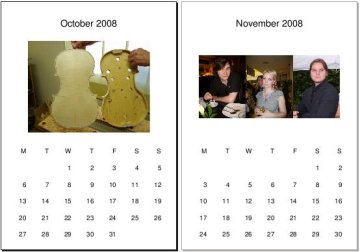
As an alternative to those Christmas “round robin” letters, my mum likes to create a calendar to send to relatives. This year, I rewrote the original crufty PHP script in Python:
usage:  pdfcalendar [options]
 Generates a simple PDF calendar for the specified year, one page per month,
 optionally using images in the specified directory.
 To use images, use the --dir argument to specify a directory (or leave empty
 to use the current directory) with the structure:
      -- 01
          -- s6000001.jpg
      -- 02
          -- s6000002.jpg
         \-- s6000003.jpg
      -- 03
         \-- s6000004.jpg
     etc.
 Images will be included on the appropriate month's page. If multiple images
 for a month exist, they are tiled horizontally.
options:
  -h, --help            show this help message and exit
  -d DIR, --dir=DIR     Directory to source images (Default: '.')
  -y YEAR, --year=YEAR  Year of calendar (Default: next year)
  -o FILE, --output=FILE
                        Output file (Default: calendar.pdf)
  -q, --quiet           Don't print status messages to STDERR
GPL3+ source available in Git. Would love a patch that tiles images in a square if anyone has a spare moment.

14 December 2007

Martin F. Krafft: Surveys on the console

As part of my research, I may have to conduct a survey among Debian contributors. The word "survey" usually elicits frowns because surveys are often misconducted. MJ has taken the time to draft up some advice to surveyors. Problems with surveys generally fall into one of two categories: content and presentation. I'll refrain from making statements about content (Wikipedia has some stuff on questionaire construction) and instead concentrate on presentation in the following. Commonly in the digital age, surveys are administered via a web page or e-mail. In my recent Ph.D. transfer report, I identified a number of shortcomings with these approaches: Asking Debian contributors to click radio buttons on a web page is a bit like expecting a mountain biking champion to ride a tricycle across a paddock: painful, if not offensive. Furthermore, web surveys can only be taken while on-line, when most of us have better things to do. E-mail surveys address some of these problems, but create new ones: answers cannot be constrained to a domain (think multiple-choice), character set and formatting issues make evaluation difficult, and it's impossible to prevent users from attaching comments or modifying responses. In thinking about the issue, I came up with a third means to administer a survey: a console tool. Think of a Debian package which provides a console application controlled by a study-specific data file. The data file specifies the questions and their answer domains, and the tool presents those to the participant. Since most of Debian happens on the console anyway, such an approach to surveys seems more appropriate. Interaction with the survey tool would be as easy as pressing the 2 or 4 keys to select one of the multiple choices, and the tool would immediately move on to the next question (and not wait for the user to hit enter). Obviously, n and p should allow navigation back and forth across the set, and c would spawn a text editor to give the user a chance to attach a comment to his/her current response, in which s/he might criticise the question or provide additional information. Finally, the tool should be able to pick up where it left off, should the user chose to exit/suspend the survey for now. Integration with debconf or another interface abstraction is also worth consideration. There is more to it: people change their minds and should thus be able to amend responses. With their consent, it might be valuable to track such changes and inquire about their motivations. As I was thinking about how to realise this, I suddenly arrived at version control: use Git as a backend storage. The set of cool features this would enable seems to be endless: it works off-line and can be used to track aforementioned changes, but also offers the possibility to create a squashed result in case the participant prefers to submit only the final result. Furthermore, it's a trivial change between anonymous submissions, and submissions authenticated by a GPG signature. In addition, the survey tool should be able to display questions according to previous responses (control flow). For instance, if the survey determines that a given user is a contributor to the bug tracking system, but not a project member, it wouldn't make sense to ask when s/he received his/her Debian account. Furthermore, questions could be dynamically creatable from context, so that the survey can drill into depth depending on previous responses, rather than asking the same questions to all participants. I am currently applying for funding to outsource the development of such a tool. If you are interested in coding it up and getting paid for it, speak to me. Here are some more specifications to keep in mind before jumping on: These are likely to be incomplete, but should convey the basic picture. Feedback is always welcome! NP: Oceansize: Frames Update: James Andrewartha pointed me to purity, which asks multiple-choice questions on the console. It has the kind of interface which I envision. Also, Chris Lamb suggested this personality survey as a base line. Well, actually he just suggested I look into it.

Next.

Previous.