Search Results: "gt"

27 July 2017

Michal Čihař: Weblate 2.16: Call for translations

Weblate 2.16 is almost ready (I expect no further code changes), so it's really great time to contribute to it's translations! Weblate 2.16 will be probably released during my presence at DebConf 17. As you might expect, Weblate is translated using Weblate, so the contributions should be really easy. In case there is something unclear, you can look into Weblate documentation. I'd especially like to see improvements in the Italian translation which was one of the first in Weblate beginnings, but hasn't received much love in past years.

Filed under: Debian English SUSE Weblate

26 July 2017

Norbert Preining: Software Development as mathematician in academia everyone bites the dust

Is it possible to do software development, mathematical or not, as mathematician in academics? This is a question I was asking myself recently a lot, seeing my own development from logician at a state university getting rid of foreigners to software developer. And then, a friend pointed me to this very depressing document: The origins of SageMath by William Stein, the main developer of SageMath. And I realized that it seems to be a global phenomenon that mathematicians who are interested in software development have to leave academics. What a sad affair. SageMath has a clear mission:
Creating a viable free open source alternative to Magma, Maple, Mathematica and Matlab.
All the Ma -software packages are commercial, and expensive. On the other hand they often have very good algorithms implemented. The Sage developers invested lots of time, energy, and brain power to develop excellent algorithm in an open source project for the mathematical researcher, but this investment wasn t honored in academic life. To quote from the presentation:
Issues with software dev in academia
  • Hard money for software development is virtually nonexistent: I can t think of anyone I know who got tenured based on his or her software.
  • Researchers on soft money are systematically discriminated against in favor of tenure-track and tenured faculty.
  • Researchers are increasingly evaluated solely on bibliometric counts rather than an informed assessment of their overall portfolio of papers, code, software, industry engagement, or student supervision.
The origins of SageMath, p.31
I can fully agree to this. Both from my own experience as well as from those around me. The presentation slides are full of other examples, from the developers of NumPy, Jupyter, as well as statements by Stephen Wolfram from Mathematica about this issue. A textbook how to not setup academia. My assumption was that this hits only on non-tenured staff, the academic precariat. It is shocking to see that even William Stein with a tenure position is leaving academics. It seems the times are not ready
Every great open source math library is built on the ashes of someone s academic career.
The origins of SageMath, p.32

Thomas Lange: Building a Debian Live CD with FAI

In this wiki entry, I describe how to extend a FAI nfsroot, so it can be used as a file system for a diskless client or a Live CD. A host can mount it via NFS when booting via PXE. You can create a Live CD easily by using the command fai-cd. This works also nicely with a Xfce desktop, and I've prepared a ISO image for easy testing. You can log in as user demo, and the password is fai. The next thing is to check, if we can use FAI's dirinstall or install method for creating the same environment, so it will be easy to create customized Live images. FAI

25 July 2017

Norbert Preining: Debian/TeX Live 2017.20170724-1

Yesterday I uploaded the first update of the TeX Live packages in Debian after TeX Live 2017 has entered Debian/unstable. The packages should by now have reached most mirrors. Nothing spectacular here besides a lot of updates and new packages. If I have to pick one update it would be the one of algorithm2e, a package that has seen lots of use and some bugs due to two years of inactivity. Good to see a new release. Enjoy. New packages algolrevived, invoice2, jfmutil, maker, marginfit, pst-geometrictools, pst-rputover, pxufont, shobhika, tikzcodeblocks, zebra-goodies. Updated packages acmart, adobemapping, algorithm2e, arabluatex, archaeologie, babel, babel-french, bangorexam, beamer, beebe, biblatex-gb7714-2015, bibleref, br-lex, bxjscls, combofont, computational-complexity, dozenal, draftfigure, elzcards, embrac, esami, factura, fancyhdr, fei, fithesis, fmtcount, fontspec, fonttable, forest, fvextra, genealogytree, gotoh, GS1, l3build, l3experimental, l3kernel, l3packages, latexindent, limap, luapackageloader, lwarp, mcf2graph, microtype, minted, mptopdf, pdfpages, polynom, powerdot, probsoln, pxbase, pxchfon, pythontex, reledmac, siunitx, struktex, tcolorbox, tetex, texdirflatten, uowthesistitlepage, uptex-fonts, xcharter.

Petter Reinholdtsen: Norwegian Bokm l edition of Debian Administrator's Handbook is now available

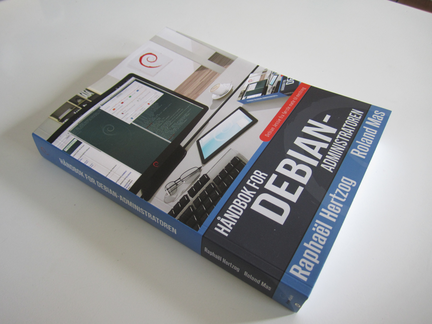
I finally received a copy of the Norwegian Bokm l edition of "The Debian Administrator's Handbook". This test copy arrived in the mail a few days ago, and I am very happy to hold the result in my hand. We spent around one and a half year translating it. This paperbook edition is available from lulu.com. If you buy it quickly, you save 25% on the list price. The book is also available for download in electronic form as PDF, EPUB and Mobipocket, as can be read online as a web page. This is the second book I publish (the first was the book "Free Culture" by Lawrence Lessig in English, French and Norwegian Bokm l), and I am very excited to finally wrap up this project. I hope "H ndbok for Debian-administratoren" will be well received.

Reproducible builds folks: Reproducible Builds: week 117 in Buster cycle

Here's what happened in the Reproducible Builds effort between Sunday July 16 and Saturday July 22 2017: Toolchain development Bernhard M. Wiedemann wrote a tool to automatically run through different sources of non-determinism, and report which of these caused irreproducibility. Dan Kegel's patches to fpm were merged. Bugs filed Patches submitted upstream: Patches filed in Debian: Reviews of unreproducible packages 73 package reviews have been added, 44 have been updated and 50 have been removed in this week, adding to our knowledge about identified issues. No issue types were updated. Weekly QA work During our reproducibility testing, FTBFS bugs have been detected and reported by: diffoscope development reprotest development Ximin also restarted the discussion with autopkgtest-devel about code reuse for reprotest. Santiago Torres began a series of patches to make reprotest more distro-agnostic, with the aim of making it usable on Arch Linux. Ximin reviewed these patches. Misc. This week's edition was written by Ximin Luo, Bernhard M. Wiedemann and Chris Lamb & reviewed by a bunch of Reproducible Builds folks on IRC & the mailing lists.

Russell Coker: Forking Mon and DKIM with Mailing Lists

I have forked the Mon network/server monitoring system. Here is a link to the new project page [1]. There hasn t been an upstream release since 2010 and I think we need more frequent releases than that. I plan to merge as many useful monitoring scripts as possible and support them well. All Perl scripts will use strict and use other best practices. The first release of etbe-mon is essentially the same as the last release of the mon package in Debian. This is because I started work on the Debian package (almost all the systems I want to monitor run Debian) and as I had been accepted as a co-maintainer of the Debian package I put all my patches into Debian. It s probably not a common practice for someone to fork upstream of a package soon after becoming a comaintainer of the Debian package. But I believe that this is in the best interests of the users. I presume that there are other collections of patches out there and I hope to merge them so that everyone can get the benefits of features and bug fixes that have been separate due to a lack of upstream releases. Last time I checked mon wasn t in Fedora. I believe that mon has some unique features for simple monitoring that would be of benefit to Fedora users and would like to work with anyone who wants to maintain the package for Fedora. I am also interested in working with any other distributions of Linux and with non-Linux systems. While setting up the mailing list for etbemon I wrote an article about DKIM and mailing lists (primarily Mailman) [2]. This explains how to setup Mailman for correct operation with DKIM and also why that seems to be the only viable option.

Satyam Zode: Maya - the OpenEBS Go Kit Project

The Kit project in Go is the common project containing all the standard libraries or packages used across all the Go projects in the organization. Motivation I attended GopherCon India 2017, there was a talk on Package Oriented Design In Go by William Kennedy. In that talk, William explained some really important and thoughtful design principles which We can apply in our day to day life, while writing Go. Hence, I wanted to apply these design philosophies to the Go projects in which I have been working on as a part of OpenEBS project. I learnt a good practice of having a Go Kit project at the organization level from William s talk. What is the Kit Project? The Kit project in Go is the common project containing all the standard libraries or packages used across all the Go projects in the organization. Packages in the Kit project should follow design philosophies. Need for a Kit project Sometimes, We write same Go packages again and again to do the same task at different levels in the different Go projects under the same organization. For example, we write custom logger package in the different Go projects. If the custom logger package is same across the organization and can be reused by simply importing it, then this custom logger package is the perfect fit for Kit project. You can sense how much time and cost it will save for us when we have a Kit project. How to convert existing projects to have kit Maya is the kit project in the progress. I will walk through our journey of creating a Kit project called maya for OpenEBS organization from existing Go projects. At OpenEBS, as a open source and growing Go project, We value Go principles and We try hard to leverage Go s offerings. Maya is the Kit project for the Application projects like maya-apiserver, maya-storage-bot etc. Maya contains all the kubernetes & nomad API s, common utilities etc. needed for development of maya-apiserver and maya-storage-bot. In the near future, we are trying to push our custom libraries to maya. So that, it will become a promising Go kit project for OpenEBS community. We have specifically followed the package oriented design principles in Go to create maya as a kit project. Project structure for the Maya as Kit project Example usage of maya kit project in maya-apiserver Maya-apiserver uses maya as a Kit project. Maya-apiserver exposes OpenEBS operations in form of REST APIs. This allows multiple clients e.g. volume related plugins to consume OpenEBS storage operations exposed by Maya API server. Conclusion Go Kit project should contain packages which are usable, purposeful and portable. Go Kit projects will improve the efficiency of the organization at both human and code level.

Gunnar Wolf: Getting ready for DebConf17 in Montreal!


(image shamelessly copied from Noodles' Emptiness) This year I will only make it to DebConf, not to DebCamp. But, still, I am very very happy and excited as the travel date looms nearer! I have ordered some of the delicacies for the Cheese and Wine party, signed up for the public bicycle system of Montreal, and done a fair share of work with the Content Team; finally today we sent out the announcement for the schedule of talks. Of course, there are several issues yet to fix, and a lot of things to do before traveling... But, no doubt about this: It will be an intense week! Oh, one more thing while we are at it: The schedule as it was published today does not really look like we have organized stuff into tracks But we have! This will be soon fixed, adding some color-coding to make tracks clearer on the schedule. This year, I pushed for the Content Team to recover the notion of tracks as an organizative measure, and as something that delivers value to DebConf as a whole. Several months ago, I created a Wiki page for the DebConf tracks, asking interested people to sign up for them. We currently have the following tracks registered:
Blends
Andreas Tille
Debian Science
Michael Banck
Cloud and containers
Luca Filipozzi
Embedded
Pending
Systems administration, automation and orchestation
Pending
Security
Gunnar Wolf
We have two tracks still needing a track coordinator. Do note that most of the tasks mentioned by the Wiki have already been carried out; what a track coordinator will now do is to serve as some sort of moderator, maybe a recurring talkmeister, ensuring continuity and probably providing for some commentary, giving some unity to its sessions. So, the responsibilities for a track coordinator right now are quite similar to what is expected for video team volunteers but to a set of contiguous sessions. If you are interested in being the track coordinator/moderator for Embedded or for Systems administration, automation and orchestation or even to share the job with any of the other, registered, coordinators, please speak up! Mail content@debconf.org and update the table in the Wiki page. See you very soon in Montreal!

24 July 2017

Bits from Debian: DebConf17 Schedule Published!

The DebConf17 orga team is proud to announce that over 120 activities have been scheduled so far, including 45- and 20-minute talks, team meetings, and workshops, as well as a variety of other events. Most of the talks and BoFs will be streamed and recorded, thanks to our amazing video team! We'd like to remind you that Saturday August 5th is also our much anticipated Open Day! This means a program for a wider audience, including special activities for newcomers, such as an AMA session about Debian, a beginners workshop on packaging, a thoughtful talk about freedom with regard to today's popular gadgets and more. In addition to the published schedule, we'll provide rooms for ad-hoc sessions where attendees will be able to schedule activities at any time during the whole conference. The current schedule is available at https://debconf17.debconf.org/schedule/ This is also available through an XML feed. You can use ConfClerk in Debian to consume this, or Giggity on Android devices: https://debconf17.debconf.org/schedule/mobile/ We look forward to seeing you in Montreal! DebConf17 logo

Norbert Preining: Garmin fenix 5x broken by design

Some month ago I upgrade my (European) fenix3 to a (Japanese) fenix 5x, looking forward to the built-in maps as well as support for Japanese. I was about to write a great review, how content I have been with the fenix 3 and how much better the 5x is. Well, until I realized that Garmin s engineers seem to be brain-damaged and shipping broken by design devices: Just one word: Set an alarm on the watch, and wonder .. because you will never wake up the next day, since the alarm was deleted due to an unattended (so-called) sync operation. Happened to me, several times, worst was when I was with clients working as guide. So the problem is well known, see this link and this link and this link, and it is not restricted to the fenix. The origin of the problem is that Garmin is incapable of implementing a synchronization protocol. They have three sources of data: The Connect website, the Connect application on the smartphone, and the watch itself. And interestingly they only do pushes from Web to application to device, overwriting settings on the lower end. Which means, any alarm that I create on the watch will be overwritten, ie deleted, on every sync sorry, not sync, on every forced push from the mobile. It is a bit depressing, but I think the urgent solution is to exempt alarms from the synchronization completely, and remove them from both the connect web page and the application, until a better, a real, synchronization is implemented. I found a work-around in one of the threads on the Garmin forum, that is: create an alarm on the web or application, better alarms for each of the times you might need it. These will be synced to the device, and can be activated/deactivated on the device without problems. But to be honest this is not a solution I can really trust in when I need to get up in the morning. Besides this issue, which is unfortunately rather severe a restriction for me as mountaineer and mountain guide, I really love the watch and will write a more detailed review soon.

Jonathan McDowell: Learning to love Ansible

This post attempts to chart my journey towards getting usefully started with Ansible to manage my system configurations. It s a high level discussion of how I went about doing so and what I got out of it, rather than including any actual config snippets - there are plenty of great resources out there that handle the actual practicalities of getting started much better than I could. I ve been convinced about the merits of configuration management for machines for a while now; I remember conversations about producing an appropriate set of recipes to reproduce our haphazard development environment reliably over 4 years ago. That never really got dealt with before I left, and as managing systems hasn t been part of my day job since then I never got around to doing more than working my way through the Puppet Learning VM. I do, however, continue to run a number of different Linux machines - a few VMs, a hosted dedicated server and a few physical machines at home and my parents . In particular I have a VM which handles my parents email, and I thought that was a good candidate for trying to properly manage. It s backed up, but it would be nice to be able to redeploy that setup easily if I wanted to move provider, or do hosting for other domains in their own VMs. I picked Ansible, largely because I wanted something lightweight and the agentless design appealed to me. All I really need to do is ensure Python is on the host I want to manage and everything else I can bootstrap using Ansible itself. Plus it meant I could use the version from Debian testing on my laptop and not require backports on the stable machines I wanted to manage. My first attempt was to write a single Ansible YAML file which did all the appropriate things for the email VM; installed Exim/Apache/Roundcube, created users, made sure the appropriate SSH keys were in place, installed configuration files, etc, etc. This did the job, but I found myself thinking it was no better than writing a shell script to do the same things. Things got a lot better when instead of concentrating on a single host I looked at what commonality was shared between hosts. I started with simple things; Debian is my default distro so I created an Ansible role debian-system which configured up APT and ensured package updates were installed. Then I added a task to setup my own account and install my SSH keys. I was then able to deploy those 2 basic steps across a dozen different machine instances. At one point I got an ARM64 VM from Scaleway to play with, and it was great to be able to just add it to my Ansible hosts file and run the playbook against it to get my basic system setup. Adding email configuration got trickier. In addition to my parents email VM I have my own email hosted elsewhere (along with a whole bunch of other users) and the needs of both systems are different. Sitting down and trying to manage both configurations sensibly forced me to do some rationalisation of the systems, pulling out the commonality and then templating the differences. Additionally I ended up using the lineinfile module to edit the Debian supplied configurations, rather than rolling out my own config files. This helped ensure more common components between systems. There were also a bunch of differences that had grown out of the fact each system was maintained by hand - I had about 4 copies of each Let s Encrypt certificate rather than just putting one copy in /etc/ssl and pointing everything at that. They weren t even in the same places on different systems. I unified these sorts of things as I came across them. Throughout the process of this rationalisation I was able to easily test using containers. I wrote an Ansible role to create systemd-nspawn based containers, doing all of the LVM + debootstrap work required to produce a system which could then be managed by Ansible. I then pointed the same configuration as I was using for the email VM at this container, and could verify at each step along the way that the results were what I expected. It was still a little nerve-racking when I switched over the live email config to be managed by Ansible, but it went without a hitch as hoped. I still have a lot more configuration to switch to being managed by Ansible, especially on the machines which handle a greater number of services, but it s already proved extremely useful. To prepare for a jessie to stretch upgrade I fired up a stretch container and pointed the Ansible config at it. Most things just worked and the minor issues I was able to fix up in that instance leaving me confident that the live system could be upgraded smoothly. Or when I want to roll out a new SSH key I can just add it to the Ansible setup, and then kick off an update. No need to worry about whether I ve updated it everywhere, or correctly removed the old one. So I m a convert; things were a bit more difficult by starting with existing machines that I didn t want too much disruption on, but going forward I ll be using Ansible to roll out any new machines or services I need, and expect that I ll find that new deployment to be much easier now I have a firm grasp on the tools available.

Jonathan Carter: Plans for DebCamp17

In a few days, I ll be attending DebCamp17 in Montr al, Canada. Here are a few things I plan to pay attention to:

Joerg Jaspert: Automated wifi login, update

With recent changes the automated login script for WifiOnICE stopped working. Fortunately a fix is easy, it is enough to add a referrer header to the call and have de/ added to the url. Updated script:
#!/bin/bash
# (Some) docs at
# https://wiki.ubuntuusers.de/NetworkManager/Dispatcher/
IFACE=$ 1:-"none" 
ACTION=$ 2:-"up" 
case $ ACTION  in
    up)
        CONID=$ CONNECTION_ID:-$(iwgetid "$ IFACE " -r) 
        if [[ $ CONID  == WIFIonICE ]]; then
            /usr/bin/timeout -k 20 15 /usr/bin/wget -q -O - --referer http://www.wifionice.de/de/ http://www.wifionice.de/de/?login > /dev/null
        fi
        ;;
    *)
        # We are not interested in this
        :
        ;;
esac

23 July 2017

Gregor Herrmann: RC bugs 2017/08-29

long time no blog post. & the stretch release happened without many RC bug fixes from me; in practice, the auto-removals are faster & more convenient. what I nevertheless did in the last months was to fix RC bugs in pkg-perl packages (it still surprises me how fast rotting & constantly moving code is); prepare RC bug fixes for jessie (also for pkg-perl packages); & in the last weeks provide patches & carry out NMUs for perl packages as part of the ongoing perl 5.26 transition.

Norbert Preining: Gaming: Refunct

A lovely little game, Refunct, just crossed my Steam installation. A simple platformer developed with much love. The game play consists of reviving a lost area by stepping on towers, finding buttons, and making more towers appear through this. The simple game play idea is enriched with wonderful lightening due to the movement of the sun. I really enjoyed the changing of environment and mood that was created by this effect.
Although not terrible useful by now, one can also swim and dive and enjoy the world from below, which is just an added nice bonus.
The game is currently (till Monday night as far as I see) on sale on Steam for 149 Yen, i.e., slightly above a Euro/Dollar. Well worth the investment for about 1h of game play. Addition: The fastest run at the moment is at 2:46.57, that is under 3min! I managed barely under 25min. Incredible.

Vincent Fourmond: Screen that hurts my eyes, take 2

Six month ago, I wrote a lengthy post about my new computer hurting my eyes. I haven't made any progress with that, but I've accidentally upgraded my work computer from Kernel 4.4 to 4.8 and the nvidia drivers from 340.96-4 to 375.66-2. Well, my work computer now hurts, I've switched back to the previous kernel and drivers, I hope it'll be back to normal.Any ideas of something specific that changed, either between 4.4 and 4.8 (kernel startup code, default framebuffer modes, etc ?), or between the 340.96 and the 375.66 drivers ? In any case, I'll try that specific combination of kernels/drivers home to see if I can get it to a useable state.Update, July 23rdI reverted to the earlier drivers/kernel, to no avail. But it seems in fact the problem with my work computer is linked to an allergy of some kind, since antihistamine drugs have an effect (there are construction works in my lab, perhaps they are the cause ?). No idea still for my home computer, for which the problem is definitely not solved.

22 July 2017

Sean Whitton: I'm going to DebCamp17, Montr al, Canada

Here s what I m planning to work on please get in touch if you want to get involved with any of these items. In rough order of priority/likelihood of completion:

Norbert Preining: Making fun of Trump thanks France

I mean, it is easy to make fun of Trump, he is just too stupid and incapable and uneducated. But what the French president Emmanuel Macron did on Bastille Day, in presence of the usual Trumpies, was just above the usual level of making fun of Trump. The French made Trump watch a French band playing a medley of Daft Punk. And as we know Trump seemed to be very unimpressed, most probably because he doesn t have a clue. I mean, normally you play these pathetic rubbish, look at the average US (or Chinese or North Korean) parades, and here we have the celebration of an event much older then anything the US can put on the table, and they are playing Daft Punk! France, thanks. You made my day actually not only one!

Niels Thykier: Improving bulk performance in debhelper

Since debhelper/10.3, there has been a number of performance related changes. The vast majority primarily improves bulk performance or only have visible effects at larger input sizes. Most visible cases are: For debhelper, this mostly involved: How to take advantage of these improvements in tools that use Dh_Lib: Credits: I would like to thank the following for reporting performance issues, regressions or/and providing patches. The list is in no particular order: Should I have missed your contribution, please do not hesitate to let me know.
Filed under: Debhelper, Debian

Next.

Previous.