Search Results: "ana"

22 April 2010

Dirk Eddelbuettel: Boston Marathon 2010

This Monday saw the 114th running of the Boston Marathon. Under near-ideal conditions with some sunny skies, some clouds and moderate temperatures in the high 40s to low 50s, a course record as well as US Mens record were set. Having run this race in 2007 and in 2009 (with 2008 in London), I knew the difficult course and was aiming to run it more evenly. So no breakdown on those famous hills! But without too much fire in my belly over the winter, training was somewhat minimal: one 20 miler, two 18 milers. Friends and co-runners were joking that I had turned my trusted 'run less, run faster' program by the FIRST lab into my own 'run less, run lesser' program. And then were a nagging achilles tendon and a little strain from the underwhelming recent half-marathon so that I was really trying to hold back and not go out too fast on the initial portion which is mostly downhill. Which seems to have worked. My pace was more even, and I conserved some energy and made it past the last of the hills around mile 21 without walking a single step while staying a few second under a 8 min/mile average pace. But then around mile 23 and 24 I had two sharp short cramps which forced me to walk. Interestingly enough, Bob Richards writes about cramps as a main theme for many runners in this year's race. Maybe the wind and temperature combined with the hills to get us after all! Anyway, I ended up with 3:29:14 which, at a 7:59 pace, is right between the 2007 and 2009 results and quite decent given the circumstances. And of course the weekend as whole was again a hoot even if I had only a short stay of around 30 hours in Boston given our R/Finance conference on Friday and Saturday. We'll see if I will manage to qualify once more for next year.

20 April 2010

Jan Hauke Rahm: VoIP of different quality

Dear lazyweb, I m using VoIP stuff of different kinds already and I actually enjoy it. Thing is, a friend of mine always complained about the quality of sound when speaking with me. He said I should switch the software but I never believed it would make a difference. Well, now I tried and it did. I used ekiga before and now switched to twinkle (which looks uuugly in Gnome at least). What can I say? It really is better. But why? I tried to get more output from twinkle but didn t quite manage. So what is so different? And don t you dare answer codecs or something! I actually don t need details. I just want ekiga to be as good as twinkle sound quality-wise. If you know a solution, tell me! :)

19 April 2010

MJ Ray: Samsung N150 Netbook and Ubuntu Netbook Remix

That was a pretty good weekend. I set up someone s new Samsung N150 netbook with Ubuntu Netbook Remix. If you like Windows, you might want to skip this long paragraph: the N150 came with Microsoft Windows 7 Starter. When I realised what that was, I thought it was some sort of joke. It s more like an advert for Windows than a proper operating system. They even removed the option to replace the branded backdrop image, which gives you an idea of the pettiness of that distribution. I read that Win7 Starter used to have a 3 simultaneous application limit but an update removed it because of the sheer volume of complaints and rumblings about court cases to get money back. Microsoft justify all the limits with the argument that it s optimised for low-power netbooks, but the N150 goes like stink compared to my own (7-year-old) work laptop and how much power is saved by loading the Windows logo backdrop instead of a nice picture anyway? What did that make me want to do? Well this:
Windows 7 Sins But I d read that Samsung view nuking Win7 Starter from orbit as voiding the warranty and I couldn t see anything to confirm or reject that in the paperwork, so I made it dual-boot with Ubuntu netbook remix. If it ever has to go back to the shop, I ll hide the boot menu. I had enough trouble installing it that I did contemplate get.debian.net with some of the Debian Eee PC things, but I wasn t sure what I needed and I didn t have that much time. There were two big gotchas when installing:
  1. When you switch between Ubuntu and Windows, it won t boot the first time. Second and subsequent boots are fine, but the first one just reboots immediately. I suspect this would be the same for all GNU/Linux distributions.
  2. I didn t realise that the current ndisgtk (or the underlying ndiswrapper?) couldn t use Win7 drivers. Once I downloaded some XP drivers, it worked. There are some native drivers for the rtl8192 but I didn t have time to go compiling on it yet.
After figuring those out, Ubuntu seems to work fine. Better than the Windows. I got particularly appreciative comments about the large clickable spaces on the launcher that netbook remix uses (which is what I d expect from Fitts s Law). Debian probably has a similar launcher, but I don t know what it s called yet. It looks like some Gnome window or file manager and I m a GNUstep throwback. Setting up the mobile phone for internet access was also a breeze. It s a later model than my old k608i, so it supports PANU, so after the Bluetooth pairing, it appeared in the networking menu on the top panel bar and it just worked. On Sunday, I cycled to Clevedon (7 miles away as the crow flies, but 12 by bike because of a missing river crossing). Pretty good weekend.

Russell Coker: Creating a Micro Conference

The TEDxVolcano The TED conference franchise has been extended to TEDxVolcano [1], this is a small conference that features people who are stranded by the Eyjafjallaj kull volcano in Iceland. As usual TED is an inspiration to us all, so there is obvious potential for other conferences to be organised in similar situations there s no reason why a free software conference can t be organised in Europe right now! What You Need to run a Conference If a conference will have limited attendance (EG due to a volcano preventing anyone from flying to the area) then filming everything is very important. I ve seen adverts for digital cameras that support Full HD resolution (1920*1080) for as little as $AU400. $AU600 will get you a digital camcorder that does Full HD which will offer some benefits for recording long movies (such as the ability to store the video on an external hard drive). If I was stuck in a foreign hotel with not much to do then I would be prepared to buy a digital camera or camcorder for the purpose of running such a conference (my current digital camera is 5.1MP and only has 3* optical zoom, it s a nice camera but I could do with something better. A tripod can cost up to $100, but I recently bought myself a 15cm tall tripod for $10 that would do at a pinch. Once you have high quality video you can easily upload it to something like Blip.TV. Of course you get a better result if you do some post-production work to merge images of the slides for the lecture into the video, but that is a lot of work and probably requires a camera that outputs uncompressed video for best results. The next issue is getting a venue. Different hotels cater for different parts of the market, some cater to tourists, some to business travel, some to conferences. If you want a venue at short notice you may be able to get a good deal if you find a hotel that is adversely affected, for example I m sure that there are some quite empty conference hotels in Europe right now but the tourist hotels are probably reasonably busy (why not do some tourism if you are stuck). I expect that hotels really don t want to have empty conference rooms and are prepared to offer good deals for bookings at short notice. Of course you would want to try to ensure that hotel rooms aren t too expensive in that hotel as some delegates will want to stay in the hotel which hosts the conference. The minimal staffing for a micro conference is probably two people, one for taking payment, directing people, etc, and the other to film the lectures and moderate panel discussions. Rumor has it that attending without paying is a problem at conferences, for conferences that are planned in advance corporations will try and send multiple employees on the one ticket and have them share a name-tag one issue with this is that there is a fixed quantity of food supplied and if extra people appear then everyone who paid gets less, another is that people who pay really hate to see freeloaders. The best reference I ve found for people not paying at conferences is Jon Oxer s description of how Leslie Cachia of Letac Drafting Services brazenly stole a book from him [2]. Name-tags are needed for any meeting with more than about 15 people. I m not sure how to get proper name-tags (ones that pin on to clothing and have printed names maybe the bigger hotels can add this to the conference package). But a roll of sticky labels from an office supply store is pretty cheap. Costs in Wellington Along with a few other people I considered running a small security conference immediately before or after LCA 2010, that ended up not happening but I will consider doing it in future. When considering that the general plan was to get a hotel to provide a meeting room for 10-30 people (we had no real idea of the demand). When investigating the possibilities for running a conference in Wellington I discovered that the hotel fees for a conference room can either be based on paying a fixed fee for the room plus additional expenses for each item or you can pay a fixed rate per person. It seemed that there was the potential to save a small amount of money by paying the fixed fees and avoiding some payments for things like tea/coffee service. But the amount that could be saved would be small and it would incur extra effort in managing it saving $5 per person is a good thing if you have 600 delegates, but if you have 30 then it s probably a waste of time. So it seemed best to go for one of the packages, you tell the hotel what time you want the lunch and snack breaks and how you want the tables arranged and they just do everything. The cost for this seemed to be in the range of $nz35 to $nz55 per delegate per day. There is some flexibility in room arrangement, so a room that seats 12 people in the board-room layout (tables in a rectangle facing the center) would fit 25 in the classroom layout (tables all facing the front) or 50 in the theater layout (chairs facing the front with no tables). So the hotel could accommodate changes in the size at relatively short notice (whatever their notice period for buying the food). The cost for a catered conference dinner seemed to be about $nz45 per diner. In many cases it would be possible to get a meal that is either cheaper, better, or both by going somewhere else, but that wastes time and effort. So that gave an overall conference cost of about $nz135 for a two day conference with a dinner at the end of the first day. Given that the cheapest budget rate from Wotif.com for a 3 star hotel in Wellington is currently $nz85 per night it seems that $nz135 for a two day conference including dinner is pretty cheap as the minimum accommodation cost would be $nz170. Also note that the hotels which I considered for hosting the conference had rates for their hotel rooms that were significantly greater than $nz85 per night. The hotels all offer other services such as catered cocktail parties , these would be good things for any company that wants to sponsor the conference. Different cities can have vastly different prices for hotels. But I expect that the way conference rooms are booked and managed is similar world-wide and the ratio of conference costs to hotel booking fees to also be similar. Most of the hotels that cater to conferences seem to be owned by multi-national corporations. It would probably make sense to charge delegates an extra $10 or $15 above the cost of running the conference to cover unexpected expenses. Of course it s difficult to balance wanting to charge a low rate to attract more people with wanting to avoid the risk of a financial loss. Conclusion The hard part is getting speakers. If you can get speakers and panel participants who can fill the time slots and have interesting things to say then all the other parts of organising a micro conference should be relatively easy. When the cost is less than $150 per delegate then a syndicate of a few people can easily agree to split the loss if the number of delegates turns out to be smaller than expected, a potential loss of $2000 shared among a few people shouldn t be a huge problem. Also if the conference is booked at short notice (EG because of a volcano) then the hotel shouldn t require any deposit for anything other than the food which is specially ordered (IE not the tea, coffee, etc) that limits the potential loss to something well under $100 per delegate who doesn t attend. Anyone who has enough dedication to a topic to consider running a conference should be prepared to risk a small financial loss. But based on my past observations of the generosity of conference delegates I m sure that if at the conference closing the organiser said unfortunately this conference cost more than the money you paid me, could you please put something in this hat on the way out then the response would be quite positive. Note that I am strictly considering non-profit conferences. If you want to make money by running a conference then most things are different.

18 April 2010

Eugene V. Lyubimkin: dealing with unwanted recommends using cupt

Some people use '--without-recommends' switch and the problem is gone. I think that's overkill.

This post will tell how (would I recommend) to deal with unwanted recommends. The following text tells about cupt package manager, and though ideas are applicable to any package managers, the techniques may differ.


Stage 1. Facing problems

Suppose we want to install the package kde-minimal:

-8<-
$ sudo cupt install kde-minimal
[sudo] password for jackyf:
Building the package cache... [done]
Initializing package resolver and worker... [done]
Scheduling requested actions... [done]
Resolving possible unmet dependencies...
The following 16 packages will be INSTALLED:

dolphin kappfinder kde-minimal kdebase-apps kdebase-bin kdebase-data kdepasswd
kfind kinfocenter konqueror konqueror-nsplugins kwrite libkonq5
libkonq5-templates libkonqsidebarplugin4 plasma-widget-folderview

The following 1 packages will be UPGRADED:

konsole

Need to get 6024KiB/6024KiB of archives. After unpacking 14.9MiB will be used.
Do you want to continue? [y/N/q]
->8-

Umm, kinfocenter? No, we don't want it to be installed.

Stage 2. Searching for a reason

Now we will use the 'reason tracking' feature of libcupt's resolver. Let's add '-s' switch (simulating) and '-D' switch (tracking reasons):

-8<-
$ cupt -s install kde-minimal -D
Building the package cache... [done]
Initializing package resolver and worker... [done]
Scheduling requested actions... [done]
Resolving possible unmet dependencies...
The following 16 packages will be INSTALLED:

dolphin
reason: kdebase-apps 4:4.3.4-1 depends on 'dolphin (>= 4:4.3.4-1)'

kappfinder
reason: kdebase-apps 4:4.3.4-1 depends on 'kappfinder (>= 4:4.3.4-1)'

kde-minimal
reason: user request

kdebase-apps
reason: kde-minimal 5:55 depends on 'kdebase-apps (>= 4:4.3.1)'

kdebase-bin
reason: kdebase-apps 4:4.3.4-1 depends on 'kdebase-bin (>= 4:4.3.4-1)'

kdebase-data
reason: kappfinder 4:4.3.4-1 depends on 'kdebase-data (= 4:4.3.4-1)'

kdepasswd
reason: kdebase-apps 4:4.3.4-1 depends on 'kdepasswd (>= 4:4.3.4-1)'

kfind
reason: kdebase-apps 4:4.3.4-1 depends on 'kfind (>= 4:4.3.4-1)'

kinfocenter
reason: kdebase-apps 4:4.3.4-1 recommends 'kinfocenter (>= 4:4.3.4-1)'

konqueror
reason: kdebase-apps 4:4.3.4-1 depends on 'konqueror (>= 4:4.3.4-1)'

konqueror-nsplugins
reason: kdebase-apps 4:4.3.4-1 recommends 'konqueror-nsplugins (>= 4:4.3.4-1)'

kwrite
reason: kdebase-apps 4:4.3.4-1 depends on 'kwrite (>= 4:4.3.4-1)'

libkonq5
reason: kdebase-apps 4:4.3.4-1 depends on 'libkonq5 (>= 4:4.3.4-1)'

libkonq5-templates
reason: libkonq5 4:4.3.4-1 depends on 'libkonq5-templates kdesktop'

libkonqsidebarplugin4
reason: konqueror 4:4.3.4-1 depends on 'libkonqsidebarplugin4 (>= 4:4.3.4)'

plasma-widget-folderview
reason: kdebase-apps 4:4.3.4-1 depends on 'plasma-widget-folderview (>= 4:4.3.4-1)'


The following 1 packages will be UPGRADED:

konsole
reason: synchronized with package 'kdebase-apps'


Need to get 6024KiB/6024KiB of archives. After unpacking 14.9MiB will be used.
Do you want to continue? [y/N/q]
->8-

Now, the output is much bigger. Every package has reason(s) to change its state appended. Let's look at the chain: kinfocenter is installed, because... kdebase-apps is to install. Ok, look further, kdebase-apps is to install because... of kde-minimal. The final chain is 'kde-minimal -> kdebase-apps -> kinfocenter'.

Stage 2.5. Analyzing reason

After determining a full chain one may try to think - is this dependency chain looks OK? Maybe, some Depends/Recommends should be turned up to a less strict dependencies? If that so, it's a good idea to fire a command 'reportbug <package>' to report an unwanted dependency.

In this example, the dependency chain looks OK (at least, to me :)).

Stage 3. Installing a package without unwanted dependency(ies)

The resolution of the problem depends on the answer to the question "Why I don't want this package to be installed?"

Case 1. Only this time/package

If the answer is, say, "Because dependency 'kdebase-apps -> kinfocenter' doesn't make sense on this system", then you do:

-8<-
$ sudo cupt install kde-minimal kinfocenter-
[sudo] password for jackyf:
Building the package cache... [done]
Initializing package resolver and worker... [done]
Scheduling requested actions... [done]
Resolving possible unmet dependencies...
The following 15 packages will be INSTALLED:

dolphin kappfinder kde-minimal kdebase-apps kdebase-bin kdebase-data kdepasswd kfind konqueror konqueror-nsplugins kwrite libkonq5 libkonq5-templates libkonqsidebarplugin4 plasma-widget-folderview

The following 1 packages will be UPGRADED:

konsole

Need to get 5463KiB/5463KiB of archives. After unpacking 13.2MiB will be used.
Do you want to continue? [y/N/q]
->8-

And that's all, kinfocenter won't be installed.

Consequences:

1. This answer implies that you are not against installing kinfocenter if some other package needs it. So, while installing other packages which recommend kinfocenter cupt will suggest you to install kinfocenter again.

2. If you will want to upgrade the package, and the new version contains the same relation, cupt will not suggest to install kinfocenter.

Case 2. Forever

If the answer is "Because I don't want to see kinfocenter in my system ever", then the good choice is APT pinning system.

Place the next three lines into your APT preferences file (usually, /etc/apt/preferences or any file in /etc/apt/preferences.d directory):

-8<-
Package: kinfocenter
Pin: version *
Pin-Priority: -10000
->8-

-10000 is a very low priority, usual priorities are (0 - 1000), so cupt will not ever suggest you to install kinfocenter because of soft (Recommends or Suggests) dependencies. Moreover, if in some actions cupt will need to choose between, say 'kde-virtual kde-virtual-alternate', where kde-virtual depends on kinfocenter and kde-virtual-alternate does not, then cupt will choose kde-virtual-alternate. The exceptions possible in (very unlikely to happen) cases, when non-installing kinfocenter will result in very bad solution for selected actions. The less priority kinfocenter has, the less chances it has to be installed when not requested explicitly (as in 'cupt install kinfocenter').

17 April 2010

Enrico Zini: Tweaking locale settings

Tweaking locale settings I sometimes meet some Italian programmer who prefers his system to be in English, so they get untranslated manpages and error messages. I sometimes notice that their solution often leaves them something to complain about. Some set LANG=C and complain they can't see accented characters. Some set LANG=en_US.UTF-8 and complain that OpenOffice Calc wants dates in the format MM/DD/YYYY which is an Abomination unto Nuggan, as well as unto Me. But the locales system can do much better than that. In fact, most times people would be extremely happy with LC_MESSAGES in English, and everything else in Italian:
$ locale
LANG=it_IT.UTF-8
LC_CTYPE="it_IT.UTF-8"
LC_NUMERIC="it_IT.UTF-8"
LC_TIME="it_IT.UTF-8"
LC_COLLATE="it_IT.UTF-8"
LC_MONETARY="it_IT.UTF-8"
LC_MESSAGES=en_US.UTF-8
LC_PAPER="it_IT.UTF-8"
LC_NAME="it_IT.UTF-8"
LC_ADDRESS="it_IT.UTF-8"
LC_TELEPHONE="it_IT.UTF-8"
LC_MEASUREMENT="it_IT.UTF-8"
LC_IDENTIFICATION="it_IT.UTF-8"
LC_ALL=
A way to do this (is there a better one?) is to tell the display manager (GDM, KDM...) to use the Italian locale, and then override the right LC_* bits in ~/.xsessionrc:
$ cat ~/.xsessionrc
export LC_MESSAGES=en_US.UTF-8
That does the trick: English messages, with Proper currency, Proper dates, accented letters sort Properly, Proper A4 printer paper, Proper SI units. Even Nuggan would be happy.

15 April 2010

Josselin Mouette: A new toy

It takes a lot to prepare for a big trip if you want to really enjoy it. This time, we re going to Japan, and we bought some stuff to stay connected there. First, there s the new camera: that s a Sony 230. We haven t made a photo trip to see all its capabilities yet, but it looks like an excellent toy so far. You ll see probably more photos on this blog in the future. And there s the new laptop: a Packard-Bell Dot-M/A. Theoretically it s called a netbook, but in practice it has everything a real laptop has. The reason I chose this model is that it features Radeon (X1270) graphics and a 64-bit processor, all in a 11,6" laptop which is one of the cheapest of all. Lots of power in one kilogram for a low price, although the drawback is more cells in the battery. Getting the Dot-M/A to work under Debian I first tried to install lenny on it, and while it worked nicely there are several problems with hardware support.

  1. The CPU runs extremely slow; you would think it is an Atom. It takes no less than one minute to boot a minimal installation. This is a very strange issue.
  2. Wi-Fi doesn t work, even after installing the firmware.
  3. 2D works out of the box, but 3D doesn t: the kernel doesn t recognize the PCI ID.
  4. Frequency scaling doesn t work, it always runs at full speed which eats battery at an impressive pace.
Upgrading to squeeze solved the first three issues in a blink. The CPU is now as fast as you can expect from an Athlon 64 @1,2 GHz, there s wifi and 3D. OTOH I was hit by a GStreamer bug when the useless snd_pcsp module was loaded why isn t this thing blacklisted by default? ACPI nightmare CPU frequency scaling is another story. I discovered that the BIOS for such Athlon L110 computers does not expose P-states in the ACPI DSDT table. Which means Linux cannot tell at which frequencies it is supposed to work. However, thanks to the awesome work from a guy named Krists Krilovs and the awesome tutorial from the Gentoo wiki I was able to: After a reboot, I immediately noticed the fan slowing down. Under GNOME, the CPU was no less than 10 C cooler and the CPU frequency applet started to work. <hrule> The Debian kernel maintainers deliberately chose not to provide support for loading a DSDT table from the initrd. There are very good reasons for this, and anyway it shouldn t be necessary to hack something as awful as that to have power saving support. The question remains: how do we deal with this madness? There needs to be some kind of support out-of-the-box for the Athlon L110, which is otherwise a very nice beast. Could the powernow-k8 module set hard-coded defaults when it detects this CPU model? It would be better than the current situation. Other pieces of the toy Otherwise this laptop is very good hardware. Among other things, I enjoyed: There is one minor annoyance: the integrated RealTek Ethernet card is only 100 Mbits/s. With all this performance otherwise, you would have expected Gigabit, but well, not everyone has GigE at home yet.

Clint Adams: DebConf Sponsorship Application Deadline Today. Register Now.

H&R Block is like a KFC for your chicken. No, not really.

Gustavo Noronha Silva: WebKit2 and WebKitGTK+

So you ve seen people talking about WebKit2, perhaps have seen someone claiming it drops support for Linux , and you ve been wondering what the hell that means for WebKitGTK+. Well, welcome to the preemptive Q&A section with WebKitGTK+ maintainers =D. Let s first explore some history so we can better understand what exactly is going on. What exactly is WebKit2? Currently, when we say WebKit we really mean one of the ports that are built on top of WebCore using the WebKit layer. WebCore is the part that does all of the hard Web-related work, WebKit an API layer that exposes WebCore functionality in a coherent way, so that the platform-specific ports can expose a public API layer for their applications to use, which is usually also called WebKit . This WebKit layer was designed by Apple to build the Mac, and Windows ports it maintains, and was later released as Free Software so that other ports, such as the GTK+, Qt, EFL ports could be built on top of it, instead of having to do all the heavy lifting from WebCore directly.

Current WebKit model WebKit2 is nothing more than the second version of that interface, with a whole lot of changes on what you can expect from it, and on how it interacts with WebCore, and the platform-specific API and UI. First of all, the first WebKit was not API stable, and that interface was usually not made public by the various ports - they only exposed their platform-specific APIs. WebKit2 is being designed to provide a stable, cross-platform, C-based, non-blocking public API. This is huge. It will allow cross-platform code to be written without having to consider language, and port differences for basic functionality. The second big change is the API will be made fully non-blocking. Currently most things you do are asynchronous already, but some of them may be completed in a synchronous ways (like, loading a string into WebKit instead of an URI). This is important for responsiveness, and is also a very important need for what comes next: process splitting. WebKit2 will bring into WebKit proper the concept of splitting the UI process from the Web process, similar to what Chromium has. It also much more awesome than what Chrome has for a large number of reasons, including, but not limited to:


  1. It s being contributed directly to the WebKit project, in a cross-platform way that lets ports such as WebKitGTK+ take advantage of it, instead of being shipped directly into Safari, like Google does with Chrome;
  2. The process separation goes bellow the API layer, meaning that all complexity involved in managing the process separation is handled by the library, and hopefully none of it leaks to the application using it; that means that applications like Devhelp and Yelp will be able to take advantage of this without having to make their lives more complicated;
There s a much better diagram in WebKit2 s wiki page, but here goes a simplified version that demonstrates what I m talking about:
WebKit2 model
What WebKit2 is not? WebKit2 is NOT a rewrite of the whole WebKit stack. Webcore will continue mostly unchanged, and all ports currently building on top of it will keep working. It is also not a fork - the code lives in the same tree as the current version of WebKit, which will allow us to progressively move towards using this new, improved layer. WebKit2 is not Apple-only, and it is not dropping Linux support. Initial builds of the code that is being landed will likely show up building on Linux in the near future (specially because us porters are already eager to play with it). What happens to WebKitGTK+? In the near future, nothing special. We will continue working towards making it feature-complete, more stable, faster, and rocking on it as always. We will, though, start working out how we can best take advantage of WebKit2 in order to provide an even more awesome library for the G world. What this means is you can expect us to have a library that will provide a nice GTK+ widget, just like we have today, with a GObject-based API, like we have today, but that is built on top of this new WebKit2 infrastructure, taking advantage of the process-splitting, and the bigger focus on not blocking the UI thread. This should give us a platform that is more stable, and faster and more responsive than what we already have today. The API is bound to change, of course, but the WebKit2 version of WebKitGTK+ will be a separate, parallel-installable library, and we will keep supporting the WebKit1 version while we work on making the new one at least as good as the current one. This is long term we re talking here. We ll likely see WebKitGTK+ 1.4, and 1.6 come to life before we are satisfied enough with WebKitGTK+2. We hope this clears some of the doubts up, and lightens your hearts! The WebKitGTK+ maintainers.

MJ Ray: Debian Project Leader Election Campaign Round-up

I ve been AWOL for most of the debian project leader election campaigns this year, but I still want to vote, so I ve been dredging the emails on the last day. Maybe someone still has to vote and reads this, or maybe it ll help someone to interpret the result. What I ve done this year is to make a quick tally of platform points and campaign answers that I liked and disliked for each candidate, then total them up to get an order. If anyone gets a negative (more dislikes than likes), then I ll rank them below NOTA. Platforms: Margarita Manterola, Stefano Zacchiroli, Wouter Verhelst, Charles Plessy. Some of the questions: Make of that what you will. It surprised me which way the scores came out, but there was one answer with such a massive problem (in my opinion) that I ranked its giver equal with the next candidate down anyway. If you re a debian developer (DD), have you voted yet?

14 April 2010

Martin Meredith: I m also a writer

For those of you who don t know, I occasionally write for Linux Format. As I ve got an article coming out in the next issue (available on April 29th), I thought I d have a check to see if the PDF s are available in the subscribers area yet. Unfortunately, they re not, however, I did notice that my first article for Linux Format has now been released to the general public. If you head on over to Issue 121, you ll find my tutorial Security: Protect your server has a Click here to read! link underneath it. One of my other articles for them, Super Snooper , has also found it s way onto TuxRadar, and, while it doesn t have the pretty artwork (or a mugshot, or any mention of me, it seems!) that the magazine does, it s still well presented on the site! Let me know in the comments if you ve any feedback to either of them! Along the same lines, I m thinking that I want to write a book (mainly so that I ll eventually come first in Google, rather than what used to be second and now for some reason seems 7th :( ). But what should I write about? I ve a few thoughts, and the one that I feel like I want to write the most is about becoming a Google Ninja (using Analytics, Website Optimiser, etc etc to their full potential) but I don t know would people be interested in buying that?

Andrew Pollock: [opinion] Queensland and daylight saving: the epic battle continues

I see that Queensland is making noises about daylight saving again. I personally quite like daylight saving. I think it works great in California. I remember when it was trialed in Queensland, and I enjoyed it when I lived in Canberra. I can't remember who told me why the farmers object to it so much, (no, it's not that they're worried about their curtains fading), but it was an interesting explanation: Farmers work the land, from sunrise to sunset, not the clock. The pub, however still closes at the same time. If they're now knocking off work an hour later, but the pub still closes at the same time, that's an hour less drinking. No idea how accurate that explanation is, but it makes for a good story. Anyway, the point of this post is to say that I think the idea of carving the state into two timezones is insane. It should be all or nothing.

12 April 2010

Chris Lawrence: epcp for R

I finally have packaged up a very rough port of my epcp routine from Stata to R as part of a package unimaginatively called cnlmisc; you can download it here. In addition to the diagnostics that the Stata routine provides, the glm method includes a bunch of R-square-like measures from various sources (including Greene and Long). The only part I m sure works at the moment is the epcp for glm objects (including survey s and Zelig s wrappers thereof); the others that are coded (for polr and VGAM) are probably half-working or totally broken, and some wrappers aren t there yet at all. The error bounds suggested by Herron aren t there either. The print routines need a lot of work too; eventually it will have a nice toLatex() wrapper as well. But it beats having it sit on my hard drive gathering dust; plus I may eventually get motivated to write a JSS piece or something based on it. epcp for Stata is still available at my site. For more information on the measure, see Michael C. Herron (1999), Postestimation Uncertainty in Limited Dependent Variable Models Political Analysis 8(1): 83 98 or Moshe Ben-Akiva and Steven Lerman (1985), Discrete Choice Analysis, MIT Press.

Erich Schubert: Removing modlogan

Unless someone drops in as new maintainer, I'll file for removal of ModLogAn from Debian soon.The software has been abandoned upstream for, well, a couple of years. It still works okayish (just the patterns need refreshing), and in fact I'm still running it. But there is plenty of software to replace it, and it seems as if many people go the Google Analytics way today.Please speak up quickly if you care about ModLogAn, otherwise it's gone from Debian soon.

11 April 2010

John Goerzen: Final comments on our trip to Europe

I wrote a lot about our trip to Europe here, and I had a few more comments to share. I had a great time there. It was fun to stay with people, and it was also fun to explore cities on our own. I am eager to be able to go back. Communication
I ll admit I wasn t sure how I d do there. I speak only a little German, and no Czech at all. I have never been in a situation in which I don t speak the dominant language, and this is probably typical for Americans. (I m not going to count the few exceptions of eating at small Mexican restaurants in the USA where the staff speaks little English, as it s not really the same experience to be in that situation for an hour or two.) I was most apprehensive about our time in Berlin and Prague. In those cities, we didn t know anyone. And, although I speak a little German, I speak no Czech at all. In the end, though, it all worked out fine. I never saw anyone get frustrated with us for our lack of language knowledge, and we also never got rattled. With patience and a bit of ingenuity, we figured things out in every different situation. I feel a sense of accomplishment from that, and I think it s left me more ready to travel in the future. And, I d also have to say, that was one of the most interesting lessons of the trip: how two people that don t share a common language can still communicate. It might be slow, but it s also rewarding and easier than I might ever have thought. I remember particularly buying a couple of fragile carved wood souvenirs at the Zeidler Holzkunst (wood art) shop in the Altes Rathaus in Leipzig (Seiffener Volkskunsterzeugnisse was on the window). The shopkeeper spoke no English. We were interested in some rather fragile items, and I wanted to ask her if she could pack it in a box. I didn t know the German words for pack or box . So after a couple seconds thought, I realized I knew how to tell her, in German, that we re from America. And then I asked, Can you? (in German) and gestured for a square box, figuring maybe she d put it together that we d need to pack it well to take it home with us. Success. She quickly produced a box, and asked if that s what we wanted. A few minutes later, a bit of pointing towards the glass case communicated what we wanted to buy. It took a little longer than it would have from someone that spoke English, but this was more rewarding in the end. The train station in Prague was another challenge. It didn t have nearly as much English signage as other train stations we d been in. We did a little wondering around, and some educated guesses, and a brief English conversation in a bank, we eventually found an ATM, a place to change the big bills for smaller ones, and a Metro ticket shop that was open. Clothes Many Americans, and American travel books, suggest not wearing jeans and tennis shoes in Europe. Many commented that people dressed more formally in Europe. That advice appeared to be rather wrong, especially in L beck, where it appeared that many people dressed less formally than in the USA. As we went south and east, we saw fewer jeans, but still they were rather common. Our biggest blunder here was probably the shoes that we brought for Terah. She brought some shoes that looked nice, but weren t very good for walking. She wound up with some painful blisters on her feet, and wished she had just brought her regular tennis shoes. Luggage and Packing We try to travel light when we can. All of our luggage for the entire trip fit into two carryon-size suitcases, though we sometimes separated some items out into a backpack for ease of use in airports/airplanes. This worked out about right. We did laundry once in Germany so we didn t have to pack enough clothes for the entire trip. As far as electronics go, we brought along an international GSM phone from onesimcard.com, my Droid (which could use Wifi but not GSM), Terah s iPod Touch, a GPS, my digital camera, and a laptop. That also was about right. We used the Droid to call back to Indiana to check on the boys, using SIP over WiFi for free calling via Google Voice. The laptop is a small one, so didn t add a lot of weight or bulk. It was nice to have to check out maps and Facebook. The GPS was somewhat less useful than I had anticipated. I had pre-loaded it with street-level maps of most of Europe, and also put on it points in Berlin that had been suggested to us. The transit maps were really more useful most places, especially when combined with a detailed street-level map. In Berlin, though, the detail on the street-level map from our hotel was somewhat lacking, so the GPS came in handy. It was also nice to quickly be able to see where the nearest S-Bahn and U-Bahn stops were, then cross-referencing with our transit map to figure out how to get where we wanted to go. One night in Leipzig, after a concert at the Gewandhaus, we made a couple of wrong turns on our way to a tram stop. The GPS would have saved us 15 minutes of walking had we brought it along, but we figured it out with our street map and it wasn t really a problem. Rick Steves is a big advocate of money belts when traveling. These are a belt with a zippered pouch, and are worn under your pants (though over your shirt, if it s tucked in). The idea is that it s hard to pickpocket. He suggests having a days worth of cash in a front pocket, and passports and larger bills in the money belt. We brought one but never used it. I kept small cash in my pocket, and we kept passports and my wallet (with larger bills) in Terah s purse, which was on a strap around her neck, zippered shut, and held under her arm. We had no problems. I tend not to keep my wallet in my back pocket even when traveling in the USA. Also, the hotels we stayed in had safes, and the residences were of course plenty safe, so we had no problem leaving valuables there. I brought only a single lens for my Digital Rebel XTi, a 28mm fixed lens that is small and light. That was just fine, and I was happy to have a fixed lens for photography in dark churches. Also, I wouldn t have wanted to carry around a bulky zoom lens all over. We sometimes took the camera with us, and sometimes not. In Berlin in particular, we just left it in the hotel room. I figured (correctly) that there would be plenty of photos on Flickr of the sites we were visiting, and we could just enjoy the time a little better if we weren t worrying about a camera too. But I was glad to have it along. Transportation The transportation systems in the cities we visited felt more, well, balanced than they often are in the USA. It s not that there weren t busy car-filled avenues, but more that there were also quiet shopping streets where cars were banned. Cars often seemed to be more of an option than a necessity, and not always the best option at that. Public transportation was common, as were pedestrian routes and bicycle lanes. The only American city I ve visited that felt even close to this approach was Portland, OR. I wish we adopted it more often here. I also admire the German intercity rail service, operated by Deutsche Bahn. You can get all over the country pretty quickly. The trains we rode on were quiet, smooth, and timely. I wish we had that kind of service in more parts of the USA.

Gregor Herrmann: RC bugs 2010/14

a short overview of my RC bug activities. more than usual, most of them in the debian perl group, some of them new bugs.

Christian Perrier: [life] Paris marathon 2010~bubulle-1 ACCEPTED

Upload accepted by organisers. Upload time has been 3h49'29" (my watch says 27", eh!). That was a good one, really (actually, I can compare to only 3 as it was my fourth marathon after Paris and Cologne 2009, plus the unofficial Rambouillet Forest marathon I ran alone 6 weeks after Paris 2009). For marathoners around, here are the chronometric data. Please note that GPS watches tend to overestimate the distance, mostly because of the jerky way one runs in mass events, as well as geometric considerations related to the imprecision of GPS (imprecision may be lateral and thus the line recorded by the watch is often less straight than the real one). For instance, according to my watch, Paris marathon was 42.63km long, so an overestimate by nearly 500meters. As a consequence, the recorded speed of 5'23"/km should be corrected to 5'25". So, times below should be increased by 2 seconds. As a conclusion, even though I can improve the pace and avoid going too fast in the first 25km, I'm very happy as I avoided nearly collapsing as I did last year (with sometimes over 7'00/km and a few walks). Going back home was OK and I had no cramps and I still haven't any. This is also what one gets when preparing well. My only regret is that I didn't run over 30km since, indeed, Cologne Marathon! That made the difference in the last 12 kilometers, obviously. Having spent the winter on many half-marathons (either alone, or a few officials) clearly improved my "performance" up to 25km. For the next marathon (a marathoner always thinks about the next one), I need to have 1 or 2 long trainings a few weeks before. Now, I have to find out which one will be the next one... and I wish good luck to my friend No l K the, who is preparing the Mainz marathon for May 9th as well as Dirk who's certainly preparing another one. Guys, rendez-vous is of course for Debconf10 in NYC. We won't run a marathon for sur, but how about an half one? :-)

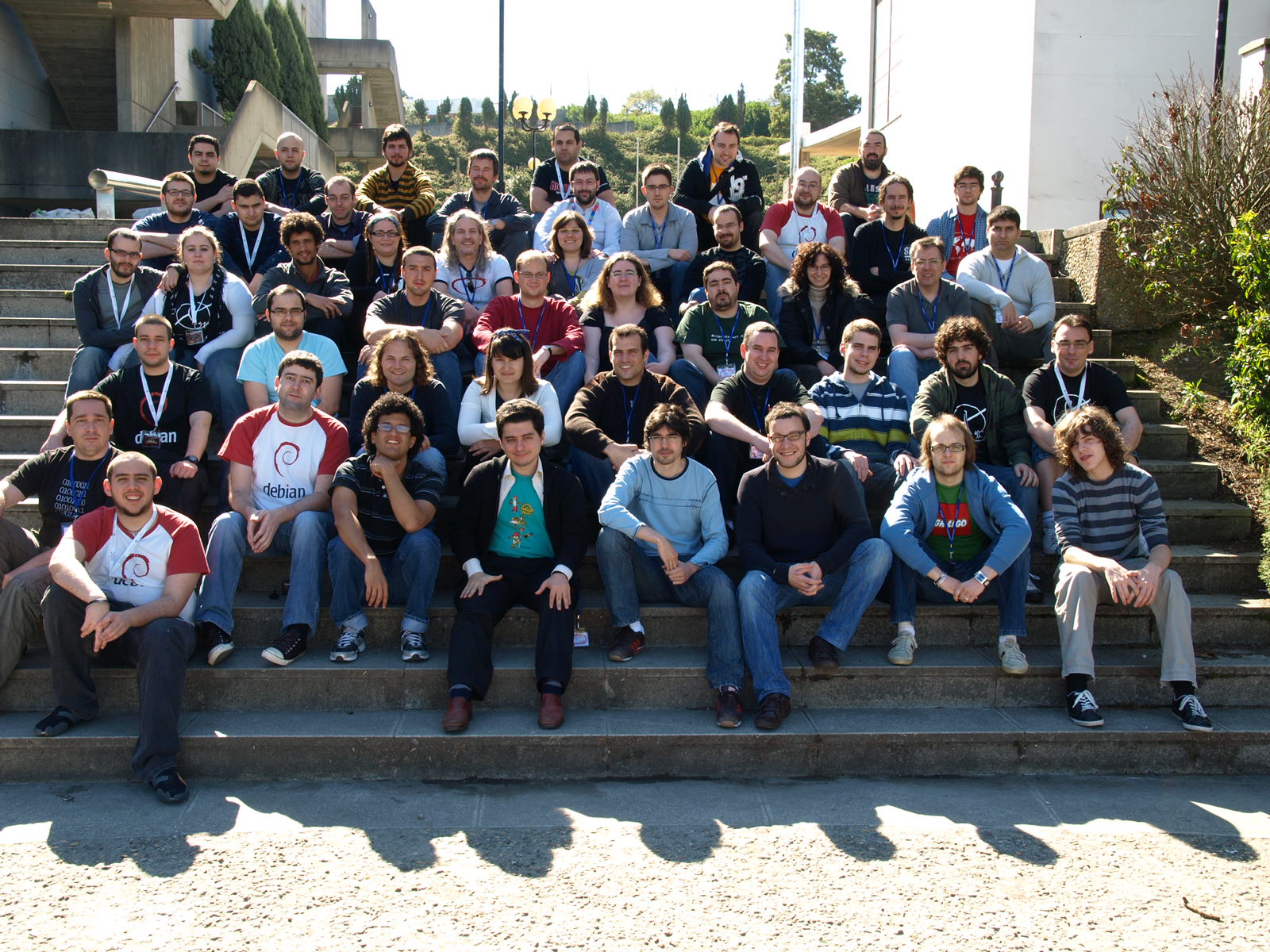
Ana Beatriz Guerrero Lopez: DudesConf 2010

Thanks GPUL (and Ghandalf!) for another perfect conference. Coru a, April 2011, Dudesconf 2010 (spanish)

Russell Coker: Debian/Testing and KDE4

I ve just upgraded my Thinkpad (which I use for most of my work) to Debian/testing with KDE4. Improvements Kde 3.5 (from Debian/Lenny) didn t properly display the applets in a vertical task bar. I want a vertical task bar because my screen resolution is 1680*1050 and I find that a less rectangular screen workspace is best for my usage patterns. In my previous post about my Thinkpad T61 I described how the sound controls weren t working [1]. These problems were fixed as part of the upgrade, KDE just does the right thing. Now when I press the buttons to increase or decrease the volume the ALSA settings are changed and a small window is briefly displayed in the center of the screen to show the new volume. Sounds are now made when I plug or unplug the power cable, this was configured in KDE 3.5 but just didn t work. Problems If I have a maximised Konqueror window and I use the middle mouse button to open a link in a new window then the new window will also be maximised. Previously when I did that the new window was not maximised. What sometimes happens is that I want to open several links from a web page in different windows, so if I can open them in non-maximised windows then I can click the title-bar or the bottom status-bar of the parent window to get it in the foreground again. Probably an ideal solution to this use-case would be to configure the middle mouse button to open a new window in the background or minimised. I can t figure out how to implement accelerator keys for window controls. In particular I like to use ALT-F9 to minimise a window (CUA89 standard). The upgrade from KDE 3.5 to KDE 4 lost this and I can t get it back. I want to have an icon on my panel to launch a Konqueror session. I don t want a large amount of space taken up for a launcher for several different Konqueror options, I just want a regular Konqueror for web browsing available at a single click. There didn t seem to be an option for this. KDE 3.5 has an option in the add widgets to toolbar dialogue to add icons for applications. I have just discovered that in KDE 4 the only way to do this is to go through the menu structure and then click the secondary mouse button. Having two ways to do something is often a good thing, particularly when the other way is the way that was most obvious in the previous version! It was annoying that the font choices for my Konsole session were lost on the KDE 4 upgrade, it s not a complex setting. Also the option to resize a Konsole session to a common size (such as 80*25) seems to have been lost. I had to spend at least 30 minutes configuring kmail to get it to display mail in much the same manner as it used to. You have to use the Select View Appearance (Theme) icon off at the right of the Search box and select Classic and then go to Select Aggregation Mode (immediately to the left) to select Flat Date View . I m happy for KDE 4 to default to new exciting things when run the first time, but when upgrading from KDE 3.5 it should try to act like KDE 3.5. I decided to use Kopete for Jabber just to preempt the GNOME people adding Mono support to Pidgin. I had to install the libqca2-plugin-ossl and qca-tls packages to enable SSL connection, missing either of those gives you an incomprehensible error condition that even strace doesn t clarify much. Given that it s generally agreed that sending passwords unencrypted over the Internet is a bad idea and that it s a configuration option in Jabber servers to reject non-SSL connections it seems to me that the Kopoete package should depend on the packages that are needed for SSL support. Failing that it would be good to have Kopete offer big visible warnings when you don t have them. I use the KDE 2 theme and the right side of the title bar of each window is a strange dappled pattern. Not sure why and I have more important problems to fix. Parts of KDE crash too often. I ll start filing bug reports soon. The management of the Desktop folder has changed. In previous versions of KDE the directory ~/Desktop had it s contents displayed in iconic form on the root window. Now by default it doesn t do that. It is possible to change it, but this is one of those things where the default in the case of an upgrade should be to act like previous versions. The way to enable the previous functionality is to go to the desktop settings (click the secondary mouse button on the background, select Desktop Settings and then under Desktop Activity change the Type: to the value Folder View and then specify the directory below. The facility to have different background colors or pictures for each of the virtual desktops seems to have been removed either that or the KDE configuration system doesn t have enough functionality to let me discover how to configure it. When the panel that I have on the left of the screen crashes everything that was next to the panel gets dragged to the left, this includes extending the width of maximised windows. Then when the panel starts again (which if lucky happens automatically) it pushes things back and if icons had been moved left it just obscures them. When using Konqueror to browse a directory full of pictures it doesn t generate thumbnail icons. When I middle-click on an icon for a picture it is opened with Konqueror not the image viewer that was used in KDE 3.5. The image viewer from KDE 3.5 had less options and therefore more screen space was used for the picture. Also the Konqueror window that is opened for this has a navigator panel at the left which I can t permanently remove. When I use Konqueror my common action is to perform a Google search and then use the middle button to open a search result in a new window. Most of my Google searches return pages that have more than one screen-full of data so shortly after opening a window with a search result I press PgDn to see the next page. That press of PgDn for some reason takes me back to the Google search. It seems that when a web page is opened in a new window the keyboard focus will be in the URL entry field, and pressing PgDn in that field takes you to the previous web page. This combination is really annoying for me. Conclusion Getting the sound working correctly is a great feature! Lots of little things are fancier and generally the upgrade is a benefit. The lack of thumbnails when displaying a folder of JPG files is really annoying though. The time taken to configure things is also annoying, I support four relatives who are just users so that probably means at least an hour of configuration work and training for each one so KDE 4 is going to cost me at least half a day because of this.

Next.

Previous.