Search Results: "ana"

3 May 2010

Wouter Verhelst: Yves Leterme, Belgian minister for resignation.

At least that's what it looks like right now. No less than five times did he offer his resignation as prime minister of Belgium to the king. Looks like fifth time is a charm now, too we get to go elect a new parliament in a month or two. Sigh. The 'fun' bit is, there's no real reason why this is necessary. The main issue that they've been talking about these past few years is the 'BHV' thing. While the issue is somewhat complex and, I'm sure, involves a huge heap of all kinds of side issues, the crux of the matter is that there's one group of politicians who wants to forbid another group of politicians from running in a region of the country around the capital. Now I'm sure that's hugely important to politicians after all, their career depends on it but beyond a few fanatics in and around that very capital, I'm pretty sure nobody actually cares what the particular names are of the particular groups of people that appear on the list of people they can vote for. Because, you see, this isn't actually about politicians wanting to forbid other politicians from running; it's about politicians wanting to forbid other political parties from running. Which, of course, makes a whole world of difference. Yeah, right. Now I wouldn't care about this much, except that it interferes with the smooth running of this country. The fact that they've come up with "problem" after "problem" related to this BHV "issue" for these past years has made it hard(er) for the government to actually to any real work. So although I hate the current situation, I'm actually quite relieved that an election is coming up. Perhaps this time we can get the fanaticals out and have a real government. (no comments allowed on this item; please use your own blog)

Junichi Uekawa: pbuilder on SSD.

pbuilder on SSD. I managed to set my new machine (vaio P) up enough that it runs pbuilder. I checked the speed. sudo cp -a base.cow sid-chroottook 50 seconds. cowbuilder does cp -al and cowbuilder took 5 seconds. Although SSD seems to improve the speed somewhat, not doing any data copying is much faster.

2 May 2010

Dominique Dumont: Improve config file upgrades Ep 01

Hello The GSoC project Krzysztof and I are working aims to facilitate configuration upgrade during package upgrades. Most of the cases, this upgrade should not require any input from the user, even if the user had previously customized his configuration file. Currently configuration upgrade may ask questions to the user which may be hard to answer for most non-technical users. For more details see PackageConfigUpgrade on Debian wiki. (If you are not familiar with upgrade issues, you might want to read this page.) At the 2 extremes of upgrade tools, we have: Each tool has its own advantages and drawbacks. On the plus side of diff3 tools : On the other hand, here are the issues with diff3 based tools: For more details on diff3 issues, see Benjamin Pierce s paper (thanks to David Lutterkort from Augeas for the info) On the other end of the spectrum, Config::Model pros are: But, Config::Model main problem is: diff3 tools is lackluster for users. While Config::Model puts too much strain on packagers because it requires configuration models where all parameters are defined and declared in the model. For fast evolving projects, this can be a huge recurrent task (been there, done that for Xorg) . (Well, this recurrent task is a problem until doc, implementation and config model can be extracted from a single meta-description But I digress, this may be a project for GSoC 2011 :-p ) So, this GSoC project (for 2010) aims to find a compromise between these 2 extreme cases. On Config::Model, I ve always had a drawer statement whenever I was asked why Config::Model does not handle unknown parameter:
a configuration file cannot be validated if an unknown parameter can t be distinguished from a user typo.
This stance is fine for casual user interaction on a stable system: an unknown parameter is most likely an error. And the user must be warned of his error as soon as possible. For a stable distro release, packagers should have the time to provide complete models, so basing upgrade on complete models should be possible (famous last words ?). On the other hand, a lot of configuration upgrades will be done on unstable systems where software evolve quite fast, where models will likely fall behind software evolutions. Another shorcoming of my drawer statement is that it assumes user interaction where erroneous input is more likely. In case of configuration upgrades, there should be no user interaction. And we can assume that the config file to be upgraded was used (and thus validated) by the old version of the software. So unknown parameters should be tolerated and managed as best as possible. Now, the big question is: how ? In all attempts I ve seen in managing upgrades that goes beyond diff3 tools, the configuration is stored as structured data. Sometimes this structure can be infered from the configuration file syntax (shell vars, INI files, YAML, XML), sometimes not (sshd config file). In the latter case, some structural knowledge must be built in the upgrade tool. Currently, Config::Model is designed to bring a complete description of the structure and semantics of a configuration file. This is perceived as bringing too much structural and semantic knowledge ( too semantic ). So the maintenance cost is perceived as too important. That may be right or wrong, but that does not matter. Perception is more important here. So, let s figure out a way to reduce the amount of work required to perform upgrades (you may want to read a little bit more on configuration model creation before going on ) One possibility would be to support configuration models that allow unknown leaves in nodes. Such a model would provide a kind of fallback leaf description. Something like: this parameter is unknown, let s assume it s a simple string value . Let s consider sshd_config example to see how such a behavior would pan out for some upgrade scenarios. sshd model is made of 2 main classes:
- Sshd
- SshdMatchElement The second one contains all parameters allowed in a Match class (in fact, Match parameter is the only one in sshd that defines a new hierarchical level. All other parameters are simple leaves). Now let s consider typical upgrade scenarios from old version (with old models) to a more modern version. Let s assume that the model is lagging behind and the model does not follow sshd evolutions. So Config::Model will face 3 upgrade cases (extracted from sshd config history):
  1. Unexpected parameter that are actually simple leaf parameters. E.g. introduction of ClientAliveInterval.
  2. Obsolete parameters that should be migrated. E.g KeepAlive is renamed into TCPKeepAlive
  3. New structural parameters (introduction of Match element)
So what would happen with a model allowing unknown parameters but lacking specific instructions for these upgrades:
  1. ClientAliveInterval value would be kept. :-)
  2. KeepAlive would be kept as is.TCPKeepAlive would also be kept. No migration is performed, but the configuration would be good. As long as sshd supports the old parameter, we re good. :-/
  3. Without knowledge of the structure brought by Match parameters, Config::Model would consider that parameter in Match block would duplicate parameters in the main block and remove the duplicate. User data may be lost. :-(
So, there s not silver bullet. Let s resume what we ve learnt: Next step is to figure out what would happen if the same strategy is applied to other types of configuration files. But that will be for another blog. All the best

Russell Coker: Lexmark Supposedly Supports Linux

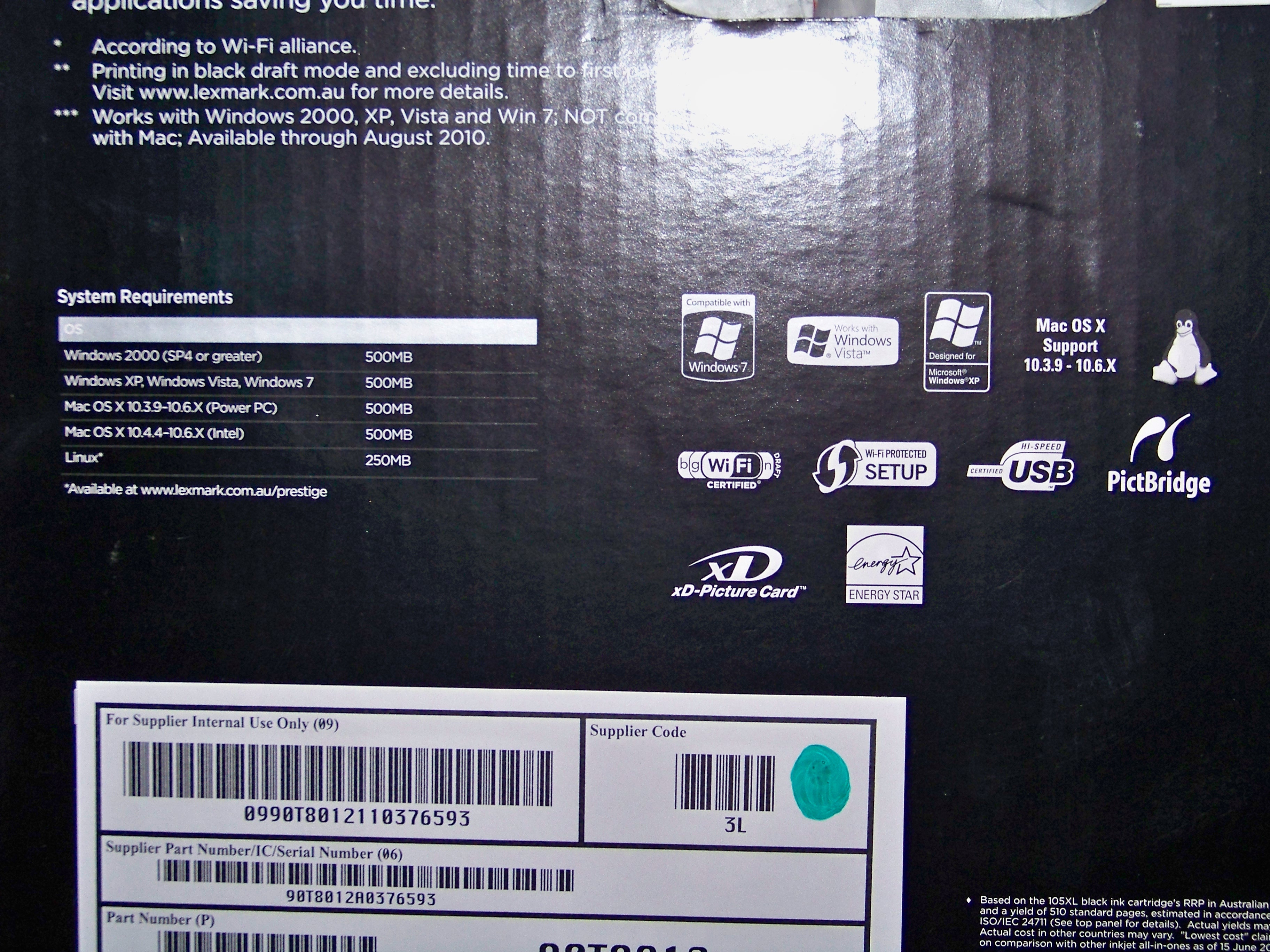
I wanted to get a Lexmark Prestige Pro805 printer to work under Linux, due to bad drivers from Lexmark and no driver support in Debian/Unstable I ve given up and advised the people who purchased it to return it for a refund. I recommend that Lexmark not be considered when purchasing a printer for use with Linux. The box advertises the URL http://www.lexmark.com.au/prestige for downloading Linux drivers. The driver file is named lexmark-inkjet-09-driver-1.5-1.i386_ts.deb.sh.tar.gz which makes anyone expect a tar.gz archive of a shell archive of a Debian package. But that s not what it is at all, in Lexmark-land deb is not the file name extension for a Debian package, but just a random bit of text to identify a file that is somewhat related to Debian, the fact that the Linux driver for Ubuntu/Debian Package Manager based distros doesn t use the string ubu in it s name is something that would lead a typical Linux user to believe that deb means a Debian package. Similarly the file named lexmark-inkjet-09-driver-1.5-1.i386_ts.rpm.sh.tar.gz and described as Linux driver for RedHat Package Manager based distros is not actually an RPM package or inherently for RPM based distros, it s just a shar archive that is built and tested for some unspecified version of some Red Hat distribution (RHEL? Fedora? SUSE?). Now when I execute lexmark-inkjet-09-driver-1.5-1.i386_ts.deb.sh on an AMD64 version of Linux it opens an X11 window, prompts for the root password, and then fails because an i386 Debian package that it somehow built couldn t be installed. When I ran the shar archive with the options --noexec --keep and examined the files it contained it has a few AMD64 executables so obviously the software they used to create the installer has some support for AMD64 but they just decided not to use it. It seems that the only way to buy an i386 system nowadays is to buy an embedded system or a NetBook, all Desktops, laptops, and servers run the AMD64 architecture, as most people do a Linux install that matches the full capabilities of their system (IE running AMD64 software on an AMD64 CPU) that means most systems sold in the last few years can t be used with a new Lexmark printer without an unreasonable amount of work. Sure it is possible to setup a chroot environment or KVM virtual machine for running printer drivers, but I don t really want to do that and a significant portion of the potential customers don t have the skill needed to do so. While technically their claims about having Linux driver support are correct (they support some distributions of Linux on i386), the majority of new systems won t work with it unless someone who has good skills spends some time and effort on it. Probably the majority of Linux Desktop and server systems that are in use today use AMD64 and are run by people who don t know how to setup a chroot so therefore for most real installations it s not supported. Even for i386 systems installation is unlikely to be trouble-free, when they support RPM based distributions (without identifying which of the many wildly different RPM systems they tested on) and Debian (without mentioning a version number) it seems that the incidence of people running a distribution that is supported is going to be quite low. Lexmark uses the Linux logo to claim compatibility Based on this experience I am not inclined to trust Lexmark in future, I will not trust any future claims of Linux support that they may make. The above picture of the Lexmark box shows Tux (the Linux logo), it doesn t mean support out of the box as you would hope, but instead means support for old systems with some effort.

1 May 2010

Sean Finney: Nouveau, Gallium3D, and Compiz on Debian

update: 20100503: It's been brought to my attention that there might have been a regression in one of the libraries, mesa, maybe, so that master might not be as reliable a reference point for this guide. so, just in case, here are the commit hashes that were used from the different projects: for the non-git-savvy: git checkout -b mybranch <hash> we now return to your regular broadcasting... A week or two ago I figured it was about time that I took the plung and tried out the latest nouveau drivers from experimental on my laptop. Unfortunately, it meant bidding adieu to compiz (apart from the bling it does actually provide some pretty damned useful features). I thought I'd give it a shot at least for a while on principal, since I've always had to think of the nvidia drivers as a necessary evil, and their lack of proper xrandr support is really, really annoying. Since then I haven't noticed any problems, apart from the following message after every suspend/resume:
[  931.213239] Uhhuh. NMI received for unknown reason 80 on CPU 0.
[  931.213240] You have some hardware problem, likely on the PCI bus.
[  931.213242] Dazed and confused, but trying to continue

No idea what's causing it, but otherwise the system is stable and functional. If anyone knows what can be done about this, I'd appreciate hearing from you. My graphics card, by the way:
01:00.0 VGA compatible controller: nVidia Corporation G72M [Quadro NVS 110M/GeForce Go 7300] (rev a1)

In the time since then, the nouveau driver has made its way into unstable, and a lot of distros (ubuntu, fedora, ...) are even using it as the default driver. So before going any further with the 3d/compiz stuff, I highly recommend that you get the packaged version working first. This will not only make sure that the basic driver works, but it will also make recovery/rollback a lot easier. Since it's all packaged in the standard repositories, it's not much harder than installing a few packages and editing a few files... so come on give it a try :) Getting the 2d driver working in Debian sid Really, this is so easy it's hardly worth writing up, but i'm running with the -v flag this morning... Make sure you don't have any reference to nvidia in /etc/modules or other places that might cause it to be automatically loaded. Then remove the proprietary glx bindings, which would otherwise interfere with the nouveau driver.
sudo apt-get remove nvidia-glx

Next, you'll need to install a kernel that includes updated drm support. Normally this would require a kernel >= 2.6.33.1, but the debian kernel maintainers have graciously backported this code to the 2.6.32-4 kernel package. note this isn't the default kernel version in testing/unstable at the time of writing so you have to explicitly install it along with the nouveau driver.
sudo apt-get install linux-image-2.6.32-4-amd64 xserver-xorg-video-nouveau

If you are already running this kernel and using the proprietary nvidia drivers, via module-assistant or otherwise, you /might/ need to uninstall them first. On my system I left them installed in the old kernel version but did not install them on the new kernel version. Required xorg configuration I don't believe that nouveau is picked by default if available at the time of writing, so you have to have the following in your xorg.conf:
sudo sh -c "cat > /etc/X11/xorg.conf" << EOF
Section "Device"
    Identifier     "nVidia Corporation G72M [Quadro NVS 110M/GeForce Go 7300]"
    Driver         "nouveau"
EndSection
EOF

This was all I needed to do, apart from rebooting into the new kernel. For those who don't want to venture outside the packaging system, this is about as far as you can go for the time being. Though really, if you're bothering to read this far along, you're probably more interested in what comes next :) Getting 3d working (without voiding your distro warranty) So I thought I'd give the 3d-accelerated gallium a go. Their wiki page certainly makes one think twice, but at this point I was seriously fiending to get my bling back (well, the compiz scale plugin, anyway) and figured it wouldn't hurt too much to try. Via google and trawling around in various forums I found a number of how-to documents for getting Gallium3d on debian/ubuntu systems, but most of them recommended doing things in a way that wasn't easily reversible and that could totally hose your system in a not-so-hypothetical worst-case scenario. It's pretty hard to roll back a make install done into /usr, for example, and subsequent package upgrades can leave your system even worse off as they will probably clobber half of what you just did, leaving the other half totally broken. And if you have a laptop which requires the gui for networking (i.e. network-manager), then fixing/rolling-back the changes is not entirely trivial, since you'd likely have to re-download the various drm/mesa/xorg packages. So enter the tried and true unix utility stow (apt-get install stow, of course). stow is a utility that lets you install software into arbitrary folders, and then manage the system-wide installation of the software via a farm of symlinks pointing at the installed location. It's probably more well known among the sysadmin crowd than the desktop user crowd, but it's incredibly useful for the task at hand as it will let us easily install multiple copies of different software in a way that's very easy to update and/or roll-back. RTFM stow(1) for more information. So, on to the juicy stuff... Install needed software, remove problematic packages, setup, etc At least on my system, I had to remove libdrm-dev to keep things from accidentally linking against it instead of the updated version that we install later on below. There's probably a way to override this with CFLAGS but I figure this is simpler.
sudo apt-get remove libdrm-dev
sudo apt-get install stow build-essential xorg-dev git-core libtool mesa-common-dev automake autoconf 
mkdir ~/nouveau

Compile a linux-2.6.34 RC kernel
cd ~/nouveau
git clone git://git.kernel.org/pub/scm/linux/kernel/git/torvalds/linux-2.6.git
cd linux-2.6
git remote add -f nouveau git://anongit.freedesktop.org/nouveau/linux-2.6
git checkout -b nouveau-master nouveau/master
make menuconfig

Enable device drivers -> staging drivers -> nouveau. Make any other changes you might want to make (I just took defaults for everything else).
make deb-pkg

The linux-firmware-free debian package ships some of the same stuff from the generated linux-firmware-image package. I decided to opt for the upstream firmware, though I'm not sure that this is necessary:
sudo apt-get remove linux-firmware-free
sudo dpkg -i ~/nouveau/linux-image*.deb ~/nouveau/linux-firmware-image*.deb
sudo update-grub

Install a copy of dri2proto
cd ~/nouveau
git clone git://anongit.freedesktop.org/xorg/proto/dri2proto
cd dri2proto
./autogen.sh --prefix=/usr/local/stow/dri2proto-20100428
sudo mkdir -p /usr/local/stow/dri2proto-20100428
sudo make install
sudo stow -d /usr/local/stow dri2proto-20100428

Install a cutting-edge version of libdrm
cd ~/nouveau
git clone git://anongit.freedesktop.org/git/mesa/drm/
cd drm
./autogen.sh --prefix=/usr/local/stow/drm-20100428 --disable-intel --disable-radeon --enable-nouveau-experimental-api
make
sudo mkdir -p /usr/local/stow/drm-20100428
sudo make install
sudo stow  -d /usr/local/stow  drm-20100428

Likewise for mesa
cd ~/nouveau
git clone git://anongit.freedesktop.org/git/mesa/mesa
cd mesa
./autogen.sh --prefix=/usr/local/stow/mesa-20100428  --enable-debug --enable-glx-tls --disable-asm --with-dri-drivers= --enable-gallium-nouveau --disable-gallium-intel --disable-gallium-radeon --disable-gallium-svga --with-state-trackers=glx,dri --with-demos=xdemos,demos,trivial,tests
make
sudo mkdir -p /usr/local/stow/mesa-20100428 
sudo make install
sudo stow -d /usr/local/stow mesa-20100428

And now the xorg driver...
cd ~/nouveau
git clone git://anongit.freedesktop.org/git/nouveau/xf86-video-nouveau/
cd xf86-video-nouveau
./autogen.sh --prefix=/usr/local/stow/xf86-video-nouveau-20100428
make
sudo mkdir -p /usr/local/stow/xf86-video-nouveau-20100428
sudo make install
sudo stow -d /usr/local/stow xf86-video-nouveau-20100428

Configuration Configure xorg to look in alternate location for xorg modules and set up DRI
sudo sh -c "cat > /etc/X11/xorg.conf" << EOF
Section "Files"
    ModulePath "/usr/local/lib/xorg/modules,/usr/lib/xorg/modules"
EndSection
Section "ServerFlags"
    Option "GlxVisuals" "all"
Endsection
Section "Device"
    Identifier     "nVidia Corporation G72M [Quadro NVS 110M/GeForce Go 7300]"
    Driver         "nouveau"
EndSection
EOF

I've /heard/ that disabling TV out is a necessity on some cards, though I haven't seen this myself:
sudo sh -c "cat > /etc/modprobe.d/nouveau.conf" << EOF
# not entirely sure this is necessary, but heard it helped with vsync
options nouveau tv_disable=1
EOF

Finally, the one thing that can not be done in /usr/local is making the nouveau DRI driver available. From what I could tell the path that mesa uses to find the DRI libraries is hard-coded (corrections welcome). Since you won't already have this file (otherwise, why would you be following along here?), just drop in a symlink to the file in /usr/local:
sudo ln -s /usr/local/lib/dri/nouveau_dri.so /usr/lib/dri/

Finally, reboot, and hope for the best :) Riding the bleeding edge: how to upgrade later on Again, stow really shows its usefullness here. Using drm as an example case, upgrading an individual component would look something like:
cd ~/nouveau/drm
git clean -dfx
git pull
today= date +%Y%m%d 
./autogen.sh --prefix=/usr/local/stow/drm-$today --disable-intel --disable-radeon --enable-nouveau-experimental-api
make
sudo mkdir -p /usr/local/stow/drm-$today
sudo make install
sudo stow -d /usr/local/stow -D drm-20100428
sudo stow -d /usr/local/stow  drm-$today

Note how the old version is still installed, so you can switch components around pretty freely. Abort! Abort!: How to roll back changes In case your system becomes totally unusable, or you've decided that you just want to go back to the safe and cozy world of what's provided by the debian packages, simply do the following: Assuming that you're using the nouveau driver from unstable, this should be all that is necessary. Conclusion Overall impression I am very, very happy with the resulting setup. I was led to believe that this whole thing was much more unstable and unusable than it actually is! While there are certainly some glitches and missing features, I feel comfortable enough using it that I don't have plans to switch back. But if I find myself in a situation where I can't use the new setup, rolling back shouldn't be a problem either. I figure I'm happy with what I have now and it will only get better. What works, at least to a "kinda works" level. What still doesn't work Further reading, references Thanks A couple shoutouts to those who helped me with this on the way: Feedback / Corrections Unforunately, I've had to disable comments for the time being due to overwhelming quantities of spam. So please drop me a line via email or on IRC (seanius on oftc/freenode).

30 April 2010

Russell Coker: Link Within

Good Things about LinkWithin For the last 10 weeks I ve been using the LinkWithin.com service to show links to other blog posts at the end of each post (the links are only shown to visitors of my blog not in the RSS feed, so people who read my posts through RSS syndication will miss this). The service shows excerpts of pictures from my blog at the bottom of each post to entice readers into reading other posts. When you click on a LinkWithin icon on my blog you visit a LinkWithin page that redirects you back to my page, so people who use that show up as new visitors being referred by LinkWithin. Currently this month LinkWithin is the fourth highest referrer to my blog, below Google, Reddit, and WebWombat.com.au so it is clearly doing some good in enticing people to read other posts that they might not otherwise read! Bad Things about LinkWithin The first problem with LinkWithin is that the Wordpress plugin was written by people who don t know much about Wordpress. Unlike every other plugin I use it doesn t support configuration options for the user in the database but instead has it hard coded in the PHP code! When you download a plugin from their web site it creates a custom zip that includes the PHP code automatically generated just for you! I have some friends using the same web server as me for running blogs, and I have to tell them you can install any plugin apart from LinkWithin it works for no-one but me . The next problem is that LinkWithin advertises that it will display related posts, it seems to be doing a poor job of that on my blog although admittedly only a minority of my blog posts have pictures so this limits what it has to work with. This has however inspired me to use more pictures in my posts. Another problem is that it produces web pages that are not valid XHTML, the following patch fixes this. --- /tmp/linkwithin.php 2010-02-22 02:09:47.000000000 +0000
+++ ./wp-content/plugins/linkwithin/linkwithin.php 2010-02-22 02:17:29.000000000 +0000
@@ -15,7 +15,7 @@
global $post, $wp_query, $linkwithin_code_start, $linkwithin_code_end; $permalink = get_permalink($post->ID);
- $content .= '<div class="linkwithin_hook" id="'.$permalink.'"></div>';
+ $content .= '<div class="linkwithin_hook" id="'.str_replace('/','-',$permalink).'"></div>';
$content = linkwithin_add_code($content);

return $content;
@@ -26,13 +26,13 @@
global $post, $wp_query, $linkwithin_code_start, $linkwithin_code_end; if ($wp_query->current_post + 1 == $wp_query->post_count)
- $embed_code = '<script>
+ $embed_code = '<script type="text/javascript">
<!-- //LinkWithinCodeStart
var linkwithin_site_id = 151382;
var linkwithin_div_class = "linkwithin_hook";
//LinkWithinCodeEnd -->
</script>
-<script src="http://www.linkwithin.com/widget.js"></script>
+<script src="http://www.linkwithin.com/widget.js" type="text/javascript"></script>
<a href="http://www.linkwithin.com/"><img src="http://www.linkwithin.com/pixel.png" alt="Related Posts with Thumbnails" style="border: 0" /></a>';
$content .= $embed_code;
Finally LinkWithin shows up badly on the FireBug analysis (see my previous post about using Firebug to speed up my blog) [1] see the below picture for details. As an aside, given that Google recommend Firebug it is rather ironic that Google Adsense related URLs cover the majority of the Firebug issues that are not caused by LinkWithin. demonstration of how Linkwithin lowers my page speed What Next? I ve sent email to the LinkWithin people about all these issues other than the FireBug problem reports, given that they haven t responded to some suggestions for over 10 weeks it seems hardly worth my effort in informing them of other issues. I m thinking of trying OutBrain.com again. 18 monthe ago I tried OutBrain but never got it working due to technical issues and then forgot about it. It has some similar features and may work better at least it has tech support people who respond to queries!

28 April 2010

Sam Hartman: Debconf 10 Enterprise Track

I ve been asked by the Debconf 10 talks team to coordinate a Debian Enterprise track at the upcoming Debconf 10 conference. I m really excited about this, and I could use your help. From my standpoint, this all started with a BOF proposal looking at better coordination and what is missing in Debian enterprise integration. The track will also include talks and other events on what exciting things are happening with Debian in the enterprise. I need your help in the form of suggestions for talks, panels and the like (especially if you would be willing to give the talk or coordinate an activity). We re under a fairly tight deadline; ideally proposals would be in by May 1, but if they are not, it s still definitely worth discussing with me. From my standpoint, topics include: Obviously, many other things could fit in and I d be interested in your ideas as well.

27 April 2010

Matthew Garrett: Radeon reclocking

Alex released another set of Radeon power management patches over the weekend, and I've been adding my own code on top of that (Alex's patches go on top of drm-next, mine go on top of there). I've left it stress-testing for a couple of hours without it falling over, which tells me that it's stable enough that I can feel smug. This is a pleasing counterpoint to the previous experiences I've been having, which have been rife with a heady mixture of chip lockups or kernel deadlocks. It turns out that gpus are hard.

There's a few things you need to know about gpus. The first is that if they're discrete devices they typically have their own memory controller and video memory. The second is that there's an impressive number of ways that you can end up touching that memory. The third is that they tend to get upset if something tries to touch that memory and the memory controller is in the middle of reclocking at the time.

The first and most obvious use of video memory is by the gpu itself. Accelerated operations on radeon are carried out by sending a command packet to the command processor. This is achieved by sharing a ring buffer between the cpu and the gpu, with the gpu reading packets out of that ring buffer and performing the operations contained within them. Many of these operations will touch video memory (that being the nature of most things you want a gpu to do), and if that happens bad things occur. Like the card locking up and potentially taking your PCI bus with it.

So, obviously, we don't want that to happen. The first thing we do is take a mutex that blocks any further accelerated operations from being submitted by userspace. Then we wait until we get an interrupt from the gpu telling us that the display engine has gone idle. The problem here is that we don't have a terribly good idea of how many more operations there are to complete and we don't know how long each of those operations is going to take, but this is less bad than some of the alternatives[1]. Jerome Glisse has some ideas on how to improve this to require less waiting, but the effects should still be pretty much invisible to the average user.

So we've stopped the command processor touching ram. Everything's good, right?

Well, not really. The obvious problem is that users typically want to display something, so there's a separate chunk of chip that's repeatedly copying video memory over to your monitor. That's got to go too. Thankfully, there's a convenient bit in the crtc registers that lets us turn that off, but the pretty unsurprising downside is that your screen goes blank while that's happening. So we don't want to do that. Instead, we try to perform the reclock while there's nothing being displayed on the screen - that is, while we're in the screen region where a crt's electron gun would be scanning back from the bottom of the screen to the top. It turns out that rather a lot of display assumptions depend on this happening even if there's no crt, no electron gun and no thick sheet of glass with a decent approximation of vacuum behind it, so we get to do this even if we're displaying to an LVDS. And we have about 400-500 microseconds to do it - an almost generous amount of time.

So we ask the hardware to generate an interrupt when we enter vblank and then we reclock. Except the hardware has an irritating habit of lying - sometimes we get the interrupt a line or two before vblank, sometimes we get it after we've already gone out the other side. Vexing, and not entirely solved yet - so sometimes you'll still get a single blank frame during reclock. But there are plans, and they'll probably even work.

At this point the acceleration hardware isn't touching the memory and the scanout hardware isn't touching the memory. Except it still crashes under some workloads. This one took me longer to track down, but the answer turned out to be pretty straightforward. Not all operations are accelerated. When they're not accelerated they have to be done in software. That means that the CPU has to write to the video memory itself. I'm sure you can see where this is going. This was fixed without too much trouble once I'd finished picking through the driver to work out every location where objects might be mapped into the CPU's address space, at which point it's a simple matter of unmapping them and blocking the fault handler from remapping them until the reclock is finished. Linux, thankfully, has lots of synchronisation primitives. And now everything works.

Except when it doesn't. This took a final period of head scratching, followed by the discovery that ttm (the memory allocator used by radeon) has a background thread that would occasionally fire to clean up objects. And by clean up objects, I mean change their mapping - which means updating their status in the gart, which means touching video memory. So, let's block that. And that tripped me off to the fact that even if it couldn't submit new commands, the CPU could still create or destroy objects - with the same consequences.

So, once all of these are blocked, video memory is quiescent and we can do what we want. And we do, at least once I'd sorted out the bits where I was taking locks in the wrong order and deadlocking. Depending on the powerplay tables available on your card we'll chose different rates and so your power savings will vary heavily depending on the values that your vendor provided, but the card I'm testing on sees a handy 30W drop at idle. Right now we're only changing clocks and not dropping voltage so there's potentially a little more to come.

While getting this stable was pretty miserable, the documented entry points for clock changing made a lot of this easier than it would otherwise have been. It's also probably worth noting that Intel's clock configuration registers are entirely missing from any public documentation and the dirver Intel submitted to make them work in their latest chips appeared to have been deliberately obfuscated, so thanks to AMD for making all of this possible.

[1] It's possible to insert various command packets that either indicate when they've passed or stall until a register value gets updated, but these either cause awkward problems with the cp locking or mean that the gui idle functionality never goes idle, so they're not ideal either.

Dirk Eddelbuettel: R Project and Google Summer of Code: Welcome to our students!

A few hours ago, I sent the following to both the R development list and the informal R / GSoC list:
Date: Mon, 26 Apr 2010 15:27:29 -0500
To: R Development List <r-devel>
CC: gsoc-r <gsoc-r>
Subject: R and the Google Summer of Code 2010 -- Please welcome our new students!
From: Dirk Eddelbuettel <edd>
Earlier today Google finalised student / mentor pairings and allocations for
the Google Summer of Code 2010 (GSoC 2010).  The R Project is happy to
announce that the following students have been accepted:
   Colin Rundel, "rgeos - an R wrapper for GEOS", mentored by Roger Bivand of
      the Norges Handelshoyskole, Norway
   Ian Fellows, "A GUI for Graphics using ggplot2 and Deducer", mentored by
      Hadley Wickham of Rice University, USA
   Chidambaram Annamalai, "rdx - Automatic Differentiation in R", mentored by
      John Nash of University of Ottawa, Canada
   Yasuhisa Yoshida, "NoSQL interface for R", mentored by Dirk Eddelbuettel,
      Chicago, USA
   Felix Schoenbrodt, "Social Relations Analyses in R", mentored by Stefan
      Schmukle, Universitaet Muenster, Germany
   Details about all proposals are on the R Wiki page for the GSoC 2010 at
   http://rwiki.sciviews.org/doku.php?id=developers:projects:gsoc2010
The R Project is honoured to have received its highest number of student
allocations yet, and looks forward to an exciting Summer of Code.  Please
join me in welcoming our new students.
At this time, I would also like to thank all the other students who have
applied for working with R in this Summer of Code. With a limited number of
available slots, not all proposals can be accepted -- but I hope that those
not lucky enough to have been granted a slot will continue to work with R and
towards making contributions within the R world. 
I would also like to express my thanks to all other mentors who provided for
a record number of proposals.  Without mentors and their project ideas we
would not have a Summer of Code -- so hopefully we will see you again next
year. 
Regards,  
Dirk (acting as R/GSoC 2010 admin)

26 April 2010

Luca Falavigna: waf removal, almost done

Some months ago I wrote about my intention to drop waf from Debian. Some bugs I filed were fixed shortly after they appeared, while I managed to upload three NMUs to fix remaining bits (flowcanvas, patchage and raul), all uploaded to DELAYED/15 to give maintainer time to react. In the meantime, jack-audio-connection-kit was uploaded build-depending on waf, this brings in a little unplanned delay, but I provided a workaround to get rid of it, it just need to be improved. I want to remove waf before Squeeze is released, so please do not upload more packages build-depending on waf, this way you can help its removal. Thank you!

Obey Arthur Liu: Welcome to our 2010 Debian Google Summer of Code students!

I d like to extend a warm welcome to our selected students for the 2010 Debian Google Summer of Code! They should pop up on Debian Planet soon and you re welcome to come talk to them on #debian-soc on irc.debian.org Aptitude Qt by Piotr Galiszewski, mentored by Sune Vuorela Qt GUI for aptitude. Currently, KDE users need to use Aptitude via the console interface, or install the newly developed GTK frontend, which does not fit well into KDE desktop. Making Qt frontend to Aptitude would solve this problem and bring an advanced and fully Debian-compliant graphical package manager to KDE. Content-aware Config Files Upgrading by Krzysztof Tyszecki, mentored by Dominique Dumont When a package deliver configuration files, the problem of merging user data with new configuration instructions will arise during package upgrades on users systems. Sometimes merging can be done with 3 way merge, but this process does not insure that the resulting file is correct or even legal. This project intends to create standards, tools an heuristics to make the scary config file conflict resolution debconf prompt a thing of the past. Debbugs Bug Reporting and Manipulation API by David Wendt Jr., mentored by Bastian Venthur Currently debbugs supports a SOAP interface for querying Debian s Bug Tracking System. Unfortunately this operation is read-only. This project would create an API for debbugs which supports sending and manipulating bug reports, without having to resort to email. This project does not intend to replace email as mean to manipulate the BTS but rather to enhance the BTS to allow other means of bug creation and manipulation. Debian High Performance Computing on Clouds by Dominique Belhachemi, mentored by Steffen Moeller The project paves a way to combine the demands in high performance computing with the dynamics of compute clouds with Debian. Combining the Eucalyptus cloud computing infrastructure with the TORQUE resource manager and preparing the components for dynamically added and removed instances provides the user with a attractive high performance computing environment. Such a system allows users to share resources with large compute centers with minimal changes in their workflow and scripts. Debian-Installer on Neo FreeRunner and Handheld Devices by Thibaut Girka, mentored by Gaudenz Steinlin This project aims to improve the installation experience of Debian on handheld devices by replacing ad-hoc install scripts by a full-blown and adapted Debian-Installer. The Neo FreeRunner is used as it is the most convenient and open device from a development standpoint, but other devices will also be explored. Hurd port and de-Linux-ization of Debian-Installer by J r mie Koenig, mentored by Samuel Thibault The primary means of distributing the Hurd is through Debian GNU/Hurd. However, the installation CDs presently use an ancient, non-native installer. The goal of this project is to port the missing parts of Debian-Installer to Hurd. To achieve this, all problematic Linux-specific code in Debian-Installer will be replaced by less or non-kernel dependent code, paving the way for better support of other non-Linux ports of Debian. Multi-Arch support in APT by David Kalnischkies, mentored by Michael Vogt Hardware like 64bit processors are perfectly able to execute 32bit opcode but until now this potentiality is disregard as the infrastructure tools like dpkg and APT are not able to install and/or solve dependencies across multiple architectures. The project therefore focuses on enabling APT to work out good solutions in a MultiArch aware environments without the need of hacky and partly working biarch packages currently in use. Package Repository Analysis and Migration Automation by Ricardo O Donell, mentored by Neil Williams Emdebian uses a filter to select packages from the main Debian repositories that are considered useful to embedded devices, excluding the majority of packages. The results of processing the filter are automated but maintaining the filter list is manual. This project seeks to automate certain elements of the filtering process to cope with specific conditions. This project will also generalize to more elaborate and intelligent algorithms to improve the transitions of the main Debian archives. Smart Upload Server for FTP Master by Petr Jasek, mentored by Joerg Jaspert Making packages upload smarter, more interactive and painless for uploaders by switching from anonymous FTP and Cron jobs to a robust protocol and modern package checking and processing daemon. This daemon would test early and report early, saving developers time. More details coming soon on http://wiki.debian.org/gsoc Congratulations everyone and have a fruitful summer!

Adam Rosi-Kessel: Lazyweb Search Request: Easy Content Management

Dear Lazyweb: Can you suggest open source content management software that meets these criteria: Generally, content will be located by search, rather than via any particular folder hierarchy. Does it exist? There seem to be a lot of open source CMS options, but at least at first glance they may be overkill with a significant learning curve at least on the admin side.

Wouter Verhelst: Yanina Wickmayer, heroine of the Belgian fed cup team

Last weekend, I went to the Grenslandhallen in Hasselt, to see Belgium compete against Estonia in a Fed Cup tie of the World Group playoffs. The winner of this tie would gain a seat in the top-tier World Group next year, which opens the possibility of winning this competition. The Belgian team was the strongest possible one, with all four best Belgian female tennis players Yanina Wickmayer, Kim Clijsters, Justine Henin, and Kirsten Flipkens. On paper, the team should not have had any problems beating the Estonian team. Unfortunately, Justine fractured her pinky finger during practice on wednesday; and while it did not make it impossible for her to play, it did reduce her fitness somewhat, which meant that on Saturday, Kim and Yanina had to defend the Belgian colors. They did and won, but then Kim injured some muscle in her foot, which made it hard for her to walk on Sunday, let alone play. With only Justine, Yanina, and Kirsten available, coach Appelmans chose to put Justine on the field. Though she made a valiant effort, she unfortunately did not manage to beat an unleashed Kaia Kanepi, who it must be said played a terrific match. As such, it fell on Yanina to bring home the tie in the fourth singles rubber against Maret Ani. Being a bit nervous in the start of the first set, she made some unnecessary errors; but after a few games, she came through and started to play much better. Unfortunately, by that time the score was already at 5-1. Yanina won her first service game of the match to bring it to 5-2, but it wasn't enough, and Ani won the first set somewhat easily. She couldn't put anything on the table against a storming Wickmayer, however, and after two more sets, the outcome of the match and, by extension, the tie was clear: a win for Belgium. I can't help but note that Wickmayer has been a great player for the Belgian fed cup team these past few years, however. Since her first Fed Cup participation in 2007, she holds what is, given her ranking at the time, a rather impressive 9-4 win-loss record in Fed Cup. If it wasn't for Wickmayer, the Belgian team would not be where it is now. It was Wickmayer who won her three matches against Canada, one as part of a doubles team, to prevent demotion from world group II to the Europe/Africa zone back in 2009, with a 3-2 score. It was Wickmayer who won the crucial third rubber against higher-ranked Radwanska in February to beat Poland, with the latter even holding the home field advantage. And it's now been Wickmayer who won two of the three rubbers against Estonia that were needed to win the tie. So Congrats, Yanina!

25 April 2010

Clint Adams: Keep braid secrets under the Hat

Even though I do not understand the whole European campaign-period concept, I kept my mouth shut even though it was at odds with trying to answer every question, no matter how stupid. I give props to Jeroen for his efforts in question-answering that year, even though the electorate obviously never cares about that. I wanted to answer all questions directed to all candidates (excluding replies for the same reason that I only responded on-list to questions directed explicitly at me), but did not. Quite a bit of the encouragement I have received after the fact has been from people who are not DDs. I find this strange since most of what I have said has been about the enfranchisement of DDs, and nothing about non-DDs. I could speculate about why this might be the case, but I will refrain. We now return you to your regular program.

Russell Coker: Links April 2010

Sam Harris gave an interesting TED talk about whether there are scientific answers to moral questions [1]. One of his insightful points was that when dealing with facts certain opinions should be excluded it would be good if journalists who report on issues of science could understand this. Another insight was that religious people most strongly agree with him regarding the issue of whether there are factual answers to moral questions but they think that God just handed the answers to their ancesters rather than making it an issue that requires consideration. He cites the issue of gay marriage as being a distraction from moral issues such as genocide and poverty. He asks how have we convinced ourself that every culture has a point of view worth considering? . He asks how the ignorance of the Taliban on the topic of physics is any less obvious than on the topic of human well-being. Dan Gilbert gave an insightful TED talk titled Why Are We Happy? [2]. One interesting fact he cites is that people who become paraplegic are no less happy in the long term than people who win the lottery. He points out that a shopping mall full of Zen monks is not going to be particularly profitable and uses this fact to explain the promotion of natural happiness over synthetic happiness in our society. Dan Barber gave an amusing and informative TED talk How I Fell in Love with a Fish [3]. He speaks about ecological fish farming and how the fish are more tasty as well as the farm being good for the environment. The farm in question is in the south-west of Spain, hopefully there will be more similar farms in other parts of the world soon. Gary Lauder gave an interesting brief TED talk about road signs [4]. His main point was to advocate a road sign saying take turns , but there are already signs in the US at freeway on-ramps saying that 1 or 2 cars may enter every time the light turns green which is a similar concept. The innovative thing he did was to estimate the amount of time and petrol wasted by stop signs, add that over a year based on the average income and then estimate that an annuity covering that ongoing expense would cost more than $2,000,000. This makes two stop signs at an intersection have an expense of $1,000,000 each. He suggests that rather than installing stop signs it would be cheaper to buy the adjacent land, chop down all trees, and then sell it again. Alan Siegel gave an insightful TED talk about simplifying legal documents [5]. He gives an example of an IRS document which was analysed with a Heat Map to show which parts confused the readers the IRS adopted a new document that his group designed which made it easier for taxpayers. He advocates legislation to make legal documents easier to understand for customers of financial services. Tim Berners Lee gave an interesting TED talk about Open Data, he illustrated it with some fantastic videos showing how mashups have been used with government data [6] and how the Open Street Map project developed over time. Martin F. Krafft gave an interesting Debconf talk about Tool Adoption Behavior in the Debian project [7]. One thing that I found particularly interesting was his description of the Delphi Method that he used to assemble a panel of experts and gather a consensus of opinion. The post-processing on this talk was very good, in some sections Martin s presentation notes are shown on screen with the video of him in the corner. As an aside, I think we really do need camera-phones. The Big Money has an interesting article comparing the Mafia Bust Out with the practices of US banks [8]. Mark Roth gave an exciting TED talk about using Hydrogen Sulphide to trigger suspended animation [9]. They are now doing human trials for suspending people who have serious injuries to reduce tissue damage during the process of surgery. Pawan Sinha gave an interesting TED talk about how brains learn to see [10]. He started by talking about curing blindness in people who have been blind since birth. But he then ended by showing some research into the correlation between visual processing and Autism, he showed that an Autistic child had significantly different visual patterns when playing Pong to an NT child. Adora Svitak gave an insightful TED talk about what adults can learn from kids [11]. She made some particularly interesting points about the education system requiring that adults respect children more and expect them to do better than their parents which is essential for all progress in society. The NY Times has an interesting article on animal homosexuality [12]. In terms of research it focusses on lesbian relationships between albatrosses. But a large part of the article is devoted to the politics of scientific research into animal sexuality. BrowserShots.org shows you what your web site looks like in different web browsers [13]. Cory Doctorow wrote an insightful article titles Can You Survive a Benevolent Dictatorship about the Apple DRM [14]. He describes the way the Apple Digital Restrictions Management (DRM) doesn t stop copyright violation but does reduce competition in the computer industry. He is not going to sell his work on the Apple store (for the iPad or iPhone etc) and suggests that customers should choose a more open platform. It s unfortunate that he didn t suggest a better platform.

Matt Zimmerman: Ten TED talks I took in today

Starting about a year ago, I started following the release of videos from TED events. If one looked interesting, I would download the video to watch later. In this way, I accumulated a substantial collection of talks which I never managed to watch. I spent a Saturday evening working my way through the list. These are my favorites out of this batch.

24 April 2010

Andreas Metzler: balance sheet snowboarding season 2009/10

Since we had little snow this year shows a negative trend. Less days spent snowboarding, less meters of altitude. In December and around christmas I basically went snowboarding instead of talking a walk, stopping after an hour or two. The first reasonable day was January 23rd. My season ended April 17th with a perfect day at Warth. Here is the balance sheet:
2005/06 2006/07 2007/08 2008/09 2009/10
number of (partial) days2517293730
Dam ls101051016
Diedamskopf154242313
Warth/Schr cken03041
total meters of altitude12463474096219936226774202089
highscore10247m8321m12108m11272m11888m
# of runs309189503551462
On good days I had problems stopping ;-), ending up with three 11000m+ days. Not included above is one day in Brand (with the company I work for, I also did this last year) and my very first time at Lech am Arlberg. The road from Bregenzerwald to Lech is usually closed in winter due to danger of avalanches which is what stopped me before. This year it was open for some time due to little snow. I had great day there, although the snow cannons did not manage to cover all rocks.

Francois Marier: Monitoring a Belkin 600VA UPS with NUT on Debian/Ubuntu

I recently bought a Belkin 600VA UPS (model F6S600auUSB) and here's what I had to do to setup the monitoring and automatic shutdown on Ubuntu 9.10 (karmic). (This procedure should work on recent versions of Debian as well.)

This UPS comes with a proprietary monitoring tool (written in Java) and you can find instructions to get this working on the Ubuntu forums, but I was looking for a free solution that would integrate well with the rest of the system. So after reading this blog post I decided to go with the Network UPS Tools project:

$ apt-get install nut

Once the nut package is installed, I edited /etc/nut/nut.conf to set:

MODE=standalone

and created the following files:

$ vim /nut/ups.conf

[belkinusb]
driver = megatec_usb
port = auto
desc = "Belkin UPS, USB interface"

$ vim /etc/nut/upsd.conf

# MAXAGE 15
# LISTEN 127.0.0.1 3493
# MAXCONN 1024

$ vim /etc/nut/upsd.users

[local_mon]
password = MYPASSWORD
upsmon master

$ vim /etc/nut/upsmon.conf

MONITOR belkinusb@localhost 1 local_mon MYPASSWORD master
POWERDOWNFLAG /etc/killpower
SHUTDOWNCMD "/sbin/shutdown -h +0"

Then all that was left to do was to restart nut:

$ /etc/init.d/nut restart

and check syslog for any errors:

$ tail /var/log/syslog

While nut is running, it will monitor the UPS and report any power problems to syslog. Once the UPS is running on battery, it will make sure the computer is safely shut down before power runs out.

Hopefully future versions of GNOME Power Manager will be able to integrate with nut directly and display battery information through its notification icon.

22 April 2010

Joey Hess: Sponsoring non-regulars for DebConf10

DebConf 10 will be held this August 1-7, in New York. I love DebConf, and I look forward to seeing friends at it each year. It rekindles my interest in the project; I leave each DebConf with new things to do. Many developers make it to most DebConfs, helped by the conference's impressive travel and lodging funding. But I know others have never gotten to experience DebConf, or have not been in years. If that's you, there's probably a reason. Maybe the scheduling never works out for you, and I can't help with that. But if your reason comes down to "money" or "they'd never pick me", we can help. This year there is special funding available for Debian Developers (and DMs) who have not been to DebConf before, or who have not been in years. Outgoing DPL Steve McIntyre has previusly mentioned this special funding, and his successor Stefano Zacchiroli has asked me to manage it, since it was originally my idea. Email me soon (before May 15th) to apply, or to suggest that a team member should be sponsored. This wiki page has the details. Let us get you to DebConf -- I promise you won't regret it! PS, going to dc10.png

Gunnar Wolf: A FLISOL critic

Once again, I was invited by several different groups to be present at FLISOL, a quite interesting phenomenon: FLISOL (Latin-american Free Software Installation Festival) is s very large-scale, very loosely coordinated thing put together for five years already in over 200 cities in basically every Latin American country. Go to the FLISOL page, it is quite interesting to try to understand it! Now, I don't like FLISOL. I managed to avoid it in 2005 and 2006; in 2007, I was present at a FLISOL, although I didn't know beforehand it was the reason for the conference I was invited to. In 2008 and 2009 I took part for reasons I should not go into right now. This year, again, I will not be part of any of its activities (regardless of rumors to the contrary I was invited to be present at a panel on ACTA, but I have not followed the topic enough to be aware of anything besides the very basic aspects, I have no authority to speak about it; I told the organizers I would like to be there as part of the audience, but not present the topic. And I am quite work-stressed, so I doubt I'll make it). Why am I against FLISOL? FLISOL itself, as I said, is a positive and interesting phenomenon, and I have enjoyed the conference cycles which often happen together with it. What I am against is installfests In my opinion, in the stage we are at today, instead of promoting Free Software, an install-fest just works against it. Free Software Linux-based distributions at least is widely known already, as a concept, even though most people dare not come anywhere close to it. Few people outside our already consolidated groups recognize programs such as the Mozilla and OpenOffice suites as being also Free Software, and valuable, quality alternatives for their everyday needs in the environments they currently use. If we need to show how to install and understand the GNU/Linux ecosystem to people who have not got close, it is not IMHO to end users. Installing a GNU/Linux system is easy enough for anybody interested in doing it, or at least, for him to request a one-on-one help session, handholding and understanding the basic ideas. We need, in any case, for the computer corner shop technicians to be somewhat acquinted, at least with the basics, at least with one popular distribution (and with the fact that there are many, and that they are different). People who have not had the curiosity and courage to try to install Linux by themselves do not need to be evangelized (a verb that should be out of our vocabularies by now, as that phase in our movement should be over by now) End users have simple needs: Things should work, and be as surprise-free as possible. They don't want to depend on a specific time-starved person (or even on a small group of people, all of which have a sanctity delirium/aura). When they go to technical support, they expect the problem to be solved Not even understanding what was wrong. End users are willing to pay a small fee to anybody to help them solve their problems. The key word is anybody. If we (myself, or me and my 10 friends who were there at the gathering, or any sufficiently defined small group) are the only support point for the OS, it is no good. Online support forums are not good either, in my experience, as the end user will prefer just lugging the computer to the nearest technician and get it fixed. Even if fixed means just installing one more readily-available package (not to mention, of course, when an update breaks something). I have witnessed, after an install fest, people walk very happy with their new system as a new toy. After a week or two, they cannot install the latest virus^Wscreen saver, or a legitimate program they need for their work. As it does not work, they take the computer to the technician... Who will end up formatting his system and installing something more usual. On the other hand, some people prefer installing a dual-boot system That guarantees the user will feel he is carrying some kind of moral superiority on his computer, and will often remember he has something Not Evil. This will often happen, of course, at boot time When they see GRUB at boot time, and rush to select Windows before That Strange Thing starts up. Anyway... Go ahead, install Free Software, enjoy the day. The conference cycles are usually interesting, and are the best part of it all I'm not saying you should stop doing it. But I'd urge you to take the focus away from the mass-installs, which become often just lost work (even detrimental to furthering Free Software). Try to see things as a non-technically-interested user would. Try to design ways to get corner shop technicians interested. Maybe that can be useful in the long run.

Next.

Previous.