Search Results: "ron"

13 February 2011

Andrew Pollock: [life] Zoe at nine months

(The requisite "I have no time any more, it's 10 days late") It certainly feels like 3 months has passed since I last reflected on her development. It feels like forever. As usual, we've managed to do a fair bit in 3 months. She's doing very well. Growing nicely. Still around the 25th percentile for weight, but now up to the 50th percentile for height. We just had to upgrade her from an infant car seat to a "big kid" car seat, because she was maxing it out on height, not weight. She seems to have handled the transition okay, but we haven't done any long car trips since making the change. She's now sitting really well, and pulling herself up into a standing position. She's cruising around on furniture a bit (and sporting various bruises to show for it). She started crawling at six and a half months, and now there's no stopping her. She's into everything. No more teeth have appeared yet. Her top teeth have been looking like they want to do something for ages. I think, given a recent uptick in fussiness, their appearance may be imminent. On the food front, she's eating all sorts of things. We've got a few infant/toddler cookbooks, so we still are predominantly feeding her either a combination of pureed fruits and vegetables, or a few pureed dishes that I've prepared (mainly vegetable stews or risotto). She also enjoys bread, toast and has taken to Vegemite on toast, like a good little Aussie. The other night we ate out at our local Italian restaurant, and she had some garlic bread and some penne pasta with marinara sauce. She's definitely enjoying finger food. We went back to Australia for a couple of weeks recently, and she handled the flights extremely well, and had an absolute ball back in Australia. She'd just started sleeping through the night a few times before we left for the trip, and didn't sleep as well while we were in Australia, but got back into the swing of things in under a week of getting back to the US. She's so much fun at this age. She laughs, she plays. She gets so excited when I get home from work in the evenings. I love her and being a Dad so much. Zoe at 9 months

12 February 2011

Michal Čihař: More on sf.net git notifications

As I've already written, SourceForge.Net has limited things which you can do on git/mercurial servers and one of the things they have prohibited is sending emails. This is one of few things which almost every projects uses so it has brought quite obvious reaction, people are reporting bugs that it stopped to working. The major reason for reporting bug is that this change was not at all communicated to users (nor users nor project admins), so it was just a surprise and every body expects bug and not this kind of reply. As I don't have way to reopen the ticket, I had to open another one, that the documentation is wrong and I hope the reply will be slightly better. SF.net, if you still don't believe people used this feature quite a lot, just look at number of bug reports you have in your tracker right now...

Filed under: English Phpmyadmin 0 comments Flattr this!

Joerg Jaspert: Daily comic strips

I ve been using dailystrips since April 2006 to get a daily overview page of all the various daily web comics I (and a few friends) like to see. It makes it much simpler than having to browse dozens of various webpages, with all their useless webbugs integrated, to see stuff. That had some drawbacks: So about two or three weeks ago I took a look at dailystrips code to figure out where I need to stuff some lines in to get the additional information. Yuck. No. I don t like it. Not because it is perl, that alone would be fine. So, instead I went and did a little rewrite of it. In a simple and pure bash script. I duplicated the functionality of the daily mode (fetch images per day and put them into a daily subdirectory, create html files for them) and didn t bother with the fetch a random strip one as I never used that. Turned out at 276 lines of shell script that can even fetch alt/title and not break on funny characters in them, yay. Even better, as the search terms for the additional information is just a regex using bashs capability there run over the html file, one can have anything from it put as alt/title onto the final page. When I had that working I asked a colleague to provide a bit of CSS, so it also looks better now. An example output is available (note that the Previous/Archive links are not available there), and if you want you can take a look at the code too. There is no Debian package and I m not sure there should ever be one. If you want to get me patches feel free to mail me, be it for the CSS or the script, whatever.

Julien Blache: forked-daapd: future directions

I ve got a few mails lately enquiring about the lack of visible activity on forked-daapd in recent times. Well, for one, I ve been busy with other things, but there s also been some non-public activity. So, here s what should happen in the next few months, in no particular order: The database overhaul will bring a much-needed speedup on small devices and big libraries. It s being worked on, but it ground to a halt with new year and all. Hopefully it ll resume soon. I m also giving up on ffmpeg for metadata extraction. It doesn t work well at all (as everybody knows by now) and it s actually getting worse and worse. With the ffmpeg takeover/fork (call it whatever you want) it s unclear what s going to happen on this front. So I m giving up and the metadata scanner will probably switch to using TagLib (one more dependency, yay). Last, but definitely not least, the libdispatch codebase should finally see the light at the end of the tunnel in the coming months. I ve been working on this since July last year, moving away from libevent. If you never heard about libdispatch, or Grand Central Dispatch, read my previous post on the subject. I ll talk about it in more details at a later date. Finally, as far as Squeeze is concerned, I plan to provide forked-daapd backports as long as it ll be practical to do so. This is it for now. I don t have a one more thing in my sleeve, sorry. Time is at a premium right now, so big things have to wait.

David Welton: Book Review: Start Small, Stay Small, A Developer's Guide to Launching a Startup

<iframe frameborder="0" marginheight="0" marginwidth="0" scrolling="no" src="http://rcm.amazon.com/e/cm?lt1=_blank&amp;bc1=000000&amp;IS2=1&amp;bg1=FFFFFF&amp;fc1=000000&amp;lc1=0000FF&amp;t=dedasys-20&amp;o=1&amp;p=8&amp;l=as4&amp;m=amazon&amp;f=ifr&amp;asins=B003YH9MMI" style="width: 120px; height: 240px; float: left; margin-right: 10px;"></iframe> I tend to be a sucker for business books, to the point where I created (and later sold) a site to discuss them. Part of the motivation for creating that site was that a lot of them tend to contain one good idea, and an inordinate amount of fluff. This book does not - it's good material that could not easily be summarized because it's full of information. I think it's actually one of the more relevant books I've ever read in that, for my situation, the idea behind it really speaks to me. I work as a consultant during the days, and I like it a lot. Rather than working on the same old thing year after year, I get to meet new people, new clients, new situations, and help them out, which is motivating. However, consulting has its downsides too, in that it doesn't create a great deal of long-term value. Once you've finished up a project, it's on to the next one, or no money comes in. I'm also a bit older and more set in my ways: I did my time in the California Bay Area, and I don't relish going back and working like mad on a "Real Startup" with VC backing, crazy hours, and having the thing consume my life. The idea behind "Start Small, Stay Small" is to find and create really niche products: stuff that will earn you some extra money as a developer, but also niches that are small enough to not really be interesting to larger companies that need a lot of income to justify a forray into a particular market segment. This, then, becomes your 'competitive advantage': Microsoft, or even 37 Signals, simply isn't going to chase after a market that is worth 20,000 dollars a year. And yet for someone working on their own, if you manage to set up something that brings in that money, and mostly automate it so that it's not a second job, it's a tidy extra bit of money. Several projects like that might even be enough to live on, depending on your lifestyle. With that in mind, the authors, Rob Walling and Mike Taper, delve into the details of how to go about doing so. The whole thing is done under the assumption that you don't have a lot of time or money to throw at things that don't bring in concrete results in relatively short order. Various subjects discussed in detail include how to find a niche, how to create a sales web site, how to measure market demand, conversion rates, how to productively outsource less critical portions of your business, and much more. They also discuss what sorts of numbers to look at for various aspects of the business, and anchor the discussion with real numbers for many things, rather than just giving you a hand-wavy phrase that's not that useful in the real world. It's not a 'timeless' book as all the concrete numbers and techniques reference technologies, sites, and the market dynamics of 2011, but after all, that's part of what makes it good. Other things I didn't like so much were being sold on their for-pay "micropreneur community", and the relatively high price of the book but I think it's worth it given the real advice you get. If you don't like marketing, and think that products succeed or fail on their merits alone, of course the book will leave you cold, but of course you're wrong about that anyway!

Wouter Verhelst: Ten years of Debian

My first ever Linux installation was done in the late nineties 1998 or thereabouts but was a RedHat 4.5 installation rather than a Debian one. The reason for that was fairly simple: the Infomagick sixpack CD set that I'd bought contained RedHat, Debian, and Slackware, but the RedHat installation was the only one that could be installed directly from CD the other two required me to write floppies and boot from those to start the installation, and I wasn't very fond of that idea. It was only a few years and a few broken RedHat upgrades later that I saw the light and considered trying out this Debian thing that some of my classmates were talking about. The fact that I'd just bought my own computer (rather than having to compete for time with my siblings on my parents' computer) was a good reason to do a fresh Linux installation. I'd been planning to install Linux From Scratch, but as what was still known as the LFS HOWTO told me you'd need a working Linux installation to do that, I considered my options. Since I'd developed a strong dislike of RedHat, I wasn't interested in doing another RedHat anymore. So, I downloaded the most recent version of Debian at the time (Potato Test Cycle III), wrote it to a CD, and installed. I've probably still got the CD lying around somewhere. A few months later, I found these "Linux Gazette" packages in the archive, with the latest packaged issue being 47, but the latest upstream version being much higher. Trying to figure out what was going on, I mailed the maintainer, Adrian Bridgett, who encouraged me to take over maintenance. Thus began my life of actively contributing to Open Source software. In November 2000, I applied to become a Debian Developer. In January 2001, Martin Michlmayr was assigned to be my AM. And in early February 2001, now just over ten years ago, I'd become a Debian Developer. Yes, that was fast, and no, I probably wasn't really ready yet, at the time. Originally, I only cared much about these Linux Gazette packages. But, as time went on, I started looking around, too. A friend passed me an old Macintosh Centris 610. As I tried to install Debian on it, I found that it didn't actually run very well. This turned out to be due to it having a broken 68LC040 processor, so I bought me another m68k-based mac, one with a full 68040 processor (a Centris 650). Thus I became involved in the m68k port and buildd maintenance. As these old machines came with 80MB or 250MB SCSI hard disks of which I had none laying around, and a then-recent Debian installation had minimum requirements of about 200MB, I was in need of network storage to be able to do anything useful with the mac. NFS didn't work as expected; the RTC implementation on m68k mac hardware was reverse engineered and didn't work too well at the time, which meant that the clock would run slower if the machine was under load, and that in turn would mean that make would get confused about timestamps, since they would suddenly appear to originate from the future (in NFS, it's the server that assigns time stamps, not the client). There was a simple solution, however; Pavel Macheck had written this neat 'Network Block Device', which would let the client do its own filesystem on network storage. Only it wasn't packaged; but then, that was easy to fix. Thus I started maintaining the single piece of software that I've worked the most on, to date. A few years later, Pavel lost interest in maintaining NBD, and handed over upstream maintenance to me and maintenance of the kernel side to Paul Clements. Thus began my life in upstream work. And while I originally joined Debian with the intent of using it as a learning experience and stepping stone on my way to more "important" free software, I found that it wasn't as satisfying as was my work for Debian. Over the years, there's been this duality where I've felt like I was doing too much and not enough at the same time. Too much, because the things I was doing would eat up much of my spare time, leaving little time left for other hobbies. Not enough, because I witnessed other people doing much more for Debian than I did, and I wanted to make a difference. As the years passed by, many things have changed. Not only in Debian, but also besides it. I became an independent contractor, focusing mostly on supporting people in using Debian (although I support them with other distributions, too). The importance of a port went from 'something which these weird porter people are doing, and that we should probably help them with if it doesn't work, but is their problem really' to 'something that I really really really have to make sure works for my packages', and back for the port that I cared about most. After several years of trying, I finally managed to explain to my parents what this Debian thing is, why it matters, and what my role in the whole thing is. We did a few releases, some taking longer than I would've liked. People joined the project, and left again. Some of my friends died. My fame in the project rose, even though I wasn't aware of it initially; and thus I was rather surprised when someone asked me whether I was "the Wouter Verhelst" at a key signing party. Recently, I've started looking back, and considered the things which Debian has meant to me. Ten years ago, I was 22, still in college, and had way too much spare time on my hands. I'd recently gotten my first Internet installation, and all these online communities were very new to me. Yes, that was all probably rather late. Debian has changed my life in many ways; it has allowed me to meet various kinds of people, both online and in meatspace. I've been to Helsinki, Edinburgh, Mar del Plata, C ceres, and New York City, places that I might otherwise not have visited. Each of these trips was an incredible experience that I have fond memories of; and while the most fond ones originate from Helsinki, I cherish the memories of each of these trips as some of the best trips I've ever done. Working on Debian has forced me to learn about the inner workings of a Linux-based system, which is knowledge that has helped me tremendously professionally, too. And finally, working on Debian has given me a unique perspective on this whole FOSS community, which has helped shape my ethics and my view of the world. While I believe that I would've subscribed to most of that ideology at any rate, I'm not sure that the details of my beliefs and understanding would've been exactly the same. And while I don't agree on every position that the project subscribes to as a whole, I do believe that the philosophies that lie at the core of this project contain just the right mix of pragmatism and ideology that makes it possible for our project to thrive in a changing world of not only a growing group of people who subscribe unconditionally to the free software ideals, but also business people who care mostly about money. Over the years, somehow I moved from "one of the recent batch of new Debian Developers" to "someone who's been with the project longer than most". It still feels weird to see people shut up because you've built up a reputation in some area, and you give your gut opinion on some subject without researching it too much. I try not to let that happen too often. Today, ten years and just over a week ago, my life as a Debian Developer started, and it would change the way I looked at the world, the things I would do in my spare time, and the people I would meet. I wouldn't have it any other way. Thanks, Debian, for what's been a blast; may the next ten years be as inspiring to me and everyone as the past ten!

11 February 2011

Michal &#268;iha&#345;: Tightening too much

After recent attack on sf.net servers, some services have been unavailable for some time. Now things are returning to "normal" operations, CVS has been made available yesterday. But this has lead to other (quite unrelated) change, affecting all SCM services:
outbound email is not functional, so any script utilizing this will fail. If you need to send outbound email, a workaround would be to use curl and and external site or Project Web to send the email.
I think this is just wrong. If this is as a measure against spam, it will rather open dozens of other places where to send spam, because every project wanting commit notifications (or using CIA.vc), will need to deploy some script on web to send mail. And I guess it simply won't be much protected. Maybe it's time to consider changing service provider... PS: The bug I've reported on this topic is here.

Filed under: English Phpmyadmin 3 comments Flattr this!

10 February 2011

Russell Coker: LCA2011, Harassment, etc

The conference LCA 2011 had an anti-harassment policy [1] which was violated by a keynote speech. The speaker and the conference organisers apologised, but of course the matter didn t end there.Discussion continued on the lca-chat list (for conference delegates) [2], on the Linux-aus list (for members of Linux Australia the parent body of the LCA conference) [3], and in some blog posts.There is also some discussion on an LWN article that is linked from an ITWire article [4].I think that the policy was reasonable and from all the descriptions it seems to have worked reasonably well. With such things there are always possibilities to tweak things, so probably there will be future policies which are better in some ways, but it seemed to do the job. The way that the LCA organisers handled the situation was appropriate. In the discussion there were some comments with logical failures that I think need further analysis, I ll summarise them one per paragraph with the heading being a para-phrase of the claim.Is it Offensive?A particularly relevant blog post is Skud s post about avoiding the use of the word offense [5]. In the various discussions about the speech in question most of the people who disapprove of the erotic images don t use the word offense , this is presumably due in part to the influence of Skud s post. This hasn t stopped people claiming that the debate is about whether the images are offensive, I m not sure if this is a deliberate straw-man attack or just cluelessness.The anti-harassment policy does use the word offensive in two places, I think that this was a mistake but it doesn t detract from the overall meaning of the document.Is it Harassment?There was some discussion about whether the actions in question were harassment. Wordnet s definition of harassment includes the act of tormenting by continued persistent attacks and criticism . It seems unlikely that any of the people in the audience who objected to the erotic content in the lecture slides had never seen unwanted erotic material before. So I think that it s worth considering this incident as just another entry in a list of similar incidents that some of the delegates have experienced, and thus as a continuation of persistent attacks IE harassment. Melissa McEwan s post about the variety of harassment that she has received from men is worth reading in this regard [6].I think that a reasonable analogy here is the school bullying campaigns that were experienced by many members of the Linux community when they were younger. School bullying in most cases is not about a small number of extreme incidents, but about a large number of small incidents each of which when considered independently can be rationalised as something that isn t significant (excusing such incidents independently is what allows bullying to be rife in most schools). In many cases of high school bullying the victim is blamed for supposedly over-reacting after a reaction is compared to some small incident at the end of a long harassment campaign, some of the criticism of the Geek Feminists seems to echo this pattern.It seems to me that some of the more dismissive comments which demonstrated a lack of regard for the experiences of other people can reasonably be considered as harassment too (which is also something that Melissa McEwan mentions). Note that I am specifically not advocating that the discussion be shut down, merely that the people who claim that it s only the (supposed) opinion of the majority that matters are part of the problem. However the fact that the apology for the talk received applause from the majority of the audience seems to indicate that the majority is in fact in favor of the anti-harassment policy.Derald Wing Sue, Ph.D. and David P. Rivera (a doctoral candidate in counseling psychology) have written a couple of interesting short articles about this for Psychology Today. Bullying and Microaggressions describes bullying as more than physical violence and also discusses adult bullies [7]. The Power to Define Reality describes the way that the experiences of people who lack power can have the reality of their experiences denied [8] this one really relates to some of the discussions about harassment.But it s Legal!It has been claimed that the legal system works well in Australia and that Australian law should be the only necessary guide to content. A trivial counter-case that was noted in the discussion is the fact that pure sales presentations are not accepted at LCA and such presentations are certainly legal! There is a good precedent for prohibiting things that are legal as part of the conference speaker agreement.More generally the legal system changes slowly and still infringes on what many people in our community regard as basic human rights. There is no reason why an Australian conference should have as it s standards the bare minimum that is required by Australian law.It was pointed out that workplace social norms translate well between cultures, they are usually more stringent than Australian law requires and Australian workplace law is a lot more stringent than the laws relating to conferences and other public events. It seems to me that a presentation which would result in a visit from HR if given at the office shouldn t be regarded as suitable for a conference such as LCA.But there is a Balance of Men and Women in Erotic Pictures!The complaints are not about a lack of balance in the erotic material, but it s presence there at all. Defending the slides on the basis that there was a supposed balance of male and female misses the point that most people just want no erotic material in presentations at conferences.Also it seems to me that if there are pictures which aren t offensive then the way to demonstrate this would be to publish them and say look, they aren t offensive . If it takes 600 words in a blog post to justify the use of some images then that alone seems to be evidence that the images were poorly chosen.But the talk was EffectiveSome of the people who have commented on this issue mentioned that they couldn t remember what was said when the images in question were displayed. When images from the talk are remembered and the main content of the talk isn t that seems to be a failure of the talk.When a major sponsor of the conference complains and requests that the talk video never be published that also seems like a major failure of the talk.I think that the effective talks are ones that educate people and inspire them to do something positive and useful. A talk that inspires a discussion about whether the speaker deserves censure doesn t seem effective.There are claims that there is no way the talk could have made the point as well if it wasn t for the images in question. But I can t believe that someone who is capable enough to get awarded a keynote speaking position at a conference such as LCA is incapable of finding other images to make the same point.But Similar Images are on MTVWhen people want MTV content they can watch MTV.Why Can t we just try Educating Men?It was claimed that education works in dealing with such issues in corporate environments and sporting clubs. My observation of the corporate environment is that such training must be extremely rare in Australia, the Netherlands, and probably the UK due to the fact that none of my employers have done it. I have heard first-hand reports of diversity training from people who work in the US. I expect that the fact that people who fail diversity training in a corporate environment get a meeting with HR is a major factor in it s effectiveness.The long email discussions and blog comment threads when these incidents happen could theoretically be used as training. But when you have some men using multiple mailing lists and dozens of posts arguing without appearing to learn it seems clear that they are not about to learn anything no matter what education is offered. It seems to me that you could broadly divide the free software community into two groups, those who want to learn how to do things better (but who are unlikely to make gross errors anyway), and those who won t learn.Besides, having a keynote speaker at a major conference apologise should be educational.But Clueless Nerds Hit on GirlsI don t know why every discussion about the treatment of women ends up getting a mention of this supposed issue.But Women Could make False AccusationsIn any classification system you have to make some sort of balance between false-positives and false-negatives. If the aim is to get zero false-positives then the incidence of false-negatives will increase. So if the aim was to never ever have a false accusation brought against a man for sexual harassment then the vast majority of real harassment cases would result in no action at all.I don t think it s reasonable to expect that most women who are mistreated should suffer in silence just to reduce the possibility that men might be falsely accused.The Rape Statistics cited in the discussion may be InaccurateThere is no possible way of interpreting rape statistics to make it not be a serious problem, now matter how you analyse the available information it happens far too often and has a significant impact on the victim. Also the suggested reinterpretation of the statistics didn t contradict the claim that it is likely that there are multiple rape victims attending LCA. So interpreting the statistics in a different way to get different numbers doesn t change anything. Trying to diminish the significance of rape generally doesn t support any other arguments that you might make.There are things that you can just discuss for the heck of it and things which should be discussed with care (if at all) to avoid needlessly hurting people. In these sorts of discussions the right thing to do is to avoid debating the numbers as much as possible.I think that the numbers produced by RAINN [9] are as good as we can get.But I am very supportive of women in our communityIf you spend all your time arguing with women and don t listen to what they have to say then you really aren t supporting them.ConclusionAfter publishing this post I ll email the URL to a few of the men who helped inspire it, I will explain how disappointed I am and how I expect better from them. I encourage others to do the same.Also when such discussions happen I encourage men to vote in favor of the positions advocated by women. Writing a message that addresses points in the debate can be difficult and if the debate is rapid then you may find that every point that you might make has been made by someone else. But in that case just posting to agree with the women can really mean a lot.

9 February 2011

Steve Kemp: Random tools I would use - and pictures

So previously I talked about pictures. Having spent a while playing with some new lighting ideas I'll present three recent images:
Now that's out of the way lets talk software. There are two specific things I think would be useful to me right now:
Opportunistic "cron"
I've got a few jobs that don't take long to run, and I schedule for once a day when my systems are idle. It'd be nice to have some long-running daemon which could trigger these odd-jobs (which do things like update my list of mutt mailboxes) when the system has been idle for >30 minutes, or some similar criterion. Ideally I'd say "Run this job when the system is idle, but if the system is never idle run it once a day, or once an hour regardless".
Content-aware tracking software
I use rsync to archive images across a number of systems. Imagine I rename a few images locally, I have to re-rsync even though ideally all I need to do is rename the contents remotely. The issue is remembering what I've changed. So given:
~/Images/Stolen-Souls/2011.02/
~/Images/Stolen-Souls/2011.02/02-Borcsa
~/Images/Stolen-Souls/2011.02/02-Camilla
~/Images/Stolen-Souls/2011.02/06-Indigo
~/Images/Stolen-Souls/2011.02/07-Rosa
If I rename "06-Indigo" then it's trivial to ssh to the remote host and do the same job. But what if I rename a bunch of individual files? Ideally I'd be able to run something like:
~$ tool --snapshot ~/Images/
~$ mv Images/old.jpg Images/new.jpg
~$ tool --show-changes ~/Images
mv Images/old.jpg Images/new.jpg
I half believe git can do something like this, but it seems like you should be able to index the filename+SHA1+size to ~/.snapshot, then later do the same thing and output a list of "mv" commands.
Anyway; I'm drunk. I'm probably not making sense, and I need to sleep. Goodnight. ObQuote: "Hello Mr. Svenning how have you been?" - Mallrats

Alexander Reichle-Schmehl: WOW! We are on the front page of the taz!

The taz (short for die tageszeitung) is one of the major German daily newspapers. And they currently feature the Squeeze release on their frontpage! The article is very good (and well investigated), managing to explain some technical details quite well, and...
It's currently the most read article! Wow! Update: The online version of the austrian newspaper der Standard has also an article about the Squeeze release!

Alexander Wirt: squeeze-backports and lenny-backports-sloppy started

The backports team is proud to announce the next generation of backports:
squeeze-backports. From now on all contributors will be able to upload
backports of packages available in wheezy (testing) to squeeze-backports.
Additionally the previously announced lenny-backports-sloppy is now officially
open for uploads.

To ensure the basic principle that a system consisting of lenny plus
lenny-backports can be upgraded to squeeze proper, the handling of the
lenny-backports branch has changed. From now on uploads to lenny-backports
need manual approval from a backports team member similar to the handling of
the proposed-updates queue within the regular archive. Feel free to upload
packages here, especially security updates to previously backported versions,
but please ensure the versions are lower than those in stable /
stable-security.

If you feel the need of newer versions for lenny than which are available in
squeeze, please do upload them to lenny-backports-sloppy. The rules for this
suite are practically the same as for squeeze-backports: Do base your uploads
on packages available in testing (wheezy) and build them in the appropriate
environment.

Please remember when using lenny-backports-sloppy you can't easily upgrade to a
plain squeeze. This suite is specificly meant to contain newer versions than
squeeze. While the aim is to only carry packages that will also be provided in
squeeze-backports for upgrade possibilities, we can't guarantee that, so be
careful.

User visible change to squeeze-backports

As the apt maintainers had been so kind to introduce a new archive wide option
in squeeze, the usage of backports.debian.org is easier than ever before: In
the past you had to explicitly configure pinning for the backports repository
to enjoy the full feature set including upgrades to new versions of packages
you had installed from there. As this is cumbersome, errorprone and a nuisance
this new setting got introduced. With this feature backports get handled in a
way that updates for packages installed from squeeze-backports will happen out
of the box.

And last but definitely not least, let us send a big "thank you" to all
contributors that backports.debian.org enjoys to have - you made it possible to
serve more than 1400 binary packages through 837 source backports since
lenny-backports got kicked into life. Keep up the good work.

Thank you very much!

8 February 2011

Cyril Brulebois: Debian XSF News #4

Here comes the forth Debian XSF News issue! I usually try to keep the items sorted chronologically (but grouped by topic when possible), so if you re wondering about the current status of X in unstable, make sure you read the last entry.

Paul Wise: Looking towards Debian wheezy

So Debian squeeze has finally been released and it is time to look toward to what we might work on or want to happen for the next release, codenamed Debian wheezy. An informal discussion on IRC mentioned libburnia libraries and apps, finishing DEP5, objnam, wayland, multiarch, Matthew Palmer plans to work on netcfg, ifupdown and the KDE team plan to remove Qt3/KDE3. I personally plan to work on catching up with my packages, the removal of defoma, boosting the Debian games team, improving collaboration with derivatives, changes to the Debian wiki, reviewing more packages mentioned on debian-mentors and more. I am really excited to see the cross-distro collaboration of Enrico Zini and others in bringing application management to Linux distributions, the multiarch work by Steve Langasek and others and hopefully optimistic about the recent discussions of automated post-install testing. I probably will not work on almost all of these but I would like to see multiarch, cross compiliation, widespread systemd integration, netconf revival, porting to phones/tablets, OEM mode and media for d-i, partitioning improvments for d-i, widespread automated post-install testing, expansion of daca, deployment of debexpo, widespread adoption of PET, automated removal of bad packages, better pro-active security measures, building all packages on buildds, migration away from Debian-specific stuff in favour of cross-distro solutions, addition of new UI experiences (like MeeGo, Android, Unity, QtMoko), addition of new APIs for portability (like Android, Khronos, MacOS/iOS stuff), more interesting/weird ports, merging derivatives into Debian, better integration of Debian Pure Blends, removing non-free packages where free alternatives exist, ex-developers and MIA folks returning to Debian, expansion of the backports repository, fixes for lots of bugs and probably other things I forgot. What are you going to work on? What do you wish you could work on? What work are you hoping others will do? What work are you excited about that others are doing?

Lars Wirzenius: Growing the Debian development community

In an article about gender issues among American atheists, Sharon Moss and Lyz Liddell give a list of things to consider to be better community, not just for women:
  • Be a leader. Take responsibility for the tone of your group. If potential new members are being made to feel uncomfortable and aren t coming back, you re doing it wrong. As a leader, it is your job to prioritize the comfort of your attendees in programs, group dynamics, and communications. Try to put yourself in other members shoes and also ask for feedback.
  • Promote a sense of community. Take the time to socialize and get to know each other. If you re group isn t primarily a social group, thinking about adding some social time. Go to breakfast before the protest, compose your letters to the editor over coffee, or grab a pizza and beer after that lecture. When you know each other, you have each others backs. Being a jerk isn t tolerated.
  • Moderate discussions. Make sure everyone has the opportunity to participate- new people, quiet people, etc. Don t let conversation be dominated by one or two people who must win.
  • Embrace and accept different ways of communicating. Whether someone is an aggressive debater or not, make sure they re still welcome. The other atheist in the room isn t your enemy.
  • Encourage subgroups. Every event your group hosts doesn t need to appeal to your entire membership. Many women appreciate women-only space to express their nonbelief and to connect with other atheist women. Here at the Humanist Community of Central Ohio, we started a subgroup book club called Reasonable Women. When it grew to have about 25 regular members and was beginning to be a little too large and unwieldy to function as a book club, we created a second group, Heathen Chicks, which is just a social group that meets at a local cafe. It isn t just about creating women only space, for us, this has been a way to draw more women into other events our group hosts.
  • Foster women in leadership. Groups with women in leadership positions tend to have more women. Encourage women in your group to be visible in leadership.
These should work pretty well for Debian as well. I mean for the project in general, for getting all kinds of new people in, and getting them to stay, not just women, even if the gender imbalance is perhaps the biggest glaring problem we have. As a concrete suggestion, maybe it would be a good idea to continue the Debian party line that Joey set up for the squeeze release. We already have IRC, but having an audio chat with your Debian peers might be a nice addition. Specifically a social one, instead of something intended to boost productivity.

Michal &#268;iha&#345;: Upgrading to Squeeze

Squeeze was released this weekend and it's time to slowly migrate servers to it. The first to upgrade came the ones backing up phpMyAdmin demo server. Reason for trying them first is they have mostly same setup as other, while definitely not being critical to run all the time. For simple reasons that users break them time to time as well :-). Everything went surprisingly smoothly, the only problematic thing being no availability of MariaDB packages for Squeeze right now. But it does not matter that much, as Lenny packages still work fine. There should be no visible changes on the servers, but in case there is something broken, please let me know. While having experience with upgrading database servers, I went to production database server and it is now running Squeeze as well. What still remains is the server doing virtualization, but I prefer to do this in time when I can quickly get to the housing, in case something goes wrong with the reboot.

Filed under: Debian English Phpmyadmin 0 comments Flattr this!

7 February 2011

Vincent Sanders: It is a bit breezy

The weather has been a bit odd round here for a while now. The snow storms in December and early January were a mild inconvenience for me but as I work from home the advice not to travel was not too much of a problem.

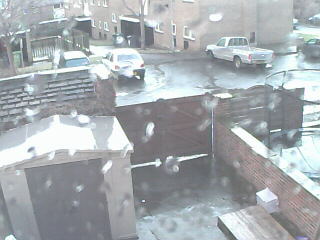
It seems however that now February is here and the snow is gone we are in for some pretty strong storms. This actually affected me today when my neighbours garden wall was blown over!

As you can see my nice new IP camera captured the event, well OK the frame before and after but you get the idea. Unfortunately for my neighbour the wall collapsed onto his pickup causing extensive damage.

A short time later when my weather station was recording gusts well over 50mph nearby drains started flowing the wrong way and it became a case of water, water everywhere!

It seems that when the new buildings were erected a few years ago that the architect while maximising used space on the building plot may have inadvertently created something of a wind tunnel.

The Gap between our properties is on a parallel (north to south) to the valley below. The wind seems to travel along the crest of the valley and be funnelled through any spaces between the houses. Fortunately the rest of the properties on green lane are pretty old and the spacing between is very generous and the funnelling effect is minimal.

I wonder if we could fit a wind turbine in there? Alas it was too much for my secondary anemometer which is now smashed in three parts.

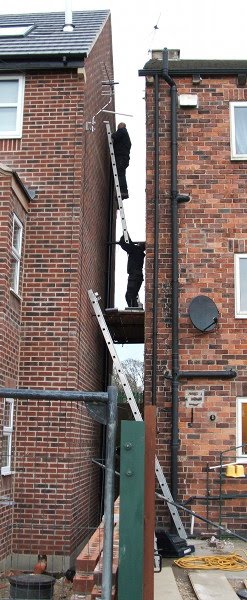
Also gaining access to the gable end wall of my property has become somewhat perilous (Hence the wonky APT antenna I cannot get fixed). Yes that really is a guy balancing on a ladder 10m high in a strong wind. And indeed the platform the ladder is resting on is built from scaffolding board wedged between the houses.

I guess the hospital emergency room being 300m away means medical assistance is on hand, even so he is braver than I am. So my weather satellite imagery will just have to come from the internet like everyone else's for a while.

Matthew Garrett: Hardware vexation

My laptop (an HP 2530p) gets quite a lot of abuse. It's been with me enough to have done the equivalent of going round the world 4 or 5 times, and it's typically just thrown in a bag without any particular care or attention being given to its care or wellbeing. It's been dropped a couple of times with the only damage being some corners that aren't really as even as they should be. All in all, it's survived amazingly well. But it recently started refusing to boot, merely flashing its LEDs. After finally finding a list of what these mean, I narrowed it down to the memory. Taking it apart and putting it back together again got things working for a while, but then it happened again. And again. So, since I have one memory module and two slots, I decided to just move the RAM in the hope that there's something physically wrong with the slot. It worked! Until I got to the BIOS splash and it informed me that Intel AMT requires that there be memory in slot 0. And didn't give me an opportunity to continue without AMT.

My hardware is conspiring against me.

Matt Zimmerman: A diversity statement for Ubuntu

The Ubuntu website states that we aim to make Ubuntu a wonderful place to participate . We developed the Ubuntu Code of Conduct to set a standard for participants to accept each other in the spirit of cooperation, and have improved it over time to state these principles more clearly. It is implicit in our philosophy that these and other Ubuntu values should hold equally true for everyone. I would like to propose that we upgrade this to an explicit statement on behalf of the project. I have spoken with many people who were interested in joining a free software project, but were put off because they felt unwelcome. I know various people who participate in Ubuntu today, but sometimes face difficult social obstacles in order to do so. Going forward, I would like for us, as members of the Ubuntu community, to make the extra effort to accept all kinds of people. This may sound simple, but it can be very difficult to put into practice. People often don t even notice they ve gotten it wrong, until the offended party points it out to them. We need tools and guidance to make this a reality. To that end, I would like to propose a diversity statement for Ubuntu. This draft has already received support from a majority of the Community Council, but I d like to take it a step further. Because I want this to be a commitment that we can all stand behind, I m also calling for support from the community as a whole. Please give this issue your consideration, and let me know in the comments if you can get on board with an official statement like this. The more support we have, the more real this commitment can be. Here s the text. Many thanks to Mary Gardiner, Valerie Aurora and Benjamin Mako Hill for their review and input.
The Ubuntu project welcomes and encourages participation by everyone. We are committed to being a community that everyone feels good about joining. Although we may not be able to satisfy everyone, we will always work to treat everyone well. Standards for behavior in the Ubuntu community are detailed in the Code of Conduct and Leadership Code of Conduct. We expect participants in our community to meet these standards in all their interactions and to help others to do so as well. Whenever any participant has made a mistake, we expect them to take responsibility for it. If someone has been harmed or offended, it is our responsibility to listen carefully and respectfully, and do our best to right the wrong. Although this list cannot be exhaustive, we explicitly honor diversity in age, culture, ethnicity, genotype, gender identity or expression, language, national origin, neurotype, phenotype, political beliefs, profession, race, religion, sexual orientation, socio-economic status, subculture, and technical ability. Some of the ideas and wording for this statement were based on diversity statements from the Python community and Dreamwidth Studios (CC-BY-SA 3.0).

6 February 2011

Dirk Eddelbuettel: Wynton Marsalis and the Jazz at Lincoln Center Orchestra

Went to the CSO on Friday night to see the annual concert of Wynton Marsalis and the Jazz at Lincoln Center Orchestra. This year's concert featured one set with four pieces from the new Vitoria Suite album---see here for a raving review. Those pieces were indeed very nice and I may to grab the disc to hear the full suite. Thhis was followed by a number of pieces composed or arranged by different band members. All in all a great concert. Hard not to love when you twelve-man strong brass section featuring four trumpets, three trombones, five saxophones supported by a nice rhythm section of three. Recommended.

Lucas Nussbaum: mutt + notmuch = perfect mail setup?

Following Our Leader, I ve just switched to using notmuch with mutt for searching (instead of maildir-utils, previously). I strongly recommend this setup to all mutt users. As a bonus, accented characters ( , , ) are now handled correctly while searching, which is quite useful in french.

Next.

Previous.