Search Results: "ema"

17 March 2009

Christian Perrier: Bug #520000

Mark Purcell reported bug #520000 on Monday March 16th, against the gsm-utils package. Bug #510000 was reported as of Dec 28th 2008. So, it took us 2.5 months for 10,000 bugs. This is still slower than our rate of 10,000 bugs/2 months but more than the pace we had for 500000-510000. Of course, in the meantime, we released lenny on Feb 14th and, therefore, the development started again and, with development, new bugs come in. To illustrate this, one will notice that bug #515000 was reported on Feb 12th. So, it took 46 days for the first 5,000 bugs and then only 32 for the remainder 5,000. In short, we're probably back to our pace of 10,000 bugs in two months. In case someone cares, the first bug reported after the release of Lenny is #515247, reported by Robin Kluth against the gvfs package. It followed the release of lenny by 25 minutes and 14 seconds. That bug isn't fixed yet but is already reported upstream.

15 March 2009

Biella Coleman: Obsessing: A Way of Life

When I teach my course on computer hackers, one of the first things that students learn is that many hackers are obsessed a viewpoint promulgated by academics and media types alike. I tend to agree with the assessment but turn it on its head a little by pointing out that many professionals (doctors, lawyers, investment bankers and my own profession, which, attracts and houses nerds and geeks alike) are equally obsessed. It is just that the professional work is legitimized via all sorts of norms, expectations, and practices, unlike hacking, which is often treated in quite exceptional terms.

Biella Coleman: Obsessing: A Way of Life

When I teach my course on computer hackers, one of the first things that students learn is that many hackers are obsessed a viewpoint promulgated by academics and media types alike. I tend to agree with the assessment but turn it on its head a little by pointing out that many professionals (doctors, lawyers, investment bankers and my own profession, which, attracts and houses nerds and geeks alike) are equally obsessed. It is just that the professional work is legitimized via all sorts of norms, expectations, and practices, unlike hacking, which is often treated in quite exceptional terms.

Kapil Paranjape: Slumdog millionaire

We managed to watch the multi-award winning "Slumdog Millionaire" this weekend. It is difficult for me to understand why people (in India or PIO's) are so upset about the movie. It is a good movie (I do not know enough about cinema to pronounce it a great movie). As a Rahman fan since "Kadal Desam" (1993 or so), my opinion on the music is a bit biased. His work on this movie is more than competent though not his best. A. R. Rahman has written better songs than "Jai Ho!" and I didn't notice anything spectacular about the rest of the music. Still, it is worth noting that his best work is in the context of Indian-style films, where there are a lot of songs; the background score of those films only stands out if it is bad! So, I suppose that the criticism of this movie by Indians is largely based on its story-line and setting. This is strange, since poverty in a Mumbai slum (to the extent that I am acquainted with it) is depicted quite accurately here. The plot (like any Dickensian story) drives home the terrible nature of poverty in cities but still manages to inject a note of optimism.
If you are lucky/strong enough to survive with your humanity intact after growing up in a Mumbai slum, then the luck required to win a TV show is nothing in comparison.

14 March 2009

Matthew Garrett: ext4, application expectations and power management

Edited to add: Sorry, it turns out that ext4 does now have a heuristic to deal with this case. However, it seems that btrfs doesn't. My point remains, though - designing a filesystem in such a way that a useful behaviour is impossible is unhelpful for the vast majority of application writers, even if it does improve performance in some other use cases.

Further edit: It's mentioned in the comments that btrfs will force a flush of data when a rename is performed as of 2.6.30. That prevents the data loss, but it means that we're still stuck with disk access when we'd be happy with that being batched up for the future. It feels like we're optimising for the wrong case here.

Original text:

There's been a certain amount of discussion about behavioural differences between ext3 and ext4[1], most notably due to ext4's increased window of opportunity for files to end up empty due to both a longer commit window and delayed allocation of blocks in order to obtain a more pleasing on-disk layout. The applications that failed hardest were doing open("foo", O_TRUNC), write(), close() and then being surprised when they got zero length files back after a crash. That's fine. That was always stupid. Asking the filesystem to truncate a file and then writing to it is an invitation to failure - there's clearly no way for it to intuit the correct answer here. In the end this has been avoided by avoiding delayed allocation when writing to a file that's just been truncated, so everything's fine.

However, there's another case that also breaks. A common way of saving files is to open("foo.tmp"), write(), close() and then rename("foo.tmp", "foo"). The mindset here is that a crash will either result in foo.tmp being zero length, foo still being the original file or foo being your new data. The important aspect of this is that the desired behaviour of this code is that foo will contain either the original data or the new data. You may suffer data loss, but you won't suffer complete data loss - the application state will be consistent.

When used with its (default) data=ordered journal option, ext3 provided these semantics. ext4 doesn't. Instead, if you want to ensure that your data doesn't get trampled, it's necessary to fsync() before closing in order to make sure it hits disk. Otherwise the rename can occur before the data is written, and you're back to a zero length file. ext4 doesn't make guarantees about whether data will be flushed before metadata is written.

Now, POSIX says this is fine, so any application that expected this behaviour is already broken by definition. But this is rules lawyering. POSIX says that many things that are not useful are fine, but doesn't exist for the pleasure of sadistic OS implementors. POSIX exists to allow application writers to write useful applications. If you interpret POSIX in such a way that gains you some benefit but shafts a large number of application writers then people are going to be reluctant to use your code. You're no longer a general purpose filesystem - you're a filesystem that's only suitable for people who write code with the expectation that their OS developers are actively trying to fuck them over. I'm sure Oracle deals with this case fine, but I also suspect that most people who work on writing Oracle on a daily basis have very, very unfulfilling lives.

But anyway. We can go and fix every single piece of software that saves files to make sure that it fsync()s, and we can avoid this problem. We can probably even do it fairly quickly, thanks to us having the source code to all of it. A lot of this code lives in libraries and can be fixed up without needing to touch every application. It's not the end of the world.

So why do I still think it's a bad idea?

It's simple. open(),write(),close(),rename() and open(),write(),fsync(),close(),rename(), are not semantically equivalent. One is "give me either the original data or the new data"[2]. The other is "always give me the new data". This is an important distinction. fsync() means that we've sent the data to the disk[3]. And, in general, that means that we've had to spin the disk up.

So, on the one hand, we're trying to use things like relatime to batch data to reduce the amount of time a disk has to be spun up. And on the other hand, we're moving to filesystems that require us to generate more io in order to guarantee that our data hits disk, which is a guarantee we often don't want anyway! Users will be fine with losing their most recent changes to preferences if a machine crashes. They will not be fine with losing the entirity of their preferences. Arguing that applications need to use fsync() and are otherwise broken is ignoring the important difference between these use cases. It's no longer going to be possible to spin down a disk when any software is running at all, since otherwise it's probably going to write something and then have to fsync it out of sheer paranoia that something bad will happen. And then probably fsync the directory as well, because what if someone writes an even more pathological filesystem. And the disks sit there spinning gently and chitter away as they write tiny files[4] and never spin down and the polar bears all drown in the bitter tears of application developers who are forced to drink so much to forget that they all die of acute liver failure by the age of 35 and where are we then oh yes we're screwed.

So. I said we could fix up applications fairly easily. But to do that, we need an interface that lets us do the right thing. The behaviour application writers want is one which ext4 doesn't appear to provide. Can that be fixed, please?

[1] xfs behaves like ext4 in this respect, so the obvious argument is that all our applications have been broken for years and so why are you complaining now. To which the obvious response is "Approximately anyone who ever used xfs expected their data to vanish if their machine crashed so nobody used it by default and seriously who gives a shit". xfs is a wonderful filesystem for all sorts of things, but it's lousy for desktop use for precisely this reason.

[2] Yes, ok, we've just established that it actually isn't that in the same way that GMT isn't UTC and battery refers to a collection of individual cells and so you don't usually put multiple batteries in your bike lights, but the point is that this is, for all practical intents and purposes, an unimportant distinction and not one people should have to care about in their daily lives.

[3] The disk is free to sit there bored for arbitrary periods of time before it does anything, but that's fine, because the OS is behaving correctly. Sigh.

[4] Dear filesystem writers - application developers like writing lots of tiny files, because it makes a large number of things significantly easier. This is fine because sheer filesystem performance is not high on the list of priorities of a typical application developer. The answer is not "Oh, you should all use sqlite". If the only effective way to use your filesystem is to use a database instead, then that indicates that you have not written a filesystem that is useful to typical application developers who enjoy storing things in files rather than binary blobs that end up with an entirely different set of pathological behaviours. If I wanted all my data to be in oracle then I wouldn't need a fucking filesystem in the first place, would I?

Adam Rosi-Kessel: Clay Shirky on Newspapers

Excellent summary of where we find the newspaper business today:
Round and round this goes, with the people committed to saving newspapers demanding to know If the old model is broken, what will work in its place? To which the answer is: Nothing. Nothing will work. There is no general model for newspapers to replace the one the internet just broke.
Oops 3/16/09. Shirky, not Sharky.

13 March 2009

Obey Arthur Liu: Summer of Code 09 @ Debian update [updated]

Just a quick update to let you know how the Debian bid for the Google Summer of Code is going. We re doing great right now. Our application is sent out, you can consult the public part here. This year, we re committed to doing a great Summer of Code performance, starting first by improving communication with the Debian community. We opened a Twitter feed for you Twitter freaks: http://twitter.com/DebianGSoC. It will be updated with live information relevant to students and devs alike during the whole summer. UPDATE: We re now also on identi.ca : http://identi.ca/debiangsoc :) We now have 12 applications on our wiki. Come, add your ideas and discuss them on our IRC channel (#debian-soc on irc.debian.org) and mailing-list. Packaging Debian Installer Blends Bug tracking Building infrastructure

MJ Ray: Paralysed Perl Package Problem

With any luck, someone has seen this problem before and can fix it easily. I don t seem to be able to find the fix by searching, but the search terms feel like they re either too general or too specific. I was trying to install some perl software on a debian lenny system that was upgraded from etch (and previously from sarge). After installing the dependencies, I started getting errors like this:-
$ perl -MYAML::Syck -e print
Can't locate YAML/Syck.pm in @INC (@INC contains:
/usr/local/lib/perl5/5.10.0/i686-linux /usr/local/lib/perl5/5.10.0
/usr/local/lib/perl5/site_perl/5.10.0/i686-linux
/usr/local/lib/perl5/site_perl/5.10.0 .).
BEGIN failed--compilation aborted.
Update: Well done to Raphael who spotted the local that I d overlooked. D oh! Now to see if I can discover where that came from. Update 2: Also thanks to Florian who emailed in at about the same time (I don t read my email as much as my website dashboard, usually).

Then I discovered that the debian mirror being used (which is in the same city, and in a nearby network) is marked as bad on the health check. I switched mirrors to a known-good one that I ve used for other systems recently, but no joy. I think a key symptom is this bit near the end of the output of perl -V:
Compiled at Aug 4 2008 09:48:59
@INC:
/usr/local/lib/perl5/5.10.0/i686-linux
/usr/local/lib/perl5/5.10.0
/usr/local/lib/perl5/site_perl/5.10.0/i686-linux
/usr/local/lib/perl5/site_perl/5.10.0
Our good systems show a December compiled at date and a much longer @INC list. I ve tried reinstalling pretty much every package I think might be connected, including libc6, libperl5.10, perl, perl-base and perl-modules (those last four are all version 5.10.0-19). I really don t want to reinstall the whole system because it s behind an irritating firewall that will make it a 10-hour round-trip site visit. I m currently hunting and removing obsolete packages to try to make sure they re not causing problems, because I m running out of straws to clutch at. How would you recover a debian system from this?

12 March 2009

Martin Michlmayr: Debian support for QNAP TS-119 and TS-219 Turbo NAS coming

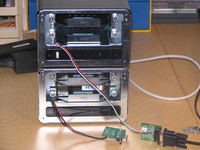
TS-219 on top of TS-209 I received a sample of QNAP's new TS-219 Turbo NAS today. The TS-119 and TS-219 devices are an upgrade to QNAP's TS-109 and TS-209 devices and were announced earlier this month at CeBIT. The new TS-219 uses the same robust case as the TS-209 but offers much more performance: The numbers I've seen about the Kirkwood CPU suggest that the TS-219 will indeed give a very significant performance boost. So far, the TS-219 looks very nice. My only complaint is that QNAP didn't export the second Ethernet port the Kirkwood chip offers, but I suspect this is because they wanted to stay as close to the original design of the TS-209 as possible. In any case, the TS-219 is a nice machine and I look forward to porting Debian to it. As a first step, this means getting the mainline kernel to run on the device and adding a kernel for Kirkwood to the archive (the latter is needed for a number of other devices based on Kirkwood anyway). Hopefully, the remaining porting work and integration into the Debian installer should be fairly straightforward given that the TS-209 is already supported in Debian. I'm sure I'll find out as I dig into the details... I'll give periodic updates of my progress. In the meantime, I've created an image gallery of the TS-219.

Theodore Ts'o: Delayed allocation and the zero-length file problem

A recent Ubuntu bug has gotten slashdotted, and has started raising a lot of questions about the safety of using ext4. I ve actually been meaning to blog about this for a week or so, but between a bout of the stomach flu and a huge todo list at work, I simply haven t had the time. The essential problem is that ext4 implements something called delayed allocation. Delayed allocation isn t new to Linux; xfs has had delayed allocation for years. Pretty much all modern file systems have delayed allocation, according to the Wikipedia Allocate-on-flush article, this includes HFS+, Reiser4, and ZFS; btrfs has this property as well. Delayed allocation is a major win for performance, both because it allows writes to be streamed more efficiently to disk, and because it can reduce file fragmentation so that later on they can be read more efficiently from disk. This sounds like a good thing, right? It is, except for badly written applications that don t use fsync() or fdatasync(). Application writers had gotten lazy, because ext3 by default has a commit interval of 5 seconds, and and uses a journalling mode called data=ordered. What does this mean? The journalling mode data=ordered means that before the commit takes place, any data blocks are
associated with inodes that are about to be committed in that transaction will be forced out to disk. This is primarily done for security reasons; if this is not done (which would be the case if the disk is mounted with the mount option data=writeback), then any newly allocated blocks might still contain previous data belonging to some other file or user, and after a crash, accessing that file might result in a user seeing unitialized data that had previously belonged to another user (say, their e-mail or their p0rn), which would be a Bad Thing from a security perspective. However, this had the side effect of essentially guaranteeing that anything that had been written was guaranteed to be on disk after 5 seconds. (This is somewhat modified if you are running on batteries
and have enabled laptop mode, but we ll ignore that for the purposes of this discussion.) Since ext3 became the dominant filesystem for Linux, application writers and users have started depending on this, and so they become shocked and angry when their system locks up and they lose data even though POSIX never really made any such guarantee. This become especially noticeable on Ubuntu, which uses many proprietary, binary-only drivers, which caused some Ubuntu systems to become highly unreliable, especially for Alpha releases of Ubuntu Jaunty, with the net result that some Ubuntu users have become used to their machines regularly crashing. (I use bleeding edge kernels, and I don t see the kind of unreliability that apparently at least some Ubuntu users are seeing, which came as quite a surprise to me.) So what are the solutions to this? One thing is that the applications could simply be rewritten to properly use fsync() and fdatasync(). This is what is required by POSIX, if you want to be sure that data has gotten written to stable storage. Some folks have resisted this suggestions, on two grounds; first, that it s too hard to fix all of the applications out there, and second, that fsync() is too slow. This perception that fsync() is too slow was most recently caused by a problem with Firefox 3.0. As Mike Shaver put it:
On some rather common Linux configurations, especially using the ext3 filesystem in the data=ordered mode, calling fsync doesn t just flush out the data for the file it s called on, but rather on all the buffered data for that filesystem.
Fundamentally, the problem is caused by data=ordered mode. This problem can be avoided by mounting the filesystem using data=writeback or by using a filesystem that supports delayed allocation such as ext4. This is because if you have a small sqllite database which you are fsync(), and in another process you are writing a large 2 megabyte file, the 2 megabyte file won t be be allocated right away, and so the fsync operation will not force the dirty blocks of that 2 megabyte file to disk; since the blocks haven t been allocated yet, there is no security issue to worry about with the previous contents of newly allocated blocks if the system were to crash at that point. Another solution is a set of patches to ext4 that has been queued for 2.6.30 merge window. These three patches (with git id s bf1b69c0, f32b730a, and 8411e347) will cause a file to have any delayed allocation blocks to be allocated immediately when a file is replaced. This gets done for files which were truncated using ftruncate() or opened via O_TRUNC when the file is closed, and when a file is renamed on top of an existing file. This solves the most annoying set of problems where an existing file gets rewritten, and thanks to the delayed allocation semantics, that existing file gets replaced with a zero-length file. However, it will not solve the problem for newly created files, of course, which would have delayed allocation semantics. Yet another solution would be to mount ext4 volumes with the nodelalloc mount option. This will cause a significant performance hit, but apparently some Ubuntu users are happy using proprietary Nvidia drivers, even if it means that when they are done playing World of Goo, quitting the game causes the system to hang and they must hard-reset the system. For those users, it may be that nodelalloc is the right solution for now personally, I would consider that kind of system instability to be completely unacceptable, but I guess gamers have very different priorities than I do. A final solution which might not be that hard to implement would be a new mount option, data=alloc-on-commit. This would work much like data=ordered, with the additional constraint that all blocks that had delayed allocation would be allocated and forced out to disk before a commit takes place. This would probably give slightly better performance compared to mounting with nodelalloc, but it shares many of the disadvantages of nodelalloc, including making fsync() to be potentially very slow because it would force all dirty blocks to be forced out to disk once again. What s the best path forward? For now, what I would recommend to Ubuntu gamers whose systems crash all the time and who want to use ext4, to use the nodelalloc mount option. I haven t quantified what the performance penalty will be for this mode of operation, but the performance will be better than ext3, and at least this way they won t have to worry about files getting lost as a result of delayed allocation. Long term, application writers who are worried about files getting lost on an unclena shutdown really should use fsync. Modern filesystems are all going to be using delayed allocation, because of its inherent performance benefits, and whether you think the future belongs to ZFS, or btrfs, or XFS, or ext4 all of these filesystems used delayed allocation. What do you think? Do you think all of these filesystems have gotten things wrong, and delayed allocation is evil? Should I try to implement a data=alloc-on-commit mount option for ext4? Should we try to fix applications to properly use fsync() and fdatasync()? Related posts (automatically generated):
  1. Don t fear the fsync! After reading the comments on my earlier post, Delayed allocation...
  2. SSD s, Journaling, and noatime/relatime On occasion, you will see the advice that the ext3...
  3. Ext4 is now the primary filesystem on my laptop Over the weekend, I converted my laptop to use the...

Gunnar Wolf: So it's "me too" time?

Wouter and Christian have started bragging about their travel arrangements to attend DebConf, with probably insane amounts of toxic substances aimed at making DebConf9 the smelliest DebConf ever. So, it is time for me to announce my intentions as well. I have booked my ticket to travel MEX-MAD, leaving on Thursday 16/07/2009 and arriving to Spain on Friday 17. That means I will be getting to C ceres Friday evening. And I am flying back on Sunday 02/08/2009, which only means that I'll be jetlagged on Monday at work :-P Buying plane tickets when your country's currency has lost 50% of its worth against any other major currency in the world (US dollars are now at ~MX$15.50, and Euros are quickly approaching MX$20), let me tell you, is no fun. Even less if the plane tickets have increased their cost in absolute terms as well, due to the decrease in demand. But, yes, the good news do stand: See you in C ceres!

11 March 2009

Steve Kemp: Oh my God, someone ate my entire pie!

Yesterday was my birthday, and it was full of cookies, pies, magical pixie dust and things made entirely of sugar and spice! The remainder of the day was spent re-installing Debian Lenny upon my EEE PC - Somehow I managed to completely screw the system. Because the EEE PC is one of those ultra-portable machines I mostly used it when I was travelling, or outdoors. That mean I was generally receiving poor connectivity and the system packages weren't up to date. While I was in bed I figured I'd dist-upgrade it to the recently released Lenny. Unfortunately I started the dist-upgrade inside X.org, once I realised this I figured I'd cancel the operation via Ctrl-c. Bad news everbody: I think I was unlucky enough to interrupt an upgrade of libc, or something equally critical. Every single application gave segfaults afterward. I had two open root terminals and I could navigate around via cd .., and "echo *", but all other commands such as sudo, dpkg, strace just gave segfaults. (Even static commands gave errors - so it might have been the dynamic loader that was borked, I admit I didn't look too closely.) I figured reinstalling would be a good solution since the machine has a 4Gb root partition and /home was stored on a separate 16Gb volume. Unfortunately I managed to misjudge the installer's partitioning step and nuke the partition table on the external volume so I ended up losing the whole system. Happily reinstallation was a breeze as my home network is setup to allow installation via PXE network booting (at some point I should document NFS-root PXE-booting). It took me longer to fiddle with the BIOS on the EEE PC to allow network booting than it did to complete a minimal install. Which I guess is good. I still need to restore my backup of /home/, but that can wait a few days. Right now I'm loathe to touch the machine at all - although I did distract myself by getting KVM to PXE boot:

# create 4gb disk image
dd if=/dev/zero of=/tmp/img.img bs=1024 count=4096k
# launch KVM
sudo kvm -no-acpi
  -boot n -tftp /var/lib/tftpboot/ -bootp /pxelinux.0
  -hda /tmp/img.img
  -net nic,macaddr=00:0E:35:be:de:ad  -net user
It seems that KVM wants to have access to the local TFTP root directory so I just pointed it at that. Since my desktop machine is also my TFTP + DHCP host that works out nicely. (A quick scan of the manual suggests that QEMU/KVM has funky built-in TFTP code, so it doesn't actually forward TFTP requests over the network.) DHCP requests were certainly passed around as expected though and were answered via my local dnsmasq installation. I did see errors at every DHCP request in syslog, but they seemed harmleess enough:
gold dnsmasq[29241]: no address range available for DHCP request via qemu0
*shrugs* ObFilm: Never Been Kissed.

10 March 2009

Biella Coleman: FDA Approves Depressant Drug For The Annoyingly Cheerful

Last week I was confronted head on with an uber cheerful person and he was clearly not undergoing this fine new treatment.

Biella Coleman: FDA Approves Depressant Drug For The Annoyingly Cheerful

Last week I was confronted head on with an uber cheerful person and he was clearly not undergoing this fine new treatment.

Francois Marier: Handling security bugs in your Free Software project

If you are managing a Free Software project, you may eventually be confronted with a security vulnerability. Normally bugs in the Open Source world are discussed in a transparent way on public forums. In the case of security bugs however, there are benefits to temporarily withholding these details from the public.

Some people describe this approach as responsible disclosure. It boils down to this:
if the vulnerability is not publicly known, warn the vendors first and give them some time to fix it before making the details public.
If the vulnerability is already public knowledge, then you can focus on fixing it as soon as possible and maybe let reporters know about a better way to report their findings.
Sample Security PolicyHere's the procedure we now follow in the Mahara project for security bugs we found ourselves or which have been privately disclosed to us through security@mahara.org:
  1. Figure out the extent of the problem: which versions of Mahara are affected by this problem?
  2. Fix the problem on all supported branches of the project in a private source control repository.
  3. Share the vulnerability information with vendor-sec and request a CVE identifier.
  4. Prepare release tarballs and packages.
  5. Draft a security advisory for the Security forum.
  6. Wait until the embargo date to push the release out.
Emails to vendor-sec should include:
Benefits of properly handling security bugs
First and foremost, it protects end-users by giving them a chance to download and install fixed versions of your software before widespread exploitation of the security flaws.

Secondly, it may increase your project credibility. While you are admitting that your software has flaws, you are also demonstrating that your project is committed to dealing with the most serious ones promptly and in a responsible manner.

Finally, sharing security flaws and having your fixes reviewed by a select group of experts may reveal extra vulnerabilities you missed while preparing your patches. This gives you an opportunity to improve your fixes before they are released and to avoid having to issue yet another security advisory a few days later.

Big thanks to Steffen Joeris for his help in shaping the Mahara policy!

Biella Coleman: Automatic Content/ID/System

Fred von Lohmman gave a lively talk tonight about public interest law (and I hope he inspired at least some NYUlawites to follow in that path) with a focus on Youtube s content ID system now being used by Warner Music to automatically delete/censor videos, such as this one from Youtube. Go Google. Go Youtube. Go Warner Music.

Biella Coleman: Automatic Content/ID/System

Fred von Lohmman gave a lively talk tonight about public interest law (and I hope he inspired at least some NYUlawites to follow in that path) with a focus on Youtube s content ID system now being used by Warner Music to automatically delete/censor videos, such as this one from Youtube. Go Google. Go Youtube. Go Warner Music.

9 March 2009

Ingo Juergensmann: IPv6 connectivity

I got an IPv6 tunnel/subnet during the weekend and set it up. So, for everyone who's visiting my blog or Buildd.Net can do this via IPv6 now. At least when I've not broke it again in the meantime. ;)

Sadly it's not a native IPv6 connectivity because the hosting company want charging me an extra amount of 29.- for that. Given the fact that the IPv4 Exhaustion Counter says that the IPv4 might be running out in 763 days, I don't think that this kind of extra charging will speed up the transition to IPv6.


Anyway, when you encounter problems in accessing my sites via IPv6, please drop me a note! For example I still need to setup rDNS and email... but http should work now - except for my SSL sites... but maybe that's a different story...

Decklin Foster: Another Monopoly Rant

A cautionary tale: Verizon's DSL salespeople are completely incompetent. Several weeks ago, I ordered residential service. I was unable to get the prequalification app on their web site to work for my address, so I called in. I was told (1) I could get a modem for free, and (2) that I didn't need to do anything for the install except plug it in -- they'd just be turning something on at the CO, perhaps even before the date my service was scheduled to begin. These were both, of course, pure fiction. On the install date, while at work, I got a call from a tech who had shown up at my house to rewire something. Luckily, I was able to rendezvous with him later in the day. The service worked briefly and then went down. Over the next few days, I called in, was told to wait at home for 8 hours, no one showed up, I called in again, was told "oh, sorry, it's going to be tomorrow", waited all day the next day, no one showed up again... a week and two actual visits later, I finally had connectivity. I can't really blame them for whatever the line problem was, but to repeatedly treat my time as worthless by making me wait at home for an entire day just in case a tech can get there, even though it's highly unlikely they will, is just offensive. Then, I received my first bill and... was charged for the modem. Calling in again, I was told that the deal I was offered was for online orders only, and even if I specifically confirmed with the sales person that he could get me the same deal since the web site wouldn't let me complete an order (and I already had an old, power-sucking modem anyway), there was no way I could get a refund. So I got an RMA and planned to go shopping for a replacement (people are selling the same model on Craigslist for $10). The RMA came in an email which also told me that if I did not return the equipment within X days I would be charged $100. This is all utter bullshit. Do not use Verizon. If your only other option is Comcast, as it is here, just steal your neighbor's wireless or tether your 3G. They could have left me reasonably happy with the whole botched situation if they had provided a honest estimate of how long it would really take to get someone out (even if it was "days"), or given me access to the same information without having to go through a call center of people only trained to read a script about how to power-cycle your router or whatever. And if they actually apologized for a saleperson convincing me to sign up by lying about what I would be charged. But why would they? What are you going to do, switch to an ISP that treats you like a human being and doesn't fuck with your traffic? Ha. Ha ha ha. Good luck with that.

Russell Coker: I need an LMTP server

I am working on a system where a front-end mail server sends mail to what it considers to be a LDA (Local Delivery Agent) which actually sends mail to a back-end server via LMTP. I can t remove that fake LDA from the design because it does a bunch of business specific processing along the way. I am working on changing the back-end from Cyrus to Dovecot. Currently the mail goes from the fake LDA to the Cyrus LMTP server. What I would like to do is to have an LMTP server run on the back-end machine that launches the Dovecot deliver program immediately and then returns an appropriate code. So far I have been experimenting with having Postfix run on the back-end to use deliver as the real LDA. The first problem with this is that the mail will be written to the Postfix queue and then written to the mail store. Doubling the number of writes is a real problem for a system that is going to be write-bottlenecked - it would significantly increase the hardware costs. The second problem is that when an account goes over quota the back-end server would be generating a bounce message. I would prefer the front-end server to generate the bounce on an un-munged message. Basically all I need is a simple daemon (which could even be launched from inetd) that talks LMTP (a very simple cut-down version of SMTP) and executes a single command to receive the data. It might be necessary to serialise running the delivery process, in which case the mail data would have to be stored in memory and there would need to be a semaphore around executing the delivery program. Does anyone know of such a program? If not then I ll have to write it myself (which shouldn t be difficult) and GPL it. If I have to do that then I need a suitable name for it. Any suggestions would be appreciated.

Next.

Previous.