Search Results: "ana"

16 May 2010

Russell Coker: systemd a Replacement for init etc

The systemd projecct is an interesting concept for replacing init and related code [1]. There have been a few attempts to replace the old init system, upstart is getting some market share in Linux distributions and Solaris has made some interesting changes too. But systemd is more radical and offers more benefits. While it s nice to be able to start multiple daemons at the same time with dependencies and doing so offers improvements to the boot times on some systems that really doesn t lead to optimal boot times or necessarily correct behavior. Systemd is designed around a similar concept to the wait option in inetd where the service manager (formerly inetd and now the init that comes with systemd) binds to the TCP, UDP, and Unix sockets and then starts daemons when needed. It apparently can start the daemons as needed which means you don t have a daemon running for months without serving a single request. It also implements some functionality similar to automount which means you can start a daemon before a filesystem that it might need has been fscked. This means that a large part of the boot process could be performed in reverse. The current process is to run fsck on all filesystems, mount them, run back-end server processes such as database servers and then run servers that need back-end services (EG a web server using a database server). The systemd way would be for process 1 to listen on port 80 and it could then start the web server when a connection is established to port 80, start the database server when a connection is made to the Unix domain socket, and then mount the filesystem when the database server tries to access it s files. Now it wouldn t be a good idea to start all services on demand. Fsck can take hours on some filesystems and is never quick at the best of times. Starting a major daemon such as a database server can also take some time. So a daemon that is known to be necessary for normal functionality and which takes some time to start could be started before a request comes in. As fsck is not only slow but usually has little scope for parallelisation (EG there s no point running two instances of fsck when you only have one hard disk), so hints as to which filesystem to be checked first would need to be used. Systemd will require more SE Linux integration than any current init system. There is ongoing debate about whether init should load the SE Linux policy, Debian has init loading the policy while Fedora and Ubuntu have the initramfs do it. Systemd will have to assign the correct SE Linux context to Unix domain socket files and listening sockets for all the daemons that support it (which means that the policy will have to be changed to allow all domains to talk to init). It will also have to manage dbus communication in an appropriate way which includes SE Linux access controls on messages. These features mean that the amount of SE Linux specific code in systemd will dwarf that in sysvinit or Upstart which among other things means that it really wouldn t make sense to have an initramfs load the policy. They have a qemu image prepared to demonstrate what systemd can do. I was disappointed that they prepared the image with SE Linux disabled. All I had to do to get it working correctly was to run the command chcon -t init_exec_t /usr/local/sbin/systemd and then configure GRUB to not use selinux=0 on the kernel command line. Another idea is to have systemd start up background processes for GUI systems such as KDE and GNOME. Faster startup for KDE and GNOME is a good thing, but I really hope that no-one wants to have process 1 manage this! Having one copy of systemd run as root with PID 1 to start daemons and another copy of the same executable run as non-root with a PID other than 1 to start user background processes is the current design which makes a lot of sense. But I expect that some misguided person will try to save some memory by combining two significantly different uses for process management.

15 May 2010

Erich Schubert: How to block "Facebook Like" tracking in Chrome

Since AdBlock in Chrome does not block, just hide (the same probably applies to Safari and other WebKit-based-browsers), here's a simple method to actually block Facebook Like tracking:Use a proxy.pac file, also known as Proxy auto-config. Then redirect Facebook Like to a blackhole or filtering proxy. I use privoxy, and this replaces Facebook Like embeds with an error message, which enables me to see which site uses Facebook like and that my filter is working.Here's the relevant excerpt of my proxy.pac file:
function FindProxyForURL(url, host)  
  var fblike = /https?:\/\/([^/]*)\.facebook\.com\/(plugins widgets)\/like.*/;
  if (fblike.test(url))  
    return "PROXY 127.0.0.1:8118";
   
  return "DIRECT";
 
Where "127.0.0.1:8118" is the proxy to use. If you use an unreachable proxy - I've seen 255.255.255.0:3421 used as blackhole server - then it should just time out as "unreachable". Or you use a proxy such as privoxy and block the URL there. Any proxy that refuses to serve the request will do.Note that you can add arbitrary domains and regexps to this filter, if you want to block additional sites, such as Google Analytics, that you do not want to be able to track your surfing behaviour.

13 May 2010

Aigars Mahinovs: Hacker Neo caught in Latvia

A scandal has been brewing in Latvia over the last half year and yesterday the activity spiked shocking the media and some IT people in the country. I ll go back and explain what happened first, what is happening now and why this could have a heavy impact on IT and journalists in Latvia. At the end of last year, there were rumours that the IT system of Latvia s Internal Revenue System was hacked and millions of documents had been downloaded by multiple organizations. Shortly thereafter more details on the glaring security hole became public (after it was closed). There is a full electronic interface to give all reports to the IRS electronically (at http://eds.vid.gov.lv) and as part of that system you could also view and export monthly report summaries about your organization into XML and PDF files. After the system checked that you are authorized to access the report, you were redirected to the URL to actually download the report by report ID (as a single param in a GET request). Unfortunately, report IDs were predicable and the script that gave the reports for download did not check if you were authorized to get that report. It did not even check if were logged into the system. There were suspicions that the authorization was disabled on purpose to allow to leak data on purpose, but apparently it was an error of forgetting to disable debug code in production environment. The error was discovered only because the firewall administrator noticed an unexplained stable increase of traffic, especially during night hours when typically the traffic fully stopped. Apparently a single hacker (who later identified himself as Neo to the press) discovered the flaw and wrote a script to just try all possible report ids and get as much data out as possible. This had been going on for months, before someone noticed. After the flaw was discovered and a bit of time passed, Neo made his first move he published the list of top salaries in a governmental company, that clearly showed that the top leadership of this company failed to cut their salary by 40%, like everyone elses during harsh budget cuts of 2009. He stripped the names and ids of the specific employees, but named the company which made it pretty easy to figure out who was who. The society was outraged that the top managers in a government owned company failed to comply with the strict pay cut that everyone else in government had to endure. But after a few weeks the outrage subsided and no action followed from the government or law enforcement. Neo continued to release documents detailing salaries of top managers in different Latvian government companies. And each time after short outrage, nothing happened. Neo gave an interview where he said that he was disappointed in the passivity of the Latvian people in face of such blatant injustices. After a few month Neo went silent, promising to return before parliamentary elections this fall. However, this week a new development shocked everyone in the middle of the night two police SWAT teams went into action: one detained Ilm rs Poik ns, a researcher in artificial intelligence at the University of Latvia s Computer Science department and another raided the home of a Latvian TV journalist Ilze Nagle who interviewed Neo. Poik ns confessed of being Neo the next day and was released (with travel restrictions, pending trial) today. Politicians reacted immediately opposition demanded the resignation of the Interior Minister over such blatant disregard of freedom of press and another politician (who is also a famous lawyer) Aleksejs Loskutovs volunteered to defend Neo pro-bono (on Twitter, no less). Almost all Latvian online media have the arrest of Neo and the raid on the home of a journalist as main stories of the day. As a legal titbit, we also know that Neo is being charged with breaking statutes 145 and and 244p2 of the criminal law. Statute 145 is hard to find applicable in this situation as talks about actions done by people authorized (..) to access [private] information . Statute 244p2 will also be hard to pin down as it mentions influencing system resources of (an IT system) and if such action caused severe harm . It looks like the first part talks about at least a DoS attack (which did not happen in this case) and also there was no measurable harm from these leaks. Also Neo was careful to strip all personally identifying information (such as names, social security numbers and addresses of the employees in question), so it will be hard to pin him on that. Also no actual breaking or other modification of an IT system occurred. And no specialized software was used beyond a trivial script such as :
for i in range(0,7000000):
    wget('https://eds.vid.gov.lv/getRep.aspx?id='+str(i))
A lot of commentators on the Internet likened the situation to walking trough an unlocked door and stealing something. I think that analogy is very incorrect there was no door, and nothing went missing after the action. I came up with a different analogy there was this corridor with a lot of doors in IRS, locked steel doors. You were instructed to go to a room with a specified number and given a key to that room to unlock it and see your secret info. However, that corridor opened out to the street on one end, oh and also the walls of the rooms with all the secrets were transparent. So Neo walked into the corridor, looked at some of the secrets, wrote them down (to remember them better) and then went out and discussed the worst examples abuses of power he saw. In the end IRS had to learn their lesson if you have to put naked photos of yourself on the Internet (or something equally embarrassing), then make damn sure you password protect that, but if you don t then don t cry that someone hacked you and stole you pictures. What other people think:
http://freespeechlatvia.blogspot.com/2010/05/neo-released-under-restrictions.html We ll see how the story develops soon.

11 May 2010

Sune Vuorela: The Debian-KDE specific things ?

So. I was wondering, which nice distro specific tools do exist in debian/gnome or in $other/kde that debian/kde is missing? We have kalternatives for managing alternatives, we have a update notifier frontend in progress and after google summer of code, hopefully a package management frontend, aptitude-qt. (Made by Piotr). But what other distribution specific tools are we missing for Debian-KDE ?

Ritesh Raj Sarraf: apt-offline 0.9.8

I just uploaded apt-offline version 0.9.8 to sid. Hopefully this is the one that would be part of squeeze. For those who still arent aware of apt-offline, it is an Offline Package Manager for apt.I wrote a small howto that can give more details about it.

Andrew Pollock: [life] One week later

Zoe's a week old today. As such things tend to do, this feels like both an eternity and no time at all. We've been back to the paediatrician twice since I last blogged. Zoe's weight is now on the increase again. Today she weighed in at 6 lbs 3 oz (2806 grams) (I think. My brain has gone a bit fuzzy) We're largely sticking with bottle feeding pumped breast milk for now. Apparently 7 lbs is the magic size where they've got enough strength to feed exclusively at the breast. Sleep-wise, I think we're all doing reasonably well. Zoe just eats, sleeps and poops. Sometimes we need to wake her up to have a feed. I think the longest we've let her got is 4.5 hours. She's taking a lot of milk at each feeding session - up to 90 mL, so I expect that she'll have blasted past her birth weight by the time she's two weeks old. It'll be good when she's exclusively breastfeeding. The current regime is a little bit tiring. Zoe wakes up (or gets woken up). I change her diaper and give her a bottle. Sarah tries a little bit of breastfeeding. I put Zoe back in her crib. Sarah pumps some milk for the next feeding session, and I go and wash and sterilise bottles and pumping paraphernalia. If Zoe's feeding every three hours, this only really gives us two hours to get anything else done. Not that I'm complaining, mind you. At the paediatrician's this morning, there was another father with the same LPCH diaper bag that we'd received while we were in the hospital. Turned out he had a two-week old boy. I asked how the sleep levels were going, and he exclaimed about how they were only getting 2.5 hours at a time, and his son would raise the roof. I mentioned the 4.5 hour stint that we'd managed to have, and he was totally gobsmacked. In other news, it seems like Sarah has a bit of UTI, which has totally wiped her out this afternoon. She got a 3 day course of antibiotics this afternoon, so hopefully that'll fix her up. Zoe at 6 days of age

10 May 2010

Romain Beauxis: Ubuntu, the firm and its employees

This post is not meant to be offensive in any way. I would just like to write down things that came to my mind recently. It all started when I was considering applying for the right to upload the package I maintain into Ubuntu. Looking at the procedure, I realized that this needs to be present during an IRC meeting at a given date online. This stopped me immediately. I am working most of my day-time and, given the time zone I am living now, this was not an option. But, since I had registered to the corresponding mailing list, I started receiving mails of other applicants that where trying to arrange things with their work and private life to be able to participate. Now, today, I stumbled upon these notes of Mark's presentation in Bruxelles, relayed by a friend that is not either working for Ubuntu. Reading it gave me a strong taste of management-oriented presentation, with all this sort of "yeah we want our product in every box next year" propaganda. Not like Steve Ballmer, fortunately, but not far perhaps. So, yeah, there is something that makes me uncomfortable with Ubuntu. I am really happy by its success and I will continue to recommend it to friends around me. However, I wonder if, in a way, Ubuntu is not a model of commercial company where a minimal core of developers are actually payed, while a second layer of developers are fan-boys that are willing to participate as if there were employees but without being actually payed, and a third layer being the open-source developers whose work is actually what makes 90% of the core of the OS. A very good illustration is at the end of the note from Mark's presentation. It reads:
Somebody asks about advertising Ubuntu, looks like there are no plans for the moment to actually advertise Ubuntu across traditional media. Mark uses the Ubuntu Manual as an example of how Ubuntu gets advertised and will reach the mainstream, Mark points out myself and the room applauds the Ubuntu Manual Project! Woohoo!
Now, guess what:
About Us We are a group of individuals trying to promote the use of Ubuntu and its variants. This is a private web site that is not connected in any official or financial way with Ubuntu, Canonical PL or Ubuntu.com. Official Ubuntu guides and downloads are freely available at www.ubuntu.com. Ubuntu is a registered trademark of Canonical PL
Source: http://ubuntumanual.org/about-us

9 May 2010

Robert Collins: Maintainable pyunit test suites

There s a test code maintenance issue I ve been grappling with, and watching others grapple with for a while now. I ve blogged about some infrastructural things related to it before, but now I think its time to talk about the problem itself. The problem shows up as soon as you start writing setUp functions, or custom assertThing functions. And the problem is where do you put this code?
If you have a single TestCase, its easy. But as soon as you have two test classes it becomes more difficult. If you choose either class, the other class cannot use your setUp or assertion code. If you create a base class for your tests and put the code there you end up with a huge base class, and every test paying the total overhead of your test needs, rather than just the overhead needed to test the particular system you want to test. Or with a large and growing list of assertions most of which are irrelevant for most tests.
The reason the choices have to be made is because test code is just code; and all the normal issues there separation of concerns, composition often being better than inheritance, do-one-thing-well all apply to our test code. These issues are exacerbated by pyunit (that is the Python unittest module included with the standard library and extended by various projects)
Lets look some (some) of the concerns involved in a test environment: Test execution, fixture management, outcome decision making. I m using slightly abstract terms here because I don t want to bind the discussion down to an existing implementation. However the down side is that I need to define these terms a little.
Test execution by this I mean the basic machinery of running a single test: the test framework calling into user code and receiving back an outcome with details. E.g. in pyunit your test_method() code is called, success is determined by it returning successfully, and other outcomes by raising specific exceptions. Other languages without exceptions might do this returning an outcome object, or passing some object into the user code to be called by the test.
Fixture management the non trivial code that prepares a situation where you can make assertions. On the small side, creating a few object instances and glueing them together, on the large end, loading data into a database (and creating the database instance at the same time). Isolation issues such as masking out environment variables and creating temp directories are included in this category in my opinion.
Outcome decision making possibly the most obtuse label I ve ever given this, I m referring the process of deciding *what* outcome you wish to have happen. This takes different forms depending on your testing framework. For instance, in Python s doctest:
>>> x
45
provides a specification the test framework calls str(x) and then compares that to the string 45 . In pyunit assertions are typically used:
self.assertEqual(45, x)
Will call 45 == x and if the result is not True, raise an exception indicating a Failure has occured. Unexpected exceptions cause Errors, and in the most recent pyunit, and some extensions, other exceptions can signal that a test should not be run, or should have failed.
So, those are the three concerns that we have when testing; where should each be expressed (in pyunit)? Pragmatically the test execution code is the hardest to separate out: Its partly outside of user control , in that the contract is with the test framework. So lets start by saying that this core facility, which we should very rarely need to change, should be in TestCase.
That leaves fixture management and outcome decision making. Lets tackle decision making if you consider the earlier doctest and assertion examples, I think its fairly clear that there are multiple discrete components at play. Two in particular I d like to highlight are: matching and signalling. In the doctest example the matching is done by string matching the reference object(s) are stringified and compared to an example the test writer provides. In the pyunit example the matching is done by the __eq__ protocol. The signalling in the doctest example is done inside the test framework (so we don t see any evidence of it at all). In the pyunit example the signalling is done by the assertion method calling self.fail(), that being the defined contract for causing a failure. Now for a more complex example: testing a float. In doctest:
>>> %0.3f % x
0.123
In pyunit:
self.assertAlmostEqual(0.123, x, places=3)
This very simple check that a floating point number is effectively 0.123 exposes two problems immediately. The first, in doctest, is that literal string comparisons are extremely limited. A regex or other language would be much more powerful (and there are some extensions to doctest; the point remains though the operator is not enough). The second problem is in pyunit. It is that the contract of assertEqual and assertAlmostEqual are different: you cannot substitute one in where the other was expected without partial function application something that while powerful is not the most obvious thing to reach for, or to read in code. The JUnit folk came up with a nice way to address this: they decoupled /matching/ and /deciding/ with a new assertion called assertThat and a language for matching expressed as classes. The initial matcher library, hamcrest, is pretty ugly in Python; I don t use it because it tries too hard to be english like rather than being honest about being code. (Aside, what would is_() in a python library mean to you? Unless you ve read the hamcrest code, or are not a Python programmer, you ll probably get it wrong. However the concept is totally sound. So, outcome decision making should be done by using a matching language totally seperate from testing, and a small bit of glue for your test framework. In testtools that glue is assertThat , and the matching language is a narrow Matcher contract (in testtools.matchers) which I m going to describe here, in case you cannot or don t want to use the testtools one.
class Matcher:
    def __str__(self):
        "Describe this matcher."""
    def match(self, something):
        """Determine if something is matched.
        :param something: Something to match.
        :return: None if something matched, or a Mismatch object otherwise.
        """
class Mismatch:
    def describe(self):
        """Describe a mismatch that has occured."""
This permits composition and inheritance within your matching code in a pretty clean way. Using == only permits this if you can simultaneously define an __eq__ for your objects that matches with arbitrarily sensitivity (e.g. you might not want to be examining the process_id value for a process a test ran, but do want to check other fields).
Now for fixture management. This one is pretty simple really: stop using setUp (and other similar on-TestCase methods). If you use them, you will end up with a hierarchy like this:
BaseTestCase1
 +TestCase1
 +TestCase2
 +BaseTestCase2
   +TestCase3
   +TestCase4
   +BaseTestCase3
     +TestCase5
     ...
That is, you ll have a tree of base classes, and hanging off them actual test cases. Instead, write on your base TestCase a single glue method e.g.
def useFixture(self, fixture):
      fixture.setUp()
      self.addCleanup(fixture.tearDown)
      return fixture
And then rather than having a setUp function which performs complex operations, define a fixture an object with a setUp and a tearDown method. Use this in tests that need that code::
def test_foo(self):
      server = self.useFixture(NewServerWithUsers())
      self.assertThat(server, HasUser('fred'))
Note that there are some things around that offer this sort of convention already: thats all it is convention. Pick one, and run with it. But please don t use setUp; it was a conflated idea in the first place and is a concrete problem. Something like testresources or testscenarios may fit your needs if it does, great! However they are not the last word they aren t convenient enough to replace just calling a simple helper like I ve presented here.
To conclude, the short story is:
  • use assertThat and have a seperate hierarchy of composable matchers
  • use or create a fixture/resouce framework rather than setUp/tearDown
  • any old TestCase that has the outcomes you want should do at this point (but I love testtools).

Alexander Wirt: Debian(.de) needs you!

I volunteered to manage the Debian booth on the Linuxtag 2010 in Berlin. I asked for booth members a few weeks ago on debian-events-eu and debian-user-german - but unfortunately there aren't that many helpers listed at the organisation wiki. So if you attend the Linuxtag or the Debian Miniconf please lend Debian a little bit of your time and apply for the debian booth. You don't have to be a Debian Developer for that, an interested user is enough. I'll plan the booth in a way that nobody will be alone at the booth ;).

Craig Small: JFFNMS 0.8.5 released

After my usual battle with PHP and database exports, jffnms 0.8.5 is now released. This program is a network management system written in PHP. The worst part about the whole maintaining process for it would have to be is the release.

Why is it so difficult to track changes within a database and PHP code? You don't get that nice compile-time versus run-time error problems and the database is just diabolical to keep up to date with what you have changed. Someone needs to invent a git for database states!

Looking around other PHP based programs, I don't think anyone else has solved this issue. Well, its out there, enjoy it or not and if you have comments about the program let me know.
<script defer="defer" src="http://static.zemanta.com/readside/loader.js" type="text/javascript"></script>

7 May 2010

David Welton: Better Software 2010

Florence, Italy, is an extremely popular tourist destination, and for a good reason: it's absolutely full of beautiful architecture and famous art. It apparently gets more than a million tourists a year. So it felt kind of odd for me, as a foreigner, to hole up in a conference talking about computers, software and business within a stone's throw of this. It was well worth it though. "Better Software" was a very interesting conference, and extremely professional. One anecdote: since there were so many people signed up, they did the lunch and coffee breaks in another facility nearby, about a block away. However, the weather wasn't very nice, so the organizers rounded up a bunch of umbrellas, and put them near the door with a sign saying "take one if you need it", so that people could stay dry while going back and forth. Of course, having grown up in Oregon, I don't trust the weather much, and carry an umbrella, but it was a really nice gesture and attention to detail. I expected it to be good, but it ended up being a really great event. Some memorable bits: I suppose that, given the huge success of the event this year, they may look for a larger facility for future events, but I hope it doesn't end up in some soulless place in the suburbs; even if I didn't do any sightseeing, I liked being in the city center. While the organizers would be more than capable of putting on a more international event, I enjoyed the focus on Italy, and the cool things people are doing here, and I feel it also contributed some to the positive atmosphere. It's one thing to have some guy come in from abroad and tell you something, another to see someone like Peldi talk about how he did what he did. And what with all the problems Italy has right now, some "positive energy" was more than welcome. Like I said, Italy has a lot of really talented people; the problems lie elsewhere. A big thanks to the organizers and everyone who came, and I hope to see you there next year.

6 May 2010

Petter Reinholdtsen: Parallellizing the boot in Debian Squeeze - ready for wider testing

These days, the init.d script dependencies in Squeeze are quite complete, so complete that it is actually possible to run all the init.d scripts in parallell based on these dependencies. If you want to test your Squeeze system, make sure dependency based boot sequencing is enabled, and add this line to /etc/default/rcS:
CONCURRENCY=makefile
That is it. It will cause sysv-rc to use the startpar tool to run scripts in parallel using the dependency information stored in /etc/init.d/.depend.boot, /etc/init.d/.depend.start and /etc/init.d/.depend.stop to order the scripts. Startpar is configured to try to start the kdm and gdm scripts as early as possible, and will start the facilities required by kdm or gdm as early as possible to make this happen. Give it a try, and see if you like the result. If some services fail to start properly, it is most likely because they have incomplete init.d script dependencies in their startup script (or some of their dependent scripts have incomplete dependencies). Report bugs and get the package maintainers to fix it. :) Running scripts in parallel could be the default in Debian when we manage to get the init.d script dependencies complete and correct. I expect we will get there in Squeeze+1, if we get manage to test and fix the remaining issues. If you report any problems with dependencies in init.d scripts to the BTS, please usertag the report to get it to show up at the list of usertagged bugs related to this.

Aigars Mahinovs: Going to Debconf10!

After a few months, today I finally got the approval and As I work for Accenture now, I got them to pay for the plane tickets and also spring for the Professional registration, so more people can attend. I am very happy, and very grateful to the company and to the managers here in Riga office for being so very supportive. It is refreshing to see that even a large corporation can be quite nimble. I hope I can get on a direct Riga New York flight (there actually is one, once a week, by Uzbekistan Airways) which would be a wicked cool way to save travel time and worries. This might even be faster end-to-end than last year going to Spain (via Frankfurt). Now I only need to replace my passport with the new biometric one, to qualify for USA Visa Waiver and I ll be good to go :)

Andrew Pollock: [life] Crazy few days

Here's why: Zoe's birth Zoe Dianne Pollock was born at 12:30pm PDT, at Lucile Packard Children's Hospital, via Caesarean-section. Her birth weight was 2920 grams (6 lbs, 7 oz) and she's 49.5 centimetres (19.5 inches) long. As for why she was born 11 days early than her previously scheduled early arrival... Monday morning started off like any other normal Monday morning. I got up at 6am to go to the gym with Dan. I got home at around 8am. I asked Sarah if she'd felt any baby movement, and she said she hadn't. Even after some jiggling and a cold glass of orange juice, there was nothing. Not wanting a repeat performance of what happened last time, we wasted no time in heading to Labour and Delivery to get things checked out. When we were nearly at the hospital, Sarah felt some small movement, so that was a relief. When we got to the hospital, they performed a non-stress test as they have previously. They spent a good couple of hours with Sarah hooked up to the monitor, and then the on-call obstetrician asked us how we'd feel about just having the baby today. I asked if there was anything particularly concerning about the NST, and the OB said that she (the baby) was doing marvelously now, but was "less than marvelous" when we first came in. I haven't had a chance since to ask her if there was anything untoward observed during the delivery. Anyway, she (the on call OB) said that rather than have Sarah get stressed out for the following 11 days, she'd talked with our regular OB, and they felt that since she was at 37 weeks (and considered "full term") that it was okay to deliver at that point. At the end of the conversation, it was upgraded to a recommendation, rather than an option. So so much for an attempt at VBAC. We got to the hospital at around 9am, and I think they/we made the decision to deliver at about 10:30am. I had enough time to race home and grab the camera and race back again, and the next thing I knew we were all in the operating room, and Zoe was being delivered. It was amazing getting to see the "extraction". They dropped down the sheet that was blocking our view of the action right at the end, and I got to see (and photograph) Zoe's head and whole body being pulled out. She gave out a little cry, and Sarah and I totally lost it with relief. Things were a bit of a blur after that. I got to come over and meet Zoe while they were weighing her and measuring her, and then they bundled her up and let me take her back to Sarah's head-end on the operating table, so Sarah could get a look at her. Sarah handled this C-section better than last time. She didn't get any nausea, but she still got the itching and involuntary shivering, courtesy of the morphine. While they were still putting Sarah's insides back in, Zoe and I went to the nursery, where they put her under a heater for a little while to warm her up a bit. Then it was back to the recovery room to have a proper meeting with Sarah. Once Sarah was ready to move to the maternity ward, Zoe and I again returned to the nursery, where she got her first bath, had her umbilical cord trimmed some more, and her anti-theft device fitted to her umbilical cord clamp. Then it was off to the maternity ward. I think we were all in the maternity ward by 3pm. After a little while, we managed to get bumped to a private room, which was a lot better than the shared room (the other bed was vacant, but just having more space made a big difference), and that's where we've been ever since. I've stayed each night on the roll away bed, helping out with diaper (sorry Aussies, I've been here too long, and dealt with too many babies, I never think of them as "nappies" any more) changes, and burping and other miscellaneous tasks. Monday night was okay. Tuesday was a bit rough. Sarah didn't get any sleep on Monday night, and the anaesthesia totally wore off and she was in a fair bit of pain. She slept better on Tuesday night, and today, the breastfeeding has been going well, and the post-operative pain is well and truly under control. She's lost a bit of weight since delivery (as is to be expected). She was down to 5 lbs 14 oz (2664 grams) at last night's weigh-in, and at tonight's weigh-in she came in at 5 lbs 13 oz (2636 grams). So the weight loss is starting to plateau. We're already supplementing the breastfeeding with syringes of colostrum/milk that Sarah's pumped previously, so I hope the weight loss will have turned around by tomorrow night's weigh-in. The breastfeeding in general is going pretty well as of today. Mum and bub have both mastered the latch. I think it's just a matter of Sarah's milk coming in now. I've brought forward my 7 weeks paternity leave (an excellent benefit Google offers) to start as of Zoe's delivery. Sarah's Mum arrives on the 19th for 4 weeks, which will be great. We expect to be discharged from hospital on Friday. Luckily we were pretty much all ready for this happening a little bit earlier. We had our last baby classes on the weekend. The nursery is ready enough to bring a baby home to, so aside from Sarah's Mum being disappointed that Zoe's going to be a bit older when she first gets to see her, we're all good. The WiFi in the hospital is great. We've already Skyped with both grandmothers and they've had a chance to see Zoe. We've had a steady trickle of visitors, and the whole baby routine is making the time go pretty quickly.

5 May 2010

Ana Beatriz Guerrero Lopez: KDE 4.4.3 in unstable

Following Qt 4.6.2, uploaded a couple of weeks ago, KDE 4.4.3, has finally found its way to unstable in the last 48 hours.
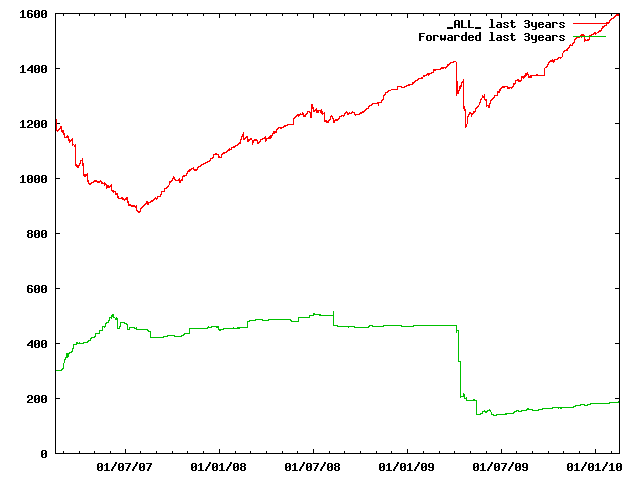
Given KDE 4.5.0 is not expected until August, it is likely the next point release, 4.4.4, will be the KDE version included in next Debian stable, Squeeze. What this means: go and update to 4.4.3, test, and when you find a bug, please, follow this instructions. If you are lazy to read it: report upstream bugs at the KDE Bugzilla and report the packaging/integration bugs in the Debian BTS. When in doubt, you have the Debian KDE mailing list, that is being successful so far in maintaining a good signal-noise ratio. I would like highlight the drop in the open bugs in the BTS experimented in the last 2-3 months, I published this graph in February: Number of bugs reported against KDE in Debian in the last 3 years - February 2010 And look at the situation now: Number of bugs reported against KDE in Debian in the last 3 years -May 2010 This is mainly due to the great work of Eckhart W rner. Also there is other people who contributed to it more modestly, a big thank you to all of you! As you can see in the second graph, there are less than 1000 bugs open now in the BTS, they are still too much and time has taught us it is very easy going over 1000 again, so we still welcome more volunteers looking at bugs. If you are not the bugsquasher type, you can write HTML and you do some IRC, we also need somebody to help us reorganize a bit the pkg-kde website. I will help you personally on this task, but it is good if you can lurk by IRC and you are not scared to share your doubts with the rest of the team there. Finally, I promise I will publish something about the status of KOffice pre-2.2 in Debian, but I still can not say whether it will be in Squeeze.

Gunnar Wolf: Post-apocalyptic times

Pestilence, War, Famine, and Death, the mythological Four Horsemen of the Apocalypse. Mexico's de facto president, Felipe Calder n, once again showed his involuntary aptitude for deep political analysis: On Monday, on a State visit to Germany, he declared Mexico has faced the Five Horsemen of the Apocalypse (second source, in English). I agree: One year ago, we were facing a health emergency, the AH1N1 epidemic, hence pestilence. Since he took power in December 2006, the president's main action has been the war on drugs, hence war. The country was the worst performing Latin American country in 2009, with our economy falling 6.5%, more than any other country, and prices have been really on the rise, hence famine. Finally, death... official numbers state that there have been over 22000 deaths in the "war on drugs" And merrily he stated that only 10% of that were civilians. Whatever that meant... But... What about the fifth? Who is he? A plausible hypothesis is offered by cartoonist El Fisg n in today's cartoon in La Jornada:
We don't know how he got here, but he is the most effective one Now... However good El Fisg n's analysis might be... Lets not get distracted with silly details. Hern ndez, another of La Jornada's great cartoonists, shows the hidden meaning:
We are over the apocalypse!
Does that mean we are facing the Final Judgement?
The coming of the five horsemen of apocalypse can only mean... It is time for the Final Judgement and the end of time!
AttachmentSize
hernandez_20100505.jpg16.6 KB
fisgon_20100505.jpg28.11 KB

4 May 2010

Wouter Verhelst: On clue and opinions

How does one define one's "national identity"? One way is to look at where a person is born. By that definion, I could be called Flemish, Belgian, or European, whatever you think about it. Another way to look at it is how one feels about one's own identity. This, of course, is a much more accurate way to describe a person; and by that definition, I am either Belgian or European. I do not feel any affinity with much of the so-called "flemish" identity, nor do I wish to be associated with it any more than is strictly necessary. Obviously, some people feel different about that for themselves. This I can understand. In fact, the statement to feel more Belgian than Flemish is probably not one that is very common in this general area. I am not stupid; I know that Belgium is not a Nation (it is a state, but that is a different matter). I just do not feel a lot of warm fuzzy feelings about Flanders. Naturally, other people have other feelings about that. This, too, I can understand. The logical result of the above is that my personal opinions about the somewhat convoluted politics in this country are not shared by many; that when I state my opinion, I may expect opposition, or at the very least someone stating why they disagree with me. This, of course, I can also understand. But what I cannot understand is that every time I state my opinion, someone must come out and insult my intelligence by telling me I "do not have a clue". Please do not mistake my disagreement for misunderstanding. Martijn asks me to "check the facts". Let's do that, shall we?
  1. There's been a judgement by the constitutional court that the current situation regarding which party may run for election in the BHV region is unconstitutional.
  2. One group of politicians wishes to resolve this issue by splitting the BHV region in two. That would certainly solve the issue.
  3. Another group of politicians dislikes this solution. They may be willing to go along, but they want other concessions before they will do so. This is what I referred to when I said that there were "a huge heap of all kinds of side issues" in my previous post.
  4. The first group does not wish to make such concessions. Some of their numbers have even stated in the press that there is no need to make them, because, given the first point, there's only one solution and that is to split.
That last point is, of course, complete and utter bullshit. It would hold merit if there was only one way to solve a constitutional crisis; but by definition, there are always at least two ways: one is to change the law to comply with the constitution, the other is to change the constitution to make the law no longer be unconstitutional. So a group that feels strongly about one of these two possible solutions should be prepared to negotiate with the other group so as to hammer out an agreement that benefits both parties. In some cases, this will mean doing things that they do not completely like; but if they're not willing to do that, at all, they have no business being politicians. For the longest time during the early negotiations, however, both parties have stubbornly refused to even acknowledge the other position, let alone talk about it. Now, for clarity, I'm not advocating that the latter of the two options in that previous paragraph is what should happen. Frankly, I don't even care what happens, so long as they manage to resolve the issue at hand in some way. What I do care about, however, is that this country has been in a near-constant state of stalemate over these past few years for an issue that only matters to politicians; I don't care who or what a group of people in a (to me) obscure part of the country can vote for. This country needs a stable government which can act on things that actually matter. Like, say, the international economic crisis of the past two years; I think it matters much more whether the man in the street has a job than whether John Q. Politician will past these next elections.

MJ Ray: Day Against DRM, 4 May 2010

Today is the Day Against DRM, working against Digital Restrictions Management or Technological Protection Measures (TPM). I ve two tips to help with our public disservice British Broadcasting Corporation which has consistently failed to act in the public interest and reject DRM:
  1. If you want to link to a BBC radio show like Global Business, you can often get mp3 and avoid Flash-forcing DRM-wannabe iPlayer (and cool toys like get_iplayer) by using BBC Mobile s Podcasts Index.
  2. Satellite TV broadcasts can be captured as MP2 by MythTV or even 50-quid black box home entertainment devices. The DRM-free file can be played back on a computer with mplayer -demuxer +mpegts filename.dvr or re-encoded for other devices with mencoder.
What DRM-avoiding tips would you give?

3 May 2010

Matthew Garrett: PCI power management problems

I've previously written about some of the implementation details of runtime PCI power management. One of the key aspects for PCI devices is that the PME line on the device be able to generate a wakeup event. Unfortunately, it turns out that since Windows makes no use of this functionality at present, some vendors have started failing to wire this up. This is problematic because the device itself still announces PME support and will even raise a PME signal when it gets woken up - but it's pretty much screaming as hard as it can and nobody's listening because somebody's replaced the air with cheese.

Bother, etc.

The obvious question is what to do next. We could poll all the PCI devices every second or so to see if there's a PME status register that's been set. This would be reasonably cheap (we're going to wake up at least once a second on x86 anyway, so it makes no real difference to power consumption) but would introduce obvious latency in the wakeup path. This would be fine for certain types of situation (you're probably not going to be too sad if your SD reader takes a second longer to notice a card insertion) but not others (if an sdio wireless card generates a wakeup interrupt then we really ought to do something about it in a more sensible timeframe). A second is to force users to pass a boottime argument to enable this at all. That kind of sucks.

The third possibility is limited to a subset of hardware, but does allow the introduction of some kind of elegance into what would otherwise be one of those nightmarish scenarios that makes me consider taking up farming instead. If we can trigger a PME ourselves then we can test whether the line is connected. This doesn't appear to be possible on SDHCI but the spec for firewire makes it look like we can do it there - one of the interrupt sources is the port enable/disable register, and we can hit toggle that ourselves. I haven't actually tested this yet, but if it works that would let us make this determination.

It's depressing that doing anything interesting with power management is still heavily determined by what Microsoft have bothered to implement - to the extent that on some machines (hello, Thinkpads) there are no GPE methods at all for PME signals and you don't get runtime power management at all. The only thing that saves us is that (a) it's pretty hard to be able to screw up stuff that's already all glued into one chip package, so integrated stuff like USB should be fine anyway, and (b) PCIe does this as part of the normal traffic stream so there's no way to get that wrong. Unless you're still missing the GPE methods for the signals (hello, Thinkpads) in which case you get nothing unless the native PCIe signalling works. I suspect that we can always force that, so there's some hope yet.

In summary, then: dispassionate.

Russell Coker: Flash, Apple, and Linux

Steve Jobs has published an interesting article about Flash [1]. He criticises Flash for being proprietary, this seems a little hypocritical coming from Apple (who s the only competitor for Microsoft in terms of being the most proprietary computer company) but is in fact correct. Steve advocates HTML5 which is a better technical solution to a lot of the things that Flash does. He claims that Apple users aren t missing out on much, but I think that sites such as Physics Games [2] demonstrate the benefits of Flash. I think that Apple s attack on Flash is generally a good thing. HTML5 web sites will work everywhere which will be a good incentive for web designers to fix their sites. I also think that we want to deprecate it, but as it s unfortunately popular it s useful to have tools such as GNASH to use Flash based web sites with free software. Microsoft has belatedly tried to compete with flash, but it s Silverlight system and the free but patent encumbered Linux equivalent Moonlight have very little content to play and will probably disappear soon. As an aside the relentless determination of GNOME people to force the MONO project (including Moonlight) on it s users convinced me to remove GNOME from all systems that I run. OS News has a good analysis of the MPEG-LA patents [3] which are designed to prevent anyone making any commercial use of H.264 which includes putting such videos on sites that contain Google advertising! These patent terms are so horrible that they want to control video streams that were ever encoded with them, so you can t even transcode a H.264 stream to an open format without potentially having the scum at MPEG-LA going after you. This is worth noting when examining Apple s actions, they support MPEG patents and therefore seem happy to do anything that reduces the freedom of their customers. Apple s 1984 commercial has been proven to be a lie, it s Apple that wants to control our freedom. Charles Stross makes some good points about the issues related to Apple and Flash [4]. He believes that it s all part of an Apple push to cloud computing and that Apple wants to own all our data at the back-end while providing a relatively reliable front-end (IE without all the anti-virus nonsense that is needed on the MS-Windows platform. Cloud computing is a good thing and I can t wait for the Linux support for it to improve, I support a number of relatives who run Linux and it would be a lot easier for me if they could have the primary storage for everything be on the cloud so that I can do central backups of user data and they can use their own data while visiting each other. I think that a network filesystem that is similar in concept to offline-IMAP would be a really good thing, I know that there are some filesystems such as AFS and CODA that are designed for wide area network use with client-side caching but as far as I am aware they aren t designed for the type of operation that offline/caching IMAP supports. Matt Brubeck has given a good status report of the work porting Firefox to Android [5]. He notes that the next version of Fennec (mobile Firefox) will have Electrolysis the Firefox one process per tab feature that was first implemented in Google Chrome [6]. I think that the development of Fennec and the one process per tab feature are both great developments. Matt also says One of my personal goals is to make Firefox compatible with more mobile sites, and to give web developers the tools and information they need to make their sites work great in mobile Firefox. I ll write much more about this in future articles , that sounds great, I look forward to the results of his coding and to reading his blog posts about it!

Next.

Previous.