Search Results: "cas"

11 April 2010

Christian Perrier: [life] Paris marathon 2010~bubulle-1 ACCEPTED

Upload accepted by organisers. Upload time has been 3h49'29" (my watch says 27", eh!). That was a good one, really (actually, I can compare to only 3 as it was my fourth marathon after Paris and Cologne 2009, plus the unofficial Rambouillet Forest marathon I ran alone 6 weeks after Paris 2009). For marathoners around, here are the chronometric data. Please note that GPS watches tend to overestimate the distance, mostly because of the jerky way one runs in mass events, as well as geometric considerations related to the imprecision of GPS (imprecision may be lateral and thus the line recorded by the watch is often less straight than the real one). For instance, according to my watch, Paris marathon was 42.63km long, so an overestimate by nearly 500meters. As a consequence, the recorded speed of 5'23"/km should be corrected to 5'25". So, times below should be increased by 2 seconds. As a conclusion, even though I can improve the pace and avoid going too fast in the first 25km, I'm very happy as I avoided nearly collapsing as I did last year (with sometimes over 7'00/km and a few walks). Going back home was OK and I had no cramps and I still haven't any. This is also what one gets when preparing well. My only regret is that I didn't run over 30km since, indeed, Cologne Marathon! That made the difference in the last 12 kilometers, obviously. Having spent the winter on many half-marathons (either alone, or a few officials) clearly improved my "performance" up to 25km. For the next marathon (a marathoner always thinks about the next one), I need to have 1 or 2 long trainings a few weeks before. Now, I have to find out which one will be the next one... and I wish good luck to my friend No l K the, who is preparing the Mainz marathon for May 9th as well as Dirk who's certainly preparing another one. Guys, rendez-vous is of course for Debconf10 in NYC. We won't run a marathon for sur, but how about an half one? :-)

Russell Coker: Debian/Testing and KDE4

I ve just upgraded my Thinkpad (which I use for most of my work) to Debian/testing with KDE4. Improvements Kde 3.5 (from Debian/Lenny) didn t properly display the applets in a vertical task bar. I want a vertical task bar because my screen resolution is 1680*1050 and I find that a less rectangular screen workspace is best for my usage patterns. In my previous post about my Thinkpad T61 I described how the sound controls weren t working [1]. These problems were fixed as part of the upgrade, KDE just does the right thing. Now when I press the buttons to increase or decrease the volume the ALSA settings are changed and a small window is briefly displayed in the center of the screen to show the new volume. Sounds are now made when I plug or unplug the power cable, this was configured in KDE 3.5 but just didn t work. Problems If I have a maximised Konqueror window and I use the middle mouse button to open a link in a new window then the new window will also be maximised. Previously when I did that the new window was not maximised. What sometimes happens is that I want to open several links from a web page in different windows, so if I can open them in non-maximised windows then I can click the title-bar or the bottom status-bar of the parent window to get it in the foreground again. Probably an ideal solution to this use-case would be to configure the middle mouse button to open a new window in the background or minimised. I can t figure out how to implement accelerator keys for window controls. In particular I like to use ALT-F9 to minimise a window (CUA89 standard). The upgrade from KDE 3.5 to KDE 4 lost this and I can t get it back. I want to have an icon on my panel to launch a Konqueror session. I don t want a large amount of space taken up for a launcher for several different Konqueror options, I just want a regular Konqueror for web browsing available at a single click. There didn t seem to be an option for this. KDE 3.5 has an option in the add widgets to toolbar dialogue to add icons for applications. I have just discovered that in KDE 4 the only way to do this is to go through the menu structure and then click the secondary mouse button. Having two ways to do something is often a good thing, particularly when the other way is the way that was most obvious in the previous version! It was annoying that the font choices for my Konsole session were lost on the KDE 4 upgrade, it s not a complex setting. Also the option to resize a Konsole session to a common size (such as 80*25) seems to have been lost. I had to spend at least 30 minutes configuring kmail to get it to display mail in much the same manner as it used to. You have to use the Select View Appearance (Theme) icon off at the right of the Search box and select Classic and then go to Select Aggregation Mode (immediately to the left) to select Flat Date View . I m happy for KDE 4 to default to new exciting things when run the first time, but when upgrading from KDE 3.5 it should try to act like KDE 3.5. I decided to use Kopete for Jabber just to preempt the GNOME people adding Mono support to Pidgin. I had to install the libqca2-plugin-ossl and qca-tls packages to enable SSL connection, missing either of those gives you an incomprehensible error condition that even strace doesn t clarify much. Given that it s generally agreed that sending passwords unencrypted over the Internet is a bad idea and that it s a configuration option in Jabber servers to reject non-SSL connections it seems to me that the Kopoete package should depend on the packages that are needed for SSL support. Failing that it would be good to have Kopete offer big visible warnings when you don t have them. I use the KDE 2 theme and the right side of the title bar of each window is a strange dappled pattern. Not sure why and I have more important problems to fix. Parts of KDE crash too often. I ll start filing bug reports soon. The management of the Desktop folder has changed. In previous versions of KDE the directory ~/Desktop had it s contents displayed in iconic form on the root window. Now by default it doesn t do that. It is possible to change it, but this is one of those things where the default in the case of an upgrade should be to act like previous versions. The way to enable the previous functionality is to go to the desktop settings (click the secondary mouse button on the background, select Desktop Settings and then under Desktop Activity change the Type: to the value Folder View and then specify the directory below. The facility to have different background colors or pictures for each of the virtual desktops seems to have been removed either that or the KDE configuration system doesn t have enough functionality to let me discover how to configure it. When the panel that I have on the left of the screen crashes everything that was next to the panel gets dragged to the left, this includes extending the width of maximised windows. Then when the panel starts again (which if lucky happens automatically) it pushes things back and if icons had been moved left it just obscures them. When using Konqueror to browse a directory full of pictures it doesn t generate thumbnail icons. When I middle-click on an icon for a picture it is opened with Konqueror not the image viewer that was used in KDE 3.5. The image viewer from KDE 3.5 had less options and therefore more screen space was used for the picture. Also the Konqueror window that is opened for this has a navigator panel at the left which I can t permanently remove. When I use Konqueror my common action is to perform a Google search and then use the middle button to open a search result in a new window. Most of my Google searches return pages that have more than one screen-full of data so shortly after opening a window with a search result I press PgDn to see the next page. That press of PgDn for some reason takes me back to the Google search. It seems that when a web page is opened in a new window the keyboard focus will be in the URL entry field, and pressing PgDn in that field takes you to the previous web page. This combination is really annoying for me. Conclusion Getting the sound working correctly is a great feature! Lots of little things are fancier and generally the upgrade is a benefit. The lack of thumbnails when displaying a folder of JPG files is really annoying though. The time taken to configure things is also annoying, I support four relatives who are just users so that probably means at least an hour of configuration work and training for each one so KDE 4 is going to cost me at least half a day because of this.

10 April 2010

Russell Coker: Web Server Performance

We Have to Make Our Servers Faster Google have just announced that they have made site speed part of their ranking criteria for search results [1]. This means that we now need to put a lot of effort into making our servers run faster. I ve just been using the Page Speed Firefox Plugin [2] (which incidentally requires the Firebug Firefox Plugin [3]) to test my blog. Image Size One thing that Page Speed recommends is to specify the width and height of images in the img tag so the browser doesn t have to change the layout of the window every time it loads a picture. The following script generates the HTML that I m now using for my blog posts. I run BASE=http://www.coker.com.au/blogpics/2010 jpeg.sh foo.jpg bar.jpg and it generates HTML code that merely needs the data for the alt tag to be added. Note that this script relies on a scheme where there are files like foo-big.jpg that have maximum resolution and foo.jpg which has the small version. Anyone with some shell coding skills can change this of course, but I expect that some people will change the naming scheme that they use for new pictures. #!/bin/bash
set -e
while [ "$1" != "" ]; do
RES=$(identify $1 cut -f3 -d\ )
WIDTH=$(echo $RES cut -f1 -dx)px
HEIGHT=$(echo $RES cut -f2 -dx)px
BIG=$(echo $1 sed -e s/.jpg/-big.jpg/)
echo "<a href=\"$BASE/$BIG\"><img src=\"$BASE/$1\" width=\"$WIDTH\" height=\"$HEIGHT\" alt=\"\" /></a>"
shift
done Thanks to Brett Pemberton for the tip about using identify from imagemagick to discover the resolution. Apache and Cache Expiry Page Speed complained that my static URLs didn t specify a cache expiry time, this didn t affect things for my own system as my Squid server forcibly caches some things without being told to but would be a problem for some others. I first ran the command a2enmod expires ; a2enmod headers to configure my web server to use the expires and headers Apache modules. Then I created a file named /etc/apache2/conf.d/expires with the following contents: ExpiresActive On
ExpiresDefault "access plus 1 day"
ExpiresByType image/gif "access plus 1 month"
ExpiresByType image/jpeg "access plus 1 month"
ExpiresByType text/css "access plus 1 day"
# Set up caching on media files for 1 year (forever?)
<FilesMatch "\.(flv ico pdf avi mov ppt doc mp3 wmv wav)$">
ExpiresDefault "access plus 1 year"
Header append Cache-Control "public"
</FilesMatch>

# Set up caching on media files for 1 month
<FilesMatch "\.(gif jpg jpeg png swf)$">
ExpiresDefault "access plus 1 month"
Header append Cache-Control "public"
</FilesMatch> DNS Lookups Page Speed complains about DNS names that are used for only one URL. One example of this was the Octofinder service [4], it s a service to find blogs based on tags, but I don t seem to get any traffic from it so I just turned it off. In this case it was the only sensible thing to do to have a single URL from their web site, but I had been considering removing the Octofinder link for a while anyway. As an aside I will be interested to see if there are comments from anyone who has found Octofinder to be useful. I ve also disabled the widget that used to display my score from Technorati.com, it wasn t doing what it used to do, the facility of allowing someone to list my blog as a favorite didn t seem to provide any benefit, and it was taking extra DNS lookups and data transfers. I might put something from Technorati on my blog again in future as they used to be useful. Cookies If you have static content (such as images) on a server that uses cookies then the cookie data is sent with every request. This requires transferring more data and breaks caching. So I modified the style-sheet for my theme to reference icons on a different web server, this will supposedly save about 4K of data transfer for a page load while also giving better caching. The down-side of this is that I have my static content on a different virtual server so now updating my Wordpress theme will require updating two servers, this isn t a problem for the theme (which doesn t get updated often) but will be a problem if I do it with plugins. Conclusion The end result is that my blog now gets a rating of 95% for Page Speed when previously it got a rating of 82%. Now most of the top references that are flagged by Page Speed come from Google, although there is still work for me to do. Also it seems that Australia is now generally unsuitable for hosting web sites for viewing in other countries. I will advise all my clients who do International business to consider hosting in the US or the EU.

9 April 2010

John Goerzen: Introducing the Command Line at 3 years

Jacob is very interested in how things work. He s 3.5 years old, and into everything. He loves to look at propane tanks, as the pressure meter, and open the lids on top to see the vent underneath. Last night, I showed him our electric meter and the spinning disc inside it. And, more importantly, last night I introduced him to the Linux command line interface, which I called the black screen. Now, Jacob can t read yet, though he does know his letters. He had a lot of fun sort of exploring the system. I ran cat , which will simply let him bash on the keyboard, and whenever he presses Enter, will echo what he typed back at him. I taught him how to hold Shift and press a number key to get a fun symbol. His favorite is the hat above the 6. Then I ran tr a-z A-Z for him, and he got to watch the computer convert every lowercase letter into an uppercase letter. Despite the fact that Jacob enjoys watching Youtube videos of trains and even a bit of Railroad Tycoon 3 with me, this was some pure exploration that he loves. Sometimes he d say, Dad, what will this key do? Sometimes I didn t know; some media keys did nothing, and some other keys caused weird things to appear. My keyboard has back and forward buttons designed to use with a web browser. He almost squealed with delight when he pressed the forward button and noticed it printed lots of ^@^@^@ characters on the screen when he held it down. DAD! It makes LOTS of little hats! And what is that other thing? (The at-sign). I ve decided it s time to build a computer for Jacob. I have an old Sempron motherboard lying around, and an old 9 black-and-white VGA CRT that s pretty much indestructible, plus an old case or two. So it will cost nothing. This evening, Jacob will help me find the parts, and then he can help me assemble them all. (This should be interesting.) Then I ll install Debian while he sleeps, and by tomorrow he should be able to run cat all by himself. I think that, within a few days, he can probably remember how to log himself in and fire up a program or two without help. I m looking for suggestions for text-mode games appropriate to a 3-year-old. So far, I ve found worm from bsdgames that looks good. It doesn t require him to have quick reflexes or to read anything, and I think he ll pick up using the arrow keys to move it just fine. I think that tetris is probably still a bit much, but maybe after he s had enough of worm he would enjoy trying it. I was asked on Twitter why I ll be using the command line for him. There are a few reasons. One is that it will actually be usable on the 9 screen, but another one is that it will expose the computer at a different level than a GUI would. He will inevitably learn about GUIs, but learning about a CLI isn t inevitable. He won t have to master coordination with a mouse right away, and there s pretty much no way he can screw it up. (No, I won t be giving him root yet!) Finally, it s new and different to him, so he s interested in it right now. My first computer was a TRS-80 Color Computer (CoCo) II. Its primary interface, a BASIC interpreter, I guess counts as a command-line interface. I remember learning how to use that, and later DOS on a PC. Some of the games and software back then had no documentation and crashed often. Part of the fun, the challenge, and sometimes the frustration, was figuring out just what a program was supposed to do and how to use it. It will be fun to see what Jacob figures out.

Gustavo Noronha Silva: Designing from the bottom up

Have you ever seen, while dealing in a support channel with a novice that just got in touch with the power of UNIX a conversation that goes like this?:
<novice> How can I process the output of a command, so that any number of spaces gets turned into a newline?
<seasoned> What are you trying to do?
<novice> I want to list the contents of a directory, but I want one per line.
<seasoned> ls -1
I have seen this numerous times, even as one of the actors. At times I was the novice, and many times in #debian-br I was the seasoned person trying to get the novice to focus on the problem they were trying to solve, not on the solution they thought was right. While reading M ir n Duffy s awesome paper about contributing to Free Software as a designer I couldn t help but get that image brought to my memory again, and again. Specially when I read this part:
This means the language and even the approach FLOSS projects take to solving problems tend to be focused on implementation and technology rather than starting with a real-life user problem to solve and determining appropriate implementation afterwards.
That does sound like us, and it does sound like many of the solutions we come up with. While I was reading her paper, there was a reference I got very interested in checking. It s a PDF with no links in it, so I only had the number of the reference. What I would have to do is I would have to scroll to the end of the paper, and find the reference, then somehow come back to the place I was looking at. My most immediate thought was you know, maybe evince should have tabs . Why? Because I could open a new tab, go to the place the reference was at, and to go back I just needed to close the new tab. Other options require much more effort - remembering the page I was at, or maybe the scroll offset more or less, and scan for the part of the text I was at. But those are not the only options! I could have the application set a marker on where I am, and have an easy command to go back to that marker, for instance, or evince could provide a way of looking ahead without throwing away the current state at all. I m pretty sure if I look around enough I will find tools that solve this problem in a fairly good way. Now, I think that is exactly how we ended up with tabs in so many places they do not make sense in, and with so many ad-hoc solutions that solve our problems in half-assed ways. Even in browsers, we tend to use tabs as ad-hoc solutions to real problems we have no real solution to handle yet, such as I want to check this other thing out real quick, but I do not want to lose any state of this page , or I want to check this out, but not right now, so let me open it, and then I ll come back to it , or maybe even I want to look at this now, but since it is going to take a while to load, I might as well let it load in the background, and when I finish reading this I can go look at it . These are the real problems we have, and I think we need better designs that solve them for real, instead of just patching them with the ad-hoc solution that tabs are. The other extreme of the spectrum is, of course, not doing something, or even anything for lack of the perfect solution. Using this is not a real solution as an excuse to not implement something that could serve as a temporary solution to a problem may cause more frustration than having to deal with the ad-hoc solution that is tested, and being applied to other applications for some time. After all, in many cases the ad-hoc solution can be later replaced with a proper one. I guess this is another instance of the very difficult problem of balancing different realities: proper design is not always available to start something up, specially if the application is backed by individuals and not by a company or a bigger project that could bring in designers to work on it from the start. In this case having something up and running is usually a very important first step in a free software project - usually required to get enough interest to make it worth designing for.

8 April 2010

John Goerzen: Face to Face With Destruction

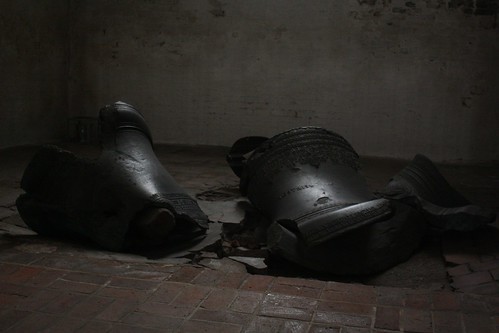
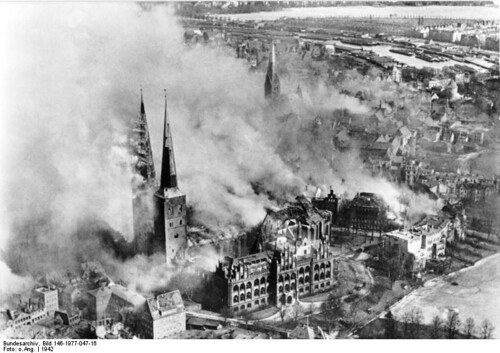
IMG_2641 Seeing these church bells in L beck wasn t easy for me. They melted and fell to the ground after an air raid in 1942, and have been left exactly as they fell. I wasn t alive in 1942, and even my parents hadn t yet been born. My grandfather was relocated by the American government because he refused to fight in the military for religious reasons. And yet, I still felt a sense of embarrassment, being an American standing there in Germany next to those bells. My country* did things like this. Why? Even if there s a war on, and whatever the other side may be doing, do we really have to bomb all their churches? Then, we went to the Dom (cathedral). It has a small gallery of photos of the destruction in 1942, and how it took 40 years to restore (though some original works are simply irreplaceable.) Burning L beck Cathedral after an air raid in 1942 I had just been walking through the beautiful Dom, and then saw pictures like that. It was very sad. I imagined the people in 1942, seeing the smoking remains of so many buildings that had been important to the town for centuries. Places where, no doubt, some of them worshiped, and their parents and grandparents had too. I imagined my sadness if a country bombed one of the churches that my ancestors helped start or build. I felt ashamed of what the democracy in which I live (and its allies) did to the Dom, to Marienkirche, and to the other churches and civilians there. Then, a few days ago, Wikileaks posted a video from an American helicopter in which our soldiers begged Come on, let us shoot! at people, most or all of which were completely unarmed. They killed a bunch of people. Then a van came to try to get the wounded to the hospital. Then the soldiers in helicopter killed those people, and wounded some children. Even if they thought their lives were in danger, I d expect to hear some quiet sadness at what they thought was a regrettable need to use force. Instead, you d hear them cheering whenever they killed someone, as if they had just won a round on some video game. They killed civilians, and considered it a fun experience and a mission accomplished. There was no sadness for knocking a man to the ground, leaving him writhing. Just jokes. There was no more care for human life here than there was 60 years ago. It saddens me that every year we celebrate our military on independence day celebrating its ability to kill, not its ability to feed. I wish that we could rather celebrate the times Americans have saved lives, whether in Berlin or in Port-au-Prince, or helped to topple dictatorships. Military power shouldn t be our first choice so often. L beck wasn t attacked for any strategic purpose; the British did it to destroy the morale of the enemy civil population , as the Americans did in Dresden or the Germans in London. In other words, those bells fell to the ground for no reason other than that they were German. People lost their lives for the same reason in Germany and in London. The British had no reason to believe that those civilians meant them any harm, that they were anything but caught between two strong powers. And the same held true in Iraq. When we went to Berlin, we walked through the replica of Checkpoint Charlie, with the big sign announcing that you are leaving the American sector. There is little positive to be said about the Cold War, but there is something the British and American military did of which I am not the least ashamed: the Berlin Airlift. Although I didn t see it, I feel a sense of the USA having been a force for good when I read about the Berlin Airlift Monument at Tempelhof, which has the names of the 70 British and American men that lost their lives in the airlift (due to accidents), above the inscription They gave their lives for the freedom of Berlin. That s the spirit I wish we d see more often in the world today: people giving their lives not just for their own security, but for strangers in need on a different continent. We Americans have been, compared to many countries in Europe, relatively sheltered from the ravages of war in our own midst. I wish that more of us would have the opportunity to gaze at fallen church bells, to wonder through a magnificent old church and then to see photos of it on fire, or to see a monument to our soldiers in a far away land. Perhaps then we could better learn from history, and see firsthand that some of our most positive contributions to the world have come in the form of coal and candy bars instead of incendiary devices. A small post script Many historic buildings or locations we saw in Germany had plaques on their exterior with a brief history, often in German and in English. I was interested to note that some (though not all) of these plaques had language such as destroyed by fire in 1942 , with no mention that the cause of the fire was a bombing. I was even more interested to note that same sort of description at several sites in Prague Castle, mentioning that the original building was lost in the fire of 1142. It was only on the third or fourth building in the Castle that we learned that the fire of 1142 was caused by a military siege of Prague Castle. * I know it was the British at L beck, but the Americans did similar things elsewhere. I also acknowledge that, at a macro level at least, the Berlin Airlift wasn t purely an altruistic act, as there were geopolitical factors in play. But I am speaking of the actions of the airmen here, who took on considerable risk to help others.

Dirk Eddelbuettel: Video of UCLA / LA RUG talk on R and C++ integration

Thanks to the efforts of the tireless R User Group organizers Szilard Pafka (in Los Angeles, recording the talk) and Drew Conway (in New York, converting and organising hosting), there is now a video and slide combo of my recent talk about Rcpp and RInside at UCLA and the Los Angeles R Users Group. Thanks also to David Smith (at the REvolutions blog) and Drew Conway (at his blog) for spreading the word about the presentation video and slides -- quite a few folks have come to my presentations page to get them.

7 April 2010

Patrick Schoenfeld: Ubuntu considering critical bugs an "invalid" bug?

I just discovered that bug report over at Ubuntu.
Short summary:
They have a script in upstart which is not meant to be run manually and if you do it will erase your whole file system. Additionally it seems that the fact that you shall not run that script is not communicated anywhere.

That alone isn't the most spectacular about it. Bugs happen. Whats spectacular about it is how a Canonical employee and member of the TechBoard (for people who don't know it: The people who decide about the technical direction Ubuntu takes) handles that bug. One quote of him to reflect it all:
Sorry, the only response here is "Don't Do That Then"

So what we have here is a classical case of bad programming. The problem in question is that the script expects a certain environment variable to be set. Fair enough. However it does not check if its set at all and instead of failing or using a sensible default it simply sticks to undefined behaviour. What we have here is a classical programming mistake every beginner tends to do. People who start programming often forget (or don't know) that every external value we rely on must be considered untrustworthy. Therefore a good practice is to check those values.In this case someone decided that this is useless because they suffer from the wrong assumption that nobody ever calls it manually and the other wrong assumption that caller of the scriptwill always set the environment variable correctly. This is a double-fail.
Now the developer in question does not accept that (someone else indicated why the behaviour of the script is dangerous), he simply says that the bug is invalid. Thats really a pity.

Joey Hess: the neverending game

(While I have a lot big stuff going on in my life right now, I don't feel most of it's suitable for blogging. So here's a bit of insignificant fluff.) I have this nethack game that won't end. I started it before Christmas, and got much, much deeper into the dungeon than I've ever managed before. Taunted Jerry with it as we hung out over the holidays; he repeatedly losing while I quested and cleared out the castle, and genocided liches to get through the valley of the dead, and generally just kept building up a character that wouldn't quit. Yeoj the Student of Metals St:18/06 Dx:18 Co:18 In:16 Wi:18 Ch:14 Lawful Dlvl:42 $:0 HP:138(138) Pw:29(147) AC:-15 Xp:20/5196103 T:66175 Hungry Burdened I should mention: I mostly don't play nethack often, only swinging back around to give it another try every year or two. So for many years I'd play a few games that quickly ended in Yet Another Stupid Death, and occasionally feel proud when I got as far as Minetown or the Oracle. Recently, though, I've started focusing on Monks, and gotten rather good at playing them in the early game. So, this is my first character who got through the early game, completed the quest, and went well into the late-game. I know where that vibrating square is, I have plenty of wishes to round out my kit. So it would be an ascention candidate, except my chances of doing that on the first try are ... slim. And, do I want to? The descriptions of what I'd need to do to even try seem a bit tedious. So, unsure if he wants to ascend, and fearing YASD, my monk sits in his recently aquired tower at level 42 of the dungeon. For months. And so I can't play nethack. The character I'm role playing has decided to opt out of the game. (Oops, I meant to leave real life out of this, but it's somehow snuck back in there.) Meanwhile, this Dungeon Crawl Stone Soup that @Play keeps talking about looks interesting... (previously previously)

6 April 2010

Sylvestre Ledru: Update of the linear algebra libraries in Debian

In the numerical computing world, the cornerstones libraries are BLAS and LAPACK. They have been used in most of the numerical software for decades (like Scilab, R, numpy, OpenOffice with calc, etc). During that time, many implementations appeared to improve the performances taking advantages of clusters, multicore, SEE 1,2,3,4 , various levels of cache...
Between the reference BLAS (refblas) to an optimized one like ATLAS or MKL (Math Kernel Library by Intel - non-free), it is not rare to have a 15 factor. In Debian, we use by default the reference implementation of BLAS (168 reverse dependencies) and LAPACK (178 reverse dependencies). If the results are usually bad, they are pretty easy to use. What is hard to use, is switch between highly optimized libraries.
For now, the main one in the archive is ATLAS. ATLAS build process will launch many computations to know what will work best on the architecture. Results are usually excellent. 1) Upload of a refactoring of the ATLAS package.
I have been working on this for a while and after 19 uploads into Debian Experimental and I am happy (and kind of relief) to upload into debian unstable the release 3.8.3 of ATLAS. The new key elements in this release are: Note that, as before, all prebuilt binaries of ATLAS will be always slower than if you built them on the target architecture (but using Debian binary packages will save a few kilograms of Uranium). And one of most important feature is the capability to switch to any ATLAS implementation. 2) Switch between the different implementation
The problem in Debian (and Ubuntu) was that it was hard to switch between the ref BLAS/LAPACK and the optimized libraries. The user has to play with the LD_LIBRARY_PATH to use the various optimized packages and since there is no convention between the various distribution, the upstream developer has to develop crappy tricks to handle such things. It is why I implemented the following proposal: Handle different versions of BLAS and LAPACK. The main idea is to use the update-alternatives system to allow a quick and easy switch. For example:
# update-alternatives --config libblas.so.3gf 
There are 3 choices for the alternative libblas.so.3gf (providing /usr/lib/libblas.so.3gf).
  Selection    Path                                           Priority   Status
------------------------------------------------------------
* 0            /usr/lib/atlas-core2sse3/atlas/libblas.so.3gf   55        auto mode
  1            /usr/lib/atlas-base/atlas/libblas.so.3gf        35        manual mode
  2            /usr/lib/atlas-core2sse3/atlas/libblas.so.3gf   55        manual mode
  3            /usr/lib/libblas/libblas.so.3gf                 10        manual mode
# update-alternatives --config liblapack.so.3gf
There are 3 choices for the alternative liblapack.so.3gf (providing /usr/lib/liblapack.so.3gf).
  Selection    Path                                             Priority   Status
------------------------------------------------------------
* 0            /usr/lib/atlas-core2sse3/atlas/liblapack.so.3gf   55        auto mode
  1            /usr/lib/atlas-base/atlas/liblapack.so.3gf        35        manual mode
  2            /usr/lib/atlas-core2sse3/atlas/liblapack.so.3gf   55        manual mode
  3            /usr/lib/lapack/liblapack.so.3gf                  10        manual mode
Thanks to this, it is just trivial to switch from one to the other... Conclusion:
I just pushed the changes into Debian unstable for blas, lapack and atlas.
I have been testing a lot these deep modifications and I fixed all the problems that I found. However, in case I missed something, please report a bug...

John Goerzen: Begin questioning my sanity NOW

It s been a long and wet winter here. We live down a dirt/sand/gravel road, and when it rains, it s difficult to get a car down the road due to mud. And impossible to get a bicycle down it. As a result, I ve only been able to ride my bicycle to work once since November, and that was in January. Last Thursday, I intended to ride in to work, but discovered my front tire wouldn t hold air. I had heard about a wonderful local bike repair shop, so I dropped off the wheel there. The owner replaced the tube and checked it out, and charged me, yes, $4 including labor and the tube. Nice. So today was my first ride of the season. I rode a total of 21.8 miles (35 km) today, which was probably unwise enough for being as out of shape as I am. It s 9.6 miles each way to work, plus I did some errands over lunch. But add to that the winds 30 MPH (48 kph) with gusts to 43 MPH (69 kph). This morning, they were weaker and also mostly at my back. This afternoon, though, they were mostly a vicious crosswind. If you ve bicycled much, you ll know that s less annoying than a headwind, but is still quite annoying and takes a lot more energy to battle than you might think. So, I am now rather sore. And the question is: will I be silly enough to do this again tomorrow? The answer to that probably depends on how late I stay up watching the Butler/Duke game tonight, as I have to get up an hour earlier on days that I bicycle to work. I found that the bicycle rack at work which, somewhat to my annoyance, was moved indoors last year has been rather disused. It is in a rather dusty and dirty part of our manufacturing shop, and there were large metal bins completely blocking the path to it, which I had to move before I could park my bike. Then, of course, it was the usual comments which I take with a smile about somebody that shows up to work wearing cycling shorts & shirt. It should be noted that I change into professional clothes at work. But my commute is too long to wear them on the way in and expect to be presentable, non-smelly, and pain-free. In any case, evidence that this may not have been the best day to start my commute: it hurts to sit at the moment.

5 April 2010

Lucas Nussbaum: Apply for the Google Summer of Code at Debian even if you are already a Debian Developer!

The Debian GSOC admins have made it clear that it is possible for DDs to be selected as GSOC students (even if people who are not Debian contributors will be prioritized). So, if you are a student, a Debian Developer, and interested in getting paid to work on Debian during the summer, it s a very good idea to apply! For the details, see this blog post. Note: the goal of this post is not to start a flamewar, but to make sure that everybody is fully aware of the unrestricted selection process. Since we are going to accept DDs as students anyway, let s at least try to get the best applications.

John Goerzen: Thougts about the Europe visit: Water

This is probably the only real surprising to an American post I ll be making, because it was the little thing that was most surprising. And that despite the fact that I had been warned:
Don t expect to get a glass of tap water at a restaurant or caf ; it s an unusual request that probably won t be understood or honoured. Lonely Planet Germany
Now, before I go on, I want to clarify that this post is NOT a complaint of what I saw in Germany and Prague; it s just a description of how it was surprising to these American eyes, and perhaps also a description of how the American approach such a mundane topic might be surprising to people from elsewhere. (Update: I want to clarify that I only visited 3 cities in Germany plus Prague. I don t want anybody to assume that I m making generalizations about the entire continent here, despite my title; I think the comments reflected that I didn t make this point clear enough. I lack data to draw much of any generalization at all; this is more of reporting on my experiences than anything else.) Utilitarian Water I noticed that the vast majority of toilets I saw in Germany and Prague are of the extremely water-saving variety, with an option for a small or a large flush. These toilets exist in the USA, but are still rather uncommon here. I was glad to see this attitude of conserving water. I was a bit surprised when I took a shower at our hotel in Berlin. Although that hotel was extremely environmentally-conscious in every other way including the toilets, light switches with RFID sensors and timers, etc the shower head was the most wasteful of water I had seen in quite a few years. I felt rather guilty of using so much water for a shower. But our hotel in Prague took shower heads to the next level. The shower head there was this huge square monstrosity, about a foot long on each side. I have never seen a shower head that big. It had a voracious appetite for water, too. Although it could be pointed in any direction, doing so was useless because, even at full blast, it was clearly getting not nearly enough water to propel the spray forward. It seems that this shower head needed special water-guzzling plumbing. But even without it, I felt even more guilty for showering in Prague. I suspect that I used more water for the two showers I took there than I would have over an entire week at home. I also very much suspect that this shower head would be illegal in the USA due to its water consumption. (I should note as an aside that the shower heads I saw in private homes were no different than American ones.) One thing I didn t see was lawn sprinklers. This may have been because there is less open grass in the places we visited, or perhaps because spring hadn t yet really hit. In any case, I wonder if our American habit of pumping water from deep beneath the ground, only to shoot it up in the air and spray it back on the ground again might appear a bit odd to others. Drinking Water In Restaurants We did a lot of walking in Europe, and sometimes we d have walked awhile to get to a restaurant. I really prefer water when I m thirsty, and ordered water with my meal at restaurants a few times. I stopped doing that, though. The presentation varied, but usually it went along these lines: they brought a glass bottle to the table, it cost EUR2 EUR5, and generally contained almost as much glass as water. The most impressive display of water was at a Berlin restaurant. I wanted some water, and so did Terah. So the waitress suggested we could share an EUR 4.90 bottle (0.75L). Sounds good, I guess although it s less water than you d get in a typical American bottle for one person, it seemed a lot by typical German restaurant standards. A few minutes later, our water arrived. It required the waitress to use a full tray to deliver our water and its, well, water accessories. First she carefully placed a frosted plastic water holder, precisely centered on the table between the two of us. Into this, she carefully placed the water bottle. It was, of course, made of glass, and also tall taller than most wine bottles, though containing less actual liquid. I am not yet sure of the purpose of the holder; it certainly wasn t to keep the water cold, as it was served warm. Perhaps they feared the bottle s impressive height acting as a sail and getting knocked over by a gentle breeze. In any case, next came our water glasses, which appeared to be exactly like wine glasses, but bore the logo of the company that bottled the water etched in the glass. After that, she picked the water bottle back up out of the holder, carefully opened it (it was just a regular twist-off lid), and then poured water into each of our glasses. She was careful not to have even a drop run down the side of the bottle, and filled each glass precisely 2/3 full. The glasses were, of course, positioned carefully on the table, and the bottle of water returned to its place of honor within the water bottle holder. This process consumed most of the small quantity of actual water in the bottle. I do believe that is the most elaborate presentation of a small amount of good ole H2O I have ever witnessed. It was made with the kind of care I would expect to be shown to someone that had just bought a $100 bottle of wine, not a EUR5 bottle of water. We had walked a mile (1.6 km) to get to that restaurant, and I was indeed a bit thirsty. I wasn t sure I wanted to drink all of my tiny quantity of water presented so elaborately all at once, so I had a sip of the beer I had the good sense to order along with the water. The beer, incidentally, cost roughly the same per liter as the water and was simply plonked down on the table with a complete lack of fanfare. Sadly, beer is not really very good for quenching thirst, due to its diuretic effects over time. Another surprise came at a restaurant in Prague. It appeared to have the typical prices for water, so I ordered a local Czech orange soda to drink. It, like the water, was served in a smallish glass bottle. In any case, I ordered a traditional Czech goulash to be served in a bread bowl, while Terah ordered some ribs. The waiter took our orders and menus, and returned a minute later bearing a bowl full of water and a lemon slice. This he put next to me, and announced, wash for you. My reaction was: Hmmm. This is different. (Which is why we went to Europe, after all!) What is this for? Did he think my hands looked dirty and needed to be washed before eating? Or did he think I would get them dirty while eating, and somehow fail to use my napkin? It turned out that the use of it became clear. I ate the goulash using the supplied spoon, but the bread bowl it was served in was of course edible too. It turns out it is pretty much impossible to eat a bread bowl that had contained a stew without getting your hands dirty, and the wash turned out to be quite practical and useful. It was free to wash my hands in, but I m sure would have cost EUR5 had I wanted to drink it. Drinking Water American Restaurants Some of you reading this may never have experienced water in an American restaurant, so allow me to explain. In a typical American restaurant, water is free and comes with unlimited refills. Americans generally think of water as healthy (and our doctors and government medical experts urge us to drink plenty of it), and water in a restaurant is a good way to save money while dining. It would generally be considered questionable service if your glass of water at a restaurant got less than half full, and really quite bad service if it sat empty for more than a minute or two. A waiter at an American restaurant will typically go around with a pitcher of ice water. If your large water glass isn t completely full, the waiter will pick it up and step a few steps back from the table before filling it from the pitcher. The waiter will then dump water and ice from the pitcher into it, usually overflowing the top such that some water and ice spills on the floor (so now you see the point of stepping back from the table). The glass will then be returned to your table, wet sides and all. It will be completely full, so you have to be careful not to spill when you take your first sip. The fancier or more expensive American restaurants will offer a version of this, though without the spilling on the floor part. Usually at one of these restaurants, you ll automatically get water set out for you when you arrive. This is free, and if you order another beverage, you ll still keep your water. (Though at any restaurant, it would be quite acceptable to order water along with your other beverage.) Needless to say, this water is coming from a faucet, not some glass bottle, but I m fine with that. A few American restaurants have bottled water on the menu, but I can t recall ever seeing somebody with one in a restaurant. Drinking Fountains Drinking fountains are common in the United States. They provide free tap water to anyone. You can find them near almost any public restroom, whether indoors or outdoors. You can also find them in virtually every park, along some walkways or bicycle routes, in airports and train stations, and even in museums. They re so common that I rarely even think about being able to find water in a city if I m thirsty. Often you ll find them installed in groups of two or three, with one at a lower height so as to be usable by children or adults in wheelchairs, and another at a regular height. Many indoor ones even contain integrated chillers to make the water cold (which, sadly, probably more than negate the environmental benefits of water fountains.) I saw exactly two drinking fountains in Europe, and I can say I got a drink at 100% of the drinking fountains I saw there. One was in the Hamburg airport, but notably it was at the place where you wait to have them check your passport. So you can use a drinking fountain in Hamburg, but apparently you must do so before you have officially entered Germany. The other one was in the Prague airport. It was in an out-of-the-way corner, on the lowest level, by the gates for the people that are flying out on the small planes. Which we were. Above it was a placard bearing a icon indicating that this was, in fact, a drinking fountain and how to use it. I was surprised at the need for the icon at first, but less so after I observed a man walk by, glance at the fountain, and wash his hands in it (rather than do so at a sink in the restroom 5 feet away). As a result, we were sometimes a bit thirsty in Germany. By the time we got to Leipzig, we realized what was going on and bought a Coke bottle which we could refill from the tap water in restrooms as we went along. (This we kept until it was confiscated at a museum in Prague). I didn t see many Germans carrying around bottles of water, but it was still cold, so it s possible they were but were in a coat or bag. I was left with the somewhat unwarranted conclusion that some Germans must be either always slightly dehydrated, carrying around hidden bottles of water, or paying EUR2 for a small plastic bottle of water all the time. In the USA, we do have bottled water. Among people that care about such things, there are certain people that drink only from bottled water as much as possible, and then there are other people that view bottled water as exceptionally expensive and an environmental catastrophe and avoid it as much as possible. I m part of that latter group. I ve noticed that statistics show that Germans consume more bottled water per capita than Americans do, which is not really a surprise given what I observed. Conclusions Part of the reason I wanted to go to Europe was to experience different approaches to things, and we surely did. I didn t expect it to lead to a blog post about something as mundane as water, but here it has. I ve got to say I like the overall attitude of water conservation in Germany, which seems to have gone further than it has in the USA. I also like the system of water fountains we have in the USA, which also helps the environment by reducing demand for plastic water bottles. The wash for me in Prague was just great. One of those moments where I was completely surprised (and in a good way) by something. (I m just glad the waiter spoke a bit of English, because I wouldn t have figured it out at all otherwise.) In the end, part of the fun of traveling is learning about these differences. So next time, we ll just plan on finding a bottle to carry around at the start of our trip, and then thirst won t be a problem. Perhaps I ll even try washing my hands in a drinking fountain.

4 April 2010

Russell Coker: Slavery vs Child Porn

Slavery Still Exists! We all like to think of slavery as a problem from the 19th century, but it still exists and is a significant problem! Kevin Bales gave an interesting TED talk about how to combat modern slavery [1]. Currently there are an estimated 27,000,000 slaves in the world, it s a lot but it s a smaller proportion of the world population in slavery than at any time in history. Also the price of slaves is lower than ever before, instead of being a capital asset a slave is a disposable item (this is really bad for the slaves). The estimated average cost to liberate a slave is $US400, this involves rescuing them from slavery and teaching them the skills that they need to have a sustainable life there s no point rescuing them only to have them get captured again! Kevin notes that the US is still paying the price of the botched emancipation of 1865, so the liberation of slaves really needs to be done properly. The estimated total cost to liberate all the slaves in the world is $US10.8 billion. Think about the trillions of dollars that have been spent on wars to supposedly liberate people, when a mere $US10.8 billion would liberate all slaves. That s a fraction of the cost of the proposed National Broadband Network which would you rather have, fast net access for cable TV services or a world without slavery? Censorship of Child-Porn (and other things) vs Liberating Slaves It is often claimed that child porn needs to be stopped to prevent there being economic incentives to molest children in other countries, to achieve this goal the Australian government wants to filter all net access to prevent access to child-porn, other prohibited porn, documentation about euthanasia, and the occasional dental practice (seriously, they just can t get their filters right). Methods that are proven to prevent children being molested should be given a much higher priority than censoring the Internet in the hope of removing economic incentives for child abuse. It seems reasonable to assume that a significant portion of child-slaves are molested (because we know that slave owners are really bad people and there s nothing to stop them from molesting children). Let s assume for the sake of discussion that 1/4 of child slaves are molested. So that would give an average cost of $US1600 to free one child from sexual slavery and three other children from physically abusive environments. Currently the Australian government plans to spend $44,000,000 in Internet censorship with the supposed aim of protecting the children. The fact that the majority of child-porn is believed to be transferred via protocols other than HTTP has not deterred the government from pushing forward a HTTP-only filter for censorship. Also the fact that anyone could use a VPN, tor, or other services to trivially bypass a HTTP filter has not deterred them. Let s assume for the sake of discussion that $US400 equates to $500 Australian, the exchange rate is lower than that but it varies and it s best to be conservative. Therefore the $44,000,000 the government wants to spent on censorship could be used to liberate 88,000 child slaves. If my estimates are correct that would save 22,000 children from being molested. In the unlikely event that slavers happen to be nice people who don t do nasty things like molest children (which really isn t credible) then freeing 88,000 children from slavery and all the physical abuse that it involves is still a really good thing! If a plan to prevent child sexual abuse by liberating slaves fails to actually prevent any sexual abuse then at least you end up with some freed slaves (which is a really good thing). But if a plan to prevent child sexual abuse by censoring the Internet fails then all you end up with is slower Internet access and censorship of totally unrelated things that the government doesn t like.

3 April 2010

Joerg Jaspert: Fun with broken hardware

As you might have read, one of Debians slightly important machines had some hardware trouble. Before I get into more details of this story, let me say thank you to all the people who worked on this issue: - The DSA (Debian System Administrators) team, - the local admins at Brown University Computer Science department. I intentionally leave out the HP support here, I think their work in this issue was pretty suboptimal. While they do follow a certain schema, it took a bit long and the stunt with the technician not finding the replacement board and later on leaving without further notice wasn t all that great. (Update: Just to clarify this: In general we are happy with HP and the hardware and relationship and all that stuff. And usually the support works pretty well, like for all the times we had to replace broken disks.) Now, the story. This all started by us noticing something in ries kernel output telling about some trouble with the ram:
ries kernel: [168074.392016] Northbridge Error, node 0, core: -1
ries kernel: [168074.392186] K8 ECC error.
This was first noticed somewhere at the beginning of January. A DSA member then used the usual HP tools to check whats up, none of it reported an error. There wasn t much of an option left besides waiting what happens in the future. No support would do anything here. Until March we did not have any trouble. But at the 14th of March this changed, as the HP tools now found a serious error, reporting Status: DIMM is degraded for the third DIMM module. A support ticket was opened at this point and a replacement DIMM got sent out. Unfortunately the well known Mr. Murphy did look at this issue and so the wrong thing was sent out to the wrong place. Countdown continued and 10 days later the host decided to randomly lockup. And as HP servers have an Automatic Server Reset function in such cases, the whole machine rebooted. Not only once. Guess how much a filesystem likes such things when the machine is active. And for added fun a second DIMM got reported as broken, we now had DIMM #3 and #4 gone off. A certain ping-pong with HP support later we asked the local admins to take out the broken DIMMs and then also to change the order in which the remaining DIMMs are arranged. Unfortunately this did not help, the errors stayed. At this time we already turned off the services running on the machine and it mostly waited in the HP Insight Diagnostics test from HPs SmartStart CD. (And it always locked itself at 97% here). The support asked us to try another round of work on the machine, which our DSA team and the local admins did. But as it already was the 30th of March and nothing helped, our DSA got a little more direct in asking for a working solution. Like replacing the board and sending a technician to look and fix the machine. This was scheduled for the 1st of April, but turned out to not work as hoped. For some reason the technician was not able to find the board that was sent as replacement (no fault of our local admins!), so nothing happened the 1st of April except us getting a little upset. DSA communicated this to HP support, asking for escalation and finally getting this fixed. Our local admins could at last greet a HP technician on the 2nd of April then and he even had the replacement board with him, so he did his work there. He also confirmed that the two DIMMs mentioned above are faulty. For some reason he did not replace them, but left them outside of the machine. He also left the place without telling the Brown CS staff, so it wasn t the best performance he made. Fortunately the machine was in a working state again, only missing 2 of its DIMMs, 4Gb RAM. This has to be replaced by HP in the next days. When the Brown CS staff found out the technician left without notice they enabled our DSA to access the ilo of the machine again, so they could get the machine back up. Of course the first run was the HP SmartStart stuff again, running a full test. It reported no error, pheeew. There had been a few more steps in getting the settings of the ilo correct again and running a full filesystem check on it, but somewhere in the night the machine was back up and ready for us FTPMasters and Release team to get the services back. As the machine was back up in the middle of the night where I was sleeping, I did start my work somewhere this morning. At 10:25 CEST this started with a md5sum check of all files we have in our pool/ structure, ie. the Debian archive. We had 655k files to check, so it naturally took a while. Luckily we only found 32 broken files. Even better a set of them is already fixed, the rest of them is easily fixable with a set of binnmus the buildd people helpfully schedule, so not too much work involved in fixing this issue. Could have been worse. (Actually, when the first reboots happened, before the long downtime, we also had some broken logfiles, unreadable changes files and such things. But those I already fixed back then). More or less in parallel to the md5sum check we also started the queue daemons again, to let our upload queues from the other hosts forward their files to the central queue on ftp-master, tested the triggers to the new buildd peoples machine and the release team did a britney run. This took the first 5 hours (and a bit) of the process. As a second step, and we are still in this, we started the processing of the incoming queue. Turned out we have to process 10gigabytes of new uploads, in a total of 1285 uploads. This process is still running at the time I write this blog post, having processed about 1100 uploads. A good 9 til 10 hours run, but this was expected. I actually thought it will take even longer. When this is done I will go and have a manual dinstall run. That is, I will run every action a dinstall is usually doing by hand. And verify each step. Usually dinstall takes some 2 hours, manually it can take a bit more. Somewhere during this run a mirror push will also be done, a fairly huge one this time, with all those updates. When this all works I will turn on FTPMaster cronjobs after this dinstall, or at latest tomorrow morning, as usual, and service is back as usual. As far as I know the release team plans to turn on their cronjobs tomorrow morning too, so this will all be nice then. Apropos release: Please note what I wrote in my latest d-d-a mail:
As a sidenote from me: If you have a package that might be involved in
whatever transition to testing, or simply might get involved, it could
really help if you wait a day or two with the next upload, so the
release team can sort through all before you give them new trouble. If
in doubt, try mailing debian-release@lists.debian.org and ask. :)
So, thats it, enough annoyance with all those status bits here and there. I go leave you alone now. :)

Russell Coker: Too Stupid to be a Bishop

A Stupid Bisop breaks the Godwin Rule The Sydney Morning Herald reports that Catholic Bishop Anthony Fisher has just claimed that GODLESSNESS and secularism led to Nazism, Stalinism, mass murder and abortion [1]. This is a violation of the rule part of Godwin s Law. We might not expect clerics to have enough general knowledge of society to know this rule, but it does seem reasonable to expect them to have enough empathy to understand why inappropriate Hitler analogies will just offend people and don t advance their cause. But anyone in a position of leadership in a global organisation who is going to talk to the media should have enough intelligence to check historical references. The Wikipedia article about Positive Christianity is worth reading, it includes references to Christian based race-hate in Nazi Germany as well as modern references [2]. There is also an interesting Wikipedia page about the Religious aspects of Nazism [3], there seems to be room for a lot of debate on the matter of how religion fit in to the Nazi regime but it seems quite clear that it was not an atheist regime. The Wikipedia page about the Rechskonkordat (the agreement between the Nazi Germany and the Catholic Church) is also worth reading [4]. Also I m sure that the Chilean Dictator Augusto Pinochet wasn t the only Catholic despot. Community Services and Moral Authority Cardinal Pell was quoted in the same SMH article as saying we find no community services sponsored by the atheists , of course if he was to investigate who is contributing to the religious based community service organisations he would find plenty of atheists. I know I m not the only atheist who donates to The Salvation Army [5] on occasion. I wonder how many religious people would be happy to donate to an explicitly atheist organisation, I suspect that the prevalence of religious charities is due to the fact that a religious charity can get money from both religious people and atheists while a charity that advocated atheism in any way would be limited to atheist donors. If I was to establish a community service charity I would seriously consider adding some religious element to help with fund raising it s just a matter of doing what s necessary to achieve the main goal. Even if it wasn t for violating Godwin s law and a total lack of any knowledge of history Anthony would still have failed. We all know the position of the Catholic Church on the sexual abuse of children. The Catholic policies are implemented in the same way in every country and as far as we can tell have been done so for all time. I believe that makes them unqualified to offer moral advice of any kind. Criticising the Secular World Peter Craven has written an article for The Age criticising the secular world [6]. He makes the extraordinary claim the molesting clergy are like the brutal policemen and negligent doctors and corrupt politicians: they come with the territory because pennies have two sides . The difference of course is that police, doctors, and politicians tend to get punished for doing the wrong thing even when they do things that are far less serious. But the molesting clergy seem to be protected by all levels of the church hierarchy. Peter makes some claims about the secular world as if there is a Borg collective of atheists and claims that there is an incomprehension of Christian values . I believe that the attitudes of atheists and the secular justice system correspond quite well with what most Christians would regard as Christian values the problem is that the actions of the church leaders tend not to match that. It s All About Money I would like to know why Christians almost never change church and never cease donating. Religious organisations are much like corporations, they seek new members and new revenue sources. If a significant number of Catholics were to pledge to not donate any money to their church for a year after every child sex abuse scandal then Catholic policies might change. Also if Catholics were to start changing to Christian denominations that do the right thing in regard to moral issues then the Catholic church would either change or eventually become irrelevant. If you keep paying people who do bad things then you are supporting them! I suggest that any church member who cares about the moral issues of the day should vote with their checkbook. If their church fails to do the right thing then inside the donation envelope they should put a note saying due to the immoral actions of the church I will donate to other charities . I am not aware of any church that would expel members for such a protest, but I know that some smaller parishes have cash-flow problems and would rapidly escalate the issue through the management chain if even a few members were to protest in such a manner.

Christine Spang: Christine Spang: is your keysigning offer up to date?

I occasionally get emails from people looking for GPG keysigning around the Boston area, addressed to all the local Debian Developers on the keysigning offers list. Generally, I'm the only one who replies to them, despite there being four or so other people addressed. I wonder if this problem pervades other locations as well. Keysigning is one of the hurdles every person interested in becoming a full Debian Developer must overcome. The New Maintainer process is a hurdle enough in itself! Let's try not to discourage excited newcomers who are already convinced that they want to help Debian by leaving them hanging for long periods of time trying to get their key signed. Have you moved? Are you no longer interested in filling keysigning requests? (I suspect many of those who would answer "yes" to that question are actually inactive, and so are unlikely to actually see this.) Are you interested in filling keysigning requests but didn't know about the offers list? Go to the keysigning offers list on the Debian wiki and update, add, or remove your information. There's also the list of people requesting keysigning you can subscribe to this page to see updates.

1 April 2010

Adrian von Bidder: SCO: Ready to give up?

The answer is probably no way! I like the way Jon Corbet put it (article will be free in a few weeks):
The SCO affair is kind of like a bad zombie movie; the plot is implausible, the acting is horrible, and, even though you know the good guys must win in the end, that obnoxious zombie just keeps coming back and ruining the party.
Realistically, what will happen? The judge in the Chapter 11 case has so far been quite interested in helping SCO succeed, so I guess there will be an appeal on this. The contract claims in the cases surrounding this are probably not very relevant, so I'm not sure how much press they'll get (although I'm sure Pam will continue to cover the issue although I think the Apple vs. Hitachi patent cause should be the one that should be in the center of attention right now.) And, of course, there's the Canonical vs. SPI lawsuit coming up. I find it very difficult to tell in what direction that will get decided, but I hope it won't take as long as the SCO case.

31 March 2010

Francois Marier: "Abusing" git storage

A git repository is primarily intended to store multiple branches of a single program or component. The underlying system however is much more flexible. Here are two ways to add files which are related to the project but outside the normal history.
Storing a single file all by itselfThis intermediate trick allows you to store a single file into a git repository without the file being in any of the branches.

First of all, let's create a new file:
echo "Hi" > message.txt
and store it in git:
git hash-object -w message.txt
b14df6442ea5a1b382985a6549b85d435376c351
At this stage, the file is stored within the git repository but there is no other way to get to it other than using the hash:
git cat-file blob b14df6442ea5a1b382985a6549b85d435376c351
Hi
A good way to point to the stored contents is to use a tag:
git tag message.txt b14df6442ea5a1b382985a6549b85d435376c351
Now you can access your file this way:
git cat-file blob message.txt
Hi
Creating an empty branchAs seen in this git screencast or in the Git Community Book, you can create a branch without a parent or any initial contents:
git symbolic-ref HEAD refs/heads/foo
rm .git/index
git clean -fdx
To finish it off, add what you were planning on storing there and commit it:
git add myfile
git commit -m 'Initial commit'

30 March 2010

Frans Pop: Debianizing an ARM-based netbook

I got this neat little Chinese netbook after a mail to the debian-arm list where one machine was offered in exchange for porting Debian to it. So I offered to get Debian Installer running on it. In total 20 of these ChiTech PC89E netbooks were bought as a group by various people in different countries. The netbook is based on an ARM S3C6410 SoC, has 256 MB RAM and an excellent 8.9" 1024x600 LCD display. The machine itself is 11" and weighs under 800 grams. Most of the weight is the LCD display; they've even had to add a small extra weight in the base to avoid it toppling over backwards. The goal of getting D-I running was achieved last week, though not without needing to overcome some steep hurdles. Base installation Our main problem is that we don't have the source code to either the kernel they use (2.6.24.2 with patches from Samsung and others), or the u-boot bootloader. SSH was available without password for the user account and various basic errors allowed us to root the system relatively quickly. Brute force cracked the root password a few days later. The only information we did have was from the provided desktop system (which is really quite good and certainly looks very polished, but in the end still way too limited), what's on the flash memory and the contents ofa "firmware upgrade" image they provided. Having that firmware upgrade image proved very important as it gave us a good idea how to boot the system from SD card and made it possible to locate the kernel, u-boot bootloader and other files in flash memory. Googling for some boot messages we found two kernel source trees (for a different device: SmartQ) that looked promising as a basis. After some disassembly work by Luke Kenneth Casson Leighton on the kernel to get LCD timings and correct GPIO data we managed to get a basic working kernel: LCD, USB (and thus keyboard and touchpad), and wired networking. Although there are still loads of things that need improving/fixing, that gave me enough to work with to try to get Debian Installer going. The main limitations for running D-I are that we cannot change the bootloader configuration and that their boot procedure does not use an initrd. But we did work out how to boot a custom kernel from an external SD card by making creative use of their "firmware upgrade" procedure. Essentially I needed to find a way to run D-I by only booting a kernel. Piggy-backing an initrd onto a kernel is possible (using the 'bootpImage' target from the upstream kernel build system), but then the size of kernel plus initrd is limited to 4 MB and that is really too limited for a decent D-I initrd (especially if you want full i18n support). I ended up creating a micro-initrd (only 66 kB!) which only function is to mount the external SD card, load the real D-I root initramfs (which now no longer has any real size limitation) and then run init in that. After adding some relatively minor customizations for this netbook (such as installing the kernel from a custom repository on alioth), the installer was up and running. As the framebuffer worked without problem for the newt frontend, I next wondered if it would be possible to also get the graphical installer working. This should be easier for non-x86 systems after the recent switch from DirectFB to X.Org as backend for the graphical installer. And the image below shows it was. I had to create an /etc/xorg.conf to get the USB keyboard and touchpad working (apparently auto-detection does not quite work for less standard hardware), but that was basically it. Language selection So now all we have to do is get all the remaining kernel issues sorted out...

Next.

Previous.