Search Results: "agi"

10 January 2006

Brett Parker: Some Shiny New Packages!

I've just packaged the django magic removal branch (well, kinda, it's more or less the same build system as the other django packages I made, so these aren't quite right, but they're good enough for the time being). They're in the same place as the other django debs, and compiled for sarge and sid... for those without the previous URL...
deb http://www.sommitrealweird.co.uk/debian stable django
deb-src http://www.sommitrealweird.co.uk/debian stable django
or
deb http://www.sommitrealweird.co.uk/debian unstable django
deb-src http://www.sommitrealweird.co.uk/debian unstable django
The package for the 0.90 release is called python-django, for the magic removal branch it's called (unsuprisingly) python-django-magic-removal. The magic-removal packages conflict with the other packages because they plonk their files in the same place, so if you're trying to 'upgrade' between the 2, you'll probably need to use some magic (or apt-get install python-django-magic-removal python-django-). I'll try to update these reasonably often (like whenever I get a spare moment or 2 to build them). That should cover it for now.

Zak B. Elep: Packaging Gyach-Enhanced^WImproved

Last October I filed an RFP for GyachE, a feature-rich Yahoo! Messenger client that supports, among other things, webcams. I requested so because Eric wanted to package this, and at the time I didn’t have any time to allot for packaging. Now, Eric has asked me to take over the packaging. And indeed, this is a difficult package, since upstream (aka Ms. Erica Andrews) seems to have a rather snobbish attitude with regard to providing support for GyachE (well, it is not required anyway, remember about the non-warranty clause.) She can’t even provide a decent autotooling of the software, and what’s worse, is that the source itself seems to be a mixture of two different applications, one involving GTK2 and the other Python. Hell, I couldn’t even get the source to compile, and when I tried fixing the autotools, it was even more hell :( I almost gave up on it, until I came across gyach-improved from Google. Mick Howe, thank you for being such a nice guy! :) /me proceeds to renaming the ITP…

Joey Hess: udev weirdness

I found a little usb drive that's the same size as my nsul2, since running it from a usb key was getting a bit cramped. So now I have a system capable of being a Debian mirror that I can fit in my hand. Anyway.. Switching over to this drive was difficult, boot seemed to hang after init started, but with no console it was hard to debug. I eventually tracked it down to udev's init script. Apparently udevsynthesize somehow makes the kernel very unhappy about this usb device: Jan 10 00:43:41 slug kernel: usb 1-1: reset high speed USB device using ehcihcd and address 2 Jan 10 00:43:44 slug kernel: usb 1-1: device descriptor read/64, error -110 Jan 10 00:44:00 slug kernel: usb 1-1: reset high speed USB device using ehcihcd and address 2 And goes on to refuse to do IO to it and mark it as dead. But this only happens if the drive is connected during udev startup; connect it later and it's ok. I've stepped through the udev init script and, since I'm running 2.6.15, I was also able to step through /sbin/udevsynthesize. Sure enough, after I run this bit and wait a minute, the drive dies: for file in $first $default $last; do echo 'add' > $file done The variables are set earlier to every uevent in /sys/class, which includes lots of usb stuff, but from here it's black magic to me; I don't know whether it would be udev's or the kernel's bug that writing to these sys files makes the disk stop working. Three other usb drives work fine with udev, so it's tempting to just disable udev on this one and ignore the issue.

9 January 2006

Wouter Verhelst: Prospective talks for the Debian Devroom @ FOSDEM2006

By request: Here's a list of people who've confirmed they're going to give a talk in the Debian Devroom at the next FOSDEM. This list isn't final yet (there are some more people who've asked for a time slot but did not confirm yet; and I didn't assign slots yet, either) but it might be interesting for those who are coming to have a preview of the subjects that will be available. Well then.
Lars Wirzenius: Nobody expects the Finnish Inquisition: Confessions of a package torturer
Piuparts tests that .deb packages can be installed, upgraded, and removed without problems. Lars uses it to torture all the packages he can get his hands on. This talk will explain how to use it on your packages before uploading them, and thus improving their quality and not having them suffer in Lars's hands.
Martin Zobel-Helas: Debian-Volatile - behind the scenes
This talk will give an overview of how packages are handled for Debian-volatile; what changes are allowed, how security is handled.
Martin F. Krafft: Improving workflow in Debian through process integration
This talk will be about the same subject as Martin's doctorate thesis. The abstract for that is:
This research paper/project details the technical challenges the Debian project faces as it continues its tremendous growth in size and popularity. It describes a research endeavour designed to increase the use of version control within the project for improved coordination of globally distributed teams of volunteers working on the software packages that make up the system. The research primarily focuses on the integration and consolidation of the involved processes. With tools already available for some parts of these processes as well as the coordination of teams, the goal is not to reinvent the wheel, but rather to reuse and improve these tools, to better integrate them, and to make them more accessible by providing abstraction wrappers with interfaces intuitive to Debian developers. It is further the intent for these tools to be optional and fully compatible to existing practices, thus not forcing developers to adapt. The research starts with process analysis and studies of the work habits on the side of the developers, and targets the final output of tools, which implement improved workflow in Debian package management through meaningful integration of existing (and proven) methods
Enrico Zini: Debtags, and what you can do with it today
This talk will introduce the Debtags project, what it has accomplished so far and the wonderful advanced tools that are now available, using debtags, to make sense of the huge package archive.
Bill Allombert: Inside the Debian menu system
The debian menu system transparently keeps the menus in sync with the list of installed applications; so transparently, in fact, that a lot of developers do not know how the system really works. This talk will detail the various components of the system, what the technical challenges are and how they are solved.
Frans J. Pop: Debian Installer internals
An introduction to the inner workings of Debian Installer. Starting with what happens when the installer boots, the talk will go on to discuss how the dynamic menu structure allows the installer to be adapted for different architectures and installation methods. Other subjects will include the special nature of udebs, the contents of a D-I initrd, how cdebconf knits everything together and allows the use of different frontends, preseeding and the use of hooks. If time allows, a short introduction into the build system and CD building may be provided. Some knowledge of Debian package management (like priorities and dependencies) is assumed in this talk.
Aurelien Jarno: The Debian GNU/kFreeBSD port
Debian GNU/kFreeBSD is a port of Debian using the FreeBSD kernel and a GNU libc library. It is currently the most advanced non-Linux port in terms of packages ported.
This talk gives an overview of GNU/kFreeBSD, and a quick comparison between the FreeBSD and the Linux kernel, to give users the necessary information to let them find how the FreeBSD kernel could fill their needs. It then describes the status of the port and the choices made concerning the architecture of the port (libc, threading library, etc.). It will continue by giving the various ways to try out this port and to give help, giving pointers to useful documentation and some useful hints.
Best portability practices are also covered, for both the Debian packaging and the upstream code. It will be based on real examples of non-portable code, and will show the best way to change it into portable code.
Summing the times that people gave me, I'll have anywhere between 5h25 and 6h00 of talks already, and two more people who've shown real interest in doing something in the Debian devroom (but who haven't sent me the information I ask for to be able to confirm their talk; please do so!). I'll probably get 9 hours in all (10 if I squeeze a little bit; but then I might have some issues with the key signing party, which I'm also co-organizing), so there is still some time left for interested parties. However, if you're interested in giving a talk, you shouldn't wait too long anymore!

8 January 2006

Jonathan McDowell: On previous posts.

I suppose I should really update the status of various things I've mentioned in the past. xsm: I gave up and just added the appropriate magic to my xinitrc to start my common apps. I tried fluxbox again for a while, but although it could cope with one of each app it didn't seem to do too well with half a dozen xterms. Maybe with a little effort it could, but xinitrc does the trick well enough. RSS reader: I've settled on Liferea for the moment, with my evil lj-openid-fetch script fetching LJ posts for me. Netgear DG834G: I wrote up a page of info about this, just to have something static. Unfortunately it seems that the Marvell 88E6060 switch chip used only supports port based vlans, which I think means you can split the switch up so that you can have completely separate ports, but doesn't allow the creation of a wan port on the device. This is a shame, as it means I can't use it to handle my setup unaided (I need wan, lan, wireless + adsl ports). X11 programming: I ended up using SDL, which gave me a framebuffer to play with. I suspect I could easily convert the code to run on /dev/fb0 directly, which is nice, though I should look at how to do the same with X again at some point.

7 January 2006

Martin F. Krafft: Unstable Linux

One thing I will never understand about this Linux hype are the operating system's miserable failures in the wake of hardware problems. Coming home from dinner, I find this all over my consoles:
Message from syslogd@piper at Sat Jan  7 22:53:35 2006 ...
piper kernel: Oops: 0002 [18] 
Message from syslogd@piper at Sat Jan  7 22:53:35 2006 ...
piper kernel: CR2: 0000004000000004
Since then, I cannot start new processes anymore (though apache2 and old processes work just fine), which means I cannot SSH into the box (which is far away from where I am right now), and thus it's become useless. The problem could be anything: corrupt memory, a broken CPU, a harddrive with bad blocks in the swap area, etc... since Linux obviously seems to be able to wall in response to a problem, I would only wish it wouldn't pout as a consequence but handle the event more gracefully. If only I had the time and energy to finally wave goodbye and choose NetBSD... Update: I managed to get a dmesg output:
<1>Unable to handle kernel paging request at 0000004000000004 RIP: 
<ffffffff80152c54> find_get_pages+36 
PGD 72cee067 PUD 0 
Oops: 0002 [18] 
CPU 0 
Modules linked in: rfcomm l2cap ipv6 af_packet ipt_REJECT ipt_state
iptable_filter iptable_nat ip_conntrack ip_tables deflate zlib_deflate
twofish serpent aes blowfish des sha256 sha1 md5 crypto_null af_key usbhid
hci_usb bluetooth raid5 xor dm_mod sbp2 ide_generic ide_cd eth1394
snd_seq_dummy snd_seq_oss snd_seq_midi snd_seq_midi_event snd_seq
snd_via82xx gameport snd_ac97_codec snd_pcm_oss snd_mixer_oss snd_pcm
snd_timer snd_page_alloc snd_mpu401_uart snd_rawmidi snd_seq_device snd
i2c_viapro soundcore i2c_core ehci_hcd via82cxxx ohci1394 shpchp pci_hotplug
sk98lin uhci_hcd ide_core ieee1394 rtc parport_pc parport floppy psmouse
pcspkr serio_raw evdev xfs exportfs sr_mod cdrom sd_mod sata_via
sata_promise libata sg scsi_mod raid1 md unix fbcon tileblit font bitblit
vesafb cfbcopyarea cfbimgblt cfbfillrect softcursor
Pid: 136, comm: kswapd0 Not tainted 2.6.12-1-amd64-k8
RIP: 0010:[<ffffffff80152c54>] <ffffffff80152c54> find_get_pages+36 
RSP: 0018:ffff81007f90dcc8  EFLAGS: 00010002
RAX: 0000004000000000 RBX: ffff81007f90dd08 RCX: ffff81007f90dd10
RDX: 0000000000000001 RSI: 0000000000000002 RDI: ffff81000289f678
RBP: 0000000000000000 R08: 0000000000000000 R09: ffff81007113f670
R10: 0000000000000040 R11: 0000000000000000 R12: ffff8100705e54e0
R13: 000000000000007a R14: ffffffffffffffff R15: ffff8100705e55f8
FS:  00002aaaab730d70(0000) GS:ffffffff8040f940(0000) knlGS:0000000000000000
CS:  0010 DS: 0018 ES: 0018 CR0: 000000008005003b
CR2: 0000004000000004 CR3: 0000000072925000 CR4: 00000000000006e0
Process kswapd0 (pid: 136, threadinfo ffff81007f90c000, task ffff81007f906760)
Stack: ffff81007f90dcf8 ffffffff8015bca7 ffff8100705e54f0 ffffffff8015c905 
       ffff810001172200 0000000000000000 0000000000000000 0000000000000000 
       ffff81000289f678 0000004000000000 
Call Trace:<ffffffff8015bca7> pagevec_lookup+23 
           <ffffffff8015c905> invalidate_mapping_pages+245 
           <ffffffff8018a403> shrink_icache_memory+259 
           <ffffffff8012d144> recalc_task_prio+324 
           <ffffffff8015ca01> shrink_slab+193 
           <ffffffff8015dcaf> balance_pgdat+623 
           <ffffffff8015df37> kswapd+295 
           <ffffffff80144e00> autoremove_wake_function+0 
           <ffffffff8010f0f7> child_rip+8  <ffffffff8015de10> kswapd+0 
           <ffffffff8010f0ef> child_rip+0  
Code: ff 40 04 ff c2 48 83 c1 08 39 d6 75 f0 fb 5b 89 f0 c3 66 66 
RIP <ffffffff80152c54> find_get_pages+36  RSP <ffff81007f90dcc8>
CR2: 0000004000000004
Now, how does a mere mortal diagnose this? This was the third in a series of oopses, the others occurred in a find process... the machine runs a software RAID5, so it really could be anything, right?

Simon Richter: Packaging kernel modules

Last night I attempted to get a few more of my packages up to date, specifically, misdn-kernel was my target. This package builds, as good kernel module packages should do, a -patch and a -source package, the former being useful for patching a tree if you absolutely want to have the drivers inside a monolithic kernel, and the second for out-of-tree building. What is puzzling to me is the amount of magic and Makefile hackery required to get a -source package to build correctly. The biggest problem I have is that the Debian standard kernels all have ABI versions and "flavours" (mostly subarchitectures) that get passed along as an EXTRAVERSION (first thing I'm not really sure of) by make-kpkg (or rather indirectly, by defining a variable that contains a variable definition for EXTRAVERSION). Problem is, people are not using make-kpkg to build modules, but rather use m-a or even invoke debian/rules binary-modules manually.

Jonathan McDowell: Beware my study.

Rar. Beware. I've now got the M&S USB missile launcher working under Linux. I hate libusb, it's very badly documented and seems to assume you know the USB spec inside out. Anyway, usblauncher-0.0.1.tar.gz does the appropriate magic (if crudely) and includes a basic GTK2 Perl program to control it. Ian Jeffrey has also produced some code that works in much the same way, but it's only a command line example and I couldn't see a license that allowed redistribution attached to it. It looks like he went about things in much the same way as I did though.

6 January 2006

John Goerzen: We need better audio support in Linux

Yesterday I had the frustrating experience of trying to configure a machine so I could use the internal soundcard while simultaneously recording sound from a USB iMic. While ALSA appears to fully support this setup, I discovered quite a few annoyances about what should be trivial: Now this is probably no worse than the situation in Windows, but it is certainly not where we should be, and isn't where MacOS X is either. Note that most of these problems are with the apps not supporting the second audio source *at all*.

5 January 2006

Jordi Mallach: "yes"

00:07 < jordi> vorlon: if you say yes, we can start right now
00:07 < vorlon> "yes"
And immediately, the magic started. sjoerd has uploaded the dbus/hal/avahi tripplet to unstable, unlocking the door for GNOME 2.12 and KDE 3.5 to leave their cold homes in experimental. Expect a few small bumps in the unstable road over the weekend. The wait is finally over, after the Release Team managed to get all the KDE C++ transition in place two days ago.

Gunnar Wolf: Re: Tabs

Matt: Please don't forget you are talking about the language with the "there should be only one way to do it" motto, where you have to "program the way Guido indented it". I also feel much more at home where I can play with the way my program works and looks like. I like whitespace to be irrelevant - Yes, Python is a nice beast alltogether, but you cannot expect much space for personal preferences once you understand how it was designed. And yes, as a Perl guy I often hate the style some of the modules I maintain are written in, but then again... It's the most comfortable style for the main upstream author, the person who will do most work with the beast!
...But anyway... Emacs knows best. I just press tab and it works magically, either becoming a set of spaces or becoming a proper tab. And as long as other people understand what I wrote (which can become messy if some lines have supposedly eight-spaces-tabs and some are made up just of eight spaces), and specially the compiler doesn't barf at me, I'm OK with it.
Using a decent editor helps you a lot when writing Python, YAML or such things..

John Goerzen: A Scaredy Cat

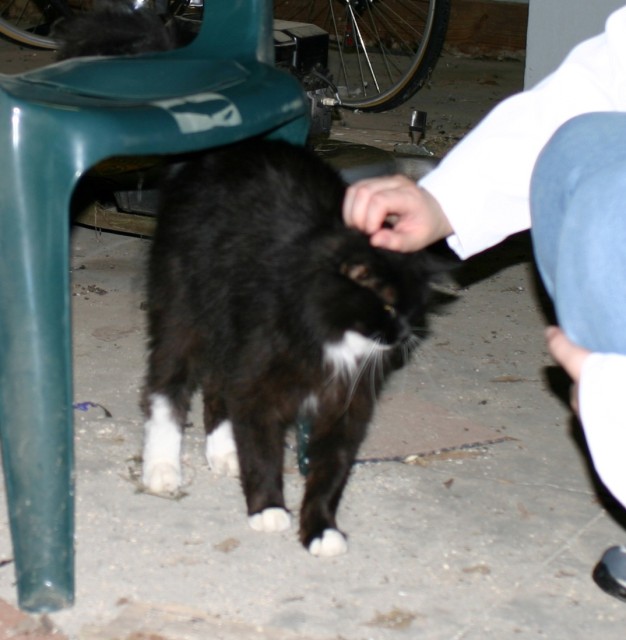
We live out in the country and both have allergies. But we both enjoy cats, and we've had one almost continuously since we moved to Kansas. Our cats are outdoor cats. They always seem to enjoy roaming around the yard so much, it's hard for me to imagine keeping a cat indoors. I know plenty of cats are happy there, but it's not for us -- especially since we're both allergic to cats. We've had Tux for about 2 of his 3 years. Tux is not a cat with your typical cat personality. Tux loves attention and loves to be petted. But he is also afraid of just about everything. Here are a few things that have caused Tux to be scared over the years. I promise I am not making any of these up: Tux's favorite activity is hunting. We often joke that if he can work up the courage to not be afraid of his prey, he'll do well. And he does -- even catches rabbits sometimes. Here's Tux starting his morning patrol: We always knew he had a routine, but only found out last month that our neighbors would see him coming up the hedge row, just poking his head around to look at their yard, and then head back to us -- each morning. He also jumps down in our window well, and we can see the shadow of a tail wisping by the basement windows, each afternoon. Tux gets half of our 4-car garage/shed at night. He enjoys going in there -- it's safe. (We put him in to keep him safe from the coyotes.) But he has a routine that Terah and I must follow precisely if he is to go in. First, we're supposed to go outside and look for him. Then, no matter where he is -- even if he's right by the garage door -- we have to walk to the house with him, then back to the garage. He doesn't like to be carried, but likes to walk just ahead of us, ears pointed backwards to make sure we're following properly. Then he will stop just outside the garage door and wait for us to step over him and go in first (to make sure it's safe). Then he'll go in. Tux has become quite the popular cat. Terah set him up with a very funny blog on Catster.com, and he was a featured cat on their site one weekend. Here's one entry:
June 16th 2005 5:06 am I just love messing with their heads. Last night I hid in some tall grass so that when they tried to put me in, they couldn't see me right away. Then, just when they were giving up on me, I bounded toward them. I have them trained so that when I jump up when running they ooohh and aaahh. What a hoot! Then I grossed them out by eating my barf.
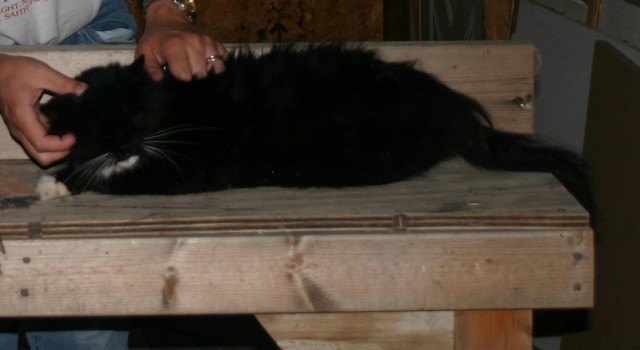
Today just before I left work, Terah called. Tux was hiding under our porch, wheezing terribly and hyperventilating. He wouldn't move at all. Which is odd, since he had been doing great the past few days. He even looked in at us watching TV a few times lately. After I got home, we managed to convince him to walk to the garage. He seemed a little better. We checked on him again at about 8:00, and he was doing pretty bad. We took him into the vet, and they decided that he had either a rare incurable viral disease, a hernia, or fluid in his chest cavity. His prognosis was not good. His lungs were functioning at only 1/8 capacity. We could attempt to treat him, but treatment would only likely save him if it was the hernia, and it would cost well over $1000. So we made the hard decision to have him put to sleep. Although I've lived around animals most of my life, this was the first time we had this decision to make. Outdoor cats usually live good lives, but rarely live long enough to become afflicted by serious disease. Cars, dogs, or coyotes usually cause a sudden end for them. As I was typing this up, I got the call that he was put to sleep. They determined that he had the viral disease, so I don't feel too bad about our choice. We have quite a few fond memories of Tux, plus some very funny video of his first experience with snow. He certainly liked to be scratched: Goodbye, Tux. We'll keep an eye on the neighbors for you.
4 January 2006

Andres Salomon: in the name of free software

A coworker and I were discussing whether we should eventually switch our company servers to Etch or Dapper. As Andreas Barth recently sent out a release announcement with a schedule prediction and goal list, I pointed him to it, and then followed up w/ my own predictions. Looking through the goals, it looks as though the easy stuff has been taken care of while the difficult things remain. This is not to discount the work done by the gcc and X people; I don’t mean technically difficult, I mean the things that have traditionally been difficult for Debian to accomplish. It’s more a question of manpower and motivation; there are plenty of people who want the latest software in Debian, and those people can also complete such work, so it tends to get done fairly quickly. On the other hand, the remaining things in the TODO list are the sorts of things that are not very much fun, or can only be done by a select few people. Point-by-point:
- amd64 as an official arch (and the mirror split as a pre-condition
for that)
Infrastructure work is not particularly fun, and can only be done by a few people. It tends to take a while, as we’ve seen in the past with things like the security queues, which blocked the release of Sarge for a decent amount of time. - sorting out docs-in-main vs. the DFSG
- sorting out non-free firmware
These two will not be fun, and will first require actual decisions about what should be done in each case, followed by actions that a lot of people will object to (that is, the stripping out of documentation from various packages, and the removal of functionality from various kernel drivers; hell, enough people complained when we removed tg3 firmware, imagine how many will complain when a couple hundred kernel drivers get their firmware removed?). The actual work here will require people dedicated to actually seeing a release put out, and will probably result in much unrest. I can’t imagine it will actually go smoothly. I guess we’ll see what happens. With a year to go still, there are a number of ways it could go.
(15:23:24) Andres Salomon: if etch actually releases on that day, i will shit myself
(15:23:40) Wes Chow: should we shake on it?
(15:24:02) Wes Chow: I think you should announce that on the debian dev list and see who takes you up on the offer
(15:24:13) Wes Chow: maybe people will actually push for a timely release just to see that happen!
(15:24:25) Wes Chow: and then you soiling yourself would be in the name of free software

3 January 2006

Colin Watson: Forwarding bugs to the IETF

Sometimes following up on a bug takes you a lot further than you expected. Debian bug #337041 looked like it was going to be fairly straightforward once I upgraded coreutils to figure out what the new IUTF8 flag actually did, since the SSH2 protocol already supports transferring termios flags around. Unfortunately, since IUTF8 is relatively new, it doesn't have a number assigned in the draft connection protocol. Moreover, that Internet-Draft is in the last stages before becoming an RFC and can't be modified any more, and it doesn't include any facility for private-use extensions. D'oh. To add further complication, since IUTF8 is Linux-specific, it's not hard to imagine that some other OS might introduce something with the same name but subtly different semantics, and so the SSH protocols can't just defer to POSIX for the definition but instead have to spell out exactly what they mean. As a result of all of this, it looks like the best way to make progress might be for me to write an I-D myself that creates a channel extension to set or clear IUTF8, and attempt to enlist support from some upstream implementors. I didn't expect bug triage to lead me into the Internet standardisation process quite so quickly!

Benjamin Mako Hill: <cite>The Enemies of Books</cite> by William Blades

While searching for treasures in Widener's stacks recently, I found a beautiful 1896 edition of William Blade's classical book on book collecting and book maintenance: The Enemies of Books. The title and driving metaphor of the book won me over right away. Books seem like inert and relatively unobjectionable objects. Many people dislike certain books or do not care for books in general but who could be the enemies of books in general? Some people may not like books but William Blades is not one of these people. Blades loves books (Caxtons in particular) and has, to say the least, a long list of ways that he wants to see books treated. Anything that violates Blade's sensibilities becomes the enemy of William Blades. Blades is happy happy to speak for books in general. Enemies enumerated include both individuals like the "Bagford the Biblioclast", behaviors, occupations, nature, states of beings, children, and most women. There are chapters on fire, water, gas and heat, dust and neglect, ignorance and bigotry, the bookworm, other vermin, bookbinders, collectors, and servants and children. The book contains something for almost everyone. Blades opens a wonderfully out-of-date section on the danger of gas lighting in libraries stating that, "unfortunately, I can speak from experience on the dire effect of gas in a confined space." Who can't? Nowhere though, is Blades as worked up as when he discusses the evils done by bookbinders who trim (and who frequently overtrim) the margins of books while binding or rebinding them. Blades explains:
Dante, in his "Inferno," deals out to the lost souls various tortures suited with dramatic fitness to the past crimes of the victims, and had I to execute judgment on the criminal binders of certain precious volumes I have seen, where the untouched maiden sheets untrusted to their care have, by barbarous treatment, lost dignity, beauty, and values, I would collect paper shavings so ruthlessly shorn off, and roast the perpetrator of the outrage over their slow combustion. In olden times, before men had learned to value the relics of our printers, there was some excuse for the sins of a binder who erred from ignorance which has general; but in these times, when the historical and antiquarian values of books is freely acknowledged, no quarter should be granted to a careless culprit.
When collectors' turns comes up, Blades rants for pages on the evils of collectors who rip out the title pages or colophons of otherwise good books to build large bibliographic collections. As Mika was looking through the book, the title page fell from the old and rather fragile binding. It seems that we may have a candidate for a new addition to the book. On the other hand, perhaps we have a new distinction: the enemy of The Enemies of Books.

Zak B. Elep: [Debian] Adopting new packages, sponsoring libmemcache

At the start of 2006, I’m adopting a couple of packages: As for my libmemcache packaging, Sylvain Le Gall has offered to sponsor my package, and he’s got some comments too. YAY!!! :-)

2 January 2006

Steve Kemp: Working Steve?

Back to work tomorrow. First day in around 7 months. Gonna be a tough day. I still don’t have a diagnosis, I’m still not cured/fixed/well, but my doctor suggested that going to work would help give me a sense of routine - and magically this would enable me to stay awake for 10+ hours. I’m not convinced, but I’m prepared to give it a try for a few days/weeks. Fingers crossed …

Zak B. Elep: [REVU] for 2005

Now here’s the thing I’m supposed to write ;) It took me quite some time since I was too busy sleeping ;) Looking back at 2005:
  • February :
  • March :
  • April :
  • May :
  • June :
  • July :
  • August :
  • September :
  • October :
  • November :
  • December :
  • Things to I want to do this 2006: Things to look out for: Rock on, 2006!

    1 January 2006

    Roger So: Chinese Market Consolidation?

    Rumours about possible consolidation in the Chinese Linux market are spreading fast. Most concentrate on the business side. While there are some truths there, as with most rumours there are nothing substantiative in any of the news articles… other than quotes from a disillusold guy. Also, there are more politics involved than others imagine. One is hated by the government, another not doing well financially, while one appears to be facing their own China-Japan relationship problems…

    Aigars Mahinovs: Aggregation the G way. I've been using the magic o...

    Aggregation the G way.
    I've been using the magic of RSS (and Atom) to keep up with Planet Debian, blogs of my friends, tech news and posts to an anime fan forum for the past several months, however one little problem bothered me - the forum has a lot of posts (sometimes more then 5 per minute) and an RSS feed of only last five items. That means that I had to have my RSS aggregator (Liferea) open at all times, so that I do not miss any posts. However keeping my laptop on and online at all times is quite bothersome, so I started looking for solutions.
    I tried Google Reader however I didn't like it much - I like to see more of my feed. There is too much screen space wasted for all the wrong reasons, one can only see 5 items at the time (which is quite a hassle if you have 500+ of them), a lot of info I would like to see is not there (which blog did this come from???), some strange html conversions, ...
    Now I have found my solution. It is a combination of rss2email and GMail. I have a computer that I always keep on and online (it could be a server, but in my case it is a simple workstation). I installed rss2email there, added all my feeds to the database there (hint: export feedlist from Liferea and do a bit of grep/sed magic), moded config so that all mails come from a single address, all have a custom identifiable header and all are HTML mails without any transformations. After that I configured cron to launch "r2e run" every half an hour and "r2e run 22" every minute (where '22' is the id of the feed of that anime forum). At Gmail side I simply filtered all mails from rss2email into a separate label and archived them (so that they do not clutter my inbox).
    Now when I want to reed my feeds, I go to the last message of the RSS label in my Gmail, open it, read it, star it if I need to look at it later and then press "k" to get to the newer message. After I am done reading I usually go and remove RSS label from read messages, so that they do not appear in this labels "folder" and are only saved in Archive. If I start running out of space, I will simply search and delete old RSS items then.
    Most of the screen space now is devoted to the message, I can see all the fields I want to see (source, author, topic, content, pictures, URLs) and I can manage messages by hundreds. Also being able to search both your mail and your rss feeds at the same time is neat.
    Yesterday I did a little improvement to this scheme. The forum that I read has the title of every message made of "author: topic", so every message is a separate conversation in Gmail. I decided to try to use the conversation feature of Gmail and did a little modification to rss2email so that if the message is from this forum, then everything up to the first semicolon is cut from the title and inserted as a part of the name of the sender. In the end the subject of every message contains only the topic of the corresponding thread in the forum and thus all messages from one thread are neatly grouped together as a single conversation. At the same time every messages From: looks like "$forum_name $author " so that I can still see who wrote what in the forum.

    Next.

    Previous.