Search Results: "ema"

31 March 2009

Gunnar Wolf: E-voting and paper-based-voting - UNAM teaches us how to achieve the worst of all worlds

As my Institute's sysadmin, I was appointed as the responsible for my Institute's certificate handling for today's voting session for the Universitary Council (Consejo Universitario). UNAM, Mexico's largest University, is moving towards an e-voting platform. I talked about this with our (sole) candidate for the Council, and she told me this has been used a couple of times already - And, as expected, it has led to having to repeat voting sessions, due in part to e-voting's inherent lackings: It is impossible to act on any kind of impugnation. The only thing we have is an electronic vote trail, no way to recount or to make sure that all votes got in. Besides, we had a perfectly antinatural and inadequate identification system, which means voter's identity have no way to be trusted. Besides, we still have all the traditional Universitary bureaucratic paper flow, which completely obscures any positive points this e-voting system might have had. Before going any further, if you are interested: There is a so-called security audit certificate for this system. In Spanish, yes. Take a look at it if you understand the language and want to crack some laughs. I will not make a detailed review of (what I could gather about) the setup. But to make things short: I had to go to the central administrative offices to get a CD-ROM with the monitoring station's SSL certificate. This certificate is tied to an IP address, so only one computer was able to be set up as a monitoring station. So far, so good. But, what is the monitoring station's real role? You will probably laugh. The voting session (at my Institute - Each dependency can specify its own opening and closing times) was from 10:00 and until 18:00. We were instructed to place this computer at a public location, from where: So, what is strange here? That there is a tremendous apparatus providing supposed security to... Information that is completely worthless. Just protecting a number that is, for all purposes, public. Oh, and the opening and closing of the booth - Of course, the system could have flaws during the process, or inject spurious votes along the way, or flip-flop the votes cast whichever way. But, did I mention votes? So far I have not mentioned how people are supposed to vote. Together with our last paycheck, we got a piece of paper with all of the needed information: A randomly generated, 10-character-long-with-mixed-case-and-symbols password, and the link to a web page2. This paper was folded, yes, but it was in no way secured - So, whoever wanted to have all of our passwords could just go through the bunch of papers and get them. Now, contrasting to the strong perception of physical security surrounding the oh-so-important monitoring stations, how can a person vote? Oh, sure, just fire up your favorite browser and go to https://www.jornadaelectoral.unam.mx/, produce your student number if you are a student or your full RFC3, select via checkboxes4, click on "submit", and voil , you have voted. From any location, from any machine. Yes, the University's population is largely itinerant, many people will be voting from abroad and all. It is good to give them a voice. But... At what price? Lets see... The security audit mentions the system is free from any malicious routine that can automatically alter the results and it has the minimum needed validations against spurious data injections from the most common Web browsers. However, if I am interested in modifying the results... I could put a trojan in a Faculty's laboratories, which modifies the votes sent by their users (students vote as well). Yes, I'd have to know how the system works, but lets accept security through obscurity does not work, and that this is a well-known system (as it has been used for over 3 years and is at version 3.5). PHP-based, for further points. Oh, and (if I recall correctly) a voter does not even get feedback as for which formula did he vote for, so no way of knowing if the computer really sent the information I requested. And given the low security for the password handling, I would not bet on it being worth much. Besides, this system was partly established to allow people voting from abroad - as long as they picked up their March 10 paycheck. That excludes anybody who has spent over three weeks away! Many other things can be said. Last detail: e-voting's main selling point is that the results are known instantaneously, and (if no paper trail exists) no tedious re-counting is ever done, right? Meet universitary bureaucracy. Technology changes, but processes don't. The Local Electoral Surveillance Commission has the responsability to enter once again the system after the vote has finished, and ask the server for the preliminary results. This consists of a tarball with the tally sheet (from the voters, who voted and who didn't), the total votes for each formula, and... one more file I don't remember. They also have to generate the signed legal documents where they testify to the received information. And then, ahem, they have to burn those files5 onto a CD-ROM, print them, and physically take them to the central administrative offices. Yes, take something from the server and get it to the server. For us it is not terrible (1.5Km can be readily done), but this same procedure must be done by people in other cities where there are University campii holding elections. How Nice! Anyway... Worst of both worlds. The inefficacies of a paper-based ellection, together with the unaccountability of an e-voting ellection, sprinkled with fake sense of security here and there. Bah.
  1. 1. Except that it didn't. I guess they didn't stress-test the server, so every couple of minutes it returned a connection error. Of course, the page would no longer self-update. And after noticing that, I (and nobody else but me) had to go and give the password and certificate for the system to continue to operate.
  2. 2. which is http://www.dgae-siae.unam.mx/ - The Schooling Administration General Direction (DGAE), an universitary body which has no relation with electoral issues. DGAE made available a poster detailing how to vote... But, again, lets ignore that fact for now
  3. 3. A nationwide ID number, largely derived from name and birth date data - Both numbers are often widely known, they cannot be considered private in any way.
  4. 4. Oh, for goodness sake... The "ballot" has 1..n options, and each has a checkbox, not a radio button. That means, you can select multiple options, which is of course invalid. Why? Because the electoral rules indicate that selecting more than one option in a ballot makes the ballot invalid, and thus, a way for making it invalid must be provided. Isn't logic beautiful?!
  5. 5. Want some more insight on what needs to be done? Take a look at the instructions. Don't forget paying attention to the lexicon used - We are still asked to count the votes, an impossible feat given the vote is 100% system-based - Quote: Los miembros de la CLVE realizar n, con base en el reporte del sistema, el c mputo de los votos depositados en la urna a favor de cada una de las f rmulas, declarando nulos los votos que procedan.

30 March 2009

John Goerzen: Kindle 2: How s It Going?

It s now been almost a month since I got my Kindle 2 and wrote about my first impressions of it. In that amount of time, I figure I have read, on the Kindle, the equivalent of 1500 to 2000 printed pages. I ll start with my personal reactions to the device, and then move on into some less subjective observations about it. What I ve Used It For To give you a quick idea of what I m reading: The Gut Reaction I want everything to be available on the Kindle, and I want to read everything on it. Whether that s just some excitement at a new device (still possible after a month, I guess), or something more lasting, I m still a little unclear about but I suspect it s something more lasting. I have read far, far more since I have had the Kindle than I had for quite some time prior, excepting a certain Hitchhiker s Guide to the Galaxy marathon one Christmas vacation. This leads me to think that the Kindle s main competitor isn t the Sony PRS-505, but rather the XBox, Wii, Netflix, and Hulu. Not that I watched that much TV to start with, but I haven t even been keeping up with the Daily Show since I got the Kindle. Not only that, but it prompted me to go to the local used bookstore (all proceeds go to charity) and buy a paper copy of David Copperfield for $10, so Terah could read it with me while I reread it on the Kindle. So it seems that Amazon s stats which show that people tend to read more once they get the Kindle, and don t cut down on paper book buying are about right in my case. Plus there s the fact that I ve loaded up the Kindle with over a hundred free books of all sorts of descriptions, some from Amazon s own free book catalog (extensive in itself), and others from Feedbooks, Gutenberg, or other places. That s taken up some time itself, and I now have achieved what I tend to achieve with all devices like this (iPod, MythTV, etc): more material than I can ever possibly get through. Why I Like It So, what exactly IS it about this thing that I like? Part of it has to be the size of the device. Granted, I wish the screen were larger, but even with the leather case, the device is a pretty nice size. I find that I keep two or three books that I m reading at the top of my list, and it s great to be able to carry around a single device and be able to select from a book as the mood strikes. Part of it is the built-in dictionary and search tools, which I ve already discussed. In the end, Amazon s execution of the concept is just done really, really well. It doesn t require some sort of proprietary Windows app like Sony s reader does. It doesn t even require a PC at all. It acts as reliable as a book, and that s something. The highlight/clippings feature is also pretty nice. You can highlight a section of text, which then causes it to be rendered with an underline on-screen just like you can underline something in a book. Better yet, when you re reading the book, you can call up a list of all such passages (as well as your bookmarks, etc), see them with an excerpt of text, and jump directly to them. No more need for millions of tiny pieces of paper marking a page that contains a marking. Even better than that, the Kindle creates a .txt (yes, plain text) file in the documents/ directory for you. Each time you bookmark or highlight a passage, it adds a little summary of the passage to that file, as well as information about the location of it. For highlights, the summary is the content of the highlight itself. So if you re going to go blog about the book later, there are a bunch of ready-made quotes you can cut-and-paste later. You can read that file both on the Kindle and on a PC. Sweet. So, I guess I would say that the Kindle makes it easier to read complex texts, and fun to read lighter ones. Availability of Content There are several ways you can get content onto the Kindle. The first, of course, is Amazon s own Kindle Store. Quite the clever bit of engineering there. You hit buy , and generally by the time you can walk over to the Kindle and pick it up, the book s on it, thanks to the integrated cell-network wireless modem. Subscriptions to newspapers and magazines work similarly each issue is automatically delivered in the middle of the night. However, it seems that the magazines such as New Yorker and Atlantic aren t exactly complete replicas of the print editions for some reason. The pricing of Kindle content is generally cheaper than paperback editions of books, but not by much. I think it should be more heavily discounted than it is, and part of that may be due to the large commission Amazon takes on things. Ironically, Amazon also has a tremendous array of free public domain and copyrighted books, and an equally staggering number of books available for under $1. For the classics, and other things out of copyright, my favorite place to turn is Feedbooks. They ve got ebooks available for download for just about any format, including Kindle, and generally do a good job of providing a real linked Table of Contents and the like. Kindle can read DRM-free content in .txt or .mobi format. I ve also built my own ebooks for the Kindle using Mobiperl. It takes an ePub source directory and makes a MobiPocket file out of it, which can be installed on the Kindle directly. For things I find on Project Gutenberg, GutenMark is a nice tool to create a good-looking HTML representation. I also use quote-fixer to help with my other pet peeve: straight quotes and lack of em-dashes on a device that can, and should, display both. Screen I m still of two minds about the screen. On the one hand, it doesn t give me eyestrain like reading on a PC, laptop, or cellphone screen does. Also, it looks remarkably book-like. A well-prepared Kindle etext feels so professional on the screen, so real, so lovingly-prepared, that it s fun to read. The Feedbooks David Copperfield is an excellent example of this, as is Houston Smith s Why Religion Matters. There are several things I don t like about the screen. One is that, while reading a book, it leaves a margin around the edge of the text. I can t figure out why it doesn t use all the available screen real-estate, especially since its built-in web browser does. Another is that, while not terribly reflective, it is still somewhat reflective, and glare from the sun or a light at a bad angle can make the screen unreadable unless you turn it a bit to a different angle. But my biggest gripe about the screen is that it s not as high-contrast as I d like. Still, I very much enjoy the Kindle, so I guess it s not as huge a problem as I think it could be sometimes. Pet Peeve I get really annoyed when I download content for the Kindle and discover that it doesn t have a linked Table of Contents (meaning I can click on a chapter and go directly to it). I m even more annoyed when it uses straight typewriter quotes instead of the angled typesetter s quotes or smart quotes . The Kindle is capable of beautifully rendering them, as well as things such as em dashes, and when I see what is obviously some cheap attempt at a conversion of some ancient ASCII document, rather than a proper attempt to make a good-looking book, I get annoyed. And so it was that I requested, and got, a $0.80 refund for my purchase of Sherlock Holmes: The Complete Collection and instead paid $3.60 for The Complete Sherlock Holmes. Yes, I could have spent a few hours converting all these from Gutenberg, but $3.60 is so cheap that it wasn t worth it. Customer Service Amazingly, Amazon s customer service for the Kindle is not their usual Asian form letter service. It s Americans, who seem to read, understand, and care about problems. I was pleasantly surprised. Too bad the rest of Amazon doesn t learn a thing or two from it. Conclusion I think the Kindle is worth it. It will pay for itself exceptionally quickly for people like me that don t live anywhere near a large library, and enjoy reading out-of-copyright material. Even if it doesn t pay for itself that quickly, the convenience of being able to carry several actively reading books with you on a single small device is pretty nice. No more pile of books in my suitcase for travel.

Gustavo Noronha Silva: WebKitGTK+ 1.1.4 released!

So, we have been able to keep up with releasing every two weeks. I can t say I emptied my wishlist for this release, but we did get a good load of good new features, and bug fixes. Go get it, and come back to read about what s new. Those of you who hate when you middle-click a link and it opens in another window will be glad to know that this version clears the only lasting missing piece of API required to allowing the browser to concede your wish. If you get irritated with weird scrolling behavior when using the keyboard, this release also fixes most of the remaining pet peeves, with a proper GtkBinding implementation for our WebView, done by Xan. Font rendering has also received some much needed love, and we have chased and killed most of the problems with WebKitGTK+ wanting to download stuff instead of displaying them because of bad headers provided by the server. There is still work to be done in this area, but most of it will probably go into libsoup, instead. You may have heard about HTML5 media tags support. Well, we have sharpened some of the rough edges of the code that already existed, making it able to play some basic ogg examples, such as the ones used by the Mozilla guys for testing. Now on to make 1.1.5 rock even more!

Erich Schubert: Java: 'base' classes and 'final' modifier

In a Java framework I'm working on, 'pairs' arise everywhere. Unfortunately in contrast to e.g. C++, Java doesn't include a predefined 'pair' class. C++ templates are really nice because of the way they are complied and optimized (in particular they also handle what Java calls 'native datatypes'); Java generics aren't up to par with that. (But yes, Java offers other benefits, such as being much easier to parse and thus refactor). Anyway, this is not going to be a rant on Generics.So I have this interface in Java called Pair<FIRST,SECOND> along with two implementations SimplePair<FIRST,SECOND> and ComparablePair<FIRST extends Comparable<FIRST>,SECOND extends Comparable<SECOND>>.For performance reasons, SimplePair is declared 'final', and so is ComparablePair. It's written everywhere that making classes final can make a large difference in Java, and since these objects will be used in a lot of places, it seems reasonable to care about this here.However, it would often be nice to have better readable code, that is assuming I'm using SimplePair<Monkey,Banana>, it would then be nice to make a derived class BananaPreference extends SimplePair<Monkey,Banana>, with added methods getMonkey() and getPreferredbanana() to make the resulting code more readable.Having readable code is also often quite as important as having performant code, after all ...If someone with solid experience in Java optimization has some ideas to share, please do so! Email: erich AT debian DOT org - no comments in blog.Right now, I have one idea on how it could be possible to achieve both (seriously, I could use some feedback from Java Gurus on that): make SimplePair and ComparablePair abstract, all methods there final, then derive final classes as needed. Does that combine the benefits?[Update: I received from Joachim Sauer the following helpful link: JavaOne presentation on performance tuning and various VMs. Basically this seems to indicate that in all these common situations, any modern Java VM should be able to figure out the inlining options automatically and optimize appropriately, so it won't benefit from any "final" hint by the developer. Note that a C++ compile doesn't do runtime optimization, but allows compile time optimization at a much lower level, so this rule doesn't apply to C++.]

Biella Coleman: Pure Data: FM Sprint in NYC and Berlin

FLOSS Manuals is proud to announce a three day book sprint for the Pure
Data FLOSS Manual. This sprint will take place simultaneously in New
York City and Berlin from Saturday 4 April to Monday 6 April. The Pure Data FLOSS Manual: http://en.flossmanuals.net/puredata There are possibilities to participate in person by coming to one of the
locations below, or remotely via the IRC interface built into the FLOSS
Manuals editing interface. Video conferencing may take place between the
venues as well. To participate, create a login at the PD FLOSS Manuals page: http://en.flossmanuals.net/bin/login/TWiki/WebHome?origurl=/bin/view/PureData/Introduction&skin=floss2 Discussion may also take place in the Pure Data mailing list: http://lists.puredata.info/listinfo/pd-list If you are in New York or Berlin, please join us at these locations! NEW YORK CITY * Contact: Hans-Christoph Steiner: hans@eds.org 718 360 4872 * Location (bring ID, you ll need to sign in): ITP/NYU Conference Room
721 Broadway, 4th Floor
NY, NY, USA
email me or call in case you can get past security: 718 360 4872 * Schedule:
Saturday: noon-midnight
Sunday: 10am-midnight
Monday: 9am-5:30pm (if we go later, we ll be in a different room) BERLIN * Contacts Derek Holzer: derek@umatic.nl +49 176 2812 5845
Adam Hyde: adam@flossmanuals.net +49 15 2230 54563 NK
ElsenStr. 52 (2.Hof)
Berlin, Germany
+49 176 20626386
http://www.myspace.com/enka52 * Schedule:
Saturday: noon-late
Sunday: noon-late
Monday: noon-late
SOME BASIC GUIDELINES: * This manual should address the widest possible user-base. Therefore,
objects which are cross-platform and in Pd Extended should have priority
over other solutions.
* Tone should be neutral and informative. Remember that humor doesn t
always translate well! ;-)
* Our readers are assumed to have little to no background in either
computer programming or digital signal processing, which much of the
existing documentation takes for granted. That s why this manual is
necessary! Please keep this in mind when explaining things.
* Please use existing the Audio Tutorials, Installing and Getting
Started chapters as a style guide.
* Keep the chapters small and self-contained. Ideally, chapters from
this manual could even be remixed into other FLOSS Manuals.
* Explain any jargon or technical terminology in-line the first time you
use it, and direct the reader to appropriate other chapters/manuals when
necessary.
* Please enter any new technical terms in the Glossary (we need to agree
on global format for glossary terms!).
* Screenshots:
Resolution? (Adam and I will work on this on Monday)
Please upload any complex patches, and make sure to label screenshot
with appropriate filename (see Audio Tutorials for examples)
Please keep explanatory text in the manual rather than only in the
screenshot, so that it can be text-searched by readers.
Please use anti-aliased fonts!
* All the chapters are moderated by Derek Holzer & Adam Hyde. Your
contributions will only be visible in the editing section until they
meet these guidelines, and after that they can be published to the main
page. Please let us know when your chapter(s) are ready for publishing
and we ll look them over. EXISTING CHAPTERS WHICH NEED HELP: # DataflowTutorials this section needs a lot of help in terms of style and content!!!!!
Tone is very informal, which doesn t help convey the information.
give titles to screenshots so that readers can tell which patches
match which images (some do this, some don t )
Math : examples/discussion of [expr]???
Order of connecting and [trigger] : explain the patches in-line,
rather than only in comments in screenshots (so that text is searchable,
copy/pasteable..)
Luka s screencaps are very aliased, to the point where you can t read
the ~ in the object names. Should they be redone at new resolution or
with antialiasing?
Possible janitors: Derek Holzer, Adam Hyde # PureGlossary format of object names = [italics in square brackets], must be
formatted correctly
format of glossary words in general text: we don t have one yet. Bold
on first use in chapter maybe? Needs formatting all through text. # ListofObjects incomplete, please add more libs
maybe more discussion of externals needed as well
formatting of object names? # PureLinks always welcome MORE CHAPTERS/SECTIONS TO DO (+ suggestions?): * GEM (in order of importance)(Derek can provide example patches for
much of this)
Basic VJ mixer (2 x
[gemhead]-[pix_film]-[alpha]-[colorRGB]-[pix_texture]-[rectangle] with
an alpha-crossfader)(+ platform specific codec info)
Live camera input (same as VJ mixer but with [pix_video], with
platform specific info on USB/firewire inputs what works & what doesn t)
VJ effects (using the various pix objects)
Basic 3D (that actually does something interesting, rather than just
show a sphere or a cube)
Basic movement tracking w/ [pix_blob]
GEM/video optimization/troubleshooting tips (see Troubleshooting
section of existing Pd FLOSS Manual) * MIDI tutorial
hardware:keyboards, sliders, etc,
objects: all MIDI objects
routing: input + output to/from devices or other programs * Patching strategies
Reusable abstractions ($0 etc)
GoP + other GUI creation strategies
Preset saving systems (Frank?) * Audiofile manipulation (Derek can provide examples, possibly also work
with www.pd-tutorial.com with permission?)
sfread, readsf, sfplay, etc
tables + tabplay, tabread, etc
oneshot playback without/with pitch shifting
looping without/with pitchshifting
granulation without/with pitchshifting
Extended objects ([xplay~], [xgroove~] are these stable? In my
experience, no ) * Realtime audio effects tutorial
delays: single tap, multitap, pitch-shifting, tuned comb filter, etc
filters: [hip~], [lop~], [bp~], [moog~], IEM lib filters
[vcf~]/[bp],[hp],[lp], difference between audio signal and message
controlled, building with ggee objects [bandpass],[llowpass],[highpass]
or [biquad~] (resources for coefficients?) * Sensor tutorial (HC?)
[hid]/[hidin]/[pduino]
simple circuit diagrams + photos (voltage divider examples:
potentiometer, photoresistor, etc)(hacked gamepads) * Networked data
netsend/netreceive
OSC
flash server
shell
python externals
others? * PDP/PiDiP
configuration info for OSX (+ poor performance disclaimer!)
basic VJ
networked streaming etc * Procedural Audio tutorial? (Andy?) * RJDJ tutorial? (Frank and the gang?)

Biella Coleman: Events on IP

If you are in the greater or lesser NYC area, there is a conference on IP and circulation that has a pretty nifty line-up as well as a international perspective. If you are in the Montreal area, IP reformer James Love will be giving a talk NGO efforts to reform the World Intellectual Property Organization and there is a semester long series (almost over) sponsored by the Columbia Society Fellows on IP with a fantastic line-up

Russell Coker: Links March 2009

Cory Doctorow has written a column for The Guardian titled You shouldn t have to sell your soul just to download some music [1]. One really interesting point he made was The same companies that spent decades telling lawmakers that they were explicitly not the guardians of the morality of the young that they couldn t be held accountable for sex, drugs and rock n'roll, for gangsta rap, for drug-fuelled dance-parties did a complete reversal and began to beat their chests about the corrupting influence of downloading on the poor kiddies . The pt4me2 organisation advocates that the Victorian government spend more money on public transport infrastructure [2]. Recently the congestion on Melbourne roads has been getting worse, the costs of private car parks in the central city area have been increasing, and during peak hours all public transport is over-crowded. Some significant improvements are needed, and more trains, trams, and buses are the only possible way of coping with the number of people working in the city. Also there s the issue of suburbs that lack any public transport, I wouldn t want to live near one of those areas when petrol hits $8/L (as the CSIRO predicts for 2018). Michael Tiemann writes about Microsoft s latest patent attack against Linux [3]. He doesn t pull any punches which is a very noteworthy thing. It s pretty rare to see someone in a senior position in a company blog in a way that makes any significant comment about another company. Dan Ariely gave an interesting Ted.com talk about Our Buggy Moral Code [4]. One of the points was that people who declare themselves to be atheists are less likely to cheat when asked to swear on a bible first, another was that if someone who is identified as a member of the same group cheats then others will follow, but if an outsider cheats then they won t. It seems that if you want to minimise cheating then you want to have only outsiders be seen to do it, and you want everyone to swear to follow some sort of moral code. Flame has written a good rant titled Anarchy is Dead about the lack of popular outrage against the Australian government s censorship plans [5]. Rolling Stone magazine has a good article about the US banking crisis [6]. A moderate amount of bad language, but no more than is deserved. Amazing video of rounding up sheep that are fitted with LEDs at night [7]. Here s an interesting TED talk by Saul Griffith about using kites to generate electricity [8]. Unfortunately he didn t give much engineering information, it was more of an executive summary of what he has done. He claims that if a wartime level of effort was put in place then wind could supply all the electricity needs of the US within 10 years. Adam Savage (of Mythbusters fame) gave a talk for TED about his obsession with the Dodo [9]. One thing that surprised me is how his manner in that talk differed from his appearance in Mythbusters. It seems that most of his crazy antics in Mythbusters are an act to entertain the audience. The information about the dodo was really interesting too. He then went on to talk about his recreation of the Maltese Falcon. His work can serve as inspiration for other geeks who want to try sculpting.

29 March 2009

Adam Rosi-Kessel: Liveblogging from Virgin America

I m on my first Virgin America flight. WiFi connected instantly. It turns out that the Internet is pretty much the same at 40,000 feet. Addendum: Apparently there is also still spam email at this altitude. Technorati Tags:
28 March 2009

Stefano Zacchiroli: post DPL campaign

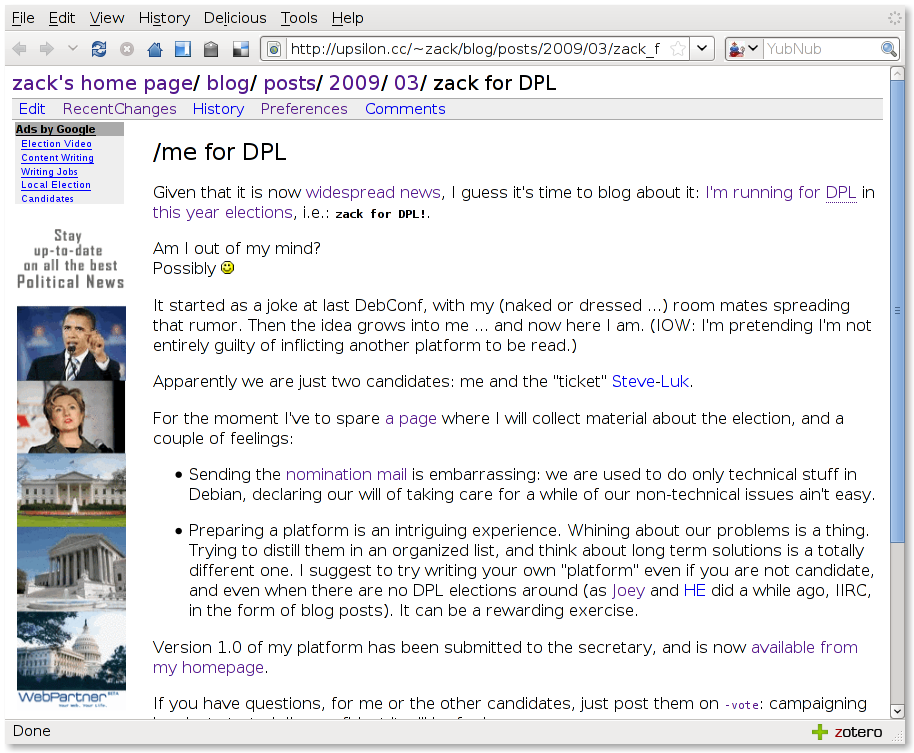
DPL campaign woes DPL campaigning is going to end today, and the draft ballot has apparead already. The latest bits of news I've to offer are that my rebuttals have been published a couple of days ago (also in the platform from www.d.o, of course, which is just lacking a direct anchor). Also, I've summarized campaigning discussions at my candidacy page. You can find there pointers to all topics raised on -vote, as direct or indirect questions to the candidates. Please let me know if I forgot something. All in all I was expecting more discussions between the candidates for a campaign, but I presume the volume is meant to remain low having just two candidates. That notwithstanding, some very inspiring and unexpected questions have been posed; it has been intriguing to think about them. As a campaign-concluding fun bit, I cannot resist posting a screenshot of my candidacy post, as it appeared to me about 10 minutes ago: zack for DPL post screenshot ... I mean, having fellow DDs making fun of me for this DPL thingy on IRC is fine, but ads stepping in is kind of too much ... :-)

Biella Coleman: Circuits-FlowCharts-Biblegrams

After telling my friend about a talk on flow charts, brains, and psychology I attended today, my friend pointed me to his amazing art-a-gram of relationships as well as this even more out of this world biblegram. Damn.

Biella Coleman: Circuits-FlowCharts-Biblegrams

After telling my friend about a talk on flow charts, brains, and psychology I attended today, my friend pointed me to his amazing art-a-gram of relationships as well as this even more out of this world biblegram. Damn.

27 March 2009

Chris Lamb: Don't rely on others to speak out

http://chris-lamb.co.uk/wp-content/2009/met_poster.jpg
For the benefit of non-Londoners, the above poster (and others) appeared a few days ago. Any further remark seems superfluous. Somewhat related, James Welch recently wrote about your rights at the so-called "knife arches".

Matthew Garrett: Reducing disk use

UNIX filesystems generally store three pieces of timing information about files - ctime (when the file was changed in any way), mtime (when the file contents, as opposed to its metadata, was last changed) and atime (when the file was last accessed by any process). This is a usefully flexible system, but the semantics of atime can be troublesome. atime must be updated every time a file is read, causing a read operation to instead become a read/write operation. This results in a surprising amount of io being generated in normal filesystem use, slowing the more relevant io and causing disks to spin up due to atime updates being required even if the file was read out of cache. It also results in a lot of unnecessary activity on flash media which may reduce their lifetime.

One option is to disable atime updates entirely. The problem with this approach is that certain applications depend on atime. This is especially common in mail clients which compare atime to mtime in order to determine whether a mailbox has been read since it was last modified. So, unfortunately, disabling atime entirely is impractical as a default. Back in 2006, Valerie Aurora submitted a patch that worked around this issue. The new relatime option meant that atime would only be updated if it would otherwise be older than ctime or mtime. Mail clients became happy and the world rejoiced.

Unfortunately, it turned out that there was one other common case of atime being used. Applications like tmpwatch monitor files in /tmp and delete them if they appear unused. In this case, "unused" means "has an atime older than a certain date". Since merely reading files doesn't update the ctime or mtime, relatime wouldn't cause the atime on these files to be updated and tmpwatch would happily delete them - even if users were reading them on a daily basis.

Ingo Molnar submitted a patch to add a further heuristic to the relatime behaviour. With it, the atime of a file will be updated if it's older than mtime, older than ctime or (and this is the important one) more than 24 hours in the past. This deals with the tmpwatch case nicely, while still providing a significant reduction in the quantity of atime updates.

Fedora shipped this patch for several releases, and Ubuntu have used it by default since 8.04. Unfortunately there were some concerns over certain aspects of its behaviour (in respect to its interface as opposed to the relatime functionality itself) and it never got merged. I pushed a trimmed down version that purely implements the change to the relatime behaviour, and earlier today Linus merged it and a further patch that makes relatime the default behaviour on Linux.

Most users won't notice this change in behaviour at all, other than as a small improvement in io performance and a reduction in the number of drive spinups. For users that do have issues, a new strictatime mount option has been added - using this will require an updated mount command, but it's a trivial patch. I'd be surprised if there are any real world use cases that are negatively affected by this, especially since it's been default behaviour in several distributions for a while, but there's always the potential that someone will be tripped up by it. We'll see.

26 March 2009

Holger Levsen: Ada Lovelace naming scheme

Two days ago I read about the Ada Lovelace day, which was an event were men and women were asked to blog about the women in technology which made an impact on them, in an effort to present girls (and women) all over the world with female role models in technology.

In similar though more personal motivation I choose my machine naming scheme at home two years ago: my (virtual) machines at home are named after women who made a difference, mostly in IT, but also some in more general science. Even though this list is not 100% in the spirit of pointing out the one woman who made a personal difference to one self, I thought I share my list, as I found it very interesting to learn about these great women myself.

goldberg is named after Adele Goldberg, who pioneered the smalltalk programming language in the 70s. According to a sympathetic annecdote she refused to show the system to Steve Jobs and only did so after her superiors ordered her to do so. Thats were Apple got many ideas which made them famous for being innovative...

goldwasser is named after Shafi Goldwasser, who is a RSA professor at MIT, doing research in complexity theory, cryptography and computational number theory. She is the co-inventor of zero-knowledge proofs.

lovelace is named after Ada Lovelace, and is widely recognized as the first programmer, who wrote a program (something that manipulated symbols according to rules) for a machine which has not even been build at that time. Of course, some men on this planet object to her being the first programmer, as work by women is always insignificant... </irony or maybe sarcasm>

bunten is named afer Danielle Bunten Berry, who was a game designer and programmer best known for the games M.U.L.E. and Seven Cities of Gold.

holberton is named after Betty Holberton, who was one of the six original programmers of ENIAC, the first general-purpose electronic digital computer, during and after World War II.

hopper is named after Grace Hopper who wrote the first compiler ever, the A compiler. She was also heavily involved in creating COBOL and standardizing COBOL and FORTRAN.

koller is named after Daphne Koller who does AI research at MIT and who seems to behind the idea of bayesian machine learning, which you might know from your spam filters... (I can only state her involvement in bayesian learning so vaguely as I'm basically clueless about the topic :)

leveson is named after Nancy Leveson who is also an MIT professior and is an expert in systems and software safety.

Last but not least I like to remark that none of the women above is even nearly covered with what I wrote here or what is written in wikipedia, which I used as my main source for this blog post. It's simple impossible to sum up one life that brief and be close to accurate.

And then there is another group of women whose achievements are noteworthy as well and who choose to present themselves on that webpage to show others that Debian is not a mens club. Thank you (a lot) for that and for your other contributions to Debian! If you want to learn more about these giants, I recommend this talk. Guess who's achievements I admire most in this group ;-)

Somewhat unrelated I wish to shout cheers to Yvonne, who tought me many things and who died six years ago today. You will also not be forgotten, though the pain is mostly gone now (well, it's gone, except for days like today). Thank you, among other stuff, for teaching me to celebrate and cheer every day, even if not everything is cheerful. Wenn die Nacht am tiefsten, ist der Tag am n chsten! :-)

John Goerzen: Time

When I was a child, I was learning to play piano. My parents didn t have one at the time, but my grandparents did. Every evening, we d go over to their house so I could practice. I suspect I was more interested in other things most of the time, though whether Grandma has some cherry moos in her fridge, or whether Grandpa would play chess with me or do something fun in his workshop. Grandma would often be in her curlers, and we d often leave her in the evening saying goodbye in the pink fluorescent lights she had shining on her plants by the door. Other times, we d just go to visit, or I d ride my bike over. I liked helping Grandma cook or bake peppernuts. And when I was trying to learn chess from Grandpa, and Grandma thought he was being too hard on me, she d say something to him in German and I d magically start winning. Grandma volunteered at a local thrift store weaving rugs. These were made by hand on old looms in a traditional way, mainly out of donated clothes and drapes that were too tattered to sell. My mom used to drop me off with grandma while she went shopping. I maybe brought my lunch, and watched grandma, until one time I asked her if I could help. She let me, and eventually the store manager told grandma that I ought to be able to work on my own loom. Pretty soon we had a routine down: in summer, Grandma would pick me up at home, I d read a computing magazine in the car to town, and work at a loom side-by-side with Grandma. That lasted until I got too busy in high school. But ever since then, Grandma delighted in telling this whole story almost every time she saw me, and she remembered word for word what the store manager said something I never quite could remember. I remember watching Grandma care for my brothers when they were sick, or helping out my parents with whatever they needed help with. We had a tradition for a number of years of spending New Year s Eve at Grandma and Grandpa s house, and going back home the next morning. The three of us boys slept in a cold upstairs room, but we didn t care because the bed had more layers on it than we could count, and an electric blanket besides. When my Grandpa Klassen passed away in 1990, Grandma missed him but didn t get too worked up about it. She was convinced that he was in a better place, and appeared to be at peace with it. Death was a normal part of life to her, and it didn t surprise her that it happened. In the last few years, Grandma s health has been failing. Her knees have been bothering her for years, and she has also been struggling with dementia for a few years. It s been hard on me to visit her, because in some ways she hasn t been the same person I remember for awhile now, and in other ways she s exactly the same. Lately she hasn t always remembered where I live, or what Terah and Jacob s names are, we knew to expect that and are respectful of the situation. For years now, Grandma has been saying, I don t know why the Good Lord doesn t take me up to be with him yet. My bags are packed and I m ready! Last time I saw her, I mentioned that we used to do weaving together, and she couldn t remember. That was a sure sign to me that things had taken a turn for the worse. Our last several visits have ended with a big hug, and her still iron grip on my hand, with her saying, Thank you for coming! My family is so good to me. We love each other! She s been battling infections and heart problems the past few weeks. This evening, I got an email from my mom saying It s time to say our goodbyes. She had been to see Grandma today, and Grandma still managed to tell her, We love each other. As much as time has changed her in the past few years, she s still there, the same loving Grandma as ever.

25 March 2009

Adrian von Bidder: Web Applications

While I'm not terrible happy with Oracle (what decade is it? Have a look at Oracle's default sql commandline tool and you're right back when I wasn't even born. Commandline history? Tab completion? Even just navigation with the arrow keys in the commandline? The future is really cool... Yes, I'm sure nobody seriously uses sqlplus), they just scored on this: I needed to download one of their products. I tried to create an account, saw that I already had one, had the password reset and mailed to me (extra point for not just sending me the old one) and signed in, getting a page where I could confirm my data (address data and subscription to their various newsletters), and hit the continue button that was at the bottom, whereupon the application still remembered that I wanted to download the file and immediately delivered the requested file. The fact that I didn't remember having an account highlights that their I don't want email from Oracle option really does mean exactly that. I really did not get a single email from them. All this is extremely trivial. Sadly, it makes me happy that there is at least one company that actually manages to do this, which goes entirely against my experience with other vendors' web jungles.

24 March 2009

Matthew Garrett

Today is Ada Lovelace day, a project to celebrate the women involved in technology and make it easier to give examples of female role models in the industry. I've had the opportunity to meet many women working on Linux over the past few years, and if there's one thing that's tended to overshadow the achievements and dedication to their work it's the sheer amount of effort they've had to go to in order to gain equal recognition. And that made me realise that in many ways, the woman who's had the greatest impact on my career is Hanna Wallach[1]. About ten years ago she spent a ridiculous amount of effort teaching me that it didn't matter how much I professed to be entirely free of sexism if I then proceeded to do things that implicitly excluded women from being involved in computing communities. I've gone to some amount of effort to repay that (contains profanity and a man with a raccoon tail covering his crotch), but I'm very aware of how different my life might have been if Hanna hadn't gone to the trouble of ensuring that I knew not to be a dick.

I think the Linux community has become more welcoming since then, and Hanna and people like her have been instrumental in helping that happen. However, we still have people being driven away by the behaviour of others or arguments that technical contributions are more important than social behaviour, and while that's true we need role models for social change just as much as we need role models for technical achievement. Thanks, Hanna[2]. The Linux world's a better place because of you.

[1] And while she's a role model of mine for social reasons, she's also got a PhD in machine learning, was British computer science student of the year in 2001 and came top of her MSc class at Edinburgh. So there.

[2] "Thanna"

Biella Coleman: Memefactory

Memefactory! :
What do you get when you combine a lecture, vaudeville and Double Dare? Memefactory! Three gentlemen with five computers and three projectors take the audience on a fast-paced, whirlwind tour of every major Internet meme, famous piece of Internet media and YouTube footage imaginable. The modus is not depth, but breadth, and constant audience participation is required. Over the course of the evening, the audience will produce an entry for every internet phenomenon possible, including but not limited to: LOLCats, Bouncing GIFs, Me Singing [blank], Reaction Videos, Folk Covers of Hip Hop Classics, FAILs, Redubbed music videos, and more. Some will become famous like Boxxy, most will drink beers and a brave few will be nude.

23 March 2009

Clint Adams: Let us see what markdown mangles

certtool --generate-privkey > cakey.pem
echo 'cn = exampleCA' > ca.tmpl
echo 'ca' >> ca.tmpl
echo 'cert_signing_key' >> ca.tmpl
echo 'expiration_days = 732' >> ca.tmpl
certtool --generate-self-signed --load-privkey cakey.pem \
  --template ca.tmpl --outfile cacert.pem
for i in host1.example.org host2.example.org host3.example.org
do
certtool --generate-privkey > $i-key.pem
echo 'organization = Example' > server.tmpl
echo 'unit = Messaging' >>server.tmpl
echo "cn = $i" >> server.tmpl
echo 'email = postmaster@example.org' >> server.tmpl
echo 'expiration_days = 366' >> server.tmpl
#    echo 'tls_www_server' >> server.tmpl
echo 'encryption_key' >> server.tmpl
echo 'signing_key' >> server.tmpl
echo "dns_name = $i" >> server.tmpl
certtool --generate-certificate --load-privkey $i-key.pem \
  --load-ca-certificate cacert.pem --load-ca-privkey cakey.pem \
  --template server.tmpl --outfile $i.pem
done

Next.

Previous.

