Search Results: "reg"

20 March 2009

Erich Schubert: On Facebooks new layout

Lot's of people complain about the new layout, but I guess it's mostly because it has actually changed. I'm okay with it, since it seems to feed me less irrelevant information and more content deliberately generated by the users.Anyway, what I'm more interested in is the technical background. The last months, I saw lot's of instability in Facebook, and it often gave the impression of being next to breaking down because of load. With the redesign, it feels more stable to me. Given that the 'mobile' page still seems to be pretty much the same, they still seem to be aggregating the same information, and the difference is just in the front page.Guess their servers just weren't able to handle all the 'live feed' access for all their users. Maybe they'll get some database experts to redesign that feature and bring it back; after all it seems one of the things people most miss in the new layout.P.S. Add this to your user stylesheet to hide some ads:
@-moz-document domain(facebook.com)  
.UIHotStory_Ad   display: none;  
#profile_sidebar_ads, #sidebar_ads   display: none;  
 
And install this small greasemonkey script I wrote to turn the front page into a two-column layout (filters are moved to the right column) that is more efficent in using the screens real estate.

Chris Lawrence: How not to do data analysis

io9 presents a chart that purports to show that shark-jumping has an effect on television ratings. I ll freely concede that Battlestar Galactica has had its, er, weaker moments, but the chart doesn t actually show that creatively weak episodes had any effect whatsoever on the ratings that can be distinguished from the underlying, secular downward trend in ratings. Since I had about 300 more important things to do, I decided to analyze the data myself. First, I reentered the ratings data from here into an OpenOffice.org spreadsheet and then identified the shark-jump episodes with a dummy variable, with the help of IMDB. I then created two new variables: a simple ratings difference variable for each episode, and a dummy variable to indicate whether or not an episode immediately followed an identified shark-jump. I then converted to a CSV file, opened R, and estimated a linear regression: Delta = a + b(FollowShark). While the effect of an episode following a shark-jump was negative (about 0.025 ratings points), the effect was not statistically significant (p 0.736, two-tailed). Throwing out Razor and The Passage, to focus on episodes io9 says showed ratings losses improves the coefficient to about -0.042 ratings points, but it is still not significant (p 0.613, two-tailed). So, the moral of the story: the episodes identified may have been shark jumps, but they didn t seem to have a discernible effect on the ratings of subsequent episodes. And, besides, any analysis that doesn t identify the crapfest known as Black Market as a shark-jumping incident isn t worth taking seriously to begin with.

Bear in mind that TV ratings themselves leave something to be desired; variations of several tenths of a ratings point are within the expected margin of measurement error.

19 March 2009

Obey Arthur Liu: Google Summer of Code 2009 - we re in!

Copy of debian-devel-announce. We re happy to announce that Debian has been accepted again as one of the mentoring organizations for this year s Google Summer of Code. According to the timeline for this year s program, we will only have a few days to get set up and ready. Student applications will be accepted between the 23rd of March and 4th of April, but we re already being contacted by students interested in working with us. That means that if you want to get involved as a mentor or a student, you don t have very long. We re also still actively looking for more project ideas - what would you like somebody to work on? You don t need to be able to mentor a project to propose it. Both students and mentors will have to register on the new Melange application. Once you ve edited your profile, you will have a linkid . Always keep it at hand. We will need it to process registrations and applications to match it with who you are. If you d like to mentor, you will need to apply to become a mentor and click on Debian in the list of orgs. Also please add yourself to the Debian wiki page and keep in touch with us (see below). Once you ve done that, the admins will be able to approve you so you can be added into the official Debian mentors list. Please add any specific ideas that you may have, or if you have nothing specific then list the areas where you think you could mentor a student. Existing Debian developers are preferred as mentors, as that will make things easier on some fronts (e.g. sponsored package uploads, data setup on Debian-hosted machines). But that s not a hard and fast rule. If you re a student hoping to work on Debian this summer in SoC, please get in contact with us (see below) to talk about project ideas, either what we already have listed or your own. It s in everybody s interests to work on applications as much as possible before the deadline closes to improve their chances of acceptance. Ideally we want to encourage new blood to join in and contribute, but we ll be happy to accept high quality applications from anybody that meets Google s eligibility requirements. We can be contacted at: Good luck to all involved; may all your code be merged in squeeze!

Uwe Hermann: Using Debian GNU/Linux on the Lenovo IdeaPad S9e netbook

TuxMobil - Linux on Laptops, Notebooks, PDAs and Mobile Phones Lenovo Ideapad S9e netbook I recently got my hands on a Lenovo IdeaPad S9e netbook for a short amount of time (I don't own it), so I did a few tests with Debian unstable (more or less Lenny right now) and a Linux 2.6.28 kernel on it, see results below. The machine type is 4187-42G, and it features an Intel Atom N270 CPU (with HyperThreading) at 1.6 GHz, 1 GB of DDR2 RAM, an 80 GB SATA drive, an 8.9" WSVGA 1024x600 (glossy) screen, VGA port, LAN, wifi, bluetooth, 2xUSB, SD card slot, PCI ExpressCard slot, built-in microphone, and a webcam. BIOS You can enter the BIOS by pressing F2, the boot menu by pressing F12 during boot. Booting from USB works fine on this netbook. There's a Splashtop installation on the netbook (called "Lenovo Quickstart" here) which you can disable in the BIOS. Installation There's no CD-ROM drive, so the simplest way is to use a USB thumb drive for installation. Here's how you can prepare one containing a Lenny installer (assuming your USB thumb drive is /dev/sda):
  $ wget http://cdimage.debian.org/debian-cd/5.0.0/i386/iso-cd/debian-500-i386-netinst.iso
  $ wget http://ftp.nl.debian.org/debian/dists/lenny/main/installer-i386/current/images/hd-media/boot.img.gz
  $ gunzip boot.img.gz
  $ dd if=boot.img of=/dev/sda1
  $ mount -t vfat /dev/sda1 /mnt
  $ cp debian-500-i386-netinst.iso /mnt
  $ umount /mnt
If the above USB thumb drive doesn't boot correctly (which it did not in my case: GRUB error 17) it's probably because of a messed-up MBR. This is how you can fix it:
  $ apt-get install mbr
  $ install-mbr /dev/sda
 Lenovo Ideapad S9e Debian installation Then insert the USB thumb drive in the Lenovo IdeaPad S9e, choose USB boot in the BIOS, and start the installer. Most of the process works as usual, the only small difference is that you might want to load the "parted" installer module in order to resize the Windows-partition on the disk (if you want to keep it) to make space for Linux. The second (fat32) partition seems to keep a restore image and/or the Splashtop stuff, not sure. Audio Works out of the box using the snd_hda_intel driver. The hardware is onboard audio in the southbridge (82801G / ICH7) and uses the Realtek ALC269 codec. If some programs don't have working audio, try modprobe snd-pcm-oss. Built-in microphone Untested so far. Bluetooth Works out of the box using the bluetooth and btusb driver. The laptop's Bluetooth device is USB-attached internally and shows up in lsusb as:
  $ lsusb
  Bus 003 Device 002: ID 0a5c:2150 Broadcom Corp.
  $ dmesg
  usb 3-2: Product: BCM2046 Bluetooth Device
After modprobe btusb you can use hcitool / hciconfig etc. as usual, and/or enable more related stuff with /etc/init.d/bluetooth start. Sensors The lm-sensors script detects the lm75, eeprom, i2c-dev, and i2c_i801 modules. The following is the 'sensors' output:
  $ sensors
  acpitz-virtual-0
  Adapter: Virtual device
  temp1:       +36.0  C  (crit = +95.0  C)    
The hard drive temperature can be viewed with:
  $ hddtemp /dev/sda
  /dev/sda: FUJITSU MHZ2080BH G1: 44  C
HPET The Intel ICH7 southbridge in this laptop supports High Performance Event Timers (HPET) which allows for more power savings and thus improved battery life.
  $ dmesg   grep -i hpet
  ACPI: HPET 3F6E1E41, 0038 (r1 INTEL  CALISTGA  6040000 LOHR       5A)
  ACPI: HPET id: 0x8086a201 base: 0xfed00000
  hpet clockevent registered
  HPET: 3 timers in total, 0 timers will be used for per-cpu timer
  hpet0: at MMIO 0xfed00000, IRQs 2, 8, 0
  hpet0: 3 comparators, 64-bit 14.318180 MHz counter
You can check the wakeups-per-second with powertop. SD card slot Works out of the box. It seems to be attached via USB internally (usb-storage driver).
  $ lsusb
  Bus 001 Device 004: ID 0bda:0158 Realtek Semiconductor Corp. Mass Stroage Device
PCI ExpressCard slot Untested so far. ACPI Works fine, see comments for "acpitool" output. Network card Works out of the box using the tg3 driver.
  $ modprobe tg3
  tg3.c:v3.94 (August 14, 2008)
  tg3 0000:02:00.0: PCI INT A -> GSI 16 (level, low) -> IRQ 16
  tg3 0000:02:00.0: setting latency timer to 64
  eth0: Tigon3 [partno(BCM95906) rev c002 PHY(5906)] (PCI Express) 10/100Base-TX Ethernet 00:11:22:33:44:55
  eth0: RXcsums[1] LinkChgREG[0] MIirq[0] ASF[0] WireSpeed[0] TSOcap[0]
  eth0: dma_rwctrl[76180000] dma_mask[64-bit]
Touchpad Works out of the box, both in X as well as in the console using gpm.
  $ dmesg
  Synaptics Touchpad, model: 1, fw: 7.2, id: 0x1c0b1, caps: 0xd04731/0xa40000
Suspend-to-disk and suspend-to-RAM I'm using the hibernate Debian package. You can explicitly force the usage of either method in /etc/hibernate/hibernate.conf by uncommenting the respective lines.
  TryMethod disk.conf
  # TryMethod ram.conf
Suspend does not yet work out of the box, however, as the machine is unknown:
  $ s2ram -n
  Machine unknown
  This machine can be identified by:
      sys_vendor   = "LENOVO                          "
      sys_product  = "418742G         "
      sys_version  = "Lenovo                  "
      bios_version = "14CN51WW  "
  See http://suspend.sf.net/s2ram-support.html for details.
After a few test I found that s2ram -f -a 3 works fine (tested from console only so far). Now this needs to be integrated upstream and in the Debian package (I'll file a bug report). Update: Submitted bug #520848, and an email to the upstream mailing list. Wireless There doesn't seem to be a mainline driver for the Broadcom BCM4312 wifi card in the laptop, yet:
  $ lspci -nn
  05:00.0 Network controller [0280]: Broadcom Corporation BCM4312 802.11b/g [14e4:4315] (rev 01)
Neither the b43 nor the b43legacy drivers work as of 2.6.28. For now, one of two possible options is to build a (partly non-free) driver provided by Broadcom from source (option 2 would be to use ndiswrapper, I guess, but that's untested):
  $ wget http://people.debian.org/~adamm/kernel/linux-kbuild-2.6.28_2.6.28-0.1_i386.deb
  $ dpkg -i linux-kbuild-2.6.28_2.6.28-0.1_i386.deb (currently needed in unstable due to bug #518115)
  $ apt-get install build-essential linux-headers-2.6.28-1-686
  $ mkdir temp; cd temp
  $ wget http://www.broadcom.com/docs/linux_sta/hybrid-portsrc-x86_32-v5_10_79_10.tar.gz
  $ tar xfvz hybrid-portsrc-x86_32-v5_10_79_10.tar.gz
  $ make -C /lib/modules/ uname -r /build M= pwd  clean
  $ make -C /lib/modules/ uname -r /build M= pwd  modules
If that worked, you can load the driver via:
  $ rmmod bcm43xx; rmmod b43; rmmod b43legacy (you could also permanently blacklist these modules)
  $ modprobe ieee80211_crypt_tkip
  $ insmod ./wl.ko
  $ dmesg
  wl: module license '' taints kernel.
  wl 0000:05:00.0: PCI INT A -> GSI 18 (level, low) -> IRQ 18
  wl 0000:05:00.0: setting latency timer to 64
  eth1: Broadcom BCM4315 802.11 Wireless Controller 5.10.79.10
You can now run iwconfig, iwlist, etc. from the command line, or use some GUIs such as kwifimanager. In order to disable wireless, run:
  $ rmmod wl
So far, I only tested WEP (but not WPA). CPU frequency scaling Works out of the box using the acpi_cpufreq driver. Use cpufreq-set -c 0 -g performance if you need full CPU power, cpufreq-set -c 0 -g powersave otherwise. Use -c 1 to do the same with the other CPU/core. PC speaker Works fine out of the box using the pcspkr module, tested with beep. Graphics card Works out of the box using the intel X.org driver.
  $ xrandr
  Screen 0: minimum 320 x 200, current 1024 x 600, maximum 1024 x 1024
  VGA disconnected (normal left inverted right x axis y axis)
  LVDS connected 1024x600+0+0 (normal left inverted right x axis y axis) 195mm x 113mm
     1024x600      60.0*+
     800x600        60.3  
     640x480        59.9  
  TV disconnected (normal left inverted right x axis y axis)
DRI works out of the box with the (mainline, open-source) driver:
  $ glxinfo   grep direct
  direct rendering: Yes
If you attach an external monitor or projector, you can enable it using xrandr as usual:
  $ xrandr --output VGA --auto
You can also use a dual-head setup by adding this to your "Screen" section in /etc/X11/xorg.conf:
  SubSection "Display"
    Virtual 2048 2048
  EndSubSection
After restarting the X server, you can play with xrandr and move the external screen (VGA) "below" the laptop's LCD screen (LVDS) for a simple dual-head setup. The GUI tools arandr or grandr are probably a bit simpler to use than plain command line xrandr. USB Works fine, of course. The only small problem is that there are only two USB ports, more would have been better. Disk drive Works fine, it's an 80 GB SATA drive. Webcam Works out of the box using the uvcvideo driver.
  $ lsusb
  Bus 001 Device 005: ID 5986:0141 Acer, Inc
  $ modprobe uvcvideo
  uvcvideo: Found UVC 1.00 device Lenovo EasyCamera (5986:0141)
  input: Lenovo EasyCamera as /devices/pci0000:00/0000:00:1d.7/usb1/1-3/1-3:1.0/input/input9
  usb 1-3: New USB device found, idVendor=5986, idProduct=0141
  usb 1-3: New USB device strings: Mfr=3, Product=1, SerialNumber=0
  usb 1-3: Product: Lenovo EasyCamera
  usb 1-3: Manufacturer: BISON Corporation
You can use luvcvideo for webcam viewing. Battery Lasts for ca. 3.5 hours, probably less if the system is under high load. Special keys Fn+CursorUp / Fn+CursorDown (brightness), Fn+ESC (enable/disable webcam), Fn+F1 (sleep mode), Fn+F2 (enable/disable TFT backlight), Fn+F6 (enable/disable thouchpad), Fn+F7 (Num lock), Fn+F8 (scroll lock), and Fn+F11 (F12 key) all work fine. Fn+F3, Fn+F5, Fn+F9, Fn+F10, and all other special keys are untested. LEDs The power, disk activity, CAPS lock, Num lock, and battery charging LEDs all work fine out of the box. lspci -tvnn
  -[0000:00]-+-00.0  Intel Corporation Mobile 945GME Express Memory Controller Hub [8086:27ac]
           +-02.0  Intel Corporation Mobile 945GME Express Integrated Graphics Controller [8086:27ae]
           +-02.1  Intel Corporation Mobile 945GM/GMS/GME, 943/940GML Express Integrated Graphics Controller [8086:27a6]
           +-1b.0  Intel Corporation 82801G (ICH7 Family) High Definition Audio Controller [8086:27d8]
           +-1c.0-[0000:02]----00.0  Broadcom Corporation NetLink BCM5906M Fast Ethernet PCI Express [14e4:1713]
           +-1c.1-[0000:03-04]--
           +-1c.2-[0000:05]----00.0  Broadcom Corporation BCM4312 802.11b/g [14e4:4315]
           +-1d.0  Intel Corporation 82801G (ICH7 Family) USB UHCI Controller #1 [8086:27c8]
           +-1d.1  Intel Corporation 82801G (ICH7 Family) USB UHCI Controller #2 [8086:27c9]
           +-1d.2  Intel Corporation 82801G (ICH7 Family) USB UHCI Controller #3 [8086:27ca]
           +-1d.3  Intel Corporation 82801G (ICH7 Family) USB UHCI Controller #4 [8086:27cb]
           +-1d.7  Intel Corporation 82801G (ICH7 Family) USB2 EHCI Controller [8086:27cc]
           +-1e.0-[0000:06]--
           +-1f.0  Intel Corporation 82801GBM (ICH7-M) LPC Interface Bridge [8086:27b9]
           +-1f.1  Intel Corporation 82801G (ICH7 Family) IDE Controller [8086:27df]
           +-1f.2  Intel Corporation 82801GBM/GHM (ICH7 Family) SATA IDE Controller [8086:27c4]
           \-1f.3  Intel Corporation 82801G (ICH7 Family) SMBus Controller [8086:27da]
cat /proc/cpuinfo See comments. Resources All in all it's a really nice hardware, and it works (more or less) flawlessly without much hassle with recent distros/kernels. Update 2009-03-22: Updated various sections, added more info. Added resources section.

Russell Coker: The Cost of Car Crashes

An article from 1999 suggested that car crashes caused a financial loss in OECD countries equivalent of 2% of their entire economies [1]. An article from the Sydney Morning Herald in 2001 gave a conservative estimate of the cost of a road fatality at $1.5 million [2], it also notes that due to different analysis methods American transport economists derived a figure of $5.5 million. $1.5 million in 2001 adjusted for CPI would be close to $2 million now. Currently that $2M cost is an externality of the car industry. Most of it is paid by the government, IE we all pay for it through our taxes. This means that there is little financial incentive for drivers and car companies to make the roads safer. Many of the attempts to legislate road safety fail due to the legal system being unable to manage the rapidly changing range of vehicles on the market. The insurance companies have very detailed analysis of the relative safety of vehicles, so it seems that the only sensible way of enforcing safe driving is through economic measures implemented via insurance. I believe that for every person who is killed or seriously injured on the road a fine of $2M should be levied. Every driver should be compelled to have insurance to cover such fines (driving without insurance should be illegal). Then the government could cease being involved in regulating what types of car someone can drive. If someone who is less than 25 years old can get insurance for a turbo-charged car then it probably means that a statistical analysis suggests that the combination of driver and vehicle is likely to be reasonably safe (EG there are many turbo-charged cars on the market that are not particularly fast). Now this will increase the car insurance costs for everyone, but it will decrease the amount of general tax money that is spent on issues related to road fatalities, which would allow the income tax rates to be decreased. This means that any tax-payer who has a good driving record and who drives a type of car that tends not to be crashed could expect to save money overall. Any tax-payer who doesn t drive a car would save even more money. But the main point of this idea is to increase road safety by forcing bad cars and drivers off the road. Currently defective cars are only removed from the road if police notice something unsafe about them and cite them for being unroadworthy - this only happens if it s a problem which can be observed from outside the vehicle (EG worn tires or broken lights). In some states elderly drivers have no requirement for periodic health checks to determine their ability to drive, I know of one case of a woman who was certified as legally blind, ordered a white cane, and then drove home afterwards! I m sure that insurance companies would implement whatever tests are necessary to reduce the risk of being hit by multiple $2M fines from a single crash.

18 March 2009

Biella Coleman: Expectations

Expectations: A little over a week ago I participated in a camp/event/conference/ that threw together 12 different networked based-groups/phenomenon/organizations. They got to do what many often can t do: spend some time working face-to-face as well as thinking about about questions of un(organizational) growth/ungrowth. Some of us spent some time learning about the nature of networked coordinations and organizations from these groups. There is a lot I could write about but, in part because I was in Amsterdam for a week, I am now playing serious catch up, but there are a few things that really struck me both of which relate to expectations, which I thought worth jotting down. Generally present were the following types of groups: open source projects (such as Blender), tech-oriented activist projects (Dyne), non-tech oriented projects (such as Free Dimensional), artistic-tech projects (such as GOTO10), artistic projects (Upgrade), academic-activist (Edu Factory) and others which are harder to classify (such as Gender Changes, and FLOSS Manuals). One thing that came out during the plenary sessions, which is when we got together as a large group to debate and discuss, is that technically oriented open source projects are at times singled out for not being inclusive. That is, people pointed out that most projects expect you to contribute technically in order to participate (and don t necessarily offer people the training/capacity so you can participate). I have heard a version of this many many and many times before and find it to be a curious (and generally unproductive) accusation, though I understand why the confusions arises. I say confusion because most of these projects are not overtly set up to be inclusive/technically pedagogical, and this is perhaps the key point they don t purport to be though many folks think this is part of their overall message/mission. Because these free software projects are open source, this, for some, somehow automatically translates into the political projects of inclusivity (that is, training folks so that they can become part of this world). And yet some other projects, such as Edu Factory and GoTo10, which are run as tight-knit of collectives, are rarely accused of not being inclusive. Why should this be? I raise this mostly because I find it interesting, pointing to the way certain terms or phrases (Freedom, Openness) combined with the visibility of FLOSS projects, automatically generate other expectations and meanings even if they don t actually exist. I also raise it because I think it is an unfair expectation to have of these communities only in so far as most of them are full of folks busy hacking up technology and this in and of itself, as I have written about before is worthwhile politically. And yet If one wants to make them more inclusive, then one can go ahead and bring into being such a project for most of them are quite open to various initiatives to enlarge the scope of participation. These projects can be internal to projects or external to them. That is, self-initiative goes a long way in this world, and has helped changed the terrain of participation and inclusivity and I am sure will continue to do so. Which brings me to my second point about expectations. Many people complain that open source is not easy to use. While this was entirely, 1000% true prior to 1998, every passing day makes this statement harder to stand by. I imagine in another 10 years, there will be many many programs that are as usable for the novice user as proprietary software. They had to play serious catch-up and I think have done a decent job. In some regards, all that was and is needed is time because time has already shown that usability has improved leaps and bounds. And yet there is still something odd about the accusations, which my friend tulpje but in the following way One would never accuse the Zapatistas for not having their military might/shit together like the US army, so why accuse open source for not being the mightiest software our there?) While I actually think that free software has already and will continue to give proprietary firms a run for their money in a way that a rag-tag guerrilla army can t do with a national army, it is nonetheless important to couch one s responses and accusations in terms of the constraints and realities of these projects. That said, I still think such expectations reflect important hopes and desires. They show us just how profoundly free software/open source has, simply by virtue of its existence, inspired many to follow suite politically, turning to FLOSS as a beacon of possibility.

17 March 2009

Adeodato Sim : When timestamp without time zone beats timestamp with time zone

I m the kind of guy that keeps a list of all the movies he s watched, with dates. Additionally, I m the kind of guy that used to keep such list in an SQLite database, and that keeps it in a PostgreSQL database now. Heh. I used to register just the day in which I watched a certain film. When moving to Postgres, I decided to record the time of day as well, which can come handy for those times where I d watch 2 films in the same day, in order to know which one came first. (I seem to have a small number of dates registered where I watched 3 films on the same day.) So, I went for a timestamp with time zone column. As its name seemed to promise, I was expecting for it to store the absolute timestamp of the event, plus the time zone it occurred in. But it doesn t work that way: a timestamp with time zone column only stores the absolute timestamp of the event, but not the associated time zone information. When returning the data to you, the event will always be in the local time zone, meaning that the only use for the with time zone part is that you can feed PostgreSQL dates in different time zones, and it will know to convert them all to absolute UTC before storing them in the database. This was a tad upsetting, because it meant I was actually losing information. For me, the most relevant information to store was the date of the event (as in, which day), and I was only storing the time for the purposes stated above. Should I move to a different timezone, either permanently or temporarily, some or all of the dates could very well be off by one day. The proper solution if you re such a pedant is to store in an additional colum the time zone, either as a symbolic name, or as a numeric offset. But I don t care that much, so I ve gone for a timestamp without time zone column, which solves the problem just fine: give me the date this event happened, in whatever time zone you happened to be at the time. By the way, one of my main objectives with keeping my list of watched movies in a database was to be able to quickly answer the question: What other films have I watched this actor in? Is a question that I make myself surprisingly often (because I ll know I ve seen a face before, but will not remember where), and an SQL statement is oh-so-much-more convenient than visiting an IMDB page and scan it for titles you think you ve watched.

Neil Williams: If the law is inconvenient, unelected bodies just change the rules?

From the FFII:

EPO seeks to validate software patents without the European Parliament

Benjamin Henrion, President of the association, says: "The current plan of the patent lobby is very clear: avoid a new software patent directive, validate the EPO practice via a central patent court, and guide the hand of the courts via a decision of the Enlarged Board of Appeal. They want to avoid the intervention of the European Parliament in substantive patent law."

In other words, seeing as the elected representatives have blocked a change in the law, the unelected quango will simply seek a change in the rules to make it unnecessary to change the law and therefore avoid asking the elected representatives at all.

This is crazy, dangerous and downright sinister.

"Considering that the EPO is an institution acting as judge and party, where the attributions and procedures have to be revised. [...] Demand the revision of rules of function of the EPO in order to guarantee that this institution can publicly justify the accountability in the exercise of its functions [...]."

Judge, jury and executioner more like.

Interested parties have up to the last day of April to send their comments to the Enlarged Board of Appeal.

Information for third parties wishing to file written statements

Communication from the Enlarged Board of Appeal concerning case G 3/08

(my comments added in bold)

In accordance with Article 112(1)(b) EPC, the President of the European Patent Office has referred the following points of law concerning the limits of patentability of programs for computers within the meaning of Article 52(2)(c) and (3) EPC to the Enlarged Board of Appeal. The case is pending under ref. No. G 3/08.

The questions referred are:

1. Can a computer program only be excluded as a computer program as such if it is explicity claimed as a computer program?

No, any computer program is excluded no matter how it is claimed because a computer program is not patentable. The patent claim must contain material other than a computer program and the computer program itself cannot be claimed as part of any patent claim nor can any computer program ever be deemed to have infringed any patent claim even if that claim was previously based entirely in hardware.

2.(a) Can a claim in the area of computer programs avoid exclusion under Art. 52(2)(c) and (3) merely by explicity mentioning the use of a computer or a computer-readable data storage medium?

No patent claim can be made against any method expressed as a computer program. It is the software that matters, not the paraphernalia of computers. Therefore, whether a computer or computer-readable data storage media are mentioned, any software is automatically excluded from patentability. If the claim makes no sense without that software, then the claim is excluded.

(b) If question 2(a) is answered in the negative, is a further technical effect necessary to avoid exclusion, said effect going beyond those effects inherent in the use of a computer or data storage medium to respectively execute or store a computer program?

Any effect is excluded from patentability if that effect is or can be executed by software. If the effect becomes possible via software at some point in the future, the software cannot be deemed to have infringed the patent claim because software is not patentable.

3.(a) Must a claimed feature cause a technical effect on a physical entity in the real world in order to contribute to the technical character of the claim?

Effects on the "real world" are irrelevant - if the effect is or can be performed in software, the effect is excluded and any software implementing that effect cannot be deemed to have infringed the patent claim. The real world still includes the electrons that implement the effect of software but software is not patentable.

(b) If question 3(a) is answered in the positive, is it sufficient that the physical entity be an unspecified computer?

No, the effect is not the issue, the method is the issue.

(c) If question 3(a) is answered in the negative, can features contribute to the technical character of the claim if the only effects to which they contribute are independent of any particular hardware that may be used?

Portability infers software and software is not patentable. A claim must be excluded if it is wholly or partially implemented as software or can be wholly implemented as software and no software implementation can be deemed to have infringed the patent claim either in whole or in part now or in the future because software is not patentable.

4.(a) Does the activity of programming a computer necessarily involve technical considerations?

No. Programming is a form of speech, it uses languages and different languages have different requirements for technical expertise. Some languages require little or no technical expertise to generate an effect within a computer by means of software.

(b) If question 4(a) is answered in the positive, do all features resulting from programming thus contribute to the technical character of a claim?

No software programming can have any technical character for patentability because software is not patentable.

(c) If question 4(a) is answered in the negative, can features resulting from programming contribute to the technical character of a claim only when they contribute to a further technical effect when the program is executed?

No, if the features result from programming then the software to effect those features is not patentable and the feature itself is not patentable. No effect of a computer program can be wholly or partially patentable.

The text of the referral in the English language is available under Referrals pending before the Enlarged Board of Appeal.

The Enlarged Board of Appeal considering the referral will be composed as follows:

* P. Messerli (CH) (Chairman)
* M. Vogel (DE)
* D. Rees (GB)
* M. Dorn (DK)
* K. H rmand (EE)
* A. Klein (FR)
* J.-P. Seitz (FR)

It is expected that third parties will wish to use the opportunity to file written statements in accordance with Article 10 of the Rules of Procedure of the Enlarged Board of Appeal (OJ EPO 2007, 303 ff). To ensure that any such statements can be given due consideration they should be filed together with any new cited documents by the end of April 2009 at the Registry of the Enlarged Board of Appeal, quoting case number G 3/08. An additional filing of the statement and documents in electronic form would be appreciated (Dg3registry_eba@epo.org ).


Feel free to add your own answers to the questions as comments.

Russell Coker: Lobbying for Free Software

I am not aware of any Linux Users Group (LUG) being active in informing it s members of how the policies of the various political parties compare with regard to free software and the other issues that are of interest to most members. I believe that this is a grave mistake. Shortly before an election there are many social groups that send lists of questions to all the parties. They ask about the policies the parties have in regard to the issues that they care about, and helpfully mention the number of members that will receive the response. This of course doesn t mean that every member of the group in question will cast their vote in the same way, merely that they will take note of the answers. The committee members of the parties in question will then decide how to answer the questions and whether policy should be tweaked to allow answers that the lobby groups will like. So this process not only helps members of a group make informed voting decisions related to issues that they care about, but it also helps political parties choose policies that are least offensive to the group in question. Here is a draft of a list of questions that I think should be asked of all political parties on behalf of Linux users:

  1. It is important for all citizens to access all government data without being forced to buy new software or hardware, open standards allow everyone to access the data with free software. Do you support the use of open standards for data on government web sites and other forms of electronic communication between government agencies and citizens?

  2. For long term archival of records it is important that file formats remain readable. The only effective way of doing this is to use open file formats that are implemented in free software. Do you support mandating that all data submitted to government agencies (by citizens or corporations) be in open file formats wherever possible?

  3. In these difficult economic times there is a great interest in keeping jobs in the country instead of sending money overseas. To what extent do you support the use of free software that is installed and managed by locals (keeping the money in the economy) instead of importing software at great taxpayer expense?

  4. Commercial software has a limited support period, after that time has elapsed there is no further support and systems become increasingly unreliable. Do you support mandating that all systems relating to the emergency services run on free software to allow quality long-term support by local citizens?

  5. There has been a lot of concern recently about the spread of child-porn. The best available evidence shows that insecure home PCs that run Trojan Horse programs are a key part of distributing it and other illegal material. Do you support the introduction of government programs to train parents in installing one of the more secure free operating systems on their home PC to protect their children?

This is just a rough draft. Obviously there needs to be local differences (EG don t use point 3 in the US because MS brings money into the US economy). Does anyone have any suggestions for other questions?

Y Giridhar Appaji Nag: External memory data-structures library

I have been looking for a free C library that supports common data structures (queues, trees, hashes etc.) and algorithms (sort, bulk search etc.) in external memory backed by regular files. One piece of software that I have been able to find as being closest to what I want was stxxl, a C+++ STL for extra large data sets. Please let me know if you happened to stumble upon something on these lines.

PS: I filed an RFP for libstxxl and I am willing to sponsor uploads in case somebody is interested in packaging and maintaining it.

15 March 2009

Gustavo Noronha Silva: WebKitGTK+ 1.1.3 released! =D

No, you re not reading it wrong but what about 1.1.2? , you ask. Well, we made a small mistake with the soversion there (if mistakes regarding soversion are ever small, that is =/), so we had to quickly release a fixed up version before packages start showing up for distributions with an incorrect library soname. Apologies. With this release we have a shiny new website at http://webkitgtk.org/, hosted by Igalia and designed by Christian Dywan, who s one of the contributors to WebKitGTK+ s code. This new release sports many interesting features and fixes. You may remember me talking about the download support initially contributed by Collabora, which I was fixing up and pushing for inclusion. Well, it is now available, and already implemented in Epiphany 2.27.0. Christian Dywan tells me he won t let Midori stay behind Epiphany on this one, so expect support for downloading correctly integrated in Midori as well. Some more pet peeves got fixed with this release, such as scrolling with keys such as space bar, home, end, not behaving the way people expect. We also found more improvements which are in order for libsoup, and we ll be pushing them, even though we have added small workarounds to WebKitGTK+ itself for the time being. We have added proper logging support for our port, providing a WEBKIT_BUILD environment variable. Documentation on how to use this will follow soonish, but for now you can look at the LoggingGTK.cpp file to know what values you can add to that variable. Also notice that only debug builds use logging to its full extent! WebKitGTK+ 1.1.1 has now hit Debian experimental, by the way, and I plan to have 1.1.3 uploaded early this week. An epiphany-webkit package based on 2.27 is in the works, and should be in soon, too. There seems to be lots of interest in having a PPA for Ubuntu, as well, so we may see that happening soonish. We plan to get more testing this way, and be able to uncover and fix more bugs, so that we can get a rock solid release ready in time for GNOME 2.28.

Martin Michlmayr: SheevaPlug: the NSLU2 killer

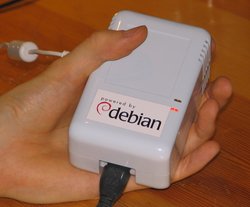
SheevaPlug in my hand I received a SheevaPlug this week, an intriguing device that packs incredible power and functionality into a tiny package. As many of you know, I've been doing a lot of work on Debian for the Linksys NSLU2 in the last few years. The NSLU2 is a key reason why ARM has become the third most popular architecture in Debian (after 32 and 64 bit x86), and I believe a main reason is that the NSLU2 is so incredibly cheap. At a price under $100, most people don't think too long and simply buy a device and do something cool with it. The SheevaPlug is being offered at the same price range but offers considerably more. Riku Voipio asked the right question: "What would you do with something approximately 10x more powerful with same prize/size range?" I believe the SheevaPlug is a killer replacement for the NSLU2 and here's why:
  • Marvell Kirkwood 6281 CPU at 1.2 GHz with 256 KB L2 cache (compared to a 266 MHz CPU)
  • 512 MB RAM (compared to lousy 32 MB)
  • 512 MB flash, enough for a basic Debian installation (compared to 8 MB)
  • Gigabit Ethernet (compared to 100 Mb) and no proprietary microcode required
  • 1x USB and 1x SD (compared to 2x USB: the only advantage the NSLU2 has)
  • ... and finally: mini-USB with serial console and JTAG: while Debian on the NSLU2 works well and is stable, we regularly had users whose system would no longer boot and there was no good way to figure out why. The serial console on the SheevaPlug actually allows users to figure out what's going on.
I'm incredibly excited about the SheevaPlug and the first thing I did was to take the device apart and look at the inside. The results can be found in the SheevaPlug image gallery. My next project will be slightly more productive: porting Debian. As I see it, we should support the following three installation variants for the SheevaPlug:
  • To an external USB drive or stick.
  • To an SD card.
  • To the 512 MB flash memory on the device.
The first two should be relatively straight forward, but of course installing to the internal flash memory is particularly interesting given that 512 MB (plus compression) is enough for a basic installation of Debian. Unfortunately, installations to MTD flash are currently not supported in the Debian installer but I hope we can find a volunteer who wants to implement this functionality. My next steps are to put a kernel for the SheevaPlug into the archive and to get a basic installation going. From there we can look at more sophisticated installation options and other functionality.

Russell Coker: Why Cyrus Sucks

I m in the middle of migrating a mail server away from the Cyrus mail store [1]. Cyrus provides a POP and IMAP server, a local delivery agent (accepting mail via LMTP). It is widely believed that Cyrus will give better performance than other mail stores, but according to a review by linux-magazin.de Dovecot and Courier deliver comparable (and sometimes better) performance [2]. The biggest problem with Cyrus is that it is totally incompatible with the Unix way. This wouldn t be a problem if it would just work and if it would display reasonable error messages when it failed, but it doesn t. It often refuses to work as desired, gives no good explanation, and it s data structures can t be easily manipulated. Dovecot [3] and Courier [4] use the Maildir++ format [5] (as well as many other programs). I have set up a system with Courier Maildrop and Dovecot for the IMAP server [6] and it works well - it s good to have a choice! But also Maildir++ is reasonably well documented and is an extension to the well known Maildir format. This means that it s easy to manipulate things if necessary, I can use mv to rename folders and rm to remove them. Cyrus starts with a database (Berkeley DB file) of all folders in all mailboxes. Therefore it is not possible to move a user from one back-end server to another by merely copying all the files across and changing the LDAP (or whatever else contains the primary authentication data) to point to the new one. It also makes it impossible to add or remove folders by using maildirmake or rm -rf. The defined way of creating, deleting, and modifying mailboxes is through IMAP. One of the problems with this is that copying a mailbox from one server to another requires writing a program to open IMAP connections to both servers at once (tar piped through netcat is much faster and easier). Also if you need to rename a mailbox that contains many gigabytes of mail then it will be a time consuming process (as opposed to a fraction of a second for mv). Cyrus has a tendency to break while Dovecot is documented as being self-healing and Cyrus also seems to cope well in the fact of a corrupted mail store. Even manually repairing problems with Cyrus is a painful exercise. The Cyrus mail store is also badly designed - and it s design was worse for older filesystems (which were common when it was first released) than it is for modern ones. The top level of a Cyrus maildir contains all the messages in the INBOX stored one per file, as well as three files containing Cyrus indexes and sub-directories for each of the sub-folders. So if I want to discover what sub-folders a mailbox has then I can run ls and wait for it to stat every file in the directory or I can use an IMAP client (which takes more configuration time). As opposed to a Maildir++ store where every file that contains a message is stored in a folder subdirectory named new , cur , or tmp which means that I can run ls on the main directory of the mail store and get a short (and quick) result. Using tools such as ls to investigate the operation of a server is standard practice for a sysadmin, it should work well! A finall disadvantage of Cyrus seems to have many small and annoying bugs (such as the reconstruct program not correctly recursing the sub folders). I guess it s because not many people use Cyrus that such things don t get fixed. One trivial advantage of Cyrus is that by default it splits users into different sub-directories for the first letter of the account name. Dovecot supports using a hash of the user-name this is better than splitting by first-letter for performance (it gives a more equal distribution) but will make it slightly more difficult to manipulate the mail store by script. Ext3 can give decent performance without a two level directory structure for as many as 31,998 sub-directories (the maximum that it will support) due to directory indexing and Linux caching of dentries. There may be some other advantages of Cyrus, but I can t think of them at the moment. Here is a script I wrote to convert Cyrus mail boxes to Maildir++. To make this usable for a different site would require substituting a different domain name for example.com (or writing extra code to handle multiple domains) and inserting commands to modify a database or directory with the new server name. There is no chance of directly using this script on another system, but it should give some ideas for people performing similar tasks.

#!/bin/bash -e
# $1 is the user to move # BASEDIR is the directory for temporary files
BASEDIR=/mail/new
rm -rf $BASEDIR/$1 archive.tgz archive2.tgz ORIGSRV=$(echo "MYSQL_COMMAND_TO_GET_SERVER" mysql dbname)
echo "original server was $ORIGSRV" if [ "$ORIGSRV" = "" ]; then
echo "No server for account, strange error."
exit 1
fi ORIGPARENT="/mail/domain/e/example.com/$(echo $1 cut -c1)/user" # copy the data to a local archive
# USERDIR is for using ^ instead of . as Cyrus does.
mkdir -p $BASEDIR
cd $BASEDIR
USERDIR=$(echo $1 sed -e "s/\./^/g")
ssh cyrus@$ORIGSRV "(cd $ORIGPARENT ; tar czf - $USERDIR)" > archive.tgz
tar xzf archive.tgz
if [ "$USERDIR" != "$1" ]; then
mv $USERDIR $1
fi DEPTH=$(find . -mindepth 3 -type d wc -l)
if [ "$DEPTH" != "0" ]; then
echo "too deep"
exit 1
fi # remove cyrus index files
find $1 -name "cyrus.*" -exec rm \;
cd $1 # "mail" is a directory with sub-folders, every other name starting with
# [a-zA-Z] is a regular folder that needs to become a Maildir
for n in [a-zA-Z]* ; do
if [ "$n" != "mail" ]; then
cd "$n" ; mkdir new cur tmp ; touch maildirfolder
mv [0-9]* new true
cd .. ; mv "$n" ".$n"
fi
done # move the inbox files to Maildir storage
mkdir new cur tmp
mv [0-9]* new true
mv mail/[0-9]* cur true # move sub-folders of "mail/" and merge ones with duplicate names
cd mail
for n in * ; do
if [ -e "../.$n" ]; then
cd "$n"
mv [0-9]* "../../.$n/cur" true
cd .. ; rmdir "$n"
else
cd "$n" ; mkdir new cur tmp ; touch maildirfolder
mv [0-9]* new true
cd .. ; mv "$n" "../.$n"
fi
done
cd ..
rmdir mail # get a list of all names so we can recognise duplicates
find . -type d egrep -v "new cur tmp" cd $BASEDIR ssh root@localhost "mv /mail/new/$1 /mail/example.com ; chown -R mail:mail /mail/example.com/$1"
echo "MYSQL_COMMAND_TO_SET_SERVER" mysql dbname

13 March 2009

Rudy Godoy: Is Debian listening to its users?

For some time ago I ve been pondering about this question. As long as GSoC 2009 is about to start and people are looking for project ideas, I m posting here a very preliminar draft of my findings and an idea for a posible software project. It s pretty written on-the-fly while I ve managed to have some minutes between work and uni. Rigurous wording isn t P1. Debian s social contract 4th item states:
Our priorities are our users and free software We will be guided by the needs of our users and the free software community. We will place their interests first in our priorities.
When we make decisions, either technical, legal and others regarding the operating system we deliver, this is one of the most referred argument. Altough that s seen as high priority often we don t have ways to properly know what our users want. While working on translations on the Spanish team we ve faced this situation. Do our users find them useful? they are able to understand them? they find that a much familiar wording would be bette than high technical details? We didn t know. Then, the question still exists. Altough Debian has ways for users to provide feedback (BTS, mailing lists, IRC, popcon, etc) none of them is designed to offer a way for the user to provide feedback on features, development roadmap and other non-bug aspects that developers and the project can tally and use for prioritize on releases. It s rather amusing to note that one of the most valuable assets free software community has is user involvement and contribution. But before we enter in details let s start on the basics. For using this information we first need to know who our users are? do we? From my findings and interaction with the community I ve identified two kinds of Debian users who can be clearly named. 1) The derivatives or pure blends, who use the Debian base and framework to build niche distributions. 2) The lead users (using E. Von Hippel s definition), who are the developers, contributors and a group of users. Debian is, if not the only, one of the projects who is best for fostering lead users. Most of them at some point involve themselves in the development process and some, later become developers. There is a more diverse group who are end-users but it s unclear to me how we can group them. Despite that they probably represent the biggest part of the pie. So, how we do please everyone? can we? In my opinion we can, at some degree. By implementing tools for first: gather user feedback, make statistical data, tally, we later can take informed decisions. In Debian decisions are voted and the set of people who votes are only developers with their own constraints. I think this would ease the constant that release-decisions-regarding-foo-tech-legal-issue represented on each release iteration, saving time, health and bits. It could be useful for knowing more about who are the ones we develop things for. I m thinking of some sort of Dell s IdeaStorm.com for software. What do you think? I m willing to co-mentor this if someone finds that is an interesting project for GSoC. Let me know!.

Emilio Pozuelo Monfort: Working on Liferea

Since this January, I ve been doing upstream work for Liferea. This is a great oportunity to learn C and to contribute more to an upstream project! And the atmosphere around Liferea is great. Today I ve published my first post in the Liferea blog. If you are a Liferea user, you may want to subscribe to it! There is a lot of work going on in Liferea. We are working hard to release 1.6 (which will use WebKit as the rendering backend) without any known regressions. Most of the performance work will likely go into the next series though, but 1.6 shouldn t be any worse than 1.4. If you would like to contribute, don t be shy and join #liferea on Freenode! We have some blockers for 1.6 and some other things to do, and we will appreciate any contributions. Testing is also appreciated. We are mostly interested in the unstable series, so if you find a bug in the latest unstable release or in trunk, file a bug report!

Alastair McKinstry: Overestimating the overspend

For the day thats in it (a salute to all triskaidekaphobians out there ...) It appears that the project under Bush was shut down due to an accounting error. According to Physics World:
A $500m accounting error led to the Bush administration scrapping a carbon capture and storage demonstration plant last year according to a report by the US House of Representatives committee of science and technology. The project was scrapped because costs appeared to have ballooned from $1bn to $1.8bn when in fact it had only risen to $1.3bn. 
Oops. Tags , ,

Bernd Zeimetz: gimp-plugin-registry update planned

Within the next days I plan to update the gimp-plugin-registry package, including the latest versions of all plugins. So if you'd like to see a new fance plugin in the package, or you have any other wish, please add a comment here, or even better, file a wishlist bug report against the package. Patches are welcome, git repository informations are listed below. Extra points if you find new/forked versions of plugins which are/were listed on registry.gimp.org but disappeared or are not updated anymore. Since the page moved to a blog-like style, and old plugin entries are not updated as before, it became harder for me keep the plugins uptodate. Help is appreciated.

Julien Blache: Kodak scanner drivers for Linux - not there yet

So, Kodak announced the availability of Linux drivers for some of its scanners, together with a frontend application. While the effort is laudable, they re not quite there yet. Let s have a look. First of all, and contrary to what a few people believe after reading the press release, the drivers themselves aren t OpenSource, let alone Free Software. They re all proprietary; read better, the press release clearly mentions that only the frontend application is GPLv2. Now let s look at what Kodak offers in its drivers packages. I ve downloaded LinuxSoftware_i1200_v3.5.tar.gz from the Kodak website, these are the drivers for the Kodak i1200 series. The archive contains a set of RPM packages, one Debian package corresponding to one of the RPM packages, and a setup script. One of the packages contains the OpenUSB library, which is released under the LGPL; sources aren t there, I haven t asked for the sources, don t plan on doing so, and am not implying anything regarding license compliance whatsoever. I ll note that I haven t seen any written offer for the sources, though, be it in the archive (there s not even a README in there) or on the website. So, although Ubuntu is listed as supported, we can say that no Debian packages are provided. The setup script actually relies on alien to convert them if it thinks it s running on a Debian-based system, which is determined by the availability of dpkg in the PATH. Using alien is far from ideal. The packages ship libraries and components under /usr/lib, /usr/local/lib and even /opt, pretty randomly it seems. Let s repeat here that /usr/local and /opt are strictly reserved for the local administrator and packages must not install anything here. There are other oddities in the paths used by the software stack, like /var/kodak. It looks like the SANE backend is only a bridge to Kodak s TWAIN data source, so you d actually need the whole stack to use it. All in all, Kodak does no better, I d even venture to say it does worse, than Epson (Avasys). At least part of Epson s backend is Free Software, even if it relies on proprietary libraries for some scanners, though unfortunately most if not all of the recent ones. I also have to mention that Epson is offering both RPM and Debian packages, and by that I mean proper Debian packages. Kodak are far from that, even the RPM aren t that great (I think the RPM packages even lack dependency information, based on what I ve read in the setup script, though I haven t checked). What Kodak offers here is a GPL frontend for TWAIN that not many people will be using, while keeping the drivers proprietary. Unfortunately their SANE backend isn t a backend so to speak, and even if it was OpenSource it d still rely on the rest of the TWAIN software stack. So, in a nutshell, while I m very happy to see yet another vendor go down the road of Linux support for its products, I am immensely disappointed by the proprietary nature of the drivers and the low quality of the packages. I was, of course, investigating the drivers to possibly package them for Debian; as you ve probably understood, it s not possible, both technically and legally. And I kept a little gem from the setup script for the end:
# We need to create a link for the libdbus-1 requirement for openusb,
# but only on Fedora.
if [ -f /etc/fedora-release ]; then
    ln -s /lib/libdbus-1.so.3 /lib/libdbus-1.so.2 2>> /dev/null
fi
As we all know, sonames and soversions are useless and they just keep getting in the way. Duh.

12 March 2009

Decklin Foster: Inside Out

I've been on Twitter for over a year and a half now. If I had to explain why I like it, and why it's so popular now, I would use an analogy:
Twitter : IRC :: Blogs : Usenet
(This applies equally to other "micro-blogging" services, but I am about to explain why I believe that's not the right metaphor. You may also substitute mailing lists for Usenet.) With the older media, you have a place -- a newsgroup, or a channel, that people went to, with a distinct culture, and that (mostly) weren't "owned" by anyone, but rather by the community. With the new ones, we are all sole proprietors of our own streams, and we "tune in" to the subset of people we find interesting, rather than topics we invest in. So, instead of bumping into the same person in a couple different groups, or never reading their words at all, you might find that your feeds overlap a bit more than they do with most people. This is how I find people to "follow" and blogs to read, in fact -- as my network expands, more people become loosely joined to it, and as I notice ones worth reading I add them. Is one model better than the other? Probably not. I could make an analogy to music. In theory, I'd rather read what my favorite critics have to say about a wide variety of new releases -- some of which I'd never know about otherwise -- than keep up with the discussion of bands and genres I really like, even if most people writing about them are terrible (remember, 90% of everything is crap). But I also lose that sense of community of being a "fan" of something; I no longer have a deep connection to what's going on in the fandom or the scene, which I also would never know about otherwise (some of it is just too obscure for my favorite writers to cover). In practice, it seems the new approach has been more popular, but maybe that's because more people are on the net now, and both kinds of communication are/were shaped by the technology available at the time (destinations make much more sense with limited/centralized computing resources, and aggregation makes much more sense with powerful clients and a wider, less specialized user base). Anyway. This post is not actually about social media theory or whatever you want to call it; it's about some software I have packaged. Because of all the above, I have always wished that I could use Twitter from something more like my IRC client. Like, say, my IRC client. One could abuse the concepts of IRC to make an "on the fly" channel of whoever happens to be in my feed. (I once read a blog comment somewhere complaining that Twitter could easily be implemented on any existing IRC server using one +m channel for everyone and some client-side direction of messages from all such channels to a single window. +1 for cleverness, but they did sort of miss the point of why normal people sign up for web sites rather than installing and configuring clients for obscure chat protocols.) So, I had grand plans to write a Twitter client which was an IRC server, with some clever mapping of IRC concepts and commands to their equivalents over there. I never got around to it, as I barely have enough time for anything I do now. But last month I noticed that someone else had implemented such a thing: tircd. I had seen Twitter/IRC services before, but like the official Twiter XMPP service, they were all implemented as bots, which I detest for this sort of application. Bitlbee, for example, translates various IM protocols to IRC, but only halfway -- for anything else you have to use a bot as a sort of poor man's command line. If I want a command line for Twitter, I already have several; IRC can do better. And tircd really does! It's great. You're not required to edit the config file, and there's no extra layer on top of IRC for things like logging in or adding people. I've finally packaged the latest release, which is waiting in NEW currently. I got a request for sneak preview packages, so if you want to install some unapproved .debs check this repository. I may still pick my own project back up, as Twitter itself, being a centralized service, feels like a stopgap solution on the way to to a more generalized 140-character equivalent of the, er, blogosphere as envisioned by open-source projects like Identi.ca. In the future, perhaps, when we use a certain micro-blogging "service" we might be randomly connected to one of any number of servers run by different individuals but all mirroring messages back and forth to each other. Which, now that I think of it, sounds vaguely like some obscure, obsolete chat and news-posting protocols I know.

Next.

Previous.