Search Results: "ina"

17 January 2014

Rog rio Brito: Developing for Android with Debian

I have just enrolled in a MOOC to learn about programming with Android. There are many tutorials and reports of people using Linux for the development of the apps out there, but, unfortunately, many of them are outdated or contain misleading information. You will find bazillion instructions out there telling you to install JDK6. (Even the instructions in the MOOCs say so, and Google says that it is the only supported version of Java). Even more than that, some of them will tell you that you should not use OpenJDK, but use Oracle's JDK instead. So, if you have a pure amd64 system and you try to install the x86-64 version of Google's Android Developer Tools (ADT), you are going to have a surprise: you will have all sorts of programs telling you that you have file not found, even though the required binaries are there. (This is, of course, besides install openjdk-7-jdk, if you wish to use the integrated Eclipse environment). Turns out that the so-called 64-bit ADT/SDK actually has many 32-bit executables(!) and they aren't statically linked. Inspecting them, I needed the following packages:
    gcc-4.8-base:i386
    libc6-i686:i386
    libc6:i386
    libgcc1:i386
    libstdc++6:i386
    zlib1g:i386
It is worth observing that: Given the above, and given that the version of the GCC libraries can vary a lot, it is perhaps better to simply do something like:
apt-get install libstdc++6:i386 zlib1g:i386
Although not necessary, since you are using an amd64 machine, your computer already supports many more recent instructions that will be used if you install the package libc6-i686:i386. To avoid the emulator from spitting out error messages related to libGL.so, install libgl1-mesa-dev (note: not i386 here). This way, you will be able to run the embedded QEMU with full KVM acceleration if you pass the options -qemu -m 1024 -enable-kvm on Eclipse's "Run > Run Configurations... > Target > Additional Emulator Command Line Options". After that, you are probably good to go.

Michael Stapelberg: debmirror 6x speed-up, or how to fill a 1 GBps Rackspace link

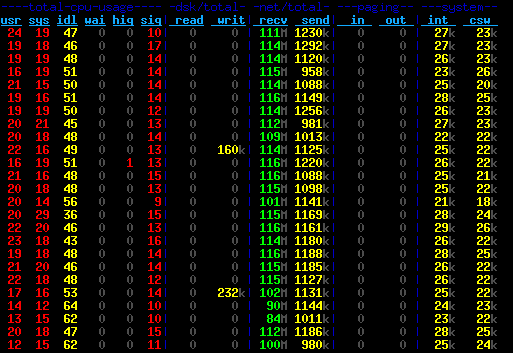
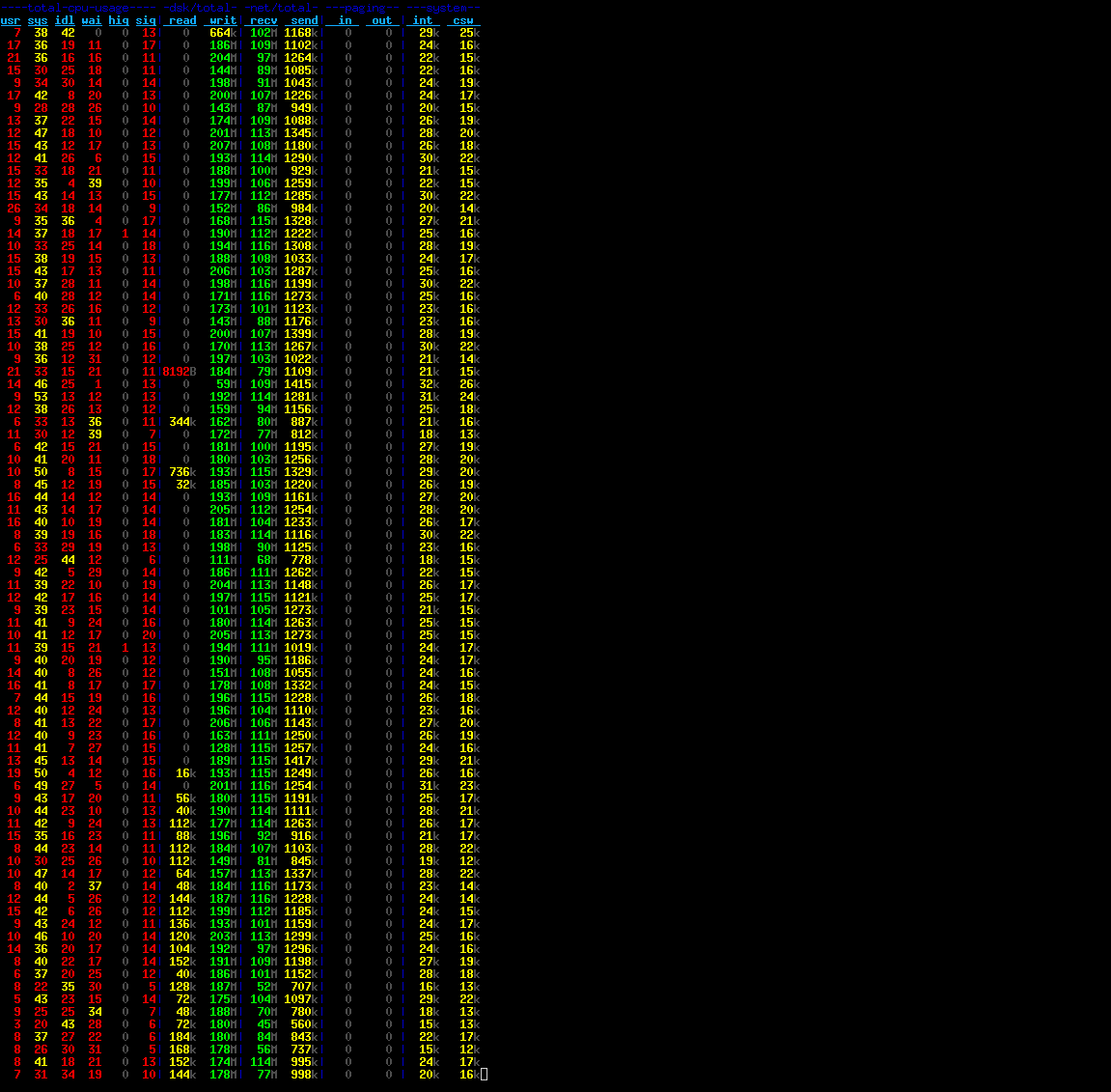
As explained in more detail in my my last blog post, Rackspace is providing hosting for Debian Code Search. For those of you who don t know, Rackspace is a cloud company that provides (among other services) a public cloud based on OpenStack. That means you can easily (and programmatically, if you want) bring up virtual servers, block storage volumes, configure the network between them, etc. As part of my initial performance experiments, I was running debmirror to clone a full Debian source mirror, and I noticed this took about one hour. Given that the peak network and storage write rates I have observed in my benchmarks are much higher, I wondered why it took so long. About 43 GB (that s how big the Debian sid sources are) in 60 minutes means 12 MB/s download rate, which is a bit more than a sustained 100 MBit/s connection. Luckily, at least the Rackspace servers I looked at are connected with 1 GBit/s to the internet, so more should be possible. Note that these are the old Rackspace servers. There is a new generation of servers, which I have not yet tried, that apparently offer even higher performance. After a brief look at the debmirror source code, I concluded that it can only use a single mirror and downloads files sequentially. There is some obvious potential for improvement here, and the fact that I could come up with a proof of concept written in Go to determine the files to download in a couple of minutes encouraged me to spend my saturday on this problem :-). About 7 hours later, my prototype had gone through various iterations and the code could sustain about 115 MB/s incoming bandwidth for most of the time. Here is a screenshot of dstat measuring the performance: Another 3 hours later, the most obvious bugs were weeded out and the code successfully cloned an entire mirror for the first time. I verified the correctness by running debmirror afterwards, and no files were downloaded that had not actually arrived on the mirror in the meantime. Features
  1. Parallel downloading from multiple mirrors.
    Of course, it is not guaranteed that the mirrors are consistent, but that is a solvable problem: whenever a non-200 HTTP response is encountered, the file is put back into the queue and gets rescheduled onto any mirror. Eventually, it will be rescheduled onto the mirror from which the sources.gz was downloaded, and that mirror has to have it.
  2. HTTP keep-alive and pipelining.
    debmirror also does HTTP keep-alive (I read that in the source, did not verify it), but it downloads files sequentially, i.e. it downloads one file, then sends the request for the next file. This means that after one file was received, no data is being received until another round-trip finished. For a lot of small files (think of .dsc and .debian.tar.gz files or small orig tarballs) that really adds up.
    Therefore, I use HTTP pipelining: I send 99 requests and then just receive all the responses at full speed. The magic number 99 comes from the fact that this is the smallest common denominator that all mirrors I have tested allow. nginx by default allows 100 requests.
  3. Request ordering.
    Instead of sending requests at random, I sort the download queue by size and make sure that the first request on each connection is for a big file. The intention is that TCP will adapt to that quickly and use a bigger window size as soon as possible instead of ramping up slower later on. Note that I have not actually measured the window sizes, so this is just a hunch.
    Another nice side-effect of the ordering is that the amount of data that is being sent through each connection is roughly equal. This means we don t waste TCP connections by sending 99 requests for small files only.
  4. (Goroutines).
    I m a bit hesitant to even write about it, so let s make it quick: Perl (and thus debmirror) is typically single-threaded, whereas Goroutines scale nicely on multi-core systems. I don t think it makes a big difference on the machines I am running this on as they have only two cores and are not maxed out on CPU usage at all. But maybe this will be more important for saturating 10 GBit/s? :-)
  5. (Mirror selection).
    It s not a feature of the code, but certainly relevant: of course I selected mirrors that are connected to the internet with at least a Gigabit link, serve files reasonably fast and have low latency to Rackspace s Chicago presence.
    Interestingly, while I used to think that universities have access to big uplinks and beefy machines, none of the mirrors that I use are located at a university. In fact, every mirror ending in .edu that I tried was really slow most of them providing something like 2-4 MB/s.
Results With the latest iteration of the code, I can clone an entire Debian source mirror with 43 GB of data in about 11.5 minutes, which corresponds to a 63 MB/s download rate:
GOMAXPROCS=20 ./dcs-debmirror -num_workers=20
68,24s user 384,90s system 66% cpu 11:25,97 total
It should be noted that the download rate is very low in the first couple of seconds since the sources.gz file is downloaded from a single mirror, then unpacked and analyzed. The peak download rate is about 115 MB/s (= 920 MBit/s) which is reasonably close at what you can achieve with a Gigabit link, I think. If the entire uplink was available to me at all time, the Rackspace hardware would be able to saturate that easily, both in terms of reading from the network and in terms of writing to block storage. I tested this on an SSD volume, but I see about 113 MB/s throughput with the internal hard disk, so I think that should work, too. There is another dstat screenshot of the final version (writing to disk). Perhaps even more interesting to some readers is the time for an incremental update:
GOMAXPROCS=20 ./dcs-debmirror -tcp_conns=20
2013/10/13 11:09:55 Downloading 307 files (447 MB total)
 
2013/10/13 11:10:04 All 307 files downloaded in 9.105605931s. Download rate is 49.186567 MB/s
4,91s user 3,99s system 67% cpu 13,205 total
The wall clock time is higher than the time reported by the code because the code does not count the time for downloading and parsing the sources.gz file. The entire program is about 400 lines (not SLOC) of Go code. It s part of the Debian Code Search source. If you re interested, you can read dcs-debmirror.go in your browser. Conclusions The outcome of this experiment is that I now know (and have shown!) that there are significantly more efficient ways of cloning a Debian mirror than what debmirror does. Furthermore, I have a good grasp on what kind of performance the Rackspace cloud offers and I am fairly happy with the numbers :-). My code is useful to me in context of Debian Code Search, but unless you need a sid-only source-only mirror, it will not be useful to you directly. Of course you can take the ideas that I implemented and implement them elsewhere personally, I don t plan to do that. If you have hardware, bandwidth and a use-case for 10 GBit/s+ mirroring, I d like to hear about it! :-)

Sylvestre Ledru: Debian & LLVM events

Being a bit hyperactive, I have been involved in the organization of two events. I am the main organizer with Alexandre Delano of the Mini Debconf 2014 in Paris, January 18 & 19th. The (great) planning is available here:
https://france.debian.net/events/minidebconf2014/
Saturday morning presentations will be general public, the beginning of Saturday afternoon will be used by the Debian France association to vote the new status (1901 law and Debian Trusted Organization).
Sunday will be more focused on Debian itself.
During the week end, I will be talking about the Debile project, the finance of Debian France and be part of the round table on compiler selection for Debian.
The (mandatory) registration should be done on the Wiki or meetup.com In parallel, with Tobias Grosser, we organized the LLVM devroom track at FOSDEM (Bruxelles), February 2nd (Sunday).
The schedule is a mix between core developers, third party software using LLVM / Clang and academic users.
https://fosdem.org/2014/schedule/track/llvm/
I will be talking on how to become a LLVM contributor. Both events should be recorded.

Chris Lamb: Captain Phillips: Pontius Pirate

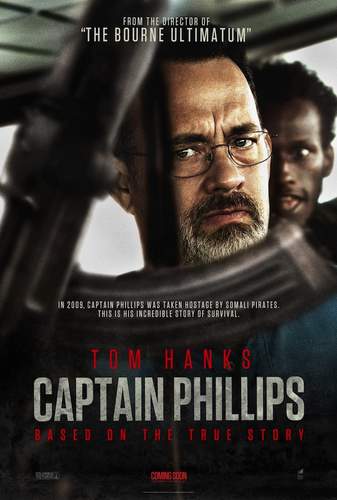
https://chris-lamb.co.uk/wp-content/2014/phillips_b.jpg Somalia's chief exports appear to be morally-ambiguous Salon articles about piracy and sophomoric evidence against libertarianism. However, it is the former topic that Captain Phillips concerns itself with, inspired by the hijacking of the Maersk Alabama container ship in 2009. What is truth? In the end, Captain Phillips does not rise above Pontius Pilate in providing an answer, but it certainly tries using more refined instruments than irony or leaden sarcasm. This motif pervades the film. Obviously, it is based on a "true story" and brings aboard that baggage, but it also permeates the plot in a much deeper sense. For example, Phillips and the US Navy lie almost compulsively to the pirates, whilst the pirates only really lie once (where they put Phillips in greater danger). Notice further that Phillips only starts to tell the truth when he thinks all hope is lost. These telling observations become even more fascinating when you realise that they must be based on the testimony of the, well, liars. Clearly, deception is a weapon to be monopolised and there are few limits on what good guys can or should lie about if they believe they can save lives.
https://chris-lamb.co.uk/wp-content/2014/phillips_c.jpg

Even Phillip's nickname ("Irish") is a falsehood he straight-up admits he is an American citizen.

Futhermore, there is an utterly disarming epilogue where Phillips is being treated for shock by clinical efficient medical staff. Not only will this scuttle any "blanket around the shoulders" clich but is probably a highly accurate portrayal of what actually happens post-trauma. This echoes the kind of truth Werner Herzog aims for in his filmmaking as well his guilt-inducing duality between uncomfortable lingering and compulsive viewing. Lastly, a starter for a meta-discussion: can a film based on real-world events even be "spoilered"? Hearing headlines on the radio before you read your newspaper hardly robs you of a literary journey... Captain Phillips does have some quotidian problems. Firstly, the only tool for ratcheting up tension is for the Somalians to launch verbal broadsides at the Americans, with each compromise somehow escalating the situation. This technique is effective but well before the climatic rescue scene where it is really needed it has been subject to the most extreme diminishing returns. (I cannot be the first to notice the "Africans festooned with guns shouting incomphensively" trope I hope it is based on a Babel-esque mechanism of disorientation from miscommunication rather than anything more unsavoury.)
https://chris-lamb.co.uk/wp-content/2014/phillips_a.jpg

The racist idea that Africans prefer an AK-47 rotated about the Z-axis is socially constructed.

Secondly, the US Navy acts like a teacher with an Ofsted inspector observing quietly from the corner of the classroom; far too well-behaved it suspends belief, with no post-kill gloating or even the tiniest of post-arrest congratulations. Whilst nobody wants to see the Navy overreact badly to other military branches getting all the glory, nobody wants to see a suspiciously bland recruitment vehicle either. Paradoxically, this hermetic treatment made me unduly fascinated by them as if they were part of some military "uncanny valley". Two quick observations:
https://chris-lamb.co.uk/wp-content/2014/phillips_d.jpg

The drone footage: I'd love to write an essay about how Call of Duty might have influenced (or even be) cinema.

Finally, despite the title, the film is actually about two captains; the skillful liar Phillips and ... well, that's the real problem. Whilst Captain Muse is certainly no caricatured Hook, we are offered little depth beyond a "You're not just a fisherman" faux-revelation that leads nowhere. I was left inventing reasons for his akrasia so that he made any sense whatsoever. One could charitably argue that the film attempts to stay objective on Muse, but the inability for the film to take any obvious ethical stance actually seems to confuse and then compromise the narrative. What deeper truth is actually being revealed? Is this film or documentary? Worse still, the moral vacuum is invariably filled by the viewer's existing political outlook: are Somali pirates victims of circumstance who are forced into (alas, regrettable) swashbuckling adventures to pacify plank-threatening warlords? Or are they violent and dangerous criminals who habour an irrational resentment against the West, flimsily represented by material goods in shipping containers? Your improvised answer to this Rorschach test will always sit more haphazardly in the film than any pre-constructed treatment ever could. 6/10

Chris Lamb: Review: Captain Phillips (2013)

https://chris-lamb.co.uk/wp-content/2014/phillips_b.jpg Somalia's chief exports appear to be morally-ambiguous Salon articles about piracy and sophomoric evidence against libertarianism. However, it is the former topic that Captain Phillips concerns itself with, inspired by the hijacking of the Maersk Alabama container ship in 2009. What is truth? In the end, Captain Phillips does not rise above Pontius Pilate in providing an answer, but it certainly tries using more refined instruments than irony or leaden sarcasm. This motif pervades the film. Obviously, it is based on a "true story" and brings aboard all that well-travelled baggage, but it also permeates the plot in a much deeper sense. For example, Phillips and the US Navy lie almost compulsively to the pirates, whilst the pirates only really lie once where they put Phillips in greater danger. Notice further that Phillips only starts to tell the truth when he thinks all hope is lost. These telling observations become even more fascinating when you realise that they must be based on the testimony of the, well, liars. Clearly, deception is a weapon to be monopolised and there are few limits on what good guys can or should lie about if they believe they can save lives.
https://chris-lamb.co.uk/wp-content/2014/phillips_c.jpg

Even Phillip's nickname ("Irish") is a falsehood he straight-up admits he is an American citizen.

Lastly, there is an utterly disarming epilogue where Phillips is being treated for shock by clinical efficient medical staff. Not only will it scuttle any "blanket around the shoulders" clich but is probably a highly accurate portrayal of what actually happens post-trauma. This echoes the kind of truth Werner Herzog often aims for in his filmmaking as well his guilt-inducing duality between uncomfortable lingering and compulsive viewing. Another angle worthy of discussion: can a film based on real-world events even be "spoilered"? Hearing headlines on the before you read the newspaper hardly robs you of a literary journey... Captain Phillips does have some quotidian problems. Firstly, the only tool for ratcheting up tension is for the Somalians to launch verbal broadsides at the Americans, with each compromise somehow escalating the situation further. This technique is genuinely effective but well before the climatic rescue scene where it is really needed it has been subject to the most extreme diminishing returns. (I cannot be the first to notice the "Africans festooned with guns shouting incomphensively" trope I hope it is based on a Babel-esque mechanism of disorientation and miscommunication rather than anything, frankly, unsavoury.)
https://chris-lamb.co.uk/wp-content/2014/phillips_a.jpg

The racist idea that Africans prefer a AK-47 rotated about the Z-axis is socially constructed.

Secondly, the US Navy acts like a teacher with an Ofsted inspector observing quietly from the corner of the classroom; far too well-behaved it suspends belief, with no post-kill gloating or even the tiniest of post-arrest congratulations. Whilst nobody wants to see the Navy overreact badly to other military branches getting all the glory, nobody wants to see a suspiciously bland recruitment vehicle either. Paradoxically, this hermetic treatment made me unduly fascinated by them, as if they were part of some military "uncanny valley". Two quick observations:
https://chris-lamb.co.uk/wp-content/2014/phillips_d.jpg

The drone footage: I'd love to read (or write) an essay about how Call of Duty might have influenced cinema.

Finally, despite the title, the film is actually about two captains; the skillful liar Phillips and ... well, that's the real problem. Whilst Captain Muse is certainly no caricatured Hook, we are offered little depth beyond a "You're not just a fisherman" faux-revelation that leads nowhere. I was left inventing reasons for his akrasia so that he made any sense whatsoever. One could charitably argue that the film attempts to stay objective on Muse, but the inability for the film to take any obvious ethical stance actually seems to confuse and then compromise the narrative. What deeper truth is actually being revealed? Is this film or documentary? Worse still, the moral vacuum is invariably filled by the viewer's existing political outlook: are Somali pirates victims of circumstance who are forced into (alas, regrettable) swashbuckling adventures to pacify plank-threatening warlords? Or are they violent and dangerous criminals who habour an irrational resentment against the West, flimsily represented by material goods in shipping containers? Your improvised answer to this Rorschach test will always sit more haphazardly in the film than any pre-constructed treatment ever could. 6/10

16 January 2014

Daniel Pocock: Get ready to try Debian SIP

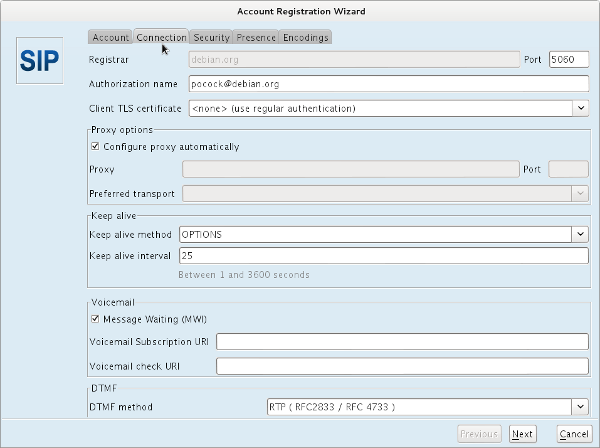
Before going on to talk about SIP, there is one really important thing that must be emphasized: XMPP/Jabber is also in the roadmap. Some of the infrastructure that has already been deployed (the new RTC passwords in ud-ldap, the TURN server and the RADIUS server) is good for both SIP and XMPP use cases. All to be revealed on Sunday As mentioned in my recent blog about the Debian.org NAPTR record, more details will be coming in my talk at mini-DebConf Paris this weekend. Today I'm just going to describe some things to install for those who want a head start. Jitsi Jitsi has been around for many years (originally as SIP Communicator) and it is probably the most advanced desktop softphone in the free software world. Jitsi packages are in jessie and sid - why not install them now. If you don't want to pull in dependencies from jessie on your wheezy system, you can also download from upstream and run it standalone. WebRTC browsers I've prepared a JSCommunicator implementation based on the jscommunicator-web-phone package. To use it, you need the latest version of Iceweasel/Firefox or Chromium. As HTML5 WebRTC / RTCPeerConnection is an evolving standard, using a recent browser is essential. Jitsi configuration for sip:debian.org It is not open for users just yet, but this is how you will configure it when it is available. More details to come...
AttachmentSize
step-4-setup-connection-scaled.png59.66 KB

Andrew Pollock: [life] And now for something completely different...

After 8 years, February 6 will be my last day with Google. The hardest pill to swallow with the end of my marriage was the reduction in my time with Zoe. It was one thing to lose my wife, but to lose 50% of my daughter as well has been, and will continue to be, a struggle for me. 2014 is the last year before Zoe starts in Prep (Queensland's school grade before "one"). This is my last opportunity to be able to have a big chunk of time with her before she gets swallowed up by the school system. It's ridiculous to be sticking her in full-time long day care if I have an alternative. And I do have an alternative. I'm in the fortunate financial position of not having a mortgage, or any debt to speak of, and a modest amount of savings. I shall be Daddy Day Care. It had always been my career goal in life to be a stay at home Dad. I'd wanted to have another child and be the one to stay at home and look after the kids, and allow Sarah to resume her career. Obviously none of that worked out, but there's no reason why I can't be a stay at home Dad for at least this year. Zoe's at a wonderful age now. We can have a lot of fun together this year. She's going to be in a 5 day a fortnight Kindergarten program (Monday, Tuesday and every other Wednesday) between 8:20am to 2:30pm, so I'm planning on using one of those days for Debian contributions, one of those days for exploring some of the crazy startup ideas I have rattling around in my head, and every second Wednesday to keep the home tidy. It's going to be a fun, different year for Zoe and I, and I'm so looking forward to it. I'm planning on doing lots of activities from Play at Home Mom, doing lots of baking and we'll be doing Science Friday's. If anyone knows where I can get a toddler-sized lab coat, drop me a line. I'm hoping I can make time to write up our activities for posterity as well.

15 January 2014

Sylvestre Ledru: Debian France shop

During the month of December, we have been working with folks from En Vente Libre to create a shop with Debian products: http://www.enventelibre.org/debian We have now a shop with plenty of Debian products. The design has been done by Ahmet DEMIR. Most of them are already known by the community (they were sold during FOSDEM or various Debconf) like the Buff, Swiss Army knife or the classical polos. But, t-shirts based on Wheezy theme are brand new:
They are available in three colors:
* Red
* Blue
* Grey For now, the website is only French, an English version might come in the future.

Sylvestre Ledru: Some thoughts concerning LLVM & Clang and their evolutions: Release of LLVM & Clang 3.4

We just released LLVM & Clang 3.4 (already available in Debian Jessie and Ubuntu Trusty). The clang new release introduces some more warning and error detections. The point of the blog post is not to detail the changes (LLVM / Clang) but more to take a step back on the LLVM and Clang toolchains, usages and dissemination. For the last couple years, I have been presenting our work on the Debian side to make Clang part of the Debian infrastructure. I add the chance to speak at many events (Debconf 12 & 13, FOSDEM 2013, Linux Plumbers 2013, Distro recipes, etc). I even had Linus Torvalds attending to one of these talks (and proposing new approach). I had many feedback from the Debian/Ubuntu communities but also from other communities.
More and more projects are using Clang as part of their workflows, in term of development, production and QA. For example, some of them are running continuous integration using clang instead of gcc, others are running scan-build (Wireshark or LLVM itself) or Address Sanitizer (asan) (Firefox for example), etc.
More and more actors are moving from gcc to clang for their developments (Sony with their PS4, Chrome under Mac OS X, Apple, the Linux Kernel with the LLVMLinux project, FreeBSD, etc).
I stopped counting the number of times when people answered me "Yeh, I am now using Clang" when I said I am involved upstream. In parallel, more and more projects are using LLVM as a backend or computing engine and, in the meantime, getting more and more attraction (not because they are based on LLVM but just because they are great projects). For example, Mesa (llvmpipe), Julia, Rust, Emscripten or Native Client (NaCL) are excellent examples of this. The two last are excellent proofs that LLVM based technologies have an impact which goes further than geek-tools and will be used on a daily basis by millions of users. I also saw an interesting and growing number of new projects using libclang and libTooling. My feeling is that the lack of plugin capabilities in gcc for a long time and, now, its current complexity limited the innovation in term of compilation capabilities, analysis and fun tools. The features and the quality of this library are enabling new developments and I am sure we will see more and more excellent tools based on this library during 2014.
For example, the LLVM toolchain ships Clang modernize and clang format and some cool projects like include-what-you-use, DXR, OCLint or creduce are emerging. Thanks to this great competition, gcc is also improving (ASAN, JIT, better warnings, etc), remaining still relevant as before. No doubt that 2014 will be a great year for compilers.

Jan Wagner: Bye bye Nagios-Plugins

Last night it seems the so called 'Nagios Plugins' project was cut off. The story started a decade ago when development of the plugins compatible with Nagios was taken over by an independend group of developers. Some time later, the domain of the 'Nagios Plugins' project was handed over to 'Nagios Enterprises, LLC.' due trademark reasons. To get an idea about that, I suggest to read on the 'Nagios Trademark Truth' and 'Nagios Trademark Triumph Provides Promise To Open Source Developers, Shows Power of Community'. In the latter Mr. Galstad is cited with "This violation took more than four years and thousands in legal fees before it was finally resolved. My hope is that this can serve as an example to Open Source developers worldwide that they can overcome infringements and protect their brands if they are persistent and engage their respective communities.". Yesterday in the evening the project members recognised that the DNS of nagios-plugins.org was moved to a different location. Now there seems to be a hosted (some may call that 'hijacked' or 'pirated') 'mirror' of the old site. Anyhow ... the content is already different from the original one or maybe changed even more in the future. From my point of view this can serve as an example to Open Source developers worldwide that they can be obstructed by (trademark holding) companies even if those companies profit from the work of them. So please don't use downloads from there, even the release tarballs maybe modified. The news all about that: 'Nagios Plugins are dead, we now have Monitoring Plugins in place!" Be sure you download your tarballs from https://www.monitoring-plugins.org/download.html and verify your checksums! You can follow the Monitoring Plugins Development Team also via Twitter.

14 January 2014

Daniel Pocock: PostFinance gives back my money

14 days with no response to written requests for a refund of the error. After a few hours of objective scrutiny on this blog, however, the money was put back: Thanks to all those who provided comments, especially Philipp Kern who found the paper form that reveals how bad the online standing order form really is, it is quite possible that was a factor in convincing PostFinance to take some responsibility. It is also possible that the contact center staff were not even aware of the way the standing order form is viewed by the customer, they may have been looking at some alternative form that had been generated by regurgitating the user input. These are just some examples of the problems that occur (and require thorough and professional analysis) when business processes go online and nobody has a paper trail to prove what they really meant.

Daniel Pocock: Blog comments working again

Blog comments have been problematic on this site for some months now. I finally had a look into the problem last night and identified the cause of the problem and implemented a workaround which other Drupal Blogspam module users are welcome to copy. Thanks to Steve Kemp for providing the Blogspam service. Anything but thanks to those who provide the spam.

Keith Packard: gl-and-bitmaps

X bitmaps vs OpenGL Of course, you all know that X started life as a monochrome window system for the VS100. Back then, bitmaps and rasterops were cool; you could do all kinds of things simple bit operations. Things changed, and eventually X bitmaps became useful only off-screen for clip masks, text and stipples. These days, you ll rarely see anyone using a bitmap everything we used to use bitmaps for has gone all alpha-values on us. In OpenGL, there aren t any bitmaps. About the most bitmap-like object you ll find is an A8 texture, holding 8 bits of alpha value for each pixel. There s no way to draw to or texture from anything where each pixel is represented as a single bit. So, as Eric goes about improving Glamor, he got a bit stuck with bitmaps. We could either: I thought the latter choice would be the best plan directly share the same object between CPU and GPU rendering, avoiding all reformatting as things move around in the server. Why is this non-trivial? Usually, you can flip formats around with reckless abandon in X, it has separate bits-per-pixel and depth values everywhere. That s how we do things like 32 bits-per-pixel RGB surfaces; we just report them as depth 24 and everyone is happy. Bitmaps are special though. The X protocol has separate (and overly complicated) image formats for single bit images, and those have to be packed 1 bit per pixel. Within the server, bitmaps are used for drawing core text, stippling and creating clip masks. They re the lingua franca of image formats, allowing you to translate between depths by pulling a single plane out of a source image and painting it into a destination of arbitrary depth. As such, the frame buffer rendering code in the server assumes that bitmaps are always 1 bit per pixel. Given that it must deal with 1bpp images on the wire, and given the history of X, it certainly made sense at the time to simplify the code with this assumption. A blast from the past I d actually looked into doing this before. As part of the DECstation line, DEC built the MX monochrome frame buffer board, and to save money, they actually created it by populating a single bit in each byte rather than packed into 8 pixels per byte. I have this vague memory that they were able to use only 4 memory chips this way. The original X driver for this exposed a depth-8 static color format because of the assumptions made by the (then current) CFB code about bitmap formats. Jim Gettys wandered over to MIT while the MX frame buffer was in design and asked how hard it would be to support it as a monochrome device instead of the depth-8 static color format. At the time, fixing CFB would have been a huge effort, and there wasn t any infrastructure for separating the wire image format from the internal pixmap format. So, we gave up and left things looking weird to applications. Hacking FB These days, the amount of frame buffer code in the X server is dramatically less; CFB and MFB have been replaced with the smaller (and more general) FB code. It turns out that the number of places which need to deal with individual bits in a bitmap are now limited to a few stippling and CopyPlane functions. And, in those functions, the number of individual read operations from the bitmap are few in number. Each of those fetches looked like:
bits = READ(src++)
All I needed to do was make this operation return 32 bits by pulling one bit from each of 8 separate 32-bit chunks and merge them together. The first thing to do was to pad the pixmap out to a 32 byte boundary, rather than a 32 bit boundary. This ensured that I would always be able to fetch data from the bitmap in 8 32-bit chunks. Next, I simply replaced the READ macro call with:
    bits = fb_stip_read(src, srcBpp);
    src += srcBpp;
The new fb_stip_read function checks srcBpp and packs things together for 8bpp images:
/*
 * Given a depth 1, 8bpp stipple, pull out
 * a full FbStip worth of packed bits
 */
static inline FbStip
fb_pack_stip_8_1(FbStip *bits)  
    FbStip      r = 0;
    int         i;
    for (i = 0; i < 8; i++)  
        FbStip  b;
        uint8_t p;
        b = FB_READ(bits++);
#if BITMAP_BIT_ORDER == LSBFirst
        p = (b & 1)   ((b >> 7) & 2)   ((b >> 14) & 4)   ((b >> 21) & 8);
        r  = p << (i << 2);
#else
        p = (b & 0x80000000)   ((b << 7) & 0x40000000)  
            ((b << 14) & 0x20000000)   ((b << 21) & 0x10000000);
        r  = p >> (i << 2);
#endif
     
    return r;
 
/*
 * Return packed stipple bits from src
 */
static inline FbStip
fb_stip_read(FbStip *bits, int bpp)
 
    switch (bpp)  
    default:
        return FB_READ(bits);
    case 8:
        return fb_pack_stip_8_1(bits);
     
 
It turns into a fairly hefty amount of code, but the number of places this ends up being used is pretty small, so it shouldn t increase the size of the server by much. Of course, I ve only tested the LSBFirst case, but I think the MSBFirst code is correct. I ve sent the patches to do this to the xorg-devel mailing list, and they re also on the depth1 branch in my repository
git://people.freedesktop.org/~keithp/xserver.git
Testing Eric also hacked up the test suite to be runnable by piglit, and I ve run it in that mode against these changes. I had made a few mistakes, and the test suite caught them nicely. Let s hope this adventure helps Eric out as he continues to improve Glamor.

13 January 2014

Daniel Pocock: PostFinance, where is my money?

Update: my money has been returned by PostFinance very soon after this blog appeared There's no better way to get the year off to a good start than finding money has gone missing from your bank account. Where I live in Switzerland, it is mandatory for everybody to make a monthly payment for health insurance (as it is mandatory, it is basically a tax, like the monthly council tax in England). Just like British council tax, the premiums go up each year and every person in the country has to log into their bank's web site and change their standing order. A few days after doing just that, I went back in to the web site to make another payment and noticed that the first health insurance payment for 2014 had been duplicated on two consecutive days, the 30th and 31st of December: I immediately sent them an email to alert them to the fault and ask for the duplicate transaction to be corrected. Normally, when a company makes a mistake, it would be fixed within a couple of days and certainly never reach my blog. Instead of getting a helpful reply, I was astonished to receive this:
There has been a misunderstanding when you have set up your standing order.
You selected "First execution" December 30, 2013 and then "monthly execution" 31. The system has followed your instruction and it results a double execution December 30 and 31.
Unfortunately, we are not able to return you the amount.
Great, apparently it is all my own fault. I thought "monthly" would mean one payment in each one month but apparently not everybody uses the same definition of monthly. (Actually, banks do have systems such as the 360 day calendar but that is another story). So let's look at these faulty instructions I supposedly gave. I immediately went back to the standing order page to take a screenshot. I even compared the page in English (my default language, which they are kind enough to let me use) and French (one of the four official languages of the Swiss Confederation) and I found they say much the same thing: Note: exact amounts and account numbers concealed The form is relatively clear: I authorised a monthly payment (Periodicite: mensuel) with the first (Premiere) payment on 30.12.2013 and then, or so I believed (and still do) a following payment (ensuite) on the 31st of each month, with the last payment at the end of November, for 12 payments in total. Simple, right? Where it says ensuite le 31, I sincerely believe that means the second payment is on 31 January, but Postfinance seem to be arguing that I meant the 31 December: just one day, rather than one month, after the first payment. Delaying tactics I replied to their email, telling them explicitly that I had authorized a monthly payment only and demanding the immediate return of the duplicate payment. When I got their next reply, I didn't know what to think:
We are pleased to do the necessary to revoke the transfer to SWICA. This will take at least two weeks.
On the one hand, it appears they are now starting to accept they may have made a blunder. But two more weeks? This was already 10 days after the money went missing. Do they even know what is wrong with their system? It doesn't give me confidence. I wrote back again and insisted that this is their error and that an immediate correction is required. Pass the buck, take three Today, another reply came back. After almost 14 days, I've now got three fob-off excuse mails and none of my money returned:
We did the request at SWICA to send back the money on your account on the 8th January 2014. The decision will be taken by them if they agree to send back this amount.
Unfortunately, we cannot do more except waiting their answer. You can call them and explain them the situation. With your call, maybe the reimbursement could be faster.
Why is it in the hands of the health insurance company? It is not their fault that Postfinance has a problem processing standing orders. Why do I have to waste my time chasing people, will I get compensation for that? Am I the only victim? With many people configuring their new health insurance payments at this time of the year, I can imagine that there may be other victims of this fault too. Are they all being fobbed off with these excuses? Some may not even realize if they don't check their account closely. What next? Sure, maybe I can just cancel the next health insurance payment: but why should I have that inconvenience? What exactly was I supposed to put on that form to not make this mistake they suggest I made? If I cancel the next payment like they suggest and then set up the payment again from March, how can I be sure the same duplication won't happen again? Using customers as unpaid QA testers Many leading financial organisations have experienced teams of developers, QA testers, and comprehensive regime of simulation/testing with paid participants to ensure their systems are reliable and as friendly and accurate as possible. Here, it feels like PostFinance has skipped all that, deploying a form that is ambiguous at best and they are using real customers like me to test the system and report the bugs. Normally organisations pay me for doing that very same task as part of my job as a software engineer. Not only have Postfinance taken almost 200 CHF of my money, but they have wasted my time with their strategy of fobbing me off and at the same time they are probably sending my feedback to their developers instead of paying a QA tester to check their systems. You be the judge What is your opinion?
  • Daniel can't use a web form, it is definitely Daniel's mistake, nobody else would make a mistake like that
  • The Postfinance form is ambiguous and so it is probably their fault and they should give back the money, it is likely these are cut and paste emails they send to all the customers who are duped by the form
  • Postfinance is completely wrong. Monthly means one payment each month.

11 January 2014

Johannes Schauer: Why do I need superuser privileges when I just want to write to a regular file

I have written a number of scripts to create Debian foreign architecture (mostly armel and armhf) rootfs images for SD cards or NAND flashing. I started with putting Debian on my Openmoko gta01 and gta02 and continued with devices like the qi nanonote, a marvel kirkwood based device, the Always Innovating Touchbook (close to the Beagleboard), the Notion Ink Adam and most recently the Golden Delicious gta04. Once it has been manufactured, I will surely also get my hands dirty with the Neo900 whose creators are currently looking for potential donors/customers to increase the size of the first batch and get the price per unit further down. Creating a Debian rootfs disk image for all these devices basically follows the same steps:
  1. create an disk image file, partition it, format the partitions and mount the / partition into a directory
  2. use debootstrap or multistrap to extract a selection of armel or armhf packages into the directory
  3. copy over /usr/bin/qemu-arm-static for qemu user mode emulation
  4. chroot into the directory to execute package maintainer scripts with dpkg --configure -a
  5. copy the disk image onto the sd card
It was not long until I started wondering why I had to run all of the above steps with superuser privileges even though everything except the final step (which I will not cover here) was in principle nothing else than writing some magic bytes to files I had write access to (the disk image file) in some more or less fancy ways. So I tried using fakeroot+fakechroot and after some initial troubles I managed to build a foreign architecture rootfs without needing root priviliges for steps two, three and four. I wrote about my solution which still included some workarounds in another article here. These workarounds were soon not needed anymore as upstream fixed the outstanding issues. As a result I wrote the polystrap tool which combines multistrap, fakeroot, fakechroot and qemu user mode emulation. Recently I managed to integrate proot support in a separate branch of polystrap. Last year I got the LEGO ev3 robot for christmas and since it runs Linux I also wanted to put Debian on it by following the instructions given by the ev3dev project. Even though ev3dev calls itself a "distribution" it only deviates from pure Debian by its kernel, some configuration options and its initial package selection. Otherwise it's vanilla Debian. The project also supplies some multistrap based scripts which create the rootfs and then partition and populate an SD card. All of this is of course done as the superuser. While the creation of the file/directory structure of the foreign Debian armel rootfs can by now easily be done without superuser priviliges by running multistrap under fakeroot/fakechroot/proot, creating the SD card image still seems to be a bit more tricky. While it is no problem to write a partition table to a regular file, it turned out to be tricky to mount these partition because tools like kpartx and losetup require superuser permissions. Tools like mkfs.ext3 and fuse-ext2 which otherwise would be able to work on a regular file without superuser privileges do not seem to allow to specify the required offsets that the partitions have within the disk image. With fuseloop there exists a tool which allows to "loop-mount" parts of a file in userspace to a new file and thus allows tools like mkfs.ext3 and fuse-ext2 to work as they normally do. But fuseloop is not packaged for Debian yet and thus also not in the current Debian stable. An obvious workaround would be to create and fill each partition in a separate file and concatenate them together. But why do I have to write my data twice just because I do not want to become the superuser? Even worse: because parted refuses to write a partition table to a file which is too small to hold the specified partitions, one spends twice the disk space of the final image: the image with the partition table plus the image with the main partition's content. So lets summarize: a bootable foreign architecture SD card disk image is nothing else than a regular file representing the contents of the SD card as a block device. This disk image is created in my home directory and given enough free disk space there is nothing stopping me from writing any possible permutation of bits to that file. Obviously I'm interested in a permutation representing a valid partition table and file systems with sensible content. Why do I need superuser privileges to generate such a sensible permutation of bits? Gladly it seems that the (at least in my opinion) hardest part of faking chroot and executing foreign architecture package maintainer scripts is already possible without superuser privileges by using fakeroot and fakechroot or proot together with qemu user mode emulation. But then there is still the blocker of creating the disk image itself through some user mode loop mounting of a filesystem occupying a virtual "partition" in the disk image. Why has all this only become available so very recently and still requires a number of workarounds to fully work in userspace? There exists a surprising amount of scripts which wrap debootstrap/multistrap. Most of them require superuser privileges. Does everybody just accept that they have to put a sudo in front of every invocation and hope for the best? While this might be okay for well tested code like debootstrap and multistrap the countless wrapper scripts might accidentally (be it a bug in the code or a typo in the given command line arguments) write to your primary hard disk instead of your SD card. Such behavior can easily be mitigated by not executing any such script with superuser privileges in the first place. Operations like loop mounting affect the whole system. Why do I have to touch anything outside of my home directory (/dev/loop in this case) to populate a file in it with some meaningful bits? Virtualization is no option because every virtualization solution again requires root privileges. One might argue that a number of solutions just require some initial setup by root to then later be used by a regular user (for example /etc/fstab configuration or the schroot approach). But then again: why do I have to write anything outside of my home directory (even if it is only once) to be able to write something meaningful to a file in it? The latter approach also does not work if one cannot become root in the first place or is limited by a virtualized environment. Imagine you are trying to build a Debian rootfs on a machine where you just have a regular user account. Or a situation I was recently in: I had a virtual server which denied me operations like loop mounting. Given all these downsides, why is it still so common to just assume that one is able and willing to use sudo and be done with it in most cases? I really wonder why technologies like fakeroot and fakechroot have only been developed this late. Has this problem not been around since the earliest days of Linux/Unix? Am I missing something and rambling around for nothing? Is this idea a lost cause or something that is worth spending time and energy on to extend and fix the required tools?

10 January 2014

Paul Tagliamonte: Docker in Debian

Hello, World! Docker s in Debian! Isn t that great! Let s all get happy! It s called docker.io, so go ahead and sudo apt-get install docker.io whenever you want :) The first two uploads have a few errors, which are 100% my fault. The first were a set of FTBFS bugs, which were a stupid error on my part. Thanks to olasd for catching the remaining bug, related to stripping the binaries. I m so sorry this happened, it slipped through as a result of me having a local docker binary in /usr/local, which I tested completely before uploading a totally different binary. I won t let it happen again. It should be fixed now. However, this comes with a warning. It appears as though systemd (which, for the record I adore) is allowing lxc-start unmount /dev/pts and friends, which causes a bunch of damage to the host. I ve filed the bug as bug #734813. Currently the outdated mount(1) is holding back a workaround. Hopefully we get util-linux updated so we can hack around this in the short-term. Hopefully the bigger issues get solved. So, if you re a systemd user, please hold off on using docker.io until we resolve this issue in Debian.

8 January 2014

Gunnar Wolf: [review] Packt's Instant Haml

Packt Publishing sent me Krzysztof Niki ski's Instant Haml to do a short blog review... Thing is, and those who read me know, I cannot write short reviews ;-) So lets see how this goes. Packt's Instant series First, as for the format this book follows and the series it fits in: They are very short books. I was the tech reviewer for their Instant Debian Build a Web Server , and when I opened it for the first time, I thought I had received only the first chapter. This series' motto is Short Fast Focused so, yes, the books are ~50 pages long, with ample margins and many big screenshots. I told the editors I was quite unsure about the value this kind of publications add, as they are very similar to online tutorials, but given they have so many books in this series (printed and electronic), there must be a market for them. They surely know their business better than me! There is one other detail regarding the publisher I'll stick in this section, although it is not specific to their Instant series: I do most of my reading in my Kindle. Packt seems to have chosen to specify a very small font for their texts. Besides the two books mentioned, I also have their Object Oriented JavaScript book. For all of the other books I read, I use the smallest font setting. Packt books in mobi format (what they present as Amazon format in their web site) are basically illegible without bumping up the font size through the roof. As I understand it, publishers should use industry-wide default sizes, and let the reader adjust their reading experience. Yes, books of technical nature (such as Packt's) often benefit from having more displayed information than what an ebook reader normally shows... But that's for me to decide! And no, this is not a Kindle-specific glitch: I also get a similar experience when opening it from Calibre. And as for the book... I am a long-time Haml convert/fan; I packaged its Ruby implementation for Debian (and should update it soon :-/ as new versions have appeared), the corresponding Emacs Lisp mode, and I use it for basically all of my static HTML sites and Ruby-based Web systems. Haml is a great templating language, meant to make dynamic HTML generation leaner and easier. It is a clean and elegant technology, and can clearly sell itself. And the project webpage has very good documentation, ranging from a short tutorial and a full API documentation for people to contribute to the project. The first part of this book, of course, covers the "why is Haml so great?" part, presenting the basic equivalences with HTML. In my opinion, the book could be structured a bit differently and would generate a stronger following. Why? Because, even given that Haml is greatly benefited from its Ruby integration and has many hooks to be tightly integrated in a Rails workflow, it can also be used by people who don't want to do Ruby. I have some static websites that are just a bunch of Haml files, compiled by a very simple Makefile and calling the haml command from the shell. I think there would be some value in presenting this invocation before learning how to call it from the Gems environment (i.e. bundle install). Using Haml as a standalone tool is only presented almost as an appendix ("Using HAML outside of Rails" section). Even more so if the author presents four different static-site solutions (probably more non-programmer-friendly than my trusty Makefile). Oh, and this little section uses the (old? obsolete?) uppercase HAML notation for the project's name instead of the now-standard Haml. Dirty screenshots About the screenshots presented in this first section (and I refer mainly to the scaffolding examples), they are meant to show how easy things are, but have an important stylistic mistake: Terminals with transparency might look cool (I hate using them, but then again I'm a very boring person when it comes to my computer habits ;-) ), but transparencies have no place in a book (be it printed or e-book), as the images appear very uncrisp. In the Kindle, they just seemed dirty Now that I'm browsing the PDF from my desktop, I see that the screenshot in "Step 1" has a photo of Earth from space behind the terminal, and even worse, in "Step 2" it is shown over a Web page detailing the installation! These elements are just distracting, and the text would be much cleaerer if it were presented typeset just as a regular code fragment. Opening many of those screenshots in the Kindle was plain useless. Editor integration It is perfectly clear from this text that the author strongly prefers Sublime Text, sometimes uses TextMate, and has just heard reports that Haml has some support in Vim, Rubymine, Emacs and Coda. Of course, devoting a full page (as it is for the first case) for each editor would be out of proportion for this size of book... I just felt the imbalance too big, specially given that most editors will sport approximately the same feature set. Text redundancy If the Instant series is about making short books, I would expect them to be loaded with easy to follow content (as they are), but free of repetition. I felt, however, a large chunk of step 1 of the "Quick start" chapter to be repeated with the the first section of the "Top 6 features" chapter. Yes, the second one adds some depth, but very little. Still, in the later parts of this "Top 6 features" chapter, a more thorough explanation could be used for the Filters, Multiline attributes/code/strings and helpers and extensions sections. It seems the author was on a hurry trying to get it finished, as it is barely explained Explaining a bit more deeply would surely benefit readers. Wrapping up Reading my review, I'm mostly talking about negative issues. IMO, the book is not excellent, but it is clearly not bad. Specially given it fits very well the format for which it was designed. There are many items that could be fixed, and I hope some of them can be fixed (i.e. the screenshots) before the book goes to print If I understand Packt's page correctly, it is currently only available as ebook, contrary to most of the Instant series' titles.

Gunnar Wolf: Meeting with Chilean sysadmins

Meeting with Chilean sysadmins
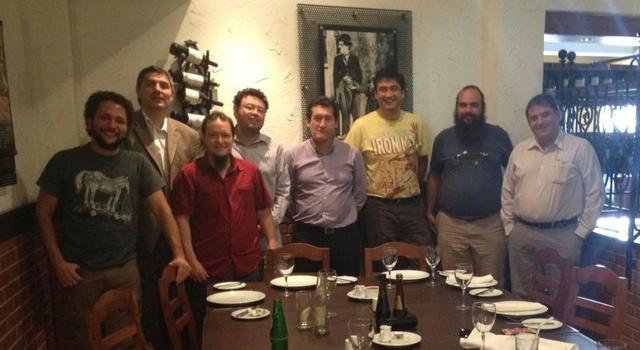
Ok, so I'm back in Mexico! This year, the best fare I found for travelling to spend the Winter^WSummer season with Regina's family had an oddity: I usually have a layover at either Santiago de Chile or Lima (Per ) of between 45 minutes and 2 hours, clearly less than enough to do anything. But this time, I had a massive 10 hours layover in Santiago. And spending 10 hours in an airport is far from fun. Specially when you have a good group of friends in town! I visited Chile in 2004 for Encuentro Linux (still before the time I had a digital camera: Those photos are all taken by Martin Michlmayr), and I have stayed in touch with a group of systems administrators since then. So, I mailed the list, and we managed to get eight people to have lunch together. In the order we appear in the photo: Some of them, even living in the same city, had never met in person before So, of course, we had a table reserved at the restaurant to the name of Dennis Ritchie. And having had nice, fun, sometimes-technical talks... Well, a tiny bit of his spirit was there. Of course, we can only trust he was there, as no Ouija boards were used and no null pointers were dereferenced (just to make sure not to disturb him). Victor Hugo and lvaro took me for a short Santiago city trip before lunch, we had a very nice time. Thanks! :-)

Russell Coker: Dr Suelette Dreyfus LCA Keynote

Dr Suelette Dreyfus gave an interesting LCA keynote speech on Monday (it s online now for people who aren t attending LCA [1]). One of the interesting points she made was regarding the greater support for privacy protection in Germany, this is apparently due to so many German citizens having read their own Stasi files. The section of her talk about the technology that is being used against us today was very concerning. I wonder whether we should plan to move away from using any hardware or closed source software from the US, China, and probably most countries other than Germany. We really need to consider these issues at election time. I have previously blogged some rough ideas about having organisations such as Linux Australia poll parties to determine how well they represent the interests of citizens who use Linux [2]. I think that such things are even more important now. Steven Levy wrote an interesting summary of the situation for Wired [3]. At the end of her talk Suelette suggested that Aspies might be more likely to be whistle-blowers due to being unable to recognise the social signals about such things (IE managers say that they won t punish people for speaking out but most people recognise that to be lies). It s a plausible theory but I m worried that managers might decide to avoid hiring Aspies because of this. I wonder how many managers plan to have illegal activity as an option. But I guess that having criminals refuse to hire me wouldn t be such a bad thing.

7 January 2014

Vincent Sanders: Healthy discontent is the prelude to progress

Back in the mists of Internet time (2002) when spirits were brave, the stakes were high, men were real men, women were real women and small furry creatures from Alpha Centauri were real small furry creatures from Alpha Centauri there were few hosting options for a budding open source project.

Despite the meteoric rise of many dot com companies in the early noughties a project either had to go it alone by running everything themselves or pick from a small selection of companies that had not yet worked out how to turn free hosting into money.

One such company, arguably the first, was VA Research with their SourceForge system. Many projects used their platform including a small niche web browser called NetSurf. For years the service was great, there were rough edges but nothing awful.

Netsurf issue tracker in the new SourceForge interface
Over time the NetSurf projects requirements grew beyond what SourceForge could provide and service after service was migrated away eventually all that was left was the bug tracking system. This remained the state of affairs until mid 2013 when SourceForge forced a migration to their new platform which made them unsuitable for the projects use case.

Aside from the issue trackers questionable user interface SourceForge had started aggressively placing advertising throughout their platform. Some of the placements so inadvisable that projects started taking the decision to leave.

While I appreciate that SourceForge had to make money to provide a service they appear to have sown discontent within a large part of their user base without understanding that there are a number of alternatives solutions with a much less onerous funding model.

NetSurf used this as an opportunity to move the remaining issue tracking service to our own infrastructure. Rob Kendrick proceeded to evaluate several solutions and in December 2013 I finally found the time to migrate an XML dump of the old data from SourceForge into MantisBT.

Migrating data from one database into another via incompatible formats took me back to my roots. My early career started with programming tasks moving historical business data from ancient large systems which were about to be scrapped to modern Sparc based systems. Later I would be in a role where financial data needed to be retrieved from obsolete proprietary systems and moved into databases on x86 servers.

My experience in this field was not really stretched as it turns out that modern systems can process a few tens of megabytes in seconds rather than the days for a run in my youth! So some ugly perl scripts and a few hours later I had a nice shiny SQL database filled with NetSurfs bugs and MantisBT instance configured to use them.

NetSurf MantisBT instance showing most recently updated open bugs
Then came the hard bit, triaging all the open bugs, fixing up all the bugs submitted as an anonymous user but with email addresses in, removing duplicates and checking every open bug was still valid took almost two weeks of tedious drudge.

I set up an initial bug workflow within the system that the project developers are still fine tuning to better suit their needs but overall Mantis is proving a very flexible tool. The main deficiencies center around configuration for the projects useage, especially removing unused fields from filters and making the workflow more intuitive..

The resulting system is now getting bug reports submitted again where the sourceforge system had had three in the six months since the forced migration.

The issue tracker is once more a useful tool for the developers allowing us to focus on areas actually causing problems for our users and allowing us to see progress we are making fixing issues.

Overall this was a successful migration and provides a platform the NetSurf project can control where we can offer guarantees to our users about their personal information usage and having a clean rapid interface with no advertisements.

Next.

Previous.