Search Results: "ema"

9 April 2009

Biella Coleman: From Open Source Software to Open Culture: Three Misunderstandings

A few weeks ago, I jotted down some thoughts about (false) expectations made on FLOSS/F/OSS, something that I wish I had more time to write about (teaching and other things seem to take most of my time these days). But before this year turned into the next one, I wanted to pass on a few additional (and similar though they enter into different territory) thoughts by O Reilly editor, Andy Oram: From Open Source Software to Open Culture: Three Misunderstandings

8 April 2009

David Welton: New LangPop.com stats, open source bits and pieces

I released some new statistics on LangPop.com. There are some new things:
  • The normalized results are now user configurable - you can put in your own weights for the various data sources (such as Amazon, Craigslist, and so on), and see how the results change.
  • Freshmeat.net fiddled with their web site, and statistics are not going to be available this month. Hopefully they will be able to correct the problem soon.
  • On the other hand, I wrote some code to grab the data from Ohloh, so there's something new to look at while we wait for Freshmeat to come back on line.
So there is a fair amount going on. Hopefully Freshmeat will come back soon, and I can also add a few fixes to the IRC statistics which I've been thinking about. In the process of doing the above, I also managed to do some open source work, albeit of a minor nature:
  • I updated LangPop.com to use the Flotr Javascript chart library instead of Plotr. So I also updated my Ruby code to integrate it. It's a fairly thin layer at this point, but it does what I need. It's available here: http://github.com/davidw/chartr/tree/master
  • I did some hacking on the Simile Timeline code, (used here on LangPop.com), correcting a bug, and also creating a system to install the whole thing with a simple command. Normally, it's kind of difficult to just use the Simile code on your own site, so I created an (admittedly hacky) way of making it easier to install. That code is here: http://github.com/davidw/standalone-timeplot/tree/master
Oh, yeah, and we moved from Innsbruck, Austria back to Padova, Italy!

John Goerzen: Goodbye

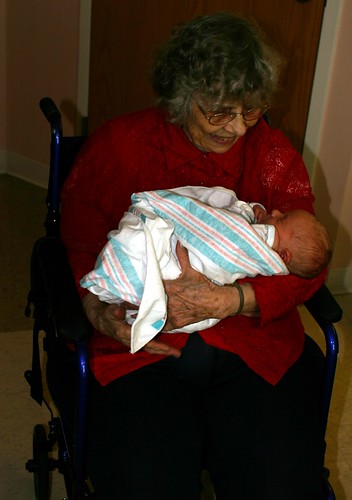
Jacob has lately been telling us gate gamma kassen so sick (Great Grandma Klassen is so sick), after his visit to the hospital, and it s true. Today started normal enough, but by 2:45 I got an email from my mom, saying that grandma had taken yet another turn for the worse; her pulse was racing, her temperature feverish, and her breathing shallow and difficult. The last grandchild that was going to be there made it, and got the last flicker of recognition from grandma. I wrapped some things up at work. Then I made the short drive from work to the nursing home, and got there just after 4. I went in to her room there, and it was full of family. Two of her children were singing her favorite hymns. I can never forget my uncle s deep bass voice as he stood at her bedside, holding her arm, while my aunt patted her head, both of them singing. Grandma s only remaining sibling, her younger brother Melvin, sat on the other side of the bed, looking on. Grandma s white table and chairs, which were in grandma and grandpa s house as long as I can remember, and followed grandma through all of the four other places she lived in the last years of her life, were in her room at the nursing home too. It always felt like home to be with grandma and those familiar things that she always took with her. Despite what was happening, I was glad she was back at home. My uncle motioned me over to her bedside, and I took her hand for a few minutes. It felt cold and weak; for the first time, she didn t grab my hand at all. A nurse came in to check oxygen saturation, but the machine wasn t able to get a reading due to poor circulation to her hand. She wasn t able to get a heart rate either because the heart was racing so fast. She discussed briefly whether the family wanted them to continue giving her oxygen, and they decided that they would, for her comfort. My uncle and aunt kept singing. I blew my nose and dabbed at my eyes, and there were hugs all around. And just a few minutes later, grandma peacefully stopped breathing, maybe 20 minutes after I had arrived. They went to get the nurse, who came back to listen to grandma s heart again, though we knew what she would find. She took the stethoscope off, and she almost lost her composure, but managed to say you can turn the oxygen off now. Several people gave grandma a last hug. After a few minutes with just the family, they told the nurses to go ahead and call the funeral home. That set off a lot of activity making arrangements for the next few days, funeral plans, and the like. I stepped back into grandma s room a few times, while the family was in the sitting area right outside it discussing. I looked around at the family photos on the wall, the old table and chairs, the recliner. Now, these are the things that were grandma s. It didn t feel like home anymore. Terah and Jacob were stuck at home Terah s car was at the mechanic for repair today. I called to give her the news. She wanted to come to be with the family, but I didn t really want to leave. She tried calling some friends to see if they could give her a lift to the mechanic, but not one of them was available. I talked to her again and suggested she just call the mechanic. She wasn t even halfway through describing the situation when he interrupted with, We ll have it at your place right away! Well, I don t expect you to have to do that, or you could certainly wait until you close. Nope, this isn t your average community, we ll bring it right over. You should be there. Grandma has enjoyed a simple life and had requested a simple death: no extraordinary measures at the end of life, no embalming either. So, by law, the burial must happen within 24 hours of death, and will be tomorrow. After all the arrangements, people realized nobody had supper yet. We went to the quickest available option pizza and ate there. It was paid for out of grandma s remaining money the last meal of so many that she provided for her family over the years. It was a happy meal. As I drove home, NPR news was on the radio. There were the same stories we hear all the time: the economy, the mideast, the president. Normally I m interested, but today I shut it off. Today is different. Tomorrow, for the second time in four years, I will help carry a grandparent s casket a few days before Easter. I ll end tonight with this photo. It was taken soon after Jacob was born. Grandma came to the hospital and held him. That smile sums her up perfectly. img_4965r.jpg
Obey Arthur Liu: Google Summer of Code at Debian: Update, need mentors!

A quick update before the big one about the 2009 Google Summer of Code. I believe we had a great recruitment drive this year and we have a very good set of proposals to work with. We d like to thank everyone involved for their help. We re now ranking out student applications. I promised elsewhere that I ll send out our shortlist of projects once Google sends us our preliminary slot allocation today but I misread the thread on the -mentors list and that count will only happen on Thursday, so we ll have to wait a bit more. That shortlist would only include projects, but not individual students. The idea is to give a heads up to everyone before committing to a group of projects and students. It is very important to inform the community as it increases visibility of the students work, giving them more help and support (and also avoids duplicating existing not yet publicized work!). As far as mentors go, we should have all of our approximately 14 planned projects covered, except for 2. I m posting them here in case you could mentor or help find mentors for those projects. (The wiki pages are not really up to date, so please come on IRC and ask clarifications, see below) Finish Petr Rockai s Adept 3.0 and bring a Qt4 Package Manager to Debian, with a different interface paradigm than Aptitude-gtk.

Petr said he would provide help with the existing codebase but can t mentor. Sune Vuorela from Debian KDE is ready to help with Qt4 related issues. Build Debian tools to create Debian images for Amazon EC2 and the free Eucalyptus implementation. Packaging of the Eucalyptus hosting framework is also possible.
For this project, we already have on board to help: Charles Plessy from Debian Med, Eric Hammond, developer of the existing vmbuilder Ubuntu tool for EC2 and Chris Grzegorczyk and Rich Wolski, from the Eucalyptus team. Plenty of people to get help from. Mentoring is a great experience! See this for what it entails. If we still can t find a mentor by the end of the week, I ll blast an announcement over at debian-devel@l.d.o along with the project shortlist. In the meantime, don t forget to idle on #debian-soc on irc.debian.org.

7 April 2009

Biella Coleman: It justifies the whole shabang

Even if you are a facebook hater, we should be thankful for its invention just for this

6 April 2009

Biella Coleman: Does the patent system make you queasy?

Great research opportunity for PhD Students out there.
Peer to Patent Summer Research Fellowship
New York Law School
Summer 2009 Background
Peer to Patent is the groundbreaking program developed by New York Law School and run in cooperation with the U.S. Patent and Trademark Office and the United Kingdom Intellectual Property Office, along with the assistance of a number of private stakeholders. It harnesses the power of citizen-experts to assist patent examiners by searching for, identifying, and annotating prior art relevant to pending patent applications. A first Peer to Patent pilot was launched in June 2007. During the first year the project participants (peer reviewers) assisted in the prior art searches on 40 patent applications, generating 173 items of prior art. These items of prior art were the basis of rejection in over ten of the patent applications considered. In June 2008 the pilot was continued for a second year, and was recently extended to encompass a pilot program in the United Kingdom. Research Issue
Although Peer to Patent has attracted over 350 active peer reviewers, the project team has little or no idea as to the motivations that cause these individuals voluntarily to contribute their substantial time to the project. The average reviewer spent approximately six hours searching and annotating individual patent applications. The project team also does not fully understand the best means for attracting additional peer reviewers to the project. In order for the project to scale to larger volumes of applications, both of these points need to be understood and addressed. More generally and theoretically, the motivations of citizens in producing material for governmental use are not well-understood. This fellowship seeks to provide an account of this sort of activity, as well as generate a design for a controlled study of incentive mechanisms for these sorts of activities. Research Activity
The selected fellow will conduct interviews among a meaningful number of currently active peer reviewers to elicit their motivations for participating in the project and contributing their time. The fellow will review the non-profit motivation literature to provide a number of alternative methods of reward to determine whether any or all of them would induce the participants to continue their participation, increase their participation, encourage others to participate, or cease their participation altogether. Potential rewards may include: (a) basic recognition; (b) monetary interest; (c) cash awards; (d) prominent public recognition; (e) some other form of reward; or (f) no reward whatsoever. The fellow will develop a survey to be conducted among a wider segment of active and potential peer reviewers to test for validation of the data gathered in the initial sampling. From the results of the initial sampling, literature review, and survey, the fellow will develop findings on which to base an incentive program to attract and retain peer reviewers. The fellow will develop an experimental design to test the efficacy of each of these incentive possibilities. Term
The fellowship will commence on or about June 1, 2009 and will continue until on or about August 31, 2009. The fellowship is a full time position for the three months stipulated; but this is open to negotiation for an exceptional candidate.
Compensation The fellow will receive a monthly stipend of $3,000 (based on full time work status). Job Qualification
It is expected that the fellow will be pursuing (ABD) or have completed a PhD in psychology, economics, policy, or communications; or some other relevant field involving the motivation of content producers. Application Deadline April 30, 2009. Application Procedure
Applicants should send (1) a letter of application detailing their qualification for the position, (2) a resum , and (3) a list of three referees, to: Ms Naomi Allen Administrator, Institute for Information Law & Policy New York Law School 57 Worth Street New York NY 10013 Naomi.Allen@nyls.edu Questions relating to the scope and nature of the fellowship can be directed to: Prof. Mark Webbink,
Director, Center for Patent Innovations
New York Law School
mhwebbink@yahoo.com Prof. Dan Hunter
Director, Institute for Information Law & Policy
New York Law School
dhunter@nyls.edu New York Law School is an equal opportunity employer that encourages excellence through diversity. Women and minority candidates are encouraged to apply.

5 April 2009

Biella Coleman: End of an era

New York City is home to fantastic set of libraries, including the the mothership of libraries, the NYPL. My favorite library is one that is much smaller, located in the north of Manhattan on the campus of Columbia University: East Asian Starr. Quiet and compact, there are tall ceilings, dark wood, stained class windows, and reading nooks. When I enter, it feels like I step back in time (if I ignore the laptops, at least). When I was an undergraduate there, it was my library of choice and I logged many hours there and have yet to find a library I so love. I also was fond of the place because of their discreet open door policy. When I was a student there, over a decade back, they were supposed to ask for you ID but they never did. When I returned back to NYC in 2007, I was thrilled to find this practice of ethical inattentiveness was still followed by the student works behind the desk. I always wanted to find out more about what sustained this practice but I never dared or was too lazy to do so. So I was pretty saddened when I popped in the library on Friday to discover a new security system that requires you to scan your ID to get in. There were large signs also indicating such, clearly seething with some passive aggressive anger expressing disbelief that this library had managed to evade security for over decade. So while it is a real shame that this gem is no longer a place that one anyone can enter at will, it is nice to know that it took so long for someone to notice.

Jose Carlos Garcia Sogo: Backup your system for a desktop user

While Linux and Debian are plenty of programs for backing up your system, things change when you need a backup system for a common desktop user. In this area there is a lot of room for improvement, as programs for KDE and GNOME are years behind what programs for Windows and Mac OS X are offering.

There has been some programs intents of writing a good program, full featured and with a nice graphical interface, as Simple Backup, and its fork Not So Simple Backup, pybackpack, or TimeVault, an intent to clone Apple s TImeMachine, and it s fork TimeVaultNG written for KDE. Those are projects that start with a great impulse, even some of the mentored by Google Summer of Code, and when they reach some basic functionality, they get abandoned or not being properly maintained.
What I would like to see for a backup system for desktop user is: A lot of improvement and innovation has taken place in Linux Desktop during all these years, but backups are also important for SOHO users, and they need a well integrated program for doing that, as console based solutions usually require configuration skills which desktop users don t have.
Updated 6th April 22:26 CEST: I have been recommended in comments to try Back in Time and D j Dup. Both are in active delopment, which is a bonus. The first one works in a similar way to TimeVault, while the second one works using duplicity as backend, but has support to upload the resulting files to a remote server using SSH or to Amazon S3. I will investigate more on these apps.

4 April 2009

Andrew Pollock: [tech] Asterisk Gateway Interface 1.4 and 1.6 Programming

Asterisk Gateway Interface 1.4 and 1.6 Programming I received an email out of the blue recently from someone related to Packt Publishing, the publisher of Asterisk Gateway Interface 1.4 and 1.6 Programming, asking me if I'd like a review copy of the book. This is the second unsolicited book review request I've received now. I just wish I had more time/mental energy to read books! I'm going to make a concerted effort to read this one and write a review of it, because AGI is something I'm moderately interested in. AGI is what makes a lot of computer-telephony integration really possible with Asterisk, and CTI done right is something I'm particularly interested in. I was also given some sample content and encouraged to post it. Based on this sample content, the book sounds like it should be good.

3 April 2009

Biella Coleman: Digital Economies and the Politics of Circulation

Expand your perspectives in IP (if you are in NYC at least)

Biella Coleman: Digital Economies and the Politics of Circulation

Expand your perspectives in IP (if you are in NYC at least)

Daniel Stone: for the record

I don't use Emacs myself, and I don't recall a single Emacs user complaining about accidentally triggering Ctrl-Alt-Backspace on their way to M-C-E-A-S paste-output-of-doctor-into-irc. Most of the grumbling came from actual users (i.e. people who don't know what an X server is, let alone how to configure it, let alone to email xorg-devel@ about it), rather than people who are perfectly capable of changing the default[0].

Regardless, Peter came up with a perfectly sane plan which makes it very easy indeed to optimise for clients with stuck grabs (being that termination requires you to be processing input events in the first place, in which case you're likely doing reasonably well anyway).

[0]: Yes, the text is woeful. Sorry.

Russell Coker: Google Server Design

Cnet has an article on the design of the Google servers [1]. It seems that their main servers are 2RU systems with a custom Gigabyte motherboard that takes only 12V DC input. The PSUs provide 12V DC and each system has a 12V battery backup to keep things running before a generator starts in the event of a power failure. They claim that they get better efficiency with small batteries local to the servers than with a single large battery array. From inspecting the pictures it seems that the parts most likely to fail are attached by velcro. The battery is at one end, the PSU is at the other, and the hard disks are at one side. It appears that it might be possible to replace the PSU or the battery while the server is operational and in the rack. The hard disks are separated from the motherboard by what appears to be a small sheet of aluminium which appears to give two paths for air to flow through the system. The thermal characteristics of the motherboard (CPUs) and the hard drives are quite different to having separate air flows seems likely to allow warmer air to be used in cooling the system (thus saving power). Google boast that their energy efficiency now matches what the rest of the industry aims to do by 2011! The servers are described as taking up 2RU, which gives a density of one CPU per RU. This surprised me as some companies such as Servers Direct [2] sell 1RU servers that have four CPUs (16 cores). Rackable systems [3] (which just bought the remains of SGI) sells 2RU half-depth systems (which can allow two systems in 2RU of rack space) that have four CPUs and 16 cores (again 4 CPUs per RU). Rackable systems also has a hardware offering designed for Cloud Computing servers, those CloudRack [4] systems have a number of 1RU trays. Each CloudRack tray can have as many as two server boards that has two CPUs (4 CPUs in 1RU) and 8 disks. While I wouldn t necessarily expect that Google would have the highest density of CPUs per rack, it did surprise me to see that they have 1/4 the CPU density of some commercial offerings and 1/8 the disk density! I wonder if this was a deliberate decision to use more server room space to allow slower movement of cooling air and thus save energy. It s interesting to note that Google have been awarded patents on some of their technology related to the batteries. Are there no journalists reading the new patents? Surely anyone who saw such patents awarded to Google could have published most of this news before Cnet got it. Now, I wonder how long it will take for IBM, HP, and Dell to start copying some of these design features. Not that I expect them to start selling their systems by the shipping crate.

2 April 2009

Ana Beatriz Guerrero Lopez: KDE 4.2 in unstable is coming

It was 2 years ago when we started working in KDE 4 packages, and exactly 20 months ago when we started uploading KDE 4.0.0 beta 1 to experimental. Finally, we are working in packages that are targeted to unstable \o/. As announced in the users mailing list, we will be uploading KDE 4.2.2 to unstable in the next days, so look carefully at what you update :) We have worked very hard in providing a smooth upgrade, but given the change is so big, some new (little!) problems will be discovered. One of the most problematic points is we were using .kde4 to store user data and settings of KDE 4 and now it is time to switch back to the default .kde. There are several possible migration cases here and for allow users select the case they prefer, a migration wizard tool named Kaboom has been created inside the Debian KDE team. Be aware that there will be some inconsistencies in unstable the following days after KDE 4.2.2 reaches the archive. So please, be patient. We are still testing and we are not uploading until we think it is good to go, so next days could become 2 weeks. Again, be patient :) If you want to keep using KDE 3.5.10 for a few weeks more, just do not upgrade yet. But if you want to keep using KDE 3.5.10 for months, maybe you should consider become a Lenny user. If you have questions, doubts and/or suggestions, you can check our Debian KDE Team website where we try to add information and the archive of the Debian KDE users mailing list. Time for a personal note. KDE 4.2 is a huge change from KDE 3.5, and it is normal if you do not fully like it in the beginning. But I do think most of users of KDE 3 will feel very comfortable in KDE 4 after some days using it. You just need to discover the new ways of doing some tasks. Also, once KDE 4.2 is sitting in unstable, a lot of third party applications (specially plasma widgets) for KDE 4 will be finally uploaded to the Debian archive, making KDE 4 even better.

Filip Van Raemdonck: Some like it hot others just are

This week brought some really nice weather. Too nice already for some people, it would seem.<br /> While most people would likely enjoy a ride home on a sunny afternoon, for certain hotheaded ones the temperature appears to set their brains and blood boiling and remove the inhibitions for juvenile behaviour.<br /> Driving home I encountered a truck driver hanging out of his window having a heated argument with a car driver standing straight up through his sunroof. I couldn't hear what they were arguing about, as it happened a few cars before where I stood, but in the meantime they were blocking the two lane drive. I'd almost be surprised if it wasn't one or the other accusing his adversary of doing exactly that, blocking his trajectory.<br /> Luckily the scene didn't take too long and they drove on before others could join in on the argument.<br /> <br /> One pattern that I've observed so far in all incidents of traffic aggression that I witnessed, is that at least one of the parties was accompanied by a female passenger. I have to wonder if female company is in fact an influencing factor

Biella Coleman: Rocket Fuel where it should not be

Blast your infant to the sky with rocket fuel.

Biella Coleman: Rocket Fuel where it should not be

Blast your infant to the sky with rocket fuel.

MJ Ray: A Question of Debian ClamAV, Freshclam and Volatile

I m not a big fan of virus-scanning on the mailservers (I think you should bolt your email-sending computers right down so that viruses and spambots can t send email), but it seems to be a necessity these days. So, I was a bit late starting on mailserver-antivirus and mainly pay attention to it when it goes badly wrong. I ve got clamav installed where needed, but recently I m seeing clamav hang, eat CPU and cause postfix to defer all emails while logging nothing useful. Often this seems to be soon after freshclam kicks in. Anyone else seen this problem? Moreover, anyone managed to narrow it down and fix it? On some systems, instead of having freshclam, we have clamav-data from volatile which seems to work better, but are they missing out on anything by doing that? Does it lag a bit behind and download a bit more? Is there a third option, either another way of feeding clamav, or an alternative debian package, which you think people should consider?

MJ Ray: Cooperatives-SW Board and Housing Enquiry, Bristol, 6 April 2009

With our AGM in Plymouth rescheduled until June or July, the Cooperatives-SW board will meet in Bristol on Monday. Cooperatives-SW aims to represent co-operative and mutual enterprises in the region. As with previous meetings, if you d like to meet up beforehand, let me know through this blog, identi.ca or email. Bristol is near HQ, so I expect I ve met most people there who want to talk to me. The meeting is just before a co-operative and mutual housing hearing. Places will be limited so please contact CDA (Brave Ltd) on 0117 989 2536 if you would like to reserve one.

31 March 2009

Manoj Srivastava: Manoj: Fighting FUD: Working with openssl

Unfortunately, there is so much FUD associated with doing your own certificates, either based on how complex the operation is (which led to my previous supervisor insisting I use something like tinyca), and now to my employer succumbing to the FUD and shelling out several hundreds, perhaps several thousands, of dollars a year for something we could well have handled in house. Public key infrastructure, in the form of the X509 standard, is the underpinning of most of the secured communications over the net these days. The big winner in the transport protocols, TLS, and its predecessor, SSL, support X509 certificates. There are several ways of getting your own services their own X509 certs; one of which I am exploring below. One may, or course, opt to get a commercially signed certificate, and various companies are eager to do just that for you. They also charge about $400 per annum per certificate for the privilege of doing so. While there is some marginal benefit of doing so (some web browsers come with the commercial public certificate built in, allowing for an out of band distribution of the public cert), the benefit accrued is in the order or pennies, in my opinion, not hundreds of dollars, unless you are providing banking or retail services, where the end users might be justified in being paranoid. Why is there so much FUD your own certificates? Especially about how hard it is do to your own? As you can see below, it only takes three commands you have to master in order to set up your own private certifying authority, and sign your own certificates. The only marginal issue is that the user needs to verify your certificate out of band (if, really, they want to bother). Most people just accept the certificate, in my experience. The sole benefit that commercial entities provide is that they verify the identity of the person asking for the certificate, with varying degrees of diligence. For a Class 1 cert the CA usually just verifies that the email address of the requester was confirmed. For $400/year. For a Class two cert, they look up the company in a credit bureau records. A class 3 certs does an ID check with a notary public present, or a government issued ID. So, a class 3 cert is somewhat less diligent than becoming a Debian developer. Or getting your key signed at a Debian conference. As to the security aspects, or wondering whether to trust the information present on a designated web site, I have no idea how it helps verify any of those things in any way. So the web site is run by a person with a government provided ID, and who has a few hundred dollars to burn. So what? Me, I just sign my own certificates. And I think most small business web sites and mail servers are perfectly well served by using their own certificates. And there are just three simple commands that enable them to do this, in the Linux world. So what are these three commands? Gory practical details and recipes hidden here In conclusion, creating your own certifying authority is trivial, and certainly not worth several hundreds of dollars every year, and the functionality provided is identical.

Next.

Previous.