Search Results: "ean"

6 November 2010

Joey Hess: howto: create your own time zone

Tomorrow I won't have to deal with it getting dark at a soul-crushing 5:30 pm. Nor will I have to wake up blearily an hour early in the spring. Instead I will be enjoying my new, custom time zone. It's "JEST", for "Joey's Eastern (non)Standard Time", and in JEST, there is no spring forward or fall back stress. The folly of daylight savings time (Ben Franlin's best prank ever) really becomes apparent when you have solar power. It's bad enough that the sun is setting at 6:30 without compounding that by an hour. By keeping my clock set so the sun sets in midwinter at 6 pm, I will maximise what little light there is, and minimise time spent using batteries in the dark. Of course, it helps that I'm my own boss, and that most of the people I work with are probably not in a nearby timezone anyway, and that most things are done asynchronously. Since JEST is an hour ahead of local time here in the winter, I will, at worst, tend to be running early. So I only have to change my clocks one time -- and by "change", I mean create a custom timezone in Linux. Here's how to do that.
  1. Make a custom timezone file. The standard one for North America is a bewildering 3000 lines of special cases, conflicting legistlation, and historical weirdness, but I only need one: echo "Zone JEST -4:00 - JEST" > JEST.zone
  2. Compile and install it to somewhere; I put it in ~/.zoneinfo zic JEST.zone -d ~/.zoneinfo
  3. Set TZ to use it. Also TZDIR if it's not in the system directory. export TZDIR=~/.zoneinfo TZ=JEST
Update: Turns out it was easier than I thought, just setting TZ=FOO+4 will make date display a timezone "FOO" that is 4 hours behind GMT. So all I need is to set TZ=JEST+4 Result:
date: Sat Oct 30 21:43:39 JEST 2010
date -R: Sat, 30 Oct 2010 21:43:39 -0400
Previously:

5 November 2010

Vincent Sanders: Keeping kindling dry

I, along with a great number of people I know, now posses a 3rd generation Kindle. It seems Amazon have found a feature set and price point which makes this device a winning solution.

My bookshelf complete with covered kindle
I did look at a huge number of alternatives like the Sony PRS600 and others but they were all more expensive than the 110 for the Kindle and did not have enough features to make a compelling argument for spending more.

Yes it has DRM. Yes it "only" supports PDF, MOBI and mp3. Yes it will not win any style or usability awards. But I went into this eyes open the device is "good enough".

The device lets me read books from a reasonable display. The integration with amazon.com is so seamless it poses a serious danger to my bank account. I should expand on that last point :-) Amazon have got the whole spending money for a book thing executed so well that you do not think twice about a couple of pounds here and there, this soon adds up. I have set myself a rigid budget.

My main complaints are really just niggles:

  • Another different USB connector! Wahh, I thought everyone had agreed on mini USB? seems that I now have to have yet another lead for micro USB

  • The commercial book selection is a bit limited and missing a surprising number of popular titles. Some of this appears to be the publishers and authors simply clinging to their old business model. I fear some of them might not survive and early indications are they are behaving like the music industry did...Guys you are selling an infinite good a scarcity model is going to fail!

  • The price of some of the books is absurd...they are asking hardback prices for the electronic edition! Seriously? how on earth can that possibly be justified? I can see that a hardback book with its print run could cost 5 per physical item (going from hulu print on demand prices as a worst case) plus shipping and stocking fees. So how can you possibly justify charging the same price for a pile of bits where none of that applies? Also the pile of bits cannot be lent or sold, not impressed.

  • eBook formatting is generally dreadful. I do not know who is mastering these books but they need to do a better job. If they tried to pull this in the physical editions they would get a seriously large number of returns.

  • I still have to pay for whispernet delivery fees even though, because its the wi-fi model, I am providing the bandwidth myself. I can see that differentiating between 3G and wi-fi delivery is a bit hard for them though.
However my one and only real complaint with the offering as a whole is the astronomical asking price for the leather cover. The cover is currently 25% of the price of the kindle itself! ( 30 cover 110 kindle) which is just silly. It is a pretty nice cover and the clever clip attachment means it does offer an integrated solution to protecting your kindle, but not 30 nice.

Kindle in a sock cover
So my lovely wife (her kindle was bought with the cover) made me a sock for mine. This is great for casual round the house usage to stop me scuffing the screen but was a bit lightweight for protecting the kindle when out and about.

One day last week I had an idea. I would make my own protective cover by crafting something I had wanted to do for ages. And the (unoriginal I am sure) project of a hollowed out book for housing my kindle was implemented.


My hollowed out book kindle cover
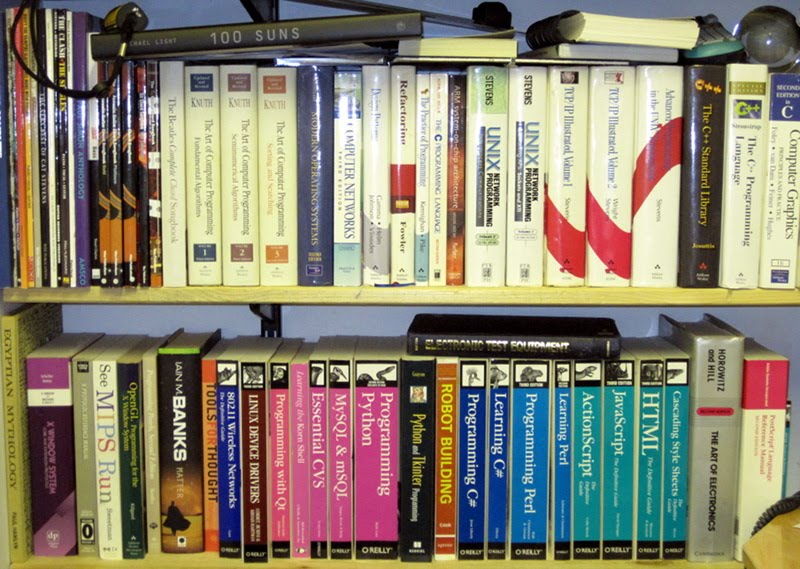
A quick Google later and I had a set of plausible instructions to follow. I used possibly the most out of date book ever (published 1981) on electronic test equipment, partly because it was a ex library sell off book which cost 10pence back in 1995 but mainly because it was the right size to just enclose the kindle without adding to much size.

I learnt a couple of things doing this:
  • Do not let your pva (white) glue mix get too runny, you want it fluid enough to be easily absorbed but not watery - this is important because otherwise the paper absorbs too much water and crinkles
  • Do not use a book where the binding has gone bad already and select a "clean" book. The spine of this book was yellowed and cracking before I started. This means the book spine simply cracks open at the hollowed out bit and it is very obvious.
  • Work out where the "solid" part at the back is going to be and treat that separately so you get a nice solid base at the back of the hole. In mine its not all stuck together and is a bit wavy. Do be sure you left enough depth for the kindle though.
  • Take your time and be careful with the glue, it is amazing how obvious even a simple splash of glue in the wrong place is. Use a small brush for this a paint brush is fast but sloppy.
  • Measure carefully and cut only a few pages at a time, it takes a bit longer but looks much better. Also I did not drill the corners of my hole which means they are a little scruffy.
  • Use the sharpest thinnest knife you can, this really helps. I started with a small stanley knife but switching to my hobby scalpel gave much better results.
  • If you have some, use woodworking clamps to clamp a bit of timber (I had some offcuts of shelving) around the book to compress it while the glue dries. Do not clamp the spine if you can avoid it. This method ensures:
    1. Heavy things do not fall off the book while it dries.
    2. An even strong pressure is applied.
    3. The book does not warp or bend while the glue dries
All in all I kinda like the results and I think I will try again with a more modern book where the spine is not so broken to begin with.

Dominique Dumont: Test CPANPLUS install on a Debian system

Hello I m a Perl author working on a Debian unstable system. The great thing about Debian is that a lot of Perl modules are available though Debian packages. I follow Debian way of life to the point that I no longer install my modules (under development) with sudo make install (or its Module::Build equivalent). I ve often been bitten by weird test errors due to old version of module lingering in /usr/local. Now, I always create Debian package of my modules under development with dh-make-perl. This way, I avoid installing Perl module in /usr/local and my developement versions are cleaned up when actual package are availalble through Debian unstable. () This method has an unfortunate side effect: I never test installation the CPAN way. And Config::Model did fail to install with CPANPLUS. Now here s a way to create a barebone Debian chroot with cowbuilder to test CPANPLUS installation. First create a new chroot: $ sudo cowbuilder --create --distribution sid

Loging into this chroot (the bindmount option is necessary for cpanp to work correctly) : $ sudo cowbuilder --login --bindmounts /dev

In the chroot: Run cpan to configure CPAN: # cpan

Hit return to configure CPAN automatically. Then install your module: # cpanp i Config::Model

Or, if your module is not yet uploaded: # cpanp i http://<path-to-tar.gz>

Once you quit, the chroot is restored to its barebone state. Et voila. I tested full installation with dependencies the CPAN way without mucking up my system. Many thanks to Christian Kuelker of Cipux project for his comments that enable me to improve Config::Model All the best

Rapha&#235;l Hertzog: Managing distribution-specific patches with a common source package

In the comments of the article explaining how to generate different dependencies on Debian and Ubuntu with a common source package, I got asked if it was possible to apply a patch only in some distribution. And indeed it is. The source package format 3.0 (quilt) has a neat feature for this. Instead of unconditionally using debian/patches/series to look up patches, dpkg-source first tries to use debian/patches/vendor.series (where vendor is ubuntu, debian, etc.). Note that dpkg-source does not stack patches from multiple series file, it uses a single series file, the first that exists. So what s the best way to use this? Debian should always provide debian/patches/series, they are supposed to provide the default set of patches to use. Any derivative cooperating with Debian can maintain their own series files within the common VCS repository used for package maintenance. They can drop Debian-specific patches (say branding patches for example), and they can add their own on top of the remaining Debian patches. It s worth noting that it s the job of the maintainers to keep both series files in sync when needed. dpkg-source offers no way to have stacked series files (or dependencies between them). If you want to use quilt to edit an alternate series file, you can temporarily set the QUILT_SERIES environment variable to vendor.series . Just make sure to start from a clean state, i.e. no patches applied. Otherwise quilt will be confused by the sudden mismatch between the series file and its internal data (stored in the .pc directory).
Found it useful? Click here to see how you can encourage me to provide more articles like this one.

Flattr this Share/Bookmark No comment Support my work

Michal &#268;iha&#345;: Changed website

After last fixes during yesterday evening, I've decided to put new website online today. It matches layout of my blog, uses same technology underneath (Django). The biggest change is probably simplification of the structure and also cleanup of old unused stuff. I tried not to miss anything, but I'm sure something will be discovered in next days. With this change, I've also shutdown my SVN server as all things has been migrated either elsewhere (usually Debian's collab-maint SVN repository) or are now using Git either on Gitorious or repo.or.cz.

Filed under: Django Website 0 comments Flattr this

Christian Perrier: Russian debconf translations complete in testing

The Russian l10n team is the first team to reach one of our translators' Grails: all debconf templates translations are now fully translated in Russian, in testing. Russian is the first language to reach this ever (I formerly announced 100% completion for a few languages, but that was in unstable: we never tracked testing up to now). It means that, in theory, on can do a full installation of all packages in squeeze (in case some crazy folks want to do this!) and always be prompted in Russian. French and German are lagging very close to this, the only missing bit being the udev package, which had two consecutive urgent uploads that couldn't include a full translation coordination. For these, we're indeed waiting for another udev upload, but I already nagged Marco about this..:-) Portuguese should make it, though I still have to track 7 packages for it. Swedish is only missing 2 packages. I'm less sure that Czech and Spanish (the other two teams working hard on 100% completion) will make it.

4 November 2010

Jaldhar Vyas: All Hail Aqua Buddha!

My fellow Republicans and I got a nice early Diwali present on Tuesday. ~65 seats in the House ~6 in the senate, ~18 governorships and control of ~20 state legislatures. (Some races haven't been formally called yet.) A few disappointments though. no majority in the Senate and Harry Reid and Barney Frank were not defeated. Still overall its an election to celebrate. Here are a few thoughts. The Election System Is An Embarassment Once again there are several races where the outcome is in doubt because of technical problems with voting. Whatever politics we have, can we agree that it is damn stupid that we still can't get something as simple as counting ballots right? Prediction: The 2012 Republican presidential candidate will come from the Tea Party. While I may be a Republican, I am also a Cosmopolitan East Coast Elitist so the Tea Party didn't move me much. There were a couple of cases (NY and DE atleast) where their candidates were subpar and cost us victory but the best of the new Republicans also came out of this movement. I would rather vote for one of them than Romney, Huckabee, McCain, Gingrich etc. (With the exception of Sarah Palin who is just too polarizing I'm afraid.) The Tea Party itself will subside in a few years as all populist movements do. (Ask the Hope'n'changers.) Young People Are Dumb Part of leftist mythology is the idea that one day "the kids" are going to rise up against the mean old corporate overlords. It ain't going to happen. There was a huge upsurge in first time voters in 2008 but that was because Obama was a novelty act not because they had suddenly discovered the merits of Keynesianism. Now Obama is old and busted so they won't vote anymore. (Not until they have kids and a mortgage sometime in the future.) They'll spend time make cool ironic signs for the Rally to Promote Comedy Central but even the prospect of legalizing pot won't get them to the polling booths in sufficient numbers to defeat the oldies. Why? Because young people are dumb. Prediction: War With Iran If you're President Obama what do you do now? Bipartisanship? Yeah right. Look at what happened to Rep. Cao of Louisiana, the only Republican to vote for Obamacare and one of only two GOP congressmen to lose on Tuesday. Obama actively campaigned for his challenger. Any of the new Republicans who try and compromise with the President will end up under the bus sooner or later as they well know. The President could go full retard with the socialism (progressivism, liberalism whatever. It's all the same.) All his initiatives will be shot down but he can claim to be a martyr to the party of No. (Who will be joined in the Senate by Lieberman and whatever centrist Democrats who are up for reelection in 2012.) But this seems to be the path to a one-term presidency to me. Maybe that's what he wants. He could retire comfortably to the deanship of some Ivy League law school and make a lucrative killing on the rubber chicken circuit. But lets assume he wants to get back in the White House in 2012. One way to get back in touch with the voters is to start getting serious about foreign policy which has either been a joke (Remember the reset button?) a travesty or just copied from the Bush administration. In particular the Obama administration has completely failed in stopping Iran from gaining nuclear technology, sponsoring terrorism in Iraq, Afghanistan and Lebanon, and oppressing its own people. War with Iran would enhance his standing with Conservatives (hey it works for me!) most liberals would go along with it and the extreme Code Pink type loonies can safely be ignored. I say it happens before November 2012.

Andrew Pollock: [life] Zoe at six months

Today, Zoe is six months old. The last three months certainly feel like they've taken their time, but a lot has happened. Developmentally, she's doing great. She's now in the 70th percentile for height (up from around the 25th percentile), and 31st percentile for weight (up from the 25th percentile). She cut her bottom front teeth a few days ago. Crawling is imminent, I'd say. She can already scoot around in reverse, and by a combination of shuffling and rolling, doesn't seem to be having problems moving around the floor. We started her on solids at five months, and she's taken like a duck to water to pureed pumpkin, sweet potato, beans, zucchini, apple, pear, banana and avocado. Speaking of water, she's also decided she likes to drink water from our glasses whenever she sees us doing it. Hilarity usually ensues, closely followed by a change of outfit. She's sleeping well, only waking up once a night under normal circumstances, and that wake-up is getting later and later. She loves her baths. She usually lets out a series of loud sighs as soon as we put her in the bath. She got her first cold a couple of weeks ago. It coincided with her first day in ad hoc daycare, but Sarah and I were both sick as well, so I think it's more likely that she caught the cold from us than from daycare. She's still battling it, but it hasn't really bothered her all that much. She's just a bit snotty. The NoseFrida has been very handy for dealing with this. She had her six month shots today, and seems to be tolerating them fairly well. Sarah says she hardly even cried when she got them. She continues to be a remarkably happy baby. She always wakes up with a smile, she really only fusses if we keep here away for more than a couple of hours, or haven't fed her on time. Even with this current cold she has, she's still stayed very happy. We feel incredibly lucky to have such a wonderful baby. The next big adventure is to try a babysitter. Zoe and me in early October

Gintautas Miliauskas: Living a monastic life for 10 days

About a month ago, at the end of August, I finished a 10-day Vipassana meditation course. This was probably one of the more extreme activities I have ever participated in, and it's well worth a blog post. I found out about the course in a ridiculously trivial way, by following a link in a Reddit comment (I wonder if I could track down that comment...). The website referenced by the comment contained (almost) no new-agey mumbo-jumbo and looked legit in general. I also appreciated the fact that this was a relatively serious and intensive course, which should be enough to form a reasonably founded opinion on meditation in general. When learning sporadically, in small bits, it is hard to say whether the material itself is no good, or you just do not understand it yet and need to study more; I was quite skeptical towards the practice, but wanted to give it fair trial. I was quite impressed that there was a course available in Lithuania, a few hours by train from where I live. Finally, the course was free (by tradition Vipassana is taught without monetary compensation). I went ahead and signed up for a standard introductory 10-day course. Vipassana (also called insight meditation) is a meditation technique allegedly coming back from Gautama Buddha himself (well, all the traditions like to claim that origin...). It has been experiencing a renaissance, partly due to an organization set up by a meditation teacher S. N. Goenka which has founded meditation centers all over the world. The essence of Vipassana is a method of teaching your mind to act instead of merely reacting to outside stimuli such as pain, anger of other people or hardships. The technique provided is to monitor your sensations, watch them with equanimity and suspend any reaction, and slowly it sinks in that all things are temporary and you can choose what to react to and how. That's the basic idea; I don't want to go deep into exposition of Vipassana as there is plenty of information about that (also at the same time the information is almost useless because you have to experience it to really understand it). Instead, I will sure some of the more personal remarks and experiences. The course took place in an cottage near Kretinga, housing around 50 people. The living conditions were absolutely great, and this would have been a true holiday if not for the regime and the rules. The day would start very early, at 4 AM (ending at around 9:30 PM), and we'd do about 12 hours of meditation in total inbetween, with occasional breaks, but the most gruesome part is that no communication at all was allowed with anyone except the manager of the camp (and the teacher during a specified time). That gets to you after a few days, but still, there are people around you, so it's bearable; on the other side, the senses (touch, smell) become very acute. The food was taken care of by volunteers (students who have finished the course), and I could say it was quite good actually. The goal, of course, was to keep the environment from interfering with meditation, and I think it was done very well. The presentation of the actual technique also did not disappoint. Each day a new step would be introduced, with the whole day to practice before moving on. Looking back, the pacing worked well. Every day in the evening there were lectures on theory. They were somewhat informative, but also sometimes annoyingly primitive and verbose. The little mistakes, holes in logic and slight doses of mumbo-jumbo almost drove me nuts by the middle of the course, until I learned not to react to them. Despite the shortcomings of presentation, the simplicity and lucidity of the practice and lightness of theoretical baggage really appealed to me. The whole organisation in general gave the impression of complete transparency, with no strings attached, no financial interests in play and no agitation for further involvement. While there are many meditation techniques, I am happy that I've gone with Vipassana in particular for one reason: Vipassana meditation uses no artificial tools to help you concentrate, such as mantras, visualisations, counting, etc. Such methods make concentration much easier, but they also create a dependence on the methods themselves. I appreciate the purity of Vipassana in this regard. Not everything in the practice is roses though. First, a particular worldview supported by Vipassana is presented as "scientific" and supposedly "the right way to live", and if even if you don't agree, "the truth" of Vipassana will become obvious to you with time. This is a distinctive mark of ideologies. The thing that makes everything break is the reincarnation, which is generally assumed as true, even if it's not shoved down the student's throat. Every rationalization of a world view has a "white lie" (usually related to the concept of eternity somehow) at the core, and in this context reincarnation is it. Given what we know now about the relationship between the mind and the body, reincarnation is absolutely ridiculous and completely untenable, and that breaks all "moral" reasoning for practicing meditation as opposed to doing something else. I'm not the first to bring up this problem, there's plenty of material about it online. The second slippery idea is that the concept of "negative happiness" is central in Vipassana, that is: happiness is defined as lack of suffering. This point is not that unreasonable actually, from personal experience I could indeed call the state of non-suffering happiness, but there is definitely something missing when compared to the state of mind when I'm truly, positively happy. Whether you consider that something important or not, it's definitely there. Third, Vipassana suggests that it is only you who is at fault when your inner state is disturbed; the world affects you as much as you let it, and in order to find happiness you should learn to control the "interface" rather than the outside world, which will usually not behave as you want. This may be correct, but sometimes it could just be easier to fix the world rather than change yourself, and I have the suspicion that it this is much more frequently the case in the modern world compared to the pre-modern environment. (This is one of the points which break when reincarnation is rejected, as with reincarnation you have the whole eternity to fix yourself.) While the complaints are serious, they do not mean complete rejection of Vipassana but rather integration among the various other techniques available. The actual meditation technique is still great for gaining and maintaining mental composure, reducing anxiety and improving well-being. Now, if I could only get used to meditating regularly... If you have the chance, I highly recommend you try out an introductory 10-day course. There is little to lose and a lot to gain. And if you do go ahead, I have two hints. First, do not even think about leaving the course before it's over. Any hardships are temporary and will be overcome quickly. Second, use the time with the teacher, those interactions were very helpful to me. Also, given the "noble silence", talking to someone once in a while will not hurt.

3 November 2010

Andrew McMillan: Something a little different

During my recent trip to Massachusetts for CalConnect XIX I passed back via New York, surfing a few nights on the couch at the Washington Cube Garden1. This was just enough time for my new Davis VantagePro2 to arrive by UPS ground (phew!) causing me much consternation, as the box was about twice as wide as I expected it to be. On opening it I discovered that the reason for the size was the physical dimensions of the rain gauge, leading me to realise that I had actually bought exactly what I wanted: a high quality weather station. Also leading me to wonder how the hell I was going to get it halfway around the world with me the next day. Unfortunately that extra wide carrying case was in no way going to fit inside my suitcase. Fortunately it came with a handle. And those wonderful people at Air New Zealand gave me a Koru Gold upgrade for a 50th birthday present, so it was time to put it to the test... Travelling on the subway out to JFK was it's own little adventure, but I made it out to terminal 5 and wandered around a bit before concluding I needed to be in terminal 7. Once I was in the right place I found the fancy people's check in counter and the nice lady there was only too happy for me to carry it to New Zealand, though she did aver that perhaps the security scanners would be dubious. Not a hitch there though: I guess they're used to letting everything through that's not specifically denied, so weather stations are fine because nobody would be silly enough to even think of doing that... Being Koru Gold really helped at this point though, because it enabled me to queue jump use the priority boarding line when getting onto the plane, and every airline in the US seems to have gone all-out for this "checked baggage costs more" approach, so the planes all fly with empty baggage holds and totally overstuffed overhead lockers. If this progresses I shouldn't wonder that the planes will get so top-heavy they roll over, but through the miracles of priority boarding I was able to commandeer all the locker space I needed before anyone else had even made it past row 40. I confess that I was a little worried that it wouldn't be quite such plain sailing getting through LAX. I mean we all know what reputation this delightful little exit port has. In the event it was totally anitclimactic. If it has a handle on it, and it's about the same size and shape as a largish carryon then it's fine. There have been no recorded stabbings with wind vanes anyway - at least on aeroplanes - so clearly they are perfectly safe. Finally back in my country of birth, thinking I was home free, I breathed a sigh of relief transferred my bags and nipped off to the Koru lounge for a much needed shower and change of clothes after I snuck the station through another scanner. By now the handle had broken, so it was looking decidedly more 'box' like and less 'carryon' like, and when I eventually rolled up at the gate with my boarding pass the attendant made a valiant attempt to relieve me of it, but she was too slow and I danced around her and swanned up the gangway to take my seat. I was slow, this time, having missed the first boarding call, and all overhead lockers were crammed full. There was no seat in front of me to put the weather station under. Fortunately a nearby cupboard proved fit for purpose and it was secreted there and we were underway. At this point the guy two seats over said "didn't I see that weather station in New York?". Of course being bright yellow does make it a little conspicuous I guess, and I'm not renowned for my own inconspicuousness myself. So that's how I got my new weather station home, and you can see right away that doing things the easy way would never even occur to me. Possibly this is why I run Linux: there just isn't enough challenge when you run a different operating system. On Windows someone has always written a program for your new weather station, and a Mac user wouldn't be seen dead with it because it's black and beige and comes in a bright yellow box! So now I had to find some code to write. I looked around and very rapidly discovered that some software called vproweather was available, which would happily talk to my weather station and download the data from it, write web pages, stuff it into a MySQL database and so forth. All, obviously, far too easy, so I thought aha! I could convert that to PostgreSQL, and then I would be happy and relax with the thought of a job well done. So I downloaded the code in question an impressive several hundred kb of C code, cranked open a text editor and started to crawl through it and see where I could add the magic pixie dust to make it work with PostgreSQL. But it was not to be. My eyes glazed over or scales fell from them or something, and I realised that this particular edifice was beyond my help. Back to square one. I downloaded the Vantage Serial Protocol docs from the Davis Instruments website did some quick googling and decided I should write a module to talk this protocol. And I should write it in Perl (it was a Thursday, and Perl always seems more sensible on a Thursday, and not because of Douglas Adams, either). I beavered away into the night. Rain threatened, so I raced outside and installed the new weather station on the roof in the hopes that it's magnificent rain collector would collect. I raced back inside and was able to count the first (and so far, only) tip of the bucket. And so I now release upon the world Davis::VantagePro my first perl module. Well, the first one I care to share with the world, anyway. I have stressed it with very little testing, lumbered it with no planning or design whatsoever and so I feel it only fair that I should cast it upon the world with very little thought for it's survival or existential goals.

1 I seem to recall one night we came up with some fantastic names for Micah & Biella's Washington Square apartment, but I couldn't remember any of the good ones and had to slap a new one on there. I should also mention my stay at the Acetarium in Boston, which was a fabulous few days, but it would pad this blog post needlessly, and I've already done that.

Rapha&#235;l Hertzog: Wiki page to share Debian presentations and associated templates

After having created my Debian presentation template, I wanted to share it so that future speakers can reuse my work. Surely there should be a place for this. I quickly found Ubuntu s dedicated wiki page, and for Debian the relevant place was on the website. However looking at that page, it s obvious that the website is not the proper place: the page has not been updated with new talks since 2005. It s just to much burden for any speaker. A wiki page is much more convenient in that regard. Switching to the wiki means we loose translations but that s still better than an outdated translated page on the website. So I went ahead, I created http://wiki.debian.org/Presentations and I filed a bug against www.debian.org to suggest to move the content to the wiki (see #601337) and to leave a link pointing to the new wiki page. So the content of the website needs to be injected into the wiki. This is an easy task for someone that wishes to start contributing to Debian. Thus it s your task. Once completed send a mail to 601337@bugs.debian.org to inform the webmasters that the wiki part of the work has been completed. They just have to drop the old pages and replace them with links to the wiki. PS: If you have given a Debian talk recently, please put your slides online and link to them on the new wiki page.

Flattr this Share/Bookmark 9 comments Support my work

Dirk Eddelbuettel: Rcpp 0.8.8

A bug-fix release 0.8.8 of Rcpp is now available. It is awaiting processing at CRAN, and will be uploaded to Debian once processed at CRAN. In the meantime, sources are available from my local directory here. This release follows on the heels of 0.8.7, but contains fixes for a few small things Romain and I had noticed over the last two weeks since releasing 0.8.7 and contains only a small number of new tweaks. The NEWS entry follows below:
0.8.8   2010-11-01
    o   New syntactic shortcut to extract rows and columns of a Matrix. 
        x(i,_) extracts the i-th row and x(_,i) extracts the i-th column. 
    
    o   Matrix indexing is more efficient. However, faster indexing is
        disabled if g++ 4.5.0 or later is used.
    o   A few new Rcpp operators such as cumsum, operator=(sugar)
    o   Variety of bug fixes:
        - column indexing was incorrect in some cases
        - compilation using clang/llvm (thanks to Karl Millar for the patch)
        - instantation order of Module corrected
        - POSIXct, POSIXt now correctly ordered for R 2.12.0 
As always, even fuller details are on the Rcpp Changelog page and the Rcpp page which also leads to the downloads, the browseable doxygen docs and zip files of doxygen output for the standard formats. A local directory has source and documentation too. Questions, comments etc should go to the rcpp-devel mailing list off the R-Forge page

2 November 2010

Sam Hartman: Review of Git DPM

I ve been looking at git dpm. It s a tool for managing Debian packages in git. The description promises the world: use of git to maintain both a set of patches to some upstream software along with the history of those patches both at the same time. It also promises the ability to let me share my development repositories. The overhead is much less than topgit. My feelings are mixed. It does deliver on its promise to allow you to maintain your upstream patches and to use git normallyish. It produces nice quilt patch series. In order to understand the down side, it s necessary to understand a bit about how it works. It maintains your normal branch roughly the way you do things today. There s also a branch that is rebased often that is effectively the quilt series. It starts from the upstream and has a commit for every patch in your quilt series containing exactly the contents of that patch. This branch is merged into your debian branch when you run git dpm update-patches. The down side is that it makes the debian branch kind of fragile. If you commit an upstream change to the Debian branch it will be reverted by the next git dpm update-patches. The history will not be lost, but unless you have turned that change into a commit along your patches branch, git dpm update-patches will remove the change without warning. This can be particularly surprising if the change in question is a merge from the upstream branch. In that case, the merged in changes will all be lost, but since the tip of the upstream branch is in your history, then future merges will not bring them back. If you either also merge your changes into the patches branch, or tell git dpm about a new upstream, then the changes will reappear at the next git dpm update-patches. The other fragility is that rebasing your debian branch can have really unpleasant consequences. The problem is that rebase removes merge commits: it assumes that the only changes introduced by merge commits are resolution of conflicts. However, git dpm synthesizes merge commits. In particular, it takes the debian directory from your debian branch, plus the upstream sources from your upstream branch, plus all the patches you applied and calls that your new debian branch. There s also a metadata file that contains pointers to the upstream branch and the quilt patch series branch. In addition, debian/patches gets populated. Discarding this commit completely would simply roll you back to the previous state of your patches. However, this loses history! There is no reference that is left pointing to the patches branch; the only reason it is still referenced is that it s a parent of the commit rebase is throwing away. This isn t really all that unusual; if you merged in any branch, deleted the branch and rebased away both the merge and the commits from the branch, you d lose history. I do find it a bit easier to do with git dpm. However, it s more likely that you ll manage to rebase and keep the commits from the patches branch. In particular, if the horizon of your rebase includes a merge of the patches branch,then for every patch that involves changes to the debian branch from the point where rebase starts rewriting history, you will see a commit included by your rebase. My suspicion is that this commit is more likely to generate conflicts than usual because it s a patch on top of the upstream sources being applied to a partially patched debian branch. However I have not fully worked through things: it may be that such a patch is exactly as likely to cause conflicts as it would in a git dpm update-patches operation. If that succeeds and you do not manage to fail to pick one of these commits, you ll end up with roughly the same debian sources you started with. There are two key exceptions: the git dpm metadata file is not updated and your debian/patches is not consistent with your sources. The first means you re in the state of the previous paragraph: git dpm update-patches will blow away your changes. The second means that any source package you produce is going to be kind of funky if not out right broken. It is possible to recover from git dpm plus rebase. I think if you git dpm checkout-patches, then cherry pick the patch related commits from your debian branch that were introduced by the rebase, then git dpm update-patches, you ll be in a sane state. Obviously you could also recover by finding the pre-rebase commit and resetting there. I m assuming though that you actually needed to rebase for some reason. Of course git dpm does involve a space penalty. You generate a commit for every patch in your quilt series for every version of the upstream sources you deal with. Also, you will introduce and store every version of the quilt series directly in your debian directory. The extra commits probably aren t a big deal: the blobs probably delta compress well. I m not sure though that the quilt patch blobs will compress well with other things. In my opinion the ability to get nice quilt patches is well worth the space penalty. In conclusion, git dpm is a sharp tool. Actually, I think that s understating things. Git dpm involves a bunch of rotating blades. You stick your face and foot between the blades, and if you use it correctly, there s exactly enough clearance that nothing gets damaged and you get some fairly neat results. Other outcomes are available. I m still trying to evaluate if it is worth it. I think the tradeoff might be different for something like the krb5 package which is maintained by two very experienced maintainers than say for Shibboleth which seems to involve several more maintainers. I m not sure that there is much git dpm can do to make things better. Even detecting loss-of-foot events might be kind of tricky.

Enrico Zini: Using the apt-xapian-index catalogedtime plugin

Using the apt-xapian-index catalogedtime plugin apt-xapian-index has recently gained a catalogedtime plugin, which stores the timestamp of when the package was first cataloged. At first glance this does not mean much, so I'll explain with an example. aptitude can show a list of "New Packages": those packages that it sees now for the first time. It is a very useful feature, but you cannot ask it "what packages became available during last week?" With the catalogedtime plugin, the apt xapian index can now answer that question. You can also sort package results by "newness", or implement a user interface with some sort of "newness timeline" package filter option. Of course you will find documentation about it in /var/lib/apt-xapian-index/README, since the index is self-documenting. As usual in my apt-xapian-index posts, here is a code example:
#!/usr/bin/python
# coding: utf-8
# Show packages that were NEW in the last N days
# (C) 2010 Enrico Zini <enrico@enricozini.org>
# License: WTFPL version 2 (http://sam.zoy.org/wtfpl/)
import axi
import xapian
import time
import sys
class App:
    def __init__(self, days):
        self.db = xapian.Database(axi.XAPIANINDEX)
        # Read the contents of /var/lib/apt-xapian-index/values
        self.values, self.descs = axi.readValueDB()
        # Find the value ID for the catalogedtime timestamps
        self.cattime_vid = self.values["catalogedtime"]
        # Filter packages first seen more than than X days ago
        self.query = xapian.Query(xapian.Query.OP_VALUE_GE, self.cattime_vid,
                    xapian.sortable_serialise(time.time() - 86400*days))
    def main(self):
        # Perform the query
        self.enquire = xapian.Enquire(self.db)
        self.enquire.set_query(self.query)
        # Sort by cataloged time
        self.enquire.set_sort_by_value(self.cattime_vid, True)
        # Print the first 200
        matches = self.enquire.get_mset(0, 200)
        for m in matches:
            name = m.document.get_data()
            val = m.document.get_value(self.cattime_vid)
            fval = xapian.sortable_unserialise(val)
            tm = time.localtime(fval)
            timestr = time.strftime("%c", tm)
            print "%s %s" % (timestr, name)
if __name__ == "__main__":
    try:
        days = int(sys.argv[1])
    except:
        print >>sys.stderr, "Usage: %s days" % sys.argv[0]
        sys.exit(1)
    app = App(days)
    app.main()
    sys.exit(0)
Enjoy!

Tollef Fog Heen: Temperature logging with 1-wire

Last night, I finally got my temperature sensors going, including a nice and shiny munin plugin giving me pretty graphs. So far, I only have a sensor in the loft, but I'll spend some days putting sensors in the rest of the house as well. Robert McQueen asked me on twitter how this all was set up, so I figured I'd blog about it. The sensors I'm using are the DS18B20 ones from Dallas Semiconductor. You can probably buy them from your local electronics supplier, but mine charges around 75 NOK a piece, so I just bought some off Ebay. It takes a bit longer, but I paid about 1/10th the price. For logging, I'm using my NAS, which is just a machine running Debian, an USB to serial adapter and an serial-to-1-wire adapter. Thanks a lot to Martin Bergek for the writeup and the ELFA part numbers for diodes. Since I'm lazy, I ended up just writing a plugin for munin. It uses owfs, which I downloaded from mentors.debian.net. I also offered sponsorship for it, assuming a few small issues are cleaned up, so hopefully you can install using just Debian in the near future. owfs is fairly easy to work with, and the plugin uses the aliased names if you provide aliases, so you can know what the temperature in a given location is, rather than having to remember 64 bit serial numbers.

1 November 2010

Biella Coleman: The Anthropology of Hackers

I meant to blog about this a long time ago but it slipped past me. Here is my course on hackers described in The Atlantic . I ma not teaching it this year but will do so next year. I actually include a lot more than what is in the syllabus (much to the chagrin of my students).

Rapha&#235;l Hertzog: 5 free software to support with Flattr

Flattr FOSS LogoIt s already the fourth issue of Flattr FOSS: it means 20 different projects using Flattr that I presented you. Here are the 5 suggestions for November:
  1. Redshift is a small utility that adjusts the color temperature of your screen to make it less aggressive on your eyes, in particular during evening/nights. It uses the time of the day and the geographic location to know whether it s night or day. I discovered it this summer and I liked it, although I m not running it permanently.
  2. Noscript is a Firefox plugin to control what sites can execute javascript, flash and other plugins. All those are creating supplementary security risks and you browse safer if you allow only some sites to run them. This is the number one entry on Flattr in the opensource category, it recently took the place of dpkg.
  3. phyMyAdmin is a web interface to manage MySQL databases. If you have such a database on a web-hosting service, you have likely already seen it in action. It s an award-winning software with a 12 year history, it s not so common for PHP applications. :-)
  4. Chromium maintenance in Debian. Chromium is a rapidly-evolving & complex software and Giuseppe Iuculano has been tirelessly working on packaging it. Almost alone within Debian. He deserves kudos for his work even though he reused work made by Fabien Tassin on the Ubuntu package.
  5. Dulwich is a pure-Python implementation of the Git file formats and protocols. It s an important building block for interoperability between Bazaar and Git: bzr-git (a Bazaar plugin providing Git integration) is notably using it. Given the large usage of bzr in Ubuntu and the popularity of Git world-wide, it s important to have such gateways.
This article is part of the Flattr FOSS project.
Update: mentioned the work of Fabien Tassin on the chromium package within Ubuntu.

Flattr this Share/Bookmark 6 comments Support my work

Michal &#268;iha&#345;: Cleaning up the web

After recent switch of this blog to Django, I've also planned to switch rest of my website to use same engine. Most of the code is already written, however I've found some forgotten parts, which nobody used for really a long time. As most of the things there is free software, I don't like idea removing it completely, however it is quite unlikely that somebody will want to use these ancient things. Especially when it quite lacks documentation and I really forgot about that (most of them being Turbo Pascal things for DOS, Delphi components for Windows and so on). Anyway it will probably live only on dl.cihar.com in case anybody is interested.

Filed under: Django Website 0 comments Flattr this

31 October 2010

Erich Schubert: The next 'terror lie' - campaign time again

There is something fishy with the latest "printer bomb" reports. One one hand, they claim the parcels were adressed to "jewish synagogues in Chicago". On the other hand, they claim they were meant to explode in the air. So: why would you address them to a synagogue then? Sending a parcel from Jemen to a synagogue probably is a sure thing to have it thoroughly checked? I don't trust any of their reports. Don't get me wrong; for example I do not believe the WTC was blown up using explosives like most of the conspiration theorists out there do. But they are not telling the truth with these parcels, either. Also given that they claimed there were way over 20 parcels sent, and the security was that weak, how come all of them were found? When they decide to make up a story for us (either for having a reason to kill more people in Jemen or just for election reasons) they should at least bother to make up a consistent story ...

27 October 2010

Joey Hess: three thousand lines of Haskell

Three thousand lines of code is not a huge program, but it is enough to get a pretty good feel for a language. Now that I've completed my first real Haskell program I feel that I've gotten over several of the humps in the learning curve and am starting to get a good feel for it. Actually, I've written closer to five thousand lines, since there were several big refactorings. One was when I stopped manually threading my program state around and added a StateT monad. I did know from the beginning I would need one, but it seemed easier and a better learning exercise to let the program start out with a vesigial tail and gills before growing up into a modern Haskell program. (I suppose it's still written in baby-Haskell, really..) Another refactoring came when I realized I needed to use a custom data type, not String, to represent keys. That was a great experience in type-based refactoring. Being able to keep typing ':make' and landing on the next bit of code that needed fixing was great, and simply adding that one type exposed several non-obvious bugs. I found myself writing code that is much more solid and reusable than normally comes easily. And yet it's also very malleable. Actually, pulling out better data types and abstractions can get a bit addictive. When I realized that I had a similar three-stage control flow being used for each of git-annex's subcommands, and factored that control flow out into a function that used the 3 data types below, I felt I'd gone down that rabbit hole perhaps far enough for now.
type SubCmdStart = String -> Annex (Maybe SubCmdPerform)
type SubCmdPerform = Annex (Maybe SubCmdCleanup)
type SubCmdCleanup = Annex Bool
(That will allow for some nice parallelism later though, and removed dozens of lines of code, so was worth it.) Since git-annex is a very Real World Haskell type program, there is a lot of impure code in it. I could probably do better at factoring out more pure code. I count 117 impure functions, and only 37 pure. Anyhow, from my perspective of a long-time perl programmer, some other random impressions..

Next.

Previous.