Search Results: "nic"

20 April 2011

Wouter Verhelst: beid software version 4

No, it hasn't been released yet, but they're working on it. We've not been doing much about beid since squeeze was released, mostly because we understood that version 4 of the software was quite close, and that working on some 3.x version in that light would not make much sense anymore. But that doesn't mean I haven't done anything about it, at all; a while back, the FedICT people contracted me to help them build Debian packages they could put an 'official' stamp on, and provide through their website or some such. Some pre-release versions of these packages are now available through their google code project, and it would be welcome if people could try them out and give feedback. Links: In both cases, look under 'featured downloads'. These contain snapshot builds that should be fairly stable, but are not officially supported yet. Alternatively, you can track the head of the code (packages that are built automatically upon commit) by going to some alternative pages for the middleware and the viewer. Feedback is welcome, preferably through the relevant Google Code bugtrackers.

Jeff Licquia: Triumphant Return

When you don t update a blog, it gets stale fast. Tim Bray Of course, I didn t intend to violate this basic rule of blogging. It just happened one thing leads to another, and pretty soon you notice just how little your front page has changed in the past two-and-a-half years. So, I shall begin again. Quite a bit has changed: All of these will get their own posts in the very near future. In the meantime, enjoy the new look. (Especially on mobile!)

18 April 2011

Asheesh Laroia: Why I spend my time on outreach

Current mood: moved Today is an amazingly great day. I wrote a blog post about an event that I put together, and an attendee then followed-up by writing a long-form comment. The thing is, the attendee did a far better job of writing about the event than I did. The amount of emotional positive reinforcement that this comment gave me is hard to overstate. You can find it toward the end of the blog post but I hope you'll read the copy below. I am stunned and awed. I guess I have my work set out for me.
8----< CUT HERE >-----8
I have never written software for an open source project. I am not subscribed to any development mailing lists. I have not been in a chat room on IRC for months. Yet I was delighted to see this tweet from @torproject on 04/15/2011 https://blog.torproject.org/blog/vidalia-get-involved Join us in #vidalia on irc.oftc.net today at 13:00 UTC. The blog post described the Build It initiative for the Vidalia project, where people would be available to help you setup your build environment and compile the project. I have wanted to participate in open source projects for quite a while, but never really knew where to begin. I have experience (and enjoy) writing software. I am glad to learn the languages they are using. I know how to compile software. I m glad to learn their versioning system and build system. I looked into participating in several projects, but felt like I would be more of a burden than a help considering the relatively small amount that I was intending to contribute. I can generally figure anything out on my own, but it s nice to have somewhere to turn when you are struggling with something simple . I thought that this would be a perfect opportunity for me, since I already preach the use of Tor and Vidalia. I ve even demonstrated the bundle at a local LUG meeting. :) I joined the OFTC #vidalia room and waited nothing happened around 13:00 UTC, so I figured I d missed the event. They began around 13:30 UTC and walked us through the source code download process and compilation process. They directed our attention to the Volunteer page and the HACKING page. chiiph even suggested several simple OSX-specific tickets for me personally, since he knew that I was building on OSX. I ve already managed to contribute a patch for one ticket and am ready to begin a second ticket. I wouldn t have done it without help and feedback from chiiph and others. I am confident that there are many others who would be glad to help out with one or more of their favorite open source projects if they only had some place to begin. I hope that other project members or leaders offer a similar Build It events for their users. Jason Klein

Iustin Pop: Videocards and power consumption

Around a year ago, I bought a new videocard (Radeon HD 4870). It worked very nicely via the radeon(4) driver, and even the transition to KMS was pretty straightforward. Performance in games was also pretty good, at least for the games I was playing. However, I knew it's a bit of a power hog, especially at idle, so I always ran the card (under Linux) at low power, via class/drm/card0/device/power_profile = low. Wall-socket measurements gave me a somewhat high ~167 Watts of power (whole system). Recently I learned that 2.6.38 finally supports the Northern Islands/Barts chipsets, so I moved to a new HD 6870, mostly for DirectX 11 support (tesselation is shiny!) (even though I don't have yet any DX11 games). Had to run a rc kernel for a while, which didn't happen in recent times, but Linux still works nicely (and remember to update the firmware embedded in kernel if you change the GPU!). Also, performance in games is better, but the biggest surprise was the new idle power consumption: just 95W. Going from 167W to 95W, a ~40% reduction in overall power consumption just by replacing the videocard is surprising to me. Hey, if I would keep my computer powered on all the time for a few years the videocard would actually pay for itself ;-) Probably when talking just for the videocard itself the change would be more like 60% reduction in idle power consumption. I'm not sure whether to be upset with AMD for the very "bad" old card, or the very good results with the new one :)

Sjoerd Simons: Codec bitrate control

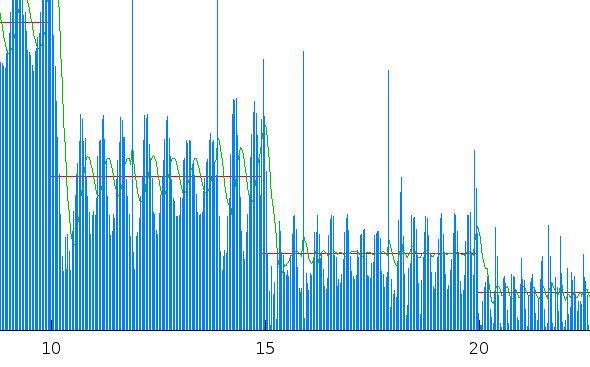
One of the more exciting upcoming features of Farsight is the ability to change the amount of required bandwidth depending on network conditions. Which means Telepathy based VoIP clients will be able to use higher resolutions and better audio/video quality if the network connectivity allows. And ofcourse, when the available bandwidth is low, the bandwidth usage can be lowered such that calls are still possible with lower but hopefully still acceptable quality. One side of the full story is measuring the available bandwidth, which hopefully Olivier will tell at some point. The other part is actually using less bandwidth. In case technical details are not that interesting to you, probably best to stop reading at this point.. An important way to control the bandwidth we're using in a call is setting the target bitrate on the encoding GStreamer element. While previously it was enough for us to set the bitrate before encoding started, we now need to be able to change it at runtime. And not only that, the codec implementation should ideally respond within a few frames and have a reasonable constant per-frame size. All in all, a lot of requirements on codecs we didn't really have before. Which usually means we need to retest the various codecs we often use and make sure we configure them correctly for the behaviour we'd like to see (and fix them if necessary). To do this I've written a small test program, which simply changes the target bitrate over time and outputs some numbers suitable to feed into gnuplot to turn into graphs. For example, when using x264enc with the current default farsight settings a part of the resulting graph looks something like this (full graph here): x264enc bitrate scaling The blue impulses is the per-frame size (scaled), the green line the bitrate average over 10 frames and the red line the target bitrate. Clearly this isn't an ideal picture, we will need to do some more tweaks to our default settings to make x264 behave the way we want. The same will be true for all other codecs and codec elements, at the moment the GStreamer VP8 element doesn't handle run-time bitrate changes at all and the Theora element acts it its very own interesting way (graph here)

Steve McIntyre: Lies, damn lies and voting system lies

So we're just over 2 weeks away from our next set of local elections in the UK (May 5th), and alongside those elections we're also being asked about switching to a new voting system for future elections. For a long time we've used the simple First Past The Post (FPTP) system here, but now we have the possbility of moving to Alternative Vote (AV) instead. First Past The Post FPTP is simple to understand - the person who receives more votes than any single other person wins. But that simplicity is the only good thing, and there are many problems with it. It's unfair: in an election with 10 candidate, it's possible for a winner to have just 11% of the vote, even in the case where the other 89% of voters would consider them to be the worst option. It's also very susceptible to tactical voting, leading to nasty tactics in parties' election literature like claiming "party foo cannot win here, so don't waste your vote on them - vote for us instead!". See this Wikipedia article for more background. Alternative Vote AV is slightly more complicated. Instead of just placing a mark against their single preferred candidate, voters are able to rank as many of the candidates as they like. In the case that there is not a clear winner with more than 50% of the votes from the initial count, the lowest-ranked candidate is eliminated and second-choice votes from their supporters are counted and re-distributed for the other candidates. Iterate this process until one candidate gets more than 50% of the total votes. By re-calculating the votes this way, supporters of less popular candidates / parties should no longer feel the pressure to vote tactically and a more accurate picture of voter intention should emerge. The downsides? AV will tend to lead to slower, more expensive counting due to the potential for several rounds. It's still not real proportional voting, but it's better than FPTP in this regard. Again, Wikipedia has a good article about this subject. Other options? I'd be much happier to see discussion / trials of other voting systems. For example, Debian uses a variation on Condorcet called Cloneproof Schwartz Sequential Dropping which is an excellent system for fair voting, but it's very difficult to explain and counting votes is comparatively very expensive. It's bad enough getting ostensibly-intelligent Debian developers to understand this system; extending this to a national election would be impossible in my opinion. It's also not an option on the ballot here... :-) Politicians spreading lies I know this won't come as a major shock for a nationwide referendum, but there's a lot of campaigning going on. And, in the best traditions of political campaigning, there's a huge amount of bullshit being spread. The worst is coming from the "No to AV" campaign, as far as I can see. Without many positive things to claim, various members of the Conservative party (current government, with most to fear from a change of voting system, of course) are spouting outright lies and sowing FUD in all directions:
  1. Claiming that AV will cost 250 million, most of which would be for the cost of electronic voting machines. Except... there's no evidence that these would be needed, nor are there any plans to use them.
  2. Continuing on, highlighting the alleged "extra costs" of AV: campaign poster FUD saying that we need to choose between cardiac facilities for babies and AV, or between equipment for our soldiers and AV. Except... there's no evidence that costs will be that high, nor that we have to make such binary choices.
  3. Claims from senior Conservative figures that changing to AV would mean more votes and legitimacy for extremists like the British National Party. Except... there is no evidence that AV will boost minority extremist parties. The BNP themselves are urging their supporters to vote against AV. Finally, if these parties have a high enough proportion of votes that they should be getting seats in parliament then they should have those seats - this is one of the tenets of democracy. Why should we be choosing a voting system to deliberately disenfranchise people?
  4. Finally, even David Cameron is at it: "too much of the debate about the alternative vote (AV) had so far been dominated by 'scientific' evaluation of the two systems' merits. But for me, politics shouldn't be some mind-bending exercise. It's about what you feel in your gut - about the values you hold dear and the beliefs you instinctively have. And I just feel it, in my gut, that AV is wrong." Well, it's nice that our Prime Minister wants to ignore all the scientific evidence and go with his gut feeling. After all, why would we want to think about choices like this?
Don't swallow the bullshit If you're eligible to vote in the UK, please ignore the bollocks. Make up your own mind how to vote in this referendum, by looking at the facts. I've done that and I'll be voting in favour of switching to AV.

17 April 2011

Joey Hess: new git-annex use cases

After two weeks of work, I've just released git-annex version 0.20110417, with some big new features that open up some interesting use cases:
joey@gnu:~/tmp/repo> git annex initremote cloud type=S3 encryption=joey@kitenet.net
initremote cloud (checking bucket) (creating bucket in US) ok
joey@gnu:~/tmp/repo> git annex add bigfile
add bigfile ok
(Recording state in git...)
joey@gnu:~/tmp/repo> git annex move bigfile --to cloud
move bigfile (gpg) (checking cloud...) (to cloud...) ok
(Recording state in git...)
joey@gnu:~/tmp/repo> file bigfile
bigfile: broken symbolic link
joey@gnu:~/tmp/repo> git annex get bigfile
get bigfile (copying from cloud...) (gpg) ok
(Recording state in git...)
joey@gnu:~/tmp/repo> file bigfile
bigfile: symbolic link

* This feature isn't available in Debian yet, blocked by a lack of the Haskell hS3 library packaged for Debian. Someone should fix that, ideally not me. Getting missingh updated for the ghc7 transition so git-annex is buildable in unstable would also be nice..

Russell Coker: More about the Xperia X10

I ve now had a Sony Ericsson Xperia X10 for almost two months (here is a link for my first review) [1]. This is a phone that people seem to really dislike because the battery life is poor and Sony doesn t allow replacing the kernel. I m happy with mine, happy enough that after buying one for my wife and trying it out I bought one for myself. I knew about it s problems in advance and wanted a relatively cheap phone with a large high resolution screen, and the Xperia X10 was the best match for my criteria.ChargingThere has been a recent trend towards using USB for charging devices. Sony provides a tiny wall-wart PSU which has a USB socket and a short (1m) USB cable that can be used to charge the phone from it s PSU or from a PC. The size is really convenient, as the phone has a short battery life I ll probably want to take the PSU to more places than I would for other phones I ve owned.The short USB cable saves weight and tangle when travelling, but can be inconvenient. I m currently working on the phone while it s plugged into my laptop, that works well and I can make calls while it s connected. If the phone was connected to a USB port on a tower computer that was on the ground then the cable could be too short to make a call, if it was charging on a power point near the floor then I wouldn t even be able to use the computer functionality let alone make calls without kneeling. My Viewty has a 175cm charging cable which alleviates these problems. I ve got a 50cm USB extension cable that I use for charging my phone while I m in bed that is just long enough to allow me to check my email without getting out of bed!The socket for connecting the USB cable is protected by a plastic lid that is connected by a strip of rubber. For a socket that will be used at least twice a day this isn t a good mechanical design. The plastic slide on the LG U990 Viewty seems like a much better design.As an aside it s a pity that they aren t designing cars with USB charging sockets built in. Some new cars have a socket for one USB flash drive to be attached to the radio, but really they need at least one USB charging port per seat. It would also be nice if they made power points with USB charging sockets built in, I d buy a few of those if they made them.Preserving the BatteryI ve been running Juice Defender to reduce the battery use, at the moment it is claiming to have extended battery life by 69%. That combined with turning off things that aren t needed (such as WiFi) has made the phone reasonably usable. I can survive more than 12 hours during which I use the phone a lot without charging it.XperiaX10.net has an interesting review of replacement batteries [5]. I m not going to buy them because the largest battery requires a replacement back case which prevents using an external case to prevent damage and the smaller one doesn t provide enough of a benefit and the design of the phone makes it difficult to change batteries so carrying a spare battery isn t a good option.Cursor Control KeysThe HP/Compaq iPaQs that I own from ~10 years ago have a single button that can be moved up/down/left/right to act as a cursor, it can also be pressed inwards to act as an ENTER key (or whatever the application might want for a fifth function). Having some sort of hardware cursor control is really handy, I often end up deleting several characters when I want to replace one because getting the cursor onto the desired character is too difficult.Adding more hardware keys would require making the phone bigger, but that would be fine by me. As described in my previous post about phone cameras I d like to have a phone that s thicker to have a better camera with a greater focal distance for a larger lens [2].Core Phone FunctionalityI really miss having separate green and red buttons for making/answering calls and for rejecting/ending calls.A really common operation is to call back the last person who called. To do this on my LG U990 Viewty I press the green button twice on my home screen which took less than a second. On the Xperia this involves selecting the phone icon from the home screen, then the call log icon, then the call that is desired, then the Call user line. That is four presses in different parts of the screen compared to pressing the same hardware button twice. I m investigating dialer applets right now, the Dialler One applet has a good interface for calling people who have called or been called recently but it still requires two presses on different parts of the screen. With my old Viewty I could call back the last person by feel without even looking at the phone!In the last 6 years the standard functionality of phones has been to include multiple profiles for noises. My Viewty has profiles named Normal , Silent , Vibrate only , Outdoor , Headset (automatically selected when a headset is connected), and three customised ones. The Xperia has only one setting, and that is three icon presses away from the home screen. It does allow changing the volume by hardware switches on the side which includes going to vibrate-only and silent mode. While this is useful, it s not the best way that two precious hardware keys could be used. It also doesn t allow control over all the different notifications, I d like to be able to activate a noise profile and have every application respond to it in an appropriate manner. This is a deficiency in Android 2.1 not in the phone itself.In many ways this phone has the worst phone functionality of any mobile phone I ve ever owned, I think that this is more the fault of the Android designers than Sony Ericsson.Android UpdatesSony had previously claimed that they wouldn t support Android later than 2.1. Now Sony has announced that they will support Gingerbread Android 2.3 [3]. So one of the major complaints about the Xperia will soon be addressed.TetheringThe build of Android that the Xperia runs at the moment doesn t support Wifi tethering. I m currently using with Easy Tether for USB tethering [4]. It s not free software and requires it s own code to run as root on your Linux system that is being tethered (which is easily locked down with SE Linux), but it basically works. The down-side with Easy Tether is that it proxies all the connections so you can t run traceroute etc and in the free version you can t use UDP.K9 MailK9 Mail fixes some of the problems in the default Android email program that I described in my previous post. It allows selection of SSL with a default port of 993 for IMAPs. It uses mail.example.com as the mail server address for an email address of user@example.com (so I ll add a mail CNAME to the domains I run). When I connected initially it told me that the SSL key was not signed by a CA and asked if I wanted to save it or reject it this is the correct and desired functionality. It also correctly parses URLs from the email (or at least has fixed the bug that I discovered in the default email app).One problem I ve found with K9 is that it seems to timeout on large folders. This is probably partly the fault of Virgin Mobile being slow for IP access, but I wonder whether K9 doesn t pipeline IMAP commands as Virgin can do bulk transfer at reasonable speeds (80KB/s) and it mainly fails on latency (900ms being typical). The result is that a folder with more than 500 messages that need to be copied to the phone will never get synchronised. When I started reading mail on my phone I had to move mail from some of the bigger folders into other folders to avoid timeouts. As an aside the amount of time I ve saved by reading email on the go has already paid for the phone.MediascapeThe Sony Mediascape software is used for categorising photos. One function of this is to assign names to photos, the names come from the contact list so if you photograph someone who you can t phone then you need to add a contact list entry for them. This also means that you couldn t conveniently add names to non-humans, I guess I could have added a contact list entry Mr Crash Dump for photos of system crash logs. But a bigger problem is that it decides what is a picture of a person, a picture of someone who is not centered in the photo or a profile picture can be regarded as not a photo of a person and therefore not subject to being associated with a contact list. Finally when selecting a name for a picture it displays the entire contacts list in a small font instead of displaying favorites, I have the phone numbers of many clients in my contacts list who I will never photograph Mediascape just isn t much good. If I feel the need to do something serious in this regard I ll search the app store for something free that s better.ProtectionFor $15 each I bought one grey and one clear Gel Case from J2K. This case covers the sides and back of the phone with a firm rubber layer that will hopefully allow it to bounce rather than break. It also extends slightly higher than the screen which should stop the screen being scratched if the phone is left face-down on a hard surface on the vibrate setting.One problem with the Gel Case is that by it s design it has to cover the buttons on the sides, due to a design or manufacturing problem the clear case that my wife uses can press slightly on the shutter button which disables the three main buttons on the front. So when the menu or back button stops working she has to slightly move the Gel Case out from the side. I m thinking of just cutting out a section of the Gel Case there, that will make it difficult to press the shutter button, but you can use the touch screen to take photos and there doesn t seem to be any other use for the shutter button so this shouldn t be a problem. The clear and grey cases have different designs, the grey one has a hole over the raised Sony logo which makes it fit a little better as well as not having the shutter problem, so it seems to be a later design I don t know whether all clear cases have the same problem but I recommend that someone who only has one Xperia X10 get the grey case just in case.Web BrowsingI m experimenting with using my own web proxy to compress the data sent to the phone. Unfortunately the Android settings for a web proxy only apply to the main web browser, not to all the other applications that use web services. Also the built-in web browser requires pressing the settings hardware button followed by at least two touch-screen presses to change between windows or close a window and it doesn t seem to support making the short-press action be to open a link in a new window. So I will have to find another web browser to use.Bandwidth UseThe 3G Watchdog applet is really good for tracking the data transfer and optionally cutting off 3G access before the quota is exceeded. Unfortunately Virgin has already sent me a bill with $234 in extra charges for bandwidth use because I used 1.6G instead of my 1.5G quota. A Virgin representative had told me over the phone that the billing period would be based on the end of the month, so while every calendar month has had less than 1.5G used because I used more than average in the end of March and the start of April that counts as excess data in the 14th March to 13th April period.I m going to appeal this to the Telecommunications Industry Ombudsman, I don t think that it s reasonable that I should be billed almost 7* the normal bill for exceeding the quota by 7.4% based on following the instructions of a Virgin employee. While I could have read the previous bill that they sent me to discover the end of billing period dates, I don t think that I should be expected to distrust everything that a Virgin employee says. If they billed me an extra $20 then I d just pay it, but $234 is unreasonable.ConclusionSince using the phone I ve found significant benefits in web browsing and reading email with the major limitation being the small screen (relative to a Netbook or Laptop). So if I was to buy another phone I would probably consider a Dell Streak which seems to be the largest Android phone on the market at the moment.Given the amount of use that I ve got I would be happy to spend more money and therefore consider a more expensive phone. But I don t regret the decision to save money by getting an Xperia X10.Finally when a telco tries to stick me with a $234 excess charge it really detracts from the value of having a phone contract. If I end up having to pay that then it s half the value of a smart-phone lost in one telco scam. This is enough to make a contract with Virgin a bad option, after this contract expires I may use VOIP and a pre-paid SIM from Telstra NextG if their network is still the best. Another possibility is to just use a small tablet and skip having a mobile phone, email and Jabber plus SMS from the people who lack net access will probably do.

16 April 2011

Iustin Pop: LaTex fun

Recently, I've had the pleasure of having to write many short documents in LaTex (short as in 1 to 6 pages). I haven't written a lot in LaTex since my school time, so this was a very nice flashback to those times. However, since then PDF is the new "standard" format, not PostScript, so I had to do a bit of adjustement. The biggest change is that pdflatex doesn't "like" EPS files for images, so what to do? As usual, the road to enlightenment has many turns First, reading docs, I said simple, create a PNG file, scaled at high resolution, then include it scaled down so that it kind of loses the ugly scaled-bitmap feel. But that's not a nice solution: it is still bitmap, just looks like aliased. So I wanted another solution and threw gnuplot's set terminal png and fig2dev's -L png out the door. Next was, of course, embedding PDFs, since pdflatex supports that. However, gnuplot's pdfcairo output is not as nice as I wanted. It works, but only kind of. Issues with font consistency and scaling, etc. Then I remembered the nice pslatex output from xfig, and learned that there's a pdftex output. And that gnuplot also can generate .fig output. So I went and redid my Makefiles and gnuplot command files and everything, and suddenly all looked almost right. There are still a few issues: So while this setup has some drawbacks, it works well enough. I was happy to simply have a well defined workflow. But then I wanted to do a simple graph (of a 3-wire sorting network), and I realised that positioning all of that using xfig will be painful. I kept stumbling upon pgf and tikz during my previous investigations, and I said I should check it out. Wow. tikz and pgfplot. While you lose a bit on the graphing capabilities, you also gain a lot. Basically one can replace both xfig (instead of hand-drawn diagrams you can actually write them in code, programatically, no more guessing) and gnuplot (so that you have consistent fonts/scaling). I was so amazed at this excellent combination that I've converted for all my new docs to this. And now I have the problem that I keep wanting to write LaTex code in ikiwiki :) PS: Yes, I've been busy lately, so busy that my Debian work has mostly been suspended. Should be back in about a month or so.

Dirk Eddelbuettel: Dianne Reeves at the CSO

Another Friday night at the Chicago Symphony with some live jazz, and once again Dianne Reeves (wikipedia) who was in town with her quartet. They performed a fairly short set which seemed not quite as polished as some of her previous concerts we had seen. But she is still an amazing live performer, radiant and with amazing vocal chops---which made for another nice evening out.

12 April 2011

Guido G nther: Bits from the 4th Debian groupware meeting

This went out to d-d-a a couple of days ago already but I figured that this might be of interest here too: The fourth Debian Groupware Meeting was held in the LinuxHotel, Essen, Germany. This is a short summary of what happened during the weekend:

Dirk Eddelbuettel: The new R compiler package in R 2.13.0: Some first experiments

R 2.13.0 will be released tomorrow. It contains a new package by R Core member Luke Tierney: compiler. What a simple and straightforward name, and something that Luke has been working on for several years. The NEWS file says
    o Package compiler is now provided as a standard package.  See
      ?compiler::compile for information on how to use the compiler.
      This package implements a byte code compiler for R: by default
      the compiler is not used in this release.  See the 'R
      Installation and Administration Manual' for how to compile the
      base and recommended packages.
so the compiler is not yet used for R's own base and recommended packages. While working on my slides for the upcoming Rcpp workshop preceding R/Finance 2011, I thought of a nice test example to illustrate the compiler. Last summer and fall, Radford Neal had sent a very nice, long and detailed list of possible patches for R performance improvements to the development list. Some patches were integrated and some more discussion ensued. One strand was on the difference in parsing between normal parens and curly braces. In isolation, these seem too large, but (as I recall) this is due some things 'deep down' in the parser. However, some folks really harped on this topic. And it just doesn't die as a post from last week demonstrated once more. Last year, Christian Robert had whittled it down to a set of functions, and I made a somewhat sarcastic post argueing that I'd rather use Rcpp to get 80-fold speed increase than spend my time argueing over ten percent changes in code that could be made faster so easily. So let us now examine what the compiler package can do for us. The starting point is the same as last year: five variants of computing 1/(1+x) for a scalar x inside an explicit for loop. Real code would never do it this way as vectorisation comes to the rescue. But for (Christian's) argument's sake, it is useful to highlight differences in the parser. We once again use the nice rbenchmark package to run, time and summarise alternatives:
> ## cf http://dirk.eddelbuettel.com/blog/2010/09/07#straight_curly_or_compiled
> f <- function(n, x=1) for (i in 1:n) x=1/(1+x)
> g <- function(n, x=1) for (i in 1:n) x=(1/(1+x))
> h <- function(n, x=1) for (i in 1:n) x=(1+x)^(-1)
> j <- function(n, x=1) for (i in 1:n) x= 1/ 1+x 
> k <- function(n, x=1) for (i in 1:n) x=1/ 1+x 
> ## now load some tools
> library(rbenchmark)
> ## now run the benchmark
> N <- 1e6
> benchmark(f(N,1), g(N,1), h(N,1), j(N,1), k(N,1),
+           columns=c("test", "replications",
+           "elapsed", "relative"),
+           order="relative", replications=10)
     test replications elapsed relative
5 k(N, 1)           10   9.764  1.00000
1 f(N, 1)           10   9.998  1.02397
4 j(N, 1)           10  11.019  1.12853
2 g(N, 1)           10  11.822  1.21077
3 h(N, 1)           10  14.560  1.49119
This replicates Christian's result. We find that function k() is the fastest using curlies, and that explicit exponentiation in function h() is the slowest with a relative penalty of 49%, or an absolute difference of almost five seconds between the 9.7 for the winner and 14.6 for the worst variant. On the other hand, function f(), the normal way of writing things, does pretty well. So what happens when we throw the compiler into the mix? Let's first create compiled variants using the new cmpfun() function and then try again:
> ## R 2.13.0 brings this toy
> library(compiler)
> lf <- cmpfun(f)
> lg <- cmpfun(g)
> lh <- cmpfun(h)
> lj <- cmpfun(j)
> lk <- cmpfun(k)
> # now run the benchmark
> N <- 1e6
> benchmark(f(N,1), g(N,1), h(N,1), j(N,1), k(N,1),
+           lf(N,1), lg(N,1), lh(N,1), lj(N,1), lk(N,1),
+           columns=c("test", "replications",
+           "elapsed", "relative"),
+           order="relative", replications=10)
       test replications elapsed relative
9  lj(N, 1)           10   2.971  1.00000
10 lk(N, 1)           10   2.980  1.00303
6  lf(N, 1)           10   2.998  1.00909
7  lg(N, 1)           10   3.007  1.01212
8  lh(N, 1)           10   4.024  1.35443
1   f(N, 1)           10   9.479  3.19051
5   k(N, 1)           10   9.526  3.20633
4   j(N, 1)           10  10.775  3.62673
2   g(N, 1)           10  11.299  3.80310
3   h(N, 1)           10  14.049  4.72871
Now things have gotten interesting and substantially faster, for very little cost. Usage is straightforward: take your function and compile it, and reap more than a threefold speed gain. Not bad at all. Also of note, the difference between the different expressions essentially vanishes. The explicit exponentiation is still the loser, but there may be an additional explicit function call involved. So we do see the new compiler as a potentially very useful addition. I am sure more folks will jump on this and run more tests to find clearer corner cases. To finish, we have to of course once more go back to Rcpp for some <emph>real</emph> gains, and some comparison between compiled and byte code compiled code.
> ## now with Rcpp and C++
> library(inline)
> ## and define our version in C++
> src <- 'int n = as<int>(ns);
+         double x = as<double>(xs);
+         for (int i=0; i<n; i++) x=1/(1+x);
+         return wrap(x); '
> l <- cxxfunction(signature(ns="integer",
+                            xs="numeric"),
+                  body=src, plugin="Rcpp")
> ## now run the benchmark again
> benchmark(f(N,1), g(N,1), h(N,1), j(N,1), k(N,1),
+           l(N,1),
+           lf(N,1), lg(N,1), lh(N,1), lj(N,1), lk(N,1),
+           columns=c("test", "replications",
+           "elapsed", "relative"),
+           order="relative", replications=10)
       test replications elapsed relative
6   l(N, 1)           10   0.120   1.0000
11 lk(N, 1)           10   2.961  24.6750
7  lf(N, 1)           10   3.128  26.0667
8  lg(N, 1)           10   3.140  26.1667
10 lj(N, 1)           10   3.161  26.3417
9  lh(N, 1)           10   4.212  35.1000
5   k(N, 1)           10   9.500  79.1667
1   f(N, 1)           10   9.621  80.1750
4   j(N, 1)           10  10.868  90.5667
2   g(N, 1)           10  11.409  95.0750
3   h(N, 1)           10  14.077 117.3083
Rcpp still shoots the lights out by a factor of 80 (or even almost 120 to the worst manual implementation) relative to interpreted code. Relative to the compiled byte code, the speed difference is about 25-fold. Now, these are of course entirely unrealistic code examples that are in no way, shape or form representative of real R work. Effective speed gains will be smaller for both the (pretty exciting new) compiler package and also for our C++ integration package Rcpp. Before I close, two more public service announcements. First, if you use Ubuntu see this post by Michael on r-sig-debian announcing his implementation of a suggestion of mine: we now have R alpha/beta/rc builds via his Launchpad PPA. Last Friday, I had the current R-rc snapshot of R 2.13.0 on my Ubuntu box only about six hours after I (as Debian maintainer for R) uploaded the underlying new R-rc package build to Debian unstable. This will be nice for testing of upcoming releases. Second, as I mentioned, the Rcpp workshop on April 28 preceding R/Finance 2011 on April 29 and 30 still has a few slots available, as has the conference itself.

11 April 2011

Sandro Tosi: Python: group a list in sub-lists of n items

A long list, and you want to process its items n at a time; easy, but how to split that list in sublists of n elements (except the last one, of course)?

I looked a bit into the stdlib but it doesn't seem to exist anything I could use (oh, did I say I'm still on 2.4?) so I directed my research to Google, and found a nice recipe at ActiveState, but it has the problem it discards the last list, if it has less than n items.

Searching again, I got more lucky with this article: it's a generator of tuples from a list, splitting every n elements and optionally return the last semi-full tuple. I slightly modified it to obtain:

def group_iter(iterator, n=2):
""" Given an iterator, it returns sub-lists made of n items
(except the last that can have len < n)
inspired by http://countergram.com/python-group-iterator-list-function"""
accumulator = []
for item in iterator:
accumulator.append(item)
if len(accumulator) == n: # tested as fast as separate counter
yield accumulator
accumulator = [] # tested faster than accumulator[:] = []
# and tested as fast as re-using one list object
if len(accumulator) != 0:
yield accumulator

How would you have done it?

Kartik Mistry: Fixing Macbook: Part 1

* Dear Lazyweb, I have Macbook (Late 2008) model running Debian Sid + Mac OS X (sigh!) and I m facing nice issues which prevents me to full use of disk. They re: 1. CD-ROM drive doesn t work. So, if I want to upgrade to Snow Leopard or anything else, there is no other way. 2. Disk is 160 GB, I want to upgrade to better disk (say with better speed, capacity). Is there any way to clone entire disk (with partition preserved) and use it? Remember: I don t have CD-ROM 3. Is there any way to wipe-out Mac OS X and running Debian with hardware acceleration? I ve noticed that if you single boot Debian, it lacks Video acceleration. Any pointers towards above 3 is appreciate. I ll hostname my computer if you help me to fix this ;)

Cyril Brulebois: Debian XSF News #10

This is the tenth Debian XSF News issue. It is basically meant to be a follow-up to DXN#9.

  1. I completed the addition of the Sinhala language, and also dealt with big changes on the xkb-data (a.k.a. xkeyboard-config) side, as explained by Sergey Udaltsov. Protocol:
    • [KiBi] x11proto-core: the upload to experimental was a bit overcautious, so upload again unstable.
    Data: Library:
    • [KiBi] libx11: new upstream release, adding support for Sinhala unstable.
  2. The Graphical Installer started receiving improved portability. There were a few patches floating around adding udebs for generic drivers for non-Linux architectures. I cleaned them up a bit (especially on the vesa side, getting rid of libdrm entirely), got them test-built on a kfreebsd-amd64 box, while Samuel Thibault was doing the same on a hurd-i386 box. I raised the topic on debian-boot@, debian-bsd@, and debian-hurd@, mentioning the remaining steps. Drivers (all accepted by ftpmasters after a tiny trip to the NEW queue):
  3. Here are some other packages which got updated. Applications: Library:
    • [Chris,Julien,KiBi] mesa 7.10.1: long-awaited upload, finally checked, built, and uploaded experimental.
  4. Finally, let s mention migration to testing (from now on I ll use testing instead of wheezy so that it s clear it s about week after week migrations to the testing distribution, rather than our final plans for the next stable release). After a while, and thanks to some hand-holding from our nice release managers (hi, Adam!), linux-2.6, libdrm, mesa, xorg-server, and several dozen drivers migrated to testing. Yay!
  5. As a consequence, some other packages got updated shortly after the successful britney run (because they were prepared right before, just in case). Libraries:
    • [KiBi] libdrm: replace 2.4.23 with 2.4.24 (which was in experimental previously) unstable.
    • [KiBi] mesa: new stable release, 7.10.2 supersedes both 7.10 in unstable and 7.10.1 in experimental (see above) unstable.
    • [KiBi] pixman: new development snapshot, 0.21.6 comes from experimental and supersedes 0.21.4 unstable.
    Drivers:

10 April 2011

Christian Perrier: [life] [running] 2nd step of my wspring challenge done

At about 12:45 today, I completed my third Paris Marathon and my 7th marathon overall (incl. 2 unofficial ones, ran alone). As I wrote earlier, the challenge this year was not breaking a record. I wanted to complete two long races in only two week, as a gift for my birthday that happened between both. So, after Paris Paris Ecotrail 55km race, I ran my beloved Paris Marathon. So, I ended up in 3h54'37", 5 minutes more than last year and 14 minutes more than my personal best The heat was the ennemy, today. A wonderful sun was shining over Paris, which is nice....but brings the temperature up to 23 C. So, the solution had to be "drink, drink, drink". I think I drank something like 4 liters, today. I was planning to start around 5'25/km but finally ended up with about 5'20", which I sustained up to km 25 and the terrible Louvre tunnel (1km in a tunnel on the right bank speedway, under Quai du Louvre). That one was a killer this year and many runners blew up in it. I then decided to use the opportunity to walk a little bit, eat my mid-marathon glucides and slow down slightly later on for the upcoming tunnels (two more...though less long). That was in some way the famous 30km wall, which, for me, was moved to km28..:-) Later on, as usual, courage enters the game and I roughly managed to keep a 5'30"-5'45" pace up to the end of the race. Cramps signs appeared around km 35 but, here again, a wise slowdown and some walking, a lot of drinking helped me in controlling them. Finally, the result is about what I intended to do. Over 4h, I would have been disappointed even if happy to finish (as everybody tells me that my challenge was kinda crazy). Abandoning would have been the real defeat. I did not..:-) And, thanks, of course, to my beloved Elizabeth who again managed to deal with his "Kiki" logistics, includiung waking up at 6am on a Sunday. Now, my running schedule will slow down a little with only training for 5 weeks. Next race: Trail des Cerfs, a 35km trail in Rambouillet Forest close to home. I may again schedule a solo marathon, at training pace, end of May, in Versailles Castle park. Next marathon: Berlin, Sept 25th. Here, the goal is breaking the personal best and head up to 3h35.

9 April 2011

Cyril Brulebois: Debian XSF News #9

This is the ninth Debian XSF News issue. As can be seen below, I m not yet decided how to present various items. This time, I ll try to gather all updated packages since the previous issue, grouped by category, with a single line summary. Lengthy comments come after that list of updated packages.
  1. Here come the updated packages, with contributors/uploaders between square brackets (Timo = Timo Aaltonen, JVdG = Julien Viard de Galbert, Robert = Robert Hooker). Protocol:
    • [KiBi] x11proto-core: new upstream release, bringing Sinhala support experimental.
    Libraries:
    • [Timo,KiBi] libx11: new upstream release, fixing some hang issues unstable.
    • [KiBi] libxi: new upstream release unstable.
    • [KiBi] libxkbcommon: finally accepted by ftpmasters, needed for wayland experimental.
    Server:
    • [KiBi] xorg-server: stable release 1.9.5, unlikely to cause regressions from the previous release candidate; in other words: a good candidate for testing if the Linux kernel migrates some day unstable.
    • [KiBi] xorg-server: first release candidate for the first stable bugfix release in the 1.10 series, which finally builds experimental.
    Drivers: Others:
    • [KiBi] xorg: originally a few tweaks to make it possible to install X on Hurd unstable
    • [KiBi] xorg: but wkhtmltopdf failed on several buildds, so I disabled PDF generation, and completed the switch to asciidoc mentioned in DXN#8 unstable.
    • [KiBi] xorg-sgml-doctools: new upstream release, adds support for docbook external references unstable.
    • [Robert,KiBi] xutils-dev: new util-macros release, and a version lookup file unstable.
  2. Why am I carefully uploading video driver packages to experimental only? Because bad regressions happen, on a regular basis; so it seems quite nice to keep well-tested versions in unstable for now. Once the X stack has migrated to testing (which as explained in DXN#7 and DXN#8 is waiting for the Linux kernel to migrate), new versions in unstable are welcome, so that one can tell easily whether bugs with those versions are regressions from the versions available in testing. In the meanwhile, one can build packages from the git repositories, using the debian-unstable branch (which is the default).
  3. Why am I so rash then, uploading input drivers to unstable as they are released? First of all, our waiting for the kernel means we have no issues on the 10-day delay front. Second of all, input bugs are usually fixed very quickly upstream (you can go there and thank Peter Hutterer in particular). So staying very close to whatever upstream ships makes some sense.
  4. Why am I uploading drivers twice? Since it isn t specific to the current situation, but a general question when it comes to supporting two versions of the server in parallel, I decided to document that in an handling multiple server versions thanks to experimental page. The answer to this specific question is available in the note at the bottom of that page.
See you in a few days for a follow-up Debian XSF News issue.

8 April 2011

Julian Andres Klode: this week: dh-autoreconf 3, and APT-related things

Internship / APT stuff This week was a rather busy week. I m currently doing a (unpaid) 1 month internship as part of my education. Thanks to Michael Vogt and his boss at Canonical Ltd, this internship takes place in IRC and is dedicated to Debian and Ubuntu stuff, primarily APT-related things. The first two days were spent on multi-arch support in python-apt: On Monday, I released python-apt 0.7.100.3, introducing initial minimal multi-arch support (just enough to not break anymore, but no really new multi-arch-specific API). This release is also the base for the version going to be shipped in Ubuntu natty, which is one of the reasons to keep the changes such minimal. I also fixed an RC bug related to Python 3.2 modules in python-apt, and implemented nocheck build option and disabled test errors on hurd. On Tuesday, I released python-apt 0.8.0~exp1 to experimental. This release now has the old-style non-PEP8 API disabled and also introduces improved multi-arch support, by introducing bindings for APT s GrpIterator class, and supporting indexing the cache by (name, architecture) tuples. On Wednesday, I noticed a strange bug in APT (via python-apt s test suite) where what the cache considered the native architecture was not the configured one. David Kalnischkies and I debugged the problem, and he found the source of the problem and implemented a fix in his branch of APT. I also introduced multi-arch support for the aptsources module, fixed all Python 3.2 ResourceWarnings in python-apt, and prepared an NMU for python-debian, to adjust it to python-apt s new API. I also took over maintenance of software-properties in Debian, and did two uploads there (rebased on the Ubuntu package), both with python-apt 0.8 API support. On Thursday, I shifted a bit more to the Ubuntu side and fixed several bugs in APT and aptdaemon, resulting in the aptdaemon 0.41+bzr614-0ubuntu2 upload and apt 0.8.13.3ubuntu2. I also fixed software-properties KDE version in Debian, as I broke it the previous day. Today, on Friday, I fixed one more bug in APT. APT now treats Release files that cannot be verified identical to Release files without signature, that is, they are actually parsed now (no more missing Origin fields) see LP: #704595. dh-autoreconf 3 I uploaded dh-autoreconf 3, fixing all bugs in the BTS except for one (if someone knows why autopoint depends on git, please tell me, and I may fix this bug as well). For those who don t know dh-autoreconf, it is a tool to run autoreconf automatically during the package build, so no need for manual cleanup or autoreconf patches. I now thought about adding the option to automatically patch ltmain.sh to dh-autoreconf. As many know, ltmain.sh does not work correctly with -Wl, as-needed. Now, if the libtool maintainer cooperates and provides a patch file in the libtool binary package, dh-autoreconf could automatically apply it during build-time, thus fixing this problem as well. GNOME 3 I m now running GNOME 3, or the parts of it we have in Debian. Next week We ll probably see python-apt 0.8.0~exp2 next week with more improved multi-arch support and other fixes.
Filed under: Debian

Wouter Verhelst: Blocking newsletter spam

It's incredible how many people are of the misguided belief that just because I happen to run a company, I am automatically interested in their newsletter about whatever it is that they are doing, no matter how far it is removed from the kinds of things my company actually does. Are these people spammers? Yes, definitely, and I don't want to do business with them. But there's a major difference between this kind of mails and your common nigerian scammer or counterfeit blue pill "salesperson". Unlike the latter, some newsletter spammers are interested in forming a genuine business relationship with my company. They're going about it the wrong way, but that doesn't necessarily mean they're trying to trick me into doing something that would not be in my best interest they're not just after my money. Although their methods are wrong, that does not mean they're entirely clueless. Some of these unwanted newsletters are sent with VERP-style return paths, which suggests that if the mail bounces at SMTP time, I would no longer receive their junk. So bouncing them is what I do. Exim makes this very easy:
acl_check_mail:
  deny
	message = Your domain has been blacklisted
	log_message = domain blacklisted
	condition = $ 
			lookup $sender_address_domain 
			wildlsearch /etc/exim4/blacklist-domains 
			 true 
			 false 
		      
  accept
What this does is use a wildlsearch lookup to verify whether the domain of the envelope sender (i.e., as specified in the MAIL FROM: SMTP command) exists in the /etc/exim4/blacklist-domains file. Since we use a wildlsearch, we can use the * as a wildcard *grep.be would mean 'grep.be, or any of its subdomains', whereas *.grep.be would mean 'any of the grep.be subdomains'. This is because at least one of the people I've blacklisted that way sends their newsletter through a distributed service, and the VERP-style header is based upon the server that actually communicates with my system; and others have a subdomain for the newsletter, but don't use it (or use a different one) for regular mail. If I'm not interested in their spam, I'm probably also not interested in their other mail, so therefore the wildcard (is this overkill? Maybe, but I don't care I don't do business with spammers). This ACL is then activated for the SMTP MAIL FROM: command (search for acl_smtp_mail variable in the exim specification). This makes it impossible for the spammer to reach postmaster@ from the same domain, too, but that doesn't matter; they can always use a different address. One might be wondering why I'm using this kind of domain-based blacklisting rather than a regular bayesian spamfilter, or anything of the sorts. The reason is fairly simple: because the general format of these newsletters is distinctly different from regular spam. For instance, some of these newsletter spammers are in fact competitors who didn't bother to check who they're sending mail to. As a result, their newsletters would contain key words that would appear in mails which I send to my regular customers, too; if I were to classify them as spam in my bayesian classifier, that would increase the chance of the classifier misclassifying a mail from an actual customer as spam. Most of these are very similar in format to newsletters that I did consciously subscribe to, and which are therefore not spam, etc. Finally, bouncing mail rather than blackholing it or filing it in a separate folder (as I have spamassassin do) has the added advantage of making it clear to a newsletter spammer that their junk is not wanted. Most (though certainly not all) will then remove me from their newsletter, saving me bandwith and processing power. And since we do this at MAIL FROM: time, rather than upon completion of the RCPT TO: or DATA commands, I'm not actually giving away any information that they don't have, either.

7 April 2011

Dirk Eddelbuettel: Review of 'R in a Nutshell' by J Adler now in JSS

Volume 40 of of the (electronic) Journal of Statistical Software just came out. It contains my short review of Josef Adler's already pretty popular R in a Nutshell from O'Reilly. You can my review as a pdf via this local preprint, or by visiting the JSS page of the review and its official copy.

Next.

Previous.