Sylvestre Ledru: Rebuild of Debian using Clang 3.9, 4.0 and 5.0
tldr: The percentage of failure is decreasing, Clang support is improving but there is a long way to go.
The goal of this initiative is to rebuild Debian using Clang as a compiler instead of gcc. I have been doing this analysis for the last 6 years.
Recently, we rebuilt the archive of the Debian archive with Clang 3.9.1 (July 6th), 4.0.1 (July 6th) and 5.0 rc2 (August 20th).
For various reasons, we didn't perform a rebuild since June 2016 with version 3.8. Therefor, we took the opportunity to do three over the last month.
Now, the 3.9 & 4.0 results are impacted by a build failure when building all haskell packages (the -no-pie option in Clang doesn't exist - I introduced it in clang 5.0). Fixing this issue with 5.0 removed more than 860 failures.
Also, for the same versions, a Qt compiler detection is considering that Clang is not a C++11 compiler because clang++, by default, defines __cplusplus as 199711L (-std=c++11 has to be added to define a correct __cplusplus). See https://bugreports.qt.io/browse/QTBUG-62535 for more information. Some discussions happened on the upstream mailing list about changing the default C++ dialect.
For example, with 4.0, this is causing 132 errors. With 5.0, probably thanks to a new Qt version, roughly the same number of packages are failing but because gcc just triggers a warning with the "nodiscard" attribute being incorrectly used when clang triggers an error. In parallel, ignoring the haskell build failures, the numbers sightly increased since last year even if the overall percentage decreased (new packages being uploaded in the archive).
In parallel, new warnings and errors showed up in Clang.
This is causing a new set of build failures (especially with the usage of -Werror). As few examples:
* Starting with 4.0, clang triggers an error ordered comparison between pointer and zero ('char *' and 'int').
* Similarly, with this version, -Wmain introduces a new warning which will trigger a warning when a bool literal is returned from main.
* clang also introduced a new warning called -Waddress-of-packed-member causing 5 new errors.
* With the same version, clang can trigger a new error when auto is used in function return type. Now, as a conclusion, having Debian being built with clang by default is still a long shot.
First, when Clang became usable for a general audience, gcc was lagging in term of warning and error detections. Now, gcc is in a much better position than it was, decreasing the interest to have clang replacing gcc. In parallel, most of the efforts in term of warnings
and mistake detections are currently done under the clang tidy umbrella, making them less intrusive as part of this initiative (but harder to use and to deploy).
As an example, the gcc warning -Wmisleading-indentation has been implemented under a clang-tidy checker.
Second, the very permissive license of clang has been a key factor for some operating systems to switch like the PS4, Mac OS X or FreeBSD. With Debian, the community is generally happy with the GPL.
Third, the performances are similar enough that it is not worth the work, except for some projects with very special needs. Last, despite that it is much easier to contribute to llvm/clang than gcc (not copyright assignment or actual review system for example), this isn't a big differentiator for most of the projects. Of course, I will continue to run and analysis these rebuilds as this is a great source of information for clang upstream developers to improve the compatibility with gcc and understand some impacts. However, until there is a big game changer, I will stop pursuing the goal of having Debian switching to clang instead of gcc. I will stop effort on the debile project (which was aiming to rebuild in the background packages).
For example, with 4.0, this is causing 132 errors. With 5.0, probably thanks to a new Qt version, roughly the same number of packages are failing but because gcc just triggers a warning with the "nodiscard" attribute being incorrectly used when clang triggers an error. In parallel, ignoring the haskell build failures, the numbers sightly increased since last year even if the overall percentage decreased (new packages being uploaded in the archive).
| Version | Build failures | Ignoring haskell pkgs |
| 3.8 | 1367 / 5.6% | |
| 3.9 | 2274 / 8.1% | 1618 / 5.8% |
| 4.0 | 2311 / 8.3% | 1655 / 5.9% |
| 5.0 | 1445 / 5.1% |
This is causing a new set of build failures (especially with the usage of -Werror). As few examples:
* Starting with 4.0, clang triggers an error ordered comparison between pointer and zero ('char *' and 'int').
* Similarly, with this version, -Wmain introduces a new warning which will trigger a warning when a bool literal is returned from main.
* clang also introduced a new warning called -Waddress-of-packed-member causing 5 new errors.
* With the same version, clang can trigger a new error when auto is used in function return type. Now, as a conclusion, having Debian being built with clang by default is still a long shot.
First, when Clang became usable for a general audience, gcc was lagging in term of warning and error detections. Now, gcc is in a much better position than it was, decreasing the interest to have clang replacing gcc. In parallel, most of the efforts in term of warnings
and mistake detections are currently done under the clang tidy umbrella, making them less intrusive as part of this initiative (but harder to use and to deploy).
As an example, the gcc warning -Wmisleading-indentation has been implemented under a clang-tidy checker.
Second, the very permissive license of clang has been a key factor for some operating systems to switch like the PS4, Mac OS X or FreeBSD. With Debian, the community is generally happy with the GPL.
Third, the performances are similar enough that it is not worth the work, except for some projects with very special needs. Last, despite that it is much easier to contribute to llvm/clang than gcc (not copyright assignment or actual review system for example), this isn't a big differentiator for most of the projects. Of course, I will continue to run and analysis these rebuilds as this is a great source of information for clang upstream developers to improve the compatibility with gcc and understand some impacts. However, until there is a big game changer, I will stop pursuing the goal of having Debian switching to clang instead of gcc. I will stop effort on the debile project (which was aiming to rebuild in the background packages).

 Over the last few days,
 I upgraded my last major machine from



 I have been playing around with

 In order to proceed further on our USB/STM32 oddessy, we need to start to build
a USB descriptor set for our first prototype piece of code. For this piece,
we're going to put together a USB device which is vendor-specific class-wise
and has a single configuration with a interface with a single endpoint which
we're not going to actually implement anything of. What we're after is just
to get the information presented to the computer so that




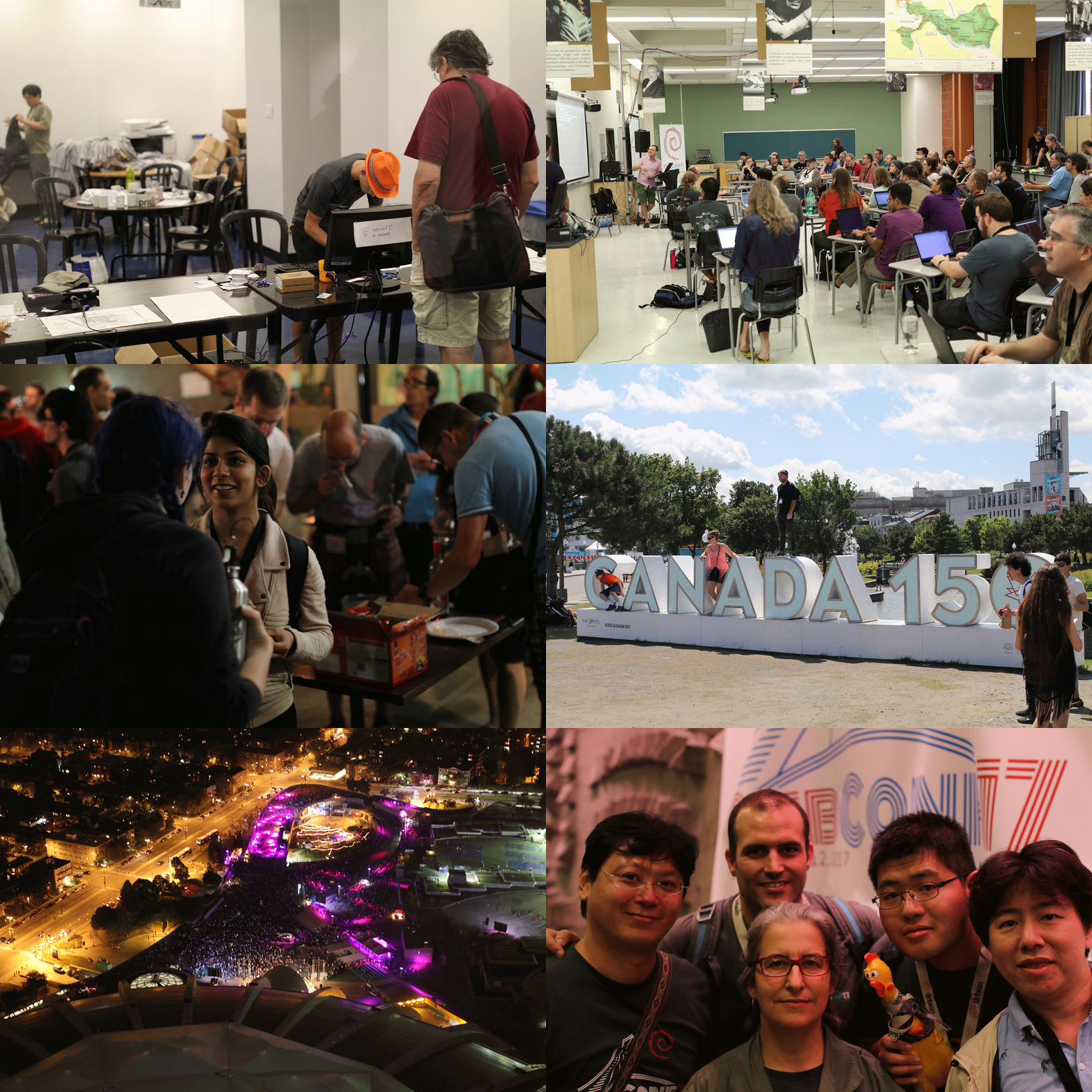
 Debconf17 has come and gone by too fast, so we all could use a moment looing back at all the fun and serious happenings of the main event in the Debian social calendar. You can find my full photo gallery on
 Post-Solskogen, there hasn't been all that many commits in the main Nageru
repository, but that doesn't mean the project is standing still. In
particular, I've been working with NVIDIA to shake out a crash bug in their
drivers (which in itself uncovered some interesting debugging techniques,
although in the end, the bug turned out just to be uncovered by the boring
standard technique of analyzing crash dumps and writing a minimal program
to reproduce). But I've also been looking at intraframe codecs; my sort-of
plan was to go to
 On the heels of the very recent
 Three months ago, I gave a talk at the

 For more in-depth explanation on the different ways to encode a routing table
into a trie and a better understanding of radix trees, see
the
 The
 Getting meaningful results is challenging due to the size of the address
space. None of the scenarios have a fallback route and we only measure time for
successful hits
 Only 50% of the time is spent in the actual route lookup. The remaining time is
spent evaluating the routing rules (about 30 ns). This ratio is dependent on the
number of routes we inserted (only 1000 in this example). It should be noted the
 Here is an approximate breakdown on the time spent:
 All kernels are compiled with
 Despite its more complex insertion logic, the IPv4 subsystem is able to insert 2
million routes in less than 10 seconds.
 The memory usage is therefore quite predictable and reasonable, as even a small
single-board computer can support several full views (20 MiB for each):
 The
 At the
 laser-cutter sprint
So I'm overcoming my jetlag after DebConf17 by helping to make the

 And now I'm even teaching weasel how to use this thing (and he already made interesting
new mistakes) and it looks like Ganneff & formorer are next. Fun fun fun!
Oh, and the Alioth sprint also seems to be quite productive, but I'll leave reporting about this
to others.
 I had to write a small Python application to listen for some broadcast message
and process the message. This broadcast messages are actually sort of discovery
messages to find some peers in a network. Writing a simple UDP Server to listen
on a particular port was easy; but while designing an application I was
wondering how can I plugin this server into my main code. There are 2
possibility



 Do you know what s happening in the wires of your network? There is a major
FLOSS player in the field of real time intrusion detection (IDS), inline
intrusion prevention (IPS) and network security monitoring (NSM).
I m talking about Suricata, a mature, fast and robust network threat detection
engine. Suricata is a community driven project, supported by the
