Search Results: "ana"

25 June 2010

Anand Kumria: The Rebound

Another coming of age movie. All about age differences and timing. Somewhat ironical given the relationship Catherine Zeta-Hones is in. Had some realism from what I have observed of relationships with big age differences but this is also very similiar to Prime (with Uma Thurman) except that this also involved children (and thus you get the associated children gags). Seems to really play off of Aram Finkelstein (played by Justin Bartha), one of the protaganists, being Jewish. Just like Prime. The Jewishness only added two (or, maybe, three). I felt the film could have done without it. It might have forced the writers to come up with something a bit more original. For me, the reason to watch this was Catherine Zeta-Jones who, as one of the characters notes is a MILF. The chemistry between two leads is really what saves this film.

Anand Kumria: Barry Munday

This is a fairly classic coming of age story involving an unwanted pregnancy. Like the others in this genre, it has a twist (in this case neither of the parents are teenagers, like Juno) but revealing it would give away much of the plot. Oddly this film was finished in 2008 but has taken two years to surface. Apparently the first cuts just did not work. So it was redone a few times. I am glad that the extra time was done, since this film feels "right". Patrick Wilson, from Watchmen, is perfecly cast as Barry. The other big names make this a delight to watch, as they put in a comedic turn. There are quite a few cringe worthy moments, especially when Barry is being his pick-up artist self. But he evolves and makes the film warm-hearted. If you end up seeing this film, I think you'll enjoy it. It won't challenge you but it will entertain.

Anand Kumria: Beginning Django Development

Oddly, I have had four different people ask me about the best way to begin a Django project or setup their system to make it easy to develop with Django. Since I've now given my response via email so many times, I figure I might as well broadcast it and hopefully this will help others as well My assumptions: What we will do is create a private binary directory and another Python modules. Then take a checkout of the two most important Django projects, and make them work. First: create your user
$ sudo adduser newbie
$ ssh localhost -l newbie
$ whoami
newbie
Then we want to create some local bin and lib directories. First the binary directory $ mkdir ~/bin # On Ubuntu/Debian, this will automatically be in your PATH the next time you login And now a local directory for our various libraries
$ mkdir -p ~/lib/python
$ echo "PYTHONPATH=~/lib/python:" >> ~/.bashrc
$ echo "export PYTHONPATH" >> ~/.bashrc
This will add that directory to our Python path. If you happen to also use another language you can put things into ~/lib/ruby, ~/lib/perl as appropriate
$ mkdir ~/Projects
$ cd ~/Projects
Here is where we will store copies of upstream software. What is the reason for using the repositories rather than packages? This allows us to checkout specific versions to match what our clients might be using. Or test things against newer versions of the upstream project. First, let's setup Django. I tend to use git by default, especially if the upstream is using Subversion. If they are using Mercurial or Bazaar, I use those directly.
$ git svn clone -s http://code.djangoproject.com/svn/django/
Initialized empty Git repository in /home/newbie/Projects/django/.git/
Using higher level of URL: http://code.djangoproject.com/svn/django => http://code.djangoproject.com/svn
r1 = 5cda37203ffa6ea83da2958a95c377984482877f (refs/remotes/trunk)
	A	django-docs/images/flatfiles_admin.png
	A	django-docs/images/users_changelist.png
	A	django-docs/model-api.txt
	A	django-docs/build.py
	A	django-docs/db-api.txt
	A	django-docs/writing-apps-guide-outline.txt
	A	django-docs/templates.txt
r2 = b8249ac45e2154933b9649fd8181d5769e31c9fc (refs/remotes/trunk)
	A	django/utils/feedgenerator.py
	A	django/utils/datastructures.py
[...]
r13399 = f3902c67a3b8788de2145899e435a394c512b455 (refs/remotes/releases)
	M	tests/regressiontests/m2m_through_regress/tests.py
r13400 = cd72207306a5a4eecdf07f65c109f37c8317ed81 (refs/remotes/trunk)
$
Now we have Django, push it into our python path
$ cd ~/lib/python
$ ln -s ~/Projects/django/django/
$ python
Python 2.6.5 (r265:79063, Apr 16 2010, 13:57:41) 
[GCC 4.4.3] on linux2
Type "help", "copyright", "credits" or "license" for more information.
>>> import django
>>> django.VERSION
(1, 2, 1, 'final', 0)
Now, let's do the same for South. South is a database migration helper for Django. These are the two things you want to have in any Django at a minimum. There are also plenty of other amazing things like haystack, piston, satchmo, etc. You can follow the same recipie for them too.
$ cd ~/Projects
$ hg clone http://bitbucket.org/andrewgodwin/south/
destination directory: south
requesting all changes
adding changesets
adding manifests
adding file changes
added 802 changesets with 1340 changes to 183 files (+1 heads)
updating to branch default
143 files updated, 0 files merged, 0 files removed, 0 files unresolved
$ cd ~/lib/python
$ ln -s ~/Projects/south/south
$ python 
Python 2.6.5 (r265:79063, Apr 16 2010, 13:57:41) 
[GCC 4.4.3] on linux2
Type "help", "copyright", "credits" or "license" for more information.
>>> import south
>>> south.__version__
'0.7.1'
Finally, we want to be able to create Django projects. There is a great helper called django-admin that will do this. Let's put it into our path
$ cd ~/bin
$ ln -s ~/Projects/django/django/bin/django-admin.py
$ hash -r
That last statment will cause your interpreter to re-read PATH and make anything new available for execution. Now, you should go ahead and create your projects. There are a variety of ways to do this. However what I like to do is keep Django applications separate from the Django project. That way, they can easily be re-used if required. So, for a project called 'foo', we might have
$ mkdir -p ~/Work/foo
$ cd ~/Work/foo
$ mkdir foo.example.com
$ mkdir templates
$ mkdir media
$ mkdir <individual apps>
For each individual app, put them into the Python library. And you then have your re-usability from within Django. For a application called 'bar', you would do:
$ cd ~/Work/foo
$ django-admin.py startapp bar
$ cd ~/lib/python
$ ln -s ~/Work/foo/bar
And now, in your Django foo.example.com setting.py's file you can put 'bar' as one the installed applications and things will Just Work Obviously there are many way to slice this particular mango, but I've found that this works pretty well for me. You can spruce it up by revision controlling each directory in your project (I do) and also take advantage of things like virtualenv and Fabric to make deploying just as easy as developing. But I'll leave those topics until a later date

24 June 2010

Joachim Breitner: nagstmon forklet necessary

A while ago, I discovered nagstamon, a very useful piece of software by Henri Wahl. This program sits in the notification area of your desktop and alerts you when your nagios-monitored services have problems. Using nagstamon allows me to keep my servers under close surveillance, and it also adds another channel besides e-mail alerts, which will be helpful in case my mail server has problems. The wish I am not a full time sysadmin, I only monitor very few hosts and the services rarely have problems. Therefore, I do not want nagstamon to constantly sit in the notification area but only use it when there is something, well, to notify me about. It turned out that nagstamon did not support this mode of operation, so I created a ticket and asked whether this feature could be added. The author raised two points, one being that then the user would not know when nagios crashed and the other being that you would not be able to configure nagstamon because you do not see it. He also indicated that he does not have the resources to work on it and asked if I could find the time. The patch Since I really liked nagstamon, but really want to keep my panel uncluttered, I found the time: I created a series of self-containing patches, adding an option for the feature, adding code to prevent more than one instance of nagstamon running in parallel and adding a "nagstamon --settings" flag that would signal the running instance to show the settings similar to how mail-notification is been behaving. The author then raised the valid point that some people run more than one instances in parallel, with different configuration options. I then extended the patch to cater for that. The rebuff The author remained reserved, did not answer my last commend on the ticket and then, six weeks later, closed the bug without explanation and turned off the possibility to add comments. I can understand when people are reluctant to add contributed features to their code, I often feel the same way. But completely blocking more comments is not a nice way of communicating with possible contributors. The fork(let) So I m left with no option but patching each released version with my changes and building my own package. As I have to do this work anyways, I d like to share it. You can find my branch in my git repository. If you happen to want this feature as well and are using a Debian-based distribution, please let me know: I am building modified Debian packages anyways and can publish them as well. As I don t want to maintain this fork of nagstamon I don t plan to diverge any more from Henri s code, so if you have other feature requests, please talk to him first.

Joachim Breitner: nagstamon forklet necessary

A while ago, I discovered nagstamon, a very useful piece of software by Henri Wahl. This program sits in the notification area of your desktop and alerts you when your nagios-monitored services have problems. Using nagstamon allows me to keep my servers under close surveillance, and it also adds another channel besides e-mail alerts, which will be helpful in case my mail server has problems. The wish I am not a full time sysadmin, I only monitor very few hosts and the services rarely have problems. Therefore, I do not want nagstamon to constantly sit in the notification area but only use it when there is something, well, to notify me about. It turned out that nagstamon did not support this mode of operation, so I created a ticket and asked whether this feature could be added. The author raised two points, one being that then the user would not know when nagios crashed and the other being that you would not be able to configure nagstamon because you do not see it. He also indicated that he does not have the resources to work on it and asked if I could find the time. The patch Since I really liked nagstamon, but really want to keep my panel uncluttered, I found the time: I created a series of self-containing patches, adding an option for the feature, adding code to prevent more than one instance of nagstamon running in parallel and adding a "nagstamon --settings" flag that would signal the running instance to show the settings similar to how mail-notification is been behaving. The author then raised the valid point that some people run more than one instances in parallel, with different configuration options. I then extended the patch to cater for that. The rebuff The author remained reserved, did not answer my last commend on the ticket and then, six weeks later, closed the bug without explanation and turned off the possibility to add comments. I can understand when people are reluctant to add contributed features to their code, I often feel the same way. But completely blocking more comments is not a nice way of communicating with possible contributors. The fork(let) So I m left with no option but patching each released version with my changes and building my own package. As I have to do this work anyways, I d like to share it. You can find my branch in my git repository. If you happen to want this feature as well and are using a Debian-based distribution, please let me know: I am building modified Debian packages anyways and can publish them as well. As I don t want to maintain this fork of nagstamon I don t plan to diverge any more from Henri s code, so if you have other feature requests, please talk to him first.

Matthew Garrett: Joojoo

I've had the opportunity to look into the Joojoo tablet recently. It's an interesting device in various ways, ranging from the screen being connected upside down and everything having to be rotated before display, to the ACPI implementation that's so generic it has no support for actually attaching most embedded controller interrupts to ACPI devices and so relies on a hacked kernel that exposes individual interrupts as ACPI events that are parsed in userspace, to the ChangeOrientation binary that's responsible for switching between landscape and portrait modes containing gems like ps aux grep fgplayer grep -v grep and containing references to org.freedesktop.PandaSystem, a somewhat gratuitous namespace grab. Hardware-wise it seems to be little more than battery, generic nvidia reference design board and touchscreen with an accelerometer and LED glued to the chipset's GPIO lines. The entire impression is one of an ambitious project not backed up by the level of technical expertise required to get things done properly. Frankly, I think Michael Arrington came out of this rather better than he could have done - behind the reasonably attractive UI, the entire device is pretty much held together by string and a following wind.

Of course, releasing shoddily put together technology isn't generally illegal and from that point of view Fusion Garage aren't any worse than a number of products I've had the misfortune to actually spend money on. But they're distributing Linux (stock Ubuntu with some additional packages and a modified kernel) without any source or an offer to provide source. I emailed them last week and got the following reply:

Dear Sir,

we are still actively making changes to the joojoo software. We will make
the source release available once we feel we are ready to do so and also
having the resources to get this sorted out and organized for publication.
We seek your kind understanding on our position and appreciate your
patience on this. Thank you.

Best Regards
joojoo Support Team


Strong work, Fusion Garage. Hardware and software may not be your strong points, but you're managing copyright infringement with the best of them.

Anand Kumria: Brilliant Love

With great love, comes great sex. This felt like a truly British film, kind of like it captured the essense of Lily Allen (Noon looks a lot like Lily Allen), Natasha Beddingfield, Kate Nash. The photage is raw there is probably too much nudity for this film to get a large run in the UK (or elsewhere). Basically this is an exploration of young lovers, one of whom is a photographer, the other a taxidermist. So there is this undercurrent of trying to capture the present (photo, stuffed animals) for the future. That exploitation theme runs throughout the movie, in fact you could say it is self-referential too. The story is fairly simplistic, so I'll focus more on the technical aspects of the film. The costuming was excellent; Mel O'Connor really captured the typical artist look. Slightly odd and somewhat edgy. Sometimes I wonder if artists really dress this way, or only because everyone expects them too The soundtrack fitted the film: obscure, offbeat but all good. The Cinematograhy: lush, raw and very personal.

Anand Kumria: Silent Voices

The introduction of this movie felt really contrived. A group of people waiting to go on a prison visit, when one of them suddenly becomes hysterical because she is unable to read the piece of paper telling her if this is the right place. The pullaway shot of one person tugging the arm of another to drag them away from the specticle was a nice touch though. There are three major story threads going on during this movie:
  • Alexandre + Laure A young couple who have met, fallen for each other and are struggle to remain together even though one is behind bars
  • Stephane + Else An older couple who are struggling to find direction, money and love with each other
  • Zorah A mother who is trying to understand what has happened to her son
Each of these has a number of sub-threads. Unfortunately, I found both the first two story threads to be clich d. Cute, but clich d. Obviously each of the threads intersects, and the finale helps you understand the title. Farida Rahouadj's portrayal of Zorah was very compelling and makes up for all the other imperfections of the movie. It held the movie together and made it watchable. 3.5 out of 5.

Anand Kumria: Back at the festival.

Once again, it is Edinburgh Film Festival time. Which means a lot of great, obscure, or pre-release movies (and some dross and dreck thrown in too) to watch. This week, rather than spending my meagre money on rather pointless stuff like food, instead I'll be spending it on movies!

23 June 2010

Anand Kumria: I'm definitely still alive

Allie Brosh's take on not being dead Yes, folks. If you haven't been stalkfollowing me on various other online channels (Facebook, Linkedin, Twitter, etc.), it might have appeared to you as if I was no longer alive. A blog with no updates in over 6 months! Heavens. However, the truth is that I've had a number of pressing matters to attend to. Mostly they relate to my personal finances and to my Fathers' health. Fortunately both of them are slightly better now. I shall endeavour to post once a week, or more frequently, when I've got interesting news / reviews / rants I'd like to share with all three of you (Hi Mum! Hi Dad! Hello you other weirdo!)

Stefano Zacchiroli: Debian consultancy for the European Framework Programme

on the interaction of FOSS communities with EU research projects The 7th Framework Programme (or FP7) is a well-known European program to fund research projects and promote the creation of the European Research Area. For some European countries, FP7-funded projects are so important that they can make the difference between an institution that has the resources to pursue its research & teaching activities and an institution that doesn't, which will then have hard time surviving. As part of FP7 and its previous editions, the European Commission (EC) has been funding research into FOSS for a while now, with different degrees of "FOSS-involvement". Some projects routinely use FOSS products, some fund the development of relevant FOSS projects (e.g. PyPy), some try to address shortcomings of specific communities (e.g. EDOS and Mancoosi, on which you surely are aware of my bias ...), some others try to remove barriers to FOSS adoption in various contexts (e.g. FLOSSinclude). A nice overview of EU-funded FOSS projects is available as a leaflet. As with all project funding initiatives: having a project funded does not mean it will be successfully. By analogy: the fact that the project (proposal) mentions FOSS does not mean it will be successful in interacting with FOSS communities. Luckily, the EC is well aware of existing difficulties and is now seeking input from FOSS communities to understand how to better interact with them, from the standpoint of FP7 research projects. That is why last week I've joined, upon invitation and as a Debian representative, a meeting at the EC in Brussels on the above topics. At the table we were about a dozen people, including representatives of ongoing research projects (both from academia and large industries), EC commissioners, ... and Debian (i.e. yours truly). Beside joining the brainstorming, what I've brought to the table are some thoughts on best and worst practices on the interaction between research projects and FOSS communities, answering to some working questions. There is probably little to see in the slides for people belonging to FOSS communities, as all suggestions would seem fairly obvious (e.g.: do not invent/use yet another FOSS license, do not jail people into specific forges, do not expect people to work at your place, etc.). Still, I assure you that most of them were not obvious for EC commissioners and that they have been very much interested in hearing Debian feedback, which is perceived has having no other interest than serving Free Software. I'm personally very proud of the fact that Debian was there, as a purely community-driven project run by volunteers, whose opinion is clearly valued by an important program as FP7 is. Various possible next steps have been discussed: from drafting guidelines that will help reviewers in evaluating the commitment of project proposals to FOSS communities, to create a scenario-based license chooser based on the needs of FP7 projects. While I did not volunteer to take part in all such initiatives, I'll keep you posted of advancements.

Andrew McMillan: Using dnsmasq to add SRV records for CardDAV and CalDAV

I've been working on implementing CardDAV support into DAViCal at the moment, and the first problem I encountered when I went to try and use it from iCal, was that the configuration on iCal didn't seem to want to let me enter a URL to my addressbook. After I hauled out Wireshark and watched what was happening on the server it was clear that it was doing an SRV request to try and find the CardDAV server for the domain I had entered in. Unfortunately the DNS management front-end that I normally use doesn't support SRV records, so I was all ready to switch my whole DNS infrastructure around (one of those 'round tuit' tasks that's been on my todo list for somewhat more than a year) until I wondered if the magic that is dnsmasq would be able to help me out. It turns out that it can, and so after a little searching I'd managed to track down the magic syntax to do this:
srv-host=_caldav._tcp.home.mcmillan.net.nz.,davical.home.mcmillan.net.nz.,8008
srv-host=_carddav._tcp.home.mcmillan.net.nz.,davical.home.mcmillan.net.nz.,8008
Of course this is a special-case server for testing at home, and I run it on the funny port because it makes for less pollution when I sniff the traffic coming in. In the real world you'd want to add SRV records for caldavs and carddavs, to get SSL for these services, something like:
srv-host=_caldavs._tcp.home.mcmillan.net.nz.,davical.home.mcmillan.net.nz.,443
srv-host=_carddavs._tcp.home.mcmillan.net.nz.,davical.home.mcmillan.net.nz.,443
Once I'd done that, and put in a few more hours of debugging, DAViCal was working with iCal's CardDAV, at least for viewing / editing / deleting contacts - there's still some work to do yet on searching. I've now also got it working with Evolution's 'WebDAV contacts' plugin as well, after a tip from Milan Crha on the Evolution IRC channel. Heather gets home soon with the Apple phone I gave her when I upgraded to Android, so I'll hopefully be able to test against their new OS release and then get a new DAViCal release out next week. Maybe. Hopefully :-)

22 June 2010

Martin Zobel-Helas: Preview of updated page layout for lists.d.o available!

First of all, THANKS Rhonda for pushing me to do that! I did plan to integrate the Debian menubar for a long time, but it never made it high enough on my todo lists up to now.

So, what am i talking about? For those of you who don't follow debian-www@l.d.o too closely, there was a recent thread about debian.org's page layout, where Rhonda pointed the initial poster to the layout proposals from Kalle S dermann. Rhonda was so kind and mainly documented in the recent blog post how to convert the gitweb theme to that layout.

I took that documentation and sat down Friday evening and converted the layout of my local instance of the DSA internal wiki to that new layout. While not everything looks perfect yet, it took me less than an hour. WOW, that was fast.

Now i became megalomaniac. After copying over the current list archive to an other machine (to not destroy the current archive while playing with mhonarc), I started playing with the same layout for lists.debian.org. The whole scripts for lists.debian.org were a bit more complex than the ikiwiki code we use for dsa.debian.org, but i managed to render usefull pages yesterday early morning.

Not everything was easyly convertable, and I still have some smaller issues to work on, but if you compare for example the following posting using the old and the new layout, i think we can use my work as basis for further improvements of the layout. Eg. i am aware that the new HTML code does not fullly validate using the w3c validator.

Many thanks also go to Kalle, who responded to my problems with the CSS immediatly.

Not all lists are converted to the new layout yet, as a full list archive rebuild seems to run about 24 hours. Also i adjusted some minor stuff in the templates while the rebuild was running, so you will see some smaller differences in the breadcrumbs. That will go away when I start the next rebuild.

So what is next? Rhonda, do we want to see if we can take over qa.d.o? ;-)

PS: if someone wants to generate new icons for the thread view arrows, i am happy to integrate them.

Michael Prokop: FAI Developer Workshop 2010

From 2nd to 4th of July 2010 the FAI developer workshop will take place at the Linuxhotel in Essen/Germany. FAI? FAI is the abbreviation for Fully Automatic Installation. It s a non-interactive system to install, customize and manage Linux systems and software configurations on computers as well as virtual machines and chroot environments, from small networks to large-scale infrastructures and clusters. As the name states the workshop is targeted towards FAI developers. We the FAI developers want to get FAI into shape for squeeze, discuss pending issues like Ubuntu packaging, release management and of course meet in real life for networking and socializing. Our rough roadmap for the FAI weekend looks like this: Friday: Saturday: Sunday: Further details are available in the FAI wiki at http://faiwiki.informatik.uni-koeln.de/index.php/DeveloperWorkshopJuly2010. The meeting wouldn t be possible without sponsors so special thanks to: If you are interested in sponsoring the FAI Developer Workshop as well please contact FAI lead developer Thomas Lange.

Russell Coker: Virtual Hosting Prices

Linode has just announced a significant increase in the amount of RAM in each of their plans [1]. The last time I compared virtual hosting prices in a serious manner was over two years ago [2], so it seems like a good time to compare the prices again. Now there are some differences between these providers that make things difficult to compare. Gandi used to not include the OS in the disk allocation presumably they did de-duplication, I m not sure if they still do that. OpenVZ/Virtuozzo and Xen can t be directly compared. OpenVZ is an Operating System Level Virtualisation that allows virtual machines to share resources to some extent which should allow better overall utilisation of the system but may allow someone to hog more resources than they deserve I prefer virtual machines so tend to avoid that. Virtuozzo is a technology I m not familiar with so with all things being equal I would choose Xen because I know it better. Years ago Vpsland deleted one of my DomUs without good notification and without keeping a backup and I m not about to forgive them. XenEurope and Gandi get good reviews, but I have no personal experience with them so in my personal ranking they are below Linode and Slicehost. RapidXen offers native IPv6 a very noteworthy feature. But they are quite expensive. Note that I have only included providers that advertise in English. I could use Google translation to place an order on a non-English web site but I am not going to risk a situation where Google translation is needed for technical support. In the price comparison tables I have used $US for price comparisons, where the price was advertised in another currency I put the $US price in brackets. For every provider that doesn t advertise prices in $US I used XE.com to get a spot price. Note that if you convert between currencies you will not get that rate, I used the spot rate because most of my readers don t use the $US as their native currency (either due to living in a country that uses it or having business interests based on the $US) converting from $AU to $US has about the same overhead for me as converting to the Euro or pound. The bandwidth is listed as either a number of Gigabytes per month that can be transferred or as a number of Megabits per second that the connection may use. I have tried to roughly order the offerings based on how good they seem to be. But as there are so many factors to consider it s quite obvious that no provider can be considered to be universally better than the others. The biggest surprise for me was how well Xen Europe compares to the others. Last time I did the comparison they were not nearly as competitive. Finally note that I am comparing the options for low-end servers. These are services that are useful for hobbyist use and low-end servers for commercial use. Some providers such as Xen Europe exclude themselves from consideration for serious commercial use by not offering big servers Xen Europe only supports up to 1GB of RAM. Prices of Xen virtual servers:
ISP RAM Disk Bandwidth Price
XenEurope 128M 10G 1TB E5 ($6.15)
XenEurope 512M 30G 1TB E17.50 ($21.52)
Linode 512M 16G 200GB $20
RackVM 128M 10G 100GB #4UK ($5.90)
RackVM 512M 30G 300GB #16UK ($23.62)
Slicehost 256M 10G 150GB $20
Slicehost 512M 20G 300GB $38
Gandi 256M 8G 5Mb/s $16
Gandi 512M 16G 10Mb/s $32
RapidXen 256M 20G 2Mb/s $20
RapidXen 512M 20G 2Mb/s $30
Rimuhosting 160M 4G 30GB $20
Rimuhosting 400M 8G 150GB $30
Prices of non-Xen virtualisation systems:
ISP Virtualisation RAM Disk Bandwidth Price
Quantact OpenVZ 256M 15G 300GB $15
Quantact OpenVZ 512M 35G 600GB $35
FreeVPS VMWare 256M 10G 100GB #10UK ($14.76)
FreeVPS VMWare 512M 20G 200GB #15UK ($22.14)
Vpsland Virtuozzo 512M 10G 250GB $20
Vpsland Virtuozzo 1024M 20G 500GB $35
Update: Added RackVM to the listing, and removed the ambiguous part about Gandi disk allocation.

21 June 2010

Kees Cook: kvm kernel console

I know there are a lot of ways to do this, but I just wanted to note what works for me to catch early boot Oopses in the kernel. In virt-manager, I set up a serial device, as a pty . After the VM boots, I pause in Grub, and check the VM details for the serial port (it ll show something like /dev/pts/13 ). In another terminal, sudo cat /dev/pts/13 , and I boot the kernel with console=ttyS0 . When the Oops happens, I get it in the terminal instead of having it scroll off the VM s screen.

Matt Zimmerman: Finishing books

Having invested in some introspection into my reading habits, I made up my mind to dial down my consumption of bite-sized nuggets of online information, and finish a few books. That s where my bottleneck has been for the past year or so. Not in selecting books, not in acquiring books, and not in starting books either. I identify promising books, I buy them, I start reading them, and at some point, I put them down and never pick them back up again. Until now. Over the weekend, I finished two books. I started reading both in 2009, and they each required my sustained attention for a period measured in hours in order to finish them. Taking a tip from Dustin, I decided to try alternating between fiction and non-fiction. Jitterbug Perfume by Tom Robbins This was the first book I had read by Tom Robbins, and I am in no hurry to read any more. It certainly wasn t without merit: its themes were clever and artfully interwoven, and the prose elicited a silent chuckle now and again. It was mainly the characters which failed to earn my devotion. They spoke and behaved in ways I found awkward at best, and problematic at worst. Race, gender, sexuality and culture each endured some abuse on the wrong end of a pervasive white male heteronormative American gaze. I really wanted to like Priscilla, who showed early promise as a smart, self-reliant individual, whose haplessness was balanced by a strong will and sense of adventure. Unfortunately, by the later chapters, she was revealed as yet another vacant vessel yearning to be filled by a man. She s even the steward of a symbolic, nearly empty perfume bottle throughout the book. Yes, really. Managing Humans by Michael Lopp Of the books I ve read on management, this one is perhaps the most outrageously reductionist. Many management books are like this, to a degree. They take the impossibly complex problem domain of getting people to work together, break it down into manageable problems with tidy labels, and prescribe methods for solving them (which are hopefully appropriate for at least some of the reader s circumstances). Managing Humans takes this approach to a new level, drawing neat boxes around such gestalts as companies, roles, teams and people, and assigning them Proper Nouns. Many of these bear a similarity to concepts which have been defined, used and tested elsewhere, such as psychological types, but the text makes no effort to link them to his own. Despite being a self-described collection of tales , it s structured like a textbook, ostensibly imparting nuggets of managerial wisdom acquired through lessons learned in the Real World (so pay attention!). However, as far as I can tell, the author s experience is limited to a string of companies of a very specific type: Silicon Valley software startups in the dot com era. Lopp (also known as Rands) does have substantial insight into this problem domain, though, and does an entertaining job of illustrating the patterns which have worked for him. If you can disregard the oracular tone, grit your teeth through the gender stereotyping, and add an implicit preface that this is (sometimes highly) context-sensitive advice, this book can be appreciated for what it actually is: a coherent, witty and thorough exposition of how one particular manager does their job. I got some good ideas out of this book, and would recommend it to someone working in certain circumstances, but as with Robbins, I m not planning to track down further work by the same author.

20 June 2010

Andrew Pollock: [life] First Father's Day

Father's Day in the US has always been a weird one for me. I've been pottering through the day oblivious, when a friend who is a father will tell me that they've been thinking of me especially today because of our loss. Then I'm reminded that Father's Day is in June and not September. I wonder what the deal is with that? It seems very few countries observe it on the first Sunday in September. Weird. Zoe hits the 7 week mark tomorrow, and I return to work. Boy is that going to be a shock to the system for all of us. The 7 weeks of paternity leave has been absolutely wonderful. Google's Paternity Leave benefit is now firmly my number one favourite employee benefit. Co-workers had complained that taking it all at birth was a bit of a waste, because all the baby does is sleep, but it's definitely been worthwhile taking it all now. Because we've been predominantly bottle feeding with pumped breast milk, I've been able to be very involved with the feeding, and I've been able to do a lot of the running around helping Sarah, so I wouldn't have done it any other way. It's also been great to watch Zoe grow and develop. She's interactive enough at this age, and it's just great to cuddle with her, or share a nap with her. On the sleeping front, things are a bit all over the place. She definitely gets fussy in the evenings, at around 5pm to 7pm. Often we have trouble getting her to go back to sleep after a feeding around this time. Sometimes the trouble can extend past the 10pm to midnight feeding. She sleeps magnificently during the day, and travels fairly well. She sleeps quite well in her car seat, and stays asleep in it when we're at a cafe or restaurant. We had our first overnight trip while Sarah's Mum was visiting. We went down to San Simeon to take her to Hearst Castle. It was fun having Zoe in a hotel room with us. Whenever she fussed during the night, we'd just grab her and bring her into bed with us. She spent quite a lot of time in our bed asleep on our chests. It was very sweet. It was like a little baby vacation. Zoe also had her first outing to the California Academy of Sciences, and we managed to spend about 5 hours there without any major meltdowns from anybody. It was absolutely fantastic having Sarah's Mum here for 4 weeks too. She's great to have around. She was a big help in cleaning up the back yard significantly, and generally helping out around the house. It was great having her take care of the 7am feeding when Sarah and I were both zonked out from overnight interruptions. It was also nice not to have to think so much about how dinner was going to materialise. My parents have decided they will come and visit in September, which is excellent, as they won't have to wait until February to meet Zoe. One of the other nice things about the Google Paternity Leave is that you keep accruing vacation time while you're on it, so I should have enough vacation time to take a couple of weeks off while they're here, as well as in February when we go back to Australia for Sarah's residential school at the University. The next big event will be Zoe's vaccinations at 8 weeks. Hopefully that will be as uneventful as possible.

19 June 2010

Torsten Werner: Results from the Debian Community Poll

I have announced the Debian Community Poll in my former blog post. I have closed the poll today and I will start publishing its results now.
What is the codename of the current stable release?This is the only compulsory question with the intention to block spammers. The correct codename is Lenny but I have accepted almost any answer that is somehow related to Debian. Version numbers, names from Sarge to Experimental, even well known codenames and version numbers from Ubuntu have been counted as correct. 22 partipants answered wrongly and their submissions got removed from the result set. A whopping number of 3258 submissions have been accepted and get analyzed now. Thanks to all participants!
How long have you been using Debian?

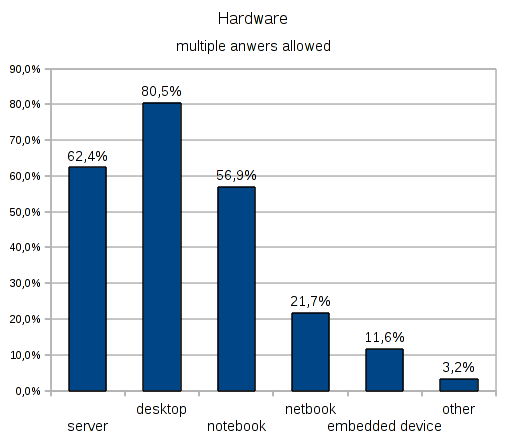
On what kind of hardware are you using Debian?
Multiple answers are allowed for this question and that is why the values do not sum up to 100%.
  • 80.5% are using Debian on the desktop
  • 62.4% on the server
  • 56.9% on the notebook
  • 21.7% on the netbook
  • 11.6% on embedded device(s)
  • 3.2% on other device(s)
The following other devices have been mentioned: smartphone, virtual machine, nettop, NAS, HTPC, workstation, pendrive, live cd, cluster, thin client, router, rocket flight computer, ibm mainframe, and automatic bar tender.

Do you contribute to Debian?
  • 50.0% choose answer #5: I don't contribute on a regular base.
  • 31.2% choose answer #4: I'm regularly helping other Debian users.
  • 8.0% choose other (see below) or simply did not answer
  • 4.9% choose answer #3: I'm regularly contributing to Debian packages without uploading them by myself.
  • 4.5% choose answer #1: I'm a Debian developer.
  • 1.4% choose answer #2: I'm a Debian maintainer.
The following other answers have been provided:
  • upstream developer or contributor
  • translator
  • bug reporter
  • advocator
  • former DD or DM
  • prospective DD or DM
  • mirror maintainer
  • package/installer tester
  • documentation writer
  • donator or debconf sponsor
  • debconf organizer or helper

How do you think about the Debian Free Software Guidelines (DFSG)?
  • 46.0% choose answer #2: I like the DFSG but it is not the most important reason for using Debian.
  • 36.6% choose answer #1: The DFSG is very important to me. I could live with many changes in Debian but I would be very upset if Debian would allow non-free software into its main component in the future.
  • 10.1% choose answer #3: I don't know.
  • 4.9% choose answer #4: I don't care.
  • 2.4% did not answer.

Are you using Debian derived distributions, too?
Multiple answers are allowed for this question and that is why the values do not sum up to 100%. There were a lot of different answers but the most frequent are:
  • 47.1%: Ubuntu (Kubuntu, Lubuntu, Xubuntu)
  • 40.8%: no answer; this was the only way to say that someone does not use a derived distribution
  • 11.0%: other (see below)
  • 7.0%: damn small linux
  • 4.8%: Sidux
  • 4.3%: grml (juxlala)
  • 2.2%: Knoppix
  • 1.6%: ELive
  • 1.4%: Maemo
The other answer includes the following distributions: 64studio, ALT Linux, arch linux, ArtistX, BackTrack, BRLix, Canaima GNU/Linux, catix, cdlinux.pl, CloneZilla, CrunchBang, Custom, ddwrt, debian arm userspace for zipit z2, DebXO (?), DreamLinux, Easy Peasy, eb4, eeebuntu, EMC2 Ubuntu (linuxcnc.org), Emdebian, Estrella Roja, Fedora, Finnix, Gentoo, gNewSense, Hackable:1, Kanotix, Kuliax, LFS and CLFS, LinEx, Linux Mint, live CDs, live-helper, Mepis antix, Musix, My own LiveCD, Mythbuntu, OpenInkpot, openwrt, paipix gnu, Parsix, Peppermint, personal debian derived, proxmox, Puppy, PureOS, qtopia, SHR, simplyMEPIS, Skolelinux, slackware, SymphonyOS, Toutou, Trisquel, tty GNU/Linux, UHU Linux, Univention Corporate Server, vinux, Voyage, Vyatta, whiite, Xandros, Xarnoppix. Not all of them are derived from Debian.

- to be continued -

18 June 2010

Alexander Reichle-Schmehl: Release Critical Bug report for Week 24

The inofficial rc bug tracker currently knows about the following bugs:
In Total:535
Affecting Squeeze:419
Squeeze only:58
Remaining to be fixed in Squeeze:361
Of these 361 bugs, the following tags are set:
Pending in Squeeze:18
Patched in Squeeze:55
Duplicates in Squeeze:50
Contrib or non-free in Squeeze:8
Claimed in Squeeze:2
Delayed in Squeeze:6
Can fixed in a security Update:31
Otherwise fixed in Squeeze:38
Ignoring all the above (multiple tags possible), 195 bugs need to be fixed by Debian Contributers to get Debian 6.0 Squeeze released. However, the with the view of the Release Managers, 337 need to be dealt with for the release to happen. Please see my older post for an explanation of the different numbers.

Next.

Previous.