Search Results: "agi"

8 February 2006

Joachim Breitner: Announcing the RiskRecorder

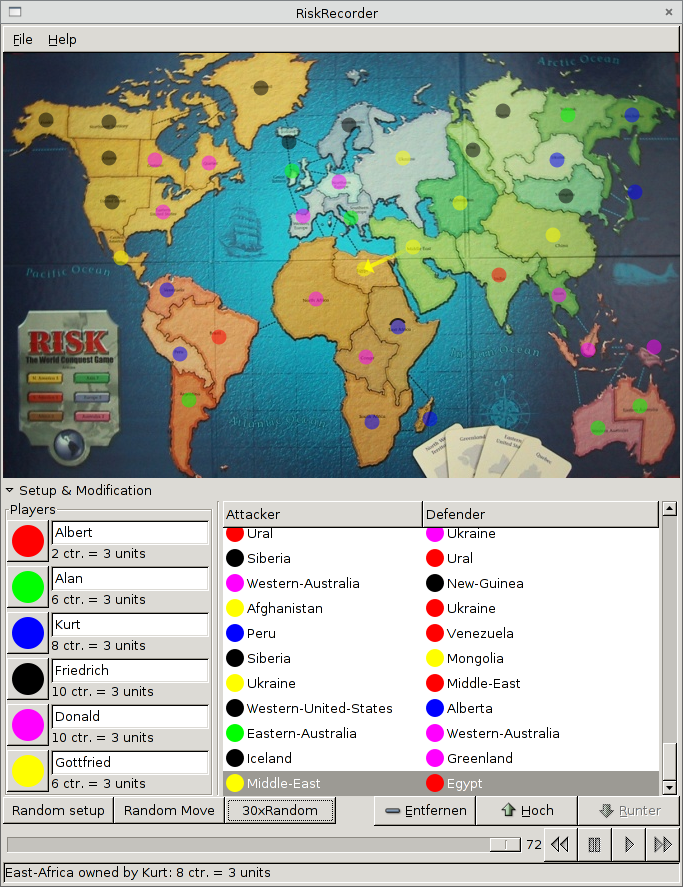
Last week, some friends and I played a very exciting and long (6 hours) game of Risk. At the end, I thought: Too bad we can’t rewind the game and play it fast forward, just see how the tides of colors are waging.Well, on Sunday, I though, why not, and started writing “RiskRecorder”. It is my first larger project with python and gtk+, and I am quite content with both of them. The map is stolen from JRisk, and with that the idea of a gif file that maps pixels to countries. The RiskRecorder is meant to be used during a game of regular risk, to - well - record the moves. As a side benefit, you don’t have to calcuate the number of units you get anymore, as the RiskRecorder can tell you that. You can then save the whole game for later review.It should be in a usable state by now, but I plan to add more features sometime, like better animations and graphs showing development of the game.To try it yourself, you need the program itself (one file so far), then get at least the board.map, board_map.gif and board_pic.jpg from the jrisk CVS repository (you can open any other JRisk map in RiskRecorder, too). You might need to download the python bindings for gtk and cairo, too. On debian, I assume that apt-get install python-gtk2 python-cairo will get you what you need.As always, comments, bugreports and patches are welcome. To follow development, have a look at my svn repository.

Aigars Mahinovs: Superball/bowl. So ... I tried to understand what ...

Superball/bowl.
So ... I tried to understand what this american football thing is all about. What got me interested in it was an anime from Japan called Eyeshield 21 where a boy that ran errants for bullies his whole school life goes into american football as a runner with his great speed and agility. That get me thinking about looking into that sport - it looked quite interesting in the anime.
Boy was I wrong.
So I watched the Superbowl XL - the biggest and most important event in the american football year. The first half was absolutely empty - nothing happened at all. The ads were much more interesting then the game. The halftime show was ok, not as good as ads.
And the second half just showed why this is the definitive american sport in the worst meaning of that - legalese. Steelers would have lost it the judges would have not interfered so much with the game. This sport has like hundreds of tiny rules that are very dependent on interpretation by the judges - that is what I call a sport for all the american lawyers to like. Cancelling several good Seahawks trows just because some guy was holding someone on the other part of the field, that must be givin an ecstasy for every law student. Not for me though.
And even without all that dilation with ridiculous rules (what's that stupidity with running clock and two minute warning ?!?) the game itself is kind of dumb - there are just too many people in the field for anything that a regular person can really understand. Strategies that almost never work out because of the other team interfering with their strategy. Too much chaos and still each person only does a one single thing. Even more - many of the players never will get any attention in the game just because they are on a supporting position, but the quarterback will always be the center of attention.
A very unbalanced game that is even more screwed by a ton of ads, a very heavy leaning on judging nitpicks and just 3-4 nice moments in the whole 1 hour game. I'll just stick back with hockey and anime :)

7 February 2006

David Welton: Conditional Compilation in Java

We've hit something of a stumbling block with Hecl, and it's proving tricky. Far from being "write once run anywhere", Java has many versions, when you take into considerations the wide array of devices that run one of several configurations roughly lumped together as "J2ME". My cell phone's implementation doesn't have floats, for instance. This necessitates that the J2ME and J2SE versions contain different code, but Java doesn't make this easy, because there are no macros or other ways of conditionally compiling code. The solution we've adapted so far is problematic because it's not very fine grained: we have two separate directories, one for 'core' Hecl (sans floats) and another that contains the exact same classes, but with floating point. For instance: BasicMathCmd.java - no floating point. BasicMathCmd.java - the floating point version. As you can imagine, this means that code is replicated in two places, and each change has to be done twice, carefully, keeping track of the actual differences between the two files. This can only get worse as the code grows. I've seen some hacky ways of doing macros and things like that, but they don't look very satisfying. I'm too much of a Java novice to think of anything better than what we've got, though.

Kai Hendry: Debian doldrums

Kai participates in a snow fight Gotta love Debian sometimes. ;) My beloved mutt seems a little broken in unstable currently. I’m in the market for a new AM. 3rd time lucky? Ok, so I am packaging Aaron’s web.py library and so I check the license with debian-legal. “Vorlon”, the omnipresent and omniscient got back to me pretty quickly, saying no. Goddam! ;) I’m no legal expert and my brain hurts thinking about these distribution clauses, GPLv3 issues and controversies. I hope debian-legal reaches some agreement. At about 6pm I noticed the Ubuntu crowd were in Seoul. I emailed hastily asking about a meetup or something. Probably too late. Damn. I’m feeling quite alone in my Linux usage here in Korea. I see Mark has been in Japan. I have fond memories of Japan and the debian guys out there. Yeah, if any Korean devs are reading this, get in touch. Part asked me to get in contact with some mail administrators in order to curtail some of the massive amounts of spam coming out of Korea.

Zak B. Elep: Whirlwind < 48h Manila Tour

Heh, its been more than a day now since I got back from Manila after the Ubuntu AsiaBusinessTour, and even then I have some stuff to do here (both IRL and IOL work) before I could find some time to blog ;) Here are the highlights of my trip: I’ve adopted opendchub, rccp, and xshisen from Grzegorz Prokopski too :D Heh, I’ll be quite busy this coming week…

6 February 2006

Colin Watson: Unix tools: sponge

Joey writes about the lack of new tools that fit into the Unix philosophy. My favourite of such things I've written is sponge. It addresses the problem of editing files in-place with Unix tools, namely that if you just redirect output to the file you're trying to edit then the redirection takes effect (clobbering the contents of the file) before the first command in the pipeline gets round to reading from the file. Switches like sed -i and perl -i work around this, but not every command you might want to use in a pipeline has such an option, and you can't use that approach with multiple-command pipelines anyway. I normally use sponge a bit like this:
sed '...' file   grep '...'   sponge file
Since it's so trivial I imagine lots of other people have written something similar (another common name for it seems to be inplace; my name indicates soaking up all the input and then squeezing it all out again); but I do keep meaning to try to get a rewritten version into coreutils at some point.

Enrico Zini: Italian screen reading

So far, it has been a fairly happy hacking day. I wanted to see how far I could go to make a Linux desktop accessible for the blind. Platform of choice is Breezy because:
  • it uses gnome, which is the most accessible stuff at the moment;
  • it's the distribution with the least amount of raw edges at the moment;
  • its gnome accessibility stuff is more up to date than the stuff in sid (I got in touch with Mario Lang and I'll see if I can help)
Step number 1: installing a fully working Breezy chroot inside my sid
  1. lvcreate -L2G -n breezy vg
  2. mkfs.jfs /dev/vg/breezy
  3. mount /dev/vg/breezy /chroot/breezy
  4. debootstrap --arch i386 breezy /chroot/breezy http://archive.ubuntu.com/ubuntu/
  5. chroot /chroot/breezy
  6. dpkg-reconfigure locales
  7. tzconfig
  8. base-config new
  9. fixed gdm configuration to work along with the sid X server
  10. fixed /etc/fstab, resolv.conf and /etc/hosts
  11. reduced the lart-delay of /etc/rcS.d/S04udev from 60 to 5 seconds
  12. "booted" the Breezy system running /etc/rcS and /etc/rc 2
Believe it or not, it works. I have another gdm login screen, I login and I hear the Ubuntu startup music. A couple of warnings about ACPI and HAL not working... well, I can imagine why. gnome-panel would refuse to show the menus. It turned out to be connected to Gnome bug #323064 (debian bug #338438) and I found out that Alt+F2 (run) and then killall gam_server would be enough to stay displayed.
Step number 2: getting the screen reader to work Note: the menu names might be incorrect as my system is localised in Italian and I'm now translating back to English.
  1. Install gnopernicus
  2. Go into Desktop/Preferences/Audio and disable the sound server
  3. Go into Desktop/Preferences/Assistive technology, enable assistive technology and screen reader
  4. Logout and in again
Now, coolness ubercoolness, the desktop starts to speak with the voice of a depressed 40 years old dude from the USA. Thanks to Luke Yelavich of ubuntu-accessibility for supporting me and for explaining me that if esd is running then the voice tends to disappear because esd steals the sound device to festival. He also explained me that if one tries to run festival through esd then it works, but since esd is a mixer then one starts hearing various voices for different events all mixed together. Now, the English speech engine often mentions the "barra dei sacramenti". In local Italian it means "toolbar for blaspheme curses". Time to move on to step 3.
Step number 3: getting the screen reader to work in Italian I'm very proud of the Italian speech engine that recently entered Debian thanks to Riccardo Vestrini and the Debian Italian Maintainers Task Force, I've already put it to good use in the past and have great plans about it for the future. It's now a good moment to turn the knowledge previously acquired with creative timewasting into something serious. So, on to work:
  1. get the italian festival voice packages from sid (the packages are festlex-ifd, festvox-itapc16k and festvox-italp16k)
  2. install them all in Breezy
  3. sudo patch /usr/share/festival/languages.scm /usr/share/doc/festlex-ifd/languages.scm.patch (and ping again Matthias Urlichs for a fix for bug#335845)
  4. log out
  5. kill all the festival servers, drivers and whatnot (need to do it when logged out, but one can just install the voices before starting gnopernicus for the first time)
  6. log in again
  7. go into gnopernicus configuration and select the new voices.
It SO WORKS! I configured some voices a bit at random, so now according to what I do the desktop speaks like the depressed dude, Adriano Celentano or the Italian dubbing of the Enterprise computer (without reverb effect). An extra cool unexpected side effect of this chroot setup is that now I can go back to my Sid X session and the Breezy X session will keep talking in the background, so I can even keep an ear on what happens in the other Virtual Console. Now, on to the applications. The menus, work. Abiword works, but I couldn't find out how to read the things I type on the editing area (not so useful until that one is solved). OpenOffice2 does not work. Firefox 1.5 works. gnome-terminal works. gedit works. It could be better, but I was fearing much worse. Now, gnopernicus has various powerful features accessible using the numeric keypad, but I haven't found a way to activate them in my laptop. It may be that with the keypad functions abiword becomes readable. I'm quite satisfied today.

5 February 2006

Martin F. Krafft: Encrypting ~

It's about time I encrypt my home directory. So far, I've found two tools for the job: dmcrypt and encfs. dmcrypt links in between the VFS layer and the data store. For an encrypted partition or image, it creates a device under /dev/mapper, which you then mount. Think cryptoloop. Encryption covers the whole scale of symmetric encryption, but I didn't find anything related to public key crypto. I am also not entirely clear yet on why a damaged block on the storage medium doesn't screw the encryption block (partially) stored on it, as well as all following ones, given a chaining mode like CBC for instance. However, as this thread shows, I am wrong and technology is right (and works), and I still just don't get it. It feels like another Monty Hall problem to me (which I also never really understood to the point of being able to convince someone else thinking 50/50 is the answer of the alleged 2/3). So then there's encfs, a FUSE-filesystem that seems (I have not tried it) to create a virtual directory for an existing one, transparently encrypting filenames and contents as they are written to the existing directory (via the virtual one), and decrypting them when requested through the virtual one. So it's a 1-to-1 mapping, which has its pro's and con's. encfs seems equally strong on the symmetric crypto side, but seems to lack public key support. For each, there's a proper PAM module: libpam-mount can mount a cryptoloop filesystem upon login (though the README says it cannot do so for OpenSSH logins. If that's right, well, one candidate less...). On the other hand, there's libpam-encfs, which creates the virtual directory on login (and removes it on logout). I can well imagine how any of the PAM modules would do their job just fine on a machine where xdm is the primary/only login method. However, what about SSH? What happens if I log in through xdm, then SSH, then quit X? How do you solve the problem? I am curious and will blog about the things I hear... Update: After rereading my thread, I am understanding, I think. We're talking encrypted block devices (or loop devices). It's not difficult at this stages to tie IV chains in with storage blocks. I am still curious why my 8M file was still all zeroes after changing the cryptotext. Update2: Sesse points out that CBC uses the ciphertext of the previous block as an IV, not the plaintext. So if some block gets corrupted, that messes up the next one's plaintext, but not its ciphertext, so the one after that is OK. Thanks.

Enrico Zini: Extract tags out of digikam

I've always wanted to tag my image collection, but it's big and a pain to do by hand. Today I found out that digikam has got to a point in which it can be used as a nice interface to categorise images, so I now have something cool for the tagging work. Now, I'd like to play with the tags using my debtags toolchain. Digikam stores data in a SQLite3 database, so it's easy to convert it into the text format used by tagcoll. Here's the script to do it:
#!/usr/bin/ruby
# gettags - Extract a tagged collection out of the digikam database
#
# Copyright (C) 2006  Enrico Zini <enrico@debian.org>
#
# This program is free software; you can redistribute it and/or modify
# it under the terms of the GNU General Public License as published by
# the Free Software Foundation; either version 2 of the License, or
# (at your option) any later version.
#
# This program is distributed in the hope that it will be useful,
# but WITHOUT ANY WARRANTY; without even the implied warranty of
# MERCHANTABILITY or FITNESS FOR A PARTICULAR PURPOSE.  See the
# GNU General Public License for more details.
#
# You should have received a copy of the GNU General Public License
# along with this program; if not, write to the Free Software
# Foundation, Inc., 59 Temple Place, Suite 330, Boston, MA  02111-1307  USA
# Usage: gettags [path/to/digikam3.db]
# If the database file is not given, use the one in the current directory
require 'sqlite3'
db = SQLite3::Database.new( ARGV[0]   'digikam3.db' )
# Build a table of id => complete tag name
tagByID =  
db.execute( "select id, pid, name from Tags" ) do  row 
        if row[1] != 0 and tagByID[row[1]] then
                tagByID[row[0]] = tagByID[row[1]]+'::'+row[2]
        else
                tagByID[row[0]] = row[2];
        end
end
# Why does it work with instant queries but not with precompiled queries?
#db.execute("select tagid from ImageTags where imageid = ?", 36887)    r  print r[0], "\n"  
#gettags = db.prepare("select tagid from ImageTags where imageid = ?")
#gettags.execute(36887)    r  print r[0], "\n"  
lastname = nil
lastdir = nil
ids = []
db.execute( "select i.name, t.tagid, a.url from Images i, ImageTags t, Albums a where i.id = t.imageid and i.dirid = a.id" ) do  row 
        if row[0] != lastname then
                if lastname != nil then
                        print lastdir, "/", lastname, ": ",
                              ids.collect    id  tagByID[id]  .join(', '), "\n"
                end
                lastname = row[0]
                lastdir = row[2]
                ids = []
        end
        ids <<= row[1]
end
if ! ids.empty? then
        print lastdir, "/", lastname, ": ", ids.collect    id  tagByID[id]  .join(', '), "\n"
end
exit 0
I didn't understand why if I perform a precompiled query I get a row object that cannot be indexed, while if I perform an instant query then everything is fine (see the comment in the script). I'm still on the learning side of Ruby, so I welcome people tellig me of better ways to write this script, and I'll be glad to update this entries with what I receive. Done the little script, now I can plug my images collection into tagcoll and have a bit of fun:
./gettags   tagcoll related /2005/12-15-03-Taiwan-Newcamera/dsci0051.jpg
./gettags   tagcoll hierarchy
./gettags   tagcoll implications
./gettags   tagcoll findspecials
Cute! And this is another little step to somehow connect pieces of the debtags toolchain to the web, which is something I'd like to explore both for the web interface of the central database, my blog and my picture gallery.

4 February 2006

Wouter Verhelst: New waffle iron

I was baking waffles today, using my not-so-secret recepy. I needed about fifteen of them, and murphy helped me let it take far longer than initially expected. I had already made some errors in creating the dough (though nothing that I couldn't fix), and when I had eventually finished it and was halfway through baking those waffles, my waffle iron broke down. Which wasn't totally unexpected, given how this is a waffle iron that was part of the inheritance of an aunt of my dad's who had died even before I was born, which must have been approximately fourty years ago. Still, it had me sitting there with a broken waffle iron, a promise that I'd be baking waffles for a fundraising activity, and only half the number of waffles that I needed. I had found myself a slight little problem. So, I went to a local shop, had a look at the waffle irons that they had for sale, and chose one that looked OK to me. I hadn't taken a close look at the box, but the saleswoman had shown me the device and it looked well suited for my needs. Once home, I showed it to my brother. Who promptly exclaimed that 'it is the same as the old one'. At first, I wanted to protest; but on close examination of the picture on the box, I had to agree that he was right! They had restyled the one inside the box—given it a different colour, and used a temperature dial with a more modern look—but it was, indeed, the same model. And this redesign must have happened fairly recently; the illustratory pictures in the user manual still show the 'old' style design, which is identical to the old waffle iron, modulo approximately fourty years of technical evolution. In fact, the single most drastic change between the old device and the pictures in the manual of the new one would seem to be the fact that the company producing these devices changed names in the mean time. They also appear to be having a website, which contains pictures of yet another design of the same appliance. I was baffled. I mean, sure, home appliances are not computers, and I could imagine how a waffle iron, designed five years ago, would still be in sale today. But after that long? What I haven't checked yet, for lack of time, is whether the irons of the old device would fit in the new device. I'll do that tomorrow, because the old device had a 4x6 "Brussels waffles" iron, whereas the new only came with a double 4x7 "Home-made waffles" iron, and an iron for six heart-shaped biscuit waffles. If that would fit, then that would save me an expense of 32 euros—I love baking Brussels waffles, so any waffle iron I use needs to be able to do those. Even if it can only do so one waffle at a time. The ability to use the iron of that 40-year-old thing in the new device would be... great.

Daniel Stone: [tech] i am too elite to understand your design process

Usually I try not to get involved in the mind-numbingly pointless desktop wars, but Benjamin produces one of the most flawed arguments I can remember having seen.

Fair enough that you want to use the keyboard. I'm much quicker on the keyboard than on the mouse, and presumably so are you. After a long time using computers, and CLIs in particular, this is no surprise.

Most people are not this way. I can assure you that my mother is not this way, and prefers the comfort of the mouse whne navigating around. I don't see what your assertion that 'stating that a typical Gnome user does not want keyboard is simply false' is grounded in. Have you done studies? Do you know the exact breakdown of geeks vs normal people using GNOME? Remember that it's not just for the cool kids who can write their own code anymore -- I know plenty of 'normal' people using Linux now, typically with a GNOME-based desktop.

But, it's 'but don't say it is for users sake' that really throws me. Why do you think they do it? For fun? To see how many people bitch on blogs about it when they do it? Because they hate people and this is the best practical way to take out their anger on the world? They've done studies on their userbase (e.g. the Sun usability study), and they're doing what they believe is best. This is true of every desktop: they simply do what they believe will produce the best desktop for their userbase. Sometimes this results in decisions which people think are bad. Fine then, so be it. This is what's happened here, as opposed to your suggestion of a deep-seated hate for all their users, individually and collectively, or something.

Your claim to be a normal user is simply false. I can't claim the same thing. A good rule of thumb is that if you're capable of writing the application you're using, then you're not a normal user. In some cases, this means you're not its target userbase (not always: this holds more true for, say, Evolution, than mutt).

If you have truly constructive suggestions (not using the words 'crap' and 'simply false'), then provide feedback to the developers through the appropriate channels. If you don't think GNOME is for you, try some of the many excellent other desktops (KDE, XFce, GNUstep, whatever else is around). If you like GNOME otherwise and would like to make a concrete improvement, then submit patches.

Daniel Burrows's point was simple: you are probably not GNOME's target audience (this is not specific to benj; if you are reading my blog, then odds are you aren't GNOME's target audience). So, assertions that they've got it all wrong and they should listen to you on matters of interface design aren't really going to be helpful, because you just aren't the primary target market.

PS: Just because you write it in Latin, doesn't make someone else's argument a logical fallacy.
PPS: If you're still having trouble wrestling with this entry, imagine instead someone bitching about Debian being crap because they don't include the proprietary Flash plugin, a bunch of closed-source games, VMware, etc. That's not what Debian's about. Make sense now?
3 February 2006

Kai Hendry: Dreading the upgrade

A deer in the sea I hate upgrading hard drives. Every time I’ve had to migrate data from a dodgy disk something wrong happens. This weekend I have the challenging task of upgrading my aging Thinkpad’s 30GB hard drive to a new Seagate momentus. My file system currently looks like:
frodo$ df -h
Filesystem            Size  Used Avail Use% Mounted on
/dev/hda1             6.5G  5.7G  460M  93% /
tmpfs                 380M     0  380M   0% /dev/shm
/dev/hda6              21G   17G  2.3G  89% /home
tmpfs                  10M   80K   10M   1% /dev
I’m tired of keeping my root system to 6GB. Though although I try my best to avoid bloat, somehow my system is 6GBs. FS. My home directory is cramped. I hate having to delete movies and episodes because there isn’t enough space. So getting the hard drive in and out my laptop is easy. Though copying the data probably will have to be through an external usb one case. OMG, that will probably take forever… And what tool do I use? sfdisk? Ideas anyone? So once copying 30GB over to my new 100GB+ (have not bought it yet) hard drive, how do I grow it so it takes full use of the space? I guess I should be using LVM. Though why on earth doesn’t the Debian Installer use it by default like Red Hat? I just pray I don’t end up installing my machine from scratch.

Matthew Palmer: Another Conference Not To Be Missed

After the rocking time I had at LCA 2006 (despite a slight brush with Norovirus), I've got my eye out for other conferences to get to (because It's Better Than Working). It looks like Waterfall 2006 is definitely worth going to. With cool keynotes ("Put Testing Where It Belongs--At the End" by Brian Marick, and "Extreme Programming Uninstalled" by Ron Jeffries) and so many great sessions (such as "Pair Managing: Two Managers per Programmer" by Jim Highsmith and "wordUnit: A Document Testing Framework" by Kent Beck) I don't see how any self-respecting software engineer can afford to miss this conference. It's a pity about the registration system, but I'm sure it'll all be sorted in time.

2 February 2006

Philipp Kern: Licenses

Licenses are just too nice... Especially if you put special clauses in the context of the application they apply to. SUN states the following in a code example for the Java Micro Edition.
You acknowledge that this software is not designed, licensed or intended
for use in the design, construction, operation or maintenance of any
nuclear facility.
Now consider that the Java Micro Edition usually runs on mobile phones. Well, yes it’s for embedded devices too, but I found it in a GUI example. If I imagine to control a nuclear power plant by just using my phone in the bus, using a nice little Java application... What a threat I would be.

1 February 2006

David Nusinow: It's Alive!

Well, I've done it. The XSF svn repo now contains a full set of packages for the Xorg modular tree that enable it to run an X server in a chroot from a clean install. Note that the packages are still very sloppy because I've been mainly beating them in to shape enough to simply run the server. But that part's now done, and I can happily get that grey hatched background to show up from inside my chroot. The next step will be to finish packaging everything, so that we have a full set of packages to install, run, test, and clean up to the standards of quality we expect from Debian. Note that I don't recommend anyone but developers even take a look at these things yet, since I've been very lax in getting them in to good shape. I had a good base to work from (more on that in a moment) but I took some liberties and cut some corners in order to get to this point. Once we have a full set of packages, I'll throw them in to experimental for people to play with, but right now they're not going to be much fun for anyone.

I couldn't have gotten this far this fast without the help of Daniel Stone, so a big thanks goes out to him. Not only has he been great about showing me just which packages to steal from and where, but every time I ran in to some obscure bug he had already been there and quickly pointed me to the way out, often with a package update ready to go. The packages he made are wonderfully simple and easy to understand, which let me get moving on them right away, and they'll form a wonderful basis for the future of Debian's X distribution.

On a further note, I've asked the release team to let us upload 6.9 to unstable when it's released, which should be next week. So far there's been no objection, and a bunch of people have chipped in so far to help out with the xlibs-dev transition. Thanks to everyone who's been helping out so far with getting 6.9 in. 6.9 will set the stage for the modular packages, by giving everyone the most up to date drivers for the next few months and taking the pressure off of me to deliver the modular packages right away :-) My goal is to ship the modular packages with etch, and I'm going to keep working to do that, but 6.9 should keep people happy until those are ready for unstable.

David Nusinow: Modular Server Debs!

I've been relatively quiet lately because I've been plodding along, working on modular packages for Xorg. For those who don't know, the next release of Xorg will actually be two releases of the same code. One release, 6.9, will be based on the old monolithic build system. This system requires me to build every single part of Xorg whenever I want to update any one part. This means that whenever I push out an Xorg fix, no matter which component it's in, you have to download all the other components even if they are 100% identical to the previous version already on your hard drive. We've all lived with this for a long time, and while it's not pleasant, we all seem to get by. The packaging apparatus for this system is mature, stable, and well understood, if complex. That's why I've been able to get the 6.9 release candidate packages out to experimental fairly quickly after they are released.

The other release happening is for 7.0, which is obviously a major version number bump. The actual code you run for 6.9 and 7.0 is 100% identical, but the build system has been totally rewritten around the venerable autotools (you know... configure /make/make install). Each piece has been split out from the others so that you can build any one component without building all the others. This means that if we want to ship a driver update, you don't have to download all of the fonts and other things that weren't touched. That also means that you won't have to install the drivers for cards you don't own if you don't want them. Furthermore, it lowers the barrier for things like hacking on X significantly.

The problem with the modular tree is that the packages for it are brand new. Ubuntu shipped modularized versions of the libraries, and I've already stolen those, fixed them up for Debian, and built them locally (they're sitting in our svn repo, but running them won't get you anything at this point.) The server and driver packages are brand new, and I've been taking the packages from Ubuntu's development branch and working on them for Debian. Today was a milestone day because in addition to the libs, with Daniel Stone's constant help I've finally managed to build packages for the modular X server itself. Now I can't run it yet (I haven't packaged the drivers and a few other bits) but the fact that I managed to produce what will be a functional server package is a huge step, and constitutes the cornerstone of the whole thing.

Once we can create packages that can actually run on at least the machines of the XSF, we can start looking at getting the packages in to the archive. Since these aren't well tested like the monolithic packages, we'll have to do a lot of polishing to get them to the same level of quality. My goal is to get that done for etch though, and I think we can do it. Exciting things are happening, and I'm hoping that the modular packages will encourage more people to hack on X, leading to even more exciting things. Build that momentum.

David Nusinow: Halfway Point

Long time no blog I guess. Things haven't been that exciting on the Debian front for me. Many of you may have noticed the Xorg -8 packages just hit unstable, complete with minor annoying debconf bug (fixed in svn now). That work was almost all packaging bugs, most of which are now taken care of. All those changes apply to the 6.9 packages too, so it's like I'm getting a two for one. This means that the 6.9 packages will be pretty well cleaned up on the Debian side of things when they actually ship. Thanks to Sven Luther, Julien Cristau, and Ari Pollak we can build 6.9 for powerpc, sparc, and amd64 (although there's currently an unrelated bug on amd64 stopping us from building any X packages there). Hopefully we can get the remainder of the arches ready to go so that we can drop 6.9 in to unstable as soon after it's released as possible.

One of the very cool changes that's come about lately is that David Mart nez Moreno has taken up the torch for xterm and produced a package for experimental. xterm never really lived at X.Org, and now we're getting it from the real upstream source. So thanks to David we'll have an up to date xterm ready to go with 6.9. It's sort of a little taste of the modular tree: if you need to get an xterm update for some reason, then you don't have to update all of X in the process.

Terrifyingly, I've reached a point where I can start working on the modular packages the moment I sit down to do Debian work next time. I'm going to repeat what I did with 6.8 and start with the Ubuntu packages and work from there. Now that I know a little more about how the whole thing is laid out I feel a lot more confident in what I'm doing. Last time it was really by the seat of my pants. The scariest thing for me is that I finally have to break down and learn the autotools, which is something I've managed to avoid until now. That should be the biggest hurdle for me in moving the modular packages forward. I have no idea how long it'll take, although history has shown that my time estimates are about 1/3 of the time that it actually takes to do a thing :-) The first third of what I set out to do (get Xorg in to Debian) is finished. The second third will be when 6.9 is in testing. The final third is when the modular packages that I'm happy with land in testing. It may take the entire etch release cycle to run this marathon, but I feel like I've reached the halfway point around now, with 6.9 stabilizing.

I've started talking with people about where to go after all that. Once the Debian packaging work is done, I want to start working on the Xorg codebase itself, preferrably on making the xserver a little nicer on the user. I have a project or two in mind, but I don't want to start on them until Debian's X packages are well in hand for the forseeable future.

David Nusinow: Xorg Progress

I didn't make it in time for dinstall today, but I uploaded xorg-6.8.2.dfsg.1-6 to unstable a few minutes ago. Most of the fixes aren't that exciting to the average user, but we did clear out a few developer-related bugs that are holding Xorg out of testing. The big thing is that David Mart nez Moreno kicked some serious ass and not only fixed a lot of those RC bugs, but he even backported the savage driver from CVS HEAD! So savage users, you've now got the latest stuff around.

Meanwhile I've been whittling away at 6.9rc0. I've finally managed to produce packages and run the thing, so the majority of it is good to go. Once I got the basic build issues worked out, Michel D nzer suggested that we switch the way our xserver-xorg-dbg package was built. In the past, the code that loads the individual drivers and other modules in to the X server was a source of serious problems, and because of that the debugging server was built entirely staticly linked, with every driver and module built in to the thing no matter what video card you had. For 6.9 the default loader has been switched to a much better one, so Michel suggested we make a more normal -dbg package. This sounded like a good idea to me, so I spent a few days working that out, and it seems to be finished. There are 100 files that I was able to remove from the debian packaging dir (a lot less to keep track of!) and the -dbg packages for all the libraries in addition to the xserver have shrunk considerably. As such, these packages should take up less space on your hard drive, should you ever need to install them.

With that out of the way, we have a few more things before I can actually upload 6.9rc0 to experimental. Upstream has split out xterm and we'll be doing the same. xterm has lived at Thomas Dickey's website for a long time now, and we're finally going to start using that as our primary upstream for the program. David Mart nez Moreno has volunteered to take this on, and he already has the work done, it's just waiting for an svn repo creation. I also need to update both the render and xrender packages in experimental, since Xorg requires both to build. Once these things are done, 6.9rc0 will hit experimental, hopefully beating rc1 out of the gate. From there, some basic tuning on 6.9 will be ongoing while we work on getting the 7.0 packages moving. Things are happening, and while they might not be as fast as I'd hoped, I'm pretty happy with how they're progressing.

David Nusinow: Oh GNOES! SCM DISCUSSIONZ0R!!!!!!

After seeing everyone shill for their favorite scm lately, with most of the predictable ones getting the attention, I thought I'd throw my choice out there, just to see it represented.

I primarily use svn with my work on X in Debian, and it's a wonderful system. Fortunately though, I don't have to maintain the repos, and when something goes wrong I can cry to our beloved DPL to get his admin on, and he fixes things up. This works out fairly well for me as a basic user, but I don't want to be dealing with these sorts of hassles for smaller projects. The distributed scm thing appealed to me in this sense, so when arch started to become a serious buzzword in the Debian crowd I had a look.

Well, more than a look. I fought for over a month with tla and baz and found that they were both so unuseable and poorly documented that I couldn't do more than scream and cry. bzr looked cool, but it wasn't ready (I sorta tried to manage one of the X.Org releases in Debian with it and failed miserably). Darcs was slow and in a minority language, which was a major turnoff for me. And I don't have a ton of diskspace, so git was out. Svk struck me as a hack (it still does) so I didn't want to go with that. Monotone was ok, but not good enough, so I sighed, gave up, and went back to svn thinking that this was as good as it could get. Indeed, we added a quilt-based patch system to the Xorg packages, so now I have a mini-scm (quilt) inside an scm (svn) and it works amazingly well.

But one of my friends just got hired by the people who make Xen, and he mentioned that they used mercurial, and asked if I had tried it yet. I scoffed and said no, and that all scm's suck harder than anything has ever sucked before, but I had a lot of time to kill while I was waiting on an X build, so I gave it a look.

Mama, I'm home. I was stunned that I was able to pick up mercurial in about half an hour after tearing my hair out for over a month with arch.

The UI is apparently very darcs-like (by accident, according to the mercurial author) which is known to be fantastic. Branching, merging, etc is simple as can be so far, although upstream is still working out better methods to deal with merging.

It's very fast, built for large trees (i.e. the kernel) so it will be suitable for managing X with (although I haven't tried this yet, but I plan to). For X, I'll need something fast to keep my sanity. This rules out darcs and baz (which has somehow managed to get amazingly slow in addition to being difficult as of late).

Unlike git, it keeps changesets in xdelta format rather than storing whole files, so it doesn't eat my hard drive.

It's written in python, so it's something I could hack on if I want to.

It supports an easy server setup with apache, and you can push your repos and serve them via static http if you don't have a server, like me.

Like monotone, it exposes hashes to the user, but unlike monotone it also provides a local revision number to make sure you don't spend all your time copying and pasting hashes, which is what put me off from monotone.

It has a fairly small command set, with 39 commands in the current tip (i.e. HEAD) as opposed to the > 150 in baz which made me weep.

It feels like using bzr, except it's here now and ready for production. Indeed, it's already used in production in making Xen.

There's a bunch more that I won't talk about, mainly because these are the things that have grabbed me. A note of caution is that I've only been hacking on local projects by myself (mainly configure-debian) with it, so I don't have the tons of real world experience with multiple trees that the thing is built for yet. I'm thinking about putting up a parallel mercurial tree to the XSF tree just for fun (the svn repo would remain the canonical one) if people are interested and I can find a server. I hope though, that all the people out there who, like me, were bouncing around trying out scm after scm and never being quite happy with any of them at least give mercurial a fair chance. I'm still amazed at how much I like it, and I think some others might feel the same.

David Nusinow: X Strike Force Moving Forward

Today was a good day in Debian X land. X.Org released the "zeroth" release candidate for both the 6.9 (monolithic) and 7.0 (modular) versions of the X.Org tree. I downloaded the 6.9 tarball, imported it in to the XSF svn repo, and got to work on the patchlist. I'd already ported a number from 6.8, and tonight I managed to finish the rest. Except for a massive GNU/kFreeBSD patch, every single patch in the debian tree has been ported over to 6.9. This work took multiple weeks with multiple people for 6.8 using dbs. Using our new quilt-based patch system I blogged about in the past, this took me about half a week, with the bulk of the work over the past two nights.

Now I haven't actually been able to build 6.9rc0 yet, nor have I been able to build 6.8 for a few days. There's currently a bug in the linux-kernel-headers package that breaks the X.Org build, so the XSF has been working on polishing the -5 release. Eugene Konev has fixed things to we now build HTML docs for xspecs again, for those of you who hate the postscript versions. David Mart nez Moreno has been doing an enormous amount of cleanup, generally dealing with a lot of the bugs that have come in and taking care of the new translations that have been flooding in almost as fast as we can change the debconf templates :-) Christian Perrier has joined the team as translation coordinator, so as soon as he can get svn access the X packages should be well taken care of in his amazingly capable hands. Finally, I've included a new script for /etc/init.d supplied by Petter Reinholdtsen that will give Debian LiveCD-derivatives a standard way of generating an X server configuration on boot. Nothing too fancy, but we're tightening up the package a bit more and those fixes have already been merged in to the 6.9 branch.

So if people need updated drivers from Xorg's HEAD, keep an eye out for 6.9rc packages to hit experimental. As soon as I can build and test them, I'll put them there for people to play with. My goal is to get 6.9 in to unstable on the day it's released by upstream. We're (or at least, I'm) going to begin work on 7.0 as soon as 6.9 hits experimental as well, borrowing one more time from Ubuntu and attempting to stabilize that packaging alongside them, if they haven't already beaten us to it completely :-) So things are moving and we're going to try and keep up the momentum.

Some people have also been asking about xcompmgr/transset packages. It's still not packaged for Debian because it's either slow or crashy, depending on your driver, although fixes are in the works. I may have found someone to maintain it for Debian, and I'll try and keep people posted about it when I know more.

Next.

Previous.