Search Results: "ag"

8 March 2017

Clint Adams: Oh, little boy, pick up the pieces

Chris sat in the window seat in the row behind his parents. Actually he also sat in half of his neighbor s seat. His neighbor was uncomfortable but said nothing and did not attempt to lower the armrest to try to contain his girth. His parents were awful human beings: selfish, self-absorbed and controlling. Chris, his dad would say, look out the window! His dad was the type of officious busybody who would snitch on you at work for not snitching on someone else. What? Chris would reply, after putting down The Handmaid s Tale and removing one of his earbuds. Then his dad would insist that it was very important that he look out the window to see a very important cloud or glacial landform. Chris would comply and then return to his book and music. Chris, his mom would say, you need to review our travel itinerary. His mom cried herself to sleep when she heard that Nigel Stock died, gave up on ever finding True Love, and resolved to achieve a husband and child instead. What? Chris would reply, after putting down The Handmaid s Tale and removing one of his earbuds. Then his mom would insist that it was very important that review photos and prose regarding their managed tour package in Costa Rica, because he wouldn t want to show up there unprepared. Chris would passive-aggressively stare at each page of the packet, then hand it back to his mother. It was already somewhat clear that due to delays in taking off they would be missing their connecting flight to Costa Rica. About of the passengers on the aeroplane were also going to Costa Rica, and were discussing the probable missed connection amongst themselves and with the flight staff. Chris s parents were oblivious to all of this, despite being native speakers of English. Additionally, just as they were unaware of what other people were discussing, they imagined that no one else could hear their private family discussions. Everyone on the plane missed their connecting flights. Chris s parents continued to be terrible human beings.
Posted on 2017-03-08
Tags: etiamdisco

Matthew Garrett: The Internet of Microphones

So the CIA has tools to snoop on you via your TV and your Echo is testifying in a murder case and yet people are still buying connected devices with microphones in and why are they doing that the world is on fire surely this is terrible?

You're right that the world is terrible, but this isn't really a contributing factor to it. There's a few reasons why. The first is that there's really not any indication that the CIA and MI5 ever turned this into an actual deployable exploit. The development reports[1] describe a project that still didn't know what would happen to their exploit over firmware updates and a "fake off" mode that left a lit LED which wouldn't be there if the TV were actually off, so there's a potential for failed updates and people noticing that there's something wrong. It's certainly possible that development continued and it was turned into a polished and usable exploit, but it really just comes across as a bunch of nerds wanting to show off a neat demo.

But let's say it did get to the stage of being deployable - there's still not a great deal to worry about. No remote infection mechanism is described, so they'd need to do it locally. If someone is in a position to reflash your TV without you noticing, they're also in a position to, uh, just leave an internet connected microphone of their own. So how would they infect you remotely? TVs don't actually consume a huge amount of untrusted content from arbitrary sources[2], so that's much harder than it sounds and probably not worth it because:

YOU ARE CARRYING AN INTERNET CONNECTED MICROPHONE THAT CONSUMES VAST QUANTITIES OF UNTRUSTED CONTENT FROM ARBITRARY SOURCES

Seriously your phone is like eleven billion times easier to infect than your TV is and you carry it everywhere. If the CIA want to spy on you, they'll do it via your phone. If you're paranoid enough to take the battery out of your phone before certain conversations, don't have those conversations in front of a TV with a microphone in it. But, uh, it's actually worse than that.

These days audio hardware usually consists of a very generic codec containing a bunch of digital analogue converters, some analogue digital converters and a bunch of io pins that can basically be wired up in arbitrary ways. Hardcoding the roles of these pins makes board layout more annoying and some people want more inputs than outputs and some people vice versa, so it's not uncommon for it to be possible to reconfigure an input as an output or vice versa. From software.

Anyone who's ever plugged a microphone into a speaker jack probably knows where I'm going with this. An attacker can "turn off" your TV, reconfigure the internal speaker output as an input and listen to you on your "microphoneless" TV. Have a nice day, and stop telling people that putting glue in their laptop microphone is any use unless you're telling them to disconnect the internal speakers as well.

If you're in a situation where you have to worry about an intelligence agency monitoring you, your TV is the least of your concerns - any device with speakers is just as bad. So what about Alexa? The summary here is, again, it's probably easier and more practical to just break your phone - it's probably near you whenever you're using an Echo anyway, and they also get to record you the rest of the time. The Echo platform is very restricted in terms of where it gets data[3], so it'd be incredibly hard to compromise without Amazon's cooperation. Amazon's not going to give their cooperation unless someone turns up with a warrant, and then we're back to you already being screwed enough that you should have got rid of all your electronics way earlier in this process. There are reasons to be worried about always listening devices, but intelligence agencies monitoring you shouldn't generally be one of them.

tl;dr: The CIA probably isn't listening to you through your TV, and if they are then you're almost certainly going to have a bad time anyway.

[1] Which I have obviously not read
[2] I look forward to the first person demonstrating code execution through malformed MPEG over terrestrial broadcast TV
[3] You'd need a vulnerability in its compressed audio codecs, and you'd need to convince the target to install a skill that played content from your servers

comment count unavailable comments

7 March 2017

Bits from Debian: New Debian Developers and Maintainers (January and February 2017)

The following contributors got their Debian Developer accounts in the last two months: The following contributors were added as Debian Maintainers in the last two months: Congratulations!

Daniel Stender: Remotely deploy a WSGI application (as a Debian package) with Ansible

This is a mini workshop as an introduction into using Ansible for the administration of Debian systems. As an example it s shown how this configuration management tool can be used to remotely set up a simple WSGI application running on an Apache web server on a Debian installation to make it available on the net. The application which is used as an example is httpbin by Runscope. This is an useful HTTP request service for the development of web software or any other purposes which features a number of specific endpoints that can be used for different testing matters. For example, the address http://<address>/user-agent of httpbin returns the user agent identification of the client program which has been used to query it (that s taken from the header of the request). There are official instances of this request server running on the net, like the one at http://httpbin.org/. WSGI is a widespread standard for programming web application in Python, and httpbin is implemented in Python using the Flask web framework. The basis of the workshop is a simple base installation of an up-to-date Debian 8 Jessie on a demonstration host, and the latest official release of that is 8.7. As a first step, the installation has to be switched over to the testing branch of Debian, because the Debian packages of httpbin are comparatively new and are going to be introduced into the stable branch of the archive the first time with the upcoming major release number 9 Stretch . After that, the Apache packages which are needed to make it available (apache2 and libapache2-mod-wsgi other web servers of course could be used instead), and which are not part of a base installation, are installed from the archive. The web server then gets launched remotely, and the httpbin package will be also pulled and the service is going to be integrated into Apache to run on that. To achieve that, two configuration files must be deployed on the target system, and a few additional operations are needed to get everything working together. Every step is preconfigured within Ansible so that the whole process could be launched by a single command on the control node, and could be run on a single or a number of comparable target machines automatically and reproducibly. If a server is needed for trying this workshop out, straightforward cloud server instances are available on the net for example at DigitalOcean, but let me underline this there are other cloud providers which offer the same things, too! If it s needed for experiments or other purposes only for a limited time, low priced droplets are available here which are billed by the hour. After being registered, the machine(s) which is/are wanted could be set up easily over the web interface (choose Debian 8.7 as OS), but there are also command line clients available like doctl (which is not yet available as a Debian package). For the convenient use of a droplet the user should generate a SSH key pair on the local machine, first:
$ ssh-keygen -t rsa -b 4096 -C "john@doe.com" -f ~/.ssh/mykey
The public part of the key ~/.ssh/mykey.pub then can be uploaded into the user account before the droplet is going to be created, it then could be integrated automatically. There is a good introduction on the whole process available in the excellent tutorial series serversforhackers.com, here. Ansible then can use the SSH keypair to login into a droplet without the need to type in the password every time. On a cloud server like this carrying a Debian base system, the examples in this workshop can be tried well. Ansible works client-less and doesn t need to be installed on the remote system but only on the control node, however a Python 2.7 interpreter is needed there (the base system of DigitalOcean includes that). For that Ansible can do anything on them, remote servers which are going to be controlled must be added to /etc/ansible/hosts. This is a configuration file in the INI format for DNS names and IP addresses. For a flexible organisation of the server inventory it s possible to group hosts here, IP ranges could be given, and optional variables can be used among other useful things (the default file contains a couple of examples). One or a couple of servers (in Ansible they are called hosts ) on which something particular is going to be happening (like httpbin is going to be installed) could be added like this (the group name is arbitrary):
[httpbin]
192.0.2.0
Whether Ansible could communicate with the hosts in the group and actually can operate on them can be verified by just pinging them like this:
$ ansible httpbin -m ping -u root --private-key=~/.ssh/mykey
192.0.2.0   SUCCESS =>  
    "changed": false, 
    "ping": "pong"
 
The command succeeded well, so it appears there isn t no significant problem regarding this machine. The return value changed:false indicates that there haven t been any changes on that host as a result of the execution of this command. Next to ping there are several other modules which could be used with the command line tool ansible the same way, and these modules are actually something like the core components of Ansible. The module shell for example can be used to execute shell commands on the remote machine like uname to get some system information returned from the server:
$ ansible httpbin -m shell -a "uname -a" -u root --private-key=~/.ssh/mykey
192.0.2.0   SUCCESS   rc=0 >>
Linux debian-512mb-fra1-01 3.16.0-4-amd64 #1 SMP Debian 3.16.36-1+deb8u2 (2016-10-19) x86_64 GNU/Linux
In the same way, the module apt could be used to remotely install packages. But with that there s no major advantage over other software products that offer a similar functionality, and using those modules on the command line is just the basics of Ansible usage. Playbooks in Ansible are YAML scripts for the manipulation of the registered hosts in /etc/ansible/hosts. Different tasks can be defined here for successive processing, like a simple playbook for changing the package source from stable to testing for example goes like this:
---
 - hosts: httpbin
   tasks:
   - name: remove "jessie" package source
     apt_repository: repo='deb http://mirrors.digitalocean.com/debian jessie main' state=absent
   - name: add "testing" package source
     apt_repository: repo='deb http://httpredir.debian.org/debian testing main contrib non-free' state=present
   - name: upgrade packages
     apt: update_cache=yes upgrade=dist
First, like used with the CLI tool ansible above, the targeted host group httpbin is chosen. The default user root and the SSH key could be fixed here, too, to spare the need to give them on the command line. Then there are three tasks defined to get worked down consecutively: With the module apt_repository the preset package source jessie is removed from /etc/apt/sources.list. Then, a new package source for the testing archive gets added to /etc/apt/sources.list.d/ by using the same module (by the way, mirrors.digitalocean.org also provides testing, though, and that might be faster). After that, the apt module is used to upgrade the package inventory (it performs apt-get dist-upgrade), after an update of the package cache has taken place (by running apt-get update) A playbook like this (the filename is arbitrary, but commonly carries the suffix .yml) can be run by the CLI tool ansible-playbook, like this:
$ ansible-playbook httpbin.yml -u root --private-key=~/.ssh/mykey
Ansible then works down the individual plays of the tasks on the remote server(s) top-down, and due to a high speed net connection and SSD block device hardware the change of the system to being a Debian Testing base installation only takes around a minute to complete in the cloud. While working, Ansible puts out status reports for the individual operations. If certain changes on the base system have been taken place already like when a playbook is run through one more time, the modules of course sense that and return just the information that the system haven t been changed because it s already there what have been wanted to change to. Beyond the basic playbook which is shown here there are more advanced features like register and when available to bind the execution of a play to the error-free result of a previous one. The apt module then can be used in the playbook to install the three needed binary packages one after another:
   - name: install apache2
     apt: pkg=apache2 state=present
   - name: install mod_wsgi
     apt: pkg=libapache2-mod-wsgi state=present
   - name: install httpbin
     apt: pkg=python-httpbin state=present
The Debian packages are configured in a way that the Apache web server is running immediately after installation, and the Apache module mod_wsgi is automatically integrated. If that would be otherwise desired, there are Ansible modules available for operating on Apache which can reverse this if that is wanted. By the way, after the package have been installed the httpbin server can be launched with python -m httpbin.core, but this runs only a mini web server which is not suitable for productive use. To get httpbin running on the Apache web server two configuration files are needed. They could be set up in the project directory on the control node and then uploaded onto the remote machine with another Ansible module. The file httpbin.wsgi (the name is again arbitrary) contains only a single line which is the starter for the WSGI application to run:
from httpbin import app as application
The module copy can be used to deploy that script on the host, while the target folder /var/www/httpbin must be set up before that by the module file. In addition to that, a separate user account like httpbin (the name is also arbitrary but picked up in the other config file) is needed to run it, and the module user can set this up. The demonstrational playbook continues, and the plays which are performing these three operations are going like this:
   - name: mkdir /var/www/httpbin
     file: path=/var/www/httpbin state=directory
   - name: set up user "httpbin"
     user: name=httpbin
   - name: copy WSGI starter
     copy: src=httpbin.wsgi dest=/var/www/httpbin/httpbin.wsgi owner=httpbin group=httpbin mode=0644 
Another configuration script httpbin.conf is needed for Apache on the remote server to include the WSGI application httpbin running as a virtual host. It goes like this:
<VirtualHost *>
 WSGIDaemonProcess httpbin user=httpbin group=httpbin threads=5
 WSGIScriptAlias / /var/www/httpbin/httpbin.wsgi
 <Directory /var/www/httpbin>
  WSGIProcessGroup httpbin
  WSGIApplicationGroup % GLOBAL 
  Order allow,deny
  Allow from all
 </Directory>
</VirtualHost>
This file needs to be copied into the folder /etc/apache2/sites-available on the host, which already exists when the apache2 package is installed. The remaining operations which are missing to get anything running together are: The default welcome screen of Apache blocks anything else and should be disabled by Apache s CLI tool a2dissite. And after that, the new virtual host needs to be activated with the complementary tool a2ensite both could be run remotely by the module command. Then the Apache server on the remote machine must be restarted to read in the new configuration. You ve guessed it already, that s all easy to perform with Ansible:
   - name: deploy configuration script
     copy: src=httpbin.conf dest=/etc/apache2/sites-available owner=root group=root mode=0644
   - name: deactivate default welcome screen
     command: a2dissite 000-default.conf
     
   - name: activate httpbin virtual host
     command: a2ensite httpbin.conf
   - name: restart Apache
     service: name=apache2 state=restarted 
That s it. After this playbook has been performed by Ansible on a (or several) freshly set up remote Debian base installation completely, then the httpbin request server is available running on the Apache web server and could be queried from anywhere by a web browser, or for example by curl:
$ curl http://192.0.2.0/user-agent
 
  "user-agent": "curl/7.50.1"
 
With the broad set of Ansible modules and the playbooks a lot of tasks can be accomplished like the example problem which has been explained here. But the range of functions of Ansible however is still even more comprehensive, but to discuss that would have blown the frame of this blog post. For example the playbooks offer more advanced features like event handler which can be used for recurring operations like the restart of Apache in more extensive projects. And beyond playbooks, templates could be set up in the roles which can behave differently on selected machine groups Ansible uses Jinja2 as template engine for that. And the scope of functions of the basic modules could be expanded by employing external tools. To drop a word on why it could be useful in certain situations to run own instances of the httpbin request server instead of using the official ones which are provided on the net by Runscope: Like some people would prefer to run a private instance for example in the local network instead of querying the one on the internet. Or for some development reasons a couple or even a large number of identical instances might be needed Ansible is ideal for setting them up automatically. Anyway, the Javascript bindings to the tracking services like Google Analytics in httpbin/templates/trackingscripts.html are patched out in the Debian package. That could be another reason to prefer to set up an own instance on a Debian server.

Jaldhar Vyas: 7DRL 2017

It's time once again for the 7-day Roguelike challenge. This years attempt is entitled "Casket of Deplorables". Further updates will be posted here.

Dirk Eddelbuettel: RProtoBuf 0.4.9

RProtoBuf provides R bindings for the Google Protocol Buffers ("Protobuf") data encoding and serialization library used and released by Google, and deployed as a language and operating-system agnostic protocol by numerous projects. The RProtoBuf 0.4.9 release is the fourth and final update this weekend following the request by CRAN to not use package= in .Call() when PACKAGE= is really called for. Some of the code in RProtoBuf 0.4.9 had this bug; some other entry points had neither (!!). With the ongoing drive to establish proper registration of entry points, a few more issues were coming up, all of which are now addressed. And we had some other unreleased minor cleanup, so this made for a somewhat longer (compared to the other updates this weekend) NEWS list:

Changes in RProtoBuf version 0.4.9 (2017-03-06)
  • A new file init.c was added with calls to R_registerRoutines() and R_useDynamicSymbols()
  • Symbol registration is enabled in useDynLib
  • Several missing PACKAGE= arguments were added to the corresponding .Call invocations
  • Two (internal) C++ functions were renamed with suffix _cpp to disambiguate them from R functions with the same name
  • All of above were part of #26
  • Some editing corrections were made to the introductory vignette (David Kretch in #25)
  • The 'configure.ac' file was updated, and renamed from the older converntion 'configure.in', along with 'src/Makevars'. (PR #24 fixing #23)

CRANberries also provides a diff to the previous release. The RProtoBuf page has an older package vignette, a 'quick' overview vignette, a unit test summary vignette, and the pre-print for the JSS paper. Questions, comments etc should go to the GitHub issue tracker off the GitHub repo.

This post by Dirk Eddelbuettel originated on his Thinking inside the box blog. Please report excessive re-aggregation in third-party for-profit settings.

Dirk Eddelbuettel: RVowpalWabbit 0.0.9

The RVowpalWabbit package update is the third of four upgrades requested by CRAN, following RcppSMC 0.1.5 and RcppGSL 0.3.2. This package being somewhat raw, the change was simple and just meant converting the single entry point to using Rcpp Attributes -- which addressed the original issue in passing. No new code or features were added. We should mention that is parallel work ongoing in a higher-level package interfacing the vw binary -- rvw -- as well as plan to redo this package via the external libraries. In that sounds interesting to you, please get in touch. More information is on the RVowpalWabbit page. Issues and bugreports should go to the GitHub issue tracker.

This post by Dirk Eddelbuettel originated on his Thinking inside the box blog. Please report excessive re-aggregation in third-party for-profit settings.

5 March 2017

Dirk Eddelbuettel: RcppGSL 0.3.2

The RcppGSL package provides an interface from R to the GNU GSL using the Rcpp package. RcppGSL release 0.3.2 is one of several maintenance releases this weekend to fix an issue flagged by CRAN: calls to .Call() sometimes used package= where PACKAGE= was meant. This came up now while the registration mechanism is being reworked. So RcppGSL was updated too, and we took the opportunity to bring several packaging aspects up to the newest standards, including support for the soon-to-be required registration of routines. No new code or features were added. The NEWS file entries follow below:

Changes in version 0.3.2 (2017-03-04)
  • In the fastLm function, .Call now uses the correct PACKAGE= argument
  • Added file init.c with calls to R_registerRoutines() and R_useDynamicSymbols(); also use .registration=TRUE in useDynLib in NAMESPACE
  • The skeleton configuration for created packages was updated.

Courtesy of CRANberries, a summary of changes to the most recent release is available. More information is on the RcppGSL page. Questions, comments etc should go to the issue tickets at the GitHub repo.

This post by Dirk Eddelbuettel originated on his Thinking inside the box blog. Please report excessive re-aggregation in third-party for-profit settings.

Dirk Eddelbuettel: RcppSMC 0.1.5

RcppSMC provides Rcpp-based bindings to R for them Sequential Monte Carlo Template Classes (SMCTC) by Adam Johansen described in his JSS article. RcppSMC release 0.1.5 is one of several maintenance releases this weekend to fix an issue flagged by CRAN: calls to .Call() sometimes used package= where PACKAGE= was meant. This came up now while the registration mechanism is being reworked. Hence RcppSMC was updated, and we took the opportunity to bring several packaging aspects up to the newest standards, including support for the soon-to-be required registration of routines. No new code or features were added. The NEWS file entries follow below:

Changes in RcppSMC version 0.1.5 (2017-03-03)
  • Correct .Call to use PACKAGE= argument
  • DESCRIPTION, NAMESPACE, README.md changes to comply with current R CMD check levels
  • Added file init.c with calls to R_registerRoutines() and R_useDynamicSymbols()
  • Updated .travis.yml file for continuous integration

Courtesy of CRANberries, there is a diffstat report for this release. More information is on the RcppSMC page. Issues and bugreports should go to the GitHub issue tracker.

This post by Dirk Eddelbuettel originated on his Thinking inside the box blog. Please report excessive re-aggregation in third-party for-profit settings.

Julien Viard de Galbert: Raspberry Pi 3 as desktop computer

For about six months I ve been using a Raspberry Pi 3 as my desktop computer at home. The overall experience is fine, but I had to do a few adjustments.
First was to use KeePass, the second to compile gcc for cross-compilation (ie use buildroot).
KeePass I m using KeePass + KeeFox to maintain my passwords on the various websites (and avoid reusing the same everywhere).
For this to work on the Raspberry Pi, one need to use mono from Xamarin:
sudo apt-key adv --keyserver hkp://keyserver.ubuntu.com:80 --recv-keys 3FA7E0328081BFF6A14DA29AA6A19B38D3D831EF
echo "deb http://download.mono-project.com/repo/debian wheezy main"   sudo tee /etc/apt/sources.list.d/mono-xamarin.list
sudo apt-get update
sudo apt-get upgrade
sudo apt-get install mono-runtime
The install instruction comes from mono-project and the initial pointer was found on raspberrypi forums, stackoverflow and Benny Michielsen s blog.
And for some plugin to work I think I had to apt-get install mono-complete. Compiling gcc Using the Raspberry Pi 3, I recovered an old project based on buildroot for the raspberry pi 2. And just for building the tool-chain I had a few issues. First the compilation would stop during mnp compilation:
 /usr/bin/gcc -std=gnu99 -c -DHAVE_CONFIG_H -I. -I.. -D__GMP_WITHIN_GMP -I.. -DOPERATION_divrem_1 -O2 -Wa,--noexecstack tmp-divrem_1.s -fPIC -DPIC -o .libs/divrem_1.o
tmp-divrem_1.s: Assembler messages:
tmp-divrem_1.s:129: Error: selected processor does not support ARM mode  mls r1,r4,r8,r11'
tmp-divrem_1.s:145: Error: selected processor does not support ARM mode  mls r1,r4,r8,r11'
tmp-divrem_1.s:158: Error: selected processor does not support ARM mode  mls r1,r4,r8,r11'
tmp-divrem_1.s:175: Error: selected processor does not support ARM mode  mls r1,r4,r3,r8'
tmp-divrem_1.s:209: Error: selected processor does not support ARM mode  mls r11,r4,r12,r3'
Makefile:768: recipe for target 'divrem_1.lo' failed
make[]: *** [divrem_1.lo] Error 1
I Googled the error and found this post on the Raspberry Pi forum not really helpful
But I finally found an explanation on Jan Hrach s page on the subject.
The raspbian distribution is still optimized for the first Raspberry Pi so basically the compiler is limited to the old raspberypi instructions. While I was compiling gcc for a Raspberry Pi 2 so needed the extra ones. The proposed solution is to basically update raspbian to debian proper. While this is a neat idea, I still wanted to get some raspbian specific packages (like the kernel) but wanted to be sure that everything else comes from debian. So I did some apt pinning. First I experienced that pinning is not sufficient so when updating source.list with plain debian Jessie, make sure to add theses lines before the raspbian lines:
# add official debian jessie (real armhf gcc)
deb http://ftp.fr.debian.org/debian/ jessie main contrib non-free
deb-src http://ftp.fr.debian.org/debian/ jessie main
deb http://security.debian.org/ jessie/updates main
deb-src http://security.debian.org/ jessie/updates main
deb http://ftp.fr.debian.org/debian/ jessie-updates main
deb-src http://ftp.fr.debian.org/debian/ jessie-updates main
Then run the following to get the debian gpg keys, but don t yet upgrade your system:
apt update
apt install debian-archive-keyring
Now, let s add the pinning.
First if you were using APT::Default-Release "stable"; in your apt.conf (as I did) remove it. It does not mix well with fine grained pinning we will then implement. Then, fill your /etc/apt/preferences file with the following:
# Debian
Package: *
Pin: release o=Debian,a=stable,n=jessie
Pin-Priority: 700
# Raspbian
Package: *
Pin: release o=Raspbian,a=stable,n=jessie
Pin-Priority: 600
Package: *
Pin: release o=Raspberry Pi Foundation,a=stable,n=jessie
Pin-Priority: 600
# Mono
Package: *
Pin: release v=7.0,o=Xamarin,a=stable,n=wheezy,l=Xamarin-Stable,c=main
Pin-Priority: 800
Note: You can use apt-cache policy (no parameter) to debug pinning.
The pinning above is mainly based on the origin field of the repositories (o=)
Finally you can upgrade your system:
apt update 
apt-cache policy gcc 
rm /var/cache/apt/archives/* 
apt upgrade 
apt-cache policy gcc
Note: Removing the cache ensure we download the packages from debian as raspbian is using the exact same naming but we now they are not compiled with a real armhf tool-chain. Second issue with gcc The build stopped on recipe for target 's-attrtab' failed. There are many references on the web, that one was easy, it just need more memory, so I added some swap on the external SSD I was already using to work on buildroot. Conclusion That s it for today, not bad considering my last post was more that 3 years ago

Thorsten Alteholz: My Debian Activities in February 2017

FTP assistant This month you didn t hear much of me, as I only marked 97 packages for accept and rejected 17 packages. I only sent one email to maintainers asking questions. Nevertheless the NEW queue is down to 46 packages at the moment, so my fellows in misery do a really good job :-). Debian LTS This was my thirty-second month that I did some work for the Debian LTS initiative, started by Raphael Hertzog at Freexian. This month my all in all workload has been 13.00h. During that time I did uploads of Thanks again to all the people who complied with my requests to test a package! I also prepared the Jessie DSA for tnef which resulted in DSA 3798-1. At the end of the month I did another week of frontdesk work and among other things I filed some bugs against packages from [1]. [1] https://security-tracker.debian.org/tracker/status/unreported Other stuff Reading about openoverlayrouter in the German magazine c t, I uploaded that software to Debian. I also uploaded npd6, which helped me to reach github from a IPv6-only-machine.
Further I uploaded pyicloud. As my DOPOM for this mont I adopted bottlerocket. Though you can t buy the hardware anymore, there still seem to be some users around.

Vincent Bernat: Netops with Emacs and Org mode

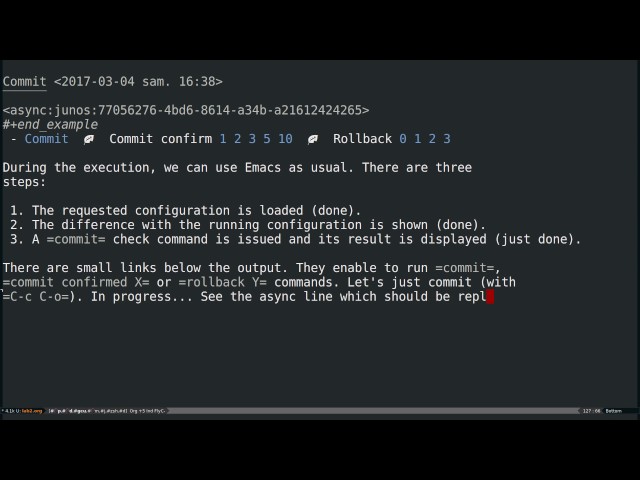
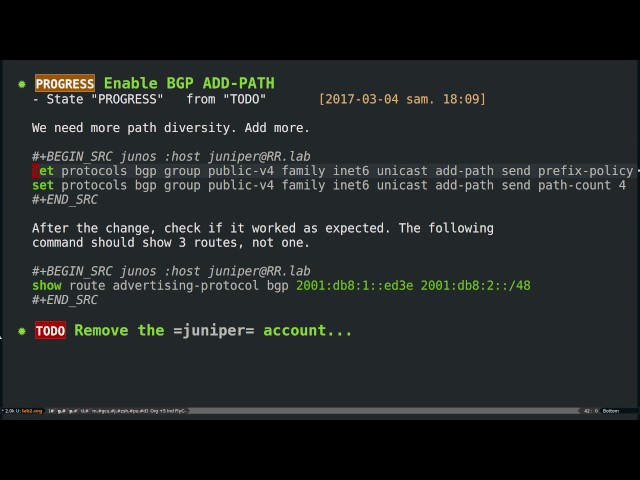
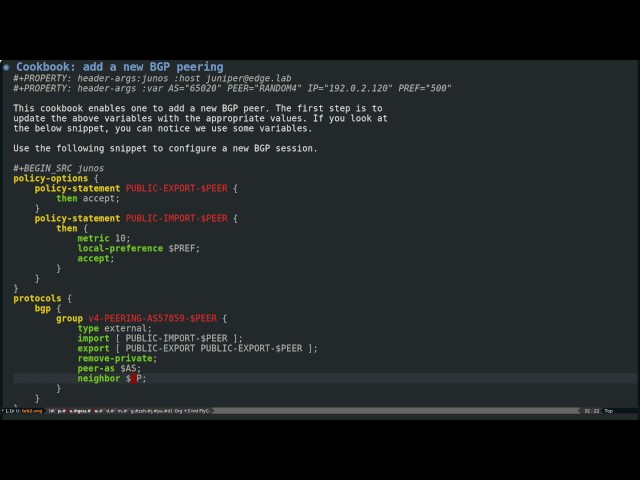
Org mode is a package for Emacs to keep notes, maintain todo lists, planning projects and authoring documents . It can execute embedded snippets of code and capture the output (through Babel). It s an invaluable tool for documenting your infrastructure and your operations. Here are three (relatively) short videos exhibiting Org mode use in the context of network operations. In all of them, I am using my own junos-mode which features the following perks: Since some Junos devices can be quite slow, commits and remote executions are done asynchronously1 with the help of a Python helper. In the first video, I take some notes about configuring BGP add-path feature (RFC 7911). It demonstrates all the available features of junos-mode. In the second video, I execute a planned operation to enable this feature in production. The document is a modus operandi and contains the configuration to apply and the commands to check if it works as expected. At the end, the document becomes a detailed report of the operation. In the third video, a cookbook has been prepared to execute some changes. I set some variables and execute the cookbook to apply the change and check the result.

  1. This is a bit of a hack since Babel doesn t have native support for that. Also have a look at ob-async which is a language-independent implementation of the same idea.

Shirish Agarwal: To say or not to say

Voltaire For people who are visually differently-abled, the above reads To learn who rules over you, simply find out who you are not allowed to criticize Voltaire wrote this either in late 16th century or early 17th century and those words were as apt in those times, as it is in these turbulent times as well. Update 05/03 According to @bla these words are attributable to a neo-nazi and apparently a child abuser. While I don t know the context in which it was shared, it describes the environment in which we are perfectly. Please see his comment for a link and better understanding. The below topic requires a bit of maturity, so if you are easily offended, feel free not to read further. While this week-end I was supposed to share about the recent Science Day celebrations that we did last week Science Day celebrations at GMRT Would explore it probably next week. This week the attempt is to share thoughts which had been simmering at the back of my mind for more than 2 weeks or more and whose answers are not clear to me. My buttons were pressed when Martin f. Kraft shared about a CoC violation and the steps taken therein. While it is easy to say with 20:20 hind-sight to say that the gentleman acted foolishly, I don t really know the circumstances to pass the judgement so quickly. In reality, while I didn t understand the joke in itself, I have to share some background by way of anecdotes as to why it isn t so easy for me to give a judgement call. a. I don t know the topics chosen by stand-up comedians in other countries, in India, most of the stand-up acts are either about dating or sex or somewhere in-between, which is lovingly given the name Leela (dance of life) in Indian mythology. I have been to several such acts over the years at different events, different occasions and 99.99% of the time I would see them dealing with pedophilia, necrophilia and all sorts of deviants in sexuality and people laughing wildly, but couple of times when the comedian shared the term sex with people, educated, probably more than a few world-travelled middle to higher-middle class people were shocked into silence. I had seen this not in once but 2-3 times in different environments and was left wondering just couple of years back Is sex such a bad word that people get easily shocked ? Then how is it that we have 1.25 billion + people in India. There had to be some people having sex. I don t think that all 1.25 billion people are test-tube babies. b. This actually was what lead to my quandary last year when my sharing of My Experience with Debian which I had carefully prepared for newbies, seeing seasoned debian people, I knew my lame observations wouldn t cut ice with them and hence had to share my actual story which involved a bit of porn. I was in two minds whether or not to say it till my eyes caught a t-shirt on which it was said We make porn or something to that effect. That helped me share my point. c. Which brings me to another point, it seems it is becoming increasingly difficult to talk about anything either before apologizing to everyone and not really knowing who will take offence at what and what the repercussions might be. In local sharings, I always start with a blanket apology that if I say something that offends you, please let me know afterwards so I can work on it. As the term goes You can t please everyone and that is what happens. Somebody sooner or later would take offence at something and re-interpret it in ways which I had not thought of. Charlie Chaplin - King of self-deprecating humor From the little sharings and interactions I have been part of, I find people take offence at the most innocuous things. For instance, one of the easy routes of not offending anyone is to use self-deprecating humour (or so I thought) either of my race, caste, class or even my issues with weight and each of the above would offend somebody. Charlie Chaplin didn t have those problems. If somebody is from my caste, I m portraying the caste in a certain light, a certain slant. If I m talking about weight issues, then anybody who is like me (fat) feels that the world is laughing at them rather than at me or they will be discriminated against. While I find the last point a bit valid, it leaves with me no tools and no humour. I neither have the observational powers or the skills that Kapil Sharma has and have to be me. While I have no clue what to do next, I feel the need to also share why humour is important in any sharing.- a. Break When any speaker uses humour, the idea is to take a break from a serious topic. It helps to break the monotony of the talk especially if the topic is full of jargon talk and new concepts. A small comedic relief brings the attendees attention back to the topic as it tends to wander in a long monotonous talk. b. Bridge Some of the better speakers use one or more humourous anecdote to explain and/or bridge the chasm between two different concepts. Some are able to produce humour on the fly while others like me have to rely on tried and tested methods. There is one another thing as well, humour is seems to be a mixture of social, cultural and political context and its very easy to have it back-fired upon you. For instance, I attempted humour on refugees, probably not the best topic to try humour in the current political climate, and predictably, it didn t go down well. I had to share and explain about Robin Williams slightly dark yet humorous tale in Moscow on the Hudson The film provides comedy and pathos in equal measure. You are left identifying with Vladimir Ivanoff (Robin Williams character) especially in the last scene where he learns of his grand-mother dying and he remembers her and his motherland, Russia and plays a piece on his saxophone as a tribute both to his grand-mother and the motherland. Apparently, in the height of the cold war, if a Russian defected to United States (land of Satan and other such terms used) you couldn t return to Russia. The movie, seen some years back left a deep impact on me. For all the shortcomings and ills that India has, even if I could, would and could I be happy anywhere else ? The answers are not so easy. With most NRI s (Non-Resident Indians) who emigrated for good did it not so much for themselves but for their children. So the children would hopefully have a better upbringing, better facilities, better opportunities than they would have got here. I talked to more than a few NRI s and while most of them give standardized answers, talking awhile and couple of beers or their favourite alcohol later, you come across deeply conflicted human beings whose heart is in India and their job, profession and money interests compel them to be in the country where they are serving. And Indian movies further don t make it easy for the Indian populace when trying to integrate into a new place. Some of the biggest hits of yesteryear s were about having the distinct Indian culture in their new country while the message of most countries is integration. I know of friends who are living in Germany who have to struggle through their German in order to be counted as a citizen, the same I guess is true of other countries as well, not just the language but the customs as well. They also probably struggle with learning more than one language and having an amalgamation of values which somehow they and their children have to make sense of. I was mildly shocked last week to learn that Mishi Choudary had to train people in the U.S. to differentiate between Afghan turban styles of wearing and the Punjabi style of wearing the turban. A simple search on Afghani turban and Punjabi turban reveals that there are a lot of differences between the two cultures. In fact, the way they talk, the way they walk, there are lots that differentiate the two cultures. The second shocking video was of an African-American man racially abusing an Indian-American girl. At first, I didn t believe it till I saw the video on facebook. My point through all that is it seems humour, that clean, simple exercise which brings a smile to you and uplifts the spirit doesn t seem to be as easy as it once was. Comments, suggestions, criticisms all are welcome.
Filed under: Miscellenous Tagged: #Elusive, #Fear, #hind-sight, #Humour, #immigrant, #integration, #Mishi Choudary, #refugee, #Robin Williams, #self-deprecating, #SFLC, #two-minds

4 March 2017

Simon Josefsson: GPS on Replicant 6

I use Replicant on my main Samsung S3 mobile phone. Replicant is a fully free Android distribution. One consequence of the fully free means that some functionality is not working properly, because the hardware requires non-free software. I am in the process of upgrading my main phone to the latest beta builds of Replicant 6. Getting GPS to work on Replicant/S3 is not that difficult. I have made the decision that I am willing to compromise on freedom a bit for my Geocaching hobby. I have written before how to get GPS to work on Replicant 4.0 and GPS on Replicant 4.2. When I upgraded to Wolfgang s Replicant 6 build back in September 2016, it took some time to figure out how to get GPS to work. I prepared notes on non-free firmware on Replicant 6 which included a section on getting GPS to work. Unfortunately, that method requires that you build your own image and has access to the build tree. Which is not for everyone. This writeup explains how to get GPS to work on a Replicant 6 without building your own image. Wolfgang already explained how to add all other non-free firmware to Replicant 6 but it did not cover GPS. The reason is that GPS requires non-free software to run on your main CPU. You should understand the consequences of this before proceeding! The first step is to download a Replicant 6.0 image, currently they are available from the replicant 6.0 forum thread. Download the replicant-6.0-i9300.zip file and flash it to your phone as usual. Make sure everything (except GPS of course) works, after loading other non-free firmware (Wifi, Bluetooth etc) using "./firmwares.sh i9300 all" that you may want. You can install the Geocaching client c:geo via fdroid by adding fdroid.cgeo.org as a separate repository. Start the app and verify that GPS does not work. Keep the replicant-6.0-i9300.zip file around, you will need it later. The tricky part about GPS is that the daemon is started through the init system of Android, specified by the file /init.target.rc. Replicant ships with the GPS part commented out. To modify this file, we need to bring out our little toolbox. Modifying the file on the device itself will not work, the root filesystem is extracted from a ramdisk file on every boot. Any changes made to the file will not be persistent. The file /init.target.rc is stored in the boot.img ramdisk, and that is the file we need to modify to make a persistent modification. First we need the unpackbootimg and mkbootimg tools. If you are lucky, you might find them pre-built for your operating system. I am using Debian and I couldn t find them easily. Building them from scratch is however not that difficult. Assuming you have a normal build environment (i.e., apt-get install build-essentials) try the following to build the tools. I was inspired by a post on unpacking and editing boot.img for some of the following instructions.
git clone https://github.com/CyanogenMod/android_system_core.git
cd android_system_core/
git checkout cm-13.0 
cd mkbootimg/
gcc -o ./mkbootimg -I ../include ../libmincrypt/*.c ./mkbootimg.c
gcc -o ./unpackbootimg -I ../include ../libmincrypt/*.c ./unpackbootimg.c
sudo cp mkbootimg unpackbootimg /usr/local/bin/
You are now ready to unpack the boot.img file. You will need the replicant ZIP file in your home directory. Also download the small patch I made for the init.target.rc file: https://gitlab.com/snippets/1639447. Save the patch as replicant-6-gps-fix.diff in your home directory.
mkdir t
cd t
unzip ~/replicant-6.0-i9300.zip 
unpackbootimg -i ./boot.img
mkdir ./ramdisk
cd ./ramdisk/
gzip -dc ../boot.img-ramdisk.gz   cpio -imd
patch < ~/replicant-6-gps-fix.diff 
Assuming the patch applied correctly (you should see output like "patching file init.target.rc" at the end) you will now need to put the ramdisk back together.
find . ! -name .   LC_ALL=C sort   cpio -o -H newc -R root:root   gzip > ../new-boot.img-ramdisk.gz
cd ..
mkbootimg --kernel ./boot.img-zImage \
--ramdisk ./new-boot.img-ramdisk.gz \
--second ./boot.img-second \
--cmdline "$(cat ./boot.img-cmdline)" \
--base "$(cat ./boot.img-base)" \
--pagesize "$(cat ./boot.img-pagesize)" \
--dt ./boot.img-dt \
--ramdisk_offset "$(cat ./boot.img-ramdisk_offset)" \
--second_offset "$(cat ./boot.img-second_offset)" \
--tags_offset "$(cat ./boot.img-tags_offset)" \
--output ./new-boot.img
Reboot your phone to the bootloader:
adb reboot bootloader
Then flash the new boot image back to your phone:
heimdall flash --BOOT new-boot.img
The phone will restart. To finalize things, you need the non-free GPS software components glgps, gps.exynos4.so and gps.cer. Before I used a complicated method involving sdat2img.py to extract these files from a CyanogenMod 13.x archive. Fortunately, Lineage OS is now offering downloads containing the relevant files too. You will need to download some files, extract them, and load them onto your phone.
wget https://mirrorbits.lineageos.org/full/i9300/20170125/lineage-14.1-20170125-experimental-i9300-signed.zip
mkdir lineage
cd lineage
unzip ../lineage-14.1-20170125-experimental-i9300-signed.zip
adb root
adb wait-for-device
adb remount
adb push system/bin/glgps /system/bin/
adb push system/lib/hw/gps.exynos4.vendor.so /system/lib/hw/gps.exynos4.so
adb push system/bin/gps.cer /system/bin/
Now reboot your phone and start c:geo and it should find some satellites. Congratulations!

intrigeri: Contribute your skills to Debian in Paris, May 13-14 2017

(There is a French translation of this announcement.) Join us in Paris, on May 13-14 2017, and we will find a way in which you can help Debian with your current set of skills! You might even learn one or two things in passing (but you don't have to). Debian is a free operating system for your computer. An operating system is the set of basic programs and utilities that make your computer run. Debian comes with dozens of thousands of packages, precompiled software bundled up for easy installation on your machine. A number of other operating systems, such as Ubuntu and Tails, are based on Debian. The upcoming version of Debian, called Stretch, will be released later this year. We need you to help us make it awesome :) Whether you're a computer user, a graphics designer, or a bug triager, there are many ways you can contribute to this effort. We also welcome experience in consensus decision-making, anti-harassment teams, and package maintenance. No effort is too small and whatever you bring to this community will be appreciated. Here's what we will be doing: Goals and principles Before diving into the exact content of this event, a few words from the organization team. This is a work in progress, and a statement of intent. Not everything is organized and confirmed yet. We want to bring together a heterogeneous group of people. This goal will guide our handling of sponsorship requests, and will help us make decisions if more people want to attend than we can welcome properly. In other words: if you're part of a group that is currently under-represented in computer communities, we would like you to be able to attend. We are committed to providing a friendly, safe and welcoming environment for all, regardless of level of experience, gender, gender identity and expression, sexual orientation, disability, personal appearance, body size, race, ethnicity, age, religion, nationality, or other similar personal characteristic. Attending this event requires reading and respecting our Code of Conduct, that sets the standards in terms of behaviour for the whole event, including communication (public and private) before, while and after. There will be a team ready to act if you feel you have been or are being harassed or made uncomfortable by an attendee. We believe that money should not be a blocker for contributing to Debian. We will sponsor travel and find a place to sleep for as many enthusiastic attendees as possible. The space where this event will take place is accessible to wheelchairs. We are trying to organize a translation into (probably French) sign language. Vegan food should be provided for lunch. If you have any specific needs regarding food, please let us know when registering, and we will do our best. What we will be doing There will be a number of stations, i.e. physical space dedicated to people with a given set of skills, hosted by someone who is ready to make this space welcoming and productive. A few stations are already organized, and are described below. If you want to host a station yourself, or would like us to organize another one, please let us know. For example, you may want to assess the state of Debian Stretch for a specific field of interest, be it audio editing, office work, network auditing or whatever you are doing with Debian :) Test the upcoming version of Debian We will test Debian Stretch and gather feedback. We are particularly interested in: Experienced Debian contributors will be ready to relay this feedback to the relevant teams so it is put to good use. Hypra collaborators will be there to bring a focus on universal access technologies. Design and graphics Truth be told, Debian lacks people who are good at design and graphics. There are definitely a good number of low-hanging fruits that can be tackled in a week-end, either in Debian per-se, or in upstream) projects, or in Debian derivatives. This station will be hosted by Juliette Belin. She designed the themes for the last two versions of Debian. Triage Release Critical bugs Bugs flagged as Release Critical are blocking the release of the upcoming version of Debian. To fix them, it helps to make sure the bug report documents the up-to-date status of the bug, and of its resolution. One does not need to be a programmer to do this work! For example, you can try and reproduce bugs in software you use... or in software you will discover. This helps package maintainers better focus their work. This station will be hosted by Solveig. She has experience in bug triaging, in Debian and elsewhere. Cyril Brulebois, a long-time Debian developer, will provide support and advice upon request. Fix Release Critical bugs There will be a Bug Squashing Party. Where? When? How to register? See https://wiki.debian.org/BSP/2017/05/fr/Paris for the exact address and time. Please register by the end of March if you want to attend this event! If you have any questions, please get in touch with us.

3 March 2017

Markus Koschany: My Free Software Activities in February 2017

Welcome to gambaru.de. Here is my monthly report that covers what I have been doing for Debian. If you re interested in Java, Games and LTS topics, this might be interesting for you. We have reached the end of Stretch s development cycle, a phase called full freeze. That means packages may only migrate to Testing aka Stretch after approval by the release team. Changes must be minimal and only address important or release critical bugs. This is usually the time when I stop uploading new upstream releases to unstable to avoid any disruptions. Of course there are exceptions but if you are unsure best practice is to use experimental instead. A lot of RC bugs are still open and affect the next release. In February I could close five one and triage two more. Debian Games Debian Java Debian LTS This was my twelfth month as a paid contributor and I have been paid to work 13 hours on Debian LTS, a project started by Rapha l Hertzog. In that time I did the following: Non-maintainer uploads Thanks for reading and see you next time.

Petter Reinholdtsen: Norwegian Bokm l translation of The Debian Administrator's Handbook complete, proofreading in progress

For almost a year now, we have been working on making a Norwegian Bokm l edition of The Debian Administrator's Handbook. Now, thanks to the tireless effort of Ole-Erik, Ingrid and Andreas, the initial translation is complete, and we are working on the proof reading to ensure consistent language and use of correct computer science terms. The plan is to make the book available on paper, as well as in electronic form. For that to happen, the proof reading must be completed and all the figures need to be translated. If you want to help out, get in touch. A fresh PDF edition in A4 format (the final book will have smaller pages) of the book created every morning is available for proofreading. If you find any errors, please visit Weblate and correct the error. The state of the translation including figures is a useful source for those provide Norwegian bokm l screen shots and figures.

Michal &#268;iha&#345;: Weblate 2.12

Weblate 2.12 has been released today, few days behind schedule. It brings improved screenshots management, better search and replace features or improved import. Many of the new features were already announced in previous post, where you can find more details about them. Full list of changes: If you are upgrading from older version, please follow our upgrading instructions. You can find more information about Weblate on https://weblate.org, the code is hosted on Github. If you are curious how it looks, you can try it out on demo server. You can login there with demo account using demo password or register your own user. Weblate is also being used on https://hosted.weblate.org/ as official translating service for phpMyAdmin, OsmAnd, Aptoide, FreedomBox, Weblate itself and many other projects. Should you be looking for hosting of translations for your project, I'm happy to host them for you or help with setting it up on your infrastructure. Further development of Weblate would not be possible without people providing donations, thanks to everybody who have helped so far! The roadmap for next release is just being prepared, you can influence this by expressing support for individual issues either by comments or by providing bounty for them.

Filed under: Debian English phpMyAdmin SUSE Weblate 0 comments

2 March 2017

Joey Hess: what I would ask my lawyers about the new Github TOS

The Internet saw Github's new TOS yesterday and collectively shrugged. That's weird.. I don't have any lawyers, but the way Github's new TOS is written, I feel I'd need to consult with lawyers to understand how it might affect the license of my software if I hosted it on Github. And the license of my software is important to me, because it is the legal framework within which my software lives or dies. If I didn't care about my software, I'd be able to shrug this off, but since I do it seems very important indeed, and not worth taking risks with. If I were looking over the TOS with my lawyers, I'd ask these questions...

4 License Grant to Us
This seems to be saying that I'm granting an additional license to my software to Github. Is that right or does "license grant" have some other legal meaning? If the Free Software license I've already licensed my software under allows for everything in this "License Grant to Us", would that be sufficient, or would my software still be licenced under two different licences? There are violations of the GPL that can revoke someone's access to software under that license. Suppose that Github took such an action with my software, and their GPL license was revoked. Would they still have a license to my software under this "License Grant to Us" or not? "Us" is actually defined earlier as "GitHub, Inc., as well as our affiliates, directors, subsidiaries, contractors, licensors, officers, agents, and employees". Does this mean that if someone say, does some brief contracting with Github, that they get my software under this license? Would they still have access to it under that license when the contract work was over? What does "affiliates" mean? Might it include other companies? Is it even legal for a TOS to require a license grant? Don't license grants normally involve an intentional action on the licensor's part, like signing a contract or writing a license down? All I did was loaded a webpage in a browser and saw on the page that by loading it, they say I've accepted the TOS. (I then set about removing everything from Github.) Github's old TOS was not structured as a license grant. What reasons might they have for structuring this TOS in such a way? Am I asking too many questions only 4 words into this thing? Or not enough?
Your Content belongs to you, and you are responsible for Content you post even if it does not belong to you. However, we need the legal right to do things like host it, publish it, and share it. You grant us and our legal successors the right to store and display your Content and make incidental copies as necessary to render the Website and provide the Service.
If this is a software license, the wording seems rather vague compared with other software licenses I've read. How much wiggle room is built into that wording? What are the chances that, if we had a dispute and this came before a judge, that Github's laywers would be able to find a creative reading of this that makes "do things like" include whatever they want? Suppose that my software is javascript code or gets compiled to javascript code. Would this let Github serve up the javascript code for their users to run as part of the process of rendering their website?
That means you're giving us the right to do things like reproduce your content (so we can do things like copy it to our database and make backups); display it (so we can do things like show it to you and other users); modify it (so our server can do things like parse it into a search index); distribute it (so we can do things like share it with other users); and perform it (in case your content is something like music or video).
Suppose that Github modified my software, does not distribute the modified version, but converts it to javascipt code and distributes that to their users to run as part of the process of rendering their website. If my software is AGPL licensed, they would be in violation of that license, but doesn't this additional license allow them to modify and distribute my software in such a way?
This license does not grant GitHub the right to sell your Content or otherwise distribute it outside of our Service.
I see that "Service" is defined as "the applications, software, products, and services provided by GitHub". Does that mean at the time I accept the TOS, or at any point in the future? If Github tomorrow starts providing say, an App Store service, that necessarily involves distribution of software to others, and they put my software in it, would that be allowed by this or not? If that hypothetical Github App Store doesn't sell apps, but licenses access to them for money, would that be allowed under this license that they want to my software?
5 License Grant to Other Users Any Content you post publicly, including issues, comments, and contributions to other Users' repositories, may be viewed by others. By setting your repositories to be viewed publicly, you agree to allow others to view and "fork" your repositories (this means that others may make their own copies of your Content in repositories they control).
Let's say that company Foo does something with my software that violates its GPL license and the license is revoked. So they no longer are allowed to copy my software under the GPL, but it's there on Github. Does this "License Grant to Other Users" give them a different license under which they can still copy my software? The word "fork" has a particular meaning on Github, which often includes modification of the software in a repository. Does this mean that other users could modify my software, even if its regular license didn't allow them to modify it or had been revoked? How would this use of a platform-specific term "fork" be interpreted in this license if it was being analized in a courtroom?
If you set your pages and repositories to be viewed publicly, you grant each User of GitHub a nonexclusive, worldwide license to access your Content through the GitHub Service, and to use, display and perform your Content, and to reproduce your Content solely on GitHub as permitted through GitHub's functionality. You may grant further rights if you adopt a license.
This paragraph seems entirely innocious. So, what does your keen lawyer mind see in it that I don't? How sure are you about your answers to all this? We're fairly sure we know how well the GPL holds up in court; how well would your interpretation of all this hold up? What questions have I forgotten to ask?
And finally, the last question I'd be asking my lawyers: What's your bill come to? That much? Is using Github worth that much to me?

Jonathan McDowell: Rational thoughts on the GitHub ToS change

I woke this morning to Thorsten claiming the new GitHub Terms of Service could require the removal of Free software projects from it. This was followed by joeyh removing everything from github. I hadn t actually been paying attention, so I went looking for some sort of summary of whether I should be worried and ended up reading the actual ToS instead. TL;DR version: No, I m not worried and I don t think you should be either. First, a disclaimer. I m not a lawyer. I have some legal training, but none of what I m about to say is legal advice. If you re really worried about the changes then you should engage the services of a professional. The gist of the concerns around GitHub s changes are that they potentially circumvent any license you have applied to your code, either converting GPL licensed software to BSD style (and thus permitting redistribution of binary forms without source) or making it illegal to host software under certain Free software licenses on GitHub due to being unable to meet the requirements of those licenses as a result of GitHub s ToS. My reading of the GitHub changes is that they are driven by a desire to ensure that GitHub are legally covered for the things they need to do with your code in order to run their service. There are sadly too many people who upload code there without a license, meaning that technically no one can do anything with it. Don t do this people; make sure that any project you put on GitHub has some sort of license attached to it (don t write your own - it s highly likely one of Apache/BSD/GPL will suit your needs) so people know whether they can make use of it or not. I don t care is not a valid reason not to do this. Section D, relating to user generated content, is the one causing the problems. It s possibly easiest to walk through each subsection in order. D1 says GitHub don t take any responsibility for your content; you make it, you re responsible for it, they re not accepting any blame for harm your content does nor for anything any member of the public might do with content you ve put on GitHub. This seems uncontentious. D2 reaffirms your ownership of any content you create, and requires you to only post 3rd party content to GitHub that you have appropriate rights to. So I can t, for example, upload a copy of Friday by Rebecca Black. Thorsten has some problems with D3, where GitHub reserve the right to remove content that violates their terms or policies. He argues this could cause issues with licenses that require unmodified source code. This seems to be alarmist, and also applies to any random software mirror. The intent of such licenses is in general to ensure that the pristine source code is clearly separate from 3rd party modifications. Removal of content that infringes GitHub s T&Cs is not going to cause an issue. D4 is a license grant to GitHub, and I think forms part of joeyh s problems with the changes. It affirms the content belongs to the user, but grants rights to GitHub to store and display the content, as well as make copies such as necessary to provide the GitHub service. They explicitly state that no right is granted to sell the content at all or to distribute the content outside of providing the GitHub service. This term would seem to be the minimum necessary for GitHub to ensure they are allowed to provide code uploaded to them for download, and provide their web interface. If you ve actually put a Free license on your code then this isn t necessary, but from GitHub s point of view I can understand wanting to make it explicit that they need these rights to be granted. I don t believe it provides a method of subverting the licensing intent of Free software authors. D5 provides more concern to Thorsten. It seems he believes that the ability to fork code on GitHub provides a mechanism to circumvent copyleft licenses. I don t agree. The second paragraph of this subsection limits the license granted to the user to be the ability to reproduce the content on GitHub - it does not grant them additional rights to reproduce outside of GitHub. These rights, to my eye, enable the forking and viewing of content within GitHub but say nothing about my rights to check code out and ignore the author s upstream license. D6 clarifies that if you submit content to a GitHub repo that features a license you are licensing your contribution under these terms, assuming you have no other agreement in place. This looks to be something that benefits projects on GitHub receiving contributions from users there; it s an explicit statement that such contributions are under the project license. D7 confirms the retention of moral rights by the content owner, but states they are waived purely for the purposes of enabling GitHub to provide service, as stated under D4. In particular this right is revocable so in the event they do something you don t like you can instantly remove all of their rights. Thorsten is more worried about the ability to remove attribution and thus breach CC-BY or some BSD licenses, but GitHub s whole model is providing attribution for changesets and tracking such changes over time, so it s hard to understand exactly where the service falls down on ensuring the provenance of content is clear. There are reasons to be wary of GitHub (they ve taken a decentralised revision control system and made a business model around being a centralised implementation of it, and they store additional metadata such as PRs that aren t as easily extracted), but I don t see any indication that the most recent changes to their Terms of Service are something to worry about. The intent is clearly to provide GitHub with the legal basis they need to provide their service, rather than to provide a means for them to subvert the license intent of any Free software uploaded.

Next.

Previous.