Search Results: "ean"

25 November 2010

Michal Čihař: Upgrading OpenWrt

While doing some bigger downloads, my wifi network used to have big problems, seeing tx errors, frame errors on the router. The router is old ASUS WL-500g Deluxe which was running OpenWrt Kamikaze up to now. I was anyway thinking going for something with 802.11a or 802.11n support, so I started to look for replacement. While looking for it and checking what newer boxes are supported by OpenWrt, I noticed, that I can finally try using 2.6 kernel and I should get working wireless as well with free (what was not possible for very long time). I gave it a try and upgraded to Backfire 10.03.1-rc4. And looks there is no need to upgrade hardware right now. No more tx errors, the wireless is much more stable and faster. Thanks to anybody who helped to create free drivers for Broadcom 4306 wireless chip. PS: Upgrading OpenWrt while keeping configuration lead to horrible mess in my case, so I rather did clean install reconfiguring everything and rediscovering all errors I've made in the past.

Filed under: Linux 3 comments Flattr this!

Russell Coker: Victorian State Election

Election TomorrowOn Saturday we will have a Victorian state election. As usual for state elections most people will vote on issues related to the federal government, the mainstream media has little coverage of state politics and people seem to vote on what they see on TV. Presumably that means we have a good chance of having a similar situation to the last Federal Election where the Labor and Liberal parties each won 72 seats in the lower house and Labor formed a coalition with the Greens MP and three independents.The independent MPs didn t give much explanation of the reasons for their choices. But it seems that a large motivating factor was the Greens success in the senate, as Labor was more willing to work with the Greens that meant that if a Liberal based coalition had won in the lower house there was a good chance of a Double Dissolution.The Liberal party can t make dealsIn a world where sanity prevailed the result of this would be the Liberal party firstly adjusting their policies to appeal to Greens voters and secondly trying to make some deals with the Greens at a high level to allow the possibility of a Liberal/Green coalition government. While there are substantial policy conflicts between the Liberal and Green parties it does seem possible to get a coalition working if both sides accept that they won t get everything that they want. Forming government and getting only some of your policy implemented seems like a better option than being in the opposition and getting almost none of your policy implemented. Also there is no reason why we couldn t have a Liberal/Labor coalition government in the next decade it seems unlikely that any election will deliver a result that doesn t have Liberal + Labor comprising more than 50% of the seats in both houses.But it seems that sanity doesn t prevail. The Liberal party have put the Greens below Labor on their preferences for the upper house and on their How To Vote cards for the lower house [1]. This greatly increases the probability of Labor scoring an outright win. It also seems likely to drive a wedge against the conservative voters who want to conserve the environment.The Sad State of the Liberal PartyKevin Andrews (Liberal MP and former minister) wrote a strange and amusing diatribe titled The ideological drive behind the Greens [2]. Here is what I regard as the best part:First, those who vote Green as their primary vote: This is the Don s Party group that used to be in the ALP in the 60s and 70s: young university students or graduates, frequently working or still studying in academia, no kids, often gay, arts and drama type degrees or architecture where they specialise is designing environmentally friendly suburbs, agnostic or atheist, often US or Canadian refugees from capitalism, but well paid in professional consulting or media jobs. According to the CIA World Factbook [3] the median age of Australians is 37.5, the majority of the population were born in 1972 or later. The film Don's_Party was released in 1976 and was about the 1969 election. While Kevin Andrews was old enough to remember the 1969 election clearly the majority of the Australian population weren t even born before that election and isn t old enough to have watched the movie when it was in the cinemas. Kevin is making it quite clear that he and his party represent a time that is past. The rest of that paragraph is filled with strangeness that is a good sample of the rest of his article.The sad thing is that he seems to think that this appeal to the minority of people who are old enough to remember the 1969 election, bigoted enough to appreciate the discrimination against homosexuals (which is a long standing Liberal policy), and politically clueless enough to support McCarthyist policies against alleged communists.We need a decent and sane conservative party to represent the decent and sane Australian citizens who are politically conservative. I am beginning to doubt that the Liberal party could ever be reformed enough to become such a party.

Axel Beckert: Useful but Unknown Unix Commandline Options: touch -d

You may wonder how I manage to write one Useful but Unknown Unix Something blog posting per day. Well, I don t. I write them in bursts, but don t want to flood Planet Debian and Planet Symlink with more than one such posting a day. The first bunch of postings were mostly slides (or part of a slide plus what I tell while showing the slide) from my Unknown but Useful Unix Tools talk and written somewhen last week. And this blog posting and yesterday s blog posting were written in a row, too. What does that have to do with Unix commandline tools? Well I use Blosxom as blogging engine and it s based on simple text files lounging around in some directories, and the last modification time stamp is the posting s date which is cached after first time seen by the entries_index plugin so that I can fix typos without resetting the posting s release date. Postings with a modification date in the future won t be shown before that time. So how do you set the last modification date to a date in the future? With touch from GNU Coreutils of course. Like date , touch also knows the option -d to explicity set a date and time instead of using the current date and time. Now in my humble opinion the cool feature is that you can easily describe dates by giving touch values like now + 1 hour , 12:00 tomorrow or so:
$ touch bla
$ ls -l
total 0
-rw-r--r-- 1 abe abe 0 2010-11-23 22:59 bla
$ touch -d 'now + 1 day + 23 hours - 42 minutes' bla
$ ls -l
total 0
-rw-r--r-- 1 abe abe 0 2010-11-25 21:17 bla
$
To see all the possibilities you have to describe relative dates with touch , date , and maybe other GNU Coreutils tools, check that you have info installed and call:
$ info '(coreutils.info.gz)Relative items in date strings'
Oh, and this whole story about setting modification dates manually to arbitrary values also means that the Tattletale Statistics: Blogtimes November 2010 image in my blog s side bar is absolute nonsense, at least this month. Well, never trust any statistic you haven t faked yourself. ;-) But on the other hand, the dates in the example may give a hint when I really wrote that blog posting. Or not. ;-) And I wonder what my backup tools think about last modification times in the future. Well, they probably only check for modification dates newer than last backup and therefore should be fine. *phew*

Michal Čihař: More on Attachmate and Novell

Surprisingly, my Monday blog post has received much more attention than I did expect and was source for at least one article full of speculations (in Czech). Hey, there was no new information in the post, nor some secret information leak (not that I know something what is not known publicly). Anyway meanwhile public announcement about UNIX copyrights has been made. I don't think it changes much, but it seems to be one if things people wanted to know. What I find more interesting (and hard to read and understand) is explanation of the currently publicly available bits from a transactional lawyer at The Standards Blog. At least it gave me basic idea why some things are so complex in this deal and just confirmed that I want to avoid need for contact with lawyers language as much as possible :-).

Filed under: Suse 0 comments Flattr this!

Stefano Zacchiroli: h-index spoofing

Next time you are asked your h-index ... Next time you are asked your h-index, I suggest replying by pointing to related work by Ike Antkare [1].
[1] Ike Antkare. Ike Antkare one of the great stars in the scientific firmament.
April, 2010.
http://membres-lig.imag.fr/labbe/Publi/IkeAntkareSub.pdf,
retrieved November 25th, 2010.
Although some people still don't get it, the bottom line is always the same: you can't rely on a fully automatic method to evaluate intelligent entities which are aware of the evaluation method, as they are very likely to adapt to it. This is even more so when the automatic method relies on a data source which is not under the control of the evaluator(s). Thanks to Lucas for sharing the bibliography entry.

Raphaël Hertzog: People behind Debian: Colin Watson, the tireless man-db maintainer and a debian-installer developer

Colin Watson is not a high-profile Debian figure, you rarely see him on mailing lists but he cares a lot about Debian and you will see him on Debconf videos sharing many thoughtful comments. I have the pleasure to work with him on dpkg as he maintains the package in Ubuntu, but he does a lot of more interesting things. I also took the opportunity to ask some Ubuntu specific questions since he s worked for Canonical since the start. Read on. My questions are in bold, the rest is by Colin. Who are you? Hi. I m 32 years old, grew up in Belfast in Northern Ireland, but have been living in Cambridge, England, since I was 18. I m married with a stepson and a daughter. I became interested in Debian due to the critical mass of Debian work happening in Cambridge at the time (and perhaps more immediately because my roommate was running Debian: hey, what s that? ), started doing random bits of development in 2000, and joined as a developer in 2001 (a really exciting time, with lots of new people joining who became integral parts of the project). I d only really been intending to do QA work and various bits of packaging around the edges, and maybe some work on the BTS, but then Fabrizio Polacco died and I took over man-db from him, and it sort of snowballed from there. I graduated from university shortly before becoming a Debian developer. I worked for a web server company (Zeus), then a hardware cryptography company (nCipher), before moving to work for Canonical in 2004, since when I ve been working full-time on Ubuntu. By this point, I suspect that going back to work in an office every day would be pretty tough. What s your biggest achievement within Debian or Ubuntu? One thing I should say: I rarely start projects. Firstly I don t think I m very good at it, and secondly I much prefer coming on to an existing project and worrying away at all the broken bits, often after other people have got bored and wandered off to the next new and shiny thing. That s probably why I ended up in the GNU/Linux distribution world in the first place, rather than doing lots of upstream development from the start I like being able to polish things into a finished product that we can give to end users. So, I ve had my fingers in a lot of pies over the years, doing ongoing maintenance and fixing lots of bugs. I think the single project I m most proud of would have to be my work on the Debian installer. I joined that team in early 2004 (a few months before Canonical started up) partly because I was a release assistant at the time and it was an obvious hot-spot, and partly because I thought it d be a good idea to make sure it worked well on the shiny new G4 PowerBook I d just treated myself to. I ended up as one of the powerpc d-i port maintainers for a while (no longer, as that machine is dead), but I ve done a lot of core work as well: much of the work to put progress bars in front of absolutely everything that used to have piles of text output, rescue mode, the current kernel selection framework, a good deal of udev support, several significant debconf extensions, lots of os-prober work, and I think I can claim to be one of the few people who understands the partitioner almost top to bottom. :-) d-i is the very first thing many of our users see, and has a huge range of uses, from simple desktop installs to massive corporate deployments; it s unspeakably important that it works well, and it s a testament to its design that it s been able to trundle along without actually very much serious refactoring for the best part of five years now. I have a soft spot for man-db too. It was my first major project in Debian, starting out from an embarrassingly broken state, and is now nice and stable to the point where I recently had time to spawn a useful generic library out of it (libpipeline). What are your plans for Debian Wheezy? d-i has a lot of code to deal with disks and partitions. Of course a lot of it is in the partitioner, and for that we use libparted so we don t have to worry very much about the minutiae of device naming. But there are several other cases where we do need to care about naming, mainly before the partitioner when detecting disks, and after the partitioner when installing the boot loader. Back in etch, we introduced list-devices , which abstracted away the disk naming assumptions involved in hardware detection. In wheezy, I would like to take all the messy, duplicated, and error-prone code that handles disk naming in the boot loader installers, and design a simple interface to cover all of them. This has only got more important following the addition of the kFreeBSD and Hurd d-i ports in squeeze, but it bites us every time we notice that, say, CCISS arrays aren t handled consistently, and it s a pain to test all that duplicated code. I d also like to spread the use of libpipeline through C programs in the archive, which I think has potential to eliminate a class of security vulnerabilities in a much simpler way than was previously available. If you could spend all your time on Debian, what would you work on? I would love to systematically reduce the need for the current mass of boot loaders. There s a significant cost to having so much variation across architectures here: it s work that needs to be done in N different places, the wildly differing configuration means that d-i has to have huge piles of code to manage them all differently, and there are a bunch of strange arbitrary limitations on what you can do. The reason I m working on GRUB 2 is that, in my view, it s the project with the best chance of centralising all this duplicated work into a single place, and making it easier to bring up new hardware in future (in a way that doesn t compromise software freedom, as many proprietary boot loaders of the kind often found on phones do). Of course, with flexibility tends to come complexity, and some people have a natural objection to that and prefer something simpler. The things I don t quite have time to do here are to figure out a coherent way to address the specific over-complexity problems people have with the configuration framework while still keeping the flexibility we need, and to do enough QA and porting work to be able to roll out GRUB 2 at installation time to all the Debian architectures it theoretically supports. What s the biggest problem of Debian? Backbiting, and too much playing the man rather than the ball. With one or two honourable exceptions, I ve largely stopped reading most Debian mailing lists since it just never seems a productive way to spend time compared to writing code and fixing bugs; and yet I m conscious that they re one of the primary means of communication for the project and I m derelict in not taking part in them. I do find it a bit frustrating that people are seen primarily in terms of their affiliations. I suppose it s natural for people to see me as an Ubuntu guy , but I don t really see myself that way: I ve been working on Debian for nearly twice as long as I ve been working on Ubuntu, and, while I care a great deal about both projects, I ve put far more of my own personal time into Debian and I try to make sure that a decent number of the things I m involved with there aren t to do with work. Work/life separation is a good thing, not that I m very good at it. Generally speaking, when I m working on Debian, I m doing so as a Debian developer, because I want Debian to be better. When that s not the case, if it matters, I try to indicate it explicitly. You re working for Canonical since Ubuntu s inception. If you were Mark Shuttleworth, is there something that you would have done differently? We had many good intentions when we founded Ubuntu. We also had a huge amount of work to deliver, to the point where it wasn t at all clear whether it would be possible (the warty release was named based on the expectations of it, after all, and came out much more usable than we d dared to hope). In hindsight, it might have helped to be quieter about our good intentions, so that we could exceed expectations rather than in some cases failing to meet them. That might have set a very different tone early on. (Personally, I m happy I m not Mark. The decisions in my office are much easier to take.) It seems to me that the community part of Ubuntu is much more eager to cooperate with Debian than the corporate part. It s probably just that more and more Canonical employees are not former Debian contributors. Do you also have this feeling? Are there processes in place to ensure everybody at Canonical is trying to do the right thing towards Debian cooperation? Just to be clear, I m wearing my own hat here which, ironically, is a fedora rather than a company hat. It makes sense for Canonical to be taking on more non-Debian folks; after all, we can t simply hire from the Debian community forever, and a variety of backgrounds is healthy. As you say, it may well be natural that Ubuntu developers who don t work for Canonical are more likely to have a Debianish background, as it tends to take something significant to get people to switch to a very different family of GNU/Linux distributions, and changing jobs is one of the most obvious of those things. Certainly, there was a definite sense among the early developers that we were all part of the Debian family and cared about the success of Debian as well. As Ubuntu has developed its own identity, people involved in it now tend to care primarily about the success of Ubuntu. At the same time, pragmatically, it s still true that getting code changes into Debian is one of the most economical ways to land them; changes made in Debian or upstream land once and tend to stay in place, while changes made only in Ubuntu incur an ongoing merge overhead, which is not at all trivial. In many ways it s human nature to try to fulfil your immediate goals in the most direct way possible. If your goal is to deliver changes to Ubuntu users, then it s natural to concentrate on that rather than looking at the bigger picture (which takes experience). Debian developers often fail to send changes upstream for much the same reason, although there s more variation there because they re normally working on Debian of their own volition and thus tend to have wider goals; the economics are more or less parallel though. Thus, I think the best way to improve things is to make it the path of least resistance for Ubuntu developers to send changes to Debian. We re already seeing how this works with the Ubuntu MOTU group; if you send a patch for review, or work on merging a package from Debian, very often the response includes have you sent these changes to Debian? . We re working on both streamlining our code review through a regular patch pilot programme and requiring more code review for changes in general, so I think this will be a good opportunity to ask more people to work with Debian when they propose changes to Ubuntu. For myself, this may be obvious, but I notice that I m much better at getting changes into Debian when I already have commit access to the Debian package in question. All the work on improving collaborative maintenance in Debian can only help, for Ubuntu as well as for everyone else. It doesn t make so much difference for large changes that require extensive discussion, but there are lots of small changes too. Canonical is upstream of many software projects (unity, indicators infrastructure, etc.). Why aren t those software immediately packaged in Debian? Do you think we can get this to change? I m not sure what the right approach is here, particularly as I haven t been involved with much of that on the Ubuntu side. I suspect it would be helpful to look at this in a similar way to Ubuntu changes in general. It s understandable that those developers have getting changes into Ubuntu as their first goal. And yet, having code in Debian offers a wider, and often technically adept, audience, and most developers like having their code reach a wider audience even if it s not their first priority, particularly if that audience is likely to be able to help with finding problems and fixing bugs. It should be seen as something beneficial to both distributions. The hardest problems will be with things that aren t merely optional add-ons (which should generally be fairly non-controversial in Debian, given the breadth of the archive in general the existence of things like bzr and germinate as Debian packages was never a hard question), but which require changes in established packages. For example, gnome-power-manager in Ubuntu is built with application indicator support, and that s an important part of having a good indicator-based panel: a lot of the point of indicators is consistency. Since I do very little desktop work myself, I don t know exactly what would be involved in making it possible to choose this system based on a Debian desktop, but I think it s probably a bit more complicated than just making sure all the new packages exist in Debian too. Obviously you have to start somewhere. Is there someone in Debian that you admire for his contributions? Christian Perrier is absolutely tireless and has done superb things for the state of translations in Debian. And Russ Allbery, even aside from his fine ongoing work on policy, Lintian, and Kerberos, is a constant voice of sanity and calmness. Release management is incredibly hard work, as I know from my own experience, and anyone who can sustain involvement in it for a long period is somebody pretty special. Steve Langasek and I got involved at about the same time but he outlasted me by quite a few years. He deserves some kind of medal for everything he s done there.
Thank you to Colin for the time spent answering my questions. I hope you enjoyed reading his answers as I did. Subscribe to my newsletter to get my monthly summary of the Debian/Ubuntu news and to not miss further interviews. You can also follow along on Identi.ca, Twitter and Facebook.

11 comments Liked this article? Click here. My blog is Flattr-enabled.

24 November 2010

Julien Blache: OFED 1.5.2 for Debian

A few weeks ago, I ve been busy at work updating the OFED packaging for OFED 1.5.2. We needed a version of the stack newer than what s (partially) available in Squeeze. As this has now been tested, we are all happy to contribute this work to Debian, courtesy of my customer, EDF. This morning, I ve pushed out packages for OFED 1.5.2 to the pkg-ofed SVN repository on Alioth. The packages should be made available in experimental at some point too, though a number of them will have to go through NEW. With this update, I ve cleaned up & updated the packaging where needed and also made two important changes that I need to highlight: A number of libraries have changed their interfaces and bumped their soversions. libibcommon is gone, it has been folded into libibumad. The API/ABI between libibverbs and the IB driver modules has changed, so the new libibverbs comes with appropriate Breaks in place. Thanks to Beno t Mortier from pkg-ofed for his 2-day IB & OFED crash course that was instrumental in getting started with the OFED maze.

23 November 2010

Julien Danjou: Color contrast correction

I finally took some time to finish my color contrast corrector. It's now able to compare two colors and to tell if they are readable when used as foreground and background color for text rendering. If they are too close, the code corrects both colors so to they'll become distant enough to be readable. To do that, it uses color coordinates in the CIE L*a*b* colorspace. This allows to determine the luminance difference between 2 colors very easily by comparing the L component of the coordinates. The default threshold used to determine readability based on luminance difference is 40 (on 100), which seems to give pretty good results so far. Then it uses the CIE Delta E 2000 formula to obtain the distance between colors. A distance of 6 is considered to be enough for the colors to be distinctive in our case, but that can be adjusted anyway. That depends on reader's eyes. If both the color and luminance distances are big enough, the color pair is considered readable when used upon each other. If these criteria are not satisfied, the code simply tries to correct the color by adjusting the L (luminance) component of the colors so their difference is 40. Optionally, the background color can be fixed so only the foreground color would be adjusted; this is especially handy when the color background is not provided by any external style, but it the screen one (like the Emacs frame background in my case). Here is an example result generated over 10 pairs of random colors. Left colors are randomly generated, and right colors are the corrected one. <style type="text/css"> </style>

bg: DarkSeaGreen4 fg: gray67 ->                             fg: #4a6b4b bg: #cccccc
bg: SlateGray4 fg: forest green ->                          fg: #9faec0 bg: #005700
bg: grey13 fg: grey36 ->                                    fg: #131313 bg: #6c6c6c
bg: MediumPurple2 fg: honeydew ->                           fg: #9e78ed bg: #f0fff0
bg: grey43 fg: chartreuse3 ->                               fg: #5e5e5e bg: #79de25
bg: linen fg: DeepPink2 ->                                  fg: linen bg: DeepPink2
bg: CadetBlue4 fg: blue1 ->                                 fg: #6c9fa4 bg: #0000e1
bg: gray33 fg: NavajoWhite3 ->                              fg: #525252 bg: #cfb58c
bg: chartreuse1 fg: RosyBrown3 ->                           fg: #9cff38 bg: #b28282
bg: medium violet red fg: DeepPink1 ->                      fg: #9c0060 bg: #ff55b9
All this has been written in Emacs Lisp. The code is now available in Gnus (and therefore in Emacs 24) in the packages color-lab and shr-color. A future work would be to add support for colour blindness. As a side note, several people pointed me at the WCAG formulas to determine luminance and contrast ratio. These are probably good criteria to choose your color when designing a user interface. However, they are not enough to determine if displayed color will be readable. This means you can use them if you are a designer, but IMHO they are pretty weak for detecting and correcting colors you did not choose. Flattr this

Mike Hommey: Improving libxul startup I/O by hacking the ELF format

If you have been following this blog during the past months, you might have gathered that I ve been focusing on I/O patterns on library initialization, more specifically libxul.so. The very patterns there s not much to do about, except enduring them, or hacking ld.so and/or the toolchain. The latter is not necessarily easy, and won t benefit everyone until all linux distros use an improved glibc and/or toolchain. This could take years before any actual result would reach end users. But with a little creativity, one can overcome these limitations and improve the situation today. Here is a summary of my recent hacks. Backwards static initializers As Taras showed in the past, static initializers are executed in reverse order. It turns out it is an unfortunate design choice in gcc, and it also turns out not to impact all ELF binary files. As far as I know there are currently two different implementations of the static initializers call loop, one provided by gcc, and one provided by ld.so. In the gcc case, the compiler creates a .ctors section, starting with 0xffffffff, ending with 0x00000000, and filled with pointers to the various static initializer functions, in ascending order. The compiler also injects an initializer function, called from .init, going through this .ctors section, starting from the end (__do_global_ctors_aux in crtend.o). A similar .dtors section is created for functions to run when the library is unloaded, and the pointers in it are called in ascending order. There is actually no importance in the order in which .ctors and .dtors are executed. All that matters is that they are executed in reverse order from each other, because that limits the risks of bad ordering. It is only unfortunate that .ctors was chosen to be the one backwards. In the ld.so case, the compiler creates a .init_array section, filled with pointers to the various static initializer functions, in ascending order. It also stores the location and the size of this section in the PT_DYNAMIC ELF header. At runtime, ld.so itself reads this information and executes the static initializers in ascending orders. A similar .fini_array section is created for functions to run when the library in unloaded, and ld.so goes through it in descending order. The .init_array section is newer, and for backwards compatibility reasons, is not used on systems that have been using the .ctors approach forever. On the other hand, some newer ABIs, such as arm EABI, uses the new facility, which means they are not victim of backwards static initialization. I however wonder if backwards compatibility is still needed, considering how long .init_array support has been around (more than 11 years, according to glibc git repository). While we could obviously bug the gcc maintainers to revert their .ctors execution order, or ditch .ctors support on glibc systems, which means we wouldn t get any immediate global benefit, we can also just revert the .ctors section content. Please note the source code out there doesn t take care of reverting the .dtors section accordingly, because it is currently empty in libxul.so. Relocations As I mentioned in an earlier post, relocations are what make it possible to load libraries at arbitrary locations. Unfortunately, a great number of relocations means awful I/O patterns: ld.so reads and applies them one by one, and while the kernel reads ahead by 128 KB chunks, when your relocation section exceeds that amount by more than an order of magnitude, it means I/O goes back and forth a lot between the relocation section and where the relocations take place. There are two classes of relocations: REL and RELA. In both cases, there are several types of relocations, some of which require an addend. The difference between both classes is in REL relocations, the addend is stored at the offset the relocation takes place, and in RELA relocations, the addend is stored in the relocation entry. It means that RELA relocations effectively waste space, as the addend ends up actually being stored twice: it is also stored at the offset the relocation takes place, like with REL relocations, though it could technically be nulled out, there ; in any case, the space is wasted. REL relocations thus take 2 words of storage, and RELA relocations, 3. On x86, the ELF ABI only uses REL relocations, and words are 32 bits, making each relocation take 8 bytes ; on x86-64, the ELF ABI only uses RELA relocations, and words are 64 bits, thus making each relocation take 24 bytes, 3 times that of x86 relocations. On ARM, both may be used, but apparently the compiler and the linker only use REL relocations. These words of storage are used to store 3 or 4 bits of informations: The linker splits relocations in two main categories: those for dynamic linking at startup and those for procedure linkage table (PLT) resolution at runtime. Here is what the repartition look like on libxul.so (taken from the mozilla-central nightly from Nov, the 22nd):
dynamic relocations PLT relocations
Architecture number size (bytes) number size (bytes)
x86 231,836 1,854,688 3,772 30,176
x86-64 235,893 5,661,432 3,773 90,528
So, PLT relocations are quite negligible, and dynamic relocations are just huge, especially on x86-64. Compared to the binary size, it s pretty scary:
Architecture libxul.so size relocations size %
x86 21,869,684 1,884,864 8.61%
x86-64 29,629,040 5,751,984 19.41%
Let me remind you that not only do we need to read these relocations at startup (at least the dynamic ones, but the PLT ones are just negligible), but we only read them by chunks, and need to read other data in between. Of the many existing types of relocations, only a few are actually used in dynamic libraries. Here is a summary of those in use in libxul.so:
x86 relocation type number x86-64 relocation type number
dynamic relocations
R_386_TLS_DTPMOD32 1 R_X86_64_DTPMOD64 1
R_386_GLOB_DAT 213 R_X86_64_GLOB_DAT 238
R_386_32 27,643 R_X86_64_64 27,611
R_386_RELATIVE 203,979 R_X86_64_RELATIVE 208,043
PLT relocations
R_386_JUMP_SLOT 3,772 R_X86_64_JUMP_SLOT 3,773
The above types can be separated in two distinct categories: In the second category, it means we are wasting all the bits for the symbol reference in each entry: 24 on x86 and 32 on x86-64. Unfortunately, the vast majority of the relocations in libxul.so are from that category. At this point, this is how much waste we identified:
description num. entries waste per entry (bytes) total % of relocation size
x86
Relocation without symbol ref. 203,980 3 611,937 32.46%
x86-64
Duplicated addend 239,666 8 1,917,328 33.33%
Relocation type encoded on 32 bits 239,666 3 718,998 12.49%
Relocation without symbol ref. 208,044 4 832,176 14.46%
Total 3,468,502 60.30%
On top of that, one could argue that we don t need 24 or 32 bits for symbol reference (which is the entry number in the symbol table), and that we re really far from requiring 64 bits for r_offset on 64 bits systems, as libxul.so is far from being bigger than 4GB. Anyways, that means we have room for improvement here, and it means that the ELF format, especially on 64 bits systems with RELA relocations, really doesn t help with big programs or libraries with a lot of relocations. (For that matter, the mach-o format used on OS-X has some kind of similar issues ; I don t know for the DLL format) Another interesting data point is looking at how relocations r_offset are following each other, once relocations are reordered (to avoid too much symbol resolution, they are actually grouped by symbol). It turns out 206,739 relocations r_offset are at 4 bytes from the previous one on x86 (i.e. strictly following it), and 210,364 at 8 bytes from the previous on x86-64. The main reason why this happens is that most relocations are happening in pointer tables, and libxul.so has lots of them: And when I say libxul.so has lots of them, that s not an understatement: there are 184,320 relocations due to vtables (function tables you get when using virtual methods in C++) on x86 and 184,098 on x86-64. That s respectively 78.23% and 76.81% of the total number of relocations. Interestingly, while most of these relocations are R_*_RELATIVE, 26,853 are R_386_32, and 26,829 are R_X86_64_64. Except for a very few, these non relative relocations are for the __cxa_pure_virtual symbol, which is a dummy function that does nothing, used for pure virtual methods, such as the following:
class Abstract
public:
virtual void pure_virtual() = 0;
;
As for the remaining relative relocations, there are a few pointer tables responsible for several thousand relocations, such as JSString::length2StringTable, gEntries, GkAtoms_info, Html5Atoms_info, kUnixCharsets, nsIDOMCSS2Properties_properties, etc. Packing relocations While they are not detrimental to most binaries, we saw that relocations can have a bad effect on startup I/O for big binaries. Reducing how much space they take would have a direct impact on these startup I/Os. One way to do so is obviously to reduce the number of relocations. But as we saw above, the vast majority are due to vtables. While reducing vtables would be a nice goal, it s a long way before this can have a significant impact on the relocations number. So another possible way is to try to avoid wasting so much space in relocations. The main problem is that relocations are applied by ld.so, and that, as mentioned in the introduction, while we can hack ld.so to do what we want, it won t work everywhere before a long time. Moreover, it s difficult to test various implementations, and binary compatibility needs to be guaranteed once something is applied in the upstream libc. The idea I started to test a few weeks ago, is to effectively apply relocations by hand instead of relying on ld.so doing it. Considering the first thing ld.so does with a library after applying relocations is to call its DT_INIT function, the idea was to replace the dynamic relocations we can with a new DT_INIT function we would inject that d apply those relocations, while storing them in a more efficient manner. The function would obviously need to call the original DT_INIT function once done. Some parts of the PT_DYNAMIC section also obviously need to be adjusted accordingly. The first iteration I tested a few weeks ago helped validating the idea, but didn t change much of the binary: the dynamic relocation section still was taking all the space it took before, though its content was mostly empty (we ll see further below how efficient even the current dumb format is). Once the theory that an injected DT_INIT function could apply the relocations without breaking everything, I went on to implement a program that would actually strip the ELF binary. I won t get too much into the gory details, but it required PT_LOAD splitting, thus program headers growth, which means moving the following sections, then removing a huge part of the relocations, shrinking the relocations section, injecting our code and the packed relocations as sections, and moving the remaining sections after these new sections, to avoid empty space, but still respecting the proper offsets for both PT_LOAD and the code itself. So far, I only took care of the R_*_RELATIVE relocations. Some but not all other relocations could be taken care of, too, but everything involving symbol resolution from other libraries would be really difficult to handle from the injected code. The relocations are currently stored with a quite dumb format: As we only take care of one type of relocations, we can skip any information about the type. Also, the addend already being stored at r_offset, we just strip it from RELA relocations ; the binary being far from 4GB big, 32 bits is enough on 64 bits systems too. We also saw that a lot of relocations were next to the following ones, so instead of storing r_offset for each one, storing some kind of range is more efficient. As I ve so far been focusing on getting something that actually works more than on getting something really efficient, I only tested this format, but the results are already nice:
x86 x86-64
before
dynamic relocations (bytes) 1,854,688 5,661,432
libxul.so size 21,869,684 29,629,040
after
dynamic relocations (bytes) 222,856 668,400
injected code size 129 84
packed relative relocations (bytes) 224,816 228,568
libxul.so size 20,464,836 (-6.42%) 24,865,520 (-16.07%)
Getting rid of the __cxa_pure_virtual relocations would help getting this even further down, and an even better storage format could be used, too. Gathering new startup coverage data should be interesting as well. The code is available via mercurial. Please note the Makefile deeply sucks, and that the code is in the middle of its third refactoring. Anyways, once you get the code to compile, you just need to run test-x86 or test-x64 depending on your architecture, from the build directory, and give it the libxul.so file as an argument. It will create a libxul.so.new file that you can use to replace libxul.so. You may successfully use the tool on other libraries, but chances are you ll bump into an assert(), or in the worst case, that the resulting library ends up broken. The tool might work on PIE executables, but most probably not on other executables. If you wonder, Chrome is not PIE. It s not even relocatable (which means ASLR won t work with it) ; or at least the x86-64 binaries I just got aren t. More possible ELF hacking The code I wrote to pack relocations allows to do various tricks on ELF files, and it opens various opportunities, such as: Some of the above could probably be done with linker scripts, but using linker scripts is unnecessarily over complicated: as soon as you start using a linker script to fiddle with sections, you need to reimplement the entire default linker script (the one you can see with ld --verbose). And it s not guaranteed to work (Taras told me he had a hard time failing to align the .bss section). And as far as I know, you can t use the same thing depending whether you use ld or gold (AIUI, gold doesn t support the whole ld linker script syntax).

Biella Coleman: An unlikely story about a pit bull attack, free software, and a New York Times reporter

If I told you that in the last two days, I have been caught in a vortex of coincidence, a vortex composed of pit bulls, free software, diaspora (the software), mold, and a New York Times reporter, I bet you would think not likely. So the story started on Jet Blue, which offers snacks, lots of them, and Direct TV. Since I don t have TV I kinda go on a binge, watching all sorts of shows as I make my way home. I watched a pretty distributing but interesting documentary on Jim Jones on CNN and a show on Animal Planet on pit bulls and parolees. When I rolled into my my current digs in northern Manhattan (I am currently banished from my downtown apt due to mold, but that is a whole other story), there was a dinner party well underway. At some point in the evening prompted by me, we talked pit bulls as my friends want to get one but their family has issued a threat of disavowal if they do. The next morning, I was scoping out the website for the Animal Planet show as I was intrigued by it and frankly I kinda like pit bulls (maybe less now although I think they are unfairly maligned). Five minutes into pursuing the site, I hear screeches from hell. It sounds like a woman is being attacked. And she is. A woman right outside of my window was being attacked by a pit bull. So I am staying with a friend, an open source developer, Karl Fogel and good soul that he is, he runs out to help the lady (since I have been subject to 5 weeks of sickness due to mold or so that is what we think it is was enough for me; I could not stomach the idea of getting bit so I played the role of concerned spectator). It took minutes upon minutes, really just too many minutes to get the pit bull off, even a brick pounded against his head failed (apparently, a cigarette or match held to the throat does the trick, which I found out later). Eventually, the dog was extracted, a huge team of cops showed up, the dog was whisked away, the victim taken to the hospital, and life returned to calm and quiet. So the next day, I was being interviewed by a New York Times reporter Jim Dwyer who wrote a story about Diaspora for the New York Times back in the summer, helping to propel it from relative obscurity to near insta-fame (one of the Diaspora developers, Max, was my student). We were running out of time (I had another appointment) so I asked him if he lived in northern Manhattan as that is what his bio page indicates. He confirmed, I explained I was up there and that we could meet up there later to finish up. He inquired what part, I told him roughly where I was, he remarked he was near there, and so naturally I told him about the crazy pit bull attack I witnessed from my window as I can t shut my trap when it comes to things like that. Well yes you know what is coming next next: he was there, helping Karl (and others) deal with the pit bull attack. He lives nearby and heard the shrieks of agony and came out to aid. All and all it was pretty horrific. He also met Karl in so far as Karl gave him his phone number and email just in case he was needed as a witness (Karl had to dash off to catch a plane). Well, the funny thing, or as you also might guess: Jim, who is doing some more writing on tech, free software etc, should really talk to Karl given his key role in the community, so they already met, although under odd and terrible circumstances. I am not sure if I am more wigged out by the fact that I was reading about pit bulls when the attack happened or whether the reporter I was interviewed by was there along side with a free software developer he really needs to interview. Whatever the case, I kinda hope the vortex of coincidence now leaves me to hit someone else (sans any horrible attack). Or else, as Karl noted in the blog comments, I will have to be very careful about what shows I watch:
Amen to that! Enough with the coincidence vortex. As I said to Biella in IRC later: Do us a favor don t watch any shows about nuclear attacks on New York, okay

Russell Coker: A First Digital Camera

I ve just been asked for advice on buying a digital camera. I m not an expert on cameras but I have a good general knowledge of technology and I m sure that the readers of my blog will correct me rapidly if I make any serious mistakes. ;)Types of CameraThe Wikipedia Page about Digital Cameras is worth reading [1].Here are the types of camera that are useful as a stand-alone camera (IE not camera phones or industrial cameras):I suggest that people not start out a hobby of digital photography with a DSLR or other interchangeable lens camera. I think that it s best to start out with simple gear that s cheap if you decide that digital photography is not your thing then you have wasted less money, and if you really get into it then you ll be able to make a more informed choice about an expensive camera after getting some experience.A spare cheap compact camera can be useful even if you own a more expensive camera. There are times when you don t want the bulk of a DSLR or Bridge Camera and when you have a risk of theft or accidental damage such that you don t want to take an expensive camera. People who are really serious about photography apparently take a camera everywhere, you could have a compact camera in your front pocket for fast pictures and a bulky camera in your backpack for when you have time to prepare a quality shot. So buying a cheap camera and then buying an expensive one a few months later would not be wasting money!As the person who asked for advice has never owned a digital camera before I ll focus on cheap compact cameras for the rest of this post.Pixels and LensesCameras are typically advertised with the resolution in Megapixels described in bold. Presumably most people search for the camera with the highest resolution. The first thing to beware of is cameras that don t have hardware which is capable of taking a picture of the stated resolution, they use interpolation to generate a higher resolution image. There are probably some cameras with interpolation that are OK and provide a decent picture at a low price, but generally I recommend avoiding all cameras that do interpolation.Optical zoom is a very important feature. Often pictures have to be cropped to remove unwanted background, if you zoom in appropriately you can avoid cropping and make better use of the available resolution. Beware of cameras that advertise things such as advanced zoom , anything that doesn t exactly say optical zoom is using digital zoom IE interpolation. I suggest not considering a compact camera unless it can do at least 4* optical zoom, with 5* or better being preferable.The physical size of the lens is important. A bigger lens allows better pictures in adverse lighting and also allows a faster shutter speed to give better photos of moving objects and better photos when you are moving. Generally you can get a rough idea of the potential that a camera has by just glancing at the lens, if it s the size of a lens in a mobile phone then the pictures won t be that great. If it is on a telescopic mount and it s wide then the result will be better. When buying a lens for a DSLR or other detachable lens camera you should be able to read specifications of the lens which indicate it s size. For compact cameras the specifications of the lens are usually available from the vendor and often available from review sites but generally aren t included in adverts by retailers. If you are comparing cameras in the store looking at them seems like the best option.The ratio of the lens area to the number of pixels determines how much light is received by the sensors for each pixel. So when there are two cameras that are essentially identical apart from the number of megapixels the one with the highest number isn t necessarily better in all situations. A 12MP camera might not give a better result than a 10MP camera, a monitor described as Full HD has a resolution of 1920*1080 which is 2MP. A 5MP camera is useful to allow cropping but if the aim is to display pictures on current monitors then anything much bigger than 5MP is probably wasted at this time and 10MP will provide pictures that can use the capabilities of monitors that are developed for a while.PrintingSome printers that are affordable for home use might require something like a 7MP camera to print a picture at A4 or Letter size at the highest quality. Professional printing will probably require something even greater. But if your intended use of a digital camera doesn t involve printing the pictures, or only rarely involves printing them at A4 or Letter size then you don t need a high resolution for printing. I expect that there are some available printers that can use paper at sizes such as B3 which might require a 20MP camera for best quality. But if the aim of the printing is to put a picture on your wall (the most common case) then even if it s not at the ideal resolution then probably no-one will notice the difference you can t see the pixels from a few meters away.If the aim of the camera is to photograph professional artwork for the purpose of selling it on the Internet then a high resolution camera really isn t desired. You want to offer pictures on the Internet which aren t good enough to be usefully printed.VideoThe capabilities for recording video can vary significantly between different cameras in the same range. If you don t care about video then that s fine, but if video matters to you then you have to read the specs. It s also worth considering digital video cameras, I have previously summarised the available digital video cameras although I m sure that there have been some new models since then [3]. A good (expensive) digital camera will have video functionality that compares well to most digital video cameras but it will cost a lot more.Choosing a Compact CameraThere are many compact cameras in the $100 to $150 price range. Ted s has the Samsung Digimax ES65 for $99.95 which has 10MP and 5* optical zoom. This seems like a good deal. Practice with a cheap camera could easily allow you to make a better choice when buying a more expensive camera that saves you more than $100 so it seems unlikely that you will have any great regrets about buying a $100 camera.Buying from the specs is a bad idea, I recommend testing a camera in the store before buying every store that you want to buy from allows this. But don t expect that quality pictures in the store means much, the people who run the camera stores usually set them up with good lighting so that pictures will tend to turn out well. The aim of an in-store test is not to discover what the camera does well, but to discover what (if anything) it does badly. Also it s useful to test the ergonomics of the camera before buying, discover whether you would be happy to hold the camera for an hour.It s a good idea to ask the staff at a camera store for advice, but don t rely on such advice. My experience is that they tend not to ask what the prospective customer plans to do with the camera and this significantly limits the quality of their recommendations.ConclusionMake your first digital camera a cheap compact camera that doesn t cost much more than $100. Make sure it has at least 4* optical zoom with 5* being preferred. Don t worry too much about the number of megapixels, anything more than 5 will do. Test the camera in the store to look for any obvious reasons that make it unsuitable for your use. If you want video then be prepared to pay a little more as the cheapest cameras have a low resolution for video.

Michal &#268;iha&#345;: New phpMyAdmin features - user interface cleanup

Next article highlighting some new features which will come in phpMyAdmin 3.4 is about more little changes. You can try them it out on our demo server. Or just wait few hours for first alpha release of 3.4. The user interface cleanup is partly connected with previous changes, because some functionality simply required more Javascript (for example editor for ENUM/SET fields). Besides these there were major changes in export and import pages, which now should be easier to understand, hiding advanced options from unexperienced users, while still providing ability to change them. New phpMyAdmin export page This feature was implemented by Lori Lee during Google Summer of Code 2010.

Filed under: Phpmyadmin 0 comments Flattr this!

22 November 2010

Sergio Talens-Oliag: The Freaky Wall (Part 1: Why?)

This post and the next to come are about a project I'm doing at work that I've called The Freaky Wall. The project has its origins on the idea that using multiples technologies is better for security; almost all the servers I use are running Debian GNU/Linux and use iptables locally, so when I decided that we had to build new firewalls at work I thought it was a good idea to look at different technologies, that is, a different kernel and firewalling tools. As I wanted to avoid iptables and the Linux kernel my first idea was to go after the free BSD systems (FreeBSD, OpenBSD or NetBSD), and soon realized that pf (the OpenBSD Packet Filter) was the way to go; it has a clean syntax and includes advanced features like CARP and pfsync that allow me to build redundant firewalls. Before going after the standard systems I looked at pfSense a firewall appliance built on top of FreeBSD that uses a PHP interface to do everything. At first it seemed that it was going to be a good option, but soon I felt that I wasn't in control of what the system was doing and I had to change the PHP code to do trivial things (I wanted to configure IP aliases on a CARP interface and it was not possible with the web interface, while it is trivial to do using the standard system configuration files), so I left the idea of using it. The second option was to use OpenBSD directly, as it is the system were pf has been developed. Soon I saw that I was going to be able to do what I wanted with the system, but I missed the Debian's way of installing and upgrading the system and the list of packages available. For different reasons the firewall project was left in a limbo for a little while and when I went back to it I already had to upgrade my test systems to a new OpenBSD release; after reading a little bit about how to upgrade and not liking the idea of doing it I remembered that jordi suggested that if we only want the kernel and the firewall tools the Debian GNU/kFreeBSD port could be an option instead of OpenBSD or FreeBSD. Before trying to install the Debian GNU/kFreeBSD system I saw Robert's post about a Debian installer with ZFS support and I decided to start with it, as the use of ZFS will allow us to use software RAID-1 and snapshots, something we have on almost all our Linux servers (we use software RAID for redundancy and LVM snapshots to be able to do our backups at any time of the day with consistent data, but that is for another post). On my next post I'll explain how I did the initial installation with ZFS, and after that I'll explain the changes I did to the kernel and some of the packages to be able to build a firewall as described on the Firewalling with PF document (that is, I needed pfctl, pflogd, a tcpdump with pflog support, the pf's ftp-proxy, etc.) and on the last document I'll explain how I've configured the firewalls The Debian Way .

Michal &#268;iha&#345;: Strange Monday

Today was quite strange day for me - at the morning I felt quite bad so I took sick day to rest a bit. During afternoon I turned on the computer to see announcement that Novell agrees to be bought in $2.2b deal. As this is company where I work, it of course has attracted my attention. Novell was bought by Attachmate, a company with one quarter of our employees, and over a third of our revenue, what sounds strange. And this is the first time I hear of this company... The information is now very scarce (we as employees were not really given more information than is available publicly), so all what remains to people is to speculate. What does it mean for openSUSE? What is the "certain intellectual property" transferred to CPTN Holdings LLC (owned by Microsoft Corp.)? And some people just comment on current situation of Novell and some of it's products :-).

Filed under: Suse 1 comments Flattr this!

19 November 2010

Alexander Reichle-Schmehl: Some signs that you are getting old

You watch Back to the Future and suddenly notice, that you are nearer to the future, than to the present of the movie... And then you search around on the web and find out, that they nowadays make time travel movies, where past means the eighties... which was the time of your youth :( PS: Damn, what's so good about living in the future? We still don't have hover boards :(

Ond&#345;ej &#268;ert&iacute;k: Google Code vs GitHub for hosting opensource projects

Cython is now considering options where to move the main (mercurial) repository, and Robert Bradshaw (one of the main Cython developers) has asked me about my experience with regards to Google Code and GitHub, since we use both with SymPy.

Google Code is older, and it was the first service that provided free (virtually unlimited) number of projects that you could easily and immediately setup. At that time (4 years ago?) that was something unheard of. However, the GitHub guys in the meantime not only made this available too, but also implemented features, that (as far as I know) no one offers at all, in particular hosting your own pages at your own domain (but at GitHub's servers, some examples are sympy.org and docs.sympy.org), commenting on git branches and pull requests before the code gets merged in (I am 100% convinced that this is the right approach, as opposed to comment on the code after it gets in), allow to easily fork the repository and it has simply more social features, that the Google Code doesn't have.

I believe that managing an opensource project is mainly a social activity, and GitHub's social features really make so many things easier. From this point of view, GitHub is clearly the best choice today.

I think there is only one (but potentially big) problem with GitHub, that its issue tracker is very bad, compared to the Google Code one. For that reason (and also because we already use it), we keep our issues at Google Code with SymPy.

The above are the main things to consider. Now there are some little things to keep in mind, that I will briefly touch below: Google Code doesn't support git and blocks access from Cuba and other countries, when you want to change the front page, you need to be an admin, while at GitHub I simply add push access to all sympy developers, so anyone just pushes a patch to this repository: https://github.com/sympy/sympy.github.com, and it automatically appears on our front page (sympy.org), with Google Code we had to write long pages (in our docs) about how to send patches, with GitHub we just say, send us a pull request, and point to: http://help.github.com/pull-requests/. In other words, GitHub takes care of teaching people how to use git and figure out how to send patches, and we can concentrate on reviewing the patches and pushing them in.

Wikipages at github are maintained in git, and they provide the webfrontend to it as opensource, so there is no vendor lock-in. Anyone with github account can modify our wiki pages, while the Google Code pages can only be modified by people that I add to the Google Code project, which forced us to install mediawiki on my linode server (hosted at linode.com, which by the way is an excellent VPS hosting service, that I have been using for couple of years already and I can fully recommend it), and I had to manage it all the time, and now we are moving our pages to the github wiki, so that I have one less thing to worry about.

So as you can see, I, as admin, have less things to worry about, as github manages everything for me now, while with Google Code, I had to manage lots of things on my linodes.

One other thing to consider is that GitHub is only for git, but they also provide svn and hg access (both push and pull, they translate the repository automatically between git and svn/hg), I never really used it much, so I don't know how stable this is. As I wrote before, I think that git is the best tool now for maintaining a project, and I think that github is now the best choice to host it (except the issue tracker, where Google Code is better).

Ian Wienand: Symbol Versions and dependencies

The documentation on ld's symbol versioning syntax is a little bit vague on "dependencies", which it talks about but doesn't give many details on. Let's construct a small example:
$ cat foo.c
#include <stdio.h>
#ifndef VERSION_2
void foo(int f)  
     printf("version 1 called\n");
 
#else
void foo_v1(int f)  
     printf("version 1 called\n");
 
__asm__(".symver foo_v1,foo@VERSION_1");
void foo_v2(int f)  
     printf("version 2 called\n");
 
/* i.e. foo_v2 is really foo@VERSION_2
 * @@ means this is the default version
 */
__asm__(".symver foo_v2,foo@@VERSION_2");
#endif
$ cat 1.ver
VERSION_1  
      global:
      foo;
      local:
        *;
 ;
$ cat 2.ver
VERSION_1  
      local:
        *;
 ;
VERSION_2  
      foo;
  VERSION_1;
$ cat main.c
#include <stdio.h>
void foo(int);
int main(void)  
    foo(100);
    return 0;
 
$ cat Makefile
all: v1 v2
libfoo.so.1 : foo.c
	    gcc -shared -fPIC -o libfoo.so.1 -Wl,--soname='libfoo.so.1' -Wl,--version-script=1.ver foo.c
libfoo.so.2 : foo.c
	    gcc -shared -fPIC -DVERSION_2 -o libfoo.so.2 -Wl,--soname='libfoo.so.2' -Wl,--version-script=2.ver foo.c
v1: main.c libfoo.so.1
    ln -sf libfoo.so.1 libfoo.so
    gcc -Wall -o v1 -lfoo -L. -Wl,-rpath=. main.c
v2: main.c libfoo.so.2
    ln -sf libfoo.so.2 libfoo.so
    gcc -Wall -o v2 -lfoo -L. -Wl,-rpath=. main.c
.PHONY: clean
clean:
	rm -f libfoo* v1 v2
$ ./v1
version 1 called
$ ./v2
version 2 called
In words, we create two libraries; a version 1 and a version 2, where we provide a new version of foo in the version 2 library. The soname is set in the libraries, so v1 and v2 can distinguish the correct library to use. In the updated 2.ver version, we say that VERSION_2 depends on VERSION_1. So, the question is, what does this mean? Does it have any effect? We can examine the version descriptors in the library and see that there is indeed a relationship recorded there.
$ readelf --version-info ./libfoo.so.2
[...]
Version definition section '.gnu.version_d' contains 3 entries:
  Addr: 0x0000000000000264  Offset: 0x000264  Link: 5 (.dynstr)
  000000: Rev: 1  Flags: BASE   Index: 1  Cnt: 1  Name: libfoo.so.2
  0x001c: Rev: 1  Flags: none  Index: 2  Cnt: 1  Name: VERSION_1
  0x0038: Rev: 1  Flags: none  Index: 3  Cnt: 2  Name: VERSION_2
  0x0054: Parent 1: VERSION_1
Looking at the specification we can see that each version definition has a vd_aux field which is a linked list of, essentially, strings that give "the version or dependency name". This is a little vague for a specification, however it appears to mean that the first entry is the name of the version specification, and any following elements are your dependencies. At least, this is how readelf interprets it when it shows you the "Parent" field in the output above. This implies something that the ld documentation doesn't mention; in that you may list multiple dependencies for a version node. That does work, and readelf will just report more parents if you try it. So the question is, what does this dependency actually do? Well, as far as I can tell, nothing really. The dynamic loader doesn't look at the dependency information; and doesn't have any need to it is looking to resolve something specific, foo@VERSION_2 for example, and doesn't really care that VERSION_1 even exists. ld does enforce the dependency, in that if you specify a dependent node but leave it out or accidentally erase it, the link will fail. However, it doesn't really convey anything other than its intrinsic documenation value.

Tim Retout: First RTMP connection

Mwahahahaa, just a few moments ago, my local copy of gnash actually got past the RTMP handshake, and got a response from iPlayer. I need to be at work in around 8 hours, though, so no time to push this until tomorrow... and it needs some cleanup. Obviously, no audio has yet been played. Don't be silly.

18 November 2010

Rapha&#235;l Hertzog: 4 tips to maintain a 3.0 (quilt) Debian source package in a VCS

Most Debian packages are managed with a version control system (VCS) like git, subversion, bazaar or mercurial. The particularities of the 3.0 (quilt) source format are not without consequences in terms of integration with the VCS. I ll give you some tips to have a smoother experience. All the samples given in the article assume that you use git as version control system. 1. Add .pc to the VCS ignore list .pc is the directory used by quilt to store its internal data (list of applied patches, backup of modified files). It s also created by dpkg-source so that quilt knows that the patches are in debian/patches (and not in patches which is the default directory used by quilt). For that reason, the directory is kept even if you unapply all the patches. However you don t want to store this directory in your repository, so it s best to put it in the VCS ignore list. With git you simply do:
$ echo ".pc" >>.gitignore
$ git add .gitignore
$ git commit -m "Ignore quilt dir"
The .gitignore file is ignored by dpkg-source, so you re not adding any noise to the generated source package. 2. Unapply patches after the build If you store upstream sources with non-applied patches (most people do), and if you don t build packages in a temporary build directory, then you probably want to unapply the patches after the build so that your repository is again in a clean status. You can do this by adding unapply-patches to debian/source/local-options:
$ echo "unapply-patches" >>debian/source/local-options
$ git add debian/source/local-options
$ git commit -m "Unapply patches after build"
svn-buildpackage always builds in a temporary directory so the repository is left exactly like it was before the build, this option is thus useless. git-buildpackage can also be told to build in a temporary directory with --git-export-dir=../build-area/ (the directory ../build-area/ is the one used by svn-buildpackage, so this option makes git-buildpackage behave like svn-buildpackage in that respect). 3. Manage your quilt patches as a git branch Instead of using quilt to manage the Debian-specific patches, it s possible to use git itself. git-buildpackage comes with gbp-pq ( Git-BuildPackage Patch Queue ): it can export the quilt serie in a git branch that you can manipulate like you want. Each commit represents a patch, so you want to rebase that branch to edit intermediary commits. Check out the upstream documentation of this tool to learn how to work with it. There s an alternative tool as well: git-dpm. Its website explains the principle very well. It s a more complicated than gbp-pq but it has the advantage of keeping the history of all branches used to generate the quilt series of all Debian releases. You might want to read a review made by Sam Hartman, it explains the limits of this tool. 4. Document how to review the changes One of the main benefit of this new source format is that it s easy to review changes because upstream changes are kept as separate patches properly documented (ideally using the DEP-3 format). With the tools above, the commit message becomes the patch header. Thus it s important to write meaningful commit messages. This works well as long as your workflow considers the Debian patches as a branch that you rebase on top of the upstream sources at each release. Some maintainers don t like this workflow and prefer to have the Debian changes applied directly in the packaging branch. They switch to a new upstream version by merging it in their packaging branch. In that case, it s difficult to generate a quilt serie out of the VCS. Instead, you should instruct dpkg-source to store all the changes in a single patch (which is then similar to the good old .diff.gz) and document in the header of that patch how the changes can be better reviewed, for example in the VCS web interface. You do the former with the --single-debian-patch option and the latter by writing the header in debian/source/patch-header:
$ echo "single-debian-patch" >> debian/source/local-options
$ cat >debian/source/patch-header <<END
This patch contains all the Debian-specific
changes mixed together. To review them
separately, please inspect the VCS history
at http://git.debian.org/?=collab-maint/foo.git
<put details="details" here="here" more="more">
END
Subscribe to this blog by RSS, by email or on Facebook.

11 comments Liked this article? Click here. My blog is Flattr-enabled.

Axel Beckert: Useful but Unknown Unix Tools: friends of du

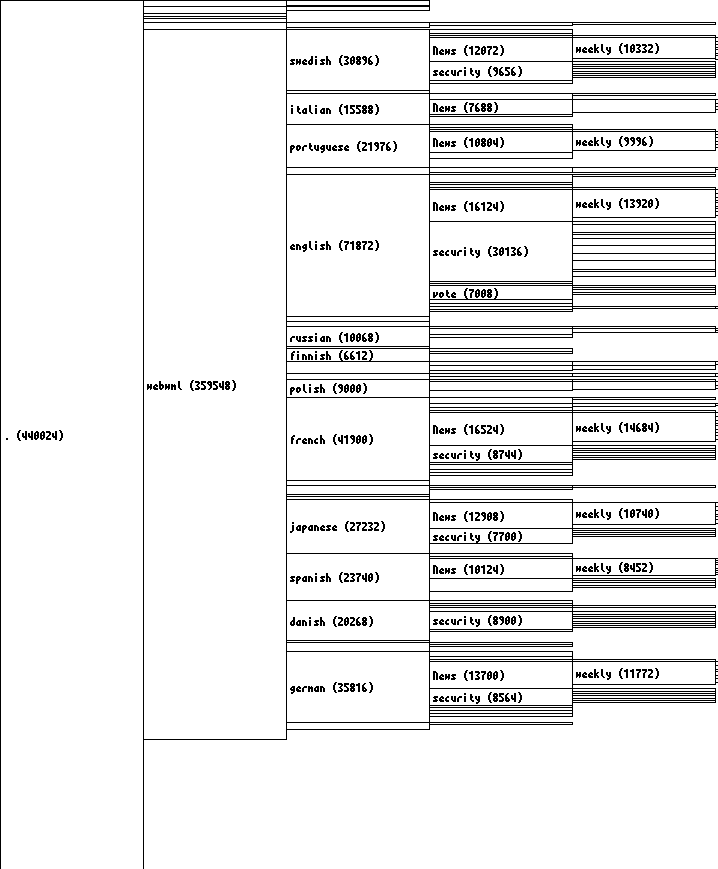
You probably all know du from GNU Coreutils. But there s more than just du around in Debian. du xdu First there is xdu, which displays du output piped into it graphically, even if du is running on some other box with the output coming over an ssh connection:
$ du   xdu
$ ssh server-without-xlibs du some-directory   xdu
Clicking on any directory except the topmost zooms into that directory. Pressing n sorts by size and s toggles the display of sizes in numbers. xdiskusage xdiskusage seems to be a fork of xdu or at least shares some GUI code with it as it looks and behaves quite similar.
But the GUI looks nicer, more modern and you don t need to pipe the output of du into it. It collects the disk usage of a given directory itself. ncdu And then there is ncdu, the ncurses du . (It has nothing to do with the German party CDU . You can easily remember that as Not CDU . ;-) It shows you the disk usage of files and subdirectories in the given directory already sorted by size, optionally displaying also ascii art bars and/or percentage (by pressing g one or more times) for better comparision between file and directory sizes. And all easily and intuitively to navigate in an ncurses text-mode user interface.
ncdu 1.3 ~ Use the arrow keys to navigate, press ? for help
--- /home/abe/debian/webwml ------------------------------------
                             /..
   70.2MB [20.0% ##########] /english
   40.9MB [11.7% #####     ] /french
   35.0MB [10.0% ####      ] /german
   30.2MB [ 8.6% ####      ] /swedish
   26.6MB [ 7.6% ###       ] /japanese
   23.2MB [ 6.6% ###       ] /spanish
   21.5MB [ 6.1% ###       ] /portuguese
   19.8MB [ 5.6% ##        ] /danish
   15.2MB [ 4.3% ##        ] /italian
    9.8MB [ 2.8% #         ] /russian
    8.8MB [ 2.5% #         ] /polish
    6.5MB [ 1.8%           ] /finnish
    5.8MB [ 1.6%           ] /chinese
    4.4MB [ 1.3%           ] /catalan
    4.3MB [ 1.2%           ] /dutch
    3.7MB [ 1.0%           ] /korean
    3.4MB [ 1.0%           ] /ukrainian
    3.0MB [ 0.9%           ] /czech
    2.6MB [ 0.7%           ] /croatian
    2.6MB [ 0.7%           ] /bulgarian
    2.4MB [ 0.7%           ] /norwegian
    1.7MB [ 0.5%           ] /hungarian
    1.6MB [ 0.4%           ] /romanian
    1.2MB [ 0.3%           ] /greek
    1.2MB [ 0.3%           ] /turkish
    1.1MB [ 0.3%           ] /slovak
  576.0kB [ 0.2%           ] /Perl
  556.0kB [ 0.2%           ] /arabic
  428.0kB [ 0.1%           ] /lithuanian
 Total disk usage: 351.1MB  Apparent size: 351.1MB  Items: 70653                                                      
And yes, I uploaded the two screenshots shown above also to screenshots.debian.net as both tools had no screenshots available yet.

Next.

Previous.