Search Results: "ana"

8 July 2010

Biella Coleman: Debian in the World: Buidling an Institution vs Managing a Crowd

So there are times that I think of course anyone remotely interested in Free Software, virtual projects, and similar endeavors knows about Debian and its strange rituals. I am pretty mistaken, actually. Recently I have attended various events where it has been made clear to me that there are hordes of folks interested in the politics of openness, access, and free software who have heard about Debian but don t really know what it takes, socially and politically, to manage such a project. Luckily I had the chance to spread some of the esoteric knowledge during a talk at MIT for the Knight News Challenge winners and I have received many emails, excited and some surprised about the governance structures of Debian. If interested, here is a video of my talk, which is quite short, so I don t go into as much detail as I would like. There is a great audio quote from a Debian developer, taken from this class visit for which there is a podcast and which I recommend as well. If you can t play flash, you can download the a video of the talk here (look at the right hand side of the page for download link). update: Interesting blog post on Why the open source way trumps the crowdsourcing way that explores some of the issues I raise in the panel talk. I don t think it always trumps open source but it is certainly a niche form of production that is useful in some cases but all too often confused with expert peer production in quite unproductive and empirically wrong ways.

Aigars Mahinovs: Phoning it in

Currently I own and use an iPhone 3G. I bought it almost two years ago, when the local phone provider LMT started offering the iPhone legally. I had a pretty good experience with it most of the time, but now it is showing its age: I will try to send my iPhone in for repair hoping to extend its usefulness, but frankly it looks that I might have to get a new phone at or before Debconf. So I am considering my options for a new phone and so far I have 3 main options each with some sub-options. The main options are: iPhone 4, MeeGo and Android. Each choice has its benefits and drawbacks and each also has several sub-options related either to specific phone models or to purchase methods. What I need is a phone with: calling function, contact information synchronised to Google, support for Google Mail/Contacts/Calendar simultaneously with one Exchange account also providing mail/contacts/calendars, music, audiobooks saving my place in the audio book and in the list of books, fully featured Twitter client with Twitpic and location support, encrypted password storage application (preferably open source), GPS with maps, ability to download maps for offline use, Geocaching support with offline cache info and logging, Skype client, ability to write in Latvian, English and Russian in all applications, reliable backup and restore of phones data including settings and data of installed apps. Optional features: last.fm streaming and reporting support, ebook applications with purchasable ebooks, high quality video and photo recording (for a phone), ability for me to write applications on the phone, ssh client, wireless data upload to the phone, ability to change the phones battery without loosing data in the phone (on the go), compass, physical keyboard, confidence in getting software upgrades and developer interest for the next 2 years. I ll try to describe all of the options here to organise my thoughts and maybe also help someone else make the choice. Option 1: iPhone 4 To get the iPhone 4 I have two options: LMT and unlocked. The official arrival of iPhone 4 to Latvia is expected in September and it will likely be sold by LMT for the same prices as iPhone 3GS is now. If I choose this scenario, I will need to survive with my semi-broken iPhone for 2-3 more months. Total price over 2 years (LVL): 131 (purchase price) + 24 * 8 (surcharge) = 323 LVL. Note: the surcharge is the extra cost of the iPhone call plan compared to a comparable regular plan (Vien dais 7 + Internets telefon 5). If I go and purchase an unlocked iPhone 4 in a country where such units are sold (UK is the most easily accessible choice, because a few of my workmates travel weekly to and from UK) then the total price over 2 years would be the purchase price: 499 GBP + 65 GBP (2 year warranty extension) = 505 LVL Now lets go over the general benefits and downsides of the iPhone 4, first the positives: Drawbacks: Option 2: Maemo/MeeGo Some of my colleagues at work (in the Riga office of Accenture) have N900 phones and I have been exposed to people with raw enthusiasm towards the Maemo platform ever since the Debconf in Helsinki, where we saw the first N700 devices in the hands of some lucky Debian/Nokia people using it as an Internet tablet. N900 has been a strong leap forward for the platform, before its head was teleported sideways by the whole MeeGo merger/debackle. Again I have two options here: Get a N900 either here in Latvia for 325 LVL (that would be the total cost over 2 years) or get it from USA during Debconf for 399 USD (+129 USD for 2 year warranty) = 317 LVL. And additional option would be to wait until October/November and then buy the new Nokia MeeGo device, rumoured to be N9-00 and likely to be around the same price as N900 was when it was introduced (around 500 LVL). Benefits: Drawbacks: Option 3 Android After looking trough the options for Android phones, I ve narrowed the selection to the ones that are either available from local carriers or can be easily gotten unlocked also the phones need to have announced plans to have at least Android 2.2 version. Currently the choice is limited to HTC Desire (from carrier or unlocked) and Samsung Galaxy S (unlocked). The prices over 2 years break down as follows: HTC Desire (locked to LMT): 69 + 9*24 = 285 LVL
HTC Desire (locked to Bite): 199 + 2*24 = 247 LVL (Note: only 500Mb of data per month available)
HTC Desire (locked to Tele2): 179 + 6*24 = 323 LVL
Note: all the above options would also require me to pay a 45 LVL early termination fee on my current iPhone contract if I choose to do this before September.
HTC Desire (unlocked): 311 LVL
Samsung Galaxy S (unlocked): 350 LVL (import from Germany) Benefits: Drawbacks: Please correct me if I am wrong with something!!! And also it would be cool if you expressed your own opinions in the comments. Currently I am very undecided about what I am going to do, but after completing this entry I am leaning towards an unlocked HTC Desire. Update:
Olivier Cr te shares a N900 vs. Nexus One experience Edit 01-07-2010: Handed my iPhone in for a warranty repair, got a dumbphone Nokia as a loaner during repairs. Very surprised about how long a battery can last on a low powered and cheap phone. In the mean time from all the comments here and elsewhere I am starting to see that I am too annoyed with the iPhone platform (mostly iTunes) to stay there and that I am also not convinced in the direction MeeGo is going (a lot of community developers are annoyed and are jumping ship), so N900 is also out. I will need to see 2-3 MeeGo smartphones and also see how Nokia will treat their smartphone users and developers on this platform, in the long term, before I ll be ready to trust them with my money. Therefore, my choice is becoming pretty clear look for the best Android phone (after my iPhone dies). We have this thing at Accenture, where we can get company phones at a discount and HTC Desire is on that list. If I can get that, it would slash 100 LVL (almost a third of the price!) off it, but to get there I either need to get a promotion (rather rare after just one year with the company) or prove the necessity of the phone for the needs of my project (kinda hard currently). Well, the situation will be a bit clearer next week when I get my iPhone back. (Apparently the Latvia s largest holiday Midsummer Festivities or J i/L go with tons of traditional outdoor activities, caused a lot of phones to become broken and there is a backlog of warranty service :) ) So at this point my plan is: get my iPhone repaired and get a promotion or a project where I can justify a company-paid HTC Desire and then hope that Nokia/Intel really get their stuff together and make MeeGo a great smartphone platform over the next year or two. Update: Got my iPhone 3G back from the warranty . It is in quotes because they just gave me a new iPhone 3G. The battery lasts for 3 days of minimal use and it has not crashed yet. The recovery process was a pain again caused by iTunes: iTunes refused to restore my backup onto the new phone, because my backup was made on a iOS 4.0, while the new phone I got from the warranty has 3.1.3 on it. So I had to set this phone as a new phone, initialise it, make a backup, upgrade to 4.0, restore from the (empty) backup, then reset the phone to factory settings again and only then I could start restoring data from my original (pre-warranty) backup and start copying my data on to the device. All in all it took nearly 3 hours if iTunes doing something and almost a dozen reboots of the phone. Almost half of that time was spent doing completely unnecessary steps to work around the fact that iTunes is braindead. I ll continue using my iPhone for now, keeping my eyes on the newest Android phones and also waiting for the long-promised first MeeGo phone from Nokia.

Michael Prokop: Report from FAI developer workshop 07/2010

Last weekend (2010-07-02 2010-07-04) nine people met at the FAI developer workshop at Linuxhotel in Essen/Germany. If you can t remember: FAI is a non-interactive system to install, customize and manage Linux systems and software configurations on computers as well as virtual machines and chroot environments, from small networks to large-scale infrastructures and clusters. The participants of the FAI meeting: picture of participants of the FAI developer workshop 2010 second row from left to right: Michael Goetze, Michael Prokop, Andreas Schuldei
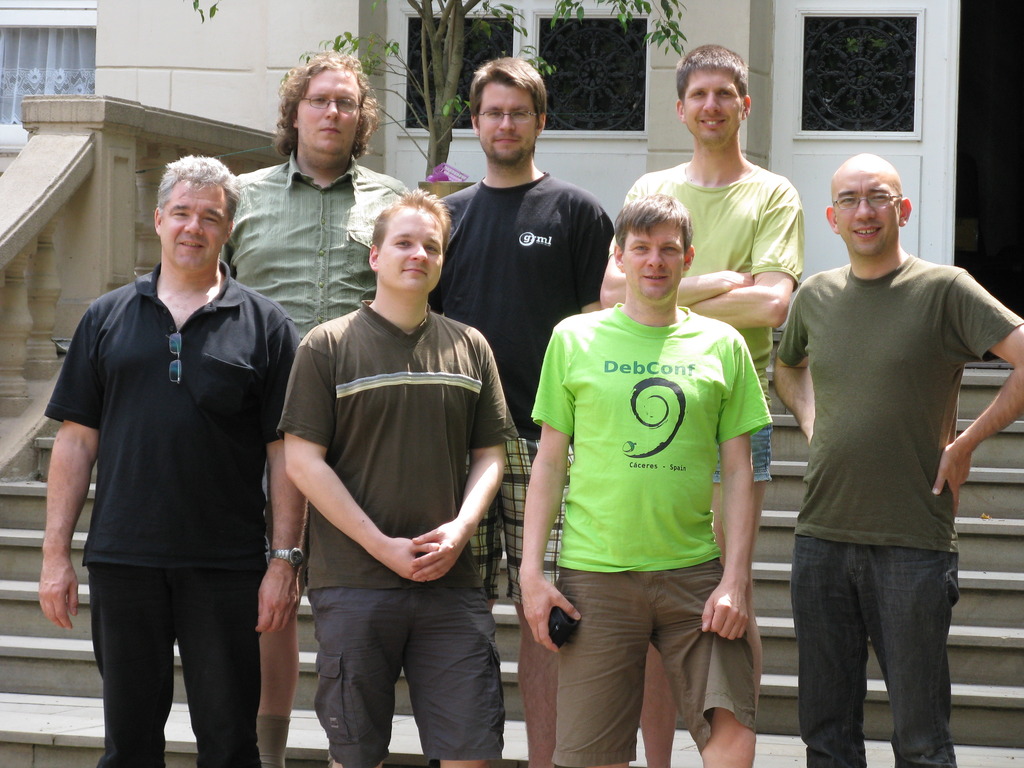
first row from left to right: Sebastian Hetze, Manuel Hachtkemper, Thomas Lange, Mattias Jansson
missing on the picture: Thomas Neumann (left on sunday midday) and Stephan Hermann (only part-time) Friday afternoon started with getting to know each other, continuing with discussions all around FAI. On saturday we started to hack on FAI. * Between the hack sessions and discussions the attending people presented their FAI usage and approaches. Some notes from the presentations:
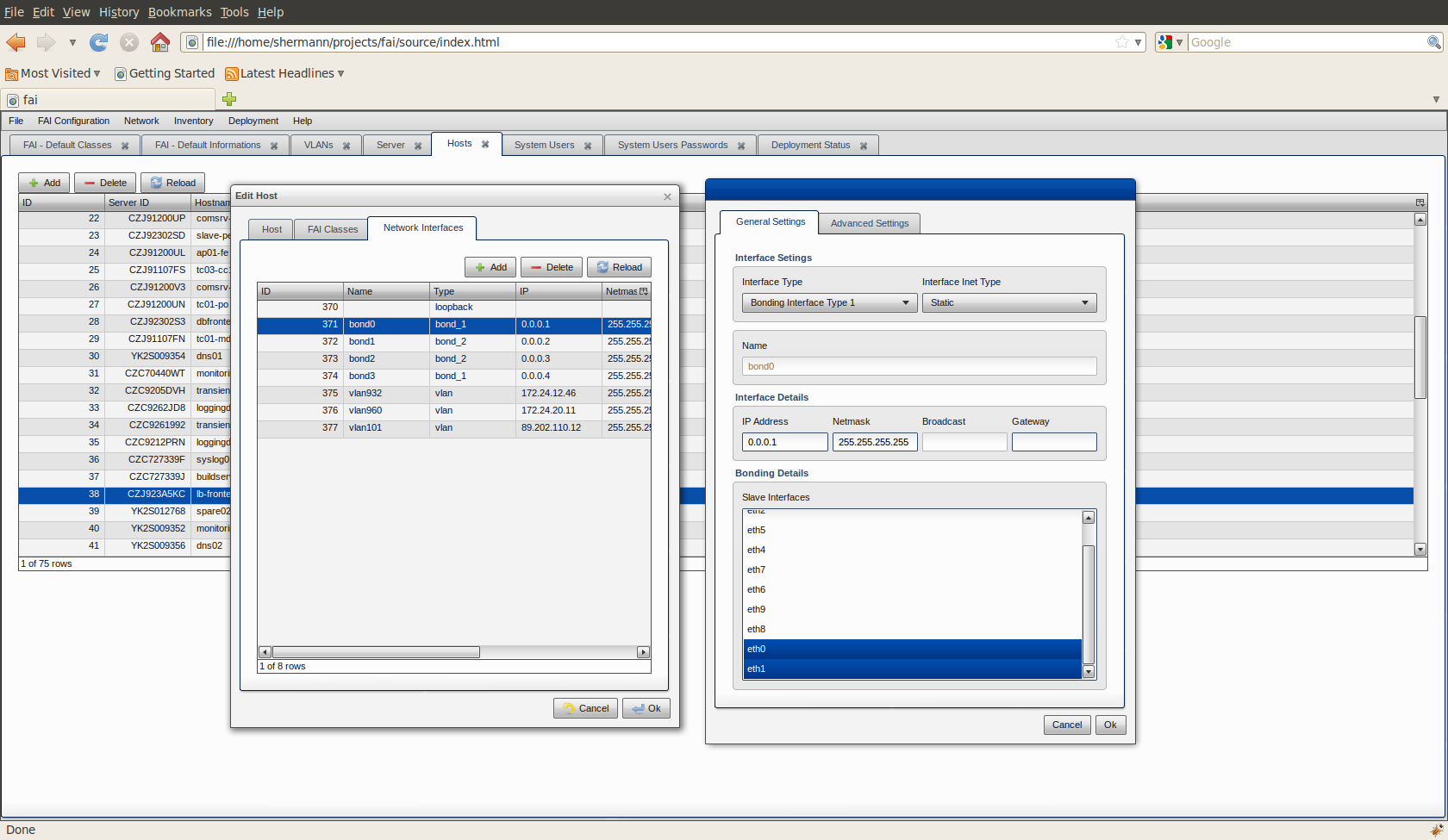
FAI Manager webfrontend / Stephan Hermann Stephan \sh Hermann presented his FAI web frontend which should be released under the GPL license in those days. The frontend uses qooxdoo whereas the backend is based on django, rpc4django and python-tftpy. Screenshot of FAI manager webfrontend A demo video is available at blip.tv. Currently Stephan is searching for a nice name for his FAI management tool please send suggestions either to him or to the linux-fai-devel mailinglist. Grml / Michael Prokop Grml is a Debian based Linux live system specially made for system administrators. Grml uses grml-live for building the ISOs, whereas grml-live itself uses FAI s dirinstall feature to build the live system. This provides the Grml team with a nice way to autobuild 18 ISOs per day, known as daily.grml.org. Mika also presented Grml s netscript bootoption and the ethdevice bootoption of live-initramfs which is useful for booting Grml/FAI via PXE. Host Europe / Michael Goetze Host Europe uses FAI for installing Debian and Ubuntu (32+64 bit) in the support center. They have ~20 FAI classes and use a Debian lenny NFSROOT as base for all deployed systems. Their main problems with FAI aren t related to FAI itself, but instead e.g. broadcom NICs with lack of support for it in Lenny s kernel. They are not using softupdate (yet) and currently use Kickstart for deploying CentOS but are working on deploying CentOS with FAI as well. LIS AG / Sebastian Hetze Linux Information Systems AG (LIS AG) are using FAI 3.2.17 and provide a luma and PyQt based GUI to their customers. They use DHCP, LDAP and DDNS for inventory, configuration and deployment. Mathematical Institute of the University of Bonn / Manuel Hachtkemper The Mathematical Institute of the University of Bonn uses FAI 3.1.8 and 3.3.5 for managing ~150 systems. They are automatically running softupdates every day, reporting how many hosts actually did run the softupdate and how many didn t run. The involved failogwatch tool supports two regex files, one for excluding specific hosts and the other one for grepping for known problems in the logs. Spotify / Andreas Schuldei + Mattias Jansson Spotify is a peer-to-peer music streaming service and the operating people at Spotify use FAI for deploying the systems. Currently they are using FAI 3.3.3 to deploy ~400 bare metal machines and ~150 virtualised machines. They have their class names in DNS using the txt/Text record entry. They are using a self written prepend_class script to manage dependencies between classes. University K ln / Thomas Lange Thomas uses FAI s trunk version (of course :) ), managing ~25 machines with less than 20 FAI classes. He s not using softupdates as Lenny s aptitude ignores the hold status of packages (this bug should be fixed for Squeeze). $COMPANY One of the big telecommunication providers in Germany uses FAI 3.3.3 for installing their bare-metal and virtual servers, providing Debian, Ubuntu and SLES. They are using Debian NFSROOT as a base for all systems as well and their main problems with FAI wasn t FAI itself but how to manage installation of virtual machines.
On Saturday evening we had a nice barbecue which included beer and K lsch *d&r*. ;) On Sunday we continued with discussions and development. Our work-log of the weekend: Important decisions made: We noticed that many FAI users implement their own way how to handle dependency management between classes, we will re-consider how we could provide such a mechanism through FAI s core. We also noted that it s important that any self-written scripts used within FAI are fully idempotent and users should be aware of this. Last but not least many thanks to the sponsors of the FAI developer workshop 07/2010! The workshop wouldn t have been possible without our generous sponsors, namely being:

7 July 2010

Clint Adams: Lack of proper shame

Some time ago, someone posted to a development mailing list about a piece of code, Cc:ing some people who had modified the code in recent past. Within hours, the original author replied to complain about not being Cc'd. Several thoughts went through my mind: This is Free Software, and people are motivated by all kinds of factors. Some bad reasons include Looking at it through an Open Source lens, all these bad reasons are good reasons. For whatever motives, people are getting work done and accomplishing things. Of course, there are always an irritating number of hangers-on, and people who do not actually achieve much but are filled with such self-importance that they believe they deserve to be highly influential through sheer force of will, and the majority of the Community will concede this influence to them due to a variety of flaws in the Human Condition, but I digress. It would be nice if everyone had motives that were pure and good, especially since at least 90% of problems in Free Software projects are due to ego issues, but when the world works, the world works. So I am happy to get code contributions for whatever reason (assuming there are no strings attached). The problem I have is when people insist that their bad reasons are legitimate and should be catered to and accommodated by others.

Clint Adams: ARMfested

I am staring at three different plug computers and wondering how many more will appear. They are in varying states of Debianness: all are running squeeze, but the GuruPlug is the only one that's pure . The SheevaPlug is running a wacky version of U-Boot, because the u-boot package in Debian can't cope with the SD card device. Hopefully this can be fixed some year. Worse yet is the FreeAgent DockStar, which is running a foreign kernel and two (TWO) foreign U-Boots (the first one chains to the second one which then boots off a USB stick). Unfortunately I'm afraid to correct these things because, unlike the other two, it is not a developer board, and messing it up would mean trying to deal with 3.3V RS-232 or something equally unpleasant. As it is, bricking one of the plugs where I actually have serial/JTAG causes enough emotional turmoil.

Clint Adams: Lazy backup

% sudo fw_printenv sed 's/^/sudo fw_setenv /;s/=/ "/;s/$/"/;'
sudo fw_setenv bootcmd "setenv ethact egiga0; $ x_bootcmd_ethernet ; setenv ethact egiga1; $ x_bootcmd_ethernet ; $ x_bootcmd_usb ; $ x_bootcmd_kernel ; setenv bootargs $ x_bootargs  $ x_bootargs_root ; bootm 0x6400000;"
sudo fw_setenv bootdelay "3"
sudo fw_setenv baudrate "115200"
sudo fw_setenv x_bootcmd_ethernet "ping 192.168.2.1"
sudo fw_setenv x_bootcmd_usb "usb start"
sudo fw_setenv x_bootcmd_kernel "nand read.e 0x6400000 0x100000 0x400000"
sudo fw_setenv x_bootargs "console=ttyS0,115200"
sudo fw_setenv x_bootargs_root "ubi.mtd=2 root=ubi0:rootfs rootfstype=ubifs"
sudo fw_setenv stdin "serial"
sudo fw_setenv stdout "serial"
sudo fw_setenv stderr "serial"
sudo fw_setenv ethact "egiga0"
sudo fw_setenv ethaddr "00:99:99:99:99:99"
sudo fw_setenv eth1addr "00:99:99:99:99:98"

6 July 2010

Matt Zimmerman: We ve packaged all of the free software what now?

Today, virtually all of the free software available can be found in packaged form in distributions like Debian and Ubuntu. Users of these distributions have access to a library of thousands of applications, ranging from trivial to highly sophisticated software systems. Developers can find a vast array of programming languages, tools and libraries for constructing new applications. This is possible because we have a mature system for turning free software components into standardized modules (packages). Some software is more difficult to package and maintain, and I m occasionally surprised to find something very useful which isn t packaged yet, but in general, the software I want is packaged and ready before I realize I need it. Even the long tail of niche software is generally packaged very effectively. Thanks to coherent standards, sophisticated management tools, and the principles of software freedom, these packages can be mixed and matched to create complete software stacks for a wide range of devices, from netbooks to supercomputing clusters. These stacks are tightly integrated, and can be tested, released, maintained and upgraded as a unit. The Debian system is unparalleled for this purpose, which is why Ubuntu is based on it. The vision, for a free software operating system which is highly modular and customizable, has been achieved. Rough edges This is a momentous achievement, and the Debian packaging system fulfills its intended purpose very well. However, there are a number of areas where it introduces friction, because the package model doesn t quite fit some new problems. Most of these are becoming more common over time as technology evolves and changes shape. Why are we stuck?
I suppose it is tempting, if the only tool you have is a hammer, to treat everything as if it were a nail.
Abraham Maslow
The packaging ecosystem is very strong. Not only do we have powerful tools for working with packages, we also benefit from packages being a well-understood concept, and having established processes for developing, exchanging and talking about them. Once something is packaged, we know what it is and how to work with it, and it fits into everything else. So, it is tempting to package everything in sight, as we already know how to make sense of packages. However, this may not always be the right tool for the job. Various attempts have been made to extend the packaging concept to make it more general, for example: Other package managers aim to solve a specific problem, such as providing lightweight package management for embedded systems, or lazy dependency installation, or fixing the filesystem hierarchy. There is a long list of package managers of various levels which solve different problems. Most of these systems suffer from an important fundamental tradeoff: they are designed to manage the entire system, from the kernel through applications, and so they must be used wholesale in order to reap their full benefit. In other words, in their world, everything is a package, and anything which is not a package is out of scope. Therefore, each of these systems requires a separate collection of packages, and each time we invent a new one, its adherents set about packaging everything in the new format. It takes a very long time to do this, and most of them lose momentum before a mature ecosystem can form around them. This lock-in effect makes it difficult for new packaging technologies to succeed. Divide and Conquer No single package management framework is flexible enough to accommodate all of the needs we have today. Even more importantly, a generic solution won t account for the needs we will have tomorrow. I propose that in order to move forward, we must make it possible to solve packaging problems separately, rather than attempting to solve them all within a single system. But I like things how they are! We don t have a choice. The world is changing around us, and distributions need to evolve with it. If we don t adapt, we will eventually give way to systems which do solve these problems. Take, for example, modern web browsers like Firefox and Chromium. Arguably the most vital application for users, the browser is coming under increasing pressure to keep up with the breakneck pace of innovation on the web. The next wave of real-time collaboration and multimedia applications relies on the rapid development of new capabilities in web browsers. Browser makers are responding by accelerating deployment in the field: both aggressively push new releases to their users. A report from Google found that Chrome upgrades 97% of their users within 21 days of a new release, and Firefox 85% (both impressive numbers). Mozilla recently changed their maintenance policies, discontinuing maintenance of stable releases and forcing Ubuntu to ship new upstream releases to users. These applications are just the leading edge of the curve, and the pressure will only increase. Equally powerful trends are pressing server applications, embedded systems, and data to adapt as well. The ideas I ve presented here are only one possible way forward, and I m sure there are more and better ideas brewing in distribution communities. I m sure that I m not the only one thinking about these problems. Whatever it looks like in the end, I have no doubt that change is ahead.

5 July 2010

Marco Túlio Gontijo e Silva: Immix on GHC Summer of Code weekly report #8

My project. This post assumes that the reader has read my last post. This week I could get my focus on the project again, since most of my classes are already over. I ve investigated the segfault that was happening in GHC with +RTS -w -DS, and I noticed that the code in rts/sm/Sanity.c assumed that all objects in the allocated area of the block are being used.
    for (; bd != NULL; bd = bd->link)  
	p = bd->start;
	while (p < bd->free)  
	    nat size = checkClosure((StgClosure *)p);
	    /* This is the smallest size of closure that can live in the heap */
	    ASSERT( size >= MIN_PAYLOAD_SIZE + sizeofW(StgHeader) );
	    p += size;
	    /* skip over slop */
	    while (p < bd->free &&
		   (*p < 0x1000   !LOOKS_LIKE_INFO_PTR(*p)))   p++;  
	 
     
Since this is true for copy collection and mark compact, it was only with mark sweep that the error happened. The only way I could manage to make the segfault disappear by now was marking the swept blocks with a new flag, and avoid running this code in them. So I went back to my old problem with the allocation of memory in lines. I noticed that (one of) the problem(s) may be that the object that is allocated in the free line is not scavenged after the evacuation. When the object is allocated in a block, using the current allocation method, it will eventually be scavenged, because all blocks that were being used to allocation are scavenged. I m planning to implement a list of lines that need to be scavenged and code to scavenge the lines in this list, and the current line. It ll be very similar to the code that does this with blocks.

4 July 2010

Bernd Zeimetz: gimp-plugin-registry 3.5-1

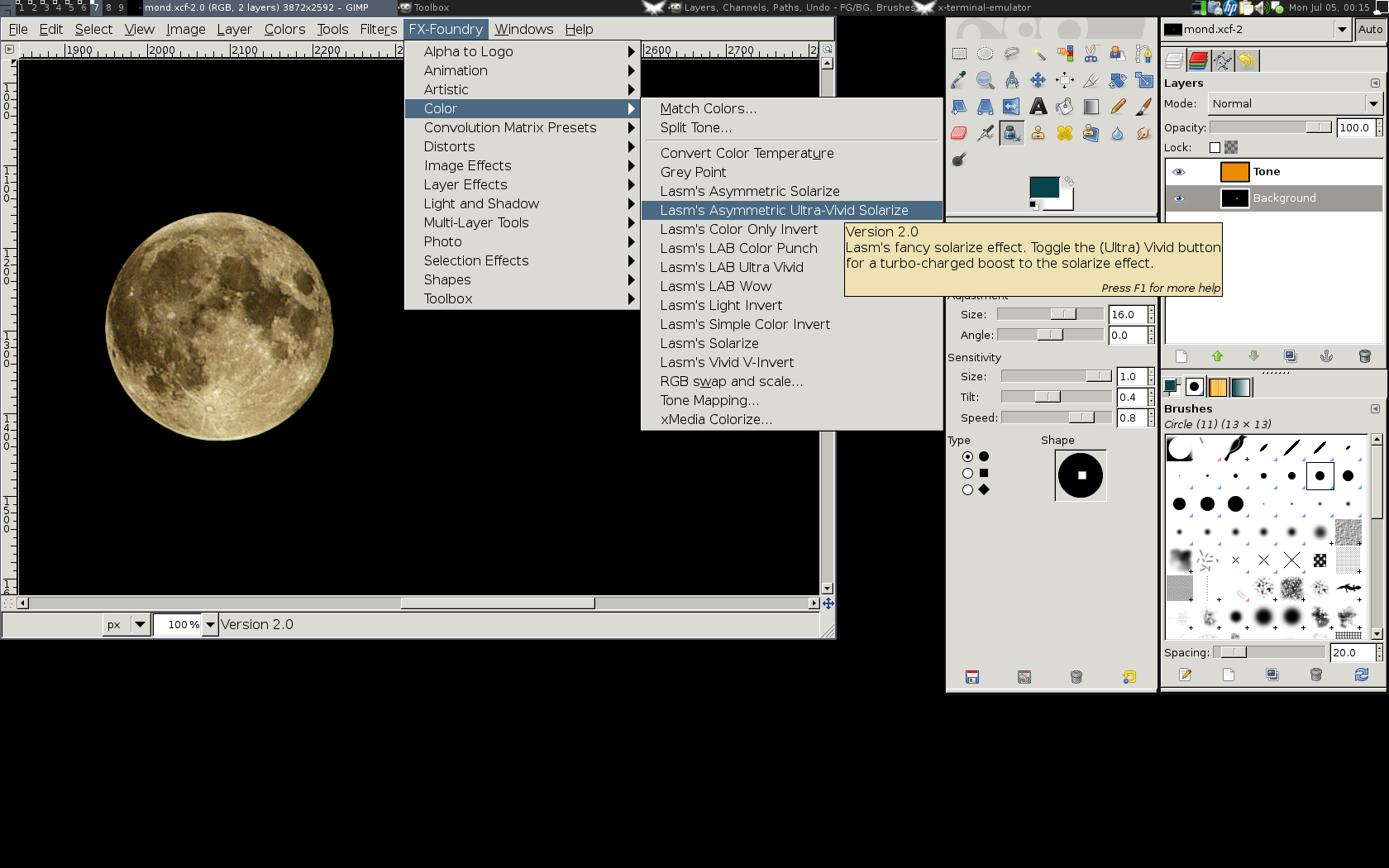
During the last three months and since my last blog-post about gimp-plugin-registry a lot happened: Mainly a large number of new plugins was added, but also various enhancements and bugfixes went into the package, together with updates for various already included plugins. The GIMP screenshot with open FX-Foundry menu For those who don't know gimp-plugin-registry yet, it is a collection of scripts and plugins for The GIMP. The name is based on the webpage GIMP Plugin Registry, where most (new) plugins and scripts are listed. So far the package ships with 170 scripts/plugins. Most of the scripts are written in TinyScheme, but there are also several plugins in C or Python. Probably most noticeable is the inclusion of the GIMP FX Foundry, which is an awesome collection of 124 scripts. Below follows a list of all scripts and plugins as shown in the long description of the Debian package. New plugins are marked with a bold fontface. If there is any interest from other distributions to include the package, I'd be happy to help out to make an integration as easy as possible. The few interesting parts could be ripped out of debian/rules and shipped as a normal Makefile, so they could be used easily. More complicated is the generation of the package description and copyright information, but I guess instead of writing debian/coyright and debian/control, it should be possible to integrate the information into a rpm spec file template or similar files. So in case you're interested to port the package to Fedora, OpenSuSE or some other distribution, don't hesitate to contact me! The sources are available via git, see git.recluse.de for details. For wishes, suggestions and bug reports either use the Debian BTS or Launchpad. While I prefer bugs via the BTS, it might be easier for non-Debian users to file bugs in the Ubuntu Launchpad.
Torsten Landschoff: Postprocessing conference videos

I was planning to attend DebConf New York this year, but for a number of reasons I decided not to go. Fortunately, Ferdinand Thommes organized a MiniDebConf in Berlin at LinuxTag and I managed to attend. Thanks, Ferdinand! There were a number of interesting Talks. I especially liked the talk of our DPL, and those about piuparts and git-buildpackage. In contrast to the other LinuxTag talks, we had a livestream of our talks and recorded (most) of them. The kudos for setting this up goes to Alexander Wirt, who spent quite a few hours to get it up and running. I have to apologize for being late in bringing my Notebook, which was intended to do the theora encoding of the livestream. This was a misunderstanding on my part, I should have known that this is not going to be setup in the night before show time So to compensate the extra hours he had to put in for me, I offered to do the post processing of the videos. Basic approach for post processing The main goal of post processing the videos was (of course) to compress them to a usable size from the original 143 GB. I also wanted to have a title on each video, and show the sponsors at the end of the video. My basic idea to implement that consisted of the following steps:
  1. Create a title animation template.
  2. Generate title animations from template for all talks.
  3. Use a video editor to create a playlist of the parts title talk epilogue.
  4. Run the video editor in batch mode to generate the combined video.
  5. Encode the resulting video as ogg theora.
As always with technology, it turned out that the original plan needed a few modifications. Title animations
<video controls="controls" height="288" src="http://www.landschoff.net/blog/uploads/2010/07/mdc2010_title_anim1.ogv" width="360 "></video>
Originally I wanted to use Blender for the title animation, but I knew it is quite a complicated bit of software. So I looked for something simpler, and stumbled across an article that pointed me towards Synfig Studio for 2D animation. This is also in Debian, so I gave it a try. I was delighted that Synfig Studio has a command line renderer which is just called synfig and that the file format is XML, which would make it simple to batch-create the title animations. My title template can be found in this git repository. Batch creation of title animations I used a combination of make and a simple python script to replace the author name and the title of the talk into the synfig XML file. The data for all talks is another XML file talks.xml. Basically, I used a simple XPath expression to find the relevant text node and change the data using the ElementTree API of lxml python module. The same could be done using XSLT of course (for a constant replacement, see this file) but I found it easier to combine two XML files in python. Note that I create PNG files with synfig and use ffmpeg to generate a DV file from those. Originally, I had synfig create DV files directly but those turned out quite gray for some reason. I am now unable to reproduce this problem. Combining the title animation with the talk For joining the title animation with the talk, I originally went with OpenShot, which somebody of the video team had running at the conference. My idea was to mix a single video manually and just replace the underlying data files for each talk. I expected that this would be easy using the openshot-render command, which renders the output video from the input clips and the OpenShot project file. However, OpenShot stores the video lengths in the project file and will take those literally, so this did not work for talks of different play times I considered working with Kino or Kdenlive but they did not look more appropriate for this use case. I noticed that OpenShot and Kdenlive both use the Media Lovin Toolkit under the hood, and OpenShot actually serializes the MLT configuration to $HOME/.openshot/sequence.xml when rendering. I first tried to read that XML file from python (using the mlt python bindings from the python-mlt2 package) but did not find an API function to do that. So I just hard coded the video sequence in python. I ran into a few gotchas on the way: Things to improve While the results look quite okay for me now, there is a lot of room for improvement. Availability

3 July 2010

Petter Reinholdtsen: Lenny->Squeeze upgrades, apt vs aptitude with the Gnome desktop

Here is a short update on my my Debian Lenny->Squeeze upgrade testing. Here is a summary of the difference for Gnome when it is upgraded by apt-get and aptitude. I'm not reporting the status for KDE, because the upgrade crashes when aptitude try because of missing conflicts (#584861 and #585716). At the end of the upgrade test script, dpkg -l is executed to get a complete list of the installed packages. Based on this I see these differences when I did a test run today. As usual, I do not really know what the correct set of packages would be, but thought it best to publish the difference. Installed using apt-get, missing with aptitude
at-spi cpp-4.3 finger gnome-spell gstreamer0.10-gnomevfs libatspi1.0-0 libcupsys2 libeel2-data libgail-common libgdl-1-common libgnomeprint2.2-data libgnomeprintui2.2-common libgnomevfs2-bin libgtksourceview-common libpt-1.10.10-plugins-alsa libpt-1.10.10-plugins-v4l libservlet2.4-java libxalan2-java libxerces2-java openoffice.org-writer2latex openssl-blacklist p7zip python-4suite-xml python-eggtrayicon python-gtkhtml2 python-gtkmozembed svgalibg1 xserver-xephyr zip
Installed using apt-get, removed with aptitude
bluez-utils dhcdbd djvulibre-desktop epiphany-gecko gnome-app-install gnome-mount gnome-vfs-obexftp gnome-volume-manager libao2 libavahi-compat-libdnssd1 libavahi-core5 libbind9-50 libbluetooth2 libcamel1.2-11 libcdio7 libcucul0 libcurl3 libdirectfb-1.0-0 libdvdread3 libedata-cal1.2-6 libedataserver1.2-9 libeel2-2.20 libepc-1.0-1 libepc-ui-1.0-1 libexchange-storage1.2-3 libfaad0 libgd2-noxpm libgda3-3 libgda3-common libggz2 libggzcore9 libggzmod4 libgksu1.2-0 libgksuui1.0-1 libgmyth0 libgnome-desktop-2 libgnome-pilot2 libgnomecups1.0-1 libgnomeprint2.2-0 libgnomeprintui2.2-0 libgpod3 libgraphviz4 libgtkhtml2-0 libgtksourceview1.0-0 libgucharmap6 libhesiod0 libicu38 libisccc50 libisccfg50 libiw29 libkpathsea4 libltdl3 liblwres50 libmagick++10 libmagick10 libmalaga7 libmtp7 libmysqlclient15off libnautilus-burn4 libneon27 libnm-glib0 libnm-util0 libopal-2.2 libosp5 libparted1.8-10 libpisock9 libpisync1 libpoppler-glib3 libpoppler3 libpt-1.10.10 libraw1394-8 libsensors3 libsmbios2 libsoup2.2-8 libssh2-1 libsuitesparse-3.1.0 libswfdec-0.6-90 libtalloc1 libtotem-plparser10 libtrackerclient0 libvoikko1 libxalan2-java-gcj libxerces2-java-gcj libxklavier12 libxtrap6 libxxf86misc1 libzephyr3 mysql-common swfdec-gnome totem-gstreamer wodim
Installed using aptitude, missing with apt-get
gnome gnome-desktop-environment hamster-applet python-gnomeapplet python-gnomekeyring python-wnck rhythmbox-plugins xorg xserver-xorg-input-all xserver-xorg-input-evdev xserver-xorg-input-kbd xserver-xorg-input-mouse xserver-xorg-input-synaptics xserver-xorg-video-all xserver-xorg-video-apm xserver-xorg-video-ark xserver-xorg-video-ati xserver-xorg-video-chips xserver-xorg-video-cirrus xserver-xorg-video-dummy xserver-xorg-video-fbdev xserver-xorg-video-glint xserver-xorg-video-i128 xserver-xorg-video-i740 xserver-xorg-video-mach64 xserver-xorg-video-mga xserver-xorg-video-neomagic xserver-xorg-video-nouveau xserver-xorg-video-nv xserver-xorg-video-r128 xserver-xorg-video-radeon xserver-xorg-video-radeonhd xserver-xorg-video-rendition xserver-xorg-video-s3 xserver-xorg-video-s3virge xserver-xorg-video-savage xserver-xorg-video-siliconmotion xserver-xorg-video-sis xserver-xorg-video-sisusb xserver-xorg-video-tdfx xserver-xorg-video-tga xserver-xorg-video-trident xserver-xorg-video-tseng xserver-xorg-video-vesa xserver-xorg-video-vmware xserver-xorg-video-voodoo
Installed using aptitude, removed with apt-get
deskbar-applet xserver-xorg xserver-xorg-core xserver-xorg-input-wacom xserver-xorg-video-intel xserver-xorg-video-openchrome
I was told on IRC that the xorg-xserver package was changed in git today to try to get apt-get to not remove xorg completely. No idea when it hits Squeeze, but when it does I hope it will reduce the difference somewhat.

Joachim Breitner: Free Groups Formalized

Since a few months, I have been playing around with Isabelle, a theorem prover system. I find it very intriguing to have proofs of mathematical statements checked by something as pendantic and comprehensive as a machine. Mathematicians always claim that their statements are true in all eternity, but the proofs are just checked by error-prone human beings. Especially with complex, large proofs that are only read by a handful of people, I doubt that these are always fully correct. Note that this does not imply that I doubt that the results are correct. They probably are. But a bit of doubt remains. A computer-checked proof, in contrast, can not accidentially omit corner cases, leave out seemingly trivial assumtions of used theorems or be misled by slightly differing definition from different sources. I was hoping to check at least parts of my diploma thesis using Isabelle, but it turns out that the standard algebra library shipped with Isabelle is not complete enough. Even free groups were missing. This was motivation enough to try to formalize them and prove the universal property and some isomorphisms (The free group over the empty set is the unit group, the free group over one generator is the additive group of integers and free groups over sets of same cardinality are isomophic). I submitted the resulting theory to the Archive of Formal Proofs and it was accepted. You can view the complete document or the document without proofs. I did not formalize the fact that isomorphic free groups have bases of same cardinality. As far as I know there is no simple argument that works directly with free groups. The proofs I have seen pass to the abelianization of the free group, i.e. the free module over and apply the well known proof from the analogous statement about vector spaces. But if someone knows an elementary proof of this fact, I d like to hear about it.

2 July 2010

Alexander Reichle-Schmehl: Release Critical Bug report for Week 26

The inofficial rc bug tracker currently knows about the following bugs:
In Total:498
Affecting Squeeze:397
Squeeze only:72
Remaining to be fixed in Squeeze:325
Of these 325 bugs, the following tags are set:
Pending in Squeeze:22
Patched in Squeeze:50
Duplicates in Squeeze:51
Contrib or non-free in Squeeze:12
Claimed in Squeeze:4
Delayed in Squeeze:11
Can fixed in a security Update:30
Otherwise fixed in Squeeze:31
Ignoring all the above (multiple tags possible), 166 bugs need to be fixed by Debian Contributers to get Debian 6.0 Squeeze released. However, the with the view of the Release Managers, 306 need to be dealt with for the release to happen. Please see my older post for an explanation of the different numbers.

30 June 2010

Anand Kumria: Vodafone and Talktalk billing

Another day, another bill Like most countries, the UK has been valiantly trying to force consumers to reduce their paper usage. Let's set aside the fact that most paper is not generated by consumers. And that, it isn't about reduce usage but reducing expenses relating to delivery of this paper. Let's us also leave aside the fact that most airlines want consumers to print out their boarding cards at home. Because it reduces expenses incurred in maintaining staff at airport check-in counters. Anyway, most communications providers have taken up this challenge by making it more expensive to obtain a paper bill. But I don't want a paper bill, per se, what I am really after is a copy of the bill I can keep for my own records. And print if I so need to. Both Vodafone and Talktalk will send you notifications, via email, that you have a bill. But neither of them allow you to obtain a copy of the PDF that would have been printed and sent to you. Instead you have to fart-arse around with their systems to get (at best) a CSV file. Why, oh why, can neither of them just send the PDF that was going to be generated? That have a bill run process anyway, it generates the PDF, sends the emails, and then promptly discards the PDFs. That would mean I have an immediate archive of all my bills from both companies in my email. Just Broken.

27 June 2010

Martin-&#201;ric Racine: How much does Free Software influence my career prospects?

Funny how life brings those A-HA moments in the least probable of circumstances. Take my career's development, for instance. I'm currently taking a training to become a government bureaucrat. During this training, each student goes through a thorough skill assessment to help the trainer select an appropriate training place in some government office. Asides from covering the obvious aspects of formal education and employment history, we also reviewed achievements and accumulated skills. My A-HA moment came as a result of our trainer asking me to completely rewrite my CV to match some known template. Additionally, she requested that I emphasize my technology background more. I countered by pointing out that the word "technology" tends to mean "engineer" to the average employer and yet I've have always been in Product Management or Business Development, which are more Sales-oriented roles than anything else, hence why I emphasize the Sales aspect and deflate the technology aspect in my CV. Still, while she conceded that difference in emphasis, she insisted that having worked in technology probably influenced my skills or my preferred workflow in one way or another. At the moment, I simply could not think of how it might have. Boy, was I wrong! Where do I begin? First of all, it dawned onto me that I simply cannot claim to know Microsoft Office anymore. Until recently, my Open Office skills were easily applicable to Microsoft Office, because Open Office borrowed a lot of concepts from its Microsoft counterpart. However, following the recent redesign of Microsoft Office, I found that I cannot navigate my way around Microsoft Word's menus anymore. While this new user interface paradigm indeed removes a lot of clutter, it also hides too many features in less than obvious places, which resulted in me concluding that I simply have to downgrade my Microsoft Office skills to medium. Given the progressive conversion of several Finnish agencies and ministries to Open Office, I'm not in such an uncomfortable position but, then again, other agencies and ministries fiercely cling on to their Microsoft licenses and have recently upgraded them. As such, should my practical training take place in one of those offices, I would essentially be unable to perform at my job. Redeeming factor: a friend who only knows Microsoft products faced similar frustrations last year when she got back from her summer vacations, after she realized that their network administrator had upgraded her workstation. It took her the whole autumn before she felt comfortable using Word again. Another aspect of working in Free Software that influences my workflow: telecommuting and teleworking. As anyone working on Free Software projects knows, teams tend to be distributed around the globe, which means that there's always someone somewhere pushing a commit or answering bug reports, at any given time of the day. Simultaneously, work quickly becomes location-independent and flexible schedules are the norm; whatever and wherever works for a given developer, as long as the work gets done. Without anyone really noticing, this work methodology has permeated the whole technology ecosystem, even at fortune-500 companies. Employees come in and out of the office at whichever time suits them, while others choose to work from home and only show up whenever face-to-face meetings are called. Others even adopt a nomad lifestyle, constantly roaming the globe for adventures and connecting to the office network via VPN, from the comfort of their hotel room or from a friend's couch, on the other side of the globe. In my case, having twice worked for Estonian companies while living in Finland, it meant taking the ferry twice a week to visit the office. This brought in more benefits than one might initially think: first of all, the quick walk between the metro station and the harbor in Helsinki meant that I arrived on the ferry with blood pumping adrenaline and fully alert. Being on the ferry gave me 2 hours of quiet time to grab my first coffee and plan my day. Getting out of the ferry in Tallinn meant another quick walk, this time between the harbor and the tramway. By the time I arrived at the office, I had exercised twice and planned all my workday. It's probably the most productive that I've ever been in my whole career. Additionally, I was frequently on the road, meeting customers and following on sales leads, which meant that I got to close many deals using my laptop in my hotel room. As our CEO used to joke, "I have no idea where in the world Martin- ric is today but, just as long as the purchase orders keep on pouring in, it's all the same to me." As a result of this reflexion, I had to explain to our trainer why I am extremely well-suited to government jobs that require a lot of traveling and where Free Software is used on the desktop and, vice-versa, extremely unsuited to back-office jobs where whatever Microsoft products of the day are the norm. I've had to put particular emphasis on what Open Office is all about, because many homeworks were supposed to be submitted in Microsoft Word format. While Writer indeed offers the option to import and export Microsoft formats, it doesn't come with any WYSIWYG guarantee, which is why I took on the habit of sending her PDF documents. Sadly, this did not always work out so well, especially in cases where the intention was to forward selected parts of a document to third-parties. Conclusion: working in the Free Software industry, even in non-engineering roles, indeed has a strong influence on someone's choice of methodology, tools and workflow. In some cases, it can even disqualify someone from making certain career choices. Who would have thought?

Leo 'costela' Antunes: Re: Firefox/Iceweasel/Chromium smart-bookmarks

Neil Williams recently commented on the lack of smart-bookmarks in Firefox/Iceweasel/Chromium and since the post doesn t accept comments, counter-post FTW.
Maybe I didn t understand exactly what was meant, but I m personally trying to see the advantage of having a smart-bookmark sit on the toolbar as opposed to just being a used via a label. Both FF/IW and Chrome can do the label thing, where you bookmark something like http://bugs.debian.org/%s with a shortcut like bugs and can then simply Ctrl-L to the address bar and type bugs 999999 . Done.
Can the way Epiphany does this be more effective? (actually this is the way Galeon did it way back then and I used to love it before I found out I could be way quicker with the keyboard+shortcut thingy. Not to mention having less clutter in the toolbar.) And granted: Chromium s interface doesn t allow the editing of this shortcut and they only work when imported from FF/IW, but I expect this to be fixed eventually. Doesn t make much sense to have such a hidden feature. [UPDATE: nevermind. As handily pointed out by Chris Butler, you can edit the shortcuts under Options Basics Default Search Manage. It might not be the most intuitive of places to put it, but it's there.] As for the rest of the reasons for switching mentioned in the original post, I can certainly see where they re coming from. No real solid counter-arguments there.

Anand Kumria: L'arnac ur (The Heartbreaker)

The setup and premise is fantastic. Alex is a professional in the love game. He job is ensure that people do not end up with the wrong partner. He is good looking, charming, speaks a multitude of languages are swears by a moral code to Never break-up a happy couple. His mission is to break up the seemingly perfect couple Juliette (played by Vanessa Paradis who has a lovely Diastema) and Jonathan (Andrew Lincoln) before they marry in 10 days. Stylish and set in luxurious Monaco. It's damn French. It's damn funny. Plenty of high-tech. spy stuff, drama about loan sharks, lots of dancing and lots of fun, if you get the chance, see this. You'll enjoy it.

26 June 2010

John Goerzen: Perfect use for broken technology: Give it to a 3-year-old

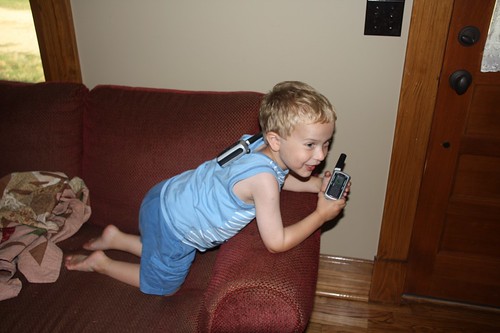
I last wrote about Jacob s new computer back in April. He has had fun with it, but is still a little young to appreciate it a whole lot. It s a fun thing, but not yet a favorite. Yesterday, though, I introduced Jacob to several bits of technology that really got him excited. We have a pair of FRS radios. These are low-power Family Radio Service devices, with a maximum practical range of maybe a mile, and are about as cheap a radio as you can buy that still has any sort of practical use. Anyhow, the receive circuit on one broke. I ordered a pair of TriSquare digital radios to replace them, which are incompatible. So, I have two radios, one with a broken receive circuit. What to do? GIVE THEM TO JACOB! I explained that one radio is the talking radio (the broken one) and the other is the listening radio. Then I demonstrated how I could use the talking radio and he could hear me on the listening radio. That was great fun. I encouraged him to go to the kitchen and see if he could still hear me in the next room. Cackles of laughter gave me the answer. Then he discovered the call button would make the other radio sound like a telephone, which was all the more exciting. He and I took turns with the talking and listening radios. Then I used the belt clip and attached the listening radio to the back of his shirt. I pointed out to him that this was sort of like a loudspeaker. Anything he said into the talking radio while holding town the transmit button would sound louder because it would also come out the radio on his back. Much cackling followed, and he ran around the house yelling MEOW! at the top of his lungs into the radio, then saying, Dad, did you hear THAT? It was VERY loud! He has spent hours listening to himself, listening to me, and generally enjoying life with radios. IMG_4218.JPG Jacob s second discovery was a cassette tape player. Awhile back, Terah rescued an old cassette tape player that was being thrown out, and bought a few 15-cent tapes for Jacob at a thrift store. The idea is that we can just let him play, and not care if he smashes it to bits. He enjoys it, but like the computer, didn t really get excited about it. Until yesterday, when we had this conversation: Me: Jacob, would you like to record your own voice on a tape? Jacob: (excited) Sure! Me: OK, bring me your tape recorder. Jacob: (exasperated) Dad, it s not a tape RECORDER. It s a tape PLAYER. Me: Jacob, it is a tape player, but it s also a tape recorder too. Jacob: (paused for about 5 seconds, then ) Ooooo! That is silly! (scampers off to find it) He found it, and I helped him put some tape over the write-protect tab on a cassette he had. Then he recorded his voice. He eventually figured out the stop, rewind, play, and record buttons with my help. But he s still confused: while he s recording, why doesn t he hear anything? Our first recording had me asking him some questions, and then telling him to press the stop button when he was done. He listened to it dozens of times, and each time my recorded voice asked a question, he answered it a little before his recorded voice did. And each time my recorded voice told him to press the stop button, he would say, I don t want to while his recorded voice asked is this it? He pretty well understands what the radios are about, but doesn t really get the tape recorder yet. Nevertheless, it has just become a far more exciting device in his eyes. Terah has been rolling her eyes at me today as I ve been trying to think up what other broken or old bits of technology we might have that Jacob would enjoy. My latest plan involves adapting his broken old batte
ry-operated fan into some sort of lego-related car. I think he d have fun working on it with me too. All this reminds me of things I did as a kid. My dad worked with a semi-retired man (Herb Miller) that loved to build weird contraptions. One of my favorites was a ball shooter made out of an old vacuum cleaner with a cardboard tube attached to the output spot. I also remember building a motorized car out of an erector set that sort of bent the rules at a school science class project. The idea was to launch a vehicle down a ramp and person whose vehicle went the farthest got a prize. There were no rules against using batteries and a scavenged motor to get that extra little edge over gravity. My car was the only one to manage to crash into the wall on the far side of the gymnasium. The science teacher, in a bit of fast thinking perhaps, announced my car the winner of the electric division. For some reason, I seem to be poised to encourage this sort of thinking in Jacob

Anand Kumria: Get Low

A story about getting people together to tell them a story of regret involving the main character, which we see at the start. The story itself isn't very dramatic. Which is why there isn't a film about that. Instead we have the story about getting people to tell the story. This is a great example of a movie with a mind-boggingly amazing cast (Bill Murray, Robert Duvell, Sissy Spacek, Lucas Black) having a script that is crap. Having the director present, to discuss the film, after the screening lifted this from a 1 to 2. Hearing Aaron talk about the different styles of Duvell, Murray and how the editing process was actually done (Final Cut Pro) was very entertaining. The story drifts, the soundtrack doesn't annoy and the filmography is alright. Oh, the period setting is done very well. Not much else to recommend it though. Get Low refers to burying in the film. Something I think that should have happened to this film.

25 June 2010

Alexander Reichle-Schmehl: Release Critical Bug report for Week 25

The inofficial rc bug tracker currently knows about the following bugs:
In Total:523
Affecting Squeeze:419
Squeeze only:65
Remaining to be fixed in Squeeze:354
Of these 354 bugs, the following tags are set:
Pending in Squeeze:19
Patched in Squeeze:55
Duplicates in Squeeze:51
Contrib or non-free in Squeeze:26
Claimed in Squeeze:6
Delayed in Squeeze:7
Can fixed in a security Update:31
Otherwise fixed in Squeeze:38
Ignoring all the above (multiple tags possible), 170 bugs need to be fixed by Debian Contributers to get Debian 6.0 Squeeze released. However, the with the view of the Release Managers, 316 need to be dealt with for the release to happen. Please see my older post for an explanation of the different numbers.

Next.

Previous.