Search Results: "sto"

20 December 2012

Russ Allbery: WebAuth 4.4.0

WebAuth is a site-wide web authentication system with single sign-on support. We use it extensively at Stanford for most of our user-facing web applications that need to authenticate people. This is the culmination of the last four months of work, so it's rather nice to finally get it out the door. Even if not everything I wanted to get done is done. That's always how it is with software releases. This release fixes a bug in the encoding of delegated Kerberos credentials when Heimdal is used as the Kerberos library. If you're building WebAuth against Heimdal, upgrade any mod_webauth modules that receive delegated credentials before upgrading mod_webkdc on the WebKDC. Otherwise, the flags of delegated tickets won't be sent correctly. The major new feature in this version is support for authorization identities separate from authentication identities. This can be used for testing, for administrators to proxy into an application as another user, or in other cases where there's a mismatch between the canonical concept of users and the capabilities of an application. The WebLogin server and WebKDC now support an ACL file that controls what alternative identities users can assert to specific web sites, and there is a new flow on the WebLogin side to set or change identities. All of this is disbled by default in each component. There is a new WebKDC directive to enable this support and specify the identity ACL file, and there is a new directive in mod_webauth to tell it to trust the authorization identity. There is a new environment variable that will be set to the authorization identity (trusted or not), and REMOTE_USER will be set to the authorization identity only if it is trusted. WEBAUTH_USER will always remain the authentication identity, so both identities can be logged and web applications can distinguish. To address one of the edge cases required by this support, there's a new mod_webkdc Apache directive, WebKdcLoginTimeLimit, which controls how long a multi-step login process can take, and also how recent a login has to be to contribute its authentication factors to the session factors for an authentication. This is also now used for WebAuthForceLogin, which means that forced logins won't require re-authentication if they're within the WebKdcLoginTimeLimit interval of the last login. This allows that feature to work properly in conjunction with authorization identities and with some multifactor authentication methods. Also in this release, optional replay detection and rate limiting of failed logins has been added to the WebLogin server. Either or both can be enabled in the configuration file. This support requires a memcached server (shared across any pool of WebLogin servers) be available to store the necessary state. There are new parameters in the error template to handle the error messages generated by these features. The WebLogin server also has a few more minor improvements: single sign-on cookies are now set even when displaying error pages if any are available, fixing some looping issues with some scenarios around restricting users to authenticate to specific sites, and the @REMUSER_REALMS setting has been broken into two settings so that its two properties can be changed independently. The old setting is still supported for backward compatibility. Multiple bugs in Kerberos ticket encoding have been fixed, some that were introduced in 4.3.0 and some that have been present since the first days of Heimdal support. Other fixes include the mapping of WebKDC error codes to names in WebLogin (which previously resulted in Perl warnings in the error log) and the missing documentation for the WebAuthRequireSSL directive. Finally, the thing that I'm the happiest about in this release is that I finished my complete refactoring of the libwebauth library. Most of the low-level interfaces are gone in favor of higher-level manipulation of WebAuth protocol objects. The last pieces of code that used the old token encoding system have been replaced with the new data-driven encoder. And the last parts of the library have been converted to APR, so there is no longer a mix of traditional memory management and APR pools. This comes with lots of simplification of the API and removal of old cruft from the public headers. You can get the latest release from the official WebAuth distribution site or from my WebAuth distribution pages.

19 December 2012

Paul Tagliamonte: The most horrifying thing i've done -- or: hy

Hang tight folks, this is a trippy one: As many have noted in my most recent post, I ve taken a shine to lisps hosted in Python. While clojure-py is badass, it s not fit for using from python. I hit some problems in the way it handles atomic variable access (well atomic , it s actually not ;) ), so I ve decided to give it a shot myself. That s right. I wrote a Lisp. A very basic, unmacroed lisp, but a lisp. So, let s take a look a trivial hy file pair The first file (really_lisp.hy), is as follows:

; vim: tabstop=2 expandtab shiftwidth=2 softtabstop=2 filetype=lisp
; Copyright (c) Paul Tagliamonte, in sofar as any of this is at all
;  copyrightable.
(def hello "World!")
(def square (fn [arg]
  (* arg arg)))
(def factorial (fn [n]
  (if (<= n 1)
   1
   (* n (factorial (- n 1))))))
(def fib (fn [n]
  (if (< n 2)
    n
    (+ (fib (- n 1)) (fib (- n 2))))))
And, the example Python script example.py is as follows:
import hy.lang.importer
import really_lisp
print really_lisp.hello
# "World!"
print really_lisp.square(4)
# 16
print really_lisp.factorial(10)
# 3628800
print [really_lisp.fib(x) for x in range(1, 20)]
# [1, 1, 2, 3, 5, 8, 13, 21, 34, 55, 89, 144,
#        233, 377, 610, 987, 1597, 2584, 4181]
Please note two awesome things firstly, we re importing a non-python script into a Python module. Awesome. Secondly, we re able to access symbols natively, as well as functions. Let s also demonstrate the other way (just hython this time):
; vim: tabstop=2 expandtab shiftwidth=2 softtabstop=2 filetype=lisp
; Copyright (c) Paul Tagliamonte, in sofar as any of this is at all
;  copyrightable.
(puts "Hello, World!")
; "Hello, World!"
(import ["os"
         "sys"])
(puts (os.path.abspath "."))
; "/home/tag/tmp"
(puts sys.argv)
; ['/home/tag/.virtualenvs/hy/bin/hython', 'test.hy']
(sys.stdout.write "Fuggn' test\n")
; "Fuggn' test"
Naturally, not to be outdone, I decided to amp it up. Django in Lisp While insane, the big stuff looks like this: I ve replaced urls.py with urls.hy:
; vim: tabstop=2 expandtab shiftwidth=2 softtabstop=2 filetype=lisp
(import ["django.conf.urls"])
(def urlpatterns (django.conf.urls.patterns ""
  (django.conf.urls.url "^$" "djlisp.hellisp.views.home")
))
And, views.py with views.hy:
; vim: tabstop=2 expandtab shiftwidth=2 softtabstop=2 filetype=lisp
(import ["django.shortcuts"])
(def home (fn [request]
  (django.shortcuts.render_to_response "home.html"  )))
And lastly, the settings.hy file. I m not going to paste it because it s huge. But, it works!

18 December 2012

Petter Reinholdtsen: Ledger - double-entry accounting using text based storage format

A few days ago I came across a blog post from Joey Hess describing ledger and hledger, a text based system for double-entry accounting. I found it interesting, as I am involved with several organizations where accounting is an issue, and I have not really become too friendly with the different web based systems we use. I find it hard to find what I look for in the menus and even harder try to get sensible data out of the systems. Ledger seem different. The accounting data is kept in text files that can be stored in a version control system, and there are at least five different implementations able to read the format. An example entry look like this, and is simple enough that it will be trivial to generate entries based on CVS files fetched from the bank:
2004-05-27 Book Store
      Expenses:Books                 $20.00
      Liabilities:Visa
The concept seemed interesting enough for me to check it out and look for others using it. I found blog posts from Christine Spang, Pete Keen, Andrew Cantino and Ronald Ip describing how they use it, as well as a post from Bradley M. Kuhn at the Software Freedom Conservancy. All seemed like good recommendations fitting my need. The ledger package is available in Debian Squeeze, while the hledger package only is available in Debian Sid. As I use Squeeze, ledger seemed the best choice to get started. To get some real data to test on, I wrote a web scraper for LODO, the accounting system used by the NUUG association, and started to play with the data set. I'm not really deeply into accounting, but I am able to get a simple balance and accounting status for example using the "ledger balance" command. But I will have to gather more experience before I know if the ledger way is a good fit for the organisations I am involved in.

17 December 2012

Lars Wirzenius: Obnam 1.3 (backup software) and other releases

I've just pushed out the release files for Obnam version 1.3, my backup application, as well as Larch, my B-tree library, and cliapp, my Python framework for command line applications. They are available via my home page (http://liw.fi/). Since Debian is frozen, I am not uploading packages to Debian, but .deb files are available from my personal apt repository for the intrepid. (I will be uploading to Debian again after the freeze. I am afraid I'm too lazy to upload to experimental, or do backports. Help is welcome!) From the Obnam NEWS file: Bug fixes for Obnam: NEWS for Larch: NEWS for cliapp:

Dominique Dumont: Be wary of optimised for devices

Hello This story began with linphone having a weird behavior: every now and then, the mouse pointer would become stuck: the pointer moves, but clikcking on it always activate the same widget. Since this always happened in the middle of phone conference done for work, this was infuriating. Long story short, I finally found that my plantronics USB headset was responsible for this weird behavior. This headset is connected to the USB bus and is seen by the computer as a USB sound card. The bug was triggered by pressing the mute button provided by the headset. Suspicious of this usb device, I used lsusb to find the features provided by the heaset: $ lsusb -v -s 1:3 2>&1 grep InterfaceClass
bInterfaceClass 1 Audio
bInterfaceClass 3 Human Interface Device
Audio devices were expected, but why a HID device ? This device is a headset, not a keyboard or a mouse Testing further, I also saw some number poping up on my screen whenever I pressed the the mute button. The only way to get the mouse back was to unplug the headset. A quick google search gave a solution to setup X11 to ignore the headset. Problem solved. But this did not answer the question regarding the HID device. Then I got a hint in the form of a sticker glued on the headset USB plug: Optimized for Microsoft Lync . This page gave the answer: an optimised for Lync device provides mute/unmute across PC and device . I can only guess that when the mute button is pressed, some data is sent from the HID interface. Unfortunately, the window manager does not like to be on the receiving end of this data. The moral of this story is: optimized for something actually means not standard .
ok. There s a bug somewhere. The comments of this blog have convinced me that I went too far with the moral of this story. It s now overstriked instead of plainly remvoed so the comments still make sense. Thanks everybody for the constructive comments.
All the best
Tagged: wtf

Russell Coker: Using BTRFS

I ve just installed BTRFS on some systems that matter to me. It is still regarded as experimental but Oracle supports it with their kernel so it can t be too bad and it s almost guaranteed that anything other than BTRFS or ZFS will lose data if you run as many systems as I do and I run lots of systems that don t have enough RAM for ZFS (4G isn t enough in my tests). So I have to use BTRFS. BTRFS and Virtual Machines I m running BTRFS for the DomUs on a virtual server which has 4G of RAM (and thus can t run ZFS). The way I have done this is to use ext4 on Linux software RAID-1 for the root filesystem on the Dom0 and use BTRFS for the rest. For BTRFS and virtual machines there seem to be two good options given that I want BTRFS to use it s own RAID-1 so that it can correct errors from a corrupted disk. One is to use a single BTRFS filesystem with RAID-1 for all the storage and then have each VM use a file on that big BTRFS filesystem for all it s storage. The other option is to have each virtual machine run BTRFS RAID-1. I ve created two LVM Volume Groups (VGs) named diska and diskb, each DomU has a Logical Volume (LV) from each VG and runs BTRFS. So if a disk becomes corrupt the DomU will have to figure out what the problem is and fix it. #!/bin/bash
for n in $(xm list cut -f1 -d\ egrep -v ^Name\ ^Domain-0) ; do
echo $n
ssh $n "btrfs scrub start -B -d /"
done I use the above script in a cron job from the Dom0 to scrub the BTRFS filesystems in the DomUs. I use the -B option so that I will receive email about any errors and so that there won t be multiple DomUs scrubbing at the same time (which would be really bad for performance). BTRFS and Workstations The first workstation installs of BTRFS that I did were similar to installations of Ext3/4 in that I had multiple filesystems on LVM block devices. This caused all the usual problems of filesystem sizes and also significantly hurt performance (sync seems to perform very badly on a BTRFS filesystem and it gets really bad with lots of BTRFS filesystems). BTRFS allows using subvolumes for snapshots and it s designed to handle large filesystems so there s no reason to have more than one filesystem IMHO. It seems to me that the only benefit in using multiple BTRFS filesystems on a system is if you want to use different RAID options. I presume that eventually the BTRFS developers will support different RAID options on a per-subvolume basis (they seem to want to copy all ZFS features). I would like to be able to configure /home to use 3 copies of all data and metadata on a workstation that only has a single disk. Currently I have some workstations using BTRFS with a BTRFS RAID-1 configuration for /home and a regular non-RAID configuration for everything else. But now it seems that this is a bad idea, I would be better off just using a single copy of all data on workstations (as I did for everything on workstations for the previous 15 years of running Linux desktop systems) and make backups that are frequent enough to not have a great risk. BTRFS and Servers One server that I run is primarily used as an NFS server and as a workstation. I have a pair of 3TB SATA disks in a BTRFS RAID-1 configuration mounted as /big and with subvolumes under /big for the various NFS exports. The system also has a 120G Intel SSD for /boot (Ext4) and the root filesystem which is BTRFS and also includes /home. The SSD gives really good read performance which is largely independent of what is done with the disks so booting and workstation use are very fast even when cron jobs are hitting the file server hard. The system has used a RAID-1 array of 1TB SATA disks for all it s storage ever since 1TB disks were big. So moving to a single storage device for /home is a decrease in theoretical reliability (in addition to the fact that a SSD might be less reliable than a traditional disk). The next thing that I am going to do is to install cron jobs that backup the root filesystem to something under /big. The server in question isn t used for anything that requires high uptime, so if the SSD dies entirely and I need to replace it with another boot device then it will be really annoying but it won t be a great problem. Snapshot Backups One of the most important uses of backups is to recover from basic user mistakes such as deleting the wrong file. To deal with this I wrote some scripts to create backups from a cron job. I put the snapshots of a subvolume under a subvolume named backup . A common use is to have everything on the root filesystem, /home as a subvolume, /home/backup as another subvolume, and then subvolumes for backups such as /home/backup/2012-12-17, /home/backup/2012-12-17:00:15, and /home/backup/2012-12-17:00:30. I make /home/backup world readable so every user can access their own backups without involving me, of course this means that if they make a mistake related to security then I would have to help them correct it but I don t expect my users to deal with security issues, if they accidentally grant inappropriate access to their files then I will be the one to notice and correct it. Here is a script I name btrfs-make-snapshot which has an optional first parameter -d to cause it do just display the btrfs commands it would run and not actually do anything. The second parameter is either minutes or days depending on whether you want to create a snapshot on a short interval (I use 15 minutes) or a daily snapshot. All other parameters are paths for subvolumes that are to be backed up: #!/bin/bash
set -e

# usage:
# btrfs-make-snapshot [-d] minutes days paths
# example:
# btrfs-make-snapshot minutes /home /mail

if [ "$1" == "-d" ]; then
BTRFS="echo btrfs"
shift
else
BTRFS=/sbin/btrfs
fi

if [ "$1" == "minutes" ]; then
DATE=$(date +%Y-%m-%d:%H:%M)
else
DATE=$(date +%Y-%m-%d)
fi
shift

for n in $* ; do
$BTRFS subvol snapshot -r $n $n/backup/$DATE
done Here is a script I name btrfs-remove-snapshots which removes old snapshots to free space. It has an optional first parameter -d to cause it do just display the btrfs commands it would run and not actually do anything. The next parameters are the number of minute based and day based snapshots to keep (I am currently experimenting with 100 100 for /home to keep 15 minute snapshots for 25 hours and daily snapshots for 100 days). After that is a list of filesystems to remove snapshots from. The removal will be from under the backup subvolume of the path in question. #!/bin/bash
set -e

# usage:
# btrfs-remove-snapshots [-d] MINSNAPS DAYSNAPS paths
# example:
# btrfs-remove-snapshots 100 100 /home /mail

if [ "$1" == "-d" ]; then
BTRFS="echo btrfs"
shift
else
BTRFS=/sbin/btrfs
fi

MINSNAPS=$1
shift
DAYSNAPS=$1
shift

for DIR in $* ; do
BASE=$(echo $DIR cut -c 2-200)
for n in $(btrfs subvol list $DIR grep $BASE/backup/.*: head -n -$MINSNAPS sed -e "s/^.* //"); do
$BTRFS subvol delete /$n
done
for n in $(btrfs subvol list $DIR grep $BASE/backup/ grep -v : head -n -$MINSNAPS sed -e "s/^.* //"); do
$BTRFS subvol delete /$n
done
done A Warning The Debian/Wheezy kernel (based on the upstream kernel 3.2.32) doesn t seem to cope well when you run out of space by making snapshots. I have a filesystem that I am still trying to recover after doing that. I ve just been buying larger storage devices for systems while migrating them to BTRFS, so I should be able to avoid running out of disk space again until I can upgrade to a kernel that fixes such bugs.

16 December 2012

John Goerzen: The world is still a good place

At times like these, it is easy to think of the world as a cold, evil place. Perhaps in some ways, it is. I saw this quote from Fred Rogers floating around today:
When I was a boy and I would see scary things in the news, my mother would say to me, Look for the helpers. You will always find people who are helping. To this day, especially in times of disaster, I remember my mother s words, and I am always comforted by realizing that there are still so many helpers so many caring people in this world.
Sometimes I think that Fred Rogers wisdom is so often under-appreciated. What he says is true, very true. I know what it s like to fear for my child s life. And sometimes the shoe has been on the other foot, when I have been one of the helpers. Many of you know these last few months have been the most difficult in my life. And despite having gone through the deaths of three relatives, nothing has quite compared to this. I can not even begin to express my gratitude for all the care, compassion, and love that has come my way and towards the boys. People I barely knew before are now close friends. Random strangers have offered kindness and support. I have never before needed to be cared for like that, and in some ways perhaps it was hard to let myself be cared for. But I did, and all that caring and generosity has made an incredible difference in my life. Most of us don t see our pain on CNN or BBC, but that doesn t mean it s less real. And it doesn t mean there s nobody that cares. Open up to others, let them care for you. Things can and do get better. The people in Newtown did nothing to deserve this. No matter what evidence is found, they will never get an adequate answer to why? Children have been frightened, families torn apart, lives ended, for no reason at all. But they will survive the terrible pain. In time, they will find happiness again. And they will feel love and compassion from people around the world something to sustain them in their grief. I am certain of this. I recently read this quote, part of a story about a dying cancer patient: Don t forget that it doesn t take much to make someone s day. Yes, the world is still a good place.

14 December 2012

C.J. Adams-Collier: Mumbling from Facebook

Leanne Rolston
Dear Leanne, Save your praat scripts before you run them. That way, if they take too long, you can run them from the command line and get on with work. Love, Leanne
Like 8 minutes ago near Seattle, WA C.J. Adams-Collier Yeah, by the way, the command line is usually the way to go if you want to get anything done. I get lost with all those buttons. I ve got 104 of them I keep pretty good track of. Those ones that keep moving around? Yeah, that s confusing.
6 minutes ago Like
Leanne Rolston I ve noticed. I need to add praat to my path so I can stop having to hunt it down every time I want to do something!
5 minutes ago Like
C.J. Adams-Collier also, teach me praat?
5 minutes ago Like
C.J. Adams-Collier cjac@phx1:/usr/share/wordpress/wp-content/plugins$ apt-cache search praat
praat program for speech analysis and synthesis
4 minutes ago Like
C.J. Adams-Collier oh, nevermind. my homies already taught me.
4 minutes ago Like
Leanne Rolston Sure. It s simple In the praat scripting window, there s a paste history command.. anything you want to do, do it using the buttons, paste history, and kapow!
3 minutes ago Like
C.J. Adams-Collier $ less /usr/share/doc/praat/README.Debian
3 minutes ago Like
C.J. Adams-Collier can I save the script that I put together with buttons to something I can open with emacs?
2 minutes ago Like
Leanne Rolston Yup. Just save it with a .praat extension.
about a minute ago Like
Leanne Rolston http://depts.washington.edu/phonlab/resources.htm <=- some good sample scripts, and praat has a scripting tutorial.
Phonetics Lab Department of Linguistics University of Washington
depts.washington.edu
The Phonetics Lab at UW is located in Padelford Hall, Room A-216 on the campus of UW Seattle.
a few seconds ago Like
C.J. Adams-Collier http://www.ling.lu.se/persons/Sidney/praate/frames.html

Benjamin Mako Hill: Heading West

University of Washington Quad in Cherry Blossom Season This week, I accepted a job on the faculty of at the University of Washington Department of Communication. I've arranged for a post-doc during the 2013-2014 academic year which I will spend at UW as an Acting Assistant Professor. I'll start the tenure-track Assistant Professor position in September 2014. The hire is part of a "big data" push across UW. I will be setting up a lab and research projects, as well as easing into a teaching program, over the next couple years. I'm not going to try to list all the great people in the department, but UW Communication has an incredible faculty with a strong background in studying the effect of communication technology on society, looking at political communication, enagement, and collective action, and tracing out the implications of new communication technologies in addition to very strong work in other areas. Years ago, I nearly joined the department as a graduate student. I am unbelievably happy that their faculty has invited me to join as a colleague. Outside of my new department, the University of Washington has a superb group of folks working across the school on issues of quantitative and computational social science, human-computer interaction, and computer-supported cooperative work. They are hiring a whole bunch of folks, across the university, who specialize in data-driven social science. I already have a bunch of relationships with UW faculty and students and am looking forward to expanding and deepening those. On a personal level, Mika and I are also very excited to return to Seattle. I grew up in the city and I've missed it, deeply, since I left now nearly half my lifetime ago! It will be wonderful to be much closer to many of my family members. But I know that I will miss the community of friends and colleagues that I've built in Boston over the last 7+ years just as deeply. I'm going to miss the intellectual resources, and the intellectual community, that folks in Cambridge get to take for granted. That said, I plan to maintain affiliations and collaborations with folks at Harvard and MIT and will have resources that let me spend time in Boston doing that. If you are curious what I'm going to be up to and what the future is likely to hold in terms of my research you should check the material I've put online as part of the job market this year. I've posted just about everything on my academic website. This includes a little four page research statement which describes the work I've done and the directions I've been thinking about taking it. The academic job market is challenging and confusing. But it's given me a lot of opportunity to reflect, at length, on both the substance of my research and the academy and its structures and processes. I've got a list of blog topics queued up based on that thinking. I'll be posting them here on my blog over the next few months.

Roland Mas: Back to space

A long time ago, I spent many many hours playing Frontier (Elite 2) on the family Atari ST. It was nice-looking (oh, those sunrises on distant planets!), playable, varied, had ample room for progression, very different possible roles, a huge universe of which nobody could ever hope of exploring more than a tiny fraction, and it was basically the first game I encountered with no set goals. You are a spaceship pilot in a galaxy colonised left and right, and it's up to you to decide what you want the game to be. Pirate, headhunter, mercenary, trader, taxi, explorer, there's no end goal to achieve except what you fix for yourself. That was, for me as a youngster, a mind-opening experience, which I never felt as strongly since (with the possible exception of the Creatures game, but I barely tried it). Then came modernity, the PC, and the First Encounters sequel (Elite 3). It added moderate complexity to the gameplay, some sort of political evolution among the factions and a kind of plot so the galaxy was no longer quite so static, but the end results were still a bit disappointing. It felt like Frontier with a few not-exactly-overwhelming textures stuck onto the ships, a loose plot arc, and a third faction, the Alliance of Independent Systems, beyond the Federation and the Empire. Not that exciting, although the name of the Alliance's capital star system stayed in my mind. So, like many others, I came to wait for Elite 4. That wait started in 1995, more than seventeen years ago. During that time, Duke Nukem Forever was announced, promised, developed, postponed, abandoned, found again, developed again, and it was even actually released in 2011, while Elite 4 went into the same kind of hell only without the actual release (yet). At some point I started trying various substitutes to help pass time. There was Parsec which was a nice-looking space combat simulator, multiplayer and all, but never felt like finished. Development slowed down to a thin trickle, and it seems like it only recently started again as Open Parsec. Hopefully it won't wither off again, but since it's only focused on combat, it's not exactly the same spirit as Elite. There's Oolite, but it looks and feels very much like a lightly-modernised Frontier. Better textures, sure, but the UI still looks like it got taken from the times where games mentioned they required an EGA/VGA video card. There's Vega Strike. It's very promising too, and I did try it at some point, but it was crashing too often for my tastes. Development seems to have slowed down, but not stopped; maybe it's time I gave it another go. I just recently found out about Pioneer, and I admit I'm excited. Really excited. It feels like like Frontier felt at the time. It's not finished yet (the on-planet cities in particular look a bit weird), but from the alpha I tried and the videos on the website it's really impressive. I'm going to keep an eye on that, knowing I could spend quite some time in there even before it's quite finished, if only to fly a spaceship in the canyons of Europa with Jupiter rising in the distance. I'll let you know if I find a black monolith. But the main event triggering this blog post is that apparently Elite 4 is not dead (yet). Much better, it's under heavy development, under the Elite Dangerous name, and the current state seems to be rather good already. And Frontier Developments, the company behind it, opened a Kickstarter campaign to fund the project. The screenshots and the videos look impressive, and the interviews of the lead developer imply that the gameplay will be awesome. The galaxy will apparently be really dynamic, and the player's actions could really influence its geopolitical (galactopolitical?) evolution, the profitability of trade routes, the prevalence and repartition of space pirates in various sectors, and so on. Combine with a multi-player mode, and this could become the greatest game ever made (for my personal taste at least). So I'm very much hoping the funding campaign reaches its target. The release date is set to March 2014. It's going to be a long wait, fraught with incertitudes. But then again, Duke Nukem Forever was eventually released, wasn't it? [No, I never played the original Elite. I'm not that old.]

Gunnar Wolf: Goodbye, LastFM - Again

I started using LastFM probably around 6 years ago, and loved its offering. I discovered a huge amount of music I would have never found otherwise. Then, some time later, it changed its terms of use, and those of us not in some selected countries lost the ability to stream them for free. Bummer. About one year ago, I decided to purchase a subscription. After all, getting to know new music is always good And listening to recommendations for friends with interesting music tastes is fun as well! Of my last music purchases, both in CD and as MP3 downloads (not a spectacular volume, probably some 15 albums in the last year), I can only point to two that I knew the interpreter beforehand. So, we could say I have bought approx. 1 album per month completely thanks to LastFM. But, as of January 15, they are changing their licensing terms, and LastFM streaming service will no longer be available in Mexico. All it will continue to give me is recommendations based on my listening habits, given I continue "scrobbling" - Much less useful, not to say completely useless given my usual patterns. So, I'm sadly cancelling my subscription, and quite probably will stop using the service altogether. And yes, this will make me reevaluate freely licensed music services. But while I know of several free music distribution sites such as Jamendo, I will long for this LastFM abililty to deliver me music that is aligned to my current tastes (instead of looking them up by myself) Any suggestions on where to look for a similar service?

13 December 2012

Andrea Veri: The future is Cloudy

Have you ever heard someone talking extensively about Cloud Computing or generally Clouds? and have you ever noticed the fact many people (even the ones who present themselves as experts) don t really understand what a Cloud is at all? That happened to me multiple times and one of the most common misunderstandings is many see the Cloud as something being on the internet. Many companies add a little logo representing a cloud on their frontpage and without a single change on their infrastructure (but surely with a price increment) they start calling their products as being on the Cloud. Given the lack of knowledge about this specific topic people tend to buy the product presented as being on the Cloud without understanding what they really bought. But what Cloud Computing really means? it took several years and more than fifteen drafts to the National Institute of Standards and Technology s (NIST) to find a definition. The final accepted proposal:
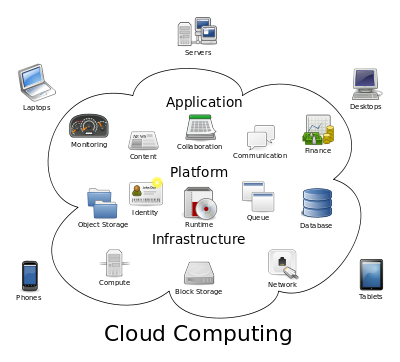

Cloud computing is a model for enabling ubiquitous, convenient, on-demand network access to a shared pool of configurable computing resources (e.g., networks, servers, storage, applications and services) that can be rapidly provisioned and released with minimal management effort or service provider interaction.

The above definition requires a few more clarifications specifically when it comes to understand where should we focus on while checking for a Cloud Computing solution. A few key points:
  1. On-demand self-service: every consumer will be able to unilaterally provision multiple computing capabilities like server time, storage, bandwidth, dedicated RAM or CPU without requiring any sort of human interaction from their respective Cloud providers.
  2. Rapid elasticity and scalability: all the computing capabilities outlined above can be elastically provisioned and released depending on how much demand my company will have in a specific period of time. Suppose the X company is launching a new product today and it expects a very large number of customers. The X company will add more resources to their Cloud for the very first days (where they suppose the load to be very high) and then it ll scale the resources back as they were before. Elasticity and scalability permit the X company to improve and enhance their infrastructure when they need it with an huge saving in monetary terms.
  3. Broad network access: capabilities are available over the network and accessed through standard mechanisms that promote use by heterogeneous thin or thick client platforms (e.g., mobile phones, tablets, laptops, and workstations).
  4. Measured service: Cloud systems allow maximum transparency between the provider and the consumer, the usage of all the resources is monitored, controlled, and reported. The consumer knows how much will spend, when and in how long.
  5. Resource pooling: each provider s computing resources are pooled to serve multiple consumers at the same time. The consumer has no control or knownledge over the exact location of the provided resources but may be able to specify location at a higher level of abstraction (e.g., country, state, or datacenter).
  6. Resources price: when buying a Cloud service make sure the cost for two units of RAM, storage, CPU, bandwidth, server time is exactly the double of the price of one unit of the same capability. An example, if a provider offers you one hour of bandwitdh for 1 Euro, the price of two hours will have to be 2 Euros.
Another common error I usually hear is people feeling Cloud Computing just as a place to put their files online as a backup or for sharing them with co-workers and friends. That is just one of the available Cloud features , specifically the Cloud Storage , where typical examples are companies like Dropbox, Spideroak, Google Drive, iCloud and so on. But let s make a little note about the other three features :
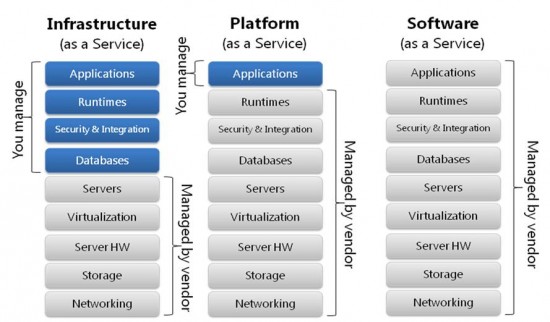
  1. Infrastructure as a Service (IaaS): the capability provided to the consumer is to provision processing, storage, networks, and other fundamental computing resources where the consumer is able to deploy and run arbitrary software, which can include operating systems and applications. In this specific case the consumer has still no control or management over the underlying Cloud infrastructure but has control over operating systems, storage, and deployed applications. A customer will be able to add and destroy virtual machines (VMs), install an operating system on them based on custom kickstart files and eventually manage selected networking components like firewalls, hosted domains, accounts.
  2. Platform as a Service (PaaS). the capability provided to the consumer is to deploy onto the cloud infrastructure consumer-created or acquired applications created using programming languages, libraries, services, and tools (like Mysql + PHP + PhpMyAdmin or Ruby on Rails) supported by the provider. In this specific case the consumer has still no control or management over the Cloud infrastructure itself (servers, OSs, storage, bandiwitdh etc.) but has control over the deployed applications and configuration settings for the application-hosting environment.
  3. Software as a Service (SaaS): the capability provided to the consumer is to use the provider s applications running on a Cloud infrastructure. The applications are accessible through various client devices, such as a browser, a mobile phone or a program interface. The consumer doesn t not manage nor control the Cloud infrastructure (servers, OSs, storage, bandwidth, etc.) that allows the applications to run. Even the provided applications aren t customizable by the consumer, which should rely on limited configuration settings.
The Cloud Computing technology is reasonably the future but can we trust Cloud providers? Are we sure that no one will ever have access to our files except us? and what about governments interested in acquiring a specific customer data hosted on the Cloud? I always suggest to read deeply both the Privacy Policy and Terms of Use of a certain service before signing in especially when it comes to choose a Cloud storage provider. Many providers have the same aspect, they seem to provide the same resources, the same amount of storage for the same price but legally they may present different problems, and that is the case of Spideroak vs Dropbox. Quoting from the Dropbox s Privacy Policy:
Compliance with Laws and Law Enforcement Requests; Protection of DropBox s Rights. We may disclose to parties outside Dropbox files stored in your Dropbox and information about you that we collect when we have a good faith belief that disclosure is reasonably necessary to (a) comply with a law, regulation or compulsory legal request; (b) protect the safety of any person from death or serious bodily injury; (c) prevent fraud or abuse of DropBox or its users; or (d) to protect Dropbox s property rights. If we provide your Dropbox files to a law enforcement agency as set forth above, we will remove Dropbox s encryption from the files before providing them to law enforcement. However, Dropbox will not be able to decrypt any files that you encrypted prior to storing them on Dropbox.
It s evident that Dropbox employees can access your data or be forced by legal process to turn over your data unencrypted. On the other side, Spideroak on its latest update to its Privacy Policy states that data stored on their Cloud is encrypted and inaccessible without user s key, which is stored locally on user s computers. And what about the latest research paper, titled Cloud Computing in Higher Education and Research Institutions and the USA Patriot Act written by the legal experts of the University of Amsterdam s Institute for Information Law stating the anti-terror Patriot Act could be theoretically used by U.S. law enforcement to bypass strict European privacy laws to acquire citizen data within the European Union without their consensus? The only requirement for the data acquisition is the provider being an U.S company or an European company conducting systematic business in the U.S. For example an Italian company storing their documents (protected by the European privacy laws and under the general Italian jurisdiction) on a provider based in Europe but conducting systematic business in the United States, could be forced by U.S. law enforcement to transfer data to the U.S. territory for inspection by law enforcement agencies. Does someone really care about the privacy of companies, consumers and users at all? or better does privacy exists at all for the millions of the people that connect to the internet every day?

11 December 2012

Christian Perrier: Celebrate Samba!

Samba 4 is out. That's just it. 21 years (same age than the Linux kernel, 2 years older than Debian) after a crazy australian student started it, Samba 4 is out. Doh.

Jelmer Vernooij: Samba 4.0.0, finally

This afternoon we released version 4.0.0 of Samba. This is a significant milestone, and I'm very proud of the result. Samba 4 is the first version that can be a domain controller in an Active Directory domain. We embarked on this journey almost a decade ago - the first commit is from August 2003. It's been a long and bumpy ride. I hardly recognize the people in this team photo from 2003 (I'm second from the left). A lot has happened in that time. We wrote a few million lines of code. We migrated from CVS to Subversion to Git. We've drifted apart and grown back together as a team. In my youthful naivity I predicted a release "within 1 or 2 years" during a talk at the NLUUG in 2004. But Active Directory was a lot harder than we thought, and there were quite a few other distractions as well. I'm glad this release, which is by far the biggest and longest running software project I have ever worked on, has finally happened. Some older RCs of Samba 4 have already been packaged for Debian and Ubuntu, in the samba4 source package. For Debian jessie, these will be integrated into the main samba source package. Please use experimental if you do want to try the existing packages, as it is most up to date.

Rudy Godoy: Puppet weird SSL error: SSL_read:: pkcs1 padding too short

While setting a puppet agent to talk to my puppetmaster I ve got this weird SSL error:

Error: SSL_read:: pkcs1 padding too short
Debugging both on the agent and master sides didn t offered much information. On the master:

puppet master --no-daemonize --debug
On the agent:

puppet agent --test --debug
Although I had my master using 3.0.1 and the tested agent using 2.7, the problem didn t look related to that. People @ #puppet also haven t seen this error before. I figured the problem reduced to an issue with openssl. So, I checked versions and there I got! agent s openssl is using version 1.0.0j-1.43.amzn1 and master s was using openssl-0.9.8b-10.el5_2.1 So I upgraded master s openssl to openssl.i686 0:0.9.8e-22.el5_8.4 and voil , the problem is gone. I learned that there has been a patch in OpenSSL s VCS that is apparently related to the issue. Hope this helps if you got into the described situation.

Russell Coker: Links December 2012

Steven Johnson gave an interesting TED talk about where good ideas come from [1]. He starts by attributing coffee replacing alcohol as a standard drink for some good ideas and then moves on to how ideas develop. Erez Lieberman Aiden and Jean-Baptiste Michel gave an interesting and amusing TED talk about the ngram analysis of books that Google scanned [2]. Here is the link for the Google Books ngram search [3]. Clay Shirky gave an insightful TED talk about how the Internet is changing the world [4]. He cites Open Source programmers as the modern day equivalent to the Invisible College based on our supposed great ability to get along with other people on the Internet. If we really are so much better than the rest of the Internet then things must be bad out there. He ends with ways of using Git to draft legislation. Hans Rosling gave an interesting TED talk about religion and the number of babies that women have [5]. His conclusion is that it s more about income and social stability and that the world s population can stabilise at 10 billion if we provide family planning to everyone. Alexis C. Madrigal wrote an interesting interview with Genevieve Bell about her work at Intel and the way people use technology [6]. Indigogo is raising funds for the Cuddle Mattress , it s a mattress with foam slats and a special fitted sheet to allow your arm to slide between the slats [7]. So you could have your arm underneath your SO for an extended period of time without risking nerve damage. They also show that when sleeping on your side your shoulder can go between the slats to avoid back problems. Nate Silver (who is famous for predicting US elections gave an interesting TED talk about racism and politics [8]. One of his main points is to show the correlation between racism and lack of contact of members of other races. Sociological Images has an interesting article by Lisa Wade about whether marriage is a universal human value [9]. In regard to historical marriage she says women were human property, equivalent to children, slaves, servants, and employees . The general trend in the comments seems to be that there are so many types of marriage that it s difficult to make any specific claims to traditional marriage unless you count a tradition of a short period in a single geographic region. Plurality is an excellent sci-fi short movie on youtube [10]. TED has an interesting interview with Hakeem Oluseyi about his research about astrophysics and how he achieved a successful career after being a gangster as a teenager [11]. He has some good ideas about helping other children from disadvantaged environments become successful. Paul Dwerryhouse wrote an interesting blog post about his work in designing and implementing a filesystem based on a Cassandra data store with FUSE [12]. Paul also wrote a post about using Apache Zookeeper to lock metadata to permit atomic operations [13]. The documentary Monumental Myths provides an interesting and insightful analysis of the processes of creating, maintaining, and explaining monuments [14]. It focusses on some significant monuments in the US and explains both sides to each story. Howard Zinn makes the insightful point that when people present a certain point of view of history it s not controversial, as soon as you present the other side they call it controversial . That happens even in debates about current issues. Howard also says to criticise whatever the government does is not anti-America, it s anti-government, it s pro-America, it s pro the people, it s pro the country . The song that plays during the closing credits is interesting too. The music video Same Love is one of the best presentations of the argument for marriage equality [15]. Chris Samuel wrote an interesting post about systems locked down for Windows 8 and options for purchasing PCs for running Linux [16]. His solution is to buy from ZaReason. I saw his laptop in action at the last LUV meeting and it looks really nice. Unfortunately a byproduct of the extremely thin form factor is the fact that it lacks a VGA port, this meant that Chris had to use my Thinkpad T61 (which is rather clunky by comparison) for his presentation.

9 December 2012

Stefano Zacchiroli: bits from the DPL for November 2012

Just posted, bits from the DPL for November 2012.
 ---------------------------------------------------------------------------------
/ Pop-up advertisement. Breaking news. Help the Release Team [0] by reviewing     \
  pending unblock requests. Oh, and by fixing RC bugs too.                         
                                                                                   
  [0]: http://nthykier.wordpress.com/2012/12/09/wheezy-release-progress-december/  
\---------------------------------------------------------------------------------/

Dear Project Members, here is another (delayed) monthly report of DPL activities, this time for November 2012. Highlights Events Assets That's all for now,
let's go back releasing Wheezy,
Cheers.
PS the day-to-day activity log for November 2012 is available at the usual place master:/srv/leader/news/bits-from-the-DPL.txt.201211

8 December 2012

Eddy Petri&#537;or: Consent is needed, but not the point

Russ makes a good point about a nuance of practical jokes that makes them special, the characteristic of involving a third party which is the target of the joke, and how that relates to consent. He is right, consent is an important fact, I acknowledge that. Russ also says at the end of his post that being an asshole doesn't make you responsible for somebody else's decisions, I ackowledge that, too. I even somewhat agree to the position that the employer might fire you on assholery reasons, but in this particular case, I think that's a hypocrite position. If assholery was an issue, it should have been before, too, and I don't think the employer thought of it before this sad even, as long as it meant more money for them. I think this only shows how cynical they are, the cost analysis for them showed them they now might lose more money by not firing, than by keeping them. It's just cynical.

In spite of that, my initial post, just as I wrote, was not about the DJs, the people involved, the assholery, the taste or lack thereof of the joke. That's why I was intentionally leaving out names or specific context. It was about the bigger picture, irrational reactions and how in the face of a tragedy we surrender our thinking capabilities and react in an irrational manner to the least significant things.

I have had quite recent unfortunate events happening to people close to me, and, invariably, I observe this loss of rational faculties in the face of sad events. Even when this kind of disproportionate response is shown for what it is and how it is harmful in itself, people still refuse to give up on being irrational or they do after a long struggle with the facts.

I'll finish my article with a similar question: can we, as a species, go beyond our condition and make a conscious effort to keep calm and think things through before making decisions in the face of tragedy, or are we incapable to do that?

And no, I am not advocating to drop feelings and affection, I find it sad that I have to say that again, but I am almost sure that in spite of it, I will be wrongly understood by somebody.

Russ Allbery: Review: Peacekeeper

Review: Peacekeeper, by Laura E. Reeve
Series: Major Ariane Kedros #1
Publisher: Roc
Copyright: December 2008
ISBN: 0-451-46245-9
Format: Mass market
Pages: 324
Ariane Kedros is a pilot of a second-wave prospecting ship. Second-wave prospectors are the first explorers into new systems after slower-than-light generation ships haul in the beacons that add them to the FTL network. She's also a reserve major in the Consortium military, which is a point of ongoing tension with her business partner and employer. She disappears on missions for the intelligence branch that she can't talk about, and usually ends up drinking herself into a stupor when she returns. In actuality, Kedros is not her real name. It's a fake identity given her after the last war, a war in which humans detonated a temporal distortion warhead for the first time and possibly destroyed an entire solar system. Kedros was part of the team that launched the bomb and is, according to the Terran Expansion League (the other side of the all-human conflict), a war criminal. She's in the equivalent of a witness protection program, as are all the other people involved in the act. But someone has broken their cover and is picking them off, one by one, and her latest secret mission from the Consortium is to protect another member of the group. Peacekeeper is Reeve's first novel, and unfortunately this shows badly at the start of the book. The writing is choppy and awkward, the paragraph breaks are a bit off, and the sentence structure kept making my teeth itch. I'm not a good enough technical critic to put a finger on what's wrong, but the writing doesn't flow. I also found myself anticipating and completing sentences in my head, which is a sign of too many low-level cliches. A few dozen pages into the book, the writing was bothering me, I hadn't warmed to any of the characters, and I wasn't sure I was going to like it. Ariane grew on me, though, particularly once she got into her mission and started balancing a cover assignment and her actual work. She's hurt, suffering from what's probably post-traumatic stress disorder and self-medicating with alcohol, but she's smart and competent and the plot is sufficiently tricky to provide a lot of meat. Not only is someone after her old team, but she and her partner discovered something potentially major on their last trip, an old friend of her partner has been murdered, the Consortium and the Terrans are negotiating a peace treaty, and all this is happening under the watchful eye of a superior alien race. The Minoans are probably Reeve's best creation here (if a little too similar to Vorlons at times). They're absolutely neutral, but they do not want humanity messing with temporal distortion weapons and are trying to nudge (or push) the humans into peace and disarmament. They are sticklers for not imposing their cultural practices on others, attempting to judge humanity solely by its own rules, but they're utterly literal-minded about rules. They expect everyone to follow any stated rules exactly and to the letter, making them excellent but frustrating overseers of disarmament treaties. They also have a fascinating tendency to interact with people in roles rather than as individuals. This is clearly the first book in an ongoing series, and a lot of the setup is not resolved here. We get only glimpses of what Ariane and her partner may have found, and only a few interactions with the Minoans, while Ariane tracks down who is responsible for killing her former team. There's a bit too much torture for my taste, and the subplot of Ariane's struggle with alcoholism wasn't really what I wanted to read about, but the writing seemed to get substantially better and the plot kept me turning the pages. There's a quality to military SF written by people who have actually been in the military that I find hard to describe but that helps a book tremendously. It didn't surprise me at all to learn that Reeve served in the US Air Force, since Peacekeeper has that quality. It's less about technical accuracy and more about a feel, a sense of what it's like to be inside a military routine and interacting with other military personnel. The culture feels coherent, despite not being described in detail. I think it makes for good SF in general, since it conveys to someone like me (who has never been in the military) a semi-alien but completely coherent culture. It certainly improves this book; in general, I thought Reeve's military characters were more interesting and more believable than her non-military characters. With the rocky beginning, the unpolished writing, and a villain who wasn't entirely satisfactory, I can't quite recommend Peacekeeper, but it's not a bad read. I'm not sure if I'll pick up the sequels, but I did leave it curious about the unresolved plot threads and willing to learn more about Reeve's world. Followed by Vigilante. Rating: 6 out of 10

Russ Allbery: Consent: Do you speak it?

Yes, humor is a matter of taste. Does this mean that practical jokes, pranks, and social engineering are just a matter of taste? No. What's different, and what's missing, is consent. A key characteristic of practical jokes is that they involve a third party in the joke without getting specific prior consent because to get prior consent would ruin the joke. There are situations in which that's fine: if the people involved know each other well, they can give implicit consent to that sort of joke, for example. If the victim isn't known to the pranksters, they are outside of the set of situations in which this is okay. Consent is something that human society in general seems to be struggling with right now. Consent to sex. Consent to have one's personal information used by a corporation. Consent to have one's pictures posted on-line. And in every case, I think the default position should be the same as the gold standard for sex: enthusiastic consent. If you want to make someone else part of your business, your art work, your joke, your sex act, or anything else that happens outside of your head in a way that affects them, the required step is very simple: you need to get their enthusiastic consent. If that's too much trouble for you, if that makes it less fun for you, if that means you can't make money, if you think your great idea overrides their rights over their own life, body, ideas, information, or participation, then you fail. That simple. If you want to use someone else, you have to ask first. It's not a hard concept. One might even say that it's basic politeness. Now, the role of governments in this is limited and often not practical. For example, I don't think one can write laws about radio performers who like prank calling, at least without causing so many negative side effects that the effort isn't really practical. Doing that doesn't make you a criminal. It just makes you an asshole. Also, doing things to other people without their consent doesn't mean that you're then morally responsible for anything that subsequently happens that may or may not be related. But you're still an asshole. And if your employer decides that you being an asshole as part of your job has suddenly stopped being funny and fires you, hey, works for me.

Next.

Previous.