Search Results: "he"

9 September 2017

Fran ois Marier: TLS Authentication on Freenode and OFTC

In order to easily authenticate with IRC networks such as OFTC and Freenode, it is possible to use client TLS certificates (also known as SSL certificates). In fact, it turns out that it's very easy to setup both on irssi and on znc.

Generate your TLS certificate On a machine with good entropy, run the following command to create a keypair that will last for 10 years:
openssl req -nodes -newkey rsa:2048 -keyout user.pem -x509 -days 3650 -out user.pem -subj "/CN=<your nick>"
Then extract your key fingerprint using this command:
openssl x509 -sha1 -noout -fingerprint -in user.pem   sed -e 's/^.*=//;s/://g'

Share your fingerprints with NickServ On each IRC network, do this:
/msg NickServ IDENTIFY Password1!
/msg NickServ CERT ADD <your fingerprint>
in order to add your fingerprint to the access control list.

Configure ZNC To configure znc, start by putting the key in the right place:
cp user.pem ~/.znc/users/<your nick>/networks/oftc/moddata/cert/
and then enable the built-in cert plugin for each network in ~/.znc/configs/znc.conf:
<Network oftc>
    ...
            LoadModule = cert
    ...
</Network>
    <Network freenode>
    ...
            LoadModule = cert
    ...
</Network>

Configure irssi For irssi, do the same thing but put the cert in ~/.irssi/user.pem and then change the OFTC entry in ~/.irssi/config to look like this:
 
  address = "irc.oftc.net";
  chatnet = "OFTC";
  port = "6697";
  use_tls = "yes";
  tls_cert = "~/.irssi/user.pem";
  tls_verify = "yes";
  autoconnect = "yes";
 
and the Freenode one to look like this:
 
  address = "chat.freenode.net";
  chatnet = "Freenode";
  port = "7000";
  use_tls = "yes";
  tls_cert = "~/.irssi/user.pem";
  tls_verify = "yes";
  autoconnect = "yes";
 
That's it. That's all you need to replace password authentication with a much stronger alternative.

8 September 2017

Vincent Fourmond: Extract many attachement from many mails in one go using ripmime

I was recently looking for a way to extract many attachments from a series of emails. I first had a look at the AttachmentExtractor thunderbird plugin, but it seems very old and not maintained anymore. So I've come up with another very simple solution that also works with any other mail client.Just copy all the mails you want to extract attachments from to a single (temporary) mail folder, find out which file holds the mail folder and use ripmime on that file (ripmime is packaged for Debian). For my case, it looked like:
~ ripmime -i .icedove/XXXXXXX.default/Mail/pop.xxxx/tmp -d target-directory
Simple solution, but it saved me quite some time. Hope it helps !

Sven Hoexter: munin with TLS

Primarily a note for my future self so I don't have to find out what I did in the past once more. If you're running some smaller systems scattered around the internet, without connecting them with a VPN, you might want your munin master and nodes to communicate with TLS and validate certificates. If you remember what to do it's a rather simple and straight forward process. To manage the PKI I'll utilize the well known easyrsa script collection. For this special purpose CA I'll go with a flat layout. So it's one root certificate issuing all server and client certificates directly. Some very basic docs can be also found in the munin wiki. master setup For your '/etc/munin/munin.conf':
tls paranoid
tls_verify_certificate yes
tls_private_key /etc/munin/master.key
tls_certificate /etc/munin/master.crt
tls_ca_certificate /etc/munin/ca.crt
tls_verify_depth 1
A node entry with TLS will look like this:
[node1.stormbind.net]
    address [2001:db8::]
    use_node_name yes
Important points here: For easy-rsa the following command invocations are relevant:
./easyrsa init-pki
./easyrsa build-ca
./easrsa gen-req master
./easyrsa sign-req client master
./easyrsa set-rsa-pass master nopass
node setup For your '/etc/munin/munin-node.conf':
tls paranoid
tls_verify_certificate yes
tls_private_key /etc/munin/node1.key
tls_certificate /etc/munin/node1.crt
tls_ca_certificate /etc/munin/ca.crt
tls_verify_depth 1
For easy-rsa the following command invocations are relevant:
./easyrsa gen-req node1
./easyrsa sign-req server node1
./easyrsa set-rsa-pass node1 nopass
Important points here:

7 September 2017

Steinar H. Gunderson: Licensing woes

On releasing modified versions of GPLv3 software in binary form only (quote anonymized):
And in my opinion it's perfectly ok to give out a binary release of a project, that is a work in progress, so that people can try it out and coment on it. It's easier for them to have it as binary and not need to compile it themselfs. If then after a (long) while the code is still only released in binary form, then it's ok to start a discussion. But only for a quick test, that is unneccessary. So people, calm down and enjoy life!
I wonder at what point we got here.

Gunnar Wolf: It was thirty years ago today... (and a bit more): My first ever public speech!

I came across a folder with the most unexpected treasure trove: The text for my first ever public speech! (and some related materials)
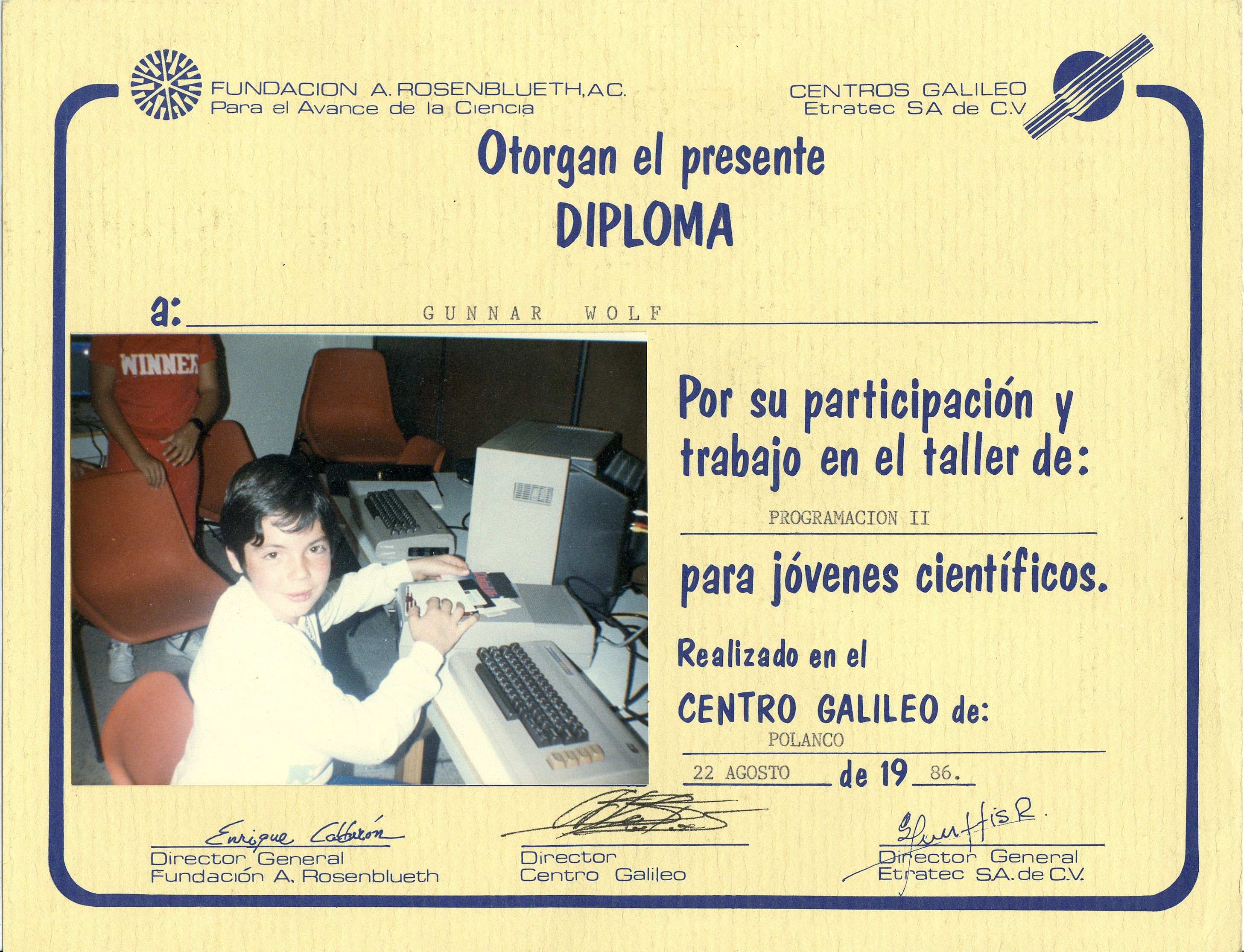
In 1985, being nine years old, I went to the IDESE school, to learn Logo. I found my diploma over ten years ago and blogged about it in this same space. Of course, I don't expect any of you to remember what I wrote twelve years ago about a (then) twenty years old piece of paper! I add to this very old stuff about Gunnar the four pages describing my game, Evitamono ("Avoid the monkey", approximately). I still remember the game quite vividly, including traumatic issues which were quite common back then; I wrote that the sprites were accidentally deleted twice and the game once . I remember several of my peers telling about such experiences. Well, that is good if you account for the second system syndrome! I also found the amazing course material for how to program sound and graphics in the C64 BASIC. That was a course taken by ten year old kids. Kids that understood that you had to write [255,129,165,244,219,165,0,102] (see pages 3-5) into a memory location starting at 53248 to redefine a character so it looked as the graphic element you wanted. Of course, it was done with a set of POKEs, as everything in C64. Or that you could program sound by setting the seven SID registers for each of the three voices containing low frequency, high frequency, low pulse, high pulse, wave control, wave length, wave amplitude in memory locations 54272 through 54292... And so on and on and on... And as a proof that I did take the course: ...I don't think I could make most of my current BSc students make sense out of what is in the manual. But, being a kid in the 1980s, that was the only way to get a computer to do what you wanted. Yay for primitivity! :-D
AttachmentSize
Speech for "Evitamono"1.29 MB
Coursee material for sound and graphics programming in C64 BASIC15.82 MB
Proof that I was there!4.86 MB

Lior Kaplan: FOSScamp Syros 2017 day 3

The 3rd day should have started with a Debian sprint and then a LibreOffice one, taking advantage I m still attending, as that s my last day. But plans don t always work out and we started 2 hours later. When everybody arrive we got everyone together for a short daily meeting (scrum style). The people were divided to 3 teams for translating: Debian Installer, LibreOffice and Gnome. For each team we did a short list of what left and with what to start. And in the end how does what so there will be no toe stepping. I was really proud with this and felt it was time well spent. The current translation percentage for Albanian in LibreOffice is 60%. So my recommendation to the team is translate master only and do not touch the help translation. My plans ahead would be to improve the translation as much as possible for LibreOffice 6.0 and near the branching point (Set to November 20th by the release schedule) decide if it s doable for the 6.0 life time or to set the goal at 6.1. In the 2nd case, we might try to backport translation back to 6.0. For the translation itself, I ve mentioned to the team about KeyID language pack and referred them to the nightly builds. These tools should help with keeping the translation quality high. For the Debian team, after deciding who works on what, I ve asked Silva to do review for the others, as doing it myself started to take more and more of my time. It s also good that the reviewer know the target language and not like me, can catch more the syntax only mistakes. Another point, as she s available more easily to the team while I m leaving soon, so I hope this role of reviewer will stay as part of the team. With the time left I mostly worked on my own tasks, which were packaging the Albanian dictionary, resulting in https://packages.debian.org/sid/myspell-sq and making sure the dictionary is also part of LibreOffice resulting in https://gerrit.libreoffice.org/#/c/41906/ . When it is accepted, I want to upload it to the LibreOffice repository so all users can download and use the dictionary. During the voyage home (ferry, bus, plain and train), I mailed Sergio Durigan Junior, my NM applicant, with a set of questions. My first action as an AM (: Overall FOSScamp results for Albanian translation were very close to the goal I set (100%): That s the result of work by Silva Arapi, Eva Vranici, Redon Skikuli, Anisa Kuci and Nafie Shehu.
Filed under: Debian GNU/Linux, i18n & l10n, LibreOffice

Thomas Lange: My recent FAI activities

During DebConf 17 in Montr al I had a FAI demo session (video), where I showed how to create a customized installation CD and how to create a diskimage using the same configuration. This diskimage is ready for use with a VM software or can be booted inside a cloud environment. During the last weeks I was working on FAI 5.4 which will be released in a few weeks. I you want to test it use
deb https://fai-project.org/download beta-testing koeln
in your sources.list file. The most important new feature will be the cross architecture support. I managed to create an ARM64 diskimage on a x86 host and boot this inside Qemu. Currently I learn how to flash images onto my new Hikey960 board for booting my own Debian images on real hardware. The embedded world is still new for me and very different in respect to the boot process. At DebConf, I also worked on debootstrap. I produced a set of patches which can speedup debootstrap by a factor of 2. See #871835 for details. FAI debootstrap ARM

Reproducible builds folks: Reproducible Builds: Weekly report #123

Here's what happened in the Reproducible Builds effort between Sunday August 27 and Saturday September 2 2017: Talks and presentations Holger Levsen talked about our progress and our still-far goals at BornHack 2017 (Video). Toolchain development and fixes The Debian FTP archive will now reject changelogs where different entries have the same timestamps. UDD now uses reproducible-tracker.json (~25MB) which ignores our tests for Debian unstable, instead of our full set of results in reproducible.json. Our tests for Debian unstable uses a stricter definition of "reproducible" than what was recently added to Debian policy, and these stricter tests are currently more unreliable. Packages reviewed and fixed, and bugs filed Patches sent upstream: Debian bugs filed: Debian packages NMU-uploaded: Reviews of unreproducible packages 25 package reviews have been added, 50 have been updated and 86 have been removed in this week, adding to our knowledge about identified issues. Weekly QA work During our reproducibility testing, FTBFS bugs have been detected and reported by: diffoscope development Version 86 was uploaded to unstable by Mattia Rizzolo. It included previous weeks' contributions from: reprotest development Development continued in git with contributions from: Misc. This week's edition was written by Ximin Luo, Chris Lamb, Bernhard M. Wiedemann and Holger Levsen & reviewed by a bunch of Reproducible Builds folks on IRC & the mailing lists.

John Goerzen: Switching to xmonad + Gnome and ditching a Mac

I have been using XFCE with xmonad for years now. I m not sure exactly how many, but at least 6 years, if not closer to 10. Today I threw in the towel and switched to Gnome. More recently, at a new job, I was given a Macbook Pro. I wasn t entirely sure what to think of this, but I thought I d give it a try. I found MacOS to be extremely frustrating and confining. It had no real support for a tiling window manager, and although projects like amethyst tried to approximate what xmonad can do on Linux, they were just too limited by the platform and were clunky. Moreover, the entire UI was surprisingly sluggish; maybe that was an induced effect from animations, but I don t think that explains it. A Debisn stretch install, even on inferior hardware, was snappy in a way that MacOS never was. So I have requested to swap for a laptop that will run Debian. The strange use of Command instead of Control for things, combined with the overall lack of configurability of keybindings, meant that I was going to always be fighting muscle memory moving from one platform to another. Not only that, but being back in the world of a Free Software OS means a lot. Now then, back to xmonad and XFCE situation. XFCE once worked very well with xmonad. Over the years, this got more challenging. Around the jessie (XFCE 4.10) time, I had to be very careful about when I would let it save my session, because it would easily break. With stretch, I had to write custom scripts because the panel wouldn t show up properly, and even some application icons would be invisible, if things were started in a certain order. This took much trial and error and was still cumbersome. Gnome 3, with its tightly-coupled Gnome Shell, has never been compatible with other window managers at least not directly. A person could have always used MATE with xmonad but a lot of people that run XFCE tend to have some Gnome 3 apps (for instance, evince) anyhow. Cinnamon also wouldn t work with xmonad, because it is simply another tightly-coupled shell instead of Gnome Shell. And then today I discovered gnome-flashback. gnome-flashback is a Gnome 3 environment that uses the traditional X approach with a separate window manager (metacity of yore by default). Sweet. It turns out that Debian s xmonad has built-in support for it. If you know the secret: apt-get install gnome-session-flashback (OK, it s not so secret; it s even in xmonad s README.Debian these days) Install that, plus gnome and gdm3 and things are nice. Configure xmonad with GNOME support and poof goodness right out of the box, selectable from the gdm sessions list. I still have some gripes about Gnome s configurability (or lack thereof). But I ve got to say: This environment is the first one I ve ever used that got external display switching very nearly right without any configuration, and I include MacOS in that. Plug in an external display, and poof it s configured and set up. You can hit a toggle key (Windows+P by default) to change the configurations, or use the Display section in gnome-control-center. Unplug it, and it instantly reconfigures itself to put everything back on the laptop screen. Yessss! I used to have scripts to do this in the wheezy/jessie days. XFCE in stretch had numerous annoying failures in this area which rendered the internal display completely dark until the next reboot very frustrating. With Gnome, it just works. And, even if you have suspend on lid closed turned on, if the system is powered up and hooked up to an external display, it will keep running even if the lid is closed, figuring you must be using it on the external screen. Another thing the Mac wouldn t do well. All in all, some pretty good stuff here. I continue to be impressed by stretch. It is darn impressive to put this OS on generic hardware and have it outshine the closed-ecosystem Mac!

6 September 2017

Mike Gabriel: MATE 1.18 landed in Debian testing

This is to announce that finally all MATE Desktop 1.18 components have landed in Debian testing (aka buster). Credits Again a big thanks to the packaging team (esp. Vangelis Mouhtsis and Martin Wimpress, but also to Jeremy Bicha for constant advice and Aron Xu for joining the Debian+Ubuntu MATE Packaging Team and merging all the Ubuntu zesty and artful branches back to master). Fully Available on all Debian-supported Architectures The very special thing about this MATE 1.18 release for Debian is that MATE is now available on all Debian hardware architectures. See "Buildd" column on our DDPO overview page [1]. Thanks to all the people from the Debian porters realm for providing feedback to my porting questions. References

5 September 2017

Kees Cook: security things in Linux v4.13

Previously: v4.12. Here s a short summary of some of interesting security things in Sunday s v4.13 release of the Linux kernel: security documentation ReSTification
The kernel has been switching to formatting documentation with ReST, and I noticed that none of the Documentation/security/ tree had been converted yet. I took the opportunity to take a few passes at formatting the existing documentation and, at Jon Corbet s recommendation, split it up between end-user documentation (which is mainly how to use LSMs) and developer documentation (which is mainly how to use various internal APIs). A bunch of these docs need some updating, so maybe with the improved visibility, they ll get some extra attention. CONFIG_REFCOUNT_FULL
Since Peter Zijlstra implemented the refcount_t API in v4.11, Elena Reshetova (with Hans Liljestrand and David Windsor) has been systematically replacing atomic_t reference counters with refcount_t. As of v4.13, there are now close to 125 conversions with many more to come. However, there were concerns over the performance characteristics of the refcount_t implementation from the maintainers of the net, mm, and block subsystems. In order to assuage these concerns and help the conversion progress continue, I added an unchecked refcount_t implementation (identical to the earlier atomic_t implementation) as the default, with the fully checked implementation now available under CONFIG_REFCOUNT_FULL. The plan is that for v4.14 and beyond, the kernel can grow per-architecture implementations of refcount_t that have performance characteristics on par with atomic_t (as done in grsecurity s PAX_REFCOUNT). CONFIG_FORTIFY_SOURCE
Daniel Micay created a version of glibc s FORTIFY_SOURCE compile-time and run-time protection for finding overflows in the common string (e.g. strcpy, strcmp) and memory (e.g. memcpy, memcmp) functions. The idea is that since the compiler already knows the size of many of the buffer arguments used by these functions, it can already build in checks for buffer overflows. When all the sizes are known at compile time, this can actually allow the compiler to fail the build instead of continuing with a proven overflow. When only some of the sizes are known (e.g. destination size is known at compile-time, but source size is only known at run-time) run-time checks are added to catch any cases where an overflow might happen. Adding this found several places where minor leaks were happening, and Daniel and I chased down fixes for them. One interesting note about this protection is that is only examines the size of the whole object for its size (via __builtin_object_size(..., 0)). If you have a string within a structure, CONFIG_FORTIFY_SOURCE as currently implemented will make sure only that you can t copy beyond the structure (but therefore, you can still overflow the string within the structure). The next step in enhancing this protection is to switch from 0 (above) to 1, which will use the closest surrounding subobject (e.g. the string). However, there are a lot of cases where the kernel intentionally copies across multiple structure fields, which means more fixes before this higher level can be enabled. NULL-prefixed stack canary
Rik van Riel and Daniel Micay changed how the stack canary is defined on 64-bit systems to always make sure that the leading byte is zero. This provides a deterministic defense against overflowing string functions (e.g. strcpy), since they will either stop an overflowing read at the NULL byte, or be unable to write a NULL byte, thereby always triggering the canary check. This does reduce the entropy from 64 bits to 56 bits for overflow cases where NULL bytes can be written (e.g. memcpy), but the trade-off is worth it. (Besdies, x86_64 s canary was 32-bits until recently.) IPC refactoring
Partially in support of allowing IPC structure layouts to be randomized by the randstruct plugin, Manfred Spraul and I reorganized the internal layout of how IPC is tracked in the kernel. The resulting allocations are smaller and much easier to deal with, even if I initially missed a few needed container_of() uses. randstruct gcc plugin
I ported grsecurity s clever randstruct gcc plugin to upstream. This plugin allows structure layouts to be randomized on a per-build basis, providing a probabilistic defense against attacks that need to know the location of sensitive structure fields in kernel memory (which is most attacks). By moving things around in this fashion, attackers need to perform much more work to determine the resulting layout before they can mount a reliable attack. Unfortunately, due to the timing of the development cycle, only the manual mode of randstruct landed in upstream (i.e. marking structures with __randomize_layout). v4.14 will also have the automatic mode enabled, which randomizes all structures that contain only function pointers. A large number of fixes to support randstruct have been landing from v4.10 through v4.13, most of which were already identified and fixed by grsecurity, but many were novel, either in newly added drivers, as whitelisted cross-structure casts, refactorings (like IPC noted above), or in a corner case on ARM found during upstream testing. lower ELF_ET_DYN_BASE
One of the issues identified from the Stack Clash set of vulnerabilities was that it was possible to collide stack memory with the highest portion of a PIE program s text memory since the default ELF_ET_DYN_BASE (the lowest possible random position of a PIE executable in memory) was already so high in the memory layout (specifically, 2/3rds of the way through the address space). Fixing this required teaching the ELF loader how to load interpreters as shared objects in the mmap region instead of as a PIE executable (to avoid potentially colliding with the binary it was loading). As a result, the PIE default could be moved down to ET_EXEC (0x400000) on 32-bit, entirely avoiding the subset of Stack Clash attacks. 64-bit could be moved to just above the 32-bit address space (0x100000000), leaving the entire 32-bit region open for VMs to do 32-bit addressing, but late in the cycle it was discovered that Address Sanitizer couldn t handle it moving. With most of the Stack Clash risk only applicable to 32-bit, fixing 64-bit has been deferred until there is a way to teach Address Sanitizer how to load itself as a shared object instead of as a PIE binary. early device randomness
I noticed that early device randomness wasn t actually getting added to the kernel entropy pools, so I fixed that to improve the effectiveness of the latent_entropy gcc plugin. That s it for now; please let me know if I missed anything. As a side note, I was rather alarmed to discover that due to all my trivial ReSTification formatting, and tiny FORTIFY_SOURCE and randstruct fixes, I made it into the most active 4.13 developers list (by patch count) at LWN with 76 patches: a whopping 0.6% of the cycle s patches. ;) Anyway, the v4.14 merge window is open!

2017, Kees Cook. This work is licensed under a Creative Commons Attribution-ShareAlike 3.0 License.
Creative Commons License

Gunnar Wolf: Made with Creative Commons: Over half translated, yay!

An image speaks for a thousand words...

And our translation project is worth several thousand words!
I am very happy and surprised to say we have surpassed the 50% mark of the Made with Creative Commons translation project. We have translated 666 out of 1210 strings (yay for 3v1l numbers)!
I have to really thank Weblate for hosting us and allowing for collaboration to happen there. And, of course, I have to thank the people that have jumped on board and helped the translation We are over half way there! Lets keep pushing!

Translation status

PS - If you want to join the project, just get in Weblate and start translating right away, either to Spanish or other languages! (Polish, Dutch and Norwegian Bokm l are on their way) If you translate into Spanish, *please* read and abide by the specific Spanish translation guidelines.

Chris Lamb: Ask the dumb questions

In the same way it vital to ask the "smart questions", it is equally important to ask the dumb ones. Whilst your milieu might be say comparing and contrasting the finer details of commission structures between bond brokers, if you aren't quite sure of the topic learn to be bold and confident enough to boldly ask: I'm sorry, but what actually is a bond? Don't consider this to be an all-or-nothing affair. After all, you might have at least some idea about what a bond is. Rather, adjust your tolerance to also ask for clarification when you are merely slightly unsure or merely slightly uncertain about a concept, term or reference.
So why do this? Most obviously, you are learning something and expanding your knowledge about the world, but a clarification can avoid problems later if you were mistaken in your assumptions. Not only that, asking "can you explain that?" or admitting "I don't follow " is not only being honest with yourself, the vulnerability you show when admitting one's ignorance opens yourself to others leading to closer friendships and working relationships. We clearly have a tendency to want to come across as knowledgable or perhaps more honestly we don't want to appear dumb or uninformed as it will bruise our ego. But the precise opposite is true: nodding and muddling your way through conversations you only partly understand is unlikely to cultivate true feelings of self-respect and a healthy self-esteem. Since adopting this approach I have found I've rarely derailed the conversation. In fact, speaking up not only encourages and flatters others that you care about their subject, it has invariably lead to related matters which are not only more inclusive but actually novel and interesting to all present.
So push through the voice in your head and be that elephant in the room. After all, you might not the only person thinking it. If it helps, try reframing it to yourself as helping others You'll be finding it effortless soon enough. Indeed, asking the dumb question is actually a positive feedback loop where each question you pose helps you make others in the future. Excellence is not an act, but a habit.

Junichi Uekawa: It's already September.

It's already September. I haven't written much code last month. I wrote a CSV parser and felt a little depressed after reading rfc4180. None of my CSV files were in CRLF.

4 September 2017

Jonathan Dowland: Sortpaper: 16:9 edition

sortpaper 16:9 sortpaper 16:9
Back in 2011 I stumbled across a file "sortpaper.png", which was a hand-crafted wallpaper I'd created some time in the early noughties to help me organise icons on my computer's Desktop. I published it at the time in the blog post sortpaper. Since then I rediscovered the blog post, and since I was looking for an excuse to try out the Processing software, I wrote a Processing Sketch to re-create it, but with the size and colours parameterized: sortpaper.pde.txt. The thumbnail above links to an example 1920x1080 rendering.

Dominique Dumont: cme: some read-write backend features are being deprecated

Hello Config::Model and cme read and write configuration data with a set of backend classes, like Config::Model::Backend::IniFile. These classes are managed by Config::Model::BackendMgr. Well, that s the simplified view. Actually, the backend manager can handle several different backends to read and write data: read backends are tried until one of them succeeds to read configuration data. And write backend cen be different from the read backend, thus offering the possibility to migrare from one format to another. This feature came at the beginning of the project, back in 2005. This felt like a good idea to let user migrate from one data format to another. More than 10 years later, this feature has never been used and is handled by a bunch of messy code that hampers further evolution of the backend classes. So, without further ado, I m going to deprecate the following features in order to simplify the backend manager: Unless someone objects, actual removal of these feature will be done in the next few months, after a quite short deprecation period. All the best
Tagged: cme, config-model, Config::Model, configuration

Alessio Treglia: MeteoSurf: a free App for the Mediterranean Sea

meteosurf

MeteoSurf is a free multi-source weather forecasting App designed to provide wind and wave conditions of the Mediterranean Sea. It is an application for smartphones and tablets, built as a Progressive Web App able to supply detailed and updated maps and data showing heights of sea waves (and other information) in the Central Mediterranean. It is mainly targeted for surfers and wind-surfers but anyone who needs to know the sea conditions will take advantage from this app.

Data can be displayed as animated graphical maps, or as detailed table data. The maps refer to the whole Mediterranean Sea, while the table data is able to provide specific information for any of the major surf spots in the Med.

As of current version, MeteoSurf shows data collecting them from 3 different forecasting systems Read More [by Fabio Marzocca]

Lior Kaplan: FOSScamp Syros 2017 day 2

The morning stated by taking the bus to Kini beach. After some to enjoy the water (which were still cold in the morning), we sat for talking about the local Debian community and how can we help it grow. The main topic was localization (l10n), but we soon started to check other options. I reminded them that l10n isn t only translation and we also talked about dictionaries for spell checking, fonts and local software which might be relevant (e.g. hdate for the Jewish/Hebrew calendar or Jcal for the Jalali calendar). For example it seems that regular Latin fonts are missing two Albanian characters. We also talked about how to use Open Labs to better work together with two hats member of the local FOSS community and also as members of various open source projects (not forgetting open content / data ones projects as well). So people can cooperate both on the local level, the international level or to mix (using the other s project international resources). In short: connections, connections, connections. Another aspect I tried to push the guys toward is cooperating with local companies about open source, whether it s the local market, the municipal and general government. Such cooperation can take many forms, sponsoring events / giving resources (computers, physical space or employee s time) and of course creating more jobs for open source people, which in turn will support more people doing open source for longer period. One of the guys thought benefit the local community will benefit from a mirror server, but that also requires to see the network topology of Albania to make sure it makes sense to invest in one (resources and effort). We continued to how it would be best to contribute to open source, mostly that Debian, although great isn t always the best target, and they should always try to work with the relevant upstream. It s better to translate gnome upstream then sending the Debian maintainer the translation to be included in the package. That shortcut can work if there s something urgent like a really problematic typo or something what unless done before the release would require a long long wait (e.g. the next Debian release). I gave an example that for important RTL bugs in LibreOffice I ve asked Rene Engelhard to include the patch instead of waiting for the next release and its inclusion in Debian. When I started the conversation I mentioned that we have 33% females out of the 12 participants. And that s considered good comparing to other computer/technical events, especially open source. To my surprise the guys told me that in the Open Labs hackerspace the situation is the opposite, they have more female members than male (14 female to 12 male). Also in their last OSCAL event they had 220 women and 100 men. I think there s grounds to learn what happens there, as the gals do something damn right over there. Maybe Outreachy rules for Albania should be different (: Later that day I did another session with Redon Skikuli to be more practical, so I started to search on an Albanian dictionary for spell checking, found an old one and asked Redon to check the current status with the guy. And also check info about such technical stuff with Social Sciences and Albanological Section of the Academy of Sciences of Albania, who is officially the regulator for Albanian. In parallel I started to check how to include the dictionary in LibreOffice, and asked Rene Engelhard to enable Albanian language pack in Debian (as upstream already provide one). Checking the dictionaries I ve took the opportunity to update the Hebrew. It took me a little longer as I needed to get rust off my LibreOffice repositories (dictionaries is a different repository) and also the gerrit setup. But in the end: https://gerrit.libreoffice.org/#/c/41864/ With the talks toady and the starting to combine both Debian and LibreOffice work today (although much of it was talking) I felt like I m the right person on the right place. I m happy to be here and contribute to two projects in parallel (:
Filed under: Debian GNU/Linux, i18n & l10n, LibreOffice

Daniel Pocock: Spyware Dolls and Intel's vPro

Back in February, it was reported that a "smart" doll with wireless capabilities could be used to remotely spy on children and was banned for breaching German laws on surveillance devices disguised as another object. Would you trust this doll? For a number of years now there has been growing concern that the management technologies in recent Intel CPUs (ME, AMT and vPro) also conceal capabilities for spying, either due to design flaws (no software is perfect) or backdoors deliberately installed for US spy agencies, as revealed by Edward Snowden. In a 2014 interview, Intel's CEO offered to answer any question, except this one. The LibreBoot project provides a more comprehensive and technical analysis of the issue, summarized in the statement "the libreboot project recommends avoiding all modern Intel hardware. If you have an Intel based system affected by the problems described below, then you should get rid of it as soon as possible" - eerily similar to the official advice German authorities are giving to victims of Cayla the doll. All those amateur psychiatrists suggesting LibreBoot developers suffer from symptoms of schizophrenia have had to shut their mouths since May when Intel confirmed a design flaw (or NSA backdoor) in every modern CPU had become known to hackers. Bill Gates famously started out with the mission to put a computer on every desk and in every home. With more than 80% of new laptops based on an Intel CPU with these hidden capabilities, can you imagine the NSA would not have wanted to come along for the ride? Four questions everybody should be asking
  • If existing laws can already be applied to Cayla the doll, why haven't they been used to alert owners of devices containing Intel's vPro?
  • Are exploits of these backdoors (either Cayla or vPro) only feasible on a targeted basis, or do the intelligence agencies harvest data from these backdoors on a wholesale level, keeping a mirror image of every laptop owner's hard disk in one of their data centers, just as they already do with phone and Internet records?
  • How long will it be before every fast food or coffee chain with a "free" wifi service starts dipping in to the data exposed by these vulnerabilities as part of their customer profiling initiatives?
  • Since Intel's admissions in May, has anybody seen any evidence that anything is changing though, either in what vendors are offering or in terms of how companies and governments outside the US buy technology?
Share your thoughts This issue was recently raised on the LibrePlanet mailing list. Please feel free to join the list and click here to reply on the thread.

3 September 2017

Lior Kaplan: FOSScamp Syros 2017 day 1

During Debconf17 I was asked by Daniel Pocock if I can attend FOSScamp Syros to help with Debian s l10n in the Balkans. I said I would be happy to, although my visit would be short (2.5 days) due to previous plans. The main idea of camp is to have FOSS people meet for about 1 week near a beach. So it s sun, water and free software. This year it takes place in Syros, Greece. After take the morning ferry, I met with the guys at noon. I didn t know how would it be, as it s my first time with this group/meeting, but they were very nice and welcoming. 10 minutes after my arrival I found myself setting with two of the female attendees starting to work on Albanian (sq) translation of Debian Installer. It took my a few minutes to find my where to check out the current level1 files, as I thought they aren t in SVN anymore, but ended up learning the PO files is the only part of the installer still on SVN. As the girls were quick with the assinged levle1 sublevels, I started to look for the level2 and level3 files, and it was annoying to have the POT files very accessible, but no links to the relevant git repositories. I do want to have all the relevant links in one central place, so people who want to help with translation could do that. While some of the team member just used a text editor to edit the files, I suggested to them using either poedit or granslator, both I used a few years ago. Yaron Shahrabani also recommended virtaal to me, but after trying it for a while I didn t like it (expect it s great feature showing the diff with fuzzy messages). For the few people who also have Windows on their machine, both poedit and Virtaal have windows binaries for download. So you don t have to have Linux in order to help with translations. In parallel, I used the free time to work on the Hebrew translation for level1, as it s been a while since either me or Omer Zak worked on it. Quite soon the guys started to send me the files for review, and I did find some errors using diff. Especially when not everyone use a PO editor. I also missed a few strings during the review, which got fixed later on by Christian Perrier. Team work indeed (: I found it interesting to see the reactions and problems for the team to work with the PO files, and most projects now use some system (e.g. Pootle) for online web translation. Which saves some of the head ace, but also prevents from making some review and quality check before submitting the files. It s a good idea to explore this option for Debian as well. A tip for those who do want to work with PO files, either use git s diff features or use colordiff to check your changes (notice less will require -R parameter to keep the color). Although I met the guys only at noon, the day was very fruitful for Debian Installer l10n: Some files are still work in progress and will be completed tomorrow. My goal is to have Albanian at 100% during the camp and ready for the next d-i alpha. I must admit that I remember d-i to have many more strings as part of the 3 levels, especially levels 2+3 which were huge (e.g. the iso codes). Except all the work and FOSS related conversations, I found a great group who welcomed me quickly, made me feel comfortable and taught me a thing or two about Greece and the Syros specifically. TIP: try the dark chocolate with red hot chili pepper in the icecream shop.
Filed under: Debian GNU/Linux, i18n & l10n

Next.

Previous.