Search Results: "ean"

1 December 2010

Gintautas Miliauskas: Windows (I)

I have been helping with an overdue web app project lately, and the project uses ASP.NET MVC, so I have had to use Windows for most of my day. Since I had been using GNU/Linux almost exclusively since 2003, this is quite an adventure (imagine trying out GNU/Linux after a seven year break). It is not nearly as bad as I thought it would be, even though I am using the not-so-well-liked Windows Vista which came pre-installed with my computer.

The first thing that struck me is how much less important the OS is when compared to the situation a few years ago: a lot of the applications I depend on are web-based (GMail, Google Calendar, Google Docs, Springpad), and the ones that are not web-based are multiplatform and installable with a few clicks (GVim comes to mind). In fact, I do not think there is a single piece of software that I really missed in Windows. (An interesting corollary of this observation is that it should be equally easy to migrate to GNU/Linux nowadays.)

The one thing where the operating system matters is hardware support, and I do not think I have to say much here. After years of whack-a-mole GNU/Linux upgrades which would fix support for one component but break another (for things as essential as video and sound), it was absolutely weird having all hardware work properly at the same time (sound after suspend! no video glitches! high quality webcam picture!). There is no point recounting the reasons why hardware support in Linux is as it is, but now I am starting to think that Linux users do tend to suffer from a sort of Stockholm syndrome regarding hardware support; I know I did.

The other important thing that operating systems do is resource management, and I did not have problems here either. In fact, I liked the virtual memory behaviour much better: when Windows ran out of memory (I had filled up the smallish Windows partition and there was no space left for the swap file to grow), it started rejecting malloc calls from applications, but the system was kept alive and responsive, and I could close apps and clean up the mess without much trouble. In Ubuntu, with the default settings, whenever a runaway process ate too much RAM, the system would start thrashing so hard that it would be very difficult to fix. My standard procedure (switch to text console, log in, find and kill app using command line tools) would take minutes and was so annoying that I would sometimes just reset the computer instead. And in the end, even if I did not reset, an important app would possibly be killed anyway. I know there are kernel parameters for tweaking this behaviour (swappiness?), but I never got around to figuring them out as this situation does not arise that frequently, and testing is painful.

I did not like the Windows FS security model. ACLs are much more complicated and thus less transparent that the Unix approach, even though they are more powerful. My main gripe with them is that I do not know a good way to display them easily (as with ls -l in Unix). I have not had to deal with them much though.

I have had no stability issues. It seems that this argument should be put to rest.

Long blog posts are annoying, so I will leave the user interface, the developer experience and my complaints with the system for separate posts (edit: you can now read my next post about the UI).

Pietro Abate: bypassing the apt-get solver

Here at mancoosi we have been working for quite a while to promote and advance solver technology for FOSS distributions. We are almost at the end of the project and it is important to make the mancoosi technology relevant for the community. On goal of the project is to provide a prototype that uses part of the results of mancoosi that can based to install/remove/upgrade packages on a user machine. We certainly don't want to create yet another meta installer. This would be very time consuming and certainly going beyond the scope of the project. The idea is to create a prototype, that can work as an apt-get drop in replacement that will allow everybody to play with different solvers and installation criteria. A very first integration step is a small shell script apt-mancoosi that tries to put together different tools that we have implemented during the project. Roberto wrote extensively about his experience with apt-mancoosi a while ago showing that somehow the mancoosi tools are already usable, as proof of concept, to experiment with all solvers participating to the Misc competition. On notable obstacle we encountered with apt-mancoosi is how to pipe the result of an external solver to apt-get to effectively install the packages proposed as solution. Apt-mancoosi fails to be a drop-in replacement for apt-get exactly for this reason. The "problem" is quite simple : The idea at the beginning was to pass to apt-get, on the command line, a request that effectively represents a complete solution. We expected that, since this was already a locked-down solution, apt-get would have just installed all packages without any further modification to the proposed installation set. Of course, since apt-get is designed to satisfy a user request, and not just to install packages, we quickly realized that our evil plan was doomed to failure. The only option left, was to use libapt directly, but the idea of programming in c++ quickly made me to desist. After a bit of research (not that much after all), I finally found a viable solution to our problems in ''python-apt'' that is a low level and wrapper around libapt. This definitely made my day. Now the juicy details. the problem was to convince apt to completely bypass the solver part and just call the installer. First a small intro. python-apt has an extensive documentation with a couple of tutorials. Using python-apt is actually pretty easy (some snippet from the python-apt doco) :
import apt

# First of all, open the cache
cache = apt.Cache()
# Now, lets update the package list
cache.update()
here we open the cache (apt.Cache is a wrapper around the low level binding in the apt_pkg module), then we update the package list. This is equivalent to apt-get update . Installing a package is equally easy :
import apt
cache = apt.Cache()
pkg = cache['python-apt']

# Mark python-apt for install
pkg.mark_install()

# Now, really install it
cache.commit()
Now, the method mark_install of the module package will effectively run the solver to resolve and mark all the dependencies of the package python-apt. This is the default behavior when apt-get is used on the command line. This method has however three optional arguments that are just what I was looking for, that is autoFix, autoInst and fromUser . The explanation from the python-apt doco is quite clear.
mark_install(*args, **kwds)
Mark a package for install.
If autoFix is True, the resolver will be run, trying to fix broken packages. This is the default.
If autoInst is True, the dependencies of the packages will be installed automatically. This is the default.
If fromUser is True, this package will not be marked as automatically installed. This is the default. Set it to False if you want to be able to automatically remove the package at a later stage when no other package depends on it.
What we want is to set autoFix and autoInst to false to completely bypass the solver. So imagine that an external solver can give use a string of the form : bash+ dash=1.4 baobab- that basically asks to install bash to the newest version, dash at version 1.4 and remove baobab. Suppose also that this is a complete solution, that is, all dependencies are satisfied and there are no conflicts. The work flow of mpm (mancoosi package manager) is as follows : We already have a first prototype on the mancoosi svn. It's not released yet as we are waiting to do more testing, add more options and make it stable enough for testing. Maybe one day, this will be uploaded to debian. This is the trace of a successful installation of a package in a lenny chroot. The solver used here is the p2 solver
dev:~/mpm# ./mpm.py -c apt.conf install baobab
Running p2cudf-paranoid-1.6 solver ...
Validate solution ...
loading CUDF ...
loading solution ...
Summary of proposed changes:
new: 30
removed: 0
replaced: 0
upgraded: 0
downgraded: 0
unsatisfied recommends:: 8
changed: 30
uptodate: 322
notuptodate: 116

New packages: baobab (2.30.0-2) dbus-x11 (1.2.24-3) gconf2 (2.28.1-5)
gconf2-common (2.28.1-5) gnome-utils-common (2.30.0-2)
libatk1.0-0 (1.30.0-1) libcairo2 (1.8.10-6) libdatrie1 (0.2.4-1)
libdbus-glib-1-2 (0.88-2) libgconf2-4 (2.28.1-5) libgtk2.0-0 (2.20.1-2)
libgtk2.0-common (2.20.1-2) libgtop2-7 (2.28.1-1) libgtop2-common (2.28.1-1)
libidl0 (0.8.14-0.1) libjasper1 (1.900.1-7+b1) liborbit2 (1:2.14.18-0.1)
libpango1.0-0 (1.28.3-1) libpango1.0-common (1.28.3-1)
libpixman-1-0 (0.16.4-1) libthai-data (0.1.14-2) libthai0 (0.1.14-2)
libtiff4 (3.9.4-5) libxcb-render-util0 (0.3.6-1) libxcb-render0 (1.6-1)
libxcomposite1 (1:0.4.2-1) libxcursor1 (1:1.1.10-2) libxrandr2 (2:1.3.0-3)
psmisc (22.11-1) shared-mime-info (0.71-3)
Removed packages:
Replaced packages:
Upgraded packages:

Selecting previously deselected package libatk1.0-0.
(Reading database ... 28065 files and directories currently installed.)
Unpacking libatk1.0-0 (from .../libatk1.0-0_1.30.0-1_i386.deb) ...
Selecting previously deselected package libpixman-1-0.
Unpacking libpixman-1-0 (from .../libpixman-1-0_0.16.4-1_i386.deb) ...
Selecting previously deselected package libxcb-render0.
Unpacking libxcb-render0 (from .../libxcb-render0_1.6-1_i386.deb) ...
Selecting previously deselected package libxcb-render-util0.
Unpacking libxcb-render-util0 (from .../libxcb-render-util0_0.3.6-1_i386.deb) ...
Selecting previously deselected package libcairo2.
Unpacking libcairo2 (from .../libcairo2_1.8.10-6_i386.deb) ...
Selecting previously deselected package libdbus-glib-1-2.
Unpacking libdbus-glib-1-2 (from .../libdbus-glib-1-2_0.88-2_i386.deb) ...
Selecting previously deselected package libidl0.
Unpacking libidl0 (from .../libidl0_0.8.14-0.1_i386.deb) ...
Selecting previously deselected package liborbit2.
Unpacking liborbit2 (from .../liborbit2_1%3a2.14.18-0.1_i386.deb) ...
Selecting previously deselected package gconf2-common.
Unpacking gconf2-common (from .../gconf2-common_2.28.1-5_all.deb) ...
Selecting previously deselected package libgconf2-4.
Unpacking libgconf2-4 (from .../libgconf2-4_2.28.1-5_i386.deb) ...
Selecting previously deselected package libgtk2.0-common.
Unpacking libgtk2.0-common (from .../libgtk2.0-common_2.20.1-2_all.deb) ...
Selecting previously deselected package libjasper1.
Unpacking libjasper1 (from .../libjasper1_1.900.1-7+b1_i386.deb) ...
Selecting previously deselected package libpango1.0-common.
Unpacking libpango1.0-common (from .../libpango1.0-common_1.28.3-1_all.deb) ...
Selecting previously deselected package libdatrie1.
Unpacking libdatrie1 (from .../libdatrie1_0.2.4-1_i386.deb) ...
Selecting previously deselected package libthai-data.
Unpacking libthai-data (from .../libthai-data_0.1.14-2_all.deb) ...
Selecting previously deselected package libthai0.
Unpacking libthai0 (from .../libthai0_0.1.14-2_i386.deb) ...
Selecting previously deselected package libpango1.0-0.
Unpacking libpango1.0-0 (from .../libpango1.0-0_1.28.3-1_i386.deb) ...
Selecting previously deselected package libtiff4.
Unpacking libtiff4 (from .../libtiff4_3.9.4-5_i386.deb) ...
Selecting previously deselected package libxcomposite1.
Unpacking libxcomposite1 (from .../libxcomposite1_1%3a0.4.2-1_i386.deb) ...
Selecting previously deselected package libxcursor1.
Selecting previously deselected package libxrandr2.
Unpacking libxrandr2 (from .../libxrandr2_2%3a1.3.0-3_i386.deb) ...
Selecting previously deselected package shared-mime-info.
Unpacking shared-mime-info (from .../shared-mime-info_0.71-3_i386.deb) ...
Selecting previously deselected package libgtk2.0-0.
Unpacking libgtk2.0-0 (from .../libgtk2.0-0_2.20.1-2_i386.deb) ...
Selecting previously deselected package libgtop2-common.
Unpacking libgtop2-common (from .../libgtop2-common_2.28.1-1_all.deb) ...
Selecting previously deselected package libgtop2-7.
Unpacking libgtop2-7 (from .../libgtop2-7_2.28.1-1_i386.deb) ...
Selecting previously deselected package psmisc.
Unpacking psmisc (from .../psmisc_22.11-1_i386.deb) ...
Selecting previously deselected package dbus-x11.
Unpacking dbus-x11 (from .../dbus-x11_1.2.24-3_i386.deb) ...
Selecting previously deselected package gconf2.
Unpacking gconf2 (from .../gconf2_2.28.1-5_i386.deb) ...
Selecting previously deselected package gnome-utils-common.
Unpacking gnome-utils-common (from .../gnome-utils-common_2.30.0-2_all.deb) ...
Selecting previously deselected package baobab.
Unpacking baobab (from .../baobab_2.30.0-2_i386.deb) ...
Processing triggers for man-db ...
Setting up libatk1.0-0 (1.30.0-1) ...
Setting up libpixman-1-0 (0.16.4-1) ...
Setting up libxcb-render0 (1.6-1) ...
Setting up libxcb-render-util0 (0.3.6-1) ...
Setting up libcairo2 (1.8.10-6) ...
Setting up libdbus-glib-1-2 (0.88-2) ...
Setting up libidl0 (0.8.14-0.1) ...
Setting up liborbit2 (1:2.14.18-0.1) ...
Setting up gconf2-common (2.28.1-5) ...

Creating config file /etc/gconf/2/path with new version
Setting up libgconf2-4 (2.28.1-5) ...
Setting up libgtk2.0-common (2.20.1-2) ...
Setting up libjasper1 (1.900.1-7+b1) ...
Setting up libpango1.0-common (1.28.3-1) ...
Cleaning up font configuration of pango...
Updating font configuration of pango...
Cleaning up category xfont..
Updating category xfont..
Setting up libdatrie1 (0.2.4-1) ...
Setting up libthai-data (0.1.14-2) ...
Setting up libthai0 (0.1.14-2) ...
Setting up libpango1.0-0 (1.28.3-1) ...
Setting up libtiff4 (3.9.4-5) ...
Setting up libxcomposite1 (1:0.4.2-1) ...
Setting up libxcursor1 (1:1.1.10-2) ...
Setting up libxrandr2 (2:1.3.0-3) ...
Setting up shared-mime-info (0.71-3) ...
Setting up libgtk2.0-0 (2.20.1-2) ...
Setting up libgtop2-common (2.28.1-1) ...
Setting up libgtop2-7 (2.28.1-1) ...
Setting up psmisc (22.11-1) ...
Setting up dbus-x11 (1.2.24-3) ...
Setting up gconf2 (2.28.1-5) ...
update-alternatives: using /usr/bin/gconftool-2 to provide /usr/bin/gconftool (gconftool) in auto mode.
Setting up gnome-utils-common (2.30.0-2) ...
Setting up baobab (2.30.0-2) ...
Broken: 0
InstCount: 30
DelCount: 0
dev:~/mpm#
I think we'll keep working on this python prototype for a while, but this is not certainly what we want to propose to the community. The mancoosi package manager is probably going to be written in Ocaml and integrated with dose3 and libcudf. This will allow us to gain speed and have a solid language to develop with (nothing against python, but we don't feel that a scripting language is suitable for an essential component as a package manager). Time will tell. For the moment this is just vapor-ware ...

Michal Čihař: Cleanup of personal Debian repository

When I accidentally looked at my personal Debian repository, I realized that it is time to remove obsolete things from it. There were packages for polld, for which which I don't see need anymore (it is now properly handled by kernel), hacked acpid packages, which were doing special things for Toshiba M30 notebook (which I don't use with Linux anymore and nobody else probably knew about these packages) or wmmp, a Window Maker applet for MPD, which I haven't used for quite a long time. All those are gone now and I don't think anybody will miss them (if you do, please tell me). What stayed there are daily snapshots of dictionaries for StarDict and gnaughty package, which was rejected as possibly causing troubles.

Filed under: Debian 0 comments Flattr this!

Raphaël Hertzog: Support 5 free software with Flattr

Flattr FOSS LogoA new month means new free software projects to support with Flattr FOSS. I m happy to see that it s gaining traction outside of the Debian world as well. I saw quite a few new entries for free software projects so that I don t have to fear running out of suggestions in the next few months. :-)
Let s go over the 5 projects that I recommend you for December:
  1. Getting Things GNOME (flattr link) is a GNOME task manager. Its name is a play on David Allen s Getting Things Done (GTD) but the software doesn t enforce the GTD methodology. You can implement GTD however since the software is very flexible and lets you organize the tasks with arbitrary tags. It s a promising software and it can be extended with many plugins.
  2. The W3C validator (flattr link) is used by thousands of web developers to verify that their HTML pages are well formed. But did you know that it was free software? Yes you can contribute code, or you can help them with a flattr.
  3. Bitlbee (flattr link) is a gateway between IRC and many other instant messaging protocols. Geeks are known to be IRC addicted (at least I am using it for Debian development) and with bitlbee it s one reason less to watch something else than the IRC client. :-)
  4. Arch Hurd (flattr link) is a port of the ArchLinux distribution to the GNU Hurd kernel.
  5. Paste.debian.net (flattr link) is a simple website where you can share some textual content for a limited amount of time (you usually paste the content from some other applications, hence its name). Very handy when you want to quickly show something to others on IRC. This service is run by Debian developer Alexander Wirt.
That s it for this month. A quick question to finish this issue: I count at least 15 Debian contributors using Flattr currently, would you be interested by a small directory listing them?

One comment Liked this article? Click here. My blog is Flattr-enabled.

Jaldhar Vyas: The Anaclepses of Darwin Fenderman

Nanowrimo winner 2010 I've been participating in National Novel Writing Month for several years now but this is the first time I've actually managed to complete writing 50,000 words in one month. My Science Fiction novel "The Anaclepses of Darwin Fenderman" is set in a future where the last individualist must fight for free will against, robots, telepathic dogs, and Phillip K. Dick. It came out fairly well I think considering the haste in which it was written. Of course here's a hell of a lot of clean up that needs to be done before I can dare to show anyone else but in the coming months I want to see if I can get it into a fit state for publishing. Meanwhile, here's a teaser:
"Where is it then?"
"Out there somewhere.", he said gesturing vaguely at the window.
"Beyond the Hudson? But there's nothing but wasteland out there."

30 November 2010

Joey Hess: debugging musings

Debugging a computer program is such an interesting activity because it's not really a matter of fixing a program. It's a matter of fixing your own understanding to the point that the cause of the bug becomes obvious. So debugging means constantly challenging your assumptions, constantly looking for the overlooked insignificant thing that turns out to be crucial. I mostly debug by print statements. I don't like it much, but it works. I add some print statements around the problem area and see if what's going on matches what the model in my head thinks should be going on. If it doesn't, I try to fix the model, and if it does, I focus the print statements in tighter and tighter, deeper and deeper, until I finally reach the bug. It's nasty and ah-hoc, but it works really well, mostly. And I know I'm in good company doing it. But that method can fail; I myself can end up caught in a loop. Like today, tracking down an obscure bug in Branchable's auditing subsystem, when I found myself at what was apparantly the point of a bug: Function A was supposed to call function B, but B never seemed to be called. So surely A was buggy, and I instrumented it to bits with print statements and stuff, and started wondering if the libraries it relied on were somehow breaking it in non-obvious ways before it could call B, or maybe there was a bug in the runtime language that was breaking the call to B. Going deeper and deeper didn't help, because the thing I was overlooking was up at the top level -- one of the first print statements I inserted showed that all this code was running twice. Why? Didn't seem relevant to the bug so I ignored it. Of course what I was ignoring was a symptom of the real problem: The first run was by another subsystem, that happened to redefine function B temporarily.. Actually, one of the nice things about Haskell is that print statements are not very helpful in debugging pure code. Pure code tends to get loaded up in ghci and tested interactively, and the bug is then clear. Or a quickcheck test case gets written with an invariant that the pure code should satisfy. I spent a whole day a few weeks ago writing an inverse form of a buggy function in git-annex just so I could feed them both into quickcheck and automate debugging. (Most of that time was spent wrestling with unicode decomposition .. ugh.) Being used to getting down in the buggy code with print statements, that at the time felt rather like a waste of time unrelated to getting on with making my program work, but it was very much worth it since I got my program working 100% in even crazy edge cases, and got a test suite for free, too. Most of my debugging of Haskell code so far has not involved bugs in pure code. The most memorable bug was actually a bug in ghc's IO manager, which I'd have never tracked down without Josh's help. The problem with finding bugs in the runtime environment or compiler is that after you've found enough over the years, you're more likely to go down false paths distrusting runtime environments, like I did with the bug today. The beginner's assumption is that the runtime environment just works, but I by now may have over-challenged that assumption. :)

Debian News: DebConf 11 to take place July 24-30, 2011

DebConf 11 will take place from July 24 to 30, 2011, in the city of Banja Luka, Republika Srpska, Bosnia and Herzegovina.

The final calendar of the event is:

The call for papers and registration dates are still to be decided.

More information at the DebConf 11 website.

Tollef Fog Heen: My Varnish is leaking memory

Every so often, we get bug reports about Varnish leaking memory. People have told Varnish to use 20 gigabytes for cache and they discover the process is eating 30 gigabytes of memory and they get confused about what's going on. So, let's take a look. First, a little bit of history. Varnish 2.0 had a fixed per-object workspace which was used for both header manipulations in vcl_fetch as well as for storing the headers of the object when vcl_fetch was done. The default size of this workspace was 8k. If we assume an average object size of 20k, that is almost 1/3 of the store being overhead. With 2.1, this changed. First, vcl_fetch doesn't have obj any longer, it only has beresp which is the backend response. At the end of vcl_fetch, the headers and other relevant bits of the backend response are copied into an object. This means we no longer have a fixed overhead, we use what we need. Of course, we're still subject to malloc's whims when it comes to page sizes and how it actually allocates memory. Less overhead means more objects in the store. More objects in the store, means, everything else being equal, more overhead outside the store (for the hash buckets or critbit tree and other structs). This is where lots of people get confused, since what they see is just Varnish consuming more memory. When moving from 2.0 to 2.1, people should lower their cache size. How much depends on the amount of objects they have, but if they have many and small objects, a significant reduction might be needed. For a machine dedicated to Varnish, we usually recommend making the cache size be 70-75% of the memory of the machine. A reasonable question to ask at this point is what all this overhead is being used for. Part of it is a per-thread overhead. Linux has a 10MB stack size by default, but luckily, most of it isn't allocated, so it only counts against virtual, not resident memory. In addition, we have a hash algorithm which has overhead and the headers from the objects are stored in the object itself and not in the stevedore (object store). Last, but by no means least, we usually see an overhead of around 1k per object, but I have seen up to somewhere above 2k. This doesn't sound like much, but when you're looking at servers with 10 million objects, 1k of overhead means 10 gigabytes of total overhead, leading to the confusion I talked about at the start.

MJ Ray: ECJ on SAS v WPL: A Coming Storm?

While I share Alex s law [is] boring view, this also attracted my attention because it s (slightly) about statistics software. I feel the SAS v WPL case mentioned on his blog deserves a wider airing:
The basic story is that the Judge in this case is deeply unsure of the boundary of copyright. [...] has sent a number of questions to the European Court of Justice (ECJ). The questions are hypothetical, but clearly designed to test the waters and figure out where this line falls.
Now will this re-affirm what I ve always been told, that copyright s border is between ideas and expressions, and copyright only covers expressions? Or will it draw a different boundary? It seems that those most likely to be affected are those who are at the edges of acceptability of licences like LGPL, or trying to provide workalikes of hostile proprietary companies, but please, read it for yourself.

29 November 2010

Theodore Ts'o: Google has a problem retaining great engineers? Bullcrap.

Once again, there s been another story about how Google is having trouble retaining talent. Despite all Eric Schmidt s attempts to tell folks that Google s regretted attrition rate has not changed in seven years, this story just doesn t want to seem to die. (And those stories about Google paying $3.5 million and $7 million to keep an engineer from defecting to Facebook? As far as I know, total bull. I bet it s something made up by some Facebook recruiter who needed to explain how she let a live prospect get away. :-) At least for me, the complete opposite is true. There are very few companies where I can do the work that I want to do, and Google is one of them. A startup is totally the wrong place for me. Why? Because if you talk to any venture capitalist, a startup has one and only one reason to exist: to prove that it has a scalable, viable business model. Take diapers.com for example. As Business Week described, while they were proving that they had a business model that worked, they purchased their diapers at the local BJ s and shipped them via Fedex. Another startup, Chegg, proved its business model by using Amazon.com to drop ship text books to their first customers. (The venture capitalist Mark Maples talked about this in a brilliant talk at the Founders Showcase; the Chegg example starts around 20:50 minutes in, but I d recommend listening to the whole thing, since it s such a great talk.) You don t negotiate volume discounts with textbook publishers, or build huge warehouses to hold all of the diapers that you re going to buy until you prove that you have a business model that works. Similarly, you don t work on great technology at a startup. Startups, by and large, aren t about technology at least, not the Web 2.0 startups like Facebook, Foursquare, Twitter, Groupon, etc. They are about business model discovery. So if you are fundamentally a technologist at heart, whose heart sings when you re making a better file system, or fixing a kernel bug, you re not going to be happy at a startup. At least, not if the startup is run competently. If you have the heart of an entrepreneur, and you are willing to roll the dice (since 9 out of 10 startups go belly up; those are the ones that failed to find a viable business model), then sure, go for a startup. And understand that your job will be to make something that works well at a small scale, quick, dirty, and cheap. If that means using some proprietary software, then that s what you should do. Hopefully you ll get lucky and win the IPO lottery. But if your primary interest is to doing great engineering work, then you want go to company that has a proven business model. Google has enough scale that I can sleep well knowing that improvements I am making to Linux and the ext4 file system are saving enough money for the company that Google is making a profit on me. That is, the value Google is getting out of my work is worth many multiples of my total compensation. And that s a position that every engineer should strive for, since that s how you can be confident that you will remain gainfully employed. The fact that I can do what I love, and go to conferences, and all of my work is open source that s just total icing on the cake. :-) No related posts.

MJ Ray: What Price Networking?

How much would you pay to participate in a social network and what would you expect for that? On the web, I m used to some social networks being available for free. Usefulness and size varies massively, but there s quite a choice of them. There s a price to access them (computer, internet access, time) but once you ve paid that, there are free-to-use networks. Offline, a lot of networking opportunities cost money and not just access costs (travel, time). Especially business networks. OK, there are paid business networks online too, but some of the biggest ones have some long-term free access level, to try to entice people to upgrade. Offline, it seems like the reverse: there are some free networks and some that have short-term free access, but the norm seems to be pay-to-play. Often you get nothing except entry for the basic subscription, but at least our co-op usually prefers networks where we re proper members with some say in how things are run. Not that democracy always works. One networking organisations made a mistake in posting out ballot papers that means we can t vote in its leadership election. This isn t the first administrative problem we ve suffered and their last decent event was at least a year ago, too. At what point should we quit? I think I ll try to address this through the membership democracy first. In this recession, some of our offline networks are reviewing their prices. In one case, a network which was free is going to become one of our more expensive annual subscriptions if we renew. If I look at it as a simple does this bring in enough work to pay for itself? decision then probably it won t. How much value do you attach to being there and to being visible, though?

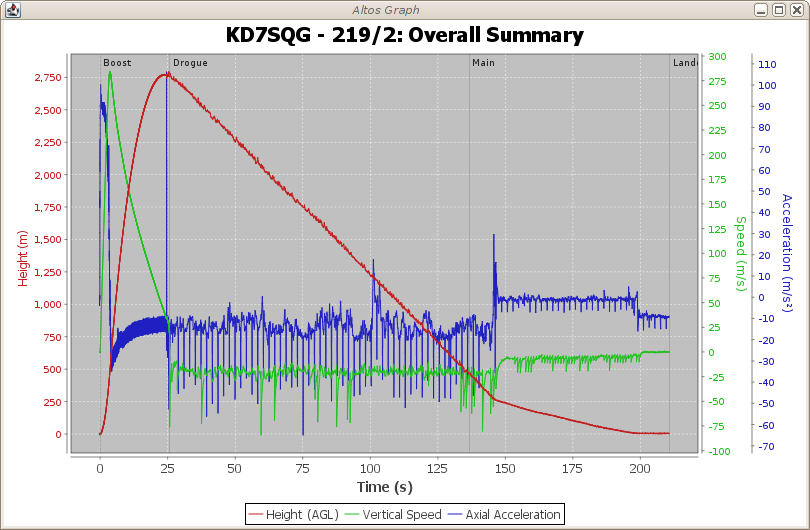
Keith Packard: Altos0.8

AltOS 0.8 New Software and Firmware for Altus Metrum Devices Bdale and I are pleased to announce the release of AltOS version 0.8. AltOS is the core of the software for all of the Altus Metrum products. It consists of cc1111-based microcontroller firmware and Java-based ground station software. AltosUI New Features in the AltusMetrum Ground Station AltOS version 0.8 contains significant upgrades to the ground station software, AltosUI: Continuing Features AltOS version 0.8 continues to provide the following features: AltOS Firmware Update AltOS version 0.8 contains a minor firmware update for TeleMetrum to resolve an issue with main deployment. A mis-feature in the igniter firing code would delay main deployment by 2 seconds in some cases. Thanks to our contributors! We had a lot of help with this release: Future Plans A number of features are implemented or in process in the sources available in our publicly visible repository that are not part of the current stable release. There are any number of additions that could be made to this list; feel free to send along ideas that you ve got. Of course, all of this software is licensed under the GNU General Public License, so you can get the source and hack on it in the comfort of your own home.

Bdale Garbee: AltOS 0.8 Released

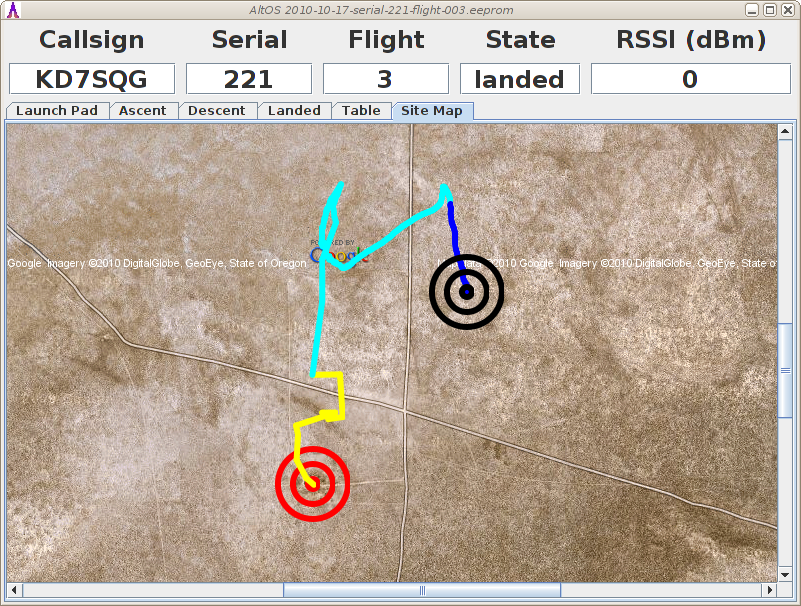
Keith and I just released version 0.8 of AltOS, the open source firmware and software system associated with our TeleMetrum hobby rocket avionics system. The AltosUI ground station user interface is significantly improved, with lots of new features including a much cleaner view of what's happening during different stages of the flight experience, a post-flight data plotting interface with pan and zoom, and a very cool live view of where the rocket is overlayed on data from Google Maps! All existing TeleMetrum owners are encouraged to download, install, and begin using this new version immediately.

28 November 2010

Biella Coleman: The Existential Philsophy of Procrastination

out of cous The New Yorker has a very nice piece about the follies and foibles of procrastination. I really identified with it, especially the ruminations of multiple/divided selves (I do feel more like Biella s instead of Biella especially during moments of extreme procrastination). The heart of the piece has to do with the existential face of procrastination, which the author nails with this quote by Mark Kingwell:
Procrastination most often arises from a sense that there is too much to do, and hence no single aspect of the to-do worth doing. . . . Underneath this rather antic form of action-as-inaction is the much more unsettling question whether anything is worth doing at all
This reminds me of another one of my favorite (and kinda distributing but also kinda liberating) quotes by Henry Miller:
Life has to be given a meaning because of the obvious fact that it has no meaning
Finally, the most humorous bit in the article had to do with Victor Hugo, who apparently, to stave off distraction, would write in the nude and then make what sounds like his man servant hide his clothes so he could not go outside. Reminds me that prior to the Internet, there were certainly other ways to squander time. For now, I encourage some procrastination: read it and you might get some insight as to this habit, which seems to afflict so many.

27 November 2010

Robert Millan: About ZFS in Squeeze (2)

Sometimes it s nice being wrong. Contrary to what I predicted, ZFS will be supported in Debian Squeeze using the official installer. This means that Debian Squeeze will be one of the first GNU distributions to support ZFS. In fact, even though ZFS support didn t make it to Debian-Installer beta1 by the time it was released, it is now available in the netboot images (this happens because netboot images fetch newer installer components from the internet). As a consequence of this my unofficial installer can now be considered obsolete. So why did I say something that turned out to be grossly inaccurate? It s not due to anyone s fault really. At that time, the version of Parted that included ZFS detection hadn t migrated to Squeeze. The unblock policy didn t appear to allow this migration. However, the Release Team kindly decided to make an exception that allowed this, and after Parted had migrated the changes in Debian-Installer itself went in quite smoothly.

Axel Beckert: Useful but Unknown Unix Tools: units

Ever wondered how to easily convert e.g. 10 seamiles into kilometres? Use units:
$ units 
2411 units, 71 prefixes, 33 nonlinear units
You have: 10 seamiles
You want: km
        * 18.288
        / 0.054680665
You have: ^C
$
Of course this is interactive. There s also a non-interactive mode:
$ units '10 seamiles' 'km'
        * 18.288
        / 0.054680665
$ 
The line with the asterisk means that 10 seamiles are 18.288 kilometres or 1 kilometre is the 0.054680665th part of 10 seamiles. This quite non-intuitive output is caused by the fact that unit is designed to be used with units only:
$ units seamiles km
        * 1.8288
        / 0.54680665
$
Now this makes more sense: You have to multiply seamiles with 1.8288 to get kilometres and you have to multiply (not divide) kilometres with 0.54something to get seamiles. But this output is still a little bit cumbersome, and annoying if you want to use it in shell scripts. But for luck, units knows some nice options, especially -v ( verbose ) and -t ( terse ):
$ units -v '10 seamiles' km
        10 seamiles = 18.288 km
        10 seamiles = (1 / 0.054680665) km
$ units -t '10 seamiles' km
18.288
Now that s way easier to read and script! You can also script more complex things like
$ units -v '100 attoparsec/microfortnight' m/s
        100 attoparsec/microfortnight = 2.5509901 m/s
        100 attoparsec/microfortnight = (1 / 0.39200466) m/s
Unfortunately not all common units are unambiguous for units:
units -v '100 km/h' m/s
conformability error
        100 km/h = 1.5091905e+38 s / kg m
        m/s = 1 m / s
Well, h seems not to be units unit for hours , so lets tell it explicity that we want km per hour:
units -v '100 km/hour' m/s
        100 km/hour = 27.777778 m/s
        100 km/hour = (1 / 0.036) m/s
Looks more like what I expected. units behaves though a little bit strange when I try to convert litres per 100 kilometres into miles per gallon:
$ units -t '6L/100km' 'mpg'
conformability error
6e-08 m^2
425143.71 / m^2
$
Interestingly changing the verbosity helps already in this case:
$ units -v '6L/100km' 'mpg'
        reciprocal conversion
        1 / (6L/100km) = 39.202431 mpg
        1 / (6L/100km) = (1 / 0.025508622) mpg
Greetings from the Debian booth at LinuxDay.at and thanks to Y_Plentyn, rhalina and bzed for example ideas and the suggestion to write a blog posting about units. :-)

26 November 2010

Dirk Eddelbuettel: RcppArmadillo 0.2.10

Conrad Sanderson released version 1.0.0 of Armadillo, his templated C++ library for linear algebra, earlier this week. So congratulations to Conrad on reaching 1.0.0! I folded his version 1.0.0 into a new release 0.2.10 of RcppArmadillo, our Rcpp-based integration into R. Other small changes comprises a small fix to the build process, and additional output in the summary() function for the fastLm function. The short NEWS file extract follows, also containing Conrad's entry for 1.0.0:
0.2.10  2010-11-25
    o   Upgraded to Armadillo 1.0.0 "Antipodean Antileech"
         * After 2 1/2 years of collaborative development, we are proud to
           release the 1.0 milestone version. 
         * Many thanks are extended to all contributors and bug reporters.
    o   R/RcppArmadillo.package.skeleton.R: Updated to no longer rely on GNU
        make for builds of packages using RcppArmadillo
 
    o   summary() for fastLm() objects now returns r.squared and adj.r.squared
And courtesy of CRANberries, here is the diff to the previous release 0.2.9:
 ChangeLog                                                   17 ++++++++
 DESCRIPTION                                                 25 +++++------
 R/RcppArmadillo.package.skeleton.R                           4 -
 R/fastLm.R                                                  21 +++++++++
 inst/NEWS                                                   13 ++++++
 inst/doc/RcppArmadillo-unitTests.pdf                     binary
 inst/doc/unitTests-results/RcppArmadillo-unitTests.html      6 +-
 inst/doc/unitTests-results/RcppArmadillo-unitTests.txt      34 ++++++++--------
 inst/include/armadillo_bits/arma_version.hpp                15 +++++--
 inst/skeleton/Makevars                                       2 
 src/Makevars                                                 2 
 src/Makevars.win                                             2 
 12 files changed, 97 insertions(+), 44 deletions(-)
More information is on the RcppArmadillo page. Questions, comments etc should go to the rcpp-devel mailing list off the R-Forge page.

Joachim Breitner: Screenshots as vector graphics

Recently, I was considering the following set of statements: Vector graphics are great, especially in print. Program documentation needs screenshots. Usual screenshots are not bitmaps. Some programs use gtk. Gtk uses Cairo to render most of its display. Cairo can generate PDF. PDF is a vector graphics format.
And while I was doing so, for some reason, I thought: Wouldn t it be great if I my gtk programs could generate vector PDF files of their screen content? And after some experimentation, I was able to extract this PDF file from the buttonbox example program (see here if you do not see anything below):
<iframe height="300" src="http://www.joachim-breitner.de/various/pdf_screenshot.pdf" width="80%">Use the link above</iframe>
This works without any modification to the original program. Instead, I am loading some code using LD_PRELOAD that overrides the cairo_xlib_surface_create function and creates a PDF surface instead. It also monitors calls to XCopyArea to observe where on the window gtk (gdk actually) paints the resulting image. Then I combine these PDF files (6 in this example, theoretically a lot more) using a latex document and I must say, the result is pretty good for a start: All lines are vector lines, the text really is text (and not just rendered pixels), so you can actually copy n paste from it. Of course this is but a proof of concept and has several problems: I don t think I ll fix that myself, as I had my fun. But maybe it can inspire a more useful tool exploiting this idea, and maybe there are cleaner approaches (for example special gtk theme engines, or by patching gtk).

Matt Zimmerman: Three ways for Ubuntu to help developers

Developers are a crucial part of any successful software platform. In the same way that an operating system is just a means for people to use applications, a platform is just a means for developers to create applications and make them available to people. There are three primary ways in which Ubuntu can help developers do their work. They are all related, but distinct, and so we should consider them individually: 1. Developing for Ubuntu Today, Ubuntu bundles thousands of free software applications, for both clients and servers, most of which are packaged by Debian. Ubuntu also carries certifications for a variety of third-party ISV software, both open source and proprietary, which are coordinated through Canonical s partner program. In both of these cases, many of these applications are actually developed on other platforms, and ported to Ubuntu, either by the free software community or by the creators of the software. 2. Developing on Ubuntu Ubuntu is already quite popular among developers, who mainly run Desktop Edition on their workstations. They might be developing: 3. Distributing through Ubuntu Like other modern operating systems, Ubuntu isn t just a platform where applications run, but also a system for finding and installing applications. Starting with APT, which originated in Debian, we ve added Software Center, the ISV partner repository, and various other capabilities in this area. They all help to connect developers with users, facilitating distribution of software to users, and feedback to developers. So, where should we focus? Some developers might be interested in all three of these, while others might only care about one or two. However, most of the developer improvements we could make in Ubuntu would only address one of these areas. For this reason, I think it s important that we consider the question of the relative importance of these three developer scenarios. Given that we want Ubuntu to flourish as a platform, how would we prioritize them? I have my own ideas, which I ll write about in subsequent posts, but here s your chance to tell me what you think. :-)

David Welton: Kindle thoughts

I went ahead and got myself a Kindle for my birthday. Thanks to everyone for their comments in the last post. Here are my thoughts on it, in no particular order:
I like it a lot. I was worried that I would not actually enjoy reading with it, or that it would be significantly inferior to real books. However, I do enjoy reading with it, and I think they have achieved their aim of making it so that it 'just disappears' like a good book does. It's a very small and light device, even with the leather cover I got for it (always best with a small child in the house), so it's in no way heavy or uncomfortable. It's relatively more expensive and fragile than a copy of The Economist or a paperback, so I don't sling it around quite so casually, and do try and remember to keep it out of reach of said small child, which makes it a little less worry-free than an actual book. On the other hand, it's much cheaper than an ipad or samsung galaxy or something like that, so it's not the end of the world if something happens to it, although it would be unfortunate to be without reading material for the time it took to replace it!
The selection of material available for it is ok, but I'm just a bit disappointed - I thought offhand there were more books than there are. I regularly bump into things I might consider getting if they were available for it, but are not. On the other hand, there are quite a few books available for it for *free* because they're old and out of copyright. Stuff you might get for 99 cents at a used book store as a paperback, but it's pretty cool to be able to just zip it right to the device, for nothing at all. I am not convinced that the economics of it all has settled down yet. It's pretty absurd, for instance, that The Intelligent Investor costs nearly twice as much for the Kindle version as for the paperback! Especially since I can never resell it. I think a lot of the value I get from the device is derived from my situation: living abroad here in Italy, it's expensive and slow to get English language books, and now I can get them *instantly*, which is absolutely wonderful, and will significantly increase my reading. Also, should we ever move back to the US or elsewhere, it means a few less books to lug along or go through the sorrow of parting with. Were I in the US in a place with a decent used book store, and sure about staying in the same place for a while, I am not sure I would have bothered. I find it somehow a bit monotonous to read everything in the same form factor and with the same fonts. It takes something away from the character of a book, especially a well-done hardback. Of course, what counts is the content, but the presentation counts for something too, I think. I really do like the size and shape of the Kindle, and could see the 'smaller tablet' size catching on. Speaking of which, I'm curious to see how reading devices and tables will intersect. Clearly, a generic device that can also read books is going to be a lot more popular, but for now e-ink still has a few advantages: it's better for reading - I can stare at it much longer than I can at an LCD screen; also the battery life is much better, meaning I don't have to worry about/fiddle with charging it every day. Also, in some ways, it's nice not to have the siren-call of the web just a click away... I think though that at some point, generic devices will likely overtake dedicated readers. Who knows when, though.
Yes, it does have a browser, however, the screen refresh is so slow that I'd only really consider using it for reading web pages - wikipedia, say, rather than doing much with it. Still, I think it's nice to have and hope they continue the experiment.
Coming back to the comparison with 'real' books, I don't like the fact that I can no longer finish a book and then hand it to my wife if it's good. We could get her a Kindle too, but I'm still not sure they have the sharing thing worked out that well. 2 weeks - and then what? One way to do it might be that you can share it with anyone who you trust with one-click purchases. That'd limit it to family members or really trustworthy friends. Although... even there, I regularly loan books to friends, and would like to continue to be able to do so. Also, like I mentioned in the previous article, I'm leary of a future where my daughter doesn't have a multitude of books to peruse on our bookshelves. Bookshelves are a great way of making serendipitous discoveries that recommendation engines (those I've used at least) don't really account for. All in all, I'm very pleased with the Kindle, though, and look forward to seeing what the future holds.

Next.

Previous.