Search Results: "ads"

10 August 2015

Norbert Preining: Updating my dual-boot Linux laptop to Windows 10

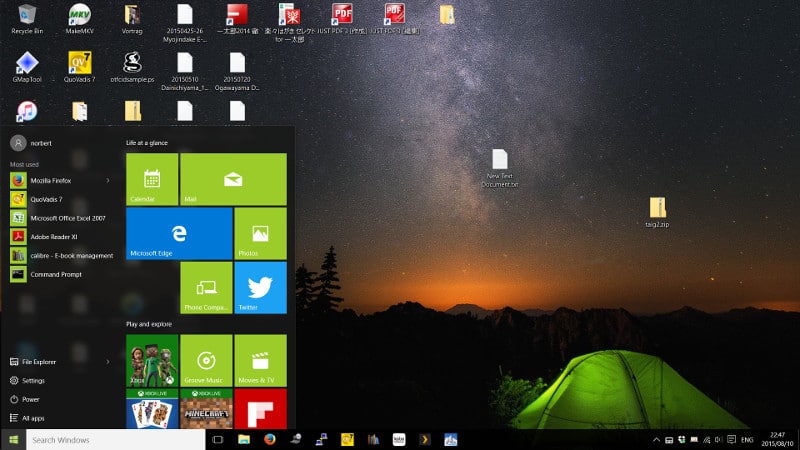
Ok, I have to admit, I still have Windows on my laptop. I do about 90% of my work on the Linux (Debian) side, but there are some applications where I don t have an alternative: Word (yes, I know LibreOffice, but it is still not capable enough to handle Japanese forms without breaking the layout), and much more, QuoVadis, a GPS and digital map program where I do have my whole history of moutaineering and bundled knowledge as mountain guide. So for the time being, I cannot switch away from Windows. Not to mention some of the Steam games that only work on Windows, unfortunately. So the other day I went ahead and accepted the upgrade offer and let Windows do its part win10 The machine is a Sony Vaio I have reported already many times, see the posts of the tag Vaio. All in all, it was a very smooth upgrade, to my complete suprise: On the other hand, as it is well documented, Windows 10 is a beast when it comes to collecting all kinds of data. There are a lot of settings to be turned off just to make sure not all your details down to your shoe size and the x-ray of your grandparents are transmitted to Microsoft. I used the German Computer News page heise where I found this article. All in all for now I am happy with the current situation, I could boot back into my comfy Linux and know that if it is necessary, I can switch to Windows (10) for some dirty work.

Daniel Pocock: Going 4K

I recently started using a 4K monitor. I've generally had a positive experience and thought I would share some comments about it. What can you do with 4K resolution?
  • View the entire London Underground map or Swiss railway map without having to zoom or scroll
  • Run a mail client like Thunderbird/Icedove and an IRC client side-by-side
  • Run Eclipse and the Android emulator side-by-side
  • Run Eclipse and some other program you are debugging side-by-side
  • When reading a PDF, show a whole page at a time but only using half the screen
Are there hardware issues? Originally the hardware was expensive and people would have to do things like using multiple cables to join their video card to their 4K screen. The latest generation of video cards and monitors don't have this problem. I chose to use NVIDIA's entry-level Quadro K420 card, the smallest and least expensive Quadro supporting 4K. The PC is a HP Z800 workstation. HP suggests they only certify the K420 with their latest workstations (e.g. Z840) but I have observed no problem using it in a Z800. The monitor is a 32" BenQ display. After reading comments from other 4K users, I felt that any monitor less than 30" would not help me get the most from the world of 4K. The monitor connects to the video card using a DisplayPort 1.2 cable that was in the box with the monitor. I've been able to get sound through the monitor but I found the volume is always a bit low and at one point sound stopped completely. What about software issues? Everything just appeared to work although the fonts are a bit smaller than what I'm used to. This appears to be related to DPI issues. DPI is not automatically detected and several applications have their own way of handling non-standard DPI. Discussion about this started on the debian-devel mailing list, given that non-standard DPI will be an issue with many newer monitors, handheld devices and more exotic displays such as televisions. Some web sites just don't look so good when the browser window is maximized to 4K resolution while others use the extra space really well. For example, using the AirBNB search, the maps show more detail but using another hotel booking site I found that it was still trying to render a map within a constant size region using less than ten percent of the page.

Matthias Klumpp: Akademy 2015

I am very late with this, but I still wanted to write a few words about Akademy 2015. First of all: It was an awesome conference! Meeting all the great people involved with KDE and seeing who I am working with (as in: face to face, not via email) was awesome. We had some very interesting discussions on a wide variety of topics, and also enjoyed quite some beer together. Particularly important to me was of course talking to Daniel Vr til who is working on XdgApp, and Aleix Pol of Muon Discover fame.
Also meeting with the other Kubuntu members was awesome I haven t seen some of them for about 3 years, and also met many cool people for the first time. My talk on AppStream/Limba went well, except that I got slightly confused by the timer showing that I had only 2 minutes left, after I had just completed the first half of my talk. It turned out that the timer was wrong  Another really nice aspect was to be able to get an insight into areas where I am usually not involved with, like visual design. It was really interesting to learn about the great work others are doing and to talk to people about their work and I also managed to scratch an itch in the Systemsettings application, where three categories had shown the same icon. Now Systemsettings looks like it is supposed to be, finally :-) The only thing I could maybe complain about was the weather, which was more Scotland/Wales like than Spanish but that didn t stop us at all, not even at the social event outside. So I actually don t complain  We also managed to discuss some new technical stuff, like AppStream for Kubuntu, and plenty of other things that I ll write about in a separate blog post. Generally, I got so many new impressions from this year s Akademy, that I could write a 10-pages long blogpost about it while still having to leave out things.

Kudos to the organizers of this Akademy, you did a fantastic job! I also want to thank the Ubuntu community for funding my flight, and the Kubuntu community for pushing me a little to attend :-). KDE is a great community with people driving the development of Free Software forward. The diversity of people, projects and ideas in KDE is a pleasure, and I am very happy to be part of this community. Akademy2015

Steve Kemp: A brief look at the weed file store

Now that I've got a citizen-ID, a pair of Finnish bank accounts, and have enrolled in a Finnish language-course (due to start next month) I guess I can go back to looking at object stores, and replicated filesystems. To recap my current favourite, despite the lack of documentation, is the Camlistore project which is written in Go. Looking around there are lots of interesting projects being written in Go, and so is my next one the seaweedfs, which despite its name is not a filesystem at all, but a store which is accessed via HTTP. Installation is simple, if you have a working go-lang environment:
go get github.com/chrislusf/seaweedfs/go/weed
Once that completes you'll find you have the executable bin/weed placed beneath your $GOPATH. This single binary is used for everything though it is worth noting that there are distinct roles: In our demo we'll have three hosts one, the master, two and three which are storage nodes. First of all we start the master:
root@one:~# mkdir /node.info
root@one:~# weed master -mdir /node.info -defaultReplication=001
Then on the storage nodes we start them up:
root@two:~# mkdir /data;
root@two:~# weed volume -dir=/data -max=1  -mserver=one.our.domain:9333
Then the second storage-node:
root@three:~# mkdir /data;
root@three:~# weed volume -dir=/data -max=1 -mserver=one.our.domain:9333
At this point we have a master to which we'll talk (on port :9333), and a pair of storage-nodes which will accept commands over :8080. We've configured replication such that all uploads will go to both volumes. (The -max=1 configuration ensures that each volume-store will only create one volume each. This is in the interest of simplicity.) Uploading content works in two phases: We'll do that like so:
laptop ~ $ curl -X POST http://one.our.domain:9333/dir/assign
 "fid":"1,06c3add5c3","url":"192.168.1.100:8080","publicUrl":"192.168.1.101:8080","count":1 
client ~ $ curl -X PUT -F file=@/etc/passwd  http://192.168.1.101:8080/1,06c3add5c3
 "name":"passwd","size":2137 
In the first command we call /dir/assign, and receive a JSON response which contains the IPs/ports of the storage-nodes, along with a "file ID", or fid. In the second command we pick one of the hosts at random (which are the IPs of our storage nodes) and make the upload using the given ID. If the upload succeeds it will be written to both volumes, which we can see directly by running strings on the files beneath /data on the two nodes. The next part is retrieving a file by ID, and we can do that by asking the master server where that ID lives:
client ~ $ curl http://one.our.domain:9333/dir/lookup?volumeId=1,06c3add5c3
 "volumeId":"1","locations":[
  "url":"192.168.1.100:8080","publicUrl":"192.168.1.100:8080" ,
  "url":"192.168.1.101:8080","publicUrl":"192.168.1.101:8080" 
] 
Or, if we prefer we could just fetch via the master - it will issue a redirect to one of the volumes that contains the file:
client ~$ curl http://one.our.domain:9333/1,06c3add5c3
<a href="http://192.168.1.100:8080/1,06c3add5c3">Moved Permanently</a>
If you follow redirections then it'll download, as you'd expect:
client ~ $ curl -L http://one.our.domain:9333/1,06c3add5c3
root:x:0:0:root:/root:/bin/bash
..
That's about all you need to know to decide if this is for you - in short uploads require two requests, one to claim an identifier, and one to use it. Downloads require that your storage-volumes be publicly accessible, and will probably require a proxy of some kind to make them visible on :80, or :443. A single "weed volume .." process, which runs as a volume-server can support multiple volumes, which are created on-demand, but I've explicitly preferred to limit them here. I'm not 100% sure yet whether it's a good idea to allow creation of multiple volumes or not. There are space implications, and you need to read about replication before you go too far down the rabbit-hole. There is the notion of "data centres", and "racks", such that you can pretend different IPs are different locations and ensure that data is replicated across them, or only within-them, but these choices will depend on your needs. Writing a thin middleware/shim to allow uploads to be atomic seems simple enough, and there are options to allow exporting the data from the volumes as .tar files, so I have no undue worries about data-storage. This system seems reliable, and it seems well designed, but people keep saying "I'm not using it in production because .. nobody else is" which is an unfortunate problem to have. Anyway, I like it. The biggest omission is really authentication. All files are public if you know their IDs, but at least they're not sequential ..

Lunar: Reproducible builds: week 15 in Stretch cycle

What happened in the reproducible builds effort this week: Toolchain fixes Guillem Jover uploaded dpkg/1.18.2 which makes dependency comparisons deep by comparing not only the first dependency alternative, to get them sorted in a reproducible way. Original patch by Chris Lamb. Dhole updated the patch adding support for SOURCE_DATE_EPOCH in gettext. A modified package is in the experimental reproducible repository. Valentin Lorentz submitted a patch adding support for SOURCE_DATE_EPOCH to ocamldoc. Valentin Lorentz also opened a bug about the inability to set an arbitrary RNG seed for ocamlopt which would be a way to fix an issue affecting many OCaml packages. Dhole submitted a patch adding support for SOURCE_DATE_EPOCH in qhelpgenerator. A modified package has been sent to the experimental repository as well. Several packages have been updated for the experimental toolchain: doxygen (akira), and dpkg (h01ger). Also, h01ger has built and uploaded all experimental packages having arch:any packages for armhf: dpkg, gettext, doxygen, fontforge, libxslt and texlive-bin. We are now providing our toolchain for armhf and amd64. Packages fixed As you might have noticed, Debian sid is currently largely uninstallable, due to the GCC 5 transition, which also can be see in our reproducibility test setup. Please help! The following packages became reproducible due to changes in their build dependencies: glosstex, indent, ktikz, liblouis, libmicrohttpd, linkchecker, multiboot, qterm, rrep, trueprint, twittering-mode. The following packages became reproducible after getting fixed: Patches submitted which have not made their way to the archive yet: Lunar reported an issue on an unstable ABI from a generated header in icedove reminding of an issue affecting libical-dev. The bug has since been fixed by Carsten Schoenert. akira identified an unreferenced embeded code copy (causing unreproducibility!) in gperf. reproducible.debian.net The scheduler has temporarily been changed to not schedule any already tested packages for sid and experimental, due to the the GCC 5 transitions, which are well visible in our graphs now. On the plus side this has caused our stretch testing to catch up (and improve stats). (h01ger) depwait packages (packages where the Build-Depends cannot be satisfied) are now listed in the last 24h and last 48h pages (Mattia Rizzolo) Two new amd64 build nodes (with 8 cores and 32 GB RAM each) have been added, kindly sponsored by Profitbricks. (h01ger) The 4 armhf (setup last week by Vagrant Cascadian) and 2 amd64 build nodes have been made available to Jenkins. Remote job scheduling has been implemented and 35 new jobs have been added for pbuilder and schroot creation and maintenance of the nodes. (h01ger) The manual scheduler gained a flag (-a/--architecture) to select which arch to schedule in. (Mattia Rizzolo) armhf will only be testing stretch for now, due to limited hardware ressources. (h01ger) The page listing maintainers of unreproducible packages gained internal anchors. As an example, one can now link to unreproducible orphaned packages. (Mattia Rizzolo) Packages with a bug tagged pending are marked using a new symbol: a brown P (Mattia Rizzolo) diffoscope development debbindiff is now called diffoscope! It also has a website at diffoscope.org. The name was changed to better reflect that it became a general purpose tool, capable of comparing many different archive formats, or directories. Version 29 is the renaming release. Amongst a couple of other cosmetic changes a favicon showing the new logo has been added to the generated HTML reports. Version 30 replaces the file matching algorithm for files listed in .changes to a smarter one that removes only the version number. It also fixes a bug where squashfs directories were being extracted even if their content was being compared at a later stage. It also fixes an issue with the test suite that was detected by debci. Documentation update More rationale have been added for supporting SOURCE_DATE_EPOCH The unfinished Reproducible Builds HOWTO is now visible on the web, feedback and patches most welcome. Package reviews 261 obsolete reviews have been removed, 73 added and 145 updated this week.

Mirco Bauer: Smuxi 1.0 "Finally" Release

And here we go again! We're proud to announce the new version of Smuxi, release 1.0 "Finally". During the development, 20 bug reports and 10 feature requests in 285 commits were worked on.

Finally 1.0 Smuxi is celebrating its 10th anniversary! 10 years ago, Mirco Bauer made the first commit to the Smuxi source code repository and is still very committed to it. He started the Gnosmirc project in 2005 when the only way a 24/7 "always-on" experience with IRC meant you had to use a console based IRC client like bitchx, irssi or epic combined with screen and SSH. This looks very practical at first and is a powerful Unix-ish way of accomplishing that job, but it has the big downside that it doesn't integrate with a desktop environment like GNOME. A bit later the Gnosmirc project was renamed to Smuxi when the new code architecture allowed other frontend implementations besides the GNOME one. The ncurses/STFL based text frontend was later implemented and is considered stable and useful enough for day to day use, but still has some rough edges. WinForms and WPF frontends also exist but need more work to reach a usable state. At this point Smuxi 1.0 contains all features that we could have imagined and even goes beyond with very advanced features like message patterns or language agnostic scripting.

Changes since Smuxi 0.11

Message Persistence One of the biggest drawbacks of the IRC protocol ever was that messages can't be retrieved from the IRC server because the IRC server is simply relaying messages to the connected clients. So, if an IRC client is freshly started and connects it starts to receive new messages, but all message you had received before are no longer available. This always made IRC in a way "volatile" unlike other communication systems like email where messages are relayed and stored on the client side. One common approach for IRC clients is to store log files in a text file. This is a simple feature and gives the user the possibility to read older conversations. Smuxi also supports text file logging like other IRC clients but it has a big user experience drawback as you need to open the file from the disk outside of the IRC client. In Smuxi 1.0 messages sent and received are now stored on the disk in a way they can automatically be retrieved/loaded when you restart Smuxi. It is like you have never closed Smuxi! This feature was already available in Smuxi for some time as a technical preview and it used the Db4o object database, but we were never happy about the performance neither with the stability so it always stayed an optional feature you need to enable. This year we tried a new message buffer backend using the famous SQLite database and it works much faster and stable as a rock. So finally we can enable this feature by default because it just works and enhanced your experience. We hope you enjoy it. Documentation of how you can change Smuxi message buffer backend and behavior can be found here. For instructions how to convert your existing db4o history to SQLite can be found in the "smuxi-message-buffer tool" section.

User Interface Enhancements
  • Synced message markers: the position of of the seen/unseen messages marker is pushed to the smuxi-server and remembered when the frontend reconnects. (Sebastian Poeplau)
  • Persistent message markers: the message marker position is also remembered across Smuxi(-server) restarts.
  • Message Counter: in addition to the highlight counter next to a chat new/unseen messages are also counted. This makes it easy to identify chats with much traffic.
  • Single application instance support. If you start Smuxi again from the menu it will bring the existing instance into the foreground. This makes the Ubuntu Messaging Menu much nicer.
  • The command/message entry is alignment with the messages. (Lex Berezhny)

Text Frontend Enhancements
  • The console background color can now be configured using: /config set STFL/Interface/TerminalBackgroundColor = #000000 (Ond ej Ho ek)
  • The text color contrast if nicks with the background is now ensured (Ond ej Ho ek) #1033
  • Messages containing images will not be skipped but their alternative text is shown instead (Ond ej Ho ek) #1035

New smuxi-message-buffer tool This is a new commandline tool that allows you to convert and export the message history of Smuxi message buffer files. This can be used to convert your existing Db4o history to SQLite like this for example:
for DB_DB4O in $HOME/.local/share/smuxi/buffers/*/*/*/*.db4o; do
    DB_SQLITE=$ DB_DB4O/.db4o/.sqlite3 
    smuxi-message-buffer convert $DB_DB4O $DB_SQLITE
done
Smuxi shouldn't be running when using this tool.

Scripting Enhancements

New Hook Points Smuxi 1.0 supports with the following new hook points:
  • engine/protocol-manager/on-presence-status-changed/ This hook point is raised when the presence status of a protocol manager changes. This happens for example when an IRC connection toggles the away state.
  • engine/session/on-event-message/ This hook point raises event messages that usually begin with "-!-". This can be useful to track state changes that are shown as a message without having a dedicated hook point for it.
  • engine/session/command-$cmd/ This hook point is raised on the engine side for commands, e.g. /some_command that isn't handled by the frontend or engine built-in commands. This is useful for commands that should be available for all frontends and isn't specific to the frontend environment.

New Plugins The following new plugins are supported by Smuxi 1.0:
  • topic-diff: Shows the word differences of the topic after topic changes. (meebey)
  • away-nick: Automatically appends and removes $AWAY_SUFFIX to/from the nick name when you go away using the /away command or by disconnecting all frontends from the smuxi-server. (meebey)
  • system-info: Shows system info. Includes system kernel version, distro name, and CPU vendor information. (AK0)
  • now-playing: This plugin is not new but was rewritten in Python to get rid of the spaghetti code monster which was written in Bash. (jamesaxl)

IRC Enhancements
  • NICKSERV support Notices from Nick/ChanServ are no longer shown on all channels as they like to send greeting messages and other spam which is annoying to see on all channels. #868
  • Automatic rejoin of channels protected with a key works as expected again
  • Connecting to irc.gitter.im is now supported. Gitter's IRCd implementation has a bug in the IRC protocol which is now tolerated.

Twitter Enhancements
  • The /search command shows tweets as live stream
  • Added /delete, /favorite and /unfavorite commands

Behind the Scenes
  • Re-licensed smuxi-common from GPLv2 to MIT/X11

Contributors Contributors to this release are the following people:
  • Mirco Bauer (199 commits)
  • Carlos Mart n Nieto (15 commits)
  • Andr s G. Aragoneses (14 commits)
  • Piotr Dr g (12 commits)
  • Ond ej Ho ek (11 commits)
  • Oliver Schneider (5 commits)
  • Calvin B (4 commits)
  • Victor Seva (3 commits)
  • Will Johansson (2 commits)
  • Sebastian Poeplau (2 commits)
  • Julian Taylor (2 commits)
  • James Axl (2 commits)
  • Daniel Mustieles (2 commits)
  • Christopher James Halse Rogers (2 commits)
  • . Uzun (1 commit)
  • Lex Berezhny (1 commit)
  • Kalle Kaitala (1 commit)
  • Jordi Mas (1 commit)
  • Joe Hansen (1 commit)
  • Jimmie Elvenmark (1 commit)
  • Dimitris Spingos (1 commit)
  • Dean Lee (1 commit)
  • Cl ment Bourgeois (1 commit)
  • Carlos Hernandez (1 commit)
Thank you very much for your contributions to Smuxi! Want this? Go here and grab it right now!

Posted Sun Aug 9 17:48:18 2015

Norbert Preining: Debian/TeX Live 2015.20150810-1

For those who are starving for some updates while the big gcc5 transitions brings the rest of Debian/sid to a halt, here is some fresh meat, a new TeX Live checkout. Nothing spectacular new here, just the usual big bunch of updates of and several new packages. Maybe worthwhile mentioning is that luasseq has been reincorporated into the TeX Live packages. Thanks to the maintainer for his work till now! Debian - TeX Live 2015 From the long list of changes let me pick one update and one new package: pgf has been updated to 3.0.1, which is just a small change in number, but incorporates 1.5 years of fixes, and the list of fixes is long. And a very interesting newcomer is pdfpagediff by C. V. Rad hakr ish nan. It allows visual comparison of two pdf files by overlaying them in a transparent way, making even slight changes in the layout immediately visible. Of course, these are not the only updates and newcomers, see the list below. Updated packages academicons, addlines, algorithms, archaic, babel, babel-estonian, biber, biblatex-source-division, bidi, bxjscls, chronology, cjk-ko, conteq, csplain, csquotes, curve2e, datatool, doclicense, dvips, eledmac, enotez, esami, eso-pic, etex-pkg, etoolbox, exsheets, fandol, fithesis, fontawesome, fontspec, forest, glossaries, greek-inputenc, jslectureplanner, kotex-oblivoir, kotex-utf, l3build, l3experimental, l3kernel, l3packages, latex, leadsheets, ledmac, lshort-english, luamplib, luasseq, luatexko, maths-symbols, media9, memoir, metrix, mhchem, minitoc, moderncv, modiagram, morefloats, mptopdf, msu-thesis, nameauth, ndsu-thesis, newpx, newtx, newtxsf, newtxtt, notes, ocgx2, pageslts, pdfpages, pdftex, pgf, phonrule, plain, polyglossia, pstricks, ptex, pxchfon, reflectgraphics, rsfso, sectionbox, siunitx, skrapport, standalone, tcolorbox, tetex, tex4ht, texfot, texinfo, texlive-scripts, todonotes, translations, tudscr, ucbthesis, unicode-math, xcharter, xgreek. New packages alertmessage, bewerbung, bidihl, bxpdfver, cloze, comicneue, copyedit, fcavtex, gradstudentresume, make4ht, mcf2graph, multiaudience, nmbib, pdfpagediff, quran, reledmac, roundrect, screenplay-pkg, shapes, tex4ebook. Enjoy.

9 August 2015

Yves-Alexis Perez: WPS and Network Manager

So, everybody knows that WPS (Wi-Fi Protected Setup) is broken. But sometimes, you don't own the access point, and you'd just want the wireless to work. That happens for example when you're a guest in some place using an Orange Livebox and you don't have the WPA passphrase (usually because it's written somewhere you don't have access too, or because someone forgot to tell you). Liveboxes WPS is the press button thing: you press a button on the front for one second, then any device can connect in the next two minutes. That works fine with Android devices, for example, but it didn't work with my laptop and NetworkManager, which doesn't support WPS at all. Fortunately, the underlying piece of software (wpa_supplicant) does support WPS, and even the push button style. And you can nicely ask it to reveal the passphrase to you with the following trick.
  1. Disconnect NetworkManager from the network, disable the wireless link, stop it; just make sure wpa_supplicant is not running;
  2. Put a stub wpa_supplicant.conf file with only the following content:
    update_config=1
    
  3. Start wpa_supplicant in the foreground with your stub config file:
    wpa_supplicant -iwlan0 -c wpa_supplicant.conf
    
  4. Start wpa_cli
Inside wpa_cli:
  1. Scan the network:
    scan
    
  2. Get the results:
    scan_results
    
    and identity the bssid of the Livebox
  3. Press the WPS button on the Livebox
  4. Run
    wps_pbc <bssid>
    ; some text should appear in the wpa_cli window, and it should eventually connect successfully (at that point you can even run a dhclient on wlan0)
  5. Run
    save_config
    
The last command will update your stub configuration file, adding a new network block with the passphrase in the clear. You can then use that passphrase inside Network Manager if it's more convenient for you. There might be something easier, but at least it worked just fine for me during the holidays.

David Moreno: 0x1F

I ve now turned 0x1F.

DebConf team: TecKids @ DebConf: Register Until Tuesday (Posted by DebConf Team)

We are happy to announce that TecKids, a non-profit specialising in working with kids, teaching them technonology, and fostering self-sustaining communities amongst them, will be holding a workshop from 15.08. to 18.08. The focus is on kids aged 10-15 years old, but kids aged 8-16 years old are welcome to attend if they can follow the course without supervision of theirs parents. Admission is free of charge, but registration through TecKids web form is mandatory. Registration is open until Tuesday, 11 August. The rough schedule for now is: You will be kept up to date on any changes to the schedule and other details by the TecKids team after registration. It is important that you check mail before heading to DebConf in order to receive any last-minute informations.

Simon Kainz: DUCK challenge: week 5

Slighthly delayed, but here are the stats for week 5 of the DUCK challenge: So we had 10 packages fixed and uploaded by 10 different uploaders. A big "Thank You" to you!! Since the start of this challenge, a total of 59 packages, were fixed. Here is a quick overview:
Week 1 Week 2 Week 3 Week 4 Week 5 Week 6 Week 7
# Packages 10 15 10 14 10 - -
Total 10 25 35 49 59 - -
The list of the fixed and updated packages is availabe here. I will try to update this ~daily. If I missed one of your uploads, please drop me a line. Only 2 more weeks to DebConf15 so please get involved: The DUCK Challenge is running until end of DebConf15! Pevious articles are here: Week 1, Week 2, Week 3, Week 4.

8 August 2015

Dirk Eddelbuettel: drat 0.1.0: Even more repository support

drat and double drat A new version 0.1.0 of the drat package arrived on CRAN today. Its name stands for drat R Archive Template, and it helps with easy-to-create and easy-to-use repositories for R packages, and is finding increasing by other projects. This version 0.1.0 builds on the previous releases and now adds complete support for binaries for both Windows and OS X. This builds on what had been added in the previous release 0.0.4. This and other new features are listed below: Also of note: The rOpenSci project now uses drat to distribute their code, and Carl Boettiger has written a nice blog post about it. Courtesy of CRANberries, there is a comparison to the previous release. More detailed information is on the drat page.

This post by Dirk Eddelbuettel originated on his Thinking inside the box blog. Please report excessive re-aggregation in third-party for-profit settings.

Matthew Garrett: Difficult social problems are still difficult problems

After less than a week of complaints, the TODO group have decided to pause development of their code of conduct. This seems to have been triggered by the public response to the changes I talked about here, which TODO appear to have been completely unprepared for.

While disappointing in a bunch of ways, this is probably the correct decision. TODO stumbled into this space with a poor understanding of the problems that they were trying to solve. Nikki Murray pointed out that the initial draft lacked several of the key components that help ensure less privileged groups can feel that their concerns are taken seriously. This was mostly rectified last week, but nobody involved appeared to be willing to stand behind those changes in a convincing way. This wasn't helped by almost all of this appearing to land on Github's plate, with the rest of the TODO group largely missing in action[1]. Where were Google in this? Yahoo? Facebook? Left facing an angry mob with nobody willing to make explicit statements of support, it's unsurprising that Github would try to back away from the situation.

But that doesn't remove their blame for being in the situation in the first place. The statement claims
We are consulting with stakeholders, community leaders, and legal professionals, which is great. It's also far too late. If an industry body wrote a new kernel from scratch and deployed it without any external review, then discovered that it didn't work and only then consulted any of the existing experts in the field, we'd never take them seriously again. But when an industry body turns up with a new social policy, fucks up spectacularly and then goes back to consult experts, it's expected that we give them a pass.

Why? Because we don't perceive social problems as difficult problems, and we assume that anybody can solve them by simply sitting down and talking for a few hours. When we find out that we've screwed up we throw our hands in the air and admit that this is all more difficult than we imagined, and we give up. We ignore the lessons that people have learned in the past. We ignore the existing work that's been done in the field. We ignore the people who work full time on helping solve these problems.

We wouldn't let an industry body with no experience of engineering build a bridge. We need to accept that social problems are outside our realm of expertise and defer to the people who are experts.

[1] The repository history shows the majority of substantive changes were from Github, with the initial work appearing to be mostly from Twitter.

comment count unavailable comments

Christoph Egger: What's wrong with the web? -- authentication

The problem One problem to solve when doing web authentication has always been one identity provider, so you don't have to remember which username (or email address) you used for that bugtracker you used three years ago or that website. And tie it to one login ideally. Five years ago this problem seemed to be basically solved. There was OpenID and while it may not have been great it worked. You could have your own provider, your institution (university, company, foss project, ..) could have one and you could use your university-provided ID for all university stuff. Today's state Looking at the problem again today and the situation seems to have changed. To the worse. A lot. People are actively removing OpenID support. There seemed to be a replacement with, at least, proper design goals: Mozilla's persona. However this seems to be a dead end, no-one (almost) actually supports it. Then there is what people call OAuth2. However there does not seem to be such a thing as OAuth2 at all, at least not for logging into websites. So for example phabricator supports 12 different OAuth2 systems. That includes Google, Facebook, Twitter, Amazon Github and a whole bunch of other services. Each with a different implementation in the webapp of course. And of course you can not just have your university/company/.. provide an OAuth2 service for you to use -- you would need to write yet another adapter on the (foreign) website to talk to your implementation and your provider. And the strange thing, people seem to still consider OAuth2 a replacement for OpenID while it does not even provide the core functionality of the older system. Plus there does not seem to be any awareness of that all together. Other features Now of course, OpenID is not (and never was) the ultimate answer to the web authentication problem. The most obvious problem being user tracking. Your identity provider will see every website you log into, will see when you log into it and even be able to log into that website with your credentials. Of course, this problem is fully inherited by OAuth2. And in contrast to OpenID you can no longer run your own provider whom you can fully trust and who already knows about your surfing habits (because it's actually you already). Mozilla's persona might have solved that, they at least intended to. But, again, persona seems quite dead.

Wouter Verhelst: Backing up with tar

The tape archiver, better known as tar, is one of the older backup programs in existence. It's not very good at automated incremental backups (for which bacula is a good choice), but it can be useful for "let's take a quick snapshot of the current system" type of situations. As I'm preparing to head off to debconf tomorrow, I'm taking a backup of my n-1 laptop (which still contains some data that I don't want to lose) so it can be reinstalled and used by the Debconf video team. While I could use a "proper" backup system, running tar to a large hard disk is much easier. By default, however, tar won't preserve everything, so it is usually a good idea to add some extra options. This is what I' mrunning currently:
sudo tar cvpaSf player.local:carillon.tgz --rmt-command=/usr/sbin/rmt --one-file-system /
which breaks down to create tar archive, verbose output, preserve permissions, automatically determine compression based on file extension, handle Sparse files efficiently, write to a file on a remote host using /usr/sbin/rmt as the rmt program, don't descend into a separate filesystem (since I don't want /proc and /sys etc to be backed up), and back up my root partition. Since I don't believe there's any value to separate file systems on a laptop, this will back up the entire contents of my n-1 laptop to the carillon.tgz in my home directory on player.local.

7 August 2015

Norbert Preining: Japanese-English dictionary for Kobo

Since ever the Kobo firmwares also allowed downloading of a bunch of dictionaries, most of which I don t need. As I am fluent in most languages I read and write, the only real dictionary I would like to see is a Japanese-English (I don t dare asking for a Japanese-German). Unfortunately, Kobo never shipped one. OTOH, starting with firmware 3.16.10 they ships two different English-Japanese dictionaries, one excellent Japanese-Japanese dictionary, but not one Japanese-English. So I took the liberty to write a script that allows everyone to enrich the shipped Japanese-Japanese dictionary with English definitions. Kobo Logo Till now I have used Tshering s excellent Japanese dictionary which was enriched with English definitions. It was based on the older Japanese-Japanese dictionary shipped with firmwares before 3.16.10. I didn t want to loose the more complete dictionary from the new firmware, so here is a script that updates the dictionary for you Prerequisites The script is neither fool-proof nor does everything by itself. Furthermore, it requires a set of programs. In details: Supported dictionaries At the moment the program can use the following two dictionaries as sources: Edict2 and Japanese3. Edict2 The Edict dictionary is a free dictionary which is the base of most other dictionaries. Created by the JMdict/EDICT Project it provides a very complete Japanese-English dictionary. To use the dict with the current program, one need to download the edict2.gz file and unpack it with gunzip edict2.gz. If you put it into the same directory as the Perl script, nothing else needs to be done, otherwise one can use the command line option --edict PATH-TO-EDICT to specify the location of the edict2 file. Japanese3 The Japanese3 is a dictionary application for iOS which provides another very complete Japanese-English dictionary. My feeling is that it is 90% and more based on Edict, so adding it will not buy you much, but still a bit (see below for how much!). If you have purchased this dictionary/application, and you manage to get access to your iOS device (via jailbreaking or some other tools), then you need to get the file Japanese3.db from the application folder, and then generate a file via sqlite3 as follows:
$ sqlite3 Japanese3.db
.output japanese3-data
select Entry, Furigana, Summary from entries;
If you save the generated file japanese3-data into the same directory as the Perl script, nothing else needs to be done, otherwise one can use the command line option --japanese3 PATH-TO-J3-DATA to specify the location of the Japanese3 data file. Command line options The program supports the following command line options: Note that in case you pass in the option --unpacked, the files should be properly named (encodings are a problem!). Furthermore, note that the unpacked directory contains lots of .gif and .html files that are actually gzip-compressed files, but lacking the .gz extension. If you want to unpack the dictionary, by advised that the file names in the Zip directory are already encoded in UTF-8, but normal programs (unzip, 7z) assume that they are encoded in some other encoding. Thus, if your are using UTF-8 locale, it is necessary to set LC_CTYPE to C to make sure that the encoding is used, as in
LC_CTYPE=C 7z x ...
Typical run In the following example we use both dict2 and Japanese3 dictionaries, and prefer Edict2:
$ perl enhance-dictionary.pl --dicts edict2 --dicts japanese3
Using the following dictionaries as source for translations: edict2 japanese3
loading edict2 ... done
loading Japanese3 data ... done
unpacking original dictionary ... done
loading dict files ... done
searching for words and updating ... done
total words 805521, matches: 130563 (edict: 123388, japanese3: 7175)
creating output html ... done
creating update dictionary in dicthtml-jaxxdjs-201508072201.zip ... done
$
Installing the dictionary After having created the enhanced dictionary, one can install the generated file as KOBO/.kobo/dicts/dicthtml-jaxxdjs.zip (where KOBO is the mount point of the eReader). The dictionary should be picked up automatically. And the next lookup should give you something like the following:
kobo-glohd-enhanced-ja-dict There is only one caveat: Syncing with Kobo will re-download the original dictionary and overwrite the enhanced one. There is at least one solution here, which I am employing, see this post on MobileRead. Download and development place I am using the github repository kobo-ja-dict-enhance to develop the program. Please report bugs, and feature requests there. The file for the last released version can be downloaded from here: enhance-dictionary.pl Future plans I am planning to get rid of the 7z dependency and use Archive::Zip for all the unpacking and packing. This would also allow to do everything in memory and thus make it faster. There is a branch on github with ongoing work on this matter. I also think about including translations for Hiragana words by providing the translations of all possible Kanji readings. Conclusions Even if Kobo does not provide us with a decent Japanese-English dictionary, adding at least a huge amount of translations to the current dictionary is now easily possible. For serious students of Japanese who are reading or starting to read Japanese eBooks, this will be of great help. Enjoy, and don t forget to give feedback, suggestions, and improvements either here or better via the Github page.

Guido G nther: Debian work in July 2015

July was the third month I contributed to Debian LTS under the Freexian umbrella. In total I spent eight hours working on: Besides that I did CVE triaging of 11 CVEs to check if and how they affect oldoldstable security as part of my LTS front desk work.

Christoph Egger: Systemd pitfalls

logind hangs If you just updated systemd and ssh to that host seems to hang, that's just a known Bug (Debian Bug). Don't panic. Wait for the logind timeout and restart logind. restart and stop;start One thing that confused me several times and still confuses people is systemctl restart doing more than systemctl stop ; systemctl start. You will notice the difference once you have a failed service. A restart will try to start the service again. Both stop and start however will just ignore it. Rumors have it this has changed post jessie however. sysvinit-wrapped services and stop While there are certainly bugs with sysvinit services in general (I found myself several times without a local resolver as unbound failed to be started, haven't managed to debug further), the stop behavior of wrapped services is just broken. systemctl stop will block until the sysv initscript finished. It will even note the result of the action in its state. However systemctl will return with exitcode 0 and not output anything on stdout/stderr. This has been reported as Debian Bug. zsh helper I found the following zshrc snipped quite helpful in dealing with non-reported systemctl failures. On root shells it will display a list of failed services as part of the prompt. This will give proper feedback whether your systemctl stop failed, it will give feedback if you still have type=simple services and if the sysv-init script or wrapper is broken.
precmd ()  
    if [[ $UID == 0 && $+commands[systemctl] != 0 ]]
    then
      use_systemd=true
      systemd_failed=" systemctl --state=failed   grep failed   cut -d \  -f 2   tr '\n' ' ' "
    fi
 
if [[ $UID == 0 && $+commands[systemctl] != 0 ]]
then
  PROMPT=$'% $fg[red]>>  $systemd_failed$reset_color% \n'
else
  PROMPT=""
fi
PROMPT+=whateveryourpromptis
zsh completion Speaking of zsh, there's one problem that bothers me a lot and I don't have any solution for. Tab-completing the service name for service is blazing fast. Tab-completing the service name for systemctl restart takes ages. People traced down to truckloads of dbus communication for the completion but no further fix is known (to me). type=simple services As described in length by Lucas Nussbaum type=simple services are actively harmful. Proper type=forking daemons are strictly superior (they provide feedback of finished initialization and success thereof) and type=notify services are so simple there's no excuse for not using them even for private one-off hacks. Even if you're language doesn't provide libsystemd-daemon bindings:
(defun sd-notify (event-string)
  (let ((socket (make-instance 'sb-bsd-sockets:local-socket :type :datagram))
        (name (posix-getenv "NOTIFY_SOCKET"))
        (bufferlen (length event-string)))
    (when name
      (sb-bsd-sockets:socket-connect socket name)
      (sb-bsd-sockets:socket-send socket event-string bufferlen))))
This is a stable API guaranteed to not break in the future and implemented in less than ten lines of code with just basic socket functions. And if your language has support it becomes actually trivial:
    try:
        import systemd
        systemd.daemon.notify("READY=1")
    except ImportError:
        pass
Note that in both cases there is no drawback at all on systemd-free setups. It has the overhead of checking the process' environment for NOTIFY_SOCKET or for the systemd package and behaves like a simple service otherwise. Actually the idea of separating the technical aspect (daemonizing) from the semantic aspect of signalizing "initialization finished, everything's fine" is a pretty good idea and hopefully has the potential to reduce the number of services signalizing the "everything's fine" too early. It could even be ported to non-systemd init systems easily given the API.

Christoph Egger: Systemd pitfalls

logind hangs If you just updated systemd and ssh to that host seems to hang, that's just a known Bug (Debian Bug #770135). Don't panic. Wait for the logind timeout and restart logind. restart and stop;start One thing that confused me several times and still confuses people is systemctl restart doing more than systemctl stop ; systemctl start. You will notice the difference once you have a failed service. A restart will try to start the service again. Both stop and start however will just ignore it. Rumors have it this has changed post jessie however. sysvinit-wrapped services and stop While there are certainly bugs with sysvinit services in general (I found myself several times without a local resolver as unbound failed to be started, haven't managed to debug further), the stop behavior of wrapped services is just broken. systemctl stop will block until the sysv initscript finished. It will even note the result of the action in its state. However systemctl will return with exitcode 0 and not output anything on stdout/stderr. This has been reported as Debian Bug #792045. zsh helper I found the following zshrc snipped quite helpful in dealing with non-reported systemctl failures. On root shells it will display a list of failed services as part of the prompt. This will give proper feedback whether your systemctl stop failed, it will give feedback if you still have type=simple services and if the sysv-init script or wrapper is broken.
precmd ()  
    if [[ $UID == 0 && $+commands[systemctl] != 0 ]]
    then
      use_systemd=true
      systemd_failed=" systemctl --state=failed   grep failed   cut -d \  -f 2   tr '\n' ' ' "
    fi
 
if [[ $UID == 0 && $+commands[systemctl] != 0 ]]
then
  PROMPT=$'% $fg[red]>>  $systemd_failed$reset_color% \n'
else
  PROMPT=""
fi
PROMPT+=whateveryourpromptis
zsh completion Speaking of zsh, there's one problem that bothers me a lot and I don't have any solution for. Tab-completing the service name for service is blazing fast. Tab-completing the service name for systemctl restart takes ages. People traced down to truckloads of dbus communication for the completion but no further fix is known (to me). type=simple services As described in length by Lucas Nussbaum type=simple services are actively harmful. Proper type=forking daemons are strictly superior (they provide feedback of finished initialization and success thereof) and type=notify services are so simple there's no excuse for not using them even for private one-off hacks. Even if you're language doesn't provide libsystemd-daemon bindings:
(defun sd-notify (event-string)
  (let ((socket (make-instance 'sb-bsd-sockets:local-socket :type :datagram))
        (name (posix-getenv "NOTIFY_SOCKET"))
        (bufferlen (length event-string)))
    (when name
      (sb-bsd-sockets:socket-connect socket name)
      (sb-bsd-sockets:socket-send socket event-string bufferlen))))
This is a stable API guaranteed to not break in the future and implemented in less than ten lines of code with just basic socket functions. And if your language has support it becomes actually trivial:
    try:
        import systemd
        systemd.daemon.notify("READY=1")
    except ImportError:
        pass
Note that in both cases there is no drawback at all on systemd-free setups. It has the overhead of checking the process' environment for NOTIFY_SOCKET or for the systemd package and behaves like a simple service otherwise. Actually the idea of separating the technical aspect (daemonizing) from the semantic aspect of signalizing "initialization finished, everything's fine" is a pretty good idea and hopefully has the potential to reduce the number of services signalizing the "everything's fine" too early. It could even be ported to non-systemd init systems easily given the API.

Neil McGovern: Forty five hours

IMG_0330As some may know, since October 2013, I ve been studying to gain my Private Pilot Licence, and I finally achieved this goal. It s actually taken quite a bit more than 45 hours a total of around 60, but that does include a day trip to France (Le Touquet) and getting my night rating as well. This basically means I can fly single engine piston aeroplanes on my own, with passengers, as soon as my paperwork gets processed by the Civil Aviation Authority anyway. I ve been flying Cessna 172s from Cambridge Aero Club, where they have four of them, G-SHWK, G-UFCB, G-HERC and G-MEGS, as well as a Extra 200, G-GLOC. It s a great club, with fantastically maintained planes and great instructors, and Cambridge Airport has a full ATC service as well, so it s been useful to get that experience, especially as the UK s airspace is fairly contended with a lot of controlled and military airspace which needs permission to enter. As for what next, I need to work that out. When you get your licence, it s often described as a license to learn, so that s what I intend to do. Apart from popping over to France for lunch every now and again, I m probably going to have a go at aerobatics and farm strip flying, then probably look at my IMC rating. So, if it s a nice day, and you re around in Cambridge, let me know if you want a trip up in the skies!

Next.

Previous.