Search Results: "spa"

10 August 2010

Russell Coker: Cyborgs solving Protein Folding problems

Arstechnica has an interesting article about protein folding problems being solved by a combination of brute-force software and human pattern recognition in the form of a computer game [1]. Here is a link to the primary source which also mentions the fact that players can design their own proteins which could potentially cure some diseases [2]. This is very similar to Garry Kasparov s observations about ideal methods for playing chess given computers and humans [3]. It is also similar to Jane McGoningal s ideas about using online gaming to make a better world [4] which inspired my post about choosing a free software mission [5]. What other serious problems can we solve via computer games and screen-savers?

7 August 2010

Christian Perrier: Developers per country

Back in 2009, I did some analysis of the number of developers per country. Apparently, some people at DebConf remember this and asked if I could update this data. So, here we are with the 2010 version, sorted by the ratio of *active* developers per million population for each country.
Act: number of active developers
Dev: total number of developers
A/M: number of active devels per million pop.
D/M: number of devels per million pop.
2009: rank in 2009
2010: rank in 2010
Code	Name		Population	Act	Dev	A/M	D/M	2009	2010
fi	Finland		5359538		21	32	3,92	5,97	1	1
ch	Switzerland	7782900		22	26	2,83	3,34	2	2
nz	New Zealand	4386207		11	15	2,51	3,42	4	3
no	Norway		4895500		11	14	2,25	2,86	5	4
lu	Luxemburg	502202		1	1	1,99	1,99	8	5
se	Sweden		9354462		18	34	1,92	3,63	3	6
de	Germany		81757600	148	212	1,81	2,59	7	7
at	Austria		8356707		14	23	1,68	2,75	6	8
ie	Ireland		6197100		9	12	1,45	1,94	13	9
au	Australia	22413132	32	56	1,43	2,5	9	10
be	Belgium		10827519	14	16	1,29	1,48	10	11
fr	France		65447374	84	112	1,28	1,71	12	12
nl	Netherlands	16607943	20	38	1,2	2,29	11	13
uk	United-Kingdom	62041708	64	102	1,03	1,64	14	14
ca	Canada		34199000	27	56	0,79	1,64	15	15
es	Spain		46030109	34	52	0,74	1,13	16	16
dk	Denmark		5540241		4	8	0,72	1,44	17	17
hr	Croatia		4489409		3	3	0,67	0,67	20	18
lt	Lithuania	3341966		2	2	0,6	0,6	28	19
cz	Czech Rep	10506813	6	6	0,57	0,57	21	20
us	USA		309913000	165	360	0,53	1,16	19	21
it	Italy		60231214	32	46	0,53	0,76	23	22
bg	Bulgaria	7563710		4	4	0,53	0,53	25	23
il	Israel		7602400		4	6	0,53	0,79	24	24
hu	Hungary		10005000	5	11	0,5	1,1	18	25
lv	Latvia		2217969		1	2	0,45	0,9	26	26
uy	Uruguay		3494382		1	2	0,29	0,57	22	27
jp	Japan		127420000	32	45	0,25	0,35	30	28
pl	Poland		38192000	9	13	0,24	0,34	29	29
cr	Costa Rica	4253897		1	1	0,24	0,24	31	30
sk	Slovakia	5379455		1	1	0,19	0,19	32	31
pt	Portugal	11317192	2	4	0,18	0,35	27	32
ar	Argentina	40134425	6	8	0,15	0,2	34	33
tw	Taiwan		23119772	3	3	0,13	0,13	37	34
br	Brazil		192272890	20	21	0,1	0,11	36	35
by	Belarus		9648533		1	1	0,1	0,1	35	36
mg	Madagascar	20653556	2	2	0,1	0,1	44	37
gr	Greece		11306183	1	3	0,09	0,27	33	38
kr	South Korea	48758000	4	6	0,08	0,12	39	39
ec	Ecuador		14790608	1	1	0,07	0,07		40
cl	Chile		17063000	1	2	0,06	0,12	42	41
ru	Russia		141927297	7	8	0,05	0,06	43	42
ro	Romania		22215421	1	2	0,05	0,09	45	43
co	Colombia	45393050	2	3	0,04	0,07	41	44
ve	Venezuela	26814843	1	1	0,04	0,04	40	45
pe	Peru		29461933	1	1	0,03	0,03	46	46
tr	Turkey		72561312	2	2	0,03	0,03	47	47
za	South Africa	49991300	1	8	0,02	0,16	38	48
mx	Mexico		111211789	2	2	0,02	0,02	49	49
th	Thailand	66404688	1	2	0,02	0,03	50	50
eg	Egypt		78737000	1	2	0,01	0,03	51	51
in	India		1184344000	7	7	0,01	0,01	52	52
cn	China		1338612968	6	10	0	0,01	53	53
ua	Ukraine		45888000	0	0	0	0	48	54
								
								
					873	1410	61,91%			
A few interesting facts:

6 August 2010

Matthew Garrett: AE_AML_BUFFER_LIMIT in \_SB_._OSC

If you get messages like this:

ACPI Error (psparse-0537): Method parse/execution failed [\_SB_._OSC] (Node ffff8801e8c62b30), AE_AML_BUFFER_LIMIT

then you've fallen foul of one of the less appealing aspects of ACPI. _OSC methods are defined as methods to allow the operating system and the firmware to handshake over their support of optional features. Different _OSC methods apply to different types of hardware. CPU _OSC methods allow the operating system to inform the firmware that it supports ACPI 3.0 throttling states, while PCIe _OSC methods allow the operating system to indicate that it can manage native PCIe hotplug. The firmware can choose whether or not to give up control of these features, and the OS then has to cope.

The problem arises when we get to the _OSC method on the system bus. This wasn't specified until ACPI 4.0, leaving an attractive mechanism for vendors to add OS/firmware integration. To that end, we now have at least three different _SB_._OSC methods in the wild:
  1. The ACPI specified _OSC. This exists purely for the OS to tell the firmware what it supports, without the firmware having the opportunity to disagree. As such it passes 8 bytes of data to the method.
  2. The Microsoft WHEA _OSC. This exists to allow the firmware and Windows to handshake over whether or not the firmware supports Microsoft's hardware error reporting.
  3. HP's PCC _OSC method, designed to allow handshaking between the OS and the firmware in order to determine whether they support OS interaction with the firmware-level CPU scaling


This wouldn't be enough to be a problem in itself. The ACPI spec requires _OSC methods to have GUIDs in order to protect users from exactly this kind of situation - Windows can attempt to enable WHEA on a machine with a spec-compliant _OSC, and the _OSC method will return an immediate failure because the GUID doesn't match. Except that the WHEA and PCC versions of _SB_._OSC pass 12 bytes of data in the third argument, against the ACPI spec version's 8. And many _OSC implementations attempt to access the region between bytes 9 and 12 before checking the GUID, resulting in the AE_AML_BUFFER_LIMIT error.

This is made even more annoying due to the fact that argument 2 contains the number of parameters being passed in argument 3, making it straightforward to avoid this kind of failure. Firmware authors, tbh.

5 August 2010

Alexander Reichle-Schmehl: DDs, please feel free to commit to the DPN directly

The svn repository used to draft the Debian Project News just passed the sixth hundreds commit. If my calculations are correct, that's quite more than the number of edits done, back when the DPN was drafted in the wiki. I take it as a hint, that the new work flow works better than the old one. However, playing a bit with statistics (done by horrible shell one liners ;) I noticed, that - while every Debian Developer may commit to the subversion repository - not that many commits from other DDs where made: Of the 602 commits so far, only 70 where done by other DDs:
alex@melusine:~$ svn log --xml svn://svn.debian.org/svn/publicity \
 xmlstarlet sel -t -m "/log/logentry/author" -v "concat(.,' ')"   \
sed -e "s/ /\n/g" sort uniq -c sort -n grep -v guest grep -v tolimar
      1
      1 abe
      1 hertzog
      1 holger
      1 mika
      1 paravoid
      2 pabs
      3 alfie
     15 zobel
     20 gio
     25 spaillard
To give credit where credit is due, here are the guest commits:
     16 tpeteul-guest
     21 jeremiah-guest
     25 gmascellani-guest
     36 madamezou-guest
    122 taffit-guest
Many thanks so far, but I would like to advertise the Debian Project News and invite every DD to help us and to commit directly. It's quite easy: Run svn co svn+ssh://svn.debian.org/svn/publicity/dpn/en/current, edit the index.wml file, and then commit your changes back to the repository. (Well, ideally you would also honor Status flag and won't commit, if it's not open-for-edit.) As for the format: While we indeed use wml, you just need some basic HTML knowledge. To add a paragraph just use the following with proper content:
<a name="X"></a>
<h2>Fancy title</h2>
<p>More details about the topic.</p>
Usually the articles are kind of sorted by importance, so unless you are pretty sure it might be the easiest to just add your article at the end of the regular news, just before the other news sections. Should you not be able to fill an entire paragraph, feel free to just a one or two sentences to the other news section (just add a <p>...</p> with your content to the end of the other news). Don't worry about style, your English or syntax: It won't end up on the web page directly, it's reviewed and checked, so you can't do anything wrong. More details are available in the wiki at http://wiki.debian.org/ProjectNews/HowToContribute. Feel free to ask any questions unanswered on the publicity list at debian-publicity@lists.debian.org. Feel also free to contact us there, if you would like to help by translations or reviews. The more people help, the less work it's for everyone :) If you are not a Debian Developer, but still would like to help us, it's no problem. All you need is an account on our Alioth System (very easy to get, you just need to ask) and request to join the publicity project. See http://wiki.debian.org/ProjectNews/HowToContribute#Becominganeditoryourself for the respective links.

4 August 2010

Neil Williams: FreedomBox

Eben Moglen's talk at DebConf10 has inspired a flood of responses and activity at DebConf10. The original talk overran the allotted time within the venue and then outside the venue for something like an hour, HackLab discussions migrated to the single theme and brought in more and more people over lunch. When the Skype talk was left without a speaker in the afternoon, it morphed into a FreedomBox BOF with maybe 100 delegates planning and contributing to the ideas and another BOF is planned for Friday. A rough outline is appearing on the wiki page for those who want to follow it and the video of the original talk is available, linked from that Wiki page.

What gets people excited about this project is that we already have all the components to do the work, people have been doing most of this stuff at home, on their own, for some time and it needs to be brought together as a series of packages and meta packages and other middleware glue to get it working. (multistrap is part of that glue - it's already being used commercially in a similar role. Debian Pure Blends is another part of the glue. This can be a Debian solution, it doesn't have to be a separate project.)

The software and glue doesn't have to be dependent on a single hardware platform, this is about getting the software right and deploying it on whatever hardware can run it - albeit that the architecture itself is likely to be ARM-something.

It is time for social networking to be freed from the man-in-the-middle - time to withdraw user data from central servers owned by some third-party and share directly with your friends (whichever network they use). Aggregate all data from all your friends, keep all your data in your own plug and access it from wherever you are using whatever devices you have to hand. What's more, your friends - especially the non-techy friends - can just buy a cheap beige box that hides away in the corner of their home and have all the same access too - everyone gets to choose exactly which pieces of data get shared and to whom and can then use their friends plugs to store encrypted backups of their other data. Or maybe the final solution will be slightly different - it's up to people in Debian to make it happen. The tools are in our own hands, if we want this, we just need to do it.

What is needed now is some direction, there are choices to be made about how the glue is designed and how this is turned into a "self-discoverable" distributed network service. Yes, IPv6 will make this easier but only once ordinary users can deploy the device transparently and without configuration, so an interim solution will be needed.

Who's up for the challenge?

Gerfried Fuchs: The Good, The Bad and The Ugly

Debian always was known for its communication "style". There were even shirts sold in memory of Espy Klecker with a quote he is known for: Morons. I'm surrounded by morons. Yes, I bought me one of those shirts too in the early days. And there were the talks that promoted Debian as a place to have Good flamewar training. And people considered that to be the fun part. After some years it got tiring. It got stressful. It got annoying. Bad feelings popped up, stirred you into the next flamewar, and it went down the gutter from there. It was almost becoming impossible to not be the target of a flamewar when one was doing more than just basic maintenance. Snide and extreme terse responses became the standard. In the end people are starting to give up and leave. The Ugly thing about this is that human resources are crucial. They aren't endless and can't be replaced as easily as broken hardware, especially when capable people or when people leave who invested an enormous amount of their spare time and effort. And given that a fair amount of people do put their heart into Debian, it feels like a small suicide to them and the public thinking about leaving is meant as a call for help which wasn't and isn't given. The solution to this death swirl? I'm not sure. When one looks over the edge of the plate and ignores for a moment all the bad feelings they one might have built up against Ubuntu because of their success and possibility to find new contributors on a regular basis one is able to find a much friendlier and productive environment there. This might be attributed to the Code of Conduct about which I wrote about last year already and which is an extremely well intended and useful document (the point I raised in there is already solved for a while, so I became a MOTU). And even if it might be hard to follow it at times, Mark Shuttleworth reminds and encourages its contributors to stick to these principles even in tough times. The result? When following the planets, one finds on Planet Ubuntu a very good rate of blog posts on things that had been done, compared to the good rate of blog posts of rants on Planet Debian. And even though people regularly complain about the communication style within Debian, the answers of this year's DPL candidates to the question about a code of conduct for Debian were rather rather disappointing. So it is just well too understandable that people go the path that hurts themself, take a cut and leave the project behind in its mess. For myself? I'm not too far from that point on a regular basis, and I can understand those who did the final step only too well. Regular abuse, especially when doing stuff that others neglect on a regular basis but needs to be done anyway, being belittled on that grounds and not being taken serious and getting disrespectful responses isn't improving the situation. It happens to way too many people, and the only thing that still keeps me on tracks is that I do not want to give in yet, that I don't think that it would improve Debian to leave the grounds to various destructive people. On the other hand, there is only so much abuse one can take...
ObTitle: Ennio Morricone - The Good, The Bad and The Ugly

/debian permanent link Comments: 5

Gerfried Fuchs: The Good, The Bad and The Ugly

Debian always was known for its communication "style". There were even shirts sold in memory of Espy Klecker with a quote he is known for: Morons. I'm surrounded by morons. Yes, I bought me one of those shirts too in the early days. And there were the talks that promoted Debian as a place to have Good flamewar training. And people considered that to be the fun part. After some years it got tiring. It got stressful. It got annoying. Bad feelings popped up, stirred you into the next flamewar, and it went down the gutter from there. It was almost becoming impossible to not be the target of a flamewar when one was doing more than just basic maintenance. Snide and extreme terse responses became the standard. In the end people are starting to give up and leave. The Ugly thing about this is that human resources are crucial. They aren't endless and can't be replaced as easily as broken hardware, especially when capable people or when people leave who invested an enormous amount of their spare time and effort. And given that a fair amount of people do put their heart into Debian, it feels like a small suicide to them and the public thinking about leaving is meant as a call for help which wasn't and isn't given. The solution to this death swirl? I'm not sure. When one looks over the edge of the plate and ignores for a moment all the bad feelings they one might have built up against Ubuntu because of their success and possibility to find new contributors on a regular basis one is able to find a much friendlier and productive environment there. This might be attributed to the Code of Conduct about which I wrote about last year already and which is an extremely well intended and useful document (the point I raised in there is already solved for a while, so I became a MOTU). And even if it might be hard to follow it at times, Mark Shuttleworth reminds and encourages its contributors to stick to these principles even in tough times. The result? When following the planets, one finds on Planet Ubuntu a very good rate of blog posts on things that had been done, compared to the good rate of blog posts of rants on Planet Debian. And even though people regularly complain about the communication style within Debian, the answers of this year's DPL candidates to the question about a code of conduct for Debian were rather rather disappointing. So it is just well too understandable that people go the path that hurts themself, take a cut and leave the project behind in its mess. For myself? I'm not too far from that point on a regular basis, and I can understand those who did the final step only too well. Regular abuse, especially when doing stuff that others neglect on a regular basis but needs to be done anyway, being belittled on that grounds and not being taken serious and getting disrespectful responses isn't improving the situation. It happens to way too many people, and the only thing that still keeps me on tracks is that I do not want to give in yet, that I don't think that it would improve Debian to leave the grounds to various destructive people. On the other hand, there is only so much abuse one can take...
ObTitle: Ennio Morricone - The Good, The Bad and The Ugly

/debian permanent link Comments: 8 Flattr this

Russell Coker: WordPress Maintainability

For a while I ve been maintaining my own WordPress packages. I use quite a few plugins that weren t included in Debian, some of them have unclear licenses so they can t go in Debian while the rest would have to go in Volatile at best because they update regularly and often have little or no information in the changelog to describe the reason for the update so we have to assume there is a potential security issue and update it reasonably quickly. As I m maintaining plugin packages it seems most reasonable to keep maintaining my own packages of WordPress itself which I started doing some time ago then the version in Debian became outdated. Now WordPress isn t a convenient package to maintain, the design of it is that a user will upload it to their web space via FTP or whatever, it s not designed to be managed by a packaging system with the option of rolling back upgrades that don t work, tracking dependencies, etc. One example of this is the fact that it comes with a couple of plugins included in the package, of which Akismet is widely used. The Akismet package is periodically updated asynchronously from the updates to the WordPress package with the apparent expectation that you can just FTP the files. Of course I have to build a new WordPress package whenever Akismet is changed. Now there is a new default theme for WordPress called TwentyTen [1]. This theme ships with WordPress and again has updates asynchronously. Just over a week ago my blog prompting me for an update to the theme even though I hadn t consciously installed it I have to update because I don t know whether one of the other users on the same system has chosen it and because having a message about an update being required is annoying. The Themes update page has no option for visiting the web site for the theme and only offered to send it to my server via FTP or SFTP, of course I m not going to give WordPress access to change it s own PHP files (and thus allow a trojan to be installed). So I had to do some Google searching to find the download page for TewntyTen which happens to not be in the first few results from a Google search (even though those pages look like they should have a link to it and thus waste the time of anyone who just wants to download it). After downloading the theme I had to build a new WordPress package containing it I could have split it out into a separate package and have the WordPress package depend on it, but I ve got enough little WordPress packages already. It doesn t seem worth-while to put too much effort into my private repository of WordPress packages that possibly aren t used by anyone other than me. Plugins aren t as bad, the list of plugins gives you a link to the main web page for each plugin which allows you to download it. I wonder what portion of the WordPress user-base install via FTP to a server that they don t understand and what portion of them use servers that are maintained properly with a packaging system, my guess is that with the possible exception of WordPress.com most bloggers are running on packaged code. It seems to me that optimising for Debian and CentOS is the smart thing to do for anyone who is developing a web service nowadays. That includes files managed by the packaging system, an option to downgrade (as well as upgrade) the database format (which changes with almost every release), and an option for upgrading the database from the command-line (so it can be done once for dozens or hundreds of users). deb http://www.coker.com.au lenny wordpress I have a repository of WordPress packages that anyone can use with the above APT sources.list line. There is no reason why they shouldn t work with Testing or Unstable (the packaging process mostly involves copying PHP files to the correct locations) but I only test them on Lenny.

3 August 2010

Russell Coker: Pre-Meeting Lightning Talks

This evening I arrived at the LUV [1] meeting half an hour before it started. I was one of about a dozen people sitting in the room waiting, some of us had laptops and were reading email but others just sat quietly the venue is sometimes open as much as an hour before the event starts and in bad weather some people arrive early because it s more comfortable than anywhere else that they might hang out. So I went to the front and suggested that instead of just doing nothing we get some short talks about random Linux things to fill the time. This seems to be a good opportunity for people to practice their public speaking skills, share things that interest them with a small and friendly audience, and keep everyone else entertained. With some prompting a few members of the audience got up and spoke about Linux things that they were doing or had recently read about. They were all interesting and I learned a few things. I considered giving a talk myself (my plan B was to just speak for 15 minutes about random Linux stuff I m doing) but decided that it would be best if I just encouraged other people to give talks. I have suggested to the committee that we plan to do this in future and maybe have a mention of it on the web site to encourage people who are interested in such things (either speaking or listening) to attend early enough. I think that this concept has been demonstrated to work and should also work well in most other user group meetings of a suitable size. At LUV we typically have about 60 people attend the main meeting and maybe a dozen arrive really early so people who would be nervous about speaking to an audience of 60 may feel more comfortable. For a significantly larger group (where you have maybe 300 people attend the main meeting and 60 arrive early) the dynamic would be quite different, instead of having more nervous people give talks you might find that a membership of 300 gives a significant number of people who have enough confidence to give an impromptu short lecture to an audience of 60. As an aside the Connected Community Hackerspace [2] is having a meeting tonight to decide what to do about an office in a central Melbourne area. One of the many things that a Hackerspace can be used for is a meeting venue for lightning talks etc.

2 August 2010

Christine Spang: lolbikeride to debconf

DebConf being in New York City this year, clearly the right way to get there was to bike, together with Molly and Daf. Being touring newbs, there were a few mishaps.

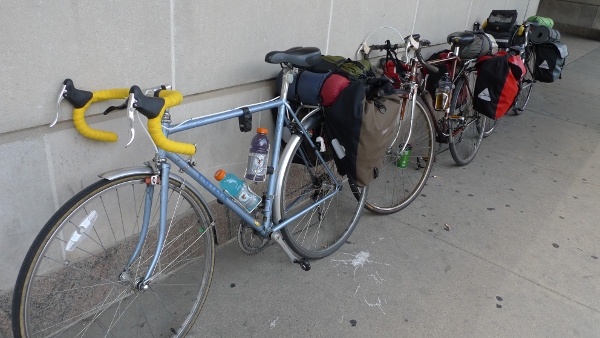
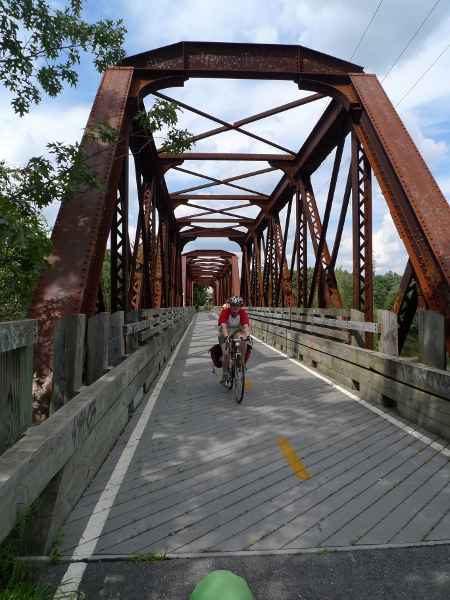
Day 1 We aimed to catch the 10:00 commuter rail train from Boston to Providence, Rhode Island, but we ran late (predictable) and had problems with the bicycle rack for my racing bike, which attaches without frame mounts (also predictable, since Mako and Mika test-rode it earlier in the week), so we didn't make it in to the station until around 10:20. We used the extra time to eat and fix up the bikes, though, so it's not clear how much of a setback that was. Here are our bikes ready to go at the Providence commuter rail station. bikes at Providence We then had some problems with Molly's brakes, and it took a long time to navigate out of the city, but eventually we found ourself on the "Washington Secondary Trail" a wonderful bike path along an old rail line. Every couple miles there'd be an old covered rail bridge over the river, and it was a well-paved straight shot for about ten miles, with no cars and no need to navigate. Molly on a train bridge Just as we were getting into things after the bike trail ended, something completely unexpected happened. This is Daf's derailleur after it sheared off in the middle as we attempted to start after a red light outside Tractor Supply Co. broken derailleur Luckily, John and his son Chris lent us a hand and hauled Daf and his bike to the nearest bicycle shop in the back of their pickup truck. They'd just come from there, where John had bought Chris a new helmet. Greenway Cycles, the only bike shop in a twenty mile radius, was three miles away. We got there an hour before it closed and Rick replaced the derailleur and straightened the hanger in a jiffy. Due to all these things, we didn't get as far as we'd planned in the first day and ended up camping in Seaport Campground in Mystic, Connecticut, rolling in at around 22:00. We did about 65 miles, including six due to the detour to the cycle shop. Carrying camping gear is heavy! Several delicious peanut butter and jelly bagels and some wheatberry and couscous salad later, we were passed out.

Day 2 Molly at the campground The second day included less bike trouble, but was no less eventful, and we were tired from the previous day's riding. The highlights included taking a tiny sidewalk path that I'm baffled how Google knows about up onto a sidewalk alongside the I-95 bridge across the Thames to New London, Connecticut. the Thames bridge The 13:00 ferry from New London to Orient Point, New York, where we got some remarkably good veggie burgers (whole edamame visible!) for lunch. Cross Sound Ferry And a vineyard on the north fork of Long Island, where we stopped for a quick tasting and ended up picking up a bottle of barrel-fermented chardonnay. The vineyard was small 23 acres, with 11 acres of grapes and the proprietors were friendly and extremely interested in our trip. They gave us a dollar off on the bottle due to our method of transport. The Old Field Vineyard It turns out there are only two trains a day on the Long Island rail, and we just barely caught the 18:52 return from Riverhead. We had mere seconds in the station and ended up without enough cash to pay for tickets onboard, but the conductor just took what we had and gave us tickets to Penn Station anyway. Outside Penn, a girl with a mohawk and a messenger bag overheard us talking about biking up Broadway and told us to bike up 8th Avenue instead. "Always bike up 8th and down Broadway because they have bike lanes in those directions." Thus, we didn't die dodging taxis in the dark. So basically, due to various people being extremely nice to us for no good reason, we made it to Columbia University around 22:30, on the correct day. Warm fuzzies for humanity all around. :)

Joachim Breitner: Protecting static content selectively by OpenID

When I created my on-line photo album, we had the year 2001 and there was nothing wrong with publishing ones photos in the Internet. It has been almost ten years now, and things have changed. Privacy is an issue, especially when it also affects your friends and family. The problem
So I needed to find some protection. These were my requirements:
  1. I only want to protect parts of the site, as there are some pictures that I intentionally share with the public. This selection should be possible down to the individual image.
  2. The solution should work without any dynamic server component besides the web server itself. This rules out any self-written CGI scripts as well.
  3. One password, given to all my friends etc., is not sufficient as it might leak to unintended audience.
  4. I do not want my visitors to have to register and remember yet another username and password just for my site. I also do not want to manage this user database.
  5. I do not want to have do large changes to the file structure of my photo album.
This rules out most common options, e.g. protection by a .htpasswd file. Requirements 3 and 4 point to a solution based on OpenID. With OpenID, my visitors can authenticate against a service they already use (Google, Yahoo, etc.), relieving me from the burden of maintaining a user database and them from having to remember a password. There is a mod_auth_openid module for the Apache webserver, and it is even distributed with Debian in the libapache2-mod-auth-openid package. So requirement 2 is fulfilled. The tricky part is: How do we achieve OpenID protection for some images, and not for others. The solution I first played around with selectively enabling or disabling mod_auth_openid based on <FileMatch> directives in the Apache configuration, but it was not elegant and would not scale well. I have more than 20.000 pictures to manage, and have already selected over 5000 pictures to be shown without protection. My solution is based on a partial copy of the whole directory tree that contains all public files. To save disk space, these are just symbolic links to the real file in the protected location. Some mod_rewrite magic then takes care of giving the user the impression that all files are in the same location. I set up a small example of my solution, which has this directory structure:
.:
drwxr-xr-x 2 root root 4096  2. Aug 12:03 images
lrwxrwxrwx 1 root root   18  1. Aug 12:05 index.html -> private/index.html
lrwxrwxrwx 1 root root   18  1. Aug 12:05 login.html -> private/login.html
drwxr-xr-x 3 root root 4096  2. Aug 12:03 private
./images:
lrwxrwxrwx 1 root root 33  2. Aug 12:00 pleaselogin.png -> ../private/images/pleaselogin.png
lrwxrwxrwx 1 root root 28  2. Aug 12:03 public.png -> ../private/images/public.png
./private:
drwxr-xr-x 2 root root 4096  2. Aug 12:00 images
-rw-r--r-- 1 root root  267  2. Aug 12:03 index.html
-rw-r--r-- 1 root root   94  2. Aug 12:01 loggedin.html
-rw-r--r-- 1 root root 2091  2. Aug 12:03 login.html
-rw-r--r-- 1 root root   10 18. Nov 2009  protected.html
./private/images:
-rw-r--r-- 1 root root 4074  2. Aug 11:58 pleaselogin.png
-rw-r--r-- 1 root root 2670  2. Aug 11:58 private.png
-rw-r--r-- 1 root root 2043  2. Aug 11:58 public.png
As you can see, real files only reside in private/, outside of that, only symbolic links exist. The apache configuration protects the private directory and blends it into the main directory:
   <directory /var/www/nomeata.de/openid-test>
        RewriteEngine On
        # Abuse the login page as an error image
        RewriteCond % QUERY_STRING  \.(png jpg)
        RewriteRule ^login.html$ /openid-test/images/pleaselogin.png
        # Ship private files, if they exist, unless public files exist
        RewriteCond  $1 !^private
        RewriteCond  /var/www/nomeata.de/openid-test/$1 !-f
        RewriteCond  /var/www/nomeata.de/openid-test/private/$1 -f
        RewriteRule  ^(.+)$ /openid-test/private/$1
   </directory>
   <directory /var/www/nomeata.de/openid-test/private>
        AuthOpenIDEnabled        On
        AuthOpenIDDBLocation     /var/lib/apache2/mod_auth_openid/mod_auth_openid.db
        AuthOpenIDLoginPage      /openid-test/login.html
        AuthOpenIDTrustRoot      http://nomeata.de
        AuthOpenIDCookiePath     /
        AuthOpenIDCookieLifespan 2592000
    </directory>
A special trick handles the login page for protected images: If the login page is requested and the referrer indicates that the user tried to access a .png or .jpg file, apache will instead ship an image containing an error message. For my photo album I have a small Perl script that, given a directory with a private/ directory therein and a list of rules in form of glob patterns, will symlink matching files and remove symlinks that are not allowed any more.
What s next? As you can see, this does not actually protect the content. It only requires the user to authenticate, then everything is visible. To select which OpenIDs are allowed to access which code, some bugs will have to be fixed in mod_auth_openid first. There was little activity there recently, I hope that the project is not dead.

Jaldhar Vyas: PreventaCamp Days 3 and 4

I missed yesterdays report but there was not a lot to say anyway. I've made further progress on the DHCP problem in the sense that I can make it go away if I use NAT in VMWare instead of Bridged networking. Tried compiling gcc 4.4.4 and ran out of disk space. I've been feeling guilty about not volunteering so that evening I assisted the organizers by eating some of their excess baked ziti. It's my civic duty. Today (Sunday) was Debian day. I spent some time in the hacklab trying to compile gcc again. This time I ran out of inodes. I did manage to get to two of the presentations. One was about the GSoC projects various students are doing. Perhaps next year Debian Minix will be a subject for GSoC? The other one was by Andy Oram about FLOSS Manuals. They are doing important work in Free Software documentation and have developed some interesting tech towards that end. One is CSS3 print profile support. This will be a relief for anyone who has had to deal with the bletcherous XSL. Another is booki a platform for collaborative writing and editing. I shall be following the progress of this project as I hope to make a big contribution to Debian documentation soon. Andy works for O'Reilly and after the talk we had some informative discussion about the publishing world. This "hallway track" is the great thing about gatherings like Debconf.

Matt Zimmerman: DebConf 10: Day 1

This week, I am attending DebConf 10 at Columbia University in New York. The first day of DebConf is known as Debian Day. While most of DebConf is for the benefit of people involved in Debian itself, Debian Day is aimed at a wider audience, and invites the public to learn about, and interact with, the Debian project. These are the talks I attended. Debian Day Opening Plenary (Gabriella Coleman, Hans-Christoph Steiner) Hans-Christoph discussed Debian and free software from a big picture perspective: why software freedom matters, challenging the producer/consumer dichotomy, how the Debian ecosystem hangs together, and so on. Steps to adopting F/OSS in government (Andy Oram) Andy discussed FLOSS adoption in governments, drawing on examples from Peru, the city of Munich, the state of Massachusetts. He covered the reasons why this is valuable, the relationship between government transparency and software freedom, and practical advice for successful adoption and deployment. Pedagogical Freedom (panel, Jonah Bossewitch et al) The panelists discussed the use of technology in education, especially free software, some of the parallels between free software and education, and what these communities could learn from each other. This is a promising topic, though the perspectives seemed to be mostly from the education realm. There is much to be learned on both sides. Google Summer of Code 2010 at Debian (Obey Arthur Liu) This talk covered the student projects for this year s Summer of Code. Most of the students were in attendance, and presented their own work. They ranged from more specialized projects like the Hurd installer, to core infrastructure improvements like multi-arch in APT. Beyond Sharing: Open Source Design (Mushon Zer-Aviv) Mushon gave an excellent talk on open design. This is a subject I ve thought quite a bit about, and Asheesh validated many of my conclusions from a different angle. I ve added a new post to my todo list to go into more detail on this subject. Some points from his talk which resonated with me: How Government can Foster Freedom in Technology (Hon. Gale Brewer) Councillor Brewer paid a visit to DebConf to tell us about the work she is doing on the city council to promote better government through technology. Brewer seems to be a strong advocate of open data, saying essentially that all government data should be public. She summarized a bill to mandate that New York City government data be public, shared in raw form using open standards, and kept up to date. It sounded like a very strong move which would encourage third party innovation around the data. She also discussed the need for greater access to computers and Internet connectivity, particularly in educational settings, and a desire to to have all public hearings and meetings shared online. Why is GNU/Linux Like a Player Piano? (Jon Anderson Hall, Esq.) Jon is a very engaging speaker. He drew parallels between the development of player pianos, reproducing pianos, reed organs, pipe organs and free software. He even tied in Hedi Lamarr s work which led to spread spectrum wireless technology. To be quite honest, I did not find that these analogies taught me much about either free software or player pianos, but nonetheless, I couldn t help but take an interest in what he was saying and how he presented it. DebConf Opening Plenary (Gabriella Coleman) Biella and company explained all the ins and outs of the event: where to go, what to do (and not do), and most importantly, whom to thank for all of it. Now in its 11th year, DebConf is an impressively well-run conference. I m looking forward to the rest of the week!

1 August 2010

Chris Lamb: screen-message prompt for Awesome

The following snippet adds a screen-message prompt to the Awesome window manager:
mypromptbox = widget( 
  type = "textbox",
  name = "mypromptbox",
  align = "left"
 )
globalkeys = awful.util.table.join(
  -- [..]
  awful.key(  "Mod1"  , "F6", function ()
    awful.prompt.run(
        prompt = "Msg: "  ,
      mypromptbox,
      function (msg)
        awful.util.spawn_with_shell(
          'echo ' .. msg .. '   sm - -b Black -f White'
        )
      end
  ) end)
)
root.keys(globalkeys)
(The default colour scheme of black-on-white is painful.)

31 July 2010

Wouter Verhelst: Wouter Verhelst, Tourist

So for one day a few days ago, I wasn't Wouter Verhelst, Debian Developer, but rather the above. I'm not usually very much interested in doing touristy things, but then on the other hand I'm of the opinion that you can't really claim to have been somewhere if all you've seen is the inside of a certain specific university campus. So, well, touristy things. I took the subway to about 10 blocks away from the very south of Manhattan, and then walked. I passed by city hall and what used to be the world trade center, but there wasn't much to see there construction sites are the same everywhere in the world. I moved on to "the battery", the south tip of Manhattan, and had an... interesting look at the Statue of Liberty in the distance. I thought about going there, but the tickets were sold out, so scratch that. Wall Street from Trinity Church Instead, I walked on to the Brooklyn Bridge (passing by Wall Street on the way), spent some time looking for the pedestrian's entrance to that bridge (which was slightly harder than would've thought it to be), and walked partway up the bridge. I wasn't interested in crossing over to Brooklyn, but it's an interesting bridge to walk on, and I had an interesting time. Brooklyn Bridge When I left the bridge again, it started raining. I don't mind a few drips on a warm day like that day, but this was more than that, and it started to bother me. So, rather than walking to the Empire State building, as I'd been planning, I decided to take the subway there. This did mean I missed out on the SOHO area, which I would've liked to see, but well, you can't have it all. dsc_6639 The Empire State building is something you grow up hearing about, and I'd seen pictures of it. It has a somewhat distinctive silhouette, shown on several comparative graphics of high-profile skyscrapers. But none of that is even close to the real thing. Not that it's higher than I expected; on the contrary. But it does look different; its color is much lighter than I thought, and the distinctive silhouette isn't as distinctive once you're standing right next to the building. But, well, going up the building clearly shows that it is the tallest building of New York. There are other skyscrapers, but most of those seem to be little dwarves in comparison. The view is nice, up there, and I took some interesting pictures. The tickets aren't very cheap ($20), but not insanely expensive either. I don't regret doing this. Going down... (in case you were wondering: yes, the above picture is in the point of view of the one above that, and vice versa) By that time it was around 4 pm already, and I thought about going back to the Columbia campus. As I checked out my map for the most efficient route, I found that it probably would've been easier to walk to Times Square and take the number 1 train there which stops right in front of Columbia (but below the surface, obviously). So since I was going to have to go there, I figured I could just visit Times Square while I was at it. Times "Square" I must say I'm not very impressed by it. For starters, Times Square isn't actually a square, at least not as I'm used to that word. Broadway and 7th avenue happen to cross at a, for Manhattan, uncharacteristically sharp angle, which results in more space between buildings than usual. But it's still fairly small as a "square". They've fenced off a part of that space and put a bunch of chairs and tables there. This would be a cosy and inviting, "gezellig" place, if not for the very audible noise of the traffic still going on all around it, and the fact that everywhere you see, there's three layers of brustling and visually noisy adverts. It could have been a relaxing oasis in the middle of the city, but instead it's just as busy as everywhere else in Manhattan. But then, I guess that's what New York City is all about. At any rate, after spending about half an hour or so there, I walked over to the subway to get back to the venue just in time for dinner. The end of a nice, touristy, day.

Jaldhar Vyas: PreventaCamp Day 2

The hacklab is so cold I'm going to lose some of my toes to frostbite. Today I spent most of my time trying to track down the DHCP problem. Phil Kern suggested it might be due to the output of Columbias DHCP server which certainly sounds plausible but without tools such as strace I'm rather at a loss as to how to figure out what exactly is going on. If anyone would like to look at the source to the Minix DNS caching thingy which is where the hang actually occurs, I would appreciate it. Other than that I also ported iconv, gettext, and grep.

30 July 2010

Biella Coleman: Holy Debconf10 is awesome


nycsubway-heart, originally uploaded by the biella.
So an email went out to Debconf-announce with all this and MORE information but it is worth highlighting the talks/events as they are great. We look forward to having you in New York City! ********************************************************************************************************** exciting schedule highlights
- Have a look at the DebConf10 schedule,
there are a lot of really interesting things planned, both during Debian Day and DebConf
itself. We have a great line-up of speakers, and other events that are
sure to make this DebConf one to remember! A couple notable events that we wanted to highlight: Be sure to come to the DebConf Welcoming Plenary in the evening of Debian Day. This opening plenary will be the first thing that kicks
off DebConf and will be brief, important, and fun. General information
about DebConf, important logistical bits, and prizes(!) will be
had. Also, this gives you a chance to ask some questions before we get
started. Be there at 7:30pm in Davis Auditorium on August 1st! The much anticipated Cheese and Wine party will be happening in the
evening on the 2nd. This will be your chance to see what mixture of
fermented, cultured and alcoholic things your stomach can handle! Also exciting to mention is Eben Moglen who will be speaking on the
3rd during DebConf at 9:30am about Freedom and Privacy in the Cloud
and how we (yes us!) here at DebConf, can be the silver lining. If you
don t already know Eben Moglen
he is Professor of Law at Columbia Law School and founding Director of the Software Freedom Law
Center. Since 1993 he has served pro bono publico as General
Counsel of the Free Software Foundation. Moglen was part of Philip
Zimmermann s defense team when Zimmermann was being investigated over
the export of PGP. As counsel to the FSF, Moglen was charged with
enforcing the GNU General Public License (GPL) and later became
heavily involved with drafting version 3 of the GPL. Also in the evening of the 3rd at 7:30pm we will be treated to not
only a screening of the brilliant and beautiful and (award winning!)
film Sita Sings the Blues in
Pupin 301, but also a Q&A afterwards with the acclaimed animator Nina
Paley! She will describe how the process of making this film caused
her to question the wisdom of copyright monopolies in the arts. The
film is under a Creative Commons ShareAlike license, and her
distribution mechanism is unique as Paley consciously adopted the
methods of the free software movement to distribute the film. The
discussion with the artist after the screening will explain in depth
how and why, and discuss what Paley and QuestionCopyright.org are
doing next to encourage more artists to try the Free route. After the film, at 9:00PM the Columbia University Astronomy
Department will host a guided stargazing event, which includes use
of several different optical telescopes on their roof. There will be
astronomers on hand to answer any questions about the stars,
telescopes, or any other topics of scientific interest. There are many talks that are going to be exciting at Debian Day, even
for Debian Developers! One track will be showcasing general Free
Software themes and issues, and many of these talks will be really
interesting to Debian Developers, so be sure to check out the schedule and come On Debian Day we are excited to have the Honorable Gale Brewer speak at 4pm. She is part of the New York City Council and was the
former Chair of the Committee on Technology in Government, current
Chair on Committee on Governmental Operations and will discuss the
ways that government can foster freedom in technology. Its both
exciting and a privilege to have her speak at DebConf! day trip
This year, the day trip is going to be a blast, a crazy adventure at
the bizarre and fun Coney Island! Explore the historic RussianBrighton Beach! Ride the Cyclone rollercoaster, 82-years old this
year! Swim in the ocean! See the circus sideshow! Eat delicious food
or if unlucky, not so good food. Or do none of the above and just hang
out with your friends outside and have a good time. At the end of the day we are going to go to a unique cultural event:
the Brooklyn Cyclones baseball game where we will have the chance to
watch our beloved DPL humiliate himself as he throws out the first
pitch, in his Debian kilt! Don t like baseball, or sports? Don t worry, neither do we, but the point really isn t the baseball game,
the point is hanging out with all your closest Debian friends and
having a good laugh as Zack tries really hard not to trip, also a good
chance to experience some local culture and to relax after a hard day at the beach. free things in the city
There are an amazing number of free events happening in New York City during the summer! If you are looking for something to do, we ve
compiled a list of various events from a number of different locations
for you to easily view in one spot.

Biella Coleman: Holy Debconf10 is awesome


nycsubway-heart, originally uploaded by the biella.
So an email went out to Debconf-announce with all this and MORE information but it is worth highlighting the talks/events as they are great. We look forward to having you in New York City! ********************************************************************************************************** exciting schedule highlights
- Have a look at the DebConf10 schedule,
there are a lot of really interesting things planned, both during Debian Day and DebConf
itself. We have a great line-up of speakers, and other events that are
sure to make this DebConf one to remember! A couple notable events that we wanted to highlight: Be sure to come to the DebConf Welcoming Plenary in the evening of Debian Day. This opening plenary will be the first thing that kicks
off DebConf and will be brief, important, and fun. General information
about DebConf, important logistical bits, and prizes(!) will be
had. Also, this gives you a chance to ask some questions before we get
started. Be there at 7:30pm in Davis Auditorium on August 1st! The much anticipated Cheese and Wine party will be happening in the
evening on the 2nd. This will be your chance to see what mixture of
fermented, cultured and alcoholic things your stomach can handle! Also exciting to mention is Eben Moglen who will be speaking on the
3rd during DebConf at 9:30am about Freedom and Privacy in the Cloud
and how we (yes us!) here at DebConf, can be the silver lining. If you
don t already know Eben Moglen
he is Professor of Law at Columbia Law School and founding Director of the Software Freedom Law
Center. Since 1993 he has served pro bono publico as General
Counsel of the Free Software Foundation. Moglen was part of Philip
Zimmermann s defense team when Zimmermann was being investigated over
the export of PGP. As counsel to the FSF, Moglen was charged with
enforcing the GNU General Public License (GPL) and later became
heavily involved with drafting version 3 of the GPL. Also in the evening of the 3rd at 7:30pm we will be treated to not
only a screening of the brilliant and beautiful and (award winning!)
film Sita Sings the Blues in
Pupin 301, but also a Q&A afterwards with the acclaimed animator Nina
Paley! She will describe how the process of making this film caused
her to question the wisdom of copyright monopolies in the arts. The
film is under a Creative Commons ShareAlike license, and her
distribution mechanism is unique as Paley consciously adopted the
methods of the free software movement to distribute the film. The
discussion with the artist after the screening will explain in depth
how and why, and discuss what Paley and QuestionCopyright.org are
doing next to encourage more artists to try the Free route. After the film, at 9:00PM the Columbia University Astronomy
Department will host a guided stargazing event, which includes use
of several different optical telescopes on their roof. There will be
astronomers on hand to answer any questions about the stars,
telescopes, or any other topics of scientific interest. There are many talks that are going to be exciting at Debian Day, even
for Debian Developers! One track will be showcasing general Free
Software themes and issues, and many of these talks will be really
interesting to Debian Developers, so be sure to check out the schedule and come On Debian Day we are excited to have the Honorable Gale Brewer speak at 4pm. She is part of the New York City Council and was the
former Chair of the Committee on Technology in Government, current
Chair on Committee on Governmental Operations and will discuss the
ways that government can foster freedom in technology. Its both
exciting and a privilege to have her speak at DebConf! day trip
This year, the day trip is going to be a blast, a crazy adventure at
the bizarre and fun Coney Island! Explore the historic RussianBrighton Beach! Ride the Cyclone rollercoaster, 82-years old this
year! Swim in the ocean! See the circus sideshow! Eat delicious food
or if unlucky, not so good food. Or do none of the above and just hang
out with your friends outside and have a good time. At the end of the day we are going to go to a unique cultural event:
the Brooklyn Cyclones baseball game where we will have the chance to
watch our beloved DPL humiliate himself as he throws out the first
pitch, in his Debian kilt! Don t like baseball, or sports? Don t worry, neither do we, but the point really isn t the baseball game,
the point is hanging out with all your closest Debian friends and
having a good laugh as Zack tries really hard not to trip, also a good
chance to experience some local culture and to relax after a hard day at the beach. free things in the city
There are an amazing number of free events happening in New York City during the summer! If you are looking for something to do, we ve
compiled a list of various events from a number of different locations
for you to easily view in one spot.

Lucas Nussbaum: Debcamp+Debconf again!

As I did since 2007, I will be attending Debconf again this year. I have been quite busy recently, and am lagging behind in some of my Debian work, so I plan to use Debconf to get stuff done, not just socialize and attend talks. Here is my TODO list, basically by order of willingness to do the work . It s probably too much for 9 days, so don t hesitate to talk to me if you want to help with some items.
Rob Bradford: GUADEC 2010

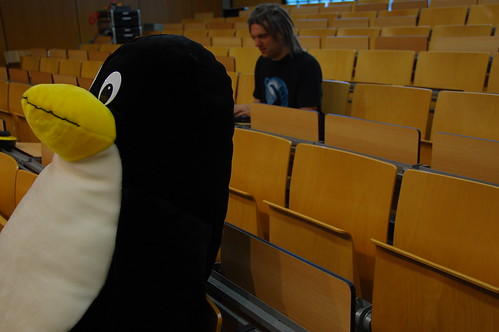
GUADEC is going really well this year, great to catch up with folks. A big thank you to everyone who came along to my tips and tricks talk yesterday. I hope that everyone discovered something new; I certainly did whilst preparing it. As suggested i ll try and get this content all collated up into a wiki page. Watch this space.

Awesome photo CC gonzalemario - http://bit.ly/9Z0iIf

Next.

Previous.