Search Results: "nic"

15 May 2011

Lars Wirzenius: vmdebootstrap and FreedomBoxLite

I played around some with with vmdebootstrap, my little toy to generate a disk image with a pre-installed Debian system. I added some more features, and to show them off, created a simplistic, proof-of-concept image to demostrate what FreedomBox might do. The image includes Apache and an SSH server, and a pre-configured user. You can use SFTP to put files on the server, and HTTP to access them. An instant file-sharing appliance. A real FreedomBox should, of course, do all sorts of other things, and this filesharing should probably be done differently, too. This is not a demonstration of the FreedomBox. It's a demonstration of vmdebootstrap. The following command builds the image. Passwords are fixed, so you'll want to not run the image on a public network.
sudo vmdebootstrap \
--log fboxlite.log \
--log-level debug \
--image fboxlite.img \
--hostname fboxlite \
--size 1G \
--verbose \
--enable-dhcp \
--package ssh \
--package apache2 \
--mirror http://mirror.lan/debian/ \
--customize=./fboxlite-customize \
--root-password=password1
You'll need the following customization script as well:
#!/usr/bin/python
import crypt
import os
import subprocess
import sys
def runcmd(argv, stdin='', ignore_fail=False, **kwargs):
    p = subprocess.Popen(argv, stdin=subprocess.PIPE, 
                         stdout=subprocess.PIPE, stderr=subprocess.PIPE, 
                         **kwargs)
    out, err = p.communicate(stdin)
    if p.returncode != 0:
        msg = 'command failed: %s\n%s\n%s' % (argv, out, err)
        if not ignore_fail:
            raise Exception(msg)
    return out
print 'Customizing fboxlite'
rootdir = sys.argv[1]
# Create a fboxlite account.
runcmd(['chroot', rootdir, 'adduser', '--gecos', 'Freedombox Lite',
        '--disabled-password', 'fboxlite'])
encrypted = crypt.crypt('password1', '..')
runcmd(['chroot', rootdir, 'usermod', '-p', encrypted, 'fboxlite'])
# Create /srv/shared for holding shared files.
shared = os.path.join(rootdir, 'srv', 'shared')
os.mkdir(shared)
runcmd(['chroot', rootdir, 'chown', 'fboxlite:fboxlite', 'srv/shared'])
os.chmod(shared, 0775)
# Configure Apache to serve /srv/shared as /shared.
conf = os.path.join(rootdir, 'etc', 'apache2', 'sites-available', 'default')
text = open(conf, 'r').read()
lines = text.splitlines()
new_lines = [
    'Alias /shared "/srv/shared"',
    '<Directory "/srv/shared/">',
    'Options Indexes',
    '</Directory>',
]
lines = lines[:-1] + new_lines + lines[-1:]
text = ''.join('%s\n' % line for line in lines)
open(conf, 'w').write(text)
If you're using libvirt with KVM, you can then use the following command to deploy the disk image:
virt-install --connect qemu:///system -n fboxlite -r 512 \
--os-type linux --os-variant debiansqueeze \
--disk $(pwd)/fboxlite.img --vnc  --import
Log in via the emulated console, and run ip addr to see what the IP address of the virtual machine is (and if you can find a way to query libvirt what the address is, please tell me). Then you can use the following URLs (in, for example, Nautilus):
sftp://fboxlite@192.168.122.133/srv/shared/
http://192.168.122.133/shared/
Replace the correct IP address in the above URLs and off you go.

Kai Wasserb ch: LWP::Authen::OAuth in NEW

I've uploaded liblwp-authen-oauth-perl to Debian today, [UPDATE: currently the package is waiting in NEW (please note, that the previous link might not work, in case the package has entered the archive already or the page hasn't been generated yet). and is now in the archive. Thanks a lot to the FTP Masters for the quick processing!] LWP::Authen::OAuth allows to easily integrate OAuth authentication into Perl programs and libraries. Some of you might already guess, why I have an interest in OAuth for Perl: as a user (and maintainer) of Chronicle I'd find it neat, if there could be some Flattr integration (especially a automatic submission of new posts to Flattr). This sent me searching for an Perl implementation of the Flattr API. Unfortunately this turned up nothing, therefore I'm now planning to write some sort of Net::Flattr Perl module, which I can then use in Chronicle for one task or another. Net::Flattr (preliminary name, but probably the final one, as the implementation of the Twitter API is called Net::Twitter) is going to be a library, which should offer the same functionality as Flattr's PHP library. For now there are some scetches to this extent on my hard drive, but nothing showable. I hope I find the time soon to write this but it shouldn't be too difficult. ;-) Apart from my particular use case, you can use LWP::Authen::OAuth for any other OAuth-requiring API. I hope the package helps you to build more cool tools for and on your Debian system!

John Goerzen: Napoleon, Winter in May, and Silly String

This is just a diary of a random day sort of post. Nothing all that particularly unusual, but then perhaps if I only blog about the unusual, the typical gets lost. This week started out with temperatures as high at 99F. Today we didn t even reach 60, and tonight will be cold almost to freezing. It s Kansas, so while we remark on the strange weather, we re not particularly surprised by it. This morning, Jacob and Oliver went over to play across the street. Jacob then went with Terah to a birthday party for one of his classmates, while Oliver helped plant some trees with his grandparents. I was at home this morning, which gave me a small but welcome break from the past week: we had something going on 6 out of the last 7 evenings, and little time to do anything else. So I got out the Kindle and read from War and Peace. I started at the kitchen table while eating some granola, and then sat on the couch. The day was cold, windy, and overcast, and I like to use natural light, so there were only a few places to sit with enough light. I sat there reading the account of Napoleon s capture of Moscow in 1812, the characters lives uprooted by those events, and stories of violent mobs forming. And, of course, Tolstoy s essays on the mistake of overstating the importance of famous figures in history were common. I am now about 3/4 through War and Peace, which means I ve read 1,044 pages and have (only) 348 to go. As I got up to try to find slippers or a blanket for my cold feet at one point, I remembered a conversation I had while eating lunch this week. I was reading on the Kindle while reading, and a person I knew happened to walk past. She asked what I was reading. I said simply, War and Peace. There was this stunned silence, so I added, for fun. It s great! Which is true. She said, Oooookay, John, you just enjoy that then and went on her way. This isn t the first time I ve had a conversation like that about this book. It seems to be held up as some example of long, dry, literature that people are made to read but don t want to. I think that only long is accurate here. Anyhow, pretty soon Oliver arrived and, much to my surprise, said Doh! (meaning no ) when I asked him if he was ready for lunch. Instead he stood there looking at me sweetly. Taking a guess, I said, Oliver, would you like to watch train videos? Yeah yeah yeah yeah! So we did. He particularly enjoyed the steam engines today, and eventually was ready for lunch at 12:30. Jacob and Terah got home just as he was finishing. Oliver got his nap, and I played with Jacob for a bit. Ever since he had heard of the British wedding in preschool, he s been interested in weddings, so I showed him pictures from Terah and me at our wedding. This was a big hit. Then he went with Terah to decorate a Sunday School room at church, so I read a bit more Tolstoy. Tolstoy s characters sometimes are prone to not just changes in mood but changes in outlook and worldview changing from cold, logical, and uncaring to warm and loving, or from despair at the vanity and shallowness of humanity to elation at the simple honesty of a peasant and renewed trust in the human spirit. At first I marveled at this tendency in certain characters, but on reflection, and in consideration of the timeline of the novel, which spans several years, it didn t seem quite so strange. Things can happen to change the mood of individuals, or even a country; I can remember the national mood changing after 9/11, and again after Obama s election, for instance. I also felt a contrast with some of the characters who, due to their decisions or circumstances, lost things that mattered while chasing things that weren t as important. I felt fortunate to be at this place, with Jacob, Oliver, and Terah, and decided that we all ought to do something fun in the evening, but hadn t quite figured out what. And about that, the clouds started to break and Oliver woke up from his nap. I went up to his room, and much to his delight, played peekaboo with him for quite awhile. Eventually he was done with that game, but spotted my phone, so I helped guide his finger to launch Youtube and watch a train video over the wifi. This was certainly a Big Deal to him. After Terah and Jacob got back, I figured it was time figure out something fun to do. And what could be more fun, I decided on the spur of the moment, than a drive into town to pick up some cans of Silly String for the boys, neither of which had ever used it before. So we went to a restaurant, then bought the surprise toy (I hadn t told them what it would be beforehand), then went to an ice cream place, and finally back home. Oliver loved it. He needed my help to press the nozzle to make it come out, but still had a great time and shrieked with delight. Jacob then tried out his can, and stood in one place spraying his bright green strings all over the place. Then he took to running around the yard spraying string randomly in every direction until he finally completely emptied out the can. And after that, he gathered up some of the different colors of string and rolled them up into a ball which he was very proud of. A nice day.

14 May 2011

Joey Hess: Blogger's hiccough

So Blogger had a hiccough, and I've seen people in blogs I read being confused about why their posts and comments to posts seemed to vanish. I wish that people had more autonomy over their data and didn't just feel it could vanish like that when someone messes up. Giving nontechnical people that autonomy is hard, things have to be made quite simple, and they have to be educated to want it. Liw and I are trying to take preservation of user data beyond backups at Branchable. Coincidentially[1], while Blogger was down I was working on automating_git_pushes_from_Branchable. So every change made to a site is committed to git and pushed right offsite to GitHub or Gitorious, or a personal server. ikiwiki-hosting's new git push configurator The only hard part of this for the user is the ssh key distribution, which is currently a cut and paste affair. Monkeysphere, I've got my eye on you.. By the way, I was stunned to see that GitHub does not support automatic git pushes out of GitHub. Although it can notify a million CIA-type services, the actual data is thus very subtly encouraged to be siloed. This feature seems to have been requested since at least 2009. Can't be that hard can it? (I didn't see a way to make Gitorious do it either.)
[1] Actually, this was the last feature I needed to move Ikiwiki's own wiki over to Branchable, so I plan to do that soon and retire its current server.

Vincent Bernat: FVWM configuration

There is actually some buzz around Gnome 3 and the new release of Ubuntu switching to Unity. I thought this was a good occasion to make this small post to tell that I still uses FVWM whose latest version was released a month ago. FVWM is a very old window manager. So old that nobody really knows what the F stands for. It comes with a ugly configuration by default and can be configured to look even uglier. However, FVWM is powerful and highly configurable. Moreover, it is pretty lightweight.

My FVWM configuration My configuration of FVWM is available on GitHub. It requires the use of fvwm-crystal. If you are running Debian or Ubuntu, there is a package for this. This is a set of powerful configuration files for FVWM which add a lot of goodies and themes. Unfortunately, the project site seems to have disappared. You can still grab the sources from your nearest Debian mirror. While those configuration files were great, I did not like to have such a complex desktop with all those icons and menus. However, what is great with fvwm-crystal is you can overlay your own configuration. If a file is present in your home directory, it will take precedence over the one installed on the system. So, I just wrote a new recipe. What you may want to steal from my configuration is the ability to alter the configuration depending on the fact that you are using one or two screens. With one screen, you get:
  • an application panel (a launcher bar) on the upper left corner,
  • an icon manager (which will contained iconified windows) on the upper right corner,
  • a systray on the left of the icon manager
  • a pager (which shows various desktops) just below it,
  • two icon managers (which act as a taskbar) on the bottom, one for regular applications and the other one for terminal windows.
One screen setup of FVWM With two screens, the organization is different. The two icon managers at the bottom are on their own screens. The pager is between the two screens and the other elements are on the upper left of the right screen. Dual screen setup of FVWM If I am using a single screen and I plug another one, I do something like this to get my setup updated:
1
2
$ xrandr --output  VGA-1 --auto --output DVI-I-1 --auto --right-of VGA-1
$ killall trayer ; FvwmCommand Restart
I also uses conky, a light-weight system monitor. It is started in my .xsession, not through FVWM.

Building wallpapers for dual-screen One difficulty with a multi-head setup is how to get the background set properly? . I have made a small script for generating one. Use it like this:
1
$ ./build-wallpaper.py -d ~/.fvwm/wallpapers -c -t ~/tmp/mywallpaper.png
It will randomly select two wallpapers and put them together to look nice on your dual-screen setup. It will also correct the aspect ratio, either by cropping the image or centering the image. You need the following dependencies to make script work: python-xpyb and python-imaging. UPDATE: Thomas Adam pointed to Nitrogen, a graphical wallpaper utility supporting multi-head setups. It is a great tool if you want to set manually your wallpaper but it does not allow to select a random one. Nowadays, I grab most of my wallpapers from InterfaceLIFT.

13 May 2011

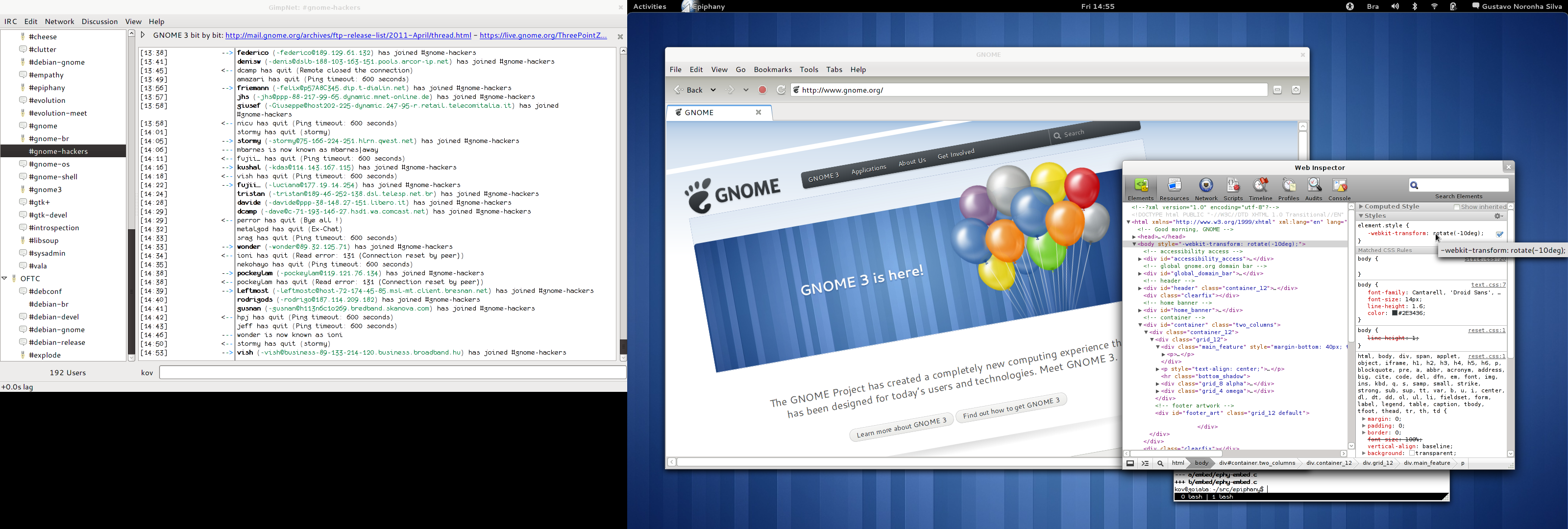
Gustavo Noronha Silva: My experience with GNOME 3 so far

You know, GNOME Shell and I are not really strangers to each other for a long time now. I have been using it almost daily as my main desktop since late 2009, when I started shipping it to Debian experimental. That means that I had ample opportunity to both get used to it and witness the huge improvements it had with every new release. My general feeling towards GNOME 3 is this: . Yes, I love it! I love the new themes, I love the window borders, I love the top panel, the overview, the dynamic workspaces, I love the Me menu, I love the clock and the calendar, the system indicators with the beautiful symbolic icons, being able to search for applications in such a nice way, the window animations, the multi-screen support, the new nautilus, the dash, looking glass. It s hard for me to even express how thankful I am and how much admiration I have for the awesome folks who helped bring this to life. Thanks so much!
My GNOME3 desktop

My GNOME 3 desktop

After all this time, there are only two things I can say I dislike about GNOME3, apart from some minor wishlists: the alt-tab behaviour and the message tray. Let me expand on those. Message Tray Of the very few things I dislike, there is only 1 I hate and cannot see myself living with: the accordion animation in the message tray. No, really, it s such a terrible, terrible idea. Every single time I try to use that thing I overshoot while moving the mouse to the left, then overshoot again moving the mouse to the right because the frigging icon has moved. It s no good knowing that I can click in the text or in the empty area to its right, it feels wrong. It s terrible that my actual target is moving at all. Every single time I use it is a small frustration for me it s as if the message tray was playing games with me, laughing at me for not having good enough mouse pointer driving skills even more than the infamous sub-menus used to. And I had to go through that penance whenever I wanted to find the person I was chating with to resume the conversation. I wrote an extension that disables the accordion animation by simply not showing the title at all when you hover the icon, and I patched GNOME Shell s CSS to make the icons a bit bigger, so that it s easier for me to hit them with the mouse. It s clearly not ideal, and you still have to click the various people icons to figure out which of your friends who were lazy enough to not add a picture to their IM profiles is that one, but it s still much better than chasing the (smaller) ones around to figure that out. Perhaps we should have the icons be bigger and always have the title bellow them? I don t know, I trust the awesome designers who designed the awesomess that s everywhere else will come up with a great idea.
My Message Tray

My message tray with bigger icons and no accordion animation.

Alt Tab The number 1 feature of workspaces for me has always been locality being able to not see all of the other applications and windows that are open elsewhere. This lowers the amount of noise when I m trying to find something. The overview is very nice in this matter only windows in the current workspace are shown, and even when you have an extra screen, the windows in there appear in that screen. The alt-tab behaviour, on the other hand, of showing all windows and apps, even with the separator, bothers me. It s really useful to have when you want to go to a specific window no matter where it is (I usually use the dash for that, though), but it adds noise when you want to go to a specific window _in this_ workspace, which is the most common use case for my usage. So I copied the alt-tab code over to an extension and modified it so that only windows in the current workspace would be considered. In addition to that, with the windows in the extra screen always being there no matter what workspace you re in (which I think is an awesome idea), they are effectively in all workspaces, so they add constant noise even with my extension. It s also weird to have to look at the main screen to switch to a window in the extra screen. There s a huge discontinuity. What I would prefer is having alt-tab to follow the mouse regarding screens only show windows in the extra screen if you hit alt-tab in there, making sure the selector thing appears in there as well.

Lars Wirzenius: I'm in the movie business now

I got recruited into the movie business via Soile, and the teaser for the movie is now out: http://www.edinburghdigest.com/. I did two evenings as a "Digital Imaging Technician", as you can see from the credits. In other words, I copied files from camera memory cards to hard disks with a laptop. While everyone else were out in the cold, I sat in a pub. Soile is in the credits too. She actually did moviestuff, I just did computer geek stuff.

Maximilian Attems: initramfs-tools release 0.99 "scarpe rotte e pur bisogna andar"

This new release features /run usage and xz support. For the details see the release announcement of latest initramfs-tools. The upload itself fixes 18 (19) bugs in the Debian BTS and has also a cute lilo support patch hiding under "initramfs-tools: Fix handling of numeric root= arguments to be udev-friendly" coming from Ubuntu. (; Ben Hutchings revamped the bootloader linux-2.6 hooks in order that update-initramfs no longer calls any bootloader by itself. Thank you for all the contributions. The development docs got nicely refreshed too.

Christoph Egger: Thouhts on secure software archives

From the java point of view Recently I had to get some Scala Tool working correctly. Unfortunately there are basically no packages in the Debian Archive at all so I had to use maven to install these (or download + install manually). Being a highly paranoid person downloading and executing code from the internet without any cryptographic verification at all one after the other practically drove me nuts. Looking a bit deeper I noticed that some of the software in maven's repository have some signatures next to them -- signed by the author or release manager of this specific project. Why secure sources matters With my experience in mind I got some Input from other people. One of the things I was told is that some scala tools just aren't security critical -- they're only installed and used as the current user. In my opinion this is, for my desktop system, totally wrong. The important things on my private Computers are my GPG and SSH keys as well as my private data. For messing with these no super user access is needed at all. Comparing to the Common Lisp situation Being a Common Lisp fan of course I noticed basically the same problem for installing Common Lisp libraries. Here the situation in Debian is quite a bit better -- and I'm working in the pkg-common-lisp Team to improve this even more. Common Lisp has some maven-alike tool for downloading and installing dependency trees called quicklisp -- without any cryptographic verification as well. However there's light at the end of this tunnel: There are plans to add GPG verification of the package lists really soon. Comparing the maven and the quicklisp model So there are basically two different approaches to be seen here. In maven the software author confirms with his signature the integrity of his software while in quicklisp the distributor confirms all users get the same software that he downloaded. Now the quicklisp author can't and won't check all the software that is downloadable using quicklisp. This won't be doable anyway as there's way to much software or a single person to check. Now in some kind of perfect World the maven way would be vastly superior as there's a End-To-End verification and verification of the full way the software takes. However there's a big problem: I don't know any of these Authors personally and there's no reason I should just trust any of them. Now comparing this to the Distribution / quicklisp model. Here I would just have to trust one person or group -- here the quicklisp team -- to benefit from the crypto which might be possible based on karma inside the using community. However here I don't gain the possibility that the software is integer. However idealized if some of these pieces of software was forged between upstream and the quicklisp team and attacker would also intercept me downloading the software from the same address so I get the source from upstream matching the checksum from quicklisp -- assuming the quicklisp team does indeed know the correct website. Additionally I get the confirmation that all other quicklisp users get the same source (if the quicklisp guys are fine of course) so no-one inside the community complaining is a good indication the software is fine. For this to work there's of course a relevant user-base of the distributor (quicklisp) necessary. Relevance for Debian So how do conventional Linux Distributions like Debian fit in here. Ideally we would have maintainers understanding and checking the software and confirming the integrity using their private key or at least know their upstreams and having at least a secured way getting the software from upstream and a trust relationship with them. Of course that's just illusionary thinking of complex and important software (think libreoffice, gcc or firefox for example). Maintainers won't fully understand a lot simpler pieces of software. And loads of upstream projects don't provide a verified way of getting the correct source code though that's a bit better on the real high-impact projects where checksums signed by the Release Manager are more common than in small projects. A misguided thought at the end As I'm a heavy emacs user I like to have snapshots from current emacs development available. Fortunately binary packages with this are available from a Debian guy I tend to trust who is also involved upstream so adding the key from his repository to the keyring apt trusts. Now my first thoughts were along the lines "It would be really nice if I could pin that key to only the emacs snapshot packages" so this guy can't just put libc packages in his repository and my apt would trust them. Now thinking of it again a bogus upload of the emacs snapshot package could just as well put some binary or library on the system at some place in front of the real on in the system path which would be rather similar bad. b

Lars Wirzenius: vmdebootstrap, for real

Some months ago I wished for a tool to create virtual disk images, something similar to debootstrap except it would create a disk image instead of a directory. It would be used like this:
sudo ./vmdebootstrap --image test.img --size 1G \
--log test.log --mirror http://mirror.lan/debian/
debootstrap is wonderful for creating a basic Debian system for use with chroot. In the modern world, something similar but for virtual machines (such as KVM) would be nice to have, I thought. Particularly if it is something that is not tied to a particular virtualization technology, and does not require running in an actual virtual machine (for speed and simplicity). I could imagine using a tool like this for automatically building appliance-like system images, for example for FreedomBox. Being able to do that in a fully automatic manner would make development simpler and more easy for others to reproduce, and would allow for things like automatic integration testing: build image, boot it in a virtual machine, run automatic tests, report results. There are a bunch of tools that almost do this, but not quite. For example, live-build builds a disk image, but it's one that is aimed for live CDs and such. This brings in some limitations. By default, the image is not persistent. You can make a persistent image, but that requires you to provide a second partition (or disk) that holds the modified parts, using copy-on-write. It also means that if the bootloader or initramfs needs to be updated, then the read-only image needs to be updated. That's fine for live CDs, but not so good if you want a real installed system that you can upgrade to all future releases of Debian. (Ben Armstrong kindly helped me use live-build the right way. Thanks!) There's also grml-debootstrap which seems to work on a real system, but not installing onto a virtual disk image (and the difference is crucial to me). Based on feedback I received back then, and some experimentation I've done the past couple of days, I wrote a very rudimentary version of the tool I want. The code is on gitorius. (You need my cliapp library to run it.) Be warned: it really is a very rudimentary version. For example, it provides not flexibility in choice of partitioning, filesystem type, what packages get installed, etc. It does not configure networking, and the root password is disabled. Some of that flexibility would be quite easy to add. It also uses extlinux as the bootloader, since I utterly failed to get grub2 to install onto the virtual disk. (I did, however, manage to overwrite my develpment machine's bootloader.) The command above works, and results in a RAW format disk image that boots under KVM. It might boot off a hard disk or USB flashdrive too, but I haven't tried that. I now have several questions:

Pietro Abate: Eating you own dog food - mpm

After a bit of work, today I decided to start using mpm, the mancoosi package manager, to upgrade my laptop. My first use of it on a production system - until now I run all my experiments in throw-away virtual machines - and it works ! Not rocket science here. During the last month David Kalnischkies (of APT fame) visited our offices in Paris and together with zack worked out a communication protocol between apt-get and the mancoosi cudf solvers (EDSP). I guess somebody is going to announce all details about this endeavor soon. This cooperation enabled us to advance in the integration of apt-get and the mancoosi technology. Reusing the same protocol and backend I developed to translate the apt problem to cudf (and to call a suitable solver), I've re-wrote large part of mpm and added the possibility to generate the installation plan before calling dpkg and really installing the selected packages. Below notice the intermediate calls as Inject Model , Simulate, Compare Models . These are at the moment stubs that are going to call the simulation framework developed at mancoosi. The food :
abate@zed.fr:~/Projects/git-svn-repos/mpm$sudo ./mpm.py -c mpm.conf update
Reading package lists... Done
Building dependency tree
Reading state information... Done
Inject Model ...


abate@zed.fr:~/Projects/git-svn-repos/mpm$sudo ./mpm.py -c mpm.conf upgrade
Reading package lists... Done
Building dependency tree
Reading state information... Done
The following new packages will be installed:
libtracker-client-0.8-0 libnet-ip-perl libio-socket-ssl-perl libasyncns0 libapr1
5 to install
Simulate
Proceed ? yes/[no]
yes
Reading package fields... Done
Reading package status... Done
Retrieving bug reports... Done
Parsing Found/Fixed information... Done
Reading changelogs... Done
apt-listchanges: Mailing root: apt-listchanges: changelogs for zed
Reading package fields... Done
Reading package status... Done
Retrieving bug reports... Done
Parsing Found/Fixed information... Done
Reading changelogs... Done
apt-listchanges: Mailing root: apt-listchanges: changelogs for zed
(Reading database ... 179534 files and directories currently installed.)
Preparing to replace libapr1 1.4.2-8 (using .../libapr1_1.4.4-1_amd64.deb) ...
Unpacking replacement libapr1 ...
Preparing to replace libasyncns0 0.8-1 (using .../libasyncns0_0.8-2_amd64.deb) ...
Unpacking replacement libasyncns0 ...
Preparing to replace libio-socket-ssl-perl 1.40-1 (using .../libio-socket-ssl-perl_1.43-1_all.deb) ...
Unpacking replacement libio-socket-ssl-perl ...
Preparing to replace libnet-ip-perl 1.25-2 (using .../libnet-ip-perl_1.25-3_all.deb) ...
Unpacking replacement libnet-ip-perl ...
Preparing to replace libtracker-client-0.8-0 0.8.17-2 (using .../libtracker-client-0.8-0_0.8.18-1_amd64.deb) ...
Unpacking replacement libtracker-client-0.8-0 ...
Processing triggers for man-db ...
Setting up libapr1 (1.4.4-1) ...
Setting up libasyncns0 (0.8-2) ...
Setting up libio-socket-ssl-perl (1.43-1) ...
Setting up libnet-ip-perl (1.25-3) ...
Setting up libtracker-client-0.8-0 (0.8.18-1) ...
localepurge: Disk space freed in /usr/share/locale: 0 KiB
localepurge: Disk space freed in /usr/share/man: 0 KiB
localepurge: Disk space freed in /usr/share/gnome/help: 0 KiB
localepurge: Disk space freed in /usr/share/omf: 0 KiB

Total disk space freed by localepurge: 0 KiB

localepurge: Disk space freed in /usr/share/locale: 0 KiB
localepurge: Disk space freed in /usr/share/man: 0 KiB
localepurge: Disk space freed in /usr/share/gnome/help: 0 KiB
localepurge: Disk space freed in /usr/share/omf: 0 KiB

Total disk space freed by localepurge: 0 KiB

Inject Model ...
Compare Models ...
abate@zed.fr:~/Projects/git-svn-repos/mpm$
Reg the installation plan, this is an xml file that will be passed to a simulator developed by the university of L'Aquila to make sure that the installation script (well, a model of them), will not cause any problem during the installation. The format is a very simple xml file as follows :
<selectionStates>
<selectionState type="Install">
<param name="package" value="libapr1" />
<param name="version" value="1.4.4-1" />
<param name="architecture" value="amd64" />
</selectionState>
<selectionState type="Install">
<param name="package" value="libasyncns0" />
<param name="version" value="0.8-2" />
<param name="architecture" value="amd64" />
</selectionState>
<selectionState type="Install">
<param name="package" value="libio-socket-ssl-perl" />
<param name="version" value="1.43-1" />
<param name="architecture" value="all" />
</selectionState>
[...]
Soon APT will ship a patch to use the very same infrastructure of mpm (yeii !!!). This will on one hand make mpm useless as package manager on its own. It is a simple hack in python and I never tough to compete with its big brothers. On the other hand I think it will stand as a nice workbench to experiment with new ideas, to prototype new features and to make it easier for poeple that are not c++ experts to play with the APT library (thanks to python-apt) in a semi structured environment. The code is in the mancoosi svn if you want to have a look.

Pietro Abate: Eating my own dog food - mpm

After a bit of work, today I decided to start using mpm, the mancoosi package manager, to upgrade my laptop. My first use of it on a production system - until now I run all my experiments in throw-away virtual machines - and it works ! Not rocket science here. During the last month David Kalnischkies (of APT fame) visited our offices in Paris and together with zack worked out a communication protocol between apt-get and the mancoosi cudf solvers (EDSP). I guess somebody is going to announce all details about this endeavor soon. This cooperation enabled us to advance in the integration of apt-get and the mancoosi technology. Reusing the same protocol, and backend I developed to translate the apt problem to cudf (and to call a suitable solver), I've re-wrote large part of mpm and added the possibility to generate the installation plan before calling dpkg and really installing the selected packages. Below notice the intermediate calls as Inject Model , Simulate, Compare Models . These are at the moment stubs that are going to call the simulation framework developed at mancoosi. The food :
abate@zed.fr:~/Projects/git-svn-repos/mpm$sudo ./mpm.py -c mpm.conf update
Reading package lists... Done
Building dependency tree
Reading state information... Done
Inject Model ...


abate@zed.fr:~/Projects/git-svn-repos/mpm$sudo ./mpm.py -c mpm.conf upgrade
Reading package lists... Done
Building dependency tree
Reading state information... Done
The following new packages will be installed:
libtracker-client-0.8-0 libnet-ip-perl libio-socket-ssl-perl libasyncns0 libapr1
5 to install
Simulate
Proceed ? yes/[no]
yes
Reading package fields... Done
Reading package status... Done
Retrieving bug reports... Done
Parsing Found/Fixed information... Done
Reading changelogs... Done
apt-listchanges: Mailing root: apt-listchanges: changelogs for zed
Reading package fields... Done
Reading package status... Done
Retrieving bug reports... Done
Parsing Found/Fixed information... Done
Reading changelogs... Done
apt-listchanges: Mailing root: apt-listchanges: changelogs for zed
(Reading database ... 179534 files and directories currently installed.)
Preparing to replace libapr1 1.4.2-8 (using .../libapr1_1.4.4-1_amd64.deb) ...
Unpacking replacement libapr1 ...
Preparing to replace libasyncns0 0.8-1 (using .../libasyncns0_0.8-2_amd64.deb) ...
Unpacking replacement libasyncns0 ...
Preparing to replace libio-socket-ssl-perl 1.40-1 (using .../libio-socket-ssl-perl_1.43-1_all.deb) ...
Unpacking replacement libio-socket-ssl-perl ...
Preparing to replace libnet-ip-perl 1.25-2 (using .../libnet-ip-perl_1.25-3_all.deb) ...
Unpacking replacement libnet-ip-perl ...
Preparing to replace libtracker-client-0.8-0 0.8.17-2 (using .../libtracker-client-0.8-0_0.8.18-1_amd64.deb) ...
Unpacking replacement libtracker-client-0.8-0 ...
Processing triggers for man-db ...
Setting up libapr1 (1.4.4-1) ...
Setting up libasyncns0 (0.8-2) ...
Setting up libio-socket-ssl-perl (1.43-1) ...
Setting up libnet-ip-perl (1.25-3) ...
Setting up libtracker-client-0.8-0 (0.8.18-1) ...
localepurge: Disk space freed in /usr/share/locale: 0 KiB
localepurge: Disk space freed in /usr/share/man: 0 KiB
localepurge: Disk space freed in /usr/share/gnome/help: 0 KiB
localepurge: Disk space freed in /usr/share/omf: 0 KiB

Total disk space freed by localepurge: 0 KiB

localepurge: Disk space freed in /usr/share/locale: 0 KiB
localepurge: Disk space freed in /usr/share/man: 0 KiB
localepurge: Disk space freed in /usr/share/gnome/help: 0 KiB
localepurge: Disk space freed in /usr/share/omf: 0 KiB

Total disk space freed by localepurge: 0 KiB

Inject Model ...
Compare Models ...
abate@zed.fr:~/Projects/git-svn-repos/mpm$
Reg the installation plan, this is an xml file that will be passed to a simulator developed by the university of L'Aquila to make sure that the installation script (well, a model of them), will not cause any problem during the installation. The format is a very simple xml file as follows :
<selectionStates>
<selectionState type="Install">
<param name="package" value="libapr1" />
<param name="version" value="1.4.4-1" />
<param name="architecture" value="amd64" />
</selectionState>
<selectionState type="Install">
<param name="package" value="libasyncns0" />
<param name="version" value="0.8-2" />
<param name="architecture" value="amd64" />
</selectionState>
<selectionState type="Install">
<param name="package" value="libio-socket-ssl-perl" />
<param name="version" value="1.43-1" />
<param name="architecture" value="all" />
</selectionState>
[...]
Soon APT will ship a patch to use the very same infrastructure of mpm (yeii !!!). This will on one hand make mpm useless as package manager on its own. It is a simple hack in python and I never tough to compete with its big brothers. On the other hand I think it will stand as a nice workbench to experiment with new ideas, to prototype new features and to make it easier for poeple that are not c++ experts to play with the APT library (thanks to python-apt) in a semi structured environment. The code is in the mancoosi svn if you want to have a look.

12 May 2011

Joey Hess: outdoor shower

There's something rather glorious about a simple outdoor shower. shower shower Not as perfect as a waterfall, but more convenient. I put it together in lego mode, just snapping bits together until it seemed right. The water barrel collects the flow when the shower is not in use and also serves as ballast. And yes, there is duct tape. It's fed down from the small spring house, so the water is always nice and cold, and gravity flow gives it just enough force. I hope it will run for a couple more months at least.
Not that the alternative isn't nice too.. river edge

Matthew Garrett: LightDM, or: an examination of a misunderstanding of the problem

LightDM's a from-scratch implementation of an X display manager, ie the piece of software that handles remote X connections, starts any local X servers, provides a login screen and kicks off the initial user session. It's split into a nominally desktop-agnostic core (built directly on xcb and glib) and greeters, the idea being that it's straightforward to implement an environment-specific greeter that integrates nicely with your desktop session. It's about 6500 lines of code in the core, 3500 lines of code in the gtk bindings to the core and about 1000 in the sample gtk greeter, for a total of about 11,000 lines of code for a full implementation. This compares to getting on for 60,000 in gdm. Ubuntu plan to switch to LightDM in their next release (11.10).

This is a ridiculous idea.

To a first approximation, when someone says "Lightweight" what they mean is "I don't understand the problems that the alternative solves". People see gtk and think "Gosh, that's kind of big for a toolkit library. I'll write my own". And at some point they have to write a file dialog. And then they need to implement support for handling remote filesystems. And then they need to know whether the system has a functioning network connection or not, and so they end up querying state from Network Manager. And then they suddenly have a library that's getting on for the size of gtk, has about the same level of complexity and has had much less testing because why would you want to use a lightweight toolkit that either does nothing or is 90% of the size of the alternative and crashes all the time.

Adding functionality means that code gets larger. Given two codebases that are of significantly different sizes, the two possible conclusions are either that (a) the smaller one is massively more competently written than the larger one, or (b) the smaller one does less. The gdm authors have never struck me as incompetent, even if some people may disagree with some of their design decisions, and the LightDM authors don't seem to have argued on that basis either. So the obvious conclusion is that LightDM does less.

And, indeed, LightDM does less. Part of this is by design - as the proposal to the Gnome development list shows, one of the key advantages of LightDM is claimed as it not starting a Gnome session. And from that statement alone, we can already see that there's been a massive failure of understanding the complexity of the problem.

Let's go back to the comparisons of code size. LightDM's simple GTK greeter is about 1000 lines of code. gdm's greeter is almost 20,000. Some of this is arbitrary shiny stuff like the slidy effects that occur, but a lot of it is additional functionality. For example, some of it is devoted to handling the interface with AccountsService so gdm can automatically update when users are created or deleted. Some of it is providing UI for accessibility functionality. Some of it is drawing a clock, which I'll admit may be a touch gratuitous.

But if your argument is that your software is better because it's doing less, you should be able to ensure that you can demonstrate that the differences aren't important. And the differences here are important. For example, one of the reasons gdm starts a local gnome session is that it wants gnome-power-manager to be there to handle power policy. Closing the lid of my laptop should suspend the system regardless of whether it's logged in or not. LightDM takes a different approach. Because there's no session, it has to take care of this kind of thing itself. So the backend daemon code speaks to upower directly, and the greeters ask the daemon to implement their policy decisions.

This is pretty obviously miserable. Now you've got two sets of policy - one at the login screen, and one in your session. How do I ensure they're consistent? The only sane solution is to ignore the functionality the backend provides and have my greeter run gnome-power-manager. And now how about accessibility preferences? Again, if I want to have the same selection of policy, I need to run the same code. So you end up with a greeter that's about as complex and large as the gdm one, and unused functionality in the backend. Lighter weight through code duplication. We have always been at war with Eurasia.

The entirety of LightDM's design is based on a false premise - that you can move a large set of common greeter functionality into a daemon and just leave UI presentation up to the greeter code. And if you believe that, then yes, you can absolutely implement a greeter in 1000 lines of code. It'll behave differently to your desktop - the range of policy you can implement will be limited to what the daemon provides, even if your desktop environment has a different range of features. It'll have worse accessibility for much the same reason. And eventually you'll end up with a daemon that's absolutely huge in order to attempt to provide the superset of functionality that each different desktop makes use of.

The only real problem LightDM solves is that it makes it easier to write custom greeters, and if you're really seeking to differentiate your project based on your login screen then maybe your priorities are a little out of line. I'm sure that Ubuntu will release with a beautiful 3D greeter that has a wonderful transition to the desktop. It's just a shame that it won't do any of the useful things that the existing implementations already do.

And if you think that when LightDM finally has the full feature set of gdm, kdm and lxdm it'll still be fewer lines of code and take less memory - I hear the BSD kernel is lighter weight than Linux. Have fun with it.

( Comments Comment on this)

11 May 2011

Matt Brown: Linux ignores IPv6 router advertisements when forwarding is enabled

IPv6 adoption is increasing, and along with it come a new set of behaviours and defaults that system administrators and users must learn and become familiar with. I was recently caught out by Linux s handling of IPv6 router advertisements (RAs) when forwarding is also enabled on the interface. It took me a while to figure out and searching for obvious terms (such as those in the first half of the title of this post) didn t immediately yield useful answers, so here is my attempt to help shed some light on the subject. By default Linux will ignore IPv6 RAs if the interface is configured to forward traffic. This is in line with RFC2462 which states that a device should be either a Host or a Router. If you re forwarding packets you re a router and you re therefore expected to be sending RAs, not receiving them. This policy does make a certain amount of sense but there are obviously situations where it can be useful to accept RAs and still forward packets over the interface[0]. The confusing part is that the Linux IPv6 stack allows the accept_ra sysctl to be set to 1 (enabled) at the same time as the forwarding sysctl is set to 1, yet all incoming RAs are ignored with no hint as to why. If you re not aware that the default behaviour is to ignore RAs when forwarding is enabled it looks very much like autoconfiguration has simply broken. The key piece of information is that makes everything as clear as mud is realising that the forwarding and accept_ra sysctl s are not simple boolean enabled/disabled flags like many of their brethren. There are instead three possible values for each, all clearly documented in sysctl.txt, when you take the time to read it. Ironically the documentation states the type of the values as BOOLEAN even though they re not at least it helped me to feel better about my hasty assumption that the sysctl s were boolean values.
accept_ra BOOLEAN
Accept Router Advertisements; autoconfigure using them. Possible values are:
0 Do not accept Router Advertisements.
1 Accept Router Advertisements if forwarding is disabled.
2 Overrule forwarding behaviour. Accept Router Advertisements
even if forwarding is enabled. Functional default: enabled if local forwarding is disabled.
disabled if local forwarding is enabled.
The documentation for forwarding is similar, but much longer, so you can refer to the link above to see it. Conclusion: If you want to autoconfigure IPv6 addresses on an interface that you re also forwarding IPv6 traffic over, you need to set accept_ra to 2. No doubt there are more IPv6 quirks and defaults like this waiting to trap me in the future :) [0] Arguably you really don t want to be autoconfiguring addresses on your router ever, but that s a philosophical debate that isn t really relevant to this post.

Julian Andres Klode: Project APT2: new cache format and small things

I did not write much code or merge much of my prototype code, but some things happened since the last blog post about APT2 specific things in August and I forgot to write about them. First of all, I dropped the GVariant-based cache. The format strings were simply getting ugly long and were not very understandable, performance was just much too slow (needing more than a few nanoseconds for a package lookup is obviously too slow for solving dependency problems); furthermore, building the cache was also slow and complicated because we needed all attributes of an object at once to pass them to GVariant, leading to ugly API. I replaced the GVariant cache with one that can be easily mmap()ed and is described completely in C. It s derived from APT s cache design (but more robust, as it includes the size of the cache and we can thus detect to small files, although that s scheduled for the next ABI break in APT as well), but has fewer duplicate data, and uses arrays where APT uses linked lists. The reason for arrays is simple: They take up less space and can be represented naturally in Python and other languages using array-based lists. The cache also contains a coalesced hash table which does use a linked list, but that one is a bit different, as it is for searching only and not exposed. Everything non-stringy is 64-bit aligned in order to keep things as simple as possible. All integers are fixed size, thus the format is architecture-independent if you fix byte orders. The format is described at http://people.debian.org/~jak/apt2-doc/apt-Cache-Format.html. I stole one more idea from cupt and changed the configuration system to verify types of variables. APT2 s configuration system knows more types than cupt s, though, including regular expressions, directory and filenames (i.e. it does not let you store a value /d/ in a file variable), strings (which store everything), unsigned and signed integers, and boolean options; all of which are checked when parsing files (producing warnings) or command-line options (producing errors). I have also simplified the type world by removing all iterator types except for one, replacing them with get_thing() and n_things() functions in the objects holding the arrays. Makes cool bindings slightly harder, but makes the C API much easier to use from C. Most things expected from a package manager are still missing, but what is there looks good in most cases (especially AptConfiguration has a nice API, and no complaints from valgrind anywhere). Currently I am working on Python bindings so I can interact with the functions easily and check things in an interactive fashion; and I am also writing a document explaining the concepts behind APT2, drafts at http://people.debian.org/~jak/midlevel.pdf. I also have some more code pending further thoughts (including complete index parsing), but it might still take some time before I have something usable in the wild. On other package managers: From time to time I also use Cupt, look at Cupt code, hack Cupt code, and report bugs against Cupt. I still do not really understand the (extreme) nesting of directory structures in the source code, why there are so (extremely) many source files split all over them, or the general concepts of Cupt, but I can hack together what I need for my personal testing. I also play with yum whenever I end up on a Fedora system (which happens from time to time).
Filed under: APT2

Julian Andres Klode: underscores and undefined behavior

As everyone should know, underscores in C are not cool, as they cause undefined behavior per 7.1.3:
All identifiers that begin with an underscore and either an uppercase letter or another underscore are always reserved for any use.
[...]
If the program declares or defines an identifier in a context in which it is reserved (other than as allowed by 7.1.4), or defines a reserved identifier as a macro name, the behavior is undefined.
Yet, they are widely used everywhere. Here are some examples: All of this triggers undefined behavior and is thus uncool. Of course in APT, it s most stupid, as we do not have any namespace and could thus
end up redefining things we should not much more likely then the other two. But why were those solutions chosen in the first place, and what is the alternative? I cannot answer the first question, but for the second one, the obvious alternative is to use trailing underscores: Then there is another class of reserved identifiers with underscores:
All identifiers that begin with an underscore are always reserved for use as identifiers
with file scope in both the ordinary and tag name spaces.
Meaning that everything except for parameters, local variables and members of structs/unions that starts with an underscore is reserved. So, if you happen to create a variable _mylibrary_debug_flag, you trigger undefined behavior as well. And while we re at it, do not think you can create a type ending in _t: POSIX reserves all identifiers ending in _t for its own use. In summary, whenever you write C and want to be 100% safe of undefined-behavior-because-of-naming, do not start any identifier with an underscore and do not end any identifier with _t.
Filed under: General

Vincent Bernat: New website with Hyde

My previous website was generated (dynamically) with mod_autoindex, a module from Apache targeted at rendering an index page for the files contained in a directory. Pretty basic (but themable). Here is a new revamped web site using Hyde, a static web generator written in Python.

Static or dynamic ? It has been a long time since almost everybody is creating dynamic websites. Most often, they are powered by some blog engine written in PHP like DotClear or WordPress. Infrequently, they are crafted with bare hands using one s preferred language. Nowadays, hosting a dynamic website is pretty easy. There are a lot of cheap virtual servers solution that allow you to get a root access. However, dynamic websites have some drawbacks:
  • Security need to be monitored tightly, especially security upgrades; some platforms are more often vulnerable than others.
  • Dynamic websites may have some problem to handle increased load.
With a static website, security problems are easier: there are far less components to monitor and most of them (for example, the web server) are pretty solid and well audited. A site powered by nginx can handle several thousands of new connections per second without any special tuning. Getting this kind of performance with a dynamic website is far more difficult. Scaling is also easier. Just add more webservers and copy the content. No database, no synchronisation mechanism needed. Hosting can even be done on simple platforms like Amazon S3, even if there is now more appropriate platforms for this like Amazon CloudFront. Moreover, even a static website can receive comments using a system like Disqus which leverages the use of Javascript to add comment system to any static page.

Hyde Hyde is a static website generator written in Python. There exists a lot of those beasts. On StackOverflow, a question about this got some interesting answers. You will also find a fairly complete list on this blog. If you like Ruby, I assume that nanoc and Webgen are good candidates. Let s go back to Hyde. It was rewritten recently and the documentation is a bit incomplete. You will need to read the source code or look at examples (like the shipped one or this site) to understand how things are handled. Everything is handled by a plugin system. I hope it will not become a mess in one year (I play a large part in this). Hyde takes your files, apply a lot of filters on them and generate the final website. It uses Jinja as a template system, Markdown for markup syntax, Less to write CSS in a more efficient way (and to minify them), UglifyJS to minify Javascript, etc. It is also possible to add metadata to files (title, author, creation date, etc.). But since everything comes as a plugin, you can use any technology you like. In the end, you can tune all knobs but you need to do most of the work (HTML, CSS, Javascript), as well. Conveniently, there is a small web server that rebuild modified files on the fly. This comes handy but this is a common feature with this kind of generator.

New website Here is a new website crafted with Hyde. It is translated both in French and in English. This is done with the help of a small plugin plugin. I am quite happy about the result. Technically, there is one minified CSS file, one minified Javascript file and the dependencies (like jQuery) are loaded with the help of yepnope.js which will become part of Modernizr. I don t want to support Internet Explorer 6, but I plan to support Firefox 3, Internet Explorer 7 and recent versions of Chrome and Safari. For the design, I have always been undecided. I am pretty impressed by some raw website but also by some others more elaborate. Since I am not a talented graphic designer, I have tried to keep things plain and simple. If you are interested, sources are available on GitHub !

Michal &#268;iha&#345;: phpMyAdmin 3.4.0 is out

Today, Marc has released phpMyAdmin 3.4.0. This is huge step and introduces lot of new features. The most noteworthy are: As you can see, many of new features come from last GSoC, it took us almost half year to stabilize all new stuff and make it work nicely together. Thanks to last minute improvements in Japanese, it is fully translated to 15 languages, other translations are little behind, but you can still help improving them for future releases. The master branch is now open to development and we will start to merge patches accumulated in patch tracker for addition after feature freeze. PS: I forgot to mention that this release fixed largest number of feature requests and bugs ever - over 160 issues from sf.net tracker got closed. This can be nicely seen on tracker stats. PS2: Package with new version was just uploaded to Debian.

Filed under: English Phpmyadmin 8 comments Flattr this!

10 May 2011

Sune Vuorela: Barcodes, Weather and other nice things

Long time no blogging. Earlier, I wrote a blog post about transporting data to mobile phones. I have since then extracted the Data Matrix code I wrote there into a separate library, prison and added support for QR Code as well. So from KDE s next feature release, versioned 4.7 arriving around first of august, you have DataMatrix and QRCode support in Klipper. While on a barcode spree, I also added barcode support to the KDE Addressbooks for easy transfer of contacts. Also using libprison. Also available from 4.7 onwards. Few minutes ago, libprison 1.0 was tagged and hopefully soon, the KDE Sysadmins will publish my tarball. And about the weather. Some nice people wrote Debian Weather which in simple ways shows if it is unsafe to upgrade. Quite recently there have been thunderstorms and heavy rain in Debian Unstable. Perl rain.
I have recently added support for Debian Weather in the Plasma Dataengine for weather. Also available from 4.7 onwards. Last but not least, after spending a couple of hours on trying to understand Q3PtrList and how it was used in KHelpCenter, it is now, as the last component in KDE-Runtime, free of Qt3Support. All for now. Next up. Platform_11

Next.

Previous.