Search Results: "ms"

30 November 2014

Enrico Zini: cxx11-talk-examples

C++11 talk examples On 2014-11-27 I gave a talk about C++ and new features introduced with C++11: these are the examples. They are all licensed under the wtfpli version 2. See cxx11-talk-notes for the talk notes. Note that the wrapper interfaces turns errors from the underlying libraries into exceptions, so the method calls just do what they should, without the need of documenting special return values for error messages, and removing the need for each library to implement yet another way of reporting errors. Also note that all wrapper objects do RAII: you create them and they clean after themselves when they go out of scope. The wrapper objects also have cast operators to make them behave as the pointer or handle that they are wrapping, so that they can be transparently passed to the underlying libraries. (note: I had to add U+2063 INVISIBLE SEPARATOR to prevent noreturn statements to be misinterpreted by the blog formatter. If you copypaste the code and encounter issues, you may want to delete the noreturn statements and retype them) A gcrypt hash class This class is a light wrapper around gcrypt's hashing functions. ezhash.h
#ifndef EZHASH_H
#define EZHASH_H
#include <string>
#include <gcrypt.h>
namespace ezhash  
class Hash
 
protected:
    // members can now be initialized just like this, without needing to repeat
    // their default assignment in every constructor
    gcry_md_hd_t handle = nullptr;
public:
    Hash(int algo, unsigned int flags=0);
    ~Hash();
    // Assign 'delete' to a method to tell the compiler not to generate it
    // automatically. In this case, we make the object non-copiable.
    Hash(const Hash&) = delete;
    Hash(const Hash&&) = delete;
    Hash& operator=(const Hash&) = delete;
    // Add a buffer to the hash
    void hash_buf(const std::string& buf);
    // Add the contents of a file to the hash
    void hash_file(int fd);
    // Get a string with the hexadecimal hash
    std::string read_hex(int algo=0);
    /// Pretend that we are a gcry_md_hd_t handle
    operator gcry_md_hd_t()   return handle;  
 ;
 
#endif
ezhash.cpp
#include "ezhash.h"
#include <unistd.h>
#include <errno.h>
#include <string>
#include <cstring>
#include <sstream>
#include <iomanip>
#include <stdexcept>
using namespace std;
namespace ezhash  
namespace  
// noreturn attribute, to tell the compiler that this function never returns
[ [noreturn]] void throw_gcrypt_error(gcry_error_t err)
 
    string msg;
    msg += gcry_strsource(err);
    msg += "/";
    msg += gcry_strerror(err);
    throw runtime_error(msg);
 
string errno_str(int error)
 
    char buf[256];
#if (_POSIX_C_SOURCE >= 200112L   _XOPEN_SOURCE >= 600) && ! _GNU_SOURCE
    strerror_r(errno, buf, 256);
    string res(buf);
#else
    string res(strerror_r(errno, buf, 256));
#endif
    return res;
 
[ [noreturn]] void throw_libc_error(int error)
 
    throw runtime_error(errno_str(error));
 
 
Hash::Hash(int algo, unsigned int flags)
 
    gcry_error_t err = gcry_md_open(&handle, algo, flags);
    if (err) throw_gcrypt_error(err);
 
Hash::~Hash()
 
    gcry_md_close(handle);
 
void Hash::hash_buf(const std::string& buf)
 
    gcry_md_write(handle, buf.data(), buf.size());
 
void Hash::hash_file(int fd)
 
    char buf[4096];
    while (true)
     
        ssize_t res = ::read(fd, buf, 4096);
        if (res < 0) ezfs::throw_libc_error();
        if (res == 0) break;
        gcry_md_write(handle, buf, res);
     
 
std::string Hash::read_hex(int algo)
 
    unsigned char* res = gcry_md_read(handle, algo);
    unsigned int len = gcry_md_get_algo_dlen(
            algo == 0 ? gcry_md_get_algo(handle) : algo);
    // Format the hash into a hex digit
    stringstream hexbuf;
    hexbuf << hex << setfill('0');
    for (unsigned i = 0; i < len; ++i)
        hexbuf << setw(2) << (unsigned)res[i];
    return hexbuf.str();
 
 
Example usage
        ezhash::Hash sha256(GCRY_MD_SHA256);
        sha256.hash_buf("ciao\n");
        sha256.hash_buf("foo\n");
        cout << sha256.read_hex() << endl;
Simple sqlite bindings Remarkably simple sqlite3 bindings based on lambda callbacks. ezsqlite.h
#ifndef EZSQLITE_H
#define EZSQLITE_H
#include <sqlite3.h>
#include <string>
#include <functional>
#include <stdexcept>
namespace ezsqlite  
/// RAII wrapper around a sqlite3 database handle
class DB
 
protected:
    sqlite3* handle = nullptr;
public:
    // Open a connection to a SQLite database
    DB(const std::string& filename, int flags=SQLITE_OPEN_READWRITE   SQLITE_OPEN_CREATE);
    DB(const DB&) = delete;
    DB(const DB&&) = delete;
    DB& operator=(const DB&) = delete;
    ~DB();
    /**
     * Execute a query, optionally calling 'callback' on every result row
     *
     * The arguments to callback are:
     *  1. number of columns
     *  2. text values of the columns
     *  3. names of the columns
     */
    // std::function can be used to wrap any callable thing in C++
    // see: http://en.cppreference.com/w/cpp/utility/functional/function
    void exec(const std::string& query, std::function<bool(int, char**, char**)> callback=nullptr);
    /// Pretend that we are a sqlite3 pointer
    operator sqlite3*()   return handle;  
 ;
 
#endif
ezsqlite.cpp
#include "ezsqlite.h"
namespace ezsqlite  
DB::DB(const std::string& filename, int flags)
 
    int res = sqlite3_open_v2(filename.c_str(), &handle, flags, nullptr);
    if (res != SQLITE_OK)
     
        // From http://www.sqlite.org/c3ref/open.html
        // Whether or not an error occurs when it is opened, resources
        // associated with the database connection handle should be
        // released by passing it to sqlite3_close() when it is no longer
        // required.
        std::string errmsg(sqlite3_errmsg(handle));
        sqlite3_close(handle);
        throw std::runtime_error(errmsg);
     
 
DB::~DB()
 
    sqlite3_close(handle);
 
namespace  
// Adapter to have sqlite3_exec call a std::function
int exec_callback(void* data, int columns, char** values, char** names)
 
    std::function<bool(int, char**, char**)> cb = *static_cast<std::function<bool(int, char**, char**)>*>(data);
    return cb(columns, values, names);
 
 
void DB::exec(const std::string& query, std::function<bool(int, char**, char**)> callback)
 
    char* errmsg;
    void* cb = callback ? &callback : nullptr;
    int res = sqlite3_exec(handle, query.c_str(), exec_callback, cb, &errmsg);
    if (res != SQLITE_OK && errmsg)
     
        // http://www.sqlite.org/c3ref/exec.html
        //
        // If the 5th parameter to sqlite3_exec() is not NULL then any error
        // message is written into memory obtained from sqlite3_malloc() and
        // passed back through the 5th parameter. To avoid memory leaks, the
        // application should invoke sqlite3_free() on error message strings
        // returned through the 5th parameter of of sqlite3_exec() after the
        // error message string is no longer needed. 
        std::string msg(errmsg);
        sqlite3_free(errmsg);
        throw std::runtime_error(errmsg);


Example usage
    // Connect to the database
    ezsqlite::DB db("erlug.sqlite");
    // Make sure we have a table
    db.exec(R"(
        CREATE TABLE IF NOT EXISTS files (
                name TEXT NOT NULL,
                sha256sum TEXT NOT NULL
        )
    )");
    // Read the list of files that we know
    map<string, string> files;
    db.exec("SELECT name, sha256sum FROM files", [&](int columns, char** vals, char** names)  
        if (columns != 2) return false;
        files.insert(make_pair(vals[0], vals[1]));
        return true;
     );
A fast Directory object This is a lightweight wrapper around O_PATH file descriptors for directories. I'd love to see a library of well-maintained and thin C++ bindings around libc, that do little more than turning errors into exceptions and making it also work with std::string buffers. ezfs.h
#ifndef EZFS_H
#define EZFS_H
#include <string>
#include <functional>
#include <memory>
#include <cerrno>
#include <sys/types.h>
#include <sys/stat.h>
#include <fcntl.h>
#include <unistd.h>
#include <dirent.h>
namespace ezfs  
class Directory
 
protected:
    int handle = -1;
public:
    Directory(const std::string& pathname, int flags=0);
    ~Directory();
    Directory(const Directory&) = delete;
    Directory(const Directory&&) = delete;
    Directory& operator=(const Directory&) = delete;
    /// List the directory contents
    void ls(std::function<void(const dirent&)> callback);
    int open(const std::string& relpath, int flags, mode_t mode=0777);
 ;
std::string errno_str(int error=errno);
[ [noreturn]] void throw_libc_error(int error=errno);
 
#endif
ezfs.cpp
#include "ezfs.h"
#include <stdexcept>
#include <memory>
#include <cstring>
#include <cstdlib>
#include <string>
#include <linux/limits.h>
using namespace std;
namespace ezfs  
string errno_str(int error)
 
    char buf[256];
#if (_POSIX_C_SOURCE >= 200112L   _XOPEN_SOURCE >= 600) && ! _GNU_SOURCE
    strerror_r(errno, buf, 256);
    string res(buf);
#else
    string res(strerror_r(errno, buf, 256));
#endif
    return res;
 
[ [noreturn]] void throw_libc_error(int error)
 
    throw runtime_error(errno_str(error));
 
Directory::Directory(const std::string& pathname, int flags)
 
    handle = ::open(pathname.c_str(), O_PATH   O_DIRECTORY   flags);
    if (handle < 0) throw_libc_error();
 
Directory::~Directory()
 
    ::close(handle);
 
void Directory::ls(std::function<void(const dirent&)> callback)
 
    int fd = openat(handle, ".", O_DIRECTORY);
    if (fd < 0) throw_libc_error();
    // RAII Self-cleaning DIR object
    unique_ptr<DIR, std::function<void(DIR*)>> dir(fdopendir(fd), [](DIR* dir)   if (dir) closedir(dir);  );
    if (!dir)
     
        // fdopendir(3): After a successful call to fdopendir(), fd is used
        // internally by the implementation, and should not otherwise be used
        // by the application.
        //
        // but if the fdopendir call was not successful, fd is not managed by
        // DIR, and we still need to close it, otherwise we leak a file
        // descriptor.
        //
        // However, close() may modify errno, so we take note of the errno set
        // by fdopendir and raise the exception based on that.
        int fdopendir_errno = errno;
        close(fd);
        throw_libc_error(fdopendir_errno);
     
    // Size the dirent buffer properly
    const unsigned len = offsetof(dirent, d_name) + PATH_MAX + 1;
    unique_ptr<dirent, std::function<void(void*)>> dirbuf((dirent*)malloc(len), free);
    while (true)
     
        dirent* res;
        int err = readdir_r(dir.get(), dirbuf.get(), &res);
        // End of directory contents
        if (err == 0)
         
            if (res)
                callback(*res);
            else
                break;
          else
            throw_libc_error(err);
     
 
int Directory::open(const std::string& relpath, int flags, mode_t mode)
 
    int res = openat(handle, relpath.c_str(), flags, mode);
    if (res < 0) throw_libc_error();
    return res;
 
 
Example usage
        // This is almost the equivalent of running "sha256sum ."
        ezfs::Directory dir(".");
        dir.ls([&](const dirent& d)  
            if (d.d_type != DT_REG) return;
            ezhash::Hash sha256(GCRY_MD_SHA256);
            // I have no RAII wrapper around file handles at the moment, so
            // I'll have to use a try/catch for cleaning up after errors
            int fd = dir.open(d.d_name, O_RDONLY);
            try  
                sha256.hash_file(fd);
                close(fd);
              catch (...)  
                close(fd);
                throw;
             
            cout << sha256.read_hex() << "  " << d.d_name << endl;
         );

Thorsten Alteholz: My Debian Activities in November 2014

FTP assistant In contrast to the last month, this month has been rather quiet and I really liked that :-) . The stress has moved to the next team. So all in all I marked 101 packages for accept and had to reject 27 packages. As I mostly reviewed really new packages, I didn t have to file any RC bug this month. Squeeze LTS This was my fifth month that I did some work for the Squeeze LTS initiative, started by Raphael Hertzog at Freexian. This month I got assigned a workload of 14.25h and I spent these hours to upload new versions of: I also uploaded [DLA 85-1] libxml-security-java security update, but as nobody of the LTS sponsors had any interest in this package, I did this in my spare time. A package with security in its name should not be affected by security issues. This month my failure of the month has been the binutils package. Although the security team prepared the way for finding the correct patches for all those CVEs, I somehow managed to not find them. This is embarassing I am also a bit disappointed by current LTS users. All important packages have been made available for testing before uploading them to the archive. Apart from some brave fellow DDs, no other feedback was reported on debian-lts. Complaints arrived only when the packages have been finally uploaded. Do admins have enough time nowadays and don t need to use some kind of testbed? Times are changing Other packages This month I even found some time to sponsor uploads, so please welcome a new version of fastaq in experimental and patiently wait for aegaen and kmc to pass NEW. At this point I also want to mention the Debian Med Advent Calendar, which was announced in this email and already mentioned by Andreas in his latest Debian Med bits. Everybody is invited to take care of as much as possible poor souls. Support If you would like to support my Debian work you could either be part of the Freexian initiative (see above) or consider to send some bitcoins to 1JHnNpbgzxkoNexeXsTUGS6qUp5P88vHej. Contact me at donation@alteholz.eu if you prefer another way to donate. Every kind of support is most appreciated.

Enrico Zini: cxx11-talk-notes

C++11 talk notes On 2014-11-27 I gave a talk about C++ and new features introduced with C++11: these are the talk notes. See cxx11-talk-examples for the examples. (note: I had to add U+2063 INVISIBLE SEPARATOR to prevent noreturn statements to be misinterpreted by the blog formatter. If you copypaste the code and encounter issues, you may want to delete the noreturn statements and retype them) Overview of programming languages
It has to be as fast as possible, so interpreted languages are out. You don't want to micro manage memory, so C is out. You don't want to require programmers to have a degree, so C++ is out. You want fast startup and not depend on a big runtime, so Java is out. [...] (Bram Moolenaar)
C++ secret cultist protip
Do not call up what you cannot put down.
C++ is a compiled language It is now possible to use the keyword constexpr to mark functions and objects that can be used at compile time:
/*
 * constexpr tells the compiler that a variable or function can be evaluated at
 * compile time.
 *
 * constexpr functions can also be run at run time, if they are called with
 * values not known at compile time.
 *
 * See http://en.cppreference.com/w/cpp/language/constexpr for more nice examples
 *
 * It can be used to avoid using constants in code, and using instead functions
 * for computing hardware bitfields or physical values, without losing in
 * efficiency.
 */
#include <iostream>
using namespace std;
constexpr int factorial(int n)
 
    return n <= 1 ? 1 : (n * factorial(n-1));
 
int main()
 
    cout << "Compile time factorial of 6: " << factorial(6) << endl;
    cout << "Enter a number: ";
    int a;
    cin >> a;
    cout << "Run time factorial of " << a << ": " << factorial(a) << endl;
 
See also this for more nice examples. See this and this for further discussion. Multiline strings
        const char* code = R"--(
          printf("foo\tbar\n");
          return 0;
        )--";
See this. C++ memory management protip RAII: Resource Acquisition Is Instantiation This is not new in C++11, but in my experience I have rarely seen it mentioned in C++ learning material, and it does make a huge difference in my code. See this and this for details. Constructors and member initializer lists Initializers in curly braces now have their own type: std::initializer_list:
#include <string>
#include <iostream>
#include <unordered_set>
using namespace std;
// std::initializer_list< >
//   will have as its value all the elements inside the curly braces
string join(initializer_list<string> strings)
 
    string res;
    for (auto str: strings)
     
        if (!res.empty())
            res += ", ";
        res += str;
     
    return res;
 
int main()
 
    unordered_set<string> blacklist  ".", "..", ".git", ".gitignore"  ;
    cout << join(  "antani", "blinda"  ) << endl;
 
See this for details, including the new uniform initialization trick of omitting parentesis in constructors so that you can call normal constructors and initializer_list constructors with the same syntax, which looks like an interesting thing when writing generic code in templates. Type inference I can now use auto instead of a type to let the compiler automatically compute the value of something I assign to:
        auto i = 3 + 2;
        // See also https://github.com/esseks/monicelli
        vector<string> names  "antani", "blinda", "supercazzola"  ;
        for (auto i = names.cbegin(); i != names.cend(); ++i)
            cout << i;
        template<typename T>
        T frobble(const T& stuff)
         
             // This will work whatever type is returned by stuff.read()
             auto i = stuff.read();
             //  
         
See this for more details. Range-based for loop C++ now has an equivalent of the various foreach constructs found in several interpreted languages!
        for (auto i: list_of_stuff)
                cout << i << endl;
        for (auto n:  0,1,2,3,4,5 )
                cout << n << endl;
        // This construct:
        for (auto i: stuff)
        // If stuff is an array, it becomes:
        for (i = stuff, i < stuff + sizeof(stuff) / sizeof(stuff[0]); ++i)
        // If stuff has .begin() and .end() methods it becomes:
        for (i = stuff.begin(); i != stuff.end(); ++i)
        // Otherwise it becomes:
        for (i = begin(stuff); i != end(stuff); ++i)
        // And you can define begin() and end() functions for any type you
        // want, at any time
See this and this for details. Lambda functions and expressions Lambdas! Closures! Something like this:
// JavaScript
var add = function(a, b)   return a + b;  
# Python
add = lambda a, b: a + b
Becomes this:
auto add = [](int a, int b)   return a + b;  
And something like this:
// JavaScript
var a = 0;
$.each([1, 2, 3, 4], function(idx, el)   a += el  );
Becomes this:
unsigned a = 0;
std::for_each(  1, 2, 3, 4  , [&a](int el)   return a += el;  );
See this, this and this. Tuple types C++ now has a std::tuple type, that like in Python can be used to implement functions that return multiple values:
        tuple<int, string, vector<string>> parse_stuff()
         
                return make_tuple(id, name, values);
         
        string name; vector<string> values;
        // std::ignore can be used to throw away a result
        tie(ignore, name, values) = parse_stuff();
        // std::tie can also be used to do other kind of
        // multi-operations besides assignment:
        return tie(a, b, c) < tie(a1, b1, c1);
        // Is the same as:
        if (a != a1) return a < a1;
        if (b != b1) return b < b1;
        return c < c1;
See here, here and here. Regular expressions We now have regular expressions!
        std::regex re(R"((\w+)\s+(\w+))");
        string s("antani blinda");
        smatch res;
        if (regex_match(s, res, re))
            cout << "OK " << res[1] << " -- " << res[2] << endl;
The syntax is ECMAScript by default and can be optionally changed to basic, extended, awk, grep, or egrep. See here and here. General-purpose smart pointers There is std::unique_ptr to code memory ownership explicitly, and std::shared_ptr as a reference counted pointer, and smart pointers can have custom destructors:
    unique_ptr<dirent, std::function<void(void*)>> dirbuf((dirent*)malloc(len), free);
See here and here. Miscellaneous other cool things Standard attribute specifiers
string errno_str(int error)
 
    char buf[256];
#if (_POSIX_C_SOURCE >= 200112L   _XOPEN_SOURCE >= 600) && ! _GNU_SOURCE
    strerror_r(errno, buf, 256);
    string res(buf);
#else
    string res(strerror_r(errno, buf, 256));
#endif
    return res;
 
[ [noreturn]] void throw_libc_error(int error)
 
    throw runtime_error(errno_str(error));
 
See here. Hash tables See here and look at the new containers unordered_set, unordered_map, unordered_multiset, and unordered_multimap. Multithreading There is a standard threading model, with quite a bit of library support: see here, here, here, and here for atomic data structures. Variadic templates Templates can now take variable number of arguments, and that opens possibilities for interesting code generation, like implementing a generic, type-safe printf statement, or something like this:
db.query(R"(
   INSERT INTO table NAMES (id, name, description)
     VALUES (?, ?, ?)
)", 4, "genio", "fantasia, intuizione, decisione, e velocit  di esecuzione");
See here and here. Essential tools You need at least g++ 4.8 or clang 3.3 to have full C++11 support. They will be both available in jessie, and for wheezy you can use the nightly clang packages repository. I cannot think of a good excuse not to use -Wall on new code. scan-build from clang is another nice resource for catching even more potential problems at compile time. valgrind is a great tool for runtime code analysis: valgrind --tool=memcheck (the default) will check your program for wrong memory accesses and memory leaks. valgrind --tool=callgrind will trace function calls for profiling, to be analyzed with kcachegrind. valgrind --tool=helgrind can check multi-threaded programs for suspicious concurrent memory accesse patterns. And of course gdb: a nice trick with C++ is to issue catch throw to get a breakpoint at the point where an exception is being thrown. help catch provides a list of other interesting catch examples. Coredump tips: ulimit -c to enable core dumps, triggering a core dump with ^\, opening a core with gdb program core, and more details on man 5 core. An extra gdb tip, which is not related to C++ but helped me considerably recently, is that it can be attached to running python programs to get a live Python traceback.

29 November 2014

Holger Levsen: 20141129-uppps

uppps it seems I had set up auto deployment and forgotten about it. yay automatisms.

28 November 2014

Holger Levsen: 20141129-debconf4

uppps it seems I had set up auto deployment and forgotten about it. yay automatisms.

Richard Hartmann: Release Critical Bug report for Week 48

Holy bug-count-drop, Batman! Some bugs which need loving: The UDD bugs interface currently knows about the following release critical bugs: How do we compare to the Squeeze release cycle?
Week Squeeze Wheezy Jessie
43 284 (213+71) 468 (332+136) 319 (240+79)
44 261 (201+60) 408 (265+143) 274 (224+50)
45 261 (205+56) 425 (291+134) 295 (229+66)
46 271 (200+71) 401 (258+143) 427 (313+114)
47 283 (209+74) 366 (221+145) 342 (260+82)
48 256 (177+79) 378 (230+148) 274 (189+85)
49 256 (180+76) 360 (216+155)
50 204 (148+56) 339 (195+144)
51 178 (124+54) 323 (190+133)
52 115 (78+37) 289 (190+99)
1 93 (60+33) 287 (171+116)
2 82 (46+36) 271 (162+109)
3 25 (15+10) 249 (165+84)
4 14 (8+6) 244 (176+68)
5 2 (0+2) 224 (132+92)
6 release! 212 (129+83)
7 release+1 194 (128+66)
8 release+2 206 (144+62)
9 release+3 174 (105+69)
10 release+4 120 (72+48)
11 release+5 115 (74+41)
12 release+6 93 (47+46)
13 release+7 50 (24+26)
14 release+8 51 (32+19)
15 release+9 39 (32+7)
16 release+10 20 (12+8)
17 release+11 24 (19+5)
18 release+12 2 (2+0)
Graphical overview of bug stats thanks to azhag:

Daniel Pocock: XCP / XenServer and Debian Jessie

In 2013, Debian wheezy was released with a number of great virtualization options include the Xen Cloud Platform (XCP / Xen-API) toolstack packaged by Thomas Goirand to run in a native Debian host environment. Unfortunately, XCP is not available as a host (dom0) solution for the upcoming Debian 8 (jessie) release. However, it is possible to continue running a Debian wheezy system as the dom0 host and run virtualized (domU) jessie systems inside it. It may also be possible to use the packages from wheezy on a jessie system, but I haven't looked into that myself so far. Newer kernel boot failures in Xen After successfully upgrading a VM (domU in Xen terminology) from wheezy to jessie, I tried to reboot the VM and found that it wouldn't start. People have reported similar problems booting newer versions of Ubuntu and Fedora in XCP and XenServer environments. PyGrub displayed an error on the dom0 console:
# xe vm-start name-label=server05
Error code: Using  to parse /grub/grub.cfg
Error parameters: Traceback (most recent call last):,
   File "/usr/lib/xcp/lib/pygrub.xcp", line 853, in ,
     raise RuntimeError, "Unable to find partition containing kernel"
There is a quick and easy workaround. Hard-code the kernel and initrd filenames into config values that will be used to boot. A more thorough solution will probably involve using a newer version of PyGrub in wheezy. If the /boot tree is a separate filesystem inside the VM, use commands like the following (substitute the correct UUID for the VM and the exact names/versions of the vmlinuz and initrd.img files):
xe vm-param-set uuid=da654fd0-74db-11e4-82f8-0800200c9a66 \
   PV-bootloader-args="--kernel=/vmlinuz-3.16-3-amd64
   --ramdisk=/initrd.img-3.16-3-amd64"
xe vm-param-set uuid=da654fd0-74db-11e4-82f8-0800200c9a66 \
   PV-args="root=/dev/mapper/vg00-root ro quiet"
and if /boot is on the root filesystem of the VM, this will do the trick:
xe vm-param-set uuid=da654fd0-74db-11e4-82f8-0800200c9a66 \
   PV-bootloader-args="--kernel=/boot/vmlinuz-3.16-3-amd64
   --ramdisk=/boot/initrd.img-3.16-3-amd64"
xe vm-param-set uuid=da654fd0-74db-11e4-82f8-0800200c9a66 \
   PV-args="root=/dev/mapper/vg00-root ro quiet"
Future strategy Once a comprehensive XCP solution appears in Debian again, hopefully it will be possible to migrate running VMs into the new platform without any downtime and retire the wheezy dom0. Other upgrade/migration options exist and the choice will depend on various factors, such as whether or not you have built your own tools around the XCP API and whether you use a solution like OpenStack that depends on it. Debian's pkg-xen-devel mailing list may be a good place to discuss these options further.

27 November 2014

Stefano Zacchiroli: CTTE nomination

Apparently, enough fellow developers have been foolish enough to nominate me as a prospective member of the Debian Technical Committee (CTTE), that I've been approached to formally accept/decline the nomination. (Accepted nominees would then go through a selection process and possibly proposed to the DPL for nomination.) I'm honored by the nominations and I thank the fellow developers that have thrown my name in the hat. But I've respectfully declined the nomination. Given my current involvement in an ongoing attempt to introduce a maximum term limit for CTTE membership, it would have been highly inappropriate for me to accept the nomination at this time. I have no doubt that the current CTTE and the DPL will fill the empty seats with worthy project members.

Jonathan Dowland: PGP transition statement

-----BEGIN PGP SIGNED MESSAGE-----
Hash: SHA512,SHA1
I'm transitioning from my old, 1024-bit DSA PGP key, FD35 0B0A C6DD 5D91 DB7A 83D1 168B 4E71 7032 F238, to my newer, 4096-bit RSA key, E037 CB2A 1A00 61B9 4336 3C8B 0907 4096 06AA AAAA. If you have signed my old key, I'd be very grateful if you would consider signing my new key. (Thanks in advance!) This is long overdue! I've had 06AAAAAA since 2009, but it took me a while to get enough signatures on it for me to consider a transition. I still have far more signatures on my older key, owing to attending more conferences when I was using it than since I switched. This statement, available in plaintext at http://jmtd.net/log/pgp_transition/statement.txt, has been signed with both keys. I've marked my old key as expiring in around 72 days time, which coincides with my change of job, and will be just short of ten years since I generated it.
-----BEGIN PGP SIGNATURE-----
Version: GnuPG/MacGPG2 v2.0.22 (Darwin)
iQIcBAEBCgAGBQJUdysuAAoJEAkHQJYGqqqquQ0QALVGcn9Wbasg0oh8JeE8rN7h
k7FeZjmGk+ZwfXwo4Eq4pjxKp+TN+r4xBCFSHDRmMaAm9q7aWF/RqkdNiEtioQfJ
SmfzLsoEnSBmS9dr1LvAoxIlUzs/9Lt8EY2tB4NQne3QIu3VyRBjQDvqff6KJgkV
849+GsrJezkg/2VFZkZp1N9y0YwrmezV/1j0N6zR8Y20LlF4YuD3egUJYvbrQ1pA
krJwhiHskXRinqviYMg4CuTZZ3m2wc4fM6uiY5t9taqK90KFgmg73KvW6Rx2L+XP
BUzTlSYHnK+qI23Cng//DthFww2Wf9RofkfRgXk0zAe4+DcoMZzALKtZQA6GrT46
wzsmu459p5nUwwa6BzUvqBzyVtzbtHN5xaFwbjHCPlemsFlH/8LHackJLsBvr2Gp
q292huYu/HNo+Q6OIslFX6rc5AR3HKdbU2DxYMPAfI+CEtW1XwetK8ADSZc1v54C
+sc+Yb2kAleLX2xMIfS9JqvcKOP2Gbo7nTdRPnS2jZRWOv8JxVfFiSzHVODtlLfk
AmRvms5rQ2nPnB21yOd+DP2sACVKY0MS7/UwMh2hoQLR/bSu/jRh24n3WHDfQWtF
Jp4AD80ABFV2t/pSP1L70HlxwPmOzra8AVzCdXMOT/SdT387rSM9fvue4FY5goT+
/pResJSl9pAbBCtjOFJoiEYEARECAAYFAlR3Ky4ACgkQFotOcXAy8jiLawCgofsp
ggze/iSpfkyeL0vhXi6N/WMAoLQogFQY+VaQrVP3lGl1VVh4jw0W
=JBA4
-----END PGP SIGNATURE-----

26 November 2014

Gunnar Wolf: Guests in the classroom: @Rolman talks about persistent storage and filesystems

On November 14, as a great way to say goodbye to a semester, a good friend came to my class again to present a topic to the group; a good way to sum up the contents of this talk is "everything you ever wondered about persistent storage". As people who follow my blog know, I like inviting my friends to present selected topics in my Operating Systems class. Many subjects will stick better if presented by more than a single viewpoint, and different experiences will surely enrich the group's learning. So, here is Rolando Cedillo A full gigabyte of him, spawning two hours (including two hiccups where my camera hit a per-file limit...). Rolando is currently a RedHat Engineer, and in his long career, he has worked from so many trenches, it would be a crime not to have him! Of course, one day we should do a low-level hardware session with him, as his passion (and deep knowledge) for 8-bit arcades is beyond any other person I have met. So, here is the full video on my server. Alternatively, you can get it from The Internet Archive.

Enrico Zini: calypso-davdroid

Calypso and DAVDroid calypso and DAVdroid appeal to me. Let's try to make the whole thing work. Update: radicale seems to also support git as a backend, and I plan to give it a try, too. A self-signed SSL certificate Generating the certificate:
$ openssl req -nodes -x509 -newkey rsa:2048 -keyout cal-key.pem -out cal-cert.pem -days 3650
[...]
Country Name (2 letter code) [AU]:IT
State or Province Name (full name) [Some-State]:Bologna
Locality Name (eg, city) []:
Organization Name (eg, company) [Internet Widgits Pty Ltd]:enricozini.org
Organizational Unit Name (eg, section) []:
Common Name (e.g. server FQDN or YOUR name) []:cal.enricozini.org
Email Address []:postmaster@enricozini.org
Installing it on my phone:
$ openssl x509 -in cal-cert.pem -outform DER -out cal-cert.crt
$ adb push cal-cert.crt /mnt/sdcard/
$ enrico --follow-instructions http://davdroid.bitfire.at/faq/entry/importing-a-certificate
Installing calypso in my VPS An updated calypso package:
$ git clone git://keithp.com/git/calypso
$ git checkout debian -b enrico
$ git remote add chrysn  git://prometheus.amsuess.com/calypso-patches
$ git fetch chrysn
$ git merge chrysn/chrysn/integration
$ dch -v 1.4+enrico  "Merged with chrysn integration branch"
$ debuild -us -uc -rfakeroot
Install the package:
# dpkg -i calypso_1.4+enrico_all.deb
Create a system user to run it:
# adduser --system --disabled-password calypso
# chsh calypso  # /bin/dash
Make it run at boot time (based on calypso-init from the git repo):
# cat /etc/default/calypso
CALYPSO_OPTS="-d -P $PIDFILE"
# diff -Nau calypso-init calypso-init.enrico
--- calypso-init        2014-11-26 11:50:35.301001194 +0100
+++ calypso-init.enrico 2014-11-26 12:18:16.564138554 +0100
@@ -62,8 +62,8 @@
          return 1
    mkdir -p $(dirname $PIDFILE)
-       chown calypso:calypso $(dirname $PIDFILE)
-       start-stop-daemon --start -c $NAME --quiet --pidfile $PIDFILE --exec $DAEMON -- \
+       chown calypso:nogroup $(dirname $PIDFILE)
+       start-stop-daemon --start -c $NAME:nogroup --quiet --pidfile $PIDFILE --exec $DAEMON -- \
        $CALYPSO_OPTS \
          return 2
    # Add code here, if necessary, that waits for the process to be ready
# cp calypso-init.enrico /etc/init.d/calypso
# update-rc.d calypso defaults
Setting up the database
# su - calypso
Certificates and server setup:
$ mkdir .config/calypso/certs
$ mv cal-key.pem .config/calypso/certs/cal.key
$ mv cal-cert.pem .config/calypso/certs/cal.pem
$ chmod 0600 .config/calypso/certs/*
$ cat > .config/calypso/config << EOF
[server]
certificate=/home/calypso/.config/calypso/certs/cal.pem
key=/home/calypso/.config/calypso/certs/cal.key
[acl]
type=htpasswd
encryption=sha1
filename=/home/calypso/.config/calypso/htpasswd
    EOF
User passwords:
    $ htpasswd -s .config/calypso/htpasswd enrico
Database initialization:
$ mkdir -p .config/calypso/calendars
$ cd .config/calypso/calendars
$ git init
    $ cat > .calypso-collection << EOF
[collection]
is-calendar = True
is-addressbook = False
displayname = Test
description = Test calendar
EOF
    $ git add .calypso-collection
$ git commit --allow-empty -m'initialize new calendar'
Start the server
# /etc/init.d/calypso start
DAVdroid configuration
  1. Add a new DAVdroid sync account
  2. Use server/username configuration
  3. For server, use https://:5233
  4. Add username and password
It should work. Related links

25 November 2014

Enrico Zini: mock-webserver

A mock webserver to use for unit testing HTTP clients With python -m SimpleHTTPServer it's easy to bring up an HTTP server to use to test HTTP client code, however it only supports GET requests, and I needed to test an HTTP client that needs to perform a file upload. It took way more than I originally expected to put this together, so here it is, hopefully saving other people (including future me) some time:
#!/usr/bin/python3
import http.server
import cgi
import socketserver
import hashlib
import json
PORT = 8081
class Handler(http.server.SimpleHTTPRequestHandler):
    def do_POST(self):
        info =  
            "method": "POST",
            "headers":   k: v for k, v in self.headers.items()  ,
         
        # From https://snipt.net/raw/f8ef141069c3e7ac7e0134c6b58c25bf/?nice
        form = cgi.FieldStorage(
            fp=self.rfile,
            headers=self.headers,
            environ= 'REQUEST_METHOD':'POST',
                     'CONTENT_TYPE':self.headers['Content-Type'],
                      )
        postdata =  
        for k in form.keys():
            if form[k].file:
                buf = form.getvalue(k)
                postdata[k] =  
                    "type": "file",
                    "name": form[k].filename,
                    "size": len(buf),
                    # json.dumps will not serialize a byte() object, so we
                    # return the shasum instead of the file body
                    "sha256": hashlib.sha256(buf).hexdigest(),
                 
            else:
                vals = form.getlist(k)
                if len(vals) == 1:
                    postdata[k] =  
                        "type": "field",
                        "val": vals[0],
                     
                else:
                    postdata[k] =  
                        "type": "multifield",
                        "vals": vals,
                     
        info["postdata"] = postdata
        resbody = json.dumps(info, indent=1)
        print(resbody)
        resbody = resbody.encode("utf-8")
        self.send_response(200)
        self.send_header("Content-type", "application/json")
        self.send_header("Content-Length", str(len(resbody)))
        self.end_headers()
        self.wfile.write(resbody)
class TCPServer(socketserver.TCPServer):
    # Allow to restart the mock server without needing to wait for the socket
    # to end TIME_WAIT: we only listen locally, and we may restart often in
    # some workflows
    allow_reuse_address = True
httpd = TCPServer(("", PORT), Handler)
print("serving at port", PORT)
httpd.serve_forever()

Scott Kitterman: On being excellent to each other

There has been a lot of discussion recently where there is strong disagreement, even about how to discuss the disagreement. Here s a few thoughts on the matter. The thing I personally find the most annoying is when someone thinks what someone else says is inappropriate and says so, it seems like the inevitable response is to scream censorship. When people do that, I m pretty sure they don t know what the word censorship actually means. Debian/Ubuntu/Insert Project Name Here resources are not public spaces and no government is telling people what they can and can t say. When you engage in speech and people respond to that speech, even if you don t feel all warm and fuzzy after reading the response, it s not censorship. It s called discussion. When someone calls out speech that they think is inappropriate, the proper response is not to blame a Code of Conduct or some other set of rules. Projects that have a code, also have a process for dealing with claims the code has been violated. Unless someone invokes that process (which almost never happens), the code is irrelevant. What s relevant is that someone is having a problem with what or how you are saying something and are in some way hurt by it. Let s focus on that. The rules are irrelevant, what matters is working together in a collegial way. I really don t think project members actively want other project members to feel bad/unsafe, but it s hard to get outside ones own defensive reaction to being called out. So please pay less attention to how you re feeling about things and try to see things from the other side. If we can all do a bit more of that, then things can be better for all of us. Final note: If you ve gotten this far and thought Oh, that other person is doing this to me , I have news for you it s not just them.

Kenshi Muto: Bug #668001

If the bug title of #668001 was not "debootstrap: cant install systemd instead of sysvinit", but was like "debootstrap ignores everything from the first pipe character to the end of Depends/Pre-Depends line.", it would be treated more carefully ;) My patch posting #20 aims to fix it. Well, I wish this bug will be solved on jessie+1 or backports.

Dirk Eddelbuettel: YATORP -- Yet Another Tutorial on R Packaging

What the world needs right now is yet another tutorial on R packages and their creation. Luckily, this last Friday and Saturday, I had the opportunity to present in a workshop organized by Frank DiTraglia at Penn's shiny new Warren Center, and held at Wharton. Given the Warren Center's focus, the workshop centered around Big Data and Open Science with R. Yihui Xie and myself alternated on delivering four units on an Introduction to R, Writing R packages, Dynamic Documents with R, and HPC with Rcpp and RcppArmadillo. So I had to come up with a plan for teaching creating R packages -- and decided to do it from the very bottom up, clearly introducing the underlying R CMD ... commands and only then switching to taking advantage of an environment such as the RStudio IDE. The resulting slides are now available on my presentations page. The code examples are in a repo subdirectory on GitHub as well. While both were designed to support the parallel live instruction offered in the workshop, I would be interested in feedback (preferably via email) about how useful the slides are by themselves.

This post by Dirk Eddelbuettel originated on his Thinking inside the box blog. Please report excessive re-aggregation in third-party for-profit settings.

24 November 2014

Rog rio Brito: Problems with Emacs 24.4

This is, essentially, a call for help, as I don't really know which program is at a fault here. Given that Emacs's upstream converted their repository from bzr to git, all the commits in mirror repositories became "invalid" in relation to the official repository. What does this mean in practical terms, in my case? Well, bear with me while I try to report my steps.
Noticing a regression and reporting a bug There is a regression with Emacs 24.4 relative to 24.3, which I discovered after Emacs 24.4 became available in Debian's sid. The regression in particular is that Emacs 24.4 doesn't seem to respect my Xresources, while 24.3 does (and this is 100% reproducible: I kept the binary packages of version 24.3 of emacs24 and I can install and reinstall things). When I reported this to upstream, I received a reply that it worked fine with another person that was using XFCE with unstable.

Testing various Desktop environments As I am using the MATE desktop environment, I proceeded to test this assertion by installing XFCE. Emacs 24.4 read my Xresources. I went ahead and installed LXDE. It worked again. I tried once more with GNOME 3, but "regular" GNOME 3 just crashed. I tried with GNOME 3 Classic and Emacs 24.4 just worked again.

Going deep into the rabbit's hole Then, I got more curious and I tried to see why things worked the way that they did and given that there was a mirror of the Emacs repo on github, I cloned it and started to git bisect to find the first problematic commit (I have no idea if bzr even offers something like git's bisect and I wouldn't really know how to do it as quickly as I do with git). To cut short a long story, after many recompiles, many wasted hours, a lot of wasted electrical energy, I found a bad commit and reported it. I received no response after that.

The new repo enters in action Of course, all my hard work bisecting things was completely invalidated after the transition to the new repository went live. To make things relevant again, I used the awesome powers of git, restricting the changes of the newly cloned repository to the e-mail of the committer in question (Chong Yidong) and, from there, I proceeded to another painful process of git bisects. And, sure enough, the first bad commit was the same one that I found with the previous tree. Semi-blindly reverting this commit, and also semi-blindly resolving the conflicts make Emacs's from master work again on my system, but I highly suspect that (given the way that I did it), it would not really be appropriate for upstream. But given also that I failed to receive feedback after my original report, I am not too confident that this bug can be solved soon (even if it doesn't qualify for being fixed in Debian 8). After all this, I don't really know what else to do. I even filed a bug report (more like a request for help) to the Debian MATE maintainers. As a side note, I would have filed a bug to upstream MATE, but it is not really clear what the proper procedure to report bugs to them is---they seem to use github's issues system, but given that they have separate repositories for each component of the project, and that I don't know precisely what repository to report to (or even if it applies to MATE after all), I am more or less paralyzed.

A side note I must say that the conversion was well done by Eric Raymond, because the whole .git repository of the new repo is only about 200MB, with history going back to 1985, while the other repository had about 800GB.

John Goerzen: My boys love 1986 computing

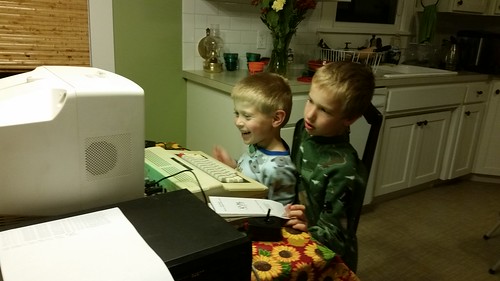
Yesterday, Jacob (age 8) asked to help me put together a 30-year-old computer from parts in my basement. Meanwhile, Oliver (age 5) asked Laura to help him learn cursive. Somehow, this doesn t seem odd for a Saturday at our place. 2014-11-22 18.58.36 Let me tell you how this came about. I ve had a project going on for a while now to load data from old floppies. It s been fun, and had a surprise twist the other day: my parents gave me an old TRS-80 Color Computer II (aka CoCo 2 ). It was, in fact, my first computer, one they got for me when I was in Kindergarten. It is nearly 30 years old. I have been musing lately about the great disservice Apple did the world by making computers easy to learn namely the fact that few people ever bother to learn about them. Who bothers to learn about them when, on the iPhone for instance, the case is sealed shut, the lifespan is 1 or 2 years for many purchasers, and the platform is closed in lots of ways? I had forgotten how finicky computers used to be. But after some days struggling with IDE incompatibilities, booting issues, etc., when I actually managed to get data off a machine that had last booted in 1999, I had quite the sense of accomplishment, which I rarely have lately. I did something that was hard to do in a world where most of the interfaces don t work with equipment that old (even if nominally they are supposed to.) The CoCo is one of those computers normally used with a floppy drive or cassette recorder to store programs. You type DIR, and you feel the clack of the drive heads through the desk. You type CLOAD and you hear the relay click closed to turn on the tape motor. You wiggle cables around until they make contact just right. You power-cycle for the times when the reset button doesn t quite do the job. The details of how it works aren t abstracted away by innumerable layers of controllers, interfaces, operating system modules, etc. It s all right there, literally vibrating your desk. So I thought this could be a great opportunity for Jacob to learn a few more computing concepts, such as the difference between mass storage and RAM, plus a great way to encourage him to practice critical thinking. So we trekked down to the basement and came up with handfulls of parts. We brought up the computer, some joysticks, all sorts of tangled cables. We needed adapters, an old TV. Jacob helped me hook everything up, and then the moment of truth: success! A green BASIC screen! I added more parts, but struck out when I tried to connect the floppy drive. The thing just wouldn t start up right whenever the floppy controller cartridge was installed. I cleaned the cartridge. I took it apart, scrubbed the contacts, even did a re-seat of the chips. No dice. So I fired up my CoCo emulator (xroar), and virtually saved some programs to cassette (a .wav file). I then burned those .wav files to an audio CD, brought up an old CD player from the basement, connected the cassette in plug to the CD player s headphone jack, and presto instant programs. (Well, almost. It takes a couple of minutes to load a program from audio codes.) The picture above is Oliver cackling at one of the very simplest BASIC programs there is: number find. The computer picks a random number between 1 and 2000, and asks the user to guess it, giving a too low or too high clue with each incorrect guess. Oliver delighted in giving invalid input (way too high numbers, or things that weren t numbers at all) and cackled at the sarcastic error messages built into the program. During Jacob s turn, he got very serious about it, and is probably going to be learning about how to calculate halfway points before too long. But imagine my pride when this morning, Jacob found the new CD I had made last night (correcting a couple recordings), found my one-line instruction on just part of how to load a program, and correctly figured out by himself all the steps to do in order (type CLOAD on the CoCo, advance the CD to the proper track, press play on the player, wait for it to load on the CoCo, then type RUN). I ordered a replacement floppy controller off eBay tonight, and paid $5 for a coax adapter that should fix some video quality issues. I rescued some 5.25 floppies from my trash can from another project, so they should have plenty of tools for exploration. It is so much easier for them to learn how a disk drive works, and even what the heck a track is, when you can look at a floppy drive with the cover off and see the heads move. There are other things we can do with more modern equipment Jacob has shown a lot of interest in Arduino projects but I have so far drawn a blank on ways to really let kids discover how a modern PC (let alone a modern phone or tablet) works. Update Nov. 24: Every so often, the world surprises me by deciding to, well, read one of my random blog posts. For the benefit of those of you that don t already know my boys, you might want to know that among their common play activites are turning trees into pretend trains, typing at a manual typewriter, reading, writing their own books, using a cassette recorder, building a PC and learning to use bash or xmonad, making long paper tapes with an adding machine, playing records on a record player, building electric gizmos, and even making mud balls. I am often asked about the role of the computer in the lives, given that my hobby and profession involves computers. The answer: less than that of most of their peers. I look for opportunities for them to learn by doing, discovering, playing, or imagining. I make no presumption that they will develop the passion for computers that I did. What I want is for them to have the curiosity and drive to learn everything there is to know about whatever they do develop a passion for, so they will be great at it.

23 November 2014

Iustin Pop: Debian, Debian

Due to some technical issues, I've been without access to my lists subscription email for a bit more than a week. Once I regained access and proceeded to read the batch of emails, I was - once again - shocked. Shocked at the amount of emails spent on the systemd issue, shocked at the number of people resigning, shocked at the amount of mud thrown. I just hope that the GR results finally will mean silence and getting over the last 3-6 months. For the record: However, some of the more recent emails on -private give me more hope, so I'm looking forward to the next 6 months. I wonder how this will all look in two years? (Side-note: emacs-nox shows me the italic word above as italic in text mode: I never saw that before, and didn't know, that it's possible to have italic fonts in xterm! What is this trickery it seems to be related to the font I use, fun!)

Matthew Palmer: You stay classy, Uber

You may have heard that Uber has been under a bit of fire lately for its desires to hire private investigators to dig up dirt on journalists who are critical of Uber. From using users ride data for party entertainment, putting the assistance dogs of blind passengers in the trunk, adding a surcharge to reduce the number of dodgy drivers, or even booking rides with competitors and then cancelling, or using the ride to try and convince the driver to change teams, it s pretty clear that Uber is a pretty good example of how companies are inherently sociopathic. However, most of those examples are internal stupidities that happened to be made public. It s a very rare company that doesn t do all sorts of shady things, on the assumption that the world will never find out about them. Uber goes quite a bit further, though, and is so out-of-touch with the world that it blogs about analysing people s sexual activity for amusement. You ll note that if you follow the above link, it sends you to the Wayback Machine, and not Uber s own site. That s because the original page has recently turned into a 404. Why? Probably because someone at Uber realised that bragging about how Uber employees can amuse themselves by perving on your one night stands might not be a great idea. That still leaves the question open of what sort of a corporate culture makes anyone ever think that inspecting user data for amusement would be a good thing, let alone publicising it? It s horrific. Thankfully, despite Uber s fairly transparent attempt at whitewashing ( clearwashing ?), the good ol Wayback Machine helps us to remember what really went on. It would be amusing if Uber tried to pressure the Internet Archive to remove their copies of this blog post (don t bother, Uber; I ve got a Save As button and I m not afraid to use it). In any event, I ve never used Uber (not that I ve got one-night stands to analyse, anyway), and I ll certainly not be patronising them in the future. If you re not keen on companies amusing themselves with your private data, I suggest you might consider doing the same.

Next.

Previous.
