Search Results: "ema"

29 April 2009

Dirk Eddelbuettel: Google Summer of Code 2009: R / Quantlib

With everything that has been going on of late, I have yet to mention that Khanh Nguyen, a Ph.D. student in Computer Science at U Mass / Boston, will be working with me on RQuantLib as part of the Google Summer of Code program this year. We had twenty-two applications to review for the R project, including three for the RQuantLib topic I had proposed. Khanh's application was clearly among the best, and I look forward to helping him do cool stuff over the summer. He already posted two short emails on the r-sig-finance and the quantlib-user lists soliciting suggestions and comments. So if you have comments regarding R and QuantLib, please get in touch with him or me!

Biella Coleman: The Politics of Open Source

Call for papers: JITP-2010
The Politics of Open Source
May 6-7, 2010 - Amherst, Massachusetts Full Paper Submission Due Date: January 10, 2010 Approach
Free/Libre and Open Source Software (FOSS) has made significant advances, both technically and organizationally, since its emergence in the mid-1980s. Over the last decade, it has moved from a software development approach involving mostly volunteers to a more complex ecology where firms, nonprofit organizations, government agencies and volunteers may be involved. Moreover, the production paradigm continues to expand to other areas of digital content (e.g., Creative Commons, Wikipedia, Connexions, etc.). In this conference we use the phrase open source to capture this broader phenomenon. The Program Committee encourages disciplinary and interdisciplinary approaches to the study of open source, broadly defined. Politics in the conference title, can have many interpretations. Political issues closely tied to the free and open source software movement(s) include: national government policies related to the adoption of open source technologies or questions related to interoperability and open standards, software patents, vendor lock-in, and copyright. These are central themes we expect may be discussed in this forum. In this context, we welcome international submissions since differences in the political perspective appear in international contexts. However, topics related to how the concept of openness has led to various interpretations, adaptations, and applications of open source in other domains, and political issues that surround these broader innovations, are also welcome. Specific topics might include, but are not limited to: General topics related to the politics of open source:
+ How open source software or its principles are changing politics
+ Emerging transparencies in software, systems and society
+ Open source in the developing world and other international contexts
+ The political economy of open source
+ Digital divides and open source Open source and the public sector:
+ Open source software and transparency in government
+ Government policies toward open source and open standards
+ Regulation and open source Open source and democracy:
+ Open source and democratic engagement
+ Open source voting systems
+ Activism, political mobilization and open source The expansion of open source into other domains:
+ Understanding how open source collaboration works and how it can be extended into other areas of collective action
+ Policy areas, such as the effects of free textbooks on education policy or the politics of One Laptop Per Child
+ The political implications of open source in other cultural domains Keynote Speakers
We are pleased to confirm Eric von Hippel (MIT) and Clay Johnson (Sunlight Labs) as the daily keynote speakers for JITP-2010. Paper Submissions
Authors are invited to prepare and submit to JITP a manuscript following one of the six submission formats by January 10, 2010. These formats include research papers, policy viewpoints, workbench notes, review essays, book reviews, and papers on teaching innovation. The goal is to produce a special issue, or double issue, of JITP with a wide variety of approaches to the broad theme of The Politics of Open Source.

How to Submit
Everything you need to know about how to prepare and submit a strong JITP paper is documented at http://www.jitp.net/. Papers will be put through an expedited blind peer review process by the Program Committee, and authors will be notified about a decision by March 10, 2010. A small number of papers will be accepted for presentation at the conference. Other paper authors will be invited to present a poster during the Friday evening reception. All posters must include a YouTube version of their research findings. Best Paper and Poster Cash Prizes
The author (or authors) of the best research paper will receive a single $1,000 prize. The creator (or creators) of the best poster/research presentation will also receive a single prize of $1,000. Program Committee
M.V. Lee Badgett, University of Massachusetts Amherst
Paul M.A. Baker, Georgia Institute of Technology
Deborah Bryant, Oregon State University Open Source Lab
Andrea Calderaro, European University Institute
Mark Cassell, Kent State University
Edward Cherlin, Earth Treasury
Gabriella Coleman, New York University
Doug Downham, University of Massachusetts Amherst
Robert English, Daystar Computing & University of Massachusetts Amherst
Joseph Feller, University College Cork
Jelena Karanovic, Rutgers University
Dave Karpf, University of Pennsylvania/Miller Center for Public Affairs
Jeremy Hunsinger, Virginia Tech
Andrea Kavanaugh, Virginia Tech
Jose Marichal, California Lutheran University
Jens Hardings Perl, Pontificia Universidad Cat lica de Chile
Charlie Schweik, University of Massachusetts Amherst, co-chair
Stuart Shulman, University of Massachusetts Amherst, co-chair
Megan Squire, Elon University
Krishna Ravi Srinivas, Research Information System For Developing Nations
Louis Suarez-Potts, Sun Microsystems, Inc. & OpenOffice.org
Anas Tawileh, Cardiff University & Meedan.net

28 April 2009

Biella Coleman: Mobile Phones in Africa: an on the ground perspective

Here is a short clip on the topic.

Biella Coleman: Mobile Phones in Africa: an on the ground perspective

Here is a short clip on the topic.

Biella Coleman: Free Access: Hacker Practice

So lately I have not had much luck getting open licenses for my articles (though I have for my book, which I will write about later) but SAGE is offering Free Access for the month of April. Alex Rex Golub and I have a piece, which is fairly jargony (in the academic sense) on three variants of hacking, which you can download here. The forthcoming articles are more accessible and I will drop a note when they are published.

Joost Yervante Damad: arduino toolkit on x86_64 linux Debian/Ubuntu

Update:

I received an email from Ethan Bisset with a much nicer solution: just use the debian provided serial library instead of the one provided with the arduino software.

This is his recipe:

1. Get arduino software
2. apt-get install sun-java6-bin binutils-avr avr-libc gcc-avr librxtx-java
3. Untar arduino software
4. Delete <arduino>/lib/librxtxSerial.so
5. Done!

(below is the old entry:)

Download the linux 32-bit arduino toolkit from the arduino toolkit download page and untar in a directory.

Install the avr tools: apt-get install avr-libc binutils-avr gcc-avr

Install "ia32-sun-java5-bin". ( apt-get install ia32-sun-java5-bin )

Adapt the "arduino" startup script script and replace java in it by

/usr/lib/jvm/ia32-java-1.5.0-sun/bin/java

Execute the "arduino" startup script. It works just fine now.

Thats all.

Many thanks to the Debian java packagers for providing this 32-bit compatibity jvm!

Florian Ragwitz: Implementing Typed Lexical Variables

For quite some time perl provided a form of my declarations that includes a type name, like this:
my Str $x = 'foo';
However, that didn't do anything useful, until Vincent Pit came along and wrote the excellent Lexical::Types module, which allows you to extend the semantics of typed lexicals and actually make them do something useful. For that, it simply invokes a callback for every my declaration with a type in the scopes it is loaded. Within that callback you get the variable that is being declared as well as the name of the type used in the declaration. We also have Moose type constraints and the great MooseX::Types module, that allows us to define our own type libraries and import the type constraints into other modules. Let's glue those modules together. Consider this code:
use MooseX::Types::Moose qw/Int/;
use Lexical::Types;
my Int $x = 42;
The first problem is that the perl compiler expects a package with the name of the type used in my to exist. If there's no such package compilation will fail. Creating top-level namespaces for all the types we want to use would obviously suck. Luckily the compiler will also try to look for a function with the name of the type in the current scope. If that exists and is inlineable, it will call that function and use the return value as a package name. In the above code snippet an Int function already exists. We imported that from MooseX::Types::Moose. Unfortunately it isn't inlineable. Even if it were, compilation would still fail, because it would return a Moose::Meta::TypeConstraint instead of a valid package name. To fix that, let's rewrite the code to this:
use MooseX::Types::Moose qw/Int/;
use MooseX::Lexical::Types qw/Int/;
my Int $x = 42;
Let's also write a MooseX::Lexical::Types module that replaces existing imported type exports with something that can be inlined and returns an existing package name based on the type constraint's name.
package MooseX::Lexical::Types;
use Class::MOP;
use MooseX::Types::Util qw/has_available_type_export/;
use namespace::autoclean;
sub import  
    my ($class, @args) = @_;
    my $caller = caller();
    my $meta = Class::MOP::class_of($caller)   Class::MOP::Class->initialize($caller);
    for my $type_name (@args)  
        # get the type constraint by introspecting the caller
        my $type_constraint = has_available_type_export($caller, $type_name);
        my $package = 'MooseX::Lexical::Types::TYPE::' . $type_constraint->name;
        Class::MOP::Class->create($package);
        $meta->add_package_symbol('&'.$type_name => sub ()   $package  );
     
    Lexical::Types->import; # enable Lexical::Types for the caller
 
1;
With that the example code now compiles. Unfortunately it breaks every other usecase of MooseX::Types. The export will still need to return a Moose::Meta::TypeConstraint at run time so this will continue to work:
has some_attribute => (is => 'ro', isa => Int);
So instead of returning a plain package name from our exported function we will return an object that delegates all method calls to the actual type constraint, but evaluates to our special package name when used as a string:
my $decorator = MooseX::Lexical::Types::TypeDecorator->new($type_constraint);
$meta->add_package_symbol('&'.$type_name => sub ()   $decorator  );
and:
package MooseX::Lexical::Types::TypeDecorator;
use Moose;
use namespace::autoclean;
# MooseX::Types happens to already have a class that doesn't do much
# more than delegating to a real type constraint!
extends 'MooseX::Types::TypeDecorator';
use overload '""' => sub  
    'MooseX::Lexical::Types::TYPE::' . $_[0]->__type_constraint->name
 ;
1;
Now we're able to use Int as usual and have Lexical::Types invoke its callback on MooseX::Lexical::Types::TYPE::Int. Within that callback we will need the real type constraint again, but as it is invoked as a class method with no good way to pass in additional arguments, we will need to store the type constraint somewhere. I choose to simply add a method to the type class we create when constructing our export. After that, all we need is to implement our Lexical::Types callback. We will put that in a class all our type classes will inherit from:
Class::MOP::Class->create(
    $package => (
        superclasses => ['MooseX::Lexical::Types::TypedScalar'],
        methods      =>  
            get_type_constraint => sub   $type_constraint  ,
         ,
    ),
);
The Lexical::Types callback will now need to tie things together by modifying the declared variable so it will automatically validate values against the type constraint when being assigned to. There are several ways of doing this. Using tie on the declared variable would probable be the easiest thing to do. However, I decided to use Variable::Magic (also written by Vincent Pit - did I mention he's awesome?), because it's mostly invisible at the perl level and also performs rather well (not that it'd matter, given that validation itself is relatively slow):
package MooseX::Lexical::Types::TypedScalar;
use Carp qw/confess/;
use Variable::Magic qw/wizard cast/;
use namespace::autoclean;
my $wiz = wizard
    # store the type constraint in the data attached to the magic
    data => sub   $_[1]->get_type_constraint  ,
    # when assigning to the variable, fail if we can't validate the
    # new value ($_[0]) against the type constraint ($_[1])
    set  => sub  
        if (defined (my $msg = $_[1]->validate($  $_[0]  )))  
            confess $msg;
         
        ();
     ;
sub TYPEDSCALAR  
    # cast $wiz on the variable in $_[1]. pass the type package name
    # in $_[0] to the wizard's data construction callback.
    cast $_[1], $wiz, $_[0];
    ();
 
1;
With this, our example code now works. If someone wants to assign, say, 'foo' to the variable declared as my Int $x our magic callback will be invoked, try to validate the value against the type constraint and fail loudly. WIN! The code for all this is available github and should also be on CPAN shortly. You might notice warnings about mismatching prototypes. Those are caused by Class::MOP and fixed in the git version of it, so they'll go away with the next release. There's still a couple of caveats, but please see the documentation for that.

27 April 2009

Biella Coleman: Mr Kelty in Madrid

I know there are DD s and other FLOSS folks in Madrid, so don t miss Chris Kelty s talk on Free Software and Open Biology on May 5th!

Biella Coleman: Mr Kelty in Madrid

I know there are DD s and other FLOSS folks in Madrid, so don t miss Chris Kelty s talk on Free Software and Open Biology on May 5th!

Biella Coleman: Free as in Beer?

Who sent me beer?

Biella Coleman: Free as in Beer?

Who sent me beer?

Russell Coker: Email Passwords

I was doing some routing sysadmin work for a client when I had to read mail in the system administration mailbox. This mailbox is used for cron job email, communication with ISPs that run servers for the company, and other important things. I noticed that the account was subscribed to some mailing lists related to system administration, the following is from one of the monthly messages from a list server: Passwords for sysadmin@example.com: List Password // URL
-
whatever-users@example.org victoria3 That doesn t seem terribly exciting, unless you know that the password used for the list server happens to be the same as the one used for POP and IMAP access to the account in question, and that it is available as webmail Of course I didn t put the real password in my blog post, I replaced it with something conceptually similar and equally difficult to guess (naturally I ve changed the password). The fact that the password wasn t a string of 8 semi-random letters and digits is not a good thing, but not really bad on it s own. It s only when the password gets used for 3rd party servers that you have a real problem. I wonder how many list servers are run by unethical people who use the passwords to gain access to email accounts, and how many hostile parties use such lists of email addresses and passwords when they compromise servers that run mailing lists. Now there would be an obvious security benefit to not having the list server store the password in clear-text or at least not send it out every month. Of course the down-side to doing that is that it doesn t give someone like me the opportunity to discover the problem and change the password.

Gunnar Wolf: Damn you pigopolists! (or whatever)

We have had a quite strange couple of days... Everything was smooth as usual on Thursday. As I posted here, I cycled to Iztacala to give a talk and back, and basically had a good time. We had heard news some days earlier on the radio that the usual seasonal flu was still present by mid-April, while usually it disappeared by early March... But nothing more. But Friday morning, as I listened to my usual news program, Aristegui repeated over and over that the Health ministry had ordered (in a press conference at 23:00 the previous day) schools of all levels not to hold activities... Quite unusual, but WTF... Got to work as usual, around 9 AM. The first thing I see in the Institute, our Academic Secretary telling us all to finish our most urgent business and head back home, do not pass go, do not collect $200. And... During the morning it started sinking in. This is a very weird and somehow scary situation. We are facing -as you all must know by now- a previously unknown strain of flu virus (influenza porcina H1N1B, AFAICT). During the past couple of days, we have seen the scenes we wondered about during the past decade, mainly in South East Asia (with SARS and with bird flu): Everybody is scared, nobody really understands what they are scared of, people do stay at home. The streets are eerily quiet, and many people are seen with masks covering nose and mouth. I must recognize our federal and local governments are acting very well coordinated (for the first time in probably over a decade, since they were from different parties for the first time). This has been clearly labeled as an epidemic (over 1600 sick people reported at hospitals, and over 100 deceased) and has spread to many of our country's states (as well as to other many countries, although it still seems to be controlled there - But we have got reports from the USA, Canada, France, Spain, Israel and New Zealand so far). I will most probably spend the next full week at home, as my University (as well as all schools and universities in this city and at least the Mexico, Nuevo Le n and San Luis Potos states) will be closed until May 6th. Of course, sports and cultural activities are all suspended as well. Many (most?) bars and restaurants remain closed. Today, my parents came from neighbouring Cuernavaca (where no alerts have yet been emitted, but will surely follow), and we went out for lunch (to a nice Yucatan food place, chosen partly as it had very little concurrence and because we could sit outdoors. Yes, I must specially thank them for being as imprudent as coming over here, given the generalized scare... I know there was nothing I could do to prevent them from doing so :-) And... In this strange climate, I can only thank I am not a party-organizer or anything like that, as I'd have had my plans frustrated. Here I sit next to my laptop, in my halfway-re-windowed house, with a still shrink-wrapped book that looks beautiful (La bicicleta: Rito, t cnica y pasi n), eager to open it (Thanks, Nadezhda! :-* ). Happy birthday to me. Take off the mask, blow 33 candles, put mask back on. Thankfully there is no cake to eat, as it could be messy with the mask on.
26 April 2009

Biella Coleman: Oggs

Here are the Winter Camp interviews in Ogg format

Biella Coleman: Oggs

Here are the Winter Camp interviews in Ogg format

Biella Coleman: Arrrghgghghg


anthropologist, originally uploaded by the biella.
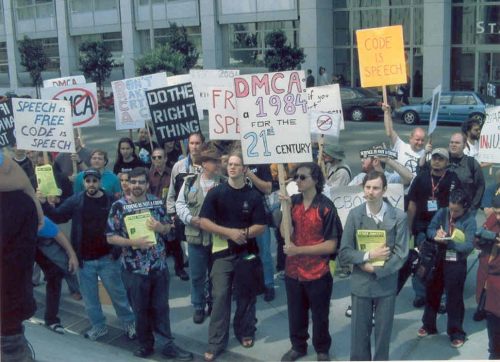
So for years and years and years I assumed this photo was taken by a good friend of mine (and we sill think it may be) but we can t totally verify if it is his as he lost all his old photos after a server hack-in. Do you recognize this photo? Do you have photos from this Free Dmitry protest (August 2008, in front of the San Francisco Prosecutors office) that would share for an academic publication on this topic??? Help!

25 April 2009

Biella Coleman: What We Know So Far

So, when I like something, I tend to yap about it for weeks and weeks. Take Icelandic Yogurt, for example. After re-discovering it a month ago, I went on a mini-binge (not a mega as it is too expensive) and spread the word to anyone who would listen. The stuff, especially with fun flavors like ginger and orange, just made my morning. Another fine fine thing out there is the performance group What We Know So Far who give performance-based lectures that mix intellectual insight with artistic flair. They put us regular academics to shame who are a bit more staid, to put it mildly. After seeing them a few weeks ago at the 3rd Ward, I snagged them to give a version of their A-mazing talk on Memes in my class and am organizing a much larger event at NYU for the fall of 2009. This is a sort of long winded way of announcing their up and coming show on April 27th the Hannah Complex, which entertains, among other topics, the nature of common sense: Can there be more than one common sense? they ask on their site. And I can t wait to hear the answer as this is a recurrent topic that anthropologists like to entertain. And in fact one of my favorite essays to teach is on this topic, Clifford Geertz Common Sense as Cultural System, a short excerpt which I found here and below is his thesis in a nutshell:
There are a number of reasons why treating common sense as a relatively organized body of considered thought, rather than just what anyone clothed and in his right mind knows, should lead on to some useful conclusions; but perhaps the most important is that it is an inherent characteristic of common-sense thought precisely to deny this and to affirm that its tenets are immediate deliverances of experience, not deliberated reflections upon it. Knowing that rain wets and that one ought to come in out of it, or that fire burns and one ought not to play with it (to stick to our own culture for the moment) are conflated into comprising one large realm of the given and undeniable, a catalog of in-the-grain-of-nature realities so peremptory as to force themselves upon any mind sufficiently unclouded to receive them. Yet this is clearly not so. No one, or no one functioning very well, doubts that rain wets; but there may be some people around who question the proposition that one ought to come in out of it, holding that it is good for one s character to brave the elements hatlessness is next to godliness. And the attractions of playing with fire often, with some people usually, override the full recognition of the pain that will result. Religion rests its case on revelation, science on method, ideology on moral passion; but common sense rests its on the assertion that it is not a case at all, just life in a nutshell. The world is its authority.

Next.

Previous.