Search Results: "ed"

4 August 2017

Michal Čihař: Changes to Docker container for Weblate

I've made several changes to the Weblate Docker container which are worth mentioning today. First of all if you are still using nijel/weblate, you should switch to weblate/weblate. They both currently share same configuration, but it might happen that some future updates will go to the weblate owned container only. Now back to the container changes. Since beginning we were using Django built in server. That's fine for development purposes, but it really doesn't work that well in production as it can handle only one request at time. Therefore we've switched to more robust approach using nginx + uwsgi + supervisor. Thanks to this, the docker-compose no longer needs separate nginx server as everything is now sanely handled within the weblate container itself.

Filed under: Debian English Gammu phpMyAdmin SUSE Weblate

Dirk Eddelbuettel: R for System Adminstration

Just getting back from the most fun meetup I have been to in quite some time: episode 23 (by their count) of Open Source Open Mic hosted by Matt Godbolt and Joe Walnes here in Chicago. Nothing but a sequence of lightning talks. Plus beer and pizza. Sounds awesome? It was! We had fantastic talks across at least half a dozen languages, covering both new-ish (Pony) and interesting ones such (Rust, Go, ...) plus of course some Javascript and some Python, no Java (yay!) and a few batshit crazy things like a self-hosting database in its own (shell) code, a terminal gif viewer (!!), and more. And it gave me an opportunity to quickly (one evening and morning commute) jam out a presentation about what is in the title: R for system administration. And I am only half-joking. I had used R a couple of years ago when I needed to select, subset, modify, ... a large number of image files given some timestamp and filename patterns. And given how well R works in a vectorised manner with both regular expressions and timestamps, as well as on top of essentially all standard POSIX-style operating system / file-system functions, I picked up that thread again on the problem of ... cleaning up the file storage underlying CRANberries which by now has well over fifty-seven thousand (!!) tarballs of CRAN packages based on now ten years of CRANberries. So I showed how to prune this in essentially half a dozen lines of R (and data.table code), plus some motivation---all just right for a lightning talk. Seemingly the talk went well enough as quite a few folks gave a thumbs up and compliments over beers afterwards. But see for yourself as the slides are now uploaded to my standard talks page. My thanks to Matt and Joe for organizing the meetup. I think I will be back.

3 August 2017

Joey Hess: home power monitoring

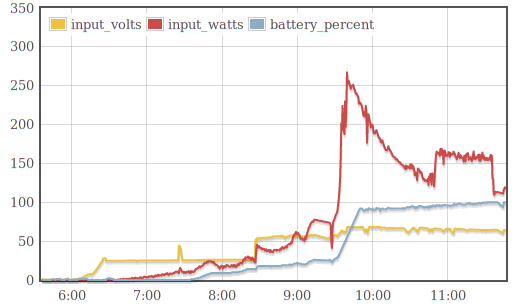
For years I've recorded solar panel data by hand. Filled two notebooks with columns of figures. My new charge controller, an EPsolar Tracer-BN, finally let me automate it.
morning activity; by 8 am the sun is still behind the hill but, 16 watts are being produced, and by 11:30 am, the battery bank is full
You can explore my home power data here: http://homepower.joeyh.name/
(click and drag to zoom) The web interface loads the RRD files into a web browser using javascriptRRD. I wrote a haskell program that drives the epsolar-tracer python library to poll for data, and stores it in RRD files. Could have used collectd or something, but the interface to the charge controller is currently a bit flakey and I have to be careful about retries and polling frequencies. Also I wanted full control over how much data is stored in the RRD files. Full source code

Daniel Silverstone: Gitano 1.1

Today marks the release of Gitano 1.1. Richard(s) and I have spent quite a lot of time and effort on this release, and there's plenty of good stuff in it. We also released new versions of Lace, Supple, Luxio, and Gall to go alongside it, with bugfixes and improvements. At this point, I intend to take a short break from Gitano to investigate some Rust-on-STM32 stuff, and then perhaps do some NetSurf work too.

Elena 'valhalla' Grandi: Debian Day in Varese

Debian Day in Varese

I'm stuck home instead of being able to go to DebConf, but that doesn't mean that Debian Day will be left uncelebrated!

Since many of the locals are away for the holidays, we of @Gruppo Linux Como and @LIFO aren't going to organize a full day of celebrations, but at the very least we are meeting for a dinner in Varese, at some restaurant that will be open on that date.

Everybody is welcome: to join us please add your name (nickname or identifier of any kind, as long as it fits in the box) on dudle.inf.tu-dresden.de/debday before thursday, August 10th, so that we can
get a reservation at the restaurant.

Michal Čihař: Going to DebConf17

After fours years, I will again make it to DebConf, I'm looking forward to meet many great people, so if you want to meet and happen to be in Montreal next week come and say hello to me :-). It seems I've settled down on four year schedule - I've attended DebConf09 and DebConf13 so far. Let's see if next one will come in 2021 or earlier.

Filed under: Debian English Gammu phpMyAdmin Weblate

2 August 2017

Markus Koschany: My Free Software Activities in July 2017

Welcome to gambaru.de. Here is my monthly report that covers what I have been doing for Debian. If you re interested in Java, Games and LTS topics, this might be interesting for you. Debian Games Debian Java Debian LTS This was my seventeenth month as a paid contributor and I have been paid to work 23,5 hours on Debian LTS, a project started by Rapha l Hertzog. In that time I did the following: Non-maintainer upload Thanks for reading and see you next time.

Steve Kemp: So I did a thing, then another thing.

So I did start a project, to write a puppet-dashboard, it is functionally complete, but the next step is to allow me to raise alerts based on failing runs of puppet - in real-time. (i.e. Now that I have a dashboard I wish to not use it. I want to be alerted to failures, without having to remember to go look for them. Something puppet-dashboard can't do ..) In other news a while back I slipped in a casual note about having a brain scan done, here in sunny Helsinki. One of the cool things about that experience, in addition to being told I wasn't going to drop dead that particular day, was that the radiologist told me that I could pay 25 to get a copy of my brain data in DICOM format. I've not yet played with this very much, but I couldn't resist a brief animation:

Markus Koschany: PDFsam: How to upgrade a Maven application for Debian

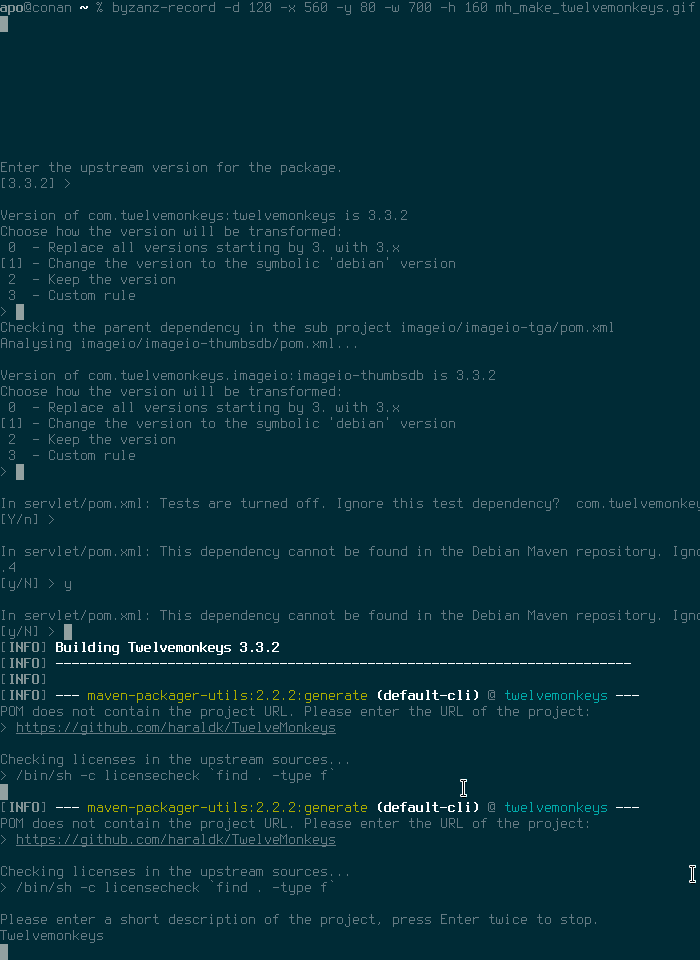
In the coming weeks and months I intend to write a mini series about packaging Java software for Debian. The following article basically starts in the middle of this journey because the PDFsam upgrade is still fresh in my mind. It requires some preexisting knowledge about build tools like Maven and some Java terminology. But do not fear. Hopefully it will make sense in the end when all pieces fall into place. A month ago I decided to upgrade PDFsam, a Java application to split, merge, extract, mix and rotate PDF documents. The current version 1.1.4 is already seven years old and uses Ant as its build system. Unfortunately up to now nobody was interested enough to invest the time to upgrade it to the latest version. A quick internet search unveils that the current sources can be found on github.com. Another brief look reveals we are dealing with a Maven project here because we can find a pom.xml file in the root directory and there is no sign of Ant s typical build.xml file anymore. Here are some general tips how to proceed from this point by using the PDFsam upgrade as an example. Find out how many new dependencies you really need The pom.xml file declares its dependencies in the <dependencies> section. It is good practice to inspect the pom.xml file and determine how much work will be required to upgrade the package. A seasoned Java packager will quickly find common dependencies like Hibernate or the Apache Commons libraries. Fortunately for you they are already packaged in Debian because a lot of projects depend on them. If you are unsure what is and what is not packaged for Debian, tracker.debian.org and codesearch.debian.net are useful tools to search for those packages. If in doubt just ask on debian-java@lists.debian.org. There is no automagical tool (yet) to find out what dependencies are really new (we talk about mh_make soon) but if you use the aforementioned tools and websites you will notice that in June 2017 one could not find the following artifacts: fontawesomefx, eventstudio, sejda-* and jackson-jr-objects. There are also jdepend and testFx but notice they are marked as <scope>test</scope> meaning they are only required if you would like to run upstream s test suite as well. For the sake of simplicity, it is best to ignore them for now and to focus on packaging only dependencies which are really needed to compile the application. Test dependencies can always be added later. This pom.xml investigation leads us to the following conclusion: PDFsam depends on Sejda, a PDF library. Basically Sejda is the product of a major refactoring that happened years ago and allows upstream to develop PDFsam faster and in multiple directions. For Debian packagers it is quite clear now that the upgrade of PDFsam is in reality more like packaging a completely new application. The inspection of Sejda s pom.xml file (another Maven project) reveals we also have to package imgscalr, Twelvemonkeys and SAMBox. We continue with these pom.xml analyses and end up with these new source packages: jackson-jr, libimgscalr-java, libsambox-java, libsejda-java, libsejda-injector-java, libsejda-io-java, libsejda-eventstudio-java, libtwelvemonkeys-java, fontawesomefx and libpdfbox2-java. Later I discovered that gettext-maven-plugin was also required. This was not obvious at first glance if you only check the pom.xml in the root directory but PDFsam and Sejda are multi-module projects! In this case every subdirectory (module) contains another pom.xml with additional information, so ideally you should check those too before you decide to start with your packaging. But don t worry it is often possible to ignore modules with a simple ignore rule inside your debian/*.poms file. The package will have less functionality but it can be still useful if you only need a subset of the modules. Of course in this case ignoring the gettext-maven-plugin artifact would result in a runtime error. C est la vie. A brief remark about Java package names: Java library packages must be named like libXXX-java. This is important for binary packages to avoid naming collisions. We are more tolerant when it comes to source package names but in general we recommend to use the exact same name as for the binary package. There are exceptions like prefixing source packages with their well known project name like jackson-XXX or jboss-XXX but this should only be used when there are already existing packages that use such a naming scheme. If in doubt, talk to us. mh_make or how to quickly generate an initial debian directory Packaging a Maven library is usually not very difficult even if it consists of multiple modules. The tricky part is to get the maven.rules, maven.IgnoreRules and your *.poms file right but debian/rules often only consists of a single dh line and the rest is finding the build-dependencies and adding them to debian/control. A small tool called mh_make, which is included in maven-debian-helper, can lend you a helping hand. The tool is not perfect yet. It requires that most build-dependencies are already installed on your local system, otherwise it won t create the initial debian directory and will only produce some unfinished (but in some cases still useful) files. A rule of thumb is to start with a package that does not depend on any other new dependency and requires the fewest build-dependencies. I have chosen libtwelvemonkeys-java because it was the simplest package and met the aforementioned criteria. Here is how mh_make looks like in action. (The animated GIF was created with Byzanz) First of all download the release tarball, unpack it and run mh_make inside the root directory. Ok, what is happening here? First you can choose a source and binary package name. Then disable the tests and don t run javadoc to create the documentation. This will simplify things a little. Tests and javadoc settings can be added later. Choose the version you want to package and then you can basically follow the default recommendations and confirm them by hitting the Enter key. Throughout the project we choose to transform the upstream version with the symbolic debian version. Remember that Java/Maven is version-centric. This will ensure that our Maven dependencies are always satisfied later and we can simply upgrade our Maven libraries and don t have to change the versions by hand in various pom.xml files; maven-debian-helper will automatically transform them for us to debian . Enable all modules. If you choose not to, you can select each module individually. Note that later on some of the required build-dependencies cannot be found because they are either not installed (libjmagick6-java) or they cannot be found in Debian s Maven repository under /usr/share/maven-repo. You can fix this by entering a substitution rule or, as I did in this case, you can just ignore these artifacts for now. They will be added to maven.IgnoreRules. In order to successfully compile your program you have to remove them from this file later again, create the correct substitution rule in maven.rules and add the missing build-dependencies to debian/control. For now we just want to quickly create our initial debian directory. If everything went as planned a complete debian directory should be visible in your root directory. The only thing left is to fix the substitution rule for the Servlet API 3.1. Add libservlet3.1-java to Build-Depends and the following rule to maven.rules: javax.servlet s/servlet-api/javax.servlet-api/ * s/.*/3.1/ * *
s/javax.servlet/javax.servlet.jsp/ s/jsp-api/javax.servlet.jsp-api/ * s/.*/2.3/ * * The maven.rules file consists of multiple rows separated by six columns. The values represent groupId, artifactId, type, version number and two fields which I never use.  You can just use an asterisk to match any value. Every value can be substituted. This is necessary when the value of upstream s pom.xml file differs from Debian s system packages. This happens frequently for API packages which are uploaded to Maven Central multiple times under a different groupId/artifactId but provide the same features. In this case the Twelvemonkeys pom requires an older API version but Debian is already at version 3.1. Note that we require a strict version number in this case because libservlet3.1-java does not use a symbolic debian version since we provide more than one Servlet API in the archive and this measure prevents conflicts. Thanks for reading this far. More articles about Java packaging will follow in the near future and hopefully they will clarify some terms and topics which could only be briefly mentioned in this post.

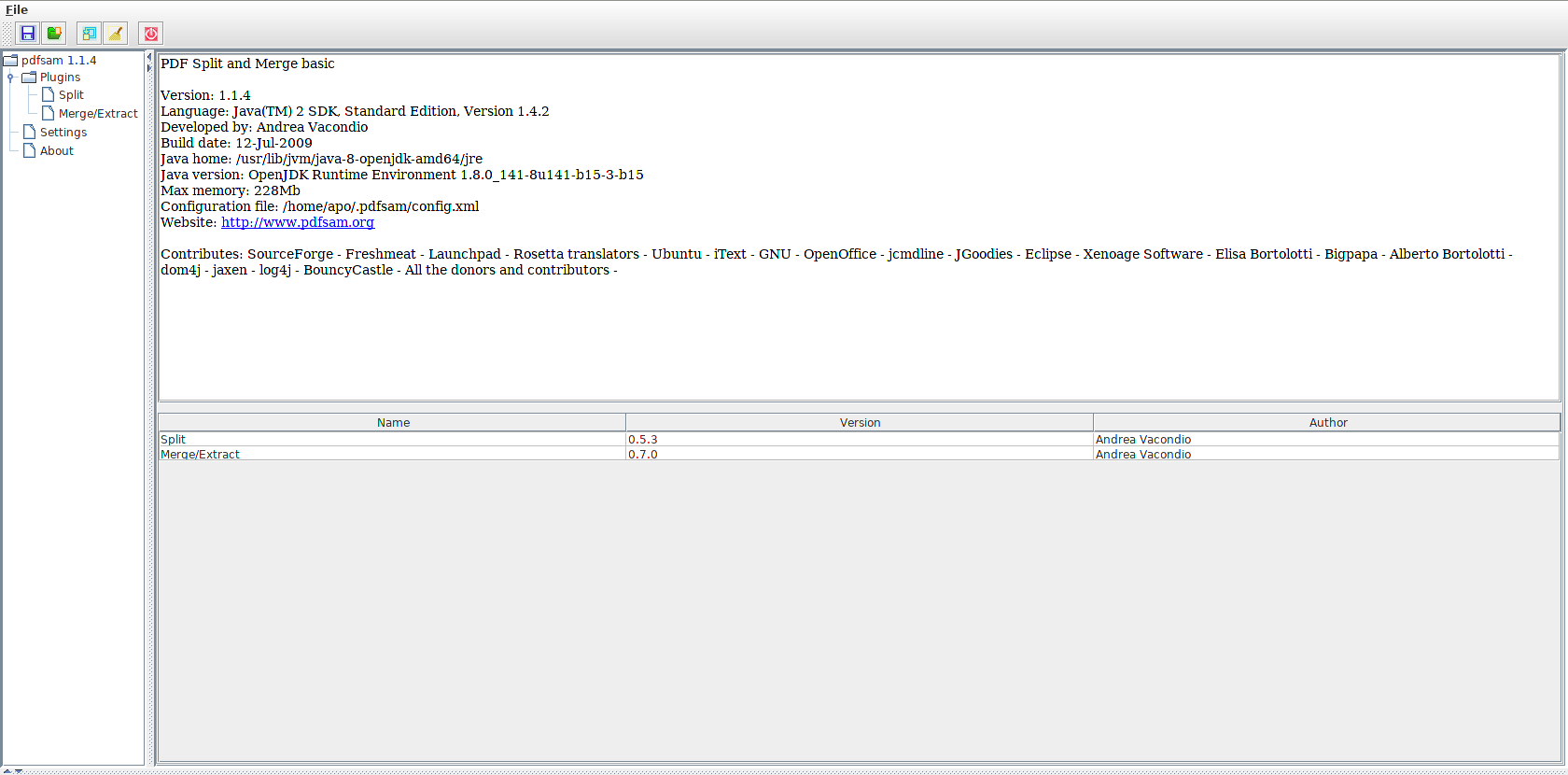
before

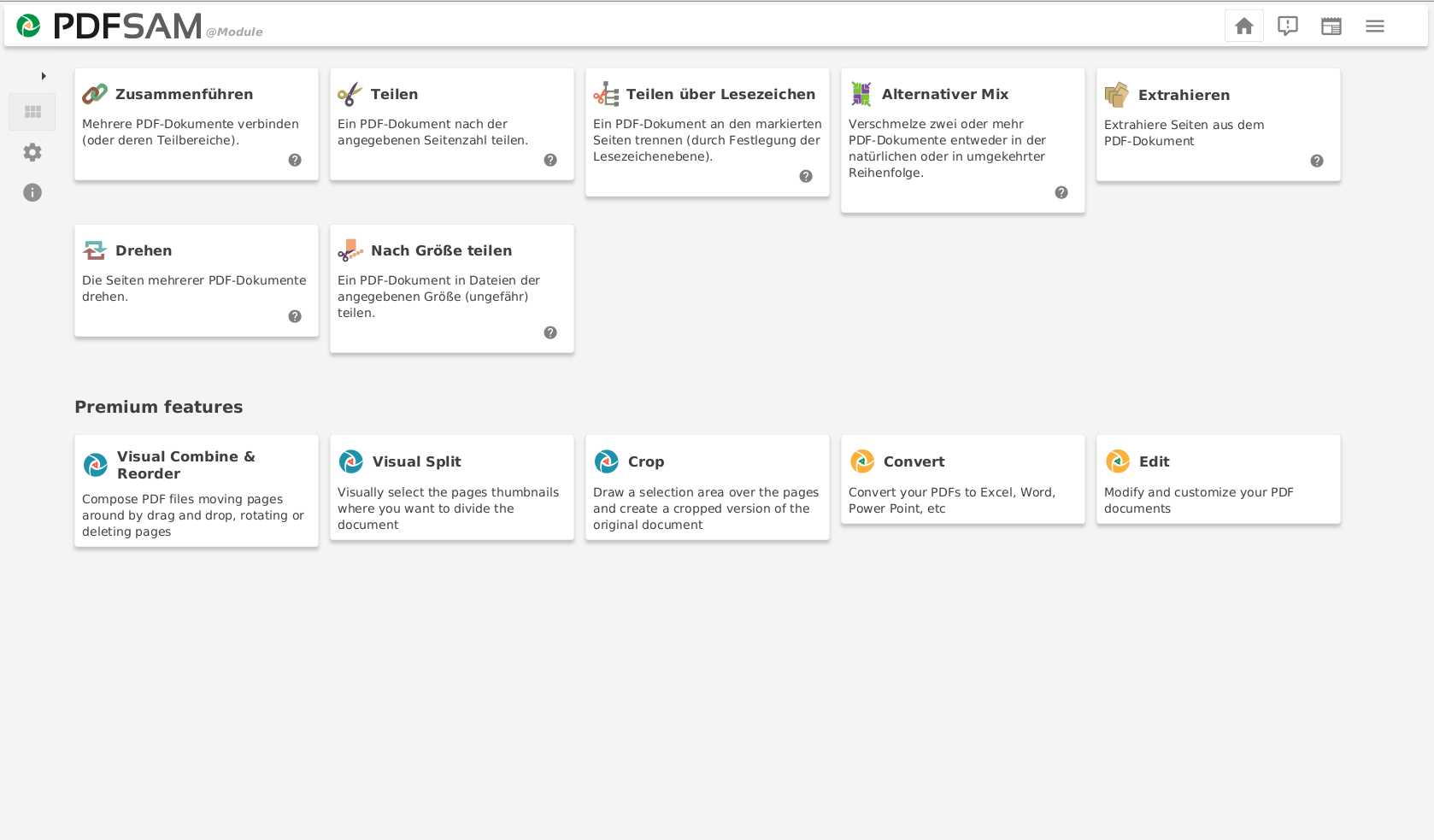
and after

Jonathan Dowland: Debian on the Raspberry Pi3

Back in November, Michael Stapelberg blogged about running (pure) Debian on the Raspberry Pi 3. This is pretty exciting because Raspbian still provide 32 bit packages, so this means you can run a true ARM64 OS on the Pi. Unfortunately, one of the major missing pieces with Debian on the Pi3 at this time is broken video support. A helpful person known as "SandPox" wrote to me in June to explain that they had working video for a custom kernel build on top of pure Debian on the Pi, and they achieved this simply by enabling CONFIG_FB_SIMPLE in the kernel configuration. On request, this has since been enabled for official Debian kernel builds. Michael and I explored this and eventually figured out that this does work when building the kernel using the upstream build instructions, but it doesn't work when building using the Debian kernel package's build instructions. I've since ran out of time to look at this more, so I wrote to request help from the debian-kernel mailing list, alas, nobody has replied yet. I've put up the dmesg.txt for a boot with the failing kernel, which might offer some clues. Can anyone help figure out what's wrong? Thanks to Michael for driving efforts for Debian on the Pi, and to SandPox for getting in touch to make their first contribution to Debian. Thanks also to Daniel Silverstone who loaned me an ARM64 VM (from Scaleway) upon which I performed some of my kernel builds.

1 August 2017

Paul Wise: FLOSS Activities July 2017

Changes

Issues

Review

Administration
  • Debian: fsck/reboot a buildd, reboot a segfaulting buildd, report/fix broken hoster contact, ping hoster about down machines, forcibly reset backup machine, merged cache patch for network-test.d.o, do some samhain dances, fix two stunnel services, update an IP address in LDAP, fix /etc/aliases on one host, reboot 1 non-responsive VM
  • Debian mentors: security updates, reboot
  • Debian wiki: whitelist several email addresses
  • Debian build log scanner: deploy my changes
  • Debian PTS: deploy my changes
  • Openmoko: security updates & reboots

Communication
  • Ping Advogato users on Planet Debian about updating/removing their feeds since it shut down
  • Invite deepin to the Debian derivatives census
  • Welcome Deepin to the Debian derivatives census
  • Inquire about the status of GreenboneOS, HandyLinux

Sponsors All work was done on a volunteer basis.

Thorsten Alteholz: My Debian Activities in July 2017

FTP assistant This month I am back to normal numbers and accepted 319 packages. I also kept the promise from last month and rejected 26 uploads. Debian LTS This was my thirty-seventh month that I did some work for the Debian LTS initiative, started by Raphael Hertzog at Freexian. This month my all in all workload went up to 23.5h. During that time I did LTS uploads of: I could also remove libtorrent-rasterbar and pspp from dla-needed.txt as the affected code was not in the Wheezy version or it was just a simple bug. Last but not least I also had a few days of frontdesk duties. Other stuff This month I uploaded a new version of entropybroker with a revised set of systemd service files. At the moment there is public instance of entropybroker running at eb.debian.net. Its entropy is fed by several Entropy Keys made by Simtec Electronics. Though it is public, it is not yet anonymous, so if you need some entropy please drop me a line. At the moment there are two consumers, but the buffers are still filled. I also uploaded several new packages, orcania, yder, hoel and ulfius. If everything works as expected, there will be soon an oauth2 server available in Debian. Last but not least my DOPOM of this month has been ptunnel.

Reproducible builds folks: Reproducible Builds: Weekly report #118

Here's what happened in the Reproducible Builds effort between Sunday July 23 and Saturday July 29 2017: Toolchain development and fixes Packages reviewed and fixed, and bugs filed Reviews of unreproducible packages 4 package reviews have been added, 2 have been updated and 24 have been removed in this week, adding to our knowledge about identified issues. Weekly QA work During our reproducibility testing, FTBFS bugs have been detected and reported by: diffoscope development Misc. This week's edition was written by Chris Lamb, Mattia Rizzolo & reviewed by a bunch of Reproducible Builds folks on IRC & the mailing lists.

Russell Coker: QEMU for ARM Processes

I m currently doing some embedded work on ARM systems. Having a virtual ARM environment is of course helpful. For the i586 class embedded systems that I run it s very easy to setup a virtual environment, I just have a chroot run from systemd-nspawn with the --personality=x86 option. I run it on my laptop for my own development and on a server my client owns so that they can deal with the hit by a bus scenario. I also occasionally run KVM virtual machines to test the boot image of i586 embedded systems (they use GRUB etc and are just like any other 32bit Intel system). ARM systems have a different boot setup, there is a uBoot loader that is fairly tightly coupled with the kernel. ARM systems also tend to have more unusual hardware choices. While the i586 embedded systems I support turned out to work well with standard Debian kernels (even though the reference OS for the hardware has a custom kernel) the ARM systems need a special kernel. I spent a reasonable amount of time playing with QEMU and was unable to make it boot from a uBoot ARM image. The Google searches I performed didn t turn up anything that helped me. If anyone has good references for getting QEMU to work for an ARM system image on an AMD64 platform then please let me know in the comments. While I am currently surviving without that facility it would be a handy thing to have if it was relatively easy to do (my client isn t going to pay me to spend a week working on this and I m not inclined to devote that much of my hobby time to it). QEMU for Process Emulation I ve given up on emulating an entire system and now I m using a chroot environment with systemd-nspawn. The package qemu-user-static has staticly linked programs for emulating various CPUs on a per-process basis. You can run this as /usr/bin/qemu-arm-static ./staticly-linked-arm-program . The Debian package qemu-user-static uses the binfmt_misc support in the kernel to automatically run /usr/bin/qemu-arm-static when an ARM binary is executed. So if you have copied the image of an ARM system to /chroot/arm you can run the following commands like the following to enter the chroot: cp /usr/bin/qemu-arm-static /chroot/arm/usr/bin/qemu-arm-static
chroot /chroot/arm bin/bash Then you can create a full virtual environment with /usr/bin/systemd-nspawn -D /chroot/arm if you have systemd-container installed. Selecting the CPU Type There is a huge range of ARM CPUs with different capabilities. How this compares to the range of x86 and AMD64 CPUs depends on how you are counting (the i5 system I m using now has 76 CPU capability flags). The default CPU type for qemu-arm-static is armv7l and I need to emulate a system with a armv5tejl. Setting the environment variable QEMU_CPU=pxa250 gives me armv5tel emulation. The ARM Architecture Wikipedia page [2] says that in armv5tejl the T stands for Thumb instructions (which I don t think Debian uses), the E stands for DSP enhancements (which probably isn t relevant for me as I m only doing integer maths), the J stands for supporting special Java instructions (which I definitely don t need) and I m still trying to work out what L means (comments appreciated). So it seems clear that the armv5tel emulation provided by QEMU_CPU=pxa250 will do everything I need for building and testing ARM embedded software. The issue is how to enable it. For a user shell I can just put export QEMU_CPU=pxa250 in .login or something, but I want to emulate an entire system (cron jobs, ssh logins, etc). I ve filed Debian bug #870329 requesting a configuration file for this [1]. If I put such a configuration file in the chroot everything would work as desired. To get things working in the meantime I wrote the below wrapper for /usr/bin/qemu-arm-static that calls /usr/bin/qemu-arm-static.orig (the renamed version of the original program). It s ugly (I would use a config file if I needed to support more than one type of CPU) but it works. #include <stdio.h>
#include <unistd.h>
#include <stdlib.h> int main(int argc, char **argv)

if(setenv("QEMU_CPU", "pxa250", 1))

printf("Can't set $QEMU_CPU\n");
return 1;

execv("/usr/bin/qemu-arm-static.orig", argv);
printf("Can't execute \"%s\" because of qemu failure\n", argv[0]);
return 1;

Russ Allbery: Learning Rust

I'm obviously not spending much time writing here. It's been a rather busy month at work, and I've been doing other things on the weekend that aren't particularly interesting to write about. This past week, though, I took advantage of our semi-annual Hack Week to finally learn Rust. I have several co-workers who love the language and have been wanting to stretch my programming language knowledge a bit. I was also profoundly disappointed by Go, which has been touted as the new C-style systems language but which I think is awful. All the reasons why is a topic for another post, but the obnoxiously verbose error handling is probably my biggest complaint. (This is the worst property of C; why would you copy it?) Rust was a favorite of a few people who felt the same way I did about Go, which seemed promising. I made it through the first thirteen chapters of the second edition Rust book and wrote a not-entirely-trivial program (a tool to filter and search trace logs a Dropbox client) with a co-worker, and I think I'm in love with this language. It reminds me of everything I liked about Perl, except with all the weird bolted-on bits of Perl cleaned up and done properly, and with types. Despite having spent most of my career writing Perl and Python (and C, which is typed but not very well), I love strongly-typed languages. I just usually don't like the rest of the syntax of languages like Java and Go. Rust avoids the garbage collection nonsense (and huge performance issues), gives me the level of fine control that I am used to with C, but gets rid of memory allocation errors and provides a much richer type system and type matching. It feels a bit like an approachable Haskell, and I quickly found myself chaining iterators and pushing myself to write in a more functional style. The lifetime stuff in Rust can be frustrating, and there are a few limitations that can be hard to deal with (like iterating over one field of a struct while modifying another field of a struct, which comes up a lot and which is the sort of thing you have to avoid in Rust). But I like a language with a very picky compiler. And I love programming in a language where my first attempt is clunky and verbose, and then I think about the problem a bit and rewrite it in half as many lines of code, and then I sleep on it and come back and can delete half of the code again. I sadly don't have a lot of work projects right now where Rust is the right answer. I'm mostly maintaining existing code bases in Python, and Python is more accessible and more maintainable in most situations. But I now would love to find the time to rewrite a bunch of my personal C projects in Rust, and I'm watching for any new opportunity to use Rust. If you like new programming languages, but you don't have the time or inclination to live on the bleeding edge, Rust has gotten more stable and is at a good point to start. The documentation is fantastic, support for generating documentation is built into the language, the Rust book is a great teaching research, and Rust is available as Debian packages (so you don't have to do the horrifying curl bash nonsense in the official Rust documentation). Recommended, particularly for people who love Perl or functional languages (or functional Perl heavy on map and grep), want a more modern language with fewer odd corners, and want low-level control and native speed.

Russ Allbery: Review: The Fifth Season

Review: The Fifth Season, by N.K. Jemisin
Series: The Broken Earth #1
Publisher: Orbit
Copyright: 2015
ISBN: 0-316-22930-X
Format: Kindle
Pages: 497
The world of The Fifth Season is one of near-constant seismic activity. Volcanoes, massive earthquakes, and all the catastrophes that follow them are a constant threat. Civilization barely survives the turmoil, and only because of two things: strict cultural rules about how to handle a "fifth season" of heavy seismic activity and its aftermath (called stonelore), and the orogenes. Orogenes are humans (well, there is some debate about that) who have an organ that others don't, a biological ability to manipulate the seismic activity and the earth itself. They can protect others by damping down activity, smoothing faults, and redirecting seismic shock waves, but they can also destroy: pull earth out of shape, set off quakes, and create paths for magma to surface. And, to gather the power to manipulate the earth, they draw energy from everything around them, including from other people, often fatally. Orogenes are feared and hated by the typical person. The Stillness, the ironically-named continent on which this book is set, is very old and has had numerous civilizations destroyed by some seismic catastrophe. The landscape is scattered with useless or dangerous remnants of previous forgotten civilizations; the history, likewise, with only the stonelore and some muddled mythology available to most people. The current rulers have kept their empire for a surprising length of time, however, due mostly to the stable ground beneath their centrally-located capital. That stability comes from Fulcrum-trained orogenes, who are taken from their family as children and trained harshly to serve their society by suppressing or fixing dangerous seismic events. Fulcrum orogenes don't have an awful life (well, most of them; for some, it is pure torture), but they're effectively slaves, kept under the watchful eye of Guardians who have mysterious powers of their own. Against this background, The Fifth Season tells three interwoven stories. Essun lives in a small village (comm) at the start of the book, leading a quiet life, until one of her children is beaten to death by her husband following a seismic event that he thinks the child stopped. He's taken their other child and left. Essun, severely traumatized, heads after him to attempt a rescue, or at least revenge. Damaya is a child from another comm who is sold to the Guardians by her parents when she demonstrates orogenic ability, and who goes through Fulcrum training. And Syenite is a Fulcrum orogene, assigned to a field mission with a difficult but very senior orogene named Alabaster. All of these stories eventually interweave, and eventually reveal where they fit in the somewhat unobvious chronology of the story, but it takes some time to get there. It also takes some time for the primary characters to have much in the way of agency. Essun starts with the most, once she recovers her senses enough to start her hunt for revenge. Syenite is ambitious but junior, and Damaya is a child, trying to navigate an unknown world of student politics and strict rules. And all three of the main characters are orogenes, rogga when one is being insulting, and this world does not like orogenes. At all. The Fifth Season starts with an unusual narrative style: a conversational narrator who begins with some of the world background and some mysterious scenes that didn't make sense until much later in the book (late enough that I didn't remember them or make sense of them until I re-read them for this review). The book then focuses on Essun, whose scenes are written in second person present. Normally I think second person feels weirdly intrusive and off-putting, but once I got used to it here, I think it works as well as I've seen it work anywhere. I also see why Jemisin did it: Essun starts the story so traumatized that she's partly disassociating. First person wouldn't have worked, and the second-person voice gives that trauma some immediacy and emotional heft that would have been hard to achieve in third person. The story starts slowly, and builds slowly, as the world is introduced and Jemisin lays down the texture and history of the world. The world-building is ambitious in tracing down the ramifications of the seismic chaos and the implications of orogene ability (although it's best to think of it as pure magic, despite the minor science fiction trappings). But through that world-building, what this story is building is a deep, powerful, frustrated rage. The Fifth Season is an angry book. It's a book about outcasts, about slaves. About people who, even if they're succeeding within the parameters they're given, are channeled and stymied and controlled. It's a story about smiling, kind paternalism hiding lies, control, and abuse, about how hard it is to find enough space from the smothering destructiveness of a totalitarian culture to let yourself relax. It's a story about the horrible things people are willing to do to those they don't consider fully human, and all the ways in which safety, expediency, tradition, culture, and established social roles conspire to keep people within the box where they belong. And it's a story about how being constantly on edge, constantly dreading the next abuse, breaking under it, and being left wanting to burn the whole world to the ground. I struggled at the start of this book, but it grew on me, and by about halfway through it had me hooked completely. At first, Syenite's part of the story (the most traditionally told) was my favorite, but the coming-of-age stories of her and Damaya were overtaken by Essun's far more complex, cautious, and battle-weary tale. And I loved Jemisin's world-building. There's a lot of depth here, a lot of things going on that are unexplained but clearly important, and a restraint and maturity in how the world is revealed that makes it feel older and more layered than Jemisin's The Hundred Thousand Kingdoms. The major drawback of this book is that it is very much the first book of a series, and it doesn't so much have an ending as a hard stop. It's not quite a cliff-hanger, but it's nearly as unsatisfying as one. Most of the major questions of the book who the stone eaters are and what they want, and the fate of Essun's husband and child, just to name two are still unresolved at the end of the story. There is a bit of emotional closure, but not a true moment of catharsis for all of the rage. Hopefully that will be coming in a future book. This is a very unusual story, mixing fantasy and a sort of magic (orogeny) with some science fiction elements and a deep history. It's gritty, textured, emotional, and furious, and very much worth reading. I'm looking forward to the next book in the series. Followed by The Obelisk Gate. Rating: 8 out of 10

Junichi Uekawa: Playing with appengine python ndb.

Playing with appengine python ndb. Some interfaces changed from the old interface and I don't think I quite got the hang of it. The last time I was actively using it is when I was doing tokyodebian reservation system that I haven't touched for 3 years and started 8 years ago.

31 July 2017

Jonathan McDowell: How to make a keyring

Every month or two keyring-maint gets a comment about how a key update we say we ve performed hasn t actually made it to the active keyring, or a query about why the keyring is so out of date, or told that although a key has been sent to the HKP interface and that is showing the update as received it isn t working when trying to upload to the Debian archive. It s frustrating to have to deal with these queries, but the confusion is understandable. There are multiple public interfaces to the Debian keyrings and they re not all equal. This post attempts to explain the interactions between them, and how I go about working with them as part of the keyring-maint team. First, a diagram to show the different interfaces to the keyring and how they connect to each other: keyring-maint workflow
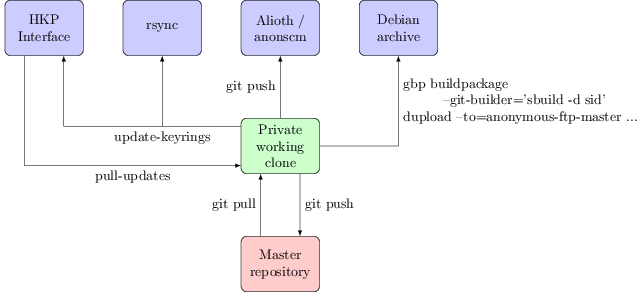
Public interfaces

rsync: keyring.debian.org::keyrings This is the most important public interface; it s the one that the Debian infrastructure uses. It s the canonical location of the active set of Debian keyrings and is what you should be using if you want the most up to date copy. The validity of the keyrings can be checked using the included sha512sums.txt file, which will be signed by whoever in keyring-maint did the last keyring update.

HKP interface: hkp://keyring.debian.org/ What you talk to with gpg --keyserver keyring.debian.org. Serves out the current keyrings, and accepts updates to any key it already knows about (allowing, for example, expiry updates, new subkeys + uids or new signatures without the need to file a ticket in RT or otherwise explicitly request it). Updates sent to this interface will be available via it within a few hours, but must be manually folded into the active keyring. This in general happens about once a month when preparing for a general update of the keyring; for example b490c1d5f075951e80b22641b2a133c725adaab8. Why not do this automatically? Even though the site uses GnuPG to verify incoming updates there are still occasions we ve seen bugs (such as #787046, where GnuPG would always import subkeys it didn t understand, even when that subkey was already present). Also we don t want to allow just any UID to be part of the keyring. It is thus useful to retain a final set of human based sanity checking for any update before it becomes part of the keyring proper.

Alioth/anonscm: https://anonscm.debian.org/git/keyring/keyring/ A public mirror of the git repository the keyring-maint team use to maintain the keyring. Every action is recorded here, and in general each commit should be a single action (such as adding a new key, doing a key replacement or moving a key between keyrings). Note that pulling in the updates sent via HKP count as a single action, rather than having a commit per key updated. This mirror is updated whenever a new keyring is made active (i.e. made available via the rsync interface). Until that point pending changes are kept private; we sometimes deal with information such as the fact someone has potentially had a key compromised that we don t want to be public until we ve actually disabled it. Every keyring push (as we refer to the process of making a new keyring active) is tagged with the date it was performed. Releases are also tagged with their codenames, to make it easy to do comparisons over time.

Debian archive This is actually the least important public interface to the keyring, at least from the perspective of the keyring-maint team. No infrastructure makes use of it and while it s mostly updated when a new keyring is made active we only make a concerted effort to do so when it is coming up to release. It s provided as a convenience package rather than something which should be utilised for active verification of which keys are and aren t currently part of the keyring.

Team interface

Master repository: kaufmann.debian.org:/srv/keyring.debian.org/master-keyring.git The master git repository for keyring maintenance is stored on kaufmann.debian.org AKA keyring.debian.org. This system is centrally managed by DSA, with only DSA and keyring-maint having login rights to it. None of the actual maintenance work takes place here; it is a bare repo providing a central point for the members of keyring-maint to collaborate around.

Private interface

Private working clone This is where all of the actual keyring work happens. I have a local clone of the repository from kaufmann on a personal machine. The key additions / changes I perform all happen here, and are then pushed to the master repository so that they re visible to the rest of the team. When preparing to make a new keyring active the changes that have been sent to the HKP interface are copied from kaufmann via scp and folded in using the pull-updates script. The tree is assembled into keyrings with a simple make and some sanity tests performed using make test. If these are successful the sha512sums.txt file is signed using gpg --clearsign and the output copied over to kaufmann. update-keyrings is then called to update the active keyrings (both rsync + HKP). A git push public pushes the changes to the public repository on anonscm. Finally gbp buildpackage --git-builder='sbuild -d sid' tells git-buildpackage to use sbuild to build a package ready to be uploaded to the archive. Hopefully that helps explain the different stages and outputs of keyring maintenance; I m aware that it would be a good idea for this to exist somewhere on keyring.debian.org as well and will look at doing so.

Daniel Silverstone: F/LOSS activity, July 2017

Once again, my focus was on Gitano, which we're working toward a 1.1 for. We had another one of our Gitano developer days which was attended by Richard maw and myself. You are invited to read the wiki page but a summary of what happened, which directly involved me, is: Other than that, related to Gitano during July I: I don't think I've done much non-Gitano F/LOSS work in July, but I am now in Montr al for debconf 2017 so hopefully more to say next month.

Chris Lamb: Free software activities in July 2017

Here is my monthly update covering what I have been doing in the free software world during July 2017 (previous month): I also blogged about my recent lintian hacking and installation-birthday package.
Reproducible builds

Whilst anyone can inspect the source code of free software for malicious flaws, most software is distributed pre-compiled to end users. The motivation behind the Reproducible Builds effort is to permit verification that no flaws have been introduced either maliciously or accidentally during this compilation process by promising identical results are always generated from a given source, thus allowing multiple third-parties to come to a consensus on whether a build was compromised. (I have generously been awarded a grant from the Core Infrastructure Initiative to fund my work in this area.) This month I:
  • Assisted Mattia with a draft of an extensive status update to the debian-devel-announce mailing list. There were interesting follow-up discussions on Hacker News and Reddit.
  • Submitted the following patches to fix reproducibility-related toolchain issues within Debian:
  • I also submitted 5 patches to fix specific reproducibility issues in autopep8, castle-game-engine, grep, libcdio & tinymux.
  • Categorised a large number of packages and issues in the Reproducible Builds "notes" repository.
  • Worked on publishing our weekly reports. (#114 #115, #116 & #117)

I also made the following changes to our tooling:
diffoscope

diffoscope is our in-depth and content-aware diff utility that can locate and diagnose reproducibility issues.

  • comparators.xml:
    • Fix EPUB "missing file" tests; they ship a META-INF/container.xml file. [ ]
    • Misc style fixups. [ ]
  • APK files can also be identified as "DOS/MBR boot sector". (#868486)
  • comparators.sqlite: Simplify file detection by rewriting manual recognizes call with a Sqlite3Database.RE_FILE_TYPE definition. [ ]
  • comparators.directory:
    • Revert the removal of a try-except. (#868534)
    • Tidy module. [ ]

strip-nondeterminism

strip-nondeterminism is our tool to remove specific non-deterministic results from a completed build.

  • Add missing File::Temp imports in the JAR and PNG handlers. This appears to have been exposed by lazily-loading handlers in #867982. (#868077)

buildinfo.debian.net

buildinfo.debian.net is my experiment into how to process, store and distribute .buildinfo files after the Debian archive software has processed them.

  • Avoid a race condition between check-and-creation of Buildinfo instances. [ ]


Debian My activities as the current Debian Project Leader are covered in my "Bits from the DPL emails to the debian-devel-announce mailing list.
Patches contributed
  • obs-studio: Remove annoying "click wrapper" on first startup. (#867756)
  • vim: Syntax highlighting for debian/copyright files. (#869965)
  • moin: Incorrect timezone offset applied due to "84600" typo. (#868463)
  • ssss: Add a simple autopkgtest. (#869645)
  • dch: Please bump $latest_bpo_dist to current stable release. (#867662)
  • python-kaitaistruct: Remove Markdown and homepage references from package long descriptions. (#869265)
  • album-data: Correct invalid Vcs-Git URI. (#869822)
  • pytest-sourceorder: Update Homepage field. (#869125)
I also made a very large number of contributions to the Lintian static analysis tool. To avoid duplication here, I have outlined them in a separate post.

Debian LTS

This month I have been paid to work 18 hours on Debian Long Term Support (LTS). In that time I did the following:
  • "Frontdesk" duties, triaging CVEs, etc.
  • Issued DLA 1014-1 for libclamunrar, a library to add unrar support to the Clam anti-virus software to fix an arbitrary code execution vulnerability.
  • Issued DLA 1015-1 for the libgcrypt11 crypto library to fix a "sliding windows" information leak.
  • Issued DLA 1016-1 for radare2 (a reverse-engineering framework) to prevent a remote denial-of-service attack.
  • Issued DLA 1017-1 to fix a heap-based buffer over-read in the mpg123 audio library.
  • Issued DLA 1018-1 for the sqlite3 database engine to prevent a vulnerability that could be exploited via a specially-crafted database file.
  • Issued DLA 1019-1 to patch a cross-site scripting (XSS) exploit in phpldapadmin, a web-based interface for administering LDAP servers.
  • Issued DLA 1024-1 to prevent an information leak in nginx via a specially-crafted HTTP range.
  • Issued DLA 1028-1 for apache2 to prevent the leakage of potentially confidential information via providing Authorization Digest headers.
  • Issued DLA 1033-1 for the memcached in-memory object caching server to prevent a remote denial-of-service attack.

Uploads
  • redis:
    • 4:4.0.0-1 Upload new major upstream release to unstable.
    • 4:4.0.0-2 Make /usr/bin/redis-server in the primary package a symlink to /usr/bin/redis-check-rdb in the redis-tools package to prevent duplicate debug symbols that result in a package file collision. (#868551)
    • 4:4.0.0-3 Add -latomic to LDFLAGS to avoid a FTBFS on the mips & mipsel architectures.
    • 4:4.0.1-1 New upstream version. Install 00-RELEASENOTES as the upstream changelog.
    • 4:4.0.1-2 Skip non-deterministic tests that rely on timing. (#857855)
  • python-django:
    • 1:1.11.3-1 New upstream bugfix release. Check DEB_BUILD_PROFILES consistently, not DEB_BUILD_OPTIONS.
  • bfs:
    • 1.0.2-2 & 1.0.2-3 Use help2man to generate a manpage.
    • 1.0.2-4 Set hardening=+all for bindnow, etc.
    • 1.0.2-5 & 1.0.2-6 Don't use upstream's release target as it overrides our CFLAGS & install RELEASES.md as the upstream changelog.
    • 1.1-1 New upstream release.
  • libfiu:
    • 0.95-4 Apply patch from Steve Langasek to fix autopkgtests. (#869709)
  • python-daiquiri:
    • 1.0.1-1 Initial upload. (ITP)
    • 1.1.0-1 New upstream release.
    • 1.1.0-2 Tidy package long description.
    • 1.2.1-1 New upstream release.

I also reviewed and sponsored the uploads of gtts-token 1.1.1-1 and nlopt 2.4.2+dfsg-3.

Debian bugs filed
  • ITP: python-daiquiri Python library to easily setup basic logging functionality. (#867322)
  • twittering-mode: Correct incorrect time formatting due to "84600" typo. (#868479)

Next.

Previous.