Search Results: "cas"

9 June 2010

David Welton: Some difficult decisions?

I am, by nature, a tinkerer. I love to build things to see how they will work or because I have an idea that I think is fun. I am not so much of a natural business guy. I go build something "because it's there". Or rather, it's there in my mind, and I want to make it. I earn money, however, via consulting work. There are problems with this line of business though, namely that it doesn't scale very well unless, besides being good at a skill, you've also got the skills to build up a consulting business, which is very much about adding and managing people, something I'm not all that passionate about and would rather avoid. So what happens is that you go through slumps with less than full capacity, and then things pick up again, and before you know it, you hit your upper limit and can't take on any new work, putting a ceiling over your potential earnings. Sure, you can raise prices a bit, but that'll only get you so far. For a while now, I've been considering this problem, and I think some sort of product would be an ideal way out. Stories like Balsamiq's are inspirational, and along the lines of what I think might be nice. Don't get me wrong, I like my clients and like to help people solve problems a lot, but it's a stressful job in that you're never very far from having no income. I'm not much of an entrepreneur, though, in the sense of someone with a nose for making money. I tend to think about building something cool first, and not really worrying about making money with it. Predictably, some of the sites I have created are popular, but don't make any money. Sure, they have some ads, but that doesn't really make much unless you get really huge page views or have some sort of content that attracts users who will click on very lucrative advertisements. I've started to think that perhaps I should constrain myself in new initiatives to creating things that have a direct source of revenue: you want to use it, you pay. In my daydream world, I'd probably just hack on open source all day long, but there's no money in that for someone like me who is not the author of some huge, famous piece of software, nor a particularly great hacker in any case (I've met some, like Andrew Tridgell, and it's a really humbling experience). So that brings up the question of what to do with the aforementioned sites. One option would be to sell them off via a site like flippa.com, another would be simply to just let them sit there and stew, but they do take up some resources on my server, and require some maintainance now and then, and they're a bit of a distraction too (I start wondering about things to add or how to fiddle with them). Maybe there's a way to make money from some of them, but I'm too blind to see it. The ones I'm thinking about, are, in no particular order:

8 June 2010

Matt Zimmerman: DevOps and Cloud

DevOps I first heard about DevOps from Lindsay Holmwood at linux.conf.au 2010. Since then, I ve been following the movement with interest. It seems to be about cross-functional involvement in software teams, specifically between software development and system administration (or operations). In many organizations, especially SaaS shops, these two groups are placed in opposition to each other: developers are driven to deliver new features to users, while system administrators are held accountable for the operation of the service. In the best case, they maintain a healthy balance by pushing in opposite directions, but more typically, they resent each other for getting in the way, as a result of this dichotomy:
Development Operations
is responsible for creating products offering services
is measured on delivery of new features high reliability
optimizes by increasing velocity controlling change
and so is perceived as reckless and irresponsible obstructing progress
Of course, both functions are essential to a viable service, and so DevOps aims to replace this opposition with cooperation. By removing this friction from the organization, we hope to improve efficiency, lower costs, and generally get more work done.
So, DevOps promotes the formation of cross-functional teams, where individuals still take on specialist development or operations roles, but work together toward the common goal of delivering a great experience to users. By working as teammates, rather than passing work over the wall , they can both contribute to development, deployment and maintenance according to their skills and expertise. The team becomes a devops team, and is responsible for the entire product life cycle. Particular tasks may be handled by specialists, but when there s a problem, it s the team s problem. Some take it a step further, and feel that what s needed is to combine the two disciplines, so that individuals contribute in both ways. Rather than thinking of themselves as developers or sysadmins , these folks consider themselves devops . They work to become proficient in both roles, and to synthesize new ways of working by drawing on both types of skills and experience. A common crossover activity is the development of sophisticated tools for automating deployment, monitoring, capacity management and failure resolution. DevOps meets Cloud Like DevOps, cloud is not a specific technology or method, but a reorganization of the model (as I ve written previously). It s about breaking down the problem in a different way, splitting and merging its parts, and creating a new representation which doesn t correspond piece-for-piece to the old one. DevOps drives cloud because it offers a richer toolkit for the way they work: fast, flexible, efficient. Tools like Amazon EC2 and Google App Engine solve the right sorts of problems. Cloud also drives DevOps because it calls into question the traditional way of organizing software teams. A development/operations division just doesn t fit cloud as well as a DevOps model. Deployment is a classic duty of system administrators. In many organizations, only the IT department can implement changes in the production environment. Reaping the benefits of an IaaS environment requires deploying through an API, and therefore deployment requires development. While it is already common practice for system administrators to develop tools for automating deployment, and tools like Puppet and Chef are gaining momentum, IaaS makes this a necessity, and raises the bar in terms of sophistication. Doing this well requires skills and knowledge from both sides of the fence between development and operations, and can accelerate development as well as promote stability in production.
This is exemplified by infrastructure service providers like Amazon Web Services, where customers pay by the hour for black box access to computing resources. How those resources are provisioned and maintained is entirely Amazon s problem, while its customers must decide how to deploy and manage their applications within Amazon s IaaS framework. In this scenario, some operations work has been explicitly outsourced to Amazon, but IaaS is not a substitute for system administration. Deployment, monitoring, failure recovery, performance management, OS maintenance, system configuration, and more are still needed. A development team which is lacking the experience or capacity for this type of work cannot simply switch to an IaaS model and expect these needs to be taken care of by their service provider.
With platform service providers, the boundaries are different. Developers, if they build their application on the appropriate platform, can effectively outsource (mostly) the management of the entire production environment to their service provider. The operating system is abstracted away, and its maintenance can be someone else s problem. For applications which can be built with the available facilities, this will be a very attractive option for many organizations. The customers of these services may be traditional developers, who have no need for operations expertise. PaaS providers, though, will require deep expertise in both disciplines in order to build and improve their platform and services, and will likely benefit from a DevOps approach. Technical architecture draws on both development and operations expertise, because design goals like performance and robustness are affected by all layers of the stack, from hardware, power and cooling all the way up to application code. DevOps itself promotes greater collaboration on architecture, by involving experts in both disciplines, but cloud is a great catalyst because cloud architecture can be described in code. Rather than talking to each other about their respective parts of the system, they can work together on the whole system at once. Developers, sysadmins and hybrids can all contribute to a unified source tree, containing both application code and a description of the production environment: how many virtual servers to deploy, their specifications, which components run on which servers, how they are configured, and so on. In this way, system and network architecture can evolve in lockstep with application architecture. Cloudy promises such as dynamic scaling and fault tolerance call for a DevOps approach in order to be realized in a real-world scenario. These systems involve dynamically manipulating production infrastructure in response to changing conditions, and the application must adapt to these changes. Whether this takes the form of an active, intelligent response or a passive crash-only approach, development and operational considerations need to be aligned. So what? DevOps and cloud will continue to reinforce each other and gain momentum. Both individuals and organizations will need to adapt in order to take advantage of the opportunities provided by these new models. Because they re complementary, it makes sense to adopt them together, so those with expertise in both will be at an advantage.

Russell Coker: Is the PC Dying?

I just read an interesting article about the dispute between Microsoft and Apple about types of PC [1]. Steve Jobs predicted a switch from desktop PCs to portable devices, while Steve Ballmer of Microsoft claimed that the iPad is just a new PC. Defining a PC I think that the defining characteristic of the IBM Compatible PC was it s open architecture. Right from the start the PC could have it s hardware expanded by adding new circuit boards into slots on the motherboard (similar to other PC systems of that era such as the Apple 2 and the S-100 bus). The deal with IBM included Intel sharing all it s CPU designs with other manufacturers such as NEC and AMD from the 8086 until the mid-90 s. AMD specialised in chips that were close copies of Intel chips at low prices and higher clock rates while NEC added new instructions. Compaq started the PC clone market as well as the laptop market, and system software for the IBM compatible PCs was primarily available from IBM and Microsoft in the early days, along with less popular variants such as CP/M86, Novell Netware and others. In the late 80 s there was OS/2 as an alternate OS and Windows as one of several optional GUI environments to run on top of MS-DOS or PC-DOS. In the mid 90 s PCs were used for running protected mode OSs such as Linux and Windows/NT. Now if we look at a system such as a Netbook then it clearly misses some of the defining characteristics of the desktop PC. I can t upgrade a Netbook in any meaningful way changing a storage device or adding more RAM does not compare to adding an ISA/MCA/EISA/VL-Bus/PCI/PCIe expansion card. With my EeePC 701 I don t even have an option of replacing the storage as it is soldered to the motherboard! A laptop allows me to add a PCMCIA or PC-Card device to expand it, but with a maximum of two cards and a high price this isn t a great option. What is Best for Home Users? For a while now my parents have been using 3G net access for their home Internet use [2]. So it seems that a laptop provides greater benefits for their use now than it previously did when they used Cable and ADSL net access. My parents have been considering getting a new monitor (1920*1080 resolution monitors are getting insanely cheap nowadays) and driving such a monitor effectively might require a more capable PC. I recently bought myself a nice refurbished Thinkpad for $796 [3], it seems likely that I could find a refurbished Thinkpad at auction which is a little older and slower for a lower price, even buying an old T41p would be a reasonable option. This would give my parents not only the option of using the Internet when on holidays, but also in a different part of their house when they are at home. The Apple iPad would probably be quite a reasonable Internet platform for my parents if it wasn t for the fact that it uses DRM. While it s not a great platform for writing, my parents probably don t do enough that it would be a huge problem for them. So I might look for a less restrictive tablet platform for my parents. At the moment the best resolution for a tablet seems to be 1024*768, but I expect that some tablets (maybe with a hybrid tablet/laptop design like the Always Innovating Smartbook [4]) with a higher resolution will be released soon. I hope that the iPad and other closed devices don t get any serious market share, but it seems likely that OSs such as Android which are only slightly more open will have a significant market share. Ultra-Mobile Design vs PCs Design One significant problem with ultra-mobile devices is that they make significant engineering trade-offs to get the small size. For a desktop system there are lots of ways of doing things inefficiently, running the AMD64 or i386 architecture which is wasteful of energy and having lots of unused space inside the box in case you decide to upgrade it. But for a laptop there are few opportunities for being inefficient, and for a tablet or smart phone everything has to be optimised. When the optimisation of a device starts by choosing a CPU that s unlike most other systems (note that there is a significant range of ARM CPUs that are not fully compatible with each other) it makes it very difficult to produce free software to run it. I can salvage a desktop PC from a rubbish bin and run Linux on it (and I ve done that many times), but I wouldn t even bother trying to run Linux on an old mobile phone. It seems that in the near future my parents (and many other people with similar needs) will be best suited by having a limited device such as a tablet that stores all data on the Internet and not having anything that greatly resembles a PC. In many ways it would be easier for me to support my parents by storing their data in the cloud and then automatically backing it up to removable SATA disks than with my current situation of supporting a fully capable PC and backing it up to a USB device whenever I visit them. I m also considering what to do for some relatives who are about to go on a holiday in Europe, they want to be able to send email etc. It might not be possible just yet, but it seems like an ideal way of doing this would be to provide them with something like an iPad that they can use with a local 3G SIM for the country that they stay in and they could then upload all their best photos to some server that I can backup and send email to everyone they know. An iPad isn t good for this now as you don t want to go on holidays in another country while carrying something that is really desirable to thieves. Ultra Mobile Devices are Killing PCs It seems to me that Google Android and the Apple iPad/iPhone OS are taking over significant parts of the PC market. The people who are doing traditional PC things are increasingly using Laptops and Netbooks, and the number of people who get the freedom that a PC user did in the 80 s and 90 s is decreasing rapidly. I predict that by 2012 the majority of Linux systems will be running Google Android on hardware that doesn t easily allow upgrading to more open software. At the moment probably the majority of Linux systems are wireless routers and other embedded devices that people don t generally think about. But when iPad type devices running a locked-down Linux installation start replacing Ubuntu and Fedora desktop systems people will take notice. I don t think that the death of the PC platform as we know it will kill Linux, but it certainly won t do us any good. If there were smarter people at Microsoft then they would be trying to work with the Linux community on developing innovative new ways of using desktop PCs. Of all the attempts that Microsoft has made to leave the PC platform the only success has been the X-Box which is apparently doing well. Tablet devices such as the iPad could work really well in a corporate environment (where MS makes most of it s money). On many occasions I ve been in a meeting and we had to adjourn due to someone needing to go to their desk to look something up. If everyone had an iPad type device at their desk that used a wired network when it was available and encrypted wireless otherwise then for a meeting everyone could take their tablet without it s keyboard and be able to consult all the usual sources of data without any interruption. Could a high-resolution version of the iPad kill MS-Windows in the corporate environment?

7 June 2010

Chris Lamb: Distributing locking with Python and Redis

This is already possible with Memcache, but if you are already drinking the Koolaid...
import time
class Lock(object):
    def __init__(self, key, expires=60, timeout=10):
        """
        Distributed locking using Redis SETNX and GETSET.
        Usage::
            with Lock('my_lock'):
                print "Critical section"
        :param  expires     We consider any existing lock older than
                             expires  seconds to be invalid in order to
                            detect crashed clients. This value must be higher
                            than it takes the critical section to execute.
        :param  timeout     If another client has already obtained the lock,
                            sleep for a maximum of  timeout  seconds before
                            giving up. A value of 0 means we never wait.
        """
        self.key = key
        self.timeout = timeout
        self.expires = expires
    def __enter__(self):
        timeout = self.timeout
        while timeout >= 0:
            expires = time.time() + self.expires + 1
            if redis.setnx(self.key, expires):
                # We gained the lock; enter critical section
                return
            current_value = redis.get(self.key)
            # We found an expired lock and nobody raced us to replacing it
            if current_value and float(current_value) < time.time() and \
                redis.getset(self.key, expires) == current_value:
                    return
            timeout -= 1
            time.sleep(1)
        raise LockTimeout("Timeout whilst waiting for lock")
    def __exit__(self, exc_type, exc_value, traceback):
        redis.delete(self.key)
class LockTimeout(BaseException):
    pass
One common use case for distributed locks in web applications is to prevent clients dog-piling onto an expensive cache key:
def cache_without_dogpiling(key, cb, cache_expiry=None, *args, **kwargs):
    val = cache.get(key)
    if val is not None:
        return val
    # Cache miss; gain the lock to prevent multiple clients calling cb()
    with Lock(key, *args, **kwargs):
        # Check cache again - another client may have set the cache
        val = cache.get(key)
        if val is None:
            val = cb()
            cache.set(key, val, cache_expiry)
        return val
def slow():
    print "Inside slow()"
    return 1 + 1 # Python is slow
>>> cache_without_dogpiling('my_key', slow, 60 * 10)
Inside slow()
2
>>> cache_without_dogpiling('my_key', slow, 60 * 10)
2
As a bonus, if you don't want your test or development environment to rely on Redis, you can replace it with a no-op lock:
import contextlib
@contextlib.contextmanager
def Lock(*args, **kwargs):
    yield

Sjoerd Simons: Is that a tea cosy on your head?

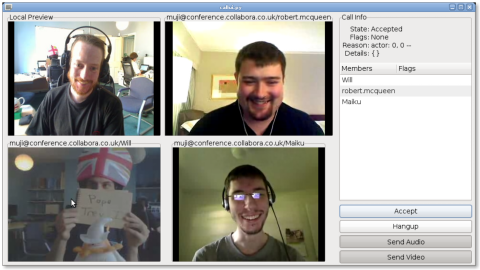
Since some time the good people at NlNet have been sponsoring Collabora to add multi-party audio/video calling to XMPP and do an implementation of this in Telepathy. This project is otherwise known as Muji. This work has resulted in: To proof it actually works, a nice screenshot of the demo client in a 4-way call: 4-way Muji Call The screenshot is featuring myself in Collabora's UK office (top-left), Robert McQueen from a hotelroom in Taipei (top-right), Will Thompson and Magical trevor also from the Collabora UK office (bottom-left) and Mike Ruprecht from somewhere in Missouri. So we were quite spread out over our little planet. Both audio and video quality was quite good, even though the network in robs hotel was a bit flaky from time to time. In case you want to try it out have a look at the MujiDemoClient page.

6 June 2010

Lucas Nussbaum: #debian-ubuntu on OFTC

If you are a Debian developer and need realtime interaction with an Ubuntu developer about the state of your packages in Ubuntu (or vice-versa), #debian-ubuntu on irc.oftc.net might be useful. I had forgotten about that channel, but it resurfaced during the discussions about improving communication between both projects.

Lucas Nussbaum: EtherPad: web-based collaborative editor

I recently (during a UDS lightning talk) discovered EtherPad. It s a collaborative editor (like gobby), but uses a browser instead of a standalone application. It s free software (Google open sourced it after buying the company that was developing it), and there s a free online instance at ietherpad.com. Setting up a new pad is as simple as going to http://ietherpad.com/foo and clicking Create Pad. It s written in Java, and not packaged in Debian (yet).

5 June 2010

Jos? Parrella: Ditching PCI cards in Asterisk for fun and profit

In the past, I ve used PCI cards providing telephony TDM for my Asterisk-based projects. I ve only worked with Digium s FXO/FXS and T1/E1 cards, both in PCI and PCI-x formats, until a client asked for a gateway solution with FXO, FXS and E1, where using the PCI cards in a 1U IPBX was simply out of the question. Using Ethernet gateways has always been a problem in those cases, since entry-to-medium level solutions lack the processing power for massive call handling, and signalling is poor, making the architecture unfit for reporting purposes and specialized apps such as call centers. But hey, that s my experience with gateways. Therefore, I looked into Xorcom s Astribank. They pack FXO, FXS and PRI/BRI ports inside a convenient 19 1U case, which can connect to an Asterisk-based IPBX server via USB and gets recognized as an integral DAHDI device in modern setups. So I ordered a composite 8xFXO, 8xFXS and 1xE1 PRI from Astribank, labelled XR0072. Getting the equipment from Arizona to Florida was easy, and since I worked with DHL, getting it to Guayaquil in Ecuador was a breeze (next-day delivery) but passing customs is, as always in Latin America, a time-consuming operation. After paying 12.5% taxes and then some for DHL operations, and 15 days waiting, I got the equipment in Quito. To my surprise, the Astribank was extremely light and small, slightly near 3 Kg in 1U form factor and under 1/4 depth in the rack. While it had a rack-mounting kit, which I used, it could also rest securely over my IPBX without rack screws. My Astribank uses a single USB cable to connect to the master PBX it could also be connected to a secondary PBX and provide a fault tolerant setup. It also depends on a DC supply, which they included. Since I was using a modern Debian, with a modern Asterisk with already-compiled modern DAHDI (formerly called Zapata/Zaptel) drivers, I just connected the equipment via USB to the IPBX, issued an invoke-rc.d dahdi restart and we were good to go. Note: you do need the fxload package in Debian for firmware loading to the Astribank. And for good to go I mean you can check the registered spans with dahdi_registration and, as soon as you connect the E1 cable that comes from the CPE to the CPE port (which in my XR0072 is the first on the lower row for PRI) you get an OK status with dahdi_tool. Also note that I use an E1/CPE port, which is the default for the Astribank, otherwise I d have to set the XPP_PRI_SETUP variable as indicated on the User Manual. DAHDI insists on configuring a crc4 parameter for the detected spans, which I needed to remove and restart DAHDI so the equipment could sync with the CPE (that is, the box that the telco provided, with the balun and the crossover RJ45 cable) and avoid some nasty noise issues on the line, that also occur with Digium s Wildcard for PRI.

usb:008/005          xpp_usb+     e4e4:1162 Astribank-modular FPGA-firmware
 LABEL=[usb:...]       CONNECTOR=@usb-0000:00:1d.7-1
	XBUS-00/XPD-00: E1       (31)  Span 1  DAHDI-SYNC
	XBUS-00/XPD-10: FXS      (8)   Span 2
	XBUS-00/XPD-20: FXO      (8)   Span 3
Using DAHDI s dahdi_genconf command writes an /etc/asterisk/dahdi-channels.conf file with the group and channel configuration as detected by DAHDI. It should be included by the chan_dahdi.conf file, which, in my case, is not necessary since I only wanted to enable one DAHDI group (DAHDI/g0) with my 31 E1 channels (1-15,17-31)
group=0
context=from-pstn
channel => 1-15,17-31
That means that when I want to use the FXO/FXS ports, it d probably be easier to include the dahdi-channels.conf (FXS ports, for example, belong to a different context, from-internal) so I don t have to type more than my laziness permits. I also found that, in my setup, some Asterisk parameters were superfluous, such as the switchtype (either national or euroisdn work, and the former is the default) or the echo-cancelling stuff, so I assume Astribank s doing a great job in negotiating that with the CPE. Do take note, however, that in my case the CPE needed to be cold-restarted so I could get an Up status in Asterisk (pri show spans) and that my only non-default, channel related configuration in chan_dahdi.conf is signalling=pri_cpe. So far, so good. I m really happy with the Astribank and I can fully understand how useful it is in terms of price (quite competitive in comparison with traditional cards, specially when bought from resellers -like me-), size/weight and functionality/ease of setup and administration. Kudos!

Russell Coker: Bugs in Google Chrome

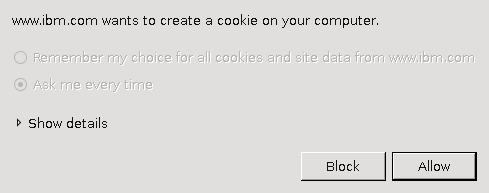
I m currently running google-chrome-beta version 5.0.375.55-r47796 on Debian/Unstable. It s the fastest web browser I ve used in recent times it s the first time that I ve run a browser that feels faster than my recollection of running IBM WebExplorer for OS/2 on a 486-66 system! It has a good feature set, and it s the only browser I ve used that in a typical configuration will make proper use of the screen space by not having a permanent status bar at the bottom of the sceen and by having tabs in the title-bar. But it s not perfect, here is a list of some bugs: Chrome Titlebar when maximisedChrome Titlebar when not maximisedRight of Chrome Titlebar when not maximised Above are three partial screen captures of Chrome, the first is when maximised and the second is when the window isn t maximised. Notice the extra vertical space above the tab in the title bar in the second picture. The third picture shows the right side of the titlebar and you can see a space below the three buttons where you can drag the window around no matter how many tabs you open that space below the three buttons is reserved. If the Chrome developers had removed the extra vertical space in the titlebar and reserved slightly more horizontal space then you would be able to drag the window around. While an anonymous commentator made a good point that the extra vertical space can be used to drag the window around when the maximum number of tabs are open, it seems that there are other ways of achieving that goal without wasting ~18 vertical pixels. Doing so would be a lot less ugly than what they did with finding text in the page. When I visit a web site that uses cookies from an Incognito Window (which means that cookies etc aren t stored) there is no option to say allow all cookies . This is really annoying when you get to a web site such as the IBM one which stores 5 cookies when you first load the page and then at least one new cookie write for every page you visit. Given that cookie data will be discarded as soon as the window is closed it seems like a good idea to have an option to allow all cookies for Incognito Windows even if all cookies aren t allowed for regular windows. Blocking all cookies would be OK too, anything but having to click on Block or Allow multiple times for each page load. The J and K keys don t work in a view of Venus version 0~bzr95-2+lenny1 (the latest version in Debian/Lenny). I once had a situation where I entered a . at the end of a domain name (which is quite legal there is always an implied dot) and Chrome then wouldn t take note of my request to accept all cookies from the domain. I haven t been able to reproduce that bug, but I have noticed that it stores the settings for whether cookies should be stored separately for domains that end in . , so www.cnn.com. is different from www.cnn.com . Iceweasel seems to just quietly strip the trailing dot. Of course this is better than Konqueror which won t even load a URL with a dot at the end. Chrome can be relied on to restore all windows rapidly after a crash, unlike Iceweasel which restores them at it s normal load speed (slow) and Konqueror which doesn t tend to restore windows. This is good as it does seem to crash regularly. In a response to my post about Chrome and SE Linux [1] Ben Hutchings pointed out that the --no-sandbox option to chrome disables the creation of a PID namespace and therefore makes debugging a lot easier, if I get a lot of spare time I ll try and track down some of the Chrome SEGVs. The JavaScript compiler is either buggy or it s not buggy in situations where people expect IE bugs. When using the Dell Australia web site I can t always order all options. When trying to order a Dell R300 1RU server with hot-plug disks in a hardware RAID array it seems impossible to get all the necessary jumpers which is a precondition to completing the order fortunately I only wanted to blog about how cheap Dell servers are so I don t actually need to complete an order. Dell s web site is also difficult in Iceweasel on occasion, so it s obviously more demanding than most sites. It might be a good test site for people who work on browsers as it s both demanding and important. When I select a URL to be opened in a new window (or when JavaScript does this) then the new tab is opened with about:blank listed as the URL. If the URL is for a PDF file (or something else that is to be downloaded) then the URL entry field is never updated to give the real URL. I believe that this is wrong, either the new tab shouldn t be opened or it should have the correct URL on display there is no benefit with a tab open to show nothing but about:blank in the URL entry field. Also if a URL takes some time to load then it may keep about:blank in the URL entry field for some time. This means that if you use the middle mouse button to rapidly open a few new tabs you won t be able to see what is to be loaded in each one. Sometimes I have several tabs loading and I m happy to close some unimportant ones if they are slow but some are worth waiting for. Overall that s not too bad. I can use Dell s site in Iceweasel, so the only critical bug is the cookies issue in Incognito Windows which makes the Incognito feature almost unusable for some sites.
4 June 2010

Marco T&uacute;lio Gontijo e Silva: Summer of Code weekly report #4

My project. I m publishing my report earlier this week, because there was a lot to talk about. This week I started to make changes in the code going in the direction of what I want to do. I haven t started a final implementation, but I m studying about how what I want to do will affect the rest of the Garbage Collection (GC). I noticed the code in rts/sm/Sweep.c was simple and similar to what I m planning to do, so I started changing how it works. Sweep in the Glasgow Haskell Compiler (GHC) is done by a bitmap, which contains a bit for each word in a memory block, and is set to 1 when there s an object starting in the mapped area and 0 otherwise. When there s a block with no objects starting at it, that is, all bits of the bitmap are set to 0, the block is freed.
        if (resid == 0)
         
            freed++;
            gen->n_old_blocks--;
            if (prev == NULL)  
                gen->old_blocks = next;
              else  
                prev->link = next;
             
            freeGroup(bd);
         
The bits are analyzed in a group of BITS_IN(W_), where BITS_IN(W_) is the number of bits in a word.
        for (i = 0; i < BLOCK_SIZE_W / BITS_IN(W_); i++)
         
            if (bd->u.bitmap[i] != 0) resid++;
         
If more than of the groups are completely set to 0, the block is considered fragmented.
            if (resid < (BLOCK_SIZE_W * 3) / (BITS_IN(W_) * 4))  
                fragd++;
                bd->flags  = BF_FRAGMENTED;
             
Immix, the GC algorithm I plan to implement in GHC, divides the blocks of memory in lines. My initial plan was to identify free lines. I decided to consider a the size of a line fixed in BITS_IN(W_) words, because it will map to a word in the bitmap, and the code was already analyzing in groups of BITS_IN(W_) words. This was very easy with the current code.
            if (bd->u.bitmap[i] != 0) resid++;
            else printf("DEBUG: line_found(%p)\n", bd->start + BITS_IN(W_) * i);
This worked, and showed some free lines. I m sure there are other ways of logging in GHC, but printf was the simplest way I could thought of. I measured the occurrence of free lines using the bernouilli program from the NoFib benchmark suite, calling it with 500 +RTS -w, to make it uses sweep. In 782 calls to GarbageCollect(), sweep() was called 171 times, for 41704 blocks to be swept and found 230461 free lines. This gives us about 5.5 free lines per block, from the 8 lines in each block (on 64 bits systems). The problem is that the bitmap is marked only in the start of the objects allocated, so even in a line that all bits are marked with 0 we can t assume that it s completely free, because there may be an object that starts in the previous line that is using the space of the line. Checking only for the previous line doesn t work either, because a big object can span several lines. What we can do here is a variation of conservative marking, as proposed in the Immix paper, checking only the previous line and working only with objects smaller than a line. To make sure I was working only with objects smaller than a line, I had to mark the blocks that contains medium objects and avoid them when seeking free lines. The block flags are defined in includes/rts/storage/Block.h, so I included another flag in this file, BF_MEDIUM.
/* Block contains objects evacuated during this GC */
#define BF_EVACUATED 1
/* Block is a large object */
#define BF_LARGE     2
/* Block is pinned */
#define BF_PINNED    4
/* Block is to be marked, not copied */
#define BF_MARKED    8
/* Block is free, and on the free list  (TODO: is this used?) */
#define BF_FREE      16
/* Block is executable */
#define BF_EXEC	     32
/* Block contains only a small amount of live data */
#define BF_FRAGMENTED 64
/* we know about this block (for finding leaks) */
#define BF_KNOWN     128
/* Block contains objects larger than a line */
#define BF_MEDIUM    256
The GHC GC is generational, there is, objects are allocated in a generation and, after a time, the ones that are still being used are moved the next generation. This idea assumes the death probability of younger objects is higher, so few objects are moved to the next generation. Sweep and Immix work only in the last generation so, to mark blocks with medium objects we have to check the size of the objects that are moved to the next generation. This is done in the copy_tag function of rts/sm/Evac.c. I inserted a code that checks for the object size and marks the block when it s bigger than BITS_IN(W_).
STATIC_INLINE GNUC_ATTR_HOT void
copy_tag(StgClosure **p, const StgInfoTable *info,
         StgClosure *src, nat size, generation *gen, StgWord tag)
 
    StgPtr to, from;
    nat i;
    to = alloc_for_copy(size,gen);
    if(size > 8)  
        Bdescr(to)->flags  = BF_MEDIUM;
     
So I updated the code in rts/sm/Sweep.c to only inspect for free lines in blocks without BF_MEDIUM mark.
            if (bd->u.bitmap[i] != 0) resid++;
            else if(!(bd->flags & BF_MEDIUM))  
                printf("DEBUG: line_found(%p)\n", bd->start + BITS_IN(W_) * i);
             
This also worked. Now, in the 32012 blocks there were 189015 free lines, found in the same number of GCs, making about 5.9 free lines per block. We considered only blocks with small objects, but we didn t ignore the first line of each group of free lines. This can be achieved by checking if the previous line was also free.
            if (bd->u.bitmap[i] != 0) resid++;
            else if(!(bd->flags & BF_MEDIUM) && i > 0 && bd->u.bitmap[i] == 0)  
                printf("DEBUG: line_found(%p)\n", bd->start + BITS_IN(W_) * i);
             
Now, from the 32239 blocks, 165547 free lines were found, giving 5.1 free lines per block. But there are more things to improve. If the whole block is free, we want to free it, instead of marking it s lines as free. So it s better to mark the lines after we know that the blocks are not completely free. So I left the code that checks the bitmap as it was, and included a line check only for blocks that are not completely free. At this point, I also associated the fragmentation test with blocks with medium objects, because in blocks of small objects we plan to allocate in free lines, so fragmentation is not a (big) issue.
            if (resid < (BLOCK_SIZE_W * 3) / (BITS_IN(W_) * 4) &&
                (bd->flags & BF_MEDIUM))  
                fragd++;
                printf("DEBUG: BF_FRAGMENTED\n");
                bd->flags  = BF_FRAGMENTED;
             
            else if(!(bd->flags & BF_MEDIUM))  
                for(i = 1; i < BLOCK_SIZE_W / BITS_IN(W_); i++)
                 
                    if(bd->u.bitmap[i] == 0 && bd->u.bitmap[i - 1] == 0)  
                        printf("DEBUG: line_found(%p)\n", bd->start + BITS_IN(W_) * i);


The total ammount of blocks increased dramatically: the blocks that become fragmented and were not called again in sweep made a huge difference. From the 345143 blocks, 1633268 free lines were found, or about 4.7 free lines per block. 9434 blocks were free, so, from the remaining blocks, we have about 4.9 free lines per block. Something we ll need then is a way to access these lines latter. The simplest way I thought to achieve it is constructing a list of lines, in each the first word of each free line is a pointer to the next free line, and the first word of the last free line is 0. It s useful to keep reporting the lines to stdout, so that we can then follow the list and check if we went to the same lines.
                    if(bd->u.bitmap[i] == 0 && bd->u.bitmap[i - 1] == 0)  
                        StgPtr start = bd->start + BITS_IN(W_) * i;
                        printf("DEBUG: line_found(%p)\n", start);
                        if(line_first == NULL)  
                            line_first = start;
                         
                        if(line_last != NULL)  
                            *line_last = (StgWord) start;
                         
                        line_last = start;
                        *line_last = 0;


    for(line_last = line_first; line_last; line_last = (StgPtr) *line_last)  
        fprintf(stderr, "DEBUG: line_found(%p)\n", line_last);
     
I printed the inclusion of the lines on the list to stdout, and the walking on the list in stderr, so that it d be easy to diff. There was no difference between the lists. There re another improvements that can be made, like using a list of groups of free lines, but I think it ll be better to think about this after studying how the allocation in the free lines will be done. That s where I m going to now.
There are some minor things I learned, and thought they worth blogging. The current GHC uses three strategies for collecting the last generation: copying, mark-compact and mark-sweep. Copying is the default until the memory reaches 30% of the maximum heap size; after that, mark-compact is used. Sweep can be chosen by a Real Time System (RTS) flag, -w. To use mark-compact always, the flag is -c. I ve been submitting small patches to the cvs-ghc mailling list, mostly about outdated comments. Most of them were accepted, except for one which contained a lot of commentary, and that indeed was not completely correct. I corrected it and resend to the list, but the message is waiting for approval because the message header matched a filter rule. I believe this is because I replied the message generated from darcs. There s a very useful ghc option, specially for testing the compiler, because in this case you need to rebuild the source, even when there re no changes in it. It s -fforce-recomp, and it makes only sense when used with --make.

Colin Watson: Hacking on grub2

Various people observed in a long thread on debian-devel that the grub2 package was in a bit of a mess in terms of its release-critical bug count, and Jordi and Stefano both got in touch with me directly to gently point out that I probably ought to be doing something about it as one of the co-maintainers. Actually, I don't think grub2 was in quite as bad a state as its 18 RC bugs suggested. Of course every boot loader failure is critical to the person affected by it, not to mention that GRUB 2 offers more complex functionality than any other boot loader (e.g. LVM and RAID), and so it tends to accumulate RC bugs at rather a high rate. That said, we'd been neglecting its bug list for some time; Robert and Felix have both been taking some time off, Jordi mostly only cared about PowerPC and can't do that any more due to hardware failure, and I hadn't been able to pick up the slack. Most of my projects at work for the next while involve GRUB in one way or another, so I decided it was a perfectly reasonable use of work time to do something about this; I was going to need fully up-to-date snapshots anyway, and practically all the Debian grub2 bugs affect Ubuntu too. Thus, with the exception of some other little things like releasing the first Maverick alpha, I've spent pretty much the last week and a half solidly trying to get the grub2 package back into shape, with four uploads so far. The RC issues that remain are: If we can fix that lot, or even just the ones that are reasonably well-understood, I think we'll be in reasonable shape. I'd also like to make grub-mkconfig a bit more robust in the event that the root filesystem isn't one that GRUB understands (#561855, #562672), and I'd quite like to write some more documentation. On the upside, progress has been good. We have multiple terminal support thanks to a new upstream snapshot (#506707), update-grub runs much faster (#508834, #574088), we have DM-RAID support with a following wind (#579919), the new scheme with symlinks under /dev/mapper/ works (#550704), we have basic support for btrfs / as long as you have something GRUB understands properly on /boot (#540786), we have full info documentation covering all the user-adjustable settings in /etc/default/grub, and a host of other smaller fixes. I'm hoping we can keep this up. If you'd like to help, contact me, especially if there's something particular that isn't being handled that you think you could work on. GRUB 2 is actually quite a pleasant codebase to work on once you get used to its layout; it's certainly much easier to fix bugs in than GRUB Legacy ever was, as far as I'm concerned. Thanks to tools like grub-probe and grub-fstest, it's very often possible to fix problems without needing to reboot for anything other than a final sanity check (although KVM certainly helps), and you can often debug very substantial bits of the boot loader - the bits that actually go wrong - using standard tools such as strace and gdb. Upstream is helpful and I've been able to get many of the problems above fixed directly there. If you have a sound knowledge of C and a decent level of understanding of the environment a boot loader needs to operate in - or for that matter specialist knowledge of interesting device types - then you should be able to find something to do.

Lucas Nussbaum: XMPP Video calls with Nokia N900

So, this morning, I did my first video call over XMPP between two N900. However, so far, I failed to do an XMPP video call from an N900 to something else. When I try to call pidgin on my laptop, pidgin simply crashes, but of course that s not a serious bug if people can DOS your pidgin instance since, according to the Debian bug:
Assuming your XMPP settings require that users must authenticate with you before being able to send you messages, only your authenticated users would be able to freeze your client, assuming they knew you were actually affected by this bug.
The upstream pidgin bug hasn t seen a lot of activity lately. :-(

3 June 2010

Steve Kemp: Everybody loves me, and I intend to keep it that way.

Would it be wrong to make a new blog entry just to test the blogging platform? If so I'm wrong. To pretend that isn't the case I'll briefly document some recent events:

Coding
I've been making changes to the blogging software, chronicle, to support RSS feeds on comments, and to allow outgoing Pings on new entries. I've also been flirting with an OpenID-backed image upload and sharing site, provisionally named picshare. Why? Partly for fun, partly because I like comments, and partly to flirt with RESTful design and API construction.
Photography
I've provisionally agreed to be the photographer for a special event at a local hair-dressers. This will either be fun, or all end badly. No money, but free food and the chance to experiment more. So all good.
There. Almost like a real entry, right? ObSubject: Cruel Intentions

Matthew Garrett: Poulsbo still makes me sad

Meego 1.0 was released last month. Predictably enough, it lacks any form of support for the GMA500 graphics chipset[1], which is reasonably in line with Intel's placing of US15W as an embedded product for MID-type devices rather than having anything to do with netbooks. Of course, the market pretty much ignored that detail, so we're left with the release of a netbook experience that's incompatible with a large number of netbooks.

There's been hints that there might be some sort of new driver coming, though, and Intel's rapidly heading towards the release of Moorestown - their new MID platform that's x86 but not a PC, that replaces Poulsbo (unless you want to run Windows) and which has the same SGX 3D core[2] as Poulsbo. Moorestown support has started landing in the mainline Linux kernel and Intel are talking about devices shipping with it this year, so we ought to see the graphics driver soon, right?

Well, kind of. Digging through the Meego kernel git tree reveals an updated driver with Moorestown support. The blob is too big for gitorious to display, so I've put up a copy here. Things to note - this isn't a new driver (it's clearly derived from the PSB one), it includes a huge blob of Imagination's platform-independent code, the front end of the driver is still pretty much the i915 driver with a small number of PSB-specfic changes and despite the cheerily optimistic "Patch-mainline: 2.6.35?" at the top it stands pretty much no chance whatsoever of going mainline given that it's even more offensive than the previous version and that one got rejected out of hand.

So it's not clear what Intel's doing here. If this is the driver that Intel are developing for upstream then there's been a pretty serious breakdown in communication over what their driver has to look like. If it's not, Intel have another and presumably better driver somewhere that they're developing entirely behind closed doors despite having shipped millions of units of hardware that people would dearly love to be able to run mainline kernels on. Neither case looks especially good, so the continuing perception would seem to be that only a subset of the company understands the Linux development model - we'll see how this ends up interacting with Meego as a whole.

(Huh. I was about to hit "Post" on this, and then found that another and entirely different driver was submitted for the Meego kernel last week. A copy of it's here. "IVI" in this context appears to stand for "In-vehicle interface" and is aimed at those contexts rather than generic ones. It includes much the same Imagination glue code as the Moorestown driver, appears to be derived from a driver that has support for other Intel chipsets, was written to be at least partially OS-independent given that it abstracts things like PCI and stands even less chance of going upstream than the other driver - as acknowledged by "Patch-mainline: Never". Hilariously, if we include IEGD, that makes three different drivers for the same hardware from the same company, each having no chance to go upstream. Thintel.)

[1] Weirdly, it includes the kernel DRM for Matrox cards. No X driver though.
[2] It's clocked higher, though

Stefano Zacchiroli: mancoosi-contest

submit your own dependency-resolution issue, a-la popcon [ repost from the original, with updates ] During the question time of my FOSDEM 2010 talk about cross-distro dependency resolution several interested people, mostly sysadms, asked how they could contribute upgrade scenarios to the Mancoosi project. The underlying idea is simple: we are working on improving dependency resolution techniques, algorithms, and tools; to that end we need a corpus of upgrade scenarios where shortcomings of state of the art tools can be observed. We already have quite some of such scenarios (partly provided by members of the project, partly generated in vitro, etc.), but we could use more. So, I'm hereby happy to announce the public availability of the mancoosi-contest package, for Debian-based distributions. mancoosi-contest essentially offers a wrapper, called dudf-save, that you can prepend to usual invocations of package managers such as apt-get and aptitude. What it does is to capture all package meta-data concerning your request, as well as the request itself and the package manager output. All these data are first compacted using snapshot.d.o hashes, then collected into a DUDF document, and finally (optionally) uploaded to a DUDF collector service. All in all it is very similar to the popularity-contest architecture, but instead of collecting installed packages it collects specific upgrade attempts. The similarity of course extends to privacy concerns, which we do take very seriously (censoring IP addresses and offering all the software we write and run available under FOSS licenses for scrutiny). Obviously, participation is completely optional and the mancoosi-contest package is currently being provided only unofficially by the Mancoosi project (even though it is signed by my key, in case you want a trust path from the Debian keyring). All that said, if, one day, you feel like having stumbled upon a challenging upgrade scenario, please consider contributing it using mancoosi-contest. We, for once, would be grateful :-) , and you will be helping in improving the state of the art in dependency solving. Some of the most interesting upgrade scenarios already received are currently being used as material for the ongoing MISC 2010 competition, which we plan to repeat in the future. Technically, dudf-save is still quite hackish and while apt-get support is OK-ish, aptitude support is sub-optimal. In particular it will work properly only for "completely batch" aptitude sessions (or, better, it will not catch any intermediate solving attempt that aptitude goes through when interactively asking questions to the user). You can get mancoosi-contest from mancoosi.debian.net, i.e. simply doing apt-get install mancoosi-contest after having added the following APT repository to your sources.list:

    deb http://mancoosi.debian.net/debian/ unstable/

For the time being, bug reports can be sent to me.

2 June 2010

Axel Beckert: xen-tools back in Debian Unstable

After xen-tools had been removed from Debian Unstable by the upstream developer last December due to no more upstream development, I took over upstream development as well as Debian package maintainership in January. Since then a lot happened: But despite all the things which were to fix after Steve discontinued the xen-tools developement, Steve Kemp did a great job to bring xen-tools so far initially. I m really happy that this software exists and that s the reason why I won t let it die so fast. :-) xen-tools 4.2 beta 1 released Last weekend I released xen-tools 4.2 beta 1 which I also uploaded to Debian Unstable. And thanks to the active ftp-master team, xen-tools went through the NEW queue in less than 12 hours and is now available again in Debian Unstable. 4.2 beta 1 still has some known bugs, the worst ones are in xen-delete-image. But no fear, it doesn t delete more than wanted, just not enough or things which don t exist anyway. :-) There are also some smaller issues to fix for a final 4.2 release. We may also create an PPA for Ubuntu Lucid in the future to work around the lack of xen-tools in Ubuntu Lucid. What about Fedora/RedHat/CentOS support? Since rinse is out of date with regards to current Fedora releases, rpmstrap seems to be out of date for even longer (it has been removed from Debian before the Lenny release) and febootstrap neither seems to work out of the box nor seems to support bootstrapping to mount points (because it wants to delete them first and fails), bootstrapping Fedora ist currently not supported. The copy installation method should work though. rinse still is able to bootstrap CentOS 4 and 5, but the installation seems incomplete. We ll try to work around these issues for the final 4.2 release. We haven t looked at mach and mock so far, but according to Lucas, both are out of date, too. Sure, implementing Lucas howto in form of a script would be a possible way, but we think it would just create yet another not so well supported clone of rinse, rpmstrap, mach, mock or febootstrap. Because of that, Dmitry works on support for the installation of Xen DomUs via kickstart. Fate of xen-shell? Xen-shell has also been removed from Debian Unstable last December because Steve stopped its developement, too. But in comparison to xen-tools itself, we didn t resurrect xen-shell since none of us currently has use for it. So if you are currently using xen-shell and intend to continue to do so, you should hurry up if you want to see it in Debian Squeeze. We can also help you, but we surely can t and won t do it alone nor will we take the majority of the necessary workload.

1 June 2010

Steve Langasek: bzr-git case study

Robert Collins did a very nice writeup not so long ago of creating a Debian package with bzr-builddeb, but he starts from the assumption that upstream also uses bzr. As we all know, there are many projects that have their upstream sources in a VCS, but don't use bzr. Can we still get reasonable results from bzr-builddeb, including the ability to merge new upstream releases direct from the VCS, if, say, upstream is using git? Yes, we can! Of course, if you're happy with using git as the VCS for your Debian packaging already, there's probably no compelling reason for you to switch to bzr. But if you prefer to use bzr and have been frustrated at having to choose between being able to use the VCS client of your choice for your packages and being able to use your VCS client to access upstream revision history, read on. Thanks to the fine work of Jelmer Vernooij and friends, bzr-git has been usable for a while if you just want to track the default git branch. But what if you care about tracking multiple upstream branches? Enter bzr git-import, which we'll use to set up a bzr repo from scratch for our cifs-utils package, with a full import of all the branches of upstream's git tree. First we do some work to set up a shared bzr repository. As long as we're going to the effort of mirroring all the git branches, we probably want to publish them for other people to use, so we make sure our bzr repository is reasonably configured for sharing data between branches:
$ bzr init-repo --no-trees cifs-utils.server
Shared repository (format: 2a)
Location:
  shared repository: cifs-utils.server
$ cd cifs-utils.server
Then we use bzr git-import, provided by the bzr-git plugin, to do a full import of the upstream branches into a cleverly named subdirectory:
$ bzr git-import git://git.samba.org/cifs-utils.git upstream
[/                   ] Counting objects: 181, done.
Now we create our own local 'trunk' for the package, by branching from the upstream tag matching the release version we're going to package.
$ bzr branch -r tag:cifs-utils-4.0rc1 upstream/HEAD trunk
Branched 42 revision(s).
Do a little more prep work for future branches...
$ mkdir branches
And that's it. Now we have a bzr repo locally that we can push out to our hosting server of choice (N.B.: we could do this all directly on the server, but alioth doesn't currently have bzr-git installed):
$ rsync -az . alioth.debian.org:/bzr/pkg-samba/cifs-utils/
$
Now that we have a bzr repository, it's time to get ourselves a working directory and do some packaging. We're probably going to work with multiple branches locally as well, so we create another shared repository for local use, and get a copy of the trunk branch we created before.
$ bzr init-repo cifs-utils
Shared repository with trees (format: 2a)
Location:
  shared repository: cifs-utils
$ cd cifs-utils
$ bzr co bzr+ssh://bzr.debian.org/bzr/pkg-samba/cifs-utils/trunk
Now we grab the upstream tarball, and whip up some quick packaging with (what else?) debhelper 7:
$ wget ftp://ftp.samba.org/pub/samba/cifs-utils/cifs-utils-4.0rc1.tar.bz2
$ ln -s cifs-utils-4.0rc1.tar.bz2 cifs-utils_4.0~rc1.orig.tar.bz2
$ cd trunk
$ mkdir -p debian/source
$ echo '3.0 (quilt)' > debian/source/format
$ echo 7 > debian/compat
$ cp /usr/share/doc/debhelper/examples/rules.tiny debian/rules
$ dch --package cifs-utils --versio 4.0~rc1-1 --create 'Initial package'
Create debian/control by hand, generate an initial source package, and import it into bzr with bzr-builddeb.
$ debuild -uc -us -S -i
$ rm -r debian
$ bzr import-dsc ../*.dsc
$
Since we want to continue tracking upstream development, we need to periodically sync our bzr import of the git tree.
$ bzr git-import git://git.samba.org/cifs-utils.git bzr+ssh://bzr.debian.org/bzr/pkg-samba/cifs-utils/upstream
$
And when we find a new upstream version in that import that we want to package, bzr-builddeb makes this a snap, too.
$ cd cifs-utils
$ wget ftp://ftp.samba.org/pub/samba/cifs-utils/cifs-utils-$version.tar.bz2
$ cd trunk
$ bzr merge-upstream --v3 --version $version_with_epoch \
    ../cifs-utils-$version.tar.bz2 -r tag:cifs-utils-$version \
    bzr+ssh://bzr.debian.org/bzr/pkg-samba/cifs-utils/upstream/HEAD
No distribution specified, and no changelog, assuming 'debian'
Committing to: /tmp/tmpbzOVMs/upstream/
Committed revision 2.
All changes applied successfully.
The new upstream version has been imported.
You should now review the changes and then commit.
$ bzr diff
<review changes>
$ bzr commit -m "merge upstream $version"
Committing to: bzr+ssh://bzr.debian.org/bzr/pkg-samba/cifs-utils/trunk
modified debian/changelog
Committed revision 50.
$
And that's it! It's exciting to see signs of real interoperability between DVCSes at last. Thanks to everyone who's helped make it possible!

Russell Coker: Can SE Linux Implement Traditional Unix Users and Groups?

I was asked by email whether SE Linux could implement traditional Unix users and groups. The Strictly Literal Answer to that Question The core of the SE Linux access control is the domain-type model where every process has a domain and every object that a process can access (including other processes) has a type. Domains are not strongly differentiated from types. It would be possible to create a SE Linux policy that created a domain for every combination of UID and GID that is valid for a user shell given that such combinations are chosen by the sysadmin who could limit them to some degree. There are about 2^32 possible UIDs and about 2^32 possible GIDs, as every domain is listed in kernel memory we obviously can t have 2^64 domains, but we could have enough to map a typical system that s in use. Of course the possible combinations of supplemental groups probably makes this impossible for even relatively small systems, but we can use a simpler model that doesn t emulate supplemental groups. For files there are more possible combinations because anyone who is a member of a group can create a SETGID directory and let other users create files in it. But in a typical system the number of groups is not much greater than the number of users the maximum number of groups is typically the number of users plus about 60. So if we had 100 users then the number of combinations of UID and GID would be something like 100*(100+60)=16,000 it should be possible to have that many domains in a SE Linux policy (but not desirable). Then all that would be needed is rules specifying that each domain (which is based on a combination of UID and GID) can have certain types of access to certain other types based on them having either the same UID or the same GID. Such a policy would be large, it would waste a lot of kernel memory, it would need to be regenerated whenever a user is added, and it s generally something you don t want to use. No-one has considered implementing such a policy, I merely describe it to illustrate why certain configuration options are not desirable. The rest of this post is about realistic things that you can do with SE Linux policy and how it will be implemented in Debian/Squeeze. My previous post titled Is SE Linux Unixish? addresses this issue at a more conceptual level and also considers MAC vs DAC [1]. The History of mapping Unix Accounts to SE Linux Access Control In the early releases of SE Linux (long before it was included in Fedora) every user who could login to a system needed to have their user-name compiled into the policy. The policy specified which roles the user could access, the roles specified which domains could be accessed, and therefore what the user could do. The identity of files on disk was used for two purposes, one was logging (you could see who created a file) and the other was a permission check for the SE Linux patched version of Vixie cron which would not execute any command on behalf of a user unless the identity on the crontab file in the cron spool matched the identity used to run it this is an analogy of the checks that Vixie cron makes on the Unix UID of the crontab file (some other cron daemons do fewer checks). Having to recompile policy source every time you added a user was annoying. So a later development was to allow arbitrary mappings between Unix account names and SE Linux Identities (which included a default identity) and another later development was to have a utility program semanage to map particular Unix account and group names to SE Linux identities. This was all done years ago. Fedora Core 5 which was released in 2006 had the modular policy which included these features (apart from mapping Unix groups to SE Linux identities which was more recent). Fedora Core 5 also introduced MCS which was comprised of a set of categories that a security context may have. The sysadmin would configure the set of categories that each account would have. A recent development has been a concept named UBAC (User Based Access Control) which basically means that a process running directly on behalf of a regular user (IE with a SE Linux identity that s not system_u) can only access files that have an identity of system_u or which have the same identity as the process. This means that you can only access your own files or system files not files of other users which may have inappropriate Unix permissions. So for example if a user with a SE Linux identity of john gives their home directory the Unix permission mode of 0777 then a user with a SE Linux identity of jane can t access their files. Of course this means that if you have a group of people working together on a project then they probably need to all have the same Identity and in practice you would probably end up with everyone having the same identity. I ve given up on the idea of using UBAC in Debian. The Current Plan for Users and SE Linux Access Control in Debian My plan is to have things work in Squeeze in much the same way as in Lenny. You have a SE Linux identity assigned to a login session and everything related to it (including cron jobs) based on the Unix account name or possibly the Unix group name (if there are login entries for both the user-name and the group-name then the user-name entry has precedence). The mapping between Unix accounts and SE Linux identities is configured by the sysadmin and SE Linux identities don t matter much for the Targeted configuration (which is what most people use). The identity determines which roles may be used and also has a limit on the MCS categories. The MCS categories are also specified in the login configuration which has to be a sub-set of the categories used by the identity record. So for example the following is the output of a couple of commands run on a Debian/Unstable system. They show that the test Unix account is assigned a SE Linux identity of staff_u and an MCS range of s0-s0:c1 (this means it creates files by default at level s0 and can also write to other files at that level, but can also have read/write access to files at the level s0:c1 ). The staff_u identity (as shown in the output of semanage user -l can be used with all categories in the set s0:c0.c1023 where the dot means the set of categories from c0 to c1023 inclusive) but in the case of the test user only one category will be used. The test group however (as expressed with %test ) is given the identity user_u and is not permitted to use any categories.
# semanage login -l
Login Name    SELinux User    MLS/MCS Range           
%test         user_u          s0                     
__default__   unconfined_u    s0-s0:c0.c1023         
root          unconfined_u    s0-s0:c0.c1023         
system_u      system_u        s0-s0:c0.c1023         
test          staff_u         s0-s0:c1               
# semanage user -l
             Labeling   MLS/       MLS/                         
SELinux User Prefix     MCS Level  MCS Range         SELinux Roles
root         sysadm     s0         s0-s0:c0.c1023    staff_r sysadm_r system_r
staff_u      staff      s0         s0-s0:c0.c1023    staff_r sysadm_r
sysadm_u     sysadm     s0         s0-s0:c0.c1023    sysadm_r
system_u     user       s0         s0-s0:c0.c1023    system_r
unconfined_u unconfined s0         s0-s0:c0.c1023    system_r unconfined_r
user_u       user       s0         s0                user_r
I hope to get the policy written to support multiple user roles in time for the release of Squeeze. If I don t make it then I will put such a policy on my own web site and try to get it included in an update. The policy currently basically works for a Targeted configuration where the users are not confined (apart from MCS). How MMCS Basically Works The vast majority of SE Linux users run with the MCS policy rather than the MLS policy. For Debian I have written a modified version of MCS that I call MMCS. MMCS is mandatory (you can t relabel files to escape it) and it prevents write-down. If a process has the range s0-s0:c1,c3 then it has full access to files labelled as s0, s0:c1, s0:c3, and s0:c1,c3 and any files it creates will be labeled as s0. If a process has the range s0:c1-s0:c1,c3 then it has read-only access to files labelled as s0 and s0:c3 and read-write access to files labelled as s0:c1 and s0:c1,c3. This means that any secret data it accesses that was labelled with category c1 can t be leaked down to a file that is not labelled with that category. Now MCS currently has no network access controls, so there s nothing stopping a user from using scp or other network utilities to transfer files. But that s the way with most usable systems. I don t think that this is necessarily a problem, the almost total lack of network access controls in a traditional Unix model doesn t seem to concern most people. Now to REALLY Answer that Question SE Linux is a Mandatory Access Control (MAC) system, this makes it inherently different to a Discretionary Access Control (DAC) system such as traditional Unix access controls. Unix permissions are based on each file having a UID, a GID, and a set of permissions and each process having a UID, a GID, and a set of supplementary GIDs. If a user runs a setuid or setgid program then the process will have extra privileges. It also has a lot of stuff that most people aren t aware of such as real vs effective UIDs, the tag bit, setgid directories, and lots more including some quite arbitrary things like making ports <1024 special. SE Linux is based on every object (process, file, socket, etc) having a single security label which includes an identity, a role, a type, and a sensitivity label (MCS categories or an MLS range). There is no support for an object to have more than one label. The SE Linux equivalent to setuid/setgid files is a label for a file which triggers a domain transition when it s executed. This differs from setuid files in that the domain transition is complete (the old privileges can t be restored) and the transition is generally not to a strict super-set of the access (usually a different sub-set of possible access and sometimes to lesser access). These differences are quite fundamental. So really SE Linux can t implement traditional Unix access control. What SE Linux is designed to do is to provide a second layer of defense and to also provide access controls that have different aims than that of Unix permissions such as being mandatory and implementing features such as MLS.

Julien Danjou: Thoughts and rambling on the X protocol

Two years ago, while working on awesome, I joined the Freedesktop initiative to work on XCB. I had to learn the arcane of the X11 protocol and all the mysterious and old world that goes with it. Now that I've swum all this months in this mud, I just feel like I need to share my thoughts about what become a mess over the decades. When I was unborn

the Toto band were releasing their song "Africa" and some smart guys were working on a windowing system: the X Window System (this is its full name) which therefore has a (too) long history. The latest version of its protocol, the 11th one, has been designed in the 80's. You can learn more about the history in the Wikipedia article about X. In 2010, we still listen disco music and we still use various protocols designed in the 80's and even before X. Music have evolved, protocols have evolved, and so did X11. The problem is that X11 did not evolve that well. The guys at MIT-and-some other-places-with-very-smart-people-in-it created X version 1 in 1984, and updated it until X version 11 (the one we're still using) in 1987. Eleven version in 3 years, that was following the "release early, release often" model. But I don't know why, it just stopped to happen for the last 23 years1. I don't know what changes have been made in the first 11 major versions of the X protocol, but I'm rather sure we should have deserve a couple of major version updates this last 2 decades. In my humble opinion, X11 was not designed to live 23 years. But hey, I'm not blaming anyone here: I was 4 years old and playing Lego when they released this latest version of the X protocol, so there is little chance I'd have done something better.

1. That's not totally true: they added (and then deprecated) many extensions. We won't fix. We'll work-around.

That is probably one of the guideline of the X protocol for the last years. And don't misread me: I'm not bashing anyone thereafter. Since the X11 protocol was aging, the X guys started to add extensions. They added tons of them over the years. This, in application of one of the early principles of X:

It is as important to decide what a system is not as to decide what it is. Do not serve all the world's needs; rather, make the system extensible so that additional needs can be met in an upwardly compatible fashion.

All of them with no exception were added because, bad luck, the X11 protocol did not anticipated the things that happened in the last 23 years, like video, OpenGL, multiple monitors, or the pleasure to draw oval windows. Some of this extensions are still in use, while some of them have been dropped. While this is not a bad thing to extends the protocol, it seems like a bad thing to try to fix the protocol with for example the XFixes extension, even with all the good intentions Keith Packard might have in his greatness. Actually it's even worst than you think

The X11 protocol (without extensions) defines about 120 types of requests: create a window, move a window, etc. Nowadays, there's at least 25 % of them which are useless: usage of server-side font, or the drawing of squares and polygon, are unused by any modern application or toolkit. All of this is superseded by requests from extensions, like the XRender one. The handling of multiple monitors displays has totally been screwed up. X11 has been designed to work in Zaphod mode (independent monitors). But Xinerama, and nowadays XRandR have replaced it up: recent X servers (released after ~2007) does not support Zaphod mode anymore, even if it's a core piece of the X11 protocol. Worst: on many requests, there's limitation or design flaws, like described in this document: Why X Is Not Our Ideal Window System by DEC researchers. We'll add more broken standard on top of that

Following its early principle, X does not define policies but only mechanisms, which seems like a good thing, Consequently, people started writing specifications to determine a number of stuff and dogmas: ICCCM. That was 22 years ago in 1988. It's useless to add that many things in this specification are now obsolete, useless, or that it misses many modern stuff. I was not the only one to think that. The people from what will be the major desktop environments, KDE and GNOME, saw that too in the 90's while I was learning to count. So they wrote EWMH, another standard that comes on top of ICCCM and extends it with nifty features like maximization, full screen mode, etc. The problem is that this standard has also been written by narrow-minded people who at that time, were working on GNOME or KDE (and maybe others). This desktop environments were having and still have some strong concepts of how should work a desktop: "it should have work-spaces", "a window is only on one workspace", "we only see a workspace at a time", "you do not have multiple screens", etc. Dude, we don't care: we have toolkits!

This vision of how the desktop should work have now been written in marble in all applications and libraries implementing EWMH, like GTK+ or Qt. Nowadays, everybody forgot about all of this standards. Toolkits have implemented this, circumvented the X11 protocol limitation and flaws, and nobody wants to look back. Like all standards, obviously some people implemented them badly. This had some side effects, like OpenOffice acting like a pager. We don't look back? Worst, we forgot where we came from!

With all these layers of bad designed standards, the desktop continued to evolve for more than a decade. They continued to add more standard, the more recent ones being based on D-Bus like the Desktop Notification Specification or the latest Status Notifier Specification developed by KDE. The Status Notifier is a new implementation of the good old system tray based on XEmbed, using D-Bus instead of the X11 mechanisms, and adding the possibility to show the system tray with something else than icons. This specification draft saw an important issue and design flaw raised by Wolfgang Draxinger in this thread on the XDG mailing-list. What Wolfgang points out, is that X is network-oriented, and D-Bus is not. Therefore, making the Status Notifier specification to use D-Bus to pass system tray messages around is a bad idea, since running a X application from host A on host B will draw the system tray on the wrong host! Apparently, reading the thread, this does not fear some of the KDE people:

of course this is a bizarre corner case not worth much thought. at least that's what you'll think until you actually run into it yourself (be it because you are testing something or because you are setting up some weird kiosk environment).

What Oswald describes as a corner case is an actual common use case for many of us. Of course, YMMV. From my point of view, this is a step back in the wrong direction. But we can conclude that the network part of X is now worthless, to at least KDE. I used to believe in XCB

When I joined Freedesktop, it was to work on XCB, the X C Binding. XCB is a nice, clean, 21st century technology based API to play with the X11 protocol. Its code is auto generated based on XML file describing the protocol. In comparison, Xlib is 80's obfuscated code with almost no comments and hard-coded things. Only a few people can understand some of its corner like its i18n or XKB implementations. And all its code is synchronous. For people not knowing it yet, X is a network protocol where you send request (like a GET in HTTP) and then get a response. Xlib forces the application to wait for the reply to its request, so the application is blocked until the X server sends the reply to the request. XCB on the other hand does not block and allows the application to send a batch of requests, do some other stuff in the mean time, and then gets the replies. It's like your Web browser would send one request at a time to a Web server, and would wait until you downloaded all the images one by one to display the page. In cases where X and all its clients are on the same host, the latency is small and not really visible, therefore the gain for XCB to be asynchronous is small. On slow network however, the gain can be huge, as proved in the rewrite of xlsclients with XCB by Peter Harris. One of the long standing goal of the XCB folks is to kick-out Xlib, to increase speed and hides latency in X11 applications. That requires to port many libraries, because almost none of them (Cairo being an exception) supports XCB. From where I stand, I don't really see if the work is worth it now. The desktop world is trusted by GNOME and KDE, meaning GTK+ and Qt. It seems none of this toolkits are interested to work on XCB, neither on the X protocol. They probably put hard effort in bypassing X limitation and flaws, and they now sit on top of crap of workarounds and broken-by-design-standard implementation. It seems to me they don't want to go back in the layers and improves things. They're too high to go back down and they don't see what the gain would be. Enlightenment with its EFL was the first toolkit to have an XCB back-end with the work of Vincent Torri. Unfortunately, the back-end is not maintained and nobody cares about it. Last time I tried it, it did not compile at all. X12 ?

There's a page called X12 on the Freedesktop wiki, listing all the things that should be fixed some days. Unfortunately, the list continues to grow up an no one talks about working on X12. On the other hand, there's a handset of people trying to work when they will have time on XKB2, the second version of the "let's-try-to-fix-up-the keyboard-part-of-the-protocol-we-wrote-23-years-ago-a-second-time" extension. To me, it does not seem X12 will happen in the next decade neither. Alternative ?

Do we got alternative to X ? There's Wayland, but it's far from being usable. There's DirectFB, but that's not very portable. None seems candidate to replace X some days to me. Anyhow, none of the main toolkits around support this alternative. GTK+ once supported DirectFB, but as far as I know, it is not supported nor works nowadays, as stated by Josselin Mouette. This is why recent versions of the Debian installer have migrated to X for the graphic part, thanks to Cyril Brulebois work. Conclusion

XCB has been around for more than half-a-decade, and very few people showed interested in it. As far as I can see, nobody is interested to use the X protocol and everybody tries to encapsulate it in some higher-level API as soon as possible to stop seeing it. This leads to poorly written application and toolkits, with a lot of ugly hack. All of that also means that starting to write applications and graphical toolkits based on XCB would be a very interesting project, but that would lead to spend too much time learning to circumvent the X protocol flaws, things that have been done in years by predecessors like Qt and GTK+. Major toolkits implementations have almost nothing to win in going back in the dark water of X. I guess most of their folks prefer to work on shiny 3D effects based on your GPS location, rather than redefining better basis for everyone. The manpower available in the X world is very small. Debian lacking of X maintainers is just the summit of that. There is very smart and very competent and skilled guys in the X world, as you can see by simply reading blog posts on Planet Freedesktop for example (me excluded). Unfortunately, there's not enough of them to cover all the things involved in X: input devices, graphics devices, new protocol extension specification and so on. The X server is really late, and it seems most of the developers prefers to work on the server itself than on the protocol behalf. Which is understandable. I'm curious to see where all of that will lead in the upcoming years. I've been walking in the X world hallways for about 3 years now, and I feel desktop alternatives to KDE and GNOME will all die sooner or later. The time were you could choose between a dozen "modern" window managers has passed away. After all, maybe that is simply Darwinism applied to computer software.

31 May 2010

Piotr Galiszewski: Short project update

Hello all.

Last week I was very busy, due to my university duties. On Tuesday I had my first exam in this semester (in Numerical Analysis), which took me more time than I had thought it would be.
From this reason my project is slightly behind schedule, but now I will do my best to catch the plan.

On the other hand, there are also some good news for me. Some time ago, Daniel Burrows migrated aptitude repository from mercurial to GIT. I am git user for nearly year, so I strongly support this move ;) .

Here are some basic thoughts which functionalities good package manager must have (and which approach (from aptitude-gtk, synaptic and adept) I like the most):
All of this will be elaborated in mockups. Am I forgetting something important?

The most important questions is: "What is the most common use case for package manager? Installing packages or upgrading packages?". I am not sure if this two actions require different views, or there should be only new category in install package view.

This is all now. More updates (and mockups) will be available today's midnight (or tomorrow morning). So please stay tuned :)

Next.

Previous.