Search Results: freedom

19 September 2010

Asheesh Laroia: When "free software" got a new name

On January 30, 1998, Wired.com gushed about the ethical underpinnings of the free software movement. The movement was growing:
Netscape's bold move last week [was] to free the source code of its browser is a prime-time endorsement for no-cost, build-it-yourself software.
The free software movement was in its second decade. In the first decade, corporations learned to tolerate it. In the late '90s, a transition was underway. Red Hat was one of the first companies ostensibly founded on free software principles. But as free software grew, some were concerned that its name was holding it back. The article explains with a link to a page within gnu.org:
But "free software" is an ambiguous term - there is a difference in meaning between the cultures of PC-based proprietary systems and the Net-centric UNIX worlds.
Michael Stutz, the author of the piece, surveyed the writing of Eric S. Raymond and interviewed luminaries like Bob Young, Russell Nelson, and Marc Andreessen. The article is about the creation of a new term for the freely-reusable code produced by the free software movement.
As proponents of free software often point out, while this software can be free-of-cost - that is, gratis - the real issue is about freedom, or human liberty. So it is really freed software.
Yes, that's right -- freed software. The emphasis is in the original. Most of us know the names Eric S. Raymond and Russ Nelson as people involved early-on in the Open Source Initiative. I guess January 1998 is before they decided on the "open source" name. Today, the community is divided into people who think it's important to say "free software" and the rest who call it "open source." We'd all agree with the following statement from the article:
"Freed software is a big win for society in general," said Russell Nelson.
And that's today's random page from the history books.

17 September 2010

Jo Shields: Mono mythbusting, September 2010 edition

There are corners of the Internest where foolish people congregate, and invent stories. These foolish stories are then read as gospel by trusting people, and reposted, until the original made-up source is concealed from view. As an attempt to stem this flow of disinformation, here are some commonly held but incorrect beliefs about the Mono framework, and an explanation of the reality of the situation, as far as I understand it. The next Mono version is co-developed with Microsoft There is a grain of truth behind this one, but it s a gross mischaracterisation. Mono 2.8, when it ships, will bundle, for convenience, a number of Free Software libraries, which are released by Microsoft under a license considered Free Software by the Free Software Foundation, the Ms-PL. These are: So, to summarise, there are five Free Software libraries written by Microsoft under the Ms-PL included in Mono 2.8 but only two of those five are new, and none of them were co-developed in any meaningful sense. Mono development is dead There have been reports that Mono development has ended, on the basis that no commits have been made to Novell s Subversion server for a few weeks. However, these reports miss one minor detail Mono has moved to Github.com. There were 35 commits from 9 different people to the main mono.git repository (of dozens of repositories under the main Mono project) in the last 2 days, at time of writing far from dead. Mono lacks features found in Microsoft.NET Mono lacks libraries found in Microsoft.NET, such as the Windows Presentation Framework GUI toolkit. In terms of features, i.e. things implemented at a compiler or runtime level, Mono is typically more advanced. This is helped in no small part by Mono s Free Software development model, allowing experimentation and what if changes to the core runtime which a sluggish corporate behemoth like Microsoft cannot accommodate. To give three real-world examples, Mono allows embedding of its compiler as a service, and provides a REPL shell this is a planned feature for .NET 5.0, but has been available for years in Mono; Mono.Simd provides a number of data structures which will run on any version of Mono or Microsoft.NET, but will use optimized CPU extensions like SSE when run on a sufficiently new version of Mono, on an appropriate architecture as far as I m aware, there is nothing like this available or planned for Microsoft.NET. Mono is able to produce fully compiled, static executables which do not need to JIT anything at runtime this is used for iPhone compilation, for example, where JITters are not permitted. There is no comparable feature in Microsoft.NET. Clearly, Microsoft.NET can only be thought of as more featureful if one defines features in terms of does it have lots of libraries? in terms of functionality, Mono is ahead. Mono can sneak onto your system without your knowledge If you don t have the mono-runtime package installed, you can t run Mono apps. It is possible to install some Mono apps alongside the awful-yet-popular mononono equivs package, since the popular equivs script fails to place Conflicts on the correct packages (F-Spot will be blocked, Tomboy will not). No package in Debian or Ubuntu embeds its own copy of the Mono runtime, and we have no plans to make any changes to packaging which would allow execution of any C# application without mono-runtime installed. If one is using a different OS, then things may be different e.g. The Sims 3 for Mac & PC uses embedded Mono, which you wouldn t know about without looking. Canonical are pursuing a pro-Mono agenda, and are responsible for it being pushed in Debian Mono development has been happening in Debian for longer than Canonical has existed the first upload was made in April 2002. Ubuntu is made primarily from software already available in Debian deemed of sufficient quality, and when F-Spot and Tomboy became parts of the default Ubuntu desktop system in 2006, both pieces of software were already available in Debian and deemed of sufficient quality. Nobody working on Mono in Debian is paid by Canonical actually, that s not entirely true, three packages related to accessibility are officially maintained by someone who was hired by Canonical after doing the initial packaging work when he worked for Novell. But the Mono runtime itself, Canonical have no influence over its direction in Debian. As for a pro-Mono agenda , they ve always taken an extremely pragmatic approach to language choice, never showing any real preference for one language or another when it comes to app selection. They don t exhibit any overt anti-Mono policies, which is not the same thing. The names of people contributing to Mono in Debian are not secret check the pkg-mono team page on Alioth. The System.Windows.Forms namespace is protected by Microsoft patents The truth is, nobody knows for sure if SWF, or any other part of Mono, or any other framework such as Vala or Python, is covered by Microsoft patents. The way the US patent system is contrived, it is actively dangerous to check whether something contains any patents when you write it, as you are liable for triple damages should it later emerge that there WAS a patent, even if your searching missed the fact. You cannot patent an API or namespace only a specific implementation of a software concept, in those countries where software patents are permitted. There has never been any evidence shown that Mono s implementation of SWF, or indeed any part of Mono, infringes any Microsoft-held patents, because if that were the case, then the code would be rewritten to avoid the issue much like the approach taken by Linux kernel developers when a patent becomes apparent. The belief within the Mono community is that the core parts of Mono as defined in ECMA334/335 are safe (they are covered by the Microsoft Community Promise patent grant); any of the Ms-PL libraries mentioned above is definitely safe (Ms-PL includes an explicit patent grant); and the rest of the package is likely safe too (on the basis that it is a named component of the Open Innovation Network s list of protected software and on the basis that there s unlikely to be anything patentable in one of many implementations of basic ideas like database connectors). Nobody knows for sure, because that s how the system works. But, again, nobody knows for sure that Microsoft patents don t apply to other frameworks such as Python there is simply a belief and an assumption that they do not. MonoDevelop contributors removed GPL code from MonoDevelop, in an attack on the GPL This is somewhat disingenuous, given MonoDevelop is LGPL. The MonoDevelop team excised the remaining GPL code (and there wasn t much of it) in order to grant greater Freedom to developers. Previously, the entire MonoDevelop IDE was a GPL combination, meaning any add-ins for the IDE also needed to be GPL, regardless of developer choice. Now, any developer can write an add-in for MonoDevelop, using the license of their choice, whether another Free license like the Mozilla Public License, or a proprietary closed-source add-in. They are still welcome to produce GPL add-ins, if they want to, as well. Mono won t run random Microsoft.NET apps anyway, so isn t really cross-platform Actually, this one is often true. When developers write apps for Windows primarily, they rarely take the time to think is this the correct way to do it? and will often plough on with an assumption about the Windows way of doing things. It might be simple things like filesystem assumptions (assuming a case-insensitive filesystem, or assuming a backslash is used to separate directories, not a forward slash). It might be more involved, such as using P/Invokes into Windows-specific C libraries, when a more cross-platform alternative is possible. So, often, random applications for Microsoft.NET won t run on Mono. The reverse is also true F-Spot or GNOME Do are fairly heavily tied to Linux (or to UNIX-like OSes with X11, at any rate), through the libraries they invoke being fairly platform-specific. You can write platform-specific Java, with one quick piece of JNI, too. It should be noted, however, that Mono makes the chance of .NET applications being ported to Linux (and/or Mac) much more likely, since even in the worst case scenario, a company only needs to fix a portion of their source to make it cross-platform. The Mono team have a tool called MoMA, which will scan an application and its libraries, and give you detailed reports on the app s portability. This info is used at both ends by app vendors who want to become more portable, and by the Mono team who want to fill in the most frequently encountered blanks. And, it should be stressed, writing cross-platform apps is entirely possible if one desires it e.g. the IRC client Smuxi is pure cross-platform C#, and the executables compiled on Mono on Linux will run fine on Microsoft.NET on Windows. Portability in this direction is important too consider how many people have been introduced to Free Software thanks to availability of Free apps on Windows like OpenOffice.org, Firefox, Pidgin or GIMP. You can download Tomboy for Windows, and work is ongoing on fixing Banshee portability issues (which are mostly caused by gStreamer). Mono on Android is a terrible idea which will be super slow There are two efforts to enable developers to write Android applications with Mono a paid proprietary product from Novell called MonoDroid, and an untitled porting effort by big-name Android hacker Koushik Dutta. I have no insight into MonoDroid since it hasn t been released yet, but Koush did some benchmarks of his work which exhibited some remarkable figures compared to Dalvik (and even compared to Sun Java for ARM). Those numbers haven t been updated to reflect the Froyo Dalvik JITter, but Mono on Android is still very exciting from a performance perspective. Mono isn t really Free Software The source code is all available under Free Software licenses. So, um, yes it is. We don t need Mono because we have $LANG By the same logic, we don t need $LANG because we have Mono. By all means, use the language of your choice other developers will use the language of their choice too. If you want to use Vala or Python or Java, then by all means, go ahead. It doesn t mean there s no room for more languages, better suited to other usage patterns. Haskell is great for some types of development, so is Fortran, and so is C#. You might not need Mono because of $LANG, but there are others in the world with different needs. Mono apps are all slow, and crash your computer, and stuff No userland app can crash your Linux system, unless there s a bug in the kernel, or you have some severe problems with your hardware. If you ve ever observed a crash as a result of running a Mono app, then it s really coincidence that Mono is tickling whichever part of your system is busted. As for slow startup time may well be slower than for apps written in C or Vala. There s a delay due to the JITter needing to compile all the libraries used by the application (we may AOT the most common libraries in a future Mono package version, at upstream s recommendation). Once an app is running, it should be fast compared to a Python app, and memory-light compared to a Java app. The new garbage collector in Mono 2.8 should also offer significant improvements to performance, especially under heavy workloads. Ubuntu s default GTK+ themes require Mono This is my favourite recent nonsense to emerge from the Internest. There are reports mostly restricted to IRC and blog comments, that (paraphrasing here) removing Mono removes the Ubuntu themes . Here s the reality: in Ubuntu 10.04, a new visual style was implemented throughout the distro. As part of this, small icons (e.g. notification area icons) were set to be black-and-white by default, and colourised when attention is needed (e.g. the power-off icon turns red when a reboot is needed, the messaging indicator turns green when there s a new message). All of these new monochrome icons are in a package named ubuntu-mono . Removing the ubuntu-mono icon package will also remove the new Ubuntu GTK+ themes, in the light-themes package. So there s your explanation: the themes have a dependence on some monochrome icons, not on the Mono framework.

15 September 2010

Martin Meredith: Freedom in Creativity

One of the things that I love about our Local LUG is the people. At our LUG, we have our resident geek artist, Antonio Roberts (aka hellocatfood) who, on the odd occasion, gets harassed into doing a talk for us. His talks are always fairly awesome. His previous talk about FLOSS + Art is the video with the highest views on our video archive, and tomorrow night, Thursday 16th September, at 19:30pm BST, he ll be delivering his next talk about his experience in the FLOSS community as an artist to us. Freedom in Creativity In his own words:-
This talk extends greatly on what was said and goes into issues of copyright and what experiences I ve had as an artist in the open source world
His previous talk was a bit of an eye-opener to me, as a pure geek with barely a trace of artistry in me, and it s always good to see the FLOSS world from the eyes of someone who doesn t exactly fit the stereotype of what you d normally expect to see. The video will be available after the event, at some point, but for those who re interested in gaining an insight into artistry and FLOSS, we ll be broadcasting the talk live over the interwebs. <script type="text/javascript"> var flattr_wp_ver = '0.9.11'; var flattr_uid = '34168'; var flattr_url = 'http://www.sourceguru.net/freedom-creativity/'; var flattr_btn = 'compact'; var flattr_hide = 0; var flattr_lng = 'en_GB'; var flattr_cat = 'text'; var flattr_tle = 'Freedom in Creativity'; var flattr_dsc = 'One of the things that I love about our Local LUG is the people. At our LUG, we have our resident geek artist, Antonio Roberts (aka hellocatfood) who, on the odd occasion, gets harassed into doing a talk for us. His talks are always fairly awesome. His previous talk about FLOSS + Art is the video with the highest views on our video archive, and tomorrow night, Thursday 16th September, at 19:30pm BST, he\'ll be delivering his next talk about his experience in the FLOSS community as an artist to us. In his own words:- This talk extends greatly on what was said and goes into issues of copyright and what experiences I ve had as an artist in the open source world His previous talk was a bit of an eye-opener to me, as a pure geek with barely a trace of artistry in me, and it\'s always good to see the FLOSS world from the eyes of someone who doesn\'t exactly fit the stereotype of what you\'d normally expect to see. The video will be available after the event, at some point, but for those who\'re interest'; var flattr_tag = 'art,artist,floss,lug,presentation,sblug birmingham lug,streaming,talk,video'; </script> <script src="http://api.flattr.com/button/load.js?v=0.2" type="text/javascript"></script>

9 September 2010

Rapha&#235;l Hertzog: Can Debian achieve world domination without being on Facebook?

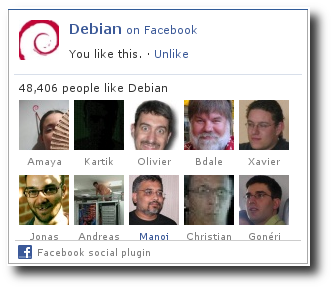
Debian Developers who like Debian on FacebookFacebook is not very popular among free software hackers. When I announced my Facebook page on identi.ca (see here) I got a few replies suggesting it was odd for me to use Facebook. Indeed there are many good reasons why Facebook should be avoided: it is a centralized and proprietary service that is not very privacy-friendly. But the truth is that lots of people are using it (even Debian developers, can you recognize them on the picture?) and some are using their Facebook news feed as their main source of news. You might wonder how many persons that represents, so here are the figures: the Debian Facebook page has 48,361 fans and the Ubuntu one has 247,932 fans. That s right, an announce put on the Debian facebook page would reach more persons than the most popular announce list that Debian is currently running (debian-announce@lists.debian.org has about 29,000 subscribers). Unfortunately that Debian Facebook page is empty and I don t even know who the administrator is. The Ubuntu page on the contrary is properly configured to relay news from The Fridge and Jono Bacon is posting some custom updates from time to time. Debian contributors regularly mention world domination as the ultimate goal of the universal operating system (I even feature this in my blog header banner! :-) ). But working towards world domination means in my opinion that we should communicate our ideals of freedom to as many people as possible, even if they are using a service that we don t want to promote. The Debian social contract acknowledges that some users have to use non-free software and we provide the non-free section for them. In the same spirit, I believe we must have a presence on Facebook. That does not mean that we endorse Facebook, and we should surely promote Joindiaspora once it s usable. But in the mean time we should reach out to Facebook users and allow them to follow us with the platform of their choice. That s the choice I recently made when I decided to setup a public facebook page featuring my free software work, my blog and my book. So if you are a Facebook user, click here to visit my page and click on Like if you want to follow this blog in your Facebook news feed. I also share interesting Debian or Ubuntu related articles that I discover while reading my RSS subscriptions. Below are the usual facebook widgets for the 3 pages quoted in this article (they might not show up if you read this article through an RSS feed):
<iframe allowtransparency="true" frameborder="0" scrolling="no" src="http://www.facebook.com/plugins/likebox.php?id=103161013077063&amp;width=292&amp;connections=0&amp;stream=false&amp;header=false&amp;height=62" style="border:none; overflow:hidden; width:292px; height:62px;"></iframe>
<iframe allowtransparency="true" frameborder="0" scrolling="no" src="http://www.facebook.com/plugins/likebox.php?id=9801962186&amp;width=292&amp;connections=0&amp;stream=false&amp;header=false&amp;height=62" style="border:none; overflow:hidden; width:292px; height:62px;"></iframe>
<iframe allowtransparency="true" frameborder="0" scrolling="no" src="http://www.facebook.com/plugins/likebox.php?id=6723083591&amp;width=292&amp;connections=0&amp;stream=false&amp;header=false&amp;height=62" style="border:none; overflow:hidden; width:292px; height:62px;"></iframe> Flattr this Share/Bookmark 14 comments Support my work

Lars Wirzenius: My Plans for Debian

I am a Debian developer again, and here's what I plan to do at first: I don't expect to do a lot of packaging work. I'll package, or help package, stuff that I develop, but I'll not be specifically be looking for stuff to package.

6 September 2010

Joey Hess: freedombox for a solar powered house

I'm swinging on the front porch shade, with happy wifi bars lit up on my laptop. A good network makes for a happy home, isn't that how the saying goes? (Maybe not yet.) Typically that's easy to achieve -- here it wasn't. The house is solar powered, the only connection to the outside is a phone line. So I needed a computer that would work in that environment, using minimal (12 volt) power, and getting the most out of the limited bandwidth while providing those happy wifi bars. At DebConf we learned that the name for these little home servers we have been building for years is "FreeDomBox". All right then, here's my latest FreedomBox build.
A typical inexplicable tangle of computer bits.
Since the solar house is in the sticks, the result is a server I call "stick".

5 September 2010

Benjamin Mako Hill: Free Software Needs Free Tools

I finally finished an article I've had in one form or another for years about on the use of proprietary tools in the creation of free software. From BitKeeper to SourceForge to Google Code to GitHub, non-free tools and services have played an important role in free software development over the past decade and, I argue, continue to create a number of important, if sometimes subtle, problems for our community. The article was published in the Spring 2010 FSF Bulletin which was mailed to all FSF associate members. I've also posted the article on my website and in PDF form as well.

27 August 2010

Russell Coker: Links August 2010

Urban Honking has an insightful article about the Arduino and suggests that it is one of the most important factors for the development of the computer industry in the near future [1]. It compares the Arduino to the Altair. Wired has an interesting article about a company that provides a satellite kit and a launch into low Earth orbit for $8000 [2]. Arduino in space? Linux Journal has an interesting article by David Rowe about the Mesh Potato which is a Wifi mesh router that also runs VOIP [3]. One particularly interesting aspect of this article is the explanation of the way they designed and tested it. Susan Shaw gave an informative TED talk about the toxic effects of the attempts to clean up the oil spill in the Gulf of Mexico [4]. It seems that trying to disperse the oil just makes it worse, and the chemical companies are refusing to disclose the chemicals that are being used. The New York Times has an interesting article by David Leonhardt about the value of pre-school teachers [5]. Some research on the difference that good teachers can make in economic terms suggests that the make an economic difference to the children to the value of $320,000 per annum (IE a class of 16 children who were taught for a year would on average each receive a benefit of $20,000 over their lifetime). Also there are social benefits which aren t counted by that study. While I can t imagine pre-school teachers getting paid $320,000 any time soon, it does seem obvious that good teachers deserve significantly better pay. Of course one problem is how to determine which teachers are good, better test results are not a reliable indication. Paul Krugman describes America as being on the unlit, unpaved road to nowhere due to the policies of saving money by cutting funding for schools, street-lights, and roads [6]. The Chive has an amusing post about how to quit a bad job [7]. It would be good if someone really did this, I m sure that there are enough creative people who don t like their job. Hell Pizza in New Zealand published a zombie themed choose your own adventure on Youtube [8]. Unfortunately the options to choose the next segment don t work on HTML5 with Chromium so if you don t have flash you miss out. AskThePilot.com has an informative essay about airline security written by a commercial pilot [9]. The anecdote about the pilot not being allowed to take the type of knife that is issued to first and business class passengers is rather amusing. FredOnEverything.net has an interesting analysis of Wikileaks and why the Pentagon and Fox News hate it [10]. Fred is a very skillful writer, while he s not the first person to say some of these things he may have said it best. The Wikipedia page on Borosilicate glass (which is best known under the trademark Pyrex) is really interesting [11]. Borsilicate glass was formerly known as Duran and it s main characteristic that makes it suitable for lab use is resistance to Thermal Shock, but it s also harder and has a higher melting point. Apparently you can get Pyrex drinking glasses, I want some! Eben Moglen gave an interesting talk Freedom in the Cloud about the development of free servers to manage personal data and replace Facebook etc (among many other things) [12]. The Debian Wiki has an articla about designing such a system [13]. The APNIC published an interesting paper on IPv4 background radiation [14]. Apparently some /24 s receive so much random traffic (from broken applications and viruses) that they can t be delegated. IPv6 will solve this problem by making it infeasible to scan all IP addresses. Also it s interesting to note the excessive amounts of traffic to 1.0.168.192 which is from applications too broken to correctly send data to 192.168.0.1 which have been installed by sysadmins who are too incompetent to watch what is being sent out of their network.

19 August 2010

Russell Coker: It s Election Time Again

Linux People and Voting Chris Samuel (a member of LUV who s known for his work on high performance computers and the vacation program) has described why he s voting for the Greens [1]. His main reasons are the Greens strong support of human rights and for science-based policy. Paul Dwerryhouse (a member of the Australian Linux community who s currently travelling around the world and who has made contributions to a range of Linux projects including SE Linux) has described his thoughts about the Filter Conroy campaign [2]. He gives a list of some of the high profile awful candidates who could possibly win a seat and therefore deserve a lower position in the preferences than Conroy. SAGE-AU and Voting for the Internet There has been some discussion by members of the System Administrators Guild of Australia (SAGE-AU) [3] about issues related to the election. As you would expect there was no consensus on which party was best. But there was a general agreement that the Greens are the only significant party to strongly support the NBN (National Broadband Network fiber to the home in cities and fast wireless in rural areas) and to also strongly oppose censoring the Internet. SAGE-AU has an official position opposing Internet filtering, and while the organisation hasn t taken a position on the NBN it seems that the majority of members are in favor of it (I am in a small minority that doesn t like the NBN). So it seems that political desires of the SAGE-AU members (and probably most people who care about the Internet in Australia) are best represented by the Greens. Note that SAGE-AU has no official policy on this, the above paragraph is based on discussions I ve had on mailing lists and in private mail with a number of SAGE-AU members. Also note that not all the SAGE-AU members who agree that the Greens advocate their positions on Internet issues plan to vote for them. The Green support for the NBN is based on the importance of the Internet to all aspects of modern life, the social justice benefit of providing decent net access for everyone (particularly people in rural areas) is very important to the Greens. I still oppose the NBN and believe that it would be better to just provide better ADSL in all suburbs, better net access (through whichever technology works best) in rural areas, and fiber to the central business areas. But the NBN isn t really that important to me, human rights and a science based policy are much more important and are the reasons why I ve been supporting and voting for the Greens. No Wasted Votes One thing to note is that the Australian electoral system is designed to avoid wasted votes. There are two ways of considering a vote to be wasted in Australia, one is if you live in an electorate where both the upper and lower house elections have an almost certain result such that no expected swing can change the outcome I doubt that this is possible for any region in Australia given the way the upper house elections work, although a large portion of the lower house seats have a result that is almost certain. The other way of having a wasted vote is to vote for someone who doesn t actually represent you. Lots of people mindlessly vote for a party that seems to represent them, either they identify with unions and vote Labor every time, they regard themselves as conservative and vote Liberal every time, or they live in a rural area and vote National every time. The Labor and Liberal parties don t differ much in policies and members in safe seats typically don t do anything for the people who elected them. If you generally support the policies of one of the major parties then it can be a good tactic to give your first preference to a minor party. For example if you tend towards Labor then vote Greens first and preference Labor over Liberal. The result will be that your vote will count towards Labor in the lower house and it sends a message to Labor and prevents them from being complacent. Before Australian elections there is always some propaganda going around about wasted votes, this is usually part of a deliberate campaign to try and prevent people from voting for smaller parties. Because the news has many mentions of wasted votes in US elections (which are watched closely in Australia) it seems that some Australians don t realise that there are significant and fundamental differences between the political systems in Australia and the US. Volunteering Last time I checked the Greens were still accepting volunteers to hand out how to vote cards, so if you want to do more for the Greens than just vote for them then this is one way to do it. If you want an uncensored Internet with freedom of speech and a lot of investment in infrastructure (as well as good support for all human rights) then you really want to help the Greens win more seats at the election on Saturday.

16 August 2010

Stefano Zacchiroli: happy birthday debian

Dear Debian, today you turn 17 ... ... happy birthday! I've already argued how you're in very good health now that you're close to the major age and how unique and important you are for the whole ecosystem of free software. So, no, I won't insist on that here. Still, today sounds like a good day to say thank you, Debian for being here promoting software freedom and showing to the world that all this can be done do-ocratically, democratically, relying on volunteer work and donations. If you too think Debian deserves being thanked for what it is giving to the world, just say thank you, Debian . My first (meta) thank you messages go to Marga, Maxy, Valessio, Raphael, Ana, and Rhonda for ideating and spreading the 1st Debian Appreciation Day ever. Update: fix 404 Penta b0rkage in the slides link

13 August 2010

Joey Hess: DebConf10 report: Eben Moglen

Long before I took the train up to New York for DebConf10, I was sure that Eben Moglen's talk, the followup to his earlier, excellent "Freedom in the Cloud", would be a highlight of the conference. Even though it was scheduled for an ugly 9 am slot the morning after that other certain highlight, the wine and cheese party. I was not disappointed. The amazing DebConf video team has already put up the video of "How We Can Be the Silver Lining of the Cloud". Embedded below for those with html5. If you watch one video from DebConf, this should be it. <video controls="controls" src="http://meetings-archive.debian.net/pub/debian-meetings/2010/debconf10/high/1252_How_We_Can_Be_the_Silver_Lining_of_the_Cloud.ogv"></video> (Note that the audio stops cutting in and out after he switches mics a few minutes in.) In this talk, Eben goes far past the earlier "Freedom in the Cloud" talk, changing the focus from scraping Facebook, to laying down a concrete, detailed vision of the "FreedomBox", and how it could be a game changer. After the first standing ovation I can remember at a DebConf, given to the first speaker in a suit I can remember at a DebConf, many of us ended up in this huddle in the hall. Which turned into an impromptu BoF in a nearby room, which led to this wiki page, which was followed by seemingly everyone buzzing about it for the rest of the conference, and a second BoF that probably exceeded its room's occupancy limit. Which led to ... ??
I will spend the next several months trying to find other things we can do to help make this suddenly happen. And believe me, to the rest of the world, this will happen very suddenly. We will disrupt a lot of games we would like to have disrupted.
-- Eben Moglen


My thoughts:

5 August 2010

Joey Hess: announcing Branchable

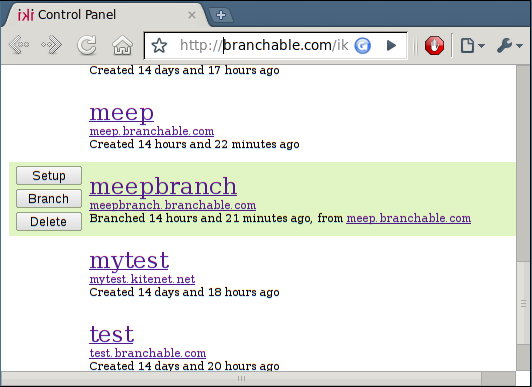
Time to introduce what I've been working on for these past too many months.. Branchable is an Ikiwiki hosting site, making it very easy to create blogs and wikis. The name "Branchable" was chosen because with its git backend, and ikiwiki-hosting frontend, sites hosted there can be easily branched by their owner (or by anyone, if the owner allows). branched site in control panel The ability to take your data and configuration and go home, as well as everything being free software, means Branchable follows the vision of the Franklin Street Statement on Freedom and Network Services, like identi.ca and last.fm. This is very important to me and to my cofounder, Lars Wirzenius. Branchable has a one month free trial, so if you've been meaning to do something with Ikiwiki, I hope you'll sign up. Also, we are offering free hosting for Free Software projects that sign up while Branchable is in beta.

Matt Zimmerman: DebConf 10: Day 3

How We Can Be the Silver Lining of the Cloud (Eben Moglen) Eben s talk was on the same topic as his Internet Society talk in February, which I had downloaded and watched some time ago. He challenges the free software community to develop the software to power the freedom box , a small, efficient and inexpensive personal server. Such a system would put users more in control of their online lives, give them better protection for it under the law, and provide a platform for many new federated services. It sounds like a very interesting project, which I d like to write more about. Statistical Machine Learning Analysis of Debian Mailing Lists (Hanna Wallach) Hanna is bringing together her interests in machine learning and free software by using machine learning techniques to analyze of publicly available data from free software communities. In doing so, she hopes to develop tools for studying the patterns of collaboration, innovation and other behavior in these communities. Her methodology uses statistical topic models, which infer the topic of a document based on the occurrence of topical words, to group Debian mailing list posts by topic. Her example analyzed posts from the debian-project and debian-women mailing lists, inferring a set of topics and categorizing all of the posts according to which topic(s) were represented in them. Using this data, she could plot over time the frequency of discussion of each topic, which revealed interesting patterns. The audience quickly zoned in on practical applications for things like flamewar and troll detection. Debian Derivatives BoF (Matt Zimmerman) I organized this discussion session to share perspectives on Debian derivatives, in particular how we can improve cooperation between derivatives and Debian itself. The room was a bit hard to find, so attendance was relatively small, but this turned out to be a plus. With a smaller group, we were able to get acquainted with each other, and everyone participated. Unsurprisingly, there were many more representatives from Ubuntu than other derivatives, and I was concerned that Ubuntu would dominate the discussion. It did, but I tried to draw out perspectives from other derivatives where possible. On the whole, the tone was positive and constructive. This may be due in part to people self-selecting for the BoF, but I think there is a lot of genuine goodwill between Debian and Ubuntu. Stefano Zacchiroli took notes in Gobby during the session, which I expect he will post somewhere public when he has a chance.

4 August 2010

Neil Williams: FreedomBox

Eben Moglen's talk at DebConf10 has inspired a flood of responses and activity at DebConf10. The original talk overran the allotted time within the venue and then outside the venue for something like an hour, HackLab discussions migrated to the single theme and brought in more and more people over lunch. When the Skype talk was left without a speaker in the afternoon, it morphed into a FreedomBox BOF with maybe 100 delegates planning and contributing to the ideas and another BOF is planned for Friday. A rough outline is appearing on the wiki page for those who want to follow it and the video of the original talk is available, linked from that Wiki page.

What gets people excited about this project is that we already have all the components to do the work, people have been doing most of this stuff at home, on their own, for some time and it needs to be brought together as a series of packages and meta packages and other middleware glue to get it working. (multistrap is part of that glue - it's already being used commercially in a similar role. Debian Pure Blends is another part of the glue. This can be a Debian solution, it doesn't have to be a separate project.)

The software and glue doesn't have to be dependent on a single hardware platform, this is about getting the software right and deploying it on whatever hardware can run it - albeit that the architecture itself is likely to be ARM-something.

It is time for social networking to be freed from the man-in-the-middle - time to withdraw user data from central servers owned by some third-party and share directly with your friends (whichever network they use). Aggregate all data from all your friends, keep all your data in your own plug and access it from wherever you are using whatever devices you have to hand. What's more, your friends - especially the non-techy friends - can just buy a cheap beige box that hides away in the corner of their home and have all the same access too - everyone gets to choose exactly which pieces of data get shared and to whom and can then use their friends plugs to store encrypted backups of their other data. Or maybe the final solution will be slightly different - it's up to people in Debian to make it happen. The tools are in our own hands, if we want this, we just need to do it.

What is needed now is some direction, there are choices to be made about how the glue is designed and how this is turned into a "self-discoverable" distributed network service. Yes, IPv6 will make this easier but only once ordinary users can deploy the device transparently and without configuration, so an interim solution will be needed.

Who's up for the challenge?

2 August 2010

Matt Zimmerman: DebConf 10: Day 2

Today was the first day of DebConf proper, where all of the sessions were aimed at project participants. Bits from the DPL (Stefano Zacchiroli) Stefano delivered an excellent address to the Debian project. As Project Leader, he offered a perspective on how far Debian has come, raised some of the key questions facing Debian today, and challenged the project to move forward and improve in several important ways. He asked the audience: Is Debian better than other distributions? Is Debian still relevant? Why/how? Having asked this question on identi.ca and Twitter recently, he presented a summary. There was a fairly standard list of technical concerns, but also: He pointed out some areas which we would like to see improve, including: All in all, I thought this was an accurate, timely and inspirational message for the project, and the talk is worth watching for any current or prospective contributor to Debian. Debian Policy BoF (Russ Albery) Russ facilitated a discussion about the Debian policy document itself and the process for managing it. He has recently put in a lot of time working on the backlog (down from 160+ to 120), but this is not sustainable for him, and help is needed. There was a wide-ranging discussion of possible improvements including: There was also some discussion in passing of the long-standing confusion (presumably among people new to the project) with regard to how policy is established. In Debian, best practices are first implemented in packages, then documented in policy (not the reverse). Sometimes, improvements are suggested at the policy level, when they need to start elsewhere. I m not very familiar with how the policy manual is maintained at present, but listening to the discussion, it sounded like it might help to extend the process to include the implementation stage. This would allow standards improvements to be tracked all the way through from concept, to implementation, to documentation. The Java Packaging Nightmare (Torsten Werner) Torsten described the current state of Java packaging in Debian and the general problems involved, including licensing issues, build system challenges (e.g. maven) and dependency management. His slides were information-dense, so I didn t take a lot of notes. His presentation inspired a lively discussion about why upstream developers of Java applications and libraries often do not engage with Debian. Suggested reasons included: Collaboration between Ubuntu and Debian (Jorge Castro) Jorge talked about the connections between Debian and Ubuntu, how people in the projects perceive each other, and how to foster good relationships between developers. He talked about past efforts to quantify collaboration between the projects, but the focus is now on building personal relationships. There were many good questions and comments afterward, and I m looking forward to the Debian derivatives BoF session tomorrow to get into more detail. Tonight is the traditional wine and cheese party. When this tradition started, I was one of just a handful of people in a room with some cheese and paper plates, but it s now a large social gathering with contributions of cheese and wine from around the world. I m looking forward to it.

Matt Zimmerman: DebConf 10: Day 1

This week, I am attending DebConf 10 at Columbia University in New York. The first day of DebConf is known as Debian Day. While most of DebConf is for the benefit of people involved in Debian itself, Debian Day is aimed at a wider audience, and invites the public to learn about, and interact with, the Debian project. These are the talks I attended. Debian Day Opening Plenary (Gabriella Coleman, Hans-Christoph Steiner) Hans-Christoph discussed Debian and free software from a big picture perspective: why software freedom matters, challenging the producer/consumer dichotomy, how the Debian ecosystem hangs together, and so on. Steps to adopting F/OSS in government (Andy Oram) Andy discussed FLOSS adoption in governments, drawing on examples from Peru, the city of Munich, the state of Massachusetts. He covered the reasons why this is valuable, the relationship between government transparency and software freedom, and practical advice for successful adoption and deployment. Pedagogical Freedom (panel, Jonah Bossewitch et al) The panelists discussed the use of technology in education, especially free software, some of the parallels between free software and education, and what these communities could learn from each other. This is a promising topic, though the perspectives seemed to be mostly from the education realm. There is much to be learned on both sides. Google Summer of Code 2010 at Debian (Obey Arthur Liu) This talk covered the student projects for this year s Summer of Code. Most of the students were in attendance, and presented their own work. They ranged from more specialized projects like the Hurd installer, to core infrastructure improvements like multi-arch in APT. Beyond Sharing: Open Source Design (Mushon Zer-Aviv) Mushon gave an excellent talk on open design. This is a subject I ve thought quite a bit about, and Asheesh validated many of my conclusions from a different angle. I ve added a new post to my todo list to go into more detail on this subject. Some points from his talk which resonated with me: How Government can Foster Freedom in Technology (Hon. Gale Brewer) Councillor Brewer paid a visit to DebConf to tell us about the work she is doing on the city council to promote better government through technology. Brewer seems to be a strong advocate of open data, saying essentially that all government data should be public. She summarized a bill to mandate that New York City government data be public, shared in raw form using open standards, and kept up to date. It sounded like a very strong move which would encourage third party innovation around the data. She also discussed the need for greater access to computers and Internet connectivity, particularly in educational settings, and a desire to to have all public hearings and meetings shared online. Why is GNU/Linux Like a Player Piano? (Jon Anderson Hall, Esq.) Jon is a very engaging speaker. He drew parallels between the development of player pianos, reproducing pianos, reed organs, pipe organs and free software. He even tied in Hedi Lamarr s work which led to spread spectrum wireless technology. To be quite honest, I did not find that these analogies taught me much about either free software or player pianos, but nonetheless, I couldn t help but take an interest in what he was saying and how he presented it. DebConf Opening Plenary (Gabriella Coleman) Biella and company explained all the ins and outs of the event: where to go, what to do (and not do), and most importantly, whom to thank for all of it. Now in its 11th year, DebConf is an impressively well-run conference. I m looking forward to the rest of the week!

30 July 2010

Biella Coleman: Holy Debconf10 is awesome


nycsubway-heart, originally uploaded by the biella.
So an email went out to Debconf-announce with all this and MORE information but it is worth highlighting the talks/events as they are great. We look forward to having you in New York City! ********************************************************************************************************** exciting schedule highlights
- Have a look at the DebConf10 schedule,
there are a lot of really interesting things planned, both during Debian Day and DebConf
itself. We have a great line-up of speakers, and other events that are
sure to make this DebConf one to remember! A couple notable events that we wanted to highlight: Be sure to come to the DebConf Welcoming Plenary in the evening of Debian Day. This opening plenary will be the first thing that kicks
off DebConf and will be brief, important, and fun. General information
about DebConf, important logistical bits, and prizes(!) will be
had. Also, this gives you a chance to ask some questions before we get
started. Be there at 7:30pm in Davis Auditorium on August 1st! The much anticipated Cheese and Wine party will be happening in the
evening on the 2nd. This will be your chance to see what mixture of
fermented, cultured and alcoholic things your stomach can handle! Also exciting to mention is Eben Moglen who will be speaking on the
3rd during DebConf at 9:30am about Freedom and Privacy in the Cloud
and how we (yes us!) here at DebConf, can be the silver lining. If you
don t already know Eben Moglen
he is Professor of Law at Columbia Law School and founding Director of the Software Freedom Law
Center. Since 1993 he has served pro bono publico as General
Counsel of the Free Software Foundation. Moglen was part of Philip
Zimmermann s defense team when Zimmermann was being investigated over
the export of PGP. As counsel to the FSF, Moglen was charged with
enforcing the GNU General Public License (GPL) and later became
heavily involved with drafting version 3 of the GPL. Also in the evening of the 3rd at 7:30pm we will be treated to not
only a screening of the brilliant and beautiful and (award winning!)
film Sita Sings the Blues in
Pupin 301, but also a Q&A afterwards with the acclaimed animator Nina
Paley! She will describe how the process of making this film caused
her to question the wisdom of copyright monopolies in the arts. The
film is under a Creative Commons ShareAlike license, and her
distribution mechanism is unique as Paley consciously adopted the
methods of the free software movement to distribute the film. The
discussion with the artist after the screening will explain in depth
how and why, and discuss what Paley and QuestionCopyright.org are
doing next to encourage more artists to try the Free route. After the film, at 9:00PM the Columbia University Astronomy
Department will host a guided stargazing event, which includes use
of several different optical telescopes on their roof. There will be
astronomers on hand to answer any questions about the stars,
telescopes, or any other topics of scientific interest. There are many talks that are going to be exciting at Debian Day, even
for Debian Developers! One track will be showcasing general Free
Software themes and issues, and many of these talks will be really
interesting to Debian Developers, so be sure to check out the schedule and come On Debian Day we are excited to have the Honorable Gale Brewer speak at 4pm. She is part of the New York City Council and was the
former Chair of the Committee on Technology in Government, current
Chair on Committee on Governmental Operations and will discuss the
ways that government can foster freedom in technology. Its both
exciting and a privilege to have her speak at DebConf! day trip
This year, the day trip is going to be a blast, a crazy adventure at
the bizarre and fun Coney Island! Explore the historic RussianBrighton Beach! Ride the Cyclone rollercoaster, 82-years old this
year! Swim in the ocean! See the circus sideshow! Eat delicious food
or if unlucky, not so good food. Or do none of the above and just hang
out with your friends outside and have a good time. At the end of the day we are going to go to a unique cultural event:
the Brooklyn Cyclones baseball game where we will have the chance to
watch our beloved DPL humiliate himself as he throws out the first
pitch, in his Debian kilt! Don t like baseball, or sports? Don t worry, neither do we, but the point really isn t the baseball game,
the point is hanging out with all your closest Debian friends and
having a good laugh as Zack tries really hard not to trip, also a good
chance to experience some local culture and to relax after a hard day at the beach. free things in the city
There are an amazing number of free events happening in New York City during the summer! If you are looking for something to do, we ve
compiled a list of various events from a number of different locations
for you to easily view in one spot.

29 July 2010

Gintautas Miliauskas: Python course projects

This spring I read a course on Python in Vilnius University, Department of Mathematics and informatics. The course was not mandatory, which I suspect is one of the reasons why my students were quite a bright and motivated bunch. I began the course with a brief introduction to the Python language and the standard library, then dedicated a few lectures to Django and in the remainder I covered various libraries (GUI toolkits, Pygame) and techniques (testing, debugging, optimization). One of the major tasks of the course (and the deciding factor in the final valuation) was to develop a project using Python. The students were given complete freedom over the topic of the project and the tools used, as long as Python was involved. The quality of the result varied, of course; had I given concrete tasks, the low bar would definitely have been higher. However, I am happy with how things turned out. Probably the best-executed project was 1000 Online, an online multiplayer card game (see rules). It was developed by Vytautas Karpavi ius. Vytautas apparently had prior experience with Python and Django, nevertheless, the quality of the app (and the code behind it) is impressive. Among the other projects, Gegute.lt, a Lithuanian clone of Reddit is still up and running. It's nothing too fancy, but looks quite clean for a university project. Other projects perhaps were not perfectly executed, but were very interesting conceptually. Jonas Keturka developed a bot (BitBucket) for the online strategy game Travian. Marius Damarackas developed a web-based guess-the-song game. He used YouTube for the song material and Last.fm (IIRC) to make you guess among similar songs, so that it would not be too easy. Andrius Chamentauskas developed a Puyo Pop clone (GitHub) with PyGame, complete with multiplayer and an AI. Paulius Budzinskas worked towards his course paper by developing a bacteria movement modelling and visualisation app (GitHub; Lithuanian only). David Abdurachmanov developed a spell-checker bot for WikiAnswers.com, with a really baroque and sophisticated architecture. I believe he has applied to Google Summer of Code with that project; I wonder how that is working out. For reference, you can find links to all student repositories on GitHub/BitBucket in this list. Beware: some of them may be documented/commented in Lithuanian. Another interesting effect of the course was that people started using Python in other related courses, for example in Mathematical Modelling and Numeric Methods. I even heard that the lecturer was impressed and expressed interest in learning Python. Another lecturer, this time a statistician, was interested in teaching and using SAGE at lab practice. Feeling such 'ripples' going through the department sure felt nice. By the way, the university also offers lectures on Ruby, read by Saulius Grigaitis. I took some inspiration from him for the course form and content.

26 July 2010

Matt Zimmerman: Embracing the Web

The web offers a compelling platform for developing modern applications. How can free software benefit more from web technology, and at the same time promote more software freedom on the web? What would the world be like if FLOSS web applications were as plentiful and successful as traditional FLOSS applications are today? Web architecture The web, as a collection of interlinked hypertext documents available on the Internet, has been well established for over a decade. However, the web as an application architecture is only just hitting its stride. With modern tools and frameworks, it s relatively straightforward to build rich applications with browser-oriented frontends and HTTP-accessible backends. This architecture has its limitations, of course: browser compatibility nightmares, limited offline capabilities, network latency, performance challenges, server-side scalability, complicated multimedia story, and so on. Most of these are slowly but surely being addressed or ameliorated as web technology improves. However, for a large class of applications, these limitations are easily outweighed by the advantages: cross-platform support, instantaneous upgrades, global availability, etc. The web enables developers to reach the largest audience of users with the most compelling functionality, and simplifies users lives by giving them immediate access to their digital lives from anywhere. Some web advocates would go so far as to say that if an application can be built for the web, it should be built for the web because it will be more successful. It s no surprise that new web applications are being developed at a staggering rate, and I expect this trend to continue. So what? This trend represents a significant threat, and a corresponding opportunity, to free software. Relatively few web applications are free software, and relatively few free software applications are built for the web. Therefore, the momentum which is leading developers and users to the web is also leading them (further) away from free software. Traditionally, pragmatists have adopted free software applications because they offered immediate gratification: it s much faster and easier to install a free software application than to buy a proprietary one. The SaaS model of web applications offers the same (and better) immediacy, so free software has lost some of its appeal among pragmatists, who instead turn to proprietary web applications. Why install and run a heavyweight client application when you can just click a link? Many web applications perhaps even a majority are built using free software, but are not themselves free. A new generation of developers share an appreciation for free software tools and frameworks, but see little value in sharing their own software. To these developers, free software is something you use, not something you make. Free software cannot afford to ignore the web. Instead, we should embrace the web more completely, more powerfully, and more effectively than proprietary systems do. What would that look like? In my view, a FLOSS client platform which fully embraced the web would: Imagine a world where free web applications are as plentiful and malleable as free native applications are today. Developers would be able to branch, test and submit patches to them. What about Chrome OS? Chrome OS is a step in the right direction, but doesn t yet realize this vision. It s a traditional operating system which is stripped down and focused on running one application (a web browser) very, very well. In some ways, it elevates web applications to first-class status, though its paradigm is still fundamentally that of a web browser. It is not designed for development, but for consuming the web. Developers who want to create and deploy web applications must use a more traditional operating system to do so. It does not put the end user in control. On the contrary, the user is almost entirely dependent on SaaS applications for all of their needs. Although it is constructed using free software, it does not seem to deliver the principles or benefits of software freedom to the web itself. How? Just as free software was bootstrapped on proprietary UNIX, the present-day web is fertile ground for the development of free web applications. The web is based on open standards. There are already excellent web development tools, web application frameworks and server software which are FLOSS. Leading-edge web browsers like Firefox and Chrome/Chromium, where much web innovation is happening today, are already open source. This is a huge head start toward a free web. I think what s missing is a client platform which catalyzes the development and use of FLOSS web applications.

Next.

Previous.