Search Results: "zed"

9 September 2022

Jonathan Dowland: memtest

Since I'm writing about my NAS, a month ago I happened to notice an odd kernel message:
Aug 8 04:04] list_del corruption. prev->next should be ffff90c96e9c2090,
but was ffff90c94e9c2090
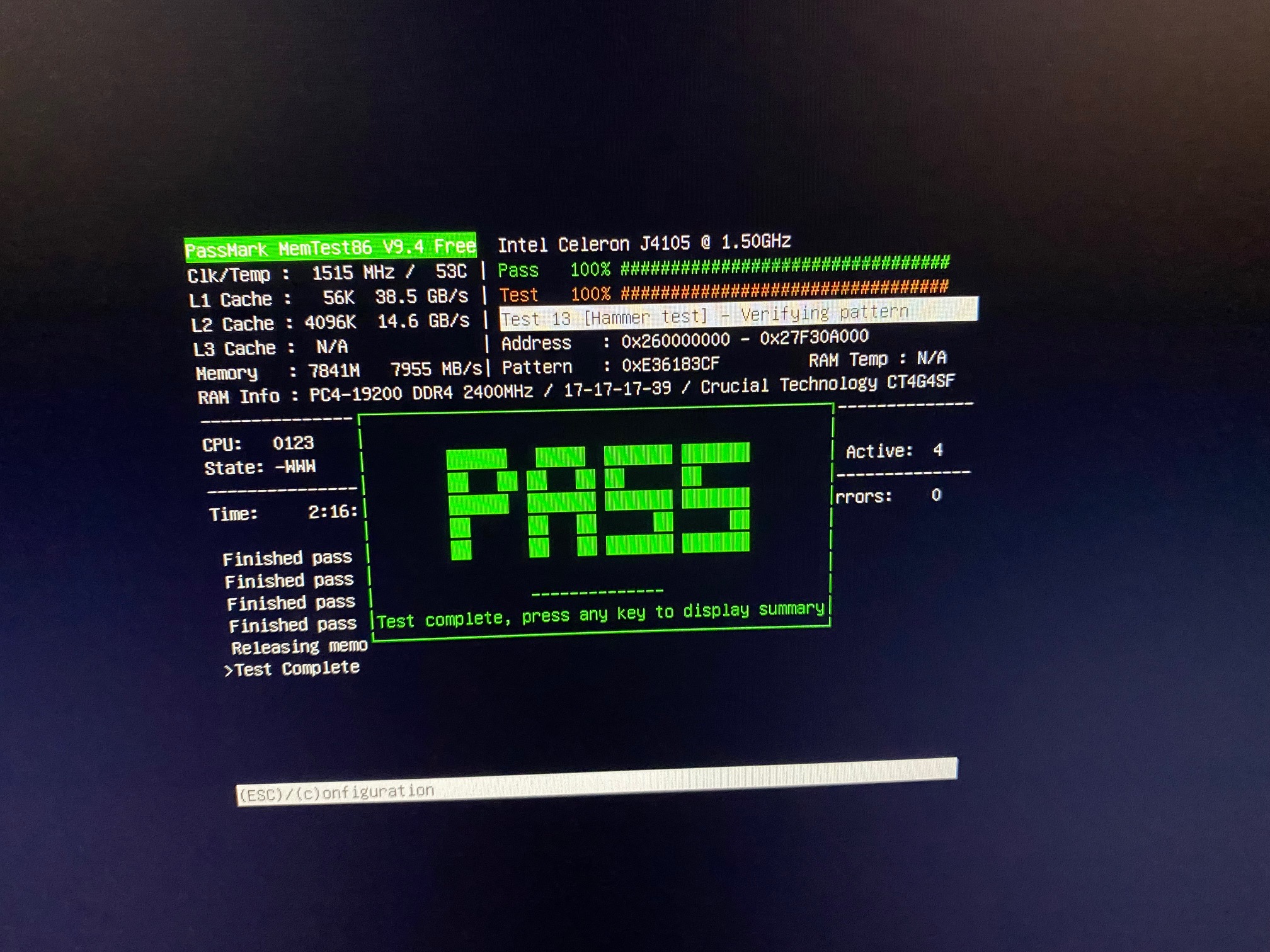
A kernel dev friend said "I'm familiar with that code ... you should run memtest86". This seemed like advice it would be foolish to ignore! I installed the memtest86 package, which on Debian stable, is actually the formerly open-source "memtest86" software, last updated in 2014, rather than the currently open-source "memtest86+". However the package (incorrectly, I think) Recommends: memtest86+ so I ended up with both. The package scripts integrate with GRUB, so both were added as boot options. Neither however, would boot on my NAS, which is a UEFI system: after selection from the GRUB prompt, I just had a blank screen. I focussed for a short while on display issues: I wondered if trying to run a 4k monitor over HDMI was too much to expect from a memory tester OS, but my mainboard has a VGA out as well. It has some quirky behaviour for the VGA out: the firmware doesn't use it at all, so output only begins appearing after something boots (GRUB for example). I fiddled about with the HDMI output, VGA output, and trying different RGB cables, to no avail. The issue was (likely) nothing to do with the video out, but rather that the packaged versions of memtest/memtest86+ don't work properly on UEFI systems. What did work, was Passmark Software's non-FOSS memtest86. It drew on HDMI, albeit in a postage stamp sized window. After some time (much less than I expected, some kind of magic modern memory matrix stuff going on I think), I got a clean bill of health:
memtest86(.com) passes
It's quite possible the FOSS versions of memtest (pcmemtest is another) have better support for UEFI in more recent versions than I installed (I just went with what's in Debian stable), and if not, then this is a worthy feature to work on.

1 September 2022

Shirish Agarwal: Culture, Books, Friends

Culture Just before I start, I would like to point out that this post may or would probably be NSFW. Again, what is SFW (Safe at Work) and NSFW that so much depends on culture and perception of culture from wherever we are or wherever we take birth? But still, to be on the safe side I have put it as NSFW. Now there have been a few statements and ideas that gave me a pause. This will be a sort of chaotic blog post as I am in such a phase today. For e.g. while I do not know which culture or which country this comes from, somebody shared that in some cultures one can talk/comment May your poop be easy and with a straight face. I dunno which culture is this but if somebody asked me that I would just die from laughing or maybe poop there itself. While I can understand if it is a constipated person, but a whole culture? Until and unless their DNA is really screwed, I don t think so but then what do I know? I do know that we shit when we have extreme reactions of either joy or fear. And IIRC, this comes from mammal response when they were in dangerous situations and we got the same as humans evolved. I would really be interested to know which culture is that. I did come to know that the Japanese do wish that you may not experience hard work or something to that effect while ironically they themselves are becoming extinct due to hard work and not enough relaxation, toxic workplace is common in Japan according to social scientists and population experts. Another term that I couldn t figure out is The Florida Man Strikes again and this term is usually used when somebody does something stupid or something weird. While it is exclusively used in the American context, I am curious to know how that came about. Why does Florida have such people or is it an exaggeration? I have heard the term e.g. What happens in Vegas, stays in Vegas . Think it is also called Sin city although why just Vegas is beyond me?

Omicron-8712 Blood pressure machine I felt so stupid. I found another site or e-commerce site called Wellness Forever. They had the blood pressure machine I wanted, an Omron-8172. I bought it online and they delivered the same within half an hour. Amazon took six days and in the end, didn t deliver it at all. I tried taking measurements from it yesterday. I have yet to figure out what it all means but I did get measurements of 109 SYS, 88 DIA and Pulse is 72. As far as the pulse is concerned, guess that is normal, the others just don t know. If only I had known this couple of months ago. I was able to register the product as well as download and use the Omron Connect app. For roughly INR 2.5k you have a sort of health monitoring system. It isn t Star Trek Tricorder in any shape or form but it will have to do while the tricorder gets invented. And while we are on the subject let s not forget Elizabeth Holmes and the scam called Theranos. It really is something to see How Elizabeth Holmes modeled so much of herself on Steve Jobs mimicking how he left college/education halfway. A part of me is sad that Theranos is not real. Joe Scott just a few days ago shared some perspectives on the same just a few days ago. The idea in itself is pretty seductive, to say the least, and that is the reason the scam went on for more than a decade and perhaps would have been longer if some people hadn t gotten the truth out. I do see potentially, something like that coming on as A.I. takes a bigger role in automating testing. Half a decade to a decade from now, who knows if there is an algorithm that is able to do what is needed? If such a product were to come to the marketplace at a decent price, it would revolutionize medicine, especially in countries like India, South Africa, and all sorts of remote places. Especially, with all sorts of off-grid technologies coming and maturing in the marketplace. Before I forget, there is a game called Cell on Android that tells or shares about the evolution of life on earth. It also shares credence to the idea that life has come 6 times on Earth and has been destroyed multiple times by asteroids. It is in the idle sort of game format, so you can see the humble beginnings from the primordial soup to various kinds of cells and bacteria to finally a mammal. This is where I am and a long way to go.

Indian Bureaucracy One of the few things that Britishers gave to India, is the bureaucracy and the bureaucracy tests us in myriad ways. It would be full 2 months on 5th September and I haven t yet got a death certificate. And I need that for a sundry number of things. The same goes for a disability certificate. What is and was interesting is my trip to the local big hospital called Sassoon Hospital. My mum had shared incidents that occurred in the 1950s when she and the family had come to Pune. According to her, when she was alive, while Sassoon was the place to be, it was big and chaotic and you never knew where you are going. That was in 1950, I had the same experience in 2022. The term/adage the more things change, the more they remain the same seems to be held true for Sassoon Hospital. Btw, those of you who think the Devil exists, he is totally a fallacy. There is a popular myth that the devil comes to deal that he/she/they come to deal with you when somebody close to you passes, I was waiting desperately for him when mum passed. Any deal that he/she/they would have offered me I would have gladly taken, but all my wait was all for nothing. While I believe evil exists, that is manifested by humans and nobody else. The whole idea and story of the devil is just to control young children and nothing beyond that

Debconf 2023, friends, JPEGOptim, and EV s Quite a number of friends had gone to Albania this year as India won the right to host Debconf for the year 2023. While I did lurk on the Debconf orga IRC channel, I m not sure how helpful I would be currently. One news that warmed my heart is some people would be coming to India to check the site way before and make sure things go smoothly. Nothing like having more eyes (in this case bodies) to throw at a problem and hopefully it will be sorted. While I have not been working for the last couple of years, one of the things that I had to do and have been doing is moving a lot of stuff online. This is in part due to the Government s own intention of having everything on the cloud. One of the things I probably may have shared it more than enough times is that the storage most of these sites give is like the 1990s. I tried jpegoptim and while it works, it degrades the quality of the image quite a bit. The whole thing seems backward, especially as newer and newer smartphones are capturing more data per picture (megapixel resolution), case in point Samsung Galaxy A04 that is being introduced. But this is not only about newer phones, even my earlier phone, Samsung J-5/500 which I bought in 2016 took images at 5 MB. So it is not a new issue but a continuous issue. And almost all Govt. sites have the upper band fixed at 1 MB. But this is not limited to Govt. sites alone, most sites in India are somewhat frozen in the 1990s. And it isn t as if resources for designing web pages using HTML5, CSS3, Javascript, Python, or Java aren t available. If worse comes to worst, one can even use amp to make his, her or their point. But this is if they want to do stuff. I would be sharing a few photos with commentary, there are still places where I can put photos apart from social media

Friends Last week, Saturday suddenly all the friends decided to show up. I have no clue one way or the other why but am glad they showed up.
Mahendra, Akshat, Shirish and Sagar Sukhose (Mangesh's friend). Mahendra, Akshat, Shirish and Sagar Sukhose (Mangesh s friend) at Bal Gandharva..
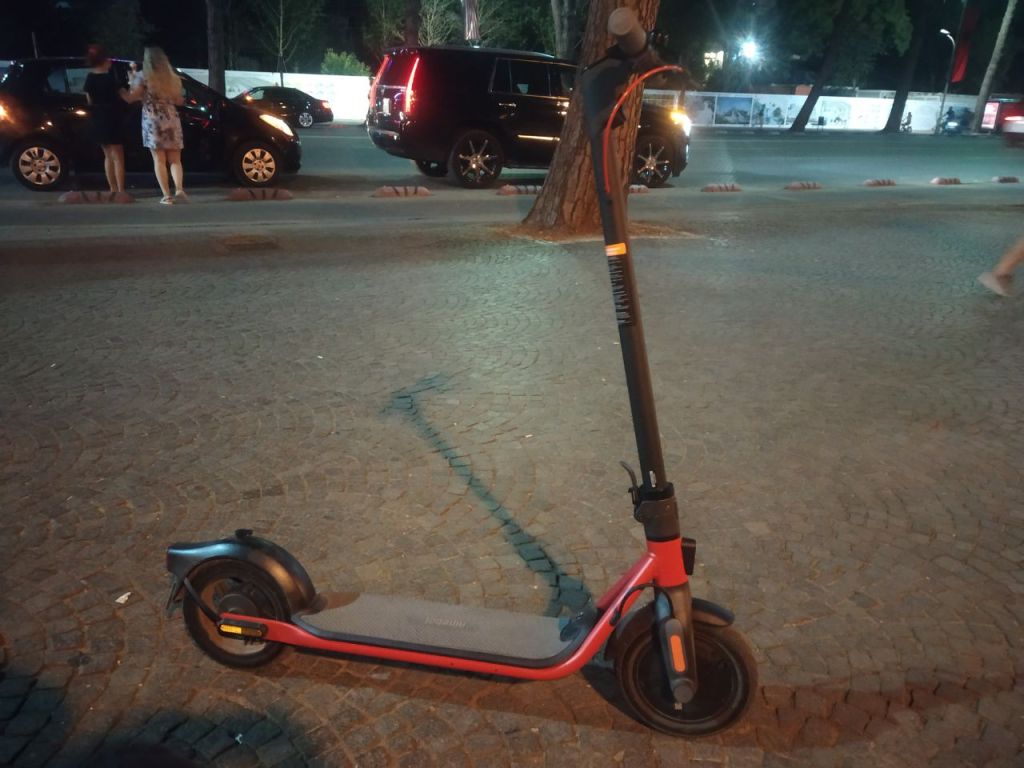
Electric scooter as shared by Akshat seen in Albania Electric scooter as shared by Akshat seen in Albania
Somebody making a  real-life replica of Wall Street on F.C. Road (Commercial, all glass)Somebody making a real-life replica of Wall Street on F.C. Road (Commercial, all glass)
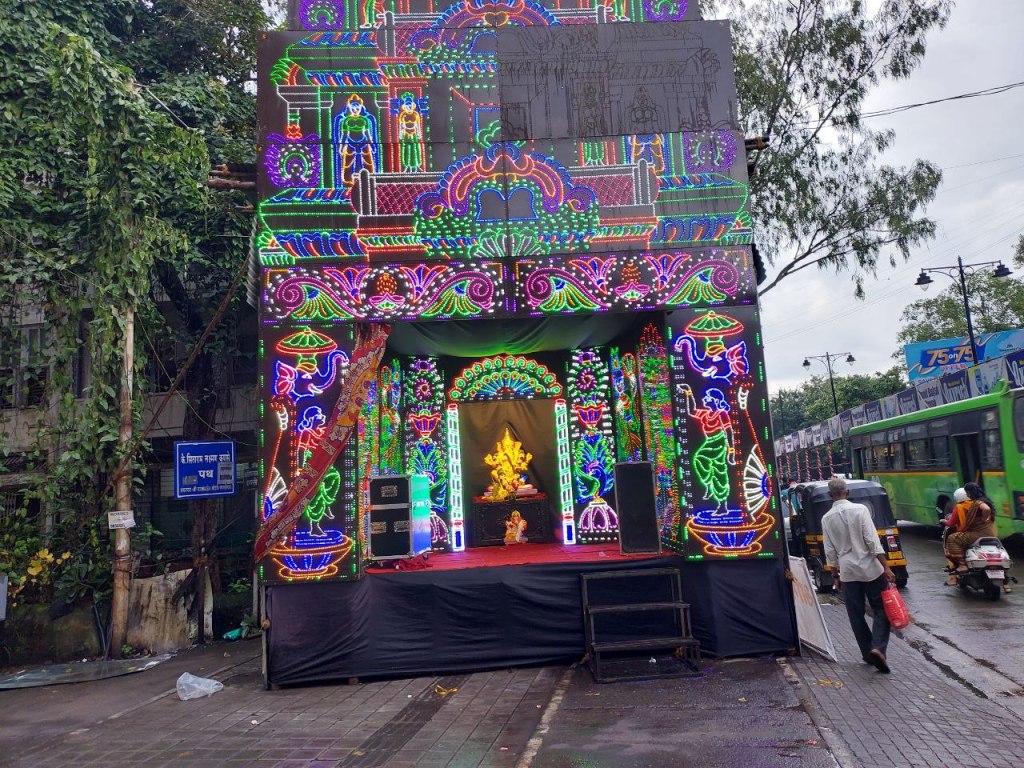
Ganesh Idol near my houseGanesh Idol near my house
Wearing new clothesWearing new clothes
I will have to be a bit rapid about what I am sharing above so here goes nothing

1. The first picture shows Mahendra, Akshat, me, and Sagar Sukhose (Mangesh s friend). The picture was taken by Mangesh Diwate. We talked quite a bit of various things that could be done in Debian. A few of the things that I shared were (bringing more stuff from BSD to Debian, I am sure there s still quite a lot of security software that could be advantageous to have in Debian.) The best person to talk to or guide about this would undoubtedly be Paul Wise or as he is affectionally called Pabs. He is one of the shy ones and yet knows so much about how things work. The one and only time I met him is 2016. The other thing that we talked about is porting Debian to one of the phones. This has been done in the past and done by a Puneitie some 4-5 years back. While I don t recollect the gentleman s name, I remember that the porting was done on a Motorola phone as that was the easiest to do. He had tried some other mobile but that didn t work. Making Debian available on phone is hard work. Just to have an idea, I went to the xda developers forum and found out that while M51 has been added, my specific phone model is not there. A Samsung Galaxy M52G Android (samsung; SM-M526B; lahaina; arm64-v8a) v12 . You look at the chat and you understand how difficult the process might be. One of the other ideas that Akshat pitched was Debian Astro, this is something that is close to the heart of many, including me. I also proposed to have some kind of web app or something where we can find and share about the various astronomy and related projects done by various agencies. While there is a NASA app, nothing comes close to JSR and that site just shares stuff, no speculation. There are so many projects taken or being done by the EU, JAXA, ISRO, and even middle-east countries are trying but other than people who are following some of the developments, we hear almost nothing. Even the Chinese have made some long strides but most people know nothing about the same. And it s sad to know that those developments are not being known, shared, or even speculated about as much as say NASA or SpaceX is. How do we go about it and how do we get people to contribute or ask questions around it would be interesting. 2. The second picture was something that was shared by Akshat. Akshat was sharing how in Albania people are moving on these electric scooters . I dunno if that is the right word for it or what. I had heard from a couple of friends who had gone to Vietnam a few years ago how most people in Vietnam had modified their scooters and they were snaking lines of electric wires charging scooters. I have no clue whether they were closer to Vespa or something like above. In India, the Govt. is in partnership with the oil, gas, and coal mafia just as it was in Australia (the new Govt. in Australia is making changes) the same thing is here. With the humongous profits that the oil sector provides the petro states and others, Corruption is bound to happen. We talk and that s the extent of things. 3. The third picture is from a nearby area called F.C. Road or Fergusson College Road. The area has come up quite sharply (commercially) in the last few years. Apparently, Mr. Kushal is making a real-life replica of Wall Street which would be given to commercial tenants. Right now the real estate market is tight in India, we will know how things pan out in the next few years. 4. Number four is an image of a Ganesh idol near my house. There is a 10-day festival of the elephant god that people used to celebrate every year. For the last couple of years because of the pandemic, people were unable to celebrate the festival as it is meant to celebrate. This time some people are going overboard while others are cautious and rightfully so. 5. Last and not least, one of the things that people do at this celebration is to have new clothes, so I shared a photo of a gentleman who had bought and was wearing new clothes. While most countries around the world are similar, Latin America is very similar to India in many ways, perhaps Gunnar can share. especially about religious activities. The elephant god is known for his penchant for sweets and that can be seen from his rounded stomach, that is also how he is celebrated. He is known to make problems disappear or that is supposed to be his thing. We do have something like 4 billion gods, so each one has to be given some work or quality to justify the same

30 August 2022

John Goerzen: The PC & Internet Revolution in Rural America

Inspired by several others (such as Alex Schroeder s post and Szcze uja s prompt), as well as a desire to get this down for my kids, I figure it s time to write a bit about living through the PC and Internet revolution where I did: outside a tiny town in rural Kansas. And, as I ve been back in that same area for the past 15 years, I reflect some on the challenges that continue to play out. Although the stories from the others were primarily about getting online, I want to start by setting some background. Those of you that didn t grow up in the same era as I did probably never realized that a typical business PC setup might cost $10,000 in today s dollars, for instance. So let me start with the background.

Nothing was easy This story begins in the 1980s. Somewhere around my Kindergarten year of school, around 1985, my parents bought a TRS-80 Color Computer 2 (aka CoCo II). It had 64K of RAM and used a TV for display and sound. This got you the computer. It didn t get you any disk drive or anything, no joysticks (required by a number of games). So whenever the system powered down, or it hung and you had to power cycle it a frequent event you d lose whatever you were doing and would have to re-enter the program, literally by typing it in. The floppy drive for the CoCo II cost more than the computer, and it was quite common for people to buy the computer first and then the floppy drive later when they d saved up the money for that. I particularly want to mention that computers then didn t come with a modem. What would be like buying a laptop or a tablet without wifi today. A modem, which I ll talk about in a bit, was another expensive accessory. To cobble together a system in the 80s that was capable of talking to others with persistent storage (floppy, or hard drive), screen, keyboard, and modem would be quite expensive. Adjusted for inflation, if you re talking a PC-style device (a clone of the IBM PC that ran DOS), this would easily be more expensive than the Macbook Pros of today. Few people back in the 80s had a computer at home. And the portion of those that had even the capability to get online in a meaningful way was even smaller. Eventually my parents bought a PC clone with 640K RAM and dual floppy drives. This was primarily used for my mom s work, but I did my best to take it over whenever possible. It ran DOS and, despite its monochrome screen, was generally a more capable machine than the CoCo II. For instance, it supported lowercase. (I m not even kidding; the CoCo II pretty much didn t.) A while later, they purchased a 32MB hard drive for it what luxury! Just getting a machine to work wasn t easy. Say you d bought a PC, and then bought a hard drive, and a modem. You didn t just plug in the hard drive and it would work. You would have to fight it every step of the way. The BIOS and DOS partition tables of the day used a cylinder/head/sector method of addressing the drive, and various parts of that those addresses had too few bits to work with the big drives of the day above 20MB. So you would have to lie to the BIOS and fdisk in various ways, and sort of work out how to do it for each drive. For each peripheral serial port, sound card (in later years), etc., you d have to set jumpers for DMA and IRQs, hoping not to conflict with anything already in the system. Perhaps you can now start to see why USB and PCI were so welcomed.

Sharing and finding resources Despite the two computers in our home, it wasn t as if software written on one machine just ran on another. A lot of software for PC clones assumed a CGA color display. The monochrome HGC in our PC wasn t particularly compatible. You could find a TSR program to emulate the CGA on the HGC, but it wasn t particularly stable, and there s only so much you can do when a program that assumes color displays on a monitor that can only show black, dark amber, or light amber. So I d periodically get to use other computers most commonly at an office in the evening when it wasn t being used. There were some local computer clubs that my dad took me to periodically. Software was swapped back then; disks copied, shareware exchanged, and so forth. For me, at least, there was no online to download software from, and selling software over the Internet wasn t a thing at all.

Three Different Worlds There were sort of three different worlds of computing experience in the 80s:
  1. Home users. Initially using a wide variety of software from Apple, Commodore, Tandy/RadioShack, etc., but eventually coming to be mostly dominated by IBM PC clones
  2. Small and mid-sized business users. Some of them had larger minicomputers or small mainframes, but most that I had contact with by the early 90s were standardized on DOS-based PCs. More advanced ones had a network running Netware, most commonly. Networking hardware and software was generally too expensive for home users to use in the early days.
  3. Universities and large institutions. These are the places that had the mainframes, the earliest implementations of TCP/IP, the earliest users of UUCP, and so forth.
The difference between the home computing experience and the large institution experience were vast. Not only in terms of dollars the large institution hardware could easily cost anywhere from tens of thousands to millions of dollars but also in terms of sheer resources required (large rooms, enormous power circuits, support staff, etc). Nothing was in common between them; not operating systems, not software, not experience. I was never much aware of the third category until the differences started to collapse in the mid-90s, and even then I only was exposed to it once the collapse was well underway. You might say to me, Well, Google certainly isn t running what I m running at home! And, yes of course, it s different. But fundamentally, most large datacenters are running on x86_64 hardware, with Linux as the operating system, and a TCP/IP network. It s a different scale, obviously, but at a fundamental level, the hardware and operating system stack are pretty similar to what you can readily run at home. Back in the 80s and 90s, this wasn t the case. TCP/IP wasn t even available for DOS or Windows until much later, and when it was, it was a clunky beast that was difficult. One of the things Kevin Driscoll highlights in his book called Modem World see my short post about it is that the history of the Internet we usually receive is focused on case 3: the large institutions. In reality, the Internet was and is literally a network of networks. Gateways to and from Internet existed from all three kinds of users for years, and while TCP/IP ultimately won the battle of the internetworking protocol, the other two streams of users also shaped the Internet as we now know it. Like many, I had no access to the large institution networks, but as I ve been reflecting on my experiences, I ve found a new appreciation for the way that those of us that grew up with primarily home PCs shaped the evolution of today s online world also.

An Era of Scarcity I should take a moment to comment about the cost of software back then. A newspaper article from 1985 comments that WordPerfect, then the most powerful word processing program, sold for $495 (or $219 if you could score a mail order discount). That s $1360/$600 in 2022 money. Other popular software, such as Lotus 1-2-3, was up there as well. If you were to buy a new PC clone in the mid to late 80s, it would often cost $2000 in 1980s dollars. Now add a printer a low-end dot matrix for $300 or a laser for $1500 or even more. A modem: another $300. So the basic system would be $3600, or $9900 in 2022 dollars. If you wanted a nice printer, you re now pushing well over $10,000 in 2022 dollars. You start to see one barrier here, and also why things like shareware and piracy if it was indeed even recognized as such were common in those days. So you can see, from a home computer setup (TRS-80, Commodore C64, Apple ][, etc) to a business-class PC setup was an order of magnitude increase in cost. From there to the high-end minis/mainframes was another order of magnitude (at least!) increase. Eventually there was price pressure on the higher end and things all got better, which is probably why the non-DOS PCs lasted until the early 90s.

Increasing Capabilities My first exposure to computers in school was in the 4th grade, when I would have been about 9. There was a single Apple ][ machine in that room. I primarily remember playing Oregon Trail on it. The next year, the school added a computer lab. Remember, this is a small rural area, so each graduating class might have about 25 people in it; this lab was shared by everyone in the K-8 building. It was full of some flavor of IBM PS/2 machines running DOS and Netware. There was a dedicated computer teacher too, though I think she was a regular teacher that was given somewhat minimal training on computers. We were going to learn typing that year, but I did so well on the very first typing program that we soon worked out that I could do programming instead. I started going to school early these machines were far more powerful than the XT at home and worked on programming projects there. Eventually my parents bought me a Gateway 486SX/25 with a VGA monitor and hard drive. Wow! This was a whole different world. It may have come with Windows 3.0 or 3.1 on it, but I mainly remember running OS/2 on that machine. More on that below.

Programming That CoCo II came with a BASIC interpreter in ROM. It came with a large manual, which served as a BASIC tutorial as well. The BASIC interpreter was also the shell, so literally you could not use the computer without at least a bit of BASIC. Once I had access to a DOS machine, it also had a basic interpreter: GW-BASIC. There was a fair bit of software written in BASIC at the time, but most of the more advanced software wasn t. I wondered how these .EXE and .COM programs were written. I could find vague references to DEBUG.EXE, assemblers, and such. But it wasn t until I got a copy of Turbo Pascal that I was able to do that sort of thing myself. Eventually I got Borland C++ and taught myself C as well. A few years later, I wanted to try writing GUI programs for Windows, and bought Watcom C++ much cheaper than the competition, and it could target Windows, DOS (and I think even OS/2). Notice that, aside from BASIC, none of this was free, and none of it was bundled. You couldn t just download a C compiler, or Python interpreter, or whatnot back then. You had to pay for the ability to write any kind of serious code on the computer you already owned.

The Microsoft Domination Microsoft came to dominate the PC landscape, and then even the computing landscape as a whole. IBM very quickly lost control over the hardware side of PCs as Compaq and others made clones, but Microsoft has managed in varying degrees even to this day to keep a stranglehold on the software, and especially the operating system, side. Yes, there was occasional talk of things like DR-DOS, but by and large the dominant platform came to be the PC, and if you had a PC, you ran DOS (and later Windows) from Microsoft. For awhile, it looked like IBM was going to challenge Microsoft on the operating system front; they had OS/2, and when I switched to it sometime around the version 2.1 era in 1993, it was unquestionably more advanced technically than the consumer-grade Windows from Microsoft at the time. It had Internet support baked in, could run most DOS and Windows programs, and had introduced a replacement for the by-then terrible FAT filesystem: HPFS, in 1988. Microsoft wouldn t introduce a better filesystem for its consumer operating systems until Windows XP in 2001, 13 years later. But more on that story later.

Free Software, Shareware, and Commercial Software I ve covered the high cost of software already. Obviously $500 software wasn t going to sell in the home market. So what did we have? Mainly, these things:
  1. Public domain software. It was free to use, and if implemented in BASIC, probably had source code with it too.
  2. Shareware
  3. Commercial software (some of it from small publishers was a lot cheaper than $500)
Let s talk about shareware. The idea with shareware was that a company would release a useful program, sometimes limited. You were encouraged to register , or pay for, it if you liked it and used it. And, regardless of whether you registered it or not, were told please copy! Sometimes shareware was fully functional, and registering it got you nothing more than printed manuals and an easy conscience (guilt trips for not registering weren t necessarily very subtle). Sometimes unregistered shareware would have a nag screen a delay of a few seconds while they told you to register. Sometimes they d be limited in some way; you d get more features if you registered. With games, it was popular to have a trilogy, and release the first episode inevitably ending with a cliffhanger as shareware, and the subsequent episodes would require registration. In any event, a lot of software people used in the 80s and 90s was shareware. Also pirated commercial software, though in the earlier days of computing, I think some people didn t even know the difference. Notice what s missing: Free Software / FLOSS in the Richard Stallman sense of the word. Stallman lived in the big institution world after all, he worked at MIT and what he was doing with the Free Software Foundation and GNU project beginning in 1983 never really filtered into the DOS/Windows world at the time. I had no awareness of it even existing until into the 90s, when I first started getting some hints of it as a port of gcc became available for OS/2. The Internet was what really brought this home, but I m getting ahead of myself. I want to say again: FLOSS never really entered the DOS and Windows 3.x ecosystems. You d see it make a few inroads here and there in later versions of Windows, and moreso now that Microsoft has been sort of forced to accept it, but still, reflect on its legacy. What is the software market like in Windows compared to Linux, even today? Now it is, finally, time to talk about connectivity!

Getting On-Line What does it even mean to get on line? Certainly not connecting to a wifi access point. The answer is, unsurprisingly, complex. But for everyone except the large institutional users, it begins with a telephone.

The telephone system By the 80s, there was one communication network that already reached into nearly every home in America: the phone system. Virtually every household (note I don t say every person) was uniquely identified by a 10-digit phone number. You could, at least in theory, call up virtually any other phone in the country and be connected in less than a minute. But I ve got to talk about cost. The way things worked in the USA, you paid a monthly fee for a phone line. Included in that monthly fee was unlimited local calling. What is a local call? That was an extremely complex question. Generally it meant, roughly, calling within your city. But of course, as you deal with things like suburbs and cities growing into each other (eg, the Dallas-Ft. Worth metroplex), things got complicated fast. But let s just say for simplicity you could call others in your city. What about calling people not in your city? That was long distance , and you paid often hugely by the minute for it. Long distance rates were difficult to figure out, but were generally most expensive during business hours and cheapest at night or on weekends. Prices eventually started to come down when competition was introduced for long distance carriers, but even then you often were stuck with a single carrier for long distance calls outside your city but within your state. Anyhow, let s just leave it at this: local calls were virtually free, and long distance calls were extremely expensive.

Getting a modem I remember getting a modem that ran at either 1200bps or 2400bps. Either way, quite slow; you could often read even plain text faster than the modem could display it. But what was a modem? A modem hooked up to a computer with a serial cable, and to the phone system. By the time I got one, modems could automatically dial and answer. You would send a command like ATDT5551212 and it would dial 555-1212. Modems had speakers, because often things wouldn t work right, and the telephone system was oriented around speech, so you could hear what was happening. You d hear it wait for dial tone, then dial, then hopefully the remote end would ring, a modem there would answer, you d hear the screeching of a handshake, and eventually your terminal would say CONNECT 2400. Now your computer was bridged to the other; anything going out your serial port was encoded as sound by your modem and decoded at the other end, and vice-versa. But what, exactly, was the other end? It might have been another person at their computer. Turn on local echo, and you can see what they did. Maybe you d send files to each other. But in my case, the answer was different: PC Magazine.

PC Magazine and CompuServe Starting around 1986 (so I would have been about 6 years old), I got to read PC Magazine. My dad would bring copies that were being discarded at his office home for me to read, and I think eventually bought me a subscription directly. This was not just a standard magazine; it ran something like 350-400 pages an issue, and came out every other week. This thing was a monster. It had reviews of hardware and software, descriptions of upcoming technologies, pages and pages of ads (that often had some degree of being informative to them). And they had sections on programming. Many issues would talk about BASIC or Pascal programming, and there d be a utility in most issues. What do I mean by a utility in most issues ? Did they include a floppy disk with software? No, of course not. There was a literal program listing printed in the magazine. If you wanted the utility, you had to type it in. And a lot of them were written in assembler, so you had to have an assembler. An assembler, of course, was not free and I didn t have one. Or maybe they wrote it in Microsoft C, and I had Borland C, and (of course) they weren t compatible. Sometimes they would list the program sort of in binary: line after line of a BASIC program, with lines like 64, 193, 253, 0, 53, 0, 87 that you would type in for hours, hopefully correctly. Running the BASIC program would, if you got it correct, emit a .COM file that you could then run. They did have a rudimentary checksum system built in, but it wasn t even a CRC, so something like swapping two numbers you d never notice except when the program would mysteriously hang. Eventually they teamed up with CompuServe to offer a limited slice of CompuServe for the purpose of downloading PC Magazine utilities. This was called PC MagNet. I am foggy on the details, but I believe that for a time you could connect to the limited PC MagNet part of CompuServe for free (after the cost of the long-distance call, that is) rather than paying for CompuServe itself (because, OF COURSE, that also charged you per the minute.) So in the early days, I would get special permission from my parents to place a long distance call, and after some nerve-wracking minutes in which we were aware every minute was racking up charges, I could navigate the menus, download what I wanted, and log off immediately. I still, incidentally, mourn what PC Magazine became. As with computing generally, it followed the mass market. It lost its deep technical chops, cut its programming columns, stopped talking about things like how SCSI worked, and so forth. By the time it stopped printing in 2009, it was no longer a square-bound 400-page beheamoth, but rather looked more like a copy of Newsweek, but with less depth.

Continuing with CompuServe CompuServe was a much larger service than just PC MagNet. Eventually, our family got a subscription. It was still an expensive and scarce resource; I d call it only after hours when the long-distance rates were cheapest. Everyone had a numerical username separated by commas; mine was 71510,1421. CompuServe had forums, and files. Eventually I would use TapCIS to queue up things I wanted to do offline, to minimize phone usage online. CompuServe eventually added a gateway to the Internet. For the sum of somewhere around $1 a message, you could send or receive an email from someone with an Internet email address! I remember the thrill of one time, as a kid of probably 11 years, sending a message to one of the editors of PC Magazine and getting a kind, if brief, reply back! But inevitably I had

The Godzilla Phone Bill Yes, one month I became lax in tracking my time online. I ran up my parents phone bill. I don t remember how high, but I remember it was hundreds of dollars, a hefty sum at the time. As I watched Jason Scott s BBS Documentary, I realized how common an experience this was. I think this was the end of CompuServe for me for awhile.

Toll-Free Numbers I lived near a town with a population of 500. Not even IN town, but near town. The calling area included another town with a population of maybe 1500, so all told, there were maybe 2000 people total I could talk to with a local call though far fewer numbers, because remember, telephones were allocated by the household. There was, as far as I know, zero modems that were a local call (aside from one that belonged to a friend I met in around 1992). So basically everything was long-distance. But there was a special feature of the telephone network: toll-free numbers. Normally when calling long-distance, you, the caller, paid the bill. But with a toll-free number, beginning with 1-800, the recipient paid the bill. These numbers almost inevitably belonged to corporations that wanted to make it easy for people to call. Sales and ordering lines, for instance. Some of these companies started to set up modems on toll-free numbers. There were few of these, but they existed, so of course I had to try them! One of them was a company called PennyWise that sold office supplies. They had a toll-free line you could call with a modem to order stuff. Yes, online ordering before the web! I loved office supplies. And, because I lived far from a big city, if the local K-Mart didn t have it, I probably couldn t get it. Of course, the interface was entirely text, but you could search for products and place orders with the modem. I had loads of fun exploring the system, and actually ordered things from them and probably actually saved money doing so. With the first order they shipped a monster full-color catalog. That thing must have been 500 pages, like the Sears catalogs of the day. Every item had a part number, which streamlined ordering through the modem.

Inbound FAXes By the 90s, a number of modems became able to send and receive FAXes as well. For those that don t know, a FAX machine was essentially a special modem. It would scan a page and digitally transmit it over the phone system, where it would at least in the early days be printed out in real time (because the machines didn t have the memory to store an entire page as an image). Eventually, PC modems integrated FAX capabilities. There still wasn t anything useful I could do locally, but there were ways I could get other companies to FAX something to me. I remember two of them. One was for US Robotics. They had an on demand FAX system. You d call up a toll-free number, which was an automated IVR system. You could navigate through it and select various documents of interest to you: spec sheets and the like. You d key in your FAX number, hang up, and US Robotics would call YOU and FAX you the documents you wanted. Yes! I was talking to a computer (of a sorts) at no cost to me! The New York Times also ran a service for awhile called TimesFax. Every day, they would FAX out a page or two of summaries of the day s top stories. This was pretty cool in an era in which I had no other way to access anything from the New York Times. I managed to sign up for TimesFax I have no idea how, anymore and for awhile I would get a daily FAX of their top stories. When my family got its first laser printer, I could them even print these FAXes complete with the gothic New York Times masthead. Wow! (OK, so technically I could print it on a dot-matrix printer also, but graphics on a 9-pin dot matrix is a kind of pain that is a whole other article.)

My own phone line Remember how I discussed that phone lines were allocated per household? This was a problem for a lot of reasons:
  1. Anybody that tried to call my family while I was using my modem would get a busy signal (unable to complete the call)
  2. If anybody in the house picked up the phone while I was using it, that would degrade the quality of the ongoing call and either mess up or disconnect the call in progress. In many cases, that could cancel a file transfer (which wasn t necessarily easy or possible to resume), prompting howls of annoyance from me.
  3. Generally we all had to work around each other
So eventually I found various small jobs and used the money I made to pay for my own phone line and my own long distance costs. Eventually I upgraded to a 28.8Kbps US Robotics Courier modem even! Yes, you heard it right: I got a job and a bank account so I could have a phone line and a faster modem. Uh, isn t that why every teenager gets a job? Now my local friend and I could call each other freely at least on my end (I can t remember if he had his own phone line too). We could exchange files using HS/Link, which had the added benefit of allowing split-screen chat even while a file transfer is in progress. I m sure we spent hours chatting to each other keyboard-to-keyboard while sharing files with each other.

Technology in Schools By this point in the story, we re in the late 80s and early 90s. I m still using PC-style OSs at home; OS/2 in the later years of this period, DOS or maybe a bit of Windows in the earlier years. I mentioned that they let me work on programming at school starting in 5th grade. It was soon apparent that I knew more about computers than anybody on staff, and I started getting pulled out of class to help teachers or administrators with vexing school problems. This continued until I graduated from high school, incidentally often to my enjoyment, and the annoyance of one particular teacher who, I must say, I was fine with annoying in this way. That s not to say that there was institutional support for what I was doing. It was, after all, a small school. Larger schools might have introduced BASIC or maybe Logo in high school. But I had already taught myself BASIC, Pascal, and C by the time I was somewhere around 12 years old. So I wouldn t have had any use for that anyhow. There were programming contests occasionally held in the area. Schools would send teams. My school didn t really send anybody, but I went as an individual. One of them was run by a local college (but for jr. high or high school students. Years later, I met one of the professors that ran it. He remembered me, and that day, better than I did. The programming contest had problems one could solve in BASIC or Logo. I knew nothing about what to expect going into it, but I had lugged my computer and screen along, and asked him, Can I write my solutions in C? He was, apparently, stunned, but said sure, go for it. I took first place that day, leading to some rather confused teams from much larger schools. The Netware network that the school had was, as these generally were, itself isolated. There was no link to the Internet or anything like it. Several schools across three local counties eventually invested in a fiber-optic network linking them together. This built a larger, but still closed, network. Its primary purpose was to allow students to be exposed to a wider variety of classes at high schools. Participating schools had an ITV room , outfitted with cameras and mics. So students at any school could take classes offered over ITV at other schools. For instance, only my school taught German classes, so people at any of those participating schools could take German. It was an early Zoom room. But alongside the TV signal, there was enough bandwidth to run some Netware frames. By about 1995 or so, this let one of the schools purchase some CD-ROM software that was made available on a file server and could be accessed by any participating school. Nice! But Netware was mainly about file and printer sharing; there wasn t even a facility like email, at least not on our deployment.

BBSs My last hop before the Internet was the BBS. A BBS was a computer program, usually ran by a hobbyist like me, on a computer with a modem connected. Callers would call it up, and they d interact with the BBS. Most BBSs had discussion groups like forums and file areas. Some also had games. I, of course, continued to have that most vexing of problems: they were all long-distance. There were some ways to help with that, chiefly QWK and BlueWave. These, somewhat like TapCIS in the CompuServe days, let me download new message posts for reading offline, and queue up my own messages to send later. QWK and BlueWave didn t help with file downloading, though.

BBSs get networked BBSs were an interesting thing. You d call up one, and inevitably somewhere in the file area would be a BBS list. Download the BBS list and you ve suddenly got a list of phone numbers to try calling. All of them were long distance, of course. You d try calling them at random and have a success rate of maybe 20%. The other 80% would be defunct; you might get the dreaded this number is no longer in service or the even more dreaded angry human answering the phone (and of course a modem can t talk to a human, so they d just get silence for probably the nth time that week). The phone company cared nothing about BBSs and recycled their numbers just as fast as any others. To talk to various people, or participate in certain discussion groups, you d have to call specific BBSs. That s annoying enough in the general case, but even more so for someone paying long distance for it all, because it takes a few minutes to establish a connection to a BBS: handshaking, logging in, menu navigation, etc. But BBSs started talking to each other. The earliest successful such effort was FidoNet, and for the duration of the BBS era, it remained by far the largest. FidoNet was analogous to the UUCP that the institutional users had, but ran on the much cheaper PC hardware. Basically, BBSs that participated in FidoNet would relay email, forum posts, and files between themselves overnight. Eventually, as with UUCP, by hopping through this network, messages could reach around the globe, and forums could have worldwide participation asynchronously, long before they could link to each other directly via the Internet. It was almost entirely volunteer-run.

Running my own BBS At age 13, I eventually chose to set up my own BBS. It ran on my single phone line, so of course when I was dialing up something else, nobody could dial up me. Not that this was a huge problem; in my town of 500, I probably had a good 1 or 2 regular callers in the beginning. In the PC era, there was a big difference between a server and a client. Server-class software was expensive and rare. Maybe in later years you had an email client, but an email server would be completely unavailable to you as a home user. But with a BBS, I could effectively run a server. I even ran serial lines in our house so that the BBS could be connected from other rooms! Since I was running OS/2, the BBS didn t tie up the computer; I could continue using it for other things. FidoNet had an Internet email gateway. This one, unlike CompuServe s, was free. Once I had a BBS on FidoNet, you could reach me from the Internet using the FidoNet address. This didn t support attachments, but then email of the day didn t really, either. Various others outside Kansas ran FidoNet distribution points. I believe one of them was mgmtsys; my memory is quite vague, but I think they offered a direct gateway and I would call them to pick up Internet mail via FidoNet protocols, but I m not at all certain of this.

Pros and Cons of the Non-Microsoft World As mentioned, Microsoft was and is the dominant operating system vendor for PCs. But I left that world in 1993, and here, nearly 30 years later, have never really returned. I got an operating system with more technical capabilities than the DOS and Windows of the day, but the tradeoff was a much smaller software ecosystem. OS/2 could run DOS programs, but it ran OS/2 programs a lot better. So if I were to run a BBS, I wanted one that had a native OS/2 version limiting me to a small fraction of available BBS server software. On the other hand, as a fully 32-bit operating system, there started to be OS/2 ports of certain software with a Unix heritage; most notably for me at the time, gcc. At some point, I eventually came across the RMS essays and started to be hooked.

Internet: The Hunt Begins I certainly was aware that the Internet was out there and interesting. But the first problem was: how the heck do I get connected to the Internet?

Computer labs There was one place that tended to have Internet access: colleges and universities. In 7th grade, I participated in a program that resulted in me being invited to visit Duke University, and in 8th grade, I participated in National History Day, resulting in a trip to visit the University of Maryland. I probably sought out computer labs at both of those. My most distinct memory was finding my way into a computer lab at one of those universities, and it was full of NeXT workstations. I had never seen or used NeXT before, and had no idea how to operate it. I had brought a box of floppy disks, unaware that the DOS disks probably weren t compatible with NeXT. Closer to home, a small college had a computer lab that I could also visit. I would go there in summer or when it wasn t used with my stack of floppies. I remember downloading disk images of FLOSS operating systems: FreeBSD, Slackware, or Debian, at the time. The hash marks from the DOS-based FTP client would creep across the screen as the 1.44MB disk images would slowly download. telnet was also available on those machines, so I could telnet to things like public-access Archie servers and libraries though not Gopher. Still, FTP and telnet access opened up a lot, and I learned quite a bit in those years.

Continuing the Journey At some point, I got a copy of the Whole Internet User s Guide and Catalog, published in 1994. I still have it. If it hadn t already figured it out by then, I certainly became aware from it that Unix was the dominant operating system on the Internet. The examples in Whole Internet covered FTP, telnet, gopher all assuming the user somehow got to a Unix prompt. The web was introduced about 300 pages in; clearly viewed as something that wasn t page 1 material. And it covered the command-line www client before introducing the graphical Mosaic. Even then, though, the book highlighted Mosaic s utility as a front-end for Gopher and FTP, and even the ability to launch telnet sessions by clicking on links. But having a copy of the book didn t equate to having any way to run Mosaic. The machines in the computer lab I mentioned above all ran DOS and were incapable of running a graphical browser. I had no SLIP or PPP (both ways to run Internet traffic over a modem) connectivity at home. In short, the Web was something for the large institutional users at the time.

CD-ROMs As CD-ROMs came out, with their huge (for the day) 650MB capacity, various companies started collecting software that could be downloaded on the Internet and selling it on CD-ROM. The two most popular ones were Walnut Creek CD-ROM and Infomagic. One could buy extensive Shareware and gaming collections, and then even entire Linux and BSD distributions. Although not exactly an Internet service per se, it was a way of bringing what may ordinarily only be accessible to institutional users into the home computer realm.

Free Software Jumps In As I mentioned, by the mid 90s, I had come across RMS s writings about free software most probably his 1992 essay Why Software Should Be Free. (Please note, this is not a commentary on the more recently-revealed issues surrounding RMS, but rather his writings and work as I encountered them in the 90s.) The notion of a Free operating system not just in cost but in openness was incredibly appealing. Not only could I tinker with it to a much greater extent due to having source for everything, but it included so much software that I d otherwise have to pay for. Compilers! Interpreters! Editors! Terminal emulators! And, especially, server software of all sorts. There d be no way I could afford or run Netware, but with a Free Unixy operating system, I could do all that. My interest was obviously piqued. Add to that the fact that I could actually participate and contribute I was about to become hooked on something that I ve stayed hooked on for decades. But then the question was: which Free operating system? Eventually I chose FreeBSD to begin with; that would have been sometime in 1995. I don t recall the exact reasons for that. I remember downloading Slackware install floppies, and probably the fact that Debian wasn t yet at 1.0 scared me off for a time. FreeBSD s fantastic Handbook far better than anything I could find for Linux at the time was no doubt also a factor.

The de Raadt Factor Why not NetBSD or OpenBSD? The short answer is Theo de Raadt. Somewhere in this time, when I was somewhere between 14 and 16 years old, I asked some questions comparing NetBSD to the other two free BSDs. This was on a NetBSD mailing list, but for some reason Theo saw it and got a flame war going, which CC d me. Now keep in mind that even if NetBSD had a web presence at the time, it would have been minimal, and I would have not all that unusually for the time had no way to access it. I was certainly not aware of the, shall we say, acrimony between Theo and NetBSD. While I had certainly seen an online flamewar before, this took on a different and more disturbing tone; months later, Theo randomly emailed me under the subject SLIME saying that I was, well, SLIME . I seem to recall periodic emails from him thereafter reminding me that he hates me and that he had blocked me. (Disclaimer: I have poor email archives from this period, so the full details are lost to me, but I believe I am accurately conveying these events from over 25 years ago) This was a surprise, and an unpleasant one. I was trying to learn, and while it is possible I didn t understand some aspect or other of netiquette (or Theo s personal hatred of NetBSD) at the time, still that is not a reason to flame a 16-year-old (though he would have had no way to know my age). This didn t leave any kind of scar, but did leave a lasting impression; to this day, I am particularly concerned with how FLOSS projects handle poisonous people. Debian, for instance, has come a long way in this over the years, and even Linus Torvalds has turned over a new leaf. I don t know if Theo has. In any case, I didn t use NetBSD then. I did try it periodically in the years since, but never found it compelling enough to justify a large switch from Debian. I never tried OpenBSD for various reasons, but one of them was that I didn t want to join a community that tolerates behavior such as Theo s from its leader.

Moving to FreeBSD Moving from OS/2 to FreeBSD was final. That is, I didn t have enough hard drive space to keep both. I also didn t have the backup capacity to back up OS/2 completely. My BBS, which ran Virtual BBS (and at some point also AdeptXBBS) was deleted and reincarnated in a different form. My BBS was a member of both FidoNet and VirtualNet; the latter was specific to VBBS, and had to be dropped. I believe I may have also had to drop the FidoNet link for a time. This was the biggest change of computing in my life to that point. The earlier experiences hadn t literally destroyed what came before. OS/2 could still run my DOS programs. Its command shell was quite DOS-like. It ran Windows programs. I was going to throw all that away and leap into the unknown. I wish I had saved a copy of my BBS; I would love to see the messages I exchanged back then, or see its menu screens again. I have little memory of what it looked like. But other than that, I have no regrets. Pursuing Free, Unixy operating systems brought me a lot of enjoyment and a good career. That s not to say it was easy. All the problems of not being in the Microsoft ecosystem were magnified under FreeBSD and Linux. In a day before EDID, monitor timings had to be calculated manually and you risked destroying your monitor if you got them wrong. Word processing and spreadsheet software was pretty much not there for FreeBSD or Linux at the time; I was therefore forced to learn LaTeX and actually appreciated that. Software like PageMaker or CorelDraw was certainly nowhere to be found for those free operating systems either. But I got a ton of new capabilities. I mentioned the BBS didn t shut down, and indeed it didn t. I ran what was surely a supremely unique oddity: a free, dialin Unix shell server in the middle of a small town in Kansas. I m sure I provided things such as pine for email and some help text and maybe even printouts for how to use it. The set of callers slowly grew over the time period, in fact. And then I got UUCP.

Enter UUCP Even throughout all this, there was no local Internet provider and things were still long distance. I had Internet Email access via assorted strange routes, but they were all strange. And, I wanted access to Usenet. In 1995, it happened. The local ISP I mentioned offered UUCP access. Though I couldn t afford the dialup shell (or later, SLIP/PPP) that they offered due to long-distance costs, UUCP s very efficient batched processes looked doable. I believe I established that link when I was 15, so in 1995. I worked to register my domain, complete.org, as well. At the time, the process was a bit lengthy and involved downloading a text file form, filling it out in a precise way, sending it to InterNIC, and probably mailing them a check. Well I did that, and in September of 1995, complete.org became mine. I set up sendmail on my local system, as well as INN to handle the limited Usenet newsfeed I requested from the ISP. I even ran Majordomo to host some mailing lists, including some that were surprisingly high-traffic for a few-times-a-day long-distance modem UUCP link! The modem client programs for FreeBSD were somewhat less advanced than for OS/2, but I believe I wound up using Minicom or Seyon to continue to dial out to BBSs and, I believe, continue to use Learning Link. So all the while I was setting up my local BBS, I continued to have access to the text Internet, consisting of chiefly Gopher for me.

Switching to Debian I switched to Debian sometime in 1995 or 1996, and have been using Debian as my primary OS ever since. I continued to offer shell access, but added the WorldVU Atlantis menuing BBS system. This provided a return of a more BBS-like interface (by default; shell was still an uption) as well as some BBS door games such as LoRD and TradeWars 2002, running under DOS emulation. I also continued to run INN, and ran ifgate to allow FidoNet echomail to be presented into INN Usenet-like newsgroups, and netmail to be gated to Unix email. This worked pretty well. The BBS continued to grow in these days, peaking at about two dozen total user accounts, and maybe a dozen regular users.

Dial-up access availability I believe it was in 1996 that dial up PPP access finally became available in my small town. What a thrill! FINALLY! I could now FTP, use Gopher, telnet, and the web all from home. Of course, it was at modem speeds, but still. (Strangely, I have a memory of accessing the Web using WebExplorer from OS/2. I don t know exactly why; it s possible that by this time, I had upgraded to a 486 DX2/66 and was able to reinstall OS/2 on the old 25MHz 486, or maybe something was wrong with the timeline from my memories from 25 years ago above. Or perhaps I made the occasional long-distance call somewhere before I ditched OS/2.) Gopher sites still existed at this point, and I could access them using Netscape Navigator which likely became my standard Gopher client at that point. I don t recall using UMN text-mode gopher client locally at that time, though it s certainly possible I did.

The city Starting when I was 15, I took computer science classes at Wichita State University. The first one was a class in the summer of 1995 on C++. I remember being worried about being good enough for it I was, after all, just after my HS freshman year and had never taken the prerequisite C class. I loved it and got an A! By 1996, I was taking more classes. In 1996 or 1997 I stayed in Wichita during the day due to having more than one class. So, what would I do then but enjoy the computer lab? The CS dept. had two of them: one that had NCD X terminals connected to a pair of SunOS servers, and another one running Windows. I spent most of the time in the Unix lab with the NCDs; I d use Netscape or pine, write code, enjoy the University s fast Internet connection, and so forth. In 1997 I had graduated high school and that summer I moved to Wichita to attend college. As was so often the case, I shut down the BBS at that time. It would be 5 years until I again dealt with Internet at home in a rural community. By the time I moved to my apartment in Wichita, I had stopped using OS/2 entirely. I have no memory of ever having OS/2 there. Along the way, I had bought a Pentium 166, and then the most expensive piece of computing equipment I have ever owned: a DEC Alpha, which, of course, ran Linux.

ISDN I must have used dialup PPP for a time, but I eventually got a job working for the ISP I had used for UUCP, and then PPP. While there, I got a 128Kbps ISDN line installed in my apartment, and they gave me a discount on the service for it. That was around 3x the speed of a modem, and crucially was always on and gave me a public IP. No longer did I have to use UUCP; now I got to host my own things! By at least 1998, I was running a web server on www.complete.org, and I had an FTP server going as well.

Even Bigger Cities In 1999 I moved to Dallas, and there got my first broadband connection: an ADSL link at, I think, 1.5Mbps! Now that was something! But it had some reliability problems. I eventually put together a server and had it hosted at an acquantaince s place who had SDSL in his apartment. Within a couple of years, I had switched to various kinds of proper hosting for it, but that is a whole other article. In Indianapolis, I got a cable modem for the first time, with even tighter speeds but prohibitions on running servers on it. Yuck.

Challenges Being non-Microsoft continued to have challenges. Until the advent of Firefox, a web browser was one of the biggest. While Netscape supported Linux on i386, it didn t support Linux on Alpha. I hobbled along with various attempts at emulators, old versions of Mosaic, and so forth. And, until StarOffice was open-sourced as Open Office, reading Microsoft file formats was also a challenge, though WordPerfect was briefly available for Linux. Over the years, I have become used to the Linux ecosystem. Perhaps I use Gimp instead of Photoshop and digikam instead of well, whatever somebody would use on Windows. But I get ZFS, and containers, and so much that isn t available there. Yes, I know Apple never went away and is a thing, but for most of the time period I discuss in this article, at least after the rise of DOS, it was niche compared to the PC market.

Back to Kansas In 2002, I moved back to Kansas, to a rural home near a different small town in the county next to where I grew up. Over there, it was back to dialup at home, but I had faster access at work. I didn t much care for this, and thus began a 20+-year effort to get broadband in the country. At first, I got a wireless link, which worked well enough in the winter, but had serious problems in the summer when the trees leafed out. Eventually DSL became available locally highly unreliable, but still, it was something. Then I moved back to the community I grew up in, a few miles from where I grew up. Again I got DSL a bit better. But after some years, being at the end of the run of DSL meant I had poor speeds and reliability problems. I eventually switched to various wireless ISPs, which continues to the present day; while people in cities can get Gbps service, I can get, at best, about 50Mbps. Long-distance fees are gone, but the speed disparity remains.

Concluding Reflections I am glad I grew up where I did; the strong community has a lot of advantages I don t have room to discuss here. In a number of very real senses, having no local services made things a lot more difficult than they otherwise would have been. However, perhaps I could say that I also learned a lot through the need to come up with inventive solutions to those challenges. To this day, I think a lot about computing in remote environments: partially because I live in one, and partially because I enjoy visiting places that are remote enough that they have no Internet, phone, or cell service whatsoever. I have written articles like Tools for Communicating Offline and in Difficult Circumstances based on my own personal experience. I instinctively think about making protocols robust in the face of various kinds of connectivity failures because I experience various kinds of connectivity failures myself.

(Almost) Everything Lives On In 2002, Gopher turned 10 years old. It had probably been about 9 or 10 years since I had first used Gopher, which was the first way I got on live Internet from my house. It was hard to believe. By that point, I had an always-on Internet link at home and at work. I had my Alpha, and probably also at least PCMCIA Ethernet for a laptop (many laptops had modems by the 90s also). Despite its popularity in the early 90s, less than 10 years after it came on the scene and started to unify the Internet, it was mostly forgotten. And it was at that moment that I decided to try to resurrect it. The University of Minnesota finally released it under an Open Source license. I wrote the first new gopher server in years, pygopherd, and introduced gopher to Debian. Gopher lives on; there are now quite a few Gopher clients and servers out there, newly started post-2002. The Gemini protocol can be thought of as something akin to Gopher 2.0, and it too has a small but blossoming ecosystem. Archie, the old FTP search tool, is dead though. Same for WAIS and a number of the other pre-web search tools. But still, even FTP lives on today. And BBSs? Well, they didn t go away either. Jason Scott s fabulous BBS documentary looks back at the history of the BBS, while Back to the BBS from last year talks about the modern BBS scene. FidoNet somehow is still alive and kicking. UUCP still has its place and has inspired a whole string of successors. Some, like NNCP, are clearly direct descendents of UUCP. Filespooler lives in that ecosystem, and you can even see UUCP concepts in projects as far afield as Syncthing and Meshtastic. Usenet still exists, and you can now run Usenet over NNCP just as I ran Usenet over UUCP back in the day (which you can still do as well). Telnet, of course, has been largely supplanted by ssh, but the concept is more popular now than ever, as Linux has made ssh be available on everything from Raspberry Pi to Android. And I still run a Gopher server, looking pretty much like it did in 2002. This post also has a permanent home on my website, where it may be periodically updated.

28 August 2022

Dirk Eddelbuettel: littler 0.3.16 on CRAN: Package Updates

max-heap image The seventeenth release of littler as a CRAN package just landed, following in the now sixteen year history (!!) as a package started by Jeff in 2006, and joined by me a few weeks later. littler is the first command-line interface for R as it predates Rscript. It allows for piping as well for shebang scripting via #!, uses command-line arguments more consistently and still starts faster. It also always loaded the methods package which Rscript only started to do in recent years. littler lives on Linux and Unix, has its difficulties on macOS due to yet-another-braindeadedness there (who ever thought case-insensitive filesystems as a default were a good idea?) and simply does not exist on Windows (yet the build system could be extended see RInside for an existence proof, and volunteers are welcome!). See the FAQ vignette on how to add it to your PATH. A few examples are highlighted at the Github repo, as well as in the examples vignette. This release, the first since last December, further extends install2.r accept multiple repos options thanks to Tatsuya Shima, overhauls and substantially extends installBioc.r thanks to Pieter Moris, and includes a number of (generally smaller) changes I added (see below). The full change description follows.

Changes in littler version 0.3.16 (2022-08-28)
  • Changes in package
    • The configure code checks for two more headers
    • The RNG seeding matches the current version in R (Dirk)
  • Changes in examples
    • A cowu.r 'check Window UCRT' helper was added (Dirk)
    • A getPandoc.r downloader has been added (Dirk)
    • The -r option tp install2.r has been generalzed (Tatsuya Shima in #95)
    • The rcc.r code / package checker now has valgrind option (Dirk)
    • install2.r now installs to first element in .libPaths() by default (Dirk)
    • A very simple r2u.r help has been added (Dirk)
    • The installBioc.r has been generalized and extended similar to install2.r (Pieter Moris in #103)

My CRANberries service provides a comparison to the previous release. Full details for the littler release are provided as usual at the ChangeLog page, and also on the package docs website. The code is available via the GitHub repo, from tarballs and now of course also from its CRAN page and via install.packages("littler"). Binary packages are available directly in Debian as well as soon via Ubuntu binaries at CRAN thanks to the tireless Michael Rutter. Comments and suggestions are welcome at the GitHub repo. If you like this or other open-source work I do, you can now sponsor me at GitHub.

This post by Dirk Eddelbuettel originated on his Thinking inside the box blog. Please report excessive re-aggregation in third-party for-profit settings.

27 August 2022

James Valleroy: FreedomBox Packages in Debian

FreedomBox is a Debian pure blend that reduces the effort needed to run and maintain a small personal server. Being a pure blend means that all of the software packages which are used in FreedomBox are included in Debian. Most of these packages are not specific to FreedomBox: they are common things such as Apache web server, firewalld, slapd (LDAP server), etc. But there are a few packages which are specific to FreedomBox: they are named freedombox, freedombox-doc-en, freedombox-doc-es, freedom-maker, fbx-all and fbx-tasks. freedombox is the core package. You could say, if freedombox is installed, then your system is a FreedomBox (or a derivative). It has dependencies on all of the packages that are needed to get a FreedomBox up and running, such as the previously mentioned Apache, firewalld, and slapd. It also provides a web interface for the initial setup, configuration, and installing apps. (The web interface service is called Plinth and is written in Python using Django framework.) The source package of freedombox also builds freedombox-doc-en and freedombox-doc-es. These packages install the FreedomBox manuals for English and Spanish, respectively. freedom-maker is a tool that is used to build FreedomBox disk images. An image can be copied to a storage device such as a Solid State Disk (SSD), eMMC (internal flash memory chip), or a microSD card. Each image is meant for a particular hardware device (or target device), or a set of devices. In some cases, one image can be used across a wide range of devices. For example, the amd64 image is for all 64-bit x86 architecture machines (including virtual machines). The arm64 image is for all 64-bit ARM machines that support booting a generic image using UEFI. fbx-all and fbx-tasks are special metapackages, both built from a single source package named debian-fbx. They are related to tasksel, a program that displays a curated list of packages that can be installed, organized by interest area. Debian blends typically provide task files to list their relevant applications in tasksel. fbx-tasks only installs the tasks for FreedomBox (without actually installing FreedomBox). fbx-all goes one step further and also installs freedombox itself. In general, FreedomBox users won t need to interact with these two packages. Links:

26 August 2022

Antoine Beaupr : How to nationalize the internet in Canada

Rogers had a catastrophic failure in July 2022. It affected emergency services (as in: people couldn't call 911, but also some 911 services themselves failed), hospitals (which couldn't access prescriptions), banks and payment systems (as payment terminals stopped working), and regular users as well. The outage lasted almost a full day, and Rogers took days to give any technical explanation on the outage, and even when they did, details were sparse. So far the only detailed account is from outside actors like Cloudflare which seem to point at an internal BGP failure. Its impact on the economy has yet to be measured, but it probably cost millions of dollars in wasted time and possibly lead to life-threatening situations. Apart from holding Rogers (criminally?) responsible for this, what should be done in the future to avoid such problems? It's not the first time something like this has happened: it happened to Bell Canada as well. The Rogers outage is also strangely similar to the Facebook outage last year, but, to its credit, Facebook did post a fairly detailed explanation only a day later. The internet is designed to be decentralised, and having large companies like Rogers hold so much power is a crucial mistake that should be reverted. The question is how. Some critics were quick to point out that we need more ISP diversity and competition, but I think that's missing the point. Others have suggested that the internet should be a public good or even straight out nationalized. I believe the solution to the problem of large, private, centralised telcos and ISPs is to replace them with smaller, public, decentralised service providers. The only way to ensure that works is to make sure that public money ends up creating infrastructure controlled by the public, which means treating ISPs as a public utility. This has been implemented elsewhere: it works, it's cheaper, and provides better service.

A modest proposal Global wireless services (like phone services) and home internet inevitably grow into monopolies. They are public utilities, just like water, power, railways, and roads. The question of how they should be managed is therefore inherently political, yet people don't seem to question the idea that only the market (i.e. "competition") can solve this problem. I disagree. 10 years ago (in french), I suggested we, in Qu bec, should nationalize large telcos and internet service providers. I no longer believe is a realistic approach: most of those companies have crap copper-based networks (at least for the last mile), yet are worth billions of dollars. It would be prohibitive, and a waste, to buy them out. Back then, I called this idea "R seau-Qu bec", a reference to the already nationalized power company, Hydro-Qu bec. (This idea, incidentally, made it into the plan of a political party.) Now, I think we should instead build our own, public internet. Start setting up municipal internet services, fiber to the home in all cities, progressively. Then interconnect cities with fiber, and build peering agreements with other providers. This also includes a bid on wireless spectrum to start competing with phone providers as well. And while that sounds really ambitious, I think it's possible to take this one step at a time.

Municipal broadband In many parts of the world, municipal broadband is an elegant solution to the problem, with solutions ranging from Stockholm's city-owned fiber network (dark fiber, layer 1) to Utah's UTOPIA network (fiber to the premises, layer 2) and municipal wireless networks like Guifi.net which connects about 40,000 nodes in Catalonia. A good first step would be for cities to start providing broadband services to its residents, directly. Cities normally own sewage and water systems that interconnect most residences and therefore have direct physical access everywhere. In Montr al, in particular, there is an ongoing project to replace a lot of old lead-based plumbing which would give an opportunity to lay down a wired fiber network across the city. This is a wild guess, but I suspect this would be much less expensive than one would think. Some people agree with me and quote this as low as 1000$ per household. There is about 800,000 households in the city of Montr al, so we're talking about a 800 million dollars investment here, to connect every household in Montr al with fiber and incidentally a quarter of the province's population. And this is not an up-front cost: this can be built progressively, with expenses amortized over many years. (We should not, however, connect Montr al first: it's used as an example here because it's a large number of households to connect.) Such a network should be built with a redundant topology. I leave it as an open question whether we should adopt Stockholm's more minimalist approach or provide direct IP connectivity. I would tend to favor the latter, because then you can immediately start to offer the service to households and generate revenues to compensate for the capital expenditures. Given the ridiculous profit margins telcos currently have 8 billion $CAD net income for BCE (2019), 2 billion $CAD for Rogers (2020) I also believe this would actually turn into a profitable revenue stream for the city, the same way Hydro-Qu bec is more and more considered as a revenue stream for the state. (I personally believe that's actually wrong and we should treat those resources as human rights and not money cows, but I digress. The point is: this is not a cost point, it's a revenue.) The other major challenge here is that the city will need competent engineers to drive this project forward. But this is not different from the way other public utilities run: we have electrical engineers at Hydro, sewer and water engineers at the city, this is just another profession. If anything, the computing science sector might be more at fault than the city here in its failure to provide competent and accountable engineers to society... Right now, most of the network in Canada is copper: we are hitting the limits of that technology with DSL, and while cable has some life left to it (DOCSIS 4.0 does 4Gbps), that is nowhere near the capacity of fiber. Take the town of Chattanooga, Tennessee: in 2010, the city-owned ISP EPB finished deploying a fiber network to the entire town and provided gigabit internet to everyone. Now, 12 years later, they are using this same network to provide the mind-boggling speed of 25 gigabit to the home. To give you an idea, Chattanooga is roughly the size and density of Sherbrooke.

Provincial public internet As part of building a municipal network, the question of getting access to "the internet" will immediately come up. Naturally, this will first be solved by using already existing commercial providers to hook up residents to the rest of the global network. But eventually, networks should inter-connect: Montr al should connect with Laval, and then Trois-Rivi res, then Qu bec City. This will require long haul fiber runs, but those links are not actually that expensive, and many of those already exist as a public resource at RISQ and CANARIE, which cross-connects universities and colleges across the province and the country. Those networks might not have the capacity to cover the needs of the entire province right now, but that is a router upgrade away, thanks to the amazing capacity of fiber. There are two crucial mistakes to avoid at this point. First, the network needs to remain decentralised. Long haul links should be IP links with BGP sessions, and each city (or MRC) should have its own independent network, to avoid Rogers-class catastrophic failures. Second, skill needs to remain in-house: RISQ has already made that mistake, to a certain extent, by selling its neutral datacenter. Tellingly, MetroOptic, probably the largest commercial dark fiber provider in the province, now operates the QIX, the second largest "public" internet exchange in Canada. Still, we have a lot of infrastructure we can leverage here. If RISQ or CANARIE cannot be up to the task, Hydro-Qu bec has power lines running into every house in the province, with high voltage power lines running hundreds of kilometers far north. The logistics of long distance maintenance are already solved by that institution. In fact, Hydro already has fiber all over the province, but it is a private network, separate from the internet for security reasons (and that should probably remain so). But this only shows they already have the expertise to lay down fiber: they would just need to lay down a parallel network to the existing one. In that architecture, Hydro would be a "dark fiber" provider.

International public internet None of the above solves the problem for the entire population of Qu bec, which is notoriously dispersed, with an area three times the size of France, but with only an eight of its population (8 million vs 67). More specifically, Canada was originally a french colony, a land violently stolen from native people who have lived here for thousands of years. Some of those people now live in reservations, sometimes far from urban centers (but definitely not always). So the idea of leveraging the Hydro-Qu bec infrastructure doesn't always work to solve this, because while Hydro will happily flood a traditional hunting territory for an electric dam, they don't bother running power lines to the village they forcibly moved, powering it instead with noisy and polluting diesel generators. So before giving me fiber to the home, we should give power (and potable water, for that matter), to those communities first. So we need to discuss international connectivity. (How else could we consider those communities than peer nations anyways?c) Qu bec has virtually zero international links. Even in Montr al, which likes to style itself a major player in gaming, AI, and technology, most peering goes through either Toronto or New York. That's a problem that we must fix, regardless of the other problems stated here. Looking at the submarine cable map, we see very few international links actually landing in Canada. There is the Greenland connect which connects Newfoundland to Iceland through Greenland. There's the EXA which lands in Ireland, the UK and the US, and Google has the Topaz link on the west coast. That's about it, and none of those land anywhere near any major urban center in Qu bec. We should have a cable running from France up to Saint-F licien. There should be a cable from Vancouver to China. Heck, there should be a fiber cable running all the way from the end of the great lakes through Qu bec, then up around the northern passage and back down to British Columbia. Those cables are expensive, and the idea might sound ludicrous, but Russia is actually planning such a project for 2026. The US has cables running all the way up (and around!) Alaska, neatly bypassing all of Canada in the process. We just look ridiculous on that map. (Addendum: I somehow forgot to talk about Teleglobe here was founded as publicly owned company in 1950, growing international phone and (later) data links all over the world. It was privatized by the conservatives in 1984, along with rails and other "crown corporations". So that's one major risk to any effort to make public utilities work properly: some government might be elected and promptly sell it out to its friends for peanuts.)

Wireless networks I know most people will have rolled their eyes so far back their heads have exploded. But I'm not done yet. I want wireless too. And by wireless, I don't mean a bunch of geeks setting up OpenWRT routers on rooftops. I tried that, and while it was fun and educational, it didn't scale. A public networking utility wouldn't be complete without providing cellular phone service. This involves bidding for frequencies at the federal level, and deploying a rather large amount of infrastructure, but it could be a later phase, when the engineers and politicians have proven their worth. At least part of the Rogers fiasco would have been averted if such a decentralized network backend existed. One might even want to argue that a separate institution should be setup to provide phone services, independently from the regular wired networking, if only for reliability. Because remember here: the problem we're trying to solve is not just technical, it's about political boundaries, centralisation, and automation. If everything is ran by this one organisation again, we will have failed. However, I must admit that phone services is where my ideas fall a little short. I can't help but think it's also an accessible goal maybe starting with a virtual operator but it seems slightly less so than the others, especially considering how closed the phone ecosystem is.

Counter points In debating these ideas while writing this article, the following objections came up.

I don't want the state to control my internet One legitimate concern I have about the idea of the state running the internet is the potential it would have to censor or control the content running over the wires. But I don't think there is necessarily a direct relationship between resource ownership and control of content. Sure, China has strong censorship in place, partly implemented through state-controlled businesses. But Russia also has strong censorship in place, based on regulatory tools: they force private service providers to install back-doors in their networks to control content and surveil their users. Besides, the USA have been doing warrantless wiretapping since at least 2003 (and yes, that's 10 years before the Snowden revelations) so a commercial internet is no assurance that we have a free internet. Quite the contrary in fact: if anything, the commercial internet goes hand in hand with the neo-colonial internet, just like businesses did in the "good old colonial days". Large media companies are the primary censors of content here. In Canada, the media cartel requested the first site-blocking order in 2018. The plaintiffs (including Qu becor, Rogers, and Bell Canada) are both content providers and internet service providers, an obvious conflict of interest. Nevertheless, there are some strong arguments against having a centralised, state-owned monopoly on internet service providers. FDN makes a good point on this. But this is not what I am suggesting: at the provincial level, the network would be purely physical, and regional entities (which could include private companies) would peer over that physical network, ensuring decentralization. Delegating the management of that infrastructure to an independent non-profit or cooperative (but owned by the state) would also ensure some level of independence.

Isn't the government incompetent and corrupt? Also known as "private enterprise is better skilled at handling this, the state can't do anything right" I don't think this is a "fait accomplit". If anything, I have found publicly ran utilities to be spectacularly reliable here. I rarely have trouble with sewage, water, or power, and keep in mind I live in a city where we receive about 2 meters of snow a year, which tend to create lots of trouble with power lines. Unless there's a major weather event, power just runs here. I think the same can happen with an internet service provider. But it would certainly need to have higher standards to what we're used to, because frankly Internet is kind of janky.

A single monopoly will be less reliable I actually agree with that, but that is not what I am proposing anyways. Current commercial or non-profit entities will be free to offer their services on top of the public network. And besides, the current "ha! diversity is great" approach is exactly what we have now, and it's not working. The pretense that we can have competition over a single network is what led the US into the ridiculous situation where they also pretend to have competition over the power utility market. This led to massive forest fires in California and major power outages in Texas. It doesn't work.

Wouldn't this create an isolated network? One theory is that this new network would be so hostile to incumbent telcos and ISPs that they would simply refuse to network with the public utility. And while it is true that the telcos currently do also act as a kind of "tier one" provider in some places, I strongly feel this is also a problem that needs to be solved, regardless of ownership of networking infrastructure. Right now, telcos often hold both ends of the stick: they are the gateway to users, the "last mile", but they also provide peering to the larger internet in some locations. In at least one datacenter in downtown Montr al, I've seen traffic go through Bell Canada that was not directly targeted at Bell customers. So in effect, they are in a position of charging twice for the same traffic, and that's not only ridiculous, it should just be plain illegal. And besides, this is not a big problem: there are other providers out there. As bad as the market is in Qu bec, there is still some diversity in Tier one providers that could allow for some exits to the wider network (e.g. yes, Cogent is here too).

What about Google and Facebook? Nationalization of other service providers like Google and Facebook is out of scope of this discussion. That said, I am not sure the state should get into the business of organising the web or providing content services however, but I will point out it already does do some of that through its own websites. It should probably keep itself to this, and also consider providing normal services for people who don't or can't access the internet. (And I would also be ready to argue that Google and Facebook already act as extensions of the state: certainly if Facebook didn't exist, the CIA or the NSA would like to create it at this point. And Google has lucrative business with the US department of defense.)

What does not work So we've seen one thing that could work. Maybe it's too expensive. Maybe the political will isn't there. Maybe it will fail. We don't know yet. But we know what does not work, and it's what we've been doing ever since the internet has gone commercial.

Subsidies The absurd price we pay for data does not actually mean everyone gets high speed internet at home. Large swathes of the Qu bec countryside don't get broadband at all, and it can be difficult or expensive, even in large urban centers like Montr al, to get high speed internet. That is despite having a series of subsidies that all avoided investing in our own infrastructure. We had the "fonds de l'autoroute de l'information", "information highway fund" (site dead since 2003, archive.org link) and "branchez les familles", "connecting families" (site dead since 2003, archive.org link) which subsidized the development of a copper network. In 2014, more of the same: the federal government poured hundreds of millions of dollars into a program called connecting Canadians to connect 280 000 households to "high speed internet". And now, the federal and provincial governments are proudly announcing that "everyone is now connected to high speed internet", after pouring more than 1.1 billion dollars to connect, guess what, another 380 000 homes, right in time for the provincial election. Of course, technically, the deadline won't actually be met until 2023. Qu bec is a big area to cover, and you can guess what happens next: the telcos threw up their hand and said some areas just can't be connected. (Or they connect their CEO but not the poor folks across the lake.) The story then takes the predictable twist of giving more money out to billionaires, subsidizing now Musk's Starlink system to connect those remote areas. To give a concrete example: a friend who lives about 1000km away from Montr al, 4km from a small, 2500 habitant village, has recently got symmetric 100 mbps fiber at home from Telus, thanks to those subsidies. But I can't get that service in Montr al at all, presumably because Telus and Bell colluded to split that market. Bell doesn't provide me with such a service either: they tell me they have "fiber to my neighborhood", and only offer me a 25/10 mbps ADSL service. (There is Vid otron offering 400mbps, but that's copper cable, again a dead technology, and asymmetric.)

Conclusion Remember Chattanooga? Back in 2010, they funded the development of a fiber network, and now they have deployed a network roughly a thousand times faster than what we have just funded with a billion dollars. In 2010, I was paying Bell Canada 60$/mth for 20mbps and a 125GB cap, and now, I'm still (indirectly) paying Bell for roughly the same speed (25mbps). Back then, Bell was throttling their competitors networks until 2009, when they were forced by the CRTC to stop throttling. Both Bell and Vid otron still explicitly forbid you from running your own servers at home, Vid otron charges prohibitive prices which make it near impossible for resellers to sell uncapped services. Those companies are not spurring innovation: they are blocking it. We have spent all this money for the private sector to build us a private internet, over decades, without any assurance of quality, equity or reliability. And while in some locations, ISPs did deploy fiber to the home, they certainly didn't upgrade their entire network to follow suit, and even less allowed resellers to compete on that network. In 10 years, when 100mbps will be laughable, I bet those service providers will again punt the ball in the public courtyard and tell us they don't have the money to upgrade everyone's equipment. We got screwed. It's time to try something new.

Updates There was a discussion about this article on Hacker News which was surprisingly productive. Trigger warning: Hacker News is kind of right-wing, in case you didn't know. Since this article was written, at least two more major acquisitions happened, just in Qu bec: In the latter case, vMedia was explicitly saying it couldn't grow because of "lack of access to capital". So basically, we have given those companies a billion dollars, and they are not using that very money to buy out their competition. At least we could have given that money to small players to even out the playing field. But this is not how that works at all. Also, in a bizarre twist, an "analyst" believes the acquisition is likely to help Rogers acquire Shaw. Also, since this article was written, the Washington Post published a review of a book bringing similar ideas: Internet for the People The Fight for Our Digital Future, by Ben Tarnoff, at Verso books. It's short, but even more ambitious than what I am suggesting in this article, arguing that all big tech companies should be broken up and better regulated:
He pulls from Ethan Zuckerman s idea of a web that is plural in purpose that just as pool halls, libraries and churches each have different norms, purposes and designs, so too should different places on the internet. To achieve this, Tarnoff wants governments to pass laws that would make the big platforms unprofitable and, in their place, fund small-scale, local experiments in social media design. Instead of having platforms ruled by engagement-maximizing algorithms, Tarnoff imagines public platforms run by local librarians that include content from public media.
(Links mine: the Washington Post obviously prefers to not link to the real web, and instead doesn't link to Zuckerman's site all and suggests Amazon for the book, in a cynical example.) And in another example of how the private sector has failed us, there was recently a fluke in the AMBER alert system where the entire province was warned about a loose shooter in Saint-Elz ar except the people in the town, because they have spotty cell phone coverage. In other words, millions of people received a strongly toned, "life-threatening", alert for a city sometimes hours away, except the people most vulnerable to the alert. Not missing a beat, the CAQ party is promising more of the same medicine again and giving more money to telcos to fix the problem, suggesting to spend three billion dollars in private infrastructure.

25 August 2022

Antoine Beaupr : One dead Purism laptop

The "s rie noire" continues. I ordered my first Purism Librem 13v4 laptop in April 2019 and it arrived, unsurprisingly, more than three weeks later. But more surprisingly, it did not work at all: a problem eerily similar to this post talking about a bricked Purism laptop. Thankfully, Purism was graceful enough to cross-ship a replacement, and once I paid the extra (gulp) 190$ Fedex fee, I had my new elite laptop read. Less than a year later, the right USB-A port breaks: it would deliver power, but no data signal (nothing in dmesg or lsusb). Two months later, the laptop short-circuits and completely dies. And here goes another RMA, this time without a shipping label or cross shipping, so I had to pay shipping fees. Now the third laptop in as many years is as good as dead. The left hinge basically broke off. Earlier this year, I had noticed something was off with the lid: it was wobbly. I figured that it was just the way that laptop was, "they don't make it as sturdy as they did in the good old days, do they". But it was probably a signal of some much worse problem. Eventually, the bottom panel actually cracked open, and I realized that some internal mechanism had basically exploded. The hinges of the Librem are screwed into little golden sprockets that are fitted in plastic shims of the laptop casing. The shims had exploded: after opening the back lid, they litterally fell off (alongside the tiny golden sprocket). Support confirmed that I needed a case replacement, but unfortunately they were "out of stock" of replacement cases for the Librem 13, and have been for a while. I am 13 on the waiting list, apparently. So this laptop is basically dead for me right now: it's my travel laptop. It's primary purpose is to sit at home until I go to a conference or a meeting or a cafe or upstairs or wherever to do some work. I take the laptop, pop the lid, tap-tap some work, close the lid. Had I used that laptop as my primary device, I would probably have closed and opened that lid thousands of times. But because it's a travel laptop, that number is probably in the hundreds, which means this laptop is not designed to withstand prolonged use. I have now ordered a framework laptop, 12th generation. I have some questions about their compatibility with Debian (and Linux in general), and concerns about power usage, but it certainly can't be worse than the Purism, in any case. And it can only get better over time: the main board is fully replaceable, and they have replacement hinges on stock, although the laptop itself is currently in pre-order (slated for September). I will probably post a full review when I actually lay my hand on this device. In the meantime, I strongly discourage anyone from buying Purism products, as I previously did. You can the full maintenance history of the laptop in the review page as well.

22 August 2022

Simon Josefsson: Static network config with Debian Cloud images

I self-host some services on virtual machines (VMs), and I m currently using Debian 11.x as the host machine relying on the libvirt infrastructure to manage QEMU/KVM machines. While everything has worked fine for years (including on Debian 10.x), there has always been one issue causing a one-minute delay every time I install a new VM: the default images run a DHCP client that never succeeds in my environment. I never found out a way to disable DHCP in the image, and none of the documented ways through cloud-init that I have tried worked. A couple of days ago, after reading the AlmaLinux wiki I found a solution that works with Debian. The following commands creates a Debian VM with static network configuration without the annoying one-minute DHCP delay. The three essential cloud-init keywords are the NoCloud meta-data parameters dsmode:local, static network-interfaces setting combined with the user-data bootcmd keyword. I m using a Raptor CS Talos II ppc64el machine, so replace the image link with a genericcloud amd64 image if you are using x86.
wget https://cloud.debian.org/images/cloud/bullseye/latest/debian-11-generic-ppc64el.qcow2
cp debian-11-generic-ppc64el.qcow2 foo.qcow2
cat>meta-data
dsmode: local
network-interfaces:  
 iface enp0s1 inet static
 address 192.168.98.14/24
 gateway 192.168.98.12
^D
cat>user-data
#cloud-config
fqdn: foo.mydomain
manage_etc_hosts: true
disable_root: false
ssh_pwauth: false
ssh_authorized_keys:
- ssh-ed25519 AAAA...
timezone: Europe/Stockholm
bootcmd:
- rm -f /run/network/interfaces.d/enp0s1
- ifup enp0s1
^D
virt-install --name foo --import --os-variant debian10 --disk foo.qcow2 --cloud-init meta-data=meta-data,user-data=user-data
Unfortunately virt-install from Debian 11 does not support the cloud-init network-config parameter, so if you want to use a version 2 network configuration with cloud-init (to specify IPv6 addresses, for example) you need to replace the final virt-install command with the following.
cat>network_config_static.cfg
version: 2
 ethernets:
  enp0s1:
   dhcp4: false
   addresses: [ 192.168.98.14/24, fc00::14/7 ]
   gateway4: 192.168.98.12
   gateway6: fc00::12
   nameservers:
    addresses: [ 192.168.98.12, fc00::12 ]
^D
cloud-localds -v -m local --network-config=network_config_static.cfg seed.iso user-data
virt-install --name foo --import --os-variant debian10 --disk foo.qcow2 --disk seed.iso,readonly=on --noreboot
virsh start foo
virsh detach-disk foo vdb --config
virsh console foo
There are still some warnings like the following, but it does not seem to cause any problem: [FAILED] Failed to start Initial cloud-init job (pre-networking). Finally, if you do not want the cloud-init tools installed in your VMs, I found the following set of additional user-data commands helpful. Cloud-init will not be enabled on first boot and a cron job will be added that purges some unwanted packages.
runcmd:
- touch /etc/cloud/cloud-init.disabled
- apt-get update && apt-get dist-upgrade -uy && apt-get autoremove --yes --purge && printf '#!/bin/sh\n  rm /etc/cloud/cloud-init.disabled /etc/cloud/cloud.cfg.d/01_debian_cloud.cfg && apt-get purge --yes cloud-init cloud-guest-utils cloud-initramfs-growroot genisoimage isc-dhcp-client && apt-get autoremove --yes --purge && rm -f /etc/cron.hourly/cloud-cleanup && shutdown --reboot +1;   2>&1   logger -t cloud-cleanup\n' > /etc/cron.hourly/cloud-cleanup && chmod +x /etc/cron.hourly/cloud-cleanup && reboot &
The production script I m using is a bit more complicated, but can be downloaded as vello-vm. Happy hacking!

14 August 2022

Sergio Durigan Junior: Debuginfod is coming to Ubuntu

These past couple of months I have been working to bring debuginfod to Ubuntu. I thought it would be a good idea to make this post and explain a little bit about what the service is and how I'm planning to deploy it. A quick recap: what's debuginfod? Here's a good summary of what debuginfod is:
debuginfod is a new-ish project whose purpose is to serve
ELF/DWARF/source-code information over HTTP.  It is developed under the
elfutils umbrella.  You can find more information about it here:
  https://sourceware.org/elfutils/Debuginfod.html
In a nutshell, by using a debuginfod service you will not need to
install debuginfo (a.k.a. dbgsym) files anymore; the symbols will be
served to GDB (or any other debuginfo consumer that supports debuginfod)
over the network.  Ultimately, this makes the debugging experience much
smoother (I myself never remember the full URL of our debuginfo
repository when I need it).
If you follow the Debian project, you might know that I run their debuginfod service. In fact, the excerpt above was taken from the announcement I made last year, letting the Debian community know that the service was available. First stage With more and more GNU/Linux distributions offering a debuginfod service to their users, I strongly believe that Ubuntu cannot afford to stay out of this "party" anymore. Fortunately, I have a manager who not only agrees with me but also turned the right knobs in order to make this project one of my priorities for this development cycle. The deployment of this service will be made in stages. The first one, whose results are due to be announced in the upcoming weeks, encompasses indexing and serving all of the available debug symbols from the official Ubuntu repository. In other words, the service will serve everything from main, universe and multiverse, from every supported Ubuntu release out there. This initial (a.k.a. "alpha") stage will also allow us to have an estimate of how much the service is used, so that we can better determine the resources allocated to it. More down the road This is just the beginning. In the following cycles, I will be working on a few interesting projects to expand the scope of the service and make it even more useful for the broader Ubuntu community. To give you an idea, here is what is on my plate: As you can see, there's a lot to do. I am happy to be working on this project, and I hope it will be helpful and useful for the Ubuntu community.

Russ Allbery: Review: Still Not Safe

Review: Still Not Safe, by Robert L. Wears & Kathleen M. Sutcliffe
Publisher: Oxford University Press
Copyright: November 2019
ISBN: 0-19-027128-0
Format: Kindle
Pages: 232
Still Not Safe is an examination of the recent politics and history of patient safety in medicine. Its conclusions are summarized by the opening paragraph of the preface:
The American moral and social philosopher Eric Hoffer reportedly said that every great cause begins as a movement, becomes a business, and eventually degenerates into a racket. The reform movement to make healthcare safer is clearly a great cause, but patient safety efforts are increasingly following Hoffer's path.
Robert Wears was Professor of Emergency Medicine at the University of Florida specializing in patient safety. Kathleen Sutcliffe is Professor of Medicine and Business at Johns Hopkins. This book is based on research funded by a grant from the Robert Wood Johnson Foundation, for which both Wears and Sutcliffe were primary investigators. (Wears died in 2017, but the acknowledgments imply that at least early drafts of the book existed by that point and it was indeed co-written.) The anchor of the story of patient safety in Still Not Safe is the 1999 report from the Institute of Medicine entitled To Err is Human, to which the authors attribute an explosion of public scrutiny of medical safety. The headline conclusion of that report, which led nightly news programs after its release, was that 44,000 to 120,000 people died each year in the United States due to medical error. This report prompted government legislation, funding for new safety initiatives, a flurry of follow-on reports, and significant public awareness of medical harm. What it did not produce, in the authors' view, is significant improvements in patient safety. The central topic of this book is an analysis of why patient safety efforts have had so little measurable effect. The authors attribute this to three primary causes: an unwillingness to involve safety experts from outside medicine or absorb safety lessons from other disciplines, an obsession with human error that led to profound misunderstandings of the nature of safety, and the misuse of safety concerns as a means to centralize control of medical practice in the hands of physician-administrators. (The term used by the authors is "managerial, scientific-bureaucratic medicine," which is technically accurate but rather awkward.) Biggest complaint first: This book desperately needed examples, case studies, or something to make these ideas concrete. There are essentially none in 230 pages apart from passing mentions of famous cases of medical error that added to public pressure, and a tantalizing but maddeningly nonspecific discussion of the atypically successful effort to radically improve the safety of anesthesia. Apparently anesthesiologists involved safety experts from outside medicine, avoided a focus on human error, turned safety into an engineering problem, and made concrete improvements that had a hugely positive impact on the number of adverse events for patients. Sounds fascinating! Alas, I'm just as much in the dark about what those improvements were as I was when I started reading this book. Apart from a vague mention of some unspecified improvements to anesthesia machines, there are no concrete descriptions whatsoever. I understand that the authors were probably leery of giving too many specific examples of successful safety initiatives since one of their core points is that safety is a mindset and philosophy rather than a replicable set of actions, and copying the actions of another field without understanding their underlying motivations or context within a larger system is doomed to failure. But you have to give the reader something, or the book starts feeling like a flurry of abstract assertions. Much is made here of the drawbacks of a focus on human error, and the superiority of the safety analysis done in other fields that have moved beyond error-centric analysis (and in some cases have largely discarded the word "error" as inherently unhelpful and ambiguous). That leads naturally to showing an analysis of an adverse incident through an error lens and then through a more nuanced safety lens, making the differences concrete for the reader. It was maddening to me that the authors never did this. This book was recommended to me as part of a discussion about safety and reliability in tech and the need to learn from safety practices in other fields. In that context, I didn't find it useful, although surprisingly that's because the thinking in medicine (at least as presented by these authors) seems behind the current thinking in distributed systems. The idea that human error is not a useful model for approaching reliability is standard in large tech companies, nearly all of which use blameless postmortems for exactly that reason. Tech, similar to medicine, does have a tendency to be insular and not look outside the field for good ideas, but the approach to large-scale reliability in tech seems to have avoided the other traps discussed here. (Security is another matter, but security is also adversarial, which creates different problems that I suspect require different tools.) What I did find fascinating in this book, although not directly applicable to my own work, is the way in which a focus on human error becomes a justification for bureaucratic control and therefore a concentration of power in a managerial layer. If the assumption is that medical harm is primarily caused by humans making avoidable mistakes, and therefore the solution is to prevent humans from making mistakes through better training, discipline, or process, this creates organizations that are divided into those who make the rules and those who follow the rules. The long-term result is a practice of medicine in which a small number of experts decide the correct treatment for a given problem, and then all other practitioners are expected to precisely follow that treatment plan to avoid "errors." (The best distributed systems approaches may avoid this problem, but this failure mode seems nearly universal in technical support organizations.) I was startled by how accurate that portrayal of medicine felt. My assumption prior to reading this book was that the modern experience of medicine as an assembly line with patients as widgets was caused by the pressure for higher "productivity" and thus shorter visit times, combined with (in the US) the distorting effects of our broken medical insurance system. After reading this book, I've added a misguided way of thinking about medical error and risk avoidance to that analysis. One of the authors' points (which, as usual, I wish they'd made more concrete with a case study) is that the same thought process that lets a doctor make a correct diagnosis and find a working treatment is the thought process that may lead to an incorrect diagnosis or treatment. There is not a separable state of "mental error" that can be eliminated. Decision-making processes are more complicated and more integrated than that. If you try to prevent "errors" by eliminating flexibility, you also eliminate vital tools for successfully treating patients. The authors are careful to point out that the prior state of medicine in which each doctor was a force to themselves and there was no role for patient safety as a discipline was also bad for safety. Reverting to the state of medicine before the advent of the scientific-bureaucratic error-avoiding culture is also not a solution. But, rather at odds with other popular books about medicine, the authors are highly critical of safety changes focused on human error prevention, such as mandatory checklists. In their view, this is exactly the sort of attempt to blindly copy the machinery of safety in another field (in this case, air travel) without understanding the underlying purpose and system of which it's a part. I am not qualified to judge the sharp dispute over whether there is solid clinical evidence that checklists are helpful (these authors claim there is not; I know other books make different claims, and I suspect it may depend heavily on how the checklist is used). But I found the authors' argument that one has to design systems holistically for safety, not try to patch in safety later by turning certain tasks into rote processes and humans into machines, to be persuasive. I'm not willing to recommend this book given how devoid it is of concrete examples. I was able to fill in some of that because of prior experience with the literature on site reliability engineering, but a reader who wasn't previously familiar with discussions of safety or reliability may find much of this book too abstract to be comprehensible. But I'm not sorry I read it. I hadn't previously thought about the power dynamics of a focus on error, and I think that will be a valuable observation to keep in mind. Rating: 6 out of 10

12 August 2022

Shirish Agarwal: Mum and Books

The last day
The first lesson I would like everybody to know and have is to buy two machines, especially a machine to check low blood pressure. I had actually ordered one from Amazon but they never delivered. I hope to sue them in consumer court in due course of time. The other one is a blood sugar machine which I ordered and did get, but the former is more important than the latter, and the reason why will be known soon. Mum had stopped eating solids and was entirely on liquids for the last month of her life. I did try enticing her however I could with aromatic food but failed. Add to that we had weird weather this entire year. June is supposed to be when the weather turns and we have gentle showers, but this whole June it felt like we were in an oven. She asked for liquids whenever and although I hated that she was not eating solids, at least she was having liquids (juices and whatnot) and that s how I pacified myself. I had been repeatedly told by family and extended family to get a full-time nurse but she objected time and again for the same and I had to side with her. Then July 1st came around and part of extended family also came, and they impressed both on me and her to get a nurse so finally, I was able to get her nurse. I was also being pulled in various directions (outside my stuff, mumma s stuff) and doing whatever she needed in terms of supplies. On July 4th, think she had low blood pressure but without a machine, one cannot know. At least that s what I know. If somebody knows anything better, please share, who knows it may save lives. I don t have a blood pressure monitor even to date

There used to be 5-6 doctors in our locality before the Pandemic, but because of the Pandemic and whatever other reasons, almost all doctors had given up attending house calls. And the house where I live is a 100-year-old house so it has narrow passageways and we have no lift. So taking her in and out is a challenge and an ordeal, and something that is not easily done. I had to do some more works so I asked the nurse to stay a bit over 8 p.m. I came and the nurse left for the day. That day I had been distracted for a number of reasons which I don t remember what was but at that point in time, doing those works seemed important. I called out to her but she didn t respond. I remember the night before she had been agitated while sleeping, I slept nearby and kept an eye on her. I had called her a few times to ask whether she needed something but she didn t respond. (this is about the earlier night). That evening, it was raining quite a bit, I called her a few times but she didn t speak. I kissed her on the cheek and realized she is cold. Mumma usually becomes very agitated if she feels cold and shouts at me. I realized she is cold and her body a bit stiff. I was supposed to eat but just couldn t. I dunno what I suspected, I just hired a rickshaw and went around till 9 p.m. and it was a fruitless search for a doctor. I returned home, and again called her but there was no response. Because she was not responding, I became fearful, had a shat, and then dialed the hospital. Asking for the ambulance, it took about an hr. but finally, the ambulance came in. It was now 11 o clock or 2300 hrs. when the ambulance arrived in. It took another half an hr. getting few kids who had come from some movie or something to get them to help mum get down through the passage to the ambulance. We finally reached the hospital at 2330. The people on casualty that day were known to me, and they also knew my hearing problem, so it was much easier to communicate. Half an hour later, they proclaimed her dead. Fortunately or not, I had just bought the newer mobile phone just a few days back. And right now, In India, WhatsApp is one of the most used apps. So I was able to chat with everybody and tell them what was happening or rather what has happened. Of all, mamaji (mother s brother) shared that most members of the family would not be able to come except a cousin sister who lives in Mumbai. I was instructed to get the body refrigerated for a few hrs. It is only then I came to know various ways in which the body is refrigerated and how cruel it would have been towards Atal Bihari Vajpayee s family, but that is politics. I had to go to quite a few places and was back home around 3 a.m. I was supposed to sleep, but sleep was out of the question. I whiled away a few hrs. playing, seeing movies, something or the other to keep myself distracted as literally, I had no idea what to do. Morning came, took a bath, went outside, had some snacks, came home and somewhere then slept. One of my Mausi s (mother s sister) was insisting to get the body burnt in the morning itself but I wanted at least one relative to be there on the last journey. Cousin sister and her husband came to Pune around 4 p.m. I somehow woke, ringing, the vibration I do not know what. I took a short bath, rushed to the place where we had kept the body, got the body and from there where we had asked permission to get the body burned. More than anything else, I felt so sad that except for cousin sister, and me, nobody was with her on the last journey. Even that day, it was raining hard, so people avoided going out. Brother-in-law tried to give me some money, but I brushed it off. I just wanted their company, money is and was never the criteria. So, in the evening we had a meal, my cousin sister, brother-in-law, their two daughters and me. The next day we took the bones and ash to Alandi and did what was needed. I have tried to resurrect the day so many times in my head trying to figure out what I could have done better and am inconclusive. Having a blood pressure monitor for sure would have prevented the tragedy or at least post-phoned for it for a few more days, weeks, years, dunno. I am not medically inclined.

The Books I have to confess, the time they said she is no more, I was hoping that the doctors would say, we have a pill, would you like to take it, it would reunite you with mum. Maybe it wa crazy or whatever, but if such a situation had been, I would have easily gone for it. If I were to go, some people might miss me, but nobody would miss me terribly, and at least I would be with her. There was nothing to look forward to. What saved me from going mad was Michael Crichton s Timeline. It is a fascinating and seductive book. I had actually read it years ago but had forgotten. So many days and nights I was able to sleep hoping that quantum teleportation can be achieved. Anybody in my space would be easily enticed. What joy would it be if I were to meet mum once again. I can tell my other dumb child what to do so she lives for few more years. I could talk to her, just be with her for some time. It is a powerful and seductive idea. I can see so many cults and whatnot that can be formed around it, there may already be, who knows. Another good book that helped me to date has been Through The, Rings Of Fire (Hardcover, J. D. Benedict Thyagarajan). It is an autobiography of Venkat Chalasany (story of an orphan boy who became a successful builder in Pune and the setbacks he had.) While the author has very strong views and I sometimes feel very naive views about things, I was taken a ride of my own city as it was in 1970s and 1980s. I could very well imagine all the different places and people as if they were happening right now. While I have finished the main story, there is still a bit left to read and I read 5-10 minutes every day as it s like a sweet morsel, it s like somebody sharing a tale passed without me having to make an effort. And no lies, the author has been pretty upfront where he has exaggerated or told lies or simply made-up stuff. I was thinking of adding something about movies and some more info or impressions about android but it seems that would have to wait, I do hope, it does work for somebody, even if a single life can be saved from what I shared above, my job is done.

Wouter Verhelst: Upgrading a Windows 10 VM to Windows 11

I run Debian on my laptop (obviously); but occasionally, for $DAYJOB, I have some work to do on Windows. In order to do so, I have had a Windows 10 VM in my libvirt configuration that I can use. A while ago, Microsoft issued Windows 11. I recently found out that all the components for running Windows 11 inside a libvirt VM are available, and so I set out to upgrade my VM from Windows 10 to Windows 11. This wasn't as easy as I thought, so here's a bit of a writeup of all the things I ran against, and how I fixed them. Windows 11 has a number of hardware requirements that aren't necessary for Windows 10. There are a number of them, but the most important three are: So let's see about all three.

A modern enough processor If your processor isn't modern enough to run Windows 11, then you can probably forget about it (unless you want to use qemu JIT compilation -- I dunno, probably not going to work, and also not worth it if it were). If it is, all you need is the "host-passthrough" setting in libvirt, which I've been using for a long time now. Since my laptop is less than two months old, that's not a problem for me.

A TPM 2.0 module My Windows 10 VM did not have a TPM configured, because it wasn't needed. Luckily, a quick web search told me that enabling that is not hard. All you need to do is:
  • Install the swtpm and swtpm-tools packages
  • Adding the TPM module, by adding the following XML snippet to your VM configuration:
    <devices>
      <tpm model='tpm-tis'>
        <backend type='emulator' version='2.0'/>
      </tpm>
    </devices>
    
    Alternatively, if you prefer the graphical interface, click on the "Add hardware" button in the VM properties, choose the TPM, set it to Emulated, model TIS, and set its version to 2.0.
You're done! Well, with this part, anyway. Read on.

Secure boot Here is where it gets interesting. My Windows 10 VM was old enough that it was configured for the older i440fx chipset. This one is limited to PCI and IDE, unlike the more modern q35 chipset (which supports PCIe and SATA, and does not support IDE nor SATA in IDE mode). There is a UEFI/Secure Boot-capable BIOS for qemu, but it apparently requires the q35 chipset, Fun fact (which I found out the hard way): Windows stores where its boot partition is somewhere. If you change the hard drive controller from an IDE one to a SATA one, you will get a BSOD at startup. In order to fix that, you need a recovery drive. To create the virtual USB disk, go to the VM properties, click "Add hardware", choose "Storage", choose the USB bus, and then under "Advanced options", select the "Removable" option, so it shows up as a USB stick in the VM. Note: this takes a while to do (took about an hour on my system), and your virtual USB drive needs to be 16G or larger (I used the libvirt default of 20G). There is no possibility, using the buttons in the virt-manager GUI, to convert the machine from i440fx to q35. However, that doesn't mean it's not possible to do so. I found that the easiest way is to use the direct XML editing capabilities in the virt-manager interface; if you edit the XML in an editor it will produce error messages if something doesn't look right and tell you to go and fix it, whereas the virt-manager GUI will actually fix things itself in some cases (and will produce helpful error messages if not). What I did was:
  • Take backups of everything. No, really. If you fuck up, you'll have to start from scratch. I'm not responsible if you do.
  • Go to the Edit->Preferences option in the VM manager, then on the "General" tab, choose "Enable XML editing"
  • Open the Windows VM properties, and in the "Overview" section, go to the "XML" tab.
  • Change the value of the machine attribute of the domain.os.type element, so that it says pc-q35-7.0.
  • Search for the domain.devices.controller element that has pci in its type attribute and pci-root in its model one, and set the model attribute to pcie-root instead.
  • Find all domain.devices.disk.target elements, setting their dev=hdX to dev=sdX, and bus="ide" to bus="sata"
  • Find the USB controller (domain.devices.controller with type="usb", and set its model to qemu-xhci. You may also want to add ports="15" if you didn't have that yet.
  • Perhaps also add a few PCIe root ports:
    <controller type="pci" index="1" model="pcie-root-port"/>
    <controller type="pci" index="2" model="pcie-root-port"/>
    <controller type="pci" index="3" model="pcie-root-port"/>
    
I figured out most of this by starting the process for creating a new VM, on the last page of the wizard that pops up selecting the "Modify configuration before installation" option, going to the "XML" tab on the "Overview" section of the new window that shows up, and then comparing that against what my current VM had. Also, it took me a while to get this right, so I might have forgotten something. If virt-manager gives you an error when you hit the Apply button, compare notes against the VM that you're in the process of creating, and copy/paste things from there to the old VM to make the errors go away. As long as you don't remove configuration that is critical for things to start, this shouldn't break matters permanently (but hey, use your backups if you do break -- you have backups, right?) OK, cool, so now we have a Windows VM that is... unable to boot. Remember what I said about Windows storing where the controller is? Yeah, there you go. Boot from the virtual USB disk that you created above, and select the "Fix the boot" option in the menu. That will fix it. Ha ha, only kidding. Of course it doesn't. I honestly can't tell you everything that I fiddled with, but I think the bit that eventually fixed it was where I chose "safe mode", which caused the system to do a hickup, a regular reboot, and then suddenly everything was working again. Meh. Don't throw the virtual USB disk away yet, you'll still need it. Anyway, once you have it booting again, you will now have a machine that theoretically supports Secure Boot, but you're still running off an MBR partition. I found a procedure on how to convert things from MBR to GPT that was written almost 10 years ago, but surprisingly it still works, except for the bit where the procedure suggests you use diskmgmt.msc (for one thing, that was renamed; and for another, it can't touch the partition table of the system disk either). The last step in that procedure says to restart your computer!, which is fine, except at this point you obviously need to switch over to the TianoCore firmware, otherwise you're trying to read a UEFI boot configuration on a system that only supports MBR booting, which obviously won't work. In order to do that, you need to add a loader element to the domain.os element of your libvirt configuration:
<loader readonly="yes" type="pflash">/usr/share/OVMF/OVMF_CODE_4M.ms.fd</loader>
When you do this, you'll note that virt-manager automatically adds an nvram element. That's fine, let it. I figured this out by looking at the documentation for enabling Secure Boot in a VM on the Debian wiki, and using the same trick as for how to switch chipsets that I explained above. Okay, yay, so now secure boot is enabled, and we can install Windows 11! All good? Well, almost. I found that once I enabled secure boot, my display reverted to a 1024x768 screen. This turned out to be because I was using older unsigned drivers, and since we're using Secure Boot, that's no longer allowed, which means Windows reverts to the default VGA driver, and that only supports the 1024x768 resolution. Yeah, I know. The solution is to download the virtio-win ISO from one of the links in the virtio-win github project, connecting it to the VM, going to Device manager, selecting the display controller, clicking on the "Update driver" button, telling the system that you have the driver on your computer, browsing to the CD-ROM drive, clicking the "include subdirectories" option, and then tell Windows to do its thing. While there, it might be good to do the same thing for unrecognized devices in the device manager, if any. So, all I have to do next is to get used to the completely different user interface of Windows 11. Sigh. Oh, and to rename the "w10" VM to "w11", or some such. Maybe.

8 August 2022

Bits from Debian: Debian Day 2022 - call for celebration

Every year on August 16th, the anniversary of the Debian Project takes place. And several communities around the world celebrate this date by organizing local meetings in an event called "Debian Day". So, how about celebrating the 29th anniversary of the Debian Project in 2022 in your city? We invite you and your local community to organize Debian Day by hosting an event with talks, workshops, bug squashing party, OpenPGP keysigning, etc. Or simply holding a meeting between people who like Debian in a bar/pizzeria/cafeteria/restaurant to celebrate. In other words, any type of meeting is valid! But remember that the COVID-19 pandemic is not over yet, so take all necessary measures to protect attendees. As the 16th of August falls on a Tuesday, if you think it's better to organize it during the weekend, no problem. The importance is to celebrate the Debian Project. Remember to add your city to the Debian Day wiki page There is a list of Debian Local Groups around the world. If your city is listed, talk to them to organize DebianDay together. There is a list of Debian Local Groups around the world. If your city is listed, talk to them to organized the Debian Day together. Let's use hashtags #DebianDay #DebianDay2022 on social media.

6 August 2022

Dirk Eddelbuettel: RcppCCTZ 0.2.11 on CRAN: Updates

A new release 0.2.11 of RcppCCTZ is now on CRAN. RcppCCTZ uses Rcpp to bring CCTZ to R. CCTZ is a C++ library for translating between absolute and civil times using the rules of a time zone. In fact, it is two libraries. One for dealing with civil time: human-readable dates and times, and one for converting between between absolute and civil times via time zones. And while CCTZ is made by Google(rs), it is not an official Google product. The RcppCCTZ page has a few usage examples and details. This package was the first CRAN package to use CCTZ; by now four others packages include its sources too. Not ideal, but beyond our control. This version updates the include headers used in the interface API header thanks to a PR by Jing Lu, updates to upstream changes, and switched r-ci CI to r2u.

Changes in version 0.2.11 (2022-08-06)
  • More specific includes in RcppCCTZ_API.h (Jing Lu in #42 closing #41).
  • Synchronized with upstream CCTZ (Dirk in #43).
  • Switched r-ci to r2u use.

Courtesy of my CRANberries, there is also a diffstat to the previous version. More details are at the RcppCCTZ page; code, issue tickets etc at the GitHub repository. If you like this or other open-source work I do, you can now sponsor me at GitHub.

This post by Dirk Eddelbuettel originated on his Thinking inside the box blog. Please report excessive re-aggregation in third-party for-profit settings.

4 August 2022

Jamie McClelland: Fine tuning Thunderbird's end-to-end encryption

I love that Thunderbird really tackled OpenPGP head on and incorporated it directly into the client. I know it s been a bit rough for some users, but I think it s a good long term investment. And to demonstrate I ll now complain about a minor issue :). I replied to an encrypted message but couldn t send the response using encryption. I got an error message indicating that End-to-end encryption requires resolving certificate issues for and it listed the recipient email address. Screen shot of error message saying: End-to-end encryption requires resolving certificate issues for I spent an enormous amount of time examining the recipient s OpenPGP key. I made sure it was not expired. I made sure it was actually in my Thunderbird key store not just in my OpenPGP keychain. I made sure I had indicated that I trust it enough to use. I re-downloaded it. I eventually gave up and didn t send the email. Then I responded to another encrypted email and it worked. What!?!? I spent more time comparing the recipients before I realized the problem was the sending address, not the recipient address. I have an OpenPGP key that lists several identities. I have a Thunderbird Account that uses the Identities feature to add several from addresses. And, it turns out that in Thunderbird, you need to indicate which OpenPGP key to use for your main account but also for each identity. When you drill down to Manage Identities for your account, you are able to indicate which OpenPGP key you want to use for each identity. Once I indicated that each identity should use my OpenPGP key, the issue was resolved. And here s my Thunderbird bug asking for an error message pointing to the sender address, not the recipient address.

Jamie McClelland: Fine tuning Thunderbird's end-to-end encryption

I love that Thunderbird really tackled OpenPGP head on and incorporated it directly into the client. I know it s been a bit rough for some users, but I think it s a good long term investment. And to demonstrate I ll now complain about a minor issue :). I replied to an encrypted message but couldn t send the response using encryption. I got an error message indicating that End-to-end encryption requires resolving certificate issues for and it listed the recipient email address. &ldquo;Screen shot of error message saying: End-to-end encryption requires resolving certificate issues for [blacked out email address]&rdquo; I spent an enormous amount of time examining the recipient s OpenPGP key. I made sure it was not expired. I made sure it was actually in my Thunderbird key store not just in my OpenPGP keychain. I made sure I had indicated that I trust it enough to use. I re-downloaded it. I eventually gave up and didn t send the email. Then I responded to another encrypted email and it worked. What!?!? I spent more time comparing the recipients before I realized the problem was the sending address, not the recipient address. I have an OpenPGP key that lists several identities. I have a Thunderbird Account that uses the Identities feature to add several from addresses. And, it turns out that in Thunderbird, you need to indicate which OpenPGP key to use for your main account but also for each identity. When you drill down to Manage Identities for your account, you are able to indicate which OpenPGP key you want to use for each identity. Once I indicated that each identity should use my OpenPGP key, the issue was resolved. And here s my Thunderbird bug asking for an error message pointing to the sender address, not the recipient address.

25 July 2022

Bits from Debian: DebConf22 closes in Prizren and DebConf23 dates announced

DebConf22 group photo - click to enlarge On Sunday 24 July 2022, the annual Debian Developers and Contributors Conference came to a close. Hosting 260 attendees from 38 different countries over a combined 91 event talks, discussion sessions, Birds of a Feather (BoF) gatherings, workshops, and activities, DebConf22 was a large success. The conference was preceded by the annual DebCamp held 10 July to 16 July which focused on individual work and team sprints for in-person collaboration towards developing Debian. In particular, this year there have been sprints to advance development of Mobian/Debian on mobile, reproducible builds and Python in Debian, and a BootCamp for newcomers, to get introduced to Debian and have some hands-on experience with using it and contributing to the community. The actual Debian Developers Conference started on Sunday 17 July 2022. Together with activities such as the traditional 'Bits from the DPL' talk, the continuous key-signing party, lightning talks and the announcement of next year's DebConf (DebConf23 in Kochi, India), there were several sessions related to programming language teams such as Python, Perl and Ruby, as well as news updates on several projects and internal Debian teams, discussion sessions (BoFs) from many technical teams (Long Term Support, Android tools, Debian Derivatives, Debian Installer and Images team, Debian Science...) and local communities (Debian Brasil, Debian India, the Debian Local Teams), along with many other events of interest regarding Debian and free software. The schedule was updated each day with planned and ad-hoc activities introduced by attendees over the course of the entire conference. Several activities that couldn\'t be organized in past years due to the COVID pandemic returned to the conference\'s schedule: a job fair, open-mic and poetry night, the traditional Cheese and Wine party, the group photos and the Day Trip. For those who were not able to attend, most of the talks and sessions were recorded for live streams with videos made, available through the Debian meetings archive website. Almost all of the sessions facilitated remote participation via IRC messaging apps or online collaborative text documents. The DebConf22 website will remain active for archival purposes and will continue to offer links to the presentations and videos of talks and events. Next year, DebConf23 will be held in Kochi, India, from September 10 to September 16, 2023. As tradition follows before the next DebConf the local organizers in India will start the conference activites with DebCamp (September 03 to September 09, 2023), with particular focus on individual and team work towards improving the distribution. DebConf is committed to a safe and welcome environment for all participants. See the web page about the Code of Conduct in DebConf22 website for more details on this. Debian thanks the commitment of numerous sponsors to support DebConf22, particularly our Platinum Sponsors: Lenovo, Infomaniak, ITP Prizren and Google. About Debian The Debian Project was founded in 1993 by Ian Murdock to be a truly free community project. Since then the project has grown to be one of the largest and most influential open source projects. Thousands of volunteers from all over the world work together to create and maintain Debian software. Available in 70 languages, and supporting a huge range of computer types, Debian calls itself the universal operating system. About DebConf DebConf is the Debian Project's developer conference. In addition to a full schedule of technical, social and policy talks, DebConf provides an opportunity for developers, contributors and other interested people to meet in person and work together more closely. It has taken place annually since 2000 in locations as varied as Scotland, Argentina, and Bosnia and Herzegovina. More information about DebConf is available from https://debconf.org/. About Lenovo As a global technology leader manufacturing a wide portfolio of connected products, including smartphones, tablets, PCs and workstations as well as AR/VR devices, smart home/office and data center solutions, Lenovo understands how critical open systems and platforms are to a connected world. About Infomaniak Infomaniak is Switzerland\'s largest web-hosting company, also offering backup and storage services, solutions for event organizers, live-streaming and video on demand services. It wholly owns its datacenters and all elements critical to the functioning of the services and products provided by the company (both software and hardware). About ITP Prizren Innovation and Training Park Prizren intends to be a changing and boosting element in the area of ICT, agro-food and creatives industries, through the creation and management of a favourable environment and efficient services for SMEs, exploiting different kinds of innovations that can contribute to Kosovo to improve its level of development in industry and research, bringing benefits to the economy and society of the country as a whole. About Google Google is one of the largest technology companies in the world, providing a wide range of Internet-related services and products such as online advertising technologies, search, cloud computing, software, and hardware. Google has been supporting Debian by sponsoring DebConf for more than ten years, and is also a Debian partner sponsoring parts of Salsa's continuous integration infrastructure within Google Cloud Platform. Contact Information For further information, please visit the DebConf22 web page at https://debconf22.debconf.org/ or send mail to press@debian.org.

18 July 2022

Bits from Debian: DebConf22 welcomes its sponsors!

DebConf22 is taking place in Prizren, Kosovo, from 17th to 24th July, 2022. It is the 23rd edition of the Debian conference and organizers are working hard to create another interesting and fruitful event for attendees. We would like to warmly welcome the sponsors of DebConf22, and introduce you to them. We have four Platinum sponsors. Our first Platinum sponsor is Lenovo. As a global technology leader manufacturing a wide portfolio of connected products, including smartphones, tablets, PCs and workstations as well as AR/VR devices, smart home/office and data center solutions, Lenovo understands how critical open systems and platforms are to a connected world. Infomaniak is our second Platinum sponsor. Infomaniak is Switzerland's largest web-hosting company, also offering backup and storage services, solutions for event organizers, live-streaming and video on demand services. It wholly owns its datacenters and all elements critical to the functioning of the services and products provided by the company (both software and hardware). The ITP Prizren is our third Platinum sponsor. ITP Prizren intends to be a changing and boosting element in the area of ICT, agro-food and creatives industries, through the creation and management of a favourable environment and efficient services for SMEs, exploiting different kinds of innovations that can contribute to Kosovo to improve its level of development in industry and research, bringing benefits to the economy and society of the country as a whole. Google is our fourth Platinum sponsor. Google is one of the largest technology companies in the world, providing a wide range of Internet-related services and products such as online advertising technologies, search, cloud computing, software, and hardware. Google has been supporting Debian by sponsoring DebConf for more than ten years, and is also a Debian partner sponsoring parts of Salsa's continuous integration infrastructure within Google Cloud Platform. Our Gold sponsors are: Roche, a major international pharmaceutical provider and research company dedicated to personalized healthcare. Microsoft, enables digital transformation for the era of an intelligent cloud and an intelligent edge. Its mission is to empower every person and every organization on the planet to achieve more. Ipko Telecommunications, provides telecommunication services and it is the first and the most dominant mobile operator which offers fast-speed mobile internet 3G and 4G networks in Kosovo. Ubuntu, the Operating System delivered by Canonical. U.S. Agency for International Development, leads international development and humanitarian efforts to save lives, reduce poverty, strengthen democratic governance and help people progress beyond assistance. Our Silver sponsors are: Pexip, is the video communications platform that solves the needs of large organizations. Deepin is a Chinese commercial company focusing on the development and service of Linux-based operating systems. Hudson River Trading, a company researching and developing automated trading algorithms using advanced mathematical techniques. Amazon Web Services (AWS), is one of the world's most comprehensive and broadly adopted cloud platforms, offering over 175 fully featured services from data centers globally. The Bern University of Applied Sciences with near 7,800 students enrolled, located in the Swiss capital. credativ, a service-oriented company focusing on open-source software and also a Debian development partner. Collabora, a global consultancy delivering Open Source software solutions to the commercial world. Arm: with the world s Best SoC Design Portfolio, Arm powered solutions have been supporting innovation for more than 30 years and are deployed in over 225 billion chips to date. GitLab, an open source end-to-end software development platform with built-in version control, issue tracking, code review, CI/CD, and more. Two Sigma, rigorous inquiry, data analysis, and invention to help solve the toughest challenges across financial services. Starlabs, builds software experiences and focus on building teams that deliver creative Tech Solutions for our clients. Solaborate, has the world s most integrated and powerful virtual care delivery platform. Civil Infrastructure Platform, a collaborative project hosted by the Linux Foundation, establishing an open source base layer of industrial grade software. Matanel Foundation, operates in Israel, as its first concern is to preserve the cohesion of a society and a nation plagued by divisions. Bronze sponsors: bevuta IT, Kutia, Univention, Freexian. And finally, our Supporter level sponsors: Altus Metrum, Linux Professional Institute, Olimex, Trembelat, Makerspace IC Prizren, Cloud68.co, Gandi.net, ISG.EE, IPKO Foundation, The Deutsche Gesellschaft f r Internationale Zusammenarbeit (GIZ) GmbH. Thanks to all our sponsors for their support! Their contributions make it possible for a large number of Debian contributors from all over the globe to work together, help and learn from each other in DebConf22. DebConf22 logo

25 June 2022

Jamie McClelland: Deleting an app won't bring back Roe v Wade

In some ways it feels like 2016 all over again. I m seeing panic-stricken calls for everyone to delete their period apps, close their Facebook accounts, de-Google their cell phones and, generally speaking, turn their entire online lives upside down to avoid the techno-surveillance dragnet unleashed by the overturning of Roe v. Wade. I m sympathetic and generally agree that many of us should do most of those things on any given day. But, there is a serious problem with this cycle of repression and panic: it s very bad for organizing. In our rush to give people concrete steps they can take to feel safer, we re fueling a frenzy of panic and fear, which seriously inhibits activism. Now is the time to remind people that, over the last 20 years, a growing movement of organizers and technologists have been building user-driven, privacy-respecting, consentful technology platforms as well as organizations and communities to develop them. We have an entire eco system of: All of these projects need our love and support over the long haul. Please help spread the word - rather then just deleting an app, let s encourage people to join an organziation or try out a new kind of technology that will serve us down the road when we may need it even more then today.

23 June 2022

Rapha&#235;l Hertzog: Freexian s report about Debian Long Term Support, May 2022

A Debian LTS logo
Like each month, have a look at the work funded by Freexian s Debian LTS offering. Debian project funding Two [1, 2] projects are in the pipeline now. Tryton project is in a final phase. Gradle projects is fighting with technical difficulties. In May, we put aside 2233 EUR to fund Debian projects. We re looking forward to receive more projects from various Debian teams! Learn more about the rationale behind this initiative in this article. Debian LTS contributors In May, 14 contributors have been paid to work on Debian LTS, their reports are available: Evolution of the situation In May we released 49 DLAs. The security tracker currently lists 71 packages with a known CVE and the dla-needed.txt file has 65 packages needing an update. The number of paid contributors increased significantly, we are pleased to welcome our latest team members: Andreas R nnquist, Dominik George, Enrico Zini and Stefano Rivera. It is worth pointing out that we are getting close to the end of the LTS period for Debian 9. After June 30th, no new security updates will be made available on security.debian.org. We are preparing to overtake Debian 10 Buster for the next two years and to make this process as smooth as possible. But Freexian and its team of paid Debian contributors will continue to maintain Debian 9 going forward for the customers of the Extended LTS offer. If you have Debian 9 servers to keep secure, it s time to subscribe! You might not have noticed, but Freexian formalized a mission statement where we explain that our purpose is to help improve Debian. For this, we want to fund work time for the Debian developers that recently joined Freexian as collaborators. The Extended LTS and the PHP LTS offers are built following a model that will help us to achieve this if we manage to have enough customers for those offers. So consider subscribing: you help your organization but you also help Debian! Thanks to our sponsors Sponsors that joined recently are in bold.

Next.

Previous.