Search Results: "tin"

1 January 2026

Dima Kogan: Using libpython3 without linking it in; and old Python, g++ compatibility patches

I just released mrcal 2.5; much more about that in a future post. Here, I'd like to talk about some implementation details.

libpython3 and linking
mrcal is a C library and a Python library. Much of mrcal itself interfaces the C and Python libraries. And it is common for external libraries to want to pass Python mrcal.cameramodel objects to their C code. The obvious way to do this is in a converter function in an O& argument to PyArg_ParseTupleAndKeywords(). I wrote this mrcal_cameramodel_converter() function, which opened a whole can of worms when thinking about the compiling and linking and distribution of this thing. mrcal_cameramodel_converter() is meant to be called by code that implements Python-wrapping of C code. This function will be called by the PyArg_ParseTupleAndKeywords() Python library function, and it uses the Python C API itself. Since it uses the Python C API, it would normally link against libpython. However:
  • The natural place to distribute this is in libmrcal.so, but this library doesn't touch Python, and I'd rather not pull in all of libpython for this utility function, even in the 99% case when that function won't even be called
  • In some cases linking to libpython actually breaks things, so I never do that anymore anyway. This is fine: since this code will only ever be called by libpython itself, we're guaranteed that libpython will already be loaded, and we don't need to ask for it.
OK, let's not link to libpython then. But if we do that, we're going to have unresolved references to our libpython calls, and the loader will complain when loading libmrcal.so, even if we're not actually calling those functions. This has an obvious solution: the references to the libpython calls should be marked weak. That won't generate unresolved-reference errors, and everything will be great. OK, how do we mark things weak? There're two usual methods:
  1. We mark the declaration (or definition?) or the relevant functions with __attribute__((weak))
  2. We weaken the symbols after the compile with objcopy --weaken.
Method 1 is more work: I don't want to keep track of what Python API calls I'm actually making. This is non-trivial, because some of the Py_...() invocations in my code are actually macros that call functions internally that I must weaken. Furthermore, all the functions are declared in Python.h that I don't control. I can re-declare stuff with __attribute__((weak)), but then I have to match the prototypes. And I have to hope that re-declaring these will make __attribute__((weak)) actually work. So clearly I want method 2. I implemented it:
python-cameramodel-converter.o: %.o:%.c
        $(c_build_rule); mv $@ _$@
        $(OBJCOPY) --wildcard --weaken-symbol='Py*' --weaken-symbol='_Py*' _$@ $@
Works great on my machine! But doesn't work on other people's machines. Because only the most recent objcopy tool actually works to weaken references. Apparently the older tools only weaken definitions, which isn't useful to me, and the tool only started handling references very recently. Well that sucks. I guess I will need to mark the symbols with __attribute__((weak)) after all. I use the nm tool to find the symbols that should be weakened, and I apply the attribute with this macro:
#define WEAKEN(f) extern __typeof__(f) f __attribute__((weak));
The prototypes are handled by __typeof__. So are we done? With gcc, we are done. With clang we are not done. Apparently this macro does not weaken symbols generated by inline function calls if using clang I have no idea if this is a bug. The Python internal machinery has some of these, so this doesn't weaken all the symbols. I give up on the people that both have a too-old objcopy and are using clang, and declare victory. So the logic ends up being:
  1. Compile
  2. objcopy --weaken
  3. nm to find the non-weak Python references
  4. If there aren't any, our objcopy call worked and we're done!
  5. Otherwise, compile again, but explicitly asking to weaken those symbols
  6. nm again to see if the compiler didn't do it
  7. If any non-weak references still remain, complain and give up.
Whew. This logic appears here and here. There were even more things to deal with here: calling nm and objcopy needed special attention and build-system support in case we were cross-building. I took care of it in mrbuild. This worked for a while. Until the converter code started to fail. Because .

Supporting old Python
. I was using PyTuple_GET_ITEM(). This is a macro to access PyTupleObject data. So the layout of PyTupleObject ended up encoded in libmrcal.so. But apparently this wasn't stable, and changed between Python3.13 and Python3.14. As described above, I'm not linking to libpython, so there's no NEEDED tag to make sure we pull in the right version. The solution was to call the PyTuple_GetItem() function instead. This is unsatisfying, and means that in theory other stuff here might stop working in some Python 3.future, but I'm ready to move on for now. There were other annoying gymnastics that had to be performed to make this work with old-but-not-super old tooling. The Python people deprecated PyModule_AddObject(), and added PyModule_Add() as a replacement. I want to support Pythons before and after this happened, so I needed some if statements. Today the old function still works, but eventually it will stop, and I will have needed to do this typing sooner or later.

Supporting old C++ compilers
mrcal is a C project, but it is common for people to want to #include the headers from C++. I widely use C99 designated initializers (27-years old in C!), which causes issues with not-very-old C++ compilers. I worked around this initialization in one spot, and disabled it a feature for a too-old compiler in another spot. Fortunately, semi-recent tooling supports my usages, so this is becoming a non-issue as time goes on.
Russ Allbery: 2025 Book Reading in Review

In 2025, I finished and reviewed 32 books, not counting another five books I've finished but not yet reviewed and which will therefore roll over to 2026. This was not a great reading year, although not my worst reading year since I started keeping track. I'm not entirely sure why, although part of the explanation was that I hit a bad stretch of books in spring of 2025 and got into a bit of a reading slump. Mostly, though, I shifted a lot of reading this year to short non-fiction (newsletters and doom-scrolling) and spent rather more time than I intended watching YouTube videos, and sadly each hour in the day can only be allocated one way. This year felt a bit like a holding pattern. I have some hopes of being more proactive and intentional in 2026. I'm still working on finding a good balance between all of my hobbies and the enjoyment of mindless entertainment. The best book I read this year was also the last book I reviewed (and yes, I snuck the review under the wire for that reason): Bethany Jacobs's This Brutal Moon, the conclusion of the Kindom Trilogy that started with These Burning Stars. I thought the first two books of the series were interesting but flawed, but the conclusion blew me away and improved the entire trilogy in retrospect. Like all books I rate 10 out of 10, I'm sure a large part of my reaction is idiosyncratic, but two friends of mine also loved the conclusion so it's not just me. The stand-out non-fiction book of the year was Rory Stewart's Politics on the Edge. I have a lot of disagreements with Stewart's political positions (the more I listen to him, the more disagreements I find), but he is an excellent memoirist who skewers the banality, superficiality, and contempt for competence that has become so prevailing in centrist and right-wing politics. It's hard not to read this book and despair of electoralism and the current structures of governments, but it's bracing to know that even some people I disagree with believe in the value of expertise. I also finished Suzanne Palmer's excellent Finder Chronicles series, reading The Scavenger Door and Ghostdrift. This series is some of the best science fiction I've read in a long time and I'm sad it is over (at least for now). Palmer has a new, unrelated book coming in 2026 (Ode to the Half-Broken), and I'm looking forward to reading that. This year, I experimented with re-reading books I had already reviewed for the first time since I started writing reviews. After my reading slump, I felt like revisiting something I knew I liked, and therefore re-read C.J. Cherryh's Cyteen and Regenesis. Cyteen mostly held up, but Regenesis was worse than I had remembered. I experimented with a way to add on to my previous reviews, but I didn't like the results and the whole process of re-reading and re-reviewing annoyed me. I'm counting this as a failed experiment, which means I've still not solved the problem of how to revisit series that I read long enough ago that I want to re-read them before picking up the new book. (You may have noticed that I've not read the new Jacqueline Carey Kushiel novel, for example.) You may have also noticed that I didn't start a new series re-read, or continue my semi-in-progress re-reads of Mercedes Lackey or David Eddings. I have tentative plans to kick off a new series re-read in 2026, but I'm not ready to commit to that yet. As always, I have no firm numeric goals for the next year, but I hope to avoid another reading slump and drag my reading attention back from lower-quality and mostly-depressing material in 2026. The full analysis includes some additional personal reading statistics, probably only of interest to me.

Russ Allbery: Review: This Brutal Moon

Review: This Brutal Moon, by Bethany Jacobs
Series: Kindom Trilogy #3
Publisher: Orbit
Copyright: December 2025
ISBN: 0-316-46373-6
Format: Kindle
Pages: 497
This Brutal Moon is a science fiction thriller with bits of cyberpunk and space opera. It concludes the trilogy begun with These Burning Stars. The three books tell one story in three volumes, and ideally you would read all three in close succession. There is a massive twist in the first book that I am still not trying to spoil, so please forgive some vague description. At the conclusion of These Burning Stars, Jacobs had moved a lot of pieces into position, but it was not yet clear to me where the plot was going, or even if it would come to a solid ending in three volumes as promised by the series title. It does. This Brutal Moon opens with some of the political maneuvering that characterized These Burning Stars, but once things start happening, the reader gets all of the action they could wish for and then some. I am pleased to report that, at least as far as I'm concerned, Jacobs nails the ending. Not only is it deeply satisfying, the characterization in this book is so good, and adds so smoothly to the characterization of the previous books, that I saw the whole series in a new light. I thought this was one of the best science fiction series finales I've ever read. Take that with a grain of salt, since some of those reasons are specific to me and the mood I was in when I read it, but this is fantastic stuff. There is a lot of action at the climax of this book, split across at least four vantage points and linked in a grand strategy with chaotic surprises. I kept all of the pieces straight and understood how they were linked thanks to Jacobs's clear narration, which is impressive given the number of pieces in motion. That's not the heart of this book, though. The action climax is payoff for the readers who want to see some ass-kicking, and it does contain some moving and memorable moments, but it relies on some questionable villain behavior and a convenient plot device introduced only in this volume. The action-thriller payoff is competent but not, I think, outstanding. What put this book into a category of its own were the characters, and specifically how Jacobs assembles sweeping political consequences from characters who, each alone, would never have brought about such a thing, and in some cases had little desire for it. Looking back on the trilogy, I think Jacobs has captured, among all of the violence and action-movie combat and space-opera politics, the understanding that political upheaval is a relay race. The people who have the personalities to start it don't have the personality required to nurture it or supply it, and those who can end it are yet again different. This series is a fascinating catalog of political actors the instigator, the idealist, the pragmatist, the soldier, the one who supports her friends, and several varieties and intensities of leaders and it respects all of them without anointing any of them as the One True Revolutionary. The characters are larger than life, yes, and this series isn't going to win awards for gritty realism, but it's saying something satisfyingly complex about where we find courage and how a cause is pushed forward by different people with different skills and emotions at different points in time. Sometimes accidentally, and often in entirely unexpected ways. As before, the main story is interwoven with flashbacks. This time, we finally see the full story of the destruction of the moon of Jeve. The reader has known about this since the first volume, but Jacobs has a few more secrets to show (including, I will admit, setting up a plot device) and some pointed commentary on resource extraction economies. I think this part of the book was a bit obviously constructed, although the characterization was great and the visible junction points of the plot didn't stop me from enjoying the thrill when the pieces came together. But the best part of this book was the fact there was 10% of it left after the climax. Jacobs wrote an actual denouement, and it was everything I wanted and then some. We get proper story conclusions for each of the characters, several powerful emotional gut punches, some remarkably subtle and thoughtful discussion of political construction for a series that tended more towards space-opera action, and a conclusion for the primary series relationship that may not be to every reader's taste but was utterly, perfectly, beautifully correct for mine. I spent a whole lot of the last fifty pages of this book trying not to cry, in the best way. The character evolution over the course of this series is simply superb. Each character ages like fine wine, developing more depth, more nuance, but without merging. They become more themselves, which is an impressive feat across at least four very different major characters. You can see the vulnerabilities and know what put them there, you can see the strengths they developed to compensate, and you can see why they need the support the other characters provide. And each of them is so delightfully different. This was so good. This was so precisely the type of story that I was in the mood for, with just the type of tenderness for its characters that I wanted, that I am certain I am not objective about it. It will be one of those books where other people will complain about flaws that I didn't see or didn't care about because it was doing the things I wanted from it so perfectly. It's so good that it elevated the entire trilogy; the journey was so worth the ending. I'm afraid this review will be less than helpful because it's mostly nonspecific raving. This series is such a spoiler minefield that I'd need a full spoiler review to be specific, but my reaction is so driven by emotion that I'm not sure that would help if the characters didn't strike you the way that they struck me. I think the best advice I can offer is to say that if you liked the emotional tone of the end of These Burning Stars (not the big plot twist, the character reaction to the political goal that you learn drove the plot), stick with the series, because that's a sign of the questions Jacobs is asking. If you didn't like the characters at the end (not the middle) of the first novel, bail out, because you're going to get a lot more of that. Highly, highly recommended, and the best thing I've read all year, with the caveats that you should read the content notes, and that some people are going to bounce off this series because it's too intense and melodramatic. That intensity will not let up, so if that's not what you're in the mood for, wait on this trilogy until you are. Content notes: Graphic violence, torture, mentions of off-screen child sexual assault, a graphic corpse, and a whole lot of trauma. One somewhat grumbly postscript: This is the sort of book where I need to not read other people's reviews because I'll get too defensive of it (it's just a book I liked!). But there is one bit of review commentary I've seen about the trilogy that annoys me enough I have to mention it. Other reviewers seem to be latching on to the Jeveni (an ethnic group in the trilogy) as Space Jews and then having various feelings about that. I can see some parallels, I'm not going to say that it's completely wrong, but I also beg people to read about a fictional oppressed ethnic and religious minority and not immediately think "oh, they must be stand-ins for Jews." That's kind of weird? And people from the US, in particular, perhaps should not read a story about an ethnic group enslaved due to their productive skill and economic value and think "they must be analogous to Jews, there are no other possible parallels here." There are a lot of other comparisons that can be made, including to the commonalities between the methods many different oppressed minorities have used to survive and preserve their culture. Rating: 10 out of 10

Daniel Baumann: P r ch storage (in Western Europe)

The majority of P r ch ( ) is stored in Asia (predominantly China, some in Malaysia and Taiwan) because of its climatic conditions:
  • warm (~30 C)
  • humid (~75% RH)
  • stable (comparatively small day to day, day to night, and seasonal differences)
These are ideal for ageing and allow efficient storage in simple storehouses, usually without the need for any air conditioning. The climate in Western European countries is significantly colder, drier, and more variable. However, residential houses offers throughout the year a warm (~20 C), humid (~50% RH), and stable baseline to start with. High quality, long term storage and ageing is possible too with some of the Asian procedures slightly adjusted for the local conditions. Nevertheless, fast accelerated ageing still doesn t work here (even with massive climate control). Personally I prefer the balanced, natural storage over the classical wet or dry , or the mixed traditional storage (of course all storage types are not that meaningful as they are all relative terms anyway). Also I don t like strong fermentation either (P r is not my favourite tea, I only drink it in the 3 months of winter). Therefore, my intention is primarily to preserve the tea while it continues to age normally, keep it in optimal drinking condition and don t rush its fermentation. The value of correct storage is of great importance and has a big effect on P r, and is often overlooked and underrated. Here s a short summary on how to store P r ch (in Western Europe).
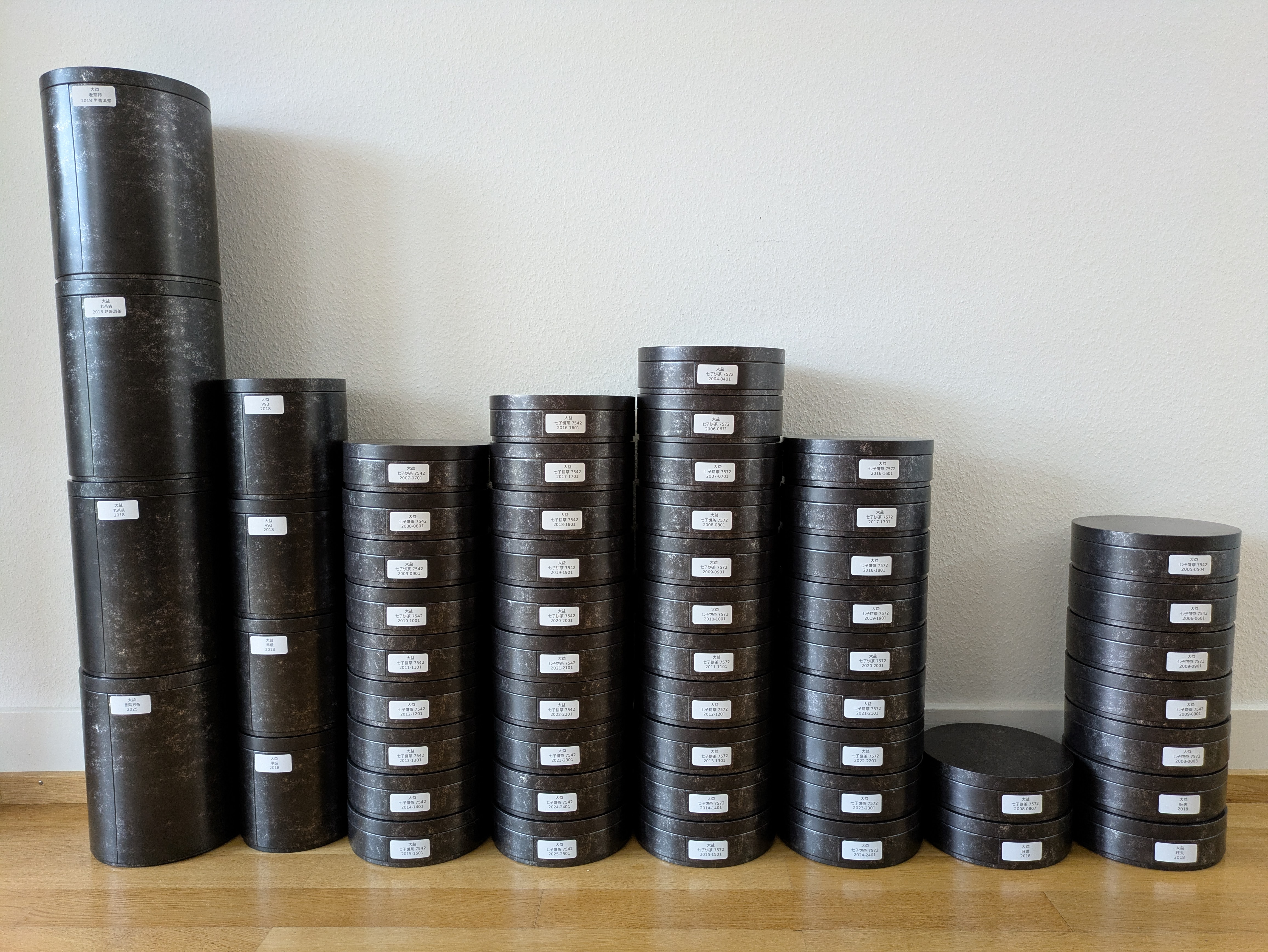
P ' r ch  storage (in Western Europe) Image: some D y P r ch stored at home
1. Location
1.1 No light Choose a location with neither direct nor indirect sunlight (= ultraviolet radiation) exposure:
  • direct sunlight damages organic material ( bleeching )
  • indirect sunlight by heating up the containers inbalances the microclimate ( suppression )
1.2 No odors Choose a location with neither direct nor indirect odor exposure:
  • direct odor immissions (like incense, food, air polution, etc.) makes the tea undrinkable
  • indirect odor immissions (especially other teas stored next to it) taint the taste and dilute the flavours
Always use individual containers for each tea, store only identical tea of the same year and batch in the same container. Idealy never store one cake, brick or tuo on its own, buy multiples and store them together for better ageing.
2. Climate
2.1 Consistent temperature Use a location with no interference from any devices or structures next to it:
  • use an regular indoor location for mild temperature curves (i.e. no attics with large day/night temperature differences)
  • aim for >= 20 C average temperature for natural storage (i.e. no cold basements)
  • don t use a place next to any heat dissipating devices (like radiators, computers, etc.)
  • don t use a place next to an outside facing wall
  • always leave 5 to 10cm distance to a wall for air to circulate (generally prevents mold on the wall but also isolates the containers further from possible immissions)
As consistent temperature as possible allows even and steady fermentation. However, neither air conditioning or filtering is needed. Regular day to day, day to night, and season to season fluctuations are balanced out fine with otherwise correct indoor storage. Also humidity control is much more important for storage and ageing, and much less forgiving than temperature control.
2.2 Consistent humidity Use humidity control packs to ensure a stable humidity level:
  • aim for ~65% RH
Lower than 60% RH will (completely) dry out the tea, higher than 70% RH increases chances for mold.
3. Equipment
3.1 Proper containers Use containers that are long term available and that are easily stackable, both in form and dimensions as well as load-bearing capacity. They should be inexpensive, otherwise it s most likely scam (there are people selling snake-oil containers specifically for tea storage). For long term storage and ageing:
  • never use plastic: they leak chemicals over time (no tupperdors , mylar and zip lock bags, etc.)
  • never use cardboard or bamboo: they let to much air in, absorb too much humity and dry to slow
  • never use wood: they emit odors (no humidors)
  • never use clay: they absorb all humidity and dry out the tea (glazed or porcelain urns are acceptable for short term storage)
Always use sealed but not air tight, cleaned steal cans (i.e. with no oil residues from manufacturing; such as these).
3.2 Proper humidity control Use two-way humidity control packs to either absorb or add moisture depending on the needs:
  • use humidity control pack(s) in every container
  • use one 60g pack (such as these) per 500g of tea
3.3 Proper labels Put labels on the outside of the containers to not need to open them to know what is inside and disturbe the ageing:
  • write at least manufacturer and name, pressing year, and batch number on the label (such as these)
  • if desired and not otherwise kept track already elsewhere, add additional information such as the amount of items, weights, previous storage location/type, date of purchase, vendor, or price, etc.
3.4 Proper monitoring Measuring and checking temperature and humidity regularly prevents storage parameters turning bad going unnoticed:
  • put temperature and humidity measurement sensors (such as these) inside some of the containers (e.g. at least one in every different size/type of container)
  • keep at least one temperature and humidity measurement sensor next to the containers on the outside to monitor the storage location
4. Storage
4.1 Continued maintenance Before beginning to initially store a new tea, let it acclimatize for 2h after unpacking from transport (or longer if temperature differences between indoors and outdoors are high, i.e. in winter). Then continuesly:
  • once a month briefly air all containers for a minute or two
  • once a month check for mold, just to be safe
  • every 3 to 6 months check all humidity control packs for need of replacement
  • monitor battery life of temperature and humidity measurement sensors
Humidity control packs can be recharged (usually voiding any warranty) by submerging them for 2 days in distilled water and 4 hours drying on paper towl afterwards. Check with a weight scale after recharging, they should regain their original weight (e.g. 60g plus ~2 to 5g for the packaging).
Finally With a correct P r ch storage:
  • beginn to drink Sh ng P r ( ) roughly after about 10-15 years, or later
  • beginn to drink Sh u P r ( ) roughly after about 3-5 years, or later
Prepare the tea by breaking it into, or breaking off from it, ~5 to 10g pieces about 1 to 3 months ahead of drinking and consider increase humidity to 70% RH during that time. 2026

31 December 2025

Bits from Debian: DebConf26 dates announced

Alt Debconf26 by Romina Molina As announced in Brest, France, in July, the Debian Conference is heading to Santa Fe, Argentina. The DebConf26 team and the local organizers team in Argentina are excited to announce Debconf26 dates, the 27th edition of the Debian Developers and Contributors Conference: DebCamp, the annual hacking session, will run from Monday July 13th to Sunday to July 19th 2026, followed by DebConf from Monday July 20th to Saturday July 25th 2026. For all those who wish to meet us in Santa Fe, the next step will be the opening of registration on January 26, 2026. The call for proposals period for anyone wishing to submit a conference or event proposal will be launched on the same day. DebConf26 is looking for sponsors; if you are interested or think you know of others who would be willing to help, please have a look at our sponsorship page and get in touch with sponsors@debconf.org. About Debian The Debian Project was founded in 1993 by Ian Murdock to be a truly free community project. Since then the project has grown to be one of the largest and most influential Open Source projects. Thousands of volunteers from all over the world work together to create and maintain Debian software. Available in 70 languages, and supporting a huge range of computer types, Debian calls itself the universal operating system. About DebConf DebConf is the Debian Project's developer conference. In addition to a full schedule of technical, social and policy talks, DebConf provides an opportunity for developers, contributors and other interested people to meet in person and work together more closely. It has taken place annually since 2000 in locations as varied as Scotland, Bosnia and Herzegovina, India, Korea. More information about DebConf is available from https://debconf.org/. For further information, please visit the DebConf26 web page at https://debconf26.debconf.org/ or send mail to press@debian.org. Debconf26 is made possible by Proxmox and others.

Sergio Cipriano: Zero-Code Instrumentation of an Envoy TCP Proxy using eBPF

Zero-Code Instrumentation of an Envoy TCP Proxy using eBPF I recently had to debug an Envoy Network Load Balancer, and the options Envoy provides just weren't enough. We were seeing a small number of HTTP 499 errors caused by latency somewhere in our cloud, but it wasn't clear what the bottleneck was. As a result, each team had to set up additional instrumentation to catch latency spikes and figure out what was going on. My team is responsible for the LBaaS product (Load Balancer as a Service) and, of course, we are the first suspects when this kind of problem appear. Before going for the current solution, I read a lot of Envoy's documentation. It is possible to enable access logs for Envoy, but they don't provide the information required for this debug. This is an example of the output:
[2025-12-08T20:44:49.918Z] "- - -" 0 - 78 223 1 - "-" "-" "-" "-" "172.18.0.2:8080"
I won't go into detail about the line above, since it's not possible to trace the request using access logs alone. Envoy also has OpenTelemetry tracing, which is perfect for understanding sources of latency. Unfortunatly, it is only available for Application Load Balancers. Most of the HTTP 499 were happening every 10 minutes, so we managed to get some of the requests with tcpdump, Wireshark and using http headers to filter the requests. This approach helped us reproduce and track down the problem, but it wasn't a great solution. We clearly needed better tools to catch this kind of issue the next time it happened. Therefore, I decided to try out OpenTelemetry eBPF Instrumentation, also referred to as OBI. I saw the announcement of Grafana Beyla before it was renamed to OBI, but I didn't have the time or a strong reason to try it out until now. Even then, I really liked the idea, and the possibility of using eBPF to solve this instrumentation problem had been in the back of my mind. OBI promises zero-code automatic instrumentation for Linux services using eBPF, so I put together a minimal setup to see how well it works.

Reproducible setup I used the following tools: Setting up a TCP Proxy with Envoy was straightforward:
static_resources:
  listeners:
  - name: go_server_listener
    address:
      socket_address:
        address: 0.0.0.0
        port_value: 8000
    filter_chains:
    - filters:
      - name: envoy.filters.network.tcp_proxy
        typed_config:
          "@type": type.googleapis.com/envoy.extensions.filters.network.tcp_proxy.v3.TcpProxy
          stat_prefix: go_server_tcp
          cluster: go_server_cluster
  clusters:
  - name: go_server_cluster
    connect_timeout: 1s
    type: LOGICAL_DNS
    load_assignment:
      cluster_name: go_server_cluster
      endpoints:
      - lb_endpoints:
        - endpoint:
            address:
              socket_address:
                address: target-backend
                port_value: 8080
This is the simplest Envoy TCP proxy configuration: a listener on port 8000 forwarding traffic to a backend running on port 8080. For the backend, I used a basic Go HTTP server:
package main

import (
    "fmt"
    "net/http"
)

func main()  
    http.Handle("/", http.FileServer(http.Dir(".")))

    server := http.Server Addr: ":8080" 

    fmt.Println("Starting server on :8080")
    panic(server.ListenAndServe())
 
Finally, I wrapped everything together with Docker Compose:
services:
  autoinstrumenter:
    image: otel/ebpf-instrument:main
    pid: "service:envoy"
    privileged: true
    environment:
      OTEL_EBPF_TRACE_PRINTER: text
      OTEL_EBPF_OPEN_PORT: 8000

  envoy:
    image: envoyproxy/envoy:v1.33-latest
    ports:
      - 8000:8000
    volumes:
      - ./envoy.yaml:/etc/envoy/envoy.yaml 
    depends_on:
      - target-backend
  
  target-backend:
    image: golang:1.22-alpine
    command: go run /app/backend.go
    volumes:
      - ./backend.go:/app/backend.go:ro
    expose:
      - 8080
OBI should output traces to the standard output similar to this when a HTTP request is made to Envoy:
2025-12-08 20:44:49.12884449 (305.572 s[305.572 s]) HTTPClient 200 GET /(/) [172.18.0.3 as envoy:36832]->[172.18.0.2 as localhost:8080] contentLen:78B responseLen:0B svc=[envoy generic] traceparent=[00-529458a2be271956134872668dc5ee47-6dba451ec8935e3e[06c7f817e6a5dae2]-01]
2025-12-08 20:44:49.12884449 (1.260901ms[366.65 s]) HTTP 200 GET /(/) [172.18.0.1 as 172.18.0.1:36282]->[172.18.0.3 as envoy:8000] contentLen:78B responseLen:223B svc=[envoy generic] traceparent=[00-529458a2be271956134872668dc5ee47-06c7f817e6a5dae2[0000000000000000]-01]
This is exactly what we needed, with zero-code. The above trace shows:
  • 2025-12-08 20:44:49.12884449: time of the trace.
  • (1.260901ms[366.65 s]): total response time for the request, with the actual internal execution time of the request (not counting the request enqueuing time).
  • HTTP 200 GET /: protocol, response code, HTTP method, and URL path.
  • [172.18.0.1 as 172.18.0.1:36282]->[172.18.0.3 as envoy:8000]: source and destination host:port. The initial request originates from my machine through the gateway (172.18.0.1), hits the Envoy (172.23.0.3), the proxy then forwards it to the backend application (172.23.0.2).
  • contentLen:78B: HTTP Content-Length. I used curl and the default request size for it is 78B.
  • responseLen:223B: Size of the response body.
  • svc=[envoy generic]: traced service.
  • traceparent: ids to trace the parent request. We can see that the Envoy makes a request to the target and this request has the other one as parent.
Let's add one more Envoy to show that it's also possible to track multiple services.
  envoy1:
    image: envoyproxy/envoy:v1.33-latest
    ports:
      - 9000:9000
    volumes:
      - ./envoy1.yaml:/etc/envoy/envoy.yaml
    depends_on:
      - envoy
The new Envoy will listen on port 9000 and forward the request to the other Envoy listening on port 8000. Now we just need to change OBI open port variable to look at a range:
OTEL_EBPF_OPEN_PORT: 8000-9000
And change the pid field of the autoinstrumenter service to use the host's PID namespace inside the container:
pid: host
This is the output I got after one curl:
2025-12-09 12:28:05.12912285 (2.202041ms[1.524713ms]) HTTP 200 GET /(/) [172.19.0.1 as 172.19.0.1:59030]->[172.19.0.5 as envoy:9000] contentLen:78B responseLen:223B svc=[envoy generic] traceparent=[00-69977bee0c2964b8fe53cdd16f8a9d19-856c9f700e73bf0d[0000000000000000]-01]
2025-12-09 12:28:05.12912285 (1.389336ms[1.389336ms]) HTTPClient 200 GET /(/) [172.19.0.5 as envoy:59806]->[172.19.0.4 as localhost:8000] contentLen:78B responseLen:0B svc=[envoy generic] traceparent=[00-69977bee0c2964b8fe53cdd16f8a9d19-caa7f1ad1c68fa77[856c9f700e73bf0d]-01]
2025-12-09 12:28:05.12912285 (1.5431ms[848.574 s]) HTTP 200 GET /(/) [172.19.0.5 as 172.19.0.5:59806]->[172.19.0.4 as envoy:8000] contentLen:78B responseLen:223B svc=[envoy generic] traceparent=[00-69977bee0c2964b8fe53cdd16f8a9d19-cbca9d64d3d26b40[caa7f1ad1c68fa77]-01]
2025-12-09 12:28:05.12912285 (690.217 s[690.217 s]) HTTPClient 200 GET /(/) [172.19.0.4 as envoy:34256]->[172.19.0.3 as localhost:8080] contentLen:78B responseLen:0B svc=[envoy generic] traceparent=[00-69977bee0c2964b8fe53cdd16f8a9d19-5502f7760ed77b5b[cbca9d64d3d26b40]-01]
2025-12-09 12:28:05.12912285 (267.9 s[238.737 s]) HTTP 200 GET /(/) [172.19.0.4 as 172.19.0.4:34256]->[172.19.0.3 as backend:8080] contentLen:0B responseLen:0B svc=[backend go] traceparent=[00-69977bee0c2964b8fe53cdd16f8a9d19-ac05c7ebe26f2530[5502f7760ed77b5b]-01]
Each log line represents a span belonging to the same trace (69977bee0c2964b8fe53cdd16f8a9d19). For readability, I ordered the spans by their traceparent relationship, showing the request's path as it moves through the system: from the client-facing Envoy, through the internal Envoy hop, and finally to the Go backend. You can see both server-side (HTTP) and client-side (HTTPClient) spans at each hop, along with per-span latency, source and destination addresses, and response sizes, making it easy to pinpoint where time is spent along the request chain. The log lines are helpful, but we need better ways to visualize the traces and the metrics generated by OBI. I'll share another setup that more closely reflects what we actually use.

Production setup I'll be using the following tools this time: The goal of this setup is to mirror an environment similar to what I used in production. This time, I've omitted the load balancer and shifted the emphasis to observability instead. setup diagram I will run three HTTP servers on port 8080: two inside Incus containers and one on the host machine. The OBI process will export metrics and traces to an OpenTelemetry Collector, which will forward traces to Jaeger and expose a metrics endpoint for Prometheus to scrape. Grafana will also be added to visualize the collected metrics using dashboards. The aim of this approach is to instrument only one of the HTTP servers while ignoring the others. This simulates an environment with hundreds of Incus containers, where the objective is to debug a single container without being overwhelmed by excessive and irrelevant telemetry data from the rest of the system. OBI can filter metrics and traces based on attribute values, but I was not able to filter by process PID. This is where the OBI Collector comes into play, it allows me to use a processor to filter telemetry data by the PID of the process being instrumented. These are the steps to reproduce this setup:
  1. Create the incus containers.
$ incus launch images:debian/trixie server01
Launching server01
$ incus launch images:debian/trixie server02
Launching server02
  1. Start the HTTP server on each container.
$ apt install python3 --update -y
$ tee /etc/systemd/system/server.service > /dev/null <<'EOF'
[Unit]
Description=Python HTTP server
After=network.target
[Service]
User=root
Group=root
Type=simple
ExecStart=/usr/bin/python3 -m http.server 8080
Restart=always
StandardOutput=journal
StandardError=journal
[Install]
WantedBy=multi-user.target
EOF
$ systemctl start server.service
  1. Start the HTTP server on the host.
$ python3 -m http.server 8080
  1. Start the Docker compose.
services:
  autoinstrumenter:
    image: otel/ebpf-instrument:main
    pid: host
    privileged: true
    environment:
      OTEL_EBPF_CONFIG_PATH: /etc/obi/obi.yml 
    volumes:
      - ./obi.yml:/etc/obi/obi.yml

  otel-collector:
    image: otel/opentelemetry-collector-contrib:0.98.0
    command: ["--config=/etc/otel-collector-config.yml"]
    volumes:
      - ./otel-collector-config.yml:/etc/otel-collector-config.yml
    ports:
      - "4318:4318" # Otel Receiver
      - "8889:8889" # Prometheus Scrape
    depends_on:
      - autoinstrumenter
      - jaeger
      - prometheus

  prometheus:
    image: prom/prometheus
    volumes:
      - ./prometheus.yml:/etc/prometheus/prometheus.yml
    ports:
      - "9090:9090" # Prometheus UI

  grafana:
    image: grafana/grafana
    restart: always
    environment:
      - GF_SECURITY_ADMIN_USER=admin
      - GF_SECURITY_ADMIN_PASSWORD=RandomString123!
    volumes:
      - ./grafana-ds.yml:/etc/grafana/provisioning/datasources/datasource.yml
    ports:
      - "3000:3000" # Grafana UI

  jaeger:
    image: jaegertracing/all-in-one
    container_name: jaeger
    ports:
      - "16686:16686" # Jaeger UI
      - "4317:4317"  # Jaeger OTLP/gRPC Collector
Here's what the configuration files look like:
  • obi.yml:
log_level: INFO
trace_printer: text

discovery:
  instrument:
    - open_ports: 8080

otel_metrics_export:
  endpoint: http://otel-collector:4318
otel_traces_export:
  endpoint: http://otel-collector:4318
  • prometheus.yml:
global:
  scrape_interval: 5s

scrape_configs:
  - job_name: 'otel-collector'
    static_configs:
      - targets: ['otel-collector:8889']
  • grafana-ds.yml:
apiVersion: 1

datasources:
  - name: Prometheus
    type: prometheus
    access: proxy
    url: http://prometheus:9090
    isDefault: true
  • otel-collector-config.yml:
receivers:
  otlp:
    protocols:
      http:
        endpoint: otel-collector:4318

exporters:
  otlp/jaeger:
    endpoint: jaeger:4317
    tls:
      insecure: true

  prometheus:
    endpoint: 0.0.0.0:8889
    namespace: default

service:
  pipelines:
    traces:
      receivers: [otlp]
      exporters: [otlp/jaeger]

    metrics:
      receivers: [otlp] 
      exporters: [prometheus]
We're almost there, the OpenTelemetry Collector is just missing a processor. To create the processor filter, we can look at the OBI logs to find the PID of the HTTP server being instrumented:
autoinstrumenter-1    time=2025-12-30T19:57:17.593Z level=INFO msg="instrumenting process" component=discover.traceAttacher cmd=/usr/bin/python3.13 pid=297514 ino=460310 type=python service=""
autoinstrumenter-1    time=2025-12-30T19:57:18.320Z level=INFO msg="instrumenting process" component=discover.traceAttacher cmd=/usr/bin/python3.13 pid=310288 ino=722998 type=python service=""
autoinstrumenter-1    time=2025-12-30T19:57:18.512Z level=INFO msg="instrumenting process" component=discover.traceAttacher cmd=/usr/bin/python3.13 pid=315183 ino=2888480 type=python service=""
Which can also be obtained using standard GNU/Linux utilities:
$ cat /sys/fs/cgroup/lxc.payload.server01/system.slice/server.service/cgroup.procs 
297514
$ cat /sys/fs/cgroup/lxc.payload.server02/system.slice/server.service/cgroup.procs 
310288
$ ps -aux   grep http.server
USER         PID %CPU %MEM    VSZ   RSS TTY      STAT START   TIME COMMAND
1000000   297514  0.0  0.1  32120 14856 ?        Ss   16:03   0:00 /usr/bin/python3 -m http.server 8080
1000000   310288  0.0  0.1  32120 10616 ?        Ss   16:09   0:00 /usr/bin/python3 -m http.server 8080
cipriano  315183  0.0  0.1 103476 11480 pts/3    S+   16:17   0:00 python -m http.server 8080
If we search for the PID in the OpenTelemetry Collector endpoint where Prometheus metrics are exposed, we can find the attribute values to filter on.
$ curl http://localhost:8889/metrics   rg 297514
default_target_info host_id="148f400ad3ea",host_name="148f400ad3ea",instance="148f400ad3ea:297514",job="python3.13",os_type="linux",service_instance_id="148f400ad3ea:297514",service_name="python3.13",telemetry_sdk_language="python",telemetry_sdk_name="opentelemetry-ebpf-instrumentation",telemetry_sdk_version="main"  1
Now we just need to add the processor to the collector configuration:
processors: # <--- NEW BLOCK
  filter/host_id:
    traces:
      span:
        - 'resource.attributes["service.instance.id"] == "148f400ad3ea:297514"'

service:
  pipelines:
    traces:
      receivers: [otlp]
      processors: [filter/host_id] # <--- NEW LINE
      exporters: [otlp/jaeger]

    metrics:
      receivers: [otlp] 
      processors:  # <--- NEW BLOCK
        - filter/host_id
      exporters: [prometheus]
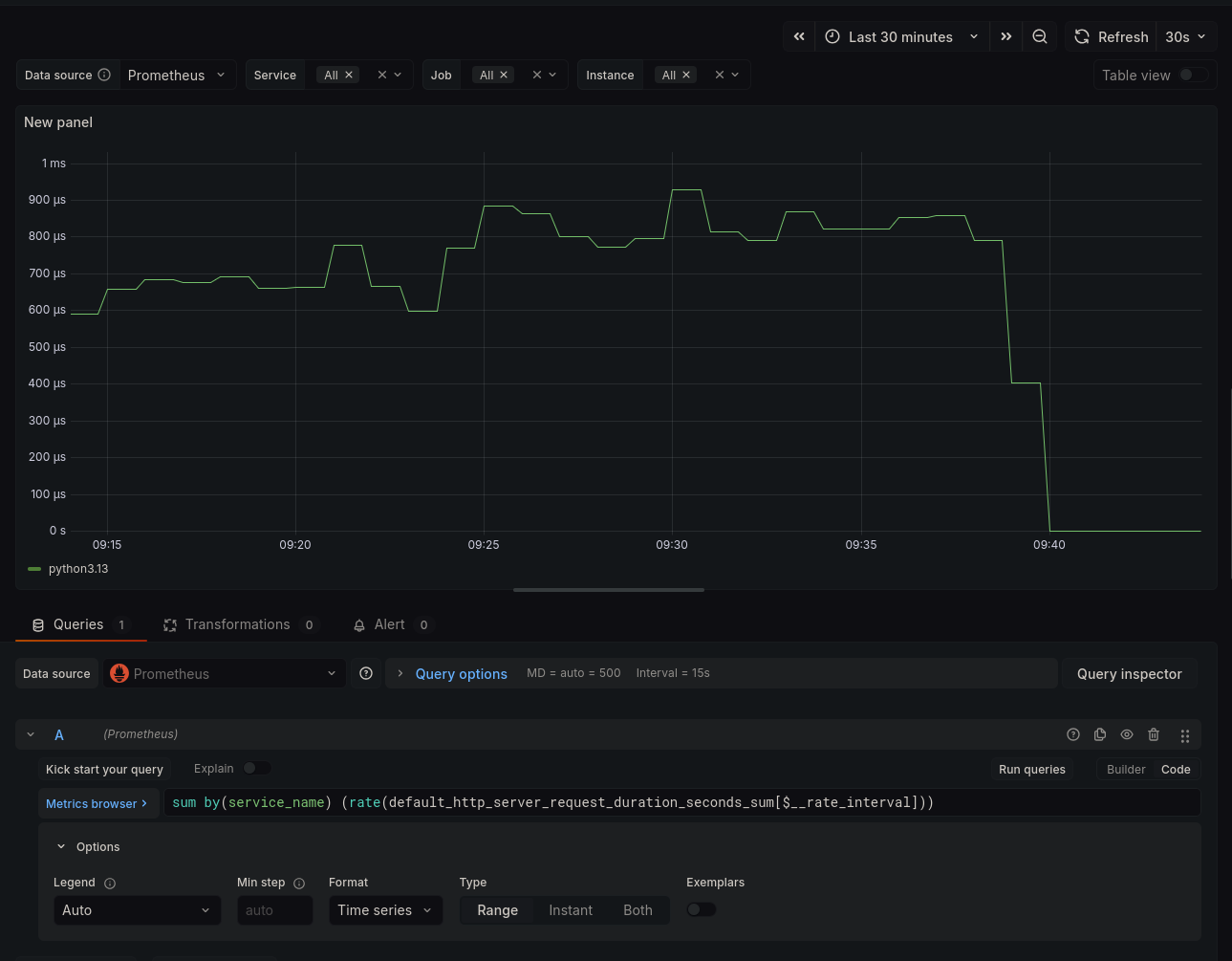
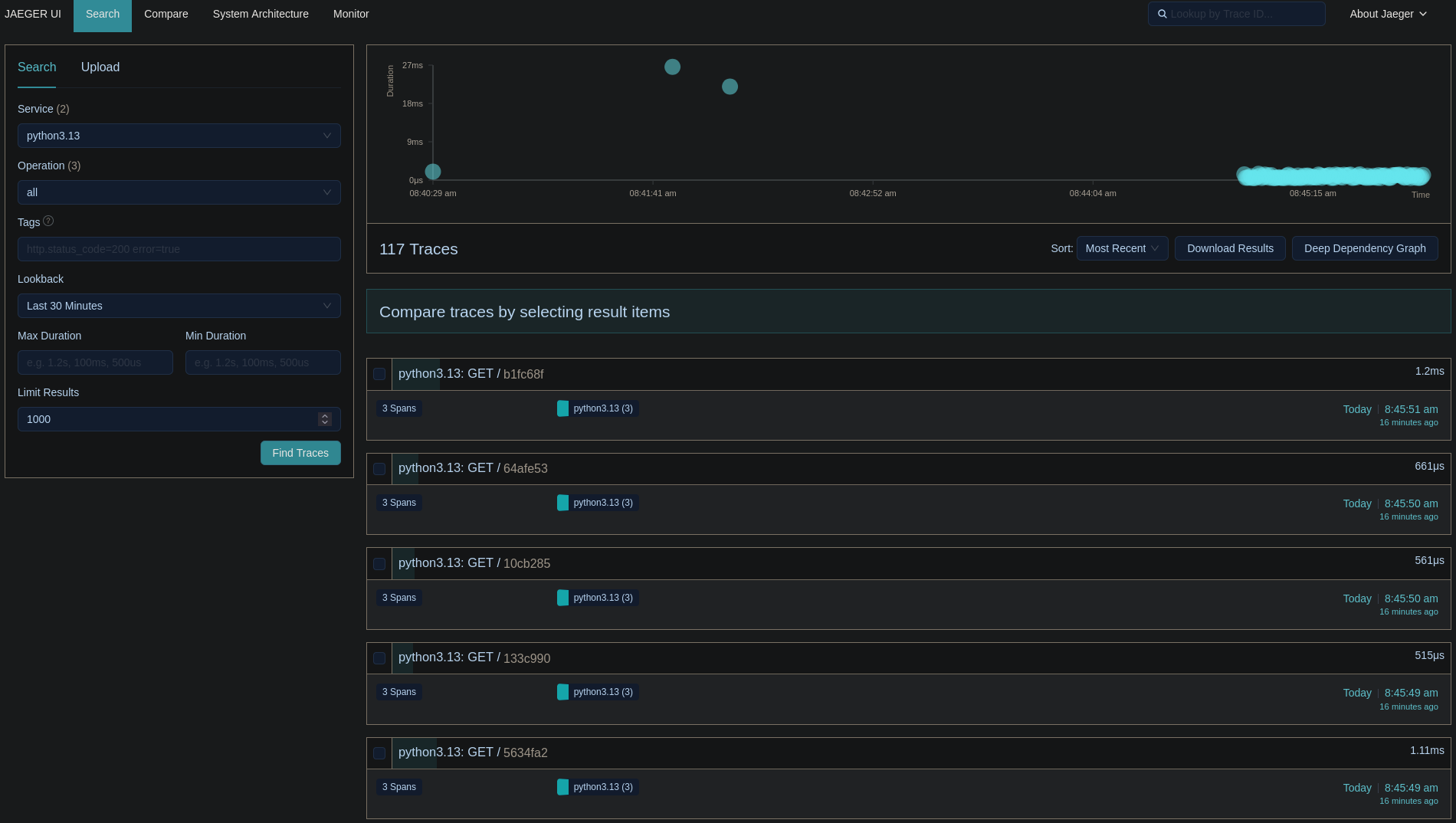
That's it! The processor will handle the filtering for us, and we'll only see traces and metrics from the HTTP server running in the server01 container. Below are some screenshots from Jaeger and Grafana: jaeger search will all traces one jaeger trace grafana request duration panel

Closing Notes I am still amazed at how powerful OBI can be. For those curious about the debug, we found out that a service responsible for the network orchestration of the Envoy containers was running netplan apply every 10 minutes because of a bug. Netplan apply causes interfaces to go down temporarily and this made the latency go above 500ms which caused the 499s.

Ravi Dwivedi: Transit through Kuala Lumpur

In my last post, Badri and I reached Kuala Lumpur - the capital of Malaysia - on the 7th of December 2024. We stayed in Bukit Bintang, the entertainment district of the city. Our accommodation was pre-booked at Manor by Mingle , a hostel where I had stayed for a couple of nights in a dormitory room earlier in February 2024. We paid 4937 rupees (the payment was online, so we paid in Indian rupees) for 3 nights for a private room. From the Terminal Bersepadu Selatan (TBS) bus station, we took the metro to the Plaza Rakyat LRT station, which was around 500 meters from the hostel. Upon arriving at the hostel, we presented our passports at their request, followed by a 20 ringgit (400 rupee) deposit which would be refunded once we returned the room keys at checkout.
Outside view of the hostel Manor by Mingle Manor by Mingle - the hostel where we stayed at during our KL transit. Photo by Ravi Dwivedi. Released under the CC-BY-SA 4.0.
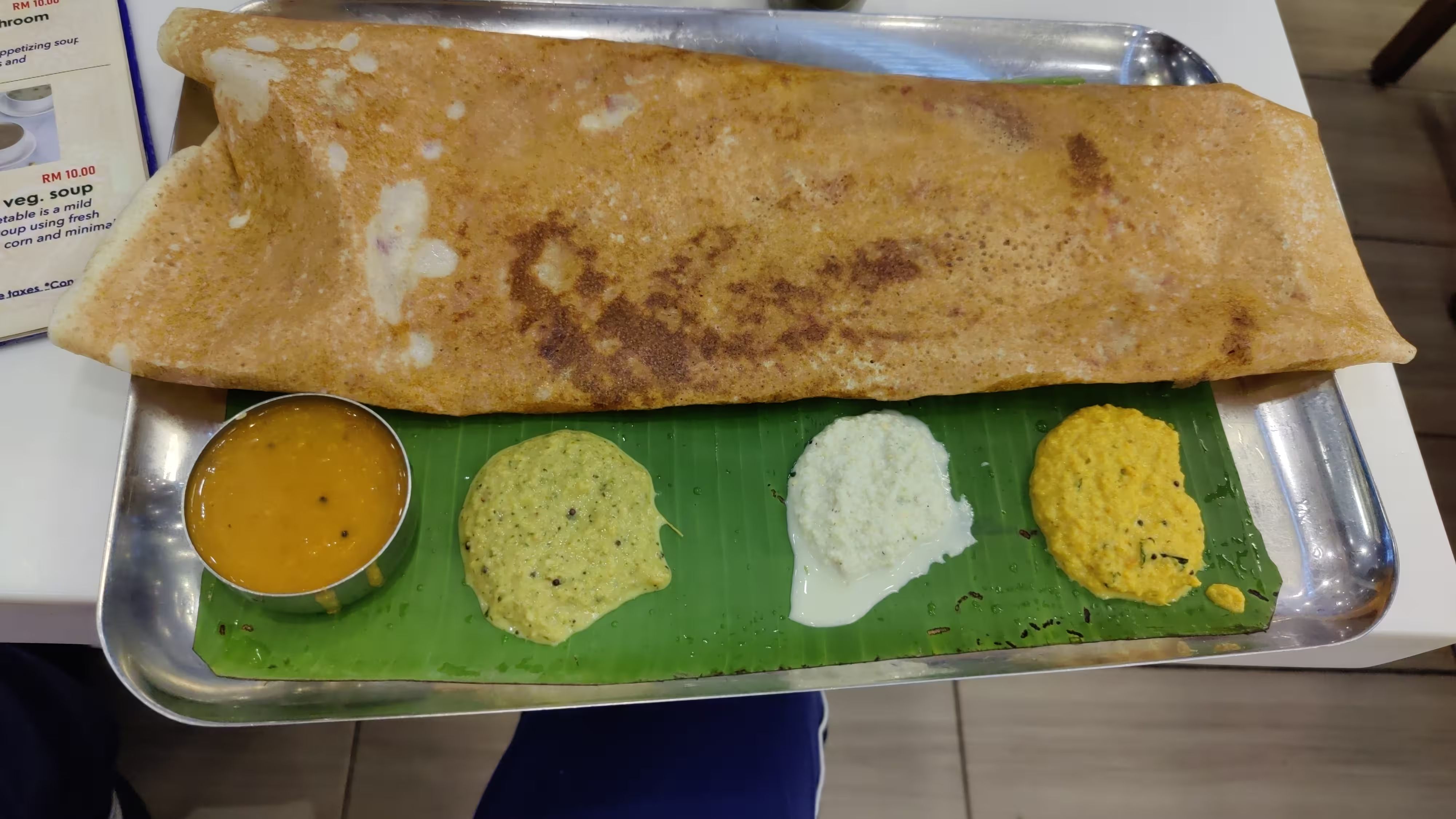
Our room was upstairs and it had a bunk bed. I had seen bunk beds in dormitories before, but this was my first time seeing a bunk bed in a private room. The room did not have any toilets, so we had to use shared toilets. Unusually, the hostel was equipped with a pool. It also had a washing machine with dryers - this was one of the reasons we chose this hostel, because we were traveling light and hadn t packed too many clothes. The machine and dryer cost 10 ringgits (200 rupees) per use, and we only used it once. The hostel provided complimentary breakfast, which included coffee. Outside of breakfast hours, there was also a paid coffee machine. During our stay, we visited a gurdwara - a place of worship for Sikhs - which was within walking distance from our hostel. The name of the gurdwara was Gurdwara Sahib Mainduab. However, it wasn t as lively as I had thought. The gurdwara was locked from the inside, and we had to knock on the gate and call for someone to open it. A man opened the gate and invited us in. The gurdwara was small, and there was only one other visitor - a man worshipping upstairs. We went upstairs briefly, then settled down on the first floor. We had some conversations with the person downstairs who kindly made chai for us. They mentioned that the langar (community meal) is organized on every Friday, which was unlike the gurdwaras I have been to where the langar is served every day. We were there for an hour before we left. We also went to Adyar Ananda Bhavan (a restaurant chain) near our hostel to try the chain in Malaysia. The chain is famous in Southern India and also known by its short name A2B. We ordered
A dosa Dosa served at Adyar Ananda Bhavan. Photo by Ravi Dwivedi. Released under the CC-BY-SA 4.0.
All this came down to around 33 ringgits (including taxes), i.e. around 660 rupees. We also purchased some snacks such as murukku from there for our trip. We had planned a day trip to Malacca, but had to cancel it due to rain. We didn t do a lot in Kuala Lumpur, and it ended up acting as a transit point for us to other destinations: flights from Kuala Lumpur were cheaper than Singapore, and in one case a flight via Kuala Lumpur was even cheaper than a direct flight! We paid 15,000 rupees in total for the following three flights:
  1. Kuala Lumpur to Brunei,
  2. Brunei to Kuala Lumpur, and
  3. Kuala Lumpur to Ho Chi Minh City (Vietnam).
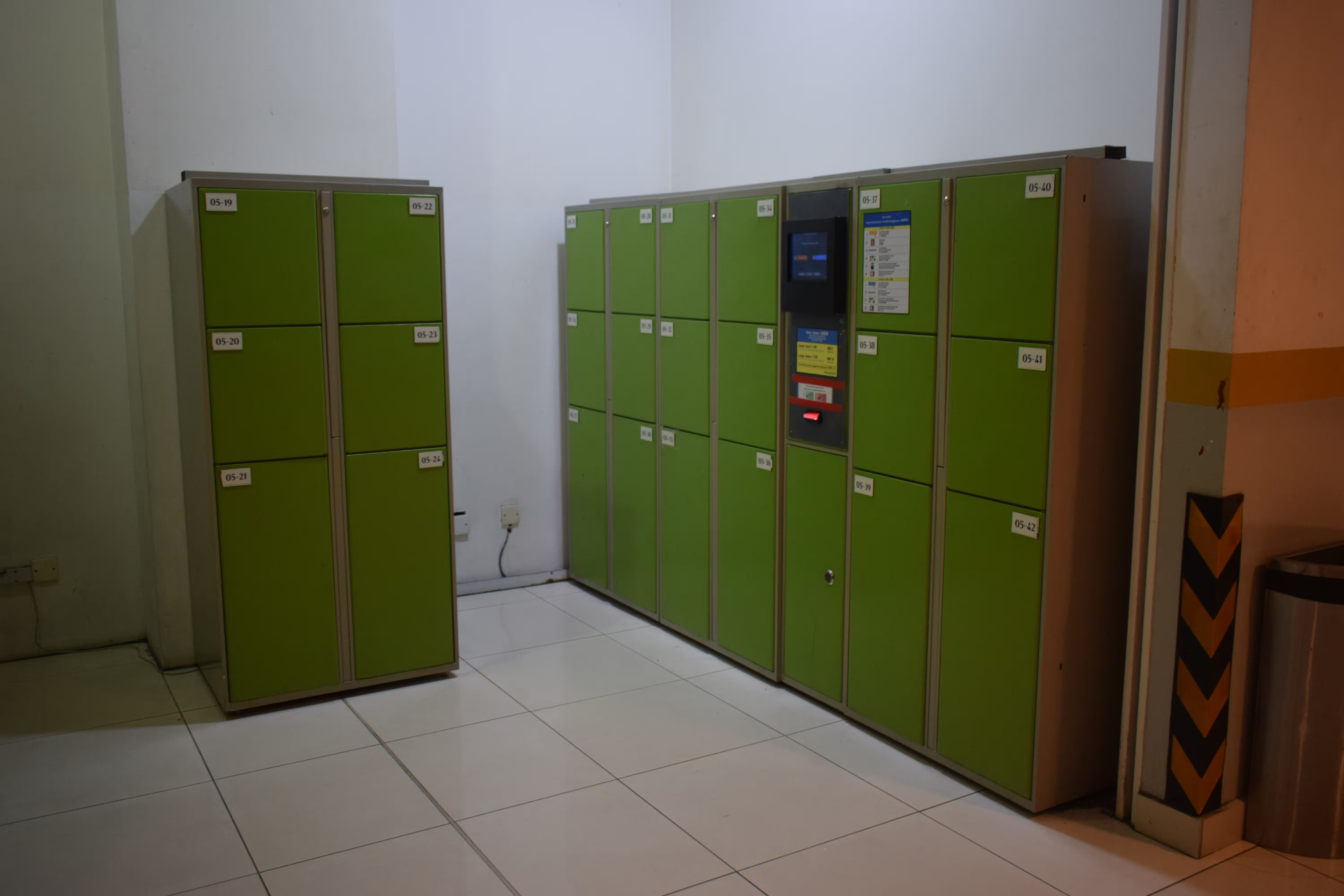
These were all AirAsia flights. The cheap tickets, however, did not include any checked-in luggage, and the cabin luggage weight limit was 7 kg. We also bought quite some stuff in Kuala Lumpur and Singapore, leading to an increase in the weight of our luggage. We estimated that it would be cheaper for us to take only essential items such as clothes, cameras, and laptops, and to leave behind souvenirs and other non-essentials in lockers at the TBS bus stand in Kuala Lumpur, than to pay more for check-in luggage. It would take 140 ringgits for us to add a checked-in bag from Kuala Lumpur to Bandar Seri Begawan and back, while the cost for lockers was 55 ringgits at the rate of 5 ringgits every six hours. We had seen these lockers when we alighted at the bus stand while coming from Johor Bahru. There might have been lockers in the airport itself as well, which would have been more convenient as we were planning to fly back in soon, but we weren t sure about finding lockers at the airport and we didn t want to waste time looking. We had an early morning flight for Brunei on the 10th of December. We checked out from our hostel on the night of the 9th of December, and left for TBS to take a bus to the airport. We took a metro from the nearest metro station to TBS. Upon reaching there, we put our luggage in the lockers. The lockers were automated and there was no staff there to guide us.
Lockers at TBS bus station Lockers at TBS bus station. Photo by Ravi Dwivedi. Released under the CC-BY-SA 4.0.

We bought a ticket for the airport bus from a counter at TBS for 26 ringgits for both of us. In order to give us tickets, the person at the counter asked for our passports, and we handed it over to them promptly. Since paying in cash did not provide any extra anonymity, I would advise others to book these buses online. In Malaysia, you also need a boarding pass for buses. The bus terminal had kiosks for getting these printed, but they were broken and we had to go to a counter to obtain them. The boarding pass mentioned our gate number and other details such as our names and departure time of the bus. The company was Jet Bus.
My boarding pass for the bus to the airport in Kuala Lumpur My boarding pass for the bus to the airport in Kuala Lumpur. Photo by Ravi Dwivedi. Released under the CC-BY-SA 4.0.

To go to our boarding gate, we had to scan our boarding pass to let the AFC gates open. Then we went downstairs, leading into the waiting area. It had departure boards listing the bus timings and their respective gates. We boarded our bus around 10 minutes before the departure time - 00:00 hours. It departed at its scheduled time and took 45 minutes to reach KL Airport Terminal 2, where we alighted. We reached 6 hours before our flight s departure time of 06:30. We stopped at a convenience store at the airport to have some snacks. Then we weighed our bags at a weighing machine to check whether we were within the weight limit. It turned out that we were. We went to an AirAsia counter to get our boarding passes. The lady at our counter checked our Brunei visas carefully and looked for any Brunei stamps on the passports to verify whether we had used that visa in the past. However, she didn t weigh our bags to check whether they were within the limit, and gave us our boarding passes. We had more than 4 hours to go before our flight. This was the downside of booking an early morning flight - we weren t able to get a full night s sleep. A couple of hours before our flight time, we were hanging around our boarding gate. The place was crowded, so there were no seats available. There were no charging points. There was a Burger King outlet there which had some seating space and charging points. As we were hungry, we ordered two cups of cappuccino coffee (15.9 ringgits) and one large french fries (8.9 ringgits) from Burger King. The total amount was 24 ringgits. When it was time to board the flight, we went to the waiting area for our boarding gates. Soon, we boarded the plane. It took 2.5 hours to reach the Brunei International Airport in the capital city of Bandar Seri Begawan.
View of Kuala Lumpur from the aeroplane View of Kuala Lumpur from the aeroplane. Photo by Ravi Dwivedi. Released under the CC-BY-SA 4.0.

Stay tuned for our experiences in Brunei! Credits: Thanks to Badri, Benson and Contrapunctus for reviewing the draft.

Petter Reinholdtsen: Some of my 2025 free software activities

I guess it is about time I posted a new summary of the free software and open culture activites and projects I have been involved in the last year. The days have been so packed the last year that I have failed with my intention to post at least one blog post per month, so this summary became rather long. I am sorry about this. This year was the year I got tired of the lack of new releases of the multimedia related libraries published via Xiph, and I decided to wrap up the current state and make the releases myself. In a burst of activity early this year, I collected and tested patches, coordinated with other developers and finally made new tarballs and release announcement for theora, and new tarball releases for liboggz, kate and fishsound. This upstreamed several patches accumulated in Debian and other Linux distributions for the last 15 years or so. To change the world and the future, it is important to start with the kids, and one such avenue of change have been created by the current president of FSF Europe, Matthias Kirschner. He wrote a book for children, Ada & Zangemann, and I have been involved in its translation framework for the entire year. The source code has been transformed to Docbook and I have been conducting and coordinating translations into Norwegian Bokm l and Nynorsk, as well as preparing paper editions of the book and an animation movie with Norwegian voices. The Bokm l edition is very close to ready, and will be available early in 2026, and the movie release will follow shortly after this. I intend announce this on my blog and elsewhere when this happen. Please get in touch if you want to help spread the word about this book in Norwegian. I hope we can get the author to Norway when making the Norwegian releases. This year I continued a push for the system I made a few years ago to improve hardware dongle handling on Linux. The Isenkram system use hardware mapping information provided by relevant packages using the AppStream system to propose which Linux distribution packages to install on a given machine to support dongles like cameras, finger print readers, smart card readers, LEGO controllers, ECC memory and other hardware. I have followed up on the list of packages providing such mapping, either to get it into Debian or to upstream the necessary metadata. I am not sure if we are at a point where package maintainers on their own add such information to their packages, but there are Debian lintian reports suggesting it and I have send patches to all packages I am aware of that should include such mappings. Most of the patches are included in Debian now, only 27 was left the last time I checked. As part of my involvement with Debian, I continued my push to get all orphaned packages without a version control repository migrated to git. I am not sure how many packages I went through, but it was in the range of 200-300 packages. In addition to this I updated, sponsored, pushed maintainers for updates upstreamed patches for and fixed RC issues with battery-stats, bs1770gain, isenkram, libonvif, mfiutil, opensnitch, simplescreenrecorder, vlc-plugin-bittorrent and wakeonlan. I've also followed up LEGO related packages, dahdi support for Asterisk, llama.cpp and whisper.cpp in particular for the AMD GPU I was donated by AMD, as well as tried yet again to convince the upstream developers of the photogrammetric workstion e-foto to get their program into a state that could be included in Debian. As I do not buy into the story that it is great to expose oneself to the whims of and priorities of commercial entities to have access to cultural expressions like films and music, I still maintain a huge collection of movies. For this to work well, I have ended up as part of the people maintaining lsdvd upstream and wrapped up a new release fixing several crash bugs caused by DVDs with intentionally broken metadata, and introduced code to list a DVD ID in the lsdvd output. Related to this, I have also worked some add-ons for my main video and music player, and took over upstream maintenance of the Invidious add-on, which sadly stopped working for non-authenticated users when web scrapers made it impossible for Invidious installations to provide a open API, as well as contributed to the NRK and projector control add-ons. As part of my involvement in the Norwegian archiving community and standardisation work, we organised a Noark 5 workshop this spring discussing how to decide what to keep and what to delete in digital archives. We finally managed to apply for Noark 5 certification for the free software archive API Nikita, as well as worked to test and improve the performance of Nikita together with people on my day job at the university. Manufacturing using Free Software is still a focus for me, and I have continued my involved with the LinuxCNC community, organising a developer gathering this summer with the help and sponsoring from the initial start in 2023 from NUUG Foundation and sponsoring from Debian and Redpill-Linpro. We plan to repeat the event also in 2026, but this time NUUG Foundation have told us they do not want a role, so we have found another friendly organisation to handle the money. A popular machine controller with LinuxCNC is the MESA set of electronics, which is centred around a FPGA which now can be programmed using only Free Software. We discussed during this summers gathering how hard it would be to compile the current FPGA source using a Free Software tool chain, and I started looking into this, locating tools to transform the VHDL source into something the Yosys tool chain can handle. Still lot to do there, and I hope to get further next year. An important part of Free Software manufacturing is the ability to design parts and create programs that can be passed to machines making parts, also known as CAD/CAM. The most prominent project for this is FreeCAD, and I have been both pushing to get opencamlib integrated with it in Debian as well as fixing bugs in the handling of Fanuc controlled machines, do make it easier to generate instructions for machines I have access to. I expect to also continue this also next year. This year the UN conference Internet Governance Forum (IGF) was held in Norway, and I tried my best to get a stand for the Norwegian Unix Users Group (NUUG) there. Sadly the effort failed, due to lack of interest with the NUUG Board, but I was happy to see several members at least attend some of the activities related to IGF. Sadly to participate at IGF one need to hand over quite private information, so I decided not to participate in any of the closed forum events myself. Related to NUUG I have been a member of the election board proposing board member candidates to the general assembly, and been part of the program committee of the "Big Tech m vekk" (Big Tech must go away) festival organised by Attac in concert with NUUG and EFN. I've also assisted the Norwegian open TV channel Frikanalen with access to their machines located in a machine room at the university. Related to the University, I have become involved in a small team of students working to build and program robots for the Robocup@Home competition. For 2026 we also plan to use the new features of FreeCAD to make parts for the open hardware robot arm OpenArm. This is also the group that will handle the money for the LinuxCNC gathering in 2026. Also related to the university I was looking into the Linux security auditing system Falco earlier this year, making improvements to the detection rules. This activity is on hold at the moment, and do not expect to continue with this in 2026. I will most likely have to cut down a bit on my free software and open culture activities going forward, as NUUG Foundation, who have funded one day a week for such activities for several years no, sadly have decided they do not want to continue doing this. I am very grateful for their contributions over the years, both with freeing up time for me and supporting several events and projects where I have been involved or taken the initiative on. Now they are reorganizing with more focus on paperwork and applications. As usual, if you use Bitcoin and want to show your support of my activities, please send Bitcoin donations to my address 15oWEoG9dUPovwmUL9KWAnYRtNJEkP1u1b.

Chris Lamb: Favourites of 2025

Here are my favourite books and movies that I read and watched throughout 2025.

Books

Eliza Clark: Boy Parts (2020)Rachel Cusk: The Outline Trilogy (2014 2018)Edith Wharton: The House of Mirth (1905)Michael Finkel: The Art Thief (2023)Tony Judt: When the Facts Change: Essays 1995-2010 (2010)Jennette McCurdy: I'm Glad My Mom Died (2022)Joan Didion: The Year of Magical Thinking (2005)Jill Lepore: These Truths: A History of the United States (2018)

Films Recent releases

Disappointments this year included 28 Years Later (Danny Boyle, 2025), Cover-Up (Laura Poitras & Mark Obenhaus, 2025), Bugonia (Yorgos Lanthimos, 2025) and Caught Stealing (Darren Aronofsky, 2025).
Older releases ie. Films released before 2024, and not including rewatches from previous years. Distinctly unenjoyable watches included War of the Worlds (Rich Lee, 2025), Highest 2 Lowest (Spike Lee, 2025), Elizabethtown (Cameron Crowe, 2005), Crazy Rich Asians (Jon M. Chu, 2018) and Spinal Tap II: The End Continues (Rob Reiner, 2025). On the other hand, unforgettable cinema experiences this year included big-screen rewatches of Chinatown (Roman Polanski, 1974), Koyaanisqatsi (Godfrey Reggio, 1982), Heat (Michael Mann, 1995) and Night of the Hunter (Charles Laughton, 1955).

Freexian Collaborators: How files are stored by Debusine (by Stefano Rivera)

Debusine is a tool designed for Debian developers and Operating System developers in general. This post describes how Debusine stores and manages files. Debusine has been designed to run a network of workers that can perform various tasks that consume and produce artifacts . The artifact itself is a collection of files structured into an ontology of artifact types. This generic architecture should be suited to many sorts of build & CI problems. We have implemented artifacts to support building a Debian-like distribution, but the foundations of Debusine aim to be more general than that. For example a package build task takes a debian:source-package as input and produces some debian:binary-packages and a debian:package-build-log as output. This generalized approach is quite different to traditional Debian APT archive implementations, which typically required having the archive contents on the filesystem. Traditionally, most Debian distribution management tasks happen within bespoke applications that cannot share much common infrastructure.

File Stores Debusine s files themselves are stored by the File Store layer. There can be multiple file stores configured, with different policies. Local storage is useful as the initial destination for uploads to Debusine, but it has to be backed up manually and might not scale to sufficiently large volumes of data. Remote storage such as S3 is also available. It is possible to serve a file from any store, with policies for which one to prefer for downloads and uploads. Administrators can set policies for which file stores to use at the scope level, as well as policies for populating and draining stores of files.

Artifacts As mentioned above, files are collected into Artifacts. They combine:
  • a set of files with names (including potentially parent directories)
  • a category, e.g. debian:source-package
  • key-value data in a schema specified by the category and stored as a JSON-encoded dictionary.
Within the stores, files are content-addressed: a file with a given SHA-256 digest is only stored once in any given store, and may be retrieved by that digest. When a new artifact is created, its files are uploaded to Debusine as needed. Some of the files may already be present in the Debusine instance. In that case, if the file is already part of the artifact s workspace, then the client will not need to re-upload the file. But if not, it must be reuploaded to avoid users obtaining unauthorized access to existing file contents in another private workspace or multi-tenant scope. Because the content-addressing makes storing duplicates cheap, it s common to have artifacts that overlap files. For example a debian:upload will contain some of the same files as the related debian:source-package as well as the .changes file. Looking at the debusine.debian.net instance that we run, we can see a content-addressing savings of 629 GiB across our (currently) 2 TiB file store. This is somewhat inflated by the Debian Archive import, that did not need to bother to share artifacts between suites. But it still shows reasonable real-world savings.

APT Repository Representation Unlike a traditional Debian APT repository management tool, the source package and binary packages are not stored directly in the pool of an APT repository on disk on the debusine server. Instead we abstract the repository into a debian:suite collection within the Debusine database. The collection contains the artifacts that make up the APT repository. To ensure that it can be safely represented as a valid URL structure (or files on disk) the suite collection maintains an index of the pool filenames of its artifacts. Suite collections can combine into a debian:archive collection that shares a common file pool. Debusine collections can keep an historical record of when things were added and removed. This, combined with the database-backed collection-driven repository representation makes it very easy to provide APT-consumable snapshot views to every point in a repository s history.

Expiry While a published distribution probably wants to keep the full history of all its package builds, we don t need to retain all of the output of all QA tasks that were run. Artifacts can have an expiration delay or inherit one from their workspace. Once this delay has expired, artifacts which are not being held in any collection are eligible to be automatically cleaned up. QA work that is done in a workspace that has automatic artifact expiry, and isn t publishing the results to an APT suite, will safely automatically expire.

Daily Vacuum A daily vacuum task handles all of the file periodic maintenance for file stores. It does some cleanup of working areas, a scan for unreferenced & missing files, and enforces file store policies. The policy work could be copying files for backup or moving files between stores to keep them within size limits (e.g. from a local upload store into a general cloud store).

In Conclusion Debusine provides abstractions for low-level file storage and object collections. This allows storage to be scalable beyond a single filesystem and highly available. Using content-addressed storage minimizes data duplication within a Debusine instance. For Debian distributions, storing the archive metadata entirely in a database made providing built-in snapshot support easy in Debusine.

kpcyrd: 2025 wrapped

Same as last year, this is a summary of what I ve been up to throughout the year. See also the recap/retrospection published by my friends (antiz, jvoisin, orhun). Thanks to everybody who has been part of my human experience, past or present. Especially those who ve been closest.

30 December 2025

Guido G nther: Phosh 2025 in Retrospect

As in previous, years we took another look back at what changed in Phosh in 2025 and instead of just updating our notes why not again share it again here: The Phosh developers focus from day one was to make devices running Phosh daily drivable without having to resort to any proprietary OSes as a fallback. This year showed improvements in some important areas people rely on like cell broadcasts and emergency calls, further improving usability and starting some ground work we ll need for some upcoming features.

Russ Allbery: Review: Dark Ambitions

Review: Dark Ambitions, by Michelle Diener
Series: Class 5 #4.5
Publisher: Eclipse
Copyright: 2020
ISBN: 1-7637844-2-8
Format: Kindle
Pages: 81
Dark Ambitions is a science fiction romance novella set in Michelle Diener's Class 5 series, following the events of Dark Matters. It returns to Rose as the protagonist and in that sense is a sequel to Dark Horse, but you don't have to remember that book in detail to read this novella. Rose and Dav (and the Class 5 ship Sazo) are escorting an exploration team to a planet that is being evaluated for settlement. Rose has her heart set on going down to the planet, feeling the breeze, and enjoying the plant life. Dav and his ship are called away to deal with a hostage situation. He tries to talk her out of going down without him, but Rose is having none of it. Predictably, hijinks ensue. This is a very slight novella dropped into the middle of the series but not (at least so far as I can tell) important in any way to the overall plot. It provides a bit of a coda to Rose's story from Dark Horse, but given that Rose has made cameos in all of the other books, readers aren't going to learn much new here. According to the Amazon blurb, it was originally published in the Pets in Space 5 anthology. The pet in question is a tiny creature a bit like a flying squirrel that Rose rescues and that then helps Rose in exactly the way that you would predict in this sort of story. This is so slight and predictable that it's hard to find enough to say about it to write a review. Dav is protective in a way that I found annoying and kind of sexist. Rose doesn't let that restrict her decisions, but seems to find this behavior more charming than I did. There is a tiny bit of Rose being awesome but a bit more damsel in distress than the series usually goes for. The cute animal is cute. There's the obligatory armory scene with another round of technomagical weapons that I think has appeared in every book in this series. It all runs on rather obvious rails. There is a subplot involving Rose feeling some mysterious illness while on the planet that annoyed me entirely out of proportion to how annoying it is objectively, mostly because mysterious illnesses tend to ramp up my anxiety, which is not a pleasant reading emotion. This objection is probably specific to me. This is completely skippable. I was told that in advance and thus only have myself to blame, but despite my completionist streak, I wish I'd skipped it. We learn one piece of series information that will probably come up in the future, but it's not the sort of information that would lead me to seek out a story about it. Otherwise, there's nothing wrong with it, really, but it would be a minor and entirely forgettable chapter in a longer novel, padded out with a cute animal and Dav trying to be smothering. Not recommended just because you probably have something better to do with that reading time (reading the next full book of the series, for example), but there's nothing wrong with this if you want to read it anyway. Followed by Dark Class. Rating: 5 out of 10

Utkarsh Gupta: FOSS Activites in December 2025

Here s my monthly but brief update about the activities I ve done in the FOSS world.

Debian
Whilst I didn t get a chance to do much, here are still a few things that I worked on:
  • Prepared security update for wordpress for trixie and bookworm.
  • A few discussions with the new DFSG team, et al.
  • Assited a few folks in getting their patches submitted via Salsa.
  • Mentoring for newcomers.
  • Moderation of -project mailing list.

Ubuntu
I joined Canonical to work on Ubuntu full-time back in February 2021. Whilst I can t give a full, detailed list of things I did, here s a quick TL;DR of what I did:
  • Successfully released Resolute Snapshot 2!
    • This one was also done without the ISO tracker and cdimage access.
    • I think this one went rather smooth. Let s see what we re able to do for snapshot 3.
  • Worked on removing GPG keys from the cdimage instance. That took a while, whew!
  • Assisted a bunch of folks with my Archive Admin and Release team hats to:
    • review NEW packages for Ubuntu Studio.
    • remove old binaries that are stalling transition and/or migration.
    • LTS requalification of Ubuntu flavours.
    • bootstrapping dotnet-10 packages for Stable Release Updates.
  • With that, we ve entered the EOY break. :)
    • I was anyway on vacation for majority of this month. ;)

Debian (E)LTS
This month I have worked 72 hours on Debian Long Term Support (LTS) and on its sister Extended LTS project and did the following things:

Released Security Updates
  • ruby-git: Multiple vulnerabilities leading to command line injection and improper path escaping.
  • ruby-sidekiq: Multiple vulnerabilities leading to Cross-site Scripting (XSS) and Denial of Service in Web UI.
  • python-apt: Vulnerability leading to crash via invalid nullptr dereference in TagSection.keys().
    • [LTS]: Fixed CVE-2025-6966 via 2.2.1.1 for bullseye. This has been released as DLA 4408-1.
    • [ELTS]: Fixed CVE-2025-6966 via 1.8.4.4 for buster and 1.4.4 for stretch. This has been released as ELA 1596-1.
    • All of this was coordinated b/w the Security team and Julian Andres Klode. Julian will take care of the stable uploads.
  • node-url-parse: Vulnerability allowing authorization bypass through specially crafted URL with empty userinfo and no host.
  • wordpress: Multiple vulnerabilities in WordPress core, leading to Sent Data & Cross-site Scripting.
  • usbmuxd: Privilege escalation vulnerability via path traversal in SavePairRecord command.
    • [LTS]: Fixed CVE-2025-66004 via 1.1.1-2+deb11u1 for bullseye. This has been released as DLA 4417-1.
    • [ELTS]: Fixed CVE-2025-66004 via 1.1.1~git20181007.f838cf6-1+deb10u1 for buster and 1.1.0-2+deb9u1 for stretch. This has been released as ELA 1599-1.
    • All of this was coordinated b/w the Security team and Yves-Alexis Perez. Yves will take care of the stable uploads.
  • gst-plugins-good1.0: Multiple vulnerabilities in isomp4 plugin leading to potential out-of-bounds reads and information disclosure.
  • postgresql-13: Multiple vulnerabilities including unauthorized schema statistics creation and integer overflow in libpq allocation calculations.
  • gst-plugins-base1.0: Multiple vulnerabilities in SubRip subtitle parsing leading to potential crashes and buffer issues.

Work in Progress
  • ceph: Affected by CVE-2024-47866, using the argument x-amz-copy-source to put an object and specifying an empty string as its content leads to the RGW daemon crashing, resulting in a DoS attack.
  • knot-resolver: Affected by CVE-2023-26249, CVE-2023-46317, and CVE-2022-40188, leading to Denial of Service.
  • adminer: Affected by CVE-2023-45195 and CVE-2023-45196, leading to SSRF and DoS, respectively.
  • u-boot: Affected by CVE-2025-24857, where boot code access control flaw in U-Boot allowing arbitrary code execution via physical access.
    • [ELTS]: As it s only affected the version in stretch, I ve started the work to find the fixing commits and prepare a backport. Not much progress there, I ll roll it over to January.
  • ruby-rack: There were multiple vulnerabilities reported in Rack, leading to DoS (memory exhaustion) and proxy bypass.
    • [ELTS]: After completing the work for LTS myself, Bastien picked it up for ELTS and reached out about an upstream regression and we ve been doing some exchanges. Bastien has done most of the work backporting the patches but needs a review and help backporting CVE-2025-61771.

Other Activities
  • Frontdesk from 01-12-2025 to 07-12-2025.
    • Auto EOL d a bunch of packages.
    • Marked CVE-2025-12084/python2.7 as end-of-life for bullseye, buster, and stretch.
    • Marked CVE-2025-12084/jython as end-of-life for bullseye.
    • Marked CVE-2025-13992/chromium as end-of-life for bullseye.
    • Marked apache2 CVEs as postponed for bullseye, buster, and stretch.
    • Marked CVE-2025-13654/duc as postponed for bullseye and buster.
    • Marked CVE-2025-32900/kdeconnect as ignored for bullseye.
    • Marked CVE-2025-12084/pypy3 as postponed for bullseye.
    • Marked CVE-2025-14104/util-linux as postponed for bullseye, buster, and stretch.
    • Marked several CVEs for fastdds as postponed for bullseye.
    • Marked several CVEs for pytorch as postponed for bullseye.
    • Marked CVE-2025-2486/edk2 as postponed for bullseye.
    • Marked CVE-2025-6172 7,9 /golang-1.15 as postponed for bullseye.
    • Marked CVE-2025-65637/golang-logrus as postponed for bullseye.
    • Marked CVE-2025-12385/qtdeclarative-opensource-src ,gles as postponed for bullseye, buster, and stretch.
    • Marked TEMP-0000000-D08402/rust-maxminddb as postponed for bullseye.
    • Added the following packages to d,e la-needed.txt:
      • liblivemedia, sogo.
    • During my triage, I had to make the bin/elts-eol script robust to determine the lts_admin repository - did a back and forth with Emilio about this on the list.
    • I sent a gentle reminder to the LTS team about the issues fixed in bullseye but not in bookworm via mailing list: https://lists.debian.org/debian-lts/2025/12/msg00013.html.
  • I claimed php-horde-css-parser to work on CVE-2020-13756 for buster and did almost all the work only to realize that the patch already existed in buster and the changelog confirmed that it was intentionally fixed.
    • After speaking with Andreas Henriksson, we figured that the CVE ID was missed when the ELA was generated and so I fixed that via 87afaaf19ce56123bc9508d9c6cd5360b18114ef and 5621431e84818b4e650ffdce4c456daec0ee4d51 in the ELTS security tracker to reflect the situation.
  • Participated in a thread which I started last month around using Salsa CI for E/LTS packages and if we plan to sunset it in favor of using Debusine. The plan for now is to keep it around as it s still beneficial and Debusine is still in its early phase.
  • Did a lot of back and forth with Helmut about debusine uploads on #debian-elts.
    • While debugging a failure in dcut uploads, I ran into an SSH compatibility issue on deb-master.freexian.com that could be fixed on the server-side. I shared all my findings to Freexian s sysadmin team.
    • A minimal fix on the server side would be one of:
      PubkeyAcceptedAlgorithms -ssh-dss
      
      or explicitly restricting to modern algorithms, e.g.:
      PubkeyAcceptedAlgorithms
      ssh-ed25519,ecdsa-sha2-nistp256,rsa-sha2-512,rsa-sha2-256
      
  • Jelly on #debian-lts reported that all my DLA mails had broken GMail s DKIM signature. So I set up sending replies from @debian.org and that seems to have fixed that! \o/
  • [LTS] Attended a rather short monthly LTS meeting on Jitsi. Summary here.
  • [E/LTS] Monitored discussions on mailing lists, IRC, and all the documentation updates.

Until next time.
:wq for today.

28 December 2025

Jonathan Dowland: Our study, 2025

We re currently thinking of renovating our study/home office. I ll likely write more about that project. Embarking on it reminded me that I d taken a photo of the state of it nearly a year ago and forgot to post it, so here it is.
Home workspace, January 2025 Home workspace, January 2025
When I took that pic last January, it had been three years since the last one, and the major difference was a reduction in clutter. I've added a lava lamp (charity shop find) and Rob Sheridan print. We got rid of the PO NG chair (originally bought for breast feeding) so we currently have no alternate seating besides the desk chair. As much as I love my vintage mahogany writing desk, our current thinking is it s likely to go. I m exploring whether we could fit in two smaller desks: one main one for the computer, and another workbench for play: the synthesiser, Amiga, crafting and 3d printing projects, etc.

Balasankar 'Balu' C: Granting Namespace-Specific Access in GKE Clusters

Heyo, In production Kubernetes environments, access control becomes critical when multiple services share the same cluster. I recently faced this exact scenario: a GKE cluster hosting multiple services across different namespaces, where a new team needed access to maintain and debug their service-but only their service. The requirement was straightforward yet specific: grant external users the ability to exec into pods, view logs, and forward ports, but restrict this access to a single namespace within a single GKE cluster. No access to other clusters in the Google Cloud project, and no access to other namespaces.

The Solution Achieving this granular access control requires combining Google Cloud IAM with Kubernetes RBAC (Role-Based Access Control). Here s how to implement it:

Step 1: Tag Your GKE Cluster First, apply a unique tag to your GKE cluster. This tag will serve as the identifier for IAM policies.

Step 2: Grant IAM Access via Tags Add an IAM policy binding that grants users access to resources with your specific tag. The Kubernetes Engine Viewer role (roles/container.viewer) provides sufficient base permissions without granting excessive access.

Step 3: Create a Kubernetes ClusterRole Define a ClusterRole that specifies the exact permissions needed:
apiVersion: rbac.authorization.k8s.io/v1
kind: ClusterRole
metadata:
  name: custom-access-role
rules:
  - apiGroups: [""]
    resources: ["pods", "pods/exec", "pods/attach", "pods/portforward", "pods/log"]
    verbs: ["get", "list", "watch", "create"]
Note: While you could use a namespace-scoped Role, a ClusterRole offers better reusability if you need similar permissions for other namespaces later.

Step 4: Bind the Role to Users Create a RoleBinding to connect the role to specific users and namespaces:
apiVersion: rbac.authorization.k8s.io/v1
kind: RoleBinding
metadata:
  name: custom-rolebinding
  namespace: my-namespace
subjects:
  - kind: User
    name: myuser@gmail.com
    apiGroup: rbac.authorization.k8s.io
roleRef:
  kind: ClusterRole
  name: custom-access-role
  apiGroup: rbac.authorization.k8s.io
Apply both configurations using kubectl apply -f <filename>.

How It Works This approach creates a two-layer security model:
  • GCP IAM controls which clusters users can access using resource tags
  • Kubernetes RBAC controls what users can do within the cluster and limits their scope to specific namespaces
The result is a secure, maintainable solution that grants teams the access they need without compromising the security of other services in your cluster.

25 December 2025

Russ Allbery: Review: Machine

Review: Machine, by Elizabeth Bear
Series: White Space #2
Publisher: Saga Press
Copyright: October 2020
ISBN: 1-5344-0303-5
Format: Kindle
Pages: 485
Machine is a far-future space opera. It is a loose sequel to Ancestral Night, but you do not have to remember the first book to enjoy this book and they have only a couple of secondary characters in common. There are passing spoilers for Ancestral Night in the story, though, if you care. Dr. Brookllyn Jens is a rescue paramedic on Synarche Medical Vessel I Race To Seek the Living. That means she goes into dangerous situations to get you out of them, patches you up enough to not die, and brings you to doctors who can do the slower and more time-consuming work. She was previously a cop (well, Judiciary, which in this universe is mostly the same thing) and then found that medicine, and specifically the flagship Synarche hospital Core General, was the institution in all the universe that she believed in the most. As Machine opens, Jens is boarding the Big Rock Candy Mountain, a generation ship launched from Earth during the bad era before right-minding and joining the Synarche, back when it looked like humanity on Earth wouldn't survive. Big Rock Candy Mountain was discovered by accident in the wrong place, going faster than it was supposed to be going and not responding to hails. The Synarche ship that first discovered and docked with it is also mysteriously silent. It's the job of Jens and her colleagues to get on board, see if anyone is still alive, and rescue them if possible. What they find is a corpse and a disturbingly servile early AI guarding a whole lot of people frozen in primitive cryobeds, along with odd artificial machinery that seems to be controlled by the AI. Or possibly controlling the AI. Jens assumes her job will be complete once she gets the cryobeds and the AI back to Core General where both the humans and the AI can be treated by appropriate doctors. Jens is very wrong. Machine is Elizabeth Bear's version of a James White Sector General novel. If one reads this book without any prior knowledge, the way that I did, you may not realize this until the characters make it to Core General, but then it becomes obvious to anyone who has read White's series. Most of the standard Sector General elements are here: A vast space station with rings at different gravity levels and atmospheres, a baffling array of species, and the ability to load other people's personalities into your head to treat other species at the cost of discomfort and body dysmorphia. There's a gruff supervisor, a fragile alien doctor, and a whole lot of idealistic and well-meaning people working around complex interspecies differences. Sadly, Bear does drop White's entertainingly oversimplified species classification codes; this is the correct call for suspension of disbelief, but I kind of missed them. I thoroughly enjoy the idea of the Sector General series, so I was delighted by an updated version that drops the sexism and the doctor/nurse hierarchy and adds AIs, doctors for AIs, and a more complicated political structure. The hospital is even run by a sentient tree, which is an inspired choice. Bear, of course, doesn't settle for a relatively simple James White problem-solving plot. There are interlocking, layered problems here, medical and political, immediate and structural, that unwind in ways that I found satisfyingly twisty. As with Ancestral Night, Bear has some complex points to make about morality. I think that aspect of the story was a bit less convincing than Ancestral Night, in part because some of the characters use rather bizarre tactics (although I will grant they are the sort of bizarre tactics that I could imagine would be used by well-meaning people using who didn't think through all of the possible consequences). I enjoyed the ethical dilemmas here, but they didn't grab me the way that Ancestral Night did. The setting, though, is even better: An interspecies hospital was a brilliant setting when James White used it, and it continues to be a brilliant setting in Bear's hands. It's also worth mentioning that Jens has a chronic inflammatory disease and uses an exoskeleton for mobility, and (as much as I can judge while not being disabled myself) everything about this aspect of the character was excellent. It's rare to see characters with meaningful disabilities in far-future science fiction. When present at all, they're usually treated like Geordi's sight: something little different than the differential abilities of the various aliens, or even a backdoor advantage. Jens has a true, meaningful disability that she has to manage and that causes a constant cognitive drain, and the treatment of her assistive device is complex and nuanced in a way that I found thoughtful and satisfying. The one structural complaint that I will make is that Jens is an astonishingly talkative first-person protagonist, particularly for an Elizabeth Bear novel. This is still better than being inscrutable, but she is prone to such extended philosophical digressions or infodumps in the middle of a scene that I found myself wishing she'd get on with it already in a few places. This provides good characterization, in the sense that the reader certainly gets inside Jens's head, but I think Bear didn't get the balance quite right. That complaint aside, this was very fun, and I am certainly going to keep reading this series. Recommended, particularly if you like James White, or want to see why other people do.
The most important thing in the universe is not, it turns out, a single, objective truth. It's not a hospital whose ideals you love, that treats all comers. It's not a lover; it's not a job. It's not friends and teammates. It's not even a child that rarely writes me back, and to be honest I probably earned that. I could have been there for her. I didn't know how to be there for anybody, though. Not even for me. The most important thing in the universe, it turns out, is a complex of subjective and individual approximations. Of tries and fails. Of ideals, and things we do to try to get close to those ideals. It's who we are when nobody is looking.
Followed by The Folded Sky. Rating: 8 out of 10

24 December 2025

Daniel Lange: Getting scanning to work with Gimp on Trixie

Trixie ships Gimp 3.0.4 and the 3.x series has gotten incompatible to XSane, the common frontend for scanners on Linux. Hence the maintainer, J rg Frings-F rst, has disabled the Gimp integration temporarily in response to a Debian bug #1088080. There seems to be no tracking bug for getting the functionality back but people have been commenting on Debian bug #993293 as that is ... loosely related :-). There are two options to get the Scanning functionality back in Trixie until this is properly resolved by an updated XSane in Debian (e.g. via trixie-backports): Lee Yingtong Li (RunasSudo) has created a Python script that calls XSane as a cli application and published it at https://yingtongli.me/git/gimp-xsanecli/. This worked okish for me but needed me to find the scan in /tmp/ a number of times. This is a good stop-gap script if you need to scan from Gimp $now and look for a quick solution. Upstream has completed the necessary steps to get XSane working as a Gimp 3.x plugin at https://gitlab.com/sane-project/frontend/xsane. Unfortunately compiling this is a bit involved but I made a version that can be dropped into /usr/local/bin or $HOME/bin and works alongside Gimp and the system-installed XSane. So:
  1. sudo apt install gimp xsane
  2. Download xsane-1.0.0-fit-003 (752kB, AMD64 executable for Trixie) and place it in /usr/local/bin (as root)
  3. sha256sum /usr/local/bin/xsane-1.0.0-fit-003
    # result needs to be af04c1a83c41cd2e48e82d04b6017ee0b29d555390ca706e4603378b401e91b2
  4. sudo chmod +x /usr/local/bin/xsane-1.0.0-fit-003
  5. # Link the executable into the Gimp plugin directory as the user running Gimp:
    mkdir -p $HOME/.config/GIMP/3.0/plug-ins/xsane/
    ln -s /usr/local/bin/xsane-1.0.0-fit-003 $HOME/.config/GIMP/3.0/plug-ins/xsane/
  6. Restart Gimp
  7. Scan from Gimp via File Create Acquire XSane
The source code for the xsane executable above is available under GPL-2 at https://gitlab.com/sane-project/frontend/xsane/-/tree/c5ac0d921606309169067041931e3b0c73436f00. This points to the last upstream commit from 27. September 2025 at the time of writing this blog article.

23 December 2025

Jonathan Dowland: Remarkable

Remarkable tablet displaying my 2025 planner PDF. My Remarkable tablet, displaying my 2025 planner.
During my PhD, on a sunny summer s day, I copied some papers to read onto an iPad and cycled down to an outdoor cafe next to the beach. armed with a coffee and an ice cream, I sat and enjoyed the warmth. The only problem was that due to the bright sunlight, I couldn t see a damn thing. In 2021 I decided to take the plunge and buy the Remarkable 2 that has been heavily advertised at the time. Over the next four or so years, I made good use of it to read papers; read drafts of my own papers and chapters; read a small number of technical books; use as a daily planner; take meeting notes for work, PhD and later, personal matters. I didn t buy the remarkable stylus or folio cover instead opting for a (at the time, slightly cheaper) LAMY AL-star EMR. And a fantastic fabric sleeve cover from Emmerson Gray. I installed a hack which let me use the Lamy s button to activate an eraser and also added a bunch of other tweaks. I wouldn t recommend that specific hack anymore as there are safer alternatives (personally untested, but e.g. https://github.com/isaacwisdom/RemarkableLamyEraser) Pros: the writing experience is unparalleled. Excellent. I enjoy writing with fountain pens on good paper but that experience comes with inky fingers, dried up nibs, and a growing pile of paper notebooks. The remarkable is very nearly as good without those drawbacks. Cons: lower contrast than black on white paper and no built in illumination. It needs good light to read. Almost the opposite problem to the iPad! I ve tried a limited number of external clip on lights but nothing is frictionless to use. The traditional two-column, wide margin formatting for academic papers is a bad fit for the remarkable s size (just as it is for computer display sizes. Really is it good for anything people use anymore?). You can pinch to zoom which is OK, or pre-process papers (with e.g. Briss) to reframe them to be more suitable but that s laborious. The newer model, the Remarkable Paper Pro, might address both those issues: its bigger; has illumination and has also added colour which would be a nice to have. It s also a lot more expensive. I had considered selling on the tablet after I finished my PhD. My current plan, inspired to some extent by my former colleague Aleksey Shipil v, who makes great use of his, is to have a go at using it more often, to see if it continues to provide value for me: more noodling out thoughts for work tasks, more drawings (e.g. plans for 3D models) and more reading of tech books.

Daniel Kahn Gillmor: AI and Secure Messaging Don't Mix

AI and Secure Messaging Don't Mix Over on the ACLU's Free Future blog, I just published an article titled AI and Secure Messaging Don't Mix. The blogpost assumes for the sake of the argument that people might actually want to have an AI involved in their personal conversations, and explores why Meta's Private Processing doesn't offer the level of assurance that they want it to offer. In short, the promises of "confidential cloud computing" are built on shaky foundations, especially against adversaries as powerful as Meta themselves. If you really want AI in your chat, the baseline step for privacy preservation is to include it in your local compute base, not to use a network service! But these operators clearly don't value private communication as much as they value binding you to their services. But let's imagine some secure messenger that actually does put message confidentiality first -- and imagine they had integrated some sort of AI capability into the messenger. That at least bypasses the privacy questions around AI use. Would you really want to talk with your friends, as augmented by their local AI, though? Would you want an AI, even one running locally with perfect privacy, intervening in your social connections? What if it summarized your friend's messages to you in a way that led you to misunderstand (or ignore) an important point your friend had made? What if it encouraged you to make an edgy joke that comes across wrong? Or to say something that seriously upsets a friend? How would you respond? How would you even know that it had happened? My handle is dkg. More times than i can count, i've had someone address me in a chat as "dog" and then cringe and apologize and blame their spellchecker/autocorrect. I can laugh these off because the failure mode is so obvious and transparent -- and repeatable. (also, dogs are awesome, so i don't really mind!) But when our attention (and our responses!) are being shaped and molded by these plausibility engines, how will we even know that mistakes are being made? What if the plausibility engine you've hooked into your messenger embeds subtle (or unsubtle!) bias? Don't we owe it to each other to engage with actual human attention?

Next.

Previous.