Search Results: "tg"

26 July 2015

Lunar: Reproducible builds: week 12 in Stretch cycle

What happened in the reproducible builds effort this week: Toolchain fixes Eric Dorlan uploaded automake-1.15/1:1.15-2 which makes the output of mdate-sh deterministic. Original patch by Reiner Herrmann. Kenneth J. Pronovici uploaded epydoc/3.0.1+dfsg-8 which now honors SOURCE_DATE_EPOCH. Original patch by Reiner Herrmann. Chris Lamb submitted a patch to dh-python to make the order of the generated maintainer scripts deterministic. Chris also offered a fix for a source of non-determinism in dpkg-shlibdeps when packages have alternative dependencies. Dhole provided a patch to add support for SOURCE_DATE_EPOCH to gettext. Packages fixed The following 78 packages became reproducible in our setup due to changes in their build dependencies: chemical-mime-data, clojure-contrib, cobertura-maven-plugin, cpm, davical, debian-security-support, dfc, diction, dvdwizard, galternatives, gentlyweb-utils, gifticlib, gmtkbabel, gnuplot-mode, gplanarity, gpodder, gtg-trace, gyoto, highlight.js, htp, ibus-table, impressive, jags, jansi-native, jnr-constants, jthread, jwm, khronos-api, latex-coffee-stains, latex-make, latex2rtf, latexdiff, libcrcutil, libdc0, libdc1394-22, libidn2-0, libint, libjava-jdbc-clojure, libkryo-java, libphone-ui-shr, libpicocontainer-java, libraw1394, librostlab-blast, librostlab, libshevek, libstxxl, libtools-logging-clojure, libtools-macro-clojure, litl, londonlaw, ltsp, macsyfinder, mapnik, maven-compiler-plugin, mc, microdc2, miniupnpd, monajat, navit, pdmenu, pirl, plm, scikit-learn, snp-sites, sra-sdk, sunpinyin, tilda, vdr-plugin-dvd, vdr-plugin-epgsearch, vdr-plugin-remote, vdr-plugin-spider, vdr-plugin-streamdev, vdr-plugin-sudoku, vdr-plugin-xineliboutput, veromix, voxbo, xaos, xbae. The following packages became reproducible after getting fixed: Some uploads fixed some reproducibility issues but not all of them: Patches submitted which have not made their way to the archive yet: reproducible.debian.net The statistics on the main page of reproducible.debian.net are now updated every five minutes. A random unreviewed package is suggested in the look at a package form on every build. (h01ger) A new package set based new on the Core Internet Infrastructure census has been added. (h01ger) Testing of FreeBSD has started, though no results yet. More details have been posted to the freebsd-hackers mailing list. The build is run on a new virtual machine running FreeBSD 10.1 with 3 cores and 6 GB of RAM, also sponsored by Profitbricks. strip-nondeterminism development Andrew Ayer released version 0.009 of strip-nondeterminism. The new version will strip locales from Javadoc, include the name of files causing errors, and ignore unhandled (but rare) zip64 archives. debbindiff development Lunar continued its major refactoring to enhance code reuse and pave the way to fuzzy-matching and parallel processing. Most file comparators have now been converted to the new class hierarchy. In order to support for archive formats, work has started on packaging Python bindings for libarchive. While getting support for more archive formats with a common interface is very nice, libarchive is a stream oriented library and might have bad performance with how debbindiff currently works. Time will tell if better solutions need to be found. Documentation update Lunar started a Reproducible builds HOWTO intended to explain the different aspects of making software build reproducibly to the different audiences that might have to get involved like software authors, producers of binary packages, and distributors. Package reviews 17 obsolete reviews have been removed, 212 added and 46 updated this week. 15 new bugs for packages failing to build from sources have been reported by Chris West (Faux), and Mattia Rizzolo. Presentations Lunar presented Debian efforts and some recipes on making software build reproducibly at Libre Software Meeting 2015. Slides and a video recording are available. Misc. h01ger, dkg, and Lunar attended a Core Infrastructure Initiative meeting. The progress and tools mode for the Debian efforts were shown. Several discussions also helped getting a better understanding of the needs of other free software projects regarding reproducible builds. The idea of a global append only log, similar to the logs used for Certificate Transparency, came up on multiple occasions. Using such append only logs for keeping records of sources and build results has gotten the name Binary Transparency Logs . They would at least help identifying a compromised software signing key. Whether the benefits in using such logs justify the costs need more research.

21 July 2015

Jonathan McDowell: Recovering a DGN3500 via JTAG

Back in 2010 when I needed an ADSL2 router in the US I bought a Netgear DGN3500. It did what I wanted out of the box and being based on a MIPS AR9 (ARX100) it seemed likely OpenWRT support might happen. Long story short I managed to overwrite u-boot (the bootloader) while flashing a test image I d built. I ended up buying a new router (same model) to get my internet connection back ASAP and never getting around to fully fixing the broken one. Until yesterday. Below is how I fixed it; both for my own future reference and in case it s of use any any other unfortunate soul. The device has clear points for serial and JTAG and it was easy enough (even with my basic soldering skills) to put a proper header on. The tricky bit is that the flash is connected via SPI, so it s not just a matter of attaching JTAG, doing a scan and reflashing from the JTAG tool. I ended up doing RAM initialisation, then copying a RAM copy of u-boot in and then using that to reflash. There may well have been a better way, but this worked for me. For reference the failure mode I saw was an infinitely repeating:
ROM VER: 1.1.3
CFG 05
My JTAG device is a Bus Pirate v3b which is much better than the parallel port JTAG device I built the first time I wanted to do something similar. I put the latest firmware (6.1) on it. All of this was done from my laptop, which runs Debian testing (stretch). I used the OpenOCD 0.9.0-1+b1 package from there. Daniel Schwierzeck has some OpenOCD scripts which include a target definition for the ARX100. I added a board definition for the DGN3500 (I ve also send Daniel a patch to add this to his repo). I tied all of this together with an openocd.cfg that contained:
source [find interface/buspirate.cfg]
buspirate_port /dev/ttyUSB1
buspirate_vreg 0
buspirate_mode normal
buspirate_pullup 0
reset_config trst_only
source [find openocd-scripts/target/arx100.cfg]
source [find openocd-scripts/board/dgn3500.cfg]
gdb_flash_program enable
gdb_memory_map enable
gdb_breakpoint_override hard
I was then able to power on the router and type dgn3500_ramboot into the OpenOCD session. This fetched my RAM copy of u-boot from dgn3500_ram/u-boot.bin, copied it into the router s memory and started it running. From there I had a u-boot environment with access to the flash commands and was able to restore the original Netgear image (and once I was sure that was working ok I subsequently upgraded to the Barrier Breaker OpenWRT image).

12 July 2015

Lunar: Reproducible builds: week 11 in Stretch cycle

Debian is undertaking a huge effort to develop a reproducible builds system. I'd like to thank you for that. This could be Debian's most important project, with how badly computer security has been going.

PerniciousPunk in Reddit's Ask me anything! to Neil McGovern, DPL. What happened in the reproducible builds effort this week: Toolchain fixes More tools are getting patched to use the value of the SOURCE_DATE_EPOCH environment variable as the current time:

In the reproducible experimental toolchain which have been uploaded: Johannes Schauer followed up on making sbuild build path deterministic with several ideas. Packages fixed The following 311 packages became reproducible due to changes in their build dependencies : 4ti2, alot, angband, appstream-glib, argvalidate, armada-backlight, ascii, ask, astroquery, atheist, aubio, autorevision, awesome-extra, bibtool, boot-info-script, bpython, brian, btrfs-tools, bugs-everywhere, capnproto, cbm, ccfits, cddlib, cflow, cfourcc, cgit, chaussette, checkbox-ng, cinnamon-settings-daemon, clfswm, clipper, compton, cppcheck, crmsh, cupt, cutechess, d-itg, dahdi-tools, dapl, darnwdl, dbusada, debian-security-support, debomatic, dime, dipy, dnsruby, doctrine, drmips, dsc-statistics, dune-common, dune-istl, dune-localfunctions, easytag, ent, epr-api, esajpip, eyed3, fastjet, fatresize, fflas-ffpack, flann, flex, flint, fltk1.3, fonts-dustin, fonts-play, fonts-uralic, freecontact, freedoom, gap-guava, gap-scscp, genometools, geogebra, git-reintegrate, git-remote-bzr, git-remote-hg, gitmagic, givaro, gnash, gocr, gorm.app, gprbuild, grapefruit, greed, gtkspellmm, gummiboot, gyp, heat-cfntools, herold, htp, httpfs2, i3status, imagetooth, imapcopy, imaprowl, irker, jansson, jmapviewer, jsdoc-toolkit, jwm, katarakt, khronos-opencl-man, khronos-opengl-man4, lastpass-cli, lava-coordinator, lava-tool, lavapdu, letterize, lhapdf, libam7xxx, libburn, libccrtp, libclaw, libcommoncpp2, libdaemon, libdbusmenu-qt, libdc0, libevhtp, libexosip2, libfreenect, libgwenhywfar, libhmsbeagle, libitpp, libldm, libmodbus, libmtp, libmwaw, libnfo, libpam-abl, libphysfs, libplayer, libqb, libsecret, libserial, libsidplayfp, libtime-y2038-perl, libxr, lift, linbox, linthesia, livestreamer, lizardfs, lmdb, log4c, logbook, lrslib, lvtk, m-tx, mailman-api, matroxset, miniupnpd, mknbi, monkeysign, mpi4py, mpmath, mpqc, mpris-remote, musicbrainzngs, network-manager, nifticlib, obfsproxy, ogre-1.9, opal, openchange, opensc, packaging-tutorial, padevchooser, pajeng, paprefs, pavumeter, pcl, pdmenu, pepper, perroquet, pgrouting, pixz, pngcheck, po4a, powerline, probabel, profitbricks-client, prosody, pstreams, pyacidobasic, pyepr, pymilter, pytest, python-amqp, python-apt, python-carrot, python-django, python-ethtool, python-mock, python-odf, python-pathtools, python-pskc, python-psutil, python-pypump, python-repoze.tm2, python-repoze.what, qdjango, qpid-proton, qsapecng, radare2, reclass, repsnapper, resource-agents, rgain, rttool, ruby-aggregate, ruby-albino, ruby-archive-tar-minitar, ruby-bcat, ruby-blankslate, ruby-coffee-script, ruby-colored, ruby-dbd-mysql, ruby-dbd-odbc, ruby-dbd-pg, ruby-dbd-sqlite3, ruby-dbi, ruby-dirty-memoize, ruby-encryptor, ruby-erubis, ruby-fast-xs, ruby-fusefs, ruby-gd, ruby-git, ruby-globalhotkeys, ruby-god, ruby-hike, ruby-hmac, ruby-integration, ruby-jnunemaker-matchy, ruby-memoize, ruby-merb-core, ruby-merb-haml, ruby-merb-helpers, ruby-metaid, ruby-mina, ruby-net-irc, ruby-net-netrc, ruby-odbc, ruby-ole, ruby-packet, ruby-parseconfig, ruby-platform, ruby-plist, ruby-popen4, ruby-rchardet, ruby-romkan, ruby-ronn, ruby-rubyforge, ruby-rubytorrent, ruby-samuel, ruby-shoulda-matchers, ruby-sourcify, ruby-test-spec, ruby-validatable, ruby-wirble, ruby-xml-simple, ruby-zoom, rumor, rurple-ng, ryu, sam2p, scikit-learn, serd, shellex, shorewall-doc, shunit2, simbody, simplejson, smcroute, soqt, sord, spacezero, spamassassin-heatu, spamprobe, sphinxcontrib-youtube, splitpatch, sratom, stompserver, syncevolution, tgt, ticgit, tinyproxy, tor, tox, transmissionrpc, tweeper, udpcast, units-filter, viennacl, visp, vite, vmfs-tools, waffle, waitress, wavtool-pl, webkit2pdf, wfmath, wit, wreport, x11proto-input, xbae, xdg-utils, xdotool, xsystem35, yapsy, yaz. Please note that some packages in the above list are falsely reproducible. In the experimental toolchain, debhelper exported TZ=UTC and this made packages capturing the current date (without the time) reproducible in the current test environment. The following packages became reproducible after getting fixed: Ben Hutchings upstreamed several patches to fix Linux reproducibility issues which were quickly merged. Some uploads fixed some reproducibility issues but not all of them: Uploads that should fix packages not in main: Patches submitted which have not made their way to the archive yet: reproducible.debian.net A new package set has been added for lua maintainers. (h01ger) tracker.debian.org now only shows reproducibility issues for unstable. Holger and Mattia worked on several bugfixes and enhancements: finished initial test setup for NetBSD, rewriting more shell scripts in Python, saving UDD requests, and more debbindiff development Reiner Herrmann fixed text comparison of files with different encoding. Documentation update Juan Picca added to the commands needed for a local test chroot installation of the locales-all package. Package reviews 286 obsolete reviews have been removed, 278 added and 243 updated this week. 43 new bugs for packages failing to build from sources have been filled by Chris West (Faux), Mattia Rizzolo, and h01ger. The following new issues have been added: timestamps_in_manpages_generated_by_ronn, timestamps_in_documentation_generated_by_org_mode, and timestamps_in_pdf_generated_by_matplotlib. Misc. Reiner Herrmann has submitted patches for OpenWrt. Chris Lamb cleaned up some code and removed cruft in the misc.git repository. Mattia Rizzolo updated the prebuilder script to match what is currently done on reproducible.debian.net.

2 July 2015

Christoph Berg: PostgreSQL 9.5 in Debian

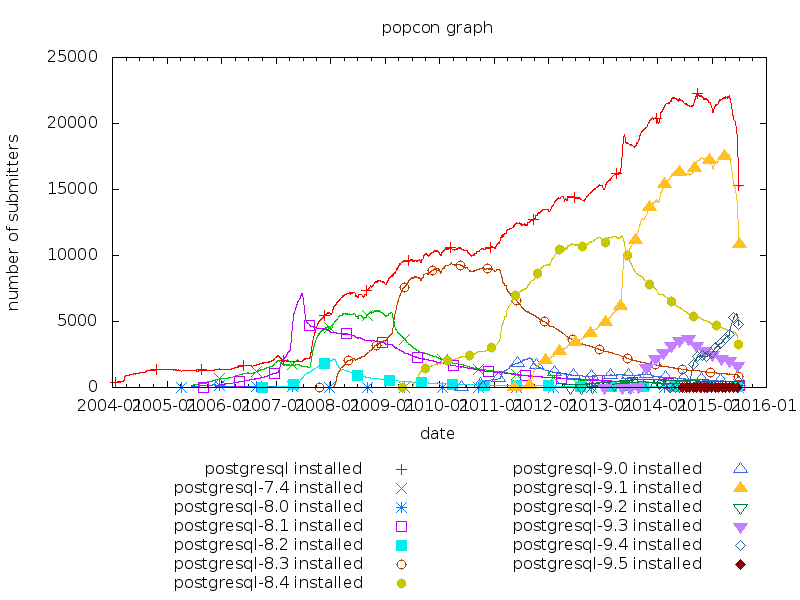
Today saw the release of PostgreSQL 9.5 Alpha 1. Packages for all supported Debian and Ubuntu releases are available on apt.postgresql.org: deb http://apt.postgresql.org/pub/repos/apt/ YOUR_RELEASE_HERE-pgdg main 9.5 The package is also waiting in NEW to be accepted for Debian experimental. Being curious which PostgreSQL releases have been in use over time, I pulled some graphics from Debian's popularity contest data: Before we included the PostgreSQL major version in the package name, "postgresql" contained the server, so that line represents the installation count of the pre-7.4 releases at the left end of the graph. Interestingly, 7.4 reached its installation peak well past 8.1's. Does anyone have an idea why that happened?

Norbert Preining: An amusing lintian error Lenna

Well, there we are, trying to build another round of TeX Live packages for Debian, just to realize that the lintian error that should have been downgraded to warning (or removed) is still around, due to doubts about the license. Ok. Well, anyway, but what I found is even more funny:
E: texlive-extra source: license-problem-non-free-img-lenna texmf-dist/doc/latex/reflectgraphics/lenna.jpg
which is about one of the most used images in images processing courses, Lenna: who-is-lenna
Without comments, I just quote the lintian error it is a whole lot of fun to read.
Ref: https://en.wikipedia.org/wiki/Lenna, https://www.debian.org/vote/2012/vote_002, #771191
Info: The given source file is cropped from playboy centerfold. This image is a picture of Lena S derberg, shot by photographer Dwight Hooker, cropped from the centerfold of the November 1972 issue of Playboy magazine. According to Hutchison, Jamie (May June 2001). Culture, Communication, and an Information Age Madonna (PDF). IEEE Professional Communication Society Newsletter 45 (3). (page 5 second column second paragraph), this image is distributable but not free. Moreover, Lenna photo has been pointed to as an example of sexism in the sciences, reinforcing gender stereotypes. Please use well known and free test image. Please also submit md5sum, sha1sum, and sha256 of this file as a bug report for lintian.
How fortunate our generation is that we don t have anything else to care about Anyway, back to rebuilding orig.tars, source packages, and binary packages!

20 June 2015

Russell Coker: BTRFS Status June 2015

The version of btrfs-tools in Debian/Jessie is incapable of creating a filesystem that can be mounted by the kernel in Debian/Wheezy. If you want to use a BTRFS filesystem on Jessie and Wheezy (which isn t uncommon with removable devices) the only options are to use the Wheezy version of mkfs.btrfs or to use a Jessie kernel on Wheezy. I recently got bitten by this issue when I created a BTRFS filesystem on a removable device with a lot of important data (which is why I wanted metadata duplication and checksums) and had to read it on a server running Wheezy. Fortunately KVM in Wheezy works really well so I created a virtual machine to read the disk. Setting up a new KVM isn t that difficult, but it s not something I want to do while a client is anxiously waiting for their data. BTRFS has been working well for me apart from the Jessie/Wheezy compatability issue (which was an annoyance but didn t stop me doing what I wanted). I haven t written a BTRFS status report for a while because everything has been OK and there has been nothing exciting to report. I regularly get errors from the cron jobs that run a balance supposedly running out of free space. I have the cron jobs due to past problems with BTRFS running out of metadata space. In spite of the jobs often failing the systems keep working so I m not too worried at the moment. I think this is a bug, but there are many more important bugs. Linux kernel version 3.19 was the first version to have working support for RAID-5 recovery. This means version 3.19 was the first version to have usable RAID-5 (I think there is no point even having RAID-5 without recovery). It wouldn t be prudent to trust your important data to a new feature in a filesystem. So at this stage if I needed a very large scratch space then BTRFS RAID-5 might be a viable option but for anything else I wouldn t use it. BTRFS still has had little performance optimisation, while this doesn t matter much for SSD and for single-disk filesystems for a RAID-5 of hard drives that would probably hurt a lot. Maybe BTRFS RAID-5 would be good for a scratch array of SSDs. The reports of problems with RAID-5 don t surprise me at all. I have a BTRFS RAID-1 filesystem on 2*4TB disks which is giving poor performance on metadata, simple operations like ls -l on a directory with ~200 subdirectories takes many seconds to run. I suspect that part of the problem is due to the filesystem being written by cron jobs with files accumulating over more than a year. The btrfs filesystem command (see btrfs-filesystem(8)) allows defragmenting files and directory trees, but unfortunately it doesn t support recursively defragmenting directories but not files. I really wish there was a way to get BTRFS to put all metadata on SSD and all data on hard drives. Sander suggested the following command to defragment directories on the BTRFS mailing list: find / -xdev -type d -execdir btrfs filesystem defrag -c + Below is the output of zfs list -t snapshot on a server I run, it s often handy to know how much space is used by snapshots, but unfortunately BTRFS has no support for this.
NAME USED AVAIL REFER MOUNTPOINT
hetz0/be0-mail@2015-03-10 2.88G 387G
hetz0/be0-mail@2015-03-11 1.12G 388G
hetz0/be0-mail@2015-03-12 1.11G 388G
hetz0/be0-mail@2015-03-13 1.19G 388G
Hugo pointed out on the BTRFS mailing list that the following command will give the amount of space used for snapshots. $SNAPSHOT is the name of a snapshot and $LASTGEN is the generation number of the previous snapshot you want to compare with. btrfs subvolume find-new $SNAPSHOT $LASTGEN awk ' total = total + $7 END print total ' One upside of the BTRFS implementation in this regard is that the above btrfs command without being piped through awk shows you the names of files that are being written and the amounts of data written to them. Through casually examining this output I discovered that the most written files in my home directory were under the .cache directory (which wasn t exactly a surprise). Now I am configuring workstations with a separate subvolume for ~/.cache for the main user. This means that ~/.cache changes don t get stored in the hourly snapshots and less disk space is used for snapshots. Conclusion My observation is that things are going quite well with BTRFS. It s more than 6 months since I had a noteworthy problem which is pretty good for a filesystem that s still under active development. But there are still many systems I run which could benefit from the data integrity features of ZFS and BTRFS that don t have the resources to run ZFS and need more reliability than I can expect from an unattended BTRFS system. At this time the only servers I run with BTRFS are located within a reasonable drive from my home (not the servers in Germany and the US) and are easily accessible (not the embedded systems). ZFS is working well for some of the servers in Germany. Eventually I ll probably run ZFS on all the hosted servers in Germany and the US, I expect that will happen before I m comfortable running BTRFS on such systems. For the embedded systems I will just take the risk of data loss/corruption for the next few years.

16 June 2015

Julien Danjou: Timezones and Python

Recently, I've been fighting with the never ending issue of timezones. I never thought I would have plunged into this rabbit hole, but hacking on OpenStack and Gnocchi I felt into that trap easily is, thanks to Python. Why you really, really, should never ever deal with timezones To get a glimpse of the complexity of timezones, I recommend that you watch Tom Scott's video on the subject. It's fun and it summarizes remarkably well the nightmare that timezones are and why you should stop thinking that you're smart.
The importance of timezones in applications
Once you've heard what Tom says, I think it gets pretty clear that a timestamp without any timezone attached does not give any useful information. It should be considered irrelevant and useless. Without the necessary context given by the timezone, you cannot infer what point in time your application is really referring to. That means your application should never handle timestamps with no timezone information. It should try to guess or raises an error if no timezone is provided in any input. Of course, you can infer that having no timezone information means UTC. This sounds very handy, but can also be dangerous in certain applications or language such as Python, as we'll see. Indeed, in certain applications, converting timestamps to UTC and losing the timezone information is a terrible idea. Imagine that a user create a recurring event every Wednesday at 10:00 in its local timezone, say CET. If you convert that to UTC, the event will end up being stored as every Wednesday at 09:00. Now imagine that the CET timezone switches from UTC+01:00 to UTC+02:00: your application will compute that the event starts at 11:00 CET every Wednesday. Which is wrong, because as the user told you, the event starts at 10:00 CET, whatever the definition of CET is. Not at 11:00 CET. So CET means CET, not necessarily UTC+1. As for endpoints like REST API, a thing I daily deal with, all timestamps should include a timezone information. It's nearly impossible to know what timezone the timestamps are in otherwise: UTC? Server local? User local? No way to know. Python design & defect
Python comes with a timestamp object named datetime.datetime. It can store date and time precise to the microsecond, and is qualified of timezone "aware" or "unaware", whether it embeds a timezone information or not. To build such an object based on the current time, one can use datetime.datetime.utcnow() to retrieve the date and time for the UTC timezone, and datetime.datetime.now() to retrieve the date and time for the current timezone, whatever it is.
>>> import datetime
>>> datetime.datetime.utcnow()
datetime.datetime(2015, 6, 15, 13, 24, 48, 27631)
>>> datetime.datetime.now()
datetime.datetime(2015, 6, 15, 15, 24, 52, 276161)

As you can notice, none of these results contains timezone information. Indeed, Python datetime API always returns unaware datetime objects, which is very unfortunate. Indeed, as soon as you get one of this object, there is no way to know what the timezone is, therefore these objects are pretty "useless" on their own. Armin Ronacher proposes that an application always consider that the unaware datetime objects from Python are considered as UTC. As we just saw, that statement cannot be considered true for objects returned by datetime.datetime.now(), so I would not advise doing so. datetime objects with no timezone should be considered as a "bug" in the application.
Recommendations My recommendation list comes down to:
  1. Always use aware datetime object, i.e. with timezone information. That makes sure you can compare them directly (aware and unaware datetime objects are not comparable) and will return them correctly to users. Leverage pytz to have timezone objects.
  2. Use ISO 8601 as input and output string format. Use datetime.datetime.isoformat() to return timestamps as string formatted using that format, which includes the timezone information.
In Python, that's equivalent to having:
>>> import datetime
>>> import pytz
>>> def utcnow():
return datetime.datetime.now(tz=pytz.utc)
>>> utcnow()
datetime.datetime(2015, 6, 15, 14, 45, 19, 182703, tzinfo=<UTC>)
>>> utcnow().isoformat()
'2015-06-15T14:45:21.982600+00:00'

If you need to parse strings containing ISO 8601 formatted timestamp, you can rely on the iso8601, which returns timestamps with correct timezone information. This makes timestamps directly comparable:
>>> import iso8601
>>> iso8601.parse_date(utcnow().isoformat())
datetime.datetime(2015, 6, 15, 14, 46, 43, 945813, tzinfo=<FixedOffset '+00:00' datetime.timedelta(0)>)
>>> iso8601.parse_date(utcnow().isoformat()) < utcnow()
True

If you need to store those timestamps, the same rule should apply. If you rely on MongoDB, it assumes that all the timestamp are in UTC, so be careful when storing them you will have to normalize the timestamp to UTC. For MySQL, nothing is assumed, it's up to the application to insert them in a timezone that makes sense to it. Obviously, if you have multiple applications accessing the same database with different data sources, this can end up being a nightmare. PostgreSQL has a special data type that is recommended called timestamp with timezone, and which can store the timezone associated, and do all the computation for you. That's the recommended way to store them obviously. That does not mean you should not use UTC in most cases; that just means you are sure that the timestamp are stored in UTC since it's written in the database, and you check if any other application inserted timestamps with different timezone. OpenStack status As a side note, I've improved OpenStack situation recently by changing the oslo.utils.timeutils module to deprecate some useless and dangerous functions. I've also added support for returning timezone aware objects when using the oslo_utils.timeutils.utcnow() function. It's not possible to make it a default unfortunately for backward compatibility reason, but it's there nevertheless, and it's advised to use it. Thanks to my colleague Victor for the help! Have a nice day, whatever your timezone is!

Simon Josefsson: SSH Host Certificates with YubiKey NEO

If you manage a bunch of server machines, you will undoubtedly have run into the following OpenSSH question:
The authenticity of host 'host.example.org (1.2.3.4)' can't be established.
RSA key fingerprint is 1b:9b:b8:5e:74:b1:31:19:35:48:48:ba:7d:d0:01:f5.
Are you sure you want to continue connecting (yes/no)?
If the server is a single-user machine, where you are the only person expected to login on it, answering yes once and then using the ~/.ssh/known_hosts file to record the key fingerprint will (sort-of) work and protect you against future man-in-the-middle attacks. I say sort-of, since if you want to access the server from multiple machines, you will need to sync the known_hosts file somehow. And once your organization grows larger, and you aren t the only person that needs to login, having a policy that everyone just answers yes on first connection on all their machines is bad. The risk that someone is able to successfully MITM attack you grows every time someone types yes to these prompts. Setting up one (or more) SSH Certificate Authority (CA) to create SSH Host Certificates, and have your users trust this CA, will allow you and your users to automatically trust the fingerprint of the host through the indirection of the SSH Host CA. I was surprised (but probably shouldn t have been) to find that deploying this is straightforward. Even setting this up with hardware-backed keys, stored on a YubiKey NEO, is easy. Below I will explain how to set this up for a hypothethical organization where two persons (sysadmins) are responsible for installing and configuring machines. I m going to assume that you already have a couple of hosts up and running and that they run the OpenSSH daemon, so they have a /etc/ssh/ssh_host_rsa_key* public/private keypair, and that you have one YubiKey NEO with the PIV applet and that the NEO is in CCID mode. I don t believe it matters, but I m running a combination of Debian and Ubuntu machines. The Yubico PIV tool is used to configure the YubiKey NEO, and I will be using OpenSC s PKCS#11 library to connect OpenSSH with the YubiKey NEO. Let s install some tools:
apt-get install yubikey-personalization yubico-piv-tool opensc-pkcs11 pcscd
Every person responsible for signing SSH Host Certificates in your organization needs a YubiKey NEO. For my example, there will only be two persons, but the number could be larger. Each one of them will have to go through the following process. The first step is to prepare the NEO. First mode switch it to CCID using some device configuration tool, like yubikey-personalization.
ykpersonalize -m1
Then prepare the PIV applet in the YubiKey NEO. This is covered by the YubiKey NEO PIV Introduction but I ll reproduce the commands below. Do this on a disconnected machine, saving all files generated on one or more secure media and store that in a safe.
user=simon
key= dd if=/dev/random bs=1 count=24 2>/dev/null   hexdump -v -e '/1 "%02X"' 
echo $key > ssh-$user-key.txt
pin= dd if=/dev/random bs=1 count=6 2>/dev/null   hexdump -v -e '/1 "%u"' cut -c1-6 
echo $pin > ssh-$user-pin.txt
puk= dd if=/dev/random bs=1 count=6 2>/dev/null   hexdump -v -e '/1 "%u"' cut -c1-8 
echo $puk > ssh-$user-puk.txt
yubico-piv-tool -a set-mgm-key -n $key
yubico-piv-tool -k $key -a change-pin -P 123456 -N $pin
yubico-piv-tool -k $key -a change-puk -P 12345678 -N $puk
Then generate a RSA private key for the SSH Host CA, and generate a dummy X.509 certificate for that key. The only use for the X.509 certificate is to make PIV/PKCS#11 happy they want to be able to extract the public-key from the smartcard, and do that through the X.509 certificate.
openssl genrsa -out ssh-$user-ca-key.pem 2048
openssl req -new -x509 -batch -key ssh-$user-ca-key.pem -out ssh-$user-ca-crt.pem
You import the key and certificate to the PIV applet as follows:
yubico-piv-tool -k $key -a import-key -s 9c < ssh-$user-ca-key.pem
yubico-piv-tool -k $key -a import-certificate -s 9c < ssh-$user-ca-crt.pem
You now have a SSH Host CA ready to go! The first thing you want to do is to extract the public-key for the CA, and you use OpenSSH's ssh-keygen for this, specifying OpenSC's PKCS#11 module.
ssh-keygen -D /usr/lib/x86_64-linux-gnu/opensc-pkcs11.so -e > ssh-$user-ca-key.pub
If you happen to use YubiKey NEO with OpenPGP using gpg-agent/scdaemon, you may get the following error message:
no slots
cannot read public key from pkcs11
The reason is that scdaemon exclusively locks the smartcard, so no other application can access it. You need to kill scdaemon, which can be done as follows:
gpg-connect-agent SCD KILLSCD SCD BYE /bye
The output from ssh-keygen may look like this:
ssh-rsa AAAAB3NzaC1yc2EAAAADAQABAAABAQCp+gbwBHova/OnWMj99A6HbeMAGE7eP3S9lKm4/fk86Qd9bzzNNz2TKHM7V1IMEj0GxeiagDC9FMVIcbg5OaSDkuT0wGzLAJWgY2Fn3AksgA6cjA3fYQCKw0Kq4/ySFX+Zb+A8zhJgCkMWT0ZB0ZEWi4zFbG4D/q6IvCAZBtdRKkj8nJtT5l3D3TGPXCWa2A2pptGVDgs+0FYbHX0ynD0KfB4PmtR4fVQyGJjJ0MbF7fXFzQVcWiBtui8WR/Np9tvYLUJHkAXY/FjLOZf9ye0jLgP1yE10+ihe7BCxkM79GU9BsyRgRt3oArawUuU6tLgkaMN8kZPKAdq0wxNauFtH
Now all your users in your organization needs to add a line to their ~/.ssh/known_hosts as follows:
@cert-authority *.example.com ssh-rsa AAAAB3NzaC1yc2EAAAADAQABAAABAQCp+gbwBHova/OnWMj99A6HbeMAGE7eP3S9lKm4/fk86Qd9bzzNNz2TKHM7V1IMEj0GxeiagDC9FMVIcbg5OaSDkuT0wGzLAJWgY2Fn3AksgA6cjA3fYQCKw0Kq4/ySFX+Zb+A8zhJgCkMWT0ZB0ZEWi4zFbG4D/q6IvCAZBtdRKkj8nJtT5l3D3TGPXCWa2A2pptGVDgs+0FYbHX0ynD0KfB4PmtR4fVQyGJjJ0MbF7fXFzQVcWiBtui8WR/Np9tvYLUJHkAXY/FjLOZf9ye0jLgP1yE10+ihe7BCxkM79GU9BsyRgRt3oArawUuU6tLgkaMN8kZPKAdq0wxNauFtH
Each sysadmin needs to go through this process, and each user needs to add one line for each sysadmin. While you could put the same key/certificate on multiple YubiKey NEOs, to allow users to only have to put one line into their file, dealing with revocation becomes a bit more complicated if you do that. If you have multiple CA keys in use at the same time, you can roll over to new CA keys without disturbing production. Users may also have different policies for different machines, so that not all sysadmins have the power to create host keys for all machines in your organization. The CA setup is now complete, however it isn't doing anything on its own. We need to sign some host keys using the CA, and to configure the hosts' sshd to use them. What you could do is something like this, for every host host.example.com that you want to create keys for:
h=host.example.com
scp root@$h:/etc/ssh/ssh_host_rsa_key.pub .
gpg-connect-agent "SCD KILLSCD" "SCD BYE" /bye
ssh-keygen -D /usr/lib/x86_64-linux-gnu/opensc-pkcs11.so -s ssh-$user-ca-key.pub -I $h -h -n $h -V +52w ssh_host_rsa_key.pub
scp ssh_host_rsa_key-cert.pub root@$h:/etc/ssh/
The ssh-keygen command will use OpenSC's PKCS#11 library to talk to the PIV applet on the NEO, and it will prompt you for the PIN. Enter the PIN that you set above. The output of the command would be something like this:
Enter PIN for 'PIV_II (PIV Card Holder pin)': 
Signed host key ssh_host_rsa_key-cert.pub: id "host.example.com" serial 0 for host.example.com valid from 2015-06-16T13:39:00 to 2016-06-14T13:40:58
The host now has a SSH Host Certificate installed. To use it, you must make sure that /etc/ssh/sshd_config has the following line:
HostCertificate /etc/ssh/ssh_host_rsa_key-cert.pub
You need to restart sshd to apply the configuration change. If you now try to connect to the host, you will likely still use the known_hosts fingerprint approach. So remove the fingerprint from your machine:
ssh-keygen -R $h
Now if you attempt to ssh to the host, and using the -v parameter to ssh, you will see the following:
debug1: Server host key: RSA-CERT 1b:9b:b8:5e:74:b1:31:19:35:48:48:ba:7d:d0:01:f5
debug1: Host 'host.example.com' is known and matches the RSA-CERT host certificate.
Success! One aspect that may warrant further discussion is the host keys. Here I only created host certificates for the hosts' RSA key. You could create host certificate for the DSA, ECDSA and Ed25519 keys as well. The reason I did not do that was that in this organization, we all used GnuPG's gpg-agent/scdaemon with YubiKey NEO's OpenPGP Card Applet with RSA keys for user authentication. So only the host RSA key is relevant. Revocation of a YubiKey NEO key is implemented by asking users to drop the corresponding line for one of the sysadmins, and regenerate the host certificate for the hosts that the sysadmin had created host certificates for. This is one reason users should have at least two CAs for your organization that they trust for signing host certificates, so they can migrate away from one of them to the other without interrupting operations.

14 June 2015

Norbert Preining: Kobo firmware 3.16.0 mega update (KSM, nickel patch, ssh, fonts)

As with all the previous versions, I have prepared a mega update for the Kobo firmware 3.16.0, including all my favorite patches and features. Please see details for 3.15.0, 3.13.1 and 3.12.1. As before, the following addons are included: Kobo Start Menu, koreader, coolreader, pbchess, ssh access, custom dictionaries, plus as a new treat, some side-loaded fonts. What I dropped this time is most of the kobohack part, as the libraries seem to get outdated. But I included the dropbear ssh server from the kobohack package. Kobo Logo So what are all these items: Please see this post for details. Here is the combined Kobo-3.16.0-combined/KoboRoot.tgz Update procedure First install the normal firmware as obtained from above. Then, install the KoboRoot.tgz from above. WARNINGS Here a a few things you need to do after you have installed the mega update: The combined KoboRoot.tgz is provided without warranty. If you need to reset your device, don t blame me!

11 June 2015

Petter Reinholdtsen: Measuring and adjusting the loudness of a TV channel using bs1770gain

Television loudness is the source of frustration for viewers everywhere. Some channels are very load, others are less loud, and ads tend to shout very high to get the attention of the viewers, and the viewers do not like this. This fact is well known to the TV channels. See for example the BBC white paper "Terminology for loudness and level dBTP, LU, and all that" from 2011 for a summary of the problem domain. To better address the need for even loadness, the TV channels got together several years ago to agree on a new way to measure loudness in digital files as one step in standardizing loudness. From this came the ITU-R standard BS.1770, "Algorithms to measure audio programme loudness and true-peak audio level". The ITU-R BS.1770 specification describe an algorithm to measure loadness in LUFS (Loudness Units, referenced to Full Scale). But having a way to measure is not enough. To get the same loudness across TV channels, one also need to decide which value to standardize on. For European TV channels, this was done in the EBU Recommondaton R128, "Loudness normalisation and permitted maximum level of audio signals", which specifies a recommended level of -23 LUFS. In Norway, I have been told that NRK, TV2, MTG and SBS have decided among themselves to follow the R128 recommondation for playout from 2016-03-01. There are free software available to measure and adjust the loudness level using the LUFS. In Debian, I am aware of a library named libebur128 able to measure the loudness and since yesterday morning a new binary named bs1770gain capable of both measuring and adjusting was uploaded and is waiting for NEW processing. I plan to maintain the latter in Debian under the Debian multimedia umbrella. The free software based TV channel I am involved in, Frikanalen, plan to follow the R128 recommondation ourself as soon as we can adjust the software to do so, and the bs1770gain tool seem like a good fit for that part of the puzzle to measure loudness on new video uploaded to Frikanalen. Personally, I plan to use bs1770gain to adjust the loudness of videos I upload to Frikanalen on behalf of the NUUG member organisation. The program seem to be able to measure the LUFS value of any media file handled by ffmpeg, but I've only successfully adjusted the LUFS value of WAV files. I suspect it should be able to adjust it for all the formats handled by ffmpeg.

10 June 2015

Norbert Preining: Tribute to Hermann Zapf

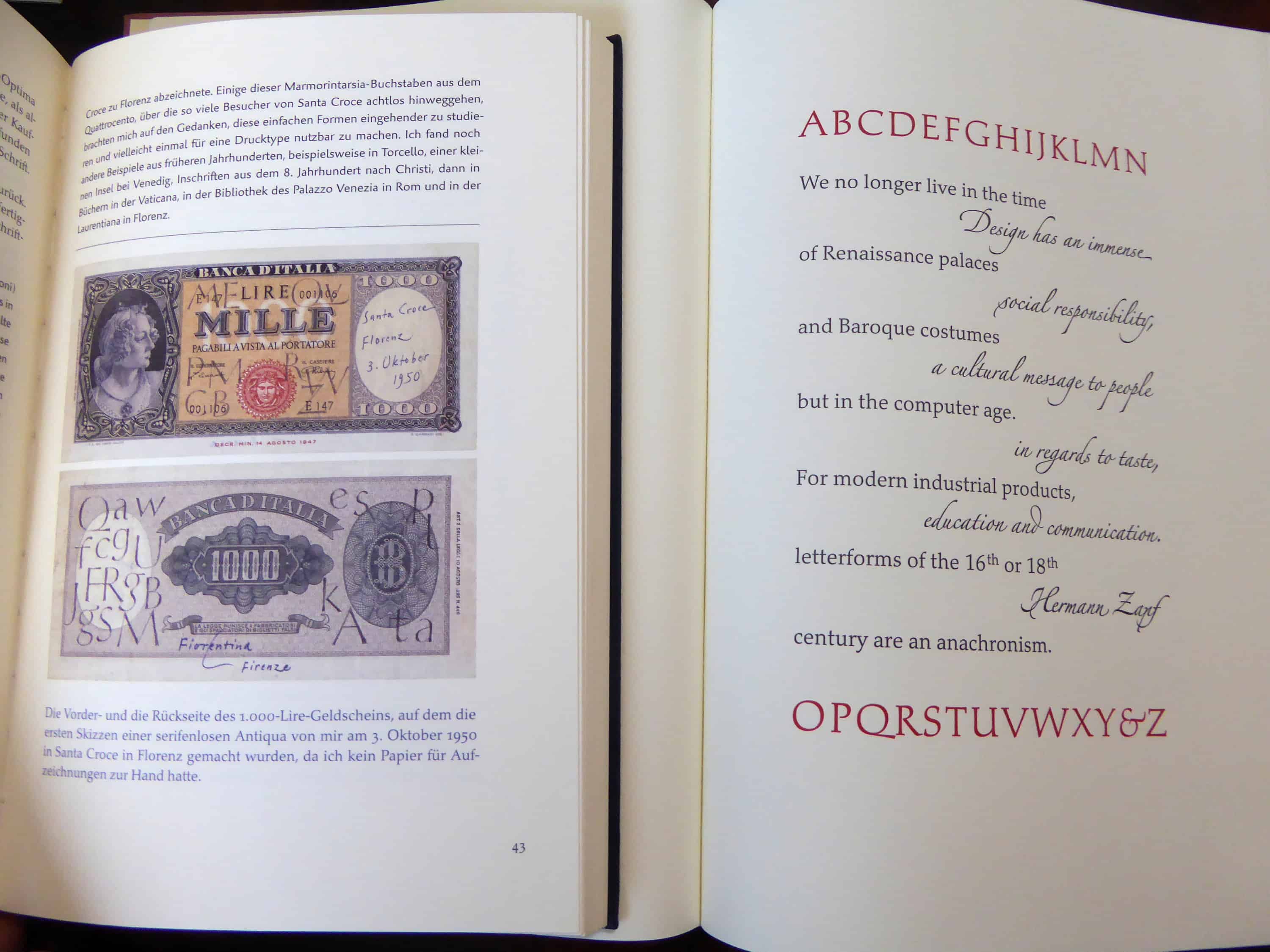
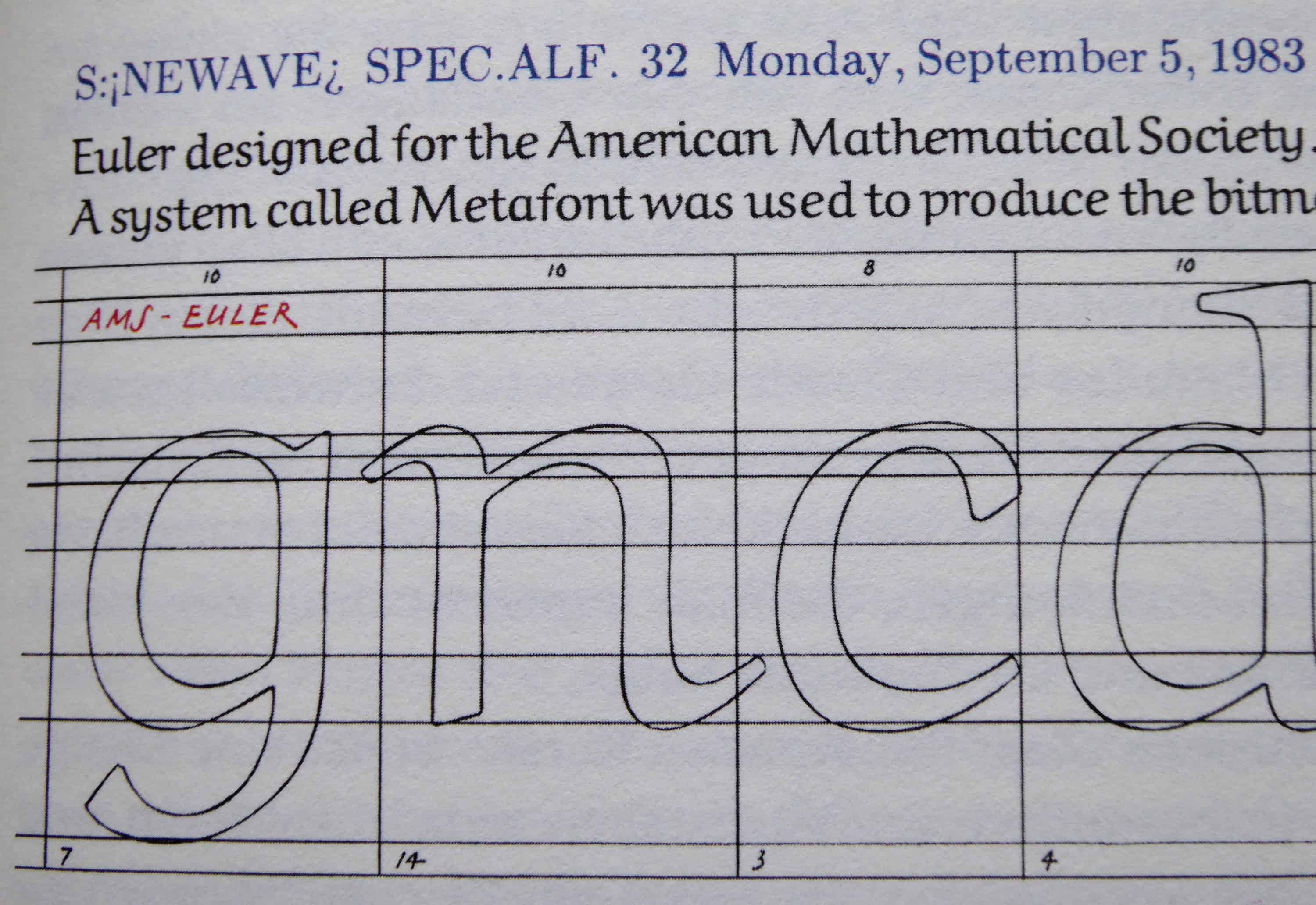
Last weekend Hermann Zapf, one of the greatest font designers and typographers of our times, has passed away at the age of 96. Much has been written about his life, his immense sphere of influence, his excellent typefaces, and some of the links to other obituaries can be found here at the end. There is nothing of value I can contribute, but let Hermann Zapf speak for himself with a few images from two books by or dedicated to him. zapf-heart-blood-ink The books I have taken these photos from are: zapf-books In his long life, Hermann Zapf has created a wide range of typefaces, some if which have become the main staple in the printing business, most notably Palatino, Janson, Optima, and Zapf Dingbats. But there are many more: zapf-alphabets While probably not as popular anymore as some years (decades?) ago, Palatino still is one of my favorite typefaces. I often wished to have the freedom to choose my own fonts for publications, but normally that doesn t happen. Palatino has found many offspring (or imitations?), and there are excellent renderings for use with (La)TeX, too. zapf-palatino Hermann Zapf also had connections with Don Knuth and the AMS (American Mathematical Society), and he designed for the AMS the Euler typeface, using Knuth s MetaFont program. zapf-euler Last weekend, when I heard of Hermann Zapf s death, I was at a conference at Tsukuba University. What a coincidence that all the signs in the building (floor numbers, indications, etc) were set optimain another of his great typefaces, the Optima. I had a strange feeling, and reset my presentation in Optima/Euler in honor of Hermann Zapf s great life. Although I never met Hermann Zapf personally I missed the TeX conferences where he participated it was to a great extent his influence that years ago I got started in typography. Living a life like he did, dedicating himself to the beauty and expressiveness of letters, design, calligraphy, seems like a dream for me. But beauty can be found even in the strangest equation in mathematics, the queerest theorem in logic. While not all of us are as gifted as Hermann Zapf in creating beauty, we should strive to increase our ability to appreciate the beauty. The beauty of letters is subtle, evasive, and needs training, that is practice, to be appreciated. Hermann Zapf taught us how even self-training can lead to excellence. His letters, which I meet every day, are a permanent reminder to strive for beauty and clarity, and never relent in our exercise. Thanks Hermann Zapf. zapf-letters Links to tributes around the world English Linotype (Type foundry where Zapf started working)
Bigelow and Holmes (Type designers)
New York Times (Newspaper)
Type Drawers
Quarz (News magazine)
Kaveh Bazargan (next president of TUG)
TeX Overflow (Q&A website concerning TeX) German FontShop (Type foundry and internet shop)
Deutschland Funk (News station)
S ddeutsche (Newspaper)
Echo (Newspaper)
Heise (Techology News page)

8 June 2015

Lunar: Reproducible builds: week 6 in Stretch cycle

What happened about the reproducible builds effort for this week: Presentations On May 26th,Holger Levsen presented reproducible builds in Debian at CCC Berlin for the Datengarten 52. The presentation was in German and the slides in English. Audio and video recordings are available. Toolchain fixes Niels Thykier fixed the experimental support for the automatic creation of debug packages in debhelper that being tested as part of the reproducible toolchain. Lunar added to the reproducible build version of dpkg the normalization of permissions for files in control.tar. The patch has also been submitted based on the main branch. Daniel Kahn Gillmor proposed a patch to add support for externally-supplying build date to help2man. This sparkled a discussion about agreeing on a common name for an environment variable to hold the date that should be used. It seems opinions are converging on using SOURCE_DATE_UTC which would hold a ISO-8601 formatted date in UTC) (e.g. 2015-06-05T01:08:20Z). Kudos to Daniel, Brendan O'Dea, Ximin Luo for pushing this forward. Lunar proposed a patch to Tar upstream adding a --clamp-mtime option as a generic solution for timestamp variations in tarballs which might also be useful for dpkg. The option changes the behavior of --mtime to only use the time specified if the file mtime is newer than the given time. So far, upstream is not convinced that it would make a worthwhile addition to Tar, though. Daniel Kahn Gillmor reached out to the libburnia project to ask for help on how to make ISO created with xorriso reproducible. We should reward Thomas Schmitt with a model upstream trophy as he went through a thorough analysis of possible sources of variations and ways to improve the situation. Most of what is missing with the current version in Debian is available in the latest upstream version, but libisoburn in Debian needs help. Daniel backported the missing option for version 1.3.2-1.1. akira submitted a new issue to Doxygen upstream regarding the timestamps added to the generated manpages. Packages fixed The following 49 packages became reproducible due to changes in their build dependencies: activemq-protobuf, bnfc, bridge-method-injector, commons-exec, console-data, djinn, github-backup, haskell-authenticate-oauth, haskell-authenticate, haskell-blaze-builder, haskell-blaze-textual, haskell-bloomfilter, haskell-brainfuck, haskell-hspec-discover, haskell-pretty-show, haskell-unlambda, haskell-x509-util, haskelldb-hdbc-odbc, haskelldb-hdbc-postgresql, haskelldb-hdbc-sqlite3, hasktags, hedgewars, hscolour, https-everywhere, java-comment-preprocessor, jffi, jgit, jnr-ffi, jnr-netdb, jsoup, lhs2tex, libcolor-calc-perl, libfile-changenotify-perl, libpdl-io-hdf5-perl, libsvn-notify-mirror-perl, localizer, maven-enforcer, pyotherside, python-xlrd, python-xstatic-angular-bootstrap, rt-extension-calendar, ruby-builder, ruby-em-hiredis, ruby-redcloth, shellcheck, sisu-plexus, tomcat-maven-plugin, v4l2loopback, vim-latexsuite. The following packages became reproducible after getting fixed: Some uploads fixed some reproducibility issues but not all of them: Patches submitted which did not make their way to the archive yet: Daniel Kahn Gilmor also started discussions for emacs24 and the unsorted lists in generated .el files, the recording of a PID number in lush, and the reproducibility of ISO images in grub2. reproducible.debian.net Notifications are now sent when the build environment for a package has changed between two builds. This is a first step before automatically building the package once more. (Holger Levsen) jenkins.debian.net was upgraded to Debian Jessie. (Holger Levsen) A new variation is now being tested: $PATH. The second build will be done with a /i/capture/the/path added. (Holger Levsen) Holger Levsen with the help of Alexander Couzens wrote extra job to test the reproducibility of coreboot. Thanks James McCoy for helping with certificate issues. Mattia Rizollo made some more internal improvements. strip-nondeterminism development Andrew Ayer released strip-nondeterminism/0.008-1. This new version fixes the gzip handler so that it now skip adding a predetermined timestamp when there was none. Holger Levsen sponsored the upload. Documentation update The pages about timestamps in manpages generated by Doxygen, GHC .hi files, and Jar files have been updated to reflect their status in upstream. Markus Koschany documented an easy way to prevent Doxygen to write timestamps in HTML output. Package reviews 83 obsolete reviews have been removed, 71 added and 48 updated this week. Meetings A meeting was held on 2015-06-03. Minutes and full logs are available. It was agreed to hold such a meeting every two weeks for the time being. The time of the next meeting should be announced soon.

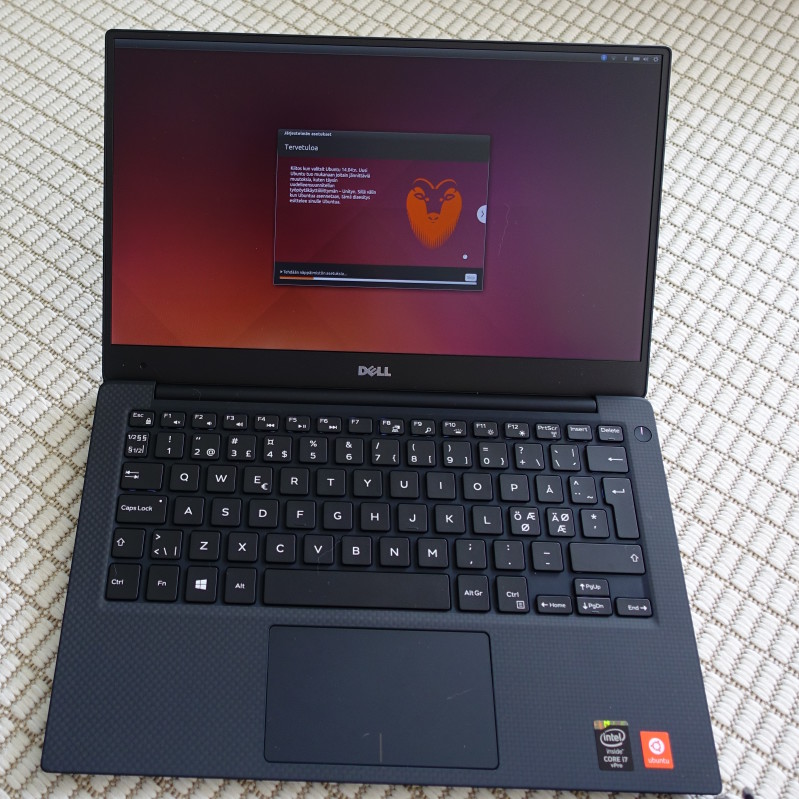
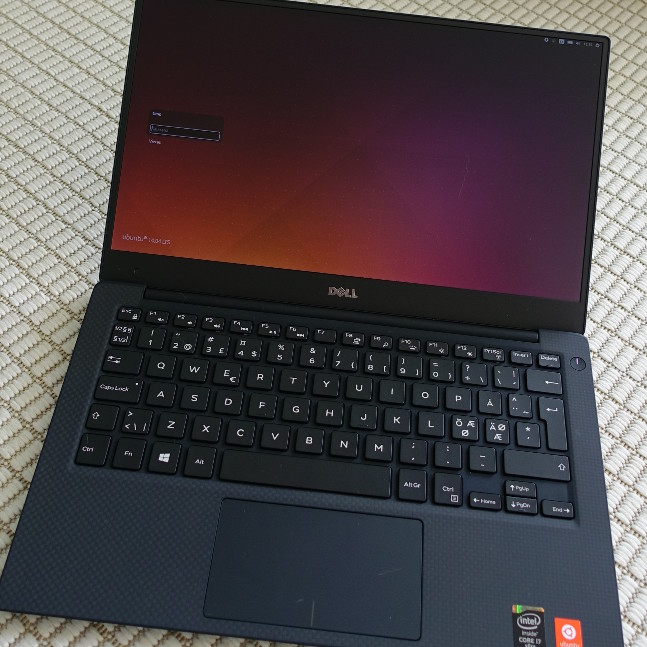
Timo Jyrinki: Quick Look: Dell XPS 13 Developer Edition (2015) with Ubuntu 14.04 LTS

I recently obtained the newest Dell's Ubuntu developer offering, XPS 13 (2015, model 9343). I opted in for FullHD non-touch display, mostly because of better battery life, the actual no need for higher resolution, and matte screen which is great outside. Touch would have been "nice-to-have", but in my work I don't really need it.

The other specifications include i7-5600U CPU, 8GB RAM, 256GB SSD [edit: lshw], and of course Ubuntu 14.04 LTS pre-installed as OEM specific installation. It was not possible to directly order it from Dell site, as Finland is reportedly not online market for Dell... The wholesale company however managed to get two models on their lists and so it's now possible to order via retailers. [edit: here are some country specific direct web order links however US, DE, FR, SE, NL]

In this blog post I give a quick look on how I started up using it, and do a few observations on the pre-installed Ubuntu included. I personally was interested in using the pre-installed Ubuntu like a non-Debian/Ubuntu developer would use it, but Dell has also provided instructions for Ubuntu 15.04, Debian 7.0 and Debian 8.0 advanced users among else. Even if not using the pre-installed Ubuntu, the benefit from buying an Ubuntu laptop is obviously smaller cost and on the other hand contributing to free software (by paying for the hardware enablement engineering done by or purchased by Dell).
Unboxing
The Black Box. (and white cat)

Opened box.


First time lid opened, no dust here yet!
First time boot up, transitioning from the boot logo to a first time Ubuntu video.
A small clip from the end of the welcoming video.
First time setup. Language, Dell EULA, connecting to WiFi, location, keyboard, user+password.
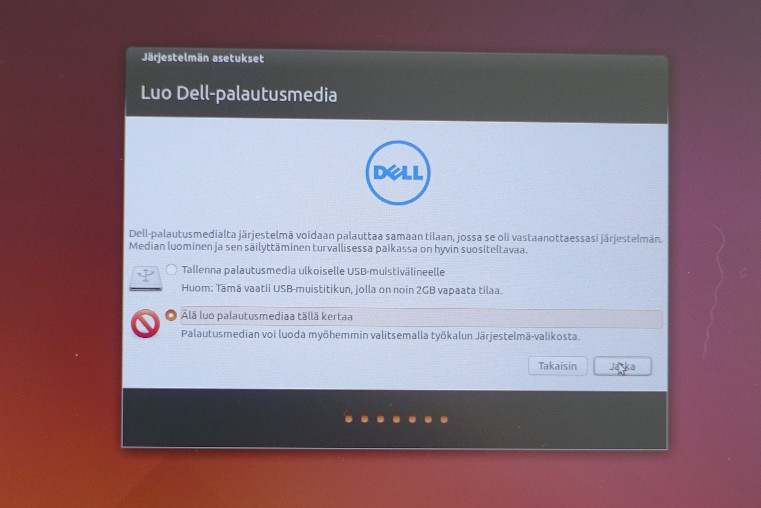
Creating recovery media. I opted not to do this as I had happened to read that it's highly recommended to install upgrades first, including to this tool.
Finalizing setup.
Ready to log in!
It's alive!
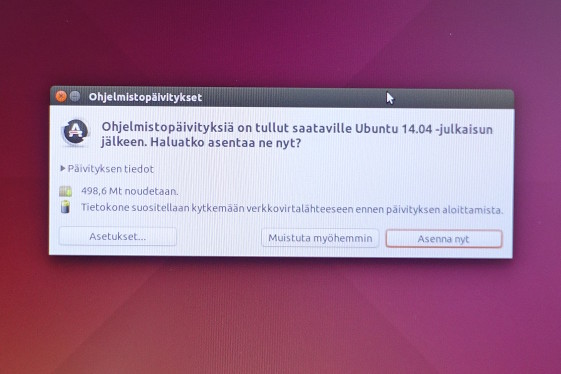
Not so recent 14.04 LTS image... lots of updates.
Problems in the First BatchUnfortunately the first batch of XPS 13:s with Ubuntu are going to ship with some problems. They're easy to fix if you know how to, but it's sad that they're there to begin with in the factory image. There is no knowledge when a fixed batch will start shipping - July maybe?

First of all, installing software upgrades stops. You need to run the following command via Dash Terminal once: sudo apt-get install -f (it suggests upgrading libc-dev-bin, libc6-dbg, libc6-dev and udev). After that you can continue running Software Updater as usual, maybe rebooting in between.

Secondly, the fixed touchpad driver is included but not enabled by default. You need to enable the only non-enabled Additional Driver as seen in the picture below or instructed in Youtube.

Dialog enabling the touchpad driver.

Clarification: you can safely ignore the two paragraphs below, they're just for advanced users like me who want to play with upgraded driver stacks.

Optionally, since I'm interested in the latest graphics drivers especially in case of a brand new hardware like Intel Broadwell, I upgraded my Ubuntu to use the 14.04.2 Hardware Enablement stack (matches 14.10 hardware support): sudo apt install --install-recommends libgles2-mesa-lts-utopic libglapi-mesa-lts-utopic linux-generic-lts-utopic xserver-xorg-lts-utopic libgl1-mesa-dri-lts-utopic libegl1-mesa-drivers-lts-utopic libgl1-mesa-glx-lts-utopic:i386

Even though it's much better than a normal Ubuntu 14.10 would be since many of the Dell fixes continue to be in use, some functionality might become worse compared to the pre-installed stack. The only thing I have noticed though is the internal microphone not working anymore out-of-the-box, requiring a kernel patch as mentioned in Dell's notes. This is not a surprise since the real eventual upstream support involves switching from HDA to I2S and during 14.10 kernel work that was not nearly done. If you're excited about new drivers, I'd recommend waiting until August when the 15.04 based 14.04.3 stack is available (same package names, but 'vivid' instead of 'utopic'). [edit: I couldn't resist myself when I saw linux-generic-lts-vivid (3.19 kernel) is already in the archives. 14.04.2 + that gives me working microphone again!]
ConclusionDell XPS 13 Developer Edition with Ubuntu 14.04 LTS is an extremely capable laptop + OS combination nearing perfection, but not quite there because of the software problems in the launch pre-install image. The laptop looks great, feels like a quality product should and is very compact for the screen size.

I've moved over all my work onto it and everything so far is working smoothly in my day-to-day tasks. I'm staying at Ubuntu 14.04 LTS and using my previous LXC configuration to run the latest Ubuntu and Debian development versions. I've also done some interesting changes already like LUKS In-Place Conversion, converting the pre-installed Ubuntu into whole disk encrypted one (not recommended for the faint hearted, GRUB reconfiguration is a bit of a pain).

I look happily forward to working a few productive years with this one!

23 May 2015

Francois Marier: Usual Debian Server Setup

I manage a few servers for myself, friends and family as well as for the Libravatar project. Here is how I customize recent releases of Debian on those servers.

Hardware tests
apt-get install memtest86+ smartmontools e2fsprogs
Prior to spending any time configuring a new physical server, I like to ensure that the hardware is fine. To check memory, I boot into memtest86+ from the grub menu and let it run overnight. Then I check the hard drives using:
smartctl -t long /dev/sdX
badblocks -swo badblocks.out /dev/sdX

Configuration
apt-get install etckeepr git sudo vim
To keep track of the configuration changes I make in /etc/, I use etckeeper to keep that directory in a git repository and make the following changes to the default /etc/etckeeper/etckeeper.conf:
  • turn off daily auto-commits
  • turn off auto-commits before package installs
To get more control over the various packages I install, I change the default debconf level to medium:
dpkg-reconfigure debconf
Since I use vim for all of my configuration file editing, I make it the default editor:
update-alternatives --config editor

ssh
apt-get install openssh-server mosh fail2ban
Since most of my servers are set to UTC time, I like to use my local timezone when sshing into them. Looking at file timestamps is much less confusing that way. I also ensure that the locale I use is available on the server by adding it the list of generated locales:
dpkg-reconfigure locales
Other than that, I harden the ssh configuration and end up with the following settings in /etc/ssh/sshd_config (jessie):
HostKey /etc/ssh/ssh_host_ed25519_key
HostKey /etc/ssh/ssh_host_rsa_key
HostKey /etc/ssh/ssh_host_ecdsa_key
KexAlgorithms curve25519-sha256@libssh.org,ecdh-sha2-nistp521,ecdh-sha2-nistp384,ecdh-sha2-nistp256,diffie-hellman-group-exchange-sha256
Ciphers chacha20-poly1305@openssh.com,aes256-ctr,aes192-ctr,aes128-ctr
MACs hmac-sha2-512-etm@openssh.com,hmac-sha2-256-etm@openssh.com,umac-128-etm@openssh.com,hmac-sha2-512,hmac-sha2-256,umac-128@openssh.com
UsePrivilegeSeparation sandbox
AuthenticationMethods publickey
PasswordAuthentication no
PermitRootLogin no
AcceptEnv LANG LC_* TZ
LogLevel VERBOSE
AllowGroups sshuser
or the following for wheezy servers:
HostKey /etc/ssh/ssh_host_rsa_key
HostKey /etc/ssh/ssh_host_ecdsa_key
KexAlgorithms ecdh-sha2-nistp521,ecdh-sha2-nistp384,ecdh-sha2-nistp256,diffie-hellman-group-exchange-sha256
Ciphers aes256-ctr,aes192-ctr,aes128-ctr
MACs hmac-sha2-512,hmac-sha2-256
On those servers where I need duplicity/paramiko to work, I also add the following:
KexAlgorithms ...,diffie-hellman-group-exchange-sha1
MACs ...,hmac-sha1
Then I remove the "Accepted" filter in /etc/logcheck/ignore.d.server/ssh (first line) to get a notification whenever anybody successfully logs into my server. I also create a new group and add the users that need ssh access to it:
addgroup sshuser
adduser francois sshuser
and add a timeout for root sessions by putting this in /root/.bash_profile:
TMOUT=600

Security checks
apt-get install logcheck logcheck-database fcheck tiger debsums corekeeper
apt-get remove john john-data rpcbind tripwire
Logcheck is the main tool I use to keep an eye on log files, which is why I add a few additional log files to the default list in /etc/logcheck/logcheck.logfiles:
/var/log/apache2/error.log
/var/log/mail.err
/var/log/mail.warn
/var/log/mail.info
/var/log/fail2ban.log
while ensuring that the apache logfiles are readable by logcheck:
chmod a+rx /var/log/apache2
chmod a+r /var/log/apache2/*
and fixing the log rotation configuration by adding the following to /etc/logrotate.d/apache2:
create 644 root adm
I also modify the main logcheck configuration file (/etc/logcheck/logcheck.conf):
INTRO=0
FQDN=0
Other than that, I enable daily checks in /etc/default/debsums and customize a few tiger settings in /etc/tiger/tigerrc:
Tiger_Check_RUNPROC=Y
Tiger_Check_DELETED=Y
Tiger_Check_APACHE=Y
Tiger_FSScan_WDIR=Y
Tiger_SSH_Protocol='2'
Tiger_Passwd_Hashes='sha512'
Tiger_Running_Procs='rsyslogd cron atd /usr/sbin/apache2 postgres'
Tiger_Listening_ValidProcs='sshd mosh-server ntpd'

General hardening
apt-get install harden-clients harden-environment harden-servers apparmor apparmor-profiles apparmor-profiles-extra
While the harden packages are configuration-free, AppArmor must be manually enabled:
perl -pi -e 's,GRUB_CMDLINE_LINUX="(.*)"$,GRUB_CMDLINE_LINUX="$1 apparmor=1 security=apparmor",' /etc/default/grub
update-grub

Entropy and timekeeping
apt-get install haveged rng-tools ntp
To keep the system clock accurate and increase the amount of entropy available to the server, I install the above packages and add the tpm_rng module to /etc/modules.

Preventing mistakes
apt-get install molly-guard safe-rm sl
The above packages are all about catching mistakes (such as accidental deletions). However, in order to extend the molly-guard protection to mosh sessions, one needs to manually apply a patch.

Package updates
apt-get install apticron unattended-upgrades deborphan debfoster apt-listchanges update-notifier-common aptitude popularity-contest
These tools help me keep packages up to date and remove unnecessary or obsolete packages from servers. On Rackspace servers, a small configuration change is needed to automatically update the monitoring tools. In addition to this, I use the update-notifier-common package along with the following cronjob in /etc/cron.daily/reboot-required:
#!/bin/sh
cat /var/run/reboot-required 2> /dev/null   true
to send me a notification whenever a kernel update requires a reboot to take effect.

Handy utilities
apt-get install renameutils atool iotop sysstat lsof mtr-tiny
Most of these tools are configure-free, except for sysstat, which requires enabling data collection in /etc/default/sysstat to be useful.

Apache configuration
apt-get install apache2-mpm-event
While configuring apache is often specific to each server and the services that will be running on it, there are a few common changes I make. I enable these in /etc/apache2/conf.d/security:
<Directory />
    AllowOverride None
    Order Deny,Allow
    Deny from all
</Directory>
ServerTokens Prod
ServerSignature Off
and remove cgi-bin directives from /etc/apache2/sites-enabled/000-default. I also create a new /etc/apache2/conf.d/servername which contains:
ServerName machine_hostname

Mail
apt-get install postfix
Configuring mail properly is tricky but the following has worked for me. In /etc/hostname, put the bare hostname (no domain), but in /etc/mailname put the fully qualified hostname. Change the following in /etc/postfix/main.cf:
inet_interfaces = loopback-only
myhostname = (fully qualified hostname)
smtp_tls_security_level = may
smtp_tls_protocols = !SSLv2, !SSLv3
Set the following aliases in /etc/aliases:
  • set francois as the destination of root emails
  • set an external email address for francois
  • set root as the destination for www-data emails
before running newaliases to update the aliases database. Create a new cronjob (/etc/cron.hourly/checkmail):
#!/bin/sh
ls /var/mail
to ensure that email doesn't accumulate unmonitored on this box. Finally, set reverse DNS for the server's IPv4 and IPv6 addresses and then test the whole setup using mail root.

Network tuning To reduce the server's contribution to bufferbloat I change the default kernel queueing discipline (jessie or later) by putting the following in /etc/sysctl.conf:
net.core.default_qdisc=fq_codel

19 May 2015

Gunnar Wolf: Feeling somewhat special

Today I feel more special than I have ever felt. Or... Well, or something like that. Thing is, there is no clear adjective for this But I successfully finished my Specialization degree! Yes, believe it or not, today I can formally say I am Specialist in Informatic Security and Information Technologies (Especialista en Seguridad Inform tica y Tecnolog as de la Informaci n), as awarded by the Higher School of Electric and Mechanic Engineering (Escuela Superior de Ingenier a Mec nica y El ctrica) of the National Polytechnical Institute (Instituto Polit cnico Nacional). In Mexico and most Latin American countries, degrees are usually incorporated to your name as if they were a nobiliary title. Thus, when graduating from Engineering studies (pre-graduate universitary level), I became "Ingeniero Gunnar Wolf". People graduating from further postgraduate programs get to introduce themselves as "Maestro Foobar Baz" or "Doctor Quux Noox". And yes, a Specialization is a small posgraduate program (I often say, the smallest possible posgraduate). And as a Specialist... What can I brag about? Can say I am Specially Gunnar Wolf? Or Special Gunnar Wolf? Nope. The honorific title for a Specialization is a pointer to null, and when casted into a char* it might corrupt your honor-recognizing function. So I'm still Ingeniero Gunnar Wolf, for information security reasons. So that's the reason I am now enrolled in the Masters program. I hope to write an addenda to this message soonish (where soonish 18 months) saying I'm finally a Maestro. As a sidenote, many people asked me: Why did I take on the specialization, which is a degree too small for most kinds of real work recognition? Because it's been around twenty years since I last attended a long-term scholar program as a student. And my dish is quite full with activities and responsabilities. I decided to take a short program, designed for 12 months (I graduated in 16, minus two months that the university was on strike... Quite good, I'd say ;-) ) to see how I fared on it, and only later jumping on the full version. Because, yes, to advance my career at the university, I finally recognized and understood that I do need postgraduate studies. Oh, and what kind of work did I do for this? Besides the classes I took, I wrote a thesis on a model for evaluating covert channels for establishing secure communications.

17 May 2015

Lunar: Reproducible builds: week 2 in Stretch cycle

What happened about the reproducible builds effort for this week: Media coverage Debian's effort on reproducible builds has been covered in the June 2015 issue of Linux Magazin in Germany. Cover of Linux Magazin June 2015 Article about reproducible builds in Linux Magazin June 2015 Toolchain fixes josch rebased the experimental version of debhelper on 9.20150507. Packages fixed The following 515 packages became reproducible due to changes of their build dependencies: airport-utils, airspy-host, all-in-one-sidebar, ampache, aptfs, arpack, asciio, aspell-kk, asused, balance, batmand, binutils-avr, bioperl, bpm-tools, c2050, cakephp-instaweb, carton, cbp2make, checkbot, checksecurity, chemeq, chronicle, cube2-data, cucumber, darkstat, debci, desktop-file-utils, dh-linktree, django-pagination, dosbox, eekboek, emboss-explorer, encfs, exabgp, fbasics, fife, fonts-lexi-saebom, gdnsd, glances, gnome-clocks, gunicorn, haproxy, haskell-aws, haskell-base-unicode-symbols, haskell-base64-bytestring, haskell-basic-prelude, haskell-binary-shared, haskell-binary, haskell-bitarray, haskell-bool-extras, haskell-boolean, haskell-boomerang, haskell-bytestring-lexing, haskell-bytestring-mmap, haskell-config-value, haskell-mueval, haskell-tasty-kat, itk3, jnr-constants, jshon, kalternatives, kdepim-runtime, kdevplatform, kwalletcli, lemonldap-ng, libalgorithm-combinatorics-perl, libalgorithm-diff-xs-perl, libany-uri-escape-perl, libanyevent-http-scopedclient-perl, libanyevent-perl, libanyevent-processor-perl, libapache-session-wrapper-perl, libapache-sessionx-perl, libapp-options-perl, libarch-perl, libarchive-peek-perl, libaudio-flac-header-perl, libaudio-wav-perl, libaudio-wma-perl, libauth-yubikey-decrypter-perl, libauthen-krb5-simple-perl, libauthen-simple-perl, libautobox-dump-perl, libb-keywords-perl, libbarcode-code128-perl, libbio-das-lite-perl, libbio-mage-perl, libbrowser-open-perl, libbusiness-creditcard-perl, libbusiness-edifact-interchange-perl, libbusiness-isbn-data-perl, libbusiness-tax-vat-validation-perl, libcache-historical-perl, libcache-memcached-perl, libcairo-gobject-perl, libcarp-always-perl, libcarp-fix-1-25-perl, libcatalyst-action-serialize-data-serializer-perl, libcatalyst-controller-formbuilder-perl, libcatalyst-dispatchtype-regex-perl, libcatalyst-plugin-authentication-perl, libcatalyst-plugin-authorization-acl-perl, libcatalyst-plugin-session-store-cache-perl, libcatalyst-plugin-session-store-fastmmap-perl, libcatalyst-plugin-static-simple-perl, libcatalyst-view-gd-perl, libcgi-application-dispatch-perl, libcgi-application-plugin-authentication-perl, libcgi-application-plugin-logdispatch-perl, libcgi-application-plugin-session-perl, libcgi-application-server-perl, libcgi-compile-perl, libcgi-xmlform-perl, libclass-accessor-classy-perl, libclass-accessor-lvalue-perl, libclass-accessor-perl, libclass-c3-adopt-next-perl, libclass-dbi-plugin-type-perl, libclass-field-perl, libclass-handle-perl, libclass-load-perl, libclass-ooorno-perl, libclass-prototyped-perl, libclass-returnvalue-perl, libclass-singleton-perl, libclass-std-fast-perl, libclone-perl, libconfig-auto-perl, libconfig-jfdi-perl, libconfig-simple-perl, libconvert-basen-perl, libconvert-ber-perl, libcpan-checksums-perl, libcpanplus-dist-build-perl, libcriticism-perl, libcrypt-cracklib-perl, libcrypt-dh-gmp-perl, libcrypt-mysql-perl, libcrypt-passwdmd5-perl, libcrypt-simple-perl, libcss-packer-perl, libcss-tiny-perl, libcurses-widgets-perl, libdaemon-control-perl, libdancer-plugin-database-perl, libdancer-session-cookie-perl, libdancer2-plugin-database-perl, libdata-format-html-perl, libdata-uuid-libuuid-perl, libdata-validate-domain-perl, libdate-jd-perl, libdate-simple-perl, libdatetime-astro-sunrise-perl, libdatetime-event-cron-perl, libdatetime-format-dbi-perl, libdatetime-format-epoch-perl, libdatetime-format-mail-perl, libdatetime-tiny-perl, libdatrie, libdb-file-lock-perl, libdbd-firebird-perl, libdbix-abstract-perl, libdbix-class-datetime-epoch-perl, libdbix-class-dynamicdefault-perl, libdbix-class-introspectablem2m-perl, libdbix-class-timestamp-perl, libdbix-connector-perl, libdbix-oo-perl, libdbix-searchbuilder-perl, libdbix-xml-rdb-perl, libdevel-stacktrace-ashtml-perl, libdigest-hmac-perl, libdist-zilla-plugin-emailnotify-perl, libemail-date-format-perl, libemail-mime-perl, libemail-received-perl, libemail-sender-perl, libemail-simple-perl, libencode-detect-perl, libexporter-tidy-perl, libextutils-cchecker-perl, libextutils-installpaths-perl, libextutils-libbuilder-perl, libextutils-makemaker-cpanfile-perl, libextutils-typemap-perl, libfile-counterfile-perl, libfile-pushd-perl, libfile-read-perl, libfile-touch-perl, libfile-type-perl, libfinance-bank-ie-permanenttsb-perl, libfont-freetype-perl, libfrontier-rpc-perl, libgd-securityimage-perl, libgeo-coordinates-utm-perl, libgit-pureperl-perl, libgnome2-canvas-perl, libgnome2-wnck-perl, libgraph-readwrite-perl, libgraphics-colornames-www-perl, libgssapi-perl, libgtk2-appindicator-perl, libgtk2-gladexml-simple-perl, libgtk2-notify-perl, libhash-asobject-perl, libhash-moreutils-perl, libhtml-calendarmonthsimple-perl, libhtml-display-perl, libhtml-fillinform-perl, libhtml-form-perl, libhtml-formhandler-model-dbic-perl, libhtml-html5-entities-perl, libhtml-linkextractor-perl, libhtml-tableextract-perl, libhtml-widget-perl, libhtml-widgets-selectlayers-perl, libhtml-wikiconverter-mediawiki-perl, libhttp-async-perl, libhttp-body-perl, libhttp-date-perl, libimage-imlib2-perl, libimdb-film-perl, libimport-into-perl, libindirect-perl, libio-bufferedselect-perl, libio-compress-lzma-perl, libio-compress-perl, libio-handle-util-perl, libio-interface-perl, libio-multiplex-perl, libio-socket-inet6-perl, libipc-system-simple-perl, libiptables-chainmgr-perl, libjoda-time-java, libjsr305-java, libkiokudb-perl, liblemonldap-ng-cli-perl, liblexical-var-perl, liblingua-en-fathom-perl, liblinux-dvb-perl, liblocales-perl, liblog-dispatch-configurator-any-perl, liblog-log4perl-perl, liblog-report-lexicon-perl, liblwp-mediatypes-perl, liblwp-protocol-https-perl, liblwpx-paranoidagent-perl, libmail-sendeasy-perl, libmarc-xml-perl, libmason-plugin-routersimple-perl, libmasonx-processdir-perl, libmath-base85-perl, libmath-basecalc-perl, libmath-basecnv-perl, libmath-bigint-perl, libmath-convexhull-perl, libmath-gmp-perl, libmath-gradient-perl, libmath-random-isaac-perl, libmath-random-oo-perl, libmath-random-tt800-perl, libmath-tamuanova-perl, libmemoize-expirelru-perl, libmemoize-memcached-perl, libmime-base32-perl, libmime-lite-tt-perl, libmixin-extrafields-param-perl, libmock-quick-perl, libmodule-cpanfile-perl, libmodule-load-conditional-perl, libmodule-starter-pbp-perl, libmodule-util-perl, libmodule-versions-report-perl, libmongodbx-class-perl, libmoo-perl, libmoosex-app-cmd-perl, libmoosex-attributehelpers-perl, libmoosex-blessed-reconstruct-perl, libmoosex-insideout-perl, libmoosex-relatedclassroles-perl, libmoosex-role-timer-perl, libmoosex-role-withoverloading-perl, libmoosex-storage-perl, libmoosex-types-common-perl, libmoosex-types-uri-perl, libmoox-singleton-perl, libmoox-types-mooselike-numeric-perl, libmousex-foreign-perl, libmp3-tag-perl, libmysql-diff-perl, libnamespace-clean-perl, libnet-bonjour-perl, libnet-cli-interact-perl, libnet-daap-dmap-perl, libnet-dbus-glib-perl, libnet-dns-perl, libnet-frame-perl, libnet-google-authsub-perl, libnet-https-any-perl, libnet-https-nb-perl, libnet-idn-encode-perl, libnet-idn-nameprep-perl, libnet-imap-client-perl, libnet-irc-perl, libnet-mac-vendor-perl, libnet-openid-server-perl, libnet-smtp-ssl-perl, libnet-smtp-tls-perl, libnet-smtpauth-perl, libnet-snpp-perl, libnet-sslglue-perl, libnet-telnet-perl, libnhgri-blastall-perl, libnumber-range-perl, libobject-signature-perl, libogg-vorbis-header-pureperl-perl, libopenoffice-oodoc-perl, libparse-cpan-packages-perl, libparse-debian-packages-perl, libparse-fixedlength-perl, libparse-syslog-perl, libparse-win32registry-perl, libpdf-create-perl, libpdf-report-perl, libperl-destruct-level-perl, libperl-metrics-simple-perl, libperl-minimumversion-perl, libperl6-slurp-perl, libpgobject-simple-perl, libplack-middleware-fixmissingbodyinredirect-perl, libplack-test-externalserver-perl, libplucene-perl, libpod-tests-perl, libpoe-component-client-ping-perl, libpoe-component-jabber-perl, libpoe-component-resolver-perl, libpoe-component-server-soap-perl, libpoe-component-syndicator-perl, libposix-strftime-compiler-perl, libposix-strptime-perl, libpostscript-simple-perl, libproc-processtable-perl, libprotocol-osc-perl, librcs-perl, libreadonly-xs-perl, libreturn-multilevel-perl, librivescript-perl, librouter-simple-perl, librrd-simple-perl, libsafe-isa-perl, libscope-guard-perl, libsemver-perl, libset-tiny-perl, libsharyanto-file-util-perl, libshell-command-perl, libsnmp-info-perl, libsoap-lite-perl, libstat-lsmode-perl, libstatistics-online-perl, libstring-compare-constanttime-perl, libstring-format-perl, libstring-toidentifier-en-perl, libstring-tt-perl, libsub-recursive-perl, libsvg-tt-graph-perl, libsvn-notify-perl, libswish-api-common-perl, libtap-formatter-junit-perl, libtap-harness-archive-perl, libtemplate-plugin-number-format-perl, libtemplate-plugin-yaml-perl, libtemplate-tiny-perl, libtenjin-perl, libterm-visual-perl, libtest-block-perl, libtest-carp-perl, libtest-classapi-perl, libtest-cmd-perl, libtest-consistentversion-perl, libtest-data-perl, libtest-databaserow-perl, libtest-differences-perl, libtest-file-sharedir-perl, libtest-hasversion-perl, libtest-kwalitee-perl, libtest-lectrotest-perl, libtest-module-used-perl, libtest-object-perl, libtest-perl-critic-perl, libtest-pod-coverage-perl, libtest-script-perl, libtest-script-run-perl, libtest-spelling-perl, libtest-strict-perl, libtest-synopsis-perl, libtest-trap-perl, libtest-unit-perl, libtest-utf8-perl, libtest-without-module-perl, libtest-www-selenium-perl, libtest-xml-simple-perl, libtest-yaml-perl, libtex-encode-perl, libtext-bibtex-perl, libtext-csv-encoded-perl, libtext-csv-perl, libtext-dhcpleases-perl, libtext-diff-perl, libtext-quoted-perl, libtext-trac-perl, libtext-vfile-asdata-perl, libthai, libthread-conveyor-perl, libthread-sigmask-perl, libtie-cphash-perl, libtie-ical-perl, libtime-stopwatch-perl, libtk-dirselect-perl, libtk-pod-perl, libtorrent, libturpial, libunicode-japanese-perl, libunicode-maputf8-perl, libunicode-stringprep-perl, libuniversal-isa-perl, libuniversal-moniker-perl, liburi-encode-perl, libvi-quickfix-perl, libvideo-capture-v4l-perl, libvideo-fourcc-info-perl, libwiki-toolkit-plugin-rss-reader-perl, libwww-mechanize-formfiller-perl, libwww-mechanize-gzip-perl, libwww-mechanize-perl, libwww-opensearch-perl, libx11-freedesktop-desktopentry-perl, libxc, libxml-dtdparser-perl, libxml-easy-perl, libxml-handler-trees-perl, libxml-libxml-iterator-perl, libxml-libxslt-perl, libxml-rss-perl, libxml-validator-schema-perl, libxml-xpathengine-perl, libxml-xql-perl, llvm-py, madbomber, makefs, mdpress, media-player-info, meta-kde-telepathy, metamonger, mmm-mode, mupen64plus-audio-sdl, mupen64plus-rsp-hle, mupen64plus-ui-console, mupen64plus-video-z64, mussort, newpid, node-formidable, node-github-url-from-git, node-transformers, nsnake, odin, otcl, parsley, pax, pcsc-perl, pd-purepd, pen, prank, proj, proot, puppet-module-puppetlabs-postgresql, python-async, python-pysnmp4, qrencode, r-bioc-graph, r-bioc-hypergraph, r-bioc-iranges, r-bioc-xvector, r-cran-pscl, rbenv, rlinetd, rs, ruby-ascii85, ruby-cutest, ruby-ejs, ruby-factory-girl, ruby-hdfeos5, ruby-kpeg, ruby-libxml, ruby-password, ruby-zip-zip, sdl-sound1.2, stterm, systemd, taktuk, tcc, tryton-modules-account-invoice, ttf-summersby, tupi, tuxpuck, unknown-horizons, unsafe-mock, vcheck, versiontools, vim-addon-manager, vlfeat, vsearch, xacobeo, xen-tools, yubikey-personalization-gui, yubikey-personalization. The following packages became reproducible after getting fixed: Some uploads fixed some reproducibility issues but not all of them: Patches submitted which did not make their way to the archive yet: reproducible.debian.net Alioth now hosts a script that can be used to redo builds and test for a package. This was preliminary done manually through requests over the IRC channel. This should reduce the number of interruptions for jenkins' maintainers The graph of the oldest build per day has been fixed. Maintainance scripts will not error out when they are no files to remove. Holger Levsen started work on being able to test variations of CPU features and build date (as in build in another month of 1984) by using virtual machines. debbindiff development Version 18 has been released. It will uses proper comparators for pk3 and info files. Tar member names are now assumed to be UTF-8 encoded. The limit for the maximum number of different lines has been removed. Let's see on reproducible.debian.net how it goes for pathological cases. It's now possible to specify both --html and --text output. When neither of them is specified, the default will be to print a text report on the standard output (thanks to Paul Wise for the suggestion). Documentation update Nicolas Boulenguez investigated Ada libraries. Package reviews 451 obsolete reviews have been removed and 156 added this week. New identified issues: running kernel version getting captured, random filenames in GHC debug symbols, and timestamps in headers generated by qdbusxml2cpp. Misc. Holger Levsen went to re:publica and talked about reproducible builds to developers and users there. Holger also had a chance to meet FreeBSD developers and discuss the status of FreeBSD. Investigations have started on how it could be made part of our current test system. Laurent Guerby gave Lunar access to systems in the GCC Compile Farm. Hopefully access to these powerful machines will help to fix packages for GCC, Iceweasel, and similar packages requiring long build times.

2 May 2015

Neil Williams: vmextract userspace VM helper

In my previous post, I covered how to extend an initramfs to serve as a basis for tests and other purposes. In that example, the initramfs was simply copied off a device after installation. It occurred to me that python-guestfs would be a useful tool to make this step easier. So I ve written the vmextract helper which is currently in the vmdebootstrap upstream git and will make it into the next release of vmdebootstrap for Debian (0.7). Once vmdebootstrap has built an image, various files can be generated or modified during the install operations and some of these files can be useful when testing the image or packages which would be included in an updated image, before release. One example is the initrd built by the process of installing a Debian kernel. Rather than having to mount the image and copy the files manually, the vmextract helper can do it for you, without needing root privileges or any special setup.
$ /usr/share/vmdebootstrap/vmextract.py --verbose --boot \
  --image bbb/bbb-debian-armmp.img \
  --path /boot/initrd.img-3.14-2-armmp \
  --path /lib/arm-linux-gnueabihf/libresolv.so.2
This uses python-guestfs (which will become a Recommended package for vmdebootstrap) to prepare a read-only version of the image in this case with the /boot partition also mounted and copies files out into the current working directory. Note the repeating use of --path to build a list of files to be copied out. To copy out an entire directory (and all sub-directories) as a single tarball, use:
$ /usr/share/vmdebootstrap/vmextract.py --verbose --boot \
  --image bbb/bbb-debian-armmp.img \
  --directory /boot/ \
  --filename bbb-armmp-boot.tgz
If --filename is not specified, the default filename is vmextract.tgz. (vmextract uses gzip compression, just because.) The other point to note is the use of the --boot option to mount the /boot partition as well as the root partition of the image as this example uses the beaglebone-black support which has a boot partition. It s just a little helper which I hope will prove useful if only to avoid both the need for sudo and the need for loopback mount operations with the inherent confusion of calculating offsets. Thanks to the developers of python-guestfs for making this workable in barely 100 lines of python. It uses the same cliapp support as vmdebootstrap, so can be used silently in scripts by omitting the --verbose option. I haven t taken this on to the next step of unpacking the initrd and extending it, but that would just a bit of shell scripting using the files extracted by vmextract.py. Next! Next on the list will be extensions to vmdebootstrap to build live images of Debian, essentially adding Debian Installer to a vmdebootstrap image, which could actually be another python-guestfs helper (mounting read-write this time) to avoid adding lots more code to vmdebootstrap (which has grown to nearly 600 lines of python). That way, we can publish the bare VM images as well as a live conversion and reducing the number of times debootstrap needs to be called.

Dimitri Fontaine: Quicklisp and debian

Common Lisp users are very happy to use Quicklisp when it comes to downloading and maintaining dependencies between their own code and the librairies it is using. Sometimes I am pointed that when compared to other programming languages Common Lisp is lacking a lot in the batteries included area. After having had to package about 50 common lisp librairies for debian I can tell you that I politely disagree with that. And this post is about the tool and process I use to maintain all those librairies. Quicklisp is good at ensuring a proper distribution of all those libs it supports and actually tests that they all compile and load together, so I've been using it as my upstream for debian packaging purposes. Using Quicklisp here makes my life much simpler as I can grovel through its metadata and automate most of the maintenance of my cl related packages. It's all automated in the ql-to-deb software which, unsurprisingly, has been written in Common Lisp itself. It's a kind of a Quicklisp client that will fetch Quicklisp current list of releases with version numbers and compare to the list of managed packages for debian in order to then build new version automatically. The current workflow I'm using begins with using ql-to-deb is to check for the work to be done today:
$ /vagrant/build/bin/ql-to-deb check
Fetching "http://beta.quicklisp.org/dist/quicklisp.txt"
Fetching "http://beta.quicklisp.org/dist/quicklisp/2015-04-07/releases.txt"
update: cl+ssl cl-csv cl-db3 drakma esrap graph hunchentoot local-time lparallel nibbles qmynd trivial-backtrace
upload: hunchentoot
After careful manual review of the automatic decision, let's just update all what check decided would have to be:
$ /vagrant/build/bin/ql-to-deb update
Fetching "http://beta.quicklisp.org/dist/quicklisp.txt"
Fetching "http://beta.quicklisp.org/dist/quicklisp/2015-04-07/releases.txt"
Updating package cl-plus-ssl from 20140826 to 20150302.
     see logs in "//tmp/ql-to-deb/logs//cl-plus-ssl.log"
Fetching "http://beta.quicklisp.org/archive/cl+ssl/2015-03-02/cl+ssl-20150302-git.tgz"
Checksum test passed.
     File: "/tmp/ql-to-deb/archives/cl+ssl-20150302-git.tgz"
      md5: 61d9d164d37ab5c91048827dfccd6835
Building package cl-plus-ssl
Updating package cl-csv from 20140826 to 20150302.
     see logs in "//tmp/ql-to-deb/logs//cl-csv.log"
Fetching "http://beta.quicklisp.org/archive/cl-csv/2015-03-02/cl-csv-20150302-git.tgz"
Checksum test passed.
     File: "/tmp/ql-to-deb/archives/cl-csv-20150302-git.tgz"
      md5: 32f6484a899fdc5b690f01c244cd9f55
Building package cl-csv
Updating package cl-db3 from 20131111 to 20150302.
     see logs in "//tmp/ql-to-deb/logs//cl-db3.log"
Fetching "http://beta.quicklisp.org/archive/cl-db3/2015-03-02/cl-db3-20150302-git.tgz"
Checksum test passed.
     File: "/tmp/ql-to-deb/archives/cl-db3-20150302-git.tgz"
      md5: 578896a3f60f474742f240b703f8c5f5
Building package cl-db3
Updating package cl-drakma from 1.3.11 to 1.3.13.
     see logs in "//tmp/ql-to-deb/logs//cl-drakma.log"
Fetching "http://beta.quicklisp.org/archive/drakma/2015-04-07/drakma-1.3.13.tgz"
Checksum test passed.
     File: "/tmp/ql-to-deb/archives/drakma-1.3.13.tgz"
      md5: 3b548bce10728c7a058f19444c8477c3
Building package cl-drakma
Updating package cl-esrap from 20150113 to 20150302.
     see logs in "//tmp/ql-to-deb/logs//cl-esrap.log"
Fetching "http://beta.quicklisp.org/archive/esrap/2015-03-02/esrap-20150302-git.tgz"
Checksum test passed.
     File: "/tmp/ql-to-deb/archives/esrap-20150302-git.tgz"
      md5: 8b198d26c27afcd1e9ce320820b0e569
Building package cl-esrap
Updating package cl-graph from 20141106 to 20150407.
     see logs in "//tmp/ql-to-deb/logs//cl-graph.log"
Fetching "http://beta.quicklisp.org/archive/graph/2015-04-07/graph-20150407-git.tgz"
Checksum test passed.
     File: "/tmp/ql-to-deb/archives/graph-20150407-git.tgz"
      md5: 3894ef9262c0912378aa3b6e8861de79
Building package cl-graph
Updating package hunchentoot from 1.2.29 to 1.2.31.
     see logs in "//tmp/ql-to-deb/logs//hunchentoot.log"
Fetching "http://beta.quicklisp.org/archive/hunchentoot/2015-04-07/hunchentoot-1.2.31.tgz"
Checksum test passed.
     File: "/tmp/ql-to-deb/archives/hunchentoot-1.2.31.tgz"
      md5: 973eccfef87e81f1922424cb19884d63
Building package hunchentoot
Updating package cl-local-time from 20150113 to 20150407.
     see logs in "//tmp/ql-to-deb/logs//cl-local-time.log"
Fetching "http://beta.quicklisp.org/archive/local-time/2015-04-07/local-time-20150407-git.tgz"
Checksum test passed.
     File: "/tmp/ql-to-deb/archives/local-time-20150407-git.tgz"
      md5: 7be4a31d692f5862014426a53eb1e48e
Building package cl-local-time
Updating package cl-lparallel from 20141106 to 20150302.
     see logs in "//tmp/ql-to-deb/logs//cl-lparallel.log"
Fetching "http://beta.quicklisp.org/archive/lparallel/2015-03-02/lparallel-20150302-git.tgz"
Checksum test passed.
     File: "/tmp/ql-to-deb/archives/lparallel-20150302-git.tgz"
      md5: dbda879d0e3abb02a09b326e14fa665d
Building package cl-lparallel
Updating package cl-nibbles from 20141106 to 20150407.
     see logs in "//tmp/ql-to-deb/logs//cl-nibbles.log"
Fetching "http://beta.quicklisp.org/archive/nibbles/2015-04-07/nibbles-20150407-git.tgz"
Checksum test passed.
     File: "/tmp/ql-to-deb/archives/nibbles-20150407-git.tgz"
      md5: 2ffb26241a1b3f49d48d28e7a61b1ab1
Building package cl-nibbles
Updating package cl-qmynd from 20141217 to 20150302.
     see logs in "//tmp/ql-to-deb/logs//cl-qmynd.log"
Fetching "http://beta.quicklisp.org/archive/qmynd/2015-03-02/qmynd-20150302-git.tgz"
Checksum test passed.
     File: "/tmp/ql-to-deb/archives/qmynd-20150302-git.tgz"
      md5: b1cc35f90b0daeb9ba507fd4e1518882
Building package cl-qmynd
Updating package cl-trivial-backtrace from 20120909 to 20150407.
     see logs in "//tmp/ql-to-deb/logs//cl-trivial-backtrace.log"
Fetching "http://beta.quicklisp.org/archive/trivial-backtrace/2015-04-07/trivial-backtrace-20150407-git.tgz"
Checksum test passed.
     File: "/tmp/ql-to-deb/archives/trivial-backtrace-20150407-git.tgz"
      md5: 762b0acf757dc8a2a6812d2f0f2614d9
Building package cl-trivial-backtrace
Quite simple. To be totally honnest, I first had a problem with the parser generator library esrap wherein the README documentation changed to be a README.org file, and I had to tell my debian packaging about that. See the 0ef669579cf7c07280eae7fe6f61f1bd664d337e commit to ql-to-deb for details. What about trying to install those packages locally? That's usually a very good test. Sometimes some dependencies are missing at the dpkg command line, so another apt-get install -f is needed:
$ /vagrant/build/bin/ql-to-deb install
sudo dpkg -i /tmp/ql-to-deb/cl-plus-ssl_20150302-1_all.deb /tmp/ql-to-deb/cl-csv_20150302-1_all.deb /tmp/ql-to-deb/cl-csv-clsql_20150302-1_all.deb /tmp/ql-to-deb/cl-csv-data-table_20150302-1_all.deb /tmp/ql-to-deb/cl-db3_20150302-1_all.deb /tmp/ql-to-deb/cl-drakma_1.3.13-1_all.deb /tmp/ql-to-deb/cl-esrap_20150302-1_all.deb /tmp/ql-to-deb/cl-graph_20150407-1_all.deb /tmp/ql-to-deb/cl-hunchentoot_1.2.31-1_all.deb /tmp/ql-to-deb/cl-local-time_20150407-1_all.deb /tmp/ql-to-deb/cl-lparallel_20150302-1_all.deb /tmp/ql-to-deb/cl-nibbles_20150407-1_all.deb /tmp/ql-to-deb/cl-qmynd_20150302-1_all.deb /tmp/ql-to-deb/cl-trivial-backtrace_20150407-1_all.deb
(Reading database ... 79689 files and directories currently installed.)
Preparing to unpack .../cl-plus-ssl_20150302-1_all.deb ...
Unpacking cl-plus-ssl (20150302-1) over (20140826-1) ...
Selecting previously unselected package cl-csv.
Preparing to unpack .../cl-csv_20150302-1_all.deb ...
Unpacking cl-csv (20150302-1) ...
Selecting previously unselected package cl-csv-clsql.
Preparing to unpack .../cl-csv-clsql_20150302-1_all.deb ...
Unpacking cl-csv-clsql (20150302-1) ...
Selecting previously unselected package cl-csv-data-table.
Preparing to unpack .../cl-csv-data-table_20150302-1_all.deb ...
Unpacking cl-csv-data-table (20150302-1) ...
Selecting previously unselected package cl-db3.
Preparing to unpack .../cl-db3_20150302-1_all.deb ...
Unpacking cl-db3 (20150302-1) ...
Preparing to unpack .../cl-drakma_1.3.13-1_all.deb ...
Unpacking cl-drakma (1.3.13-1) over (1.3.11-1) ...
Preparing to unpack .../cl-esrap_20150302-1_all.deb ...
Unpacking cl-esrap (20150302-1) over (20150113-1) ...
Preparing to unpack .../cl-graph_20150407-1_all.deb ...
Unpacking cl-graph (20150407-1) over (20141106-1) ...
Preparing to unpack .../cl-hunchentoot_1.2.31-1_all.deb ...
Unpacking cl-hunchentoot (1.2.31-1) over (1.2.29-1) ...
Preparing to unpack .../cl-local-time_20150407-1_all.deb ...
Unpacking cl-local-time (20150407-1) over (20150113-1) ...
Preparing to unpack .../cl-lparallel_20150302-1_all.deb ...
Unpacking cl-lparallel (20150302-1) over (20141106-1) ...
Preparing to unpack .../cl-nibbles_20150407-1_all.deb ...
Unpacking cl-nibbles (20150407-1) over (20141106-1) ...
Preparing to unpack .../cl-qmynd_20150302-1_all.deb ...
Unpacking cl-qmynd (20150302-1) over (20141217-1) ...
Preparing to unpack .../cl-trivial-backtrace_20150407-1_all.deb ...
Unpacking cl-trivial-backtrace (20150407-1) over (20120909-2) ...
Setting up cl-plus-ssl (20150302-1) ...
dpkg: dependency problems prevent configuration of cl-csv:
 cl-csv depends on cl-interpol; however:
  Package cl-interpol is not installed.
dpkg: error processing package cl-csv (--install):
 dependency problems - leaving unconfigured
dpkg: dependency problems prevent configuration of cl-csv-clsql:
 cl-csv-clsql depends on cl-csv; however:
  Package cl-csv is not configured yet.
dpkg: error processing package cl-csv-clsql (--install):
 dependency problems - leaving unconfigured
dpkg: dependency problems prevent configuration of cl-csv-data-table:
 cl-csv-data-table depends on cl-csv; however:
  Package cl-csv is not configured yet.
dpkg: error processing package cl-csv-data-table (--install):
 dependency problems - leaving unconfigured
Setting up cl-db3 (20150302-1) ...
Setting up cl-drakma (1.3.13-1) ...
Setting up cl-esrap (20150302-1) ...
Setting up cl-graph (20150407-1) ...
Setting up cl-local-time (20150407-1) ...
Setting up cl-lparallel (20150302-1) ...
Setting up cl-nibbles (20150407-1) ...
Setting up cl-qmynd (20150302-1) ...
Setting up cl-trivial-backtrace (20150407-1) ...
Setting up cl-hunchentoot (1.2.31-1) ...
Errors were encountered while processing:
 cl-csv
 cl-csv-clsql
 cl-csv-data-table
Let's make sure that our sid users will be happy with the update here:
$ sudo apt-get install -f
Reading package lists... Done
Building dependency tree       
Reading state information... Done
Correcting dependencies... Done
The following packages were automatically installed and are no longer required:
  g++-4.7 git git-man html2text libaugeas-ruby1.8 libbind9-80
  libclass-isa-perl libcurl3-gnutls libdns88 libdrm-nouveau1a
  libegl1-mesa-drivers libffi5 libgraphite3 libgssglue1 libisc84 libisccc80
  libisccfg82 liblcms1 liblwres80 libmpc2 libopenjpeg2 libopenvg1-mesa
  libpoppler19 librtmp0 libswitch-perl libtiff4 libwayland-egl1-mesa luatex
  openssh-blacklist openssh-blacklist-extra python-chardet python-debian
  python-magic python-pkg-resources python-six ttf-dejavu-core ttf-marvosym
Use 'apt-get autoremove' to remove them.
The following extra packages will be installed:
  cl-interpol
The following NEW packages will be installed:
  cl-interpol
0 upgraded, 1 newly installed, 0 to remove and 51 not upgraded.
3 not fully installed or removed.
Need to get 20.7 kB of archives.
After this operation, 135 kB of additional disk space will be used.
Do you want to continue? [Y/n] 
Get:1 http://ftp.fr.debian.org/debian/ sid/main cl-interpol all 0.2.1-2 [20.7 kB]
Fetched 20.7 kB in 0s (84.5 kB/s)
debconf: unable to initialize frontend: Dialog
debconf: (Dialog frontend will not work on a dumb terminal, an emacs shell buffer, or without a controlling terminal.)
debconf: falling back to frontend: Readline
Selecting previously unselected package cl-interpol.
(Reading database ... 79725 files and directories currently installed.)
Preparing to unpack .../cl-interpol_0.2.1-2_all.deb ...
Unpacking cl-interpol (0.2.1-2) ...
Setting up cl-interpol (0.2.1-2) ...
Setting up cl-csv (20150302-1) ...
Setting up cl-csv-clsql (20150302-1) ...
Setting up cl-csv-data-table (20150302-1) ...
All looks fine, time to sign those packages. There's a trick here, where you want to be sure you're using a GnuPG setup that allows you to enter your passphrase only once, see ql-to-deb vm setup for details, and the usual documentations about all that if you're interested into the details.
$ /vagrant/build/bin/ql-to-deb sign
 signfile /tmp/ql-to-deb/cl-plus-ssl_20150302-1.dsc 60B1CB4E
 signfile /tmp/ql-to-deb/cl-plus-ssl_20150302-1_amd64.changes 60B1CB4E
Successfully signed dsc and changes files
 signfile /tmp/ql-to-deb/cl-csv_20150302-1.dsc 60B1CB4E
 signfile /tmp/ql-to-deb/cl-csv_20150302-1_amd64.changes 60B1CB4E
Successfully signed dsc and changes files
 signfile /tmp/ql-to-deb/cl-db3_20150302-1.dsc 60B1CB4E
 signfile /tmp/ql-to-deb/cl-db3_20150302-1_amd64.changes 60B1CB4E
Successfully signed dsc and changes files
 signfile /tmp/ql-to-deb/cl-drakma_1.3.13-1.dsc 60B1CB4E
 signfile /tmp/ql-to-deb/cl-drakma_1.3.13-1_amd64.changes 60B1CB4E
Successfully signed dsc and changes files
 signfile /tmp/ql-to-deb/cl-esrap_20150302-1.dsc 60B1CB4E
 signfile /tmp/ql-to-deb/cl-esrap_20150302-1_amd64.changes 60B1CB4E
Successfully signed dsc and changes files
 signfile /tmp/ql-to-deb/cl-graph_20150407-1.dsc 60B1CB4E
 signfile /tmp/ql-to-deb/cl-graph_20150407-1_amd64.changes 60B1CB4E
Successfully signed dsc and changes files
 signfile /tmp/ql-to-deb/hunchentoot_1.2.31-1.dsc 60B1CB4E
 signfile /tmp/ql-to-deb/hunchentoot_1.2.31-1_amd64.changes 60B1CB4E
Successfully signed dsc and changes files
 signfile /tmp/ql-to-deb/cl-local-time_20150407-1.dsc 60B1CB4E
 signfile /tmp/ql-to-deb/cl-local-time_20150407-1_amd64.changes 60B1CB4E
Successfully signed dsc and changes files
 signfile /tmp/ql-to-deb/cl-lparallel_20150302-1.dsc 60B1CB4E
 signfile /tmp/ql-to-deb/cl-lparallel_20150302-1_amd64.changes 60B1CB4E
Successfully signed dsc and changes files
 signfile /tmp/ql-to-deb/cl-nibbles_20150407-1.dsc 60B1CB4E
 signfile /tmp/ql-to-deb/cl-nibbles_20150407-1_amd64.changes 60B1CB4E
Successfully signed dsc and changes files
 signfile /tmp/ql-to-deb/cl-qmynd_20150302-1.dsc 60B1CB4E
 signfile /tmp/ql-to-deb/cl-qmynd_20150302-1_amd64.changes 60B1CB4E
Successfully signed dsc and changes files
 signfile /tmp/ql-to-deb/cl-trivial-backtrace_20150407-1.dsc 60B1CB4E
 signfile /tmp/ql-to-deb/cl-trivial-backtrace_20150407-1_amd64.changes 60B1CB4E
Successfully signed dsc and changes files
Ok, with all tested and signed, it's time we upload our packages on debian servers for our dear debian users to be able to use newer and better versions of their beloved Common Lisp librairies:
$ /vagrant/build/bin/ql-to-deb upload
Trying to upload package to ftp-master (ftp.upload.debian.org)
Checking signature on .changes
gpg: Signature made Sat 02 May 2015 05:06:48 PM MSK using RSA key ID 60B1CB4E
gpg: Good signature from "Dimitri Fontaine <dim@tapoueh.org>"
Good signature on /tmp/ql-to-deb/cl-plus-ssl_20150302-1_amd64.changes.
Checking signature on .dsc
gpg: Signature made Sat 02 May 2015 05:06:46 PM MSK using RSA key ID 60B1CB4E
gpg: Good signature from "Dimitri Fontaine <dim@tapoueh.org>"
Good signature on /tmp/ql-to-deb/cl-plus-ssl_20150302-1.dsc.
Uploading to ftp-master (via ftp to ftp.upload.debian.org):
  Uploading cl-plus-ssl_20150302-1.dsc: done.
  Uploading cl-plus-ssl_20150302.orig.tar.gz: done.
  Uploading cl-plus-ssl_20150302-1.debian.tar.xz: done.
  Uploading cl-plus-ssl_20150302-1_all.deb: done.
  Uploading cl-plus-ssl_20150302-1_amd64.changes: done.
Successfully uploaded packages.
Of course the same text or abouts is then repeated for all the other packages. Enjoy using Common Lisp in debian! Oh and remember, the only reason I've written ql-to-deb and signed myself up to maintain those upteens Common Lisp librairies as debian package is to be able to properly package pgloader in debian, as you can see at https://packages.debian.org/sid/pgloader and in particular in the Other Packages Related to pgloader section of the debian source package for pgloader at https://packages.debian.org/source/sid/pgloader. That level of effort is done to ensure that we respect the Debian Social Contract wherein debian ensures its users that it's possible to rebuild anything from sources as found in the debian repositories.

23 April 2015

Jonathan Dowland: Deterministic Doom

What happens if you remove randomness from Doom? For some reason, recently I have been thinking about Doom. This evening I was wanting to explore some behaviour in an old version of Doom and to do so, I hex-edited the binary and replaced the random number lookup table with static values. Rather than consume system randomness, Doom has a fixed 256-value random number table from which numbers are pulled by aspects of the game logic. By replacing the whole table with a constant value, you essentially make the game entirely deterministic. What does it play like? I tried two values, 0x00 and 0xFF. With either value, the screen "melt" effect that is used at the end of levels is replaced with a level vertical wipe: the randomness was used to offset each column. Monsters do not make different death noises at different times; only one is played for each category of monster. The bullet-based (hitscan) weapons have no spread at all: the shotgun becomes like a sniper rifle, and the chain-gun is likewise always true. You'd think this would make the super-shotgun a pretty lethal weapon, but it seems to have been nerfed: the spread pattern is integral to its function. With 0x00, monsters never make their idle noises (breathing etc.) On the other hand, with 0xFF, they always do: so often, that each sample collides with the previous one, and you just get a sort-of monster drone. This is quite overwhelming with even a small pack of monsters. With 0xFF, any strobing sectors (flickering lights etc.), are static. However, with 0x00, they strobe like crazy. With 0x00, monsters seem to choose to attack much more frequently than usual. Damage seems to be worst-case. The most damaging floor type ("super hellslime"/20%) can hurt you even if you are wearing a radiation suit: There was a very low chance of it hurting whilst wearing the suit (~2.6%) each time the game checked; this is rounded up to 100%. Various other aspects of the game become weird. A monster may always choose to use a ranged attack, regardless of how close you are. They might give up pursuing you. I've seen them walk aimlessly in circles if they are obstructed by another thing. The chance of monster in-fighting is never, or a certainty. The player is either mute, or cries in pain whenever he's hurt. If you want to try this yourself, the easiest way is to hack the m_random.c file in the source, but you can hex-edit a binary. Look for a 256-byte sequence beginning beginning ['0x0', '0x8', '0x6d', '0xdc', '0xde', '0xf1'] and ending ['0x78', '0xa3', '0xec', '0xf9'].

21 April 2015

Jonathan Wiltshire: Tube in a Day

For some reason, I ve decided that gallivanting around the London Underground for the day one Saturday is a fine way to raise money for a local children s hospice. You d make my day by supporting us we aren t deducting expenses from pledges, so there s no penalty to the charity for our travel. We re going to run a modified version of the Guinness-recognised Tube Challenge starting about 05:15 (modified to allow for unavoidable maintenance works; we don t have the luxury of being able to pick a day when that s not going to be a problem) and likely finishing about midnight. I m also interested to hear ideas for some kind of micro-blogging platform that we can update on the move, preferably presenting in stream format and with an Android-friendly site/app that can cope with uploading a photo smoothly. Not Twitter or Facebook; it ll probably be a short-lived account. I don t want to part with personal information and I want to be able to throw it away afterwards. Suggestions?
Tube in a Day is a post from: jwiltshire.org.uk Flattr

Next.

Previous.