Search Results: "tats"

5 April 2011

Dirk Eddelbuettel: Rcpp 0.9.3

A brand new and shiny 0.9.3 release of Rcpp is now on CRAN and Debian. This version contains an actual bug fix for Rcpp modules and a few build improvements, including for both clang/llvm and g++-4.6 (which, being in Debian, is already used for conformance checks on CRAN's incoming directory) and g++-4.5. We also updated the main introductory vignette Rcpp-introduction to the content of what should be a forthcoming paper in the Journal of Statistical Software. The complete NEWS entry is below; more details are in the ChangeLog file in the package and on the Rcpp Changelog page.
0.9.3   2011-04-05
    o   Fixed a bug in which modules code was not behaving when compiled 
        twice as can easily happen with inline'ed version
    o   Exceptions code includes exception_defines.h only when g++ is 4.5 or
        younger as the file no longer exists with g++-4.6
    
    o   The documentation Makefile now uses the $R_HOME environment variable
    o   The documentation Makefile no longer calls clean in the all target
    o   C++ conformance issue found by clang/llvm addressed by re-ordering
        declarations in grow.h as unqualified names must be declared before
        they are used, even when used within templates
    o   The 'long long' typedef now depends on C++0x being enabled as this
        was not a feature in C++98; this suppresses a new g++-4.5 warning
    o   The Rcpp-introduction vignette was updated to the forthcoming JSS paper
Thanks to CRANberries, there is also a diff to the previous release 0.9.2:
Diff between Rcpp versions 0.9.2 dated 2011-02-24 and 0.9.3 dated 2011-04-05
 ChangeLog                                                      60 
 DESCRIPTION                                                     8 
 R/00_classes.R                                                  5 
 R/01_show.R                                                    44 
 R/Module.R                                                      1 
 cleanup                                                         2 
 inst/NEWS                                                      23 
 inst/doc/Makefile                                              74 
 inst/doc/Rcpp-FAQ.pdf                                       binary
 inst/doc/Rcpp-FAQ/Rcpp-FAQ.Rnw                                  2 
 inst/doc/Rcpp-extending.pdf                                 binary
 inst/doc/Rcpp-introduction.Rnw                               1355 +++++++------
 inst/doc/Rcpp-introduction.pdf                              binary
 inst/doc/Rcpp-modules.pdf                                   binary
 inst/doc/Rcpp-package.pdf                                   binary
 inst/doc/Rcpp-quickref.pdf                                  binary
 inst/doc/Rcpp-sugar.pdf                                     binary
 inst/doc/Rcpp-unitTests.pdf                                 binary
 inst/doc/Rcpp.bib                                              99 
 inst/doc/jss.bst                                            only
 inst/doc/unitTests-results/Rcpp-unitTests.html                 18 
 inst/doc/unitTests-results/Rcpp-unitTests.txt                  46 
 inst/include/Rcpp/Module.h                                     40 
 inst/include/Rcpp/Vector.h                                      6 
 inst/include/Rcpp/config.h                                      2 
 inst/include/Rcpp/grow.h                                       91 
 inst/include/Rcpp/module/Module_generated_ctor_signature.h     18 
 inst/include/Rcpp/vector/RangeIndexer.h                         5 
 inst/include/RcppCommon.h                                       6 
 inst/unitTests/runit.Module.R                                  19 
 inst/unitTests/testRcppModule/src/stdVector.cpp                 7 
 src/exceptions.cpp                                              2 
 32 files changed, 1167 insertions(+), 766 deletions(-)
As always, even fuller details are on the Rcpp Changelog page and the Rcpp page which also leads to the downloads, the browseable doxygen docs and zip files of doxygen output for the standard formats. A local directory has source and documentation too. Questions, comments etc should go to the rcpp-devel mailing list off the R-Forge page

4 April 2011

Dirk Eddelbuettel: RQuantLib 0.3.7

A build-fix release RQuantLib 0.3.7 is now on CRAN and in Debian. RQuantLib combines (some of) the quantitative analytics of QuantLib with the R statistical computing environment and language. Thanks to the help by Brian Ripley (who compiled QuantLib for 64 bit Windows), Josh Ulrich (who did the same for 32 bit Windows, and arranged the Windows builds) and Uwe Ligges (who runs win-builder for R) we once again have Windows binaries as well as the usual source distribution (and Debian binaries). The only other change was minor fix to the documentation files. We had found that the pdf reference manual build would break for Uwe and Kurt (using A4 paper settings) but not myself (using letter). Uwe finally tracked that down: we had some arguments to \url with over seventy characters, and that broke typesetting. I commented those out (as the entries were in doxygen-generated QuantLib page which have volatile names anyway) and fully automated builds now resume as usual. Thanks again to Uwe for that too. No other changes were made. Thanks to CRANberries, there is also a diff to the previous release 0.3.6. Full changelog details, examples and more details about this package are at my RQuantLib page.

2 April 2011

Niels Thykier: Cross package checks in Lintian

If you have been using Lintian you may also know that it has some limitations. One of these are that Lintian always checks every package isolated from each other unlike other tools like piuparts. It has its advantages (such as not requiring all dependencies being present) but it also has it disadvantages. Currently Lintian emits a binary-without-manpage -tag if the package contains a binary without a manpage. At first glance this appears reasonable, but it really is too simple (#512645). Basically Lintian complains about the missing manpage even if the manpage will always be present. A simple case is package foo depends on foo-data, the binary is in foo and the manpage is in foo-data. A live example of this is gedit and gedit-common[1]. The problem is that Lintian does not know if a given package is going to processed or not. Lintian does have a few cross package checks; namely binary checks can see the source package if it is available. This can be done with a bit of clever sorting (quote from Lintian source code):
# [...] (the sort is to make sure that source packages are
# before the corresponding binary packages--this has the advantage that binary
# can use information from the source packages if these are unpacked)
This works rather well, but its scope is very limited. Particularly it is no help, if we need to check if the manpage missing in foo might be in foo-data. This is what #513663 is all about. In January I branched the Lintian code and started working on grouping packages from the same source together. Yesterday I finished refactoring Lintian to do just that. However, this in itself is not very useful if the checks cannot take advantage of this. So today I sat down and extended our manpages check a bit and posted the results to the Lintian mailing list. [1]http://packages.debian.org/sid/gedit http://packages.debian.org/sid/gedit-common

31 March 2011

Benjamin Drung: System cleanup

Tonight was system cleanup day. Baobob showed me where are the gigabytes hide. The home directory got rid of huge, old VCS checkouts of various projects. Then it was time to look at the system directories. I cleaned my apt cache sudo apt-get clean and the cache from pbuilder. Then I found something that lead to this blog post: /var/log consumed 3.8 GB. The biggest files were 1.8 GB /var/log/kern.log
1.8 GB /var/log/syslog
4.3 MB /var/log/dpkg.log
1.4 MB /var/log/kern.log.1
Flattr this

Kartik Mistry: New toy: Canon 550D

* Finally! Thanks to Sham who forced me for this ;)

30 March 2011

Benjamin Drung: Hardware review I

This month I built two systems with identical hardware component (except for the case). Here s the list of components: Cases often don t meet my high requirements. Many cases are sharp-edged, bad designed (inside and outside), use cheep plastic, and/or vibrate, because the hard drives confer their vibration to the case. The Sugo SG02-F case is not perfect, but I will recommend it. The Silentium T11 case has no shard edges, but I won t recommend it. Too much plastic and optical not appealing. You probably have to replace the boxed CPU heat sink and use a better power supply if you want a silent system. How well do these components work with Ubuntu 10.10 (and probably other recent GNU/Linux distributions)? Perfectly. Everything that I tested worked: Flattr this

Benjamin Drung: First interview

Kristian Ki ling from the Ubuntu User magazine interviewed me at the last Ubucon. You can read the (German) interview in Ubuntu User 02/2011 or on-line. Flattr this

16 March 2011

Matt Zimmerman: DEX: Debian and its derivatives, getting things done together

Since I resumed active status in Debian, I ve been thinking about how to bridge the gap between Debian and its derivatives*. I ve spoken at length with Zack, the attendees of the Derivatives BoF at DebConf 10, and the fine folks at the Derivatives Front Desk about the technical and social issues affecting derivative projects, and could probably write a very thorough series of blog posts on the subject. Instead, Zack and I decided to try doing something about it: we have begun a project to test out a new approach to the problem. Introducing DEX DEX is all about action: merging patches, fixing bugs, crunching data, whatever is necessary to get changes from derivatives into Debian proper. DEX doesn t try to change the way any existing project works, but adds a fast path for getting code from one place to another. DEX is a joint task force where developers from Debian and its derivatives work together on this common goal. As a pilot project, we ve established an Ubuntu DEX Team focused on merging code from Ubuntu into Debian. With members from both projects, we hope to be able to resolve blockage anywhere in the pipeline. Whatever needs to get done in order to merge an Ubuntu patch, someone in the Ubuntu DEX team will know what to do. If we get good results with Ubuntu, we hope that other derivatives will follow. With thanks to David Paleino, we re excited that the Utnubu project is merging into DEX as it aligns well with their goals. I m very grateful to have Colin Watson and James Westby signed up to contribute as well. Our first project is simple: turn this list green. This is an archive of quite old patches from Ubuntu, most of which have probably been merged already or made obsolete, but they pre-date any kind of tracking system so they need to be verified. Once that s done, we ll move on to a new project with a new todo list. If you want to see Debian benefit from technical work done in derivatives, DEX is a chance for you to act together to make it happen. If you work on a derivative and want to carry a smaller delta, come and join us. I m sure we ll learn a lot from this experience. * There are many instances of great cooperation between Debian and derivative distributions, including joint package maintenance teams, and some derivatives are even part of the Debian project. Nonetheless, there are areas were most people I ve spoken to agree that we need to do better. This is what I ve referred to as the gap .

14 March 2011

Scott Kitterman: DNS and Python

If you ve ever needed to care about DNS and Python, you probably know about pydns (python-dns) and dnspython (python-dnspython). Both have been around a long time (dnspython hit 1.0 in 2003 and the origins of pydns are long enough ago that they are lost to the mists of time I think dnslib.py, from which it is derived was initially developed with Python 1.5). They each have their advantages.
Until recently, if you needed DNS functionality and you re interested in Python 3, you were out of luck. Last month I had some business travel with long airplane rides that I put to good use and I ported pydns to Python 3. Upstream took the changes and released it as py3dns, so now you have a Python 3 DNS option. Packages are available in Debian Wheezy/Unstable and in Ubuntu Natty as python3-dns. It passes all the tests (better than the existing pydns), but I know test coverage is incomplete, so take it for a spin and let me know if there are problems. The code isn t pretty (it s set of minimal changes to get to a working Python 3 port), but it seems to work OK.

7 March 2011

Matt Zimmerman: Listening to users

In the software community, people hold strong opinions on the subject of listening to users. Some feel that users are an essential source of information for making successful products, as evidenced in the customer development methodology, and seek to involve users deeply in product development. Others believe that users don t know what they want, invoking the quote attributed to Henry Ford, If I d asked customers what they wanted, they would have said a faster horse . Some say that user needs are unknowable except through the lens of a marketplace, where people choose in aggregate which products suit them best, and customers vote with their wallets (anything else is anecdata ). Regular readers will not be surprised that I believe they are all right, but only in certain contexts. The right strategy for involving users in product decisions will depend on factors related to the product itself, the market, and the product development method being used. One of the most important is the life cycle stage of the product: is it a new and rapidly evolving concept, or a mature commodity, or somewhere in between? Simon Wardley explains this well over on his blog, so I won t rehash his points here, but will add a few of my own. If what we re looking for is inspiration for a new product, it s here that Henry Ford was right: users generally won t hand you a complete product vision on a silver platter. They ll frame their input in terms of what they know, and the choices already available to them. However, this doesn t mean that users don t have a role to play in this instance: watching users can be a great source of inspiration. It s the combination of domain knowledge and passionate imagination which triggers the creative spark. Henry Ford applied his engineer s interests to a problem which was evident all around him. If our goal is to test whether a new product is a good fit for its users, there is no substitute for user feedback. We can guess at whether there is a fit, and our intuition may be good, but users are the ultimate judges, and we don t know if we re right or wrong until users evaluate it. So ask them! By engaging in dialogue with individual users, we can learn unexpected things which will help to refine the idea. If we don t find what they think until our new product is released, we risk making something that no one wants. Why wait until it s too late? It can be challenging to extract useful feedback for a product which doesn t yet exist, but this effort is well worth it to avoid wasting much more effort in software engineering. When our objective is to incrementally improve an existing product, individual anecdotes can mislead us. A given change may be an improvement for one user, but a disaster for another. What we want to know is whether the new version is better for the population as a whole, and in this case, we do well to rely on data. There are pitfalls here as well, of course. We need to choose our questions carefully, and realize that users will often resist any change: not because they re stodgy by nature, but because they have to invest effort in adapting to the change. I think of incremental improvement as a joint investment made between product developers and their users, to improve the whole system of people and technology for the better. By choosing the right tool for the job, we can make better decisions, improve faster, and ultimately solve the right problem for our users.

28 February 2011

Russell Coker: Links February 2011

Australia s Department of Finance has mandated that the MS-Office document format should be the standard document format for all agencies [1]. Paul Wayper notes the fact that MS doesn t plan to support it s own standards and suggests ODF, also known as ISO/IEC standard 26300:2006. [2].Psychology Today has an interesting blog post by Marnia Robinson about scientific reasons for avoiding porn addiction [3]. Her post links to a number of other posts on the topic on Psychology Today.Psychology Today has an interesting post by Noam Shpancer titled What Doesn t Kill You Makes You Weaker [4]. It seems to me that the belief to the contrary is due to people rationalising bad things that happened to them, it s not all bad as it made me stronger .Psychology Today has an interesting article by Noam Shpancer about the soldier as hero myth [5]. He argues that soldiers are really just employees, the risk to American soldiers in war zones really isn t that great and that they are just pawns to the military-industrial complex.Anders Ynnerman gave an interesting TED talk about visualising medical data which includes many startling 3D pictures of humans and animals that are being scanned [6]. He describes how this is useful in forensic analysis by the police and in better understanding biological processes.Margarita Manterola gave an interesting Debconf talk titled Making Debian Rule, again , she has some interesting ideas for improving Debian [7]. She is most focussed on social problems and the questions and comments had some interesting ideas. The Center for Non-Violent Communication [8] was mentioned in the questions, apparently their success includes teaching better communication skills to violent criminals, so it seems that they can help with some big problems.Benjamin Mako Hill wrote an interesting article about the ratio of writers to readers on Wikipedia [9]. While he makes some good points I m wondering about the measure of an editor , there have been few months where I have made 5 edits, so I guess I m just a reader. I probably should take more care in logging in when I make changes though, I ve made more than a few small changes from random systems (client sites, Internet cafes, etc) without bothering to login. This would mess up the stats a bit.The Reid Report has an interesting article about Bush being limited in his international travel due to the fact that he has admitted being a war criminal [10].Understanding Prejudice is an interesting article that summarises a lot of psychological research [11]. It gives many ideas for anyone who wants to reduce prejudice.Robin Harris wrote an interesting ZD Net article about vibrations and the impact on disk performance [12]. Apparently it s very common to be able to get more performance from drive arrays if you dampen vibration, previously I believed that unless you had extreme vibration to cause catastrophic problems then nothing would go wrong. But it seems that even smaller amounts of vibration can cause a 30% performance loss or worse! There is work in progress on vibration-damping racks.In a story published in The Australian about the NSW ambulance service being shut down due to a virus, Professor Caelli cites SE Linux as an example of a technology to make computers more virus resistant [13]. Professor Caelli also states that there should be a legal requirement to have backup systems for computers that have such grave consequences if they crash.Sinclair Community College is offering a new class Fundamentals of Linux Security , it includes SE Linux [14].Slate has an interesting article about Pickpockets [15]. Apparently they are becoming extinct in the US as law enforcement has prevented the Fagins from training younger people, and it s only in Eastern Europe that the skills base remains.

27 February 2011

Dominique Dumont: How to clean up dependencies with version in Debian packages

Hello Now that Squeeze is out, a lot of cleanup is going in Debian packages. One of them is getting rid of unnecessary dependencies with minimal versions in packages. I.e. getting rid if unnecessary versions like perl (>= 5.8.1).
Because Lenny was shipped with Perl 5.10, requiring Perl with version greater than 5.8 is not necessary and needlessly loads dependencies resolvers. In other words, you re not only doing this cleanup to make your source package lighter, you re doing it also for your users so that package upgrade go faster. Anyway, checking these versioned in a real PITA. So I ve enhanced Dpkg control model in Config::Model to take care of this check. To check your package, install libconfig-model-perl (from Sid), go in your package directory and run this command: config-edit -application dpkg -ui none This command will check your control file, your copyright file and may issue warnings or errors. Some warnings like the versioned dependencies can be fixed automatically with this command: config-edit -application dpkg -ui none -apply-fixes -save Be sure to archive your files before running this command to check what s been done by -apply-fixes options. For more information on using config-edit, please read Using config-model wiki page. All the best

16 February 2011

Kartik Mistry: Nexenta is hiring!

* It is always fantastic being with Kernel, Device Drivers, File Systems and Network Protocol and yeah, Illumos, NCP and NexentaStor! So, if you re around or in St. Petersburg, Krasnodar or Northen Boston (or even somewhere else too) read below :) we re hiring! From, John Goerzen s recent post,
Oh, and if you d like to work for us, you should probably be sending me an email. No, I m not going to list the address here on this blog post. If you can t figure it out, I don t want to hear from you

15 February 2011

Kartik Mistry: conf.kde.in

I'm going to conf.kde.in Yes. And, I m talking about Localization in Localization foo talk. Speaker list is awesome. See you there! * List of talks: http://kde.in/conf/talks/
* Delegate registration: http://kde.in/conf/register/ In case, you re in Ahmedabad or near by (and college student!) , I ve awesome posters to put into your college notice board to let your friends and spread the word. Ping me that case.

13 February 2011

Lior Kaplan: Someone wants to port kkbswitch to QT4 ?

As part of the KDE3/QT3 cleanup after the Squeeze release, Debian is about to remove the kkbswitch package from it s archives (unstable, testing). I got a request to keep the package available as it solves some complicated situations when having more than two keyboard layouts. As a response to that request I m staring to look for someone who is willing to port kkbswitch to QT4. I d be more than happy to continue maintaining the package if such a port is done.
Filed under: Debian GNU/Linux, Free software applications

12 February 2011

Dominique Dumont: FOSDEM video of config-model talks are available

Hello The Cross-Distro video team was very fast this year: All videos of the cross-distro talks are available. Among them, you can find the 2 config-model related talks I gave: If you re interested in the subject of collaboration between distribution, you can also view Vincent Untz s talk: Example of cross-distro collaboration: Application Installer All the best.

7 February 2011

Matt Zimmerman: A diversity statement for Ubuntu

The Ubuntu website states that we aim to make Ubuntu a wonderful place to participate . We developed the Ubuntu Code of Conduct to set a standard for participants to accept each other in the spirit of cooperation, and have improved it over time to state these principles more clearly. It is implicit in our philosophy that these and other Ubuntu values should hold equally true for everyone. I would like to propose that we upgrade this to an explicit statement on behalf of the project. I have spoken with many people who were interested in joining a free software project, but were put off because they felt unwelcome. I know various people who participate in Ubuntu today, but sometimes face difficult social obstacles in order to do so. Going forward, I would like for us, as members of the Ubuntu community, to make the extra effort to accept all kinds of people. This may sound simple, but it can be very difficult to put into practice. People often don t even notice they ve gotten it wrong, until the offended party points it out to them. We need tools and guidance to make this a reality. To that end, I would like to propose a diversity statement for Ubuntu. This draft has already received support from a majority of the Community Council, but I d like to take it a step further. Because I want this to be a commitment that we can all stand behind, I m also calling for support from the community as a whole. Please give this issue your consideration, and let me know in the comments if you can get on board with an official statement like this. The more support we have, the more real this commitment can be. Here s the text. Many thanks to Mary Gardiner, Valerie Aurora and Benjamin Mako Hill for their review and input.
The Ubuntu project welcomes and encourages participation by everyone. We are committed to being a community that everyone feels good about joining. Although we may not be able to satisfy everyone, we will always work to treat everyone well. Standards for behavior in the Ubuntu community are detailed in the Code of Conduct and Leadership Code of Conduct. We expect participants in our community to meet these standards in all their interactions and to help others to do so as well. Whenever any participant has made a mistake, we expect them to take responsibility for it. If someone has been harmed or offended, it is our responsibility to listen carefully and respectfully, and do our best to right the wrong. Although this list cannot be exhaustive, we explicitly honor diversity in age, culture, ethnicity, genotype, gender identity or expression, language, national origin, neurotype, phenotype, political beliefs, profession, race, religion, sexual orientation, socio-economic status, subculture, and technical ability. Some of the ideas and wording for this statement were based on diversity statements from the Python community and Dreamwidth Studios (CC-BY-SA 3.0).

6 February 2011

David Paleino: Bash-Completion 1.3 released

After almost 8 months from the previous release, the Bash Completion Team is proud to announce the release of bash-completion 1.3! Nothing really innovative in this release. Just "boring" new completions, and bugfixes :) For some stats, this release features 184 completions, the previous (1.2) had 168. For more numbers, please read previous posts. New completions are obviously welcome! Apart from the usual team members (Ville Skytt , Freddy Vulto, Guillaume Rousse and me), we've had contributions from (in no particular order): Anton Khirnov, Paul Walmsley, Miklos Vajna, Andrej Gelenberg, Stephen Gildea and Andrey G. Grozin. Thank you people for helping us! The exciting things will arrive with 2.0. So stay tuned, and enjoy the new bash-completion! -- David

Benjamin Mako Hill: Editor-to-Reader Ratios on Wikipedia

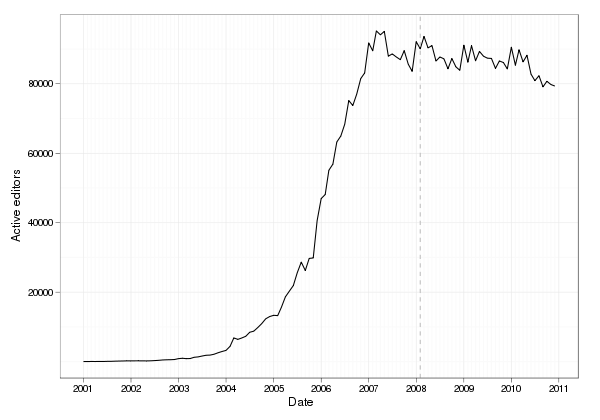
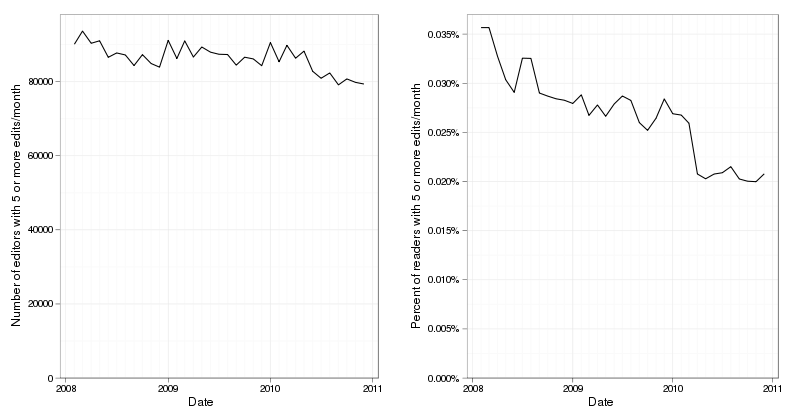
It's been reported for some time now that the number of active editors on Wikipedia (usually defined as people who have edited at least 5 times in a given month) peaked in 2007 and has been mostly stable since then. A graph of the total number of active editors in every month since Wikipedia's founding is shown below. The graph shows the aggregate numbers for all language Wikipedias. English Wikipedia is the largest component of this and is generally more variable. That said, very similar patterns exist for most larger languages. /copyrighteous/images/active_editors_all_wikpiedia.png Felipe Ortega, who has provided many of these statistics, has warned against fatalist claims. Although there seems to be a decrease in the total number of active editors over the last two years, the situation seems to have somewhat stabilized in most languages. New editors in Wikipedia are replacing folks at almost the rate that they are leaving. It is also widely known that the number of readers of Wikipedia has been increasing during this period. According to the report cards released by the foundation using comScore data, the number of unique visitors to Wikipedia each month has increased by 61 million people in the last year -- over 17%. This discrepancy between rising readership and stable or sinking editorship should raise major concern. After all, the Wikimedia Foundation's mission is two part: (1) to empower and engage people around the world to collect and develop educational content and (2) to disseminate it effectively and globally. Although the Foundation report cards include measures of raw levels of editorship, a better metric of engagement and empowerment might be the proportion of readers who engage in editing. I could not find reliable data on the number of unique readers reached each month for more than a few months in the last year. What is available, however, is wonderful data on page views each month going back to 2008. Analysis of the data from available report cards show that, at least during the last year, there is a very stable ratio of 35 page views per unique visitor, as estimated by comScore. Using that measure, we can do a back of the envelope estimation on the proportion of users that are editors for the period where page view data is available, dating back from February 2008 ( marked with the grey dashed lined above). The graphs below show the very different results you get when you consider the change in the number of Wikipedia editors and the change in the editor-to-reader ratio. Once again, these data are combined data for all language Wikipedias although graphs look very similar for most larger languages. The results are striking. Although there has been a 12% decrease between February 2008 and December 2010 in the number of active editors, there is a 42% decrease in the proportion of readers who edit at least five times a month. We can see that fulfilling the first half of the Wikimedia mission remains a struggle. /copyrighteous/images/wikipedia_editors_combined_graph.png Although the graphs above do not say anything directly about the most active core contributors to Wikipedia, the fact that Wikipedia is being maintained by a tiny -- and shrinking -- proportion of its readership does mean that the idea behind Wikipedia is under threat. Although none are as big as Wikipedia, there are lots of good encyclopedias out there. The reason Wikipedia is different, interesting, and important is because -- unlike all those others -- Wikipedia is the encyclopedia that anyone can edit. Wikipedia is powerful because it allow its users to transcend their role as consumers of the information they use to understand the world. Wikipedia allows users to define the reference works that define their understanding of the their environment and each other. But 99.98% of the time, readers do not transcend that role. I think that's a problem. Worse, that the number is growing. The Wikimedia Foundation recently ran a major successful effort to attract donations in its annual fundraiser. Jimmy Wales' smiling mug is apparently enough in the way of motivation to get something like 1% of its readers to donate money to support the project. I think that's very good news. If the Wikimedia community can entice even half of those people to contribute through an increased involvement in the projects themselves, they might do more than ensure Wikipedia's continued growth. They would help take a step toward the empowerment and engagement of those users in sharing their own knowledge, and the continued fulfillment of a critically important mission.
Kartik Mistry: Squeeze!

* So, Debian 6.0 Squeeze is released! And, congratulations and thanks to all people involved. Lets have party now!

Next.

Previous.