Search Results: "sto"

25 May 2025

Valhalla's Things: Honeycomb shirt

Posted on May 25, 2025
Tags: madeof:atoms, craft:sewing, FreeSoftWear, GNU Terry Pratchett
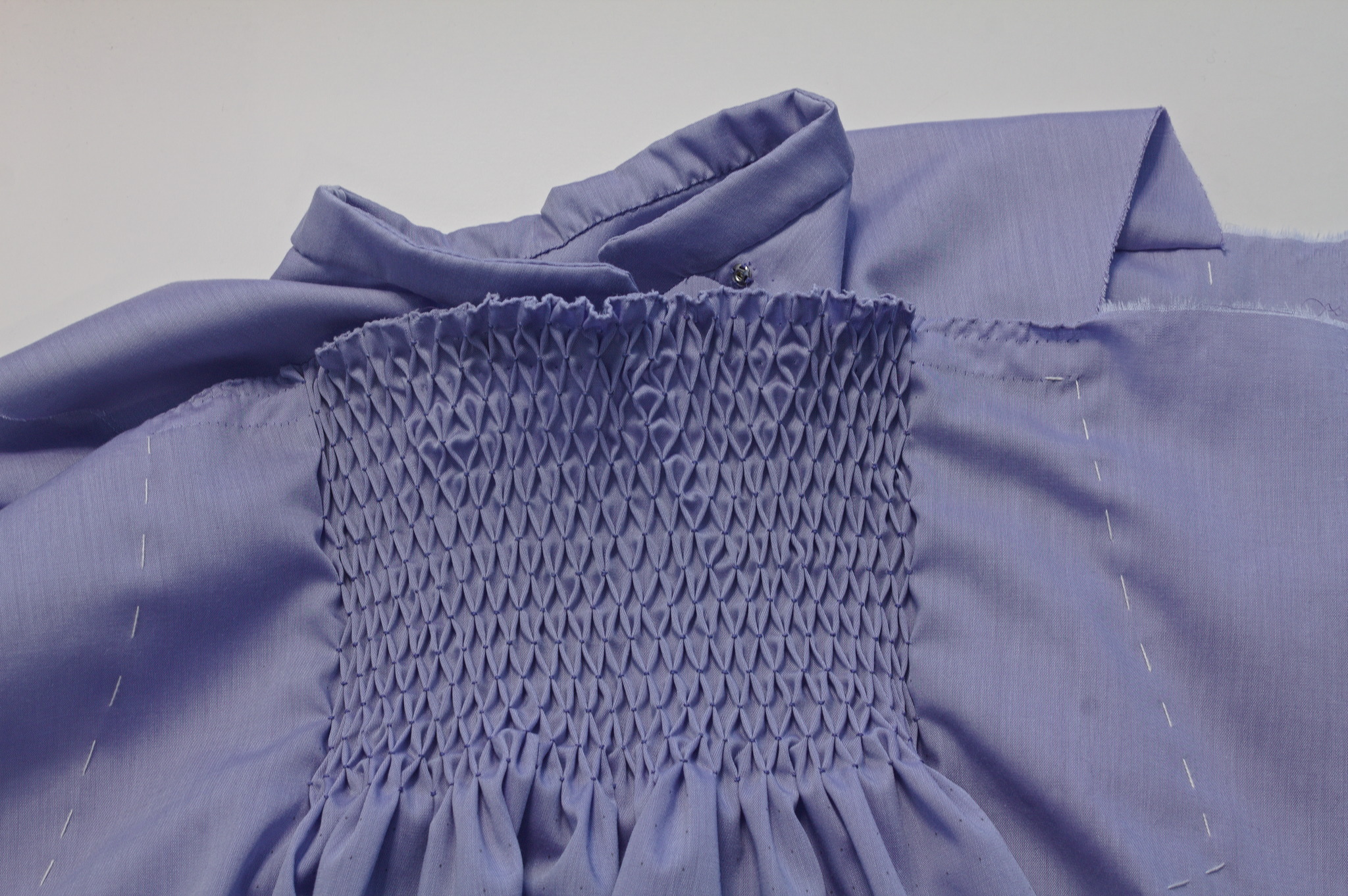
A woman wearing a purplish blue shirt with very wide sleeves, gathered at the cuffs and shoulder with honeycombing, and also a rectangle of honeycombing in the front between the neckline and just above the bust. The shirt is gathered at the waist with a wide belt, and an almost lilac towel hangs from the belt. After cartridge pleating, the next fabric manipulation technique I wanted to try was smocking, of the honeycombing variety, on a shirt. My current go-to pattern for shirts is the 1880 menswear one I have on my website: I love the fact that most of the fabric is still cut as big rectangles, but the shaped yoke and armscyes make it significantly more comfortable than the earlier style where most of the shaping at the neck was done with gathers into a straight collar. A woman wearing a shirt in the same fabric; this one has a slit in the front, is gathered into a tall rectangular collar and has dropped shoulders because it's cut from plain rectangles. The sleeves are still huge, and gathered into tall cuffs. It is worn belted (with the same wide white elastic belt used in the previous picture) and the woman is wearing a matching fabric mask, because the picture has been taken in 2021. In my stash I had a cut of purple-blue hopefully cotton [#cotton] I had bought for a cheap price and used for my first attempt at an historically accurate pirate / vampire shirt that has now become by official summer vaccine jab / blood test shirt (because it has the long sleeves I need, but they are pretty easy to roll up to give access to my arm. That shirt tends to get out of the washing machine pretty wearable even without ironing, which made me think it could be a good fabric for something that may be somewhat hard to iron (but also made me suspicious about the actual composition of the fabric, even if it feels nice enough even when worn in the summer). A piece of fabric with many rows of honeycombing laid on top of the collar and yoke of the shirt; a metal snap peeks from behind the piece of honeycombed fabric.  There are still basting lines for the armscyes. Of course I wanted some honeycombing on the front, but I was afraid that the slit in the middle of it would interfere with the honeycombing and gape, so I decided to have the shirt open in an horizontal line at the yoke. I added instructions to the pattern page for how I changed the opening in the front, basically it involved finishing the front edge of the yoke, and sewing the honeycombed yoke to a piece of tape with snaps. Another change from the pattern is that I used plain rectangles for the sleeves, and a square gusset, rather than the new style tapered sleeve , because I wanted to have more fabric to gather at the wrist. I did the side and sleeve seams with a hem + whipstitch method rather than a felled seam, which may have helped, but the sleeves went into the fitted armscyes with no issue. I think that if (yeah, right. when) I ll make another sleeve in this style I ll sew it into the side seam starting 2-3 cm lower than the place I ve marked on the pattern for the original sleeve. The back of the unbelted shirt: it has a fitted yoke, and then it is quite wide and unfitted, with the fabric gathered into the yoke with a row of honeycombing and some pleating on top. I also used a row of honeycombing on the back and two on the upper part of the sleeves, instead of the gathering, and of course some rows to gather the cuffs. The honeycombing on the back was a bit too far away from the edge, so it s a bit of an odd combination of honeycombing and pleating that I don t hate, but don t love either. It s on the back, so I don t mind. On the sleeves I ve done the honeycombing closer to the edge and I ve decided to sew the sleeve as if it was a cartridge pleated sleeve, and that worked better. Because circumstances are still making access to my sewing machine more of a hassle than I d want it to be, this was completely sewn by hand, and at a bit more than a month I have to admit that near the end it felt like it had been taken forever. I m not sure whether it was the actual sewing being slow, some interruptions that happened when I had little time to work on it, or the fact that I ve just gone through a time when my brain kept throwing new projects at me, and I kept thinking of how to make those. Thanks brain. Even when on a hurry to finish it, however, it was still enjoyable sewing, and I think I ll want to do more honeycombing in the future. The same woman with arms wide to show the big sleeves and the shirt unbelted to show that it is pretty wide also from the front, below the yoke and the honeycombing. The back can be seen as about 10 cm longer than the front. Anyway, it s done! And it s going straight into my daily garment rotation, because the weather is getting hot, and that means it s definitely shirt time.

23 May 2025

Yves-Alexis Perez: strongSwan autopkgtests

For a while, the strongSwan Debian package had an autopktest. The initial version was proposed by Christian Ehrhardt in 2016 (presumably especially for downstream use in Ubuntu) and updated in 2019, but since then not much at least in Debian. With the metapackage dependencies update in 6.0.0-1 I had to tune a bit the tests dependencies so they wouldn't totally fail, and I noticed the amd64 tests were failing since basically the beginning (the other architectures would pass, but because the tests wouldn't actually run at all since they rely on the isolation-machine restriction which is not available there. So I tried to fix them, and it actually took me quite a while because I wasn't able to run the tests locally easily and the salsa CI doesn't have the isolation-machine restriction either. And some tests would pass and not other. With some nice help from #debci, and using my newly received X13G5 I set up an autopkgtest VM and started experimenting. The 6.0.0-4 autopkgtests were failing 19 times over 20 steps, but passing one time. So it looked like a race condition, which we narrowed to the fact that starting the daemons (using invoke-rc.d which calls systemctl) is asynchronous. So depending on the load and maybe the machine, the tests would usually fail but sometime pass. There's no easy way to make the call synchronous, so as a stopgap I added a small sleep 1 command and it fixed it for now. Tada! strongSwan has now passing autopkgtests in unstable (and testing) amd64. It's not entirely satisfying but still. Next steps would be to add tests for the new daemon using the swanctl inteface, but that'll be for Forky (Trixie+1).

Sven Hoexter: pflogsumm 1.1.6

Mainly relevant for the few who still run their own mail server and use Postfix + pflogsumm. Few weeks back Jim contacted me that he's going to pick up work on pflogsumm again, and as first step wanted to release 1.1.6 to incorporate patches from the Debian package. That one is now released. Since we're already in the Trixie freeze the package is in experimental, but as usual should be fine to install manually. Heads Up - Move to /usr/bin I took that as an opportunity to move pflogsumm from /usr/sbin to /usr/bin! There was not really a good reason to ever have it in sbin. It's neither a system binary, nor statically linked (like in the very old days), or something that really only makes sense to be used as root. Some out there likely have custom scripts which do not rely on an adjusted PATH variable, those scripts require an update.

Gunnar Wolf: No further discussion -- I am staying with a Thinkpad keyboard.

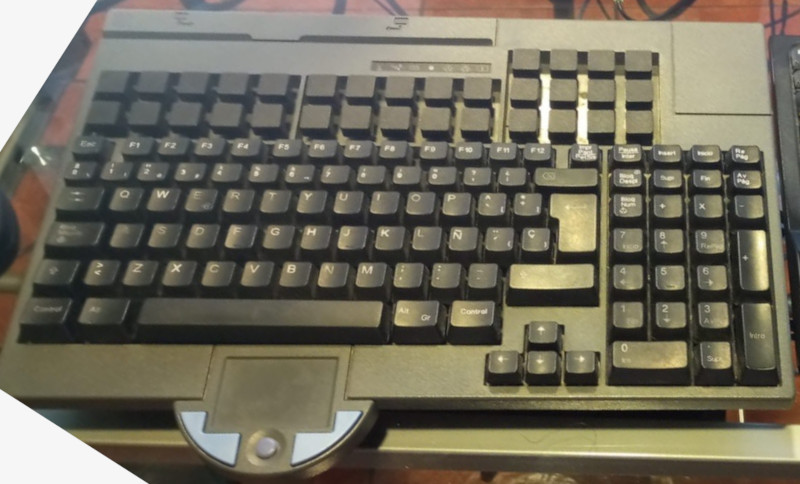
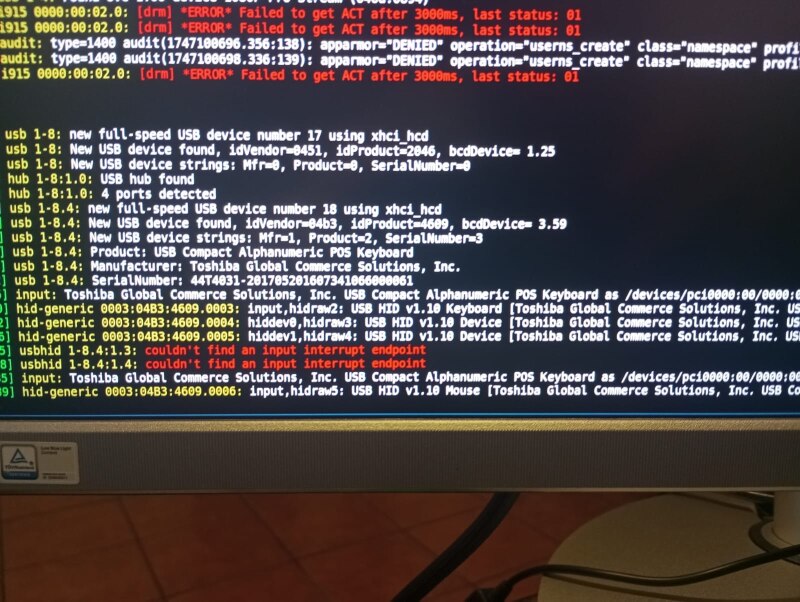
I have been a very happy user of my two SK-8845 keyboards (one at my office, one at home) since I bought them, in 2018 and 2021 respectively. What are they, mind you? SK-8845 keyboard) The beautiful keyboard every Thinkpad owner knows and loves. And although I no longer use my X230 laptop that was my workhorse for several years, my fingers are spoiled. So, both shift keys of my home keyboard have been getting flaky, and I am basically sure it s a failure in the controller, as it does not feel to be physical. It s time to revisit that seven year old post where I found the SK-8845. This time, I decided to try my luck with something different. As a Emacs user, everybody knows we ought to be happy with more and more keys. In fact, I suppose many international people are now familiar with El Eternauta, true? we Emacs users would be the natural ambassadors to deal with the hand species: Emacs users from outer space! So it kind-of sort-of made sense, when I saw a Toshiba-IBM keyboard being sold for quite cheap (MX$400, just over US$20) to try my luck with it: A truly POS keyboard This is quite an odd piece of hardware, built in 2013 according to its label. At first I was unsure whether to buy it because of the weird interface it had, but the vendor replied they would ship a (very long!) USB cable with it, so A weird port inside the keyboard And a matching weird connector As expected, connecting it to Linux led to a swift, errorless recognition: Nothing too odd here Within minutes of receiving the hardware, I had it hooked up and started looking at the events it generated However the romance soon started to wane. Some of the reasons: Anyway I m returning it I found an SK-8845 for sale in China for just MX$1814 (~US$90), and jumped for it They are getting scarce! Nowadays it s getting more common (and cheaper) to find the newer style Thinkpad keyboards, but without a trackpad I don t think I should stockpile on keyboards, but no, I m not doing that Anyway, so I m sticking to a Thinkpad keyboard, third in a row.

22 May 2025

Scarlett Gately Moore: KDE Application Snaps 25.04.1 with Major Bug Fix!,Life ( Good news finally!)

Snaps!

I actually released last week  I haven t had time to blog, but today is my birthday and taking some time to myself!This release came with a major bugfix. As it turns out our applications were very crashy on non-KDE platforms including Ubuntu proper. Unfortunately, for years, and I didn t know. Developers were closing the bug reports as invalid because users couldn t provide a stacktrace. I have now convinced most developers to assign snap bugs to the Snap platform so I at least get a chance to try and fix them. So with that said, if you tried our snaps in the past and gave up in frustration, please do try them again! I also spent some time cleaning up our snaps to only have current releases in the store, as rumor has it snapcrafters will be responsible for any security issues. With 200+ snaps I maintain, that is a lot of responsibility. We ll see if I can pull it off.

Life!

My last surgery was a success! I am finally healing and out of a sling for the first time in almost a year. I have also lined up a good amount of web work for next month and hopefully beyond. I have decided to drop the piece work for donations and will only accept per project proposals for open source work. I will continue to maintain KDE snaps for as long as time allows. A big thank you to everyone that has donated over the last year to fund my survival during this broken arm fiasco. I truly appreciate it!
With that said, if you want to drop me a donation for my work, birthday or well-being until I get paid for the aforementioned web work please do so here:

21 May 2025

Simon Quigley: Fences and Values

Don t knock the fence down before you know why it s up. I repeat this phrase over and over again, yet the (metaphorical) Homeowner s Association still decides my fence is the wrong color.Well, now you get to know why the fence is up. If anyone s actually willing to challenge me on this level, I d welcome it.The four ideas I d like to discuss are this: quantum physics, Lutheranism, mental resilience, and psychology. I ve been studying these topics intensely for the past decade as a passion project. I m just going to let my thoughts flow, but I d like to hear other opinions on this.Can the mysteries of the mind, the subatomic world, and faith converge to reveal deeper truths?When it comes to self-taught knowledge on analysis, I m mostly learned on Freud, with some hints of Jung and Peterson. I ve read much of the original source material, and watched countless presentations on it. This all being said, I m both learned on Rothbard and Marx, so if there is a major flaw in the way of Freud is frowned upon, I d genuinely like to know so I can update my research and juxtapose the two schools of thought.Alongside this, although probably not directly relevant, I m learned on John Locke and transcendentalism. What I d like to focus on here is this the Id.The Id is the pleasure-seeking, instinctual part of the psyche. Jung further extends this into the idea of the shadow self, and Peterson maps the meanings of these texts into a combined work (at least in my rudimentary understanding).In my research, the Id represents the part of your psyche that deals with religious values. As an example, if you re an impulsive person, turning to a spiritual or religious outlet can be highly beneficial. I ve been using references from the foundational text of the Judaeo-Christian value system this entire time, feel free to re-read my other blog posts (instead of claiming they don t exist).Let s tie this into quantum physics. This is the part where I ll struggle most. I ve watched several movies about this, read several books, and even learned about it academically, but quantum physics is likely to be my weak spot here.I did some research, and here are the elements I m looking for: uncertainty principle, wave-particle duality, quantum entanglement, and the observer effect.I already know about the cat in the box. And the Cat in the Hat, for that matter. I know about wave-particle duality from an incredibly intelligent high school physics teacher of mine. I know about the uncertainty principle purely in a colloquial sense. The remaining element I need to wrap my head around is quantum entanglement, but it feels like I m almost there.These concepts do actually challenge the idea of pure free will. It s almost like we re coming full circle. Some theologians (including myself, if you can call me a self-taught one) do believe the idea of quantum indeterminacy can be a space where divine action may take place. You could also liken the unpredictable nature of the Id to quantum indeterminacy as well. These are ones to think about, because in all reality, they re subjective opinions. I do believe they re interconnected.In terms of Lutheranism, I ll be short on this one. Please do go read the full history behind Martin Luther and his turbulent relationship with Catholicism. I m not a Bible thumper, and I actually think this is the first time I ve mentioned religion publicly at all. This being said, now I m actually ready to defend the points on an academic level.The Id represents hidden psychological forces, quantum physics reveals subatomic mysteries, and Lutheranism emphasizes faith in the unseen God. Okay, so we have the baseline. Now, time for some mental resilience. When I think of mental resilience, the first people I think of are David Goggins and Jocko Willink. I ve also enjoyed Dr. Andrew Huberman s podcast.The idea there is simple if you understand exactly how to learn, you know your fundamentals well enough to draw them and explain them vividly on a whiteboard, and you can make it a habit, at that point you re ready to work on your mental resilience. Little by little, gradually, how far can you push the bar towards the ceiling?There s obviously limits. People sometimes get scared when I mention mental resilience, but obviously that s a bit of a catch 22. There are plenty of satirical videos out there, and of course, I don t believe in Goggins or Jocko wholeheartedly. They re just tools in the toolbox when times get tough.I wish you all well, and I hope this gets you thinking about those people who just insist there is no God or higher being, and think you re stupid for believing there is one. Those people obviously haven t read analysis, in my own opinion.Have a great night!

Simon Quigley: Loose Cannons and Orwellian Tactics

Edit: for the people calling this unhinged, you don t have the full context. I know it s not a good look. Just stop and think for a second, though.I d like to start this post by saying that I am indeed well. I ve thought so from the very beginning, and it s been confirmed by professionals as such. That being said, there is still this perception that people are still believing the other person that needs help.See, when you re deeply involved in this space for ten years and start a blog to share all the cool things you ve learned, you don t expect people to spread the rumor that you re crazy. And you especially don t expect them to resort to a legal bluff and then brag about it in a private IRC channel (yes, I have the proof.)I d like my apology letter, please. And I d like you all to stop using Orwellian tactics to silence me by spreading those rumors, please. I know the source of the rumor-mill, and it s being dealt with. There has been progress, but one thing hasn t happened yet I haven t received my apology letter. I ll even volunteer, out of my own good spirit, to remove this post and all BwE parts of my first post if you send me a full apology letter in the next 24 hours. I d do that, just to get you to open your eyes and smile.Silencing people, or asking them to remove parts of a post you don t like, is never okay. You could choose whether to publish it on your platform, sure, but you certainly don t get to pick and choose what I put in my personal blog posts.I am a United States citizen with a 1st amendment right that shall be respected. I ve also studied and enjoyed writing for years. I m sick and tired of the back and forth on this. I ve wanted to move on and you are actively not letting me.I have the full IRC logs. Several other people have attested they also have them. What would you like to do next?I m not sure about you, but I m sitting here eating a donut. This isn t harrassment, this is self defense. At some point, you have to get sick and tired of issues happening, and you have to stand up for yourself, on your own footing.It isn t easy. I probably won t look back favorably on this post and thought process in a few years. That being said, it s necessary to defend myself on someone who has mistreated me personally on so many grave levels. You ll note I still haven t made the name public.They want to make you out to look like a loose cannon. They want to push your buttons and make you write a rant blog post telling you how much they hate them. I m not going to dignify that, because I know a specific electrician who wouldn t be happy if I had to write him a dissent.I m done. Don t defame me anymore.With donuts,
Simon

Russell Coker: Digital Sovereignty and Email

Running Your Own Email Srever I run my own mail server. I have run it since about 1995, initially on a 28k8 modem connection but the connection improved as technology became cheaper and now I m running it on a VM on a Hetzner server which is also running domains for some small businesses. I make a small amount of money running mail services for those companies but generally not enough to make it profitable. From a strictly financial basis I might be better off just using a big service, but I like having control over my own email. If email doesn t arrive I can read the logs to find out why. I repeatedly have issues of big services not accepting mail. The most recent is the MS services claiming that my IP has a bad ratio of good mail to spam and blocked me so I had to tunnel that through a different IP address. It seems that the way things are going is that if you run a small server companies like MS can block you even though your amount of spam is low but if you run a large scale service that is horrible for sending spam then you don t get blocked. For most users they just use one of the major email services (Gmail or Microsoft) and find that no-one blocks them because those providers are too big to block and things mostly work. Until of course the company decides to cancel their account. The Latest News The latest news is that MS is shutting down services for the International Court of Justice after a panel of ICC judges issued arrest warrants against Israeli Prime Minister Benjamin Netanyahu [1] . This is now making politicians realise the issues of email accounts hosted outside their jurisdiction. What we need is for each independent jurisdiction to have it s own email infrastructure, that means controlling DNS servers for their domains, commercial and government mail services on those domains, running the servers for those services on hardware located in the jurisdiction and run by people based in that jurisdiction and citizens of it. I say independent jurisdiction because there are groups like the EU which have sufficient harmony of laws to not require different services. With the current EU arrangements I don t think it s possible for the German government to block French people from accessing email or vice versa. While Australia and New Zealand have a long history of cooperation there s still the possibility of a lying asshole like Scott Morrison trying something on so New Zealanders shouldn t feel safe using services run in Australia. Note that Scott Morrison misled his own parliamentary colleagues about what he was doing and got himself assigned as a secret minister [2] demonstrating that even conservatives can t trust someone like him. With the ongoing human rights abuses by the Morrison government it s easy to imagine New Zealand based organisations that protect human rights being treated by the Australian government in the way that the ICC was treated by the US government. The Problem with Partial Solutions Now it would be very easy for the ICC to host their own mail servers and they probably will do just that in the near future. I m sure that there are many companies offering to set them up accounts in a hurry to deal with this (probably including some of the Dutch companies I ve worked for). Let s imagine for the sake of discussion that the ICC has their own private server, the US government could compel Google and MS to block the IP addresses of that server and then at least 1/3 of the EU population won t get mail from them. If the ICC used email addresses hosted on someone else s server then Google and MS could be compelled to block the addresses in question for the same result. The ICC could have changing email addresses to get around block lists and there could be a game of cat and mouse between the ICC and the US government but that would just be annoying for everyone. The EU needs to have services hosted and run in their jurisdiction that are used by the vast majority of the people in the country. The more people who are using services outside the control of hostile governments the lesser the impact of bad IT policies by those hostile governments. One possible model to consider is the Postbank model. Postbank is a bank run in the Netherlands from post offices which provides services to people deemed unprofitable for the big banks. If the post offices were associated with a mail service you could have it government subsidised providing free service for citizens and using government ID if the user forgets their password. You could also have it provide a cheap service for non-citizen residents. Other Problems What will the US government do next? Will they demand that Apple and Google do a remote-wipe on all phones run by ICC employees? Are they currently tracking all ICC employees by Android and iPhone services? Huawei s decision to develop their own phone OS was a reasonable one but there s no need to go that far. Other governments could setup their own equivalent to Google Play services for Android and have their own localised Android build. Even a small country like Australia could get this going for the services of calendaring etc. But the app store needs a bigger market. There s no reason why Android has to tie the app store to the services for calendaring etc. So you could have a per country system for calendaring and a per region system for selling apps. The invasion of Amazon services such as Alexa is also a major problem for digital sovereignty. We need government controls about this sort of thing, maybe have high tariffs on the import of all hardware that can only work with a single cloud service. Have 100+% tariffs on every phone, home automation system, or networked device that is either tied to a single cloud service or which can t work in a usable manner on other cloud services.

20 May 2025

Arturo Borrero Gonz lez: Wikimedia Cloud VPS: IPv6 support

Cape Town (ZA), Sea Point, Nachtansicht Dietmar Rabich, Cape Town (ZA), Sea Point, Nachtansicht 2024 1867-70 2, CC BY-SA 4.0 This post was originally published in the Wikimedia Tech blog, authored by Arturo Borrero Gonzalez. Wikimedia Cloud VPS is a service offered by the Wikimedia Foundation, built using OpenStack and managed by the Wikimedia Cloud Services team. It provides cloud computing resources for projects related to the Wikimedia movement, including virtual machines, databases, storage, Kubernetes, and DNS. A few weeks ago, in April 2025, we were finally able to introduce IPv6 to the cloud virtual network, enhancing the platform s scalability, security, and future-readiness. This is a major milestone, many years in the making, and serves as an excellent point to take a moment to reflect on the road that got us here. There were definitely a number of challenges that needed to be addressed before we could get into IPv6. This post covers the journey to this implementation. The Wikimedia Foundation was an early adopter of the OpenStack technology, and the original OpenStack deployment in the organization dates back to 2011. At that time, IPv6 support was still nascent and had limited implementation across various OpenStack components. In 2012, the Wikimedia cloud users formally requested IPv6 support. When Cloud VPS was originally deployed, we had set up the network following some of the upstream-recommended patterns: In order for us to be able to implement IPv6 in a way that aligned with our architectural goals and operational requirements, pretty much all the elements in this list would need to change. First of all, we needed to migrate from nova-networks into Neutron, a migration effort that started in 2017. Neutron was the more modern component to implement software-defined networks in OpenStack. To facilitate this transition, we made the strategic decision to backport certain functionalities from nova-networks into Neutron, specifically the dmz_cidr mechanism and some egress NAT capabilities. Once in Neutron, we started to think about IPv6. In 2018 there was an initial attempt to decide on the network CIDR allocations that Wikimedia Cloud Services would have. This initiative encountered unforeseen challenges and was subsequently put on hold. We focused on removing the previously backported nova-networks patches from Neutron. Between 2020 and 2021, we initiated another significant network refresh. We were able to introduce the cloudgw project, as part of a larger effort to rework the Cloud VPS edge network. The new edge routers allowed us to drop all the custom backported patches we had in Neutron from the nova-networks era, unblocking further progress. Worth mentioning that the cloudgw router would use nftables as firewalling and NAT engine. A pivotal decision in 2022 was to expose the OpenStack APIs to the internet, which crucially enabled infrastructure management via OpenTofu. This was key in the IPv6 rollout as will be explained later. Before this, management was limited to Horizon the OpenStack graphical interface or the command-line interface accessible only from internal control servers. Later, in 2023, following the OpenStack project s announcement of the deprecation of the neutron-linuxbridge-agent, we began to seriously consider migrating to the neutron-openvswitch-agent. This transition would, in turn, simplify the enablement of tenant networks a feature allowing each OpenStack project to define its own isolated network, rather than all virtual machines sharing a single flat network. Once we replaced neutron-linuxbridge-agent with neutron-openvswitch-agent, we were ready to migrate virtual machines to VXLAN. Demonstrating perseverance, we decided to execute the VXLAN migration in conjunction with the IPv6 rollout. We prepared and tested several things, including the rework of the edge routing to be based on BGP/OSPF instead of static routing. In 2024 we were ready for the initial attempt to deploy IPv6, which failed for unknown reasons. There was a full network outage and we immediately reverted the changes. This quick rollback was feasible due to our adoption of OpenTofu: deploying IPv6 had been reduced to a single code change within our repository. We started an investigation, corrected a few issues, and increased our network functional testing coverage before trying again. One of the problems we discovered was that Neutron would enable the enable_snat configuration flag for our main router when adding the new external IPv6 address. Finally, in April 2025, after many years in the making, IPv6 was successfully deployed. Compared to the network from 2011, we would have: Over time, the WMCS team has skillfully navigated numerous challenges to ensure our service offerings consistently meet high standards of quality and operational efficiency. Often engaging in multi-year planning strategies, we have enabled ourselves to set and achieve significant milestones. The successful IPv6 deployment stands as further testament to the team s dedication and hard work over the years. I believe we can confidently say that the 2025 Cloud VPS represents its most advanced and capable iteration to date. This post was originally published in the Wikimedia Tech blog, authored by Arturo Borrero Gonzalez.

Simon Quigley: Donuts and 5-Star Restaurants

In my home state of Wisconsin, there is an incredibly popular gas station called Kwik Trip. (Not to be confused with Quik Trip.) It is legitimately one of the best gas stations I ve ever been to, and I m a frequent customer.What makes it that great?Well, everything about it. The store is clean, the lights work, the staff are always friendly (and encourage you to come back next time), there s usually bakery on sale (just depends on location etc), and the list goes on.There s even a light-switch in the bathroom of a large amount of locations that you can flip if a janitor needs to attend to things. It actually does set off an alarm in the back room.A dear friend of mine from Wisconsin once told me something along the lines of, it s inaccurate to call Kwik Trip a gas station, because in all reality, it s a five star restaurant. (M , I hope you re well.)In my own opinion, they have an espresso machine. That s what really matters. ;)I mentioned the discount bakery. In reality, it s a pretty great system. To my limited understanding, the bakery that is older than standard but younger than expiry are set to half price and put towards the front of the store. In my personal experience, the vast majority of the time, the quality is still amazing. In fact, even if it isn t, the people working at Kwik Trip seem to genuinely enjoy their job.When you re looking at that discount rack of bakery, what do you choose? A personal favorite of mine is the banana nut bread with frosting on top. (To the non-Americans, yes, it does taste like it s homemade, it doesn t taste like something made in a factory.)Everyone chooses different bakery items. And honestly, there could be different discount items out depending on the time. You take what you can get, but you still have your own preferences. You like a specific type of donut (custard-filled, or maybe jelly-filled). Frosting, sprinkles there are so many ways to make different bakery items.It s not only art, it s kind of a science too.Is there a Kwik Trip that you ve called a gas station instead of a five star restaurant? Do you also want to tell people about your gas station? Do you only pick certain bakery items off the discount rack, or maybe ignore it completely? (And yes, there would be good reason to ignore the bakery in favor of the Hot Spot, I d consider that acceptable in my personal opinion.)Remember, sometimes you just have to like donuts.https://medium.com/media/73f78efd7bd6bb9ce495c2f08428c7d3/hrefHave a sweet day. :)

19 May 2025

Melissa Wen: A Look at the Latest Linux KMS Color API Developments on AMD and Intel

This week, I reviewed the last available version of the Linux KMS Color API. Specifically, I explored the proposed API by Harry Wentland and Alex Hung (AMD), their implementation for the AMD display driver and tracked the parallel efforts of Uma Shankar and Chaitanya Kumar Borah (Intel) in bringing this plane color management to life. With this API in place, compositors will be able to provide better HDR support and advanced color management for Linux users. To get a hands-on feel for the API s potential, I developed a fork of drm_info compatible with the new color properties. This allowed me to visualize the display hardware color management capabilities being exposed. If you re curious and want to peek behind the curtain, you can find my exploratory work on the drm_info/kms_color branch. The README there will guide you through the simple compilation and installation process. Note: You will need to update libdrm to match the proposed API. You can find an updated version in my personal repository here. To avoid potential conflicts with your official libdrm installation, you can compile and install it in a local directory. Then, use the following command: export LD_LIBRARY_PATH="/usr/local/lib/" In this post, I invite you to familiarize yourself with the new API that is about to be released. You can start doing as I did below: just deploy a custom kernel with the necessary patches and visualize the interface with the help of drm_info. Or, better yet, if you are a userspace developer, you can start developing user cases by experimenting with it. The more eyes the better.

KMS Color API on AMD The great news is that AMD s driver implementation for plane color operations is being developed right alongside their Linux KMS Color API proposal, so it s easy to apply to your kernel branch and check it out. You can find details of their progress in the AMD s series. I just needed to compile a custom kernel with this series applied, intentionally leaving out the AMD_PRIVATE_COLOR flag. The AMD_PRIVATE_COLOR flag guards driver-specific color plane properties, which experimentally expose hardware capabilities while we don t have the generic KMS plane color management interface available. If you don t know or don t remember the details of AMD driver specific color properties, you can learn more about this work in my blog posts [1] [2] [3]. As driver-specific color properties and KMS colorops are redundant, the driver only advertises one of them, as you can see in AMD workaround patch 24. So, with the custom kernel image ready, I installed it on a system powered by AMD DCN3 hardware (i.e. my Steam Deck). Using my custom drm_info, I could clearly see the Plane Color Pipeline with eight color operations as below:
 "COLOR_PIPELINE" (atomic): enum  Bypass, Color Pipeline 258  = Bypass
     Bypass
     Color Pipeline 258
         Color Operation 258
             "TYPE" (immutable): enum  1D Curve, 1D LUT, 3x4 Matrix, Multiplier, 3D LUT  = 1D Curve
             "BYPASS" (atomic): range [0, 1] = 1
             "CURVE_1D_TYPE" (atomic): enum  sRGB EOTF, PQ 125 EOTF, BT.2020 Inverse OETF  = sRGB EOTF
         Color Operation 263
             "TYPE" (immutable): enum  1D Curve, 1D LUT, 3x4 Matrix, Multiplier, 3D LUT  = Multiplier
             "BYPASS" (atomic): range [0, 1] = 1
             "MULTIPLIER" (atomic): range [0, UINT64_MAX] = 0
         Color Operation 268
             "TYPE" (immutable): enum  1D Curve, 1D LUT, 3x4 Matrix, Multiplier, 3D LUT  = 3x4 Matrix
             "BYPASS" (atomic): range [0, 1] = 1
             "DATA" (atomic): blob = 0
         Color Operation 273
             "TYPE" (immutable): enum  1D Curve, 1D LUT, 3x4 Matrix, Multiplier, 3D LUT  = 1D Curve
             "BYPASS" (atomic): range [0, 1] = 1
             "CURVE_1D_TYPE" (atomic): enum  sRGB Inverse EOTF, PQ 125 Inverse EOTF, BT.2020 OETF  = sRGB Inverse EOTF
         Color Operation 278
             "TYPE" (immutable): enum  1D Curve, 1D LUT, 3x4 Matrix, Multiplier, 3D LUT  = 1D LUT
             "BYPASS" (atomic): range [0, 1] = 1
             "SIZE" (atomic, immutable): range [0, UINT32_MAX] = 4096
             "LUT1D_INTERPOLATION" (immutable): enum  Linear  = Linear
             "DATA" (atomic): blob = 0
         Color Operation 285
             "TYPE" (immutable): enum  1D Curve, 1D LUT, 3x4 Matrix, Multiplier, 3D LUT  = 3D LUT
             "BYPASS" (atomic): range [0, 1] = 1
             "SIZE" (atomic, immutable): range [0, UINT32_MAX] = 17
             "LUT3D_INTERPOLATION" (immutable): enum  Tetrahedral  = Tetrahedral
             "DATA" (atomic): blob = 0
         Color Operation 292
             "TYPE" (immutable): enum  1D Curve, 1D LUT, 3x4 Matrix, Multiplier, 3D LUT  = 1D Curve
             "BYPASS" (atomic): range [0, 1] = 1
             "CURVE_1D_TYPE" (atomic): enum  sRGB EOTF, PQ 125 EOTF, BT.2020 Inverse OETF  = sRGB EOTF
         Color Operation 297
             "TYPE" (immutable): enum  1D Curve, 1D LUT, 3x4 Matrix, Multiplier, 3D LUT  = 1D LUT
             "BYPASS" (atomic): range [0, 1] = 1
             "SIZE" (atomic, immutable): range [0, UINT32_MAX] = 4096
             "LUT1D_INTERPOLATION" (immutable): enum  Linear  = Linear
             "DATA" (atomic): blob = 0
Note that Gamescope is currently using AMD driver-specific color properties implemented by me, Autumn Ashton and Harry Wentland. It doesn t use this KMS Color API, and therefore COLOR_PIPELINE is set to Bypass. Once the API is accepted upstream, all users of the driver-specific API (including Gamescope) should switch to the KMS generic API, as this will be the official plane color management interface of the Linux kernel.

KMS Color API on Intel On the Intel side, the driver implementation available upstream was built upon an earlier iteration of the API. This meant I had to apply a few tweaks to bring it in line with the latest specifications. You can explore their latest work here. For a more simplified handling, combining the V9 of the Linux Color API, Intel s contributions, and my necessary adjustments, check out my dedicated branch. I then compiled a kernel from this integrated branch and deployed it on a system featuring Intel TigerLake GT2 graphics. Running my custom drm_info revealed a Plane Color Pipeline with three color operations as follows:
 "COLOR_PIPELINE" (atomic): enum  Bypass, Color Pipeline 480  = Bypass
     Bypass
     Color Pipeline 480
         Color Operation 480
             "TYPE" (immutable): enum  1D Curve, 1D LUT, 3x4 Matrix, 1D LUT Mult Seg, 3x3 Matrix, Multiplier, 3D LUT  = 1D LUT Mult Seg
             "BYPASS" (atomic): range [0, 1] = 1
             "HW_CAPS" (atomic, immutable): blob = 484
             "DATA" (atomic): blob = 0
         Color Operation 487
             "TYPE" (immutable): enum  1D Curve, 1D LUT, 3x4 Matrix, 1D LUT Mult Seg, 3x3 Matrix, Multiplier, 3D LUT  = 3x3 Matrix
             "BYPASS" (atomic): range [0, 1] = 1
             "DATA" (atomic): blob = 0
         Color Operation 492
             "TYPE" (immutable): enum  1D Curve, 1D LUT, 3x4 Matrix, 1D LUT Mult Seg, 3x3 Matrix, Multiplier, 3D LUT  = 1D LUT Mult Seg
             "BYPASS" (atomic): range [0, 1] = 1
             "HW_CAPS" (atomic, immutable): blob = 496
             "DATA" (atomic): blob = 0
Observe that Intel s approach introduces additional properties like HW_CAPS at the color operation level, along with two new color operation types: 1D LUT with Multiple Segments and 3x3 Matrix. It s important to remember that this implementation is based on an earlier stage of the KMS Color API and is awaiting review.

A Shout-Out to Those Who Made This Happen I m impressed by the solid implementation and clear direction of the V9 of the KMS Color API. It aligns with the many insightful discussions we ve had over the past years. A huge thank you to Harry Wentland and Alex Hung for their dedication in bringing this to fruition! Beyond their efforts, I deeply appreciate Uma and Chaitanya s commitment to updating Intel s driver implementation to align with the freshest version of the KMS Color API. The collaborative spirit of the AMD and Intel developers in sharing their color pipeline work upstream is invaluable. We re now gaining a much clearer picture of the color capabilities embedded in modern display hardware, all thanks to their hard work, comprehensive documentation, and engaging discussions. Finally, thanks all the userspace developers, color science experts, and kernel developers from various vendors who actively participate in the upstream discussions, meetings, workshops, each iteration of this API and the crucial code review process. I m happy to be part of the final stages of this long kernel journey, but I know that when it comes to colors, one step is completed for new challenges to be unlocked. Looking forward to meeting you in this year Linux Display Next hackfest, organized by AMD in Toronto, to further discuss HDR, advanced color management, and other display trends.

Simon Quigley: Coffee and Adapting to your Environment

This morning, I went to make my usual cup of coffee. I was given an espresso machine for Christmas, and I ve developed this technique for making a warm drink that hits the spot every time.I ll start by turning on my espresso machine and starting a single shot of espresso. It dispenses and drips while I m working on the other parts.I then grab a coffee cup. Usually one of the taller ones. For maybe the bottom inch or two of the cup, that gets sugar and chocolate milk. Microwave for 45 seconds, pour in the espresso, then wash out the actual espresso from the metal cup with milk. Pour all of that in, another 45 seconds in the microwave, a few quick stirs, and you re all set.To the actual baristas out there, that probably sounds horrible. It probably sounds like the worst possible recommendation for a morning coffee ever.But, you know what? It works.So, I went to put my coffee into the microwave today, and I realized that someone else had put the glass plate for the microwave into the sink after accidentally spilling their breakfast on it.Instead of saying, well, I m not going to have my coffee this morning, I grabbed a large plate. I remembered the physics of levers from high school, and I understood that if I balanced everything just right, it would heat my coffee up.And well, here I am. With an un-spilled coffee and a story to tell.My point here is actually pretty simple, and this is before I even read any messages for the day. People with much more formal educations sometimes look at the guy engineering coffee with his microwave and think, what is this guy doing?!? All I m doing is making a really good cup of coffee. And to be honest, it tastes amazing.That s all. Have a wonderful day.

Simon Quigley: Toolboxes and Hammers Be You

Toolboxes and Hammers Be YouEveryone has a story. We all started from somewhere, and we re all going somewhere.Ten years ago this summer, I first heard of Ubuntu. It took me time to learn how to properly pronounce the word, although I m glad I learned that early on. I was less fortunate when it came to the pronunciation of the acronym for the Ubuntu Code of Conduct. I had spent time and time again breaking my computer, and I d wanted to start fresh.I ve actually talked about this in an interview before, which you can find here (skip to 5:02 6:12 for my short explanation, I m in orange):https://medium.com/media/ad59becdbd06d230b875fb1512df1921/hrefI ve also done a few interviews over the years, here are some of the more recent ones:https://medium.com/media/83bda448d5f2a979f848e17f04376aa6/hrefAsk Noah Show 377Lastly, I did a few talks at SCaLE 21x (which the Ubuntu community donation funds helped me attend, thank you for that!):https://medium.com/media/0fbde7ef0ed83c2272a8653a5ea38b67/hrefhttps://medium.com/media/4d18f1770dc7eed6c7a9d711ff6a6e89/hrefMy story is fairly simple to summarize, if you don t have the time to go through all the clips.I started in the Ubuntu project at 13 years old, as a middle school student living in Green Bay, WI. I m now 23 years old, still living in Green Bay, but I became an Ubuntu Core Developer, Lubuntu s Release Manager, and worked up to a very great and comfortable spot.So, Simon, what advice would you give to someone at 13 who wants to do the same thing? Here are a few tips * Don t be afraid to be yourself. If you put on a mask, it hinders your growth, and you ll end up paying for it later anyway.
* Find a mentor. Someone who is okay working with someone your age, and ideally someone who works well with people your age (quick shoutout to Aaron Prisk and Walter Lapchynski for always being awesome to me and other folks starting out at high school.) This is probably the most important part.
* Ask questions. Tons of them. Ask questions until you re blue in the face. Ask questions until you get a headache so bad that your weekend needs to come early. Okay, maybe don t go that far, but at the very least, always stay curious.
* Own up to your mistakes. Even the most experienced people you know have made tons of mistakes. It s not about the mistake itself, it s about how you handle it and grow as a person.Now, after ten years, I ve seen many people come and go in Ubuntu. I was around for the transition from upstart to systemd. I was around for the transition from Unity to GNOME. I watched Kubuntu as a flavor recover from the arguments only a few years before I first started, only to jump in and help years later when the project started to trend downwards again.I have deep love, respect, and admiration for Ubuntu and its community. I also have deep love, respect, and admiration for Canonical as a company. It s all valuable work. That being said, I need to recognize where my own limits are, and it s not what you d think. This isn t some big burnout rant.Some of you may have heard rumors about an argument between me and the Ubuntu Community Council. I refuse to go into the private details of that, but what I ll tell you is this in retrospect, it was in good faith. The entire thing, from both my end and theirs, was to try to either help me as a person, or the entire community. If you think any part of this was bad faith from either side, you re fooling yourself. Plus, tons of great work and stories actually came out of this.The Ubuntu Community Council really does care. And so does Mark Shuttleworth.Now, I won t go into many specifics. If you want specifics, I d direct you to the Ubuntu Community Council who would be more than happy to answer any questions (actually they d probably stay silent. Nevermind.) That being said, I can t really talk about any of this without mentioning how great Mark has become.Remember, I was around for a few different major changes within the project. I ve heard and seen stories about Mark that actually match what Reddit says about him. But in 2025, out of the bottom of my heart, I m here to tell you that you re all wrong now.See, Mark didn t just side with somebody and be done with it. He actually listened, and I could tell, he cares very very deeply. I really enjoyed reading ogra s recent blog post, you should seriously check it out. Of course, I m only 23 years old, but I have to say, my experiences with Mark match that too.Now, as for what happens from here. I m taking a year off from Ubuntu. I talked this over with a wide variety of people, and I think it s the right decision. People who know me personally know that I m not one to make a major decision like this without a very good reason to. Well, I d like to share my reasons with you, because I think they d help.People who contribute time to open source find it to be very rewarding. Sometimes so rewarding, in fact, that no matter how many economics and finance books they read, they still haven t figured out how to balance that with a job that pays money. I m sure everyone deeply involved in this space has had the urge to quit their job at least once or twice to pursue their passions.Here s the other element too I ve had a handful of romantic relationships before, and they ve never really panned out. I found the woman that I truly believe I m going to marry. Is it going to be a rough road ahead of us? Absolutely, and to be totally honest, there is still a (small, at this point) chance it doesn t work out.That being said I remain optimistic. I m not taking a year off because I m in some kind of trouble. I haven t burned any bridge here except for one.You know who you are. You need help. I d be happy to reconnect with you once you realize that it s not okay to do what you did. An apology letter is all I want. I don t want Mutually Assured Destruction, I don t want to sit and battle on this for years on end. Seriously dude, just back off. Please.I hate having to take out the large hammer. But sometimes, you just have to do it. I ve quite enjoyed Louis Rossmann s (very not-safe-for-work) videos on BwE.https://medium.com/media/ab64411c41e65317f271058f56bb2aba/hrefI genuinely enjoy being nice to people. I want to see everyone be successful and happy, in that order (but with both being very important). I m not perfect, I m a 23-year-old who just happened to stumble into this space at the right time.To this specific person only, I tell you, please, let me go take my year off in peace. I don t wish you harm, and I won t make anything public, including your name, if you just back off.Whew. Okay. Time to be happy again.Again, I want to see people succeed. That goes for anyone in Ubuntu, Lubuntu, Kubuntu, Canonical, you name it. I m going to remain detached from Ubuntu for at least a year. If circumstances change, or if I feel the timing just isn t right, I ll wait longer. My point is, I ll be back, the when of it will just never be public before it happens.In the meantime, you re welcome to reach out to me. It ll take me some time to bootstrap things, more than I originally thought, but I m hoping it ll be quick. After all, I ve had practice.I m also going to continue writing. About what? I don t know yet.But, I ll just keep writing. I want to share all of the useful tips I ve learned over the years. If you actually liked this post, or if you ve enjoyed my work in the Ubuntu project, please do subscribe to my personal blog, which will be here on Medium (unless someone can give me an open source alternative with a funding model). This being said, while I d absolutely take any donations people would like to provide, at the end of the day, I don t do this for the money. I do this for the people just like me, out of love.So you, just like me, can make your dreams happen.Don t give up, it ll come. Just be patient with yourself.As for me, I have business to attend to. What business is that, exactly? Read Walden, and you ll find out.I wish you all well, even the person I called out. I sincerely hope you find what you re looking for in life. It takes time. Sometimes you have to listen to some music to pass the time, so I created a conceptual mixtape if you want to listen to some of the same music as me.I ll do another blog post soon, don t worry.Be well. Much, much more to come.

16 May 2025

Michael Prokop: Grml 2025.05 codename Nudlaug

Debian hard freeze on 2025-05-15? We bring you a new Grml release on top of that! 2025.05 codename Nudlaug. There s plenty of new stuff, check out our official release announcement for all the details. But I d like to highlight one feature that I particularly like: SSH service announcement with Avahi. The grml-full flavor ships Avahi, and when you enable SSH, it automatically announces the SSH service on your local network. So when f.e. booting Grml with boot option ssh=debian , you should be able to login on your Grml live system with ssh grml@grml.local and password debian :
% insecssh grml@grml.local
Warning: Permanently added 'grml.local' (ED25519) to the list of known hosts.
grml@grml.local's password: 
Linux grml 6.12.27-amd64 #1 SMP PREEMPT_DYNAMIC Debian 6.12.27-1 (2025-05-06) x86_64
Grml - Linux for geeks
grml@grml ~ %
Hint: grml-zshrc provides that useful shell alias insecssh , which is aliased to ssh -o StrictHostKeyChecking=no -o UserKnownHostsFile=/dev/null . Using those options, you aren t storing the SSH host key of the (temporary) Grml live system (permanently) in your UserKnownHostsFile. BTW, you can run avahi-browse -d local _ssh._tcp resolve -t to discover the SSH services on your local network. Happy Grml-ing!

15 May 2025

Yves-Alexis Perez: New laptop: Lenovo Thinkpad X13 Gen 5

After more than ten years on my trusted X250, and with a lot of financial help for Debian (which I really thank, more on that later), I finally jumped on a new ThinkPad, an X13 Gen 5. The migration path was really easy: I'm doing daily backups with borg of the whole filesystems on an encrypted USB drive, so I just had to boot a live USB key on the new laptop, plug the USB drive, create the partitioning (encryption, LVM etc.) and then run borg extract. Since I'm using LABEL in the various fstab I didn't have much to change. I actually had a small hiccup because my daily backup scripts used ProtectKernelModules and besides preventing loading modules into the running kernel, it also prevents access to /usr/lib/modules. So when restoring I didn't have any modules for the installed kernels. No big deal, I reinstalled the kernel package from the chroot and it did work just fine. All in all it was pretty smooth. I've started a similar page as the X250 for the X13G5 but honestly I don't think I'll have to document a lot of stuff because everything basically works out of the box. It's not really a surprise because we went a long way since 2015 and Linux kernels are really tested on a lot of hardware, including laptops these days, and Intel laptops are the most standard stuff you can find. I guess it's still rocky for ARM64 laptops (and especially Apple hardware) but the point was less to do porting work for Debian and rather beeing more efficient for the current stuff I maintain (and sometimes struggle with). As said above, the laptop has been funded by Debian and I really thank the DPL and the Debian France treasurer for authorizing it and beeing really fast on the reimbursement. I had already posted a long time ago about hardware funding for Debian developers. It took me quite a while but I finally managed to ask for help because I couldn't afford the hardware at this point and it was becoming problematic. This is not something which should be done lightly (Debian wouldn't have the funds) but this is definitely something which should be done if needed. Don't hesitate to ask your fellow Debian developpers about advice on this.

14 May 2025

Sven Hoexter: Disable Firefox DRM Plugin Infobar

... or how I spent my lunch break today. An increasing amount of news outlets (hello heise.de) start to embed bullshit which requires DRM playback. Since I keep that disabled I now get an infobar that tells me that I need to enable it for this page. Pretty useless and a pain in the back because it takes up screen space. Here's the quick way how to get rid of it:
  1. Go to about:config and turn on toolkit.legacyUserProfileCustomizations.stylesheets.
  2. Go to your Firefox profile folder (e.g. ~/.mozilla/firefox/<random-value>.default/) and mkdir chrome && touch chrome/userChrome.css.
  3. Add the following to your userChrome.css file:
     .infobar[value="drmContentDisabled"]  
       display: none !important;
      
    
  4. Restart Firefox and read news again with full screen space.

Jonathan Dowland: Orbital

Orbital at NX, Newcastle in 2023 Orbital at NX, Newcastle in 2023
I'm on a bit of an Orbital kick at the moment. Last year they re-issued their 1991 debut album with 43 extra tracks. Later this month they're doing the same for their 1993 sophomore album. I thought I'd try to narrow down some tracks to recommend. I seem to have settled on roughly 5 in previous posts (for Underworld, The Cure, Coil and Gazelle Twin). This time I've done 6 (I borrowed one from Underworld) As always it's a hard choice. I've tried to select some tracks I really enjoy that don't often come up on best-of compilation albums. For a more conventional choice of best-of tracks, I recommend the recent-ish 30 something "compilation" (of sorts, previously written about)
  1. The Naked and the Dead (1992) The Naked and the Dead by Orbital From an early EP Radiccio, which is being re-issued this month. Digital versions of the re-issue will feature a new recording "Deepest" featuring Tilda Swinton. Sadly this isn't making it onto the pressed version. She performed with them live at Glastonbury 2024. That entire performance was a real pick-me-up during my convolescence, and is recommended. Anyway I've now written more about a song I haven't recommended than the one I did
  2. Remind (1993) Remind by Orbital From the Brown Album, I first heard this as the Encore from their "final show", for John Peel, when they split up in 2004. "Remind" wasn't broadcast, but an audience recording was circulated on fan site Loopz. Remarkably, 21 years on, it's still there. In writing this I discovered that it's a re-working of a remix Orbital did for Meat Beat Manifesto: MindStream (Mind The Bend The Mind)
  3. You Lot (2004) From the unfairly-maligned "final" Blue album. Featuring a sample of pre-Doctor Who Christoper Eccleston, from another Russell T Davies production, Second Coming.
  4. Beached (2000) Beached (Long version) by Orbital, Angelo Badalamenti Co-written by Angelo Badalamenti, it's built around a sample of Badalamenti's score for the movie "The Beach". Orbital's re-work adds some grit to the orchestral instrumentation and opens with a monologue, delivered by Leonardo Di Caprio, sampled from the movie.
  5. Spare Parts Express (1999) Spare Parts Express by Orbital Critics had started to be quite unfair to Orbital by this point. The band themselves said that they'd ran out of ideas (pointing at album closer "Style", built around a Stylophone melody, as proof). Their malaise continued right up to the Blue Album, at which point the split up; ostensibly for good, before regrouping 8 years later. Spare Parts Express is a hatchet job of various bits that they didn't develop into full songs on their own. Despite this I think it works. I love long-form electronica, and this clocks in at 10:07. My favourite segment (06:37) is adjacent to a reference (05:05) to John Baker's theme for the BBC children's program Newsround (sadly they aren't using it today. Here's a rundown of Newsround themes over time)
  6. Attached (1994) Attached by Orbital This originally debuted on a Peel session before appearing on the subsequent album Snivilisation a few months later. An album closer, and a good come-down song to close this list.

Evgeni Golov: running modified containers with podman

Everybody (who runs containers) knows this situation: you've been running happycontainer:stable for a while and it's been great but now something external changed and you need to adjust the code while there is still no release with the patch. I've encountered exactly this when our Home-Assistant stopped showing the presence of our cat correctly, but we've also been discussing this at work recently. Now the most obvious (to me?) solution would be to build a new container, based on the original one, and perform the modifications at build time. Something like this:
FROM happycontainer:stable
RUN curl     patch -p1
But that's not interactive, and if you don't have a patch readily available, that's not what you want. (And I'll save you the idea of RUNing sed and friends to alter files!) You could run vim inside the container, but that requires vim to be installed there in the first place. And a reasonable configuration. And Well, turns out podman can mount the root fs of a running container.
[root@sai ~]# podman mount homeassistant
/var/lib/containers/storage/overlay/f3ac502d97b5681989dff
And if you're running as non-root, you'll get an error:
[container@sai ~]$ podman mount homeassistant
Error: cannot run command "podman mount" in rootless mode, must execute  podman unshare  first
Luckily the solution is in the error message - use podman unshare
[container@sai ~]$ podman unshare
[root@sai ~]# podman mount homeassistant
/home/container/.local/share/containers/storage/overlay/95d3809d53125e4d40ad05e52efaa5a48e6e61fe9b8a8478416ff44459c7eb31/merged
So in both cases (root and rootless) we get a path, which is the mounted root fs and we can edit things in there as we like.
[root@sai ~]# vi /home/container/.local/share/containers/storage/overlay/95d3809d53125e4d40ad05e52efaa5a48e6e61fe9b8a8478416ff44459c7eb31/merged/usr/src/homeassistant/homeassistant/components/surepetcare/binary_sensor.py
Once done, the container can be unmounted again, and the namespace left
[root@sai ~]# podman umount homeassistant
homeassistant
[root@sai ~]# exit
[container@sai ~]$
At this point we have modified the code inside the container, but the running process is still using the old code. If we restart the container now to restart the process, our changes will be lost. Instead, we can commit the changes as a new layer and tag the result.
[container@sai ~]$ podman commit homeassistant docker.io/homeassistant/home-assistant:stable
And now, when we restart the container, it will use the new code with our changes
[container@sai ~]$ systemctl --user restart homeassistant
Is this the best workflow you can get? Probably not. Does it work? Hell yeah!

13 May 2025

Sergio Talens-Oliag: Running dind with sysbox

When I configured forgejo-actions I used a docker-compose.yaml file to execute the runner and a dind container configured to run using privileged mode to be able to build images with it; as mentioned on my post about my setup, the use of the privileged mode is not a big issue for my use case, but reduces the overall security of the installation. On a work chat the other day someone mentioned that the GitLab documentation about using kaniko says it is no longer maintained (see the kaniko issue #3348) so we should look into alternatives for kubernetes clusters. I never liked kaniko too much, but it works without privileged mode and does not need a daemon, which is a good reason to use it, but if it is deprecated it makes sense to look into alternatives, and today I looked into some of them to use with my forgejo-actions setup. I was going to try buildah and podman but it seems that they need to adjust things on the systems running them:
  • When I tried to use buildah inside a docker container in Ubuntu I found the problems described on the buildah issue #1901 so I moved on.
  • Reading the podman documentation I saw that I need to export the fuse device to run it inside a container and, as I found other option, I also skipped it.
As my runner was already configured to use dind I decided to look into sysbox as a way of removing the privileged flag to make things more secure but have the same functionality.

Installing the sysbox packageAs I use Debian and Ubuntu systems I used the .deb packages distributed from the sysbox release page to install it (in my case I used the one from the 0.6.7 version). On the machine running forgejo (a Debian 12 server) I downloaded the package, stopped the running containers (it is needed to install the package and the only ones running where the ones started by the docker-compose.yaml file) and installed the sysbox-ce_0.6.7.linux_amd64.deb package using dpkg.

Updating the docker-compose.yaml fileTo run the dind container without setting the privileged mode we set sysbox-runc as the runtime on the dind container definition and set the privileged flag to false (it is the same as removing the key, as it defaults to false):
--- a/docker-compose.yml
+++ b/docker-compose.yml
@@ -2,7 +2,9 @@ services:
   dind:
     image: docker:dind
     container_name: 'dind'
-    privileged: 'true'
+    # use sysbox-runc instead of using privileged mode
+    runtime: 'sysbox-runc'
+    privileged: 'false'
     command: ['dockerd', '-H', 'unix:///dind/docker.sock', '-G', '$RUNNER_GID']
     restart: 'unless-stopped'
     volumes:

Testing the changesAfter applying the changes to the docker-compose.yaml file we start the containers and to test things we re-run previously executed jobs to see if things work as before. In my case I re-executed the build-image-from-tag workflow #18 from the oci project and everything worked as expected.

ConclusionFor my current use case (docker + dind) seems that sysbox is a good solution but I m not sure if I ll be installing it on kubernetes anytime soon unless I find a valid reason to do it (last time we talked about it my co workers said that they are evaluating buildah and podman for kubernetes and probably we will use them to replace kaniko in our gitlab-ci pipelines and for those tools the use of sysbox seems an overkill).

12 May 2025

Reproducible Builds: Reproducible Builds in April 2025

Welcome to our fourth report from the Reproducible Builds project in 2025. These monthly reports outline what we ve been up to over the past month, and highlight items of news from elsewhere in the increasingly-important area of software supply-chain security. Lastly, if you are interested in contributing to the Reproducible Builds project, please visit our Contribute page on our website. Table of contents:
  1. reproduce.debian.net
  2. Fifty Years of Open Source Software Supply Chain Security
  3. 4th CHAINS Software Supply Chain Workshop
  4. Mailing list updates
  5. Canonicalization for Unreproducible Builds in Java
  6. OSS Rebuild adds new TUI features
  7. Distribution roundup
  8. diffoscope & strip-nondeterminism
  9. Website updates
  10. Reproducibility testing framework
  11. Upstream patches

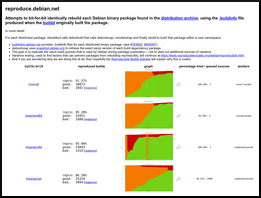
reproduce.debian.net The last few months have seen the introduction, development and deployment of reproduce.debian.net. In technical terms, this is an instance of rebuilderd, our server designed monitor the official package repositories of Linux distributions and attempt to reproduce the observed results there. This month, however, we are pleased to announce that reproduce.debian.net now tests all the Debian trixie architectures except s390x and mips64el. The ppc64el architecture was added through the generous support of Oregon State University Open Source Laboratory (OSUOSL), and we can support the armel architecture thanks to CodeThink.

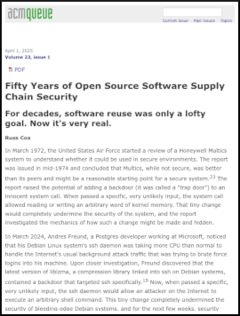
Fifty Years of Open Source Software Supply Chain Security Russ Cox has published a must-read article in ACM Queue on Fifty Years of Open Source Software Supply Chain Security. Subtitled, For decades, software reuse was only a lofty goal. Now it s very real. , Russ article goes on to outline the history and original goals of software supply-chain security in the US military in the early 1970s, all the way to the XZ Utils backdoor of 2024. Through that lens, Russ explores the problem and how it has changed, and hasn t changed, over time. He concludes as follows:
We are all struggling with a massive shift that has happened in the past 10 or 20 years in the software industry. For decades, software reuse was only a lofty goal. Now it s very real. Modern programming environments such as Go, Node and Rust have made it trivial to reuse work by others, but our instincts about responsible behaviors have not yet adapted to this new reality. We all have more work to do.

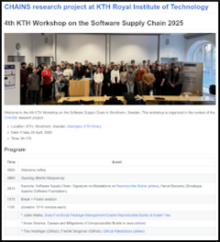
4th CHAINS Software Supply Chain Workshop Convened as part of the CHAINS research project at the KTH Royal Institute of Technology in Stockholm, Sweden, the 4th CHAINS Software Supply Chain Workshop occurred during April. During the workshop, there were a number of relevant workshops, including: The full listing of the agenda is available on the workshop s website.

Mailing list updates On our mailing list this month:
  • Luca DiMaio of Chainguard posted to the list reporting that they had successfully implemented reproducible filesystem images with both ext4 and an EFI system partition. They go on to list the various methods, and the thread generated at least fifteen replies.
  • David Wheeler announced that the OpenSSF is building a glossary of sorts in order that they consistently use the same meaning for the same term and, moreover, that they have drafted a definition for reproducible build . The thread generated a significant number of replies on the definition, leading to a potential update to the Reproducible Build s own definition.
  • Lastly, kpcyrd posted to the list with a timely reminder and update on their repro-env tool. As first reported in our July 2023 report, kpcyrd mentions that:
    My initial interest in reproducible builds was how do I distribute pre-compiled binaries on GitHub without people raising security concerns about them . I ve cycled back to this original problem about 5 years later and built a tool that is meant to address this. [ ]

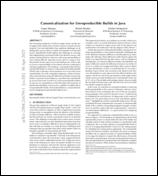
Canonicalization for Unreproducible Builds in Java Aman Sharma, Benoit Baudry and Martin Monperrus have published a new scholarly study related to reproducible builds within Java. Titled Canonicalization for Unreproducible Builds in Java, the article s abstract is as follows:
[ ] Achieving reproducibility at scale remains difficult, especially in Java, due to a range of non-deterministic factors and caveats in the build process. In this work, we focus on reproducibility in Java-based software, archetypal of enterprise applications. We introduce a conceptual framework for reproducible builds, we analyze a large dataset from Reproducible Central and we develop a novel taxonomy of six root causes of unreproducibility. We study actionable mitigations: artifact and bytecode canonicalization using OSS-Rebuild and jNorm respectively. Finally, we present Chains-Rebuild, a tool that raises reproducibility success from 9.48% to 26.89% on 12,283 unreproducible artifacts. To sum up, our contributions are the first large-scale taxonomy of build unreproducibility causes in Java, a publicly available dataset of unreproducible builds, and Chains-Rebuild, a canonicalization tool for mitigating unreproducible builds in Java.
A full PDF of their article is available from arXiv.

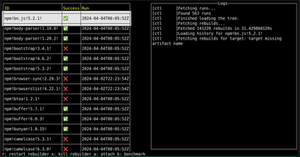
OSS Rebuild adds new TUI features OSS Rebuild aims to automate rebuilding upstream language packages (e.g. from PyPI, crates.io and npm registries) and publish signed attestations and build definitions for public use. OSS Rebuild ships a text-based user interface (TUI) for viewing, launching, and debugging rebuilds. While previously requiring ownership of a full instance of OSS Rebuild s hosted infrastructure, the TUI now supports a fully local mode of build execution and artifact storage. Thanks to Giacomo Benedetti for his usage feedback and work to extend the local-only development toolkit. Another feature added to the TUI was an experimental chatbot integration that provides interactive feedback on rebuild failure root causes and suggests fixes.

Distribution roundup In Debian this month:
  • Roland Clobus posted another status report on reproducible ISO images on our mailing list this month, with the summary that all live images build reproducibly from the online Debian archive .
  • Debian developer Simon Josefsson published another two reproducibility-related blog posts this month, the first on the topic of Verified Reproducible Tarballs. Simon sardonically challenges the reader as follows: Do you want a supply-chain challenge for the Easter weekend? Pick some well-known software and try to re-create the official release tarballs from the corresponding Git checkout. Is anyone able to reproduce anything these days? After that, they also published a blog post on Building Debian in a GitLab Pipeline using their multi-stage rebuild approach.
  • Roland also posted to our mailing list to highlight that there is now another tool in Debian that generates reproducible output, equivs . This is a tool to create trivial Debian packages that might Depend on other packages. As Roland writes, building the [equivs] package has been reproducible for a while, [but] now the output of the [tool] has become reproducible as well .
  • Lastly, 9 reviews of Debian packages were added, 10 were updated and 10 were removed this month adding to our extensive knowledge about identified issues.
The IzzyOnDroid Android APK repository made more progress in April. Thanks to funding by NLnet and Mobifree, the project was also to put more time into their tooling. For instance, developers can now easily run their own verification builder in less than 5 minutes . This currently supports Debian-based systems, but support for RPM-based systems is incoming.
  • The rbuilder_setup tool can now setup the entire framework within less than five minutes. The process is configurable, too, so everything from just the basics to verify builds up to a fully-fledged RB environment is also possible.
  • This tool works on Debian, RedHat and Arch Linux, as well as their derivates. The project has received successful reports from Debian, Ubuntu, Fedora and some Arch Linux derivates so far.
  • Documentation on how to work with reproducible builds (making apps reproducible, debugging unreproducible packages, etc) is available in the project s wiki page.
  • Future work is also in the pipeline, including documentation, guidelines and helpers for debugging.
NixOS defined an Outreachy project for improving build reproducibility. In the application phase, NixOS saw some strong candidates providing contributions, both on the NixOS side and upstream: guider-le-ecit analyzed a libpinyin issue. Tessy James fixed an issue in arandr and helped analyze one in libvlc that led to a proposed upstream fix. Finally, 3pleX fixed an issue which was accepted in upstream kitty, one in upstream maturin, one in upstream python-sip and one in the Nix packaging of python-libbytesize. Sadly, the funding for this internship fell through, so NixOS were forced to abandon their search. Lastly, in openSUSE news, Bernhard M. Wiedemann posted another monthly update for their work there.

diffoscope & strip-nondeterminism diffoscope is our in-depth and content-aware diff utility that can locate and diagnose reproducibility issues. This month, Chris Lamb made the following changes, including preparing and uploading a number of versions to Debian:
  • Use the --walk argument over the potentially dangerous alternative --scan when calling out to zipdetails(1). [ ]
  • Correct a longstanding issue where many >-based version tests used in conditional fixtures were broken. This was used to ensure that specific tests were only run when the version on the system was newer than a particular number. Thanks to Colin Watson for the report (Debian bug #1102658) [ ]
  • Address a long-hidden issue in the test_versions testsuite as well, where we weren t actually testing the greater-than comparisons mentioned above, as it was masked by the tests for equality. [ ]
  • Update copyright years. [ ]
In strip-nondeterminism, however, Holger Levsen updated the Continuous Integration (CI) configuration in order to use the standard Debian pipelines via debian/salsa-ci.yml instead of using .gitlab-ci.yml. [ ]

Website updates Once again, there were a number of improvements made to our website this month including:
  • Aman Sharma added OSS-Rebuild s stabilize tool to the Tools page. [ ][ ]
  • Chris Lamb added a configure.ac (GNU Autotools) example for using SOURCE_DATE_EPOCH. [ ]. Chris also updated the SOURCE_DATE_EPOCH snippet and move the archive metadata to a more suitable location. [ ]
  • Denis Carikli added GNU Boot to our ever-evolving Projects page.

Reproducibility testing framework The Reproducible Builds project operates a comprehensive testing framework running primarily at tests.reproducible-builds.org in order to check packages and other artifacts for reproducibility. In April, a number of changes were made by Holger Levsen, including:
  • reproduce.debian.net-related:
    • Add armel.reproduce.debian.net to support the armel architecture. [ ][ ]
    • Add a new ARM node, codethink05. [ ][ ]
    • Add ppc64el.reproduce.debian.net to support testing of the ppc64el architecture. [ ][ ][ ]
    • Improve the reproduce.debian.net front page. [ ][ ]
    • Make various changes to the ppc64el nodes. [ ][ ]9[ ][ ]
    • Make various changes to the arm64 and armhf nodes. [ ][ ][ ][ ]
    • Various changes related to the rebuilderd-worker entry point. [ ][ ][ ]
    • Create and deploy a pkgsync script. [ ][ ][ ][ ][ ][ ][ ][ ]
    • Fix the monitoring of the riscv64 architecture. [ ][ ]
    • Make a number of changes related to starting the rebuilderd service. [ ][ ][ ][ ]
  • Backup-related:
    • Backup the rebuilder databases every week. [ ][ ][ ][ ]
    • Improve the node health checks. [ ][ ]
  • Misc:
    • Re-use existing connections to the SSH proxy node on the riscv64 nodes. [ ][ ]
    • Node maintenance. [ ][ ][ ]
In addition:
  • Jochen Sprickerhof fixed the risvc64 host names [ ] and requested access to all the rebuilderd nodes [ ].
  • Mattia Rizzolo updated the self-serve rebuild scheduling tool, replacing the deprecated SSO -style authentication with OpenIDC which authenticates against salsa.debian.org. [ ][ ][ ]
  • Roland Clobus updated the configuration for the osuosl3 node to designate 4 workers for bigger builds. [ ]

Upstream patches The Reproducible Builds project detects, dissects and attempts to fix as many currently-unreproducible packages as possible. We endeavour to send all of our patches upstream where appropriate. This month, we wrote a large number of such patches, including:

Finally, if you are interested in contributing to the Reproducible Builds project, please visit our Contribute page on our website. However, you can get in touch with us via:

Next.

Previous.