Search Results: "sten"

9 May 2022

Robert McQueen: Evolving a strategy for 2022 and beyond

As a board, we have been working on several initiatives to make the Foundation a better asset for the GNOME Project. We re working on a number of threads in parallel, so I wanted to explain the big picture a bit more to try and connect together things like the new ED search and the bylaw changes. We re all here to see free and open source software succeed and thrive, so that people can be be truly empowered with agency over their technology, rather than being passive consumers. We want to bring GNOME to as many people as possible so that they have computing devices that they can inspect, trust, share and learn from. In previous years we ve tried to boost the relevance of GNOME (or technologies such as GTK) or solicit donations from businesses and individuals with existing engagement in FOSS ideology and technology. The problem with this approach is that we re mostly addressing people and organisations who are already supporting or contributing FOSS in some way. To truly scale our impact, we need to look to the outside world, build better awareness of GNOME outside of our current user base, and find opportunities to secure funding to invest back into the GNOME project. The Foundation supports the GNOME project with infrastructure, arranging conferences, sponsoring hackfests and travel, design work, legal support, managing sponsorships, advisory board, being the fiscal sponsor of GNOME, GTK, Flathub and we will keep doing all of these things. What we re talking about here are additional ways for the Foundation to support the GNOME project we want to go beyond these activities, and invest into GNOME to grow its adoption amongst people who need it. This has a cost, and that means in parallel with these initiatives, we need to find partners to fund this work. Neil has previously talked about themes such as education, advocacy, privacy, but we ve not previously translated these into clear specific initiatives that we would establish in addition to the Foundation s existing work. This is all a work in progress and we welcome any feedback from the community about refining these ideas, but here are the current strategic initiatives the board is working on. We ve been thinking about growing our community by encouraging and retaining diverse contributors, and addressing evolving computing needs which aren t currently well served on the desktop. Initiative 1. Welcoming newcomers. The community is already spending a lot of time welcoming newcomers and teaching them the best practices. Those activities are as time consuming as they are important, but currently a handful of individuals are running initiatives such as GSoC, Outreachy and outreach to Universities. These activities help bring diverse individuals and perspectives into the community, and helps them develop skills and experience of collaborating to create Open Source projects. We want to make those efforts more sustainable by finding sponsors for these activities. With funding, we can hire people to dedicate their time to operating these programs, including paid mentors and creating materials to support newcomers in future, such as developer documentation, examples and tutorials. This is the initiative that needs to be refined the most before we can turn it into something real. Initiative 2: Diverse and sustainable Linux app ecosystem. I spoke at the Linux App Summit about the work that GNOME and Endless has been supporting in Flathub, but this is an example of something which has a great overlap between commercial, technical and mission-based advantages. The key goal here is to improve the financial sustainability of participating in our community, which in turn has an impact on the diversity of who we can expect to afford to enter and remain in our community. We believe the existence of this is critically important for individual developers and contributors to unlock earning potential from our ecosystem, through donations or app sales. In turn, a healthy app ecosystem also improves the usefulness of the Linux desktop as a whole for potential users. We believe that we can build a case for commercial vendors in the space to join an advisory board alongside with GNOME, KDE, etc to input into the governance and contribute to the costs of growing Flathub. Initiative 3: Local-first applications for the GNOME desktop. This is what Thib has been starting to discuss on Discourse, in this thread. There are many different threats to free access to computing and information in today s world. The GNOME desktop and apps need to give users convenient and reliable access to technology which works similarly to the tools they already use everyday, but keeps them and their data safe from surveillance, censorship, filtering or just being completely cut off from the Internet. We believe that we can seek both philanthropic and grant funding for this work. It will make GNOME a more appealing and comprehensive offering for the many people who want to protect their privacy. The idea is that these initiatives all sit on the boundary between the GNOME community and the outside world. If the Foundation can grow and deliver these kinds of projects, we are reaching to new people, new contributors and new funding. These contributions and investments back into GNOME represent a true win-win for the newcomers and our existing community. (Originally posted to GNOME Discourse, please feel free to join the discussion there.)

8 May 2022

Thorsten Alteholz: My Debian Activities in April 2022

FTP master This month I accepted 186 and rejected 26 packages. The overall number of packages that got accepted was 188. Debian LTS This was my ninety-fourth month that I did some work for the Debian LTS initiative, started by Raphael Hertzog at Freexian. This month my all in all workload has been 40h. During that time I did LTS and normal security uploads of: Further I worked on libvirt, the dependency problems in unstable have been resolved and fixing in other releases can continue. I also continued to work on security support for golang packages. Last but not least I did some days of frontdesk duties. Debian ELTS This month was the forty-siyth ELTS month. During my allocated time I uploaded: Last but not least I did some days of frontdesk duties. Debian Printing This month I uploaded new upstream versions or improved packaging of: As I already became the maintainer of usb-modeswitch I also adopted usb-modeswitch-data Debian Astro Unfortunately I didn t do anything for this group, but in May I will upload a new version of openvlbi and several indi-3rdparty packages. Other stuff Last but not least I uploaded several new upstream version of golang packages but not before checking with ratt that all dependencies still work.

3 May 2022

Gunnar Wolf: Using a RPi as a display adapter

Almost ten months ago, I mentioned on this blog I bought an ARM laptop, which is now my main machine while away from home a Lenovo Yoga C630 13Q50. Yes, yes, I am still not as much away from home as I used to before, as this pandemic is still somewhat of a thing, but I do move more. My main activity in the outside world with my laptop is teaching. I teach twice a week, and well, having a display for my slides and for showing examples in the terminal and such is a must. However, as I said back in August, one of the hardware support issues for this machine is:
No HDMI support via the USB-C displayport. While I don t expect
to go to conferences or even classes in the next several months,
I hope this can be fixed before I do. It s a potential important
issue for me.
It has sadly not yet been solved While many things have improved since kernel 5.12 (the first I used), the Device Tree does not yet hint at where external video might sit. So, I went to the obvious: Many people carry different kinds of video adaptors I carry a slightly bulky one: A RPi3 For two months already (time flies!), I had an ugly contraption where the RPi3 connected via Ethernet and displayed a VNC client, and my laptop had a VNC server. Oh, but did I mention My laptop works so much better with Wayland than with Xorg that I switched, and am now a happy user of the Sway compositor (a drop-in replacement for the i3 window manager). It is built over WLRoots, which is a great and (relatively) simple project, but will thankfully not carry some of Gnome or KDE s ideas not even those I d rather have. So it took a bit of searching; I was very happy to find WayVNC, a VNC server for wlroot-sbased Wayland compositors. I launched a second Wayland, to be able to have my main session undisturbed and present only a window from it. Only that VNC is slow and laggy, and sometimes awkward. So I kept searching for something better. And something better is, happily, what I was finally able to do! In the laptop, I am using wf-recorder to grab an area of the screen and funnel it into a V4L2 loopback device (which allows it to be used as a camera, solving the main issue with grabbing parts of a Wayland screen):
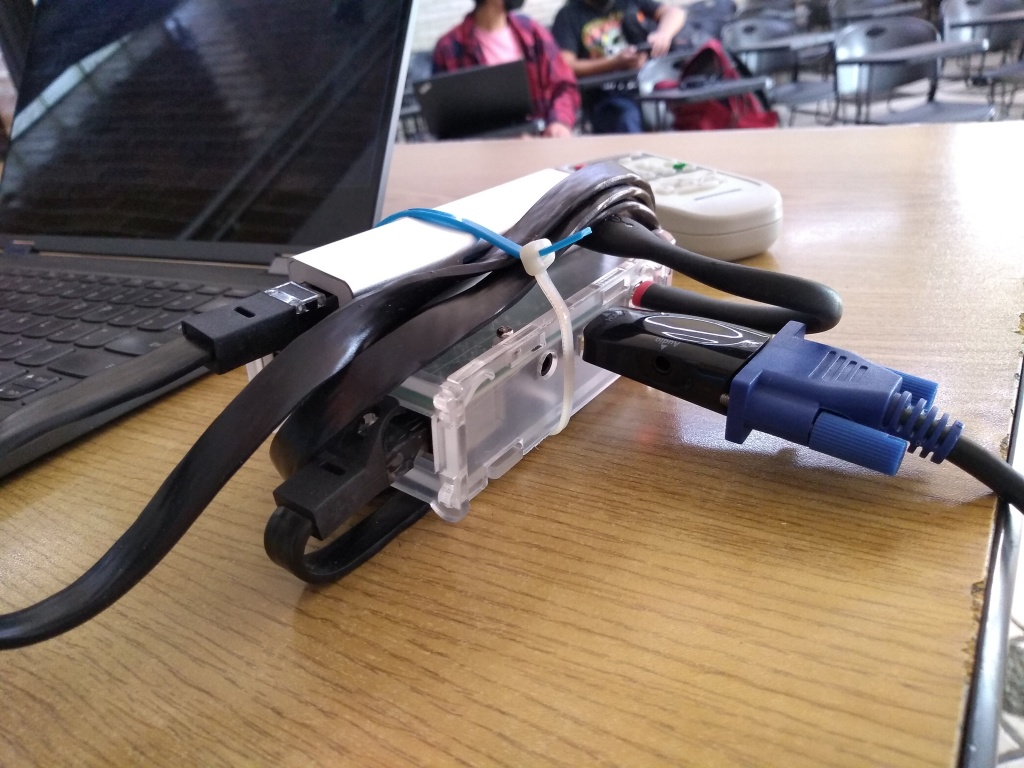
/usr/bin/wf-recorder -g '0,32 960x540' -t --muxer=v4l2 --codec=rawvideo --pixelformat=yuv420p --file=/dev/video10
(yes, my V4L2Loopback device is set to /dev/video10). You will note I m grabbing a 960 540 rectangle, which is the top of my screen (1920x1080) minus the Waybar. I think I ll increase it to 960 720, as the projector to which I connect the Raspberry has a 4 3 output. After this is sent to /dev/video10, I tell ffmpeg to send it via RTP to the fixed address of the Raspberry:
/usr/bin/ffmpeg -i /dev/video10 -an -f rtp -sdp_file /tmp/video.sdp rtp://10.0.0.100:7000/
Yes, some uglier things happen here. You will note /tmp/video.sdp is created in the laptop itself; this file describes the stream s metadata so it can be used from the client side. I cheated and copied it over to the Raspberry, doing an ugly hardcode along the way:
user@raspi:~ $ cat video.sdp
v=0
o=- 0 0 IN IP4 127.0.0.1
s=No Name
c=IN IP4 10.0.0.100
t=0 0
a=tool:libavformat 58.76.100
m=video 7000 RTP/AVP 96
b=AS:200
a=rtpmap:96 MP4V-ES/90000
a=fmtp:96 profile-level-id=1
People familiar with RTP will scold me: How come I m streaming to the unicast client address? I should do it to an address in the 224.0.0.0 239.0.0.0 range. And it worked, sometimes. I switched over to 10.0.0.100 because it works, basically always Finally, upon bootup, I have configured NoDM to start a session with the user user, and dropped the following in my user s .xsession:
setterm -blank 0 -powersave off -powerdown 0
xset s off
xset -dpms
xset s noblank
mplayer -msglevel all=1 -fs /home/usuario/video.sdp
Anyway, as a result, my students are able to much better follow the pace of my presentation, and I m able to do some tricks better (particularly when it requires quick reaction times, as often happens when dealing with concurrency and such issues). Oh, and of course in case it s of interest to anybody, knowing that SD cards are all but reliable in the long run, I wrote a vmdb2 recipe to build the images. You can grab it here; it requires some local files to be present to be built some are the ones I copied over above, and the other ones are surely of no interest to you (such as my public ssh key or such :-] ) What am I still missing? (read: Can you help me with some ideas? ) Of course, this is a blog post published to brag about my stuff, but also to serve me as persistent memory in case I need to recreate this

29 April 2022

Russ Allbery: Review: Interesting Times

Review: Interesting Times, by Terry Pratchett
Series: Discworld #17
Publisher: Harper
Copyright: 1994
Printing: February 2014
ISBN: 0-06-227629-8
Format: Mass market
Pages: 399
Interesting Times is the seventeenth Discworld novel and certainly not the place to start. At the least, you will probably want to read The Colour of Magic and The Light Fantastic before this book, since it's a sequel to those (although Rincewind has had some intervening adventures). Lord Vetinari has received a message from the Counterweight Continent, the first in ten years, cryptically demanding the Great Wizzard be sent immediately. The Agatean Empire is one of the most powerful states on the Disc. Thankfully for everyone else, it normally suits its rulers to believe that the lands outside their walls are inhabited only by ghosts. No one is inclined to try to change their minds or otherwise draw their attention. Accordingly, the Great Wizard must be sent, a task that Vetinari efficiently delegates to the Archchancellor. There is only the small matter of determining who the Great Wizzard is, and why it was spelled with two z's. Discworld readers with a better memory than I will recall Rincewind's hat. Why the Counterweight Continent would demanding a wizard notorious for his near-total inability to perform magic is a puzzle for other people. Rincewind is promptly located by a magical computer, and nearly as promptly transported across the Disc, swapping him for an unnecessarily exciting object of roughly equivalent mass and hurling him into an unexpected rescue of Cohen the Barbarian. Rincewind predictably reacts by running away, although not fast or far enough to keep him from being entangled in a glorious popular uprising. Or, well, something that has aspirations of being glorious, and popular, and an uprising. I hate to say this, because Pratchett is an ethically thoughtful writer to whom I am willing to give the benefit of many doubts, but this book was kind of racist. The Agatean Empire is modeled after China, and the Rincewind books tend to be the broadest and most obvious parodies, so that was already a recipe for some trouble. Some of the social parody is not too objectionable, albeit not my thing. I find ethnic stereotypes and making fun of funny-sounding names in other languages (like a city named Hunghung) to be in poor taste, but Pratchett makes fun of everyone's names and cultures rather equally. (Also, I admit that some of the water buffalo jokes, despite the stereotypes, were pretty good.) If it had stopped there, it would have prompted some eye-rolling but not much comment. Unfortunately, a significant portion of the plot depends on the idea that the population of the Agatean Empire has been so brainwashed into obedience that they have a hard time even imagining resistance, and even their revolutionaries are so polite that the best they can manage for slogans are things like "Timely Demise to All Enemies!" What they need are a bunch of outsiders, such as Rincewind or Cohen and his gang. More details would be spoilers, but there are several deliberate uses of Ankh-Morpork as a revolutionary inspiration and a great deal of narrative hand-wringing over how awful it is to so completely convince people they are slaves that you don't need chains. There is a depressingly tedious tendency of western writers, even otherwise thoughtful and well-meaning ones like Pratchett, to adopt a simplistic ranking of political systems on a crude measure of freedom. That analysis immediately encounters the problem that lots of people who live within systems that rate poorly on this one-dimensional scale seem inadequately upset about circumstances that are "obviously" horrific oppression. This should raise questions about the validity of the assumptions, but those assumptions are so unquestionable that the writer instead decides the people who are insufficiently upset about their lack of freedom must be defective. The more racist writers attribute that defectiveness to racial characteristics. The less racist writers, like Pratchett, attribute that defectiveness to brainwashing and systemic evil, which is not quite as bad as overt racism but still rests on a foundation of smug cultural superiority. Krister Stendahl, a bishop of the Church of Sweden, coined three famous rules for understanding other religions:
  1. When you are trying to understand another religion, you should ask the adherents of that religion and not its enemies.
  2. Don't compare your best to their worst.
  3. Leave room for "holy envy."
This is excellent advice that should also be applied to politics. Most systems exist for some reason. The differences from your preferred system are easy to see, particularly those that strike you as horrible. But often there are countervailing advantages that are less obvious, and those are more psychologically difficult to understand and objectively analyze. You might find they have something that you wish your system had, which causes discomfort if you're convinced you have the best political system in the world, or are making yourself feel better about the abuses of your local politics by assuring yourself that at least you're better than those people. I was particularly irritated to see this sort of simplistic stereotyping in Discworld given that Ankh-Morpork, the setting of most of the Discworld novels, is an authoritarian dictatorship. Vetinari quite capably maintains his hold on power, and yet this is not taken as a sign that the city's inhabitants have been brainwashed into considering themselves slaves. Instead, he's shown as adept at maintaining the stability of a precarious system with a lot of competing forces and a high potential for destructive chaos. Vetinari is an awful person, but he may be better than anyone who would replace him. Hmm. This sort of complexity is permitted in the "local" city, but as soon as we end up in an analog of China, the rulers are evil, the system lacks any justification, and the peasants only don't revolt because they've been trained to believe they can't. Gah. I was muttering about this all the way through Interesting Times, which is a shame because, outside of the ham-handed political plot, it has some great Pratchett moments. Rincewind's approach to any and all danger is a running (sorry) gag that keeps working, and Cohen and his gang of absurdly competent decrepit barbarians are both funnier here than they have been in any previous book and the rare highly-positive portrayal of old people in fantasy adventures who are not wizards or crones. Pretty Butterfly is a great character who deserved to be in a better plot. And I loved the trouble that Rincewind had with the Agatean tonal language, which is an excuse for Pratchett to write dialog full of frustrated non-sequiturs when Rincewind mispronounces a word. I do have to grumble about the Luggage, though. From a world-building perspective its subplot makes sense, but the Luggage was always the best character in the Rincewind stories, and the way it lost all of its specialness here was oddly sad and depressing. Pratchett also failed to convince me of the drastic retcon of The Colour of Magic and The Light Fantastic that he does here (and which I can't talk about in detail due to spoilers), in part because it's entangled in the orientalism of the plot. I'm not sure Pratchett could write a bad book, and I still enjoyed reading Interesting Times, but I don't think he gave the politics his normal care, attention, and thoughtful humanism. I hope later books in this part of the Disc add more nuance, and are less confident and judgmental. I can't really recommend this one, even though it has some merits. Also, just for the record, "may you live in interesting times" is not a Chinese curse. It's an English saying that likely was attributed to China to make it sound exotic, which is the sort of landmine that good-natured parody of other people's cultures needs to be wary of. Followed in publication order by Maskerade, and in Rincewind's personal timeline by The Last Continent. Rating: 6 out of 10

28 April 2022

Raphaël Hertzog: Freexian s report about Debian Long Term Support, March 2022

A Debian LTS logo
Every month we review the work funded by Freexian s Debian LTS offering. Please find the report for March below. Debian project funding Learn more about the rationale behind this initiative in this article. Debian LTS contributors In March, 11 contributors were paid to work on Debian LTS, their reports are available below. If you re interested in participating in the LTS or ELTS teams, we welcome participation from the Debian community. Simply get in touch with Jeremiah or Rapha l if you are if you are interested in participating. Evolution of the situation In March we released 42 DLAs. The security tracker currently lists 81 packages with a known CVE and the dla-needed.txt file has 52 packages needing an update. We re glad to welcome a few new sponsors such as lectricit de France (Gold sponsor), Telecats BV and Soliton Systems. Thanks to our sponsors Sponsors that joined recently are in bold.

26 April 2022

Reproducible Builds: Supporter spotlight: Google Open Source Security Team (GOSST)

The Reproducible Builds project relies on several projects, supporters and sponsors for financial support, but they are also valued as ambassadors who spread the word about our project and the work that we do. This is the fourth instalment in a series featuring the projects, companies and individuals who support the Reproducible Builds project. If you are a supporter of the Reproducible Builds project (of whatever size) and would like to be featured here, please let get in touch with us at contact@reproducible-builds.org. We started this series by featuring the Civil Infrastructure Platform project and followed this up with a post about the Ford Foundation as well as a recent one about ARDC. However, today, we ll be talking with Meder Kydyraliev of the Google Open Source Security Team (GOSST).
Chris Lamb: Hi Meder, thanks for taking the time to talk to us today. So, for someone who has not heard of the Google Open Source Security Team (GOSST) before, could you tell us what your team is about? Meder: Of course. The Google Open Source Security Team (or GOSST ) was created in 2020 to work with the open source community at large, with the goal of making the open source software that everyone relies on more secure.
Chris: What kinds of activities is the GOSST involved in? Meder: The range of initiatives that the team is involved in recognizes the diversity of the ecosystem and unique challenges that projects face on their security journey. For example, our sponsorship of sos.dev ensures that developers are rewarded for security improvements to open source projects, whilst the long term work on improving Linux kernel security tackles specific kernel-related vulnerability classes. Many of the projects GOSST is involved with aim to make it easier for developers to improve security through automated assessment (Scorecards and Allstar) and vulnerability discovery tools (OSS-Fuzz, ClusterFuzzLite, FuzzIntrospector), in addition to contributing to infrastructure to make adopting certain best practices easier. Two great examples of best practice efforts are Sigstore for artifact signing and OSV for automated vulnerability management.
Chris: The usage of open source software has exploded in the last decade, but supply-chain hygiene and best practices has seemingly not kept up. How does GOSST see this issue and what approaches is it taking to ensure that past and future systems are resilient? Meder: Every open source ecosystem is a complex environment and that awareness informs our approaches in this space. There are, of course, no silver bullets , and long-lasting and material supply-chain improvements requires infrastructure and tools that will make lives of open source developers easier, all whilst improving the state of the wider software supply chain. As part of a broader effort, we created the Supply-chain Levels for Software Artifacts framework that has been used internally at Google to protect production workloads. This framework describes the best practices for source code and binary artifact integrity, and we are engaging with the community on its refinement and adoption. Here, package managers (such as PyPI, Maven Central, Debian, etc.) are an essential link in the software supply chain due to their near-universal adoption; users do not download and compile their own software anymore. GOSST is starting to work with package managers to explore ways to collaborate together on improving the state of the supply chain and helping package maintainers and application developers do better all with the understanding that many open source projects are developed in spare time as a hobby! Solutions like this, which are the result of collaboration between GOSST and GitHub, are very encouraging as they demonstrate a way to materially strengthen software supply chain security with readily available tools, while also improving development workflows. For GOSST, the problem of supply chain security also covers vulnerability management and solutions to make it easier for everyone to discover known vulnerabilities in open source packages in a scalable and automated way. This has been difficult in the past due to lack of consistently high-quality data in an easily-consumable format. To address this, we re working on infrastructure (OSV.dev) to make vulnerability data more easily accessible as well as a widely adopted and automation friendly data format.
Chris: How does the Reproducible Builds effort help GOSST achieve its goals? Meder: Build reproducibility has a lot of attributes that are attractive as part of generally good build hygiene . As an example, hermeticity, one of requirements to meet SLSA level 4, makes it much easier to reason about the dependencies of a piece of software. This is an enormous benefit during vulnerability or supply chain incident response. On a higher level, however, we always think about reproducibility from the viewpoint of a user and the threats that reproducibility protects them from. Here, a lot of progress has been made, of course, but a lot of work remains to make reproducibility part of everyone s software consumption practices.
Chris: So if someone wanted to know more about GOSST or follow the team s work, where might they go to look? Meder: We post regular updates on Google s Security Blog and on the Linux hardening mailing list. We also welcome community participation in the projects we work on! See any of the projects linked above or OpenSSF s GitHub projects page for a list of efforts you can contribute to directly if you want to get involved in strengthening the open source ecosystem.
Chris: Thanks for taking the time to talk to us today. Meder: No problem. :)


For more information about the Reproducible Builds project, please see our website at reproducible-builds.org. If you are interested in ensuring the ongoing security of the software that underpins our civilisation and wish to sponsor the Reproducible Builds project, please reach out to the project by emailing contact@reproducible-builds.org.

13 April 2022

Antoine Beaupr : Tuning my wifi radios

After listening to an episode of the 2.5 admins podcast, I realized there was some sort of low-hanging fruit I could pick to better tune my WiFi at home. You see, I'm kind of a fraud in WiFi: I only started a WiFi mesh in Montreal (now defunct), I don't really know how any of that stuff works. So I was surprised to hear one of the podcast host say "it's all about airtime" and "you want to reduce the power on your access points" (APs). It seemed like sound advice: better bandwidth means less time on air, means less collisions, less latency, and less power also means less collisions. Worth a try, right?

Frequency So the first thing I looked at was WifiAnalyzer to see if I had any optimisation I could do there. Normally, I try to avoid having nearby APs on the same frequency to avoid collisions, but who knows, maybe I had messed that up. And turns out I did! Both APs were on "auto" for 5GHz, which typically means "do nothing or worse". 5GHz is really interesting, because, in theory, there are LOTS of channels to pick from, it goes up to 196!! And both my APs were on 36, what gives? So the first thing I did was to set it to channel 100, as there was that long gap in WifiAnalyzer where no other AP was. But that just broke 5GHz on the AP. The OpenWRT GUI (luci) would just say "wireless not associated" and the ESSID wouldn't show up in a scan anymore. At first, I thought this was a problem with OpenWRT or my hardware, but I could reproduce the problem with both my APs: a TP-Link Archer A7 v5 and a Turris Omnia (see also my review). As it turns out, that's because that range of the WiFi band interferes with trivial things like satellites and radar, which make the actually very useful radar maps look like useless christmas trees. So those channels require DFS to operate. DFS works by first listening on the frequency for a certain amount of time (1-2 minute, but could be as high as 10) to see if there's something else transmitting at all. So typically, that means they just don't operate at all in those bands, especially if you're near any major city which generally means you are near a weather radar that will transmit on that band. In the system logs, if you have such a problem, you might see this:
Apr  9 22:17:39 octavia hostapd: wlan0: DFS-CAC-START freq=5500 chan=100 sec_chan=1, width=0, seg0=102, seg1=0, cac_time=60s
Apr  9 22:17:39 octavia hostapd: DFS start_dfs_cac() failed, -1
... and/or this:
Sat Apr  9 18:05:03 2022 daemon.notice hostapd: Channel 100 (primary) not allowed for AP mode, flags: 0x10095b NO-IR RADAR
Sat Apr  9 18:05:03 2022 daemon.warn hostapd: wlan0: IEEE 802.11 Configured channel (100) not found from the channel list of current mode (2) IEEE 802.11a
Sat Apr  9 18:05:03 2022 daemon.warn hostapd: wlan0: IEEE 802.11 Hardware does not support configured channel
Here, it clearly says RADAR (in all caps too, which means it's really important). NO-IR is also important, I'm not sure what it means but it could be that you're not allowed to transmit in that band because of other local regulations. There might be a way to workaround those by changing the "region" in the Luci GUI, but I didn't mess with that, because I figured that other devices will have that already configured. So using a forbidden channel might make it more difficult for clients to connect (although it's possible this is enforced only on the AP side). In any case, 5GHz is promising, but in reality, you only get from channel 36 (5.170GHz) to 48 (5.250GHz), inclusively. Fast counters will notice that is exactly 80MHz, which means that if an AP is configured for that hungry, all-powerful 80MHz, it will effectively take up all 5GHz channels at once. This, in other words, is as bad as 2.4GHz, where you also have only two 40MHz channels. (Really, what did you expect: this is an unregulated frequency controlled by commercial interests...) So the first thing I did was to switch to 40MHz. This gives me two distinct channels in 5GHz at no noticeable bandwidth cost. (In fact, I couldn't find hard data on what the bandwidth ends up being on those frequencies, but I could still get 400Mbps which is fine for my use case.)

Power The next thing I did was to fiddle with power. By default, both radios were configured to transmit as much power as they needed to reach clients, which means that if a client gets farther away, it would boost its transmit power which, in turns, would mean the client would still connect to instead of failing and properly roaming to the other AP. The higher power also means more interference with neighbors and other APs, although that matters less if they are on different channels. On 5GHz, power was about 20dBm (100 mW) -- and more on the Turris! -- when I first looked, so I tried to lower it drastically to 5dBm (3mW) just for kicks. That didn't work so well, so I bumped it back up to 14 dBm (25 mW) and that seems to work well: clients hit about -80dBm when they get far enough from the AP, which gets close to the noise floor (and where the neighbor APs are), which is exactly what I want. On 2.4GHz, I lowered it down even further, to 10 dBm (10mW) since it's better at going through wells, I figured it would need less power. And anyways, I rather people use the 5GHz APs, so maybe that will act as an encouragement to switch. I was still able to connect correctly to the APs at that power as well.

Other tweaks I disabled the "Allow legacy 802.11b rates" setting in the 5GHz configuration. According to this discussion:
Checking the "Allow b rates" affects what the AP will transmit. In particular it will send most overhead packets including beacons, probe responses, and authentication / authorization as the slow, noisy, 1 Mb DSSS signal. That is bad for you and your neighbors. Do not check that box. The default really should be unchecked.
This, in particular, "will make the AP unusable to distant clients, which again is a good thing for public wifi in general". So I just unchecked that box and I feel happier now. I didn't make tests to see the effect separately however, so this is mostly just a guess.

11 April 2022

Paul Tagliamonte: k3xec.com/patty: Go bindings to patty

AX.25 is a tough protocol to use on UNIX systems. A lot of the support in Linux, specifically, is pretty hard to use, and tends to be built into the reptilian brain of the kernel. xan built a userland AX.25 stack called patty, for which I have now built some Go bindings on top of. Code needed to create AX.25 Sockets via Go can be found at github.com/k3xec/go-patty, and imported by Go source as k3xec.com/patty.

Overview Clint patty programs (including consumers of this Go library) work by communicating with a userland daemon (pattyd) via a UNIX named socket. That daemon will communicate with a particular radio using a KISS TNC serial device. The Go bindings implement as many standard Go library interfaces as is practical, allowing for the plug and play use of patty (and AX.25) in places where you would expect a network socket (such as TCP) to work, such as Go s http library.

Example
package main
import (
"fmt"
"log"
"net"
"os"
"time"
"k3xec.com/patty"
)
func main()  
callsign := "N0CALL-10"
client, err := patty.Open("patty.sock")
if err != nil  
panic(err)
 
l, err := client.Listen("ax25", callsign)
if err != nil  
panic(err)
 
for  
log.Printf("Listening for requests to %s", l.Addr())
conn, err := l.Accept()
if err != nil  
log.Printf("Error accepting: %s", err)
continue
 
go handle(conn)
 
 
func handle(c net.Conn) error  
defer c.Close()
log.Printf("New connection from %s (local: %s)", c.RemoteAddr(), c.LocalAddr())
fmt.Fprintf(c,  

Hello! This is Paul's experimental %s node. Feel free
to poke around. Let me know if you spot anything funny.

Five pings are to follow!

 , c.LocalAddr())
for i := 0; i < 5; i++  
time.Sleep(time.Second * 5)
fmt.Fprintf(c, "Ping!\n")
 
return nil
 

8 April 2022

Jacob Adams: The Unexpected Importance of the Trailing Slash

For many using Unix-derived systems today, we take for granted that /some/path and /some/path/ are the same. Most shells will even add a trailing slash for you when you press the Tab key after the name of a directory or a symbolic link to one. However, many programs treat these two paths as subtly different in certain cases, which I outline below, as all three have tripped me up in various ways1.

POSIX and Coreutils Perhaps the trickiest use of the trailing slash in a distinguishing way is in POSIX2 which states:
When the final component of a pathname is a symbolic link, the standard requires that a trailing <slash> causes the link to be followed. This is the behavior of historical implementations3. For example, for /a/b and /a/b/, if /a/b is a symbolic link to a directory, then /a/b refers to the symbolic link, and /a/b/ refers to the directory to which the symbolic link points.
This leads to some unexpected behavior. For example, if you have the following structure of a directory dir containing a file dirfile with a symbolic link link pointing to dir. (which will be used in all shell examples throughout this article):
$ ls -lR
.:
total 4
drwxr-xr-x 2 jacob jacob 4096 Apr  3 00:00 dir
lrwxrwxrwx 1 jacob jacob    3 Apr  3 00:00 link -> dir
./dir:
total 0
-rw-r--r-- 1 jacob jacob 0 Apr  3 00:12 dirfile
On Unixes such as MacOS, FreeBSD or Illumos4, you can move a directory through a symbolic link by using a trailing slash:
$ mv link/ otherdir
$ ls
link	otherdir
On Linux5, mv will not rename the indirectly referenced directory and not the symbolic link, when given a symbolic link with a trailing slash as the source to be renamed. despite the coreutils documentation s claims to the contrary6, instead failing with Not a directory:
$ mv link/ other
mv: cannot move 'link/' to 'other': Not a directory
$ mkdir otherdir
$ mv link/ otherdir
mv: cannot move 'link/' to 'otherdir/link': Not a directory
$ mv link/ otherdir/
mv: cannot move 'link/' to 'otherdir/link': Not a directory
$ mv link otherdirlink
$ ls -l otherdirlink
lrwxrwxrwx 1 jacob jacob 3 Apr  3 00:13 otherdirlink -> dir
This is probably for the best, as it is very confusing behavior. There is still one advantage the trailing slash has when using mv, even on Linux, in that is it does not allow you to move a file to a non-existent directory, or move a file that you expect to be a directory that isn t.
$ mv dir/dirfile nonedir/
mv: cannot move 'dir/dirfile' to 'nonedir/': Not a directory
$ touch otherfile
$ mv otherfile/ dir
mv: cannot stat 'otherfile/': Not a directory
$ mv otherfile dir
$ ls dir
dirfile  otherfile
However, Linux still exhibits some confusing behavior of its own, like when you attempt to remove link recursively with a trailing slash:
rm -rvf link/
Neither link nor dir are removed, but the contents of dir are removed:
removed 'link/dirfile'
Whereas if you remove the trailing slash, you just remove the symbolic link:
$ rm -rvf link
removed 'link'
While on MacOS, FreeBSD or Illumos4, rm will also remove the source directory:
$ rm -rvf link
link/dirfile
link/
$ ls
link
The find and ls commands, in contrast, behave the same on all three operating systems. The find command only searches the contents of the directory a symbolic link points to if the trailing slash is added:
$ find link -name dirfile
$ find link/ -name dirfile
link/dirfile
The ls command acts similarly, showing information on just a symbolic link by itself unless a trailing slash is added, at which point it shows the contents of the directory that it links to:
$ ls -l link
lrwxrwxrwx 1 jacob jacob 3 Apr  3 00:13 link -> dir
$ ls -l link/
total 0
-rw-r--r-- 1 jacob jacob 0 Apr  3 00:13 dirfile

rsync The command rsync handles a trailing slash in an unusual way that trips up many new users. The rsync man page notes:
You can think of a trailing / on a source as meaning copy the contents of this directory as opposed to copy the directory by name , but in both cases the attributes of the containing directory are transferred to the containing directory on the destination.
That is to say, if we had two folders a and b each of which contained some files:
$ ls -R .
.:
a  b
./a:
a1  a2
./b:
b1  b2
Running rsync -av a b moves the entire directory a to directory b:
$ rsync -av a b
sending incremental file list
a/
a/a1
a/a2
sent 181 bytes  received 58 bytes  478.00 bytes/sec
total size is 0  speedup is 0.00
$ ls -R b
b:
a  b1  b2
b/a:
a1  a2
While running rsync -av a/ b moves the contents of directory a to b:
$ rsync -av a/ b
sending incremental file list
./
a1
a2
sent 170 bytes  received 57 bytes  454.00 bytes/sec
total size is 0  speedup is 0.00
$ ls b
a1  a2	b1  b2

Dockerfile COPY The Dockerfile COPY command also cares about the presence of the trailing slash, using it to determine whether the destination should be considered a file or directory. The Docker documentation explains the rules of the command thusly:
COPY [--chown=<user>:<group>] <src>... <dest>
If <src> is a directory, the entire contents of the directory are copied, including filesystem metadata. Note: The directory itself is not copied, just its contents. If <src> is any other kind of file, it is copied individually along with its metadata. In this case, if <dest> ends with a trailing slash /, it will be considered a directory and the contents of <src> will be written at <dest>/base(<src>). If multiple <src> resources are specified, either directly or due to the use of a wildcard, then <dest> must be a directory, and it must end with a slash /. If <dest> does not end with a trailing slash, it will be considered a regular file and the contents of <src> will be written at <dest>. If <dest> doesn t exist, it is created along with all missing directories in its path.
This means if you had a COPY command that moved file to a nonexistent containerfile without the slash, it would create containerfile as a file with the contents of file.
COPY file /containerfile
container$ stat -c %F containerfile
regular empty file
Whereas if you add a trailing slash, then file will be added as a file under the new directory containerdir:
COPY file /containerdir/
container$ stat -c %F containerdir
directory
Interestingly, at no point can you copy a directory completely, only its contents. Thus if you wanted to make a directory in the new container, you need to specify its name in both the source and the destination:
COPY dir /dirincontainer
container$ stat -c %F /dirincontainer
directory
Dockerfiles do also make good use of the trailing slash to ensure they re doing what you mean by requiring a trailing slash on the destination of multiple files:
COPY file otherfile /othercontainerdir
results in the following error:
When using COPY with more than one source file, the destination must be a directory and end with a /
  1. I m sure there are probably more than just these three cases, but these are the three I m familiar with. If you know of more, please tell me about them!.
  2. Some additional relevant sections are the Path Resolution Appendix and the section on Symbolic Links.
  3. The sentence This is the behavior of historical implementations implies that this probably originated in some ancient Unix derivative, possibly BSD or even the original Unix. I don t really have a source on that though, so please reach out if you happen to have any more knowledge on what this refers to.
  4. I tested on MacOS 11.6.5, FreeBSD 12.0 and OmniOS 5.11 2
  5. unless the source is a directory trailing slashes give -ENOTDIR
  6. In fairness to the coreutils maintainers, it seems to be true on all other Unix platforms, but it probably deserves a mention in the documentation when Linux is the most common platform on which coreutils is used. I should submit a patch.

6 April 2022

Thorsten Alteholz: My Debian Activities in March 2022

FTP master This month I accepted 332 and rejected 15 packages. This ratio gives a reason to hope. The overall number of packages that got accepted was 342. Debian LTS This was my ninety-third month that I did some work for the Debian LTS initiative, started by Raphael Hertzog at Freexian. This month my all in all workload has been 40h. During that time I did LTS and normal security uploads of: All my PU bugs for Buster and Bullseye, that accumulated over the last months, were part of the latest point release. So new ones have to be created now :-). I also continued to work on security support for golang packages. As a result #1008577 and #1008578 were the first real tests with a simple package. Debian ELTS This month was the forty-fifth ELTS month. During my allocated time I uploaded: Unfortunately uploads have to be done for younger releases first, so I had to withhold some uploads for ELTS. Hopefully they can be done in April. Probably this policy needs to be reconsidered. Last but not least I did some days of frontdesk duties. Debian Printing This month I uploaded new upstream versions or improved packaging of: In order to make the Debian Edu team happy, I uploaded a new version of cups-filters with an adapted Apparmor-file to Unstable and Bullseye. Debian Astro This month I uploaded new upstream versions or improved packaging of: Other stuff This month I uploaded new upstream versions or improved packaging of: In order to avoid an AUTORM of some Osmocom packages, I also had to NMU:

5 April 2022

Kees Cook: security things in Linux v5.10

Previously: v5.9 Linux v5.10 was released in December, 2020. Here s my summary of various security things that I found interesting: AMD SEV-ES
While guest VM memory encryption with AMD SEV has been supported for a while, Joerg Roedel, Thomas Lendacky, and others added register state encryption (SEV-ES). This means it s even harder for a VM host to reconstruct a guest VM s state. x86 static calls
Josh Poimboeuf and Peter Zijlstra implemented static calls for x86, which operates very similarly to the static branch infrastructure in the kernel. With static branches, an if/else choice can be hard-coded, instead of being run-time evaluated every time. Such branches can be updated too (the kernel just rewrites the code to switch around the branch ). All these principles apply to static calls as well, but they re for replacing indirect function calls (i.e. a call through a function pointer) with a direct call (i.e. a hard-coded call address). This eliminates the need for Spectre mitigations (e.g. RETPOLINE) for these indirect calls, and avoids a memory lookup for the pointer. For hot-path code (like the scheduler), this has a measurable performance impact. It also serves as a kind of Control Flow Integrity implementation: an indirect call got removed, and the potential destinations have been explicitly identified at compile-time. network RNG improvements
In an effort to improve the pseudo-random number generator used by the network subsystem (for things like port numbers and packet sequence numbers), Linux s home-grown pRNG has been replaced by the SipHash round function, and perturbed by (hopefully) hard-to-predict internal kernel states. This should make it very hard to brute force the internal state of the pRNG and make predictions about future random numbers just from examining network traffic. Similarly, ICMP s global rate limiter was adjusted to avoid leaking details of network state, as a start to fixing recent DNS Cache Poisoning attacks. SafeSetID handles GID
Thomas Cedeno improved the SafeSetID LSM to handle group IDs (which required teaching the kernel about which syscalls were actually performing setgid.) Like the earlier setuid policy, this lets the system owner define an explicit list of allowed group ID transitions under CAP_SETGID (instead of to just any group), providing a way to keep the power of granting this capability much more limited. (This isn t complete yet, though, since handling setgroups() is still needed.) improve kernel s internal checking of file contents
The kernel provides LSMs (like the Integrity subsystem) with details about files as they re loaded. (For example, loading modules, new kernel images for kexec, and firmware.) There wasn t very good coverage for cases where the contents were coming from things that weren t files. To deal with this, new hooks were added that allow the LSMs to introspect the contents directly, and to do partial reads. This will give the LSMs much finer grain visibility into these kinds of operations. set_fs removal continues
With the earlier work landed to free the core kernel code from set_fs(), Christoph Hellwig made it possible for set_fs() to be optional for an architecture. Subsequently, he then removed set_fs() entirely for x86, riscv, and powerpc. These architectures will now be free from the entire class of kernel address limit attacks that only needed to corrupt a single value in struct thead_info. sysfs_emit() replaces sprintf() in /sys
Joe Perches tackled one of the most common bug classes with sprintf() and snprintf() in /sys handlers by creating a new helper, sysfs_emit(). This will handle the cases where kernel code was not correctly dealing with the length results from sprintf() calls, which might lead to buffer overflows in the PAGE_SIZE buffer that /sys handlers operate on. With the helper in place, it was possible to start the refactoring of the many sprintf() callers. nosymfollow mount option
Mattias Nissler and Ross Zwisler implemented the nosymfollow mount option. This entirely disables symlink resolution for the given filesystem, similar to other mount options where noexec disallows execve(), nosuid disallows setid bits, and nodev disallows device files. Quoting the patch, it is useful as a defensive measure for systems that need to deal with untrusted file systems in privileged contexts. (i.e. for when /proc/sys/fs/protected_symlinks isn t a big enough hammer.) Chrome OS uses this option for its stateful filesystem, as symlink traversal as been a common attack-persistence vector. ARMv8.5 Memory Tagging Extension support
Vincenzo Frascino added support to arm64 for the coming Memory Tagging Extension, which will be available for ARMv8.5 and later chips. It provides 4 bits of tags (covering multiples of 16 byte spans of the address space). This is enough to deterministically eliminate all linear heap buffer overflow flaws (1 tag for free , and then rotate even values and odd values for neighboring allocations), which is probably one of the most common bugs being currently exploited. It also makes use-after-free and over/under indexing much more difficult for attackers (but still possible if the target s tag bits can be exposed). Maybe some day we can switch to 128 bit virtual memory addresses and have fully versioned allocations. But for now, 16 tag values is better than none, though we do still need to wait for anyone to actually be shipping ARMv8.5 hardware. fixes for flaws found by UBSAN
The work to make UBSAN generally usable under syzkaller continues to bear fruit, with various fixes all over the kernel for stuff like shift-out-of-bounds, divide-by-zero, and integer overflow. Seeing these kinds of patches land reinforces the the rationale of shifting the burden of these kinds of checks to the toolchain: these run-time bugs continue to pop up. flexible array conversions
The work on flexible array conversions continues. Gustavo A. R. Silva and others continued to grind on the conversions, getting the kernel ever closer to being able to enable the -Warray-bounds compiler flag and clear the path for saner bounds checking of array indexes and memcpy() usage. That s it for now! Please let me know if you think anything else needs some attention. Next up is Linux v5.11.

2022, Kees Cook. This work is licensed under a Creative Commons Attribution-ShareAlike 4.0 License.
CC BY-SA 4.0

1 April 2022

Antoine Beaupr : Salvaged my first Debian package

I finally salvaged my first Debian package, python-invoke. As part of ITS 964718, I moved the package from the Openstack Team to the Python team. The Python team might not be super happy with it, because it's breaking some of its rules, but at least someone (ie. me) is actively working (and using) the package.

Wait what People not familiar with Debian will not understand anything in that first paragraph, so let me expand. Know-it-all Debian developers (you know who you are) can skip to the next section. Traditionally, the Debian project (my Linux-based operating system of choice) has prided itself on the self-managed, anarchistic organisation of its packaging. Each package maintainer is the lord of their little kingdom. Some maintainers like to accumulate lots of kingdoms to rule over. (Yes, it really doesn't sound like anarchism when you put it like that. Yes, it's complicated: there's a constitution and voting involved. And yes, we're old.) Therefore, it's really hard to make package maintainers do something they don't want. Typically, when things go south, someone makes a complaint to the Debian Technical Committee (CTTE) which is established by the Debian constitution to resolve such conflicts. The committee is appointed by the Debian Project leader, elected each year (and there's an election coming up if you haven't heard). Typically, the CTTE will then vote and formulate a decision. But here's the trick: maintainers are still free to do whatever they want after that, in a sense. It's not like the CTTE can just break down doors and force maintainers to type code. (I won't go into the details of the why of that, but it involves legal issues and, I think, something about the Turing halting problem. Or something like that.) Anyways. The point is all that is super heavy and no one wants to go there... (Know-it-all Debian developers, I know you are still reading this anyways and disagree with that statement, but please, please, make it true.) ... but sometimes, packages just get lost. Maintainers get distracted, or busy with something else. It's not that they want to abandon their packages. They love their little fiefdoms. It's just there was a famine or a war or something and everyone died, and they have better things to do than put up fences or whatever. So clever people in Debian found a better way of handling such problems than waging war in the poor old CTTE's backyard. It's called the Package Salvaging process. Through that process, a maintainer can propose to take over an existing package from another maintainer, if a certain set of condition are met and a specific process is followed. Normally, taking over another maintainer's package is basically a war declaration, rarely seen in the history of Debian (yes, I do think it happened!), as rowdy as ours is. But through this process, it seems we have found a fair way of going forward. The process is basically like this:
  1. file a bug proposing the change
  2. wait three weeks
  3. upload a package making the change, with another week delay
  4. you now have one more package to worry about
Easy right? It actually is! Process! It's magic! It will cure your babies and resurrect your cat!

So how did that go? It went well! The old maintainer was actually fine with the change because his team wasn't using the package anymore anyways. He asked to be kept as an uploader, which I was glad to oblige. (He replied a few months after the deadline, but I wasn't in a rush anyways, so that doesn't matter. It was polite for him to answer, even if, technically, I was already allowed to take it over.) What happened next is less shiny for me though. I totally forgot about the ITS, even after the maintainer reminded me of its existence. See, the thing is the ITS doesn't show up on my dashboard at all. So I totally forgot about it (yes, twice). In fact, the only reason I remembered it was that got into the process of formulating another ITS (1008753, trocla) and I was trying to figure out how to write the email. Then I remembered: "hey wait, I think I did this before!" followed by "oops, yes, I totally did this before and forgot for 9 months". So, not great. Also, the package is still not in a perfect shape. I was able to upload the upstream version that was pending 1.5.0 to clear out the ITS, basically. And then there's already two new upstream releases to upload, so I pushed 1.7.0 to experimental as well, for good measure. Unfortunately, I still can't enable tests because everything is on fire, as usual. But at least my kingdom is growing.

Appendix Just in case someone didn't notice the hyperbole, I'm not a monarchist promoting feudalism as a practice to manage a community. I do not intend to really "grow my kingdom" and I think the culture around "property" of "packages" is kind of absurd in Debian. I kind of wish it would go away. (Update: It has also been pointed out that I might have made Debian seem more confrontational than it actually is. And it's kind of true: most work and interactions in Debian actually go fine, it's only a minority of issues that degenerate into conflicts. It's just that they tend to take up a lot of space in the community, and I find that particularly draining. And I think think our "package ownership" culture is part of at least some of those problems.) Team maintenance, the LowNMU process, and low threshold adoption processes are all steps in the good direction, but they are all opt in. At least the package salvaging process is someone a little more ... uh... coercive? Or at least it allows the community to step in and do the right thing, in a sense. We'll see what happens with the coming wars around the recent tech committee decision, which are bound to touch on that topic. (Hint: our next drama is called "usrmerge".) Hopefully, LWN will make a brilliant article to sum it up for us so that I don't have to go through the inevitable debian-devel flamewar to figure it out. I already wrecked havoc on the #debian-devel IRC channel asking newbie questions so I won't stir that mud any further for now. (Update: LWN, of course, did make an article about usrmerge in Debian. I will read it soon and can then tell you know if it's brilliant, but they are typically spot on.)

31 March 2022

Russell Coker: Links March 2022

Anarcat wrote a great blog post about switching from OpenNTP to Chrony which gives a good overview of how NTP works and how accurate the different versions are [1]. Bleeping Computer has an amusing article about criminals who copied a lot of data from NVidia servers including specs of their latest products [2], they are threatening to release all the data if NVidia doesn t stop crippling their GPUs to make them unsuitable for crypto currency mining. I don t support these criminals, but I think NVidia should allow people who buy hardware to use their property as they choose. If cryptocurrency miners buy all the NVidia products then NVidia still makes the sales, they could even auction them to make more money. NPR has a disturbing article about the way execution by lethal injection works in the US [3]. It seems that most people die in an extremely unpleasant way. It makes the North Korean execution by anti-aircraft gun seem civilised. The DirtyPipe vulnerability is the latest serious security issue in the Linux kernel [4]. The report of how it was discovered is very interesting and should be read by all sysadmins. SE Linux will not save you from this as the vulnerability allows writing to read-only files like /etc/passwd. Politico has an insightful analysis of Putin, it s not good news he wants to conquer all territory that had ever been part of a Russian empire at any time in history [5]. The Guardian has an informative article about the EU s attempts to debunk Russian propaganda about Covid19 [6]. Fortunately the sanctions are reducing Russia s ability to do such things now. The Guardian has in interesting article about a project to use literary analysis to predict wars [7]. Funded by the German military but funding was cut after it was proven to work. The Fact Act is a proposal by David Brin for political changes in the US to involve scientists and statisticians in an official advisory role in the legislative process [8], it s an idea with a lot of potential. Technology Review has an interesting interview with the leader of the NSA s Research Directorate [9]. In 2008 the EFF posted a long and informative article about the RIAA s war against music fans [10]. I had followed a lot of the news about this when it was happening, but I still learnt some things from this article that I hadn t known at the time. Also considering past legal battles in the context of the current situation is useful. As an aside all the music I want to listen to is now on YouTube and youtube-dl works really well for me. The 1952 edition of Psychiatry: Journal of Interpersonal Relations has an interesting article On Cooling the Mark Out [11] which starts about how criminal gangs engaged in fraud try to make their victims come to terms with the loss in a way that doesn t involve the police. But it goes on to cover ways of dealing with loss of status in general. The layout is hacky with words broken by hyphens in the middle of lines as it appears to have been scanned from paper, converted to MS-Word, and from there to PDF. But it s worth it. The Internet Heist by Cory Doctorow is an insightful series of 3 articles about the MPAA (MAFIAA) attempts to take over all TV distribution in the US [12]. Wired has an interesting exerpt from the book Spies, Lies, and Algorithms: The History and Future of American Intelligence , by Amy B. Zegart [13]. Interesting summary of the open source intelligence systems (which have nothing to do with open source as free software). But it would be interesting to have an open source intelligence organisation along similar lines to open source software. The guy who tracks billionaire s private jets is an example of this.

30 March 2022

Ulrike Uhlig: How do kids conceive the internet?

I wanted to understand how kids between 10 and 18 conceive the internet. Surely, we have seen a generation that we call digital natives grow up with the internet. Now, there is a younger generation who grows up with pervasive technology, such as smartphones, smart watches, virtual assistants and so on. And only a few of them have parents who work in IT or engineering
Pervasive technology contributes to the idea that the internet is immaterial With their search engine website design, Google has put in place an extremely simple and straightforward user interface. Since then, designers and psychologists have worked on making user interfaces more and more intuitive to use. The buzzwords are usability and user experience design . Besides this optimization of visual interfaces, haptic interfaces have evolved as well, specifically on smartphones and tablets where hand gestures have replaced more clumsy external haptic interfaces such as a mouse. And beyond interfaces, the devices themselves have become smaller and slicker. While in our generation many people have experienced opening a computer tower or a laptop to replace parts, with the side effect of seeing the parts the device is physically composed of, the new generation of end user devices makes this close to impossible, essentially transforming these devices into black boxes, and further contributing to the idea that the internet they are being used to access with would be something entirely intangible.

What do kids in 2022 really know about the internet? So, what do kids of that generation really know about the internet, beyond purely using services they do not control? In order to find out, I decided to interview children between 10 and 18. I conducted 5 interviews with kids aged 9, 10, 12, 15 and 17, two boys and three girls. Two live in rural Germany, one in a German urban area, and two live in the French capital. I wrote the questions in a way to stimulate the interviewees to tell me a story each time. I also told them that the interview is not a test and that there are no wrong answers. Except for the 9 year old, all interviewees possessed both, their own smartphone and their own laptop. All of them used the internet mostly for chatting, entertainment (video and music streaming, online games), social media (TikTok, Instagram, Youtube), and instant messaging. Let me introduce you to their concepts of the internet. That was my first story telling question to them:

If aliens had landed on Earth and would ask you what the internet is, what would you explain to them? The majority of respondents agreed in their replies that the internet is intangible while still being a place where one can do anything and everything . Before I tell you more about their detailed answers to the above question, let me show you how they visualize their internet.

If you had to make a drawing to explain to a person what the internet is, how would this drawing look like? Each interviewee had some minutes to come up with a drawing. As you will see, that drawing corresponds to what the kids would want an alien to know about the internet and how they are using the internet themselves.

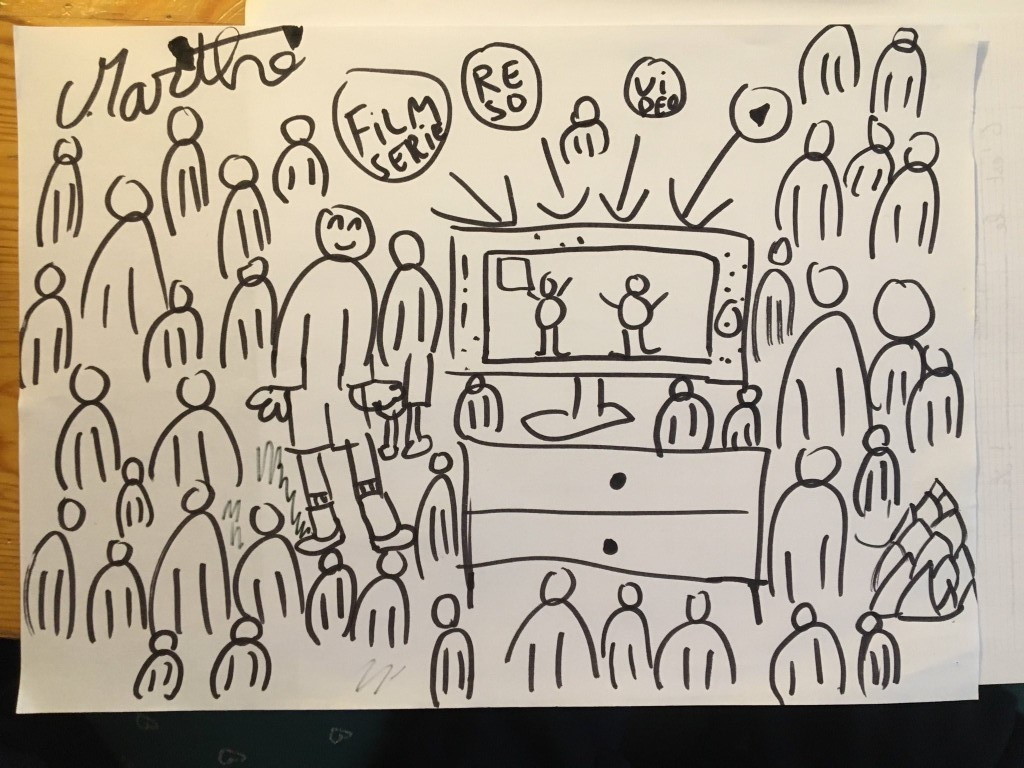
Movies, series, videos A child's drawing. In the middle, there is a screen, on the screen a movie is running. Around the screen there are many people, at least two dozens. The words 'film', 'series', 'network', 'video' are written and arrows point from these words to the screen. There's also a play icon. The youngest respondent, a 9 year old girl, drew a screen with lots of people around it and the words film, series, network, video , as well as a play icon. She said that she mostly uses the internet to watch movies. She was the only one who used a shared tablet and smartphone that belonged to her family, not to herself. And she would explain the net like this to an alien:
"Internet is a er one cannot touch it it s an, er [I propose the word idea ], yes it s an idea. Many people use it not necessarily to watch things, but also to read things or do other stuff."

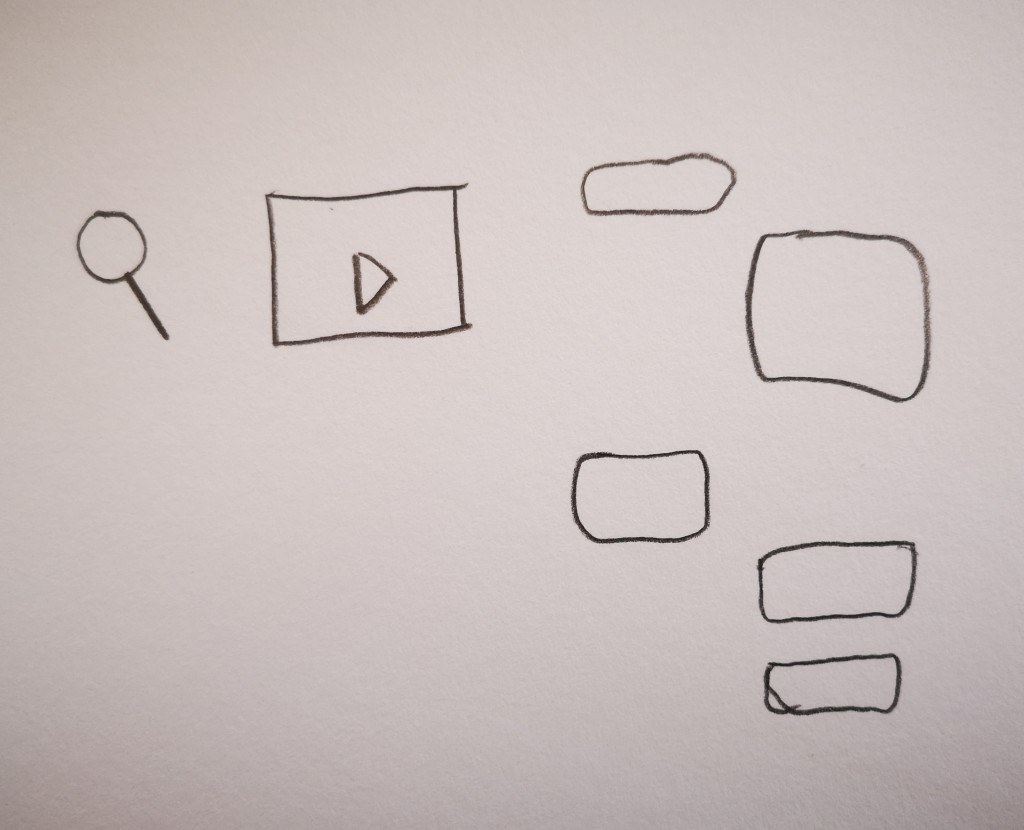
User interface elements There is a magnifying glass icon, a play icon and speech bubbles drawn with a pencil. A 10 year old boy represented the internet by recalling user interface elements he sees every day in his drawing: a magnifying glass (search engine), a play icon (video streaming), speech bubbles (instant messaging). He would explain the internet like this to an alien:
"You can use the internet to learn things or get information, listen to music, watch movies, and chat with friends. You can do nearly anything with it."

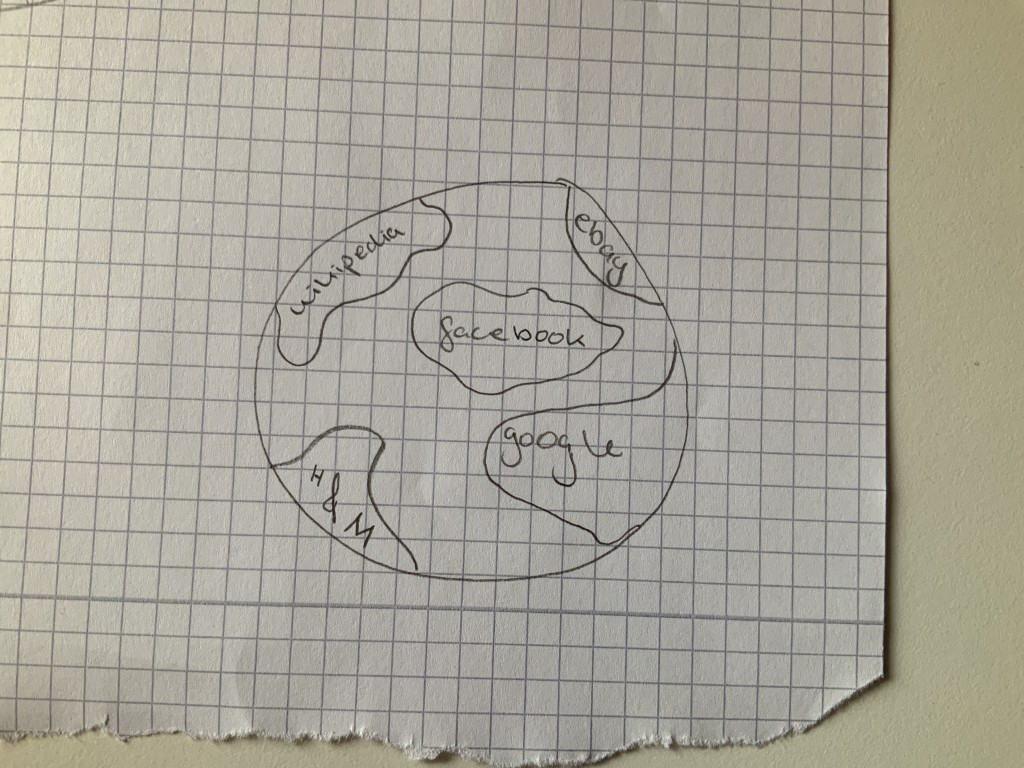
Another planet Pencil drawing that shows a planet with continents. The continents are named: H&M, Ebay, Google, Wikipedia, Facebook. A 12 year old girl imagines the internet like a second, intangible, planet where Google, Wikipedia, Facebook, Ebay, or H&M are continents that one enters into.
"And on [the] Ebay [continent] there s a country for clothes, and ,trousers , for example, would be a federal state in that country."
Something that was unique about this interview was that she told me she had an email address but she never writes emails. She only has an email account to receive confirmation emails, for example when doing online shopping, or when registering to a service and needing to confirm one s address. This is interesting because it s an anti-spam measure that might become outdated with a generation that uses email less or not at all.

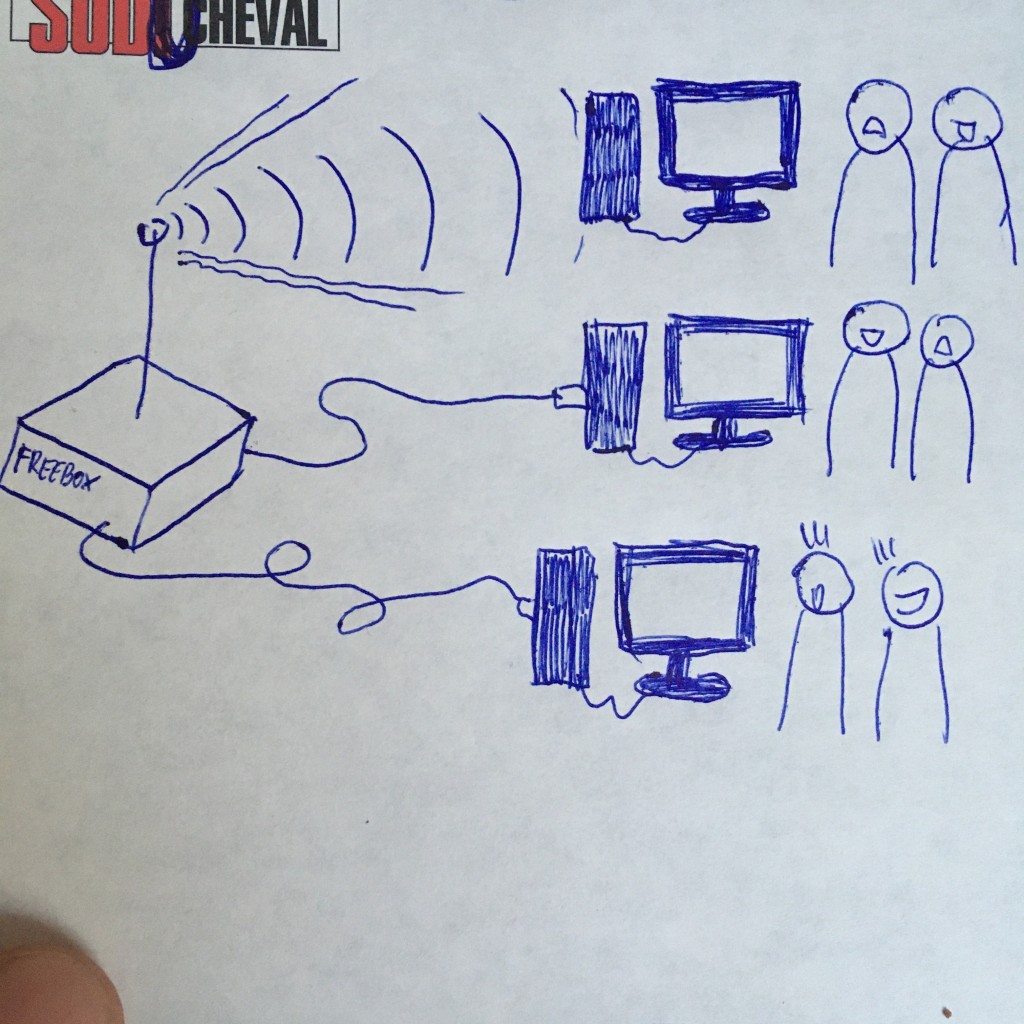
Home network Kid's drawing: there are three computer towers and next to each there are two people. The first couple is sad, the seconf couple is smiling, the last one is suprised. Each computer is connected to a router, two of them by cable, one by wifi. A 15 year old boy knew that his family s devices are connected to a home router (Freebox is a router from the French ISP Free) but lacked an imagination of the rest of the internet s functioning. When I asked him about what would be behind the router, on the other side, he said what s behind is like a black hole to him. However, he was the only interviewee who did actually draw cables, wifi waves, a router, and the local network. His drawing is even extremely precise, it just lacks the cable connecting the router to the rest of the internet.
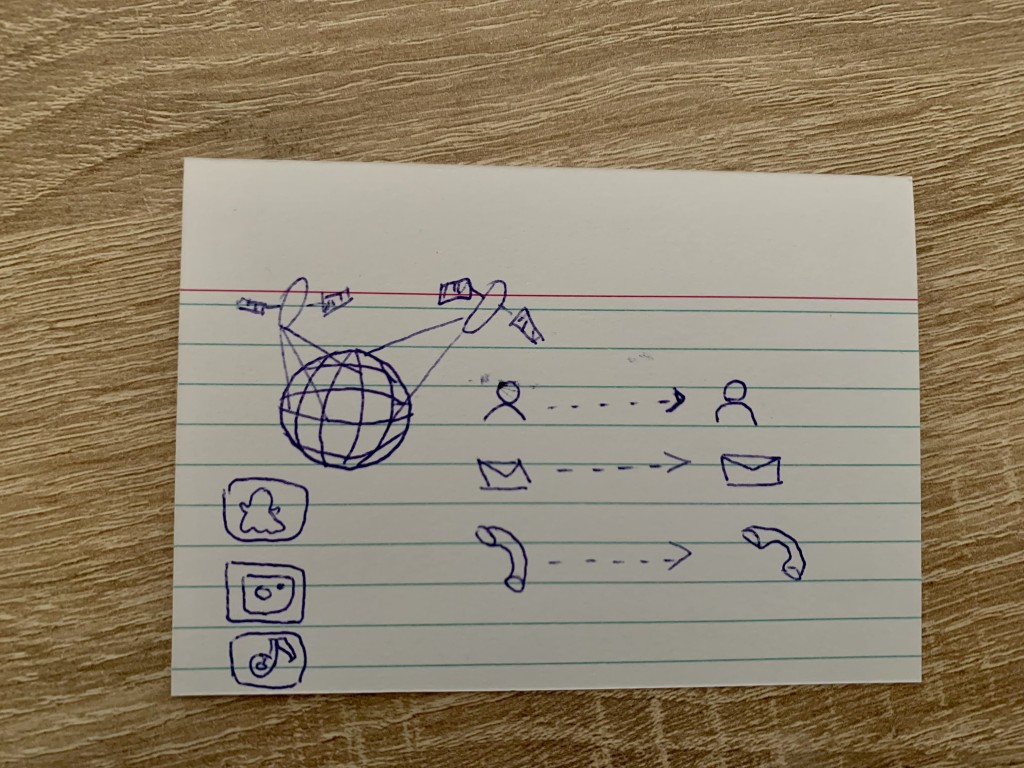
Satellite internet This is another very simple drawing: On top left, there's planet Earth an there are lines indicating that earth is a sphere. Around Earth there are two big satellites reaching most of Earth. on the left, below, there are three icons representing social media services on the internet: Snapchat, Instagram, TikTok. On the right, there are simplified drawings of possibilities which the internet offers: person to person connection, email (represented by envelopes), calls (represented by an old-style telephone set). A 17 year old girl would explain the internet to an alien as follows:
"The internet goes around the entire globe. One is networked with everyone else on Earth. One can find everything. But one cannot touch the internet. It s like a parallel world. With a device one can look into the internet. With search engines, one can find anything in the world, one can phone around the world, and write messages. [The internet] is a gigantic thing."
This interviewee stated as the only one that the internet is huge. And while she also is the only one who drew the internet as actually having some kind of physical extension beyond her own home, she seems to believe that internet connectivity is based on satellite technology and wireless communication.

Imagine that a wise and friendly dragon could teach you one thing about the internet that you ve always wanted to know. What would you ask the dragon to teach you about? A 10 year old boy said he d like to know how big are the servers behind all of this . That s the only interview in which the word server came up. A 12 year old girl said I would ask how to earn money with the internet. I always wanted to know how this works, and where the money comes from. I love the last part of her question! The 15 year old boy for whom everything behind the home router is out of his event horizon would ask How is it possible to be connected like we are? How does the internet work scientifically? A 17 year old girl said she d like to learn how the darknet works, what hidden things are there? Is it possible to get spied on via the internet? Would it be technically possible to influence devices in a way that one can listen to secret or telecommanded devices? Lastly, I wanted to learn about what they find annoying, or problematic about the internet.

Imagine you could make the internet better for everyone. What would you do first? Asked what she would change if she could, the 9 year old girl advocated for a global usage limit of the internet in order to protect the human brain. Also, she said, her parents spend way too much time on their phones and people should rather spend more time with their children. Three of the interviewees agreed that they see way too many advertisements and two of them would like ads to disappear entirely from the web. The other one said that she doesn t want to see ads, but that ads are fine if she can at least click them away. The 15 year old boy had different ambitions. He told me he would change:
"the age of access to the internet. More and more younger people access the internet ; especially with TikTok there is a recommendation algorithm that can influcence young people a lot. And influencing young people should be avoided but the internet does it too much. And that can be negative. If you don t yet have a critical spirit, and you watch certain videos you cannot yet moderate your stance. It can influence you a lot. There are so many things that have become indispensable and that happen on the internet and we have become dependent. What happens if one day it doesn t work anymore? If we connect more and more things to the net, that s not a good thing."

The internet - Oh, that s what you mean! On a sidenote, my first interview tentative was with an 8 year old girl from my family. I asked her if she uses the internet and she denied, so I abandoned interviewing her. Some days later, while talking to her, she proposed to look something up on Google, using her smartphone. I said: Oh, so you are using the internet! She replied: Oh, that s what you re talking about? I think she knows the word Google and she knows that she can search for information with this Google thing. But it appeared that she doesn t know that the Google search engine is located somewhere else on internet and not on her smartphone. I concluded that for her, using the services on the smartphone is as natural as switching on a light in the house: we also don t think about where the electricity comes from when we do that.

What can we learn from these few interviews? Unsurprisingly, social media, streaming, entertainment, and instant messaging are the main activities kids undertake on the internet. They are completely at the mercy of advertisements in apps and on websites, not knowing how to get rid of them. They interact on a daily basis with algorithms that are unregulated and known to perpetuate discrimination and to create filter bubbles, without necessarily being aware of it. The kids I interviewed act as mere service users and seem to be mostly confined to specific apps or websites. All of them perceived the internet as being something intangible. Only the older interviewees perceived that there must be some kind of physical expansion to it: the 17 year old girl by drawing a network of satellites around the globe, the 15 year old boy by drawing the local network in his home. To be continued

29 March 2022

Dirk Eddelbuettel: RcppBDT 0.2.5: Maintenance

A minor maintenance release for the RcppBDT package is now on CRAN. The RcppBDT package is an early adopter of Rcpp and was one of the first packages utilizing Boost and its Date_Time library. The now more widely-used package anytime is a direct descentant of RcppBDT. Thanks again for the heads-up! This release mostly deals with a one-definition rule violation detected by link-time optimisation (which can be enable when configuring R itself at build time with --enable-lto). I confused myself into thinking Rcpp Modules may be at fault, but I aki was a little more awake than myself and noticed that I only needed to carry the (common) header RcppBDT.h to the file toPOSIXct.cpp added last summer. The NEWS entry follows:

Changes in version 0.2.5 (2022-03-29)
  • Ensure consistent compilation by ensuring RcppBDT.h is included in all files, this addresses an LTO/ODR issue
  • Correct one declaration in init.c
  • Minor additional cleanups

Courtesy of my CRANberries, there is also a diffstat report for this release. If you like this or other open-source work I do, you can now sponsor me at GitHub.

This post by Dirk Eddelbuettel originated on his Thinking inside the box blog. Please report excessive re-aggregation in third-party for-profit settings.

27 March 2022

Russ Allbery: Review: A Song for a New Day

Review: A Song for a New Day, by Sarah Pinsker
Publisher: Berkley
Copyright: September 2019
ISBN: 1-9848-0259-3
Format: Kindle
Pages: 372
Luce Cannon was touring with a session band when the shutdown began. First came the hotel evacuation in the middle of the night due to bomb threats against every hotel in the state. Then came the stadium bombing just before they were ready to go on stage. Luce and most of the band performed anyway, with a volunteer crew and a shaken crowd. It was, people later decided, the last large stage show in the United States before the congregation laws shut down public gatherings. That was the end of Luce's expected career, and could have been the end of music, or at least public music. But Luce was stubborn and needed the music. Rosemary grew up in the aftermath: living at home with her parents well away from other people, attending school virtually, and then moving seamlessly into a virtual job for Superwally, the corporation that ran essentially everything. A good fix for some last-minute technical problems with StageHoloLive's ticketing system got her an upgraded VR hoodie and complimentary tickets to the first virtual concert she'd ever attended. She found the experience astonishing, prompting her to browse StageHoloLive job openings and then apply for a technical job and, on a whim, an artist recruiter role. That's how Rosemary found herself, quite nerve-wrackingly, traveling out into the unsafe world to look for underground musicians who could become StageHoloLive acts. A Song for a New Day was published in 2019 and had a moment of fame at the beginning of 2020, culminating in the Nebula Award for best novel, because it's about lockdowns, isolation, and the suppression of public performances. There's even a pandemic, although it's not a respiratory disease (it's some variety of smallpox or chicken pox) and is only a minor contributing factor to the lockdowns in this book. The primary impetus is random violence. Unfortunately, the subsequent two years have not been kind to this novel. Reading it in 2022, with the experience of the past two years fresh in my mind, was a frustrating and exasperating experience because the world setting is completely unbelievable. This is not entirely Pinsker's fault; this book was published in 2019, was not intended to be about our pandemic, and therefore could not reasonably predict its consequences. Still, it required significant effort to extract the premise of the book from the contradictory evidence of current affairs and salvage the pieces of it I still enjoyed. First, Pinsker's characters are the most astonishingly incurious and docile group of people I've seen in a recent political SF novel. This extends beyond the protagonists, where it could arguably be part of their characterization, to encompass the entire world (or at least the United States; the rest of the world does not appear in this book at all so far as I can recall). You may be wondering why someone bombs a stadium at the start of the book. If so, you are alone; this is not something anyone else sees any reason to be curious about. Why is random violence spiraling out of control? Is there some coordinated terrorist activity? Is there some social condition that has gotten markedly worse? Race riots? Climate crises? Wars? The only answer this book offers is a completely apathetic shrug. There is a hint at one point that the government may have theories that they're not communicating, but no one cares about that either. That leads to the second bizarre gap: for a book that hinges on political action, formal political structures are weirdly absent. Near the end of the book, one random person says that they have been inspired to run for office, which so far as I can tell is the first mention of elections in the entire book. The "government" passes congregation laws shutting down public gatherings and there are no protests, no arguments, no debate, but also no suppression, no laws against the press or free speech, no attempt to stop that debate. There's no attempt to build consensus for or against the laws, and no noticeable political campaigning. That's because there's no need. So far as one can tell from this story, literally everyone just shrugs and feels sad and vaguely compliant. Police officers exist and enforce laws, but changing those laws or defying them in other than tiny covert ways simply never occurs to anyone. This makes the book read a bit like a fatuous libertarian parody of a docile populace, but this is so obviously not the author's intent that it wouldn't be satisfying to read even as that. To be clear, this is not something that lasts only a few months in an emergency when everyone is still scared. This complete political docility and total incuriosity persists for enough years that Rosemary grows up within that mindset. The triggering event was a stadium bombing followed by an escalating series of random shootings and bombings. (The pandemic in the book only happens after everything is locked down and, apart from adding to Rosemary's agoraphobia and making people inconsistently obsessed with surface cleanliness, plays little role in the novel.) I lived through 9/11 and the Oklahoma City bombing in the US, other countries have been through more protracted and personally dangerous periods of violence (the Troubles come to mind), and never in human history has any country reacted to a shock of violence (or, for that matter, disease) like the US does in this book. At points it felt like one of those SF novels where the author is telling an apparently normal story and all the characters turn out to be aliens based on spiders or bats. I finally made sense of this by deciding that the author wasn't using sudden shocks like terrorism or pandemics as a model, even though that's what the book postulates. Instead, the model seems to be something implicitly tolerated and worked around: US school shootings, for instance, or the (incorrect but widespread) US belief in a rise of child kidnappings by strangers. The societal reaction here looks less like a public health or counter-terrorism response and more like suburban attitudes towards child-raising, where no child is ever left unattended for safety reasons but we routinely have school shootings no other country has at the same scale. We have been willing to radically (and ineffectually) alter the experience of childhood due to fears of external threat, and that's vaguely and superficially similar to the premise of this novel. What I think Pinsker still misses (and which the pandemic has made glaringly obvious) is the immense momentum of normality and the inability of adults to accept limitations on their own activities for very long. Even with school shootings, kids go to school in person. We now know that parts of society essentially collapse if they don't, and political pressure becomes intolerable. But by using school shootings as the model, I managed to view Pinsker's setup as an unrealistic but still potentially interesting SF extrapolation: a thought experiment that ignores countervailing pressures in order to exaggerate one aspect of society to an extreme. This is half of Pinsker's setup. The other half, which made less of a splash because it didn't have the same accident of timing, is the company Superwally: essentially "what if Amazon bought Walmart, Google, Facebook, Netflix, Disney, and Live Nation." This is a more typical SF extrapolation that left me with a few grumbles about realism, but that I'll accept as a plot device to talk about commercialization, monopolies, and surveillance capitalism. But here again, the complete absence of formal political structures in this book is not credible. Superwally achieves an all-pervasiveness that in other SF novels results in corporations taking over the role of national governments, but it still lobbies the government in much the same way and with about the same effectiveness as Amazon does in our world. I thought this directly undermined some parts of the end of the book. I simply did not believe that Superwally would be as benign and ineffectual as it is shown here. Those are a lot of complaints. I found reading the first half of this book to be an utterly miserable experience and only continued reading out of pure stubbornness and completionism. But the combination of the above-mentioned perspective shift and Pinsker's character focus did partly salvage the book for me. This is not a book about practical political change, even though it makes gestures in that direction. It's primarily a book about people, music, and personal connection, and Pinsker's portrayal of individual and community trust in all its complexity is the one thing the book gets right. Rosemary's character combines a sort of naive arrogance with self-justification in a way that I found very off-putting, but the pivot point of the book is the way in which Luce and her community extends trust to her anyway, as part of staying true to what they believe. The problem that I think Pinsker was trying to write about is atomization, which leads to social fragmentation into small trust networks with vast gulfs between them. Luce and Rosemary are both characters who are willing to bridge those gulfs in their own ways. Pinsker does an excellent job describing the benefits, the hurt, the misunderstandings, the risk, and the awkward process of building those bridges between communities that fundamentally do not understand each other. There's something deep here about the nature of solidarity, and how you need both people like Luce and people like Rosemary to build strong and effective communities. I've kept thinking about that part. It's also helpful for a community to have people who are curious about cause and effect, and who know how a bill becomes a law. It's hard to sum up this book, other than to say that I understand why it won a Nebula but it has deep world-building flaws that have become far more obvious over the past two years. Pinsker tries hard to capture the feeling of live music for both the listener and the performer and partly succeeded even for me, which probably means others will enjoy that part of the book immensely. The portrayal of the difficult dynamics of personal trust was the best part of the book for me, but you may have to build scaffolding and bracing for your world-building disbelief in order to get there. On the whole, I think A Song for a New Day is worth reading, but maybe not right now. If you do read it now, tell yourself at the start that this is absolutely not about the pandemic and that everything political in this book is a hugely simplified straw-man extrapolation, and hopefully you'll find the experience less frustrating than I found it. Rating: 6 out of 10

17 March 2022

Rapha&#235;l Hertzog: Freexian s report about Debian Long Term Support, February 2022

A Debian LTS logo
Every month we review the work funded by Freexian s Debian LTS offering. Please find the report for February below. Debian project funding
  • In February Rapha l and the LTS worked on a survey of Debian developers meant to solicit ideas for improvements in the Debian project at large. You can see the results of the initial discussion here in the list of ideas of which there are already over 30.
  • The full survey is due to be emailed to Debian Developers shortly.
  • In February 2250 was put aside to fund Debian projects.
Debian LTS contributors In February, 12 contributors were paid to work on Debian LTS, their reports are available below. If you re interested in participating in the LTS or ELTS teams, we welcome participation from the Debian community. Simply get in touch with Jeremiah or Rapha l if you are if you are interested in participating. Evolution of the situation In February we released 24 DLAs. The security tracker currently lists 61 packages with a known CVE and the dla-needed.txt file has 26 packages needing an update. You can find out more about the Debian LTS project via the following video:
Thanks to our sponsors Sponsors that joined recently are in bold.

12 March 2022

Petter Reinholdtsen: Publish Hargassner wood chip boiler state to MQTT

Recently I had a look at a Hargassner wood chip boiler, and what kind of free software can be used to monitor and control it. The boiler can be connected to some cloud service via what the producer call an Internet Gateway, which seem to be a computer connecting to the boiler and passing the information gathered to the cloud. I discovered the boiler controller got an IP address on the local network and listen on TCP port 23 to provide status information as a text line of numbers. It also provide a HTTP server listening on port 80, but I have not yet figured out what it can do beside return an error code. If I am to believe various free software implementations talking to such boiler, the interpretation of the line of numbers differ between type of boiler and software version on the boiler. By comparing the list of numbers on the front panel of the boiler with the numbers returned via TCP, I have been able to figure out several of the numbers, but there are a lot left to understand. I've located several temperature measurements and hours running values, as well as oxygen measurements and counters. I decided to write a simple parser in Python for the values I figured out so far, and a simple MQTT injector publishing both the interpreted and the unknown values on a MQTT bus to make collecting and graphing simpler. The end result is available from the hargassner2mqtt project page on gitlab. I very much welcome patches extending the parser to understand more values, boiler types and software versions. I do not really expect very few free software developers got their hands on such unit to experiment, but it would be fun if others too find this project useful. As usual, if you use Bitcoin and want to show your support of my activities, please send Bitcoin donations to my address 15oWEoG9dUPovwmUL9KWAnYRtNJEkP1u1b.

9 March 2022

Dirk Eddelbuettel: RcppRedis 0.2.0: Major Updates

A new major release of RcppRedis arrived on CRAN today. RcppRedis is one of several packages connecting R to the fabulous Redis in-memory datastructure store (and much more). RcppRedis does not pretend to be feature complete, but it may do some things faster than the other interfaces, and also offers an optional coupling with MessagePack binary (de)serialization via RcppMsgPack. The package has carried production loads for several years now. This release integrates support for pub/sub, a popular messaging pattern in which one or more clients can subscribe to one or more channels . Whenever a client instances publishes, the Redis server immediately updates all clients listening on the given channel. This pattern is fairly common to transmit data to listeners. A there is a bit more to explain about this, I also added a brand-new vignette describing pub/sub with RcppRedis, along with another introductory vignette about Redis itself. We blogged about this exciting new feature and its particular use for market monitoring in R4 #36 recently too. The pub/sub feature was available in package rredis by Bryan Lewis and has now been ported over by Bryan in a truly elegant yet compact implementation. We placed the code for the pub/sub examples, both for a single symbol (SP 500) as well as for a set of (futures) symbols, into a new examples/ subdirectory. Other changes in this release are the removal of the build-dependency on Boost (or, rather, my BH package), an update to the included hiredis library (used if no system-wide version is found), and an updated to the UCRT build for R. That last one is a bit of a sore spot and nobody at CRAN deemed it necessary to tell me they were waiting for me to make this change; communication with the CRAN team can still be challenging (and I am being generous here). Anyway, the package is now on CRAN so all is well now, at long last. The detailed changes list follows.

Changes in version 0.2.0 (2022-03-08)
  • Two simple C++11 features remove needs for BH and lexical_cast() (Dirk in #45 addressing #44).
  • Redis pub/sub is now supported (Dirk in #43, Bryan in #46).
  • Bryan Lewis is now a coauthor.
  • Added pub/sub examples for single and multiple Globex symbols.
  • The included hiredis sources have been updated to release 1.0.2.
  • Two vignettes have been added to introduce Redis and to described a live market-monitoring application included in directory pubsub/.
  • The UCRT build was updated per a suggestion by Tomas.

Courtesy of CRANberries, there is also a diffstat report for this release. More information is on the RcppRedis page. If you like this or other open-source work I do, you can now sponsor me at GitHub.

This post by Dirk Eddelbuettel originated on his Thinking inside the box blog. Please report excessive re-aggregation in third-party for-profit settings.

5 March 2022

Thorsten Alteholz: My Debian Activities in February 2022

FTP master This month I accepted 484 and rejected 73 packages. The overall number of packages that got accepted was 495. The overall number of rejected packages was 76, which is about 15% of the uploads to NEW. While most of the maintainers do a great job when creating their debian/copyright, others are a bit lax. Unfortunately those people seem to be more enthusiastic when fighting for changes in NEW processing or even removing NEW. One argument in discussions about NEW is that the copyright verification of packages can be done by the community after accepting the packages in the archive.
Last month I did not get any hint that such checks have been done by anybody. As the past already showed several times, this community based checks simply do not exist. So in the end poorly maintained copyright information will rot in the archive and I am not sure that this really corresponds with the Debian Social Contract. Debian LTS This was my ninety-second month that I did some work for the Debian LTS initiative, started by Raphael Hertzog at Freexian. This month my all in all workload has been 40h. During that time I did LTS and normal security uploads of:
  • [DLA 2928-1] htmldoc security update for three CVEs
  • [#1004049] buster-pu: zziplib debdiff was approved and package uploaded
  • [#1004050] bullseye-pu: zziplib debdiff was approved and package uploaded
  • [#1004055] buster-pu: debdiff was approved and package uploaded
  • [#1006493] bullseye-pu: htmldoc/1.9.11-4+deb11u2
  • [#1006494] buster-pu: htmldoc/1.9.3-1+deb10u3
  • [#1006550] buster-pu: tiff/4.1.0+git191117-2~deb10u4
  • [#1006551] bullseye-pu: tiff/4.2.0-1+deb11u1
Unfortunately salsa went down at the end of the month, so several planned uploads did not happen and have to be delayed to March. I also continued to work on security support for golang packages. Further I worked on packages in NEW on security-master and injected missing sources. Last but not least I did some days of frontdesk duties. Debian ELTS This month was the forty-fourth ELTS month. During my allocated time I uploaded:
  • ELA-567-1 for apache2
  • ELA-567-2 for apache2
  • ELA-568-1 for ksh
  • ELA-569-1 for tiff
  • ELA-570-1 for htmldoc
Further I worked on cyrus-sasl but did not do an upload yet. Last but not least I did some days of frontdesk duties. Debian Printing As announced last month I uploaded a new version of cups. Altogether I uploaded new upstream versions or improved packaging of: Debian Astro This month I uploaded new upstream versions or improved packaging of: Other stuff This month I uploaded new upstream versions or improved packaging of:

Next.

Previous.