Search Results: "spa"

13 December 2024

Emanuele Rocca: Murder Mystery: GCC Builds Failing After sbuild Refactoring

This is the story of an investigation conducted by Jochen Sprickerhof, Helmut Grohne, and myself. It was true teamwork, and we would have not reached the bottom of the issue working individually. We think you will find it as interesting and fun as we did, so here is a brief writeup. A few of the steps mentioned here took several days, others just a few minutes. What is described as a natural progression of events did not always look very obvious at the moment at all.
Let us go through the Six Stages of Debugging together.

Stage 1: That cannot happen
Official Debian GCC builds start failing on multiple architectures in late November.
The build error happens on the build servers when running the testuite, but we know this cannot happen. GCC builds are not meant to fail in case of testsuite failures! Return codes are not making the build fail, make is being called with -k, it just cannot happen.
A lot of the GCC tests are always failing in fact, and an extensive log of the results is posted to the debian-gcc mailing list, but the packages always build fine regardless.
On the build daemons, build failures take several hours.

Stage 2: That does not happen on my machine
Building on my machine running Bookworm is just fine. The Build Daemons run Bookworm and use a Sid chroot for the build environment, just like I am. Same kernel.
The only obvious difference between my setup and the Debian buildds is that I am using sbuild 0.85.0 from bookworm, and the buildds have 0.86.3~bpo12+1 from bookworm-backports. Trying again with 0.86.3~bpo12+1, the build fails on my system too. The build daemons were updated to the bookworm-backports version of sbuild at some point in late November. Ha.

Stage 3: That should not happen
There are quite a few sbuild versions in between 0.85.0 and 0.86.3~bpo12+1, but looking at recent sbuild bugs shows that sbuild 0.86.0 was breaking "quite a number of packages". Indeed, with 0.86.0 the build still fails. Trying the version immediately before, 0.85.11, the build finishes correctly. This took more time than it sounds, one run including the tests takes several hours. We need a way to shorten this somehow.
The Debian packaging of GCC allows to specify which languages you may want to skip, and by default it builds Ada, Go, C, C++, D, Fortran, Objective C, Objective C++, M2, and Rust. When running the tests sequentially, the build logs stop roughly around the tests of a runtime library for D, libphobos. So can we still reproduce the failure by skipping everything except for D? With DEB_BUILD_OPTIONS=nolang=ada,go,c,c++,fortran,objc,obj-c++,m2,rust the build still fails, and it fails faster than before. Several minutes, not hours. This is progress, and time to file a bug. The report contains massive spoilers, so no link. :-)

Stage 4: Why does that happen?
Something is causing the build to end prematurely. It s not the OOM killer, and the kernel does not have anything useful to say in the logs. Can it be that the D language tests are sending signals to some process, and that is what s killing make ? We start tracing signals sent with bpftrace by writing the following script, signals.bt:
tracepoint:signal:signal_generate  
    printf("%s PID %d (%s) sent signal %d to PID %d\n", comm, pid, args->sig, args->pid);
 
And executing it with sudo bpftrace signals.bt.
The build takes its sweet time, and it fails. Looking at the trace output there s a suspicious process.exe terminating stuff.
process.exe (PID: 2868133) sent signal 15 to PID 711826
That looks interesting, but we have no clue what PID 711826 may be. Let s change the script a bit, and trace signals received as well.
tracepoint:signal:signal_generate  
    printf("PID %d (%s) sent signal %d to %d\n", pid, comm, args->sig, args->pid);
 
tracepoint:signal:signal_deliver  
    printf("PID %d (%s) received signal %d\n", pid, comm, args->sig);
 
The working version of sbuild was using dumb-init, whereas the new one features a little init in perl. We patch the current version of sbuild by making it use dumb-init instead, and trace two builds: one with the perl init, one with dumb-init.
Here are the signals observed when building with dumb-init.
PID 3590011 (process.exe) sent signal 2 to 3590014
PID 3590014 (sleep) received signal 9
PID 3590011 (process.exe) sent signal 15 to 3590063
PID 3590063 (std.process tem) received signal 9
PID 3590011 (process.exe) sent signal 9 to 3590065
PID 3590065 (std.process tem) received signal 9
And this is what happens with the new init in perl:
PID 3589274 (process.exe) sent signal 2 to 3589291
PID 3589291 (sleep) received signal 9
PID 3589274 (process.exe) sent signal 15 to 3589338
PID 3589338 (std.process tem) received signal 9
PID 3589274 (process.exe) sent signal 9 to 3589340
PID 3589340 (std.process tem) received signal 9
PID 3589274 (process.exe) sent signal 15 to 3589341
PID 3589274 (process.exe) sent signal 15 to 3589323
PID 3589274 (process.exe) sent signal 15 to 3589320
PID 3589274 (process.exe) sent signal 15 to 3589274
PID 3589274 (process.exe) received signal 9
PID 3589341 (sleep) received signal 9
PID 3589273 (sbuild-usernsex) sent signal 9 to 3589320
PID 3589273 (sbuild-usernsex) sent signal 9 to 3589323
There are a few additional SIGTERM being sent when using the perl init, that s helpful. At this point we are fairly convinced that process.exe is worth additional inspection. The source code of process.d shows something interesting:
1221 @system unittest
1222  
[...]
1247     auto pid = spawnProcess(["sleep", "10000"],
[...]
1260     // kill the spawned process with SIGINT
1261     // and send its return code
1262     spawn((shared Pid pid)  
1263         auto p = cast() pid;
1264         kill(p, SIGINT);
So yes, there s our sleep and the SIGINT (signal 2) right in the unit tests of process.d, just like we have observed in the bpftrace output.
Can we study the behavior of process.exe in isolation, separatedly from the build? Indeed we can. Let s take the executable from a failed build, and try running it under /usr/libexec/sbuild-usernsexec.
First, we prepare a chroot inside a suitable user namespace:
unshare --map-auto --setuid 0 --setgid 0 mkdir /tmp/rootfs
cd /tmp/rootfs
cat /home/ema/.cache/sbuild/unstable-arm64.tar   unshare --map-auto --setuid 0 --setgid 0 tar xf  -
unshare --map-auto --setuid 0 --setgid 0 mkdir /tmp/rootfs/whatever
unshare --map-auto --setuid 0 --setgid 0 cp process.exe /tmp/rootfs/
Now we can run process.exe on its own using the perl init, and trace signals at will:
/usr/libexec/sbuild-usernsexec --pivotroot --nonet u:0:100000:65536  g:0:100000:65536 /tmp/rootfs ema /whatever -- /process.exe
We can compare the behavior of the perl init vis-a-vis the one using dumb-init in milliseconds instead of minutes.

Stage 5: Oh, I see.
Why does process.exe send more SIGTERMs when using the perl init is now the big question. We have a simple reproducer, so this is where using strace becomes possible.
sudo strace --user ema --follow-forks -o sbuild-dumb-init.strace ./sbuild-usernsexec-dumb-init --pivotroot --nonet u:0:100000:65536  g:0:100000:65536 /tmp/dumbroot ema /whatever -- /process.exe
We start comparing the strace output of dumb-init with that of perl-init, looking in particular for different calls to kill.
Here is what process.exe does under dumb-init:
3593883 kill(-2, SIGTERM)               = -1 ESRCH (No such process)
No such process. Under perl-init instead:
3593777 kill(-2, SIGTERM <unfinished ...>
The process is there under perl-init!
That is a kill with negative pid. From the kill(2) man page:
If pid is less than -1, then sig is sent to every process in the process group whose ID is -pid.
It would have been very useful to see this kill with negative pid in the output of bpftrace, why didn t we? The tracepoint used, tracepoint:signal:signal_generate, shows when signals are actually being sent, and not the syscall being called. To confirm, one can trace tracepoint:syscalls:sys_enter_kill and see the negative PIDs, for example:
PID 312719 (bash) sent signal 2 to -312728
The obvious question at this point is: why is there no process group 2 when using dumb-init?

Stage 6: How did that ever work?
We know that process.exe sends a SIGTERM to every process in the process group with ID 2. To find out what this process group may be, we spawn a shell with dumb-init and observe under /proc PIDs 1, 16, and 17. With perl-init we have 1, 2, and 17. When running dumb-init, there are a few forks before launching the program, explaining the difference. Looking at /proc/2/cmdline we see that it s bash, ie. the program we are running under perl-init. When building a package, that is dpkg-buildpackage itself.
The test is accidentally killing its own process group.
Now where does this -2 come from in the test?
2363     // Special values for _processID.
2364     enum invalid = -1, terminated = -2;
Oh. -2 is used as a special value for PID, meaning "terminated". And there s a call to kill() later on:
2694     do   s = tryWait(pid);   while (!s.terminated);
[...]
2697     assertThrown!ProcessException(kill(pid));
What sets pid to terminated you ask?
Here is tryWait:
2568 auto tryWait(Pid pid) @safe
2569  
2570     import std.typecons : Tuple;
2571     assert(pid !is null, "Called tryWait on a null Pid.");
2572     auto code = pid.performWait(false);
And performWait:
2306         _processID = terminated;
The solution, dear reader, is not to kill.
PS: the bug report with spoilers for those interested is #1089007.

Freexian Collaborators: Monthly report about Debian Long Term Support, November 2024 (by Roberto C. S nchez)

Like each month, have a look at the work funded by Freexian s Debian LTS offering.

Debian LTS contributors In November, 20 contributors have been paid to work on Debian LTS, their reports are available:
  • Abhijith PA did 14.0h (out of 6.0h assigned and 8.0h from previous period).
  • Adrian Bunk did 53.0h (out of 15.0h assigned and 85.0h from previous period), thus carrying over 47.0h to the next month.
  • Andrej Shadura did 7.0h (out of 7.0h assigned).
  • Arturo Borrero Gonzalez did 1.0h (out of 10.0h assigned), thus carrying over 9.0h to the next month.
  • Bastien Roucari s did 20.0h (out of 20.0h assigned).
  • Ben Hutchings did 0.0h (out of 24.0h assigned), thus carrying over 24.0h to the next month.
  • Chris Lamb did 18.0h (out of 18.0h assigned).
  • Daniel Leidert did 17.0h (out of 26.0h assigned), thus carrying over 9.0h to the next month.
  • Emilio Pozuelo Monfort did 40.5h (out of 60.0h assigned), thus carrying over 19.5h to the next month.
  • Guilhem Moulin did 7.25h (out of 7.5h assigned and 12.5h from previous period), thus carrying over 12.75h to the next month.
  • Jochen Sprickerhof did 3.5h (out of 10.0h assigned), thus carrying over 6.5h to the next month.
  • Lee Garrett did 14.75h (out of 15.25h assigned and 44.75h from previous period), thus carrying over 45.25h to the next month.
  • Lucas Kanashiro did 10.0h (out of 54.0h assigned and 10.0h from previous period), thus carrying over 54.0h to the next month.
  • Markus Koschany did 20.0h (out of 40.0h assigned), thus carrying over 20.0h to the next month.
  • Roberto C. S nchez did 6.75h (out of 9.75h assigned and 14.25h from previous period), thus carrying over 17.25h to the next month.
  • Santiago Ruano Rinc n did 24.75h (out of 23.5h assigned and 1.5h from previous period), thus carrying over 0.25h to the next month.
  • Sean Whitton did 2.0h (out of 6.0h assigned), thus carrying over 4.0h to the next month.
  • Sylvain Beucler did 21.5h (out of 9.5h assigned and 50.5h from previous period), thus carrying over 38.5h to the next month.
  • Thorsten Alteholz did 11.0h (out of 11.0h assigned).
  • Tobias Frost did 12.0h (out of 10.5h assigned and 1.5h from previous period).

Evolution of the situation In November, we have released 38 DLAs. The LTS coordinators, Roberto and Santiago, delivered a talk at the Mini-DebConf event in Toulouse, France. The title of the talk was How LTS goes beyond LTS . The talk covered work done by the LTS Team during the past year. This included contributions related to individual packages in Debian (such as tomcat, jetty, radius, samba, apache2, ruby, and many others); improvements to tooling and documentation useful to the Debian project as a whole; and contributions to upstream work (apache2, freeimage, node-dompurify, samba, and more). Additionally, several contributors external to the LTS Team were highlighted for their contributions to LTS. Readers are encouraged to watch the video of the presentation for a more detailed review of various ways in which the LTS team has contributed more broadly to the Debian project and to the free software community during the past year. We wish to specifically thank Salvatore (of the Debian Security Team) for swiftly handling during November the updates of needrestart and libmodule-scandeps-perl, both of which involved arbitrary code execution vulnerabilities. We are happy to see increased involvement in LTS work by contributors from outside the formal LTS Team. The work of the LTS Team in November was otherwise unremarkable, encompassing the customary triage, development, testing, and release of numerous DLAs, along with some associated contributions to related packages in stable and unstable.

Thanks to our sponsors Sponsors that joined recently are in bold.

10 December 2024

Emmanuel Kasper: Too many open files in Minikube Pod

Right now playing with minikube, to run a three nodes highly available Kubernetes control plane. I am using the docker driver of minikube, so each Kubernetes node component is running inside a docker container, instead of using full blown VMs. In my experience this works better than Kind, as using Kind you cannot correctly restart a cluster deployed in highly available mode. This is the topology of the cluster:
$ minikube node list 
minikube        192.168.49.2
minikube-m02    192.168.49.3
minikube-m03    192.168.49.4
Each kubernetes node is actually a docker container:
$ docker ps
CONTAINER ID   IMAGE                                 COMMAND                  CREATED          STATUS         PORTS                                                                                                                                  NAMES
977046487e5e   gcr.io/k8s-minikube/kicbase:v0.0.45   "/usr/local/bin/entr "   31 minutes ago   Up 6 minutes   127.0.0.1:32812->22/tcp, 127.0.0.1:32811->2376/tcp, 127.0.0.1:32810->5000/tcp, 127.0.0.1:32809->8443/tcp, 127.0.0.1:32808->32443/tcp   minikube-m03
8be3549f0c4c   gcr.io/k8s-minikube/kicbase:v0.0.45   "/usr/local/bin/entr "   31 minutes ago   Up 6 minutes   127.0.0.1:32807->22/tcp, 127.0.0.1:32806->2376/tcp, 127.0.0.1:32805->5000/tcp, 127.0.0.1:32804->8443/tcp, 127.0.0.1:32803->32443/tcp   minikube-m02
4b39f1c47c23   gcr.io/k8s-minikube/kicbase:v0.0.45   "/usr/local/bin/entr "   31 minutes ago   Up 6 minutes   127.0.0.1:32802->22/tcp, 127.0.0.1:32801->2376/tcp, 127.0.0.1:32800->5000/tcp, 127.0.0.1:32799->8443/tcp, 127.0.0.1:32798->32443/tcp   minikube
The whole list of pods running in the cluster is as this:
$ minikube kubectl -- get pods --all-namespaces
kube-system   coredns-6f6b679f8f-85n9l               0/1     Running   1 (44s ago)   3m32s
kube-system   coredns-6f6b679f8f-pnhxv               0/1     Running   1 (44s ago)   3m32s
kube-system   etcd-minikube                          1/1     Running   1 (44s ago)   3m37s
kube-system   etcd-minikube-m02                      1/1     Running   1 (42s ago)   3m21s
...
kube-system   kube-proxy-84gm6                       0/1     Error     1 (31s ago)   3m4s
There is this container in Error status, let us check the logs
$ minikube kubectl -- logs -n kube-system kube-proxy-84gm6
E1210 11:50:42.117036       1 run.go:72] "command failed" err="failed complete: too many open files"
This can be fixed by increasing the number of inotify watchers:
# cat > /etc/sysctl.d/minikube.conf <<EOF
fs.inotify.max_user_watches = 524288
fs.inotify.max_user_instances = 512
EOF
# sysctl --system
...
* Applying /etc/sysctl.d/minikube.conf ...
* Applying /etc/sysctl.conf ...
...
fs.inotify.max_user_watches = 524288
fs.inotify.max_user_instances = 512
Restart the cluster
$ minikube stop
$ minikube start 
$ minikube kubectl -- get pods --all-namespaces   grep Error
$

9 December 2024

Gunnar Wolf: Some tips for those who still administer Drupal7-based sites

A bit of history: Drupal at my workplace (and in Debian) My main day-to-day responsibility in my workplace is, and has been for 20 years, to take care of the network infrastructure for UNAM s Economics Research Institute. One of the most visible parts of this responsibility is to ensure we have a working Web presence, and that it caters for the needs of our academic community. I joined the Institute in January 2005. Back then, our designer pushed static versions of our webpage, completely built in her computer. This was standard practice at the time, and lasted through some redesigns, but I soon started advocating for the adoption of a Content Management System. After evaluating some alternatives, I recommended adopting Drupal. It took us quite a bit to do the change: even though I clearly recall starting work toward adopting it as early as 2006, according to the Internet Archive, we switched to a Drupal-backed site around June 2010. We started using it somewhere in the version 6 s lifecycle. As for my Debian work, by late 2012 I started getting involved in the maintenance of the drupal7 package, and by April 2013 I became its primary maintainer. I kept the drupal7 package up to date in Debian until 2018; the supported build methods for Drupal 8 are not compatible with Debian (mainly, bundling third-party libraries and updating them without coordination with the rest of the ecosystem), so towards the end of 2016, I announced I would not package Drupal 8 for Debian. By March 2016, we migrated our main page to Drupal 7. By then, we already had several other sites for our academics projects, but my narrative follows our main Web site. I did manage to migrate several Drupal 6 (D6) sites to Drupal 7 (D7); it was quite involved process, never transparent to the user, and we did have the backlash of long downtimes (or partial downtimes, with sites half-available only) with many of our users. For our main site, we took the opportunity to do a complete redesign and deployed a fully new site. You might note that March 2016 is after the release of D8 (November 2015). I don t recall many of the specifics for this decision, but if I m not mistaken, building the new site was a several months long process not only for the technical work of setting it up, but for the legwork of getting all of the needed information from the different areas that need to be represented in the Institute. Not only that: Drupal sites often include tens of contributed themes and modules; the technological shift the project underwent between its 7 and 8 releases was too deep, and modules took a long time (if at all many themes and modules were outright dumped) to become available for the new release. Naturally, the Drupal Foundation wanted to evolve and deprecate the old codebase. But the pain to migrate from D7 to D8 is too big, and many sites have remained under version 7 Eight years after D8 s release, almost 40% of Drupal installs are for version 7, and a similar proportion runs a currently-supported release (10 or 11). And while the Drupal Foundation made a great job at providing very-long-term support for D7, I understand the burden is becoming too much, so close to a year ago (and after pushing several times the D7, they finally announced support will finish this upcoming January 5.

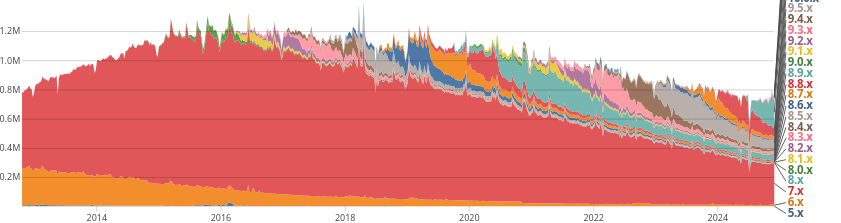
Drupal 7 must go! I found the following usage graphs quite interesting: the usage statistics for all Drupal versions follows a very positive slope, peaking around 2014 during the best years of D7, and somewhat stagnating afterwards, staying since 2015 at the 25000 28000 sites mark (I m very tempted to copy the graphs, but builtwith s terms of use are very clear in not allowing it). There is a sharp drop in the last year I attribute it to the people that are leaving D7 for other technologies after its end-of-life announcement. This becomes clearer looking only at D7 s usage statistics: D7 peaks at 15000 installs in 2016 stays there for close to 5 years, and has a sharp drop to under 7500 sites in the span of one year. D8 has a more regular rise, peak and fall peaking at ~8500 between 2020 and 2021, and down to close to 2500 for some months already; D9 has a very brief peak of almost 9000 sites in 2023 and is now close to half of it. Currently, the Drupal king appears to be D10, still on a positive slope and with over 9000 sites. Drupal 11 is still just a blip in builtwith s radar, with 3 registered sites as of September 2024 :- After writing this last paragraph, I came across the statistics found in the Drupal webpage; the methodology for acquiring its data is completely different: while builtwith s methodology is their trade secret, you can read more about how Drupal s data is gathered (and agree or disagree with it , but at least you have a page detailing 12 years so far of reported data, producing the following graph (which can be shared under the CC BY-SA license ): Drupal usage statistics by version 2013 2024 This graph is disgregated into minor versions, and I don t want to come up with yet another graph for it but it supports (most of) the narrative I presented above although I do miss the recent drop builtwith reported in D7 s numbers!

And what about Backdrop? During the D8 release cycle, a group of Drupal developers were not happy with the depth of the architectural changes that were being adopted, particularly the transition to the Symfony PHP component framework, and forked the D7 codebase to create the Backdrop CMS, a modern version of Drupal, without dropping the known and tested architecture it had. The Backdrop developers keep working closely together with the Drupal community, and although its usage numbers are way smaller than Drupal s, seems to be sustainable and lively. Of course, as I presented their numbers in the previous section, you can see Backdrop s numbers in builtwith are way, way lower. I have found it to be a very warm and welcoming community, eager to receive new members. And, thanks to its contributed D2B Migrate module, I found it is quite easy to migrate a live site from Drupal 7 to Backdrop.

Migration by playbook! So Well, I m an academic. And (if it s not obvious to you after reading so far ), one of the things I must do in my job is to write. So I decided to write an article to invite my colleagues to consider Backdrop for their D7 sites in Cuadernos T cnicos Universitarios de la DGTIC, a young journal in our university for showcasing technical academical work. And now that my article got accepted and published, I m happy to share it with you of course, if you can read Spanish But anyway Given I have several sites to migrate, and that I m trying to get my colleagues to follow suite, I decided to automatize the migration by writing an Ansible playbook to do the heavy lifting. Of course, the playbook s users will probably need to tweak it a bit to their personal needs. I m also far from an Ansible expert, so I m sure there is ample room fo improvement in my style. But it works. Quite well, I must add.

But with this size of database I did stumble across a big pebble, though. I am working on the migration of one of my users sites, and found that its database is huge. I checked the mysqldump output, and it got me close to 3GB of data. And given the D2B_migrate is meant to work via a Web interface (my playbook works around it by using a client I wrote with Perl s WWW::Mechanize), I repeatedly stumbled with PHP s maximum POST size, maximum upload size, maximum memory size I asked for help in Backdrop s Zulip chat site, and my attention was taken off fixing PHP to something more obvious: Why is the database so large? So I took a quick look at the database (or rather: my first look was at the database server s filesystem usage). MariaDB stores each table as a separate file on disk, so I looked for the nine largest tables:
# ls -lhS head
total 3.8G
-rw-rw---- 1 mysql mysql 2.4G Dec 10 12:09 accesslog.ibd
-rw-rw---- 1 mysql mysql 224M Dec  2 16:43 search_index.ibd
-rw-rw---- 1 mysql mysql 220M Dec 10 12:09 watchdog.ibd
-rw-rw---- 1 mysql mysql 148M Dec  6 14:45 cache_field.ibd
-rw-rw---- 1 mysql mysql  92M Dec  9 05:08 aggregator_item.ibd
-rw-rw---- 1 mysql mysql  80M Dec 10 12:15 cache_path.ibd
-rw-rw---- 1 mysql mysql  72M Dec  2 16:39 search_dataset.ibd
-rw-rw---- 1 mysql mysql  68M Dec  2 13:16 field_revision_field_idea_principal_articulo.ibd
-rw-rw---- 1 mysql mysql  60M Dec  9 13:19 cache_menu.ibd
A single table, the access log, is over 2.4GB long. The three following tables are, cache tables. I can perfectly live without their data in our new site! But I don t want to touch the slightest bit of this site until I m satisfied with the migration process, so I found a way to exclude those tables in a non-destructive way: given D2B_migrate works with a mysqldump output, and given that mysqldump locks each table before starting to modify it and unlocks it after its job is done, I can just do the following:
$ perl -e '$output = 1; while (<>)   $output=0 if /^LOCK TABLES  (accesslog search_index watchdog cache_field cache_path) /; $output=1 if /^UNLOCK TABLES/; print if $output ' < /tmp/d7_backup.sql  > /tmp/d7_backup.eviscerated.sql; ls -hl /tmp/d7_backup.sql /tmp/d7_backup.eviscerated.sql
-rw-rw-r-- 1 gwolf gwolf 216M Dec 10 12:22 /tmp/d7_backup.eviscerated.sql
-rw------- 1 gwolf gwolf 2.1G Dec  6 18:14 /tmp/d7_backup.sql
Five seconds later, I m done! The database is now a tenth of its size, and D2B_migrate is happy to take it. And I m a big step closer to finishing my reliance on (this bit of) legacy code for my highly-visible sites

8 December 2024

Dirk Eddelbuettel: pinp 0.0.11 on CRAN: Maintenance

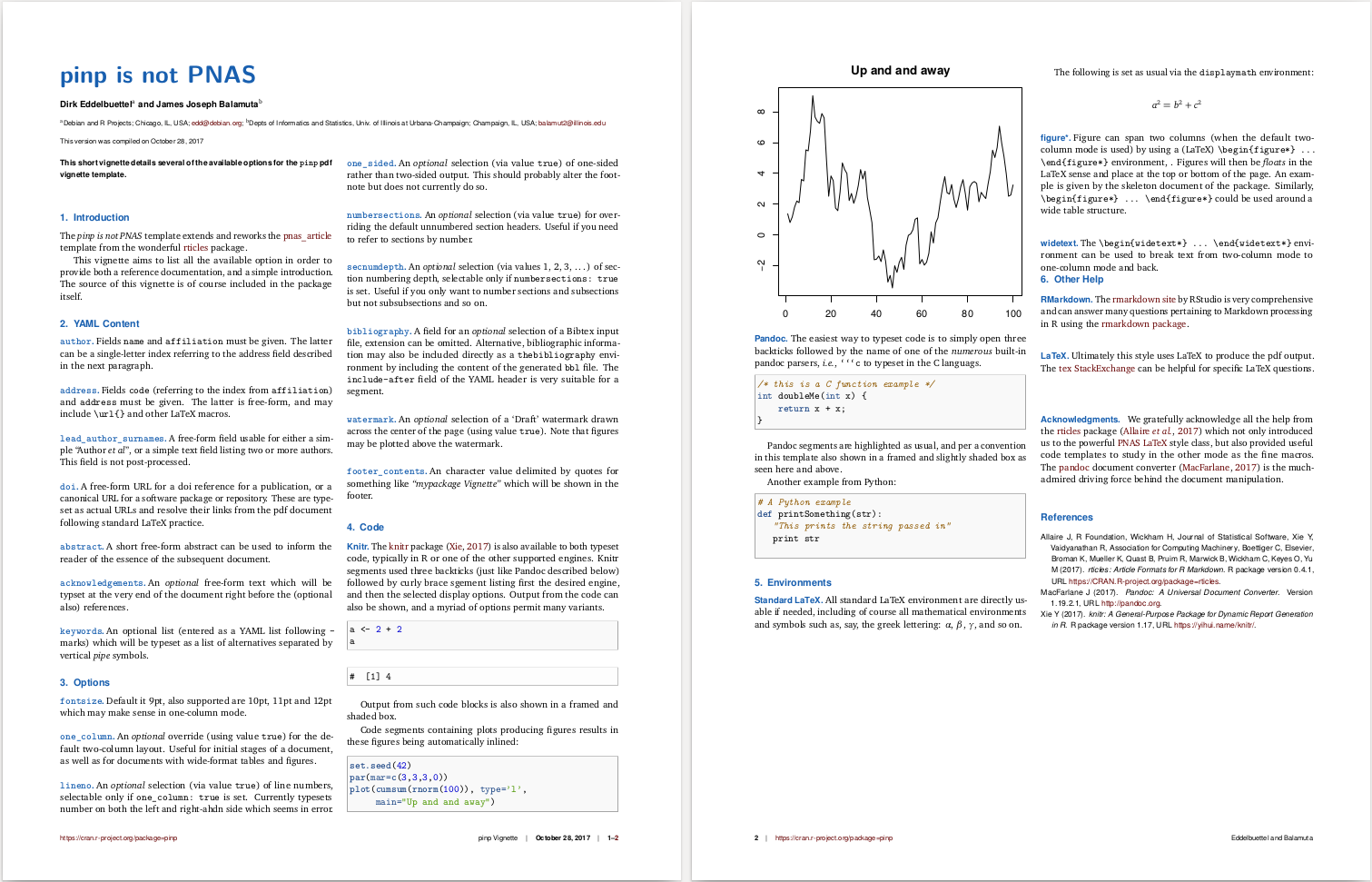
A new version of our pinp package arrived on CRAN today, and is the first release in four years. The pinp package allows for snazzier one or two column Markdown-based pdf vignettes, and is now used by a few packages. A screenshot of the package vignette can be seen below. Additional screenshots are at the pinp page. pinp vignette This release contains no new features or new user-facing changes but reflects the standard package and repository maintenance over the four-year window since the last release: updating of actions, updating of URLs and addressing small packaging changes spotted by ever-more-vigilant R checking code. The NEWS entry for this release follows.

Changes in pinp version 0.0.11 (2024-12-08)
  • Standard package maintenance for continuous integration, URL updates, and packaging conventions
  • Correct two minor nags in the Rd file

Courtesy of my CRANberries, there is a diffstat report relative to previous release. More detailed information is on the ping page. For questions or comments use the issue tracker off the GitHub repo. If you like this or other open-source work I do, you can sponsor me at GitHub.

This post by Dirk Eddelbuettel originated on his Thinking inside the box blog. Please report excessive re-aggregation in third-party for-profit settings.

Paulo Henrique de Lima Santana: Bits from MiniDebConf Toulouse 2024

Intro I always find it amazing the opportunities I have thanks to my contributions to the Debian Project. I am happy to receive this recognition through the help I receive with travel to attend events in other countries. This year, two MiniDebConfs were scheduled for the second half of the year in Europe: the traditional edition in Cambridge in UK and a new edition in Toulouse in France. After weighing the difficulties and advantages that I would have to attend one of them, I decided to choose Toulouse, mainly because it was cheaper and because it was in November, giving me more time to plan the trip. I contacted the current DPL Andreas Tille explaining my desire to attend the event and he kindly approved my request for Debian to pay for the tickets. Thanks again to Andreas! MiniDebConf Toulouse 2024 was held in November 16th and 17th (Saturday and Sunday) and took place in one of the rooms of a traditional Free Software event in the city named Capitole du Libre. Before MiniDebConf, the team organized a MiniDebCamp in November 14th and 15th at a coworking space. The whole experience promised to be incredible, and it was! From visiting a city in France for the first time, to attending a local Free Software event, and sharing four days with people from the Debian community from various countries.

Travel and the city My plan was to leave Belo Horizonte on Monday, pass through S o Paulo, and arrive in Toulouse on Tuesday night. I was going to spend the whole of Wednesday walking around the city and then participate in the MiniDebCamp on Thursday. But the flight that was supposed to leave S o Paulo in the early hours of Monday to Tuesday was cancelled due to a problem with the airplane and I had spent all Tuesday waiting. I was rebooked on another flight that left in the evening and arrived in Toulouse on Wednesday afternoon. Even though I was very tired from the trip, I still took advantage of the end of the day to walk around the city. But it was a shame to have lost an entire day of sightseeing. On Thursday I left early in the morning to walk around a little more before going to the MiniDebCamp venue. I walked around a lot and saw several tourist attractions. The city is really very beautiful, as they say, especially the houses and buildings made of pink bricks. I was impressed by the narrow and winding streets; at one point it seemed like I was walking through a maze. I arrived to a corner and there would be 5 streets crossing in different directions. The riverbank that runs through the city is very beautiful and people spend their evenings there just hanging out. There was a lot of history around there. I stayed in an airbnb 25 minutes walking from the coworking space and only 10 minutes from the event venue. It was a very spacious apartment that was much cheaper than a hotel. MiniDebConf Toulouse 2024

MiniDebConf Toulouse 2024

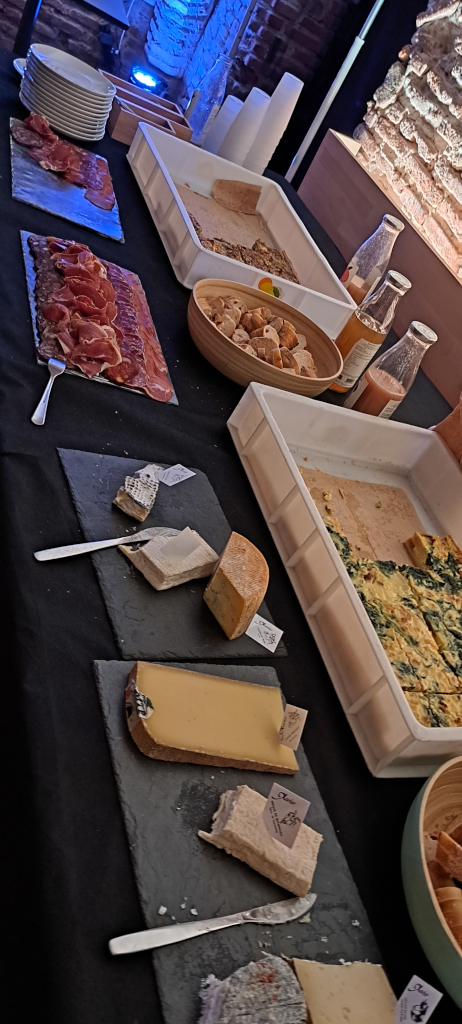
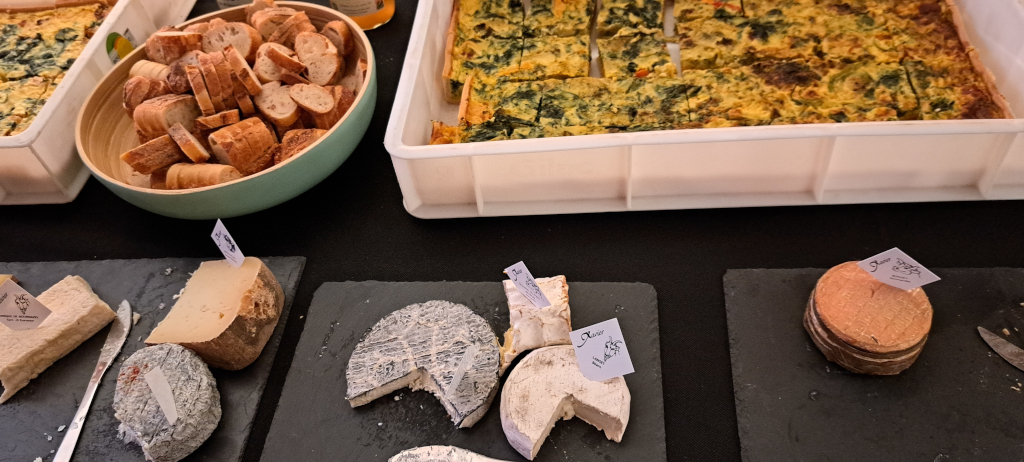
MiniDebCamp I arrived at the coworking space where the MiniDebCamp was being held and met up with several friends. I also met some new people, talked about the translation work we do in Brazil, and other topics. We already knew that the organization would pay for lunch for everyone during the two days of MiniDebCamp, and at a certain point they told us that we could go to the room (which was downstairs from the coworking space) to have lunch. They set up a table with quiches, breads, charcuterie and LOTS of cheese :-) There were several types of cheese and they were all very good. I just found it a little strange because I m not used to having cheese for lunch, but the experience was amazing anyway :-) MiniDebConf Toulouse 2024

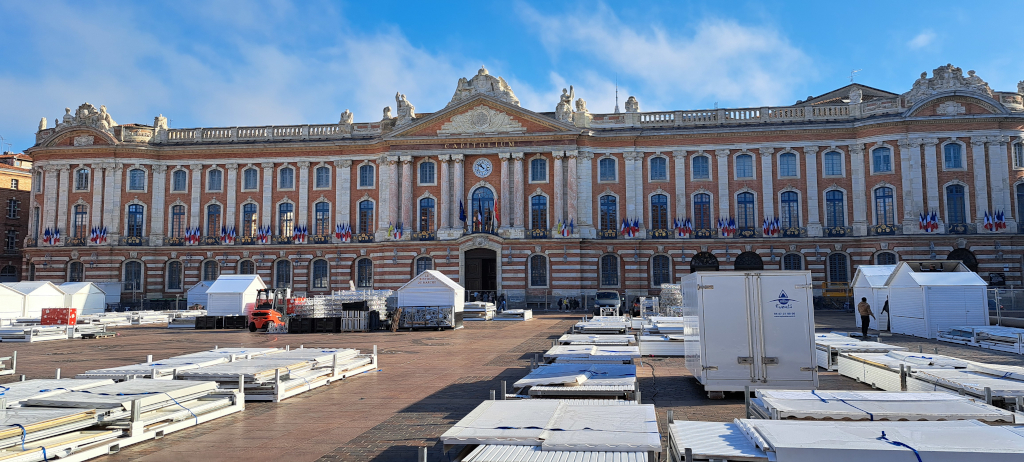
MiniDebConf Toulouse 2024 In the evening, we went as a group to dinner at a restaurant in front of the Capitolium, the city s main tourist attraction. On the second day, in the morning, I walked around the city a bit more, then went to the coworking space and had another incredible cheese table for lunch.
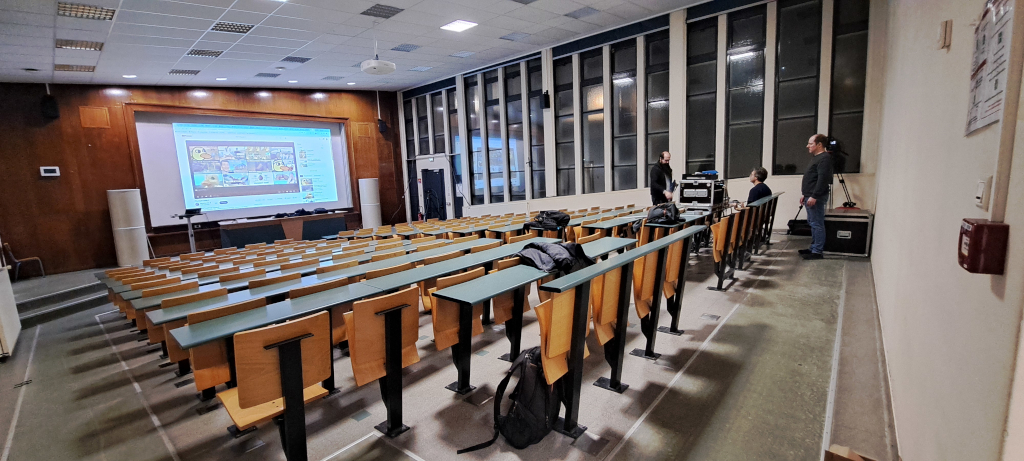

Video Team One of my ideas for going to Toulouse was to be able to help the video team in setting up the equipment for broadcasting and recording the talks. I wanted to follow this work from the beginning and learn some details, something I can t do before the DebConfs because I always arrive after the people have already set up the infrastructure. And later reproduce this work in the MiniDebConfs in Brazil, such as the one in Macei that is already scheduled for May 1-4, 2025. As I had agreed with the people from the video team that I would help set up the equipment, on Friday night we went to the University and stayed in the room working. I asked several questions about what they were doing, about the equipment, and I was able to clear up several doubts. Over the next two days I was handling one of the cameras during the talks. And on Sunday night I helped put everything away. Thanks to olasd, tumbleweed and ivodd for their guidance and patience. MiniDebConf Toulouse 2024

The event in general There was also a meeting with some members of the publicity team who were there with the DPL. We went to a cafeteria and talked mainly about areas that could be improved in the team. The talks at MiniDebConf were very good and the recordings are also available here. I ended up not watching any of the talks from the general schedule at Capitole du Libre because they were in French. It s always great to see free software events abroad to learn how they are done there and to bring some of those experiences to our events in Brazil. I hope that MiniDebConf in Toulouse will continue to take place every year, or that the French community will hold the next edition in another city and I will be able to join again :-) If everything goes well, in July next year I will return to France to join DebConf25 in Brest. MiniDebConf Toulouse 2024 More photos

7 December 2024

Dominique Dumont: New cme command to update Debian Standards-Version field

Hi While updating my Debian package, I often have to update a field from debian/control file. This field is named Standards-Version and it declares which version of Debian policy the package complies to. When updating this field, one must follow the upgrading checklist. That being said, I maintain a lot of similar package and I often have to update this Standards-Version field. This field can be updated manually with cme fix dpkg (see Managing Debian packages with cme). But this command may make other changes and does not commit the result. So I ve created a new update-standards-version cme script that: For instance:
$ cme run update-standards-version 
Reading package lists... Done
Building dependency tree... Done
Reading state information... Done
Connecting to api.ftp-master.debian.org to check 31 package versions. Please wait...
Got info from api.ftp-master.debian.org for 31 packages.
Warning in 'source Standards-Version': Current standards version is '4.7.0'. Please read https://www.debian.org/doc/debian-policy/upgrading-checklist.html for the changes that may be needed on your package
to upgrade it from standard version '4.6.2' to '4.7.0'.
Offending value: '4.6.2'
Changes applied to dpkg-control configuration:
- source Standards-Version: '4.6.2' -> '4.7.0'
[master 552862c1] control: declare compliance with Debian policy 4.7.0
 1 file changed, 1 insertion(+), 1 deletion(-)
Here s the generated commit. Note that the generated log mentions the new policy version:
$ git show
commit 552862c1f24479b1c0c8c35a6289557f65e8ff3b (HEAD -> master)
Author: Dominique Dumont <dod[at]debian.org>
Date:   Sat Dec 7 19:06:14 2024 +0100
    control: declare compliance with Debian policy 4.7.0
diff --git a/debian/control b/debian/control
index cdb41dc0..e888012e 100644
--- a/debian/control
+++ b/debian/control
@@ -48,7 +48,7 @@ Build-Depends-Indep: dh-sequence-bash-completion,
                      libtext-levenshtein-damerau-perl,
                      libyaml-tiny-perl,
                      po-debconf
-Standards-Version: 4.6.2
+Standards-Version: 4.7.0
 Vcs-Browser: https://salsa.debian.org/perl-team/modules/packages/libconfig-model-perl
 Vcs-Git: https://salsa.debian.org/perl-team/modules/packages/libconfig-model-perl.git
 Homepage: https://github.com/dod38fr/config-model/wiki
Notes: I hope this will be useful to all my fellow Debian developers to reduce the boring parts of packaging activities. All the best

6 December 2024

B lint R czey: Firebuild 0.8.3 is out with 100+ fixes and experimental macOS support!

The new Firebuild release contains plenty of small fixes and a few notable improvements.

Experimental macOS support The most frequently asked question from people getting to know Firebuild was if it worked on their Mac and the answer sadly used to be that well, it did, but only in a Linux VM. This was far from what they were looking for. Linux and macOS have common UNIX roots, but porting Firebuild to macOS included bigger challenges, like ensuring that dyld(1), macOS s dynamic loader initializes the preloaded interceptor library early enough to catch all interesting calls, and avoid using anything that uses malloc() or thread local variables which are not yet set up then. Preloading libraries on Linux is really easy, running LD_PRELOAD=my_lib.so ls just works if the library exports the symbols to be interposed, while macOS employs multiple lines of defense to prevent applications from using unknown libraries. Firebuild s guide for making DYLD_INSERT_LIBRARIES honored on Macs can be helpful with other projects as well that rely on injecting libraries. Since GitHub s Arm64 macOS runners don t allow intercepting binaries with arm64e ABI yet, Firebuild s Apple Silicon tests are run at Bitrise, who are proud to be first to provide the latest Xcode stacks and were also quick to make the needed changes to their infrastructure to support Firebuild (thanks!  ). Firebuild on macOS can already accelerate simple projects and rebuild itself with Xcode. Since Xcode introduces a lot of nondeterminism to the build, Firebuild can t shine in acceleration with Xcode yet, but can provide nice reports to show which part of the build is the most time consuming and how each sub-command is called. If you would like to try Firebuild on macOS please compile it from the GitHub repository for now. Precompiled binaries will be distributed on the Mac App Store and via CI providers. Contact us to get notified when those channels become available.

Dealing with the Epochalypse Glibc s API provides many functions with time parameters and some of those functions are intercepted by Firebuild. Time parameters used to be passed as 32-bit values on 32-bit systems, preventing them to accurately represent timestamps after year 2038, which is known as the Y2038 problem or the Epochalypse. To deal with the problem glibc 2.34 started providing new function symbol variants with 64-bit time parameters, e.g clock_gettime64() in addition to clock_gettime(). The new 64-bit variants are used when compiling consumers of the API with _TIME_BITS=64 defined. Processes intercepted by Firebuild may have been compiled with or without _TIME_BITS=64, thus libfirebuild now provides both variants on affected systems running glibc >= 34 to work safely with binaries using 64-bit and 32-bit time representation. Many Linux distributions already stopped supporting 32-bit architectures, but Debian and Ubuntu still supports armhf, for example, where the Y2038 problem still applies. Both Debian and Ubuntu performed a transition rebuilding every library (and their reverse dependencies) with -D_FILE_OFFSET_BITS=64 set where the libraries exported symbols that changed when switching to 64-bit time representation (thanks to Steve Langasek for driving this!) . Thanks to the transition most programs are ready for 2038, but interposer libraries are trickier to fix and if you maintain one it might be a good idea to check if it works well both 32-bit and 64-bit libraries. Faketime, for example is not fixed yet, see #1064555.

Select passed through environment variables with regular expressions Firebuild filters out most of the environment variables set when starting a build to make the build more reproducible and achieve higher cache hit rate. Extra environment variables to pass through can be specified on the command line one by one, but with many similarly named variables this may become hard to maintain. With regular expressions this just became easier:
firebuild -o 'env_vars.pass_through += "MY_VARS_.*"' my_build_command
If you are not interested in acceleration just would like to explore what the build does by generating a report you can simply pass all variables:
firebuild -r -o 'env_vars.pass_through += ".*"' my_build_command

Other highlights from the 0.8.3 release
  • Fixed and nicer report in Chrome and other WebKit based browsers
  • Support GLibc 2.39 by intercepting pidfd_spawn() and pidfd_spawnp()
  • Even faster Rust build acceleration
For all the changes please check out the release page on GitHub!  (This post is also published on The Firebuild blog.)

5 December 2024

Reproducible Builds: Reproducible Builds in November 2024

Welcome to the November 2024 report from the Reproducible Builds project! Our monthly reports outline what we ve been up to over the past month and highlight items of news from elsewhere in the world of software supply-chain security where relevant. As ever, if you are interested in contributing to the Reproducible Builds project, please visit our Contribute page on our website. Table of contents:
  1. Reproducible Builds mourns the passing of Lunar
  2. Introducing reproduce.debian.net
  3. New landing page design
  4. SBOMs for Python packages
  5. Debian updates
  6. Reproducible builds by default in Maven 4
  7. PyPI now supports digital attestations
  8. Dependency Challenges in OSS Package Registries
  9. Zig programming language demonstrated reproducible
  10. Website updates
  11. Upstream patches
  12. Misc development news
  13. Reproducibility testing framework

Reproducible Builds mourns the passing of Lunar The Reproducible Builds community sadly announced it has lost its founding member, Lunar. J r my Bobbio aka Lunar passed away on Friday November 8th in palliative care in Rennes, France. Lunar was instrumental in starting the Reproducible Builds project in 2013 as a loose initiative within the Debian project. He was the author of our earliest status reports and many of our key tools in use today are based on his design. Lunar s creativity, insight and kindness were often noted. You can view our full tribute elsewhere on our website. He will be greatly missed.

Introducing reproduce.debian.net In happier news, this month saw the introduction of reproduce.debian.net. Announced at the recent Debian MiniDebConf in Toulouse, reproduce.debian.net is an instance of rebuilderd operated by the Reproducible Builds project. rebuilderd is our server designed monitor the official package repositories of Linux distributions and attempts to reproduce the observed results there. In November, reproduce.debian.net began rebuilding Debian unstable on the amd64 architecture, but throughout the MiniDebConf, it had attempted to rebuild 66% of the official archive. From this, it could be determined that it is currently possible to bit-for-bit reproduce and corroborate approximately 78% of the actual binaries distributed by Debian that is, using the .buildinfo files hosted by Debian itself. reproduce.debian.net also contains instructions how to setup one s own rebuilderd instance, and we very much invite everyone with a machine to spare to setup their own version and to share the results. Whilst rebuilderd is still in development, it has been used to reproduce Arch Linux since 2019. We are especially looking for installations targeting Debian architectures other than i386 and amd64.

New landing page design As part of a very productive partnership with the Sovereign Tech Fund and Neighbourhoodie, we are pleased to unveil our new homepage/landing page. We are very happy with our collaboration with both STF and Neighbourhoodie (including many changes not directly related to the website), and look forward to working with them in the future.

SBOMs for Python packages The Python Software Foundation has announced a new cross-functional project for SBOMs and Python packages . Seth Michael Larson writes that the project is specifically looking to solve these issues :
  • Enable Python users that require SBOM documents (likely due to regulations like CRA or SSDF) to self-serve using existing SBOM generation tools.
  • Solve the phantom dependency problem, where non-Python software is bundled in Python packages but not recorded in any metadata. This makes the job of software composition analysis (SCA) tools difficult or impossible.
  • Make the adoption work by relevant projects such as build backends, auditwheel-esque tools, as minimal as possible. Empower users who are interested in having better SBOM data for the Python projects they are using to be able to contribute engineering time towards that goal.
A GitHub repository for the initiative is available, and there are a number of queries, comments and remarks on Seth s Discourse forum post.

Debian updates There was significant development within Debian this month. Firstly, at the recent MiniDebConf in Toulouse, France, Holger Levsen gave a Debian-specific talk on rebuilding packages distributed from ftp.debian.org that is to say, how to reproduce the results from the official Debian build servers: Holger described the talk as follows:
For more than ten years, the Reproducible Builds project has worked towards reproducible builds of many projects, and for ten years now we have build Debian packages twice with maximal variations applied to see if they can be build reproducible still. Since about a month, we ve also been rebuilding trying to exactly match the builds being distributed via ftp.debian.org. This talk will describe the setup and the lessons learned so far, and why the results currently are what they are (spoiler: they are less than 30% reproducible), and what we can do to fix that.
The Debian Project Leader, Andreas Tille, was present at the talk and remarked later in his Bits from the DPL update that:
It might be unfair to single out a specific talk from Toulouse, but I d like to highlight the one on reproducible builds. Beyond its technical focus, the talk also addressed the recent loss of Lunar, whom we mourn deeply. It served as a tribute to Lunar s contributions and legacy. Personally, I ve encountered packages maintained by Lunar and bugs he had filed. I believe that taking over his packages and addressing the bugs he reported is a meaningful way to honor his memory and acknowledge the value of his work.
Holger s slides and video in .webm format are available.
Next, rebuilderd is the server to monitor package repositories of Linux distributions and attempt to reproduce the observed results. This month, version 0.21.0 released, most notably with improved support for binNMUs by Jochen Sprickerhof and updating the rebuilderd-debian.sh integration to the latest debrebuild version by Holger Levsen. There has also been significant work to get the rebuilderd package into the Debian archive, in particular, both rust-rebuilderd-common version 0.20.0-1 and rust-rust-lzma version 0.6.0-1 were packaged by kpcyrd and uploaded by Holger Levsen. Related to this, Holger Levsen submitted three additional issues against rebuilderd as well:
  • rebuildctl should be more verbose when encountering issues. [ ]
  • Please add an option to used randomised queues. [ ]
  • Scheduling and re-scheduling multiple packages at once. [ ]
and lastly, Jochen Sprickerhof submitted one an issue requested that rebuilderd downloads the source package in addition to the .buildinfo file [ ] and kpcyrd also submitted and fixed an issue surrounding dependencies and clarifying the license [ ]
Separate to this, back in 2018, Chris Lamb filed a bug report against the sphinx-gallery package as it generates unreproducible content in various ways. This month, however, Dmitry Shachnev finally closed the bug, listing the multiple sub-issues that were part of the problem and how they were resolved.
Elsewhere, Roland Clobus posted to our mailing list this month, asking for input on a bug in Debian s ca-certificates-java package. The issue is that the Java key management tools embed timestamps in its output, and this output ends up in the /etc/ssl/certs/java/cacerts file on the generated ISO images. A discussion resulted from Roland s post suggesting some short- and medium-term solutions to the problem.
Holger Levsen uploaded some packages with reproducibility-related changes:
Lastly, 12 reviews of Debian packages were added, 5 were updated and 21 were removed this month adding to our knowledge about identified issues in Debian.

Reproducible builds by default in Maven 4 On our mailing list this month, Herv Boutemy reported the latest release of Maven (4.0.0-beta-5) has reproducible builds enabled by default. In his mailing list post, Herv mentions that this story started during our Reproducible Builds summit in Hamburg , where he created the upstream issue that builds on a multi-year effort to have Maven builds configured for reproducibility.

PyPI now supports digital attestations Elsewhere in the Python ecosystem and as reported on LWN and elsewhere, the Python Package Index (PyPI) has announced that it has finalised support for PEP 740 ( Index support for digital attestations ). Trail of Bits, who performed much of the development work, has an in-depth blog post about the work and its adoption, as well as what is left undone:
One thing is notably missing from all of this work: downstream verification. [ ] This isn t an acceptable end state (cryptographic attestations have defensive properties only insofar as they re actually verified), so we re looking into ways to bring verification to individual installing clients. In particular, we re currently working on a plugin architecture for pip that will enable users to load verification logic directly into their pip install flows.
There was an in-depth discussion on LWN s announcement page, as well as on Hacker News.

Dependency Challenges in OSS Package Registries At BENEVOL, the Belgium-Netherlands Software Evolution workshop in Namur, Belgium, Tom Mens and Alexandre Decan presented their paper, An Overview and Catalogue of Dependency Challenges in Open Source Software Package Registries . The abstract of their paper is as follows:
While open-source software has enabled significant levels of reuse to speed up software development, it has also given rise to the dreadful dependency hell that all software practitioners face on a regular basis. This article provides a catalogue of dependency-related challenges that come with relying on OSS packages or libraries. The catalogue is based on the scientific literature on empirical research that has been conducted to understand, quantify and overcome these challenges. [ ]
A PDF of the paper is available online.

Zig programming language demonstrated reproducible Motiejus Jak ty posted an interesting and practical blog post on his successful attempt to reproduce the Zig programming language without using the pre-compiled binaries checked into the repository, and despite the circular dependency inherent in its bootstrapping process. As a summary, Motiejus concludes that:
I can now confidently say (and you can also check, you don t need to trust me) that there is nothing hiding in zig1.wasm [the checked-in binary] that hasn t been checked-in as a source file.
The full post is full of practical details, and includes a few open questions.

Website updates Notwithstanding the significant change to the landing page (screenshot above), there were an enormous number of changes made to our website this month. This included:
  • Alex Feyerke and Mariano Gim nez:
    • Dramatically overhaul the website s landing page with new benefit cards tailored to the expected visitors to our website and a reworking of the visual hierarchy and design. [ ][ ][ ][ ][ ][ ][ ][ ][ ][ ]
  • Bernhard M. Wiedemann:
    • Update the System images page to document the e2fsprogs approach. [ ]
  • Chris Lamb:
  • FC (Fay) Stegerman:
    • Replace more inline markdown with HTML on the Success stories page. [ ]
    • Add some links, fix some other links and correct some spelling errors on the Tools page. [ ]
  • Holger Levsen:
    • Add a historical presentation ( Reproducible builds everywhere eg. in Debian, OpenWrt and LEDE ) from October 2016. [ ]
    • Add jochensp and Oejet to the list of known contributors. [ ][ ]
  • Julia Kr ger:
  • Ninette Adhikari & hulkoba:
    • Add/rework the list of success stories into a new page that clearly shows milestones in Reproducible Builds. [ ][ ][ ][ ][ ][ ]
  • Philip Rinn:
    • Import 47 historical weekly reports. [ ]
  • hulkoba:
    • Add alt text to almost all images (!). [ ][ ]
    • Fix a number of links on the Talks . [ ][ ]
    • Avoid so-called ghost buttons by not using <button> elements as links, as the affordance of a <button> implies an action with (potentially) a side effect. [ ][ ]
    • Center the sponsor logos on the homepage. [ ]
    • Move publications and generate them instead from a data.yml file with an improved layout. [ ][ ]
    • Make a large number of small but impactful stylisting changes. [ ][ ][ ][ ]
    • Expand the Tools to include a number of missing tools, fix some styling issues and fix a number of stale/broken links. [ ][ ][ ][ ][ ][ ]

Upstream patches The Reproducible Builds project detects, dissects and attempts to fix as many currently-unreproducible packages as possible. We endeavour to send all of our patches upstream where appropriate. This month, we wrote a large number of such patches, including:

Misc development news

Reproducibility testing framework The Reproducible Builds project operates a comprehensive testing framework running primarily at tests.reproducible-builds.org in order to check packages and other artifacts for reproducibility. In November, a number of changes were made by Holger Levsen, including:
  • reproduce.debian.net-related changes:
    • Create and introduce a new reproduce.debian.net service and subdomain [ ]
    • Make a large number of documentation changes relevant to rebuilderd. [ ][ ][ ][ ][ ]
    • Explain a temporary workaround for a specific issue in rebuilderd. [ ]
    • Setup another rebuilderd instance on the o4 node and update installation documentation to match. [ ][ ]
    • Make a number of helpful/cosmetic changes to the interface, such as clarifying terms and adding links. [ ][ ][ ][ ][ ]
    • Deploy configuration to the /opt and /var directories. [ ][ ]
    • Add an infancy (or alpha ) disclaimer. [ ][ ]
    • Add more notes to the temporary rebuilderd documentation. [ ]
    • Commit an nginx configuration file for reproduce.debian.net s Stats page. [ ]
    • Commit a rebuilder-worker.conf configuration for the o5 node. [ ]
  • Debian-related changes:
    • Grant jspricke and jochensp access to the o5 node. [ ][ ]
    • Build the qemu package with the nocheck build flag. [ ]
  • Misc changes:
    • Adapt the update_jdn.sh script for new Debian trixie systems. [ ]
    • Stop installing the PostgreSQL database engine on the o4 and o5 nodes. [ ]
    • Prevent accidental reboots of the o4 node because of a long-running job owned by josch. [ ][ ]
In addition, Mattia Rizzolo addressed a number of issues with reproduce.debian.net [ ][ ][ ][ ]. And lastly, both Holger Levsen [ ][ ][ ][ ] and Vagrant Cascadian [ ][ ][ ][ ] performed node maintenance.
If you are interested in contributing to the Reproducible Builds project, please visit our Contribute page on our website. However, you can get in touch with us via:

Russ Allbery: Review: Paladin's Hope

Review: Paladin's Hope, by T. Kingfisher
Series: The Saint of Steel #3
Publisher: Red Wombat Studio
Copyright: 2021
ISBN: 1-61450-613-2
Format: Kindle
Pages: 303
Paladin's Hope is a fantasy romance novel and the third book of The Saint of Steel series. Each book of that series features different protagonists in closer to the romance series style than the fantasy series style and stands alone reasonably well. There are a few spoilers for the previous books here, so you probably want to read the series in order. Galen is one of the former paladins of the Saint of Steel, left bereft and then adopted by the Temple of the Rat after their god dies. Even more than the paladin protagonists of the previous two books, he reacted very badly to that death and has ongoing problems with nightmares and going into berserker rages when awakened. As the book opens, he's the escort for a lich-doctor named Piper who is examining a corpse found in the river.
The last of the five was the only one who did not share a certain martial quality. He was slim and well-groomed and would be considered handsome, but he was also extraordinarily pale, as if he lived his life underground. It was this fifth man who nudged the corpse with the toe of his boot and said, "Well, if you want my professional opinion, this great goddamn hole in his chest is probably what killed him."
As it turns out, slim and well-groomed and exceedingly pale is Galen's type. This is another paladin romance, this time between two men. It's almost all romance; the plot is barely worth mentioning. About half of the book is an exploration of a puzzle dungeon of the sort that might be fun in a video game or tabletop RPG, but that I found rather boring and monotonous in a novel. This creates a lot more room for the yearning and angst. Kingfisher tends towards slow-burn romances. This romance is a somewhat faster burn than some of her other books, but instead implodes into one of the most egregiously stupid third-act breakups that I've read in a romance plot. Of all the Kingfisher paladin books, I think this one was hurt the most by my basic difference in taste from the author. Kingfisher finds constant worrying and despair over being good enough for the romantic partner to be an enjoyable element, and I find it incredibly annoying. I think your enjoyment of this book will heavily depend on where you fall on that taste divide. The saving grace of this book are the gnoles, who are by far the best part of this world. Earstripe, a gnole constable, is the one who found the body that the book opens with and he drives most of the plot, such that it is. He's also the source of the best banter in the book, which is full of pointed and amused gnole observations about humans and their various stupidities. Given that I was also grumbling about human stupidities for most of the book, the gnole viewpoint and I got along rather well.
"God's stripes." Earstripe shook his head in disbelief. "Bone-doctor would save some gnole, yes? If some gnole was hurt." "Of course," said Piper. "If I could." "And tomato-man would save some gnole?" He swung his muzzle toward Galen. "If some gnome needed big human with sword?" "Yes, of course." Earstripe spread his hands, claws gleaming. "A gnole saves some human. Same thing." He took a deep breath, clearly choosing his words carefully. "A gnole's compassion does not require fur."
We learn a great deal more about gnole culture, all of which I found fascinating, and we get a rather satisfying amount of gnole acerbic commentary. Kingfisher is very good at banter, and dialogue in general, which also smoothes over the paucity of detailed plot. There was no salvaging the romance, at least for me, but I did at least like Piper, and Galen wasn't too bad when he wasn't being annoyingly self-destructive. I had been wondering a little if gay romance would, like sapphic romance, avoid my dislike of heterosexual gender roles. I think the jury is still out, but it did not work in this book because Galen is so committed to being the self-sacrificing protector who is unable to talk about his feelings that he single-handedly introduced a bunch of annoying pieces of the male gender role anyway. I will have to try that experiment with a book that doesn't involve hard-headed paladins. I have yet to read a bad T. Kingfisher novel, but I thought this one was on the weaker side. The gnoles are great and kept me reading, but I wish there had been a more robust plot, a lot less of the romance, and no third-act breakup. As is, I recommend the other Saint of Steel books over this one. Ah well. Followed by Paladin's Faith. Rating: 6 out of 10

2 December 2024

Bits from Debian: Bits from the DPL

This is bits from DPL for November. MiniDebConf Toulouse I had the pleasure of attending the MiniDebConf in Toulouse, which featured a range of engaging talks, complementing those from the recent MiniDebConf in Cambridge. Both events were preceded by a DebCamp, which provided a valuable opportunity for focused work and collaboration. DebCamp During these events, I participated in numerous technical discussions on topics such as maintaining long-neglected packages, team-based maintenance, FTP master policies, Debusine, and strategies for separating maintainer script dependencies from runtime dependencies, among others. I was also fortunate that members of the Publicity Team attended the MiniDebCamp, giving us the opportunity to meet in person and collaborate face-to-face. Independent of the ongoing lengthy discussion on the Debian Devel mailing list, I encountered the perspective that unifying Git workflows might be more critical than ensuring all packages are managed in Git. While I'm uncertain whether these two questions--adopting Git as a universal development tool and agreeing on a common workflow for its use--can be fully separated, I believe it's worth raising this topic for further consideration. Attracting newcomers In my own talk, I regret not leaving enough time for questions--my apologies for this. However, I want to revisit the sole question raised, which essentially asked: Is the documentation for newcomers sufficient to attract new contributors? My immediate response was that this question is best directed to new contributors themselves, as they are in the best position to identify gaps and suggest improvements that could make the documentation more helpful. That said, I'm personally convinced that our challenges extend beyond just documentation. I don't get the impression that newcomers are lining up to join Debian only to be deterred by inadequate documentation. The issue might be more about fostering interest and engagement in the first place. My personal impression is that we sometimes fail to convey that Debian is not just a product to download for free but also a technical challenge that warmly invites participation. Everyone who respects our Code of Conduct will find that Debian is a highly diverse community, where joining the project offers not only opportunities for technical contributions but also meaningful social interactions that can make the effort and time truly rewarding. In several of my previous talks (you can find them on my talks page just search for "team," and don't be deterred if you see "Debian Med" in the title; it's simply an example), I emphasized that the interaction between a mentor and a mentee often plays a far more significant role than the documentation the mentee has to read. The key to success has always been finding a way to spark the mentee's interest in a specific topic that resonates with their own passions. Bug of the Day In my presentation, I provided a brief overview of the Bug of the Day initiative, which was launched with the aim of demonstrating how to fix bugs as an entry point for learning about packaging. While the current level of interest from newcomers seems limited, the initiative has brought several additional benefits. I must admit that I'm learning quite a bit about Debian myself. I often compare it to exploring a house's cellar with a flashlight you uncover everything from hidden marvels to things you might prefer to discard. I've also come across traces of incredibly diligent people who have invested their spare time polishing these hidden treasures (what we call NMUs). The janitor, a service in Salsa that automatically updates packages, fits perfectly into this cellar metaphor, symbolizing the ongoing care and maintenance that keep everything in order. I hadn't realized the immense amount of silent work being done behind the scenes--thank you all so much for your invaluable QA efforts. Reproducible builds It might be unfair to single out a specific talk from Toulouse, but I'd like to highlight the one on reproducible builds. Beyond its technical focus, the talk also addressed the recent loss of Lunar, whom we mourn deeply. It served as a tribute to Lunar's contributions and legacy. Personally, I've encountered packages maintained by Lunar and bugs he had filed. I believe that taking over his packages and addressing the bugs he reported is a meaningful way to honor his memory and acknowledge the value of his work. Advent calendar bug squashing I d like to promote an idea originally introduced by Thorsten Alteholz, who in 2011 proposed a Bug Squashing Advent Calendar for the Debian Med team. (For those unfamiliar with the concept of an Advent Calendar, you can find an explanation on Wikipedia.) While the original version included a fun graphical element which we ve had to set aside due to time constraints (volunteers, anyone?) we ve kept the tradition alive by tackling one bug per day from December 1st to 24th each year. This initiative helps clean up issues that have accumulated over the year. Regardless of whether you celebrate the concept of Advent, I warmly recommend this approach as a form of continuous bug-squashing party for every team. Not only does it contribute to the release readiness of your team s packages, but it s also an enjoyable and bonding activity for team members. Best wishes for a cheerful and productive December
Andreas.

Dirk Eddelbuettel: anytime 0.3.10 on CRAN: Multiple Enhancements

A new release of the anytime package arrived on CRAN today the first is well over four years. The package is fairly feature-complete, and code and functionality remain mature and stable, of course. anytime is a very focused package aiming to do just one thing really well: to convert anything in integer, numeric, character, factor, ordered, input format to either POSIXct (when called as anytime) or Date objects (when called as anydate) and to do so without requiring a format string as well as accomodating different formats in one input vector. See the anytime page, or the GitHub repo for a few examples, and the beautiful documentation site for all documentation. This release slowly matured over four years. It combines a number of strictly internal repository maintenance such as changes to continuous integration with small enhancements (adding for example some new formats, responding better to an error condition, dealing with logical input as an error) with a relaxation of the C++ compilation standard. While we once needed C++11, it is now a constraint as as R itself is quite proactive (the last two releases defaulted already to C++17, suitable compiler permitting) we can now relax this constraint. The documentation site is new, as some other small changes. See the full list of changes which follows.

Changes in anytime version 0.3.10 (2024-12-02)
  • A new documentation site was added.
  • Continuous Integration now uses run.sh from r-ci with bspm
  • Logical input vectors are now recognised as an error (#121)
  • Additional dot-separated format '%Y.%m.%d' is supported
  • Other small updates were made throughout the package
  • No longer set a C++ compilation standard as the default choices by R are sufficient for the package
  • Switch Rcpp include file to Rcpp/Lightest
  • We recommend ~/.R/Makevars compiler flag options -Wno-ignored-attributes -Wno-nonnull -Wno-parentheses
  • The tinytest runner was simplified
  • NA values from conversion now trigger a warning

Courtesy of my CRANberries, there is also a diffstat report of changes relative to the previous release. The issue tracker tracker off the GitHub repo can be use for questions and comments. More information about the package is at the package page, the GitHub repo and the documentation site. If you like this or other open-source work I do, you can now sponsor me at GitHub.

This post by Dirk Eddelbuettel originated on his Thinking inside the box blog. Please report excessive re-aggregation in third-party for-profit settings.

1 December 2024

Colin Watson: Free software activity in November 2024

Most of my Debian contributions this month were sponsored by Freexian. You can also support my work directly via Liberapay. Conferences I attended MiniDebConf Toulouse 2024, and the MiniDebCamp before it. Most of my time was spent with the Freexian folks working on debusine; Stefano gave a talk about its current status with a live demo (frantically fixed up over the previous couple of days, as is traditional) and with me and others helping to answer questions at the end. I also caught up with some people I haven t seen in ages, ate a variety of delicious cheeses, and generally had a good time. Many thanks to the organizers and sponsors! After the conference, Freexian collaborators spent a day and a half doing some planning for next year, and then went for an afternoon visiting the Cit de l espace. Rust team I upgraded these packages to new upstream versions, as part of upgrading pydantic and rpds-py: Python team Last month, I mentioned that we still need to work out what to do about the multipart vs. python-multipart name conflict in Debian (#1085728). We eventually managed to come up with an agreed plan; Sandro has uploaded a renamed binary package to experimental, and I ve begun work on converting reverse-dependencies (asgi-csrf, fastapi, python-curies, and starlette done so far). There s a bit more still to do, but I expect we can finish it soon. I fixed problems related to adding Python 3.13 support in: I fixed some packaging problems that resulted in failures any time we add a new Python version to Debian: I fixed other build/autopkgtest failures in: I packaged python-quart-trio, needed for a new upstream version of python-urllib3, and contributed a small packaging tweak upstream. I backported a twisted fix that caused problems in other packages, including breaking debusine s tests. I disentangled some upstream version confusion in python-catalogue, and upgraded to the current upstream version. I upgraded these packages to new upstream versions: Other small fixes I contributed Incus support to needrestart upstream. In response to Helmut s Cross building talk at MiniDebConf Toulouse, I fixed libfilter-perl to support cross-building (5b4c2e10, f9788c27). I applied a patch to move aliased files from / to /usr in iprutils (#1087733). I adjusted debconf to use the new /usr/lib/apt/apt-extracttemplates path (#1087523). I upgraded putty to 0.82.
30 November 2024

Dima Kogan: Strava track filtering validation

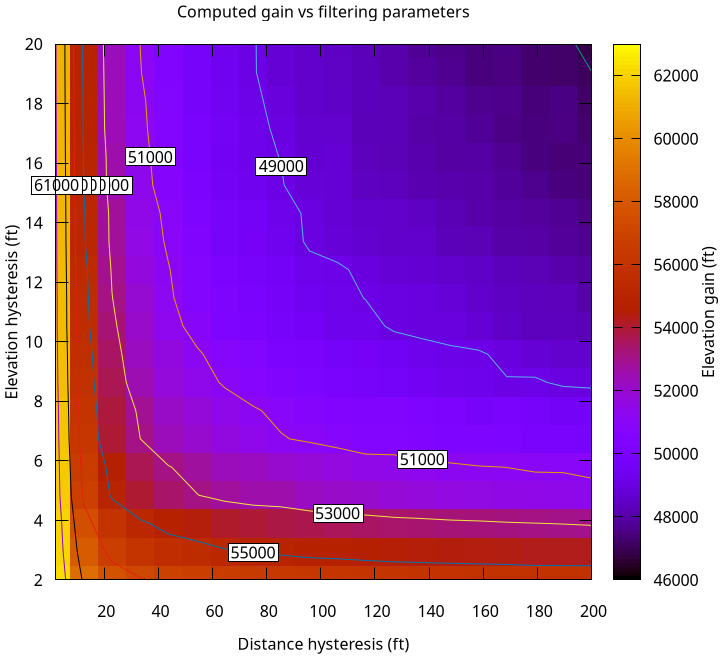
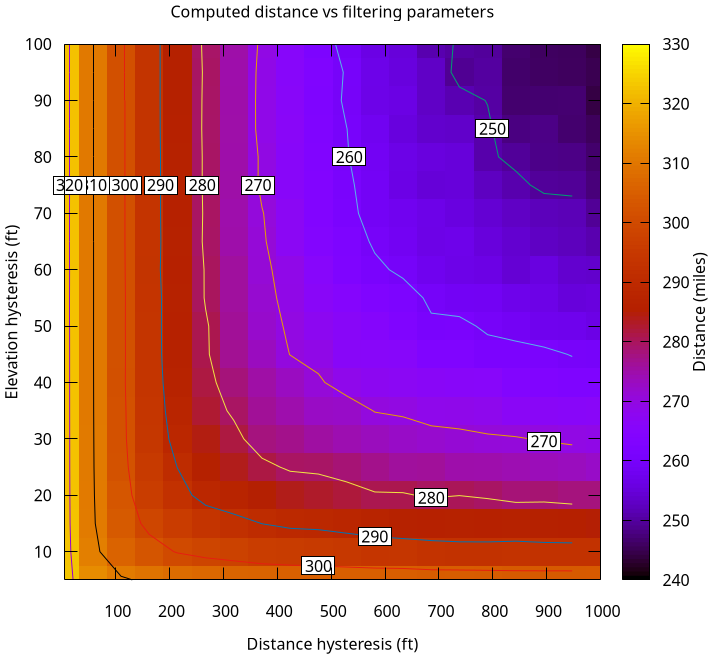
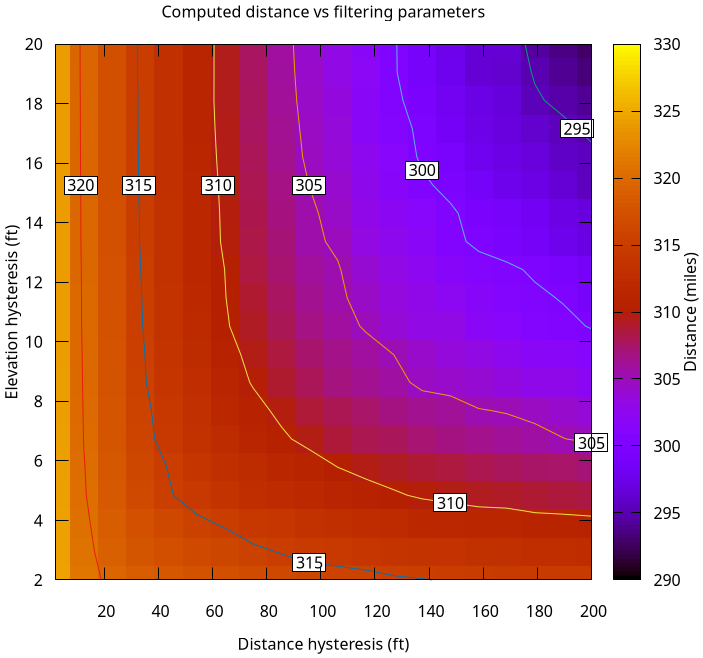
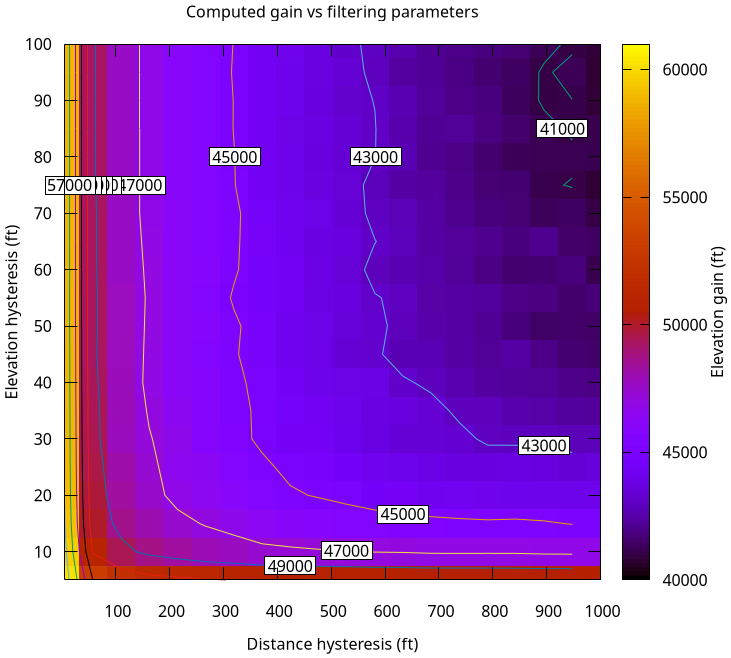
After years of seeing people's strava tracks, I became convinced that they insufficiently filter the data, resulting in over-estimating the effort. Today I did a bit of lazy analysis, and half-confirmed this: in the one case I looked at, strava reported reasonable elevation gain numbers, but greatly overestimated the distance traveled. I looked at a single gps track of a long bike ride. This was uploaded to strava manually, as a .gpx file. I can imagine that different things happen if you use the strava app or some device that integrates with the service (the filtering might happen before the data hits the server, and the server could decide to not apply any more filtering). I processed the data with a simple hysteretic filter, ignoring small changes in position and elevation, trying out different thresholds in the process. I completely ignore the timestamps, and only look at the differences between successive points. This handles the usual GPS noise; it does not handle GPS jumps, which I completely ignore in this analysis. Ignoring these would produce inflated elevation/gain numbers, but I'm working with a looong track, so hopefully this is a small effect. Clearly this is not scientific, but it's something.

The code
Parsing .gpx is slow (this is a big file), so I cache that into a .vnl:
import sys
import gpxpy
filename_in  = 'INPUT.gpx'
filename_out = 'OUTPUT.gpx'
with open(filename_in, 'r') as f:
    gpx = gpxpy.parse(f)
f_out = open(filename_out, 'w')
tracks = gpx.tracks
if len(tracks) != 1:
    print("I want just one track", file=sys.stderr)
    sys.exit(1)
track = tracks[0]
segments = track.segments
if len(segments) != 1:
    print("I want just one segment", file=sys.stderr)
    sys.exit(1)
segment = segments[0]
time0 = segment.points[0].time
print("# time lat lon ele_m")
for p in segment.points:
    print(f" (p.time - time0).seconds   p.latitude   p.longitude   p.elevation ",
          file = f_out)
And I process this data with the different filters (this is a silly Python loop, and is slow):
#!/usr/bin/python3
import sys
import numpy as np
import numpysane as nps
import gnuplotlib as gp
import vnlog
import pyproj
geod = None
def dist_ft(lat0,lon0, lat1,lon1):
    global geod
    if geod is None:
        geod = pyproj.Geod(ellps='WGS84')
    return \
        geod.inv(lon0,lat0, lon1,lat1)[2] * 100./2.54/12.
f = 'OUTPUT.gpx'
track,list_keys,dict_key_index = \
    vnlog.slurp(f)
t      = track[:,dict_key_index['time' ]]
lat    = track[:,dict_key_index['lat'  ]]
lon    = track[:,dict_key_index['lon'  ]]
ele_ft = track[:,dict_key_index['ele_m']] * 100./2.54/12.
@nps.broadcast_define( ( (), ()),
                       (2,))
def filter_track(ele_hysteresis_ft,
                 dxy_hysteresis_ft):
    dist        = 0.0
    ele_gain_ft = 0.0
    lon_accepted = None
    lat_accepted = None
    ele_accepted = None
    for i in range(len(lat)):
        if ele_accepted is not None:
            dxy_here  = dist_ft(lat_accepted,lon_accepted, lat[i],lon[i])
            dele_here = np.abs( ele_ft[i] - ele_accepted )
            if dxy_here < dxy_hysteresis_ft and dele_here < ele_hysteresis_ft:
                continue
            if ele_ft[i] > ele_accepted:
                ele_gain_ft += dele_here;
            dist += np.sqrt(dele_here * dele_here +
                            dxy_here  * dxy_here)
        lon_accepted = lon[i]
        lat_accepted = lat[i]
        ele_accepted = ele_ft[i]
    # lose the last point. It simply doesn't matter
    dist_mi = dist / 5280.
    return np.array((ele_gain_ft, dist_mi))
Nele_hysteresis_ft    = 20
ele_hysteresis0_ft    = 5
ele_hysteresis1_ft    = 100
ele_hysteresis_ft_all = np.linspace(ele_hysteresis0_ft,
                                    ele_hysteresis1_ft,
                                    Nele_hysteresis_ft)
Ndxy_hysteresis_ft = 20
dxy_hysteresis0_ft = 5
dxy_hysteresis1_ft = 1000
dxy_hysteresis_ft  = np.linspace(dxy_hysteresis0_ft,
                                 dxy_hysteresis1_ft,
                                 Ndxy_hysteresis_ft)
# shape (Nele,Ndxy,2)
gain,distance = \
    nps.mv( filter_track( nps.dummy(ele_hysteresis_ft_all,-1),
                          dxy_hysteresis_ft),
            -1,0 )
# Stolen from mrcal
def options_heatmap_with_contours( plotoptions, # we update this on output
                                   *,
                                   contour_min           = 0,
                                   contour_max,
                                   contour_increment     = None,
                                   do_contours           = True,
                                   contour_labels_styles = 'boxed',
                                   contour_labels_font   = None):
    r'''Update plotoptions, return curveoptions for a contoured heat map'''
    gp.add_plot_option(plotoptions,
                       'set',
                       ('view equal xy',
                        'view map'))
    if do_contours:
        if contour_increment is None:
            # Compute a "nice" contour increment. I pick a round number that gives
            # me a reasonable number of contours
            Nwant = 10
            increment = (contour_max - contour_min)/Nwant
            # I find the nearest 1eX or 2eX or 5eX
            base10_floor = np.power(10., np.floor(np.log10(increment)))
            # Look through the options, and pick the best one
            m   = np.array((1., 2., 5., 10.))
            err = np.abs(m * base10_floor - increment)
            contour_increment = -m[ np.argmin(err) ] * base10_floor
        gp.add_plot_option(plotoptions,
                           'set',
                           ('key box opaque',
                            'style textbox opaque',
                            'contour base',
                            f'cntrparam levels incremental  contour_max , contour_increment , contour_min '))
        if contour_labels_font is not None:
            gp.add_plot_option(plotoptions,
                               'set',
                               f'cntrlabel format "%d" font " contour_labels_font "' )
        else:
            gp.add_plot_option(plotoptions,
                               'set',
                               f'cntrlabel format "%.0f"' )
        plotoptions['cbrange'] = [contour_min, contour_max]
        # I plot 3 times:
        # - to make the heat map
        # - to make the contours
        # - to make the contour labels
        _with = np.array(('image',
                          'lines nosurface',
                          f'labels  contour_labels_styles  nosurface'))
    else:
        gp.add_plot_option(plotoptions, 'unset', 'key')
        _with = 'image'
    using = \
        f'( dxy_hysteresis0_ft +$1* float(dxy_hysteresis1_ft-dxy_hysteresis0_ft)/(Ndxy_hysteresis_ft-1) ):' + \
        f'( ele_hysteresis0_ft +$2* float(ele_hysteresis1_ft-ele_hysteresis0_ft)/(Nele_hysteresis_ft-1) ):3'
    plotoptions['_3d']     = True
    plotoptions['_xrange'] = [dxy_hysteresis0_ft,dxy_hysteresis1_ft]
    plotoptions['_yrange'] = [ele_hysteresis0_ft,ele_hysteresis1_ft]
    plotoptions['ascii']   = True # needed for using to work
    gp.add_plot_option(plotoptions, 'unset', 'grid')
    return \
        dict( tuplesize=3,
              legend = "", # needed to force contour labels
              using = using,
              _with=_with)
contour_granularity = 1000
plotoptions = dict()
curveoptions = \
    options_heatmap_with_contours( plotoptions, # we update this on output
                                   # round down to the nearest contour_granularity
                                   contour_min = (np.min(gain) // contour_granularity)*contour_granularity,
                                   # round up to the nearest contour_granularity
                                   contour_max = ((np.max(gain) + (contour_granularity-1)) // contour_granularity) * contour_granularity,
                                   do_contours = True)
gp.add_plot_option(plotoptions, 'unset', 'key')
gp.add_plot_option(plotoptions, 'set', 'size square')
gp.plot(gain,
        xlabel  = "Distance hysteresis (ft)",
        ylabel  = "Elevation hysteresis (ft)",
        cblabel = "Elevation gain (ft)",
        wait = True,
        **curveoptions,
        **plotoptions,
        title    = 'Computed gain vs filtering parameters')
contour_granularity = 10
plotoptions = dict()
curveoptions = \
    options_heatmap_with_contours( plotoptions, # we update this on output
                                   # round down to the nearest contour_granularity
                                   contour_min = (np.min(distance) // contour_granularity)*contour_granularity,
                                   # round up to the nearest contour_granularity
                                   contour_max = ((np.max(distance) + (contour_granularity-1)) // contour_granularity) * contour_granularity,
                                   do_contours = True)
gp.add_plot_option(plotoptions, 'unset', 'key')
gp.add_plot_option(plotoptions, 'set', 'size square')
gp.plot(distance,
        xlabel  = "Distance hysteresis (ft)",
        ylabel  = "Elevation hysteresis (ft)",
        cblabel = "Distance (miles)",
        wait = True,
        **curveoptions,
        **plotoptions,
        title    = 'Computed distance vs filtering parameters')

Results: gain
Strava says the gain was 46307ft. The analysis says:
strava-gain.png
strava-gain-zoom.png
These show the filtered gain for different values of the distance and gain hysteresis thresholds. The same data is shown at diffent zoom levels. There's no sweet spot, but we get 46307ft with a reasonable amount of filtering. Maybe 46307ft is a bit low even.

Results: distance
Strava says the distance covered was 322 miles. The analysis says:
strava-distance.png
strava-distance-zoom.png
Once again, there's no sweet spot, but we get 322 miles only if we apply no filtering at all. That's clearly too high, and is not reasonable. From the map (and from other people's strava routes) the true distance is closer to 305 miles. Why those people's strava numbers are more believable is anybody's guess.

Enrico Zini: New laptop setup

My new laptop Framework (Framework Laptop 13 DIY Edition (AMD Ryzen 7040 Series)) arrived, all the hardware works out of the box on Debian Stable, and I'm very happy indeed. This post has the notes of all the provisioning steps, so that I can replicate them again if needed. Installing Debian 12 Debian 12's installer just worked, with Secure Boot enabled no less, which was nice. The only glitch is an argument with the guided partitioner, which was uncooperative: I have been hit before by a /boot partition too small, and I wanted 1G of EFI and 1G of boot, while the partitioner decided that 512Mb were good enough. Frustratingly, there was no way of changing that, nor I found how to get more than 1G of swap, as I wanted enough swap to fit RAM for hybernation. I let it install the way it pleased, then I booted into grml for a round of gparted. The tricky part of that was resizing the root btrfs filesystem, which is in an LV, which is in a VG, which is in a PV, which is in LUKS. Here's a cheatsheet. Shrink partitions: note that I used an increasing size because I don't trust that each tool has a way of representing sizes that aligns to the byte. I'd be happy to find out that they do, but didn't want to find out the hard way that they didn't. Resize with gparted: Move and resize partitions at will. Shrinking first means it all takes a reasonable time, and you won't have to wait almost an hour for a terabyte-sized empty partition to be carefully moved around. Don't ask me why I know. Regrow partitions: Setup gnome When I get a new laptop I have a tradition of trying to make it work with Gnome and Wayland, which normally ended up in frustration and a swift move to X11 and Xfce: I have a lot of long-time muscle memory involved in how I use a computer, and it needs to fit like prosthetics. I can learn to do a thing or two in a different way, but any papercut that makes me break flow and I cannot fix will soon become a dealbreaker. This applies to Gnome as present in Debian Stable. General Gnome settings tips I can list all available settings with:
gsettings list-recursively
which is handy for grepping things like hotkeys. I can manually set a value with:
gsettings set <schema> <key> <value>
and I can reset it to its default with:
gsettings reset <schema> <key>
Some applications like Gnome Terminal use "relocatable schemas", and in those cases you also need to specify a path, which can be discovered using dconf-editor:
gsettings set <schema>:<path> <key> <value>
Install appindicators First thing first: app install gnome-shell-extension-appindicator, log out and in again: the Gnome Extension manager won't see the extension as available until you restart the whole session. I have no idea why that is so, and I have no idea why a notification area is not present in Gnome by default, but at least now I can get one. Fix font sizes across monitors My laptop screen and monitor have significantly different DPIs, so:
gsettings set org.gnome.mutter experimental-features "['scale-monitor-framebuffer']"
And in Settings/Displays, set a reasonable scaling factor for each display. Disable Alt/Super as hotkey for the Overlay Seeing all my screen reorganize and reshuffle every time I accidentally press Alt leaves me disoriented and seasick:
gsettings set org.gnome.mutter overlay-key ''
Focus-follows-mouse and Raise-or-lower My desktop is like my desktop: messy and cluttered. I have lots of overlapping window and I switch between them by moving the focus with the mouse, and when the visible part is not enough I have a handy hotkey mapped to raise-or-lower to bring forward what I need and send back what I don't need anymore. Thankfully Gnome can be configured that way, with some work: This almost worked, but sometimes it didn't do what I wanted, like I expected to find a window to the front but another window disappeared instead. I eventually figured that by default Gnome delays focus changes by a perceivable amount, which is evidently too slow for the way I move around windows. The amount cannot be shortened, but it can be removed with:
gsettings set org.gnome.shell.overrides focus-change-on-pointer-rest false
Mouse and keyboard shortcuts Gnome has lots of preconfigured sounds, shortcuts, animations and other distractions that I do not need. They also either interfere with key combinations I want to use in terminals, or cause accidental window moves or resizes that make me break flow, or otherwise provide sensory overstimulation that really does not work for me. It was a lot of work, and these are the steps I used to get rid of most of them. Disable Super+N combinations that accidentally launch a questionable choice of programs:
for i in  seq 1 9 ; do gsettings set org.gnome.shell.keybindings switch-to-application-$i '[]'; done
Gnome-Shell settings: gnome-tweak-tool settings: Gnome Terminal settings: Thankfully 10 years ago I took notes on how to customize Gnome Terminal, and they're still mostly valid: Other hotkeys that got in my way and had to disable the hard way:
for n in  seq 1 12 ; do gsettings set org.gnome.mutter.wayland.keybindings switch-to-session-$n '[]'; done
gsettings set org.gnome.desktop.wm.keybindings move-to-workspace-down '[]'
gsettings set org.gnome.desktop.wm.keybindings move-to-workspace-up '[]'
gsettings set org.gnome.desktop.wm.keybindings panel-main-menu '[]'
gsettings set org.gnome.desktop.interface menubar-accel '[]'
Note that even after removing F10 from being bound to menubar-accel, and after having to gsetting binding to F10 as is:
$ gsettings list-recursively grep F10
org.gnome.Terminal.Legacy.Keybindings switch-to-tab-10 '<Alt>F10'
I still cannot quit Midnight Commander using F10 in a terminal, as that moves the focus in the window title bar. This looks like a Gnome bug, and a very frustrating one for me. Appearance Gnome-Shell settings: gnome-tweak-tool settings: Gnome Terminal settings: Other decluttering and tweaks Gnome Shell Settings: Set a delay between screen blank and lock: when the screen goes blank, it is important for me to be able to say "nope, don't blank yet!", and maybe switch on caffeine mode during a presentation without needing to type my password in front of cameras. No UI for this, but at least gsettings has it:
gsettings set org.gnome.desktop.screensaver lock-delay 30
Extensions I enabled the Applications Menu extension, since it's impossible to find less famous applications in the Overview without knowing in advance how they're named in the desktop. This stole a precious hotkey, which I had to disable in gsettings:
gsettings set org.gnome.shell.extensions.apps-menu apps-menu-toggle-menu '[]'
I also enabled: I didn't go and look for Gnome Shell extentions outside what is packaged in Debian, as I'm very wary about running JavaScript code randomly downloaded from the internet with full access over my data and desktop interaction. I also took care of checking that the Gnome Shell Extensions web page complains about the lacking "GNOME Shell integration" browser extension, because the web browser shouldn't be allowed to download random JavaScript from the internet and run it with full local access. Yuck. Run program dialog The default run program dialog is almost, but not quite, totally useless to me, as it does not provide completion, not even just for executable names in path, and so it ends up being faster to open a new terminal window and type in there. It's possible, in Gnome Shell settings, to bind a custom command to a key. The resulting keybinding will now show up in gsettings, though it can be located in a more circuitous way by grepping first, and then looking up the resulting path in dconf-editor:
gsettings list-recursively grep custom-key
org.gnome.settings-daemon.plugins.media-keys custom-keybindings ['/org/gnome/settings-daemon/plugins/media-keys/custom-keybindings/custom0/']
I tried out several run dialogs present in Debian, with sad results, possibly due to most of them not being tested on wayland: Both gmrun and xfrun4 seem like workable options, with xfrun4 being customizable with convenient shortcut prefixes, so xfrun4 it is. TODO I'll try to update these notes as I investigate. Conclusion so far I now have something that seems to work for me. A few papercuts to figure out still, but they seem manageable. It all feels a lot harder than it should be: for something intended to be minimal, Gnome defaults feel horribly cluttered and noisy to me, continuosly getting in the way of getting things done until tamed into being out of the way unless called for. It felt like a device that boots into flashy demo mode, which needs to be switched off before actual use. Thankfully it can be switched off, and now I have notes to do it again if needed. gsettings oddly feels to me like a better UI than the interactive settings managers: it's more comprehensive, more discoverable, more scriptable, and more stable across releases. Most of the Q&A I found on the internet with guidance given on the UI was obsolete, while when given with gsettings command lines it kept being relevant. I also have the feeling that these notes would be easier to understand and follow if given as gsettings invocations instead of descriptions of UI navigation paths. At some point I'll upgrade to Trixie and reevaluate things, and these notes will be a useful checklist for that. Fingers crossed that this time I'll manage to stay on Wayland. If not, I know that Xfce is still there for me, and I can trust it to be both helpful and good at not getting in the way of my work.

Aurelien Jarno: UEFI Unified Kernel Image for Debian Installer on riscv64

On the riscv64 port, the default boot method is UEFI, with U-Boot typically used as the firmware. This approach aligns more closely with other architectures, which avoid developping riscv64 specific code. For advanced users, booting using U-Boot and extlinux is possible, thanks to the kernel being built with CONFIG_EFI_STUB=y. The same applies to the Debian Installer, which is provided as ISO images in various sizes and formats like on other architectures. These images can be put on a USB drive or an SD-card and booted directly from U-Boot in UEFI mode. Some users prefer to use the netboot "image", which in practice consists of a Linux kernel, an initrd, plus a set of Device Tree Blob (DTB) files. However, booting this in UEFI mode is not straightforward, unless you use a TFTP server, which is also not trivial. Less known to users, there is also a corresponding mini.iso image, which contains all the above plus a bootloader. This offers a simpler alternative for installation, but depending on your (vendor) U-Boot version this still requires to go through a media. Systemd version 257-rc2 comes with a great new feature, the ability to include multiple DTB files in a single UKI (Unified Kernel Image) file, with systemd-stub automatically loading the appropriate one for the current hardware. A UKI file combines a UEFI boot stub program, a Linux kernel image, an optional initrd, and further resources in a single UEFI PE file. This finally solves the DTB problem in the UEFI world for distributions, as a single image can work on multiple boards. Building upon this, debian-installer on riscv64 now also creates a UEFI UKI mini.efi image, which contains systemd-stub, a Linux kernel, an initrd, plus a set of Device Tree Blob (DTB) files. Using this image also ensures that the system is booted in UEFI mode. Booting it with debian-installer is as simple as:
load mmc 0:1 mini.efo $kernel_addr_r # (can also be done using tftpboot, wget, etc.)
bootefi $kernel_addr_r
Additional parameters can be passed to the image using the U-Boot bootargs environment variable. For instance, to boot in rescue mode:
setenv bootargs "rescue/enable=true"

Russell Coker: Links November 2024

Interesting news about NVidia using RISC-V CPUs in all their GPUs [1]. Hopefully they will develop some fast RISC-V cores. Interesting blog post about using an 8K TV as a monitor, I m very tempted to do this [2]. Interesting post about how the Windows kernel development work can t compete with Linux kernel development [3]. Paul T wrote an insightful article about the ideal of reducing complexity of computer systems and the question of from who s perspective complexity will be reduced [4]. Interesting lecture at the seL4 symposium about the PANCAKE language for verified systems programming [5]. The idea that if you are verifying your code types don t help much is interesting. Interesting lecture from the seL4 summit about real world security, starts with the big picture and ends with seL4 specifics [6]. Interesting lecture from the seL4 summit about Cog s work building a commercial virtualised phome [7]. He talks about not building a brick of a smartphone that s obsolete 6 months after release , is he referring to the Librem5? Informative document about how Qualcom prevents OSs from accessing EL2 on Snapdragon devices with a link to a work-around for devices shipped with Windows (not Android), this means that only Windows can use the hypervisor features of those CPUs [8]. Linus tech tips did a walk through of an Intel fab, I learned a few things about CPU manufacture [9]. Interesting information on the amount of engineering that can go into a single component. There s lots of parts that are grossly overpriced (Dell and HP have plenty of examples in their catalogues) but generally aerospace doesn t have much overpricing [10]. Interesting lecture about TEE on RISC-V with the seL4 kernel [11]. Ian Jackson wrote an informative blog post about the repeating issue of software licenses that aren t free enough with Rust being the current iteration of this issue [12]. The quackery of Master Bates to allegedly remove the need for glasses is still going around [13].

26 November 2024

Sandro Knau : Akademy 2024 in W rzburg

In order to prepare for the Akademy I started some days before to give my Librem 5 ( an Open Hardware Phone) another try and ended up with a non starting Plasma 6. Actually this issue was known already, but hasn't been addressed. In the end I reached the Akademy with my Librem 5 having phosh installed (which is Gnome based), in order to have something working. I met Bushan and Bart who took care and the issue was fixed two days later I could finally install Plasma 6 on it. The last time I tested my Librem 5 with Plasma 5 it felt sluggish and not well working. But this time I was impressed how well the system reacts. Sure there are some things here and there, but in the bigger picture it is quite useable. One annoying issue is that the camera is only working with one app and the other issue is the battery capacity, you have to charge it once a day. Because of missing a QR reader that can use the camera, getting data to the phone was quite challenging. Unfortunately the conference Wifi separated the devices and I couldn't use KDE Connect to transfer data. In the end the only way to import data was taking five photos from the QR Code to import my D-Ticket to Itinerary. With a device with Plasma Mobile, it directly was used for a experiment: How well does Dolphin works on a Plasma Mobile device. Together with Felix Ernst we tried it out and were quite impressed, that Dolphin does work very well on Plasma Mobile, after some simple modifications on the UI. That resulted in a patch to add a mobile UI for Dolphin !826. With more time to play with my Librem 5 I also found an bug in KWeather, that is missing a Refresh option, when used in a Plasma Mobile environment #493656. Akademy is a good place to identify and solve some issues. It is always like that, you chat with someone and they can tell you who to ask to answer the concrete question and in the end you can solve things, that seems unsolvable in the beginning. There was also time to look into the travelling app Itinerary. A lot people are faced with a lot of real world issues, when not in their home town. Itinerary is the best traveling apps I know about. It can import nearly every ticket you have and can get location information from restaurant websites and allow routing to that place. It does add many useful information, while traveling like current delays, platform changes, live updates for elevator, weather information at the destination, a station map and all those features with strong focus on privacy. In detail I found some small things to improve: I additionally learned that it has a lot of details that helps people who have special needs. That is the reason why Daniel Kraut wants to get Itinerary available for iOS. As spoken out, that Daniel wants to reach this goal, others already started to implement the first steps to build apps for iOS. This year I was volunteering in helping out at Akademy. For me it was a lot of fun to meet everyone at the infodesk or help the speakers setup the beamer and microphone. It is also a good opportunity to meet many new faces and get in contact with them. I see also room for improvement. As we were quite busy at the Welcome Event to get out the badges to everyone, I couldn't answer the questions from newcomers, as the queue was too long. I propose that some people volunteer to be available for questions from newcomers. Often it is hard for newcomers to get their first contact(s) in a new community. There is a lot of space for improvement to make it easier for newcomers to join. Some ideas in my head are: Make an event for the newcomers to get them some links into the community and show that everyone is friendly. The tables at the BoFs should make a circle, so everyone can see each other. It was also hard for me to understand everyone as they mostly spoken towards the front. And then BoFs are sometimes full of very specific words and if you are not already deep in the topic you are lost. I can see the problem, on the one side BoFs are also the place where the person that knows the topic already wants to get things done. On the other side new comers join BoFs, are overwhelmed by to many new words get frustrated and think, that they are not welcome. Maybe at least everyone should present itself with name and ask new faces, why they joined the BoF to help them joining. I'm happy, that the food provided for the attendees was very delicious and that I'm not the only one mostly vegetarian with a big amount to be vegan. At the conference the KDE Eco initiation really caught me, as I see a lot of new possibilities in giving more reasons to switch to an Open Source system. The talk from Natalie was great to see how pupils get excited about Open Source and also help their grandparents to move to a Linux system. As I also will start to work as a teacher, I really got ideas what I can do at school. Together with Joseph and Nicole, we finally started to think about how to drive an exploration on what kind of old hardware is still KDE software running. The ones with the oldest hardware will get an old KDE shirt. For more information see #40. The conference was very motivating for me, I also had still energy at the evening to do some Debian packaging and finally pushed kweathercore to Debian and started to work on KWeather. Now I'm even more interested in the KDE apps focusing the mobile world, as I now have some hardware that can actually use those apps. I really enjoyed the workshop how to contribute to Qt by Volker Hilsheimer, especially the way how Volker explained things in a very friendly way, answered every question, sometime postponed some questions but came back to them later. All in all I now have a good overview how Qt is doing development and how I can fix bugs. The daytrip to Rothenburg ob der Tauber was very interesting for me. It was the first time I visited the village. But in my memory it feels like I know the village already. I grew up with reading a lot of comic albums including the good SiFi comic album series "Yoku Tsuno" created by the Belgian writer Roger Leloup. Yoku Tsuno is an electronics engineer, raised in Japan but now living in Belgium. In "On the edge of life" she helps her friend Ingard, who actually lives in Rothenburg. Leloup invested a lot of time to travel to make the make his drawings as accurate as possible. a comic page with Yoko Tsuno in Rothenburg ob der Tauber In order to not have a hard cut from Akademy to normal life, I had a lunch with Carlos, to discuss KDE Neon and how we can improve the interaction with Debian. In the future this should have less friction and make both communities work together more smoothly. Additionally as I used to develop on KDEPIM with the help of Docker images based on Neon I ask for a meta kf6 dev meta package. That should help to get rid of most hand written lists of dev packages in the Docker file in order to make it more simple for new contributors to start hacking on KDEPIM. The rest of the day I finally found time to do the normal tourist stuff: Going to the Wine bridge and having a walk to the castle of W rzburg. Unfortunately you hear a lot of car noises up there, but I could finally relaxe in a Japanese designed garden. Finally at Saturday I started my trip back. The trains towards Eberswalde are broken and I needed to find alternative routing. I got a little bit nervous, as it was the first time I travelled with my Librem 5 and Itinerary only and needed to reach the next train in less than two mins. With the indoor maps provided, I could prepare my run through the train station so I reached successfully my next train. By the way, also if you only only use KDE software, I would recommend everyone to join Akademy ;)
24 November 2024

Edward Betts: A mini adventure at MiniDebConf Toulouse

A mini adventure at MiniDebConf Toulouse Last week, I ventured to Toulouse, for a delightful mix of coding, conversation, and crepes at MiniDebConf Toulouse, part of the broader Capitole du Libre conference, akin to the more well-known FOSDEM but with a distinctly French flair. This was my fourth and final MiniDebConf of the year. no jet bridge My trek to Toulouse was seamless. I hopped on a bus from my home in Bristol to the airport, then took a short flight. I luxuriated in seat 1A, making me the first to disembark a mere ten minutes later, I was already on the bus heading to my hotel.

Exploring the Pink City pink img 29 duck shop Once settled, I wasted no time exploring the charms of Toulouse. Just a short stroll from my hotel, I found myself beside a tranquil canal, its waters mirroring the golden hues of the trees lining its banks. Autumn in Toulouse painted the city in warm oranges and reds, creating a picturesque backdrop that was a joy to wander through. Every corner of the street revealed more of the city's rich cultural tapestry and striking architecture. Known affectionately as 'La Ville Rose' (The Pink City) for its unique terracotta brickwork, Toulouse captivated me with its blend of historical allure and vibrant modern life.

MiniDebCamp FabLab sign laptop setup Prior to the main event, the MiniDebCamp provided two days of hacking at Artilect FabLab a space as creative as it was welcoming. It was a pleasure to reconnect with familiar faces and forge new friendships.
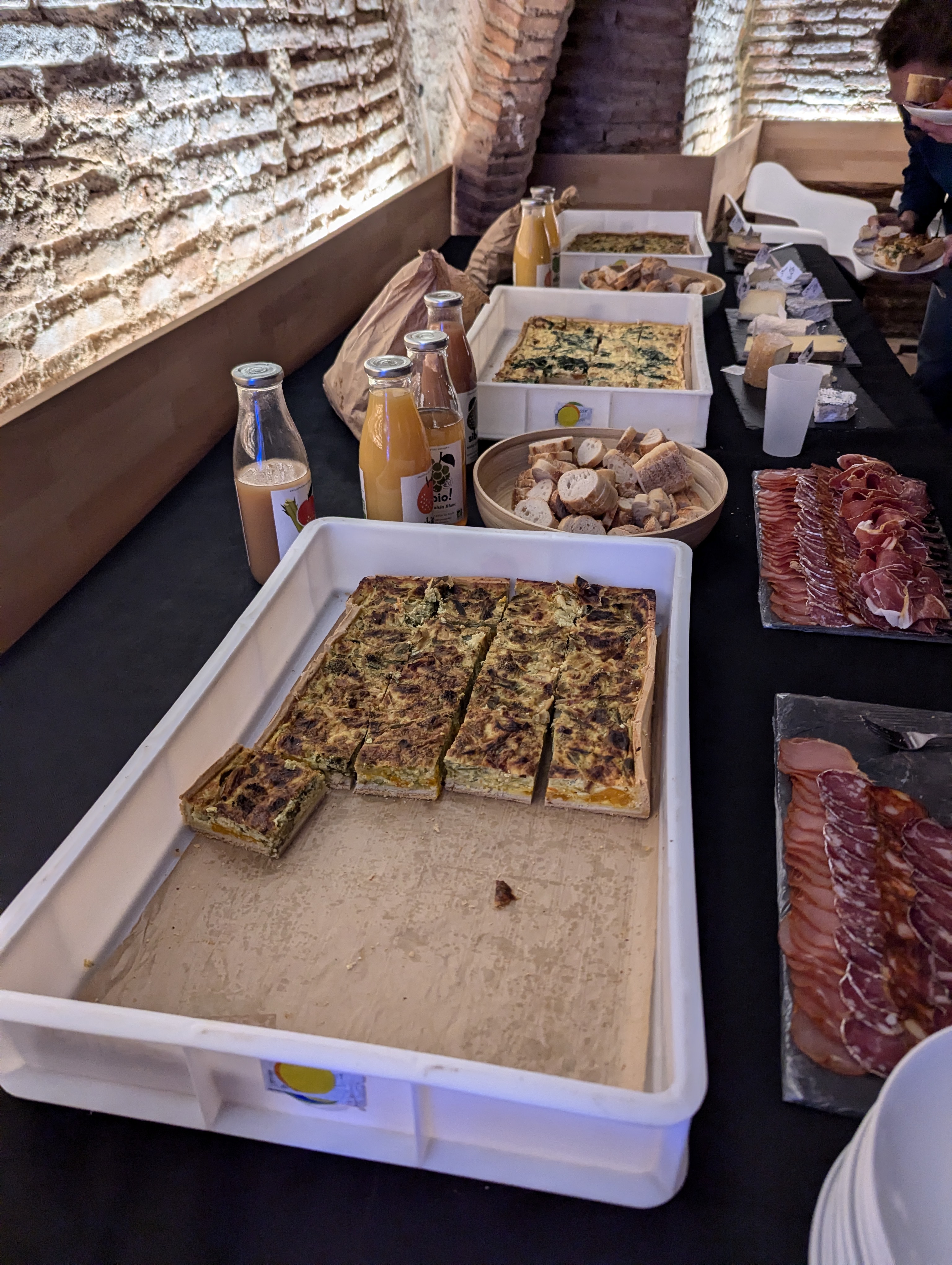
Culinary delights lunch 1 img 14 img 15 img 16 img 17 cakes The hospitality was exceptional. Our lunches boasted a delicious array of quiches, an enticing charcuterie board, and a superb selection of cheeses, all perfectly complemented by exquisite petite fours. Each item was not only a feast for the eyes but also a delight for the palate.
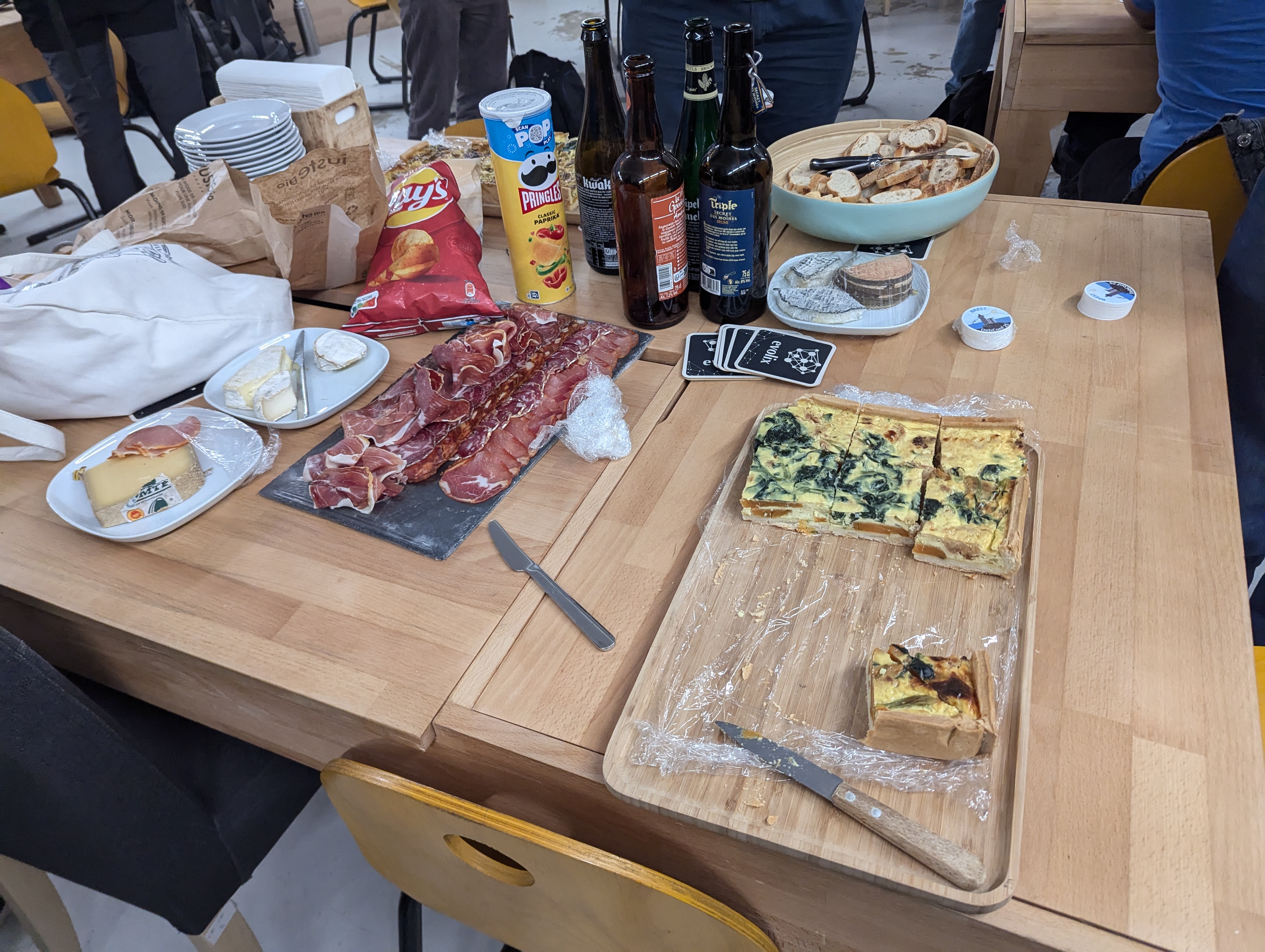
Wine and cheese wine and cheese 1 wine and cheese 2 Leftovers from these gourmet feasts fuelled our impromptu cheese and wine party on Thursday evening a highlight where informal chats blended seamlessly with serious software discussions.


The river at night night river 1 night river 2 night river 3 night river 4 The enchantment of Toulouse doesn't dim with the setting sun; instead, it transforms. My evening strolls took me along the banks of the Garonne, under a sky just turning from twilight to velvet blue. The river, a dark mirror, perfectly reflected the illuminated grandeur of the city's architecture. Notably, the dome of the H pital de La Grave stood out, bathed in a warm glow against the night sky. This architectural gem, coupled with the soft lights of the bridge and the serene river, created a breathtaking scene that was both tranquil and awe-inspiring.

Capitole du Libre making crepes The MiniDebConf itself, part of the larger Capitole du Libre event, was a fantastic immersion into the world of free software. Unlike the ticket-free FOSDEM, this conference required QR codes for entry and even had bag searches, adding an unusual layer of security for a software conference. Highlights included the crepe-making by the organisers, reminiscent of street food scenes from larger festivals. The availability of crepes for MiniDebConf attendees and the presence of food trucks added a festive air, albeit with the inevitable long queues familiar to any festival-goer.

v l Toulouse bike cyclocity The city's bike rental system was a boon easy to use with handy bike baskets perfect for casual city touring. I chose pedal power over electric, finding it a pleasant way to navigate the streets and absorb the city's vibrant atmosphere.

Markets market flatbreads Toulouse's markets were a delightful discovery. From a spontaneous visit to a market near my hotel upon arrival, to cycling past bustling marketplaces, each day presented new local flavours and crafts to explore. The Za'atar flatbread from a Syrian stall was a particularly memorable lunch pick.

La brasserie Les Arcades img 25 img 26 img 27 Our conference wrapped up with a spontaneous gathering at La Brasserie Les Arcades in Place du Capitole. Finding a caf that could accommodate 30 of us on a Sunday evening without a booking felt like striking gold. What began with coffee and ice cream smoothly transitioned into dinner, where I enjoyed a delicious braised duck leg with green peppercorn sauce. This meal rounded off the trip with lively conversations and shared experiences.

The journey back home img 30 img 31 img 32 img 33 Returning from Toulouse, I found myself once again in seat 1A, offering the advantage of being the first off the plane, both on departure and arrival. My flight touched down in Bristol ahead of schedule, and within ten minutes, I was on the A1 bus, making my way back into the heart of Bristol.

Anticipating DebConf 25 in Brittany My trip to Toulouse for MiniDebConf was yet another fulfilling experience; the city was delightful, and the talks were insightful. While I frequently travel, these journeys are more about continuous learning and networking than escape. The food in Toulouse was particularly impressive, a highlight I've come to expect and relish on my trips to France. Looking ahead, I'm eagerly anticipating DebConf in Brest next year, especially the opportunity to indulge once more in the excellent French cuisine and beverages.

20 November 2024

Russell Coker: Solving Spam and Phishing for Corporations

Centralisation and Corporations An advantage of a medium to large company is that it permits specialisation. For example I m currently working in the IT department of a medium sized company and because we have standardised hardware (Dell Latitude and Precision laptops, Dell Precision Tower workstations, and Dell PowerEdge servers) and I am involved in fixing all Linux compatibility issues on that I can fix most problems in a small fraction of the time that I would take to fix on a random computer. There is scope for a lot of debate about the extent to which companies should standardise and centralise things. But for computer problems which can escalate quickly from minor to serious if not approached in the correct manner it s clear that a good deal of centralisation is appropriate. For people doing technical computer work such as programming there s a large portion of the employees who are computer hobbyists who like to fiddle with computers. But if the support system is run well even they will appreciate having computers just work most of the time and for a large portion of the failures having someone immediately recognise the problem, like the issues with NVidia drivers that I have documented so that first line support can implement workarounds without the need for a lengthy investigation. A big problem with email in the modern Internet is the prevalence of Phishing scams. The current corporate approach to this is to send out test Phishing email to people and then force computer security training on everyone who clicks on them. One problem with this is that attackers only need to fool one person on one occasion and when you have hundreds of people doing something on rare occasions that s not part of their core work they will periodically get it wrong. When every test Phishing run finds several people who need extra training it seems obvious to me that this isn t a solution that s working well. I will concede that the majority of people who click on the test Phishing email would probably realise their mistake if asked to enter the password for the corporate email system, but I think it s still clear that this isn t a great solution. Let s imagine for the sake of discussion that everyone in a company was 100% accurate at identifying Phishing email and other scam email, if that was the case would the problem be solved? I believe that even in that hypothetical case it would not be a solved problem due to the wasted time and concentration. People can spend minutes determining if a single email is legitimate. On many occasions I have had relatives and clients forward me email because they are unsure if it s valid, it s great that they seek expert advice when they are unsure about things but it would be better if they didn t have to go to that effort. What we ideally want to do is centralise the anti-Phishing and anti-spam work to a small group of people who are actually good at it and who can recognise patterns by seeing larger quantities of spam. When a spam or Phishing message is sent to 600 people in a company you don t want 600 people to individually consider it, you want one person to recognise it and delete/block all 600. If 600 people each spend one minute considering the matter then that s 10 work hours wasted! The Rationale for Human Filtering For personal email human filtering usually isn t viable because people want privacy. But corporate email isn t private, it s expected that the company can read it under certain circumstances (in most jurisdictions) and having email open in public areas of the office where colleagues might see it is expected. You can visit gmail.com on your lunch break to read personal email but every company policy (and common sense) says to not have actually private correspondence on company systems. The amount of time spent by reception staff in sorting out such email would be less than that taken by individuals. When someone sends a spam to everyone in the company instead of 500 people each spending a couple of minutes working out whether it s legit you have one person who s good at recognising spam (because it s their job) who clicks on a remove mail from this sender from all mailboxes button and 500 messages are deleted and the sender is blocked. Delaying email would be a concern. It s standard practice for CEOs (and C*Os at larger companies) to have a PA receive their email and forward the ones that need their attention. So human vetting of email can work without unreasonable delays. If we had someone checking all email for the entire company probably email to the senior people would never get noticeably delayed and while people like me would get their mail delayed on occasion people doing technical work generally don t have notifications turned on for email because it s a distraction and a fast response isn t needed. There are a few senders where fast response is required, which is mostly corporations sending a click this link within 10 minutes to confirm your password change email. Setting up rules for all such senders that are relevant to work wouldn t be difficult to do. How to Solve This Spam and Phishing became serious problems over 20 years ago and we have had 20 years of evolution of email filtering which still hasn t solved the problem. The vast majority of email addresses in use are run by major managed service providers and they haven t managed to filter out spam/phishing mail effectively so I think we should assume that it s not going to be solved by filtering. There is talk about what AI technology might do for filtering spam/phishing but that same technology can product better crafted hostile email to avoid filters. An additional complication for corporate email filtering is that some criteria that are used to filter personal email don t apply to corporate mail. If someone sends email to me personally about millions of dollars then it s obviously not legit. If someone sends email to a company then it could be legit. Companies routinely have people emailing potential clients about how their products can save millions of dollars and make purchases over a million dollars. This is not a problem that s impossible to solve, it s just an extra difficulty that reduces the efficiency of filters. It seems to me that the best solution to the problem involves having all mail filtered by a human. A company could configure their mail server to not accept direct external mail for any employee s address. Then people could email files to colleagues etc without any restriction but spam and phishing wouldn t be a problem. The issue is how to manage inbound mail. One possibility is to have addresses of the form it+russell.coker@example.com (for me as an employee in the IT department) and you would have a team of people who would read those mailboxes and forward mail to the right people if it seemed legit. Having addresses like it+russell.coker means that all mail to the IT department would be received into folders of the same account and they could be filtered by someone with suitable security level and not require any special configuration of the mail server. So the person who read the is mailbox would have a folder named russell.coker receiving mail addressed to me. The system could be configured to automate the processing of mail from known good addresses (and even domains), so they could just put in a rule saying that when Dell sends DMARC authenticated mail to is+$USER it gets immediately directed to $USER. This is the sort of thing that can be automated in the email client (mail filtering is becoming a common feature in MUAs). For a FOSS implementation of such things the server side of it (including extracting account data from a directory to determine which department a user is in) would be about a day s work and then an option would be to modify a webmail program to have extra functionality for approving senders and sending change requests to the server to automatically direct future mail from the same sender. As an aside I have previously worked on a project that had a modified version of the Horde webmail system to do this sort of thing for challenge-response email and adding certain automated messages to the allow-list. The Change One of the first things to do is configuring the system to add every recipient of an outbound message to the allow list for receiving a reply. Having a script go through the sent-mail folders of all accounts and adding the recipients to the allow lists would be easy and catch the common cases. But even with processing the sent mail folders going from a working system without such things to a system like this will take some time for the initial work of adding addresses to the allow lists, particularly for domain wide additions of all the sites that send password confirmation messages. You would need rules to direct inbound mail to the old addresses to the new style and then address a huge amount of mail that needs to be categorised. If you have 600 employees and the average amount of time taken on the first day is 10 minutes per user then that s 100 hours of work, 12 work days. If you had everyone from the IT department, reception, and executive assistants working on it that would be viable. After about a week there wouldn t be much work involved in maintaining it. Then after that it would be a net win for the company. The Benefits If the average employee spends one minute a day dealing with spam and phishing email then with 600 employees that s 10 hours of wasted time per day. Effectively wasting one employee s work! I m sure that s the low end of the range, 5 minutes average per day doesn t seem unreasonable especially when people are unsure about phishing email and send it to Slack so multiple employees spend time analysing it. So you could have 5 employees being wasted by hostile email and avoiding that would take a fraction of the time of a few people adding up to less than an hour of total work per day. Then there s the training time for phishing mail. Instead of having every employee spend half an hour doing email security training every few months (that s 300 hours or 7.5 working weeks every time you do it) you just train the few experts. In addition to saving time there are significant security benefits to having experts deal with possibly hostile email. Someone who deals with a lot of phishing email is much less likely to be tricked. Will They Do It? They probably won t do it any time soon. I don t think it s expensive enough for companies yet. Maybe government agencies already have equivalent measures in place, but for regular corporations it s probably regarded as too difficult to change anything and the costs aren t obvious. I have been unsuccessful in suggesting that managers spend slightly more on computer hardware to save significant amounts of worker time for 30 years.

Next.

Previous.