Search Results: "rui"

4 June 2008

John Goerzen: Camping

Terah, Jacob, and I went camping last weekend. Terah had asked me what I wanted for Father's Day. I thought for just a second, and said "camping!" She looked like she regretted asking. But it has been a year since our last camping trip, so off we went.

We went to Marion County Park and Lake, a nice park built by FDR's CCC program in the 1930s. It is on the National Register of Historic Places thanks to all the stone buildings, bridges, etc. that were built back then and still survive.

The reason we like it is because one side of the lake has the park office, rentable meeting houses, RV hookups, a swimming area, and really all the things you expect at a park like this (albeit on a small scale). The other side of the lake has gravel roads and fire rings. No power, no running water, but the occasional stone outhouse every half mile or so. Which means that the RV owners are not going to want to spend the night on that side of the lake. So, unlike far too many parks, it is possible to pitch a tent a good distance from the RVs. It's so annoying to go to camping and find it to be noisier than home because of all the TVs and generators running.

Jacob wasn't so sure about the first evening, but he was having a blast all day Saturday. His favorite thing was the campfire. He called it "fie" (rhymes with "buy"). He watched me gathering up brush and preparing the fire, carefully placing the small sticks first, then the big ones. So he picked up a small stick, and carefully laid it inside the fire ring, too. Then he'd watch me light the fire, or blow on some embers, and he'd blow on it, too. Fffffffffffffff! As hard as he could. At one point, I was kneeling next to the fire ring, inspecting the kindling. Terah noticed Jacob kneeling next to the fire ring on the other side, with the exact same posture and expression as I had. It was a perfect Father's Day, I think.

Once the fire got going, he'd walk up towards it, say "HA!" (hot), and then run away. Educational, this camping business. He now knows what "hot" is all about.

Jacob also loved the lake. We would walk the few feet down to the beach, and he'd (holding on to one of us) walk just far enough into it to get his feet covered by the water, then pick up sand and throw it into the water to watch it splash. Or, he'd point at a boat ("bope") in the water ("wah") going past, all excited -- Bope! Bope!!! BOPE!!!

One of my favorite things while camping is sitting outside and watch the sun set. Terah and I did that while munching on banana boats we cooked in the fire (a banana and chocolate concoction that you sort of melt in tinfoil). Or we could sit in the shade on the ground and just relax and enjoy the scenery.

Terah didn't say that she enjoyed camping, but she did agree that there were good times and we could come back. Woohoo, I guess.

We're not really camping pros, and we learned a few things. One is that it would be nice to not have three meals in a day that require a fire. I'm fine with eating fruit, canned stuff, and other no-cooking-needed stuff when camping, but Terah likes more traditional food. And that's fine, and we had some great stuff to eat, but building fires is hard and hot work.

Over the first few days after we got home, Jacob came up to me and said, looking rather sad, "Fie? Fie?" I said, "Jacob, we don't have a fire here. There is no fire here." He would look so sad, and just repeat to himself for a few minutes, "No fie. No fie. No fie." So I asked him if I should build a little fire. "Yeah!" So I got a match and lit a candle. Oh, was that exciting, and almost as soon as it showed up, he tried to blow on it. By today he has learned how to blow out a candle.

A great Father's Day for sure, but we hadn't really tried to sow the seeds of a fascination with fire on the trip.

31 May 2008

Dirk Eddelbuettel: Accelerated R in Debian

A few months ago, Stephen Milborrow started releasing a patched version of R that performs just-in-time compilation -- see his Ra page for some details and further pointers. In a nutshell, Ra provides a modified R engine so that code preceded by all jit(1) function call, using his jit package from the CRAN archive, will run faster due to just-in-time compilation of loops and arithmetic expressions. Ra offers to pick the low-hanging fruit for users as loops can be a bottleneck. Of course, as shown in Stephen's case study, using appropriate vectorised expression will often be faster still. That said, for a certain class of problems, Ra should offer a decent speed boost. Debian users can now just say
    sudo apt-get install r-base-core-ra r-cran-jit
as the Ra and jit packages in Debian's unstable distribution (and in the case of jit, even in testing). Lastly, version 1.1.0 of Ra was released by Stephen yesterday and is now also in Debian unstable.

26 May 2008

Manoj Srivastava: Manoj: Theming Emacs


Update Added screenshots
I spend a lot of time working in front of a screen (many hours in a dimly lit room) and eye fatigue is an issue. A consistent color scheme, especially one which is easy on the eyes, is important and it also helps to have way of doing that where the directives are not all scattered all over my Emacs-lisp setup. Enter Emacs Color Themes, available as the Debian package emacs-goodies. Aided with a HSL color picker, I set around trying to create a dark color theme for Emacs. It does not help that I am blue-green color blind, so subtle variations are often lost on me. I do want to use color contrast to increase productivity, but I also want to avoid the jarring angry fruit salad look, and so I am in the process of crafting a logical color scheme that is high contrast enough for me, without being too unpleasing. Gnus Groups In circumstances where there a lot of related faces that can be viewed, for example, the Gnus group buffer, consistent and logical color choices are the only sane option. Gnus groups can be news (bluish) or mail (greenish), have states (large number of unread messages, normal, and empty). The large number unread groups have highest luminosity (appear brighter), and the empty one have lower luminosity (appear greyer), but have the same hue and saturation. Sub states and group priorities are rendered using a color series which has constant luminosity and saturation, and vary in hue by a constant separation so all the related groups have the same brightness ( mail,news / unread,normal,empty ), and a graded selection of foreground colors. It sounds more complicated that it looks. The eye is drawn naturally to the unread groups, and first to the mail, then USENET groups (which is my preference). Gnus Groups Similar color variations occur for individual messages in a group; high scoring messages bubble to the top, and have a higher luminosity. This color schema has made me slightly faster at reading mail/USENET. In the message itself, quoted mail messages from different people are color coordinated, with high contrast between citations that are close to each other in the hierarchy, so it is less likely that one misunderstands who said what in a long conversation. The resulting scheme covers programming languages, Gnus, Erc, mail, org-mode, CUA-mode, apt-utils, bbdb, compilation buffers, changelog mode, diff and ediff, eshell, and more. This has allowed me to consolidate all my color directives into a single file, and is in a format that might be usable by others. See the wiki page for details about how to use and switch color themes in Emacs. Enjoy.

25 May 2008

Dirk Eddelbuettel: Bike The Drive 2008

Memorial Day weekend, so time for the annual Bike The Drive in Chicago. Got the whole family up bright and early, and was it ever nice -- 60-some degrees, sunny blue skies and no wind. Perfect conditions. And the Chicagoist blog has some pictures up.

23 May 2008

Edd Dumbill: Badges, blogging and bragging

Back from my travels, it's time for a few updates. I've mostly blogged about these elsewhere, so I'll just give some pointers here. The launch of magnetic-stripe cards at Where 2.0 went well. We had some initial teething issues with Linux talking to the card printers, which was resolved by backing down to Linux kernel 2.6.22 from 2.6.24. I'm not entirely sure what's up with 2.6.24, but it exhibited strange behavior talking to the card printers over ethernet — as if there were MTU misconfigurations. It's a big nuisance, as 2.6.24 is the default kernel shipped with Ubuntu Hardy, an otherwise excellent release. I've been paying some attention to OpenID 2.0 recently, as it's time for me to upgrade my OpenID accepting websites to use the new release of the specification — if for no other reason than Yahoo! OpenIDs are 2.0-only. This investigation led me to notice XRIs again, which are the confusing underbelly of the OpenID specs. The W3C Technical Architecture Group recently advised against using XRIs. I wrote about this over on my XML.com blog. I've not used for that blog for a long time, but will try to do so more. I've realized that I've still got a lot to say about the web, XML and open standards, and the XML.com blog seems like a good place to say it. Finally, to brag for a short moment. Another XTech has been and gone, and this year's was a great experience for everybody involved. This quote from attendee Paul Smith summed things up nicely, as it tells me I succeeded in my main goal for the conference:
What I really liked about this conference was the mix of attendees and presenters, both from academia, and the commercial world both and small. It made it feel much more valid, and it really felt like everyone was there for the right reasons - not trying to sell anything, but out of a genuinely altruistic wish to make the web better.
My sincere thanks to everybody involved in XTech this year.

22 May 2008

Lior Kaplan: What can Debian learn from Fedora about recruiting new people?


I’ve been visiting the fedora website in the last couple of days. One thing caught my interest, and that’s the “join Fedora” link just bellow the “get Fedora” one. I clicked on it and got to this very simple “Join Fedora” page. The appealing part is the large icons which roughly lists the main ways to contribute to Fedora:
  • Content Writer
  • Designer
  • People Person
  • OS Developer
  • Translator
  • Web Developer or Administrator
Clicking etch icon gives you a description of relevant skills, related teams and typical tasks of this role. This is very useful for people not sure about what can they do or where exactly their skills are needed. On the Debian’s website we have a “help debian” page which lists very similar functions the user can help with. The difference is that we list them at text which is less appealing than the Fedora’s icons. Fedora does have similar text to Debian, but it is organized into roles instead of suggesting everything to everyone. I also think there’s a semantic difference with the term help and join. To me joining a project sounds more strong than helping it. Probably because joining something makes you a part of it, while helping does not. Although in the end both term have the exact same meaning in for the project themselves - users getting involved. Openoffice.org has a big “I want to participate in openoffice.org” text in their font page, which like Fedora leads to a set of defined roles. Same thing in Ubuntu with their “Get Involved” page. It is important that each role page will have links the to tools people need in order to start contribute. I don’t have the required graphical skills to do such icons, but I’m willing to create/edit the pages on the Debian website. I’ll be happy to hear comments before I approach the debian-www people.

David Pashley: Apache 2.2 auth_ldap config

Apache 2.2 changed the way you configure LDAP authentication. mod_auth_ldap was replaced with mod_authnz_ldap, so don't forget to enable the new module and disable the old one. Because I'll always forget, here's the new style config.
AuthType basic
AuthName "admin"
AuthBasicProvider ldap
AuthLDAPUrl ldap://ldap.example.com:389/ou=people,dc=example,dc=com?uid?sub
AuthLDAPGroupAttributeIsDN off
Require ldap-group cn=systems,ou=groups,dc=example,dc=com
AuthLDAPGroupAttribute memberUid
The sections in bold are the sections I had to change from the 2.0 config.
Read Comments ()

20 May 2008

Jacobo Tarrío Barreiro: No Galician translations of Mozilla, apparently

It’s not every day that your work is ignored by a founder of Mozilla Europe. From El Pa s:

En Espa a un 23,5% de visitas se dan en Firefox, un ndice que es superior al de EE UU, pero que no llega a los ndices de Polonia donde el 40% del tr fico se da en el navegador de Mozilla. A pesar de estos aceptables datos [Tristan] Nitot ha recordado y pr cticamente hecho un llamamiento para crear una versi n del navegador en gallego: “Hay una versi n en catal n de Firefox construidas por voluntarios que les importa su idioma, al igual que la hay de euskera. Pero a n no hay una versi n en Galicia, muchas veces me lo preguntan y mi respuesta es que si nadie de Galicia se presenta no habr una versi n en gallego, estamos dispuestos a que la gente trabaje con nosotros".
Loosely translated:
“There’s a Catalan version of Firefox built by volunteers who care about their language, and there’s another one in Basque. But there’s no Galician version yet, I get asked this very often, and my answer is that if nobody from Galicia steps up there will be no Galician version. We would like people to work with us".
So, apparently, there’s no Galician translation of Mozilla. I guess that my more than three years’ worth of work were wasted (Dec 2001 - Jul 2004 and Jan 2006 - Aug 2006), that Xis and Galego21 did nothing back in the nineties and noughties, and that what mancomun.org is hosting is an empty XPI file. To not speak of the paralysed/paralysing bureaucracy of the Mozilla Foundation when several groups of volunteers, one after the other, tried to reinstate the official Galician l10n team. I would be pissed off if I cared about Galician. Because, you know, from reading my blog it’s obvious I don’t.

Y Giridhar Appaji Nag: In the Valley of Elah

A brilliant commentary on how the mindless war in Iraq has been effecting the lives of people in the USA, In the Valley of Elah says a lot without speaking much. By the end of the movie, a father -- the same who tells his disturbed soldier-son over the phone: "it is your nerves speaking" -- hangs the US flag upside down.

A full week of high fever kept me down and even the "low hanging fruit" of life went undone. Then, another few days of blood-red eyes, thanks to some stiff antibiotics that I was on. The cause for this recurring fever seems to be an infection of the throat and tonsils, so it looks like I might have to consider getting my tonsils removed. To some extent, In the Valley of Elah shook me out of my moroseness. H says that Charlize Theron is a very cerebral actress and I must agree.

On a related note, I was pointed to this neat article titled Why Do They Hate Us? in which Mohsin Hamid says that the question that US-o-American's should be asking is Why do they love us?.

11 May 2008

Andrew Pollock: [tech] Unleashing the magic blue smoke

Last weekend, Sarah and I went to the Maker Faire again. I love how I don't even have to negotiate with Sarah to go, she loves it just for watching the Combot Cup, where the combat robots destroy each other spectacularly. Ever since Jon Oxer gave his Hardware/Software Hacking: Joining the Real and the Virtualtalk at Google about, I got vaguely interested in electronics again. The Arduino board seemed like a pretty cool thing to hack on, and since it seemed like I'd need to get vaguely electronically savvy to do a thing or two for the dream home we want to build one day (which coincidentally seems to quite similar to what Jon's currently building), I figured I'd have to get my act together and learn the difference between an Ohm and an Amp. The last time I dabbled in electronics was as a kit, with the ubiquitous Dick Smith Funway 1 kit. So the Maker Store at the Faire had copies of Making Things Talk, bundled with an Arduino starter kit, so I lashed out on one of them, a BoArduino, and a little breadboard-based electronics kit. I've been flicking through the Making Things Talk book, and reading the projects. The Arduino board seems really cool. The Processing/Wiring language seems fairly straightforward. I'd decided that my "project" would be a water monitor for the cat water bowl. We have a dish with a little tank on it, not unlike the office water cooler, and it usually lasts about 7 days. We typically refill it on a Saturday as part of the weekend chores. Sometimes our schedule gets a bit disrupted (we go away, we have visitors) and we forget. Or worse, we're away, have a house sitter, and they completely forget to check it. It's only happened a couple of times, but we really don't want to neglect the cats. So I thought a water sensor would be a perfect project. One of the projects in the book involves a Bluetooth modem, so I figured that as the MythTV box has a Bluetooth adapter, and would be within range of the water bowl, I could use it to monitor the water sensor (as well as stick a blinking light on it). The end goal is to have the house call us (via Asterisk and eSpeak) if the water bowl gets empty. So I ordered a Bluetooth modem, the exact part number in the book, and it arrived on the weekend, and I got around to playing with it today. To cut a long story short, I was messing around with it attached to a USB to TTL serial cable, and I was trying to get it to talk to my laptop, and instead of swapping the TX and RX lines, I swapped the VCC and ground lines, and well, I let the magic blue smoke out. What I discovered, after the fact, was that the Bluetooth chipset had been changed since the book had been written, and so the commands for the chipset were different. So most of my second-guessing whether I had the TX and RX round right way was because of that. So I'm miffed with myself for frying the thing within hours of getting my hands on it, and I'm miffed with the supplier for maintaining the same product ID for a product that has changed componentry. Chalk that one up to experience... To add insult to injury, Spark Fun is out of stock of the (cheaper) item that it turns out I want instead. I doubt I'll get my hands on it until after we get back from Zurich, so it'll be another three weeks before I can begin to make any progress. I guess I can try to prototype the water-sensing part with the board connected to my laptop with the USB cable in the meantime...

7 May 2008

Eddy Petrișor: Motorcycles DO EXIST on the road!

Some of you might have noticed that in the recent weeks I wasn't active at all online. This was because I was on a vacation in Italy. On the way back I was eager to write about my experiences, but after entering Romania, I found out that may parents had been involved in a motorcycle accident due to a careless driver.

The accident took place on the second day of the Orthodox Easter (on the 28th of April)[1] while my parents were coming back from my sister's, just 20 km away from my home town, Caracal, in a village called Z noaga. There, a Daewoo Cielo was parked on the left side of the road[2], facing the direction towards Caracal. The driver decided that it was a good idea to turn his vehicle and, according to his declaration, instead of looking himself if there was anything comming, he asked a passenger if there were any cars comming.

Since a motorcycle is not a car, I guess the passenger thought it was OK to answer "no".

So the driver simply started his maneuver and managed to occupy the entire right lane, according to the accident schematics (I saw the official police schematics of the accident site with my own eyes). There were only 30 cm from the front most point of the car to the ditch on the right side of road, while the rear wheels were on the mark indicating the axis of the road. That left only 2 meters free on the opposite lane out of the 6.60 meters wide road, so there was no way for my father (driving the motorcycle) to avoid the collision, in spite of the fact he was travelling at about 40-50 km/h[3], within the legal speed limit (50 km/h).

My father barely had enough time to avoid the central pillar and aim for the rear right door of the car, obviously, a safer place to hit. Still, this wasn't enough to keep my mother on the motorcycle, a safer place for her than anywhere on the road.

My mother was projected over my father and over the car, and, luckily, landed on the side of the road, between the asphalt and the ditch, on an area covered with grass. She landed straight onto her head (the helmet protected her really well), and the shock of the landing propagated along the spine, resulting in the fracture of the L1 vertebra. She also got a fissure in the right clavicula, but that should already be OK now.

My father managed to remain on the motorcycle, but the impact was violent enough that he managed to bend the gas tank and has two huge bruises on the inside of his thighs (one for each leg). He also accuses pains in his shoulders and the lower end of the spine (unfortunately he "managed" not to do the medical investigations after the accident), but I hope all of these will pass soon and will have no ill effects. Also, out of sheer luck, at that time, my father was wearing a full-face helmet, contrary to his habit of earing an open-face helmet; due to this, his face was protected and suffered no harm, while the chin of the helmet broke after the impact with the motorcycle windshield. Also some deep scratches starting from the half of the helmet windshield up to the top of the helmet were the signs of a (probably second) violent impact with the motorcycle windshield.


So, the next time you are on the wheel, please look out for motorcycles, too. Motorcycles do exist on the road!

Also, I advice anyone driving a motorcycle to wear good protection equipment like a full-face helmet, jacket, pants, boots, gloves, etc. These helped a lot my parents, and will help you too, if, God forbid, you are involved in an accident.


My mother is in a cast that covers her from hips to shoulders to help with the fracture recovery and also wears a collar (just for safety reasons since she is suffering of spondyloses).
My father is able to walk (with some pain) and seems not to have any injures (I will take him for a close investigation some time soon in spite of his stubbornness).


[1] worrying for us (me and my future spouse), my parents didn't told us and waited for us to return to Romania
[2] in Romania the vehicles travel on the right side of the road, so the driver also drove on opposite lane, a fact which, according to the law, is punished with the suspension of the driving license
[3] he speed was confirmed by the measurements done by the police

Steve Kemp: You're not too technical, just ugly, gross ugly

Well a brief post about what I've been up to over the past few days. An alioth project was created for the maintainance of the bash-completion package. I spent about 40 minutes yesterday committing fixes to some of the low-lying fruit. I suspect I'll do a little more of that, and then back off. I only started looking at the package because there was a request-for-help bug filed against it. It works well enough for me with some small local additions The big decision for the bash-completion project is how to go forwards from the current situation where the project is basically a large monolithic script. Ideally the openssh-client package should contain the completion for ssh, scp, etc.. Making that transition will be hard. But interesting. In other news I submitted a couple of "make-work" patches to the QPSMTPD SMTP proxy - just tidying up a minor cosmetic issues. I'm starting to get to the point where I understand the internals pretty well now, which is a good thing! I love working on QPSMTPD. It rocks. It is basically the core of my antispam service and a real delight to code for. I cannot overemphasise that enough - some projects are just so obviously coded properly. Hard to replicate, easy to recognise... I've been working on my own pre-connection system which is a little more specialied; making use of the Class::Pluggable library - packaged for Debian by Sarah. (The world -> Pre-Connection/Load-Balancing Proxy -> QPSMTPD -> Exim4. No fragility there then ;) Finally I made a tweak to the Debian Planet configuration. If you have Javascript disabled you'll no longer see the "Show Author"/"Hide Author" links. This is great for people who use Lynx, Links, or other minimal browsers. TODO:

I'm still waiting for the creation of the javascript project to be setup so that I can work on importing my jQuery package. I still need to sit down and work through the Apache2 bugs I identified as being simple to fix. I've got it building from SVN now though; so progress is being made! Finally this weekend I need to sit down and find the time to answer Steve's "Team Questionnaire". Leave it any longer and it'll never get answered. Sigh.
ObQuote: Shooting Fish

Kapil Paranjape: Setting up this blog

One of the biggest questions which has to be answered when one starts a blog is what is the blog engine going to be? (Using a readymade hosted solution like LiveJournal or blogspot is for wimps.) Since the blog is going to be on IMSc's "people" server, there are a lot of choices. The scripting language for the engine is usually a choice between PHP, Perl, Ruby and Python (though with nanoblogger, even a POSIX shell is possible!). The gem looked tempting for a while. Eventually, I realised that the engine is far less important than the entries. Start writing the entries with some engine. It should be "relatively easy" to migrate the entries to a different engine. In some sense, having put essays on the web in the past, a change of engine (from wetware to software) is what I am doing anyway!So the temporary choice is the snake --- think of this is as the snake in the monkey's shadow. Specifically, this blog is currently powered by pyblosxom.

Configuring pyblosxom

StructureSince everything on this blog is meant to be public, all of its data and configuration information is kept in public_html. As far as I can see this causes no security issues --- but if some turn up then it may change!Current directory structure is
blog/ ->
    config.py   Configuration file
    drafts/     -> draft entries
    sources/    -> sources where required
    entries/    -> format of entries is "string"-"date"
    flavours/   -> not tutti-fruity!
    plugins/    -> actual plugins used
    style/      -> stylesheets and images
    index.cgi   -> pyblosxom.cgi renamed
    .htaccess   -> for apache2
Any and all of these files (except drafts) can be examined by extending the URL http://www.imsc.res.in/~kapil/blog by the file or directory name.The development of my web pages is done on my user machine and these are synchronised with the "real" web pages using unison. The local copy of my web pages is managed using git.The plugins were downloaded from the pyblosxom web site.The flavour was downloaded from snarfed.org.Since everything about this blog is visible, there is probably no need to document things further.
Minor cribsI couldn't find anyone who had documented how they had setup their blog using pyblosxom. This meant that it took a while for me to set things up.The apache2 web server behaved rather differently from mathopd. In particular, the latter does not need or use .htaccess files and just declaring that index.cgi was the a CGI script and was the "index file" for the blog/ directory was enough for the blog to start working. However, I had to struggle with apache2 as it needed "Rewrite*" entries in the .htaccess file in order to pick up the style sheets and the blog pages.

3 May 2008

Matthew Garrett

People rarely ask me about my amazing ability to remove fruitfly ovaries in under 10 seconds. "This skill makes me strangely attracted to you" they then inevitably fail to add, thus giving the lie to claims that a PhD in biology is a great way to impress women. In order to avoid future social embarrassment I have therefore decided to provide a step-by-step guide to removing ovaries from any fruitflies you may have to hand.See? It's all very easy.

(Note: This protocol involves chemicals known by the state of California to cause cancer, birth defects and general fucked-upness. Do not ingest methanol unless you want to demonstrate competitive inhibition in the form of a bottle of vodka. Value of fruitfly ovaries may go up as well as down. Do not taunt fruitfly ovaries)

30 April 2008

Adam Rosi-Kessel: Vegetarian Shout Out to Radius

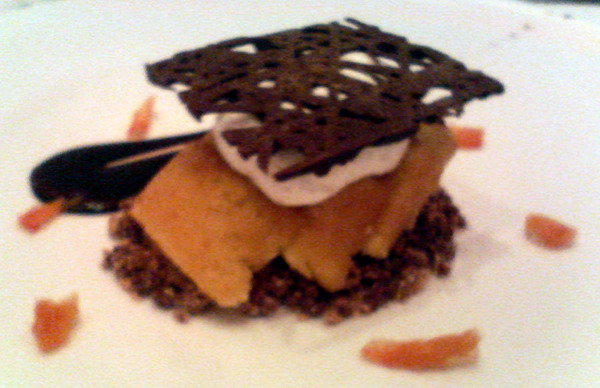
Boston offers slim pickings for vegetarian fine-dining options in the financial district. Most nice places have some sort of pasta dish and not much else. I have forgotten several times, but now write this blog entry to permanently remember, that Radius at 8 High Street is an excellent choice for vegetarians. Although almost nothing vegetarian appears on the menu, you can just tell the waiter that you are vegetarian (along with any other restrictions), and the chef will prepare a plate of three unique fancy concoctions. I’ve had lunch with other vegetarians, and each of us got three entirely different creative and delicious dishes. They were complex enough that I won’t attempt to describe them here. I’m not sure how they chose who got what, but we were all pleased. Of course, dessert is always vegetarian: Excuse the quality; this is a low-light low-resolution image taken by cell phone. It was called “Butter Cake” but went well beyond the humble title. Those specks around the outside are dried grapefruit. Technorati Tags: , , ,
29 April 2008

Miriam Ruiz: MAGIC: More Active Girls In Computing

Ira Pramanick talks in her weblog about a mentorship program targeted towards middle and high school girls to foster in them a positive attitude towards computing. The program is called MAGIC, which stands for More Active Girls In Computing, and tries to address the issue of the low number of girls entering the computing and high tech world. As they say, it is a serious issue caused not by then lack of talent, but due to a bunch of discouraging factors that exist in our culture and society. Right now, women represent only about 28% of the technology workforce. I don’t know if a mentorship program dedicated to these girls would be enough to increase the number of women participating in the technology workforce, but it will probably help to improve the situation. It would be nice to import the project model into Spanish speaking countries if it’s successful. The Mentor Qualification Process is quite strange anyway. It might be that we europeans have cultural differences, but I find some of the questions there quite disturbing, like “Are you willing to be finger-printed and screened?”. I don’t exactly know what they might want such a sensitive data for.

25 April 2008

Gerfried Fuchs: Baby is Leaving

Just to not confuse readers from Planet Debian, the mentioned baby is not Miriam Ruiz. Sorry. :)
baby is leaving
flying over the big sea
heading for some place I wish her good luck
and that she will come back soon
to my open arms
P.S.: Tiny bits changed after some nagging from baby. ;)

24 April 2008

Theodore Ts'o: Organic vs. Non-organic Open Source

Brian Aker dropped by and replied to my previous essay by making the following comment:
I believe you are hitting the nail on the organic vs nonorganic open source. I do not believe we have a model for going from one to the other. Linux and Apache both have very different models for contribution but I don t believe either are really optimized at this point. Optimization to me would lead to a system of less priests and more inclusion.
I made an initial reply as comment, and then decided it was so long that I should promote it to a top-level post. I assume that when Brian talks about “organic open source” what he means is what I was calling an “open source development community”. Some googling turned up the following definition from Mozilla Firefox’s organic software page: “Our most well-known product, Firefox, is created by an international movement of thousands, only a small percentage of whom are actual employees.” This puts it in contrast with “non-organic” software, where all or nearly all of the developers are employed by one company. (And anyone who proves talented at adding features to that source base soon gets a job offer by that one company. :-) By that definition we can certainly see projects like Wine, Mysql, Ghostscript (at one time), and others as fitting into that model, and being quite successful. There’s nothing really wrong with the non-organic software model, although many of them have struggled to make enough money when competing with pure proprietary softare competitors, with MySQL perhaps being the exception which proves the rule. In most of these cases, though, the project started more as an organic open source, and then transitioned into the non-organic model when there was a desire to monetize the project and/or when the open source programmers decided that it would be nice if they could turn their avocation into a vocation, and let their hobby put food on the family table. Solaris, of course, is doing something else quite different, though. They are trying to make the transition from a proprietary customer/supplier relationship to trying to develop an Open Source community and what John s candidate statement pointed out is that they weren t really interested in creating an organic open source developer community at all, but they wanted the fruits of an open source community with plenty of application developers, end-users, etc., all participating in that community. We don t have a lot of precedent for projects who try to go in this direction, but I suspect they are skipping a step when they try to go to the end step without bothering to try to make themselves open to outside developers. And by continuing to act like a corporation, they end up shooting themselves in the foot. For example, the OpenSolaris license still prohibits people from publishing benchmarks or comparisons with other operating systems. Very common in closed-source operating systems and databases, but it discourages people from even trying to make things better, both within and outside of the Open Solaris core team. Instead, they respond to posts like David Miller s with Have you ever kissed a girl? . (Thanks, Simon, for that quote; I had seen it before, but not for a while, and it pretty well sums up the sheer arrogance of the Open Solaris development team.) So while Linux may not be completely optimized in terms of less priests and more inclusion, at least over 1200 developers contributed to 2.6.25 during its development cycle. Compared to that, Open Solaris is positively dominated by high priests and with a you may not touch the holy-of-holies attitude; heck, they won t even allow you to compare them to other religions without branding you a heretic and suing you for licensing violations!

18 April 2008

Miriam Ruiz: Birth Day, Lovely Day

How could I express how happy I am? It’s raining cats and dogs here, but it’s such a lovely day! Congratz to the other new Debian Developers :)

Next.

Previous.