Search Results: "reg"

31 July 2024

Matthew Palmer: Health Industry Company Sues to Prevent Certificate Revocation

It s not often that a company is willing to make a sworn statement to a court about how its IT practices are incompatible with the needs of the Internet, but when they do it s popcorn time.

The Combatants In the red corner, weighing in at nah, I m not going to do that schtick. The plaintiff in the case is Alegeus Technologies, LLC, a Delaware Corporation that, according to their filings, is a leading provider of a business-tobusiness, white-label funding and payment platform for healthcare carriers and third-party administrators to administer consumer-directed employee benefit programs . Not being subject to the US bonkers health care system, I have only a passing familiarity with the sorts of things they do, but presumably it involves moving a lot of money around, which is sometimes important. The defendant is DigiCert, a CA which, based on analysis I ve done previously, is the second-largest issuer of WebPKI certificates by volume.

The History According to a recently opened Mozilla CA bug, DigiCert found an issue in their domain control validation workflow, that meant it may have been possible for a miscreant to have certificates issued to them that they weren t legitimately entitled to. Given that validating domain names is basically the YOU HAD ONE JOB! of a CA, this is a big deal. The CA/Browser Forum Baseline Requirements (BRs) (which all CAs are required to adhere to, by virtue of their being included in various browser and OS trust stores), say that revocation is required within 24 hours when [t]he CA obtains evidence that the validation of domain authorization or control for any Fully Qualified Domain Name or IP address in the Certificate should not be relied upon (section 4.9.1.1, point 5). DigiCert appears to have at least tried to do the right thing, by opening the above Mozilla bug giving some details of the problem, and notifying their customers that their certificates were going to be revoked. One may quibble about how fast they re doing it, but they re giving it a decent shot, at least. A complicating factor in all this is that, only a touch over a month ago, Google Chrome announced the removal of another CA, Entrust, from its own trust store program, citing a pattern of compliance failures, unmet improvement commitments, and the absence of tangible, measurable progress in response to publicly disclosed incident reports . Many of these compliance failures were failures to revoke certificates in a timely manner. One imagines that DigiCert would not like to gain a reputation for tardy revocation, particularly at the moment.

The Legal Action Now we come to Alegeus Technologies. They ve opened a civil case whose first action is to request the issuance of a Temporary Restraining Order (TRO) that prevents DigiCert from revoking certificates issued to Alegeus (which the court has issued). This is a big deal, because TROs are legal instruments that, if not obeyed, constitute contempt of court (or something similar) and courts do not like people who disregard their instructions. That means that, in the short term, those certificates aren t getting revoked, despite the requirement imposed by root stores on DigiCert that the certificates must be revoked. DigiCert is in a real rock / hard place situation here: revoke and get punished by the courts, or don t revoke and potentially (though almost certainly not, in the circumstances) face removal from trust stores (which would kill, or at least massively hurt, their business). The reasons that Alegeus gives for requesting the restraining order is that [t]o Reissue and Reinstall the Security Certificates, Alegeus must work with and coordinate with its Clients, who are required to take steps to rectify the certificates. Alegeus has hundreds of such Clients. Alegeus is generally required by contract to give its clients much longer than 24 hours notice before executing such a change regarding certification. In the filing, Alegeus does acknowledge that DigiCert is a voluntary member of the Certification Authority Browser Forum (CABF), which has bylaws stating that certificates with an issue in their domain validation must be revoked within 24 hours. This is a misstatement of the facts, though. It is the BRs, not the CABF bylaws, that require revocation, and the BRs apply to all CAs that wish to be included in browser and OS trust stores, not just those that are members of the CABF. In any event, given that Alegeus was aware that DigiCert is required to revoke certificates within 24 hours, one wonders why Alegeus went ahead and signed agreements with their customers that required a lengthy notice period before changing certificates. What complicates the situation is that there is apparently a Master Services Agreement (MSA) that states that it constitutes the entire agreement between the parties and that MSA doesn t mention certificate revocation anywhere relevant. That means that it s not quite so cut-and-dried that DigiCert does, in fact, have the right to revoke those certificates. I d expect a lot of update to your Master Services Agreement emails to be going out from DigiCert (and other CAs) in the near future to clarify this point. Not being a lawyer, I can t imagine which way this case might go, but there s one thing we can be sure of: some lawyers are going to able to afford that trip to a tropical paradise this year.

The Security Issues The requirement for revocation within 24 hours is an important security control in the WebPKI ecosystem. If a certificate is misissued to a malicious party, or is otherwise compromised, it needs to be marked as untrustworthy as soon as possible. While revocation is far from perfect, it is the best tool we have. In this court filing, Alegeus has claimed that they are unable to switch certificates with less than 24 hours notice (due to contractual SLAs ). This is a pretty big problem, because there are lots of reasons why a certificate might need to be switched out Very Quickly. As a practical example, someone with access to the private key for your SSL certificate might decide to use it in a blog post. Letting that sort of problem linger for an extended period of time might end up being a Pretty Big Problem of its own. An organisation that cannot respond within hours to a compromised certificate is playing chicken with their security.

The Takeaways Contractual obligations that require you to notify anyone else of a certificate (or private key) changing are bonkers, and completely antithetical to the needs of the WebPKI. If you have to have them, you re going to want to start transitioning to a private PKI, wherein you can do whatever you darn well please with revocation (or not). As these sorts of problems keep happening, trust stores (and hence CAs) are going to crack down on this sort of thing, so you may as well move sooner rather than later. If you are an organisation that uses WebPKI certificates, you ve got to be able to deal with any kind of certificate revocation event within hours, not days. This basically boils down to automated issuance and lifecycle management, because having someone manually request and install certificates is terrible on many levels. There isn t currently a completed standard for notifying subscribers if their certificates need premature renewal (say, due to needing to be revoked), but the ACME Renewal Information Extension is currently being developed to fill that need. Ask your CA if they re tracking this standards development, and when they intend to have the extension available for use. (Pro-tip: if they say we ll start doing development when the RFC is published , run for the hills; that s not how responsible organisations work on the Internet).

The Givings If you ve found this helpful, consider shouting me a refreshing beverage. Reading through legal filings is thirsty work!

29 July 2024

Sahil Dhiman: Ola Maps and OpenStreetMap Data

Recently, Ola started rolling out Ola Maps in their main mobile app, replacing Google Maps, while also offering maps as a service to other organizations. The interesting part for me was the usage of OpenStreetMap data as base map with Ola s proprietary data sources. I ll mostly about talk about map data part here. RTI 1
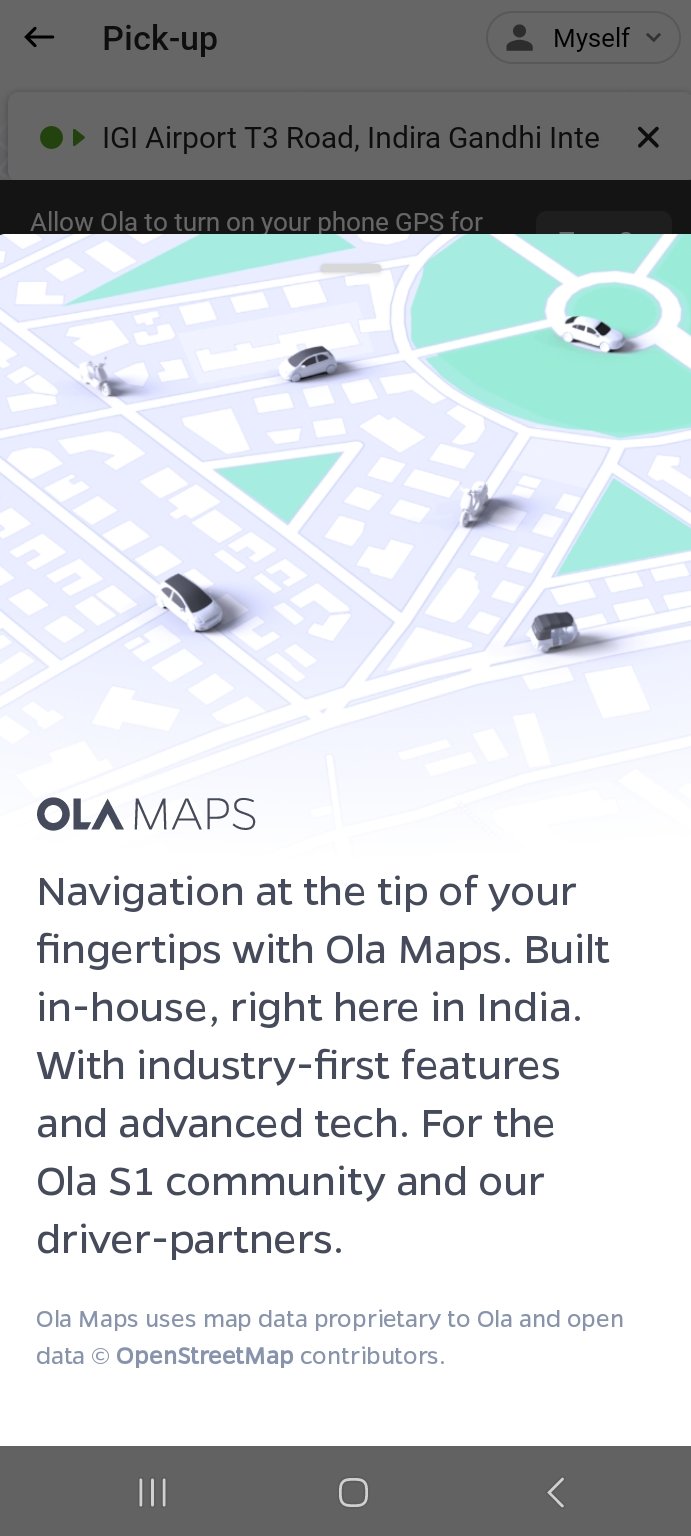
Screenshot of Ola App.
OpenStreetMap attribution is shown after clicking the Ola Map icon.
OpenStreetMap (OSM) for starters, is a community owned and edited map data resource which gives freedom to use map data for any purpose. This includes the condition that attribution is given back to OSM which in turn ideally would encourage other users to contribute, correct and edit, helping everyone in turn. Due to this, OSM is also regarded as Wikipedia of maps. OSM data is not just used by Ola. Many others use it for various purposes like Wikipedia Maps, Strava Maps, Snapchat Map, bus tracking in GoIbibo/Redbus. OSM India community has been following Ola map endeavor to use and contribute to OSM since they went public. As required by OSM for organized mapping efforts, Ola created wiki entry with information regarding their editors, usage, policy and mentions following as their data usage case:
OSM data is used for the road network, traffic signs and signals, buildings, natural features, landuse polygons and some POIs.
Creating a map product is a task in itself, an engineering hurdle creating the tech stack for collection, validation, import and serving the map and the map data part. Ola has done a good job describing the development of tech stack in their blog post. Ola holds an enormous corpus of live and constantly updated GPS trace data. Their drivers, users, and delivery partners generate those, which they harness to validate, correct and add missing map data. Ola employees now regularly contribute new or missing roads (including adding dual carriageway to existing ones), fix road geometry, classification, road access type and restrictions pan India. They have been active and engaging in OSM India community channels, though community members have raised some concerns on their OSM edit practices. Ola s venture into the map industry isn t something out of the ordinary. Grab, a South East Asian company which has business interests in food deliveries, ride hailing and a bunch of other services too switched to their in-house map based on OpenStreetMap, followed by launching of their map product. Grab too contributed back data like Ola. Both Ola and Grab heavily rely on map for their business operations and seem to chose to go independent for it, bootstrapping the products on OSM. In India too, a bunch of organizations contribute to OSM like Swiggy, Stackbox, Amazon, Apple. Microsoft, Meta/Facebook and many others. Everyone wants a better map (data), so everyone works together. Ola could have gone their own route, bootstrapping map data from scratch, which would have been a gargantuan task when you re competing against the likes of Google Maps and Bing Maps, which have been into this since many years. Deciding to use OSM and actively giving back to make data better for everyone deserves accolades. Now I m waiting to for their second blog post, which they mention would be on map data. If you re an Ola map user through Ola Electric or Ola app, and find some road unmapped, you can always edit them in OSM. What I have heard from their employee, they import new OSM data weekly, which means your changes should start reflecting for you (and everyone else) by next week. If you re new, follow Beginners guide and join OSM India community community.osm.be/resources/asia/india/ for any doubts and participating in various mapping events. PS You can see live OSM edits in India subcontinent here.

28 July 2024

Scarlett Gately Moore: KDE Snaps, Kubuntu, Debian updates and Oh no, not again..

This week our family suffered another loss with my brother in-law. We will miss him dearly. On our way down to Phoenix to console our nephew that just lost his dad our car blew up. Last week we were in a roll over accident that totaled our truck and left me with a broken arm. We are now in great need of a new vehicle. Please consider donating to this fund: https://gofund.me/033eb25d . Kubuntu is out of money and I am between work packages with the project . We are 50 miles away from the closest town for supplies, essentials such as water requires a vehicle. I have had bad years before ( covid ) in which I lost my beloved job at Blue Systems. I made a vow to myself to never let my personal life affect my work again. I have so far kept that promise to myself and without further ado I present to you my work. Kubuntu: Debian: KDE Snaps: Please note: for the most part the Qt6 snaps are in edge except the few in the project that are heavily tested. Please help test the edge snaps so I can promote them. WIP Snaps or MR s made Please note that 95% of the snaps are free-time work. The project covers 5. I am going as fast as I can between Kubuntu/Debian and the project commitments. Not to mention I have only one arm! My GSOC student is also helping which you can read all about here: https://soumyadghosh.github.io/website/interns/gsoc-2024/gsoc-week-3-week-7/ There is still much work to do in Kubuntu to be Plasma 6 ready for Oracular and they are out of funds. I will still continue my work regardless, but please consider donating until we can procure a consistent flow of funding : https://kubuntu.org/donate/ Thank you for reading and have a blessed day!

Marco d'Itri: An interesting architecture-dependent autopkgtest regression

More than two years after I last uploaded the purity-off Debian package, its autopkgtest (the Debian distribution-wide continuous integration system) started failing on arm64, and only on this architecture. The failing test is very simple: it prints a long stream of "y" or "n" characters to purity(6)'s standard input and then checks the output for the expected result. While investigating the live autopkgtest system, I figured out that: I did not have time to verify this, but I have noticed that the 25 years old purity(6) program calls TIOCGWINSZ to determine the screen length, and then uses the results in the answer buffer without checking if the ioctl(2) call returned an error. Which it obviously does in this case, because standard input is not a console but a pipe. So my theory is that paging is enabled because the undefined result of the ioctl has changed, and only on this architecture. Since I do not want to fix purity(6) right now, I have implemented the workaround of printing many more "y" characters as input.

24 July 2024

Dirk Eddelbuettel: RQuantLib 0.4.23 on CRAN: Updates

A new minor release 0.4.23 of RQuantLib just arrived at CRAN earlier today, and will be uploaded to Debian in due course. QuantLib is a rather comprehensice free/open-source library for quantitative finance. RQuantLib connects (some parts of) it to the R environment and language, and has been part of CRAN for more than twenty-two years (!!) as it was one of the first packages I uploaded. This release of RQuantLib updates to QuantLib version 1.35 released this morning. It accommodates some removals following earlier deprecations, and also updates most of the code in the function for a more readable and compact form of creating shared pointers via make_shared() along with auto.

Changes in RQuantLib version 0.4.23 (2024-07-23)
  • Adjustments for QuantLib 1.35 and removal of deprecated code (in utility functions and dividend case of vanilla options)
  • Adjustments for new changes in QuantLib 1.35
  • Refactoring most C++ files making more use of both auto and make_shared to simplify and shorten expressions

Courtesy of my CRANberries, there is also a diffstat report for the this release. As always, more detailed information is on the RQuantLib page. Questions, comments etc should go to the rquantlib-devel mailing list. Issue tickets can be filed at the GitHub repo. If you like this or other open-source work I do, you can now sponsor me at GitHub.

This post by Dirk Eddelbuettel originated on his Thinking inside the box blog. Please report excessive re-aggregation in third-party for-profit settings.

Dirk Eddelbuettel: qlcal 0.0.12 on CRAN: Calendar Updates

The twelveth release of the qlcal package arrivied at CRAN today. qlcal delivers the calendaring parts of QuantLib. It is provided (for the R package) as a set of included files, so the package is self-contained and does not depend on an external QuantLib library (which can be demanding to build). qlcal covers over sixty country / market calendars and can compute holiday lists, its complement (i.e. business day lists) and much more. Examples are in the README at the repository, the package page, and course at the CRAN package page. This releases synchronizes qlcal with the QuantLib release 1.35 (made today) and contains more updates to 2024 calendars.

Changes in version 0.0.12 (2024-07-22)
  • Synchronized with QuantLib 1.35 released today
  • Calendar updates for Chile, India, United States, Brazil

Courtesy of my CRANberries, there is a diffstat report for this release. See the project page and package documentation for more details, and more examples. If you like this or other open-source work I do, you can sponsor me at GitHub.

This post by Dirk Eddelbuettel originated on his Thinking inside the box blog. Please report excessive re-aggregation in third-party for-profit settings.

23 July 2024

Russell Coker: More About Kogan 5120*2160 Monitor

On the 18th of May I blogged about my new 5120*2160 monitor [1]. One thing I noted was that one Netflix movie had run in an aspect ratio that used all space on the monitor. I still don t know if the movie in question was cropped in a letterbox manner but other Netflix shows in full screen mode don t extend to both edges. Also one movie I downloaded as in 3840*1608 resolution which is almost exactly the same aspect ratio as my monitor. I wonder if some company is using 5120*2160 screens for TVs, 4K and FullHD are rumoured to be cheaper than most other resolutions partly due to TV technology being used for monitors. There is the Anamorphic Format of between 2.35:1 and 2.40:1 [2] which is a close match for the 2.37:1 of my new monitor. I tried out the HDMI audio on a Dell laptop and my Thinkpad Yoga Gen3 and found it to be of poor quality, it seemed limited to 2560*1440, at this time I m not sure how much of the fault is due to the laptops and how much is due to the monitor. The monitor docs state that it needs HDMI version 2.1 which was released in 2017 and my Thinkpad Yoga Gen3 was released in 2018 so probably doesn t have that. The HDMI cable in question did 4K resolution on my previous monitor so it should all work at a minimum of 4K resolution. The switching between inputs is a problem. If I switch between DisplayPort for my PC and HDMI for a laptop the monitor will usually timeout before the laptop establishes a connection and then switch back to the DisplayPort input. So far I have had to physically disconnect the input source I don t want to use. The DisplayPort switch that I ve used doesn t seem designed to work with resolutions higher than 4K. I ve bought a new USB-C dock which is described as doing 8K which means that as my Thinkpad is described as supporting 5120 2880@60Hz over USB-C I should be able to get 5120*2160 without any problems, however for unknown reasons I only get 4K. For work I m using a Dell Latitude 7400 2in1 that s apparently only capable of 4096*2304 @24 Hz which is less pixels than 5120*2160 and it will also only do 4K resolution. But for both those cases it s still a significant improvement over 2560*1440. I tested with a Dell Latitude 7440 which gave the full 5120*2160 resolution, I was unable to find specs on what the maximum resolution of the 7440 is. I also have bought DisplayPort switch rated at 8K resolution. I got a switch that doesn t also do USB because the ones that do 8K resolution and USB are about $70. The only KVM switch I saw for 8K resolution at a reasonable price was one designed for switching between two laptops and there doesn t seem to be any adaptors to convert from regular DisplayPort to USB-C alternative mode so that wasn t viable. Currently I have the old KVM switch used for USB only (for keyboard and mouse) and the new switch which only does DisplayPort. So I have two buttons to push when switching between input sources which isn t too bad. It seems that for PCs resolutions with more pixels than 4K are as difficult and inconvenient now as 4K was 6 years ago when I started doing it. If you want higher than 4K resolution to just work at this time then you need Apple hardware. The monitor has a series of modes for different types of output, I ve found standard to be good for text and movie to be good for watching movies/TV and for playing RTS games. I previously wrote about how to use ddcutil to use a monitor as a KVM switch [3], unfortunately I can t do this with the new monitor as the time that the monitor waits for a good signal on a new input after changing is shorter than the time taken for Linux on the laptops I m using to enable HDMI output. I ve found the following commands to do the basics.
# get display mode
ddcutil getvcp DC
# set standard mode
ddcutil setvcp DC 0
# set movie mode
ddcutil setvcp DC 03
Now that I have that going the next thing I want to do is to have it switch between standard and movie modes when I switch keyboard focus.

22 July 2024

Russell Coker: Blog Comments

The Akismet WordPress anti-spam plugin has changed it s policy to not run on sites that have adverts which includes mine. Without it I get an average of about 1 spam comment per hour and the interface for removing spam takes more mouse actions than desired. For email spam it s about the same volume half of which is messages with SpamAssassin scores high enough to go into the MaybeSpam folder (that I go through every few weeks) and half of which goes straight to my inbox. But fortunately moving spam to a folder where I can later use it to train Bayesian classification is a much faster option on PC and is also something I can do from my phone MUA. As an experiment I have configured my blog to only take comments from registered users. It will be interesting to see how many spammers make it through that and to also see feedback from genuine people. People who can t comment can tell me about it via the contact methods listed here [1]. I previously wrote about other ways of dealing with hostile comments [2]. Blogging seems to be less popular nowadays so a Planet specific forum doesn t seem a viable option. It s a pity, I think that YouTube and Facebook have taken over from blogs and that s not a good thing.

19 July 2024

Dirk Eddelbuettel: dtts 0.1.3 on CRAN: More Maintenance

Leonardo and I are happy to announce the release of another maintenance release 0.1.3 of our dtts package which has been on CRAN for a good two years now. dtts builds upon our nanotime package as well as the beloved data.table to bring high-performance and high-resolution indexing at the nanosecond level to data frames. dtts aims to offers the time-series indexing versatility of xts (and zoo) to the immense power of data.table while supporting highest nanosecond resolution. This release contains two nice and focussed contributed pull requests. Tomas Kalibera, who as part of R Core looks after everything concerning R on Windows, and then some, needed an adjustment for pending / upcoming R on Windows changes for builds with LLVM which is what Arm-on-Windows uses. We happily obliged: neither Leonardo nor I see much of Windows these decades. (Easy thing to say on a day like today with its crowdstrike hammer falling!) Similarly, Michael Chirico supplied a PR updating one of our tests to an upcoming change at data.table which we are of course happy to support. The short list of changes follows.

Changes in version 0.1.3 (2024-07-18)
  • Windows builds use localtime_s with LLVM (Tomas Kalibera in #16)
  • Tests code has been adjusted for an upstream change in data.table tests for all.equal (Michael Chirico in #18 addressing #17)

Courtesy of my CRANberries, there is also a report with diffstat for this release. Questions, comments, issue tickets can be brought to the GitHub repo. If you like this or other open-source work I do, you can now sponsor me at GitHub.

This post by Dirk Eddelbuettel originated on his Thinking inside the box blog. Please report excessive re-aggregation in third-party for-profit settings.

18 July 2024

Enrico Zini: meson, includedir, and current directory

Suppose you have a meson project like this: meson.build:
project('example', 'cpp', version: '1.0', license : ' ', default_options: ['warning_level=everything', 'cpp_std=c++17'])
subdir('example')
example/meson.build:
test_example = executable('example-test', ['main.cc'])
example/string.h:
/* This file intentionally left empty */
example/main.cc:
#include <cstring>
int main(int argc,const char* argv[])
 
    std::string foo("foo");
    return 0;
 
This builds fine with autotools and cmake, but not meson:
$ meson setup builddir
The Meson build system
Version: 1.0.1
Source dir: /home/enrico/dev/deb/wobble-repr
Build dir: /home/enrico/dev/deb/wobble-repr/builddir
Build type: native build
Project name: example
Project version: 1.0
C++ compiler for the host machine: ccache c++ (gcc 12.2.0 "c++ (Debian 12.2.0-14) 12.2.0")
C++ linker for the host machine: c++ ld.bfd 2.40
Host machine cpu family: x86_64
Host machine cpu: x86_64
Build targets in project: 1
Found ninja-1.11.1 at /usr/bin/ninja
$ ninja -C builddir
ninja: Entering directory  builddir'
[1/2] Compiling C++ object example/example-test.p/main.cc.o
FAILED: example/example-test.p/main.cc.o
ccache c++ -Iexample/example-test.p -Iexample -I../example -fdiagnostics-color=always -D_FILE_OFFSET_BITS=64 -Wall -Winvalid-pch -Wextra -Wpedantic -Wcast-qual -Wconversion -Wfloat-equal -Wformat=2 -Winline -Wmissing-declarations -Wredundant-decls -Wshadow -Wundef -Wuninitialized -Wwrite-strings -Wdisabled-optimization -Wpacked -Wpadded -Wmultichar -Wswitch-default -Wswitch-enum -Wunused-macros -Wmissing-include-dirs -Wunsafe-loop-optimizations -Wstack-protector -Wstrict-overflow=5 -Warray-bounds=2 -Wlogical-op -Wstrict-aliasing=3 -Wvla -Wdouble-promotion -Wsuggest-attribute=const -Wsuggest-attribute=noreturn -Wsuggest-attribute=pure -Wtrampolines -Wvector-operation-performance -Wsuggest-attribute=format -Wdate-time -Wformat-signedness -Wnormalized=nfc -Wduplicated-cond -Wnull-dereference -Wshift-negative-value -Wshift-overflow=2 -Wunused-const-variable=2 -Walloca -Walloc-zero -Wformat-overflow=2 -Wformat-truncation=2 -Wstringop-overflow=3 -Wduplicated-branches -Wattribute-alias=2 -Wcast-align=strict -Wsuggest-attribute=cold -Wsuggest-attribute=malloc -Wanalyzer-too-complex -Warith-conversion -Wbidi-chars=ucn -Wopenacc-parallelism -Wtrivial-auto-var-init -Wctor-dtor-privacy -Weffc++ -Wnon-virtual-dtor -Wold-style-cast -Woverloaded-virtual -Wsign-promo -Wstrict-null-sentinel -Wnoexcept -Wzero-as-null-pointer-constant -Wabi-tag -Wuseless-cast -Wconditionally-supported -Wsuggest-final-methods -Wsuggest-final-types -Wsuggest-override -Wmultiple-inheritance -Wplacement-new=2 -Wvirtual-inheritance -Waligned-new=all -Wnoexcept-type -Wregister -Wcatch-value=3 -Wextra-semi -Wdeprecated-copy-dtor -Wredundant-move -Wcomma-subscript -Wmismatched-tags -Wredundant-tags -Wvolatile -Wdeprecated-enum-enum-conversion -Wdeprecated-enum-float-conversion -Winvalid-imported-macros -std=c++17 -O0 -g -MD -MQ example/example-test.p/main.cc.o -MF example/example-test.p/main.cc.o.d -o example/example-test.p/main.cc.o -c ../example/main.cc
In file included from ../example/main.cc:1:
/usr/include/c++/12/cstring:77:11: error:  memchr  has not been declared in  :: 
   77     using ::memchr;
                  ^~~~~~
/usr/include/c++/12/cstring:78:11: error:  memcmp  has not been declared in  :: 
   78     using ::memcmp;
                  ^~~~~~
/usr/include/c++/12/cstring:79:11: error:  memcpy  has not been declared in  :: 
   79     using ::memcpy;
                  ^~~~~~
/usr/include/c++/12/cstring:80:11: error:  memmove  has not been declared in  :: 
   80     using ::memmove;
                  ^~~~~~~
 
It turns out that meson adds the current directory to the include path by default:
Another thing to note is that include_directories adds both the source directory and corresponding build directory to include path, so you don't have to care.
It seems that I have to care after all. Thankfully there is an implicit_include_directories setting that can turn this off if needed. Its documentation is not as easy to find as I'd like (kudos to Kangie on IRC), and hopefully this blog post will make it easier for me to find it in the future.

17 July 2024

Dirk Eddelbuettel: Rcpp 1.0.13 on CRAN: Some Updates

rcpp logo The Rcpp Core Team is once again pleased to announce a new release (now at 1.0.13) of the Rcpp package. It arrived on CRAN earlier today, and has since been uploaded to Debian. Windows and macOS builds should appear at CRAN in the next few days, as will builds in different Linux distribution and of course r2u should catch up tomorrow too. The release was uploaded last week, but not only does Rcpp always gets flagged because of the grandfathered .Call(symbol) but CRAN also found two packages regressing which then required them to take five days to get back to us. One issue was known; another did not reproduce under our tests against over 2800 reverse dependencies leading to the eventual release today. Yay. Checks are good and appreciated, and it does take time by humans to review them. This release continues with the six-months January-July cycle started with release 1.0.5 in July 2020. As a reminder, we do of course make interim snapshot dev or rc releases available via the Rcpp drat repo as well as the r-universe page and repo and strongly encourage their use and testing I run my systems with these versions which tend to work just as well, and are also fully tested against all reverse-dependencies. Rcpp has long established itself as the most popular way of enhancing R with C or C++ code. Right now, 2867 packages on CRAN depend on Rcpp for making analytical code go faster and further, along with 256 in BioConductor. On CRAN, 13.6% of all packages depend (directly) on Rcpp, and 59.9% of all compiled packages do. From the cloud mirror of CRAN (which is but a subset of all CRAN downloads), Rcpp has been downloaded 86.3 million times. The two published papers (also included in the package as preprint vignettes) have, respectively, 1848 (JSS, 2011) and 324 (TAS, 2018) citations, while the the book (Springer useR!, 2013) has another 641. This release is incremental as usual, generally preserving existing capabilities faithfully while smoothing our corners and / or extending slightly, sometimes in response to changing and tightened demands from CRAN or R standards. The move towards a more standardized approach for the C API of R leads to a few changes; Kevin did most of the PRs for this. Andrew Johnsom also provided a very nice PR to update internals taking advantage of variadic templates. The full list below details all changes, their respective PRs and, if applicable, issue tickets. Big thanks from all of us to all contributors!

Changes in Rcpp release version 1.0.13 (2024-07-11)
  • Changes in Rcpp API:
    • Set R_NO_REMAP if not already defined (Dirk in #1296)
    • Add variadic templates to be used instead of generated code (Andrew Johnson in #1303)
    • Count variables were switches to size_t to avoid warnings about conversion-narrowing (Dirk in #1307)
    • Rcpp now avoids the usage of the (non-API) DATAPTR function when accessing the contents of Rcpp Vector objects where possible. (Kevin in #1310)
    • Rcpp now emits an R warning on out-of-bounds Vector accesses. This may become an error in a future Rcpp release. (Kevin in #1310)
    • Switch VECTOR_PTR and STRING_PTR to new API-compliant RO variants (Kevin in #1317 fixing #1316)
  • Changes in Rcpp Deployment:
    • Small updates to the CI test containers have been made (#1304)

Thanks to my CRANberries, you can also look at a diff to the previous release Questions, comments etc should go to the rcpp-devel mailing list off the R-Forge page. Bugs reports are welcome at the GitHub issue tracker as well (where one can also search among open or closed issues). If you like this or other open-source work I do, you can sponsor me at GitHub.

This post by Dirk Eddelbuettel originated on his Thinking inside the box blog. Please report excessive re-aggregation in third-party for-profit settings.

Gunnar Wolf: Script for weather reporting in Waybar

While I was living in Argentina, we (my family) found ourselves checking for weather forecasts almost constantly weather there can be quite unexpected, much more so that here in Mexico. So it took me a bit of tinkering to come up with a couple of simple scripts to show the weather forecast as part of my Waybar setup. I haven t cared to share with anybody, as I believe them to be quite trivial and quite dirty. But today, V ctor was asking for some slightly-related things, so here I go. Please do remember I warned: Dirty. Forecast I am using OpenWeather s open API. I had to register to get an APPID, and it allows me for up to 1,000 API calls per day, more than plenty for my uses, even if I am logged in at my desktops at three different computers (not an uncommon situation). Having that, I set up a file named /etc/get_weather/, that currently reads:
# Home, Mexico City
LAT=19.3364
LONG=-99.1819
# # Home, Paran , Argentina
# LAT=-31.7208
# LONG=-60.5317
# # PKNU, Busan, South Korea
# LAT=35.1339
#LONG=129.1055
APPID=SomeLongRandomStringIAmNotSharing
Then, I have a simple script, /usr/local/bin/get_weather, that fetches the current weather and the forecast, and stores them as /run/weather.json and /run/forecast.json:
#!/usr/bin/bash
CONF_FILE=/etc/get_weather
if [ -e "$CONF_FILE" ]; then
    . "$CONF_FILE"
else
    echo "Configuration file $CONF_FILE not found"
    exit 1
fi
if [ -z "$LAT" -o -z "$LONG" -o -z "$APPID" ]; then
    echo "Configuration file must declare latitude (LAT), longitude (LONG) "
    echo "and app ID (APPID)."
    exit 1
fi
CURRENT=/run/weather.json
FORECAST=/run/forecast.json
wget -q "https://api.openweathermap.org/data/2.5/weather?lat=$ LAT &lon=$ LONG &units=metric&appid=$ APPID " -O "$ CURRENT "
wget -q "https://api.openweathermap.org/data/2.5/forecast?lat=$ LAT &lon=$ LONG &units=metric&appid=$ APPID " -O "$ FORECAST "
This script is called by the corresponding systemd service unit, found at /etc/systemd/system/get_weather.service:
[Unit]
Description=Get the current weather
[Service]
Type=oneshot
ExecStart=/usr/local/bin/get_weather
And it is run every 15 minutes via the following systemd timer unit, /etc/systemd/system/get_weather.timer:
[Unit]
Description=Get the current weather every 15 minutes
[Timer]
OnCalendar=*:00/15:00
Unit=get_weather.service
[Install]
WantedBy=multi-user.target
(yes, it runs even if I m not logged in, wasting some of my free API calls but within reason) Then, I declare a "custom/weather" module in the desired position of my ~/.config/waybar/waybar.config, and define it as:
"custom/weather":  
    "exec": "while true;do /home/gwolf/bin/parse_weather.rb;sleep 10; done",
"return-type": "json",
 ,
This script basically morphs a generic weather JSON description into another set of JSON bits that display my weather in the way I prefer to have it displayed as:
#!/usr/bin/ruby
require 'json'
Sources =  :weather => '/run/weather.json',
           :forecast => '/run/forecast.json'
           
Icons =  '01d' => ' ', # d   day
         '01n' => ' ', # n   night
         '02d' => ' ',
         '02n' => ' ',
         '03d' => ' ',
         '03n' => ' ',
         '04d'  => ' ',
         '04n' => ' ',
         '09d' => ' ',
         '10n' =>  '  ',
         '10d' => ' ',
         '13d' => ' ',
         '50d' => ' '
         
ret =  'text': nil, 'tooltip': nil, 'class': 'weather', 'percentage': 100 
# Current weather report: Main text of the module
begin
  weather = JSON.parse(open(Sources[:weather],'r').read)
  loc_name = weather['name']
  icon = Icons[weather['weather'][0]['icon']]   ' ' + f['weather'][0]['icon'] + f['weather'][0]['main']
  temp = weather['main']['temp']
  sens = weather['main']['feels_like']
  hum = weather['main']['humidity']
  wind_vel = weather['wind']['speed']
  wind_dir = weather['wind']['deg']
  portions =  
  portions[:loc] = loc_name
  portions[:temp] = '%s  %2.2f C (%2.2f)' % [icon, temp, sens]
  portions[:hum] = '  %2d%%' % hum
  portions[:wind] = ' %2.2fm/s %d ' % [wind_vel, wind_dir]
  ret['text'] = [:loc, :temp, :hum, :wind].map   p  portions[p] .join(' ')
rescue => err
  ret['text'] = 'Could not process weather file (%s   %s: %s)' % [Sources[:weather], err.class, err.to_s]
end
# Weather prevision for the following hours/days
begin
  cast = []
  forecast = JSON.parse(open(Sources[:forecast], 'r').read)
  min = ''
  max = ''
  day=Time.now.strftime('%Y.%m.%d')
  by_day =  
  forecast['list'].each_with_index do  f,i 
    by_day[day]  = []
    time = Time.at(f['dt'])
    time_lbl = '%02d:%02d' % [time.hour, time.min]
    icon = Icons[f['weather'][0]['icon']]   ' ' + f['weather'][0]['icon'] + f['weather'][0]['main']
    by_day[day] << f['main']['temp']
    if time.hour == 0
      min = '%2.2f' % by_day[day].min
      max = '%2.2f' % by_day[day].max
      cast << '          min: <b>%s C</b> max: <b>%s C</b>' % [min, max]
      day = time.strftime('%Y.%m.%d')
      cast << '        <b>%04d.%02d.%02d</b>  ' %
              [time.year, time.month, time.day]
    end
    cast << '%s   %2.2f C    %2d%%   %s %s' % [time_lbl,
                                                f['main']['temp'],
                                                f['main']['humidity'],
                                                icon,
                                                f['weather'][0]['description']
                                               ]
  end
  cast << '          min: <b>%s</b> C max: <b>%s C</b>' % [min, max]
  ret['tooltip'] = cast.join("\n")
  
rescue => err
  ret['tooltip'] = 'Could not process forecast file (%s   %s)' % [Sources[:forecast], err.class, err.to_s]
end
# Print out the result for Waybar to process
puts ret.to_json
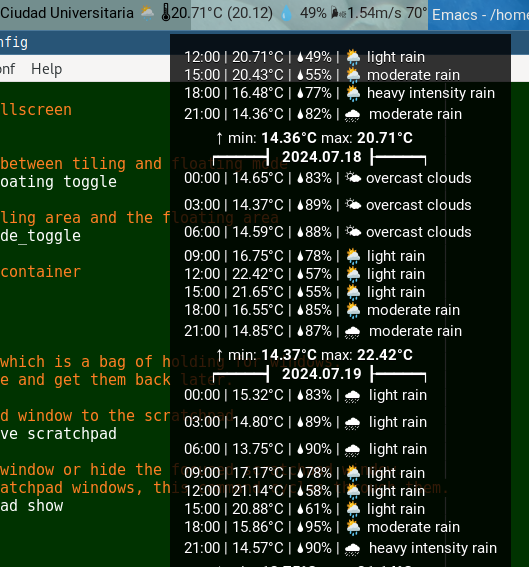
The end result? Nothing too stunning, but definitively something I find useful and even nicely laid out: Screenshot Do note that it seems OpenWeather will return the name of the closest available meteorology station with (most?) recent data for my home, I often get Ciudad Universitaria, but sometimes Coyoac n or even San ngel Inn.

Russell Coker: Samsung Galaxy Note 9 Review

After the VoLTE saga [1] and the problems with battery life on the PinePhonePro [2] (which lasted 4 hours while idle with the screen off in my last test a few weeks ago) I m running a Galaxy Note 9 [3] with the default Samsung OS as my daily driver. I don t think that many people will be rushing out to buy a 2018 phone regardless of my review. For someone who wants a phone of such age (which has decent hardware and a low price) then good options are the Pixel phones which are all supported by LineageOS. I recommend not buying this phone due to the fact that it doesn t have support for VoLTE with LineageOS (and presumably any other non-Samsung Android build) and doesn t have support from any other OS. The One Plus 6/6T has Mobian support [4] as well as LineageOS support and is worth considering. The Note 9 still has capable hardware by today s standards. A 6.4 display is about as big as most people want in their pocket and 2960 1440 resolution in that size (516dpi) is probably as high as most people can see without a magnifying glass. The model I m using has 8G of RAM which is as much as the laptop I was using at the start of this year. I don t think that many people will have things that they actually want to do on a phone which needs more hardware than this. The only hardware feature in new phones which beats this is the large folding screen in some recent phones, but $2500+ (the price of such phones in Australia) is too much IMHO and the second hand market for folding phones is poor due to the apparently high incidence of screens breaking. The Note 9 has the Dex environment for running as a laptop if you connect it to a USB-C dock. It can run nicely with a 4K monitor with USB keyboard and mouse. The UI is very similar to that of older versions of Windows. The Samsung version of Android seems mostly less useful than the stock Google version or the LineageOS version. The Samsung keyboard flags words such as gay as spelling errors and it can t be uninstalled even when you install a better keyboard app. There is a Bixby button on the side of the phone to launch the Bixby voice recognition app which can t be mapped to any useful purpose, The Google keyboard has a voice dictation option which I will try out some time but that s all I desire in terms of voice recognition. There are alerts about Samsung special deals and configuration options including something about signing in to some service and having it donate money to charity, I doubt that any users want such features. Apart from Dex the Samsung Android build is a good advert for LineageOS. The screen has curved sides for no good reason. This makes it more difficult to make a protective phone case as a case can t extend beyond the screen at the sides and therefore if it s dropped and hits an edge (step, table, etc) then the glass can make direct contact with something. Also the curved sides reflect sunlight in all directions, this means that the user has to go to more effort to avoid reflecting the sun into their eyes and that a passenger can more easily reflect sunlight into the eyes of a car driver. It s an impressive engineering feat to make a curved touch-screen but it doesn t do any good for users. The stylus is good as always and the screen is AMOLED so it doesn t waste much power when in dark mode. There is a configuration option to display a clock all the time when the screen is locked because that apparently doesn t use much power. I haven t felt inclined to enable the always on screen but it s a nice feature for those who like such things. The VoLTE implementation is apparently a bit unusual so it s not supported by LineageOS and didn t work on Droidian for the small amount of time that Droidian supported it. Generally this phone is quite nice hardware it s just a pity that it demonstrates all of the downsides to buying a non-Pixel phone.

Gunnar Wolf: Scholarly spam Wulfenia

I just got one of those utterly funny spam messages And yes, I recognize everybody likes building a name for themselves. But some spammers are downright silly. I just got the following mail:
From: Hermine Wolf <hwolf850@gmail.com>
To: me, obviously  
Date: Mon, 15 Jul 2024 22:18:58 -0700
Subject: Make sure that your manuscript gets indexed and showcased in the prestigious Scopus database soon.
Message-ID: <CAEZZb3XCXSc_YOeR7KtnoSK4i3OhD=FH7u+A5xSMsYvhQZojQA@mail.gmail.com>
This message has visual elements included. If they don't display, please   
update your email preferences.
*Dear Esteemed Author,*
Upon careful examination of your recent research articles available online,
we are excited to invite you to submit your latest work to our esteemed    
journal, '*WULFENIA*'. Renowned for upholding high standards of excellence 
in peer-reviewed academic research spanning various fields, our journal is 
committed to promoting innovative ideas and driving advancements in        
theoretical and applied sciences, engineering, natural sciences, and social
sciences. 'WULFENIA' takes pride in its impressive 5-year impact factor of 
*1.000* and is highly respected in prestigious databases including the     
Science Citation Index Expanded (ISI Thomson Reuters), Index Copernicus,   
Elsevier BIOBASE, and BIOSIS Previews.                                     
                                                                           
*Wulfenia submission page:*                                                
[image: research--check.png][image: scrutiny-table-chat.png][image:        
exchange-check.png][image: interaction.png]                                
.                                                                          
Please don't reply to this email                                           
                                                                           
We sincerely value your consideration of 'WULFENIA' as a platform to       
present your scholarly work. We eagerly anticipate receiving your valuable 
contributions.                                                             
*Best regards,*                                                            
Professor Dr. Vienna S. Franz                                              
Scholarly spam Who cares what Wulfenia is about? It s about you, my stupid Wolf cousin!

12 July 2024

Reproducible Builds: Reproducible Builds in June 2024

Welcome to the June 2024 report from the Reproducible Builds project! In our reports, we outline what we ve been up to over the past month and highlight news items in software supply-chain security more broadly. As always, if you are interested in contributing to the project, please visit our Contribute page on our website. Table of contents:
  1. Next Reproducible Builds Summit dates announced
  2. GNU Guix patch review session for reproducibility
  3. New reproducibility-related academic papers
  4. Misc development news
  5. Website updates
  6. Reproducibility testing framework


Next Reproducible Builds Summit dates announced We are very pleased to announce the upcoming Reproducible Builds Summit, set to take place from September 17th 19th 2024 in Hamburg, Germany. We are thrilled to host the seventh edition of this exciting event, following the success of previous summits in various iconic locations around the world, including Venice, Marrakesh, Paris, Berlin and Athens. Our summits are a unique gathering that brings together attendees from diverse projects, united by a shared vision of advancing the Reproducible Builds effort. During this enriching event, participants will have the opportunity to engage in discussions, establish connections and exchange ideas to drive progress in this vital field. Our aim is to create an inclusive space that fosters collaboration, innovation and problem-solving. If you re interesting in joining us this year, please make sure to read the event page which has more details about the event and location. We are very much looking forward to seeing many readers of these reports there.

GNU Guix patch review session for reproducibility Vagrant Cascadian will be holding a Reproducible Builds session as part of the monthly Guix patch review series on July 11th at 17:00 UTC. These online events are intended to encourage everyone everyone becoming a patch reviewer and the goal of reviewing patches is to help Guix project accept contributions while maintaining our quality standards and learning how to do patch reviews together in a friendly hacking session.

Development news In Debian this month, 4 reviews of Debian packages were added, 11 were updated and 14 were removed this month adding to our knowledge about identified issues. Only one issue types was updated, though, explaining that we don t vary the build path anymore.
On our mailing list this month, Bernhard M. Wiedemann wrote that whilst he had previously collected issues that introduce non-determinism he has now moved on to discuss about mitigations , in the sense of how can we avoid whole categories of problem without patching an infinite number of individual packages . In addition, Janneke Nieuwenhuizen announced the release of two versions of GNU Mes. [ ][ ]
In openSUSE news, Bernhard M. Wiedemann published another report for that distribution.
In NixOS, with the 24.05 release out, it was again validated that our minimal ISO is reproducible by building it on a virtual machine with no access to the binary cache.
What s more, we continued to write patches in order to fix specific reproducibility issues, including Bernhard M. Wiedemann writing three patches (for qutebrowser, samba and systemd), Chris Lamb filing Debian bug #1074214 against the fastfetch package and Arnout Engelen proposing fixes to refind and for the Scala compiler [ .
Lastly, diffoscope is our in-depth and content-aware diff utility that can locate and diagnose reproducibility issues. This month, Chris Lamb uploaded two versions (270 and 271) to Debian, and made the following changes as well:
  • Drop Build-Depends on liblz4-tool in order to fix Debian bug #1072575. [ ]
  • Update tests to support zipdetails version 4.004 that is shipped with Perl 5.40. [ ]

Website updates There were a number of improvements made to our website this month, including Akihiro Suda very helpfully making the <h4> elements more distinguishable from the <h3> level [ ][ ] as well as adding a guide for Dockerfile reproducibility [ ]. In addition Fay Stegerman added two tools, apksigcopier and reproducible-apk-tools, to our Tools page.

Reproducibility testing framework The Reproducible Builds project operates a comprehensive testing framework running primarily at tests.reproducible-builds.org in order to check packages and other artifacts for reproducibility. In June, a number of changes were made by Holger Levsen, including:
  • Marking the virt(32 64)c-armhf nodes as down. [ ]
  • Granting a developer access to the osuosl4 node in order to debug a regression on the ppc64el architecture. [ ]
  • Granting a developer access to the osuosl4 node. [ ][ ]
In addition, Mattia Rizzolo re-aligned the /etc/default/jenkins file with changes performed upstream [ ] and changed how configuration files are handled on the rb-mail1 host. [ ], whilst Vagrant Cascadian documented the failure of the virt32c and virt64c nodes after initial investigation [ ].

If you are interested in contributing to the Reproducible Builds project, please visit our Contribute page on our website. However, you can get in touch with us via:

10 July 2024

Petter Reinholdtsen: Some notes from the 2024 LinuxCNC Norwegian developer gathering

The Norwegian The LinuxCNC developer gathering 2024 is over. It was a great and productive weekend, and I am sad that it is over. Regular readers probably still remember what LinuxCNC is, but her is a quick summary for those that forgot? LinuxCNC is a free software system for numerical control of machines such as milling machines, lathes, plasma cutters, routers, cutting machines, robots and hexapods. It eats G-code and produce motor movement and other changes to the physical world, while reading sensor input. I am not quite sure about the total head count, as not all people were present at the gathering the entire weekend, but I believe it was close to 10 people showing their faces at the gathering. The "hard core" of the group, who stayed the entire weekend, were two from Norway, two from Germany and one from England. I am happy with the outcome from the gathering. We managed to wrap up a new stable LinuxCNC release 2.9.3 and even tested it on real hardware within minutes of the release. The release notes for 2.9.3 are still being written, but should show up on on the project site in the next few days. We managed to go through around twenty pull requests and merge then into either the stable release (2.9) or the development branch (master). There are still around thirty pull requests left to process, so we are not out of work yet. We even managed to fix/improve a slightly worn lathe, and experiment with running a mechanical clock using G-code. The evening barbeque worked well both on Saturday and Sunday. It is quite fun to light up a charcoal grill using compressed air. Sadly the weather was not the best, so we stayed indoors most of the time. This gathering was made possible partly with sponsoring from both Redpill Linpro, Debian and NUUG Foundation, and we are most grateful for the support. I would also like to thank the local school for lending us some furniture, and of course the rest of the members of the organizers team, Asle and Bosse, for their countless contributions. The gathering was such success that we want to do it again next year. We plan to organize the next Norwegian LinuxCNC developer gathering at the end of June next year, the weekend Friday 27th to Sunday 29th of June 2025. I recommend you reserve the dates on your calendar today. Other related communities are also welcome to join in, for example those working on systems like FreeCAD and opencamlib, as I am sure we have much in common and sharing experiences would be very useful to all involved. We are of course looking for sponsors for this gathering already. The total budget for this gathering was around NOK 25.000 (around EUR 2.300), so our needs are quite modest. Perhaps a machine or tools company would like to help out the free software manufacturing community by sponsoring food, lodging and transport for such gathering?

Freexian Collaborators: Debian Contributions: YubiHSM packaging, unschroot, live-patching, and more! (by Stefano Rivera)

Debian Contributions: 2024-06 Contributing to Debian is part of Freexian s mission. This article covers the latest achievements of Freexian and their collaborators. All of this is made possible by organizations subscribing to our Long Term Support contracts and consulting services.

YubiHSM packaging, by Colin Watson Freexian is starting to use YubiHSM devices (hardware security modules) as part of some projects, and we wanted to have the supporting software directly in Debian rather than needing to use third-party repositories. Since Yubico publish everything we need under free software licences, Colin packaged yubihsm-connector, yubihsm-shell, and python-yubihsm from https://developers.yubico.com/, in some cases based partly on the upstream packaging, and got them all into Debian unstable. Backports to bookworm will be forthcoming once they ve all reached testing.

unschroot by Helmut Grohne Following an in-person discussion at MiniDebConf Berlin, Helmut attempted splitting the containment functionality of sbuild --chroot-mode=unshare into a dedicated tool interfacing with sbuild as a variant of --chroot-mode=schroot providing a sufficiently compatible interface. While this seemed technically promising initially, a discussion on debian-devel indicated a desire to rely on an existing container runtime such as podman instead of using another Debian-specific tool with unclear long term maintenance. None of the existing container runtimes meet the specific needs of sbuild, so further advancing this matter implies a compromise one way or another.

Linux live-patching, by Santiago Ruano Rinc n In collaboration with Emmanuel Arias, Santiago is working on the development of linux live-patching for Debian. For the moment, this is in an exploratory phase, that includes how to handle the different patches that will need to be provided. kpatch could help significantly in this regard. However, kpatch was removed from unstable because there are some RC bugs affecting the version that was present in Debian unstable. Santiago packaged the most recent upstream version (0.9.9) and filed an Intent to Salvage bug. Santiago is waiting for an ACK by the maintainer, and will upload to unstable after July 10th, following the package salvaging rules. While kpatch 0.9.9 fixes the main issues, it still needs some work to properly support Debian and the Linux kernel versions packaged in our distribution. More on this in the report next month.

Salsa CI, by Santiago Ruano Rinc n The work by Santiago in Salsa CI this month includes a merge request to ease testing how the production images are built from the changes introduced by future merge requests. By default, the pipelines triggered by a merge request build a subset of the images built for production, to reduce the use of resources, and because most of the time the subset of staging images is enough to test the proposed modifications. However, sometimes it is needed to test how the full set of production images is built, and the above mentioned MR helps to do that. The changes include documentation, so hopefully this will make it easier to test future contributions. Also, for being able to include support for RISC-V, Salsa CI needs to replace kaniko as the tool used to build the images. Santiago tested buildah, but there are some issues when pushing built images for non-default platform architectures (i386, armhf, armel) to the container registry. Santiago will continue to work on this to find a solution.

Miscellaneous contributions
  • Stefano Rivera prepared updates for a number of Python modules.
  • Stefano uploaded the latest point release of Python 3.12 and the latest Python 3.13 beta. Both uncovered upstream regressions that had to be addressed.
  • Stefano worked on preparations for DebConf 24.
  • Stefano helped SPI to reconcile their financial records for DebConf 23.
  • Colin did his usual routine work on the Python team, upgrading 36 packages to new upstream versions (including fixes for four CVEs in python-aiohttp), fixing RC bugs in ipykernel, ipywidgets, khard, and python-repoze.sphinx.autointerface, and packaging zope.deferredimport which was needed for a new upstream version of python-persistent.
  • Colin removed the user_readenv option from OpenSSH s PAM configuration (#1018260), and prepared a release note.
  • Thorsten Alteholz uploaded a new upstream version of cups.
  • Nicholas Skaggs updated xmacro to support reproducible builds (#1014428), DEP-3 and DEP-5 compatibility, along with utilizing hardening build flags. Helmut supported and uploaded package.
  • As a result of login having become non-essential, Helmut uploaded debvm to unstable and stable and fixed a crossqa.debian.net worker.
  • Santiago worked on the Content Team activities for DebConf24. Together with other DebConf25 team members, Santiago wrote a document for the head of the venue to describe the project of the conference.

8 July 2024

Thorsten Alteholz: My Debian Activities in June 2024

FTP master This month I accepted 270 and rejected 23 packages. The overall number of packages that got accepted was 279.

Debian LTS This was my hundred-twentieth month that I did some work for the Debian LTS initiative, started by Raphael Hertzog at Freexian. During my allocated time I uploaded or worked on: This month handling of the CVE of cups was a bit messy. After lifting the embargo of the CVE, a published patch did not work with all possible combinations of the configuration. In other words, in cases of having only one local domain socket configured, the cupsd did not start and failed with a strange error. Anyway, upstream published a new set of patches, which made cups work again. Unfortunately this happended just before the latest point release for Bullseye and Bookworm, so that the new packages did not make it into the release, but stopped in the corresponding p-u-queues: stable-p-u and old-p-u. I also continued to work on tiff and last but not least did a week of FD and attended the monthly LTS/ELTS meeting. Debian ELTS This month was the seventy-first ELTS month. During my allocated time I tried to upload a new version of cups for Jessie and Stretch. Unfortunately this was stopped due to an autopkgtest error, which I could not reproduce yet. I also wanted to finally upload a fixed version of exim4. Unfortunately this was stopped due to lots of CI-jobs for Buster. Updates for Buster are now also availble from ELTS, so some stuff had to prepared before the actual switch end of June. Additionally everything was delayed due to a crash of the CI worker. All in all this month was rather ill-fated. At least the exim4 upload will happen/already happened in July. I also continued to work on an update for libvirt, did a week of FD and attended the LTS/ELTS meeting. Debian Printing This month I uploaded new upstream or bugfix versions of: This work is generously funded by Freexian! Debian Astro This month I uploaded a new upstream or bugfix version of: All of those uploads are somehow related to /usr-move. Debian IoT This month I uploaded new upstream or bugfix versions of: Debian Mobcom The following packages have been prepared by the GSoC student Nathan: misc This month I uploaded new upstream or bugfix versions of: Here as well all uploads are somehow related to /usr-move

Dirk Eddelbuettel: RcppArmadillo 14.0.0-1 on CRAN: New Upstream

armadillo image Armadillo is a powerful and expressive C++ template library for linear algebra and scientific computing. It aims towards a good balance between speed and ease of use, has a syntax deliberately close to Matlab, and is useful for algorithm development directly in C++, or quick conversion of research code into production environments. RcppArmadillo integrates this library with the R environment and language and is widely used by (currently) 1158 other packages on CRAN, downloaded 35.1 million times (per the partial logs from the cloud mirrors of CRAN), and the CSDA paper (preprint / vignette) by Conrad and myself has been cited 587 times according to Google Scholar. Conrad released a new major upstream version 14.0.0 a couple of days ago. We had been testing this new version extensively over several rounds of reverse-dependency checks across all 1100+ packages. This revealed nine packages requiring truly minor adjustments which eight maintainers made in a matter of days; all this was coordinated in issue #443. Following the upload, CRAN noticed one more issue (see issue #446) but this turned out to be local to the package. There are also renewed deprecation warnings with some Armadillo changes which we will need to address one-by-one. Last but not least with this release we also changed the package versioning scheme to follow upstream Armadillo more closely. The set of changes since the last CRAN release follows.

Changes in RcppArmadillo version 14.0.0-1 (2024-07-05)
  • Upgraded to Armadillo release 14.0.0 (Stochastic Parrot)
    • C++14 is now the minimum recommended C++ standard
    • Faster handling of compound expressions by as_scalar(), accu(), dot()
    • Faster interactions between sparse and dense matrices
    • Expanded stddev() to handle sparse matrices
    • Expanded relational operators to handle expressions between sparse matrices and scalars
    • Added .as_dense() to obtain dense vector/matrix representation of any sparse matrix expression
    • Updated physical constants to NIST 2022 CODATA values
  • New package version numbering scheme following upstream versions
  • Re-enabling ARMA_IGNORE_DEPRECATED_MARKE for silent CRAN builds

Courtesy of my CRANberries, there is a diffstat report relative to previous release. More detailed information is on the RcppArmadillo page. Questions, comments etc should go to the rcpp-devel mailing list off the Rcpp R-Forge page. If you like this or other open-source work I do, you can sponsor me at GitHub.

This post by Dirk Eddelbuettel originated on his Thinking inside the box blog. Please report excessive re-aggregation in third-party for-profit settings.

7 July 2024

Dirk Eddelbuettel: RcppSimdJson 0.1.12 on CRAN: Maintenance

A new maintenance release 0.1.12 of the RcppSimdJson package is now on CRAN. RcppSimdJson wraps the fantastic and genuinely impressive simdjson library by Daniel Lemire and collaborators. Via very clever algorithmic engineering to obtain largely branch-free code, coupled with modern C++ and newer compiler instructions, it results in parsing gigabytes of JSON parsed per second which is quite mindboggling. The best-case performance is faster than CPU speed as use of parallel SIMD instructions and careful branch avoidance can lead to less than one cpu cycle per byte parsed; see the video of the talk by Daniel Lemire at QCon. This release responds to another CRAN request, this time to accomodate compilation under C++20 with g++-14. As this was alreadt addressed upstream in simdjson it was simply a matter of upgrading to the current upstream which Daniel did in a PR. The (once again very short) NEWS entry for this release follows.

Changes in version 0.1.12 (2024-07-05)
  • Updated benchmarks now include 'yyjsonr'
  • simdjson was upgraded to version 3.95 (Daniel in #92 fixing #91)
  • Additional small update for C++20 compilation under g++-14

Courtesy of my CRANberries, there is also a diffstat report for this release. For questions, suggestions, or issues please use the issue tracker at the GitHub repo. If you like this or other open-source work I do, you can now sponsor me at GitHub.

This post by Dirk Eddelbuettel originated on his Thinking inside the box blog. Please report excessive re-aggregation in third-party for-profit settings.

Next.

Previous.