Search Results: "otto"

8 August 2011

Jaldhar Vyas: Debian GNU/Minix Erratically Timed News vol. 1

Wondering what is going on with the port of Debian to the Minix 3 microkernal? Here's an update. dpkg Ported Well, the big news as I mentioned in my last post is that dpkg has been successfully ported. I haven't sent the patches to the maintainers just yet as they need review and clean up but I will do that ASAP. The architecture name is defined as minix_i386. (There is no k because I am using the Minix libc as well as the kernel.) I am currently targetting squeeze. A Maze of Twisty Dependencies All Different Armed with my new dpkg, I have begun building packages which has been an interesting experience. The Debian packaging systems greatest asset dependencies is also its most frustrating during initial bootstrapping. Take debhelper for instance; nowadays most packages depend on it and I personally wouldn't think of creating a .deb without it but it build-depends e.g. po4a which build-depends on...debhelper. Also some programs which are assumed to be present on linux such as ldconfig are simply not available on Minix. So currently theres a lot of dpkg --force-depends and even --force-all going on. Of course this is only a temporary problem until I get a full set of base packages built. The equivs package is coming in handy too. In lieu of working .debs, I have been using Minix native packages to fill in the gaps. They use NetBSD pkgsrc which is a new experience for me. I can't say I'm that impressed but they work and, being uptodate, are a good source of patches. Works in Progress The two big packages I need to work on next are perl 5.10.1 and gcc 4.4.5. I haven't touched the latter yet. Perl is failing in its second-stage bootstrap for reasons I haven't gotten to the bottom of just yet. I suspect it has more to do with deficiencies in my build environment than a problem in perl itself. libc Deficiencies As I mentioned last time, the situation has improved tremendously since Minix switched over to using the NetBSD libc but I am still running into problems with unimplemented APIs. Take getpwent(3) and getpwuid(3) for instance. Being able to map between user ids and names is kind of important you know? Even worse instead of being completely absent some of these exist as stubs. So they compile and link without warning but always return ENOFILE and so on. I was surprised to find that there is no standardized API for getting information on mounted filesystems. (Which e.g. df(1) needs.) Linux uses getmnt(3) similar but incompatible with System V. The BSDs use getmntinfo so probably this is what Minix will implement. GNU programs are good about portability but a lot of Free software is unfortunately Linux-centric. Hopefully the Debian FreeBSD port already has patches for these cases. There are several annoyances like this but I suppose I shouldn't complain too much. I am using an unreleased version of Minix which is under heavy development and I must say the upstream developers have been good about responding to my concerns. Looking forward: fakeroot, grub2, ext2 fakeroot is a very handy development tool that frees a developer from having to create .debs as root. Alas it won't work under Minix as it depends on LD_PRELOAD and Minix doesn't even support shared libraries. fakeroot-ng sounds a bit more promising as it uses the ptrace(2) system call which is implemented in the Minix kernel though I don't know how well. Minix is now multiboot compliant so it is possible to use grub2 instead of the Minix boot loader. Definitely something I'm going to look at soon. Minix now supports ext2 (though not ext3 or ext4) in addition to its native file system. For compatability this should become the default in the Debian port. While the kernel support is part of the standard Minix system, the userland support (e2fsprogs) is not for some reason. So I'll have to see about porting that. Can I Help the Porting Effort? Sorry not yet. Though if you are determined I'll try and help you get set up. Hopefully in a month or less I will be able to distribute a pre-alpha version so I suggest waiting for that. I am definitely going to be looking for outside help.

7 August 2011

Tanguy Ortolo: Useful options of rsync

rsync logo
rsync is often used to back up systems, with options such as:
-a --archive
recurse and preserve usual attributes: symlinks, devices and special files, user and groups ownership, permissions and times;
-H --hard-links
detect and preserve hard links;
-A --acls
preserve ACLs, if you use them;
-X --xattrs
preserve extended attributes, if you use them.
In addition to these common options, rsync has plenty others, so everyone has his own recipe, but I would like to share two useful options I discovered.--numeric-ids By default, rsync uses literal UIDs and GIDs if it can find matches in both the source and the destination. That is, if you have users jacquouille (1002) on your source system Reblochon, and a user jacquouille (1005) on your destination system Neufch tel, rsync will map them: files with an UID of 1002 will be backed up with an UID of 1005. This may or may not be wanted, but anyway you must be aware of it. For instance, if you have to restore Reblochon's home directories and do that by attaching a new drive locally to Neufch tel, you will end with mixed up UIDs. This option --numeric-ids forces rsync to use numeric IDs instead of trying to map them. It is notably needed for backups of jailed systems (BSD jails, OpenVZ, VServer, lxc ) which appear to have bogus IDs when seen from their host system because they have their own ID maps. --fake-super When you back up a full system or anything that requires keeping file ownership or device information, you need to have root privileges on the destination system. Without them, rsync would be unable to correctly chown() the destination files. This option --fake-super offers a way to back up privileged information without requiring root privileges. It works by adding special extended attributes such as user.rsync.%stat containing al this information. Of course, it still requires a destination file system that supports extended attributes. This provides a good way to push system backups without weakening your security by opening a root access on you destination system. For instance, I personally use it with rsyncd running as an unprivileged user.

3 August 2011

Andrew Pollock: [life] Zoe at 15 months

Boy, the last three months have been very eventful, developmentally. First off, about 2 weeks after she turned 1, Zoe started walking in earnest. Within about 2 weeks of that there was no stopping her. It's funny to think she's only been walking for under 3 months and yet she's very stable on her feet. Secondly, she developed a mild egg allergy. Sarah was giving her some scrambled eggs (one egg's worth) for lunch one day, and she mixed in some cream cheese, and Zoe absolutely scoffed it all down, so she scrambled another egg and she scoffed that down too. She then broke out in some hives around her mouth and Sarah noticed that she was coughing a bit and a little wheezy when she put her down for her afternoon nap. Upon subsequent consultation with her paediatrician and a blood test, the allergy was confirmed and we now have to avoid eggs and Zoe was prescribed an Epi Pen Jr. We went and saw an allergist as a followup, and he did some skin tests that showed eggs were the only thing she's allergic to. He said her allergy was very mild in the grand scheme of things, and we're going to do another skin test when she's 2 to see if she's grown out of it. Eggs in baked goods are generally okay, as the offending protein is denatured at high temperatures. She's more allergic to the egg whites (1.56, which is in the "moderate" range) than the egg yolks (0.55, which is in the "low" range). Egg allergies are apparently something that one does eventually out grow, so that's a good thing. We'd also been keeping her off gluten and dairy because of a strong correlation between them and rather disgusting bowel motions. We've successfully reintroduced gluten with no adverse effects, and we've just started her back on cow's milk. We of course had our epic trip to the Grand Canyon, which Zoe handled absolutely marvelously. That was closely followed by a weekend down in LA, which was a bit more of a disaster as Sarah and I both came down with a 24 hour stomach bug that Zoe had had during the week. There's nothing quite like languishing in a non-childproofed hotel room, feeling like death, with a full of beans toddler busy running around jamming her fingers in drawers. Fortunately we were able to use a babysitter for a few hours respite, but it did rather completely mess up our plans for the weekend. Zoe did handle the drive to and from LA very well though. Zoe's been doing Saturday morning swim classes at the YMCA, which I've taken her to. I don't think she's enjoyed them as much as the indoor ones she did at the Sutton Swim School, where she went with Sarah previously, and I definitely don't feel like the classes are as structured. Unfortunately we just finished an 8 week session, and the next one filled up before we got a chance to book, so we're hoping to get back into something at the Sutton Swim School once an opening comes up. I might do something ad hoc with her on Saturdays at the Rinconada Pool in Palo Alto in the meantime. Zoe has also started going to regular daycare on Thursdays, so Sarah gets a day to focus on her University study. It's a home daycare that isn't too far away, and our friend's daughter goes there too, so there's someone she knows. The first few times Zoe got pretty upset when she was dropped off, but she barely makes a whimper now when Sarah drops her off. She's also usually down to one nap a day now. She has four teeth, top and bottom, with one molar definitely through and another three starting to make an appearance. I just bought an iBert safe-T-seat for my bike, because I've been itching to get out on the bike with Zoe on the weekends when I'm looking after her so Sarah can get some more study done. The weather is currently nice, and I've just learned about a bike trail that cuts across the bay in front of Moffett Field, so I'm keen to check that out. Apparently there's geese out there. I did my first decent ride with her last Sunday to the Mountain View Farmer's Markets and back. Zoe seemed to be okay with it. The helmet we got her drew a lot of comments from people at the markets. She's very much in the "point and grunt" stage at the moment. What's really cool is she'll nod or shake her head in response to yes/no questions. It's so cool when you can ask her a question and she solemnly nods her head in response. Often in the morning Sarah takes her to the park around the back of our home, and so now Zoe's gotten into that habit, so she'll scratch around at the front door and they head over there. The other day, Sarah opened the front door and she took off in the direction of the park, so Sarah just followed her to see where she went. Sure enough, she made her way over to the park. Tonight, Zoe fetched me my shoes and then dragged me over by the hand to the front door to demand that I take her out for a walk. She's also really getting into books now. She actively seeks out books, and has a bit of a flick through them, or brings one over and climbs into our laps, or backs up and sits in our laps if we're sitting on the floor, to have us read them to her. She's now strong enough to hold her bottle herself at bedtime, so I sit with her in my lap in the glider and read a story to her while she has her bedtime bottle. It's indescribably wonderful. She seems to understand quite a large array of words. We can go "Where's your <insert object here> and she'll look around the living room and generally find the item we're talking about. She also seems to understand questions about breakfast, lunch, going to the park, going to the bathroom, having a bath, etc as she seems to respond appropriately. In the speech department, I haven't really counted the words, but she's not saying a huge number of words. This morning, apparently she yelled "MAMA! MAMA! PARK!". "Park" being a new word for her. We bought an annual membership to the Children's Discovery Museum in San Jose, and we've probably taken her there half a dozen times or so since getting the membership. She particularly loves the water area. We finally got around to getting our back yard landscaped and made generally fit for a small child to run around in. Sarah's planted a butterfly garden in one corner, so hopefully once that's established we'll have some fun things for Zoe to watch from the window. I'm looking forward to planting some bulbs in the autumn. I expect the next 3 months will be more of the same. We've got some more overseas travel coming up, but a lot of relatives will be around, so hopefully we'll get a bit of downtime to ourselves. Zoe and I on my bike

30 July 2011

Vincent Bernat: Plot benchmark results with matplotlib

In the past week, I ran a lot of benchmarks using a Spirent Avalanche which is an appliance providing performance testing of network related products (a load balancer, a router, a web server, ). The reporting module does not provide a lot of flexibility and the plots are not the most beautiful ones. Fortunately, the results are also exported as CSV. matplotlib is a python plotting library which produces great figures without making things hard when they should be easy. It is a good replacement for GNU Plot and you don t need a lot of Python knowledge to use it. The documentation includes a fine user s guide that should get you started in less than 20 minutes.

Quick introduction You can use matplotlib from IPython to experiment:
$ ipython -pylab
Python 2.6.7 (r267:88850, Jul 10 2011, 08:11:54) 
Type "copyright", "credits" or "license" for more information.
  Welcome to pylab, a matplotlib-based Python environment.
  For more information, type 'help(pylab)'.
> In [1]: plot([1,1,4,5,10,11])
When you are ready, you can build a simple Python script:
#!/usr/bin/env python
from matplotlib.pylab import *
plot([1,1,4,5,10,11])
savefig("my-plot.pdf")

Grabbing results from CSV Data are contained into a file named realtime.csv. It contains the raw data as well as some general information about the benchmark (test name, description, paramaters ). We need to skip those. Fortunately, csv2rec() allows to load data from a CSV file into a record array and skip the first rows if necessary.
from matplotlib.pylab import *
import sys, os
import gzip
skip = 0
for line in gzip.open(sys.argv[1]):
    if line.startswith("Seconds Elapsed,"):
        break
    skip = skip + 1
ava = csv2rec(gzip.open(sys.argv[1]),skiprows=skip)
Now, the Elapsed seconds column can be accessed with ava['elapsed_seconds'].

General structure I need 4 plots:
  • successful, unsuccesful and attempted transactions per second,
  • minimum, average and maximum response time per page,
  • Avalanche CPU usage,
  • incoming and outgoing bandwidth.
The most important plot is the first one. The second one is less important and the last ones are here only to check we did not hit some bottleneck during the benchmark. We want to produce a page like this: General structure matplotlib allows to plot subfigures. We create 4 subfigures sharing the same X axis (which the number of seconds elapsed since the beginning of the benchmark). We save the result to PDF.
# Create the figure (A4 format)
figure(num=None, figsize=(8.27, 11.69), dpi=100)
ax1 = subplot2grid((4, 2), (0, 0), rowspan=2, colspan=2)
# [...]
ax2 = subplot2grid((4, 2), (2, 0), colspan=2, sharex=ax1)
# [...]
ax3 = subplot2grid((4, 2), (3, 0), sharex=ax1)
# [...]
ax4 = subplot2grid((4, 2), (3, 1), sharex=ax1)
# [...]
# Save to PDF
savefig("%s.pdf" % TITLE)

Bandwidth plot Let s start with the easiest plot: bandwidth usage.
# Plot 4: Bandwidth
ax4 = subplot2grid((4, 2), (3, 1), sharex=ax1)
plot(ava['seconds_elapsed'], ava['incoming_traffic_kbps']/1000.,
     'b-', label='Incoming traffic')
plot(ava['seconds_elapsed'], -ava['outgoing_traffic_kbps']/1000.,
     'r-', label='Outgoing traffic')
grid(True, which="both", linestyle="dotted")
ylabel("Mbps", fontsize=7)
xticks(fontsize=7)
yticks(fontsize=7)
Here, in the suplot positioned in (3,1), we plot the number of seconds elapsed versus the incoming traffic with a blue line (b-). We also plot the seconds elapsed versus the outgoing traffic with a red line (r-). Here is the result: Bandwidth plot Most functions of matplotlib are exposed as a method of the object they refer to and as a global function. In the latest case, the function is applied to the latest created figure or plotting area. For example, plot() is called a function and therefore refer to the plotting area ax4. We could have written ax4.plot() instead.

CPU plot The average CPU utilization data available in the CSV file needs to be normalized. We assume the Avalanche to be mostly idle on start. The plotting part is pretty similar to our previous case.
# CPU
max = np.max(ava['average_cpu_utilization'])
order = 10**np.floor(np.log10(max))
max = np.ceil(max/order)*order
cpu = (max - ava['average_cpu_utilization'])*100/max
# Plot 3: CPU
ax3 = subplot2grid((4, 2), (3, 0), sharex=ax1)
plot(ava['seconds_elapsed'],
     cpu,
     'r-', label="Avalanche CPU")
grid(True, which="both", linestyle="dotted")
ylabel("Avalanche CPU%", fontsize=7)
xticks(fontsize=7)
yticks(fontsize=7)

Response time We would like to plot response time. We have three corresponding metrics: minimum response time, average response time, maximum response time. Because those metrics start from 0 ms up to several seconds, a logarithmic scale is used:
# Plot 2: response time
ax2 = subplot2grid((4, 2), (2, 0), colspan=2, sharex=ax1)
plot(ava['seconds_elapsed'], ava['minimum_response_time_per_page_msec'],
     'b-', label="Minimum response time")
plot(ava['seconds_elapsed'], ava['maximum_response_time_per_page_msec'],
     'r-', label="Maximum response time")
plot(ava['seconds_elapsed'], ava['average_response_time_per_page_msec'],
     'g-', linewidth=2, label="Average response time")
legend(loc='upper left', fancybox=True, shadow=True, prop=dict(size=8))
grid(True, which="major", linestyle="dotted")
yscale("log")
ylabel("Response time (msec)", fontsize=9)
xticks(fontsize=9)
yticks(fontsize=9)
This is also the first graphic with a legend. Response time plot

Transactions per second The most important plot is the number of transactions per second.
# Plot 1: TPS
ax1 = subplot2grid((4, 2), (0, 0), rowspan=2, colspan=2)
plot(ava['seconds_elapsed'], ava['desired_load_transactionssec'],
     '-', color='0.7', label="Desired Load")
plot(ava['seconds_elapsed'], ava['successful_transactionssecond'],
     'g:', label="Successful")
plot(ava['seconds_elapsed'], smooth(ava['successful_transactionssecond']),
     'g-', linewidth=2)
plot(ava['seconds_elapsed'], ava['attempted_transactionssecond'],
     'b-', label="Attempted")
plot(ava['seconds_elapsed'], ava['aborted_transactionssecond'],
     'k-', label="Aborted")
plot(ava['seconds_elapsed'][:-1], ava['unsuccessful_transactionssecond'][:-1],
     'r-', label="Unsuccessful")
legend(loc='upper left', fancybox=True, shadow=True, prop=dict(size=10))
grid(True, which="both", linestyle="dotted")
ylabel("Transactions/s")
The number of successful transactions is plotted twice: when the benchmarked equipment becomes overloaded, we get a lot of noise in this metric and it can be difficult to read. Therefore, we plot a smoothed version with the help of NumPy:
import numpy as np
def smooth(x, win=4):
    s = np.r_[x[win-1:0:-1],x,x[-1:-win:-1]]
    w = np.ones(win, 'd')
    y = np.convolve(w/w.sum(),s,mode='valid')
    return y[(win-1)/2:-(win-1)/2]
np.r_() is just here to extend our data by the size of the window. np.ones() build a weight vector of the size of the window. If the window is 4, we get [0.25, 0.25, 0.25, 0.25]. We use this vector to apply a convolution to the original data. Here is the result: Transactions plot The original data is a green dotted line while the smoothed one is a green thick line. What about the three annotations? matplotlib allows to put annotations on a figure. Here is how this is done:
# Noticeable points
count = 0
def highlight(index, reason):
    global count
    if index and index > 0:
        x,y = (ava['seconds_elapsed'][index],
               smooth(ava['successful_transactionssecond'])[index])
        plot([x], [y], 'ko')
        annotate('%d TPS\n(%s)' % (y,reason), xy=(x,y),
                 xytext=(20, -(count+4.7)*22), textcoords='axes points',
                 arrowprops=dict(arrowstyle="-",
                 connectionstyle="angle,angleA=0,angleB=80,rad=10"),
                 horizontalalignment='left',
                 verticalalignment='bottom',
                 fontsize=8)
        count = count + 1
highlight(np.argmax(smooth(ava['successful_transactionssecond'])), "Max TPS")
highlight(np.argmax(cpu > 99), "CPU>99%")
highlight(np.argmax(ava['average_response_time_per_page_msec'] > 500), ">500ms")
highlight(np.argmax(ava['average_response_time_per_page_msec'] > 100), ">100ms")
np.argmax() returns the index of the first maximum value. The trick here is that when I write ava['average_response_time_per_page_msec'] > 100, I get an array with 1 when the value is more than 100 and 0 otherwise. Therefore, np.argmax() will return the first index where the value is superior to 100 ms. The highlight() function will add a point (plot([x], [y], 'ko')) on the smoothed successful transactions par second plot and add an annotation with some fancy arrow. Look at this benchmark of nginx as SSL termination for a complete output of this script.

26 July 2011

Benjamin Mako Hill: Lawn Scrabble

The Acetarium, where I live, runs what we like to think of as the world's smallest artistic residency program by hosting artists, social scientists, hackers, and free software and free culture folks for periods of 1-3 months. Our most recently graduated resident, Noah, built a lawn scrabble set on the Media Lab ShopBot and held a Scrabble picnic this weekend with some former Acetarium residents and others. I don't really like playing Scrabble, so you can see me working on an essay (and verifying words) in the background. /copyrighteous/images/lawn_scrabble_01.jpg

/copyrighteous/images/lawn_scrabble_02.jpg Thanks to Ben Schwartz as I yoinked these pictures from his blog.

24 July 2011

Tore S. Bekkedal: Ut ya: English version

If a single man can display so much hatred
think only of how much love we all can display together.

Stine Renate H heim

I wrote a Norwegian post explaining my experience at Ut ya. I had taken this blog for dead, and had entirely forgotten that it was syndicated on Planet Debian. I don t want to let Google Translate make this disaster any worse than it is the translation of bullets into balls being particularly bad so the international attention the massacre has garnered in consideration, I am writing an English translation of my experiences. I feel somehow duty-bound to make people aware of what happened, but I don t want to get into anything else but a sober description of the events and some very brief reflections. There are many details I have chosen to omit. Others have written their experiences of the events at Ut ya. I wanted to write mine down as well, and get it out there . Partly, I want to write this down because I m unsure if I will remember all the details at a later point in time, although I think I d prefer it if I couldn t. I m also writing this because people are asking about my experiences and it s much better to have an URL to give them, lest I have to keep going through the same spiel over and over again. Our former Prime Minister and current labour movement demigod Gro Harlem Brundtland had recently left the island. I had been the cameraman for a video interview of her talking about Ut ya, and I was in the media group room encoding the video into a file suitable for YouTube, when someone else in the room startled and said that Twitter was full of messages about a loud explosion in Oslo. As the newspapers brought us information about the extent of the damages, a consensus arose that an informational meeting was in order. As soon as the current round of talks finished, we were gathered into the main hall. The meeting was duly held, and after the statement was made that a TV feed would be made available, I took it upon myself as the local alpha geek to make it happen. Of course, the situation caused both the wireless network and the GPRS networks to become totally unusable. As I was waiting for someone to set up a password, I took the opportunity to face the consequences of having eaten two bits of a microwavable dish called Hold-It the local equivalent of a Hot Pocket and went to the toilet. As I was in there, I first heard agitated shouting, then screams, then gunshots coming from just outside the toilets. More than anything else, it sounded like a toy gun. I was convinced that someone was making a joke in incredibly bad taste and I stormed out of the booth with the intent of halting it. As I tore the door open, I saw two of my comrades hiding in a recessed corner. Their facial expressions left absolutely no doubt that this was no toy. They signalled for me to get back in the booth. I closed the door, did a mental double-take in utter, complete confusion, and opened it again. They were still signalling. Had they not stood there, I would have run straight into the gunman; they saved my life. I looked out into the hallway, and I made eye contact with a young boy lying in a pool of blood. He was motioning for me to help him. I heard more gunshots from inside the building and retreated back inside. As I was trying to think through my next move, I realized that the decidedly insubstantial wood-fiber door would not resist any kind of bullets. I made my way out into the hallway, with the intent of escaping outside. At that point, I was of course not aware that there was an intention to kill as many as possible, so I thought that the open spaces outside would be a place of relative safety. Of course, this proved to be wrong and my life was probably saved a second time by one of the caf volunteers taking me into a hard-to-spot employee s bathroom. We sat there for ninety minutes. Always ready to make a run for it, ready for just about anything. A peculiar group dynamic arose with these two people with whom I had barely previously spoken. We came to share a strange sense of common destiny and gallows humour. One of them had seen the shooter and described the police uniform. I perceived it to be realistic that we were the only ones aware of the wounded outside the toilet. I tried to reach the emergency services, but all their lines were busy; the terror attack in Oslo had probably clogged their lines. I finally got through to the fire services, who could inform me that the police did know about the situation and were on their way. This was to take 90 minutes and by the time we evacuated, the young boy outside my door had perished. The despair I first saw in his eyes as I passed him, fleeing from one room to the other and the empty, blank stare as we left, are burned into me and they are images I will never in my life forget. Finally, the real police arrived. We walked out. I chose the path through the minor conference hall something I now regret. The sight was simply beyond my capacity to describe fully, and so terrifying that I barely remember the sight only the terror it struck in me. There were several people bunched up in a corner, a big amorphous heap of bodies. Some were conscious and yelled at me not to do anything that could startle the police, others lay still. Their bodies were all covered in blood, and a thick pool of blood extended at least a half-metre in all directions around them. The policeman across the hall was screaming orders at me, but he was screaming so loudly that I couldn t make out his words at first. We were first moved into the camp newspaper s offices. There were about eight of us there, I think, in addition to one girl who lay wounded. Towards the end she was drifting in and out of consciousness. We covered her with sweaters to keep her warm and one of us tried to at least temper her bleeding. The bullet had missed her heart, but by the entry wound it was clear that it was not by far. I do not know who this girl was or how she is now. I sat behind and never saw her face. The wounded were evacuated first. I don t remember how long we remained; I had lost all concept of time. In spite of protests from the group who knew him, one kid was put in handcuffs. At the time I didn t understand why, and the policeman seemed to say something almost to the effect that there was no reason for it at all. I didn t see when they undid his cuffs, but I remember thinking that this treatment made a terrible experience even worse for him. I tried my best to comfort him but knew it would be little help. Later, when things stabilised a little, we were told that he was handcuffed because he had come from an unsecured area. The police was extremely good at carefully explaining what was happening and why; this was a big help and I am grateful for it. Eventually we were moved out into the main corridor of the building, where we joined up into a group of about fifty. Only when I saw the two people who saved my life did any emotion other than mild confusion arise. I broke down shivering in tears in one of their arms. After a few seconds, I came back to my senses and realised that this was not the time. I quickly gathered myself, got the shaking under control, and sat down. We were given some chocolate and soda from the kiosk. I remember making an offhand remark that an inability to find joy in free candy was a sure sign of a bad situation. We all laughed out loud. Gallows humour is a coping mechanism, but in retrospect one almost feels guilty for it. We were shown out in a single file with hands above our heads. I remember an intense concern that someone would slip in the steep, muddy slope and create a misunderstanding. Outside, there were more bodies. Some under improvised covers a tarpaulin from the waffle stand, the deflated bouncy castle but some simply lay there. Everyone I met displayed a courage, a mental discipline and unity of purpose far beyond anything one would ever wish to expect from people this young. Everyone conducted themselves with an attitude that could almost be described as stiff upper lip . Safely across the fjord we were offered blankets. I was asked if I was aware of any injuries, and asked to lift my shirt and show my abdominal region. We were shown into the bus which took us to the hotel used by the survivors and their family. I simply cannot describe in any words the relief I felt when I was able to embrace my living comrades. It was completely unlike anything I had ever felt before in my life. The euphoric feeling was tempered only by the realisation that there would be many I could never see again, comrades whom I had taken great pride in calling my friends, with futures in the service of all mankind, futures I had previously found such great joy in pondering and guessing about. The feeling which continues to upset me the most, is the feeling that so many of my comrades left behind grieving families and friends. Torn away senselessly. I do not know how much more than this relatively sober account of the events on Ut ya I can muster. I would, however, like to offer some reflections. First of all, from the bottom of my heart, I want to thank the police who saved the lives of so many still on the island, the holidaymakers who took aboard swimmers into their boats and the rescue services staffed primarily by volunteers who have spared no effort in trying to soften the blow as much as they can. The opportunity to spend time with those comrades who underwent the same experience as myself has also been an immeasurable aid. I was also so relieved to find my very closest friend among the survivors, which has also been an indescribable help. If I can name a single positive in this tragedy: Had he arrived with his automatic weapon fifteen or twenty minutes prior, he would have arrived during the informational meeting, at a time when the major hall was absolutely jam-packed the death toll would be many times what it ended up being. I am agonisingly aware of the meager comfort this provides to those who have been bereft of their closest, but I do find some solace in this. We cannot sweep under a rug that this was without question! a political attack on the labour movement. But it is thankfully also an attack which has been perceived by everyone as an attack on the Norwegian society, and on a symbol of the wide recruitment to the participatory democracy which lies at our very national soul. I cannot thank the Norwegian people, and indeed the people in other nations who have offered their condolences, enough for their shows of support and shared grief. It really has been a tremendous help to me knowing that so many people feel with us. I also want to thank from the bottom of my heart the rock-steadiness of everyone in both the national and local wings of the Labour Party and Labour Youth in supporting us, and the political milieu in general for their resolute steadfastness saving me from losing yet more that I cherish; our freedoms in a participatory democracy. Our Party has lost many of its very brightest youngsters. Personally I feel an angry spite, a deep restless urge to get the wheels of society going again. I want to show his kind that we will not be broken. We re stronger than that. I will not be frightened into silence and passivity. I want to remember the dead, and honor them by carrying on our common work. I want to end this with a request to everyone who reads this, echoing a statement I read by one of my good friends and comrades: Please, don t let me see any messages of hatred, wishes for the death penalty, anything like that. If anyone should be of the belief that anything will improve by murdering this sad little person, they would be profoundly wrong. All attention now should be plowed into caring for those victims and their relatives who did not share my luck, and not giving an audience to a perpetrator who wants one. Tore Sinding Bekkedal

20 July 2011

Andrew Pollock: [life/americania] 4th of July in the Grand Canyon

Our adventurous friends Eric and Katie had invited us to join them on a hike in the Grand Canyon over the 4th of July weekend. As this struck us as something we'd never have considered doing otherwise, we thought we'd accept their kind offer. We're so glad we did. It was quite a bit of traveling just to get there. We flew out of San Jose on Thursday night, got into Las Vegas, rented a car, and then drove to Peach Springs, Arizona, where we stayed the night. We didn't get in at the Grand Canyon Caverns Inn until around midnight, and we had to get up again for a 5:00am departure (I think we actually got away by more like 5:30am), to drive to the Hualapai Hilltop, where the trail head was. Zoe handled all of this very well. She didn't end up falling asleep in the car until about 10:30pm I think, and dealt with the transfer out of the car at midnight very well and went back to sleep. The drive to the Hualapai Hilltop, along Indian Road 18, took about an hour. We had to dodge a bit of livestock on the road. The road itself was sealed and of good quality. We remarked on the way back out that as soon as you left the Havasupai Reservation and entered the Hualapai Reservation that there was a distinct degradation in the quality of the road. We parked at the Hilltop, and got ourselves organised, and commenced our descent by about 7:10am. The first 1.5 miles was very steep. There were a bunch of switchbacks and there was a fair few people coming up the other way already. There were also a few mule trains coming in the opposite direction that we had to dodge. The mule trains have right of way, so we had to stop and get out of the way to let them pass. Zoe thought they were pretty cool because they invariably had a few dogs with them as well, and she thinks dogs are awesome. The remaining 6.5 miles (it was an 8 mile/13 kilometre hike in total) were fairly easy. There was a lot of variety in terrain. Rocks, sand, dirt. It wasn't all in the sun, which was made it more comfortable. Heat wise, I think it was in the high 30's Celsius, with pretty much no humidity, so it didn't feel too uncomfortable. Towards the end, as we got near the water, there was a distinct change in the canyon. There was more greenery, and we started hearing insects and seeing bird life. When we first saw the water, it was hard not to just jump in, it looked so inviting. The total hiking time was about 4 hours 45 minutes, which included a reasonable stop to give Zoe some breakfast. We arrived in the village at around midday. Unfortunately the lodge wasn't ready for check ins until 1pm, so we had to twiddle our thumbs for a little bit. Zoe handled the hike incredibly well. We used a Macpac Possum child carrier that Nigel had passed down to us, and she didn't complain the whole time. She even took a nap in it. We were very relieved that it wasn't a problem for her. Sarah carried her, and I carried everything else. (I'm so glad I didn't see the photo of how I looked until well afterwards). In hindsight we probably brought too much stuff, but we didn't really know what to expect down there, so we'd rather have too much than too little. The village completely exceeded my expectations. I had this (silly) mental picture of it being just the lodge and not much else, but somewhere between 450 and 700 people live in the village. It had two general-type stores, a cafe that was pretty much like a fast food/takeaway place, an elementary school, and some sort of basic medical clinic. There was also a small general purpose community centre of some sort. The main store had pretty much everything you'd need in the food department. The cafe frequently ran out of various different things, but you weren't going to go hungry. For the remainder of Friday, we just stayed put in the village and let Zoe stretch her legs. Eric and Katie and their kids explored the first set of falls down from the village, unofficially named Rock Falls. On Saturday, we all hiked down to Havasu Falls. We met a couple of other families (amusingly both from the Bay Area) along the way, so we had some interesting conversations. I have no idea how long the hike was. Havasu Falls was impressive. Quite tall and narrow at the top, and quite loud. Zoe was impressed. We took her for a bit of a swim in the pools in the bottom. We had lunch there, and then Zoe and Sarah stayed there (Zoe took a nap in the KinderKot (also courtesy of Nigel) in the shade by the falls, and I took the Macpac with a water bladder in it to refill it at the spring in the campground, which was further down stream, and to check out Mooney Falls with Eric and Katie (and their kids), which was further downstream again from the campground. Mooney Falls was pretty insane. A lot taller than Havasu Falls, and a lot more treacherous to get to the bottom of. Parts of it were vertical. Chains and rickety ladders were involved. Caves were involved. I'm so glad I didn't have Zoe in the Macpac, because on multiple occasions, the top of it got bashed into rocks, so without having Sarah with me also to act as a guide, there's no way I could have safely descended with Zoe in the backpack. My favourite photo illustrating how crazy this was is this one that I took of Eric and Katie. This photo highlights some of the craziness involved to get down. I pretty much got to the bottom, had a quick look around and left Eric and Katie to it, because I figured Zoe would have woken up by now, and was probably bored. Turned out I had all of the sunscreen with me as well. So I climbed back up, and trekked back to the campground, refilled at the spring, and headed back up to Havasu Falls. After we reunited, we then hiked back up to the village, which to be honest, was the hardest bit of hiking we did. I was carrying Zoe in the Macpac, and it was hot, and it was mostly loose sand all the way. We were very glad to get back to the village. Zoe started showing signs of coming down with a cold and a cough, so we decided to cut short our stay in the village and leave on Sunday instead of Monday. We'd been tossing up between getting a helicopter or horses out. We ended up opting for the helicopter after learning that the horses still took about 3.5 hours, and you basically had no control over the animal. We were dubious as to how Zoe would go being bounced around on the back of a horse for that long. The helicopter ride also took all of about 5 minutes. The tribal members get first dibs on the helicopter, and there had been a death in the village, and I think a lot of people had come to the village for the viewing (the casket itself was flown out earlier on Sunday morning for a burial out of the village), so I suspect there was a higher number of tribal passengers than usual. We didn't get out until 2pm. Again, Zoe was incredibly good. She just hung out with us while we waiting for a flight out. There were plenty of dogs for her to be entertained by, and some other kids. She also took a pretty decent nap. So we finally got out, and got back to our car, and then the heavens opened. It absolutely poured down with rain. Sarah was keen to check out Hoover Dam, so we decided to stay near Boulder City in Nevada, and got a suite in the Hacienda Hotel and Casino for cheap. The next day was the Monday public holiday for Independence Day, and we were tossing up whether or not to take Zoe to a doctor to get her checked to see if she had bronchitis (we've been a bit gun-shy about bronchitis since the time she came down with it when we were in Australia). She ended up falling asleep in the car while we were hunting around for an Urgent Care facility that was open, so we decided to let her sleep and drove to Las Vegas. After she woke up, we took her to see the flamingos at Flamingo and the lions at MGM Grand. Zoe absolutely loved all the lights, sights and sounds of Las Vegas. In the afternoon, we took her to a doctor, and got the "first child, huh?" from the doctor (she didn't have bronchitis). After that, we went and briefly checked out Hoover Dam (just walked half way across the bridge in front of it and walked across the dam itself). The following day, we packed up and spent the morning on the Las Vegas strip again. This time we went to the Venetian (Zoe thought the gondolas were pretty cool) and then we flew out in the afternoon. So it was a lovely little family vacation. We ended up spending about as much time in Las Vegas as we did in the Grand Canyon, but that was okay. I'd really like to go back to Supai again, but I'm not sure if the stars will align themselves appropriately. If we did, knowing what I know now, I'd take a lot less food and put all of the luggage on a horse, and just hike in with the minimum of stuff. I'd probably be game to hike out as well if the bulk of the luggage was on a horse. Photos from the trip are here.

4 July 2011

Nathan Handler: Google Summer of Code Report #3

Since my last report, a lot of visible changes have been made. First, if you edit the value of any of the text inputs on the dashboard table, your changes will be saved when you hit the submit button. This feature still needs a bit of work though. For example, I noticed during testing that if you submit the form multiple times, you will sometimes end up with approximately duplicate entries in the changes file (the file that stores user-submitted changes to the table). I also need to implement some checks to ensure that the values submitted are actually valid (i.e. we probably only want to allow a few possible values for the status column). Another big improvement is the addition of a graph at the bottom of each project s page. This graph tracks the number of open tasks versus time. The graph is re-generated once each day based on a progress file. This file simply lists a date and the number of open tasks on each line. While the graph does correctly show a line tracking the progress, it still has some issues to sort out. For example, the x-axis does not properly display a time increment. Work on the graph was blocked for a while due to not having a fully-functioning dashboard. Now that the dashboard is functioning, I should be able to start working on fixing these graph issues. Several people approached me to request the ability to link directly to a particular project. That way, users do not need to mess around with the select boxes. Above each table is a title. If you click on the title, the URL should update to link directly to the project. This is done with the distro and project query parameters. For example, a link to dex.html?distro=ubuntu&project=ancient-patches will take you directly to Ubuntu s ancient-patches project. Attempting to specify an invalid distro or project will cause the query parameters to be ignored. While looking at the table title, you will also notice a new (Graph) link. This link will take you directly to the bottom of the page so you can view the graph. Currently, it is not possible to link directly to the graph anchor tag of a specific project. Attempting to do so will cause the #graph portion of the URL to be ignored. However, if you click on the actual graph, it will load a full-size graph.png that you can link to. One rather significant issue that has shown up is that the table is very wide. On most monitors, you will have to scroll horizontally to view all of the columns. This is due to the fact that most of the cells are made up of text inputs (they don t have a background or border, but if you click on some text in the table, you should see the box) rather than plain text. The size parameter for a text input was meant to specify how many characters should be visible. However, while I have the size parameter set correctly for each input, it is showing up much wider than the text. I will continue to play around with this, since excluding the size parameter results in some values getting cut-off. As mentioned in my last report, I have continued to work with Allison Randal to make the dashboard more useful. I have received feedback directly from her and indirectly from other people working on the python2.7 project. During my last phone call with my mentor, Stefano Zacchiroli, we agreed that it would be very helpful to spend some time documenting how to go about adding a new project to the dashboard and how to utilize all of the dashboard s features. The goal of this is to not require people to go through me or any other individual to be able to use the dashboard. So while the Summer of Code is meant to focus on programming, I will probably spend some time adding some documentation, as a program is rather useless if nobody knows how to use it. Another bug that I will be working on has to do with sorting the table. I had this feature working early on in the project. However, the sorting broke when I starting using text inputs instead of plain text. I have done some research, and I hope to get the sorting re-implemented in the near future. One other feature that has been requested by several people is the ability to hide completed tasks. This has been on my todo list for a while. Matt Zimmerman wanted to take this a step farther. He felt that the status of the task should be separate from the bug. This means that you can have an open task with a closed bug or a closed task with an open bug. The user could then have some more control over what data they are seeing. I will probably attempt to add some check boxes to control whether certain information is displayed. The user will also be able to specify this directly in the URL. This means that a team could link directly to all open tasks in a project. It is also worth noting that thanks to some help from the fantastic Alioth admins, I now have a live instance of the dashboard running on Alioth. While the URL might change in the future, I hope to keep it running on Alioth. If you are interested in helping out with DEX or dextools, my code is available in a git repository on alioth. You can also join the debian-derivatives mailing list, join #debian-derivatives on OFTC, or contact me directly via email or on IRC (nhandler).

30 June 2011

Rapha&#235;l Hertzog: How to start contributing to Debian?

I often get requests of persons who would like to contribute to Debian but who don t know where to start. Let s try to answer this question properly so that I can give out this URL the next time that I am asked. The Debian website has a page explaining how to help Debian. While it provides no less than 10 suggestions in a daunting text-only list, it s difficult to know what to do next once you picked up something that you could do. I will try to fix this by providing concrete information for each cases in upcoming articles but in the mean time I propose you another approach to start with. Before answering your question ( what can I do for Debian ), we need to know some information about you. What motivates you? You re a volunteer, you re not doing stuff for Debian because someone told you so. You must have some intrinsic motivation and the ultimate motivation is usually that you re enjoying what you re doing. So what are you enjoying and/or what are your motivations ? On the opposite, make sure to know what you hate and what you want to stay far away from. Maybe you dislike a programming language so much that you don t want to be involved in a project where you would have to use it, etc. Write down the answers to the questions, you might need them later when you ll ask other Debian contributors how you can help. What are your skills? If you re not interested in learning new skills, then you must obviously select a task where your current skills are sufficient. Again make a list of your skills and in particular of skills that you d like to practice! Here s a non-exhaustive list of skills to consider: How much time can you spend on Debian? This is the last important information that you need to communicate whenever you re asking someone else what you could do for Debian. There s no point giving you a big task if you can only spend 30 minutes every week. On the opposite if you can work on Debian full time during a week (because you re between 2 contracts or because you re in vacation), it s equally important to know. In general contributing to Debian requires time, you should be ready to spend at least several hours per week and possibly more at the start while you re learning everything. Find something to do At this point you have a generic idea of what you d like to do but you re still missing a concrete objective. Let s try to find one, we ll explore several ways to do this. Scratch your itch The best objectives are those that satisfy your own needs. Here are some examples: If you re a good Debian citizen, you have already filed bugs for issues that bugged you. Then you can browse http://bugs.debian.org/from:hertzog@debian.org to find out some ideas of stuff to do (obviously replace hertzog@debian.org by your own email address). Join a team If you don t have a specific itch to scratch, you might want to focus your work on a specific team. Head over to wiki.debian.org/Teams and browse the list of teams. You ll surely find one that works in an area that you like. If you select a packaging team, pick one that works on packages that you re actually using. Some of the teams have instructions for newcomers, follow them when that is the case. Otherwise join the mailing list and the IRC channel, and get a feel of how the team works. See if it suits you, you can follow several teams at the same time and pick the one that you prefer after a few days/weeks. Once you have lurked a bit, if you still don t know how you could help, then just ask on the mailing list. Include all the answers you have collected to the 3 questions on your motivations, your skills and your time available. Focus on a specific package You can concentrate your work on a specific package even if you re in a team, it s often a good idea. But I list it separately because not all packages are team maintained and you might want to help maintain a package where there s a single maintainer currently. I leave it up to you to find a way to select a package that interests you Then head over to the package tracking system: http://packages.qa.debian.org/dpkg (replace dpkg by the name of the package that interests you) Fill in the form in the bottom-left corner with your email and select opts in the drop-down list, then click go . You get a new form where you can select the information that you ll receive, I recommend you to keep everything except upload-binary and to validate the form. From now on, you get the same mails than the maintainer (and a bit more actually), and it s a good idea to inform the maintainer that you subscribed and that you re going to help a bit. Maybe he s willing to grant you commit rights immediately, maybe he will ask you to send patches for a start. The important thing is to create a good relationship. In any case (even if you did not get any answer from the maintainer), you should be free to help triage existing bugs and to help deal with the flow of incoming bugs (including forwarding bugs when appropriate). Help a Debian developer Paul Tagliamonte once blogged Hey, DDs, need help?. He offered his help to overworked Debian developers . His post was missing all the information required (cf motivations/skills/time) but the approach is a good one. The best way to start contributing is to work with existing Debian developers. Even if you just want to be sponsored for your own pet package, you should consider that mentoring is a burden for many Debian developers and that you re more likely to get a sponsor if you have an existing relationship with a Debian developer that you helped. Pick a developer that works in an area that is of interest, and offer him your help. To simplify things even further, I have created a wiki page where you can find out how you can help me and thus build a relationship with me. That s it for now, I hope this article will help you to start contributing. Don t forget to subscribe to my newsletter to not miss future articles for new contributors. Note that you can refer to this article with the following URL: http://raphaelhertzog.com/go/contributing/ (easier to type and remember).

13 comments Liked this article? Click here. My blog is Flattr-enabled.

27 June 2011

Riku Voipio: QEMU with OpenGL ES acceleration

In the graphics side, the major differences between ARM and X86 systems is that on ARM 3D acceleration is done with OpenGL ES. It is mostly a subset of modern OpenGL used on X86 desktop machines. From QEMU point of view this could mostly be ignored, as OpenGL was mostly used on games and specialist applications. This has now been changing, as desktops and user interfaces have started OpenGL to render graphics. Without acceleration, these user interfaces become slower than slugs crossing a tarpit.

For this reason, MeeGo introduced OpenGL ES acceleration support to QEMU. With the lack of easily available MeeGo QEMU images and test setup, I've created a test setup for Linaro 11.05 image.

Running torus opengl es1 demo from mesa-demos inside QEMU.

23 June 2011

Philipp Kern: I'm going to DebConf 11

I finally got around to book my (train) trip back from Zagreb. The hotline of Deutsche Bahn was interesting. The booking system crashed and I was called back. But in the end it worked and I can print it the next time I get near a vending machine.

I'm worried how I manage to get there from Banja Luka on my own. And the travel to Zagreb together with Joachim Breitner won't be as comfortable as it should be. But meh, I'm going to DebConf again! \o/

10 June 2011

Neil Williams: Putting the magic smoke back into the ring main

Haven't been in my new home that long and through a long chain of contacts, my neighbour was finally able to contact me. (Just goes to show that having Debian friends nearby who like board games turns out to make some things JustWork.)
So, when I got the message and got home the flat was fine - just with no electrical power. Murphy's Law ensured that my laptop was also low on power, as was my mobile phone and my landline is cordless and the router was, naturally, not working. My communication options were suddenly rather limited.

The 50yr old wiring in this block finally surrendered the magic smoke and caused a fire downstairs (mostly melted insulation) before it disconnected. I got home around 1pm, electricians to fix the problem arrived about 5pm and haven't finished quite yet. (It's now 12:11am). A relatively large hole in the lawn was dug (a hard task in itself seeing as this area is officially in a drought and the ground is like iron), two junction boxes rebuilt, new connection made from downstairs to upstairs, the work just went on and on.

I'll get some accurate details when I manage to speak to my brother - I do a little bit of hardware but I deal in 1W or a few hundred mA, when a 80A cable melts I'm just a bit out of my depth. I've not seen a fuse that size since I left school.

Thanks to those Debian and non-Debian people who helped me actually contact the relevant people today. I was due to get so many things done today, instead I got through the worry to end up incredibly bored - it turns out to be surprisingly difficult to find things to do when there is no mains power, all the batteries in mobile devices are flat and it's too dark to read.
:-(

2 June 2011

Joachim Breitner: Satire on Gender Issues at IIT Bombay

IIT Bombay, like most likely most Indian educational instituates, has some rules and regulations about the interaction between boys and girls that, at least to the uninitiated eye of a foreigner who was brought up in a liberal society, seem arbitrary and archaic. At IIT Bombay, for example, there may be no visits in hostels by students of the other gender (yes, there are separate boys and girls hostels) between 10pm and 7am, and during the day any such visit has to be registered at the reception security guard. And when there was need for more room for girls and they reassigned one wing of a boys hostel to the adjacent girls hostel, they closed the connection by bricking it and split the lawn by a fence. With barbed wire on top. I took this as a theme for a satirical inspection of these policies which comes to the conclusion that IIT Bombay is a very progressive institute that puts these rules in place as affirmative action towards same-gender relationships. After some discussion with the editors the text got actually published in the institutes bi-monthly newspaper Raintree , unfortunately only now, two weeks after I left India. You can read the text on the bottom of page 8 in the 6MB PDF file. I cannot predict how it will be received, but at least Utkarsh Raut, who illustrated the text, clearly got the message right. Thanks for the nice and very fitting drawing!

31 May 2011

Jamie McClelland: We need better metaphors

Most of us developers use metaphors to help convey an understanding of how our software works. Sadly, many developers choose the "master" and "slave" metaphor. Why would we voluntarily choose such an ugly human human interaction with a real and present history in many of our lives to describe software that we've written? I wouldn't rule out the possibility that someone will (or already has) invented software for which the master/slave metaphor aptly conveys its function, however, I'd prefer not to use it. Also, many people intentionally play with master/slave relationships because of the history and connotations it provokes. However, use of this metaphor in software like MySQL databases or Bind Name servers seems pointless, offensive and mis-leading. I've never seen the use of the master/slave metaphor in software that conveyed more than the idea that one piece of the software essentially controls, wholly or in part, another piece of software. So, why master/slave? There are many metaphors to choose from - parent/infant, boss/worker, guard/prisoner, king/subject, landowner/serf, top/bottom, etc. What does master/slave convey that the others don't convey? Or, maybe they all convey the same thing, so it doesn't make a difference which one you choose (after all, it's just a metaphor). In that case, how about replacing master/slave with the metaphor husband/wife? Whoops. Now that's offensive (if you don't think that's offensive you can stop reading here and please don't post any comments - I won't change your mind). But, that's different right? At one point in history, the role of the wife was to do as her husband says, but it's 2011, and we've evolved beyond that, so by using husband/wife we'd be re-enforcing that ugly, sexist stereotype. However, how is that different from master/slave? It is 2011 after all. Isn't the role of the master to abdicate and the role of the slave to revolt? Maybe that's why Bind has so many security problems...

30 May 2011

John Goerzen: War and Peace

I doubt I have ever read a book that had as significant an impact on me, and my act of reading it had on others, as this one. Conversations like this were frequent: Someone, upon seeing me reading my Kindle, would ask what I am reading. War and Peace. Oh. . . uhm, wow. Yeah, it s great. I m reading it for fun. Uhm, OK then, see you later. . . It seems to be so revered, and also so loathed, that I had to read it. At 1400 pages, it took me 8 months to finish, though I read several other entire books in that time. I feel rather unequal to the task of expressing how this book impacted me, let alone a review of it. And nonetheless, I also feel I would be remiss if I let it go past saying nothing. I was struck by so many things as I read War and Peace. Some of them I won t mention here and hope to turn into their own blog posts. Of the others, I felt I gained some sense of how the nobility and serfs in Russia (and, to a certain extent, Europe) thought about life, their position, and how things ran. Being a modern Kansan, this thought process was not familiar to me, and though I head read about it in history texts before, felt far more informed having read it in Tolstoy s novel. Although much of the novel centers around Napoleon s invasion of Russia in 1812, the work as a whole spans nearly two decades of time. Tolstoy s characters aren t static; they change over time. Some, yes, die; others go through hardships and triumphs that change them to their core. It evoked a feeling of nostalgia in me at times for the younger, childlike Natasha who was so full of simple delight in life. But then, a thousand pages later, the older Pierre finally was able to find simple delight in life too. Sometimes I have missed on the simple joy of being, and Jacob or Oliver or Terah remind me of that. Today Oliver and I read a book together, one that we read often, and we discovered an illustration of a tiny worm we had never noticed before. And the worm had a red hat ( hat is one of Oliver s favorite words right now.) The happy laughter as he pointed at the tiny hat, saying hat over and over, reminds me that sometimes children know how to live better than adults. Jacob later asked me how my day was, and I told him how I read a book on my Kindle, where I sat, and how I even read it lying down on the couch for a bit. At that he too laughed. As with some other wonderful, engrossing books, I was sad to reach the end of this one. I felt as if I was leaving a conversation early; fictional characters, yes, but their story wasn t over. And really, that was part of Tolstoy s point: things don t happen in isolation, and stories don t have clearly-defined start and end points. The novel touched on politics, religion, philosophy, free will, and just about every topic imaginable. It is, really, unfair to call it a just a novel. Here are some random quotes from the book, which I highlighted:
his heart was now overflowing with love, and by loving people without cause he discovered indubitable causes for loving them. How often we sin, how much we deceive, and all for what? All will end in death, all! A pleasant humming and whistling of bullets were often heard. Looking into Napoleon s eyes Prince Andrew thought of the insignificance of greatness, the unimportance of life which no one could understand, and the still greater unimportance of death, the meaning of which no one alive could understand or explain. If there is a God and future life, there is truth and good, and man s highest happiness consists in striving to attain them. We must live, we must love, and we must believe that we live not only today on this scrap of earth, but have lived and shall live forever, there, in the Whole, said Pierre, and he pointed to the sky. Prince Andrew stood leaning on the railing of the raft listening to Pierre, and he gazed with his eyes fixed on the red reflection of the sun gleaming on the blue waters. There was perfect stillness. Pierre became silent. The raft had long since stopped and only the waves of the current beat softly against it below. Prince Andrew felt as if the sound of the waves kept up a refrain to Pierre s words, whispering: It is true, believe it. He sighed, and glanced with a radiant, childlike, tender look at Pierre s face, flushed and rapturous, but yet shy before his superior friend. In Natasha Prince Andrew was conscious of a strange world completely alien to him and brimful of joys unknown to him, a different world, that in the Otradnoe avenue and at the window that moonlight night had already begun to disconcert him. Now this world disconcerted him no longer and was no longer alien to him, but he himself having entered it found in it a new enjoyment. All the kings, except the Chinese, wear military uniforms, and he who kills most people receives the highest rewards. But what is war? What is needed for success in warfare? What are the habits of the military? The aim of war is murder; the methods of war are spying, treachery, and their encouragement, the ruin of a country s inhabitants, robbing them or stealing to provision the army, and fraud and falsehood termed military craft. The habits of the military class are the absence of freedom, that is, discipline, idleness, ignorance, cruelty, debauchery, and drunkenness. And in spite of all this it is the highest class, respected by everyone. From the moment Pierre had witnessed those terrible murders committed by men who did not wish to commit them, it was as if the mainspring of his life, on which everything depended and which made everything appear alive, had suddenly been wrenched out and everything had collapsed into a heap of meaningless rubbish. Though he did not acknowledge it to himself, his faith in the right ordering of the universe, in humanity, in his own soul, and in God, had been destroyed. He had experienced this before, but never so strongly as now. When similar doubts had assailed him before, they had been the result of his own wrongdoing, and at the bottom of his heart he had felt that relief from his despair and from those doubts was to be found within himself. But now he felt that the universe had crumbled before his eyes and only meaningless ruins remained, and this not by any fault of his own. He felt that it was not in his power to regain faith in the meaning of life. When Princess Mary began to cry, he understood that she was crying at the thought that little Nicholas would be left without a father. With a great effort he tried to return to life and to see things from their point of view. Yes, to them it must seem sad! he thought. But how simple it is. The fowls of the air sow not, neither do they reap, yet your Father feedeth them, he said to himself and wished to say to Princess Mary; but no, they will take it their own way, they won t understand! They can t understand that all those feelings they prize so all our feelings, all those ideas that seem so important to us, are unnecessary. We cannot understand one another, and he remained silent. Love hinders death. Love is life. All, everything that I understand, I understand only because I love. Everything is, everything exists, only because I love. Everything is united by it alone. Love is God, and to die means that I, a particle of love, shall return to the general and eternal source. These thoughts seemed to him comforting. People speak of misfortunes and sufferings, remarked Pierre, but if at this moment I were asked: Would you rather be what you were before you were taken prisoner, or go through all this again? then for heaven s sake let me again have captivity and horseflesh! We imagine that when we are thrown out of our usual ruts all is lost, but it is only then that what is new and good begins. While there is life there is happiness. There is much, much before us. I say this to you, he added, turning to Natasha. During that twenty-year period an immense number of fields were left untilled, houses were burned, trade changed its direction, millions of men migrated, were impoverished, or were enriched, and millions of Christian men professing the law of love of their fellows slew one another. What does all this mean? Why did it happen? What made those people burn houses and slay their fellow men? What were the causes of these events? What force made men act so? These are the instinctive, plain, and most legitimate questions humanity asks itself when it encounters the monuments and tradition of that period.

24 May 2011

Cyril Brulebois: Git tip of the day: insteadOf

The recent Alioth migration (thanks, Alioth folks!) led to slight variations in the URL schemes for various VCS. I guess some migration path will be considered but in the meanwhile that seemed to be a good example for the nice git-config insteadOf trick. Here s the bottom of ~/.gitconfig:
[url "git://anonscm.debian.org"]
    insteadOf = "git://git.debian.org"
[url "ssh://git.debian.org"]
    pushInsteadOf = "git://git.debian.org"
And tada! debcheckout picks the appropriate service (anonscm for anonymous access), and one is still able to push (through ssh) without having to change the URL in each and every .git/config file (which would also lead to higher CPU usage when updating afterwards).

23 May 2011

Amaya Rodrigo: Monday Cat Blogging


Jazz on the table
Originally uploaded by Amayita.
Jazz on the table

David Welton: Summary: Built To Sell - Creating A Business That Can Thrive Without You

<iframe frameborder="0" marginheight="0" marginwidth="0" scrolling="no" src="http://rcm.amazon.com/e/cm?lt1=_blank&amp;bc1=000000&amp;IS2=1&amp;bg1=FFFFFF&amp;fc1=000000&amp;lc1=0000FF&amp;t=dedasys-20&amp;o=1&amp;p=8&amp;l=as4&amp;m=amazon&amp;f=ifr&amp;ref=ss_til&amp;asins=B004IYISQW" style="width: 120px; height: 240px; float: left; margin-right: 20px; margin-bottom: 8px;"></iframe> Many small business owners start a business with the idea of greater freedom in mind, yet end up chaining themselves to something that takes even more dedication than a regular job. This book discusses the dos and don'ts that business owners need to be conscious of in order to create a business that is independent of its owner(s) in order to be able to sell it. It does so in an easy to read format that's a bit of a gimmick - a fictional story illustrating the authors points. Like most business books, the core idea isn't that hard to explain. the book even includes a handy summary of the main points, which I'll paraphrase here:
  1. Focus on one thing you can do really well; even a service business can be 'productized' by creating a standard service that is the focus of the business.
  2. If your business revolves around one or two key clients, the risk inherent in that approach will lower the value or scare of potential buyers completely.
  3. Put a process in place, from sales through production.
  4. Don't "be" your company. If the company is all about you, what's a potential buyer really getting if you sell it and leave?
  5. By focusing on products, you can charge up front rather than having poor cash flow. If you pay people to work on a project for 3 months, and don't get paid for another month, you are, by the end, out 4 months salary while waiting for the payment.
  6. Say no to projects outside the scope of your business. Only by focusing narrowly can you really excel at what you do.
  7. Spend time doing some research and calculations to estimate your potential market size; buyers will want to know this.
  8. If you have a business that has sales people, hire at least two so that they'll compete with one another.
  9. You want people who are good at selling products, not services; the latter will want to tweak your offering for each and every client, rather than selling it as-is and trying to find how it can meet the customer's needs that way, which is the best strategy for a product.
  10. If you were previously running a more 'generic' services company, and you switch to a more productized approach, be prepared to take a hit the year when you switch.
  11. Potential acquirers will want to see at least a couple of years of steady growth with the new model after making the switch.
  12. If you grow, you'll need a management team that can work without you. Put an incentive system into place to reward their loyalty and results.
  13. When looking for an adviser to sell your company, aim for one where you will not be the largest or smallest client.
  14. If your adviser really only has one company in mind to sell yours to, they may be trying to sell you off cheap as a favor.
  15. Consider how much you could grow with the resources of a buyer. Think big, and show them what kind of growth could happen with the right backing.
  16. Think and speak like a product business with 'customers' rather than 'clients'.
  17. Stock options are more complex than simpler options like bonuses that are paid out over a period of time, in terms of ways to give people an incentive to stay.
All in all, it was an enjoyable read, with solid points. Even if you have no intention of selling your business, thinking of the business itself as a sort of "product" that is not dependent on you to work correctly is a sensible way to go about creating and growing a business. He's certainly not, nor claims to be the first one to discuss this idea, and indeed references the well known E-Myth Revisited which focuses less on selling a business, and more on how to go about extricating you and your skills from the business.

22 May 2011

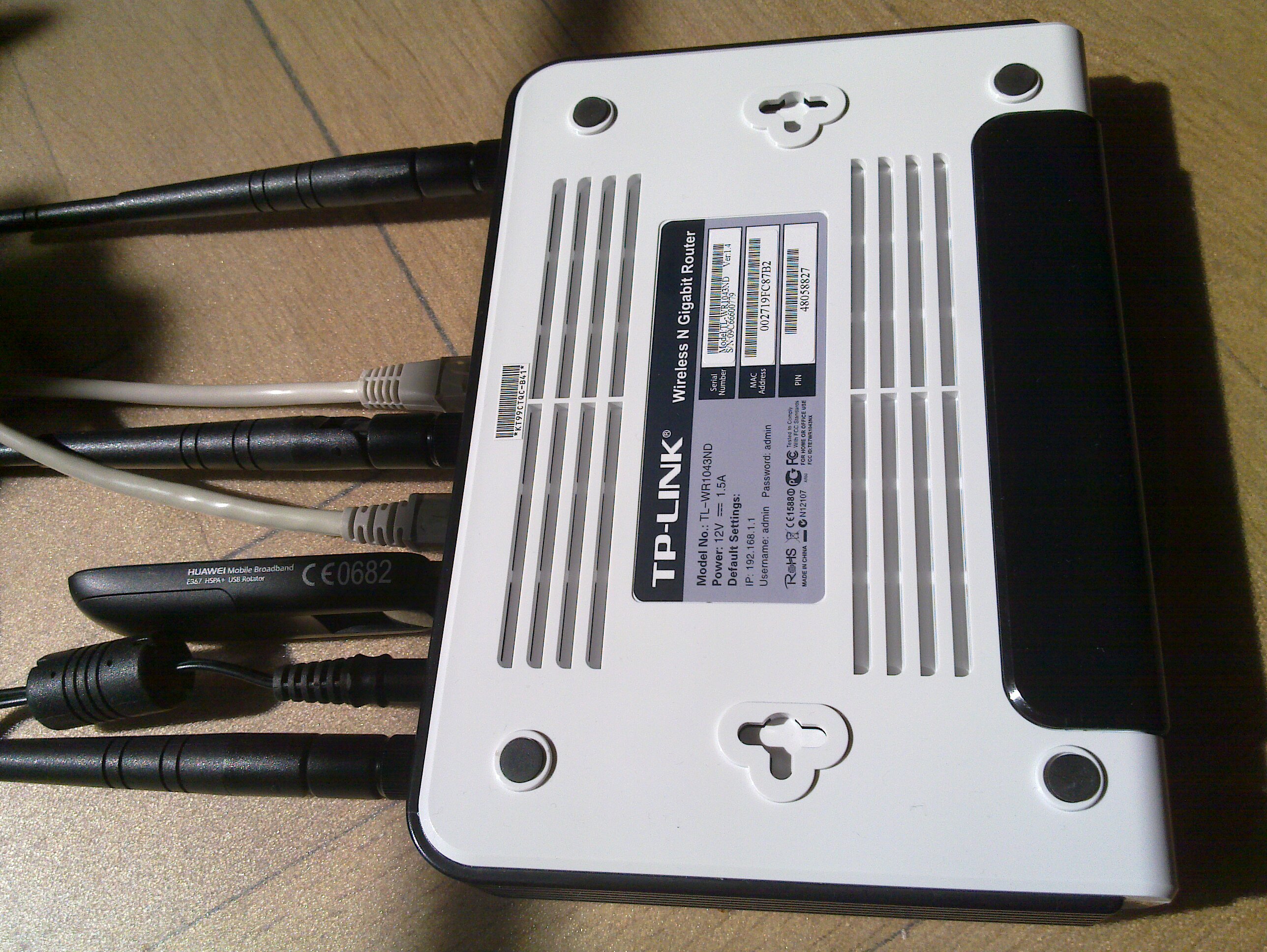
Simon Josefsson: OpenWRT with Huawei E367 and TP-Link TL-WR1043ND

The ability to connect a 3G modem to a wireless router to form a Internet connected ad-hoc network of machines is very powerful. I ve done this many times and have written about it before (e.g., see my OpenWRT writeup page) but I recently did it with modern hardware again. Here I will use the TP-Link TL-WR1043ND wireless router (available here for around $50) together with the Huawei E367 3G UMTS/HSDPA modem. Other wireless routers and modem should work fine. The software is OpenWRT 10.03 although I hope to redo this with LibreWRT eventually. My writeup is mostly focused around what is happening around the prompt, so it is mostly a cut n'paste terminal session with a comment interlined.

TL-WR1043ND and Huawei 367

Router and modem


The first step is to flash the firmware with OpenWRT. The OpenWRT wiki page for the TL-WR1043ND covers this in detail, and for any other hardware you should find what you need in the OpenWRT wiki. If you have already installed OpenWRT on the TL-WR1043ND, and want to wipe it out and start from scratch (like I did for this writeup) here is how to do it:
root@choco:~# cd /tmp
root@choco:/tmp# wget http://downloads.openwrt.org/backfire/10.03/ar71xx/openwrt-ar71xx-tl-wr1043nd-v1-squashfs-sysupgrade.bin
Connecting to downloads.openwrt.org (78.24.191.177:80)
openwrt-ar71xx-tl-wr 100%  *******************************   2688k 00:00:00 ETA
root@choco:/tmp# md5sum openwrt-ar71xx-tl-wr1043nd-v1-squashfs-sysupgrade.bin
9927973ba5da65d0d52e255397452b87  openwrt-ar71xx-tl-wr1043nd-v1-squashfs-sysupgrade.bin
root@choco:/tmp# mtd -r write /tmp/openwrt-ar71xx-tl-wr1043nd-v1-squashfs-sysupgrade.bin firmware
Unlocking firmware ...
Writing from /tmp/openwrt-ar71xx-tl-wr1043nd-v1-squashfs-sysupgrade.bin to firmware ...
Rebooting ...
The device will reboot automatically when it is done. After say 30 seconds, try to connect to it using the default IPv4 address 192.168.1.1. I have connected the WAN port to the Internet and connect to the router over local network connected to the router s LAN1 input. Let s configure OpenWRT, I m calling the host choco and giving it the IPv4 address 192.168.1.46. I ll also set a good root password to disable telnet, and add some SSH keys to simplify remote login.
jas@latte:~$ telnet 192.168.1.1
Trying 192.168.1.1...
Connected to 192.168.1.1.
Escape character is '^]'.
 === IMPORTANT ============================
  Use 'passwd' to set your login password
  this will disable telnet and enable SSH
 ------------------------------------------
BusyBox v1.15.3 (2010-04-06 03:14:11 CEST) built-in shell (ash)
Enter 'help' for a list of built-in commands.
  _______                     ________        __
          .-----.-----.-----.          .----.    _
     -      _     -__                   _    _ 
  _______    __ _____ __ __ ________ __    ____ 
           __  W I R E L E S S   F R E E D O M
 Backfire (10.03, r20728) --------------------------
  * 1/3 shot Kahlua    In a shot glass, layer Kahlua
  * 1/3 shot Bailey's  on the bottom, then Bailey's,
  * 1/3 shot Vodka     then Vodka.
 ---------------------------------------------------
root@OpenWrt:/# passwd
Changing password for root
New password:
Retype password:
Password for root changed by root
root@OpenWrt:/# sed -i -e 's/OpenWrt/choco/' /etc/config/system
root@OpenWrt:/# sed -i -e 's/192.168.1.1/192.168.1.46/' /etc/config/network
root@OpenWrt:/# cat>/etc/dropbear/authorized_keys
ssh-rsa AAAAB3NzaC1yc2...
^D
root@OpenWrt:/# dropbearkey -y -f /etc/dropbear/dropbear_rsa_host_key
Public key portion is:
ssh-rsa AAAA... root@OpenWrt
Fingerprint: md5 45:fd:62...
root@OpenWrt:/#
You could reboot the machine here to switch from telnet to SSH, but I ll install a bunch of packages while I m at it. Run opkg update to update the package list, and then install the wireless modules for the TL-WR1043ND.
root@OpenWrt:/# opkg update
Downloading http://downloads.openwrt.org/backfire/10.03/ar71xx/packages/Packages.gz.
Inflating http://downloads.openwrt.org/backfire/10.03/ar71xx/packages/Packages.gz.
Updated list of available packages in /var/opkg-lists/packages.
root@OpenWrt:/# opkg install kmod-ath9k wpad-mini
...
Configuring iw.
Configuring kmod-crypto-core.
Configuring kmod-crypto-arc4.
Configuring kmod-crypto-aes.
Configuring wireless-tools.
Configuring kmod-cfg80211.
Configuring kmod-mac80211.
Configuring kmod-ath.
Configuring kmod-ath9k.
Configuring crda.
Configuring wpad-mini.
root@OpenWrt:/#
Next I ll install some packages that will are needed for the modem.
root@OpenWrt:/# opkg install comgt kmod-usb-serial kmod-usb2 kmod-usb-uhci kmod-usb-ohci usb-modeswitch
...
Configuring kmod-nls-base.
Configuring kmod-usb-core.
Configuring chat.
Configuring kmod-usb-ohci.
Configuring kmod-usb2.
Configuring comgt.
Configuring usb-modeswitch.
Configuring kmod-usb-serial.
Configuring kmod-usb-uhci.
root@OpenWrt:/#
Now let s reboot the machine and try to get things to really work.
root@OpenWrt:/# sync
root@OpenWrt:/# reboot
Use SSH to connect to the router, and don t forget the use its new IPv4 address! 3G modems are notoriously known for not acting as a modem directly. Instead they often simulate a CD-ROM that will install device driver software, for inferior operating systems. Fortunately the usb_modeswitch tool fixes the hardware for us. My Huawei E367 start up with the USB vendor/product IDs 0x12d1:0 1446, you normally find this out by looking in /proc/bus/usb/devices. Here is the output on my device:
root@choco:~# cat /proc/bus/usb/devices
...
T:  Bus=01 Lev=01 Prnt=01 Port=00 Cnt=01 Dev#=  2 Spd=480 MxCh= 0
D:  Ver= 2.00 Cls=00(>ifc ) Sub=00 Prot=00 MxPS=64 #Cfgs=  1
P:  Vendor=12d1 ProdID=1446 Rev= 0.00
S:  Manufacturer=Huawei Technologies
S:  Product=HUAWEI Mobile
C:* #Ifs= 2 Cfg#= 1 Atr=c0 MxPwr=500mA
I:* If#= 0 Alt= 0 #EPs= 2 Cls=08(stor.) Sub=06 Prot=50 Driver=(none)
E:  Ad=81(I) Atr=02(Bulk) MxPS= 512 Ivl=0ms
E:  Ad=01(O) Atr=02(Bulk) MxPS= 512 Ivl=0ms
I:* If#= 1 Alt= 0 #EPs= 2 Cls=08(stor.) Sub=06 Prot=50 Driver=(none)
E:  Ad=02(O) Atr=02(Bulk) MxPS= 512 Ivl=0ms
E:  Ad=82(I) Atr=02(Bulk) MxPS= 512 Ivl=0ms
root@choco:~#
This means I have to go find a usb-modeswitch configuration for this device. Fortunately, I found it on my Debian Squeeze box in /etc/usb_modeswitch.d/12d1:1446 (from the usb-modeswitch-data package). There was a slight problem with the file, it didn t specify the correct USB vendor/product ID of the device after it has been switched . My Huawei E367 switches to 12d1:1506, so I add 1506 to the TargetProductList list. Here is the final configuration:
root@choco:~# cat>/etc/usb-modeswitch.conf
EnableLogging=1
DefaultVendor= 0x12d1
DefaultProduct=0x1446
TargetVendor=  0x12d1
TargetProductList="1001,1406,140b,140c,1412,141b,14ac,1506"
CheckSuccess=20
MessageContent="55534243123456780000000000000011062000000100000000000000000000"
root@choco:~#
Now you should be able to run usb_modeswitch to perform the switch :
root@choco:~# usb_modeswitch 
Looking for target devices ...
 No devices in target mode or class found
Looking for default devices ...
 Found default devices (1)
Accessing device 002 on bus 001 ...
Using endpoints 0x01 (out) and 0x81 (in)
Inquiring device details; driver will be detached ...
Looking for active driver ...
 No driver found. Either detached before or never attached
SCSI inquiry data (for identification)
-------------------------
  Vendor String: HUAWEI
   Model String: Mass Storage
Revision String: 2.31
-------------------------
USB description data (for identification)
-------------------------
Manufacturer: Huawei Technologies
     Product: HUAWEI Mobile
  Serial No.: not provided
-------------------------
Setting up communication with interface 0 ...
Trying to send the message to endpoint 0x01 ...
 OK, message successfully sent
Checking for mode switch (max. 20 times, once per second) ...
 Waiting for original device to vanish ...
 Original device can't be accessed anymore. Good.
 Searching for target devices ...
 Searching for target devices ...
 Searching for target devices ...
 Searching for target devices ...
 Searching for target devices ...
 Found correct target device
Mode switch succeeded. Bye.
root@choco:~#
The /proc/bus/usb/devices file will now contain information about the real device:
root@choco:~# cat /proc/bus/usb/devices
...
T:  Bus=01 Lev=01 Prnt=01 Port=00 Cnt=01 Dev#=  3 Spd=480 MxCh= 0
D:  Ver= 2.00 Cls=ef(misc ) Sub=02 Prot=01 MxPS=64 #Cfgs=  1
P:  Vendor=12d1 ProdID=1506 Rev= 0.00
S:  Manufacturer=Huawei Technologies
S:  Product=HUAWEI Mobile
C:* #Ifs= 7 Cfg#= 1 Atr=c0 MxPwr=500mA
A:  FirstIf#= 1 IfCount= 2 Cls=02(comm.) Sub=00 Prot=00
I:* If#= 0 Alt= 0 #EPs= 3 Cls=ff(vend.) Sub=01 Prot=01 Driver=(none)
E:  Ad=81(I) Atr=03(Int.) MxPS=  64 Ivl=2ms
E:  Ad=82(I) Atr=02(Bulk) MxPS= 512 Ivl=0ms
E:  Ad=01(O) Atr=02(Bulk) MxPS= 512 Ivl=4ms
I:* If#= 1 Alt= 0 #EPs= 1 Cls=ff(vend.) Sub=01 Prot=09 Driver=(none)
E:  Ad=83(I) Atr=03(Int.) MxPS=  64 Ivl=2ms
I:* If#= 2 Alt= 0 #EPs= 2 Cls=ff(vend.) Sub=01 Prot=08 Driver=(none)
E:  Ad=84(I) Atr=02(Bulk) MxPS= 512 Ivl=0ms
E:  Ad=02(O) Atr=02(Bulk) MxPS= 512 Ivl=4ms
I:* If#= 3 Alt= 0 #EPs= 2 Cls=ff(vend.) Sub=01 Prot=03 Driver=(none)
E:  Ad=85(I) Atr=02(Bulk) MxPS= 512 Ivl=0ms
E:  Ad=03(O) Atr=02(Bulk) MxPS= 512 Ivl=4ms
I:* If#= 4 Alt= 0 #EPs= 2 Cls=ff(vend.) Sub=01 Prot=02 Driver=(none)
E:  Ad=86(I) Atr=02(Bulk) MxPS= 512 Ivl=0ms
E:  Ad=04(O) Atr=02(Bulk) MxPS= 512 Ivl=4ms
I:* If#= 5 Alt= 0 #EPs= 2 Cls=08(stor.) Sub=06 Prot=50 Driver=(none)
E:  Ad=87(I) Atr=02(Bulk) MxPS= 512 Ivl=0ms
E:  Ad=05(O) Atr=02(Bulk) MxPS= 512 Ivl=0ms
I:* If#= 6 Alt= 0 #EPs= 2 Cls=08(stor.) Sub=06 Prot=50 Driver=(none)
E:  Ad=06(O) Atr=02(Bulk) MxPS= 512 Ivl=0ms
E:  Ad=88(I) Atr=02(Bulk) MxPS= 512 Ivl=0ms
root@choco:~#
Let s put that command in /etc/rc.local so that it will be run on every boot.
root@choco:~# cat /etc/rc.local
# Put your custom commands here that should be executed once
# the system init finished. By default this file does nothing.
/usr/bin/usb_modeswitch
exit 0
root@choco:~#
We are not quite ready, the usbserial module needs to be told which USB vendor/product to use. The /etc/modules.d/60-usb-serial file is used during boot to set the right parameters. You can also run rmmod followed by insmod with the proper parameters to avoid a reboot. You can use the gcom info tool to find some information about the modem. Normally you use /dev/ttyUSB0 but for some reason it does not work for me and instead I had to use /dev/ttyUSB3.
root@choco:~# cat>/etc/modules.d/60-usb-serial
usbserial vendor=0x12d1 product=0x1506 maxSize=4096
root@choco:~# rmmod usbserial
root@choco:~# insmod usbserial vendor=0x12d1 product=0x1506 maxSize=4096
root@choco:~# gcom -d /dev/ttyUSB3 info
##### Wireless WAN Modem Configuration #####
Product text:
====
Manufacturer: huawei
Model: E367
Revision: 11.807.05.00.00
IMEI: 353613040739180
+GCAP: +CGSM,+DS,+ES
OK
====
Manufacturer:           huawei
IMEI and Serial Number: 353613040739180
Manufacturer's Revision:
11.807.05.00.
Hardware Revision:      NOT
Network Locked:         ERROR:
Customisation:          NOT SUPPORT
Band settings:          (NOT)
APN:                    ERROR:
##### END #####
root@choco:~#
Let s configure network and wireless. The configurations files are /etc/config/network and /etc/config/wireless. Edit them using your favorite editor, or vi. I m setting up a PSK2 encrypted WLAN and I have a WDS to connect two wireless routers. Note that you need to use the correct PIN for your SIM card (here I m using 8328) and set the APN correctly (I m using bredband.tre.se ). Reboot after making these changes.
root@choco:~# cat /etc/config/network
config 'interface' 'loopback'
       option 'ifname'   'lo'
       option 'proto'    'static'
       option 'ipaddr'   '127.0.0.1'
       option 'netmask'  '255.0.0.0'
config 'interface' 'lan'
        option 'ifname'   'eth0.1'
        option 'type'     'bridge'
        option 'proto'    'static'
        option 'ipaddr'   '192.168.1.46'
        option 'netmask'  '255.255.255.0'
#config 'interface' 'wan'
#        option 'ifname' 'eth0.2'
#        option 'proto' 'dhcp'
config 'switch'
	option 'name' 'rtl8366rb'
        option 'reset' '1'
        option 'enable_vlan' '1'
config 'switch_vlan'
        option 'device' 'rtl8366rb'
        option 'vlan' '1'
        option 'ports' '1 2 3 4 5t'
config 'switch_vlan'
        option 'device' 'rtl8366rb'
        option 'vlan' '2'
        option 'ports' '0 5t'
config interface wan
        option ifname   ppp0
        option proto    3g
        option device   /dev/ttyUSB0
        option apn      bredband.tre.se
        option pincode  8328
root@choco:~# cat /etc/config/wireless
config wifi-device  radio0
	option type     mac80211
	option channel  5
	option macaddr	00:27:19:fc:87:b2
	option hwmode	11ng
	option htmode	HT20
	list ht_capab	SHORT-GI-40
	list ht_capab	DSSS_CCK-40
config wifi-iface
	option device   radio0
	option network  lan
	option mode     ap
	option ssid     Grisslan
	option encryption psk2
	option key	  notforyoutosee
config wifi-iface
        option device     radio0
        option network    lan
        option mode       wds
        option bssid      00:1F:C6:60:D3:11
        option ssid       GrisslanWDS
        option encryption psk2
        option key        thisisalsosecret
root@choco:~# reboot
root@choco:~#
Once the machine have rebooted, you can bring up the 3G connection by using ifup wan . Look at the log by using logread and tail the log in the background by doing logread -f & .
root@choco:~# ifup wan
Trying to set PIN
PIN set successfully
root@choco:~# logread  tail -20
May 21 13:41:20 choco local2.info chat[2419]: send (ATD*99***1#^M)
May 21 13:41:20 choco local2.info chat[2419]: expect (CONNECT)
May 21 13:41:20 choco local2.info chat[2419]: ^M
May 21 13:41:20 choco local2.info chat[2419]: ATD*99***1#^M^M
May 21 13:41:20 choco local2.info chat[2419]: CONNECT
May 21 13:41:20 choco local2.info chat[2419]:  -- got it
May 21 13:41:20 choco local2.info chat[2419]: send ( ^M)
May 21 13:41:20 choco daemon.info pppd[2412]: Serial connection established.
May 21 13:41:20 choco daemon.info pppd[2412]: Using interface ppp0
May 21 13:41:20 choco daemon.notice pppd[2412]: Connect: ppp0 <--> /dev/ttyUSB0
May 21 13:41:24 choco daemon.warn pppd[2412]: Could not determine remote IP address: defaulting to 10.64.64.64
May 21 13:41:24 choco daemon.notice pppd[2412]: local  IP address 95.209.96.115
May 21 13:41:24 choco daemon.notice pppd[2412]: remote IP address 10.64.64.64
May 21 13:41:24 choco daemon.notice pppd[2412]: primary   DNS address 80.251.201.177
May 21 13:41:24 choco daemon.notice pppd[2412]: secondary DNS address 80.251.201.178
May 21 13:41:24 choco daemon.info dnsmasq[1028]: reading /tmp/resolv.conf.auto
May 21 13:41:24 choco daemon.info dnsmasq[1028]: using nameserver 80.251.201.178#53
May 21 13:41:24 choco daemon.info dnsmasq[1028]: using nameserver 80.251.201.177#53
May 21 13:41:24 choco daemon.info dnsmasq[1028]: using local addresses only for domain lan
May 21 13:41:25 choco user.notice rdate: Synced with ptbtime1.ptb.de
root@choco:~#
Hooray! Or almost so usually the first time you connect, I often get incorrect DNS servers from the server. It shows up like this in the log:
May 21 12:25:04 choco daemon.notice pppd[1157]: primary   DNS address 10.11.12.13
May 21 12:25:04 choco daemon.notice pppd[1157]: secondary DNS address 10.11.12.14
The exact reason why this happens is beyond me. There are patches floating around for pppd, but I haven t tried them. A common workaround is to hardcode static DNS servers (like Google DNS or OpenDNS). I have come up with my own workaround, based on the observation that when the problem has occurred it will not happen again if I disconnect and reconnect. Thus I have written a small script which is invoked whenever an interface is brought up (typically the WAN interface).
# Written by Simon Josefsson May 2011.
root@choco:~# cat> /etc/hotplug.d/iface/01-reconnect-if-dns-is-broken
case "$ ACTION:-ifup " in
    ifup)
	    if grep -q 10.11.12.13 /tmp/resolv.conf.auto; then
		(sleep 30 && ifdown wan && ifup wan) &
	    fi
	    ;;
esac
root@choco:~# chmod +x /etc/hotplug.d/iface/01-reconnect-if-dns-is-broken
root@choco:~#
That s it! If you found this writeup useful, please flattr it.

14 May 2011

Vincent Bernat: FVWM configuration

There is actually some buzz around Gnome 3 and the new release of Ubuntu switching to Unity. I thought this was a good occasion to make this small post to tell that I still uses FVWM whose latest version was released a month ago. FVWM is a very old window manager. So old that nobody really knows what the F stands for. It comes with a ugly configuration by default and can be configured to look even uglier. However, FVWM is powerful and highly configurable. Moreover, it is pretty lightweight.

My FVWM configuration My configuration of FVWM is available on GitHub. It requires the use of fvwm-crystal. If you are running Debian or Ubuntu, there is a package for this. This is a set of powerful configuration files for FVWM which add a lot of goodies and themes. Unfortunately, the project site seems to have disappared. You can still grab the sources from your nearest Debian mirror. While those configuration files were great, I did not like to have such a complex desktop with all those icons and menus. However, what is great with fvwm-crystal is you can overlay your own configuration. If a file is present in your home directory, it will take precedence over the one installed on the system. So, I just wrote a new recipe. What you may want to steal from my configuration is the ability to alter the configuration depending on the fact that you are using one or two screens. With one screen, you get:
  • an application panel (a launcher bar) on the upper left corner,
  • an icon manager (which will contained iconified windows) on the upper right corner,
  • a systray on the left of the icon manager
  • a pager (which shows various desktops) just below it,
  • two icon managers (which act as a taskbar) on the bottom, one for regular applications and the other one for terminal windows.
One screen setup of FVWM With two screens, the organization is different. The two icon managers at the bottom are on their own screens. The pager is between the two screens and the other elements are on the upper left of the right screen. Dual screen setup of FVWM If I am using a single screen and I plug another one, I do something like this to get my setup updated:
1
2
$ xrandr --output  VGA-1 --auto --output DVI-I-1 --auto --right-of VGA-1
$ killall trayer ; FvwmCommand Restart
I also uses conky, a light-weight system monitor. It is started in my .xsession, not through FVWM.

Building wallpapers for dual-screen One difficulty with a multi-head setup is how to get the background set properly? . I have made a small script for generating one. Use it like this:
1
$ ./build-wallpaper.py -d ~/.fvwm/wallpapers -c -t ~/tmp/mywallpaper.png
It will randomly select two wallpapers and put them together to look nice on your dual-screen setup. It will also correct the aspect ratio, either by cropping the image or centering the image. You need the following dependencies to make script work: python-xpyb and python-imaging. UPDATE: Thomas Adam pointed to Nitrogen, a graphical wallpaper utility supporting multi-head setups. It is a great tool if you want to set manually your wallpaper but it does not allow to select a random one. Nowadays, I grab most of my wallpapers from InterfaceLIFT.

Next.

Previous.