Search Results: "nic"

13 January 2025

Freexian Collaborators: Monthly report about Debian Long Term Support, December 2024 (by Roberto C. S nchez)

Like each month, have a look at the work funded by Freexian s Debian LTS offering.

Debian LTS contributors In December, 19 contributors have been paid to work on Debian LTS, their reports are available:
  • Abhijith PA did 14.0h (out of 14.0h assigned).
  • Adrian Bunk did 47.75h (out of 53.0h assigned and 47.0h from previous period), thus carrying over 52.25h to the next month.
  • Andrej Shadura did 6.0h (out of 17.0h assigned and -7.0h from previous period after hours given back), thus carrying over 4.0h to the next month.
  • Bastien Roucari s did 22.0h (out of 22.0h assigned).
  • Ben Hutchings did 15.0h (out of 0.0h assigned and 18.0h from previous period), thus carrying over 3.0h to the next month.
  • Chris Lamb did 18.0h (out of 18.0h assigned).
  • Daniel Leidert did 23.0h (out of 17.0h assigned and 9.0h from previous period), thus carrying over 3.0h to the next month.
  • Emilio Pozuelo Monfort did 32.25h (out of 40.5h assigned and 19.5h from previous period), thus carrying over 27.75h to the next month.
  • Guilhem Moulin did 22.5h (out of 9.75h assigned and 12.75h from previous period).
  • Jochen Sprickerhof did 2.0h (out of 3.5h assigned and 6.5h from previous period), thus carrying over 8.0h to the next month.
  • Lee Garrett did 8.5h (out of 14.75h assigned and 45.25h from previous period), thus carrying over 51.5h to the next month.
  • Lucas Kanashiro did 32.0h (out of 10.0h assigned and 54.0h from previous period), thus carrying over 32.0h to the next month.
  • Markus Koschany did 40.0h (out of 20.0h assigned and 20.0h from previous period).
  • Roberto C. S nchez did 13.5h (out of 6.75h assigned and 17.25h from previous period), thus carrying over 10.5h to the next month.
  • Santiago Ruano Rinc n did 18.75h (out of 24.75h assigned and 0.25h from previous period), thus carrying over 6.25h to the next month.
  • Sean Whitton did 6.0h (out of 2.0h assigned and 4.0h from previous period).
  • Sylvain Beucler did 10.5h (out of 21.5h assigned and 38.5h from previous period), thus carrying over 49.5h to the next month.
  • Thorsten Alteholz did 11.0h (out of 11.0h assigned).
  • Tobias Frost did 12.0h (out of 12.0h assigned).

Evolution of the situation In December, we have released 29 DLAs. The LTS Team has published updates to several notable packages. Contributor Guilhem Moulin published an update of php7.4, a widely-used open source general purpose scripting language, which addressed denial of service, authorization bypass, and information disclosure vulnerabilities. Contributor Lucas Kanashiro published an update of clamav, an antivirus toolkit for Unix and Linux, which addressed denial of service and authorization bypass vulnerabilities. Finally, contributor Tobias Frost published an update of intel-microcode, the microcode for Intel microprocessors, which well help to ensure that processor hardware is protected against several local privilege escalation and local denial of service vulnerabilities. Beyond our customary LTS package updates, the LTS Team has made contributions to Debian s stable bookworm release and its experimental section. Notably, contributor Lee Garrett published a stable update of dnsmasq. The LTS update was previously published in November and in December Lee continued working to bring the same fixes (addressing the high profile KeyTrap and NSEC3 vulnerabilities) to the dnsmasq package in Debian bookworm. This package was accepted for inclusion in the Debian 12.9 point release scheduled for January 2025. Addititionally, contributor Sean Whitton provided assistance, via upload sponsorships, to the Debian maintainers of xen. This assistance resulted in two uploads of xen into Debian s experimental section, which will contribute to the next Debian stable release having a version of xen with better longterm support from the upstream development team.

Thanks to our sponsors Sponsors that joined recently are in bold.

9 January 2025

Reproducible Builds: Reproducible Builds in December 2024

Welcome to the December 2024 report from the Reproducible Builds project! Our monthly reports outline what we ve been up to over the past month and highlight items of news from elsewhere in the world of software supply-chain security when relevant. As ever, however, if you are interested in contributing to the Reproducible Builds project, please visit our Contribute page on our website. Table of contents:
  1. reproduce.debian.net
  2. debian-repro-status
  3. On our mailing list
  4. Enhancing the Security of Software Supply Chains
  5. diffoscope
  6. Supply-chain attack in the Solana ecosystem
  7. Website updates
  8. Debian changes
  9. Other development news
  10. Upstream patches
  11. Reproducibility testing framework

reproduce.debian.net Last month saw the introduction of reproduce.debian.net. Announced at the recent Debian MiniDebConf in Toulouse, reproduce.debian.net is an instance of rebuilderd operated by the Reproducible Builds project. rebuilderd is our server designed monitor the official package repositories of Linux distributions and attempts to reproduce the observed results there. This month, however, we are pleased to announce that not only does the service now produce graphs, the reproduce.debian.net homepage itself has become a start page of sorts, and the amd64.reproduce.debian.net and i386.reproduce.debian.net pages have emerged. The first of these rebuilds the amd64 architecture, naturally, but it also is building Debian packages that are marked with the no architecture label, all. The second builder is, however, only rebuilding the i386 architecture. Both of these services were also switched to reproduce the Debian trixie distribution instead of unstable, which started with 43% of the archive rebuild with 79.3% reproduced successfully. This is very much a work in progress, and we ll start reproducing Debian unstable soon. Our i386 hosts are very kindly sponsored by Infomaniak whilst the amd64 node is sponsored by OSUOSL thank you! Indeed, we are looking for more workers for more Debian architectures; please contact us if you are able to help.

debian-repro-status Reproducible builds developer kpcyrd has published a client program for reproduce.debian.net (see above) that queries the status of the locally installed packages and rates the system with a percentage score. This tool works analogously to arch-repro-status for the Arch Linux Reproducible Builds setup. The tool was packaged for Debian and is currently available in Debian trixie: it can be installed with apt install debian-repro-status.

On our mailing list On our mailing list this month:
  • Bernhard M. Wiedemann wrote a detailed post on his long journey towards a bit-reproducible Emacs package. In his interesting message, Bernhard goes into depth about the tools that they used and the lower-level technical details of, for instance, compatibility with the version for glibc within openSUSE.
  • Shivanand Kunijadar posed a question pertaining to the reproducibility issues with encrypted images. Shivanand explains that they must use a random IV for encryption with AES CBC. The resulting artifact is not reproducible due to the random IV used. The message resulted in a handful of replies, hopefully helpful!
  • User Danilo posted an in interesting question related to their attempts in trying to achieve reproducible builds for Threema Desktop 2.0. The question resulted in a number of replies attempting to find the right combination of compiler and linker flags (for example).
  • Longstanding contributor David A. Wheeler wrote to our list announcing the release of the Census III of Free and Open Source Software: Application Libraries report written by Frank Nagle, Kate Powell, Richie Zitomer and David himself. As David writes in his message, the report attempts to answer the question what is the most popular Free and Open Source Software (FOSS)? .
  • Lastly, kpcyrd followed-up to a post from September 2024 which mentioned their desire for someone to implement a hashset of allowed module hashes that is generated during the kernel build and then embedded in the kernel image , thus enabling a deterministic and reproducible build. However, they are now reporting that somebody implemented the hash-based allow list feature and submitted it to the Linux kernel mailing list . Like kpcyrd, we hope it gets merged.

Enhancing the Security of Software Supply Chains: Methods and Practices Mehdi Keshani of the Delft University of Technology in the Netherlands has published their thesis on Enhancing the Security of Software Supply Chains: Methods and Practices . Their introductory summary first begins with an outline of software supply chains and the importance of the Maven ecosystem before outlining the issues that it faces that threaten its security and effectiveness . To address these:
First, we propose an automated approach for library reproducibility to enhance library security during the deployment phase. We then develop a scalable call graph generation technique to support various use cases, such as method-level vulnerability analysis and change impact analysis, which help mitigate security challenges within the ecosystem. Utilizing the generated call graphs, we explore the impact of libraries on their users. Finally, through empirical research and mining techniques, we investigate the current state of the Maven ecosystem, identify harmful practices, and propose recommendations to address them.
A PDF of Mehdi s entire thesis is available to download.

diffoscope diffoscope is our in-depth and content-aware diff utility that can locate and diagnose reproducibility issues. This month, Chris Lamb made the following changes, including preparing and uploading versions 283 and 284 to Debian:
  • Update copyright years. [ ]
  • Update tests to support file 5.46. [ ][ ]
  • Simplify tests_quines.py::test_ differences,differences_deb to simply use assert_diff and not mangle the test fixture. [ ]

Supply-chain attack in the Solana ecosystem A significant supply-chain attack impacted Solana, an ecosystem for decentralised applications running on a blockchain. Hackers targeted the @solana/web3.js JavaScript library and embedded malicious code that extracted private keys and drained funds from cryptocurrency wallets. According to some reports, about $160,000 worth of assets were stolen, not including SOL tokens and other crypto assets.

Website updates Similar to last month, there was a large number of changes made to our website this month, including:
  • Chris Lamb:
    • Make the landing page hero look nicer when the vertical height component of the viewport is restricted, not just the horizontal width.
    • Rename the Buy-in page to Why Reproducible Builds? [ ]
    • Removing the top black border. [ ][ ]
  • Holger Levsen:
  • hulkoba:
    • Remove the sidebar-type layout and move to a static navigation element. [ ][ ][ ][ ]
    • Create and merge a new Success stories page, which highlights the success stories of Reproducible Builds, showcasing real-world examples of projects shipping with verifiable, reproducible builds. These stories aim to enhance the technical resilience of the initiative by encouraging community involvement and inspiring new contributions. . [ ]
    • Further changes to the homepage. [ ]
    • Remove the translation icon from the navigation bar. [ ]
    • Remove unused CSS styles pertaining to the sidebar. [ ]
    • Add sponsors to the global footer. [ ]
    • Add extra space on large screens on the Who page. [ ]
    • Hide the side navigation on small screens on the Documentation pages. [ ]

Debian changes There were a significant number of reproducibility-related changes within Debian this month, including:
  • Santiago Vila uploaded version 0.11+nmu4 of the dh-buildinfo package. In this release, the dh_buildinfo becomes a no-op ie. it no longer does anything beyond warning the developer that the dh-buildinfo package is now obsolete. In his upload, Santiago wrote that We still want packages to drop their [dependency] on dh-buildinfo, but now they will immediately benefit from this change after a simple rebuild.
  • Holger Levsen filed Debian bug #1091550 requesting a rebuild of a number of packages that were built with a very old version of dpkg.
  • Fay Stegerman contributed to an extensive thread on the debian-devel development mailing list on the topic of Supporting alternative zlib implementations . In particular, Fay wrote about her results experimenting whether zlib-ng produces identical results or not.
  • kpcyrd uploaded a new rust-rebuilderd-worker, rust-derp, rust-in-toto and debian-repro-status to Debian, which passed successfully through the so-called NEW queue.
  • Gioele Barabucci filed a number of bugs against the debrebuild component/script of the devscripts package, including:
    • #1089087: Address a spurious extra subdirectory in the build path.
    • #1089201: Extra zero bytes added to .dynstr when rebuilding CMake projects.
    • #1089088: Some binNMUs have a 1-second offset in some timestamps.
  • Gioele Barabucci also filed a bug against the dh-r package to report that the Recommends and Suggests fields are missing from rebuilt R packages. At the time of writing, this bug has no patch and needs some help to make over 350 binary packages reproducible.
  • Lastly, 8 reviews of Debian packages were added, 11 were updated and 11 were removed this month adding to our knowledge about identified issues.

Other development news In other ecosystem and distribution news:
  • Lastly, in openSUSE, Bernhard M. Wiedemann published another report for the distribution. There, Bernhard reports about the success of building R-B-OS , a partial fork of openSUSE with only 100% bit-reproducible packages. This effort was sponsored by the NLNet NGI0 initiative.

Upstream patches The Reproducible Builds project detects, dissects and attempts to fix as many currently-unreproducible packages as possible. We endeavour to send all of our patches upstream where appropriate. This month, we wrote a large number of such patches, including:

Reproducibility testing framework The Reproducible Builds project operates a comprehensive testing framework running primarily at tests.reproducible-builds.org in order to check packages and other artifacts for reproducibility. In November, a number of changes were made by Holger Levsen, including:
  • reproduce.debian.net-related:
    • Add a new i386.reproduce.debian.net rebuilder. [ ][ ][ ][ ][ ][ ]
    • Make a number of updates to the documentation. [ ][ ][ ][ ][ ]
    • Run i386.reproduce.debian.net run on a public port to allow external workers. [ ]
    • Add a link to the /api/v0/pkgs/list endpoint. [ ]
    • Add support for a statistics page. [ ][ ][ ][ ][ ][ ]
    • Limit build logs to 20 MiB and diffoscope output to 10 MiB. [ ]
    • Improve the frontpage. [ ][ ]
    • Explain that we re testing arch:any and arch:all on the amd64 architecture, but only arch:any on i386. [ ]
  • Misc:
    • Remove code for testing Arch Linux, which has moved to reproduce.archlinux.org. [ ][ ]
    • Don t install dstat on Jenkins nodes anymore as its been removed from Debian trixie. [ ]
    • Prepare the infom08-i386 node to become another rebuilder. [ ]
    • Add debug date output for benchmarking the reproducible_pool_buildinfos.sh script. [ ]
    • Install installation-birthday everywhere. [ ]
    • Temporarily disable automatic updates of pool links on buildinfos.debian.net. [ ]
    • Install Recommends by default on Jenkins nodes. [ ]
    • Rename rebuilder_stats.py to rebuilderd_stats.py. [ ]
    • r.d.n/stats: minor formatting changes. [ ]
    • Install files under /etc/cron.d/ with the correct permissions. [ ]
and Jochen Sprickerhof made the following changes: Lastly, Gioele Barabucci also classified packages affected by 1-second offset issue filed as Debian bug #1089088 [ ][ ][ ][ ], Chris Hofstaedtler updated the URL for Grml s dpkg.selections file [ ], Roland Clobus updated the Jenkins log parser to parse warnings from diffoscope [ ] and Mattia Rizzolo banned a number of bots and crawlers from the service [ ][ ].
If you are interested in contributing to the Reproducible Builds project, please visit our Contribute page on our website. However, you can get in touch with us via:

Freexian Collaborators: Debian Contributions: Tracker.debian.org updates, Salsa CI improvements, Coinstallable build-essential, Python 3.13 transition, Ruby 3.3 transition and more! (by Anupa Ann Joseph, Stefano Rivera)

Debian Contributions: 2024-12 Contributing to Debian is part of Freexian s mission. This article covers the latest achievements of Freexian and their collaborators. All of this is made possible by organizations subscribing to our Long Term Support contracts and consulting services.

Tracker.debian.org updates, by Rapha l Hertzog Profiting from end-of-year vacations, Rapha l prepared for tracker.debian.org to be upgraded to Debian 12 bookworm by getting rid of the remnants of python3-django-jsonfield in the code (it was superseded by a Django-native field). Thanks to Philipp Kern from the Debian System Administrators team, the upgrade happened on December 23rd. Rapha l also improved distro-tracker to better deal with invalid Maintainer fields which recently caused multiples issues in the regular data updates (#1089985, MR 105). While working on this, he filed #1089648 asking dpkg tools to error out early when maintainers make such mistakes. Finally he provided feedback to multiple issues and merge requests (MR 106, issues #21, #76, #77), there seems to be a surge of interest in distro-tracker lately. It would be nice if those new contributors could stick around and help out with the significant backlog of issues (in the Debian BTS, in Salsa).

Salsa CI improvements, by Santiago Ruano Rinc n Given that the Debian buildd network now relies on sbuild using the unshare backend, and that Salsa CI s reproducibility testing needs to be reworked (#399), Santiago resumed the work for moving the build job to use sbuild. There was some related work a few months ago that was focused on sbuild with the schroot and the sudo backends, but those attempts were stalled for different reasons, including discussions around the convenience of the move (#296). However, using sbuild and unshare avoids all of the drawbacks that have been identified so far. Santiago is preparing two merge requests: !568 to introduce a new build image, and !569 that moves all the extract-source related tasks to the build job. As mentioned in the previous reports, this change will make it possible for more projects to use the pipeline to build the packages (See #195). Additional advantages of this change include a more optimal way to test if a package builds twice in a row: instead of actually building it twice, the Salsa CI pipeline will configure sbuild to check if the clean target of debian/rules correctly restores the source tree, saving some CPU cycles by avoiding one build. Also, the images related to Ubuntu won t be needed anymore, since the build job will create chroots for different distributions and vendors from a single common build image. This will save space in the container registry. More changes are to come, especially those related to handling projects that customize the pipeline and make use of the extract-source job.

Coinstallable build-essential, by Helmut Grohne Building on the gcc-for-host work of last December, a notable patch turning build-essential Multi-Arch: same became feasible. Whilst the change is small, its implications and foundations are not. We still install crossbuild-essential-$ARCH for cross building and due to a britney2 limitation, we cannot have it depend on the host s C library. As a result, there are workarounds in place for sbuild and pbuilder. In turning build-essential Multi-Arch: same, we may actually express these dependencies directly as we install build-essential:$ARCH instead. The crossbuild-essential-$ARCH packages will continue to be available as transitional dummy packages.

Python 3.13 transition, by Colin Watson and Stefano Rivera Building on last month s work, Colin, Stefano, and other members of the Debian Python team fixed 3.13 compatibility bugs in many more packages, allowing 3.13 to now be a supported but non-default version in testing. The next stage will be to switch to it as the default version, which will start soon. Stefano did some test-rebuilds of packages that only build for the default Python 3 version, to find issues that will block the transition. The default version transition typically shakes out some more issues in applications that (unlike libraries) only test with the default Python version. Colin also fixed Sphinx 8.0 compatibility issues in many packages, which otherwise threatened to get in the way of this transition.

Ruby 3.3 transition, by Lucas Kanashiro The Debian Ruby team decided to ship Ruby 3.3 in the next Debian release, and Lucas took the lead of the interpreter transition with the assistance of the rest of the team. In order to understand the impact of the new interpreter in the ruby ecosystem, ruby-defaults was uploaded to experimental adding ruby3.3 as an alternative interpreter, and a mass rebuild of reverse dependencies was done here. Initially, a couple of hundred packages were failing to build, after many rounds of rebuilds, adjustments, and many uploads we are down to 30 package build failures, of those, 21 packages were asked to be removed from testing and for the other 9, bugs were filled. All the information to track this transition can be found here. Now, we are waiting for PHP 8.4 to finish to avoid any collision. Once it is done the Ruby 3.3 transition will start in unstable.

Miscellaneous contributions
  • Enrico Zini redesigned the way nm.debian.org stores historical audit logs and personal data backups.
  • Carles Pina submitted a new package (python-firebase-messaging) and prepared updates for python3-ring-doorbell.
  • Carles Pina developed further po-debconf-manager: better state transition, fixed bugs, automated assigning translators and reviewers on edit, updating po header files automatically, fixed bugs, etc.
  • Carles Pina reviewed, submitted and followed up the debconf templates translation (more than 20 packages) and translated some packages (about 5).
  • Santiago continued to work on DebConf 25 organization related tasks, including handling the logo survey and results. Stefano spent time on DebConf 25 too.
  • Santiago continued the exploratory work about linux livepatching with Emmanuel Arias. Santiago and Emmanuel found a challenge since kpatch won t fully support linux in trixie and newer, so they are exploring alternatives such as klp-build.
  • Helmut maintained the /usr-move transition filing bugs in e.g. bubblewrap, e2fsprogs, libvpd-2.2-3, and pam-tmpdir and corresponding on related issues such as kexec-tools and live-build. The removal of the usrmerge package unfortunately broke debootstrap and was quickly reverted. Continued fallout is expected and will continue until trixie is released.
  • Helmut sent patches for 10 cross build failures and worked with Sandro Knau on stuck Qt/KDE patches related to cross building.
  • Helmut continued to maintain rebootstrap removing the need to build gnu-efi in the process.
  • Helmut collaborated with Emanuele Rocca and Jochen Sprickerhof on an interesting adventure in diagnosing why gcc would FTBFS in recent sbuild.
  • Helmut proposed supporting build concurrency limits in coreutils s nproc. As it turns out nproc is not a good place for this functionality.
  • Colin worked with Sandro Tosi and Andrej Shadura to finish resolving the multipart vs. python-multipart name conflict, as mentioned last month.
  • Colin upgraded 48 Python packages to new upstream versions, fixing four CVEs and a number of compatibility bugs with recent Python versions.
  • Colin issued an openssh bookworm update with a number of fixes that had accumulated over the last year, especially fixing GSS-API key exchange which had been quite broken in bookworm.
  • Stefano fixed a minor bug in debian-reimbursements that was disallowing combination PDFs containing JAL tickets, encoded in UTF-16.
  • Stefano uploaded a stable update to PyPy3 in bookworm, catching up with security issues resolved in cPython.
  • Stefano fixed a regression in the eventlet from his Python 3.13 porting patch.
  • Stefano continued discussing a forwarded patch (renaming the sysconfigdata module) with cPython upstream, ending in a decision to drop the patch from Debian. This will need some continued work.
  • Anupa participated in the Debian Publicity team meeting in December, which discussed the team activities done in 2024 and projects for 2025.

8 January 2025

John Goerzen: Censorship Is Complicated: What Internet History Says about Meta/Facebook

In light of this week s announcement by Meta (Facebook, Instagram, Threads, etc), I have been pondering this question: Why am I, a person that has long been a staunch advocate of free speech and encryption, leery of sites that talk about being free speech-oriented? And, more to the point, why an I a person that has been censored by Facebook for mentioning the Open Source social network Mastodon not cheering a lighter touch ? The answers are complicated, and take me back to the early days of social networking. Yes, I mean the 1980s and 1990s. Before digital communications, there were barriers to reaching a lot of people. Especially money. This led to a sort of self-censorship: it may be legal to write certain things, but would a newspaper publish a letter to the editor containing expletives? Probably not. As digital communications started to happen, suddenly people could have their own communities. Not just free from the same kinds of monetary pressures, but free from outside oversight (parents, teachers, peers, community, etc.) When you have a community that the majority of people lack the equipment to access and wouldn t understand how to access even if they had the equipment you have a place where self-expression can be unleashed. And, as J. C. Herz covers in what is now an unintentional history (her book Surfing on the Internet was published in 1995), self-expression WAS unleashed. She enjoyed the wit and expression of everything from odd corners of Usenet to the text-based open world of MOOs and MUDs. She even talks about groups dedicated to insults (flaming) in positive terms. But as I ve seen time and again, if there are absolutely no rules, then whenever a group gets big enough more than a few dozen people, say there are troublemakers that ruin it for everyone. Maybe it s trolling, maybe it s vicious attacks, you name it it will arrive and it will be poisonous. I remember the debates within the Debian community about this. Debian is one of the pillars of the Internet today, a nonprofit project with free speech in its DNA. And yet there were inevitably the poisonous people. Debian took too long to learn that allowing those people to run rampant was causing more harm than good, because having a well-worn Delete key and a tolerance for insults became a requirement for being a Debian developer, and that drove away people that had no desire to deal with such things. (I should note that Debian strikes a much better balance today.) But in reality, there were never absolutely no rules. If you joined a BBS, you used it at the whim of the owner (the sysop or system operator). The sysop may be a 16-yr-old running it from their bedroom, or a retired programmer, but in any case they were letting you use their resources for free and they could kick you off for any or no reason at all. So if you caused trouble, or perhaps insulted their cat, you re banned. But, in all but the smallest towns, there were other options you could try. On the other hand, sysops enjoyed having people call their BBSs and didn t want to drive everyone off, so there was a natural balance at play. As networks like Fidonet developed, a sort of uneasy approach kicked in: don t be excessively annoying, and don t be easily annoyed. Like it or not, it seemed to generally work. A BBS that repeatedly failed to deal with troublemakers could risk removal from Fidonet. On the more institutional Usenet, you generally got access through your university (or, in a few cases, employer). Most universities didn t really even know they were running a Usenet server, and you were generally left alone. Until you did something that annoyed somebody enough that they tracked down the phone number for your dean, in which case real-world consequences would kick in. A site may face the Usenet Death Penalty delinking from the network if they repeatedly failed to prevent malicious content from flowing through their site. Some BBSs let people from minority communities such as LGBTQ+ thrive in a place of peace from tormentors. A lot of them let people be themselves in a way they couldn t be in real life . And yes, some harbored trolls and flamers. The point I am trying to make here is that each BBS, or Usenet site, set their own policies about what their own users could do. These had to be harmonized to a certain extent with the global community, but in a certain sense, with BBSs especially, you could just use a different one if you didn t like what the vibe was at a certain place. That this free speech ethos survived was never inevitable. There were many attempts to regulate the Internet, and it was thanks to the advocacy of groups like the EFF that we have things like strong encryption and a degree of freedom online. With the rise of the very large platforms and here I mean CompuServe and AOL at first, and then Facebook, Twitter, and the like later the low-friction option of just choosing a different place started to decline. You could participate on a Fidonet forum from any of thousands of BBSs, but you could only participate in an AOL forum from AOL. The same goes for Facebook, Twitter, and so forth. Not only that, but as social media became conceived of as very large sites, it became impossible for a person with enough skill, funds, and time to just start a site themselves. Instead of neading a few thousand dollars of equipment, you d need tens or hundreds of millions of dollars of equipment and employees. All that means you can t really run Facebook as a nonprofit. It is a business. It should be absolutely clear to everyone that Facebook s mission is not the one they say it is [to] give people the power to build community and bring the world closer together. If that was their goal, they wouldn t be creating AI users and AI spam and all the rest. Zuck isn t showing courage; he s sucking up to Trump and those that will pay the price are those that always do: women and minorities. Really, the point of any large social network isn t to build community. It s to make the owners their next billion. They do that by convincing people to look at ads on their site. Zuck is as much a windsock as anyone else; he will adjust policies in whichever direction he thinks the wind is blowing so as to let him keep putting ads in front of eyeballs, and stomp all over principles even free speech doing it. Don t expect anything different from any large commercial social network either. Bluesky is going to follow the same trajectory as all the others. The problem with a one-size-fits-all content policy is that the world isn t that kind of place. For instance, I am a pacifist. There is a place for a group where pacifists can hang out with each other, free from the noise of the debate about pacifism. And there is a place for the debate. Forcing everyone that signs up for the conversation to sign up for the debate is harmful. Preventing the debate is often also harmful. One company can t square this circle. Beyond that, the fact that we care so much about one company is a problem on two levels. First, it indicates how succeptible people are to misinformation and such. I don t have much to offer on that point. Secondly, it indicates that we are too centralized. We have a solution there: Mastodon. Mastodon is a modern, open source, decentralized social network. You can join any instance, easily migrate your account from one server to another, and so forth. You pick an instance that suits you. There are thousands of others you can choose from. Some aggressively defederate with instances known to harbor poisonous people; some don t. And, to harken back to the BBS era, if you have some time, some skill, and a few bucks, you can run your own Mastodon instance. Personally, I still visit Facebook on occasion because some people I care about are mainly there. But it is such a terrible experience that I rarely do. Meta is becoming irrelevant to me. They are on a path to becoming irrelevant to many more as well. Maybe this is the moment to go shrug, this sucks and try something better. (And when you do, feel free to say hi to me at @jgoerzen@floss.social on Mastodon.)

5 January 2025

Jonathan McDowell: Free Software Activities for 2024

I tailed off on blog posts towards the end of the year; I blame a bunch of travel (personal + business), catching the flu, then December being its usual busy self. Anyway, to try and start off the year a bit better I thought I d do my annual recap of my Free Software activities. For previous years see 2019, 2020, 2021, 2022 + 2023.

Conferences In 2024 I managed to make it to FOSDEM again. It s a hectic conference, and I know there are legitimate concerns about it being a super spreader event, but it has the advantage of being relatively close and having a lot of different groups of people I want to talk to / see talk at it. I m already booked to go this year as well. I spoke at All Systems Go in Berlin about Using TPMs at scale for protecting keys. It was nice to actually be able to talk publicly about some of the work stuff my team and I have been working on. I d a talk submission in for FOSDEM about our use of attestation and why it s not necessarily the evil some folk claim, but there were a lot of good talks submitted and I wasn t selected. Maybe I ll find somewhere else suitable to do it. BSides Belfast may or may not count - it s a security conference, but there s a lot of overlap with various bits of Free software, so I feel it deserves a mention. I skipped DebConf for 2024 for a variety of reasons, but I m expecting to make DebConf25 in Brest, France in July.

Debian Most of my contributions to Free software continue to happen within Debian. In 2023 I d done a bunch of work on retrogaming with Kodi on Debian, so I made an effort to try and keep those bits more up to date, even if I m not actually regularly using them at present. RetroArch got 1.18.0+dfsg-1 and 1.19.1+dfsg-1 uploads. libretro-core-info got associated 1.18.0-1 and 1.19.0-1 uploads too. I note 1.20.0 has been released recently, so I ll have to find some time to build the appropriate DFSG tarball and update it. rcheevos saw 11.2.0-1, 11.5.0-1 + 11.6.0-1 uploaded. kodi-game-libretro itself had 20.2.7-1 uploaded, then 21.0.7-1. Latest upstream is 22.1.0, but that s tracking Kodi 22 and we re still on Kodi 21 so I plan to follow the Omega branch for now. Which I ve just noticed had a 21.0.8 release this week. Finally in the games space I uploaded mgba 0.10.3+dfsg-1 and 0.10.3+dfsg-2 for Ryan Tandy, before realising he was already a Debian Maintainer and granting him the appropriate ACL access so he can upload it himself; I ve had zero concerns about any of his packaging. The Debian Electronics Packaging Team continues to be home for a bunch of packages I care about. There was nothing big there, for me, in 2024, but a few bits of cleanup here and there. I seem to have become one of the main uploaders for sdcc - I have some interest in the space, and the sigrok firmware requires it to build, so I at least like to ensure it s in half decent state. I uploaded 4.4.0+dfsg-1, 4.4.0+dfsg-2, and, just in time to count for 2024, 4.4.0+dfsg-3. The sdcc 4.4 upload lead to some compilation issues for sigrok-firmware-fx2laf so I uploaded 0.1.7-2 fixing that, then 0.1.7-3 doing some further cleanups. OpenOCD had 0.12.0-2 uploaded to disable the libgpiod backend thanks to incompatible changes upstream. There were some in-discussion patches with OpenOCD upstream at the time, but they didn t seem to be ready yet so I held off on pulling them in. 0.12.0-3 fixed builds with more recent versions of jimtcl. It looks like the next upstream release is about a year away, so Trixie will in all probability ship with 0.12.0 as well. libjaylink had a new upstream release, so 0.4.0-1 was uploaded. libserialsport also had a new upstream release, leading to 0.1.2-1. I finally cracked and uploaded sg3-utils 1.48-1 into experimental. I m not the primary maintainer, but 1.46 is nearly 4 years old now and I wanted to get it updated in enough time to shake out any problems before we get to a Trixie freeze. Outside of team owned packages, libcli had compilation issues with GCC 14, leading to 1.10.7-2. I also added a new package, sedutil 1.20.0-2 back in April; it looks fairly unmaintained upstream (there s been some recent activity, but it doesn t seem to be release quality), but there was an outstanding ITP and I ve some familiarity with the space as we ve been using it at work as part of investigating TCG OPAL encryption. I continue to keep an eye on Debian New Members, even though I m mostly inactive as an application manager - we generally seem to have enough available recently. Mostly my involvement is via Front Desk activities, helping out with queries to the team alias, and contributing to internal discussions. Finally the 3 month rotation for Debian Keyring continues to operate smoothly. I dealt with 2023.03.24, 2023.06.24, 2023.09.22 + 2023.11.24.

Linux I d a single kernel contribution this year, to Clean up TPM space after command failure. That was based on some issues we saw at work. I ve another fix in progress that I hope to submit in 2025, but it s for an intermittent failure so confirming the fix is necessary + sufficient is taking a little while.

Personal projects I didn t end up doing much in the way of externally published personal project work in 2024. Despite the release of OpenPGP v6 in RFC 9580 I did not manage to really work on onak. I started on the v6 support, but have not had sufficient time to complete anything worth pushing external yet. listadmin3 got some minor updates based on external feedback / MRs. It s nice to know it s useful to other folk even in its basic state. That wraps up 2024. I ve got no particular goals for this year at present. Ideally I d get v6 support into onak, and it would be nice to implement some of the wishlist items people have provided for listadmin3, but I ll settle for making sure all my Debian packages are in reasonable state for Trixie.

4 January 2025

Louis-Philippe V ronneau: Montreal's Debian & Stuff - December 2024

Our Debian User Group met on December 22nd for our last meeting of 2024. I wasn't sure at first it was a good idea, but many people showed up and it was great! Here's what we did: pollo: anarcat: lelutin: lavamind: tvaz: mjeanson and joeDoe: Some of us ended up grabbing a drink after the event at l'Isle de Garde, a pub right next to the venue. Pictures This time around, we were hosted by l'Espace des possibles, at their new location (they moved since our last visit). It was great! People liked the space so much we actually discussed going back there more often :) Group photo at l'Espace des possibles

3 January 2025

Bits from Debian: Bits from the DPL

Dear Debian community, this is bits from DPL for December. Happy New Year 2025! Wishing everyone health, productivity, and a successful Debian release later in this year. Strict ownership of packages I'm glad my last bits sparked discussions about barriers between packages and contributors, summarized temporarily in some post on the debian-devel list. As one participant aptly put it, we need a way to visibly say, "I'll do the job until someone else steps up". Based on my experience with the Bug of the Day initiative, simplifying the process for engaging with packages would significantly help. Currently we have
  1. NMU The Developers Reference outlines several preconditions for NMUs, explicitly stating, "Fixing cosmetic issues or changing the packaging style in NMUs is discouraged." This makes NMUs unsuitable for addressing package smells. However, I've seen NMUs used for tasks like switching to source format 3.0 or bumping the debhelper compat level. While it's technically possible to file a bug and then address it in an NMU, the process inherently limits the NMUer's flexibility to reduce package smells.
  2. Package Salvaging This is another approach for working on someone else's packages, aligning with the process we often follow in the Bug of the Day initiative. The criteria for selecting packages typically indicate that the maintainer either lacks time to address open bugs, has lost interest, or is generally MIA.
Both options have drawbacks, so I'd welcome continued discussion on criteria for lowering the barriers to moving packages to Salsa and modernizing their packaging. These steps could enhance Debian overall and are generally welcomed by active maintainers. The discussion also highlighted that packages on Salsa are often maintained collaboratively, fostering the team-oriented atmosphere already established in several Debian teams. Salsa Continuous Integration As part of the ongoing discussion about package maintenance, I'm considering the suggestion to switch from the current opt-in model for Salsa CI to an opt-out approach. While I fully agree that human verification is necessary when the pipeline is activated, I believe the current option to enable CI is less visible than it should be. I'd welcome a more straightforward approach to improve access to better testing for what we push to Salsa. Number of packages not on Salsa In my campaign, I stated that I aimed to reduce the number of packages maintained outside Salsa to below 2,000. As of March 28, 2024, the count was 2,368. As of this writing, the count stands at 1,928 [1], so I consider this promise fulfilled. My thanks go out to everyone who contributed to this effort. Moving forward, I'd like to set a more ambitious goal for the remainder of my term and hope we can reduce the number to below 1,800. [1] UDD query: SELECT DISTINCT count(*) FROM sources WHERE release = 'sid' and vcs_url not like '%salsa%' ; Past and future events Talk at MRI Together In early December, I gave a short online talk, primarily focusing on my work with the Debian Med team. I also used my position as DPL to advocate for attracting more users and developers from the scientific research community. FOSSASIA I originally planned to attend FOSDEM this year. However, given the strong Debian presence there and the need for better representation at the FOSSASIA Summit, I decided to prioritize the latter. This aligns with my goal of improving geographic diversity. I also look forward to opportunities for inter-distribution discussions. Debian team sprints Debian Ruby Sprint I approved the budget for the Debian Ruby Sprint, scheduled for January 2025 in Paris. If you're interested in contributing to the Ruby team, whether in person or online, consider reaching out to them. I'm sure any helping hand would be appreciated. Debian Med sprint There will also be a Debian Med sprint in Berlin in mid-February. As usual, you don't need to be an expert in biology or medicine basic bug squashing skills are enough to contribute and enjoy the friendly atmosphere the Debian Med team fosters at their sprints. For those working in biology and medicine, we typically offer packaging support. Anyone interested in spending a weekend focused on impactful scientific work with Debian is warmly invited. Again all the best for 2025
Andreas.

Taavi V n nen: Automatically updating reverse DNS entries for my Hetzner servers

Some parts of my infrastructure run on Hetzner dedicated servers. Hetzner's management console has an interface to update reverse DNS entries, and I wanted to automate that. Unfortunately there's no option to just delegate the zones to my own authoritative DNS servers. So I did the next best thing, which is updating the Hetzner-managed records with data from my own authoritative DNS servers.

Generating DNS zones the hard way The first step of automating DNS record provisioning is, well, figuring out which records need to be provisioned. I wanted to re-use my existing automation for generating the record data, instead of coming up with a new system for these records. The basic summary is that there's a Go program creatively named dnsgen that's in charge of generating zone file snippets from various sources (these include Netbox, Kubernetes, PuppetDB and my custom reverse web proxy setup). Those snippets are combined with Jinja templates to generate full zone files to be loaded to a hidden primary running Bind9 (like all other DNS servers I run). The zone files are then transferred to a fleet of internal authoritative servers as well as my public authoritative DNS server, which in turn transfers them to various other authoritative DNS servers (like ns-global and Traficom anycast) for redundancy. There's also a bunch of other smaller features, like using Bind views to server different data to internal and external clients, and resolving external records during record generation time to be used on apex records that would use CNAME records if they could. (The latter is a workaround for Masto.host, the hosting provider we use for Wikis World, not having a stable IPv6 address.) Overall it's a really nice system, and I've spent quite a bit of time on it.

Updating records on Hetzner-managed space As mentioned above, Hetzner unfortunately does not support custom DNS servers for reverse records on IP space rented from them. But I wanted to use my existing, perfectly working DNS record generation setup since that works perfectly fine. So the obvious answer is to (ab)use DNS zone file transfers. I quickly wrote a few hundred lines of Go to request the zone data and then use the Hetzner robot API to ensure the reverse entries are in sync. The main obstacle hit here was the Hetzner API somehow requiring an "update" call (instead of a "create" one) to create a new record, as the create endpoint was returning an HTTP 400 response no matter what. Once I sorted that out, the script started working fine and created the few dozen missing records. Finally I added a CronJob in my Kubernetes cluster to run the script once in a while. Overall this is a big improvement over doing things by hand and didn't require that much effort. The obvious next step would be to expand the script to a tiny DNS server capable of receiving zone update NOTIFYs to make the updates happen real-time. Unfortunately there's now no hiding of the records revealing my ugly hacks clever networking solutions :(

2 January 2025

Matthew Garrett: The GPU, not the TPM, is the root of hardware DRM

As part of their "Defective by Design" anti-DRM campaign, the FSF recently made the following claim:
Today, most of the major streaming media platforms utilize the TPM to decrypt media streams, forcefully placing the decryption out of the user's control (from here).
This is part of an overall argument that Microsoft's insistence that only hardware with a TPM can run Windows 11 is with the goal of aiding streaming companies in their attempt to ensure media can only be played in tightly constrained environments.

I'm going to be honest here and say that I don't know what Microsoft's actual motivation for requiring a TPM in Windows 11 is. I've been talking about TPM stuff for a long time. My job involves writing a lot of TPM code. I think having a TPM enables a number of worthwhile security features. Given the choice, I'd certainly pick a computer with a TPM. But in terms of whether it's of sufficient value to lock out Windows 11 on hardware with no TPM that would otherwise be able to run it? I'm not sure that's a worthwhile tradeoff.

What I can say is that the FSF's claim is just 100% wrong, and since this seems to be the sole basis of their overall claim about Microsoft's strategy here, the argument is pretty significantly undermined. I'm not aware of any streaming media platforms making use of TPMs in any way whatsoever. There is hardware DRM that the media companies use to restrict users, but it's not in the TPM - it's in the GPU.

Let's back up for a moment. There's multiple different DRM implementations, but the big three are Widevine (owned by Google, used on Android, Chromebooks, and some other embedded devices), Fairplay (Apple implementation, used for Mac and iOS), and Playready (Microsoft's implementation, used in Windows and some other hardware streaming devices and TVs). These generally implement several levels of functionality, depending on the capabilities of the device they're running on - this will range from all the DRM functionality being implemented in software up to the hardware path that will be discussed shortly. Streaming providers can choose what level of functionality and quality to provide based on the level implemented on the client device, and it's common for 4K and HDR content to be tied to hardware DRM. In any scenario, they stream encrypted content to the client and the DRM stack decrypts it before the compressed data can be decoded and played.

The "problem" with software DRM implementations is that the decrypted material is going to exist somewhere the OS can get at it at some point, making it possible for users to simply grab the decrypted stream, somewhat defeating the entire point. Vendors try to make this difficult by obfuscating their code as much as possible (and in some cases putting some of it in-kernel), but pretty much all software DRM is at least somewhat broken and copies of any new streaming media end up being available via Bittorrent pretty quickly after release. This is why higher quality media tends to be restricted to clients that implement hardware-based DRM.

The implementation of hardware-based DRM varies. On devices in the ARM world this is usually handled by performing the cryptography in a Trusted Execution Environment, or TEE. A TEE is an area where code can be executed without the OS having any insight into it at all, with ARM's TrustZone being an example of this. By putting the DRM code in TrustZone, the cryptography can be performed in RAM that the OS has no access to, making the scraping described earlier impossible. x86 has no well-specified TEE (Intel's SGX is an example, but is no longer implemented in consumer parts), so instead this tends to be handed off to the GPU. The exact details of this implementation are somewhat opaque - of the previously mentioned DRM implementations, only Playready does hardware DRM on x86, and I haven't found any public documentation of what drivers need to expose for this to work.

In any case, as part of the DRM handshake between the client and the streaming platform, encryption keys are negotiated with the key material being stored in the GPU or the TEE, inaccessible from the OS. Once decrypted, the material is decoded (again either on the GPU or in the TEE - even in implementations that use the TEE for the cryptography, the actual media decoding may happen on the GPU) and displayed. One key point is that the decoded video material is still stored in RAM that the OS has no access to, and the GPU composites it onto the outbound video stream (which is why if you take a screenshot of a browser playing a stream using hardware-based DRM you'll just see a black window - as far as the OS can see, there is only a black window there).

Now, TPMs are sometimes referred to as a TEE, and in a way they are. However, they're fixed function - you can't run arbitrary code on the TPM, you only have whatever functionality it provides. But TPMs do have the ability to decrypt data using keys that are tied to the TPM, so isn't this sufficient? Well, no. First, the TPM can't communicate with the GPU. The OS could push encrypted material to it, and it would get plaintext material back. But the entire point of this exercise was to avoid the decrypted version of the stream from ever being visible to the OS, so this would be pointless. And rather more fundamentally, TPMs are slow. I don't think there's a TPM on the market that could decrypt a 1080p stream in realtime, let alone a 4K one.

The FSF's focus on TPMs here is not only technically wrong, it's indicative of a failure to understand what's actually happening in the industry. While the FSF has been focusing on TPMs, GPU vendors have quietly deployed all of this technology without the FSF complaining at all. Microsoft has enthusiastically participated in making hardware DRM on Windows possible, and user freedoms have suffered as a result, but Playready hardware-based DRM works just fine on hardware that doesn't have a TPM and will continue to do so.

comment count unavailable comments

Colin Watson: Free software activity in December 2024

Most of my Debian contributions this month were sponsored by Freexian, as well as one direct donation via Liberapay (thanks!). OpenSSH I issued a bookworm update with a number of fixes that had accumulated over the last year, especially fixing GSS-API key exchange which was quite broken in bookworm. base-passwd A few months ago, the adduser maintainer started a discussion with me (as the base-passwd maintainer) and the shadow maintainer about bringing all three source packages under one team, since they often need to cooperate on things like user and group names. I agreed, but hadn t got round to doing anything about it until recently. I ve now officially moved it under team maintenance. debconf Gioele Barabucci has been working on eliminating duplicated code between debconf and cdebconf, ultimately with the goal of migrating to cdebconf (which I m not sure I m convinced of as a goal, but if we can make improvements to both packages as part of working towards it then there s no harm in that). I finally got round to reviewing and merging confmodule changes in each of debconf and cdebconf. This caused an installer regression due to a weirdness in cdebconf-udeb s packaging, which I fixed - sorry about that! I ve also been dealing with a few patch submissions that had been in my queue for a long time, but more on that next month if all goes well. CI issues I noticed and fixed a problem with Restrictions: needs-sudo in autopkgtest. I fixed broken aptly images in the Salsa CI pipeline. Python team Last month, I mentioned some progress on sorting out the multipart vs. python-multipart name conflict in Debian (#1085728), and said that I thought we d be able to finish it soon. I was right! We got it all done this month: The Python 3.13 transition continues, and last month we were able to add it to the supported Python versions in testing. (The next step will be to make it the default.) I fixed lots of problems in aid of this, including: Sphinx 8.0 removed some old intersphinx_mapping syntax which turned out to still be in use by many packages in Debian. The fixes for this were individually trivial, but there were a lot of them: I found that twisted 24.11.0 broke tests in buildbot and wokkel, and fixed those. I packaged python-flatdict, needed for a new upstream version of python-semantic-release. I tracked down a test failure in vdirsyncer (which I ve been using for some years, but had never previously needed to modify) and contributed a fix upstream. I fixed some packages to tolerate future versions of dh-python that will drop their dependency on python3-setuptools: I fixed django-cte to remove a build-dependency on the obsolete python3-nose package. I added Django 5.1 support to django-polymorphic. (There are a number of other packages that still need work here.) I fixed various other build/test failures: I upgraded these packages to new upstream versions: I updated the team s library style guide to remove material related to Python 2 and early versions of Python 3, which is no longer relevant to any current Python packaging work. Other Python upstream work I happened to notice a Twisted upstream issue requesting the removal of the deprecated twisted.internet.defer.returnValue, realized it was still used in many places in Debian, and went on a PR-filing spree informed by codesearch to try to reduce the future impact of such a change on Debian: Other small fixes Santiago Vila has been building the archive with make --shuffle (also see its author s explanation). I fixed associated bugs in cccc (contributed upstream), groff, and spectemu. I backported an upstream patch to putty to fix undefined behaviour that affected use of the small keypad . I removed groff s Recommends: libpaper1 (#1091375, #1091376), since it isn t currently all that useful and was getting in the way of a transition to libpaper2. I filed an upstream bug suggesting better integration in this area.

1 January 2025

Tim Retout: Strauss as Pop Music

While watching the Vienna New Year s Concert today, reading about its perhaps somewhat problematic origins, I was struck by the observation that the Strauss family s polkas were seen as pop music during their lifetime, not as serious as proper classical composers, and so it took some time before the Vienna Philharmonic would actually play their work. (Perhaps the space-themed interval today and the ballet dancers pretending to be a steam train were a continuation of the true spirit of this? It felt very Eurovision.) I can t decide if it s remarkable that this year was the first time a female composer (Constanze Geiger) was represented at this concert, or if that is what you get when you set up a tradition of playing mainly Strauss?

Junichi Uekawa: Happy New Year.

Happy New Year. Spending most of my time in work and family. Kids are taking my time.

Russ Allbery: Review: Driving the Deep

Review: Driving the Deep, by Suzanne Palmer
Series: Finder Chronicles #2
Publisher: DAW
Copyright: 2020
ISBN: 0-7564-1512-8
Format: Kindle
Pages: 426
Driving the Deep is science fiction, a sequel to Finder (not to be confused with Finders, Emma Bull's Finder, or the many other books and manga with the same title). It stands alone and you could start reading here, although there will be spoilers for the first book of the series. It's Suzanne Palmer's second novel. When Fergus Ferguson was fifteen, he stole his cousin's motorcycle to escape an abusive home, stashed it in a storage locker, and got the hell off of Earth. Nineteen years later, he's still paying for the storage locker and it's still bothering him that he never returned the motorcycle. His friends in the Shipyard orbiting Pluto convince him to go to Earth and resolve this ghost of his past, once and for all. Nothing for Fergus is ever that simple. When the key he's been carrying all these years fails to open the storage unit, he hacks it open, only to find no sign of his cousin's motorcycle. Instead, the unit is full of expensive storage crates containing paintings by artists like Van Gogh. They're obviously stolen. Presumably the paintings also explain the irate retired police officer who knocks him out and tries to arrest him, slightly after the urgent message from the Shipyard AI telling him his friends are under attack. Fergus does not stay arrested, a development that will not surprise readers of the previous book. He does end up with an obsessed and increasingly angry ex-cop named Zacker as an unwanted passenger. Fergus reluctantly cuts a deal with Zacker: assist him in finding out what happened to his friends, and Fergus will then go back to Earth and help track down the art thieves who shot Zacker's daughter. It will be some time before they get back to Earth. Fergus's friends have been abducted by skilled professionals. What faint clues he can track down point to Enceladus, a moon of Saturn with a vast subsurface ocean. One simulation test with a desperate and untrustworthy employer later, Fergus is now a newly-hired pilot of an underwater hauler. The trend in recent SFF genre novels has been towards big feelings and character-centric stories. Sometimes this comes in the form of found family, sometimes as melodrama, and often now as romance. I am in general a fan of this trend, particularly as a corrective to the endless engineer-with-a-wrench stories, wooden protagonists, and cardboard characters that plagued classic science fiction. But sometimes I want to read a twisty and intelligent plot navigated by a competent but understated protagonist and built around nifty science fiction ideas. That is exactly what Driving the Deep is, and I suspect this series is going to become my go-to recommendation for people who "just want a science fiction novel." I don't want to overstate this. Fergus is not a blank slate; he gets the benefit of the dramatic improvement in writing standards and characterization in SFF over the past thirty years. He's still struggling with what happened to him in Finder, and the ending of this book is rather emotional. But the overall plot structure is more like a thriller or a detective novel: there are places to go, people to investigate, bases to infiltrate, and captives to find, so the amount of time spent on emotional processing is necessarily limited. Fergus's emotions and characterization are grace notes around the edges of the plot, not its center. I thoroughly enjoyed this. Palmer has a light but effective touch with characterization and populates the story with interesting and distinguishable characters. The plot has a layered complexity that allows Fergus to keep making forward progress without running out of twists or getting repetitive. The motivations of the villains were not the most original, but they didn't need to be; the fun of the story is figuring out who the villains are and watching Fergus get out of impossible situations with the help of new friends. Finder was a solid first novel, but I thought Driving the Deep was a substantial improvement in both pacing and plot coherence. If I say a novel is standard science fiction, that sounds like criticism of lack of originality, but sometimes standard science fiction is exactly what I want to read. Not every book needs to do something wildly original or upend my understanding of story. I started reading science fiction because I loved tense adventures on moons of Saturn with intelligent spaceships and neat bits of technology, and they're even better with polished writing, quietly competent characterization, and an understated sense of humor. This is great stuff, and there are two more books already published that I'm now looking forward to. Highly recommended when you just want a science fiction novel. Followed by The Scavenger Door. Rating: 8 out of 10

31 December 2024

Russell Coker: Links December 2024

Interesting video about the hack of Andrew Tate s The Real World site [1]. Informative video about Nick Fuentes covering the racism, anti-semitism, misogyny, and how he is clearly in denial about being gay [2]. It ends with his arrest. Hopefully the first of many arrests. This is what conservatives support. Insightful article covering the history of bus-mastering attacks on computer security and ending with pwning via CF cards [3]. Interesting lecture at the seL4 symposium about attestation of a running Linux kernel [4]. I m not a fan of most attestation systems but using a separate isolated seL4 process to monitor a Linux VM offers some real benefits. Interesting seL4 symposium lecture about CPU drivers and the fact that a modern SoC is a distributed computing environment with lots of untrusted firmware [5]. I like the way he slipped and called it unworthy firmware instead of untrustworthy firmware , I think I ll copy that.

29 December 2024

Russ Allbery: Review: The Last Hour Between Worlds

Review: The Last Hour Between Worlds, by Melissa Caruso
Series: The Echo Archives #1
Publisher: Orbit
Copyright: November 2024
ISBN: 0-316-30364-X
Format: Kindle
Pages: 388
The Last Hour Between Worlds is urban, somewhat political high fantasy with strong fae vibes. It is the first book of a series, but it stands alone quite well. Kembral Thorne is a Hound, a member of the guild that serves as guards, investigators, and protectors. Kembral's specialty is Echo retrieval: rescues of people and animals who have fallen through a weak spot in reality into one of the strange, dangerous, and malleable layers called Echoes. Kem once rescued a dog from six layers down, an almost unheard-of feat. Kem is also a new single mother, which means her past two months have been spent in a sleep-deprived haze revolving exclusively around her much-beloved infant. Dona Marjorie Swift's year-turning party is the first time she's been out without Emmi since she gave birth, and she's only there because her sister took the child and practically shoved her out the door. Now, she's desperately trying to remember how to be social and normal, which is not made easier by the unexpected presence of Rika at the party. Rika Nonesuch is not a Hound. She's a Cat, a member of the guild of thieves and occasional assassins. They are the nemesis of the Hounds, but in a stylized and formalized way in which certain courtesies are expected. (The politics of this don't really make sense; you just have to go with it.) Kem has complicated feelings about Rika's grace, banter, and intoxicating perfume, feelings that she thought might be reciprocated until Rika drugged her during an apparent date and left her buried under a pile of garbage. She was not expecting Rika to be at this party and is definitely not ready to have a conversation with her. This emotional turmoil is rudely interrupted by the death of nearly everyone at the party via an Echo poison, the appearance of a dark figure driving a black sword into someone, and the descent of the entire party into an Echo. This was one of those books that kept getting better the farther into the book I read. I was a bit leery at first because the publisher's blurb made it sound more like horror than I prefer, but this is more the disturbing strangeness of fae creatures than the sort of gruesomeness, disgust, or body horror that I find off-putting. Most importantly, the point of this book is not to torture the characters or scare the reader. It's instead structured a bit like a murder mystery, but one whose resolution requires working out obscure fantasy rules and hidden political agendas. One of the currencies in the world of Echos is blood, but another is emotion, revelation, and the stories that bring both, and Caruso focuses the story more on that aspect than on horrifying imagery.
Rika frowned. "Resolve it? How?" "I have no idea." I couldn't keep my frustration from leaking through. "Might be that we have to delve deep into our own hearts to confront the unhealed wounds we've carried with us in secret. Might be that we have to say their names backward, or just close our eyes and they'll go away. Echoes never make any damned sense." Rika made a face. "We'd better not have to confront our unhealed wounds, or I'm leaving you to die."
All of The Last Hour Between Worlds is told in the first person from Kem's perspective, but Rika is the best character in this book. Kem is a rather straightforward, dogged, stubborn protector; Rika is complicated, selfish, conflicted, and considerably more dynamic. The first obvious twist in her background I spotted so long before Kem found out that it was a bit frustrating, but there were multiple satisfying twists after that. As advertised in the blurb, there's a sapphic romance angle here, but it's the sort that comes from a complicated friendship and a lot of mutual respect rather than love at first sight. Some of their relationship conflict is driven by misunderstanding, but the misunderstanding happens before the novel begins, which means the reader doesn't have to sit through the bit where one yells at the characters for being stupid. It helps that the characters have something concrete to do, and that driving plot problem is multi-layered and satisfying. Each time the party falls through a layer of reality, it's mostly reset to the start of the book, but the word "mostly" is hiding a lot of subtlety. Given the clock at the start of each chapter and the blurb (if one read it), the reader can make a good guess that the plot problem will not be fully resolved until the characters fall quite deep into the Echoes, but the story never felt repetitive the way that some time loop stories can. As the characters gain more understanding, the problems change, the players change, and they have to make several excursions into the surrounding world. This is the sort of fantasy that feels a bit like science fiction. You're thrown into a world with a different culture and different rules that are foreign to the reader and natural to the characters. Part of the fun of reading is figuring out the rules, history, and backstory while watching the characters try to solve the puzzles they're faced with. The writing is good but not great. Characterization was good enough for a story primarily focused on action and puzzle-solving, but it was a bit lacking in subtlety. I think Caruso's strengths showed most in the world design, particularly the magic system and the rules followed by the Echo creatures. The excursions outside of the somewhat-protected house struck a balance between eeriness and comprehensibility that reminded me of T. Kingfisher or Sandman. The human politics were unfortunately less successful and rested on some tired centrist cliches. Thankfully, this was not the main point of the story. I should also warn that there is a lot of talk about babies. Kem's entire identity at the start of the novel, to the point of incessant monologue, is "new mother." This is not a perspective we get very often in fantasy, and Kem eventually finds a steadier balance between her bond with her daughter and the other parts of her life. I think some readers will feel very seen. But Caruso leans hard into maternal bonding. So hard. If you don't want to read about someone who is deliriously obsessed with their new child, you may want to skip this one. Right after I finished this book, I thought it was amazing. Now that I've had a few days to think about it, the lack of subtlety and the facile human politics brought it down a notch. I'm a science fiction reader at heart, so I loved the slow revelation of mechanics; the reader starts the story by knowing that Kem can "blink step" but not knowing what that means, and by the end of the story one not only knows but has opinions about its limitations, political implications, and interactions with other forms of magic. The Echo worlds are treated similarly, and this type of world-building is my jam. But the cost is that the human characters, particularly the supporting cast, don't get the same focus and therefore are a bit straightforward and obvious. The subplot with Dona Vandelle was particularly annoying. Ah well. Kem and Rika's relationship did work, and it's the center of the book. If you like fantasy mechanics but are a bit leery of fae stories because they feel too symbolic or arbitrary, give this a try. It's the most satisfyingly constructed fae story that I've read in a long time. It's not great literary fiction, but it's also not trying to be; it's a puzzle adventure, and a well-executed one. Recommended, and I will definitely be reading the sequel. Content notes: Lots of violent death and other physical damage, creepy dream worlds with implied but not explicit horror, and rather a lot of blood. Followed by The Last Soul Among Wolves, not yet published at the time I wrote this review. Rating: 8 out of 10

24 December 2024

Russ Allbery: Review: Number Go Up

Review: Number Go Up, by Zeke Faux
Publisher: Crown Currency
Copyright: 2023
Printing: 2024
ISBN: 0-593-44382-9
Format: Kindle
Pages: 373
Number Go Up is a cross between a history and a first-person account of investigative journalism around the cryptocurrency bubble and subsequent collapse in 2022. The edition I read has an afterward from June 2024 that brings the story up to date with Sam Bankman-Fried's trial and a few other events. Zeke Faux is a reporter for Bloomberg News and a fellow of New America. Last year, I read Michael Lewis's Going Infinite, a somewhat-sympathetic book-length profile of Sam Bankman-Fried that made a lot of people angry. One of the common refrains at the time was that people should read Number Go Up instead, and since I'm happy to read more about the absurdities of the cryptocurrency world, I finally got around to reading the other big crypto book of 2023. This is a good book, with some caveats that I am about to explain at absurd length. If you want a skeptical history of the cryptocurrency bubble, you should read it. People who think that it's somehow in competition with Michael Lewis's book or who think the two books disagree (including Faux himself) have profoundly missed the point of Going Infinite. I agree with Matt Levine: Both of these books are worth your time if this is the sort of thing you like reading about. But (much) more on Faux's disagreements with Lewis later. The frame of Number Go Up is Faux's quixotic quest to prove that Tether is a fraud. To review this book, I therefore need to briefly explain what Tether is. This is only the first of many extended digressions. One natural way to buy cryptocurrency would be to follow the same pattern as a stock brokerage account. You would deposit some amount of money into the account (or connect the brokerage account to your bank account), and then exchange money for cryptocurrency or vice versa, using bank transfers to put money in or take it out. However, there are several problems with this. One is that swapping cryptocurrency for money is awkward and sometimes expensive. Another is that holding people's investment money for them is usually highly regulated, partly for customer safety but also to prevent money laundering. These are often called KYC laws (Know Your Customer), and the regulation-hostile world of cryptocurrency didn't want to comply with them. Tether is a stablecoin, which means that the company behind Tether attempts to guarantee that one Tether is always worth exactly one US dollar. It is not a speculative investment like Bitcoin; it's a cryptocurrency substitute for dollars. People exchange dollars for Tether to get their money into the system and then settle all of their subsequent trades in Tether, only converting the Tether back to dollars when they want to take their money out of cryptocurrency entirely. In essence, Tether functions like the cash reserve in a brokerage account: Your Tether holdings are supposedly guaranteed to be equivalent to US dollars, you can withdraw them at any time, and because you can do so, you don't bother, instead leaving your money in the reserve account while you contemplate what new coin you want to buy. As with a bank, this system rests on the assurance that one can always exchange one Tether for one US dollar. The instant people stop believing this is true, people will scramble to get their money out of Tether, creating the equivalent of a bank run. Since Tether is not a regulated bank or broker and has no deposit insurance or strong legal protections, the primary defense against a run on Tether is Tether's promise that they hold enough liquid assets to be able to hand out dollars to everyone who wants to redeem Tether. (A secondary defense that I wish Faux had mentioned is that Tether limits redemptions to registered accounts redeeming more than $100,000, which is a tiny fraction of the people who hold Tether, but for most purposes this doesn't matter because that promise is sufficient to maintain the peg with the dollar.) Faux's firmly-held belief throughout this book is that Tether is lying. He believes they do not have enough money to redeem all existing Tether coins, and that rather than backing every coin with very safe liquid assets, they are using the dollars deposited in the system to make illiquid and risky investments. Faux never finds the evidence that he's looking for, which makes this narrative choice feel strange. His theory was tested when there was a run on Tether following the collapse of the Terra stablecoin. Tether passed without apparent difficulty, redeeming $16B or about 20% of the outstanding Tether coins. This doesn't mean Faux is wrong; being able to redeem 20% of the outstanding tokens is very different from being able to redeem 100%, and Tether has been fined for lying about its reserves. But Tether is clearly more stable than Faux thought it was, which makes the main narrative of the book weirdly unsatisfying. If he admitted he might be wrong, I would give him credit for showing his work even if it didn't lead where he expected, but instead he pivots to focusing on Tether's role in money laundering without acknowledging that his original theory took a serious blow. In Faux's pursuit of Tether, he wanders through most of the other elements of the cryptocurrency bubble, and that's the strength of this book. Rather than write Number Go Up as a traditional history, Faux chooses to closely follow his own thought processes and curiosity. This has the advantage of giving Faux an easy and natural narrative, something that non-fiction books of this type can struggle with, and it lets Faux show how confusing and off-putting the cryptocurrency world is to an outsider. The best parts of this book were the parts unrelated to Tether. Faux provides an excellent summary of the Axie Infinity speculative bubble and even traveled to the Philippines to interview people who were directly affected. He then wandered through the bizarre world of NFTs, and his first-hand account of purchasing one (specifically a Mutant Ape) to get entrance to a party (which sounded like a miserable experience I would pay money to get out of) really drives home how sketchy and weird cryptocurrency-related software and markets can be. He also went to El Salvador to talk to people directly about the country's supposed embrace of Bitcoin, and there's no substitute for that type of reporting to show how exaggerated and dishonest the claims of cryptocurrency adoption are. The disadvantage of this personal focus on Faux himself is that it sometimes feels tedious or sensationalized. I was much less interested in his unsuccessful attempts to interview the founder of Tether than Faux was, and while the digression into forced labor compounds in Cambodia devoted to pig butchering scams was informative (and horrific), I think Faux leaned too heavily on an indirect link to Tether. His argument is that cryptocurrency enables a type of money laundering that is particularly well-suited to supporting scams, but both scams and this type of economic slavery existed before cryptocurrency and will exist afterwards. He did not make a very strong case that Tether was uniquely valuable as a money laundering service, as opposed to a currently useful tool that would be replaced with some other tool should it go away. This part of the book is essentially an argument that money laundering is bad because it enables crime, and sure, to an extent I agree. But if you're going to put this much emphasis on the evils of money laundering, I think you need to at least acknowledge that many people outside the United States do not want to give US government, which is often openly hostile to them, veto power over their financial transactions. Faux does not. The other big complaint I have with this book, and with a lot of other reporting on cryptocurrency, is that Faux is sloppy with the term "Ponzi scheme." This is going to sound like nit-picking, but I think this sloppiness matters because it may obscure an ongoing a shift in cryptocurrency markets. A Ponzi scheme is not any speculative bubble. It is a very specific type of fraud in which investors are promised improbably high returns at very low risk and with safe principal. These returns are paid out, not via investment in some underlying enterprise, but by taking the money from new investments and paying it to earlier investors. Ponzi schemes are doomed because satisfying their promises requires a constantly increasing flow of new investors. Since the population of the world is finite, all Ponzi schemes are mathematically guaranteed to eventually fail, often in a sudden death spiral of ever-increasing promises to lure new investors when the investment stream starts to dry up. There are some Ponzi schemes in cryptocurrency, but most practices that are called Ponzi schemes are not. For example, Faux calls Axie Infinity a Ponzi scheme, but it was missing the critical elements of promised safe returns and fraudulently paying returns from the investments of later investors. It was simply a speculative bubble that people bought into on the assumption that its price would increase, and like any speculative bubble those who sold before the peak made money at the expense of those who bought at the peak. The reason why this matters is that Ponzi schemes are a self-correcting problem. One can decry the damage caused when they collapse, but one can also feel the reassuring certainty that they will inevitably collapse and prove the skeptics correct. The same is not true of speculative assets in general. You may think that the lack of an underlying economic justification for prices means that a speculative bubble is guaranteed to collapse eventually, but in the famous words of Gary Schilling, "markets can remain irrational a lot longer than you and I can remain solvent." One of the people Faux interviews explains this distinction to him directly:
Rong explained that in a true Ponzi scheme, the organizer would have to handle the "fraud money." Instead, he gave the sneakers away and then only took a small cut of each trade. "The users are trading between each other. They are not going through me, right?" Rong said. Essentially, he was arguing that by downloading the Stepn app and walking to earn tokens, crypto bros were Ponzi'ing themselves.
Faux is openly contemptuous of this response, but it is technically correct. Stepn is not a Ponzi scheme; it's a speculative bubble. There are no guaranteed returns being paid out of later investments and no promise that your principal is safe. People are buying in at price that you may consider irrational, but Stepn never promised you would get your money back, let alone make a profit, and therefore it doesn't have the exponential progression of a Ponzi scheme. One can argue that this is a distinction without a moral difference, and personally I would agree, but it matters immensely if one is trying to analyze the future of cryptocurrencies. Schemes as transparently unstable as Stepn (which gives you coins for exercise and then tries to claim those coins have value through some vigorous hand-waving) are nearly as certain as Ponzi schemes to eventually collapse. But it's also possible to create a stable business around allowing large numbers of people to regularly lose money to small numbers of sophisticated players who are collecting all of the winnings. It's called a poker room at a casino, and no one thinks poker rooms are Ponzi schemes or are doomed to collapse, even though nearly everyone who plays poker will lose money. This is the part of the story that I think Faux largely missed, and which Michael Lewis highlights in Going Infinite. FTX was a legitimate business that made money (a lot of money) off of trading fees, in much the same way that a casino makes money off of poker rooms. Lots of people want to bet on cryptocurrencies, similar to how lots of people want to play poker. Some of those people will win; most of those people will lose. The casino doesn't care. Its profit comes from taking a little bit of each pot, regardless of who wins. Bankman-Fried also speculated with customer funds, and therefore FTX collapsed, but there is no inherent reason why the core exchange business cannot be stable if people continue to want to speculate in cryptocurrencies. Perhaps people will get tired of this method of gambling, but poker has been going strong for 200 years. It's also important to note that although trading fees are the most obvious way to be a profitable cryptocurrency casino, they're not the only way. Wall Street firms specialize in finding creative ways to take a cut of every financial transaction, and many of those methods are more sophisticated than fees. They are so good at this that buying and selling stock through trading apps like Robinhood is free. The money to run the brokerage platform comes from companies that are delighted to pay for the opportunity to handle stock trades by day traders with a phone app. This is not, as some conspiracy theories would have you believe, due to some sort of fraudulent price manipulation. It is because the average person with a Robinhood phone app is sufficiently unsophisticated that companies that have invested in complex financial modeling will make a steady profit taking the other side of their trades, mostly because of the spread (the difference between offered buy and sell prices). Faux is so caught up in looking for Ponzi schemes and fraud that I think he misses this aspect of cryptocurrency's transformation. Wall Street trading firms aren't piling into cryptocurrency because they want to do securities fraud. They're entering this market because there seems to be persistent demand for this form of gambling, cryptocurrency markets reward complex financial engineering, and running a legal casino is a profitable business model. Michael Lewis appears as a character in this book, and Faux portrays him quite negatively. The root of this animosity appears to stem from a cryptocurrency conference in the Bahamas that Faux attended. Lewis interviewed Bankman-Fried on stage, and, from Faux's account, his questions were fawning and he praised cryptocurrencies in ways that Faux is certain he knew were untrue. From that point on, Faux treats Lewis as an apologist for the cryptocurrency industry and for Sam Bankman-Fried specifically. I think this is a legitimate criticism of Lewis's methods of getting close to the people he wants to write about, but I think Faux also makes the common mistake of assuming Lewis is a muckraking reporter like himself. This has never been what Lewis is interested in. He writes about people he finds interesting and that he thinks a reader will also find interesting. One can legitimately accuse him of being credulous, but that's partly because he's not even trying to do the same thing Faux is doing. He's not trying to judge; he's trying to understand. This shows when it comes to the parts of this book about Sam Bankman-Fried. Faux's default assumption is that everyone involved in cryptocurrency is knowingly doing fraud, and a lot of his research is looking for evidence to support the conclusion he had already reached. I don't think there's anything inherently wrong with that approach: Faux is largely, although not entirely, correct, and this type of hostile journalism is incredibly valuable for society at large. Upton Sinclair didn't start writing The Jungle with an open mind about the meat-packing industry. But where Faux and Lewis disagree on Bankman-Fried's motivations and intentions, I think Lewis has the much stronger argument. Faux's position is that Bankman-Fried always intended to steal people's money through fraud, perhaps to fund his effective altruism donations, and his protestations that he made mistakes and misplaced funds are obvious lies. This is an appealing narrative if one is looking for a simple villain, but Faux's evidence in support of this is weak. He mostly argues through stereotype: Bankman-Fried was a physics major and a Jane Street trader and therefore could not possibly be the type of person to misplace large amounts of money or miscalculate risk. If he wants to understand how that could be possible, he could read Going Infinite? I find it completely credible that someone with what appears to be uncontrolled, severe ADHD could be adept at trading and calculating probabilities and yet also misplace millions of dollars of assets because he wasn't thinking about them and therefore they stopped existing. Lewis made a lot of people angry by being somewhat sympathetic to someone few people wanted to be sympathetic towards, but Faux (and many others) are also misrepresenting his position. Lewis agrees that Bankman-Fried intentionally intermingled customer funds with his hedge fund and agrees that he lied about doing this. His only contention is that Bankman-Fried didn't do this to steal the money; instead, he invested customer money in risky bets that he thought would pay off. In support of this, Lewis made a prediction that was widely scoffed at, namely that much less of FTX's money was missing than was claimed, and that likely most or all of it would be found. And, well, Lewis was basically correct? The FTX bankruptcy is now expected to recover considerably more than the amount of money owed to creditors. Faux argues that this is only because the bankruptcy clawed back assets and cryptocurrencies have gone up considerably since the FTX bankruptcy, and therefore that the lost money was just replaced by unexpected windfall profits on other investments, but I don't think this point is as strong as he thinks it is. Bankman-Fried lost money on some of what he did with customer funds, made money on other things, and if he'd been able to freeze withdrawals for the year that the bankruptcy froze them, it does appear most of the money would have been recoverable. This does not make what he did legal or morally right, but no one is arguing that, only that he didn't intentionally steal money for his own personal gain or for effective altruism donations. And on that point, I don't think Faux is giving Lewis's argument enough credit. I have a lot of complaints about this book because I know way too much about this topic than anyone should probably know. I think Faux missed the plot in a couple of places, and I wish someone would write a book about where cryptocurrency markets are currently going. (Matt Levine's Money Stuff newsletter is quite good, but it's about all sorts of things other than cryptocurrency and isn't designed to tell a coherent story.) But if you know less about cryptocurrency and just want to hear the details of the run-up to the 2022 bubble, this is a great book for that. Faux is writing for people who are already skeptical and is not going to convince people who are cryptocurrency true believers, but that's fine. The details are largely correct (and extensively footnoted) and will satisfy most people's curiosity. Lewis's Going Infinite is a better book, though. It's not the same type of book at all, and it will not give you the broader overview of the cryptocurrency world. But if you're curious about what was going through the head of someone at the center of all of this chaos, I think Lewis's analysis is much stronger than Faux's. I'm happy I read both books. Rating: 8 out of 10

23 December 2024

Sahil Dhiman: Debian Mirrors Hierarchy

After finding AlmaLinux mirror sync capacity at Tier 0 (or Tier 1, however you look at it) is around 140 Gbps, I wanted to find source and hierarchy in Debian mirroring systems. There are two main types of mirrors in Debian - Debian package mirrors (for package installs and updates) and Debian CD mirrors (for ISO and others medias). Let s talk about package mirrors (and it s hierarchy) first.

Package mirror hierarchy Trace file was a good starting point for checking upstream for a package mirror in Debian. It resides at <URL>/debian/project/trace/_traces and shows flow of data. Sample trace file from jing.rocks s mirror. It showed, canonical source for packages is ftp-master.debian.org. Checking via https://db.debian.org/machines.cgi, showed it s fasolo.d.o hosted at Brown University, US. This serves as Master Archive Server , making it a Tier 0 mirror. It s entry mentions that it has 1 Gbps shared LAN connectivity (dated information?) but it only has to push to 3 other machines/sites. Side note - .d.o is .debian.org As shown on https://mirror-master.debian.org/status/mirror-hierarchy.html, the three sites are:
  • syncproxy2.eu.debian.org ie smit.d.o hosted by University of Twente, Netherlands with 2x10 Gbps connectivity.
  • syncproxy4.eu.debian.org ie schmelzer.d.o hosted by Conova in Austria with 2x10 Gbps connectivity.
  • syncproxy2.wna.debian.org - https://db.debian.org/machines.cgi entry mentions it being hosted at UBC here, but IP seems to be pointing to OSUOSL IP range as of now. IIRC few months ago, syncproxy2.wna.d.o was made to point to other host due to some issue (?). mirror-osuosl.d.o seems to be serving as syncproxy2.wna.d.o now. Bandwidth isn t explicitly mentioned but from my experience seeing bandwidths which other free software projects hosted at OSUOSL have, it would be atleast 10 Gbps and maybe more for Debian.

                     syncproxy2.eu.d.o (NL) ---> to the world
                    /
ftp-master.d.o (US) -- syncproxy4.eu.d.o (AT)  --> to the world 
                    \
                     syncproxy2.wna.d.o (US) --> to the world
A visualation of flow of package from ftp-master.d.o
These form the Debian Tier 1 mirror network, as all the mirrors sync from them. So Debian has atleast 50 Gbps+ capacity at Tier 1. A normal Debian user might never directly interact with any of these 3 machines, but every Debian package they run/download/install flows through these machines. Though, I m unsure what wna stands for in syncproxy2.wna.d.o. NA probably is North America and W is west (coast)? If you know, do let me know. After Tier 1, there are a few more syncproxies (detailed below). There are atleast 45 mirrors at Tier 2, updates for which are directly pushed from the three Tier 1 sync proxies. Most country mirrors i.e. ftp..debian.org are at Tier 2 too (barring a few like ftp.au.d.o, ftp.nz.do etc). Coming back to Sync proxies at Tier 2:
  • syncproxy3.wna.debian.org - gretchaninov.d.o which is marked as syncproxy2 on db.d.o (information dated). It s hosted in University of British Columbia, Canada, where a lot of Debian infrastructure including Salsa is hosted.
  • syncproxy.eu.debian.org - Croatian Academic and Research Network managed machine. CNAME directs to debian.carnet.hr.
  • syncproxy.au.debian.org - mirror-anu.d.o hosted by Australian National University with 100Mbps connectivity. Closest sync proxy for all Australian mirrors.
  • syncproxy4.wna.debian.org - syncproxy-aws-wna-01.d.o hosted in AWS, in US (according to GeoIP). IPv6 only (CNAME to syncproxy-aws-wna-01.debian.org. which only has an AAAA record, no A record). A m6g.2xlarge instance which has speeds upto 10 Gbps.
Coming back to https://mirror-master.debian.org/status/mirror-hierarchy.html, one can see chain extend till Tier 6 like in case of this mirror in AU which should add some latency for the updates from being pushed at ftp-master.d.o to them. Ideally, which shouldn t be a problem as https://www.debian.org/mirror/ftpmirror#when mentions The main archive gets updated four times a day . In my case, I get my updates from NITC mirror, so my updates flows from US > US > TW > IN > me in IN. CDNs have to internally manage cache purging too unlike normal mirrors which directly serve static file. Both deb.debian.org (sponsored by Fastly) and cdn-aws.deb.debian.org (sponsored by Amazon Cloudfront) sync from following CDN backends: See deb.d.o trace file and cdn-aws.deb.d.o trace file. (Thanks to Philipp Kern for the heads up here.)

CD image mirrors Hierarchy Till now, I have only talked about Debian package mirrors. When you see /debian directory on various mirrors, they re usually for package install and updates. If you want to grab the latest (and greatest) Debian ISO, you go to Debian CD (as they re still called) mirror site. casulana.d.o is mentioned as CD builder site hosted by Bytemark while pettersson-ng.d.o is mentioned as CD publishing server hosted at Academic Computer Club in Ume , Sweden. Primary download site for Debian CD when you click download on debian.org homepage is https://cdimage.debian.org/debian-cd/ is hosted here as well. This essentially becomes Tier 0 mirror for Debian CD. All Debian CD mirrors are downstream to it.
pettersson-ng.d.o / cdimage.d.o (SE) ---> to the world
A visualation of flow of Debian CD from cdimage.d.o
Academic Computer Club s mirror setup uses a combination of multiple machines (called frontends and offloading servers) to load balance requests. Their document setup is a highly recommended read. Also, in that document, they mention , All machines are reachable via both IPv4 and IPv6 and connected with 10 or 25 gigabit Ethernet, external bandwidth available is 200 gigabit/s. For completeness sake, following mirror (or mirror systems) exists too for Debian: Debian heavily rely on various organizations to donate resources (hosting and hardware) to distribute and update Debian. Compiling above information made me thankful to all these organizations. Many thanks to DSA and mirror team as well for managing these stuffs. I relied heavily on https://db.debian.org/machines.cgi which seems to be manually updated, so things might have changed along the way. If anything looks amiss, feel free to ping.

Joey Hess: the twenty-fifth year of my free software career

I've been lucky to be able to spend twenty! five! years! developing free software and making a living on it, and this was a banner year for that career. To start with, there was the Distribits conference. There's a big ecosystem of tools and projects that are based on git-annex, especially in scientific data management, and this was the first conference focused on that. Basically every talk involved git-annex in some way. It's been a while since I was at a conference where my software was in the center like that -- reminded me of Debconf days. I gave a talk on how git-annex was probably basically feature complete. I have been very busy ever since adding new features to it, because in mapping out git-annex's feature set, I discovered new possibilities. Meeting people and getting a better feel for the shape of that ecosytem, both technically and funding wise, led to several big developments in funding later in the year. Going into the year, I had an ongoing source of funding from several projects at Dartmouth that use git-annex, but after 10 years, some of that was winding up. That all came together in my essentially writing a grant proposal to the OpenNeuro project at Stanford, to spend 6 months building out a whole constellation of features. The summer became a sprint to get it all done. Signficant amounts of very productive design work were done while swimming in the river. That was great. (Somehow in there, I ended up onstage at FOSSY in Portland, in a keynote panel on Open Source and AI. This required developing a nuanced understanding of the mess of the OSI's Open Source AI definition, but I was mostly on the panel as the unqualified guy.) Capping off the year, I have a new maintenance contract with Forschungszentrum J lich. This covers the typical daily grind kind of tasks, like bug triage, keeping on top of security, release preparation, and updating dependencies, which is the kind of thing I've never been able to find dedicated funding for before. A career in free software is a succession of hurdles. How to do something new and worthwhile? How to make any income while developing it at all? How to maintain your independant vision when working on it for hire? How to deal with burn-out? How to grow a project to be more than a one developer affair? And on and on. How does a free software project keep paying the bills once it's feature complete? Maybe I am starting to get a glimpse of an answer.

Thomas Lange: Happy Birthday FAI!

A Brief History of FAI, Which Began 25 Years Ago On Dec 21st, 1999 version 1.0 of FAI (Fully Automatic Installation) was announced. That was 25 years ago. Some months before, the computer science department of the University of Cologne bought a small HPC cluster with 16 nodes (each with dual CPU Pentium II 400Mhz, 256 MB RAM) and I was too lazy to install those nodes manually. That's why I started the FAI project. With FAI you can install computers in a few minutes from scratch to a machine with a custom configuration that is ready to go for their users. At that time Debian 2.1 aka slink was using kernel 2.0.36 and it was the first release using apt. Many things have happened since then. In the beginning we wrote the first technical report about FAI and a lot of documentation were added afterwards. I gave more than 45 talks about FAI all over the world. Over the past 25 years, there has been an average of more than one commit per day to the FAI software repository. Several top500.org HPC clusters were built using FAI and many companies are using FAI for their IT infrastructure or deploying Linux on their products using FAI. An overview of users can be found here. Some major milestones of FAI are listed in the blog post of the 20th anniversary. What Happended in the Last 5 Years? Currently, I'm preparing for the next FAI release and I still have ideas for new features. Thanks for all the feedback from you, which helped a lot in making FAI a successful project. About FAI FAI is a tool for unattended mass deployment of Linux. It's a system to install and configure Linux systems and software packages on computers as well as virtual machines, from small labs to large-scale infrastructures like clusters and cloud environments. You can take one or more virgin PC's, turn on the power, and after a few minutes, the systems are installed, and completely configured to your exact needs, without any interaction necessary.
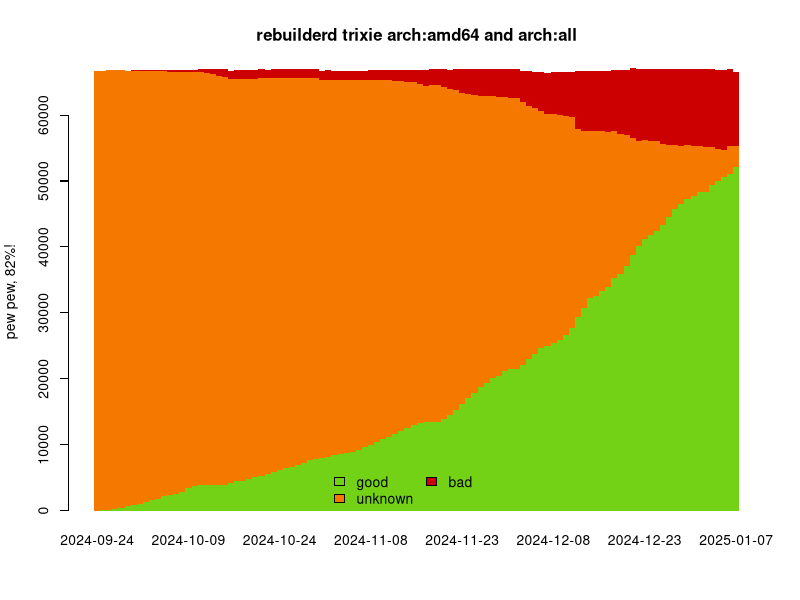
22 December 2024

Junichi Uekawa: Looking at my private repositories for what language I wrote.

Looking at my private repositories for what language I wrote. I'm counting the number of days I wrote a certain file with specific file extension. Markdown was at the top, because I usually have a doc, that's fine. C++ is my top language. Then lilypond and then js. Rust came much lower. Lilypond was for my band scores it seems.

Next.

Previous.


