Search Results: "mt"

29 February 2020

Chris Lamb: Free software activities in February 2020

Here is my monthly update covering what I have been doing in the free software world during February 2020 (previous month): For the Tails privacy-oriented operating system, I uploaded the following packages to Debian:
Reproducible builds One of the original promises of open source software is that distributed peer review and transparency of process results in enhanced end-user security. However, whilst anyone may inspect the source code of free and open source software for malicious flaws, almost all software today is distributed as pre-compiled binaries. This allows nefarious third-parties to compromise systems by injecting malicious code into ostensibly secure software during the various compilation and distribution processes. The motivation behind the Reproducible Builds effort is to provide the ability to demonstrate these binaries originated from a particular trusted source release: if identical results are generated from a given source in all circumstances, reproducible builds provides the means for multiple third-parties to reach a consensus on whether a build was compromised via distributed checksum validation or some other scheme. The initiative is proud to be a member project of the Software Freedom Conservancy, a not-for-profit 501(c)(3) charity focused on ethical technology and user freedom. Conservancy acts as a corporate umbrella allowing projects to operate as non-profit initiatives without managing their own corporate structure. If you like the work of the Conservancy or the Reproducible Builds project, please consider becoming an official supporter. This month, I: In our tooling, I also made the following changes to diffoscope, our in-depth and content-aware diff utility that can locate and diagnose reproducibility issues, including uploading version 137 to Debian:
Debian I submitted a Request for Package (RFP) bug for hsd, a blockchain-based top-level domain DNS protocol implementation that underpins Handshake and worked on some initial packaging. (#952472)
Debian LTS This month I have worked 18 hours on Debian Long Term Support (LTS) and 12 hours on its sister Extended LTS project. You can find out more about the project via the following video:
Uploads Finally, I made a non-maintainer upload of adminer (4.7.6-1) on behalf of Alexandre Rossi.

23 November 2017

Jonathan Dowland: Concreate and Red Hat JBoss OpenShift image sources

Last year I wrote about some tools for working with Docker images. Since then, we've deprecated the dogen tool for our own images and have built a successor called Concreate. Concreate takes a container image definition described in a YAML document and generates an output image. To do so, it generates an intermediate Dockerfile, along with the scripts and artefacts you references in the YAML file, and by default invokes docker build on the result. However, it can use other builders, such as the OpenShift Build Service, which is what we use for our production images. Concreate can also manage running tests against the image. As with the Container Testing Framework that I mentioned last time, these tests are defined using the Behave system. In related news is that we have published the sources for all of our images. You can now go and read the image.yaml file for EAP 7 on OpenShift to give you an example of what a real image using Concreate looks like.

19 November 2017

Joey Hess: custom ARM disk image generation with propellor

Following up on propelling disk images, Propellor can now build custom ARM disk images for a variety of different ARM boards. The disk image build can run on a powerful laptop or server, so it's super fast and easy compared with manually installing Debian on an ARM board. Here's a simple propellor config for a Olimex LIME board, with ssh access and a root password:
lime :: Host
lime = host "lime.example.com" $ props
    & osDebian Unstable ARMHF
    & Machine.olimex_A10_OLinuXino_LIME
    & hasPartition (partition EXT4  mountedAt  "/"  setSize  MegaBytes 8192)
        & hasPassword (User "root")
        & Ssh.installed
    & Ssh.permitRootLogin (RootLogin True)
To make a disk image for that board, I only have to add this property to my laptop:
& imageBuiltFor lime
    (RawDiskImage "/srv/lime.img")
    (Debootstrapped mempty)
Propellor knows what kernel to install and how to make the image bootable for a bunch of ARM boards, including the Olimex LIME, the SheevaPlug, Banana Pi, and CubieTruck. To build the disk image targeting ARM, propellor uses qemu. So it's helpful that, after the first build, propellor incrementally updates disk images, quite quickly and efficiently. Once the board has the image installed, you can run propellor on it to further maintain it, and if there's a hardware problem, you can quickly replace it with an updated image.
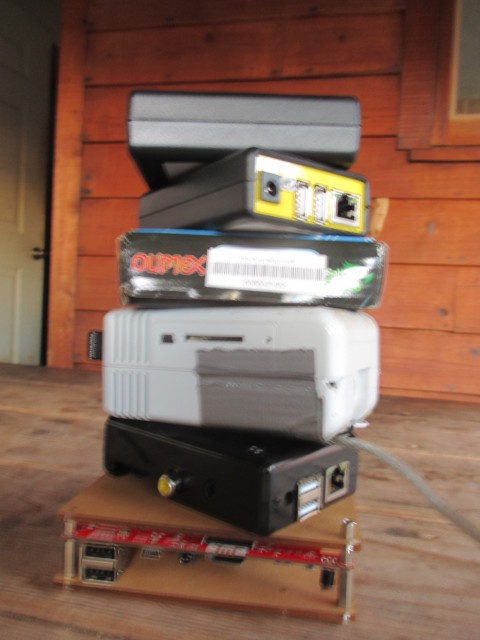
computer tower that I will be maintaining with propellor
It's fairly simple to teach propellor about other ARM boards, so it should be quite easy to keep propellor knowing about all ARM boards supported by Debian (and other distros). Here's how I taught it about the Olimex LIME:
olimex_A10_OLinuXino_LIME :: Property (HasInfo + DebianLike)
olimex_A10_OLinuXino_LIME = FlashKernel.installed "Olimex A10-OLinuXino-LIME"
     requires  sunixi "A10-OLinuXino-Lime"
     requires  armmp
My home server is a CubieTruck which serves as a wireless access point, solar panel data collector, and git-annex autobuilder. It's deployed from a disk image built by propellor, using this config. I've been involved with building disk image for ARM boards for a long time -- it was part of my job for five years -- and this is the first time I've been entirely happy with the process.

14 November 2017

Jonathan Dowland: WadC 2.2

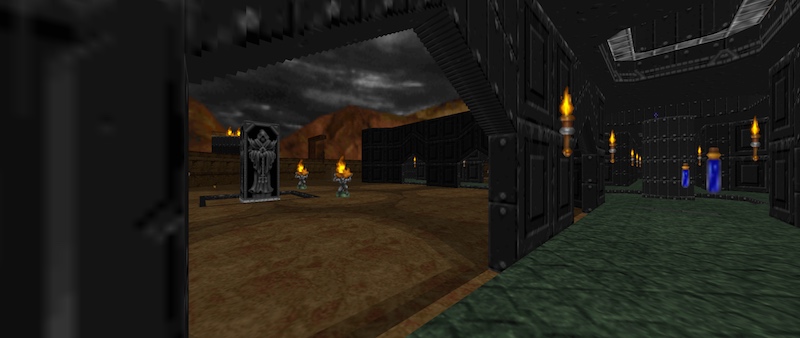
Bird Cage, a WadC-generated map for Heretic
Bird Cage map
I have recently released version 2.2 of Wad Compiler, a lazy functional programming language and IDE for the construction of Doom maps. The biggest change in this version is a reworking of the preferences system (to use the Java Preferences API), the wadcli command-line interface respecting preferences and a new preferences UI dialog (adapted from Quake Injector). There are two new example maps: A Labyrinth demonstration contributed by "Yoruk", and a Heretic map Bird Cage by yours truly. These are both now amongst the largest examples in the collection, although laby.wl was generated by a higher-level program. For more information see the release notes and the reference, or check out the new gallery of examples or skip straight to downloads. I have no plans to work on WadC further (but never say never, I suppose.)

12 November 2017

Sven Hoexter: Offering a Simtec Entropy Key

Since I started to lean a bit towards the concept of minimalism I've got rid of stuff, including all stationary computers. So for now I'm left with just my laptop and that's something where I do not want to attach an USB entropy key permanently. That's why I've a spare Simtec Entropy Key I no longer use, and I'm willing to sell. In case someone is interested, I'm willing to give it away for 20EUR + shipping. If you can convince me it'll be of use for the Debian project (end up on a DSA managed machine for example) I'm willing to give it away for less. If you're located in Cologne, Copenhagen or Barcelona we might be able, depending on the timing, to do a personal handover (with or without keysigning). Otherwise I guess shipping is mainly interesting for someone also located in Europe. You can use sven at stormbind dot net or hoexter at debian dot org to contact me and use GPG key 0xA6DC24D9DA2493D1.

8 November 2017

Neil McGovern: Software Freedom Law Center and Conservancy

Before I start, I would like to make it clear that the below is entirely my personal view, and not necessarily that of the GNOME Foundation, the Debian Project, or anyone else. There s been quite a bit of interest recently about the petition by Software Freedom Law Center to cancel the Software Freedom Conservancy s trademark. A number of people have asked my views on it, so I thought I d write up a quick blog on my experience with SFLC and Conservancy both during my time as Debian Project Leader, and since. It s clear to me that for some time, there s been quite a bit of animosity between SFLC and Conservancy, which for me started to become apparent around the time of the large debate over ZFS on Linux. I talked about this in my DebConf 16 talk, which fortunately was recorded (ZFS bit from 8:05 to 17:30).
This culminated in SFLC publishing a statement, and Conservancy also publishing their statement, backed up by the FSF. These obviously came to different conclusions, and it seems bizarre to me that SFLC who were acting as Debian s legal counsel published a position that was contrary to the position taken by Debian. Additionally, Conservancy and FSF who were not acting as counsel mirrored the position of the project. Then, I hear of an even more confusing move that SFLC has filed legal action against Conservancy, despite being the organisation they helped set up. This happened on the 22nd September, the day after SFLC announced corporate and support services for Free Software projects. SFLC has also published a follow up, which they say that the act is not an attack, let alone a bizarre attack , and that the response from Conservancy, who view it as such was like reading a declaration of war issued in response to a parking ticket . Then, as SFLC somehow find the threat of your trademark being taken away as something other than an attack, they also state: Any project working with the Conservancy that feels in any way at risk should contact us. We will immediately work with them to put in place measures fully ensuring that they face no costs and no risks in this situation. which I read as a direct pitch to try and pull projects away from Conservancy and over to SFLC. Now, even if there is a valid claim here, despite the objections that were filed by a trademark lawyer who I have a great deal of respect for (disclosure: Pam also provides pro-bono trademark advice to my employer, the GNOME Foundation), the optics are pretty terrible. We have a case of one FOSS organisation taking another one to court, after many years of them being aware of the issue, and when wishing to promote a competing service. At best, this is a distraction from the supposed goals of Free Software organisations, and at worst is a direct attempt to interrupt the workings of an established and successful umbrella organisation which lots of projects rely on. I truly hope that this case is simply dropped, and if I was advising SFLC, that s exactly what I would suggest, along with an apology for the distress. Put it this way if SFLC win, then they re simply displaying what would be viewed as an aggressive move to hold the term software freedom exclusively to themselves. If they lose, then it shows that they re willing to do so to another 501(c)3 without actually having a case. Before I took on the DPL role, I was under the naive impression that although there were differences in approach, at least we were coming to try and work together to promote software freedoms for the end user. Unfortunately, since then, I ve now become a lot more jaded about exactly who, and which organisations hold our best interests at heart. (Featured image by Nick Youngson CC-BY-SA-3.0 http://nyphotographic.com/)

Jonathan Dowland: Christmas

Every year, family members ask me to produce a list of gift suggestions for them to buy for me for Christmas. An enviable position for many, I'm sure, but combined with trying to come up with gift ideas for them, this can sometimes be a stressful situation, with a risk of either giving or receiving gifts that are really nothing more than tat, fluff or kipple. I've started to feel that this is detracting from the spirit of the season. I also don't really want much "stuff". When I am interested in something, it's not something that is convenient for others to buy, either because it's hard to describe, or has limited availability, or is only available at particular times of the year, etc. I'd rather focus on spending time with friends and family. Starting this year, I'm asking that people who wish to do so donate to a charity on my behalf instead. The charity I have chosen for this year is St. Oswald's Hospice.

6 November 2017

Jonathan Dowland: Coil

Peter Christopherson and Jhonn Balance, from [Santa Sangre](https://santasangremagazine.wordpress.com/2014/11/16/the-angelic-conversation-in-remembrance-of-coil/) Peter Christopherson and Jhonn Balance, from Santa Sangre
A friend asked me to suggest five tracks by Coil that gave an introduction to their work. Trying to summarize Coil in 5 tracks is tough. I think it's probably impossible to fairly summarize Coil with any subset of their music, for two reasons. Firstly, their music was the output of their work but I don't think is really the whole of the work itself. There's a real mystique around them. They were deeply interested in arcania, old magic, Aleister Crowley, scatology; they were both openly and happily gay and their work sometimes explored their experiences in various related underground scenes and sub-cultures; they lost friends to HIV/AIDS and that had a profound impact on them. They had a big influence on some people who discovered them who were exploring their own sexualities at the time and might have felt excluded from mainstream society. They frequently explored drugs, meditation and other ways to try to expand and open their minds; occultism. They were also fiercely anti-commercial, their stuff was released in limited quantities across a multitude of different music labels, often under different names, and often paired with odd physical objects, runes, vials of blood, etc. Later fascinations included paganism and moon worship. I read somewhere that they literally cursed one of their albums. Secondly, part of their "signature" was the lack of any consistency in their work, or to put it another way, their style over time varied enormously. I'm also not necessarily well-versed in all their stuff, I'm part way on this journey myself... but these are tracks which stand out at least from the subset I've listened to. Both original/core members of Coil have passed away and the legal status of their catalogue is in a state of limbo. Some of these songs are available on currently-in-print releases, but all such releases are under dispute by some associate or other.

1. Heaven's Blade Like (probably) a lot of Coil songs, this one exists in multiple forms, with some dispute about which are canonical, which are officially sanctioned, etc. the video linked above actually contains 5 different versions, but I've linked to a time offset to the 4th: "Heaven's Blade (Backwards)". This version was the last to come to light with the recent release of "Backwards", an album originally prepared in the 90s at Trent Reznor's Nothing Studios in New Orleans, but not finished or released. The circumstances around its present-day release, as well as who did what to it and what manipulation may have been performed to the audio a long time after the two core members had passed, is a current topic in fan circles. Despite that, this is my preferred version. You can choose to investigate the others, or not, at your own discretion.

2. how to destroy angels (ritual music for the accumulation of male sexual energy) A few years ago, "guidopaparazzi", a user at the Echoing the Sound music message board attempted to listen to every Coil release ever made and document the process. He didn't do it chronologically, leaving the EPs until near the end, which is when he tackled this one (which was the first release by Coil, and was the inspiration behind the naming of Trent Reznor's one-time side project "How To Destroy Angels"). Guido seemed to think this was some kind of elaborate joke. Personally I think it's a serious piece and there's something to it but this just goes to show, different people can take things in entirely different ways. Here's Guido's review, and you can find the rest of his reviews linked from that one if you wish. https://archive.org/details/Coil-HowToDestroyAngels1984

3. Red Birds Will Fly Out Of The East And Destroy Paris In A Night Both "Musick To Play In The Dark" volumes (one and two) are generally regarded as amongst the most accessible entry points to the Coil discography. This is my choice of cut from volume 1. For some reason this reminds me a little of some of the background music from the game "Unreal Tournament". I haven't played that in at least 15 years. I should go back and see if I can figure out why it does. The whole EP is worth a listen, especially at night. https://archive.org/details/CoilMusickToPlayInTheDarkVol1/Coil+-+Musick+To+Play+In+The+Dark+Vol+1+-+2+Red+Birds+Will+Fly+Out+Of+The+East+And+Destroy+Paris+In+A+Night.flac

4. Things Happen It's tricky to pick a track from either "Love's Secret Domain" or "Horse Rotorvator"; there are other choices which I think are better known and loved than this one but it's one that haunted me after I first heard it for one reason or another, so here it is.

5. The Anal Staircase Track 1 from Horse Rotorvator. What the heck is a Horse Rotorvator anyway? I think it was supposed to have been a lucid nightmare experienced by the vocalist Jhonn Balance. So here they wrote a song about anal sex. No messing about, no allusion particularly, but why should there be? https://archive.org/details/CoilHorseRotorvator2001Remaster/Coil+-+Horse+Rotorvator+%5B2001+remaster%5D+-+01+The+Anal+Staircase.flac

Bonus 6th: 7-Methoxy-B-Carboline (Telepathine) From the drone album "Time Machines", which has just been re-issued by DIAS records, who describe it as "authorized". Each track is titled by the specific combination of compounds that inspired its composition, supposedly. Or, perhaps it's a "recommended dosing" for listening along. https://archive.org/details/TimeMachines-TimeMachines

Post-script If those piqued your interest, there's some decent words and a list of album suggestions in this Vinyl Factory article. Finally, if you can track them down, Stuart Maconie had two radio shows about Coil on his "Freak Zone" programme. The main show discusses the release of "Backwards", including an interview with collaborator Danny Hyde, who was the main person behind the recent re-issue. The shorter show is entitled John Doran uncoils Coil. Guest John Doran from The Quietus discusses the group and their history interspersed with Coil tracks and tracks from their contemporaries. Interestingly they chose a completely different set of 5 tracks to me.

3 November 2017

Reproducible builds folks: Reproducible Builds: Weekly report #131

Here's what happened in the Reproducible Builds effort between Sunday October 22 and Saturday October 28 2017: Past Events Upcoming/current events Documentation updates Bernhard Wiedemann started The Unreproducible Package which "is meant as a practical way to demonstrate the various ways that software can break reproducible builds using just low level primitives without requiring external existing programs that implement these primitives themselves. It is structured so that one subdirectory demonstrates one class of issues in some variants observed in the wild." Reproducible work in other projects Hush, a fork of ZCash, opened an issue into reproducible builds. A new tag was added to lintian (lint checker for Debian packages) to ensure that changelog entry timestamps are strictly increasing. This avoids certain real-world issues with identical timestamps, documented in Debian #843773. Packages reviewed and fixed, and bugs filed Patches sent upstream: Debian bug reports: Reviews of unreproducible packages 14 package reviews have been added, 35 have been updated and 28 have been removed in this week, adding to our knowledge about identified issues. 1 issue type has been updated: Weekly QA work During our reproducibility testing, FTBFS bugs have been detected and reported by: strip-nondeterminism development Version 0.040-1 was uploaded to unstable by Mattia Rizzolo. It included contributions already covered by posts of the previous weeks, as well as new ones from: reprotest development Development continued in git: buildinfo.debian.net development Development continued in git: reproducible-website development Misc. This week's edition was written by Ximin Luo, Chris Lamb, Bernhard M. Wiedemann and Holger Levsen & reviewed by a bunch of Reproducible Builds folks on IRC & the mailing lists.

2 November 2017

Antoine Beaupr : October 2017 report: LTS, feed2exec beta, pandoc filters, git mediawiki

Debian Long Term Support (LTS) This is my monthly Debian LTS report. This time I worked on the famous KRACK attack, git-annex, golang and the continuous stream of GraphicsMagick security issues.

WPA & KRACK update I spent most of my time this month on the Linux WPA code, to backport it to the old (~2012) wpa_supplicant release. I first published a patchset based on the patches shipped after the embargo for the oldstable/jessie release. After feedback from the list, I also built packages for i386 and ARM. I have also reviewed the WPA protocol to make sure I understood the implications of the changes required to backport the patches. For example, I removed the patches touching the WNM sleep mode code as that was introduced only in the 2.0 release. Chunks of code regarding state tracking were also not backported as they are part of the state tracking code introduced later, in 3ff3323. Finally, I still have concerns about the nonce setup in patch #5. In the last chunk, you'll notice peer->tk is reset, to_set to negotiate a new TK. The other approach I considered was to backport 1380fcbd9f ("TDLS: Do not modify RNonce for an TPK M1 frame with same INonce") but I figured I would play it safe and not introduce further variations. I should note that I share Matthew Green's observations regarding the opacity of the protocol. Normally, network protocols are freely available and security researchers like me can easily review them. In this case, I would have needed to read the opaque 802.11i-2004 pdf which is behind a TOS wall at the IEEE. I ended up reading up on the IEEE_802.11i-2004 Wikipedia article which gives a simpler view of the protocol. But it's a real problem to see such critical protocols developed behind closed doors like this. At Guido's suggestion, I sent the final patch upstream explaining the concerns I had with the patch. I have not, at the time of writing, received any response from upstream about this, unfortunately. I uploaded the fixed packages as DLA 1150-1 on October 31st.

Git-annex The next big chunk on my list was completing the work on git-annex (CVE-2017-12976) that I started in August. It turns out doing the backport was simpler than I expected, even with my rusty experience with Haskell. Type-checking really helps in doing the right thing, especially considering how Joey Hess implemented the fix: by introducing a new type. So I backported the patch from upstream and notified the security team that the jessie and stretch updates would be similarly easy. I shipped the backport to LTS as DLA-1144-1. I also shared the updated packages for jessie (which required a similar backport) and stretch (which didn't) and those Sebastien Delafond published those as DSA 4010-1.

Graphicsmagick Up next was yet another security vulnerability in the Graphicsmagick stack. This involved the usual deep dive into intricate and sometimes just unreasonable C code to try and fit a round tree in a square sinkhole. I'm always unsure about those patches, but the test suite passes, smoke tests show the vulnerability as fixed, and that's pretty much as good as it gets. The announcement (DLA 1154-1) turned out to be a little special because I had previously noticed that the penultimate announcement (DLA 1130-1) was never sent out. So I made a merged announcement to cover both instead of re-sending the original 3 weeks late, which may have been confusing for our users.

Triage & misc We always do a bit of triage even when not on frontdesk duty, so I: I also did smaller bits of work on: The latter reminded me of the concerns I have about the long-term maintainability of the golang ecosystem: because everything is statically linked, an update to a core library (say the SMTP library as in CVE-2017-15042, thankfully not affecting LTS) requires a full rebuild of all packages including the library in all distributions. So what would be a simple update in a shared library system could mean an explosion of work on statically linked infrastructures. This is a lot of work which can definitely be error-prone: as I've seen in other updates, some packages (for example the Ruby interpreter) just bit-rot on their own and eventually fail to build from source. We would also have to investigate all packages to see which one include the library, something which we are not well equipped for at this point. Wheezy was the first release shipping golang packages but at least it's shipping only one... Stretch has shipped with two golang versions (1.7 and 1.8) which will make maintenance ever harder in the long term.
We build our computers the way we build our cities--over time, without a plan, on top of ruins. - Ellen Ullman

Other free software work This month again, I was busy doing some serious yak shaving operations all over the internet, on top of publishing two of my largest LWN articles to date (2017-10-16-strategies-offline-pgp-key-storage and 2017-10-26-comparison-cryptographic-keycards).

feed2exec beta Since I announced this new project last month I have released it as a beta and it entered Debian. I have also wrote useful plugins like the wayback plugin that saves pages on the Wayback machine for eternal archival. The archive plugin can also similarly save pages to the local filesystem. I also added bash completion, expanded unit tests and documentation, fixed default file paths and a bunch of bugs, and refactored the code. Finally, I also started using two external Python libraries instead of rolling my own code: the pyxdg and requests-file libraries, the latter which I packaged in Debian (and fixed a bug in their test suite). The program is working pretty well for me. The only thing I feel is really missing now is a retry/fail mechanism. Right now, it's a little brittle: any network hiccup will yield an error email, which are readable to me but could be confusing to a new user. Strangely enough, I am particularly having trouble with (local!) DNS resolution that I need to look into, but that is probably unrelated with the software itself. Thankfully, the user can disable those with --loglevel=ERROR to silence WARNINGs. Furthermore, some plugins still have some rough edges. For example, The Transmission integration would probably work better as a distinct plugin instead of a simple exec call, because when it adds new torrents, the output is totally cryptic. That plugin could also leverage more feed parameters to save different files in different locations depending on the feed titles, something would be hard to do safely with the exec plugin now. I am keeping a steady flow of releases. I wish there was a way to see how effective I am at reaching out with this project, but unfortunately GitLab doesn't provide usage statistics... And I have received only a few comments on IRC about the project, so maybe I need to reach out more like it says in the fine manual. Always feels strange to have to promote your project like it's some new bubbly soap... Next steps for the project is a final review of the API and release production-ready 1.0.0. I am also thinking of making a small screencast to show the basic capabilities of the software, maybe with asciinema's upcoming audio support?

Pandoc filters As I mentioned earlier, I dove again in Haskell programming when working on the git-annex security update. But I also have a small Haskell program of my own - a Pandoc filter that I use to convert the HTML articles I publish on LWN.net into a Ikiwiki-compatible markdown version. It turns out the script was still missing a bunch of stuff: image sizes, proper table formatting, etc. I also worked hard on automating more bits of the publishing workflow by extracting the time from the article which allowed me to simply extract the full article into an almost final copy just by specifying the article ID. The only thing left is to add tags, and the article is complete. In the process, I learned about new weird Haskell constructs. Take this code, for example:
-- remove needless blockquote wrapper around some tables
--
-- haskell newbie tips:
--
-- @ is the "at-pattern", allows us to define both a name for the
-- construct and inspect the contents as once
--
--   is the "empty record pattern": it basically means "match the
-- arguments but ignore the args"
cleanBlock (BlockQuote t@[Table  ]) = t
Here the idea is to remove <blockquote> elements needlessly wrapping a <table>. I can't specify the Table type on its own, because then I couldn't address the table as a whole, only its parts. I could reconstruct the whole table bits by bits, but it wasn't as clean. The other pattern was how to, at last, address multiple string elements, which was difficult because Pandoc treats spaces specially:
cleanBlock (Plain (Strong (Str "Notifications":Space:Str "for":Space:Str "all":Space:Str "responses":_):_)) = []
The last bit that drove me crazy was the date parsing:
-- the "GAByline" div has a date, use it to generate the ikiwiki dates
--
-- this is distinct from cleanBlock because we do not want to have to
-- deal with time there: it is only here we need it, and we need to
-- pass it in here because we do not want to mess with IO (time is I/O
-- in haskell) all across the function hierarchy
cleanDates :: ZonedTime -> Block -> [Block]
-- this mouthful is just the way the data comes in from
-- LWN/Pandoc. there could be a cleaner way to represent this,
-- possibly with a record, but this is complicated and obscure enough.
cleanDates time (Div (_, [cls], _)
                 [Para [Str month, Space, Str day, Space, Str year], Para _])
    cls == "GAByline" = ikiwikiRawInline (ikiwikiMetaField "date"
                                           (iso8601Format (parseTimeOrError True defaultTimeLocale "%Y-%B-%e,"
                                                           (year ++ "-" ++ month ++ "-" ++ day) :: ZonedTime)))
                        ++ ikiwikiRawInline (ikiwikiMetaField "updated"
                                             (iso8601Format time))
                        ++ [Para []]
-- other elements just pass through
cleanDates time x = [x]
Now that seems just dirty, but it was even worse before. One thing I find difficult in adapting to coding in Haskell is that you need to take the habit of writing smaller functions. The language is really not well adapted to long discourse: it's more about getting small things connected together. Other languages (e.g. Python) discourage this because there's some overhead in calling functions (10 nanoseconds in my tests, but still), whereas functions are a fundamental and important construction in Haskell that are much more heavily optimized. So I constantly need to remind myself to split things up early, otherwise I can't do anything in Haskell. Other languages are more lenient, which does mean my code can be more dirty, but I feel get things done faster then. The oddity of Haskell makes frustrating to work with. It's like doing construction work but you're not allowed to get the floor dirty. When I build stuff, I don't mind things being dirty: I can cleanup afterwards. This is especially critical when you don't actually know how to make things clean in the first place, as Haskell will simply not let you do that at all. And obviously, I fought with Monads, or, more specifically, "I/O" or IO in this case. Turns out that getting the current time is IO in Haskell: indeed, it's not a "pure" function that will always return the same thing. But this means that I would have had to change the signature of all the functions that touched time to include IO. I eventually moved the time initialization up into main so that I had only one IO function and moved that timestamp downwards as simple argument. That way I could keep the rest of the code clean, which seems to be an acceptable pattern. I would of course be happy to get feedback from my Haskell readers (if any) to see how to improve that code. I am always eager to learn.

Git remote MediaWiki Few people know that there is a MediaWiki remote for Git which allow you to mirror a MediaWiki site as a Git repository. As a disaster recovery mechanism, I have been keeping such a historical backup of the Amateur radio wiki for a while now. This originally started as a homegrown Python script to also convert the contents in Markdown. My theory then was to see if we could switch from Mediawiki to Ikiwiki, but it took so long to implement that I never completed the work. When someone had the weird idea of renaming a page to some impossible long name on the wiki, my script broke. I tried to look at fixing it and then remember I also had a mirror running using the Git remote. It turns out it also broke on the same issue and that got me looking in the remote again. I got lost in a zillion issues, including fixing that specific issue, but I especially looked at the possibility of fetching all namespaces because I realized that the remote fetches only a part of the wiki by default. And that drove me to submit namespace support as a patch to the git mailing list. Finally, the discussion came back to how to actually maintain that contrib: in git core or outside? Finally, it looks like I'll be doing some maintenance that project outside of git, as I was granted access to the GitHub organisation...

Galore Yak Shaving Then there's the usual hodgepodge of fixes and random things I did over the month.
There is no [web extension] only XUL! - Inside joke

1 November 2017

Jonathan Dowland: In defence of "Thought for the Day"

BBC Radio 4's long-running "Thought for the Day" has been in the news this week, as several presenters for the Today Programme have criticised the segment in an interview with Radio Times magazine. One facet of the criticism was whether the BBC should be broadcasting three minutes of religious content daily when more than half of the population are atheist. I'm an atheist and in my day-to-day life I have almost zero interaction with people of faith, certainly none where faith is a topic of conversation. However when I was an undergrad at Durham, I was a member of St John's College which has a Christian/Anglican/Evangelical heritage, and I met a lot of religious friends during my time there. What I find a little disturbing about the lack of faithful people in my day-to-day life, compared to then, is how it shines a light on how disjoint our society is. This has become even more apparent with the advent of the "filter bubble" and how irreconcilable factions are around topics like Brexit, Trump, etc. For these reasons I appreciate Thought for the Day and hearing voices from communities that I normally have little to do with. I can agree with the complaints about the lack of diversity, and I particularly enjoy hearing Thoughts from Muslims, Sikhs, Hindus, Buddhists, and such. Another criticism levelled against the segment was that it can be "preachy". I haven't found that myself. I get the impression that most of the monologues are carefully constructed to be as unpreaching as possible. I can usually appreciate the ethical content of the talks, without having to buy into the faith aspect. Interestingly the current principal of St John's College, David Wilkinson, has written his own response to the interview for the Radio Times.

Petter Reinholdtsen: Some notes on fault tolerant storage systems

If you care about how fault tolerant your storage is, you might find these articles and papers interesting. They have formed how I think of when designing a storage system. Several of these research papers are based on data collected from hundred thousands or millions of disk, and their findings are eye opening. The short story is simply do not implicitly trust RAID or redundant storage systems. Details matter. And unfortunately there are few options on Linux addressing all the identified issues. Both ZFS and Btrfs are doing a fairly good job, but have legal and practical issues on their own. I wonder how cluster file systems like Ceph do in this regard. After all, there is an old saying, you know you have a distributed system when the crash of a compyter you have never heard of stops you from getting any work done. The same holds true if fault tolerance do not work. Just remember, in the end, it do not matter how redundant, or how fault tolerant your storage is, if you do not continuously monitor its status to detect and replace failed disks.

31 October 2017

Chris Lamb: Free software activities in October 2017

Here is my monthly update covering what I have been doing in the free software world in October 2017 (previous month):
Reproducible builds

Whilst anyone can inspect the source code of free software for malicious flaws, most software is distributed pre-compiled to end users. The motivation behind the Reproducible Builds effort is to allow verification that no flaws have been introduced either maliciously or accidentally during this compilation process by promising identical results are always generated from a given source, thus allowing multiple third-parties to come to a consensus on whether a build was compromised. I have generously been awarded a grant from the Core Infrastructure Initiative to fund my work in this area. This month I:


I also made the following changes to our tooling:
diffoscope

diffoscope is our in-depth and content-aware diff utility that can locate and diagnose reproducibility issues.

  • Improve names in output of "internal" binwalk members. (#877525).
  • Don't crash on malformed md5sums files. (#877473).
  • Omit misleading "any of" prefix when only complaining about a single module on import. [...]
  • Adjust tests as ps2ascii now varies its output on timezone. [...]

strip-nondeterminism

strip-nondeterminism is our tool to remove specific non-deterministic results from a completed build.

  • Clojure considers .class file to be stale if it shares the same timestamp of the .clj. We thus adjust the timestamps of the .clj to always be younger. (#877418).
  • Print a message in --verbose mode if no canonical time was specified. [...]

buildinfo.debian.net

buildinfo.debian.net is my experiment into how to process, store and distribute .buildinfo files after the Debian archive software has processed them.

  • Always show SHA-256 checksums, regardless of the browser viewport size. [...]
  • Add an API endpoint to fetch specific .buildinfo files for a certain package/version/architecture. [...]


Debian My activities as the current Debian Project Leader are covered in my "Bits from the DPL" email to the debian-devel-announce mailing list.
Patches contributed
  • devscripts: Please print the actual arguments debuild makes to Lintian. (#880124)
  • hw-detect: Drop reference to floppy disks; it's almost 2018. (#880122)
  • debci:
    • Use deb.debian.org over http.debian.net. (#879654)
    • Document how to use an alternative mirror. (#879655)

Debian LTS

This month I have been paid to work 18 hours on Debian Long Term Support (LTS). In that time I did the following:
  • "Frontdesk" duties, triaging CVEs, etc.
  • Followed up on a large number of upstream "pings" that have been left dormant.
  • Issued DLA 1121-1 to fix an out-of-bounds read vulnerability in curl where a malicious FTP server could abuse this to prevent clients from interacting with it.
  • Issued DLA 1123-1 for the "Go" programming language where an attacker could generate a MIME request such that the server ran out of file descriptors.
  • Issued DLA 1126-1 for the libxfont font selection and rasterisation library, correcting two vulnerabilities, both involving the library being tricked into reading invalid/random memory.
  • Issued DLA 1134-1 for sdl-image1.2, an image loading library. A maliciously-crafted .xcf file could cause a stack-based buffer overflow resulting in potential code execution.

Uploads
  • python-django:
    • 2.0~beta1-1 New upstream 2.x release.
    • 1.11.6-1 New upstream bugfix release.
  • gunicorn (19.6.0-10+deb9u1) Prepared a release for stable to avoid a runtime dependency on a compiler. (#877722)
  • redis:
    • 4:4.0.2-3:
      • Drop the Debian-specific /etc/redis/redis-server.pre-up.d (etc.) hooks and remove them if unchanged.
      • Include systemd redis-server@.service and redis-sentinel@.service template files to easily run multiple Redis instances. (#877702)
      • Patch redis.conf and sentinel.conf with quilt instead of maintaining our own versions under debian/.
    • 4:4.0.2-4:
      • Add input validity checking to cluster config slot numbers to fix CVE-2017-15047. (#878076)
      • Drop debian/bin/generate-parts now we aren't calling it.
      • Correct Bash-ism in NEWS file.
    • 4:4.0.2-5: Replace the existing patch for CVE-2017-15047 with an upstream-blessed version that covers another case.
  • redisearch (0.21.3-5) Initial release.
  • docbook2man (2.0.0-40) Correct spelling mistakes in binaries and other misc packaging tidying.
  • python-redis (2.10.6-1) New upstream release.
  • bfs (1.1.3-1) New upstream release.

FTP Team

As a Debian FTP assistant I ACCEPTed 103 packages: amcheck, argagg, binutils, blockui, bro-pkg, chkservice, citus, django-axes, docker-containerd, doctest, dtkwidget, duktape, feed2exec, fontforge, fonttools, gcc-8, gcc-8-cross, generator-scripting-language, gitgraph.js, haskell-uri-encode, hoel, iniparser, its, jquery-areyousure, kodi, libcatmandu-mods-perl, libcatmandu-template-perl, libcatmandu-xml-perl, libcatmandu-xsd-perl, libcode-tidyall-plugin-sortlines-naturally-perl, libgdamm5.0, libinfinity, libmods-record-perl, libreoffice-dictionaries, libset-intervaltree-perl, libsodium, linux, linux-grsec, ltsp-manager, lxqt-themes, mailman3-core, measurement-kit, mini-buildd, musescore, node-babel, node-babel-eslint, node-babel-loader, node-babel-plugin-add-module-exports, node-babel-plugin-transform-define, node-gulp-newer, node-regenerate-unicode-properties, node-regexpu-core, node-regjsparser, node-unicode-data, node-unicode-loose-match, openjdk-9, orafce, pgaudit, pgsql-ogr-fdw, pk4, postgresql-mysql-fdw, powa-archivist, python-azure-devtools, python-colormap, python-darkslide, python-dotenv, python-karborclient, python-logfury, python-lupa, python-marshmallow, python-murano-pkg-check, python-octaviaclient, python-pathspec, python-pgpy, python-pydub, python-randomize, python-sabyenc, python-searchlightclient, python-stestr, python-subunit2sql, python-twitter, python-utils, python-wsgilog, r-cran-bindr, r-cran-desc, r-cran-hms, r-cran-readstata13, r-cran-rprojroot, r-cran-wikidatar, r-cran-wikipedir, r-cran-wikitaxa, repmgr, requests-file, resteasy3.0, sdl-kitchensink, stardicter, systemd-el, thunderbird, tomcat8.0, uwsgi-plugin-luajit, uwsgi-plugin-mongo, uwsgi-plugin-php & uwsgi-plugin-v8. I additionally filed 3 RC bugs against packages that had incomplete debian/copyright files against: fonttools, generator-scripting-language & libsodium.

Norbert Preining: Debian/TeX Live 2017.20171031-1

Halloween is here, time to upload a new set of scary packages of TeX Live. About a month has passed, so there is the usual big stream up updates. There was actually an intermediate release to get out some urgent fixes, but I never reported the news here. So here are the accumulated changes and updates. My favorite this time is wallcalendar, a great class to design all kind of calendars, it looks really well done. I immediately will start putting one together. On the font side there is the new addition coelacanth. To quote from the README: Coelacanth is inspired by the classic Centaur type design of Bruce Rogers, described by some as the most beautiful typeface ever designed. It aims to be a professional quality type family for general book typesetting. And indeed it is beautiful! Other noteworthy addition is the Spark font that allows creating sparklines in the running text with LaTeX. Enjoy. New packages algobox, amscls-doc, beilstein, bib2gls, coelacanth, crossreftools, dejavu-otf, dijkstra, ducksay, dynkin-diagrams, eqnnumwarn, fetchcls, fixjfm, glossaries-finnish, hagenberg-thesis, hecthese, ifxptex, isopt, istgame, ku-template, limecv, mensa-tex, musicography, na-position, notestex, outlining, pdfreview, spark-otf, spark-otf-fonts, theatre, unitn-bimrep, upzhkinsoku, wallcalendar, xltabular. Updated packages acmart, amsmath, animate, arabluatex, arara, babel, babel-french, bangorexam, baskervillef, beebe, biblatex-philosophy, biblatex-source-division, bibletext, bidi, bxjaprnind, bxjscls, bxpapersize, bytefield, classicthesis, cochineal, complexity, cooking-units, curves, datetime2-german, dccpaper, doclicense, docsurvey, eledmac, epstopdf, eqparbox, esami, etoc, fbb, fei, fithesis, fmtcount, fnspe, fonts-tlwg, fontspec, genealogytree, glossaries, glossaries-extra, hecthese, hepthesis, hvfloat, ifplatform, ifptex, inconsolata, jfmutil, jsclasses, ketcindy, knowledge, koma-script, l3build, l3experimental, l3kernel, l3packages, langsci, latex2man, latexbug, lato, leadsheets, libertinust1math, listofitems, luatexja, luatexko, luatodonotes, lwarp, markdown, mcf2graph, media9, newtx, novel, numspell, ocgx2, overpic, philokalia, phonenumbers, platex, poemscol, pst-exa, pst-geometrictools, pst-ovl, pst-plot, pst-pulley, pst-tools, pst-vehicle, pst2pdf, pstool, pstricks, pstricks-add, pxchfon, pxjahyper, quran, randomlist, rec-thy, reledmac, robustindex, scratch, skrapport, spectralsequences, tcolorbox, tetex, tex4ht, texcount, texdoc, tikzducks, tikzsymbols, toptesi, translation-biblatex-de, unicode-math, updmap-map, uplatex, widetable, xcharter, xepersian, xetexko, xetexref, xsim, zhlipsum.

23 October 2017

Patrick Schoenfeld: Testing javascript in a dockerized rails application with rspec-rails

The other day I wanted to add support for tests of javascript functionality in a (dockerized) rails application using rspec-rails. Since rails 5.1 includes system tests with niceties like automatically taking a screenshot on failed tests, I hoped for a way to benefit from this
features without changing to another test framework. Lucky me only recently the authors of rspec-rails added support for so-called system specs. There is not much documentation so far (but there are a lot of useful information in the corresponding bug report #1838 and a friendly guy named Thomas Walpole (@twalpole) is helpfully answering to questions in that issue. To make things a little bit more complicated: the application in question is usually running in a docker container and thus the tests of the application are also run in a docker container. I didn t want to change this, so here is what it took me to get this running. Overview Let s see what we want to achieve exactly: From a technical point of view, we will have the application under test (AUT) and the tests in one container (let s call it: web) and we will need another container running a javascript-capable browser (let s call it browser). Thus we need the tests to drive a remote running browser (at least when running in a docker environment) which needs to access the application under a different address than usually. Namely an address reachable by the chrome-container, since it will not be reachable via 127.0.0.1 as is (rightfully) assumed by default. If we want Warden authentication stubbing to work (as we do, since our application uses Devise) and transactional fixtures as well (e.g. rails handling database cleanup between tests without database_cleaner gem) we also need to ensure that the application server is being started by the tests and the tests are actually run against that server. Otherwise we might run into problems. Getting the containers ready Assuming you already have a container setup (and are using docker-compose like we do) there is not that much to change on the docker front. Basically you need to add a new service called chrome and point it to an appropriate image and add a link to it in your existing web-container. I ve decided to use standalone-chrome for the browser part, for which there are docker images provided by the selenium project (they also have images for other browsers). Kudos for that.
...
services:
  chrome:
    image: selenium/standalone-chrome
   
  web:
   
    links:
      - chrome
The link ensures that the chrome instance is available before we run the tests and that the the web-container is able to resolve the name of this container. Unfortunately this is not true for the other way round, so we need some magic in our test code to find out the ip-address of the web-container. More to this later. Other than that, you probably want to configure a volume for you to be able to access the screenshots, which get saved to tmp/screenshots
in the application directory. Preparing the application for running system tests There is a bit more to do on the application side. The steps are roughly:
  1. Add necessary depends / version constraints
  2. Register a driver for the remote chrome
  3. Configure capybara to use the appropriate host for your tests (and your configured driver)
  4. Add actual tests with type: :system and js: true
Let s walk them through. Add necessary depends What we need is the following: The required features are already part of 3.7.0, but this version is the version I used and it contains a bugfix, which may or may not be relevant. One comment about the rails version: for the tests to properly work it s viable to have puma use certain settings. In rails 5.1.4 (the version released, at time of writing this) uses the settings from config/puma.rb which most likely collides with the necessary settings. You can ensure these settings yourself or use rails from branch 5-1-stable which includes this change. I decided for the latter and pinned my Gemfile to the then current commit. Register a driver for the remote chrome To register the required driver, you ll have to add some lines to your rails_helper.rb:
if ENV['DOCKER']
  selenium_url =
      "http://chrome:4444/wd/hub"
  Capybara.register_driver :selenium_remote do  app 
    Capybara::Selenium::Driver.new(app,
         :url => selenium_url, :browser => :remote, desired_capabilities: :chrome )
  end
end
Note that I added those lines conditionally (since I still want to be able to use a local chrome via chromedriver) if an environment variable DOCKER is set. We defined that environment variable in our Dockerfile and thus you might need to adapt this to your case. Also note that the selenium_url is hard-coded. You could very well take a different approach, e.g. using an externally specified SELENIUM_URL, but ultimately the requirement is that the driver needs to know that the chrome instance is running on host chrome, port 4444 (the containers default). Configure capybara to use the appropriate host and driver The next step is to ensure that javascript-requiring system tests are actually run with the given driver and use the right host. To achieve that we need to add a before-hook to the corresponding tests or we can configure rspec accordingly to always include such a hook by modifying the rspec-configuration in rails_helper.rb like this:
RSpec.configure do  config 
  ...
  config.before(:each, type: :system, js: true) do
    if ENV['DOCKER']
      driven_by :selenium_remote
      ip = Socket.ip_address_list.detect addr  addr.ipv4_private?  .ip_address
      host! "http://# ip :# Capybara.server_port "
    else
      driven_by :headless_chrome
    end
  end
Note the part with the ip-address: it tries to find an IPv4 private address for the web-container (the container running the tests) to ensure the chrome-container uses this address to access the application. The Capybara.server_port is important here, since it will correspond to the puma instance launched by the tests. That heuristic (first ipv4 private address) works for us at the moment, but it might not work for you. It is basically a workaround to the fact that I couldn t get web resolvable for the chrome container which may be fixable on the docker side, but I was to lazy to further investigate that. If you change it: Just make sure the host! method uses an URI pointing to an address of the web-container that is reachable to the chrome-container. Define tests with type: :system and js: true Last but certainly not least, you need actual tests of the required type and with or without js: true. This can be achieved by creating tests files starting like this:
RSpec.feature "Foobar", type: :system, js: true do
Since the new rspec-style system tests are based around the feature-specs which used to be around previously, the rest of the tests is exactly like it is described for feature specs. Run the tests To run the tests a commandline like the following should do: docker-compose run web rspec It won t make a big noise about running the tests against chrome, unless something fails. In that case you ll see a message telling you where the screenshot has been placed. Troubleshooting Below I add some hints about problems I ve seen during configuring that: Test failing, screenshot shows login screen In that case puma might be configured wrongly or you are not using transactional fixtures. See the hints above about the rails version to use which also includes some pointers to helpful explanations. Note that rspec-rails by default does not output the puma startup output as it clutters the tests. For debugging purposes it might be helpful to change that by adding the following line to your tests:
ActionDispatch::SystemTesting::Server.silence_puma = false
Error message: Unable to find chromedriver This indicates that your driver is not configured properly, because the default for system tests is to be driven_by selenium, which tries to spawn an own chrome instance and is suitable for non-dockerized tests. Check if your tests are marked as js: true (if you followed the instructions above) and that you properly added the before-hook to your rspec-configuration. Collisions with VCR If you happen to have tests that make use of the vcr gem you might see it complaining about not knowing what to do with the requests between the driver and the chrome instance. You can fix this, by telling VCR to ignore that requests, by adding a line where you configured VCR:
VCR.configure do  config 
# required so we don't collide with capybara tests
config.ignore_hosts 'chrome'
...

22 October 2017

Michael Stapelberg: Which VCS do Debian s Go package upstreams use?

In the pkg-go team, we are currently discussing which workflows we should standardize on. One of the considerations is what goes into the upstream Git branch of our repositories: should it track the upstream Git repository, or should it contain orig tarball imports? Now, tracking the upstream Git repository only works if upstream actually uses Git. The go tool, which is widely used within the Go community for managing Go packages, supports Git, Mercurial, Bazaar and Subversion. But which of these are actually used in practice? Let s find out! Option 1: If you have the sources lists of all suites locally anyway
/usr/lib/apt/apt-helper cat-file \
  $(apt-get indextargets --format '$(FILENAME)' 'ShortDesc: Sources' 'Origin: Debian') \
    sed -n 's,Go-Import-Path: ,,gp' \
    sort -u
Option 2: If you prefer to use a relational database over textfiles This is the harder option, but also the more complete one. First, we ll need the Go package import paths of all Go packages which are in Debian. We can get them from the ProjectB database, Debian s main PostgreSQL database containing all of the state about the Debian archive. Unfortunately, only Debian Developers have SSH access to a mirror of ProjectB at the moment. I contacted DSA to ask about providing public ProjectB access.
  ssh mirror.ftp-master.debian.org "echo \"SELECT value FROM source_metadata \
  LEFT JOIN metadata_keys ON (source_metadata.key_id = metadata_keys.key_id) \
  WHERE metadata_keys.key = 'Go-Import-Path' GROUP BY value\"   \
    psql -A -t service=projectb" > go_import_path.txt
I uploaded a copy of resulting go_import_path.txt, if you re curious. Now, let s come up with a little bit of Go to print the VCS responsible for each specified Go import path:
go get -u golang.org/x/tools/go/vcs
cat >vcs4.go <<'EOT'
package main
import (
	"fmt"
	"log"
	"os"
	"sync"
	"golang.org/x/tools/go/vcs"
)
func main()  
	var wg sync.WaitGroup
	for _, arg := range os.Args[1:]  
		wg.Add(1)
		go func(arg string)  
			defer wg.Done()
			rr, err := vcs.RepoRootForImportPath(arg, false)
			if err != nil  
				log.Println(err)
				return
			 
			fmt.Println(rr.VCS.Name)
		 (arg)
	 
	wg.Wait()
 
EOT
Lastly, run it in combination with uniq(1) to discover
go run vcs4.go $(tr '\n' ' ' < go_import_path.txt)   sort   uniq -c
    760 Git
      1 Mercurial

17 October 2017

Jonathan Dowland: Electric Dreams

No spoilers, for those who have yet to watch it... Channel 4 have been broadcasting a new 10-part series called Electric Dreams, based on some of the short fiction of Philip K Dick. The series was commissioned after Channel 4 lost Black Mirror to Netflix, perhaps to try and find something tonally similar. Electric Dreams is executive-produced by Brian Cranston, who also stars in one of the episodes yet to broadcast. I've read all of PKD's short fiction1 but it was a long time ago so I have mostly forgotten the stories upon which the series is based. I've quite enjoyed going back and re-reading them after watching the corresponding episodes to see what changes they've made. In some cases the changes are subtle or complementary, in other cases they've whittled the original story right out and installed a new one inside the shell. A companion compilation has been published with just the relevant short stories in it, and from what I've seen browsing it in a book shop it also contains short introductions which might be worth a read. Things started strong with The Hood Maker, which my wife also enjoyed, although she was disappointed to realise we wouldn't be revisiting those characters in the future. The world-building was strong enough that it seemed like a waste for a single episode. My favourite episode of those broadcast so far was The Commuter, starring Timothy Spall. The changes made were complementary and immensely expanded the emotional range of the story. In some ways, a key aspect of the original story was completely inverted, which I found quite funny: my original take on Dick's story was Dick implying a particular outcome was horrific, whereas it becomes desirable in the TV episode.
Episode 4, *Crazy Diamond* Episode 4, Crazy Diamond
One of the stories most hollowed-out was Sales Pitch which was the basis for Tony Grisoni s episode Crazy Diamond, starring Steve Buscemi and Sidse Babett Knudsen. Buscemi was good but Knudsen totally stole every frame she was in. Fans of the cancelled Channel 4 show Utopia should enjoy this one: both were directed by Marc Munden and the directing, photography and colour balance really recall it. The last episode broadcast was Real Life directed by Ronald D Moore of Battlestar Galactica reboot fame and starring Anna Paquin. Like Sales Pitch it bears very little resemblance to the original story. It played around with similar ideas explored in a lot of Sci-Fi movies and TV shows but left me a little flat; I didn't think it contributed much that I hadn't seen before. I was disappointed that there was a relatively conclusive ending. There was a subversive humour in the Dick short that was completely lost in the retelling. The world design seemed pretty generic. I'm looking forward to Autofac, which is one of the shorts I can remember particularly enjoying.

  1. as collected in the 5 volumes of The Collected Stories of Philip K Dick, although I don't doubt there are some stragglers that were missed out when that series was compiled.

Norbert Preining: Japanese TeX User Meeting 2017

Last saturday the Japanese TeX User Meeting took place in Fujisawa, Kanagawa. For those who have been at the TUG 2013 in Tokyo you will remember that the Japanese TeX community is quite big and vibrant. On Saturday about 50 users and developers gathered for a set of talks on a variety of topics. The first talk was by Keiichiro Shikano ( ) on using Markup text to generate (La)TeX and HTML. He presented a variety of markup formats, including his own tool xml2tex. The second talk was my Masamichi Hosoda ( ) on reducing the size of PDF files using PDFmark extraction. As a contributor to many projects including Texinfo and LilyPond, Masamichi Hosoda tells us horror stories about multiple font embedding in the manual of LilyPond, the permanent need for adaption to newer Ghostscript versions, and the very recent development in Ghostscript prohibiting the merge of font definitions in PDF files. Next up was Yusuke Terada ( ) on grading exams using TeX. Working through hundreds and hundreds of exams and do the grading is something many of us are used to and I think nobody really enjoys it. Yusuke Terada has combined various tools, including scans, pdf merging using pdfpages, to generate gradable PDF which were then checked on an iPad. On the way he did hit some limits in dvipdfmx on the number of images, but this was obviously only a small bump on the road. Now if that could be automatized as a nice application, it would be a big hit I guess! The forth talk was by Satoshi Yamashita ( ) on the preparation of slides using KETpic. KETpic is a long running project by Setsuo Takato ( ) for the generation of graphics, in particular using Cinderella. KETpic and KETcindy integrates with lots of algebraic and statistical programs (R, Maxima, SciLab, ) and has a long history of development. Currently there are activities to incorporate it into TeX Live. The fifth talk was by Takuto Asakura ( ) on programming TeX using expl3, the main building block of the LaTeX3 project and already adopted by many TeX developers. Takuto Asakura came to fame on this years TUG/BachoTeX 2017 when he won the W. J. Martin Prize for his presentation Implementing bioinformatics algorithms in TeX. I think we can expect great new developments from Takuto! The last talk was by myself on fmtutil and updmap, two of the main management programs in any TeX installation, presenting the changes introduced over the last year, including the most recent release of TeX Live. Details have been posted on my blog, and a lengthy article in TUGboat 38:2, 2017 is available on this topic, too. After the conference about half of the participants joined a social dinner in a nearby Izakaya, followed by a after-dinner beer tasting at a local craft beer place. Thanks to Tatsuyoshi Hamada for the organization. As usual, the Japanese TeX User Meetings are a great opportunity to discuss new features and make new friends. I am always grateful to be part of this very nice community! I am looking forward to the next year s meeting.

2 October 2017

Jonathan Dowland: PhD

I'm very excited to (finally) announce that I've embarked upon a part-time PhD in Computing Science at Newcastle University! I'm at the very beginning of a journey that is expected to last about six years. The area I am going to be working in is functional stream processing and distributed systems architecture, in the context of IoT. This means investigating and working with technologies such as Apache Spark; containers (inc. Docker); Kubernetes and OpenShift; but also Haskell. My supervisor is Prof. Paul Watson. This would not be possible without the support of my employer, Red Hat, for which I am extremely grateful. I hope to write much more about this topic here in the near future, so watch this space!

30 September 2017

Chris Lamb: Free software activities in September 2017

Here is my monthly update covering what I have been doing in the free software world in September 2017 (previous month):
Reproducible builds

Whilst anyone can inspect the source code of free software for malicious flaws, most software is distributed pre-compiled to end users. The motivation behind the Reproducible Builds effort is to allow verification that no flaws have been introduced either maliciously or accidentally during this compilation process by promising identical results are always generated from a given source, thus allowing multiple third-parties to come to a consensus on whether a build was compromised. I have generously been awarded a grant from the Core Infrastructure Initiative to fund my work in this area. This month I:
  • Published a short blog post about how to determine which packages on your system are reproducible. [...]
  • Submitted a pull request for Numpy to make the generated config.py files reproducible. [...]
  • Provided a patch to GTK upstream to ensure the immodules.cache files are reproducible. [...]
  • Within Debian:
    • Updated isdebianreproducibleyet.com, moving it to HTTPS, adding cachebusting as well as keeping the number up-to-date.
    • Submitted the following patches to fix reproducibility-related toolchain issues:
      • gdk-pixbuf: Make the output of gdk-pixbuf-query-loaders reproducible. (#875704)
      • texlive-bin: Make PDF IDs reproducible. (#874102)
    • Submitted a patch to fix a reproducibility issue in doit.
  • Categorised a large number of packages and issues in the Reproducible Builds "notes" repository.
  • Chaired our monthly IRC meeting. [...]
  • Worked on publishing our weekly reports. (#123, #124, #125, #126 & #127)


I also made the following changes to our tooling:
reproducible-check

reproducible-check is our script to determine which packages actually installed on your system are reproducible or not.

  • Handle multi-architecture systems correctly. (#875887)
  • Use the "restricted" data file to mask transient issues. (#875861)
  • Expire the cache file after one day and base the local cache filename on the remote name. [...] [...]
I also blogged about this utility. [...]
diffoscope

diffoscope is our in-depth and content-aware diff utility that can locate and diagnose reproducibility issues.

  • Filed an issue attempting to identify the causes behind an increased number of timeouts visible in our CI infrastructure, including running a number of benchmarks of recent versions. (#875324)
  • New features:
    • Add "binwalking" support to analyse concatenated CPIO archives such as initramfs images. (#820631).
    • Print a message if we are reading data from standard input. [...]
  • Bug fixes:
    • Loosen matching of file(1)'s output to ensure we correctly also match TTF files under file version 5.32. [...]
    • Correct references to path_apparent_size in comparators.utils.file and self.buf in diffoscope.diff. [...] [...]
  • Testing:
    • Make failing some critical flake8 tests result in a failed build. [...]
    • Check we identify all CPIO fixtures. [...]
  • Misc:
    • No need for try-assert-except block in setup.py. [...]
    • Compare types with identity not equality. [...] [...]
    • Use logging.py's lazy argument interpolation. [...]
    • Remove unused imports. [...]
    • Numerous PEP8, flake8, whitespace, other cosmetic tidy-ups.

strip-nondeterminism

strip-nondeterminism is our tool to remove specific non-deterministic results from a completed build.

  • Log which handler processed a file. (#876140). [...]

disorderfs

disorderfs is our FUSE-based filesystem that deliberately introduces non-determinism into directory system calls in order to flush out reproducibility issues.


Debian My activities as the current Debian Project Leader are covered in my monthly "Bits from the DPL" email to the debian-devel-announce mailing list.
Lintian I made a large number of changes to Lintian, the static analysis tool for Debian packages. It reports on various errors, omissions and general quality-assurance issues to maintainers: I also blogged specifically about the Lintian 2.5.54 release.

Patches contributed
  • debconf: Please add a context manager to debconf.py. (#877096)
  • nm.debian.org: Add pronouns to ALL_STATUS_DESC. (#875128)
  • user-setup: Please drop set_special_users hack added for "the convenience of heavy testers". (#875909)
  • postgresql-common: Please update README.Debian for PostgreSQL 10. (#876438)
  • django-sitetree: Should not mask test failures. (#877321)
  • charmtimetracker:
    • Missing binary dependency on libqt5sql5-sqlite. (#873918)
    • Please drop "Cross-Platform" from package description. (#873917)
I also submitted 5 patches for packages with incorrect calls to find(1) in debian/rules against hamster-applet, libkml, pyferret, python-gssapi & roundcube.

Debian LTS

This month I have been paid to work 15 hours on Debian Long Term Support (LTS). In that time I did the following:
  • "Frontdesk" duties, triaging CVEs, etc.
  • Documented an example usage of autopkgtests to test security changes.
  • Issued DLA 1084-1 and DLA 1085-1 for libidn and libidn2-0 to fix an integer overflow vulnerabilities in Punycode handling.
  • Issued DLA 1091-1 for unrar-free to prevent a directory traversal vulnerability from a specially-crafted .rar archive. This update introduces an regression test.
  • Issued DLA 1092-1 for libarchive to prevent malicious .xar archives causing a denial of service via a heap-based buffer over-read.
  • Issued DLA 1096-1 for wordpress-shibboleth, correcting an cross-site scripting vulnerability in the Shibboleth identity provider module.

Uploads
  • python-django:
    • 1.11.5-1 New upstream security release. (#874415)
    • 1.11.5-2 Apply upstream patch to fix QuerySet.defer() with "super" and "subclass" fields. (#876816)
    • 2.0~alpha1-2 New upstream alpha release of Django 2.0, dropping support for Python 2.x.
  • redis:
    • 4.0.2-1 New upstream release.
    • 4.0.2-2 Update 0004-redis-check-rdb autopkgtest test to ensure that the redis.rdb file exists before testing against it.
    • 4.0.2-2~bpo9+1 Upload to stretch-backports.
  • aptfs (0.11.0-1) New upstream release, moving away from using /var/lib/apt/lists internals. Thanks to Julian Andres Klode for a helpful bug report. (#874765)
  • lintian (2.5.53, 2.5.54) New upstream releases. (Documented in more detail above.)
  • bfs (1.1.2-1) New upstream release.
  • docbook-to-man (1:2.0.0-39) Tighten autopkgtests and enable testing via travis.debian.net.
  • python-daiquiri (1.3.0-1) New upstream release.

I also made the following non-maintainer uploads (NMUs):

Debian bugs filed
  • clipit: Please choose a sensible startup default in "live" mode. (#875903)
  • git-buildpackage: Please add a --reset option to gbp pull. (#875852)
  • bluez: Please default Device "friendly name" to hostname without domain. (#874094)
  • bugs.debian.org: Please explicitly link to packages,tracker .debian.org. (#876746)
  • Requests for packaging:
    • selfspy log everything you do on the computer. (#873955)
    • shoogle use the Google API from the shell. (#873916)

FTP Team

As a Debian FTP assistant I ACCEPTed 86 packages: bgw-replstatus, build-essential, caja-admin, caja-rename, calamares, cdiff, cockpit, colorized-logs, comptext, comptty, copyq, django-allauth, django-paintstore, django-q, django-test-without-migrations, docker-runc, emacs-db, emacs-uuid, esxml, fast5, flake8-docstrings, gcc-6-doc, gcc-7-doc, gcc-8, golang-github-go-logfmt-logfmt, golang-github-google-go-cmp, golang-github-nightlyone-lockfile, golang-github-oklog-ulid, golang-pault-go-macchanger, h2o, inhomog, ip4r, ldc, libayatana-appindicator, libbson-perl, libencoding-fixlatin-perl, libfile-monitor-lite-perl, libhtml-restrict-perl, libmojo-rabbitmq-client-perl, libmoosex-types-laxnum-perl, libparse-mime-perl, libplack-test-agent-perl, libpod-projectdocs-perl, libregexp-pattern-license-perl, libstring-trim-perl, libtext-simpletable-autowidth-perl, libvirt, linux, mac-fdisk, myspell-sq, node-coveralls, node-module-deps, nov-el, owncloud-client, pantomime-clojure, pg-dirtyread, pgfincore, pgpool2, pgsql-asn1oid, phpliteadmin, powerlevel9k, pyjokes, python-evdev, python-oslo.db, python-pygal, python-wsaccel, python3.7, r-cran-bindrcpp, r-cran-dotcall64, r-cran-glue, r-cran-gtable, r-cran-pkgconfig, r-cran-rlang, r-cran-spatstat.utils, resolvconf-admin, retro-gtk, ring-ssl-clojure, robot-detection, rpy2-2.8, ruby-hocon, sass-stylesheets-compass, selinux-dbus, selinux-python, statsmodels, webkit2-sharp & weston. I additionally filed 4 RC bugs against packages that had incomplete debian/copyright files against: comptext, comptext, ldc & python-oslo.concurrency.

Next.

Previous.