Search Results: "eof"

4 August 2008

Adrian von Bidder: 419

Got this gem today:
This is to bring to your notice that I am delegated from the United Nations to Central bank of Nigeria to pay 100 Nigerian 419 scam victims $10 Million each, you are listed and approved for this payments as oneof the scammed victims, get back to as soon as possible for the immediate payments of your $10Million compensations funds.
Quite clever — the kind of stupidity that lets you believe this kind of email the first time will also get you a second time with this one... (Oh, yes: if you really want, you can contact mrjohnwilliamy2k1@live.com yourself.)

7 July 2008

Russell Coker: New ZCAV Development

I have just been running some ZCAV tests on some new supposedly 1TB disks (10^40 bytes is about 931*2^30 so is about 931G according to almost everyone in the computer industry who doesn’t work for a hard disk vendor). I’ve added a new graph to my ZCAV results page [1] with the results. One interesting thing that I discovered is that the faster disks can deliver contiguous data at a speed of more than 110MB/s, previously the best I’d seen from a single disk was about 90MB/s. When I first wrote ZCAV the best disks I had to test with all had a maximum speed of about 10MB/s so KB/s was a reasonable unit. Now I plan to change the units to MB/s to make it easier to read the graphs. Of course it’s not that difficult to munge the data before graphing it, but I think that it will give a better result for most users if I just change the units. The next interesting thing I discovered is that by default GNUplot defaults to using exponential notation at the value of 1,000,000 (or 1e+06). I’m sure that I could override that but it would still make it difficult to read for the users. So I guess it’s time to change the units to GB. I idly considered using the hard drive manufacturer’s definition of GB so that a 1TB disk would actually display as having 1000GB (the Wikipedia page for Gibibyte has the different definitions [2]). But of course having decimal and binary prefixes used in the X and Y axis of a graph would be a horror. Also the block and chunk sizes used have to be multiples of a reasonably large power of two (at least 2^14) to get reasonable performance from the OS. The next implication of this is that it’s a bad idea to have a default block size that is not a power of two. The previous block sizes were 100M and 200M (for 1.0x and 1.9x branches respectively). Expressing these as 0.0976G and 0.1953G respectively would not be user-friendly. So I’m currently planning on 0.25G as the block size for both branches. While changing the format it makes sense to change as many things as possible at once to reduce the number of incompatable file formats that are out there. The next thing I’m considering is the precision. In the past the speed in K/s was an integer. Obviously an integer for the speed in M/s is not going to work well for some of the slower devices that are still in use (EG a 4* CD-ROM drive maxes out at 600KB/s). Of course the accuracy of this is determined by the accuracy of the system clock. The gettimeofday() system call returns the time in micro-seconds. I expect that most systems don’t approach miro-second accuracy. I expect that it’s not worth reporting with a precision that is greater than the accuracy. Then there’s no point in making the precision of the speed any greater than the precision of the time. Things were easier with the Bonnie++ program when I just reduced the precision as needed to fit in an 80 column display. ;) Finally I ran my tests on my new Dell T105 system. While I didn’t get time to do as many tests as I desired before putting the machine in production I did get to do a quick test of two disks running at full speed. Previously when testing desktop systems I had not found a system which when run with two disks of the same age as the machine could extract full performance from both disks simultaneously. While the Dell T105 is a server-class system, it is a rather low-end server and I had anticipated that it would lack performance in this regard. I was pleased to note that I could run both 1TB disks at full speed at the same time. I didn’t get a chance to test three or four disks though (maybe for scheduled down-time in the future).

6 July 2008

Clint Adams: Never thought love had a rainbow on it see the girl dance

A sound caught my ear, tickling my consciousness until I was impelled to locate its source. It was not that I wanted any ice cream from the ice cream truck I was sure was the culprit; it was because it sounded suspiciously like it was playing Come Dancing by the Kinks. When I saw that it was a large garbage truck, I was still more bothered by the calliope-like riffs coming from it than the fact that the garbage truck was playing a song. Naturally, I whirled around and goosestepped away. After having dinner with what was probably a contracted companion, I was escorted to a massage parlor. While I was being serviced, I stared at the TV while a news program started. Its theme song was a muzak version of Yanni. Shortly thereafter I made the mistake of getting into a conversation about lavender: the flower, not the color. The musical accompaniment was Elvis Costello. This is not notable. Then, before I was fondled unpleasantly by an 8-year-old with Down's Syndrome, whose mother was entirely unsympathetic to my plight, I encountered a much smaller garbage truck. It was playing F r Elise. What a contrast! I only want to encounter garbage trucks playing classic rock from now on. Come dancing; it's only natural, unless you get molested by a mongoloid.

2 July 2008

Enrico Zini: Using OpenStreetMap maps with gpsdrive

Using OpenStreetMap maps with gpsdrive Here's how I made it:
  1. wget http://download.geofabrik.de/osm/europe/italy.osm.bz2
  2. bunzip2 italy.osm.bz2 (this might not be needed)
  3. setup mapnik; the instructions for sid worked on my lenny/testing system.
  4. osm2pgsql -c /store/italy.osm (you should not use -m with gpsdrive)
  5. start gpsdrive and turn on mapnik mode. Originally it did not work for me, until I deleted ~/.gpsdrive/osm.xml.
This makes gpsdrive not only more useful, but also completely Free.

25 June 2008

Clint Adams: Relaxation

I was misled. That much is probably true. I certainly had no idea what I was getting myself into. Enough of that though; there's narrative fading away. The part I should take responsibility for is the decision I made to stray off the map. Perhaps it was not so much a decision as a compulsion. I looked at the map. I saw the suspicious unmarked area at the edge, and concluded immediately that there was something good there, something the people wanted to keep hidden from me. I was correct, but I presumed far too much about the terrain. I thought I would make a quick exploration of the secret place, then backtrack to the more mapped area and get back with the program. Enough of that though; I've nearly forgotten the story. First I should point out that, had the map been to scale, it should have taken me an leisurely fifteen minutes to get to my first destination. It should have, assuming the land would be as flat as the map that represented it. Instead, it turned out to be something one could cover in fifteen minutes if one had, say, a jetpack and spring boots. I'm probably wrong; I'd probably injure myself in the process and take longer. Anyway, the average incline was close to 45 , and luckily was mostly uphill. Luckily. When I got to a resting place, I was able to conclude that my supply of fluids was almost certainly insufficient for me to continue. On the other hand, there was probably no way I would return if I went back for more drink. I told myself that there would likely be a beverage-selling shack out in the middle of nowhere around the next bend or so. Having solved this probability problem, I pressed on into the blazing sun. I came to a path leading down to the sea. It was unclear what was down there, but it was clear that it seemed to be a million miles down, and that that path might be the only way back. Given my current state of exhaustion and hydration, I decided to pass on this opportunity. After continuing for a while, the features at the bottom of that path became visible. A very pretty cove was down there, and almost certainly no shack o' drinks. I then came upon a fork. A wide path led downward: to what, I could not see. To its left, a narrow and rough path led straight. Knowing that a descent probably meant climbing four to eight times the altitude back somehow, and assuming the less pleasant-looking path led somewhere better, I went left. After a while, the land began to slope down, ever so slightly. Little clusters of bottles and newspapers were left on the rocks here and there. Then came a sofa under a tent. I began to wonder what hippies were traveling this path. The slope grew greater, and I passed a bench in a tent. Then I came to a giant staircase, almost straight down. It was covered in weeds and insects. Some were vegan, some wanted my flesh. As I got toward the bottom I thought about how glad I was that I had come that way from the top and not the other way around. Oh, I was very glad. At the bottom was something resembling a plastic bottle graveyard and barrels among barrels filled with water. Rubber hoses seemed to run randomly between certain barrels. A kitchen stood at the edge of some barrels. I suddenly got the feeling that I was not supposed to be here. After discovering that a couple of escape routes were actually dead ends, I proceeded to descend a small staircase to a terraced garden. Hoses lay about the rows, presumably for watering the plants. A cot under a tent lay empty, and I hurried past hoping I would not encounter the owner. Then I was at the ocean. The coast was lined with huge boulders, and a wooden bridge led me to the first one, and another wooden bridge took me to the second. Then the bridges stopped. In the distance, I could see that pretty little cove from before. I took stock. I could either return whence I came, up that horrifying staircase, or I could try to traverse the rocky coast over to the cove, then maybe do a faceplant on the beach and let the tide drown me rather than climbing back up. It seemed like a no-brainer, so I began making my way toward the cove. It got harder. Several times I became very afraid, either of falling and smashing my head against a rock or falling into the water below, or some sequential combination thereof. In the end I turned out to be more afraid of going back, at least until I got to what I judged the point of no return. I was reasonably close to where I imagined the sandy beach started, but there was a huge and impassable boulder in the way. Also, if I went further there was no way I would be able to climb back up in case I needed to retreat. I was thinking I would need to retreat, because unless there was some magical hidden toehold, I would be forced to jump into the water and swim around. I did not want to jump into the water. I wanted my phone to stay unfried in the event that I would need to use it to get rescued. I also did not want to call anyone to get rescued, especially since I didn't really know how to explain where I was. With a heavy sigh, I gave up, turned, and went back. This time I moved more quickly, though incurring more damage to my hands and feet. No humans were visible at the crazy farm/garden and makeshift reservoir, but plenty of bugs were visible on the staircase. I made the mistake of trying to lean against the railing to catch my breath. When I finally got to the bench in the tent, I understood exactly what it was for. I sat down, took a sip of my remaining water, ate an apple, and kept going up. When I got to the couch, I sat again. This time I sat and tried to figure out a plan. I still clung to the belief that once I got back to somewhere less wild I'd be able to buy a drink. I noted that I only had a little bit of water left, that I was dehydrated, that I was sunburned, that my pulse was about 180, and that there were no dogs or Russian people wandering past me. I ate a pear and drank my last few drops of water. I kept sitting until my pulse was down to around 150, then I figured I needed to keep moving. I was experiencing most of the effects of caffeine, and for free. Oddly, I passed a dog a few steps later. It was just standing by a rock, looking at me. I decided not to converse. When I had nearly reached the fork again, a couple came my way. I thought about begging them for water. I decided not to be rude. I have no idea what happened to them. I'm betting they wisely decided not to go down the steps. Resolving that the only sane option was to go back all the way to where I absolutely knew I could buy something potable, I headed in that direction. Still, I took two risks. Instead of going up the exact way I had come, or taking a well-travelled path down, I took a narrow and flat dirt path. It was actually a bit of a dilemma. I started down the latter two more than once each. Finally I saw that the down path was rather V shaped, and I concluded correctly that the straight path would bypass that angular-half-pipe-like construct. When I finally got to a point I recognized, it was smooth sailing the rest of the way down. I bought water and a snack, since I had had almost nothing to eat that day. At this point it would have been prudent to call it quits and go off and gorge myself on seafood or something, but no, I was now in the mapped area and surely it would all be roses and manna. Finishing one bottle, I bought two more. Five minutes later I bought another. I had now overcompensated, but I was playing it safe. I continued my explorations. Bicyclists kept nearly running into me, and, aside from the obvious, I viewed this as a good sign. Bicyclists, especially those that can't seem to steer straight for some reason, avoid difficult terrain. This is why they take their bikes on subways, trains, and buses. I don't like bike-riding, but if I had my druthers, I would always go downhill. No up, no flat, just down. Like downhill skiing, just down. It is a good thing I don't ride a bike. Once I got to the point where the bicycles thinned out to nonexistence, I was at an intersection. The way I wanted to go was up. The way I didn't want to go, but was a reasonable option, was only very slightly up. Additional factors complicated this decision point. [elision] This passage has been marked friends-only and you will not be able to view it without logging in. Moving hurriedly away from there, I headed upward. After a couple of turns, I ran into Catholics. First there were dead Catholics. Then there were Catholics pre-occupied with dead Catholics. Then there were Catholics waiting to die. Then there were seminarians. Then there were teens with prayer books. When I reached the next pinnacle, there were more teens with prayer books. There were benches, and there were no teens on them, for the teens were standing or sitting on the ground, quietly contemplating the Word. Unfortunately, they had decided that the benches were more suitable for holding all their bags, so there was nowhere for me to sit. I considered interrupting their reverie, but decided it wouldn't be very Christian of me to disturb them, so I just placed an ancient Drasnian curse on them and plodded down the hill toward a small beach. I really didn't need any more sun, but at least there probably wouldn't be anyone praying there. The water was tempting, but I'm always paranoid about my belongings when swimming alone, and if my phone were taken I wouldn't be able to call anybody to come rescue me at the next crisis point, sure to come. So I skirted the coastline and arrived at a much larger beach, one with facilities and services. Opting to save money but complicate things by using the public changing rooms and showers, I made a discovery. [elision] This passage has been marked friends-only and you will not be able to view it without logging in. Nonetheless, I changed into my swimming trunks, stuffed everything else but my towel, sunglasses, and a disgusting sugary drink I never should have bought into my bag, and went barefoot a few buildings down to rent a locker. The locker was ridiculously large for a single person, which is good to know should I ever want to kidnap a family and torture them at this place. The proprietor informed me that they were closing at some specific time, about an hour from then. I had no timekeeping device outside of the locker, so I had to wing it, and erring heavily on the side of caution, I had a short beach diversion. Given that large swathes of my epidermis were turning bright red, it's probably for the best. Handling the shower, locker, and changing in the other direction was slightly more complicated, but I did it and then I headed inland, figuring I should have a substantial meal for once that day. On my way to find dinner is when things got really crazy. [elision] This passage has been marked friends-only and you will not be able to view it without logging in. I wandered over to a bench to eat my newly-acquired snack, and did not exercise enough caution, because the flimsy paper bag ripped and I got sauce all over my pants and a little on my shirt. Unfortunately I had used my napkin in that earlier episode, and I'm not sure how much it would have helped anyway. Thus I continued on, looking like a slobby retard. Then I made an obviously-poor decision and ended up having a subpar dinner. What happened after that is a story for another time.

7 May 2008

Andrew McMillan: Finally: DAViCal 0.9.5

Finally, I have released DAViCal 0.9.5. Hopefully this will resolve the series of installation- and upgrade- related problems which plagued the 0.9.4 release. Thanks for everyone being patient while this release was thoroughly tested through five pre-release versions, and especially thanks to those patient people who helped test those pre-releases. Now if I don't get too distracted by: ... then maybe I will be able to really concentrate on nailing the scheduling extensions work over the next couple of months... Wish me luck!

6 May 2008

Martin F. Krafft: How launchpad got it wrong

A common rant against Launchpad is that it s closed: the code is proprietary, and Canonical doesn t give raw access to the data they collect via the interface. Anyway, other people have taken up this issue, and it s not the point of this post to do so. I ve heard two argument why Launchpad is closed: first, it s a test bed for a product, which Canonical hopes to market to commercial entities to manage their own release cycles. And second: it s purposely cross-project and tries to integrate and link between them. Thus, lots of instances of Launchpad would defeat the point. I ll address these points in turn, starting from the back: While I won t deny a pre-trend towards (back to) mainframe-like computing, with Google, Amazon, and others providing rent-a-computer-cycle services. In addition, environmental concerns cast clouds over the 400W heating appliance under your desk, which happens to run your word processor and browser when it doesn t lose track of its countless spare cycles. Yet, I maintain that centralised services, such as Launchpad are a thing of the past. If you ask me, Launchpad got it wrong, even though it s light years further than its predecessors. It features pleasant graphics and obviously has had lots of smart thinking and experience shoved into it, but it s still centralised. It might be a business case, but it s not what the world needs. We ve seen massive growth of decentralised approaches to classic services, from file sharing to version control, from number crunching to simple web browsing, and yet, there s Launchpad, single point of entry (and failure) to the world of data surrounding Free software (at least if you follow their vision). What we need is something as slick as Launchpad, and thousands of instances thereof, which all peer with each other, automatically. The information would automatically be mirrored wherever it s referenced, so the entire cloud would be highly-available and failure-proof. Obviously, this wouldn t render itself well to the (traditional) software business model Canonical seems to strive for, so they re unlikely to go down this route. But we could. It would be a non-competitor. Update: thanks for the copious feedback I ve received. Among them was a comment by [Elliot Murphy]](http://launchpad.net/~statik), who speaks of us and thus leads me to believe that he s part of the Launchpad team:
We re definitely listening, and we still have lots more improvements we want to make. Our goal is collaboration, not centralization: thats why we build bazaar, are working busily on doing two-way integration with other bug tracker systems, and are building the best API we can. Our goal in the team is to make it trivially easy for you to get all the data that you put into launchpad back out through the API, data portability is very important. There is no big evil business model, but it would be socially irresponsible if we did not work toward making launchpad self-sustaining. It has been a long road, but the launchpad team is steadily working toward a distributed model, one step at a time.
While it s definitely nice to hear that data portability is a concern to them, I don t see Debian using Launchpad without the ability to run it on our own servers. I m definitely curious to hear more about the distributed model the team is pursuing. I certainly don t have a problem with self-sustainability, but in the Free software world, I do wonder what that is supposed to achieve. Release early, release often, anyone? Update: Philip Newborough took up the issue and has received a number of noteworthy replies. It made me very happy that he sees my post as a rant about Launchpad which is not lambasting Canonical for their proprietary Launchpad software; I wasn t aiming for any lambasting. NP: Nine Inch Nails: Further Down the Spiral

30 April 2008

Biella Coleman: The Future of the Internet Depends on its Past

A few weeks ago, NYU hosted an interesting event about the future of the Internet, appropriately tittled The Futures of the Internet, the video of which is now available here. One of the panelists was Jonathan Zittrain (who recently wrote an important new book bearing the same name as the event) and during the talk he provided a few ideas about how geeks and developers can help secure the Future of the Internet. While I agree with a lot in fact most of his assessments about the state and fate of the Internet as he lays out in his book and his talks, his characterization of geek/hacker/developer politics is not one of them. Basically, one of Zittrain’s claims is that developers are not doing enough to save the Future of the Internet and it is their rampant, Atlas-like libertarianism, which is, in part, to blame (first made 37:20 minutes into the video for those who want to listen to the actual comments). They have little-to-no political consciousness, are too cool to care about the fine print and they don’t care about the broader politics of the the Internet because they assume that they can just hack around any sort of barrier and impediment. While we can, without a doubt, identify a strain of libertarianism among hackers, it is by no means representative of all of geekdom and in fact, is becoming more and more a worn out 1990s stereotype/clich as time passes than an accurate representation of what is a far more variegated set of ethics and practices among hackers (and I will soon publish an article on this topic). It also completely fails to capture the ethical spirit as well as sociological, and political workings of one of the most important strains of hacking free and open source software which not only powers most of our (open) Internet but which in fact has provided a pretty hefty ethical backbone by which to conceptualize one of the ways we should think about the fight for the future of the Internet. Ok, time for a rant now :-) Geeks not only designed the Internet, an indisputably revolutionary medium, but also implemented, and continue to maintain it, and then in their copious spare time, also engage in fighting back the political, legal and corporate encroachment which threatens to limit the very revolutionary nature of the Internet (as Chris Kelty’s new book on Free Software argues). If these acts by geeks are not enough political action, then maybe the development of not just one, but multiple entirely open and free alternatives to the only two proprietary operating systems that exist today might be a political act that would satisfy? Many would agree that even simply using a free operating system is a political act. It would be better to claim that individuals, lawyers and other political actors are not doing enough to save the Future of the Internet, rather than imploring the already overtaxed geeks to set aside everything that they are already doing to do something even more. (end rant) It also seems that when it comes to political questions related to the Internet, net neutrality being the hot topic now, or fighting restrictive and problematic laws like the DMCA, one of the only groups of people (outside of lawyers and librarians) to actually understand and dissect the fine print (and geeks actually are pretty attuned to and like to dissect the fine legal print), to protest these unsavory laws, and to support the organizations who are doing something about it (like the EFF), are geeks and hackers. While many geeks are not necessarily keen on conceptualizing their labor in traditional political terms, or aligning their technical projects with a political affiliation, and yes would rather just be writing good code, they do fight for their productive freedom and this productive freedom just happens to relate to most questions and concerns related to an open, accessible, and tweakable Internet, built by the geeks, lest we forget What was perhaps most surprising was that he also seemed to think that geeks and developers have not turned to “apprenticeship,” nor policies and procedure to coordinate their development projects, unlike Wikipedia, which he considers a shining example that geeks should look towards as a beacon of policy that geeks should consider emulating in their projects (comments made answering my question). He clearly has not been hanging out with any Debian developers in the last 10 years nor has he gone through their New Maintainer Process ;-) In other words, he seems to think they are allergic to regulation due to their accentuated libertarianism, or are against structure because of their anarchism, neither which is remotely true. I think I found this characterization most ironic and problematic for before Wikipedia was even an entry on a Wiki, projects like Debian (and most other F/OSS projects) were transforming and changing to integrate normative procedures and policies that allowed a group of people to work together, scale, grow and deal with crises’. No, they don’t have the Wikipedia badge system, but that system is emblematic of Wikipedia’s own transformation into integrating its own normative procedures and policies for working together, not an example of an idealized policy system that other projects are too primitive to have evolved into yet. About one hour into the talk when questions opened up, I objected to his characterization, but given his answer back to me, I did not make much of a dent in his thinking. Another lawyer Tim Wu (who also wrote a wonderful book on the Internet) chimed in to give me some props and also made a good point that even if geeks are the only groups of people who would storm AT&T and know intimately about the importance of net neutrality, there is a lot of room for thinking about how to strengthen and improve the tactics and politics among geeks and developers so that we can ensure the type of open and generative Internet and set of technologies we value. As part of thinking and rethinking new strategies, it is as key to acknowledge and honor the past. In this regard, free software development has been pivotal both in terms of providing software (and making it is an important political act as is choosing to use free software over propriety software) and a set of important set of ideas that a lot of lawyers like Yochai Benkler and Lawrence Lessig have run with to make some important political claims of their own. So despite my rant above, which was a rant and thus exaggerates things to some degree, I do think there is much more that geeks and non-geeks can do, such as help translate these uber-geeky issues into less geeky terms (and actually this is already being done by some geeks as the work of Jelena Karanovic has shown, or translate the technical issues into new domains as the uber-geek Karl Fogel is doing with question copyright but first lets give credit where credit it due and recognize that labor is political

9 April 2008

Anthony Towns: Select and Python Generators

One of the loveliest things about Unix is the select() function (or its replacement, poll()), and the way it lets a single thread handle a host of concurrent tasks efficiently by just using file descriptors as work queues. Unfortunately, it can be a nuisance to use – you end up having to structure your program as a state machine around the select() invocation, rather than the actual procedure you want to have happen. You can avoid that by not using select() and instead just having a separate thread/process for every task you want to do – but that creates a bunch of tedious overhead for the OS (and admin) to worry about. But magically making state machines is what Python’s generators are all about; so for my little pet project that involves forking a bunch of subprocesses to do the interesting computational work my python program wants done, I thought I’d see if I could use that to make my code more obvious. What I want to achieve is to have a bunch of subprocesses accepting some setup data, then a bunch of two byte ids, terminated by two bytes of 0xFF, and for each of the two byte inputs to output a line of text giving the calculation result. For the time being at least, I want the IO to be asynchronous: so I’ll give it as many inputs as I can, rather than waiting for the result before sending the next input. So basically, I want to write something like:

def send_inputs(f, s, n):
	f.write(s) # write setup data
	for i in xrange(n):
		f.write(struct.pack("!H", i))
	f.write(struct.pack("!H", 0xFFFF))
def read_output(f):
	for line in f:
		if is_interesting(line):
			print line
Except of course, that doesn’t work directly because writing some data or reading a line can block, and when it does, I want it to be doing something else (reading instead of writing or vice-versa, or paying attention to another process). Generators are the way to do that in Python, with the “yield” keyword passing control flow and some information back somewhere else, so adopting the theory that: (a) I’ll only resume from a “yield” when it’s okay to write some more data, (b) if I “yield None” there’s probably no point coming back to me unless you’ve got some more data for me to read, and (c) I’ll provide a single parameter which is an iterator that will give me input when it’s available and None when it’s not, I can code the above as:

def send_inputs(_):
	# s, n declared in enclosing scope
	yield s
	for i in xrange(n):
		yield struct.pack("!H", i))
	yield struct.pack("!H", 0xFFFF)
def read_output(f):
	for line in f:
		if line is None: yield None; continue
		if is_interesting(line):
			print line
There’s a few complications there. For one, I could be yielding more data than can actually be written, so I might want to buffer there to avoid blocking. (I haven’t bothered; just as I haven’t worried about “print” possibly blocking) Likewise, I might only receive part of a line, or I might receive more than one line at once, and afaics a buffer there is unavoidable. If I were doing fixed size reads (instead of line at a time), that might be different. So far, the above seems pretty pleasant to me – those functions describe what I want to have happen in a nice procedural manner (almost as if they had a thread all to themselves) with the only extra bit the “None, None, continue” line, which I’m willing to accept in order not to use threads. Making that actually function does need a little grunging around, but happily we can hide that away in a module – so my API looks like:

p = subprocess.Popen(["./helper"], stdin=PIPE, stdout=PIPE, close_fds=True)
comm = communicate.Communication()
comm.add(send_inputs, p.stdin, None)
comm.add(read_output, None, p.stdout, communicate.ByLine())
comm.communicate()
The comm.add() function takes a generator function, an output fd (ie, the subprocess’s stdin), an input fd (the subprocess’s output), and an (optional) iterator. The generator gets created when communication starts, with the iterator passed as the argument. The iterator needs to have an “add” function (which gets given the bytes received), a “waiting” function, which returns True or False depending on whether it can provide any more input for the generator, and a “finish” function that gets called once EOF is hit on the input. (Actually, it doesn’t strictly need to be an iterator, though it’s convenient for the generator if it is) The generator functions once “executed” return an object with a next() method that’ll run the function you defined until the next “yield” (in which case next() will return the value yielded), or a “return” is hit (in which case the StopIteration exception is raised). So what we then want to do to have this all work then, is this: (a) do a select() on all the files we’ve been given; (b) for the ones we can read from, read them and add() to the corresponding iterators; (c) for the generators that don’t have an output file, or whose output file we can write to, invoke next() until either: they raise StopIteration, they yield a value for us to output, or they yield None and their iterator reports that it’s waiting. Add in some code to ensure that reads from the file descriptors don’t block, and you get:

def communicate(self):
    readable, writable = [], []
    for g,o,i,iter in self.coroutines:
        if i is not None:
            fcntl.fcntl(i, fcntl.F_SETFL, 
                        fcntl.fcntl(i, fcntl.F_GETFL)   os.O_NONBLOCK)
            readable.append(i)
        if o is not None:
            writable.append(o)
    
    while readable != [] or writable != []:
        read, write, exc = select.select(readable, writable, [])
        for g,o,i,iter in self.coroutines:
            if i in read:
                x = i.read()
                if x == "": # eof
                    iter.finish()
                    readable.remove(i)
                else:
                    iter.add(x)
            if o is None or o in write:
                x = None
                try:
                    while x is None and not iter.waiting():
                        x = g.next()
                    if x is not None:
                        o.write(x)
                except StopIteration:
                    if o is not None:
                        writable.remove(o)
    return
You can break it by: (a) yielding more than you can write without blocking (it’ll block rather than buffer, and you might get a deadlock), (b) yielding a value from a generator that doesn’t have a file associated with it (None.write(x) won’t work), (c) having generators that don’t actually yield, and (d) probably some other ways. And it would’ve been nice if I could have somehow moved the “yield None” into the iterator so that it was implicit in the “for line in f”, rather than explicit. But even so, I quite like it.

3 April 2008

Lars Wirzenius: Secret Life of Machines

"The Secret Life of Machines" is a wonderful British TV series from 1988, about how various everyday machines work. The first season (six episodes) covers the vacuum cleaner, washing machine, sewing machine, fridge, central heating system, and television set. All the usual kind of hard-core geeks already know all that, but since I'm not one of those, I enjoyed the show a lot, and learned from every episode. The show did not have a bid budget. It's less showy than your typical mainstream production from the US: fewer people, fewer computer generated effects, fewer exotic places, and not HD, either (what with being made 20 years before HD). What they lack in budget, they more than compensate in cleverness. It's truly a magnificent show. The wonderful dry British humor doesn't hurt. What's more, the author of the show, Tim Hunkin points people at places to download the show. One of the places is a torrent file at Pirate Bay. That's highly unusual. In order to encourage such behavior, and to help others enjoy the show, I am using some of the bandwidth I have to seed the torrent.

15 March 2008

Daniel Burrows: aptitude 0.4.10 released

I've just released version 0.4.10 of aptitude, a terminal and command-line package management tool for Debian. This release has many user-visible changes (see the changelog below). It also fixes an annoying and much-reported segfault. The Debian packages of this version are built against the new version of cwidget, which is sitting in NEW, but if you're impatient you can compile it by hand by dropping the versioned dependency. The dependency is there to ensure that we don't get dependency skew across architectures (aptitude depending on libcwidget0 on some archs and libcwidget1 on others) and doesn't represent an actual build requirement of aptitude.
[12/15/2007] Version 0.4.10 Oscillating Reindeer
  • New features:
    • In command-line mode, if the resolver fails to produce a solution for whatever reason, then instead of aborting the program entirely aptitude will now display a prompt at which you can fix the dependency problems by hand. Enter r at this prompt to try to automatically fix dependencies again.
    • safe-upgrade will now install new packages to fulfill dependences (but it will never remove packages, downgrade packages, or install a version that's not the default). The option --no-new-installs will disable this behavior.
    • Updates and commands that install, remove, or upgrade packages will now display a brief summary of what changed. For instance:
      There are now 64 updates [+10], 3 new [+1].
      
      Unfortunately, this change requires reading the cache after an update is complete. Passing -q will disable this behavior, but also make the update progress bar less attractive. More work on resolving this tension between features and performance remains to be done.
    • Add an option --allow-untrusted to override trust warnings. (Closes: bug #452201, bug #452541)
    • Recommended packages are now hidden if quiet mode is enabled. (Closes: bug #452202)
    • The options Aptitude::ProblemResolver::Trace-File and Aptitude::ProblemResolver::Trace-Directory allow you to generate a minimal cut of the cache that allows a problem resolver run to be reproduced. The eventual aim is both to simplify bug reporting and to generate a corpus of automatic test cases for the resolver (although more work needs to be done to accomplish the latter).
    • When run in command-line mode, instead of displaying many separate and sometimes duplicative groups of packages (e.g.: installed, auto-installed, auto-installed in a light cream sauce, etc), aptitude displays packages in a few exclusive categories and uses tags (like the existing purge tag) to provide more state information. For instance:
      $ aptitude -s install wesnoth
      The following NEW packages will be installed:
        wesnoth wesnoth-data a  wesnoth-music a 
      $ aptitude -s remove freeciv-data
          (... dependency resolution ...)
      The following packages will be REMOVED:
        freeciv-client-gtk a  freeciv-data freeciv-server a  ggzcore-bin u 
        libggz-gtk1 u  libggz2 u  libggzcore9 u  libggzdmod6 u  libggzmod4 u 
      
      Here a indicates that a package was automatically installed or removed, and u indicates that a package is being removed because it is unused. Hopefully this will be less confusing than the old format.
  • Bug fixes:
    • Crashes and serious errors:
      • Track down and fix a SEGV triggered on the first action after a cache reload (sometimes). There are multiple bugs where this might have been the root cause, but it's confirmed that it was the cause of at least bug #454695, bug #454700, bug #455349, and bug #453362. Bug bug #455865 is almost certainly the same issue, and bug bug #352278 may be another manifestation of it.
      • If StepLimit is set to 0, refuse to solve dependencies instead of going into an infinite loop. (Closes: bug #451311)
    • Minor bugs:
      • Return a failing exit code after jumping from the command-line to visual mode if the last install run failed. (Closes: bug #282408)
      • Return a failing exit code from aptitude update if any download fails. (Closes: bug #233129)
    • Cosmetic and UI bugs:
      • In addition to Enter, Space will now activate checkboxes and radio buttons. (Closes: bug #451765)
      • Abort the program if we get EOF at the resolver prompt instead of claiming the resolver failed.
      • Command-line searches will now only print each result once. (Closes: bug #450798)
    • Documentation bugs:
      • The options menu documentation now minimally describes the new configuration interface.
      • The documentation of the configuration file options has been placed back in alphabetic order after apparently suffering bitrot over the years.
      • Corrected the documented default of Parse-Description-Bullets to match reality.
      • The manpages for aptitude-create-state-bundle and aptitude-run-state-bundle are now generated using DocBook, which should produce higher-quality and more consistent typesetting, as well as making the manpages more maintainable and allowing translators to easily produce localized versions of the manpages.
  • Internal changes:
    • Removed some unit tests that really tested cwidget.
  • Translation updates:
    • French (Christian Perrier)

8 February 2008

Gunnar Wolf: cat STDERR rot13

Cannot help but laugh and share.
I've been triaging and trying to reproduce some oldish bugs on pkg-perl's packages. Some bugs are no longer there, some have to be forwarded upstream, and so on. Usual tasks, yes.
Until I stumbled with #406227. I just have to laugh and share! Hope nobody feels ashamed - The bug is the result of different people coding maybe under pressure and with quite different mindsets :)
For some reason I fail to understand, the submitter's test case (rot13 implemented over a HTTP proxy) is invoked in the report as ./rot13 2>/dev/null. Of course, when trying to debug a bug report, the first thing to do is not to ignore STDERR. So, off goes the 2>/dev/null. What happens next? 0 gwolf@mosca[2]/tmp$ perl ./rot13 &
[1] 4394
0 gwolf@mosca[3]/tmp$ GET -p http://localhost:8080/ http://www.debian.org/
Can't locate object method "filter" via package "UGGC::Cebkl::ObqlSvygre::fvzcyr=UNFU(0k604160)" (perhaps you forgot to load "UGGC::Cebkl::ObqlSvygre::fvzcyr=UNFU(0k604160)"?) at /usr/share/perl5/HTTP/Proxy/FilterStack.pm line 126.
500 EOF when chunk header expected
WTF... Well, at least the program name gives me a clue... Lets try to "decrypt" the error message... gwolf@mosca[4]/tmp$ echo 'UGGC::Cebkl::ObqlSvygre::fvzcyr=UNFU(0k604160)' rot13
HTTP::Proxy::BodyFilter::simple=HASH(0x604160)
hrm... How comes the filter is filtering its own code and only then refusing to find itself!? Ok, time to open up the manpage - Remember, I'm only group-maintaining this pacakge, I am not yet at all familiar with it! Ok, so the core of the filter is when the submitter states: my $proxy = new HTTP::Proxy();
$proxy->push_filter(response => new HTTP::Proxy::BodyFilter::simple(sub tr/a-zA-z/n-za-mN-ZA-M/; ));
While the manpage states it should be invoked as: my $filter = HTTP::Proxy::BodyFilter::simple->new( sub $ $_[1] =~ s/foo/bar/g; );
$proxy->push_filter( response => $filter );
Of course, once looking at it, the answer is simple: The submitter left out which element to act on in the anonymous function body - The $ $_[1] =~ part. Adding it makes gur svygre jbex nf rkcrpgrq... Err, sorry - makes the filter work as expected. Now, bonus points: For the non-Perlers out ther: How come we get the namespace translated as well? Oh, that's very simple: In Perl, as in Python (and concievably other languages I'm unaware of), the object is passed to any of its methods as the first argument. Functions in Perl receive their arguments via @_ (read: the default array). And, of course, the tr (regex-based transliteration) takes by default the first thing it sees - the object itself. And what happens when you apply a (string-oriented) regex to an object? Of course, it gets stringified - which, by default, in Perl means converting it to the closest possible description: "a hash reference blessed as an object of the class such-and-such at this memory location". That string gets worked on, and we get UGGC::Cebkl::ObqlSvygre::fvzcyr=UNFU(0k604160). This proxy does not die on very-very-short web pages, where the whole content fits on one iteration of the code (although it does not work correctly - the text remains unaltered, of course, as it was not worked on), but if the request spans several chunks, the second time the filter is called, it will be... just gibberish. Oh, and what about the extra $ (...) around $_[1]? Oh, simple: The string is passed as a scalar reference, so it can be modified in place. Yes, it's the Perl way of pass-by-reference instead of pass-by-value (the default behaviour): Of course the parameter is only passed as a value. Only that the value is incidentally a reference - but who cares? ;-) Anyway... Many oddities. I would implement the module in a completely different way, and it looks quite backwardish in my book. But then again, TIMTOWTDI.

30 January 2008

Martin F. Krafft: Linux for visually-impaired (developers)

On Sunday, the day before LCA 2008 officially started, Kelly and Rusty asked us first-timers to blog about events, specifically about what we liked and disliked. So far, this conference has been really enjoyable and busy, and I have not found the time to write about its content. The talk I just heard leaves me without an excuse, so there: I have recently had a very interesting and enlightening discussion with a blind Debian developer. When I saw on the conference schedule that Jason White would talk about using Linux with speech and Braille output interfaces, I passed up my opportunity to hear Andrew Tridgell talk about clustered Samba and attended his lecture instead. Jason covered a great number of aspects: from the history of the Braille system, and current, Free implementations thereof, via speech output, to strategies of integrating these techniques into existing programmes which are generally not designed with visually-impaired users in mind. He has a collection of references on his webpage, to which I shall refer for the technical content. His presentation left me very excited and impressed. Excited to see him giving a presentation with such enthusiasm and energy, and impressed because his talk (without notes or slides) was by far better than the job of the average presenter with access to notes and slides to display. Jason conveyed a lot of information in a very well-structured, capitivating report. I think he left most of the audience speechless (figuratively speaking; there were good questions). I feel uneasy with thanking Jason explicitly, or even writing this blog post. If you bear with me for a minute, then let me bridge to women involvement in open-source software. My position on this topic is quite clear: I make no distinctions where they are not obvious, and simultaneously I think it s awesome that more and more women are joining the predominantly male crowd (and their influence undeniably makes the community a more comfortable place). Every now and then, I would like to comment on that, such as I think it s awesome that you are working on this, being a woman (an oversimplified example). What I am trying to say is given how few women are involved with OSS, I appreciate all the more what you are doing. This is non-judgemental, I don t say this because I am trying to highlight someone s gender or sex. It s a communication issue, and I am learning, but I d also rather not limit what I say by making absolutely sure never to offend anyone. But when I utter such a comment, it might still greatly annoy someone or yield vicious returns. This is not always the case in fact, less than it used to be but I ve encountered it here and there, which made me more careful. So when I write about Jason s presentation and how great it was, I want to highlight how it s a greater achievement for him than it would be for me, because he is blind and I am not. I don t mean to single him out or put him on the spot. I am simply impressed, very impressed. And being who I am, I d like to say so. Thanks, Jason. Update: David Schmitt makes an interesting point:
The important question is now, why are we blind people doing great presentations more impressing than people with working eyes doing a great presentation? My personal answer isn t so great: because I didn t expect it. No wonder people get offended if you tell em to their face that I m impressed with his achievements, because I wouldn t have expected it.
I don t agree, or at least I fail to see it. I was impressed, I did not expect it (which isn t to say that I came in to Jason s talk expecting it to be any less than a good talk, I had no expectation! Please think for a second if this isn t immediately clear!) is that offensive? I didn t know Jason, had no way to know whether his presentations are great or less so, but then he pretty much blew me away. The presentation was better than what I am used to (from anyone), and the achievement is all the more greater because it seems to me that he has had to put much more effort into it, purely for accessibility reasons. I guess I should know better, but I still, after all these years, have a problem seeing through the end of it, understanding it. Kant to the rescue, my intentions are good (I claim), but this goes both ways regardless: in any communication, one ought to try hard never to offend. At the same time, one ought to try hard not to be offended until one can be reasonably sure that offence was intended. When I brought this up in Adaora Oniya s miniconf talk on communication challenges, Bdale Garbee recalled the policy in use when he was involved in protocol design work groups: send politely, receive with an open mind. I don t remember his exact words, but I think I got the gist. Update: I just talked to Jason and got his feedback on the issue. It boils down to a quote I ll transcribe: I want my work to be judged by its merit and not by who I am. It only leaves me wondering about the situation at hand: I was impressed by his very well-structured and presented talk and by the fact that he did such a good job given his visual impairment. In any case, I ll close the issue. Jason told me he d happily engage in further discussion and I stated that he is not offended. There is another lesson I learnt: the next time I blog about someone else in such a way, I should really get his/her clearance before publishing! Just to be sure

16 December 2007

Zak B. Elep: Tying Perl hashes to Amazon S3 buckets

As mentioned last time, I released my first Perl module to the CPAN, called Tie::Amazon::S3. What it does is rather simple: it allows one to treat an Amazon S3 bucket as a Perl hash, like so:
use Tie::Amazon::S3;
tie my %bucket, 'Tie::Amazon::S3', $my_aws_id, $my_aws_passwd, $my_s3_bucket;
 
# read a remote file to a scalar
my $textfile = $bucket textfile ;
 
# write some text to a key
$bucket 'songs/freesoftwaresong/list' = <<EOF;
freesoftwaresong.au
jonobacon-freesoftwaresong.ogg
Fenster-FreeSoftwareSong.ogg
EOF
Tie::Amazon::S3 builds on top of Leon Brocard’s Net::Amazon::S3 module, so one can still do other actions such as setting a key’s ACL by accessing the tied(%bucket). Today I made another version of that module, completing the hash abstraction by implementing some missing methods, allowing one to iterate through the list of available keys in the bucket (e.g. foreach keys %bucket and such.) As mentioned, it can be found on the CPAN, but I also have a git tree up. Helpful comments & patches are welcome!

5 December 2007

Stefano Zacchiroli: pts debian style

On wiki.d.o and PTS styles [Eddy, you're totally right in stating that it is a pity to base the PTS reword on the wiki.d.o current theme. Actually, it would have been a pity :-), indeed after some people commenting that the wiki.d.o current theme is just one of moin's default I've made up my mind. In particular, thanks to Dan Callahan who contributed a new CSS, we now have a really more Debian-ish theme for the PTS. Here are some samples though, as you can guess from the URL, these links are not meant to last. I've been quite busy since my return from Extremadura and that's why I haven't mentioned the new colors on planet; I guess the next you'll see is directly a change in the PTS pages in the next days or something. On the reworking of the wiki.d.o theme though, I think making it resemble www.d.o is not the way to go. After all there have been many proposals to change it because a lot of people think it is not that nice, and many more think that it feels very old-fashioned, actually: too much old-fashioned. (The fact that those actual proposals haven't been turned into a working reality is sad, but somewhat unrelated ...) I would much prefer to see a wiki.d.o theme that is somewhat Debian-ish, i.e. it uses our "social colors", but which feels less ancient than current www.d.o. I think Dan's work is an example that something in that spirit can be achieved, maybe we can collaborate? (Well, actually you can, I'm nowhere near a web designer :-) )

3 December 2007

Michael Prokop: git[-svn] in 30 minutes

… or something like that… I planned to write a short note about how to start with using git-svn so I can provide a pointer to some of my colleagues. It turned out that git has too many nice features that you should be aware of. :) Hopefully my notes (now being a reference for myself as well, thx to gebi for all the help and feedback) are useful anyway. If you think something (more or less essential, or at least something most of us should be aware of) is missing: please feel free to mention that in the comment section of my blog entry, thanks. Disclaimer: I’m still happy with mercurial for what I - and we at grml in general - use it: linear, but anyway distributed development. git on the other hand provides some really nice features. Rebasing and branching with git is really great - so non-linear development just works. As usual: use the right tool for the right job. git is a bit complicate to use. Not only but especially in the beginning. On the other hand I’m not such a big friend of subversion. If you wanthave to use subversion (Graz University of Technology for example provides a svn service to their students and employees) but prefer to work with git instead you should be aware of git-svn. git-svn gives you bidirectional operation between subversion and git. First of all make sure you have all you might need when working with git. Make sure to use a current version of git (I’m refering to version >=1.5.3). Just execute the following command line on your Debian system to install all relevant packages:
aptitude install \
git-buildpackage git-core git-cvs git-daemon-run \
git-doc git-email git-gui git-load-dirs git-svn \
gitk gitweb qgit
Now let’s start with some general and basic configuration:
# Remove directories from the SVN tree if there
# are no files left behind, configure it globaly:
git config --global svn.rmdir=true
# Want some more global, personal git configuration?
for line in  
  user.name=Michael Prokop 
  user.email=foo@example.invalid 
  color.diff=auto 
  color.diff.new=cyan 
  color.diff.old=magenta 
  color.diff.frag=yellow 
  color.diff.meta=green 
  color.diff.commit=normal 
do
  git config --global $line
done
Check out man git-config for much more details about configuration options. First tip: set ‘g’ as an alias for git so you don’t have to type that much. I’ll write the long version in the following examples so copy/paste works for everyone. Make sure to use the short options of git itself as well: use ‘git co’ for example instead of ‘git checkout’. You can define your own aliases inside git as well - either manually in ~/.gitconfig or running something like:
git config --global alias.st status
Enough pre-configuration for now. It’s time to checkout the SVN repository:
# Check out the SVN repository and set 'svn/' as
# prefix for the branches:
git svn clone -s --prefix=svn/ \
https://svn.tugraz.at/svn/$project foobar && 
cd foobar
# Adjust svn:ignore settings within git:
git svn show-ignore >> .git/info/exclude
# List all branches:
git branch -a
# List all remote branches:
git branch -r
# Rebase your local changes against the
# latest changes in SVN (kind of 'svn up'):
git svn rebase
# Checkout a specific branch:
git checkout $branch
Ok so far? But what do we have to do if we want to work on the upstream source and are allowed to commit/push directly to the repository? Let’s see how to work on that without using branches:
# Hack:
$EDITOR foobar
# Check status
git st[atus]
# List diff:
git diff [foobar]
# Commit it with a commit message using $EDITOR:
git commit -a
# Now commit your changes (that were committed
# previously using git) to SVN, as well as
# automatically updating your working HEAD:
git svn dcommit
But what should we do if we do not have commit rights? Let’s create our own branch and send a patch via mail to upstream:
# Make a new branch:
git checkout -b mikas_demo_patch
# and hack...
$EDITOR
# Commit all changes:
git ci -a -m 'Best patch but worst commit msg ever'
# ... and prepare patch[es]:
git format-patch -s -p -n master
# Now send mail(s) either use git-send-email:
git send-email --to foo@example.invalid *.patch
# ... or if you prefer mutt instead (short zsh syntax):
for f in *.patch ; mutt -H $f
You got a mail from someone else and would like to incorporate changes from the attached patch in your repository? Just store the mail in a seperate mailbox (use save-message in mutt for example, keybinding ’s’ by default), then execute:
# Apply a [series of] patch[es] from a mailbox
git am /path/to/mailbox
Want to work on a seperate branch and rebase your work with upstream?
# First of all make sure to use recent sources...
# So pull when using plain git:
git pull -u
# .. or when using git-svn use:
git svn rebase
# Then create a new branch:
git checkout -b mika
# Hack:
$EDITOR
# Commit:
git ci -a -m 'Best patch but worst commit msg ever'
# Switch to master branch:
git checkout master
# Pull again when using plain git:
git pull -u
# .. or when using git-svn use:
git svn rebase
# Finally switch back
git checkout mika
# Now rebase it with plain git using:
git rebase origin/master
# ... or when using git-svn:
git svn rebase
# Now check out the last 5 commits:
git log -n5
Another branch-session might look like:
git co -b foo
$EDITOR
git ci -a -m 'foo changes'
git co master
git co -b bar
$EDITOR
git ci -a -m 'bar changes''
git co foo
git rebase bar
git log -n5
git st
git branch
Pfuhhh? Right. :) Now it’s time to check out another cool feature: git stash, which is just great when pulling into a dirty tree or when suffering from interrupted workflow. Demo:
git stash
git pull / fetch+rebase
$EDITOR # fix conflicts
git commit -a -m "Fix in a hurry"
git stash apply
git stash clear # unless you want to keep the stash
git reset rocks as well:
# List all recent actions:
git reflog
# Now undo the last action:
git reset --hard HEAD@ 0 
How to get rid of branches?
# Delete a branch. The branch must be fully merged:
git branch -d remove_me_branch
# Delete a branch irrespective of its index status:
git branch -D remove_me_branch
# Delete a remote branch:
git push reponame :branch
Repack a git repository to minimize its disk usage:
git pack-refs --prune
git reflog expire --all
git repack -a -d -f -l
git prune
git rerere gc
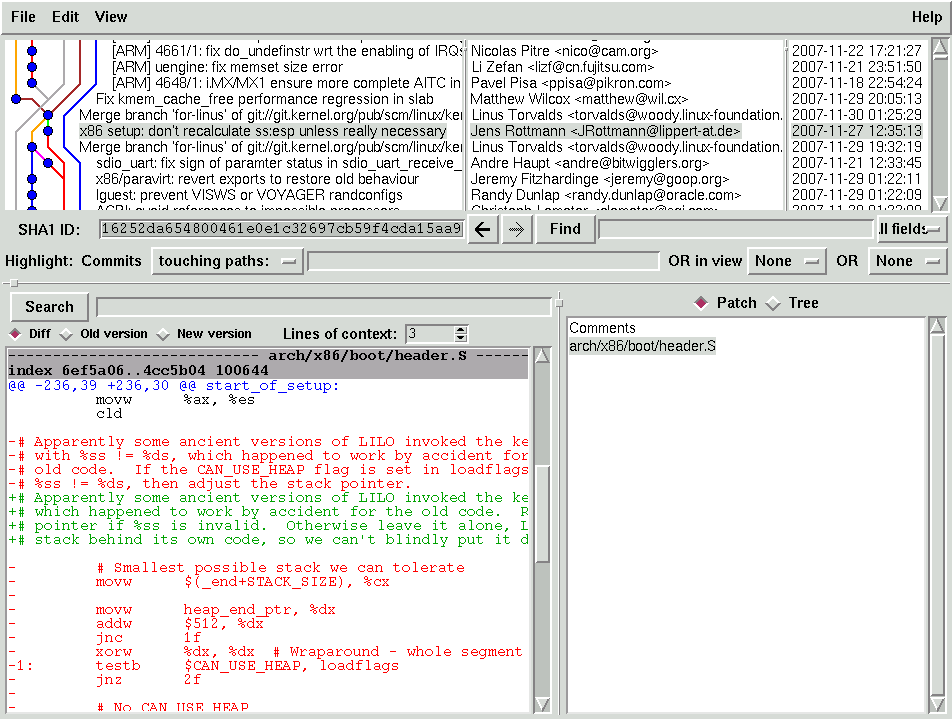
Use git cherry to find commits not merged upstream. Another really cool feature is the interactive rebasing: git rebase –interactive Make sure you are aware of gitk: Screenshot of gitk … and don’t forget to set readable fonts for gitk, like:
[ -r ~/.gitk ]   cat > ~/.gitk << EOF
set mainfont  Arial 10 
set textfont   Courier 10 
set uifont  Arial 10 bold 
EOF
If you prefer a Qt based interface check out qgit. Useful ressources:

14 November 2007

Anthony Towns: Managing Debian Installs

For a while I’ve been trying to find some easy way to keep a few machines I admin behaving the way I want them too with minimal effort. They don’t really need much maintenance – but I would like something to help keep them all in sync. Basically, something like FAI, but much, much simpler – ideally something that takes five minutes to understand, and another five minutes to deploy; and leave the more complicated and powerful tools for when they’re actually needed. I figured what I really want was just a simple way to make a meta-package – one that doesn’t really provide any functionality, just tells apt/dpkg what I want installed (via Depends), and what I don’t want installed (via Conflicts) and adds any extra configuration stuff or local scripts that I decide I want. But doing that with a real Debian package is harder than I’m really comfortable with – I don’t want to have to worry about potential lintian errors, or rules files and debhelper commands, or writing a Makefile to get my files installed or whatever, I want something more trivial than that. Looking for meta-package creators, the only one I spotted that I thought looked likely was cdd-dev, described as “Custom Debian Distributions common files for developing meta packages”. Unfortunately it seems to just provide templates, which makes things quicker, but no less complex. Fortunately equivs (“Circumvent Debian package dependencies”) is actually used for metapackages these days, according to its maintainer on IRC and its long description:
This package provides a tool to create Debian packages that only contain dependency information. One use for this is to create a metapackage: a package whose sole purpose is to declare dependencies and conflicts on other packages so that these will be automatically installed, upgraded, or removed. Another use is to circumvent dependency checking. […]
That turned out to work much better than I remembered (from whenever I last tried it – back in ‘99 I guess?), with the only drawback being that I couldn’t add files easily. But that’s just a matter of creating a patch to equivs, which I then won’t have to worry about again. So having done that, I can now create a metapackage to do whatever I want by creating a file like:
Suite: client
Section: misc
Priority: standard
Package: ajs-client-stuff
Version: 20071114.1
Maintainer: Anthony Towns <aj@erisian.com.au>
Description: Metapackage for aj's client computers
 Depends on necessary packages, etc.
File: /etc/apt/sources.list.d/client.list
 deb http://mirror.localnet/debian etch main contrib non-free
 deb http://mirror.localnet/debian etch-proposed-updates main contrib non-free
 .
 deb http://security.debian.org/ etch/updates main contrib non-free
File: postinst
 #!/bin/sh -e
 .
 apt-key add - <<EOF
 [output of gpg --armour --export $KEY]
 EOF
 .
 ##DEBHELPER##
debhelper kindly takes care of getting the permissions right for me, and equivs will generate a full source package if I tell it to, which I can just upload to mini-dinstall and have a regular Debian repository just by writing a text file and running equivs-build. And my metapackage can add dependencies, conflicts, apt sources, cronjobs, scripts, configuration files, documentation, or whatever I happen to want – which means I can make it automatically update itself, and thus install any dependencies or remove any conflicts, which then means that modifying the config on all the machines is just a matter of updating the metapackage. And new installs is (hopefully) just a matter of doing a standard install and then adding the metapackage. Perfect. …even if it is really little more than a reinvention of rpm’s .spec files. :)

6 November 2007

John Goerzen: American Priorities

Number of people killed on Sept. 11, 2001: 2,974
Number of suicides in 2004: 32,439
Number of people killed on American highways in 2006: 38,588
Annual deaths from obesity:300,000
Total deaths from cancer in 2007:559,650
Total deaths from heart disease in 2004:871,500
 
Total military spending in FY2008: $1228 billion
Funding for health research & improvement (NIH):$29 billion
Total support of Amtrak (safer, cleaner than highways):$1.6 billion
National Highway Traffic Safety Admin. spending in FY2008: $0.8 billion
 
WHAT IS WRONG WITH THIS PICTURE?

16 October 2007

MJ Ray: Stuttering through comment spam

I get too much spam and some of it isn't obvious from the subject line, particularly if it's a blog comment, so I use the following script to read the suspicious emails and pause at the bottom of each mail. It takes two optional parameters, explained in the comments below. Please comment on any obvious improvements to this quick hack.
#!/usr/bin/mzscheme -qr
(let ((c (or (and (> (vector-length argv) 0)
                  (string->number (vector-ref argv 0)))
             1)) ; first arg is how long to pause in seconds, default 1
      (re (or (and (> (vector-length argv) 1)
                   (regexp (vector-ref argv 1)))
              (regexp "^From [^ ]*@"))) ; second arg is regexp to pause at
      (i #f))
  (let loop ((l (read-line)))
    (if (regexp-match re l) (if i (sleep c) (set! i #t)))
    (write-string l) (newline)
    (if (not (eof-object? (peek-char))) (loop (read-line)))))
(exit)
;
#!/usr/bin/perl
# An earlier version in perl
$c = ($ARGV[0] 1); # How long to pause, in seconds
$re = ($ARGV[1] '^From [^ ]*@'); # What to pause on
$i = 0;
while (<STDIN>)  
  if (/$re/)   if ($i)   sleep ($c)   $i=1;  
  print $_;
 

22 September 2007

David Welton: Erlang

As someone who tries to read a lot about my field, I feel I have my "ear to the ground", so to speak. And right now, I'm picking up a lot of hype-rumblings about the Erlang programming language. I have a little bit of experience with it, having used it briefly about 3 years, and having made a few minor contributions. Why are people interested in it? Picking up new programming languages is fun for some people, but in general, unless it's something backed by millions of dollars of marketing and development (Java, C#/.Net) there needs to be a 'killer feature' to drive adoption. Tk and Tcl, ease of developing simple dynamic web content with PHP, Rails and Ruby, and so on. Erlang, in many people's eyes:
  1. gets concurrency right, or at least is a big improvement over existing models (threads).
  2. Makes distributed computing easier and does it naturally.
  3. Is a solid base on which to construct reliable applications.
That appears to be enough to have nudged Erlang into a position where it has a chance at the big time. While I would highly encourage people to learn a bit of Erlang, and to seriously consider its use for the type of systems for which it was created, I have some doubts about it becoming that widespread. Please read the following as the thoughts of a critical mind, and keep in mind that it's far easier to zero in on defects than it is to create something from scratch, so do not misconstrue my writing as being "against" Erlang (I do use it, enjoy it, and recommend learning it!), but as an honest appraisal colored by my own view of the world, which might not be like yours. To begin with the superficial, its syntax is a bit odd. For a professional programmer, that shouldn't present much of an obstacle, and indeed isn't after a few days of using it, but there are a few things that I do find a bit annoying despite being used to the syntax, first and foremost being the use of . and , to separate lines of code, rather than a newline, or ; (which is used elsewhere). They're like little mouse droppings - hard to spot, and they get in your way when you swap out bits of code here and there. The last line of a function must end with a ., but other lines are separated with commas, so when you're cutting and pasting lines from here to there, you end up having to recheck the line endings each time. Erlang is a functional programming language. Once again, someone with a wide exposure to many programming styles will not find this difficult after a week or so of practice, to wrap your mind around a different way of thinking. However, I have some doubts as to whether a functional language will be able to bring on board the numbers necessary to be widely adopted (see Scaling Down). One of the benefits of wider adoption is, indeed, having a wider set of libraries - it's a "positive network externality" in terms of economics. Other people have written about the relative lack of Erlang libraries to do various things, but it's actually not one of the things I'm worried about - it's something that will take care of itself if the language grows in popularity. After being spoiled by Ruby's gems, what I really miss, though, is a nice, simple, easy distribution mechanism. Related to making it easier for J Q Programmer to adopt, the error messages are at times not the most helpful I've seen in the computing industry:
Error in process <0.29.0> with exit value:
 undef,[ shell_default,sfdsf,[] , erl_eval,do_apply,5 , shell,exprs,6 , shell,eval_loop,3 ] 
In English, that means that I tried to execute the function sfdsf(), which doesn't exist. It seems that there ought to be a way to keep the nice, computer parseable error messages, and add in something that humans would find just a bit easier. Other people have already covered the problems with Erlang's strings, so I won't belabor the point. Suffice it to say that, in my opinion, is_list([foo, bar, baz]) and is_list("hello") should probably not both be true. Which brings us to another issue. Erlang is a language used in big, reliable systems like telephony switches. That's not the sort of environment where you want to break things, so I doubt that Erlang will ever see big changes that introduce incompatibilities, like Python has recently done. This one is a tradeoff - stable, reliable and backwards compatible is simply not compatible with rapid development of the language - it's a zero-sum game, you want more of one, you get less of the other. Related, is the "open sourceness" of the language. It is open source, which for me is very nearly a prerequisite for dedicating my time to a language, but Ericsson appears to maintain firm control over it. This is another thing that's both good and bad. Having the backing of a large corporation means that developers are paid to work on and enhance Erlang, which is beneficial to everyone. On the other hand, as some people say, open source is just the start, open development is important too. Random thought: I bet Erlang would make a nice Apache project, but I'm sure the bureaucracy involved would be a nightmare. In terms of the language itself, beyond the syntax, it feels a little bit too verbose. Perhaps not as much as Java (that would be difficult, wouldn't it)... maybe I'm just used to Ruby, which is about as concise as I'm comfortable with while still being readable. Sometimes, though, there is a little bit more 'repeat yourself' than I would like to see. For instance, in this implementation of string_join (something else that ought to be in the standard library, but still isn't), it's necessary to create the same function, with different arity, simply to work around the fact that it's not possible to say the default separator should be " ":
string_join(Items) ->
    string_join(Items, " ").
string_join(Items, Sep) ->
    lists:flatten(lists:reverse(string_join1(Items, Sep, []))).
Which is a lot more typing than string_join(Items, Sep=" "). This is pure opinion, and very subjective, but Erlang to me feels like it falls more in the "systems programming language" category than "scripting language". It's a bit more verbose, it needs to be compiled to run it, modules need to have an entry point... it's not as suitable to quick throwaways as Ruby, Tcl or Python. Of course, it is certainly higher level than C, and leaner than Java, but still falls an the other side of an admittedly fuzzy line in my head. Its command line options reinforce that. Whereas "scripting" languages do the obvious thing first:
ruby foo/bar.rb
Erlang is a little bit more complex:
erl -noshell -pa foo/ -run bar
A minor detail, once you get used to it, but still, I prefer the "do the obvious thing first, and let the user have some say in the matter if they want to do something else" approach to systems design. One of the wonderful things about Ruby on Rails, is that it uses Ruby throughout, templates included. Without getting into the merits of using templates vs other systems, my own opinion is that Rails gets them right, and demonstrates the flexibility of Ruby by using it as the language for the templates, rather than inventing some other solution. I don't see the same flexibility in Erlang, which is unfortunate, as it blows Ruby out of the water in terms of being a very solid solution to deploy on a server (no fiddling with proxies and load balancers and single threaded mini-servers + hot code replacement = nice). Of course, there are lots of good things about Erlang, as mentioned at the beginning of this article - concurrency and distribution, but also language features like pattern matching that are a lot of fun to use, a pleasant syntax for dealing with binary data, list comprehensions, first class functions, tail recursion, and lots of other goodies. However, if I had to try and predict the future, I could easily imagine another language grabbing some of Erlang's good ideas and running with them, perhaps being more "conventional" in other respects - this isn't uncommon in the languages field, as we've seen with things like Lisp and Smalltalk. On the other hand, one of the reasons I *am* quite happy with Erlang is that it is most certainly not a proof of concept - it is a very practical language that excels at solving certain classes of problem, and does so in many commercial settings. If you're the kind of person who enjoys new things, check it out!

Next.

Previous.