Search Results: "dpk"

1 November 2011

Bernhard R. Link: File ownership and permissions in Debian packages

As you will know, every file on a unixoid system has some meta-data like owner, group and permission bits. This is of course also true for files part of some Debian package. And it is not very surprising that different files should have different permissions. Or even different owners or groups. Which file has which settings is of course for the package maintainer to decide and Debian would not be Debian if there were not ways for the user to give their own preferences and have them preserved. This post is thus about how those settings end up in the package and what is to be observed when doing it. As you will also have heard, a .deb file is simply a tar archive stored as part of an ar archive, as you can verify by unpacking a package manually:
$ ar t reprepro_4.8.1-1_amd64.deb
debian-binary
control.tar.gz
data.tar.gz
$ ar p reprepro_4.8.1-1_amd64.deb data.tar.gz   gunzip   tar -tvvf -
drwxr-xr-x root/root         0 2011-10-10 12:05 ./
drwxr-xr-x root/root         0 2011-10-10 12:05 ./etc/
drwxr-xr-x root/root         0 2011-10-10 12:05 ./etc/bash_completion.d/
-rw-r--r-- root/root     19823 2011-10-10 12:05 ./etc/bash_completion.d/reprepro
drwxr-xr-x root/root         0 2011-10-10 12:05 ./usr/
drwxr-xr-x root/root         0 2011-10-10 12:05 ./usr/share/
--More--
(For unpacking stuff from scripts, you should of course use dpkg-deb --fsys-tarfile instead of ar gunzip. Above example is about the format, not a recipe to unpack files). This already explains how the information is usually encoded in the package: A tar file contains that information for each contained file and dpkg is simply using that information. (As tar stores numeric owner and group information, that limits group and owner information to users and groups with fixed numbers, i.e. 0-99. Other cases will be covered later.) The question for the maintainer is now: Where is the information which file has which owner/group/permissions in the .tar inside the .deb, and the answer is simple: It's taken from the files to be put into the .deb. This means that package tools could simply be implemented first by simply calling tar and there is no imminent need to write you own tar generator. It also means that the maintainer has full control and does not have to learn new descriptive languages or tools to change permissions, but can simply put the usually shell commands into debian/rules. There are some disadvantages, though: A normal user cannot change ownership of files and one has to make sure all files have proper permissions and owners. This means that dpkg-deb -b (or the usually used wrapper dh_builddeb) must be run in some context where you could change the file ownership to root first. This means you either need to be root, or at least to fake being root by using fakeroot. (While this could be considered some ugly workaround, it also means upstream's make install is run believing to be root, which also avoids some -- for a packager -- quite annoying automatisms in upstream build scripts assuming a package is not installed system wide if not installed as root). Another problem are random build host characteristics changing how files are created in the directory later given to dpkg-deb -b. For example an umask which might make all files non-world-readable by default. The usual workaround is to first fix up all those permissions. Most packages use dh_fixperms for this, which also sets executable bits according to some simple rules and has some more special cases so that the overall majority of packages does not need to look at permissions at all. So using some debhelper setup, every special permissions and all owner/group information for owner groups with fixed numbers only needs to be set using the normal command line tools between dh_fixperms and dh_builddeb. Everything else happens automatically. Note that games is a group with fixed gid. So it is not necessary (and usually a bug) to change group-ownership of files withing the package to group games in maintainer scripts (postinst,...). If a user wants to change permissions or ownership of a file, dpkg allows this using the dpkg-statoverride command. This command essentially manages a list of files to get special treatment and ownership and permission information they should get. This way a user can specify that files should have different permissions and this setting is applied if a new version of this file is installed by dpkg. Being a user setting especially means, that packages (that means their maintainer scripts) should not usually use dpkg-statoverride. There are two exceptions, though: Different permissions based on interaction with the user (e.g. asking question with debconf) and dynamically allocated users/groups with dynamic id. In both cases one should note that settings to dpkg-statoverride are settings of the user, so the same care should be given as to files in /etc, especially one should never override something the user has set in there. (I can think of no example where calling dpkg-statoverride --add without dpkg-statoverride --list in some maintainer script is not a serious bug: Either you override user settings or you are using debconf as a registry. Moral To recap, your package is doing something wrong if:

Raphaël Hertzog: My Debian activities in October 2011

This is my monthly summary of my Debian related activities. If you re among the people who made a donation to support my work (130.30 , thanks everybody!), then you can learn how I spent your money. Otherwise it s just an interesting status update on my various projects. Dpkg work The month started with fixing newly reported bugs to prepare the 1.16.1.1 release: With the help of Guillem, we decided on a proper fix for a race condition sometimes triggered by parallel builds when 2 concurrent dpkg-gencontrol try to update debian/files (see #642608). This ended up requiring a new package (libfile-fcntllock-perl) that the Debian perl team kindly packaged for us. With all this sorted, it was a rather easy fix. Multiarch progress I also spent lots of time on multiarch. I fixed an old bug that requested to support the multi-arch paths in case of cross-building (see #595144), the discussion was not really conclusive on which of the two proposed patches was better so I ended up picking my own patch because it was closer to how we currently deal with cross-building. Then I fixed 2 issues that have been reported on Ubuntu s dpkg. The first one (LP #863675) was rather severe since an installed package ended being disappeared in favor of its foreign counterpart that was removed (but that had some config files left). The second one (LP #853679) only affected dselect users (apparently there are still some!) who had a self-conflicting library (Provides: foo, Conflicts: foo) installed for multiple architectures. But the bulk of the time spent on multiarch has been spent discussing with various parties on how to go forward with multiarch. The release team commented on the schedule of the merge to ensure it makes it into Wheezy, and the Debian project leader also commented on the problems encountered so far. While not the best course of action I could have hoped for, it certainly helped since Guillem started pushing some reviewed commits. Out of the 66 commits that were in my pu/multiarch/full branch one week ago, 20 have been merged in the master branch already. Python-django security update and RC bug Since python-django s maintainer did not manage to prepare the required security updates, I stepped in and prepared version 1.2.3-3+squeeze2 for Squeeze and 1.0.2-1+lenny3 for Lenny. Unfortunately this security update is an example of how an inactive maintainer is likely to result in a severe delay for the release of security updates. Furthermore in this specific case, the security team did not want to release the Squeeze security update until the Lenny one had been investigated (which required some time since upstream no longer supports the version in Lenny) but they did not make this very clear. Later another release critical bug had been filed against the package (#646634) but after investigation, it turned out to be a local configuration problem so I downgraded it. I still forwarded the test suite failure to upstream authors since the test could be enhanced. In any case, co-maintainers for python-django are welcome. I really preferred the situation where I can quietly sit down as backup maintainer :-) WordPress packaging WordPress sounds similar to python-django. I m also only a backup maintainer but Giuseppe has been inactive for many months and I had to step in August because I wanted the new upstream version. I discovered a bit late that I was not subscribed to wordpress bugs and thus the release critical bug #639733 (that I introduced with my new upstream version) went unattended for a rather long time. Once aware, though, I quickly fixed it. I also took the opportunity to start a discussion on debian-devel about how to deal with embedded javascript libraries and proposed a mechanism of opportunistic replacement with symlinks . WordPress is my testbed package for this mechanism, you can check out its debian/dh_linktree that implements the replacement logic. The discussion has not been very interesting but at least I learned that Debian now requires that each source package shipping minified javascript files includes the original files too. It s somewhat of a pain since it s not a license requirement in many cases (many of those libraries are not under the GPL), but just a Debian requirement that many upstreams are not complying with. WordPress is affected and Jakub Wilk thus opened #646729 which is going to be a long-standing RC bug. To give good measures, I spent several hours investigating the case of each javascript file in the WordPress source package and I filed a new ticket on the upstream bugtracker. Dropbox packaging work A few months after the introduction of nautilus-dropbox to Debian and Ubuntu, I can say that the decision to only support the download of dropbox in the postinst has been a mistake. Because of this decision I had to make the postinst fail if the download failed. Even if the error message is relatively clear, this lead to many (mostly automated) bug reports on the Ubuntu side. Various other problems cropped up on top of this (trying to start dropbox while the package was not configured would result in an error because the user did not have the required rights to install the software, reinstalling the package while dropbox was running would result in a failure too, etc.). I have fixed all those issues in the version 0.7.0-2 of the package. Now if the user has to install dropbox, it will use PolicyKit to request the root rights. The postinst will no longer fail if the dropbox download fails since it can be run later by the user. And I fixed the download code to remove the replaced file before unpacking a new file (insead of overwriting the existing file). All this work has been forwarded upstream. The Debian Administrator s Handbook Update I m glad to tell you that the translation will happen because we reached the minimal funding goal on October 22th with the help of 380 supporters. Now the fundraising continues, but this time the goal is the liberation of the resulting book. For this to happen, we need to reach 25000 EUR in the liberation fund. So far we re at 37% of this goal with 9400 EUR in the liberation fund (which means that 59% of the money raised has been put in the liberation fund).

Click here if you want to contribute towards the liberation of this book. With (less than) 27 days left, it s going to be a challenge to meet the goal, but we do like challenges, don t we? Misc work

Thanks See you next month for a new summary of my activities.

2 comments Liked this article? Click here. My blog is Flattr-enabled.

25 October 2011

Wouter Verhelst: diff6

There are six servers. They're meant to be used for the same purpose, and are mostly the same too, but not quite entirely. This being the case, mostly because of how they were maintained in the past: with cssh mostly, but it's inevitable that eventually there will be differences. So we're in the process of migrating them to puppet now. One of the things I need to do while doing that, however, is figure out what the differences are, and get rid of them where applicable. Differences such as, say, in the installed packages. Some of these servers have extra things installed, for a reason that isn't clear anymore, that others don't. So how does one figure out what the difference is? If this were two servers, I'd create a list of installed packages and use 'diff' on them. If there were three, I'd use 'diff3' instead. But if there are 6? Turns out that isn't too hard. First, of course, you need a list of packages installed on each individual host. Both rpm and dpkg can do this with a simple command line invocation. Assuming that's done, and the output is stored in files called installed-host1 through installed-host6, the procedure is:
$ comm -12 installed-host1 installed-host2 > installed-common
$ for i in $(seq 3 6)
> do
>   comm -12 installed-common installed-host$i > installed-tmp
>   mv installed-tmp installed-common
> done
And there, you now have a file "installed-common" containing everything which is installed everywhere. If you use "comm" or "diff" to compare that file against the installed-hostX files, you can easily see what the difference is. Granted, that doesn't give you the overview in just one file, but usually that's not really necessary. The 'installed-common' file contains the largest common denominator, which really is everything you need.

19 October 2011

Yves-Alexis Perez: Debian grsec kernels

I received recently a mail about my attempt to provide Grsecurity kernels in Debian. The sender found the bug by accident, and asked me why I didn't do some more publicity here. So here we are. I won't go into details on what grsecurity is, it's fairly complex. But it's basically a hardening patch for the Linux kernel, with three main components: A lot of this touches low level stuff in the kernel, especially memory management. Ideally this patch would be pushed upstream, but Brad Spengler (grsecurity main developper) already said he wasn't interested in upstreaming it and upstream already said the patch was too huge and invasive to include it like that (especially since the original authors aren't interested in maintaining it upstream). There's an ongoing effort to split the patch and merge things little by little, but in the meanwhile having a mid-term solution would be nice. I know Debian users rebuilding grsecurity-patched kernels themselves, and I know some of them would appreciate having them included in the Debian kernel. Fortunately, the linux-2.6 source package has a nice feature which is called featureset. Basically it's a way to build some (binary) packages using a different set of patches and a different config. For example this was used to provide xen/openvz/vserver patchsets, and is now used to provide rt kernels. So I though it'd be nice to provide a grsec featureset, and starting doing the work. I have a working setup for producing those kernels, so I've opened a wishlist bug against the kernel (#605090) to have this merged. Those packages follow the sid kernel. There's an ongoing work for Squeeze, but it's a bit harder there because both the grsecurity patchset and the Debian kernel ship a whole lot of backports to the Linux kernel, meaning the grsecurity patch doesn't apply directly to the Debian source package. Basically I need to remove some of the hunks (since they are already applied to the source) and port some others (since there are some backported code not present in the vanilla 2.6.32, for example the drm code). Until the patches are merged and the bug is closed, I host some of the built packages at:

deb http://molly.corsac.net/~corsac/debian/kernel-grsec/packages/ sid/ The repository is signed by my key which you can add to your apt setup using apt-key add. If you want to rebuild the packages yourself, here's the method:

mkdir kernel-grsec
cd kernel-grsec
svn checkout svn://svn.debian.org/svn/kernel/dists/sid/linux-2.6
git clone git://anonscm.debian.org/users/corsac/grsec-patches.git
wget http://www.kernel.org/pub/linux/kernel/v3.0/linux-3.0.tar.bz2
wget http://www.kernel.org/pub/linux/kernel/v3.0/linux-3.0.tar.bz2.sign
gpg --verify linux-3.0.tar.bz2
cd linux-2.6
apt-get build-dep linux-2.6
export QUILT_PATCHES=../grsec-patches
quilt push -a
python debian/bin/genorig.py ../linux-3.0.tar.bz2
debian/rules orig
fakeroot debian/rules source
fakeroot make -f debian/rules.gen binary-arch_amd64_grsec_amd64 You could also do dpkg-buildpackage, pdebuild or whatever. Kernel handbook is a nice reading too if you want more information on how to rebuild Debian kernels. The quilt push -a may fail if you checkout an svn version more recent than mine. I try to keep patches up to date but I usually have some delay. Note that installing the kernel will require installing linux-grsec-base package. Binary is not yet available on my mirror but you can easily build it. Source can be found on git.debian.org. If you're interested by this, don't hesitate to mail me or the bug.

Steve Langasek: Debian: not stale, just hardened

Rapha l Hertzog recently announced a new dpkg-buildflags interface in dpkg that at long last gives the distribution, the package maintainers, and users the control they want over the build flags used when building packages. The announcement mail gives all the gory details about how to invoke dpkg-buildflags in your build to be compliant; but the nice thing is, if you're using dh(1) with debian/compat=9, debhelper does it for you automatically so long as you're using a build system that it knows how to pass compiler flags to. So for the first time, /usr/share/doc/debhelper/examples/rules.tiny can now be used as-is to provide a policy-compliant package by default (setting -g -O2 or -g -O0 for your build regardless of how debian/rules is invoked). Of course, none of my packages actually work that way; among other things I have a habit of liberally sprinkling DEB_MAINT_CFLAGS_APPEND := -Wall in my rules, and sometimes DEB_LDFLAGS_MAINT_APPEND := -Wl,-z,defs and DEB_CFLAGS_MAINT_APPEND := $(shell getconf LFS_CFLAGS) as well. And my upstreams' build systems rarely work 100% out of the box with dhauto* without one override or another somewhere. So in practice, the shortest debian/rules file in any of my packages seems to be 13 lines currently. But that's 13 lines of almost 100% signal, unlike the bad old days of cut'n'pasted dh_* command lists. The biggest benefit, though, isn't in making it shorter to write a rules file with the old, standard build options. The biggest benefit is that dpkg-buildflags now also outputs build-hardening compiler and linker flags by default on Debian. Specifically, using the new interface lets you pick up all of these hardening flags for free:
-fstack-protector --param=ssp-buffer-size=4 -Wformat -Wformat-security -Werror=format-security -Wl,-z,relro
It also lets you get -fPIE and -Wl,-z,now by adding this one line to your debian/rules (assuming you're using dh(1) and compat 9):
export DEB_BUILD_MAINT_OPTIONS := hardening=+pie,+bindnow
Converting all my packages to use dh(1) has always been a long-term goal, but some packages are easier to convert than others. This was the tipping point for me, though. Even though debhelper compat level 9 isn't yet frozen, meaning there might still be other behavior changes to it that will make more work for me between now and release, over the past couple of weekends I've been systematically converting all my packages to use it with dh. In particular, pam and samba have been rebuilt to use the default hardening flags, and openldap uses these flags plus PIE support. (Samba already builds with PIE by default courtesy of upstream.) You can't really make samba and openldap out on the graph, but they're there (with their rules files reduced by 50% or more). I cannot overstate the significance of proactive hardening. There have been a number of vulnerabilities over the past few years that have been thwarted on Ubuntu because Ubuntu is using -fstack-protector by default. Debian has a great security team that responds quickly to these issues as soon as they're revealed, but we don't always get to find out about them before they're already being exploited in the wild. In this respect, Debian has lagged behind other distros. With dpkg-buildflags, we now have the tools to correct this. It's just a matter of getting packages to use the new interfaces. If you're a maintainer of a security sensitive package (such as a network-facing daemon or a setuid application), please enable dpkg-buildflags in your package for wheezy! (Preferably with PIE as well.) And if you don't maintain security sensitive packages, you can still help out with the hardening release goal.

7 October 2011

Raphaël Hertzog: My Debian activities in September 2011

This is my monthly summary of my Debian related activities. If you re among the people who made a donation to support my work (144.3 , thanks everybody!), then you can learn how I spent your money. Otherwise it s just an interesting status update on my various projects. Dpkg work While taking care of the last details for the hardening feature in dpkg 1.16.1, I have mailed debian-devel to find volunteers to handle a hardening release goal. The objective is to ensure a large number of packages have been converted/rebuilt to actually use the new hardening build flags. Then I prepared the draft of the announce of the dpkg 1.16.1 upload (aka Bits of dpkg maintainers sent to debian-devel-announce) which got expanded by Guillem to also cover new features since dpkg 1.15.7. update-alternatives got some refactoring by Guillem which resulted in a regression that has been fortunately discovered by Sven Joachim. I fixed that regression and did some further cleanup inspired by the root cause of this regression (see top 4 commits here). Note that Sven is one of the few persons who are running the git version of dpkg. Hopefully the number of tester will increase since I recently documented the APT repositories with autobuilt versions of dpkg in the wiki. At the end of the month, I started working on a bugfix release (what s going to be 1.16.1.1) by fixing some of the unavoidable problems discovered after an upload that accumulated more than 4 months worth of work (see top 4 commits here). The Debian Administrator s Handbook I spent countless hours finalizing the launch of the crowdfunding campaign for the Debian Administrator s Handbook and it went live on September 27th. So far it s on good track with more than 63% of the base funding already secured. But we still have a long way to go to reach the liberation goal (we re at 21%). It s still worth nothing that more than 55% of the money raised has been put in the liberation fund so there are many persons who care about getting the book freed. More than 250 persons are supporting the project currently with an average contribution of 38 EUR. I would have expected much less for the average contribution but many more supporters. I still hope we can get more people on board with the perspective of a good DFSG-free Debian ebook. Did you order your copy? If not, click here and fix this! ;-) By the way Paypal used to be required but it s no longer the case, you can support the project just with your usual credit card. Misc blog updates Over time, I have written many useful articles for Debian users and Debian contributors. But scattered in the history, they are somewhat difficult to find. To fix this I have created some index pages listing them. Check them out: Two new articles joined those pages this month: How to triage bugs in the Debian Bug Tracking System and Understand dpkg and don t get stuck with a maintainer script failure. While writing the first article, I noticed we lacked a good page showing the most buggy packages so I quickly created it (with the help of UDD): http://qa.debian.org/cgi-bin/bugs-by-source Misc packaging work I did a small update to the developer s reference. Luca Falavigna submitted a patch to clarify how one is supposed to deal with meta-packages (cf #569219), I improved it and integrated the result in the SVN repository. I upgraded nautilus-dropbox to version 0.6.9 and while doing this I discovered a bug in mergechanges (filed as #640782). I uploaded a new release of quilt mainly to add the Multi-Arch: foreign field so that it can satisfy dependencies of foreign packages (i.e. packages of a different architecture). Django released some security advisories (tracked in #641405) and since the maintainer did not deal with the issue, I stepped up to the task (I m a backup maintainer) and released the fixed version 1.3.1 to unstable. I took the opportunity to switch from python-support to dh_python2, and do some misc improvements to the packaging (see changelog). I wanted to update publican to a newer version but it turned out to be not possible because Debian doesn t have the latest version of docbook-xsl yet. I also discovered some bugs in the test suite and forwarded upstream the patch I created (see upstream bug). On top of this, fop was failing due to some java problem related to the introduction of multiarch. After having reported the bug, the java maintainers quickly released a fixed version. So now publican is ready in the git repository but it s waiting on the docbook-xsl update. I got in touch with the maintainer who said he would have the time to take care of it by mid-october. Thanks See you next month for a new summary of my activities.

One comment Liked this article? Click here. My blog is Flattr-enabled.

2 October 2011

Neil Williams: Uses of Emdebian - special purpose computers

A continuation of my intermittent series on Emdebian and prompted by a query from Paul Wise, I thought I'd cover some of the uses to which a device running Emdebian can be put. It is a bit long this one...

So, yes, there are general purpose computers which could run Emdebian but there are common features amongst general purpose computers:
  1. Lots of different tasks must be supported - lots of different packages installed, each user could quite easily use a distinct set of packages from another user.

  2. Multi-user support - even if any one machine is only used by one person, a general purpose computer must have support for adding another user - not just a system user, a real user with a login, shell, possibly bookmarks and browser history etc.

  3. Connectivity - general purpose computers (and that includes mobile phones) must connect to a variety of other computers to be at all useful.

  4. Multi-modal data input - there needs to be support for a mouse and a keyboard or touchscreen and just as likely, software support for accessibility interfaces like an on screen keyboard and switch inputs.

  5. Storage for user data - the system admin can't know how much data users are going to add and if it is general purpose, it's probably going to support media players, image viewers, even office software. The data files managed and written by such software tend to be large and tend to accumulate into large collections. This means that a general purpose machine cannot anticipate the full storage requirements, so has to allow plenty of room for user data storage. If there's so much storage space available, why use an OS which is primarily designed to take up less space? Just use the full version, Debian.


Now compare with the common features of special purpose or single-purpose computers:
  1. Single task only - a splash screen (without support for removal) covers all the boot information, the single task starts as a daemon and if the user quits the task, the task initiates a shutdown, not quit. Every effort is made to prevent the task from exposing the underlying OS, including auto-restarts if it does crash.

  2. Single-user support - indeed, user is not the typical user. user in this case is a non-login user without a shell, created by the postinst of the task package purely to support running the task without root privileges (because if the task doesn't need privileges, it shouldn't retain privileges).

  3. Single mode input - don't expect these machines to support 105 key keyboards. You'll be lucky to have 5 keys which are really just buttons. The button won't just enter 'J' into the machine, it will fire off a command to charge your bank or start a drill or shutdown a malfunctioning service. (Each button will often be multi-functional as well, depending on context). Some devices will replace the mouse with a touchscreen but many are fitted in places where touchscreens simply won't survive, where keys have to be able to withstand being submerged in water (or oil) for hours. Many machines simply won't have mouse support at all. Many will not have any typical external connectors. Indeed, units which go into dirty or wet environments certainly won't have standard external connectors of any kind. Think boats and factories. Internal battery packs with custom hot-fit replacements, buttons encased in 4mm of clear plastic, screens viewable only through protective mesh / filters.

  4. Restricted connectivity - if the task doesn't need networking, no networking hardware is fitted. If the task doesn't need USB, no USB hardware is fitted. If the task doesn't need serial connections, there will probably be an internal serial connector but also a Warranty void if removed sticker. Don't expect an RS232 inside the case either, this will be a flat cable connector which you'll need to attach to a breakout board which correctly connects the cable wires to the RS232 port pins. That mapping is not standardised (why would it? only service engineers are approved to use it.)

  5. Constrained user data - the task is in complete control and determines what the user can view, store and access. Storage can be expensive and a power drain, so if the task doesn't need Gb of storage, don't fit the machine with Gb of storage. Profit.


So what are these mysterious single-use computers running Emdebian? It's hard to tell because the task has no particular reason to tell the user anything about the OS. Perhaps a different way to phrase the same question would be: Why use a general purpose OS for a special purpose computer?.


This is why Emdebian Grip is popular for these machines - because Emdebian Grip is binary compatible with the equivalent Debian suite and when a bug appears in the high level user interface, it is much easier to debug that on the desktop than on device. Debian stable is a fantastic OS for commercial development - the stability of the OS makes detection of interface bugs much easier. It is rare that developers have to investigate whether bugs in their UI come down to a bug in the underlying OS. That saves time.

The machines themselves? I'm sure others can come up with other examples but these are some which come to my mind (no particular order):


Anywhere where the device simply needs to DoTheRightThing in a variety of unpredictable circumstances, you're going to need a general purpose OS to gather the data and produce the right result. Anywhere where the device has only a single task, you're going to want to not provide access to the rest of the system. There's no point providing "general purpose access" when the device doesn't have "general purpose hardware". There's no point fitting general purpose hardware if the device does not use it. That is a waste of money, a waste of resources and causes unnecessary delays if one component or other becomes unobtainable or changes behaviour. Limit your exposure to hardware bugs and get the product out to the user more quickly and more reliably, everyone is happy. Fit non-standard hardware and you can fit custom hardware which better matches the profile of the device usage - why use standard speakers capable of CD quality across a vast frequency range when the device only makes very very loud alert noises which can be done at lower sample rates and with narrow range, high amplitude, speakers.

There are all sorts of estimates for the number of computers now in the average Western home. It's worth noting that the vast majority of those computers are not PCs or laptops or even game consoles and routers - all instances of general purpose machines with general purpose access / connectivity. A lot of the computers in your home are embedded in machines like white goods, media controllers (set top boxes and the like). Some of these will still use low level firmware written entirely in assembly or COBOL. More complex ones already have a general purpose OS inside yet constrain that OS with a simple, user-friendly interface which is tailored to the hardware actually fitted. It might be cool to connect to your set top box over Bluetooth but really, is that actually going to sell more units? Only if there are other high-end services written for the device which the average customer won't want to see pushing up the price of the base unit. Some machines (particularly in automotive uses) will need to be using Real Time operating systems and Safety Critical operating systems but even some of those are based on general purpose systems - just old versions which have been thoroughly tested.

Finally, consider that for a lot of these devices, the customer is not you. The customer is another business who then put the device into something else which is installed into a factory production line which produces something which goes into creating a consumer product you find in Tesco or on Amazon or bundled in with another service like your TV/broadband contract. There is absolutely no reason for these devices to provide general purpose computing to you, even if the device itself is part of something else which can provide such services.

25 September 2011

Joachim Breitner: Yesod packaged for Debian

As Clint writes on his blog, we have now Yesod, a Haskell web framework, packaged in Debian. Despite his humble choice of words, it was mostly his work, and it is quite some work, given that Yesod has a huge number of dependencies that were not yet packaged. So if you want to use Yesod on Debian, and prefer pre-built libraries without dependency problems and clean installation/deinstallation with dpkg over having always latest and greatest, this should provide you with a solid base.

Flattr this post

13 September 2011

Raphaël Hertzog: Understand dpkg and don t get stuck with a maintainer script failure

Continuing my series of articles on dpkg s errors, this time I ll cover a pretty common one which has several variations:
Setting up acpid (1:2.0.12-1) ...
rm: cannot remove  /etc/rc1.d/K20acpid': No such file or directory
dpkg: error processing acpid (--configure):
 subprocess installed post-installation script returned error exit status 1
Errors were encountered while processing:
 acpid
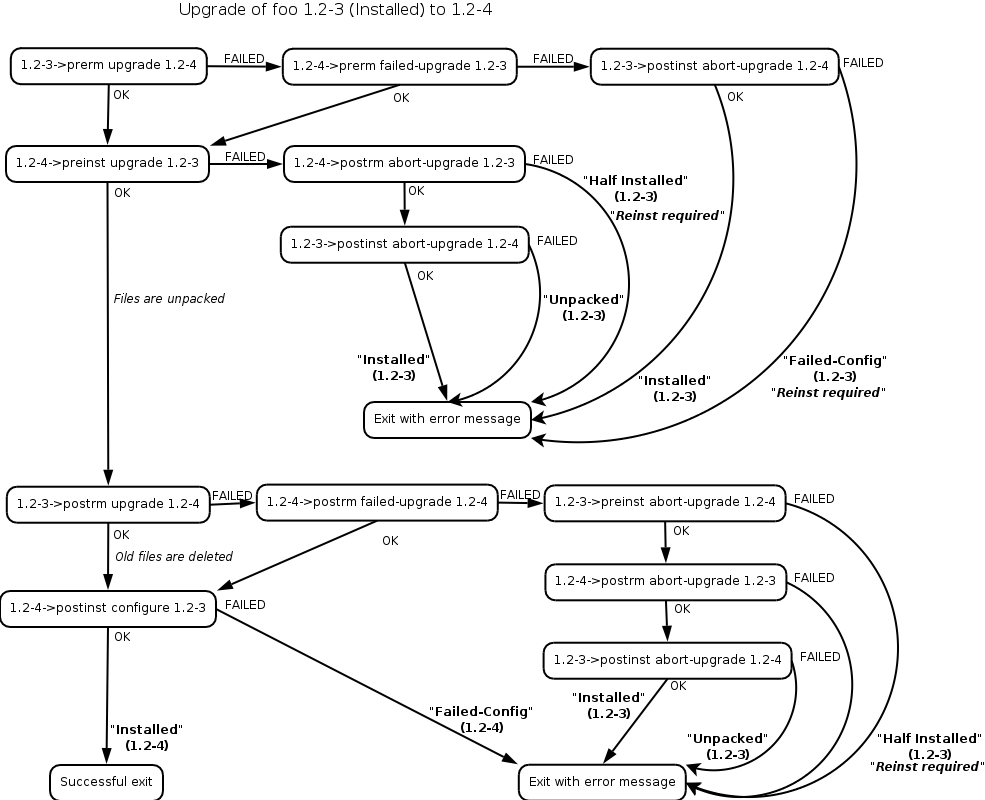
Even if dpkg is failing and outputting the error message, the real problem is not in dpkg but in the installed package (acpid in the example above). As we already learned, a package contains not only files but also maintainer scripts that are executed at various points of the installation process (see some useful graphics to understand how they are called, thanks to Margarita Manterola).

Maintainer scripts in a package upgrade

In the introductory example it was acpid s post-installation script that failed, and dpkg is only forwarding that failure back to the caller. The maintainer scripts are stored in /var/lib/dpkg/info/. You can thus inspect them and even modify them if you hit a bug and want to work around it (do this only if you understand what you do!). One common modification is to add set -x at the start of the script and to retry the failing operation. That way you can see what s executed exactly. Here s what the output could look like after the addition of set -x to /var/lib/dpkg/info/acpid.postinst:
$ sudo dpkg --configure acpid
Setting up acpid (1:2.0.12-1) ...
+ dpkg --compare-versions 1:2.0.11-1 lt-nl 1.0.10-3
+ dpkg --compare-versions 1:2.0.11-1 lt-nl 1.0.6-16
+ dpkg --compare-versions 1:2.0.11-1 lt 1.0.6-6
+ rm /etc/rc1.d/K20acpid
rm: cannot remove  /etc/rc1.d/K20acpid': No such file or directory
dpkg: error processing acpid (--configure):
 subprocess installed post-installation script returned error exit status 1
Errors were encountered while processing:
 acpid
This output helps you locate the command that is actually failing. Here s it s relatively easy since we have an error message from rm . And the fix is trivial too, we replace rm with rm -f so that it doesn t fail when the file doesn t exist (this is a fake bug I made up for this article I just added a failing rm call but it s inspired by real bugs I experienced). Maintainer scripts are supposed to be idempotent: we should be able to execute them several times in a row without bad consequences. It happens from time to time that the maintainer gets this wrong on the first try it works, so he uploads his package and we discover the problem only later once someone ended up executing the same code twice for some reason.

Follow me on Identi.ca, Twitter, Facebook and Google+. Or subscribe to this blog by RSS or by email.

7 comments Liked this article? Click here. My blog is Flattr-enabled.

5 September 2011

Eugene V. Lyubimkin: cupt: 2.2.0~rc1

It took longer than usual, but I believe it's worth.

I just released Cupt 2.2.0~rc1 to Debian experimental. To experimental, because there are important changes and I would appreciate "in-field" testing before final 2.2.0.

Here are the major changes since 2.1.x:


Enjoy and send the bug reports.

4 September 2011

Raphaël Hertzog: My Debian activities in August 2011

This is my monthly summary of my Debian related activities. If you re among the people who made a donation to support my work (91.44 , thanks everybody!), then you can learn how I spent your money. Otherwise it s just an interesting status update on my various projects. Dpkg work When I came back from Debconf, I merged my implementation of dpkg-source --commit (already presented last month). I continued some work on the hardening build flags but it s currently stalled waiting on Kees Cook to provide the required documentation to integrate in dpkg-buildflags(1). Following a discussion held during DebConf, Michael Prokop has been kind enough to setup a git-triggered auto-builder of dpkg (using Jenkins). You can now help us by testing the latest git version. Follow those instructions:
$ wget -O - http://jenkins.grml.org/debian/C525F56752D4A654.asc   sudo apt-key add -
$ sudo sponge /etc/apt/sources.list.d/dpkg-git <<END
deb http://jenkins.grml.org/debian dpkg main
END
$ sudo apt-get update && sudo apt-get upgrade
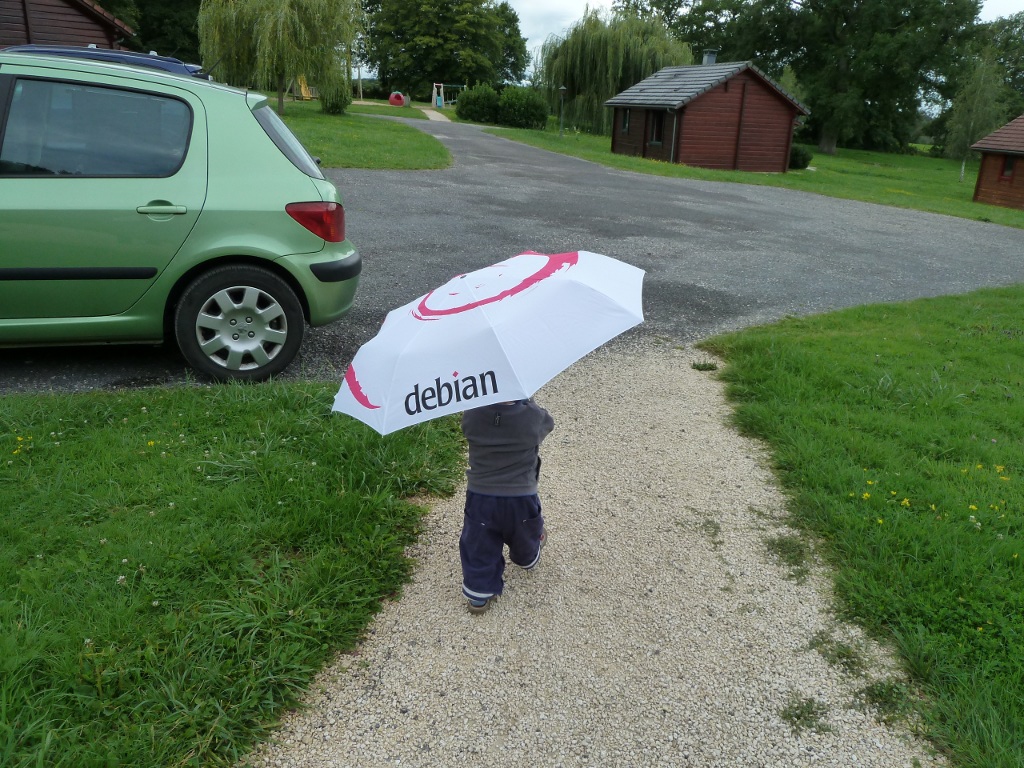
On the bug fixing side I took care of #640198 (minor man page update), #638291 (a fix to correctly handle hardlinks of conffiles), #637564 (the simplification logic of union dependencies was broken in some cases) and #631494 (interrupting dpkg-source while building a native source package left some temporary files around that should have been cleaned). WordPress update I released WordPress 3.2.1 in unstable (after having taken the time to test the updated package on my blog!) and fixed its RC bug (#625773). In the process I discovered a false positive in lintian (I reported it in 637473). Gnome-shell-timer package From time to time, I like to use the Pomodoro Technique. That s why I was an user of timer-applet in GNOME 2. Now with the switch to GNOME 3, I lost this feature. But I recently discovered gnome-shell-timer, a GNOME Shell extension that provides the same features. I created a Debian package of it and quickly filed some bugs while I was testing it (two usability issues and an encoding problem) QA Work During DebConf I met Giovanni Mascellani and he was interested to help the QA team. He started working on the backlog of bugs concerning the Package Tracking System (PTS) and submitted a bunch of patches. I reviewed them and merged them but since they were good, I quickly got lazy and got him added to the QA team so that he can commit his fixes alone. It also helps to build trust when you have had the opportunity to discuss face to face. :-) Vacation That s not so much compared to usual but to my defense I also took 2 weeks of vacation with my family. But somehow even in vacation I can t really forget Debian. Here s my son:
Thanks See you next month for a new summary of my activities.

3 comments Liked this article? Click here. My blog is Flattr-enabled.

19 August 2011

Kai Wasserb ch: wine-unstable: partly broken on amd64

Just a short entry, as I've already got a few e-mails about this: the JPEG is broken at the moment for my unofficial wine-unstable packages on amd64. This is due to #638543 in ia32-libs-dev. Please see the bug report for a detailed explanation. A rebuild with libjpeg62-dev isn't an option, as other build dependencies pull libjpeg8-dev in anyway. Thus forcing the older version on amd64 just generates a FTBFS. Full multi-arch support in the toolchain (including dpkg) or an update for ia32-libs are the two viable solutions for this as far as I can tell.

18 August 2011

Thorsten Glaser: How not to create DEB files

Once upon a time, there was Deb and Ian. That was about exactly 18 years ago. We don t talk about the 0.939000 format any more, but they eventually settled on:

	$ ar rc pkg_1.0_all.deb debian-binary control.tar.gz data.tar.gz
	$ hexdump -C pkg_1.0_all.deb   head
	00000000  21 3c 61 72 63 68 3e 0a  64 65 62 69 61 6e 2d 62   !<arch>.debian-b 
	00000010  69 6e 61 72 79 20 20 20  31 33 31 33 36 38 33 35   inary   13136835 
	00000020  32 39 20 20 31 30 30 36  20 20 32 30 30 20 20 20   29  1006  200    
	00000030  31 30 30 36 34 34 20 20  34 20 20 20 20 20 20 20   100644  4        
	00000040  20 20 60 0a 32 2e 30 0a  63 6f 6e 74 72 6f 6c 2e      .2.0.control. 
	00000050  74 61 72 2e 67 7a 20 20  31 33 31 33 36 38 33 35   tar.gz  13136835 
	00000060  32 39 20 20 31 30 30 36  20 20 32 30 30 20 20 20   29  1006  200    
	00000070  31 30 30 36 34 34 20 20  31 33 39 31 20 20 20 20   100644  1391     
	00000080  20 20 60 0a 1f 8b 08 00  00 00 00 00 00 03 ed 59      ............Y 
	00000090  eb 6f db 36 10 f7 d7 f0  af b8 3a 5e 9b 74 b1 f5   .o.6......:^.t.. 
 

By then, systems were a.out(5), and everything was good. (Of course, if you look at the mtimes, you ll notice I faked this. But it s really equivalent to the real thing.

But oh horror! GNU binutils, not always everyone s friend, switched from using BSD style Unix Archiver libraries in ar(1) to SYSV style libraries on elf(5) systems:

	$ ar rc on-elf debian-binary control.tar.gz data.tar.gz
	$ hexdump -C on-elf   head
	00000000  21 3c 61 72 63 68 3e 0a  64 65 62 69 61 6e 2d 62   !<arch>.debian-b 
	00000010  69 6e 61 72 79 2f 20 20  31 33 31 33 36 38 33 35   inary/  13136835 
	00000020  32 39 20 20 31 30 30 36  20 20 32 30 30 20 20 20   29  1006  200    
	00000030  31 30 30 36 34 34 20 20  34 20 20 20 20 20 20 20   100644  4        
	00000040  20 20 60 0a 32 2e 30 0a  63 6f 6e 74 72 6f 6c 2e      .2.0.control. 
	00000050  74 61 72 2e 67 7a 2f 20  31 33 31 33 36 38 33 35   tar.gz/ 13136835 
	00000060  32 39 20 20 31 30 30 36  20 20 32 30 30 20 20 20   29  1006  200    
	00000070  31 30 30 36 34 34 20 20  31 33 39 31 20 20 20 20   100644  1391     
	00000080  20 20 60 0a 1f 8b 08 00  00 00 00 00 00 03 ed 59      ............Y 
	00000090  eb 6f db 36 10 f7 d7 f0  af b8 3a 5e 9b 74 b1 f5   .o.6......:^.t.. 
 

Can you spot the difference?

Of course, ELF is what you want , so there is little choice. Unix Archiver libraries are system dependent, and no format has ever been normed, but DEB files use it as format so what is one to do?

	$ GNUTARGET=a.out-i386-linux ar rc with-aout \
	> debian-binary control.tar.gz data.tar.gz
	$ md5sum pkg_1.0_all.deb with-aout on-elf
	248f78d42f8ca8f2a3560f9800b2bf01  pkg_1.0_all.deb
	248f78d42f8ca8f2a3560f9800b2bf01  with-aout
	09eca70c9b11b6b55bbadcab5c3201fb  on-elf
 

OK, and what do I do on my Debian/m68k system?

ar(1) uses bfd, and GNU binutils can not only forcibly set the target emulation but also show them:

debian_m68k$ ar -h 2>&1 grep '^ar: supported targets'
ar: supported targets: elf32-m68k a.out-m68k-linux elf32-little elf32-big plugin srec symbolsrec verilog tekhex binary ihex trad-core
debian_i386$ ar -h 2>&1 grep '^ar: supported targets'
ar: supported targets: elf32-i386 a.out-i386-linux pei-i386 elf32-little elf32-big elf64-x86-64 elf32-x86-64 pei-x86-64 elf64-l1om elf64-k1om elf64-little elf64-big plugin srec symbolsrec verilog tekhex binary ihex trad-core
debian_i386$ ar -h 2>&1 grep '^ar: supported targets' # binutils-multiarch
ar: supported targets: elf32-i386 a.out-i386-linux pei-i386 elf32-little elf32-big elf64-alpha ecoff-littlealpha elf64-little elf64-big elf32-littlearm elf32-bigarm elf32-hppa-linux elf32-hppa elf64-x86-64 elf32-x86-64 elf64-l1om elf64-k1om elf64-ia64-little elf64-ia64-big pei-ia64 elf32-m68k a.out-m68k-linux coff-m68k versados ieee a.out-zero-big elf32-tradbigmips elf32-tradlittlemips ecoff-bigmips ecoff-littlemips elf32-ntradbigmips elf64-tradbigmips elf32-ntradlittlemips elf64-tradlittlemips elf32-powerpc aixcoff-rs6000 elf32-powerpcle ppcboot elf64-powerpc elf64-powerpcle aixcoff64-rs6000 aix5coff64-rs6000 elf32-s390 elf64-s390 elf32-shbig-linux elf32-sh-linux elf32-sh64-linux elf32-sh64big-linux elf64-sh64-linux elf64-sh64big-linux elf32-sparc a.out-sparc-linux elf64-sparc a.out-sunos-big pei-x86-64 elf32-m32r-linux elf32-m32rle-linux elf32-spu plugin srec symbolsrec verilog tekhex binary ihex trad-core
mirbsd_i386$ ar -h 2>&1 grep '^ar: supported targets'
ar: supported targets: elf32-i386 coff-a29k-big a.out.adobe aix5coff64-rs6000 a.out-zero-big a.out-mips-little epoc-pe-arm-big epoc-pe-arm-little epoc-pei-arm-big epoc-pei-arm-little coff-arm-big coff-arm-little a.out-arm-netbsd pe-arm-big pe-arm-little pei-arm-big pei-arm-little b.out.big b.out.little efi-app-ia32 efi-app-ia64 elf32-avr elf32-big elf32-bigarc elf32-bigarm elf32-bigarm-symbian elf32-bigarm-vxworks elf32-bigmips elf32-cr16c elf32-cris elf32-crx elf32-d10v elf32-d30v elf32-dlx elf32-fr30 elf32-frv elf32-frvfdpic elf32-h8300 elf32-hppa-linux elf32-hppa-netbsd elf32-hppa elf32-i370 elf32-i386-freebsd elf32-i386-vxworks elf32-i860-little elf32-i860 elf32-i960 elf32-ia64-hpux-big elf32-ip2k elf32-iq2000 elf32-little elf32-littlearc elf32-littlearm elf32-littlearm-symbian elf32-littlearm-vxworks elf32-littlemips elf32-m32r elf32-m32rle elf32-m32r-linux elf32-m32rle-linux elf32-m68hc11 elf32-m68hc12 elf32-m68k elf32-m88k elf32-mcore-big elf32-mcore-little elf32-mn10200 elf32-mn10300 elf32-msp430 elf32-nbigmips elf32-nlittlemips elf32-ntradbigmips elf32-ntradlittlemips elf32-openrisc elf32-or32 elf32-pj elf32-pjl elf32-powerpc elf32-powerpc-vxworks elf32-powerpcle elf32-s390 elf32-sh elf32-shbig-linux elf32-shl elf32-shl-symbian elf32-sh-linux elf32-shl-nbsd elf32-sh-nbsd elf32-sh64 elf32-sh64l elf32-sh64l-nbsd elf32-sh64-nbsd elf32-sh64-linux elf32-sh64big-linux elf32-sparc elf32-tradbigmips elf32-tradlittlemips elf32-us-cris elf32-v850 elf32-vax elf32-xstormy16 elf32-xtensa-be elf32-xtensa-le elf64-alpha-freebsd elf64-alpha elf64-big elf64-bigmips elf64-hppa-linux elf64-hppa elf64-ia64-big elf64-ia64-hpux-big elf64-ia64-little elf64-little elf64-littlemips elf64-mmix elf64-powerpc elf64-powerpcle elf64-s390 elf64-sh64 elf64-sh64l elf64-sh64l-nbsd elf64-sh64-nbsd elf64-sh64-linux elf64-sh64big-linux elf64-sparc elf64-tradbigmips elf64-tradlittlemips elf64-x86-64 mmo pe-powerpc pei-powerpc pe-powerpcle pei-powerpcle a.out-cris demo64 ecoff-bigmips ecoff-biglittlemips ecoff-littlemips ecoff-littlealpha coff-go32 coff-go32-exe coff-h8300 coff-h8500 a.out-hp300hpux a.out-i386 a.out-i386-bsd coff-i386 a.out-i386-freebsd a.out-i386-lynx coff-i386-lynx msdos a.out-i386-netbsd i386os9k pe-i386 pei-i386 coff-i860 coff-Intel-big coff-Intel-little ieee coff-m68k coff-m68k-un a.out-m68k-lynx coff-m68k-lynx a.out-m68k-netbsd coff-m68k-sysv coff-m88kbcs a.out-m88k-mach3 a.out-m88k-openbsd mach-o-be mach-o-le mach-o-fat coff-maxq pe-mcore-big pe-mcore-little pei-mcore-big pei-mcore-little pe-mips pei-mips a.out-newsos3 nlm32-alpha nlm32-i386 nlm32-powerpc nlm32-sparc coff-or32-big a.out-pc532-mach a.out-ns32k-netbsd a.out-pdp11 pef pef-xlib ppcboot aixcoff64-rs6000 aixcoff-rs6000 coff-sh-small coff-sh coff-shl-small coff-shl pe-shl pei-shl coff-sparc a.out-sparc-little a.out-sparc-linux a.out-sparc-lynx coff-sparc-lynx a.out-sparc-netbsd a.out-sunos-big sym a.out-tic30 coff-tic30 coff0-beh-c54x coff0-c54x coff1-beh-c54x coff1-c54x coff2-beh-c54x coff2-c54x coff-tic80 a.out-vax-bsd a.out-vax-netbsd a.out-vax1k-netbsd versados vms-alpha vms-vax coff-w65 coff-we32k coff-z8k elf32-am33lin elf32-ms1 srec symbolsrec tekhex binary ihex netbsd-core

Wow. While binutils share no single supported working target, they can be built multiarch, or (on MirBSD) with --enable-targets=all --enable-64-bit-bfd. Doesn t help if you want to stay portable: GNUTARGET=srec is common on all Debian (sid) binutils versions (single or multiarch), but errors out on older binutils. The a.out-* targets are not common. Sure, you could hack around things, but this is tedious. If you follow things or know me a little, you might already have guessed that I wouldn t let that stand.

pax(1) to the rescue. On MirBSD, we use paxtar, which has cpio(1) and tar(1) front-ends and supports multiple formats (4 cpio and 2 tar variants) and has already been extended a lot and is lovingly called paxmirabilis (mirabilos peace in Latin) it has options to anonymise archives: set uid and gid to zero, set mtime to zero, (for ustar) only write the numeric uid and gid to the archive, (for cpio formats) serialise inodes and device information, write content of hardlinked files only once (breaks partial extraction but saves a lot of space, e.g. 2 MiB off the Grml initrd.gz). And, recently, the ability to append a trailing slash to pathnames of ustar members which are directories (GNU tar does it and I thought some Debian utilities check for it). So why not (the -M dist and fakeroot set the uid/gid to 0)

	$ find debian-binary control.tar.gz data.tar.gz   \
	> mircpio -oHar -Mdist >with-mircpio
	$ mirpax -w -M dist -f with-mirpax -x ar \
	> debian-binary control.tar.gz data.tar.gz
	$ mirtar -M dist -A -cf with-mirtar \
	> debian-binary control.tar.gz data.tar.gz
	$ GNUTARGET=a.out-i386-linux fakeroot ar rc with-aout-ar \
	> debian-binary control.tar.gz data.tar.gz
	$ md5sum with-*
	a466e2fd57cdee141fe585a43245548f  with-aout-ar
	a466e2fd57cdee141fe585a43245548f  with-mircpio
	a466e2fd57cdee141fe585a43245548f  with-mirpax
	a466e2fd57cdee141fe585a43245548f  with-mirtar
 

Voil . I got it, and even appending is possible. It supports the BSD format with special focus on DEB files, and deals with long filenames, but not symbol or filename tables (used by ranlib(1) or strange formats, respectively, but since we don t create *.a files to use with some native linker/binder/loader, we don t need that anyway).

On extraction (oh, and listing!) it deals with SYSV style filenames as well.

	$ mirtar tvf on-elf
	-rw-r--r--  1 tg       tg          4 Aug 18 16:05 debian-binary
	-rw-r--r--  1 tg       tg       1391 Aug 18 16:05 control.tar.gz
	-rw-r--r--  1 tg       tg      18135 Aug 18 16:05 data.tar.gz
	$ mirtar tvf with-aout
	-rw-r--r--  1 tg       tg          4 Aug 18 16:05 debian-binary
	-rw-r--r--  1 tg       tg       1391 Aug 18 16:05 control.tar.gz
	-rw-r--r--  1 tg       tg      18135 Aug 18 16:05 data.tar.gz
 

One of the real benefits is that you can use the front-ends interchangably for example, mirtar tzf foo.cpio.gz would work (which GNU tar can t do), and mircpio s ustar implementation, unlike GNU cpio s, is not horribly broken. Of course, there are some drawbacks: it s not GNU tar or GNU cpio, so there are absolutely zero --long-options. Some of their features are missing (but tar s -O is implemented now), so it s no replacement (but very well usable alongside it). The format called pax, committee-designed to replace ustar, isn t yet supported ironically, but that s on the TODO.

So, what do you think?

	tg@frozenfish:~/Debs/dists/sid/wtf/Pkgs/mircpio $ ll *.deb
	-rw-r--r-- 2 tg freewrt 78140 Aug 17 11:04 mircpio_20110817-0wtf2_amd64.deb
	-rw-r--r-- 3 tg freewrt 72262 Aug 17 11:00 mircpio_20110817-0wtf2_i386.deb
	-rw-r--r-- 1 tg freewrt 67446 Aug 17 18:21 mircpio_20110817-0wtf2_m68k.deb
 

Should I upload this to Debian proper? As for the licence: 3-clause UCB (and 2-clause BSD, which is a subset of it), so no problem. I m asking because the other package which I had been using for a long time and not uploaded, jupp, got uploaded recently (during DebConf) on user input (people wondered why it did not yet exist in Debian proper). I guess the old saying if it s not in Debian, it doesn t exist holds true in many parts of the OSS world. It s up to date wrt. standards btw, and lintian-clean save for two pedantic-class warnings (no upstream changelog file, no homepage link) which aren t fulfillable (could link this wlog entry as homepage). If you know Alioth you re familiar with the software formerly known as SourceForge, formerly known as GForge, currently known as FusionForge. My employer both uses it and contributes to it, we run an adapted (mostly themed, prototyping new functions that often end up in FusionForge itself, and backporting functions from FF to our production codebase ) version.

I ve backported the extratabs plugin to appease project managers and other non-technical people while we move our codebase to FF 5.1, and I did so on an installed version of the plugin rather than the source because the latter was tightly integrated with rather heavy packaging style changes.

	[ ]
	dh_builddeb
	# create fusionforge-plugin-extratabs binary package
	toplev=$$(pwd); cd plugins/fusionforge-plugin-extratabs; \
	p=$$(print -r -- $$(sed -n '/^Package: /s///p' C/control   head -1)); \
	v=$$(print -r -- $$(sed -n '/^Version: /s///p' C/control   head -1)); \
	a=$$(print -r -- $$(sed -n '/^Architecture: /s///p' C/control   head -1)); \
	d=$$ p _$$ v _$$ a .deb; \
	rm -f $$toplev/../$$d control.tar.gz data.tar.gz; \
	(cd control; find .   fgrep -v /.svn   sort   \
	    mircpio -oC512 -Hustar -M0x0B -Mgslash)   gzip -n9 >control.tar.gz; \
	(cd data; find .   fgrep -v /.svn   sort   \
	    mircpio -oC512 -Hustar -M0x0B -Mgslash)   gzip -n9 >data.tar.gz; \
	mirtar -M dist -Acf $$toplev/../$$d debian-binary cont*gz dat*gz; \
	rm -f control.tar.gz data.tar.gz; \
	cd $$toplev; dpkg-distaddfile $$d non-free/devel optional
 

The hardest part of extending debian/rules with that was to get the autobuild and dpkg-distaddfile call right. This works, even though I d call it a temporary kludge. (No need to tell me I should have used && I know. And I only shell out to mksh(1) because the inner part was already there from before, when I still used ar(1). This was slightly edited for the wlog.) In the meanwhile, apt-extracttemplates can deal with SYSV style filenames in DEB files on Debian sid, but not on Kubuntu hardy, which some people are using as Desktop OS still

12 August 2011

Chris Lamb: Careful what you wish for...

Via #241343:
* Package name    : apt-gentoo
  Version         : 0.0.1
* URL             : http://www-jcsu.jesus.cam.ac.uk/~mma29/apt-gentoo/
* License         : GPL version 2 or above
  Description     : enhanced package installation
 apt-gentoo enhances the Debian package installation experience to make
 it fully competitive with newly-popular source-based distributions.
 As packages are installed, apt-gentoo automatically downloads their
 build logs from the buildd network. The logs are then slowly scrolled
 past on the user's terminal to simulate building the software on the
 local machine.
 [..]
So, something like:
#!/usr/bin/env python
#
# Insert into /etc/apt/conf.d/50apt-gentoo:
#
# DPkg  
#         Pre-Install-Pkgs   "/path/to/apt-gentoo   true";  ;
#  ;
import time
import random
import urllib
import urllib2
import urlparse
import fileinput
from lxml import etree
from debian import debfile
for filename in fileinput.input():
    pkg_data = debfile.DebFile(filename.strip()).debcontrol()
    url = "https://buildd.debian.org/status/logs.php?%s" % urllib.urlencode( 
        'pkg': pkg_data['Package'],
        'ver': pkg_data['Version'],
        'arch': pkg_data['Architecture'],
     )
    html = etree.parse(urllib2.urlopen(url), etree.HTMLParser())
    link = html.xpath("//table[@class='data logs']//td[3]/a")
    try:
        fetch_url = urlparse.urljoin(
            'https://buildd.debian.org/status/',
            link[0].get('href'),
        )
    except IndexError:
        continue
    html = etree.parse(urllib2.urlopen(fetch_url), etree.HTMLParser())
    try:
        log = html.xpath('//pre')[0].text.split('\n')
    except IndexError:
        continue
    for line in log:
        print line
        time.sleep(random.random() * 0.09)
Package/source and example installation transcript.

8 August 2011

Jaldhar Vyas: Debian GNU/Minix Erratically Timed News vol. 1

Wondering what is going on with the port of Debian to the Minix 3 microkernal? Here's an update. dpkg Ported Well, the big news as I mentioned in my last post is that dpkg has been successfully ported. I haven't sent the patches to the maintainers just yet as they need review and clean up but I will do that ASAP. The architecture name is defined as minix_i386. (There is no k because I am using the Minix libc as well as the kernel.) I am currently targetting squeeze. A Maze of Twisty Dependencies All Different Armed with my new dpkg, I have begun building packages which has been an interesting experience. The Debian packaging systems greatest asset dependencies is also its most frustrating during initial bootstrapping. Take debhelper for instance; nowadays most packages depend on it and I personally wouldn't think of creating a .deb without it but it build-depends e.g. po4a which build-depends on...debhelper. Also some programs which are assumed to be present on linux such as ldconfig are simply not available on Minix. So currently theres a lot of dpkg --force-depends and even --force-all going on. Of course this is only a temporary problem until I get a full set of base packages built. The equivs package is coming in handy too. In lieu of working .debs, I have been using Minix native packages to fill in the gaps. They use NetBSD pkgsrc which is a new experience for me. I can't say I'm that impressed but they work and, being uptodate, are a good source of patches. Works in Progress The two big packages I need to work on next are perl 5.10.1 and gcc 4.4.5. I haven't touched the latter yet. Perl is failing in its second-stage bootstrap for reasons I haven't gotten to the bottom of just yet. I suspect it has more to do with deficiencies in my build environment than a problem in perl itself. libc Deficiencies As I mentioned last time, the situation has improved tremendously since Minix switched over to using the NetBSD libc but I am still running into problems with unimplemented APIs. Take getpwent(3) and getpwuid(3) for instance. Being able to map between user ids and names is kind of important you know? Even worse instead of being completely absent some of these exist as stubs. So they compile and link without warning but always return ENOFILE and so on. I was surprised to find that there is no standardized API for getting information on mounted filesystems. (Which e.g. df(1) needs.) Linux uses getmnt(3) similar but incompatible with System V. The BSDs use getmntinfo so probably this is what Minix will implement. GNU programs are good about portability but a lot of Free software is unfortunately Linux-centric. Hopefully the Debian FreeBSD port already has patches for these cases. There are several annoyances like this but I suppose I shouldn't complain too much. I am using an unreleased version of Minix which is under heavy development and I must say the upstream developers have been good about responding to my concerns. Looking forward: fakeroot, grub2, ext2 fakeroot is a very handy development tool that frees a developer from having to create .debs as root. Alas it won't work under Minix as it depends on LD_PRELOAD and Minix doesn't even support shared libraries. fakeroot-ng sounds a bit more promising as it uses the ptrace(2) system call which is implemented in the Minix kernel though I don't know how well. Minix is now multiboot compliant so it is possible to use grub2 instead of the Minix boot loader. Definitely something I'm going to look at soon. Minix now supports ext2 (though not ext3 or ext4) in addition to its native file system. For compatability this should become the default in the Debian port. While the kernel support is part of the standard Minix system, the userland support (e2fsprogs) is not for some reason. So I'll have to see about porting that. Can I Help the Porting Effort? Sorry not yet. Though if you are determined I'll try and help you get set up. Hopefully in a month or less I will be able to distribute a pre-alpha version so I suggest waiting for that. I am definitely going to be looking for outside help.

7 August 2011

Rapha&#235;l Hertzog: People behind Debian: Margarita Manterola, Debian Women member

Photograph taken by Julia Palandri

When I think about Margarita, I always remember her as a friendly and welcoming person. Like most of the Debian Women members by the way. But she likes to spread some love and organized a Debian Appreciation Day for example. I think I met her in real life for the first time at Debconf 6 in Oaxtepec (Mexico). She deeply cares about Debian in general. She has proven it multiple times with her DPL candidacy and by giving talks like Making Debian rule again. One last thing, Debconf11 is just over and you will see that Debconf4 has had a big influence on Marga. My advice is simple: next time there s a Debconf on your continent, make sure to take a few days off and come to meet us! It really gives another picture of the Debian community. Now let s proceed with the interview. Raphael: Who are you? Margarita: I m Margarita Manterola, a Software Developer from Argentina. I work developing software in Python in a Debian-friendly company during the day, and teach programming at a local university during the evenings. I m married to Maximiliano Curia who is also a Debian Developer, most of our Free Software work has been done together. I only maintain a handful of packages in Debian, I m more interested in fixing bugs than in packaging new software. I ve also been a part of the organizing team of many of the previous Debian Conferences. One of the biggest commitments and the biggest success of my participation in Debian was being part of the organizing team of DebConf8, in Argentina. Raphael: How did you start contributing to Debian? Margarita: I started using Debian around 2000. Soon after we had learned the grips of general GNU/Linux usage, Maxy and I started giving an introductory course at our local university, and became quite involved with the local LUG. At some point in 2002/2003 I became a Debian Bug Reporter : most of my friends would report bugs to me, and I would then write them in the proper form to the BTS. I would also be very attentive about reporting any bugs that I might encounter myself trying to create good bug reports. The turning point in my participation in Debian was DebConf4 in Porto Alegre, Brazil. Being so close to Argentina meant that we felt specially invited to be there, and Maxy and I decided to go to DebConf for our honeymoon. We didn t really know much about DebConf dynamics, but we were really eager to learn more about Debian and become more involved. What happened was that meeting with DDs from all over the world transformed our lives, we became part of the Debian family and wanted to be more and more involved. Soon after that we both started maintaining packages and not long after that, applied to become Developers. The Debian Women project also meant a lot to me. I felt encouraged all along the way, encouraged to learn, to ask questions and to lose the fear of making mistakes. I became a Debian Developer on November 2005. Since then, Debian has always been one of the most important things I do in my life. Raphael There was a Debian Women BoF during debconf. What are the plans for Debian Women in the upcoming months? Margarita: I was not there in person, but thanks to the awesome work of the video team, and of Christian Perrier s typing efforts when something failed, I was able to experience much of what was discussed. :) One of the many points that came up during the BOF is that many people Want to help but don t know where to start or how to go about it. It s a challenge for the Debian Women project to find a way to allow these people to become involved in Debian through Mini projects or something like that. Another of the subjects that was brought up was the Debian Women mentoring project, which has been going on for quite a while now, but lacks enough publicity. So, we need to reach more people about it, and maybe also improve it with some templates, similar to the New Maintainer templates, so that mentees that don t know where to start have some sort of general path to follow. Raphael: You created very useful diagrams documenting how package maintainer scripts are invoked by dpkg. How did you do it and was that a useful experience? Margarita: I did those diagrams to be able to answer one of the questions in the NM templates, regarding the order of the maintainer script execution. Answering the question in text was basically copying and pasting the part of the Debian Policy that explained it, which wasn t really too clear for me, so I decided to go and make a diagram of it, so that I could really understand it. I did it by the best of all debugging techniques: adding prints to each of the maintainer scripts, and testing them in all the different orders that I could think of. It was a useful experience at the time, because I learned a lot of how maintainers scripts work. I didn t expect the diagrams to become so famous, though, I only did them to answer one NM question, that I assumed most other people had already answered before :) Raphael: You participated in a DPL election. This is a big commitment to make. What were your motivations? Margarita: As I said, I was part of the organizing team of DebConf8, in Argentina. Which was quite a success, a lot of people enjoyed it and praised the good work that had been done by the local team. During said DebConf8, I had a dream (it was almost a nightmare, actually): I woke up and just like that, I was the DPL. I spoke to some people about this dream and to my complete surprise many said that I should actually do it. After giving that possibility a year and a half of thoughts, during the 2010 campaign I was talked into participating myself as a candidate, and it was a very interesting experience. However, I m very glad that Zack got elected and not me, I think he makes a much better DPL that I would have made. Raphael: What s the biggest problem of Debian? Margarita: I think the main problem that we have is our communication, both inside the project and outside the project. Most of us are very technical people, our skills lay in the technical part of Debian (preparing packages, fixing bugs, writing software, administering systems) not in the social part. And thus, we lack a general empathy that is quite needed when interacting with people from all over the world. Raphael: Do you have wishes for Debian Wheezy? Margarita: Not particularly. I do want it to be a great release with good quality, stable software. I would also like to keep making Debian more and more universal with each release, making it more user friendly, more accessible, and more robust than any other previous release. Raphael: Is there someone in Debian that you admire for their contributions? Margarita: I admire a lot of people in Debian. There s a lot of people that contribute a lot of time to Debian, amounts of time that I can t begin to understand how they can afford. I admire Stefano Zacchiroli, our current project leader. And Steve McIntyre, the project leader before him. Also Bdale Garbee, who s also been a DPL in the past. Making this list I realize that Debian has been blessed by quite a number of great leaders in the past. I admire Holger Levsen, for his contributions to the DebConf video team, that have made it possible year after year for the whole project to participate in DebConf remotely. I admire Steve Langasek and Andreas Barth (etch is still my favourite release). I admire Christian Perrier for his work on internationalization. I admire Joerg Jaspert for the incredible amounts of time that he puts into Debian. And actually, I could go on admiring people all night long. I admire so many people that this interview could become a very boring list of names. I guess it s better to leave it at saying that Debian is lucky to have quite a lot of excellent hackers around.
Thank you to Marga for the time spent answering my questions. I hope you enjoyed reading her answers as I did. Subscribe to my newsletter to get my monthly summary of the Debian/Ubuntu news and to not miss further interviews. You can also follow along on Identi.ca, Twitter and Facebook.

14 comments Liked this article? Click here. My blog is Flattr-enabled.

4 August 2011

Rapha&#235;l Hertzog: My Debian activities in July 2011

This is my monthly summary of my Debian related activities. If you re among the people who made a donation to support my work (170 , thanks everybody!), then you can learn how I spent your money. Otherwise it s just an interesting status update on my various projects. This month passed by very quickly since I attended both the Libre Software Meeting / RMLL and the DebConf. Libre Software Meeting / RMLL I attended only 3 days out of the 6 but that was a deliberate choice since I was also attending DebConf for a full week later in the month. During those 3 days I helped with the Debian booth that was already well taken care of by Fr d ric Perrenot and Arnaud Gambonnet. Unfortunately we did not have any goodies to sell. We (as in Debian France) should do better in this regard next time. One of the talks I attended presented EnVenteLibre. This website started as an online shop for two French associations (Ubuntu-fr, Framasoft). They externalize all the logistic to a company and only have to care about ordering goodies and delivering to the warehouse of the logistic company. They can also take some goodies from the warehouse and ship them for a conference, etc. We discussed a bit to see how Debian France could join, they are even ready to study what can be done to operate at the international level (that would be interesting for Debian with all the local associations that we have throughout the world). Back to the LSM, while I had 3 good days in Strasbourg, it seems to mee that the event is slowly fading out it s far from being an international event and the number of talks doesn t make for a better quality. BTW, do you remember that Debconf 0 and Debconf 1 were associated to this event while it was in Bordeaux? dpkg-source improvements During my time in Strasbourg (and in particular the travel to go there and back!) I implemented some changes to 3.0 (quilt) source format. It will now fail to build the source package if there are upstream changes that are not properly recorded in a quilt patch:
dpkg-source: info: local changes detected, the modified files are:
 2ping-1.1/README
dpkg-source: info: you can integrate the local changes with dpkg-source --commit
dpkg-source: error: aborting due to unexpected upstream changes, see /tmp/2ping_1.1-1.diff.cki8YB
As the error message hints, there s a new --commit command supported by dpkg-source that will generate the required quilt patch to fix this. In the processe you will have to submit a name and edit the patch header (pre-formatted with DEP3 compatible fields). You can get back the old behavior with the --auto-commit option. Build flags changes Ever since we adopted the Ubuntu changes to let dpkg-buildpackage set some build related environment variables (see #465282), many Debian people expressed their concerns with this approach both because it broke some packages and because those variables are not set if you execute debian/rules directly. In the end, the change was not quickly reverted and we fixed the package that this change broke. Despite this we later decided that the correct approach to inject build flags would be a new interface: dpkg-buildflags. Before changing dpkg-buildpackage to no longer set the compilation flags, I wanted to ensure dpkg-buildflags had some decent coverage in the archive (to avoid breaking too many packages again). My criteria was that CDBS and dh (of debhelper) should be using it. With the recent debhelper change (see #544844) this has been reached so I changed dpkg-buildpackage accordingly. Makefile snippets provided by dpkg At the same time, I also wanted an easy way for maintainers not using dh or CDBS to be able to fix their package easily and go back to injecting the compilation flags in the environment but doing it from the rules files. Starting with the next version of dpkg, this will be possible with something like this:
DPKG_EXPORT_BUILDFLAGS = 1
include /usr/share/dpkg/default.mk
Without DPKG_EXPORT_BUILDFLAGS the variables are not exported in the environment and have no effect unless you use them somewhere. More than build flags, this will also provide a bunch of other variables that can be useful in a rules files: all the variables provided by dpkg-architecture, vendor related variables/macro and some basic package information (mainly version related). dpkg-buildflags improvements Given the renewed importance that dpkg-buildflags will take now that dpkg-buildpackage no longer sets the corresponding environment variables, I thought that I could give it some love by fixing all the open issues and implementing some suggestions I got. I also had a chat with a few members of the technical committee to discuss how hardening build flags could be enabled in Debian and this also resulted in a few ideas of improvements. In the end, here are the main changes implemented: Will all those changes, the complete set of compilation flags can be returned by dpkg-buildflags (before it would only return the default flags and it was expected that the Debian packaging would add whatever else is required afterwards). Now the maintainer just has to use the new environment variables to ensure the returned values correspond to what the package needs. DebConf: rolling and hardening build flags I spent a full week in DebConf (from Sunday 24th to Sunday 31th) and as usual, it s been a pleasure to meet again all my Debian friends. It s always difficult to find a good balance between attending talks, working in the hacklab and socializing but I m pretty happy with the result. I did not have any goal when I arrived, except managing the Rolling Bof (slides and video here) but all the discussions during talks always lead to a growing TODO list. This year was no exception. The technical committee BoF resulted in some discussions of some of the pending issues, in particular one that interests me: how to enable hardening build flags in Debian (see #552688). We scheduled another discussion on the topic for Tuesday and the outcome is that dpkg-buildflags is the proper interface to inject hardening build flags provided that it offers a mean to drop unwanted flags and a practical way to inject them in the ./configure command line. Given this I got to work and implemented those new features and worked with Kees Cook to prepare a patch that enables the hardening build flags by default. It s not ready to be merged but it s working already (see my last update in the bug log). A few words about the Rolling BoF too. The room was pretty crowded: as usual the topic generates lots of interest. My goal with the BoF was very limited, I wanted to weigh the importance of the various opinions expressed in the last gigantic discussion on debian-devel. It turns out a vast majority of attendants believe that testing is already usable. But when you ask them if we must advertise it more, answers are relatively mixed. When asked if we can sustain lots of testing/rolling users, few people feel qualified to reply but those that do tend to say yes. More dpkg work Lots of small things done: Package Tracking System and DEHS Christoph Berg recently wrote a replacement for DEHS because the latter was not really reliable and not under control of the QA team. This is a centralized system that uses the watch files to detect new upstream versions of the software available in Debian. I updated the Package Tracking System to use this new tool instead of DEHS. The new thing works well but we re still lacking the mail notifications that DEHS used to send out. If someone wants to contribute it, that would be great! Misc packaging work I did some preliminary work to update the WordPress package to the latest upstream version (3.2). I still have to test the resulting package, replacing upstream shipped copies of javascript/PHP libraries is always a risk and unfortunately all of them had some changes in the integration process. I also updated nautilus-dropbox to version 0.6.8 released upstream. I also uploaded the previous version (that was in testing at that time) to squeeze-backports. So there s now an official package in all the Debian distributions (Squeeze, Wheezy, Sid and Experimental)! Thanks See you next month for a new summary of my activities.

No comment Liked this article? Click here. My blog is Flattr-enabled.

29 July 2011

Jaldhar Vyas: hello_minix-i386.deb

NEW YORK, Jul 29, 2011 PreventaConf The crowd of thousands gathered here to attend PreventaConf 2011 were abuzz over the unveiling of the culmination of 3 years of aimless arsing about^ww^w concentrated development which has led to the porting of dpkg to the MINIX 3 operating system. dselect on Minix Women fainted, men wept openly, medical personnel were kept busy dealing with the many instances of heart seizure, multisensory hallucination and spontaneous combustion which accompanied this momentous event. Much remains to be done. Still this is a major milestone of which the Debian Minix developers are justifiably proud.
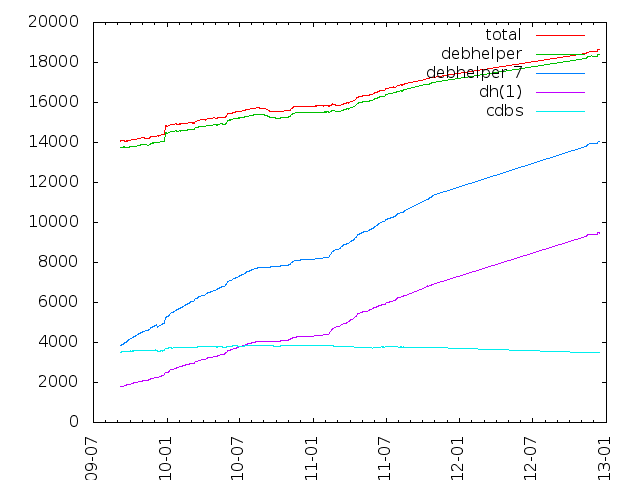
26 July 2011

Ingo Juergensmann: Upgrading m68k from etch-m68 to unstable

After being dropped out of Debian, the m68k was stalled from some time now. There was no real upgrade path and so my machines still are running etch-m68k. Thanks to Thorsten Glaser the port is slowly keeping up with NPTL now ported to kernel and glibc for m68k. He took care to port and compile a lots of packages that are needed for upgrading from etch-m68k. Big thanks for that to Thorsten! Anyway, I'm in the progress of upgrading my m68k machines and buildds with the help and tips from Thorsten and this is the way I'm doing this:
  1. Change your /etc/apt/sources.list to include this:

    deb http://ftp.debian-ports.org/debian/ unstable main contrib
    deb http://archive.debian.org/debian etch-m68k main contrib non-free
  2. Get libuuid-perl from snapshot.debian.org:

    wget http://snapshot.debian.org/archive/debian/20070128T000000Z/pool/main/libu/libuuid-perl/libuuid-perl_0.02-1_m68k.deb
    dpkg -i libuuid-perl_0.02-1_m68k.deb

  3. Get kernel & linux-base from unstable
    You need to install a recent kernel like linux-image-2.6.39-2-amiga in my case. Either download it by hand or use apt:

    apt-get -d install linux-image-2.6.39-2-amiga linux-base
    cd /var/cache/apt/archive
    dpkg --force-depends -i linux-image-2.6.39-2-amiga_2.6.39-3_m68k.deb linux-base_3.3_all.deb

  4. If needed, remove linux-bases postinst, when you get this kind of error:

    syntax error at /var/lib/dpkg/info/linux-base.postinst line 1275, near "# UUIDs under /dev"
    Can't use global $_ in "my" at /var/lib/dpkg/info/linux-base.postinst line 1289, near " $_"
    rm /var/lib/dpkg/info/linux-base.postinst
    dpkg --configure --pending --force-depends

  5. If everything installed fine you should be ready to boot into your new kernel.
    On Amigas you mostly likely need to edit your boot script and copy your kernel and System.map to your AmigaOS partition. This is how my boot looks like:

    amiboot-5.6 -k vmlinux-2.6.39 "debug=mem root=/dev/sda4 video=pal-lace devtmpfs.mount=1"


    You can omit the debug=mem. This is just for the case that the kernel crashes. You can then collect the dmesg output under AmigaOS with the dmesg tool. The other parameter devtmpfs.mount=1 is needed because we don't want udev. Using video=pal-lace is necessary because the 2.6.39 kernel crashes on initializing my PicassoII graphics card and I've unplugged the card for the time being necessary to solve the problem.
  6. Kernel 2.6.39 runs fine, but you can't ssh into machine.
    Because we don't want udevd, there's now a problem when trying to login by SSH:

    pty allocation request failed on channel 0
    stdin is not a tty


    You can fix this either by installing udev, which most websites recommend when you're looking for this error, because on Xen this is the recommended solution, but as we are on m68k and not under Xen, it's better to run with a static /dev. So you need to create /dev/pts and add the following to your /etc/fstab:

    mkdir /dev/pts

    devpts /dev/pts devpts rw,noexec,nosuid,gid=5,mode=620 0 0
  7. After kernel boots into 2.6.39 you can dist-upgrade to unstable.
    When you successfully booted into your new kernel, you should be save to proceed with upgrading to unstable. For that you should first let the missing or broken depends from linux-image and linux-base being installed:

    apt-get -f install


    This should lead to install some dependencies that were missing, because using dpkg --force-depends from above. After that I upgraded dpkg, apt and apt-utils:

    apt-get install dpkg apt apt-utils


    When this succeeded, you should be save to fully dist-upgrade to unstable:

    apt-get -u dist-upgrade

    When you get errors during apt-get dist-upgrade, you might run dpkg --configure --pending or apt-get -f install, before proceeding with apt-get -u dist-upgrade. Another problem can occur with apt. When you see this error:

    E: Could not perform immediate configuration on 'perl-modules'. Please see man 5 apt.conf under APT::Immediate-Configure for details. (2)

    you should add "-o APT::Immediate-Configure=false" to your apt-get command, for example:

    apt-get -o APT::Immediate-Configure=false -f install
As stated above, my PicassoII in my A3000 doesn't seem to work under 2.6.39, whereas the PicassoIV in my A4000T does not crash the kernel. Please don't hesitate to add additions, corrections or other kind of feedback by commenting below! P.S.:
Wouter and Thorsten are currently at Debconf in Banja Luka, working on the m68k port. Wouter just finished a first version of a new debian-installer image. He asks for testing it on real hardware. Please volunteer if you can! It's available at: http://people.debian.org/~wouter/di-m68k/

Ingo Juergensmann: Upgrading m68k from etch-m68k to unstable

After being dropped out of Debian, the m68k was stalled from some time now. There was no real upgrade path and so my machines still are running etch-m68k. Thanks to Thorsten Glaser the port is slowly keeping up with NPTL now ported to kernel and glibc for m68k. He took care to port and compile a lots of packages that are needed for upgrading from etch-m68k. Big thanks for that to Thorsten! Anyway, I'm in the progress of upgrading my m68k machines and buildds with the help and tips from Thorsten and this is the way I'm doing this:
  1. Change your /etc/apt/sources.list to include this:

    deb http://ftp.debian-ports.org/debian/ unstable main contrib
    deb http://archive.debian.org/debian etch-m68k main contrib non-free
  2. Get libuuid-perl from snapshot.debian.org:

    wget http://snapshot.debian.org/archive/debian/20070128T000000Z/pool/main/libu/libuuid-perl/libuuid-perl_0.02-1_m68k.deb
    dpkg -i libuuid-perl_0.02-1_m68k.deb

  3. Get kernel & linux-base from unstable
    You need to install a recent kernel like linux-image-2.6.39-2-amiga in my case. Either download it by hand or use apt:

    apt-get -d install linux-image-2.6.39-2-amiga linux-base
    cd /var/cache/apt/archive
    dpkg --force-depends -i linux-image-2.6.39-2-amiga_2.6.39-3_m68k.deb linux-base_3.3_all.deb

  4. If needed, remove linux-bases postinst, when you get this kind of error:

    syntax error at /var/lib/dpkg/info/linux-base.postinst line 1275, near "# UUIDs under /dev"
    Can't use global $_ in "my" at /var/lib/dpkg/info/linux-base.postinst line 1289, near " $_"
    rm /var/lib/dpkg/info/linux-base.postinst
    dpkg --configure --pending --force-depends

  5. If everything installed fine you should be ready to boot into your new kernel.
    On Amigas you mostly likely need to edit your boot script and copy your kernel and System.map to your AmigaOS partition. This is how my boot looks like:

    amiboot-5.6 -k vmlinux-2.6.39 "debug=mem root=/dev/sda4 video=pal-lace devtmpfs.mount=1"


    You can omit the debug=mem. This is just for the case that the kernel crashes. You can then collect the dmesg output under AmigaOS with the dmesg tool. The other parameter devtmpfs.mount=1 is needed because we don't want udev. Using video=pal-lace is necessary because the 2.6.39 kernel crashes on initializing my PicassoII graphics card and I've unplugged the card for the time being necessary to solve the problem.
  6. Kernel 2.6.39 runs fine, but you can't ssh into machine.
    Because we don't want udevd, there's now a problem when trying to login by SSH:

    pty allocation request failed on channel 0
    stdin is not a tty


    You can fix this either by installing udev, which most websites recommend when you're looking for this error, because on Xen this is the recommended solution, but as we are on m68k and not under Xen, it's better to run with a static /dev. So you need to create /dev/pts and add the following to your /etc/fstab:

    mkdir /dev/pts

    devpts /dev/pts devpts rw,noexec,nosuid,gid=5,mode=620 0 0
  7. After kernel boots into 2.6.39 you can dist-upgrade to unstable.
    When you successfully booted into your new kernel, you should be save to proceed with upgrading to unstable. For that you should first let the missing or broken depends from linux-image and linux-base being installed:

    apt-get -f install


    This should lead to install some dependencies that were missing, because using dpkg --force-depends from above. After that I upgraded dpkg, apt and apt-utils:

    apt-get install dpkg apt apt-utils


    When this succeeded, you should be save to fully dist-upgrade to unstable:

    apt-get -u dist-upgrade

    When you get errors during apt-get dist-upgrade, you might run dpkg --configure --pending or apt-get -f install, before proceeding with apt-get -u dist-upgrade. Another problem can occur with apt. When you see this error:

    E: Could not perform immediate configuration on 'perl-modules'. Please see man 5 apt.conf under APT::Immediate-Configure for details. (2)

    you should add "-o APT::Immediate-Configure=false" to your apt-get command, for example:

    apt-get -o APT::Immediate-Configure=false -f install

    Another pitfall might be exim4-daemon-heavy, which currently segfaults. Replace it by exim4-daemon-light in that case, which works.
As stated above, my PicassoII in my A3000 doesn't seem to work under 2.6.39, whereas the PicassoIV in my A4000T does not crash the kernel. Please don't hesitate to add additions, corrections or other kind of feedback by commenting below! P.S.:
Wouter and Thorsten are currently at Debconf in Banja Luka, working on the m68k port. Wouter just finished a first version of a new debian-installer image. He asks for testing it on real hardware. Please volunteer if you can! It's available at: http://people.debian.org/~wouter/di-m68k/

Next.

Previous.