Search Results: "cts"

21 August 2024

Russ Allbery: Review: These Burning Stars

Review: These Burning Stars, by Bethany Jacobs
Series: Kindom Trilogy #1
Publisher: Orbit
Copyright: October 2023
ISBN: 0-316-46342-6
Format: Kindle
Pages: 430
These Burning Stars is a science fiction thriller with cyberpunk vibes. It is Bethany Jacobs's first novel and the first of an expected trilogy, and won the 2024 Philip K. Dick Award for the best SF paperback original published in the US. Generation starships brought humanity to the three star systems of the Treble, where they've built a new and thriving culture of billions. The Treble is ruled by the Kindom, a tripartite government structure built around the worship of six gods and the aristocratic power of the First Families. The Clerisy handle religion, the Secretaries run the bureaucracy, and the Cloaksaan enforce the decisions of the other branches. The Nightfoots are one of the First Families. They control sevite, the propellant required to move between the systems of the Treble now that the moon Jeve and the sole source of natural jevite has been destroyed. Esek Nightfoot is a cleric, theoretically following the rules of the Clerisy, but she has made a career of training cloaksaan. She is is mercurial, powerful, ruthless, ambitious, politically well-connected, and greatly feared. She is also obsessed with a person named Six: an orphan she first encountered at a training school who was too young to have a gender or a name but who was already one of the best fighters in the school. In the sort of manipulative challenge typical of Esek, she dangled the offer of a place as a student and challenged the child to learn enough to do something impressive. The subsequent twenty years of elusive taunts and mysterious gifts from the impossible-to-locate Six have driven Esek wild. Cleric Chono was beside Esek for much of that time. One of Six's classmates and another of Esek's rescues, Chono is the rare student who became a cleric rather than a cloaksaan. She is pious, cautious, and careful, the opposite of Esek's mercurial rage, but it's impossible to spend that much time around the woman and not be affected and manipulated by her. As this story opens, Chono is summoned by the First Cleric to join Esek on an assignment: recover a data coin that was stolen from a pirate raid on the Nightfoot compound. He refuses to tell them what data is on it, only saying that he believes it could be used to undermine public trust in the Nightfoot family. Jun is a hacker with considerably fewer connections to power or government and no desire to meet any of these people. She and her partner Liis make a dubiously legal living from smaller, quieter jobs. Buying a collection of stolen data coins for an archivist consortium is riskier than she prefers, but she's been tracking down rumors of this coin for months. The deal is worth a lot of money, enough to make a huge difference for her family. This is the second book I've read recently with strong cyberpunk vibes, although These Burning Stars mixes them with political thriller. This is a messy world with complicated political and religious systems, a lot of contentious history, and vast inequality. The story is told in two interleaved time sequences: the present-day fight over the data coin and the information that it contains, and a sequence of flashbacks telling the history of Esek's relationship with Six and Chono. Jun's story is the most cyberpunk and the one I found the most enjoyable to read, but Chono is a good viewpoint character for Esek's vicious energy and abusive charisma. Six is not a viewpoint character. For most of the book, they're present mostly in shadows, glimpses, and consequences, but they're the strongest character of the book. Both Esek and Six are larger than life, creatures of legend stuffed into mundane politics but too full of strong emotions, both good and bad, to play by any of the rules. Esek has the power base and access to the levers of government, but Six's quiet competence and mercilessly targeted morality may make them the more dangerous of the pair. I found the twisty political thriller part of this book engrossing and very difficult to put down, but it was also a bit too much drama for me in places. Jacobs has some surprises in store, one of which I did not expect at all, and they're set up beautifully and well-done within the story, but Esek and Six become an emotional star that the other characters orbit around and are in danger of getting pulled into. Chono is an accomplished and powerful character in her own right, but she's also an abuse victim, and while those parts are realistic, I didn't entirely enjoy reading them. There is quiet competence here alongside the drama, but I think I wanted the balance of emotion to tip a bit more towards the competence. There is one thing that Jacobs does with the end of the book that greatly impressed me. Unfortunately I can't even hint at it for fear of spoilers, but the ending is unsettling in a way that I found surprising and thought-provoking. I think what I can say is that this book respects the intelligence and skill of secondary characters in a way that I think is rare in a story with such overwhelming protagonists. I'm still thinking about that, and it's going to pull me right into the sequel. This is not going to be to everyone's taste. Esek is a viewpoint character and she can be very nasty. There's a lot of violence and abuse, including one rather graphic fight scene that I thought dragged on much longer than it needed to. But it's a satisfying, complex story with a true variety of characters and some real surprises. I'm glad I read it. Followed by On Vicious Worlds, not yet published as I write this. Content warnings: emotional and physical abuse, graphic violence, off-screen rape and sexual abuse of minors. Rating: 7 out of 10

20 August 2024

Dirk Eddelbuettel: digest 0.6.37 on CRAN: Maintenance

Release 0.6.37 of the digest package arrived at CRAN today and has also been uploaded to Debian. digest creates hash digests of arbitrary R objects. It can use a number different hashing algorithms (md5, sha-1, sha-256, sha-512, crc32, xxhash32, xxhash64, murmur32, spookyhash, blake3,crc32c, xxh3_64 and xxh3_128), and enables easy comparison of (potentially large and nested) R language objects as it relies on the native serialization in R. It is a mature and widely-used package (with 70.8 million downloads just on the partial cloud mirrors of CRAN which keep logs) as many tasks may involve caching of objects for which it provides convenient general-purpose hash key generation to quickly identify the various objects. This release updates one of the different hashing source functions which, to remain close to their upstream, used Free() and Calloc() (uppercased to use the R allocator) but not the prefixed stricter versions R_Free() and R_Calloc(). R will switch to enforcing these in the next release next year. Kevin had noticed (while doing some other testing) that this now fails under R-devel (with a switch set), and prepares a very nice and clean PR to take care of it. As of today, CRAN is now sending please fix, or else notes so it was a good time to send this to CRAN. We also updated some remaining http URLs in the README.md to https, and switched to Author/Maintainer field to the now also mandatory Authors@R. My CRANberries provides a summary of changes to the previous version. For questions or comments use the issue tracker off the GitHub repo. For documentation (including the changelog) see the documentation site. If you like this or other open-source work I do, you can now sponsor me at GitHub.

This post by Dirk Eddelbuettel originated on his Thinking inside the box blog. Please report excessive re-aggregation in third-party for-profit settings.

16 August 2024

Dirk Eddelbuettel: RcppEigen 0.3.4.0.1 on CRAN: Minor Maintenance

A new maintenance release of RcppEigen is now on CRAN, and will go to Debian shortly as usual. Eigen is a C++ template library for linear algebra: matrices, vectors, numerical solvers, and related algorithms. A very recent change in the development version of R (aka r-devel ) expanded the set of declared BLAS and LAPACK functions (and I tooted approvingly about it as well). It turns out that the xerbla() declaration there (which, as usual for R and as discussed in Writing R Extensions, defines the new optional character length entry for a char vector) conflicts with one in the blas.h header in Eigen upsetting the compilation of just one reverse-dependency. So CRAN, as they so often (and quietly) do in these cases, gave us a friendly and concise heads-up and asked for a change so we complied, did the usual reverse-dependency check of the other 400+ packages using RcppEigen and produced the new release which was injected into the repository during the current summer break. The complete NEWS file entry follows.

Changes in RcppEigen version 0.3.4.0.1 (2024-08-14)
  • Conditionally comment-out xerbla in blas.h as it is now providedd by R-devel albeit with FC_LEN_T (per a CRAN request)
  • Minor package updates (continuous integration, badges)

Courtesy of CRANberries, there is also a diffstat report for the most recent release. If you like this or other open-source work I do, you can sponsor me at GitHub.

This post by Dirk Eddelbuettel originated on his Thinking inside the box blog. Please report excessive re-aggregation in third-party for-profit settings.

12 August 2024

Scarlett Gately Moore: KDE, Kubuntu, Debian Qt6 updates plus Kubuntu Noble .1 updates.

Another loss last week of a friend. I am staying strong and working through it. A big thank you to all of you that have donated to my car fund, I still have a long way to go. I am not above getting a cheap old car, but we live in sand dunes so it must be a cheap old car with 4 4 to get to my property. A vehicle is necessary as we are 50 miles away from staples such as food and water. We also have 2 funerals to attend. Please consider a donation if my work is useful to you. https://gofund.me/1e784e74 All of my work is currently unpaid work, as I am between contracts. Thank you for your consideration. Now onto the good stuff, last weeks work. It was another very busy week with Qt6 packaging in Debian/Kubuntu and KDE snaps. I also have many SRUs for Kubuntu Noble .1 release that needs their verification done. Kubuntu: Debian: Starting the salvage process for kdsoap which is blocking a long line of packages, notably kio-extras. KDE Snaps: Please note: Please help test the edge snaps so I can promote them to stable. WIP Snaps or MR s made Thanks for stopping by.

Freexian Collaborators: Debian Contributions: autopkgtest/incus builds, live-patching, Salsa CI, Python 3.13 (by Stefano Rivera)

Debian Contributions: 2024-07 Contributing to Debian is part of Freexian s mission. This article covers the latest achievements of Freexian and their collaborators. All of this is made possible by organizations subscribing to our Long Term Support contracts and consulting services.

autopkgtest/Incus build streamlining, by Colin Watson Colin contributed a change to allow maintaining Incus container and VM images in parallel. Both of these are useful (containers are faster, but some tests need full machine isolation), and the build tools previously didn t handle that very well. This isn t yet in unstable, but once it is, keeping both flavours of unstable images up to date will be a simple matter of running this regularly:
RELEASE=sid autopkgtest-build-incus images:debian/trixie
RELEASE=sid autopkgtest-build-incus --vm images:debian/trixie

Linux live-patching, by Santiago Ruano Rinc n In collaboration with Emmanuel Arias, Santiago continued the work on the support for applying security fixes to the Linux kernel in Debian, without the need to reboot the machine. As mentioned in the previous month report, kpatch 0.9.9-1 (and 0.9.9-2 afterwards) was uploaded to unstable in July, closing the Intent to Salvage (ITS) bug. With this upload, the remaining RC bugs were solved, and kpatch was able to transition to Debian testing recently. Kpatch is expected to be an important component in the live-patching support, since it makes it easy to build a patch as a kernel module. Emmanuel and Santiago continued to work on the design for Linux live-patching and presented the current status in the DebConf24 presentation.

Salsa CI, by Santiago Ruano Rinc n To be able to add RISC-V support and to avoid using tools not packaged in Debian (See #331), the Salsa CI pipeline first needed to move away from kaniko to build the images used by the pipeline. Santiago created a merge request to use buildah instead, and it was merged last month. Santiago also prepared a couple of more MRs related to how the images are built: initial RISC-V support, that should be merged after improving how built images are tested. The switch to buildah introduced a regression in the work-in-progress MR that adds new build image so the build job can run sbuild. Santiago hopes to address this regression and continue with the sbuild-related MRs in August. Additionally, Santiago also contributed to the install docker-cli instead of docker.io in the piuparts image MR, and reviewed others such as reprotest: Add append-build-command option, fix failure at manual pipeline run when leaving RELEASE variable empty and Fix image not found error on image building stage.

Python 3.13 Betas, by Stefano Rivera As Python 3.13 is approaching the first release, Stefano has been uploading the beta releases to Debian unstable. Most of these have uncovered small bugs that needed to be investigated and fixed. Stefano also took the time to review the current patch set against cPython in Debian. Python 3.13 isn t marked as a supported Python release in Debian s Python tooling, yet, so nothing has been built against it, yet. Now that the Python 3.12 transition has completed, the next task will be to start trying to build Debian s Python module packages against Python 3.13, to estimate the work required to transition to 3.13 in unstable.

Miscellaneous contributions
  • Carles Pina updated the packages python-asyncclick, python-pyaarlo and prepared updates for python-ring-doorbell and simplemonitor.
  • Carles Pina updated (reviewing or translating) Catalan translations for adduser, apt-listchanges, debconf and shadow.
  • Colin merged OpenSSH 9.8, and prepared a corresponding release note for DSA support now being disabled. This version included some substantial changes to split the server into a listener binary and a per-session binary, and those required some corresponding changes in the GSS-API key exchange patch. Sorting out the details of this and getting it to work again took some time.
  • Colin upgraded 11 Python packages to new upstream versions, and modernized the build process and/or added non-superficial autopkgtests to several more.
  • Rapha l Hertzog tweaked tracker.debian.org s debci task to work around changes in the JSON output. He also improved tracker.debian.org s ability to detect bounces due to spam to avoid unsubscribing emails that are not broken, but that are better than Debian at rejecting spam.
  • Helmut Grohne monitored the /usr-move transition with few incidents. A notable one is that some systems have ended up with aliasing links that don t match the ones installed by base-files which could lead to an unpack error from dpkg. This is now prevented by having base-files.preinst error out.
  • Helmut investigated toolchain bootstrap failures with gcc-14 in rebootstrap but would only discover the cause in August.
  • Helmut sent a MR for the cross-exe-wrapper requested by Simon McVittie for gobject-introspection. It is a way of conditionally requesting qemu-user when emulation is required for execution during cross compilation.
  • Helmut sent three patches for cross build failures.
  • Thorsten Alteholz uploaded packages lprint and magicfilter to fix RC-bugs that appeared due to the introduction of gcc-14.
  • Santiago continued to work on activities related to the DebConf24 Content Team, including reviewing the schedule and handling updates on it.
  • Santiago worked on preparations for the DebConf25, to be held in Brest, France, next year. A video of the BoF presented during DebConf24 can be found here.
  • Stefano worked on preparations for DebConf24, and helped to run the event.

10 August 2024

Bits from Debian: DebConf24 closes in Busan and DebConf25 dates announced

DebConf24 group photo - click to enlarge On Saturday 3 August 2024, the annual Debian Developers and Contributors Conference came to a close. Over 339 attendees representing 48 countries from around the world came together for a combined 108 events made up of more than 50 Talks and Discussions, 37 Birds of a Feather (BoF informal meeting between developers and users) sessions, 12 workshops, and activities in support of furthering our distribution and free software (25 patches submitted to the Linux kernel), learning from our mentors and peers, building our community, and having a bit of fun. The conference was preceded by the annual DebCamp hacking session held July 21st through July 27th where Debian Developers and Contributors convened to focus on their Individual Debian-related projects or work in team sprints geared toward in-person collaboration in developing Debian. This year featured a BootCamp that was held for newcomers with a GPG Workshop and a focus on Introduction to creating .deb files (Debian packaging) staged by a team of dedicated mentors who shared hands-on experience in Debian and offered a deeper understanding of how to work in and contribute to the community. The actual Debian Developers Conference started on Sunday July 28 2024. In addition to the traditional 'Bits from the DPL' talk, the continuous key-signing party, lightning talks and the announcement of next year's DebConf25, there were several update sessions shared by internal projects and teams. Many of the hosted discussion sessions were presented by our technical core teams with the usual and useful meet the Technical Committee and the ftpteam and a set of BoFs about packaging policy and Debian infrastructure, including talk about APT and Debian Installer and an overview about the first eleven years of Reproducible Builds. Internationalization and localization have been subject of several talks. The Python, Perl, Ruby, and Go programming language teams, as well as Med team, also shared updates on their work and efforts. More than fifteen BoFs and talks about community, diversity and local outreach highlighted the work of various team involved in the social aspect of our community. This year again, Debian Brazil shared strategy and action to attract and retain new contributors and members and opportunities both in Debian and F/OSS. The schedule was updated each day with planned and ad-hoc activities introduced by attendees over the course of the conference. Several traditional activities took place: a job fair, a poetry performance, the traditional Cheese and Wine party, the group photos and the Day Trips. For those who were not able to attend, most of the talks and sessions were broadcast live and recorded and the videos made available through a link in their summary in the schedule. Almost all of the sessions facilitated remote participation via IRC messaging apps or online collaborative text documents which allowed remote attendees to 'be in the room' to ask questions or share comments with the speaker or assembled audience. DebConf24 saw over 6.8 TiB (4.3 TiB in 2023) of data streamed, 91.25 hours (55 in 2023) of scheduled talks, 20 network access points, 1.6 km fibers (1 broken fiber...) and 2.2 km UTP cable deployed, more than 20 country Geoip viewers, 354 T-shirts, 3 day trips, and up to 200 meals planned per day. All of these events, activities, conversations, and streams coupled with our love, interest, and participation in Debian and F/OSS certainly made this conference an overall success both here in Busan, South Korea and online around the world. The DebConf24 website will remain active for archival purposes and will continue to offer links to the presentations and videos of talks and events. Next year, DebConf25 will be held in Brest, France, from Monday, July 7 to Monday, July 21, 2025. As tradition follows before the next DebConf the local organizers in France will start the conference activities with DebCamp with particular focus on individual and team work towards improving the distribution. DebConf is committed to a safe and welcome environment for all participants. See the web page about the Code of Conduct in DebConf24 website for more details on this. Debian thanks the commitment of numerous sponsors to support DebConf24, particularly our Platinum Sponsors: Infomaniak, Proxmox, and Wind River. We also wish to thank our Video and Infrastructure teams, the DebConf24 and DebConf committees, our host nation of South Korea, and each and every person who helped contribute to this event and to Debian overall. Thank you all for your work in helping Debian continue to be "The Universal Operating System". See you next year! About Debian The Debian Project was founded in 1993 by Ian Murdock to be a truly free community project. Since then the project has grown to be one of the largest and most influential open source projects. Thousands of volunteers from all over the world work together to create and maintain Debian software. Available in 70 languages, and supporting a huge range of computer types, Debian calls itself the universal operating system. About DebConf DebConf is the Debian Project's developer conference. In addition to a full schedule of technical, social and policy talks, DebConf provides an opportunity for developers, contributors and other interested people to meet in person and work together more closely. It has taken place annually since 2000 in locations as varied as Scotland, Argentina, Bosnia and Herzegovina, and India. More information about DebConf is available from https://debconf.org/. About Infomaniak Infomaniak is an independent cloud service provider recognized throughout Europe for its commitment to privacy, the local economy and the environment. Recording growth of 18% in 2023, the company is developing a suite of online collaborative tools and cloud hosting, streaming, marketing and events solutions. Infomaniak uses exclusively renewable energy, builds its own data centers and develops its solutions in Switzerland, without relocating. The company powers the website of the Belgian radio and TV service (RTBF) and provides streaming for more than 3,000 TV and radio stations in Europe. About Proxmox Proxmox provides powerful and user-friendly Open Source server software. Enterprises of all sizes and industries use Proxmox solutions to deploy efficient and simplified IT infrastructures, minimize total cost of ownership, and avoid vendor lock-in. Proxmox also offers commercial support, training services, and an extensive partner ecosystem to ensure business continuity for its customers. Proxmox Server Solutions GmbH was established in 2005 and is headquartered in Vienna, Austria. Proxmox builds its product offerings on top of the Debian operating system. About Wind River Wind River For nearly 20 years, Wind River has led in commercial Open Source Linux solutions for mission-critical enterprise edge computing. With expertise across aerospace, automotive, industrial, telecom, and more, the company is committed to Open Source through initiatives like eLxr, Yocto, Zephyr, and StarlingX. Contact Information For further information, please visit the DebConf24 web page at https://debconf24.debconf.org/ or send mail to press@debian.org.

Russell Coker: PineTime Status

Since my last blog post about the PineTime [1] I haven t done anything exciting with it. I ve been wearing it every day and it s working reasonably well for me. It s been working better since I changed to a Samsung Galaxy Note 9 as my main phone [2], so it seems that the Huawei Mate 10 Pro has some issues with Bluetooth that were making it unreliable. A relative also has one which is working well for them but which had some problems, I only discovered that holding the button down for a long time (longer than usual for device reset) makes a PineTime reboot because of their issues. I also once had their device get into a bad state where the only thing I could do was flash a newer firmware which fortunately fixed the problem. My latest issue is the battery life. Recently it has been taking ages to get above about 90% charge when charging and the time taken to go down to ~70% when I charge it seems to be decreasing. Yesterday it suddenly went to 13% after being 73% the previous night. Then it stayed at 13% all day. It seems quite inaccurate. But also it doesn t seem to be lasting as long as before. Generally it seems to me that Pine64 products are almost great. I won t rule out the possibility of a newer firmware for the PineTime alleviating the battery issues (or at least reporting the status accurately) and making Bluetooth connectivity more reliable (even on older phones). For the PinePhonePro an update to Mobian could reduce power wasting from user space (there s an issue that I have reported in Plasma Mobile but no-one is interested on working on this before KDE 6), and a kernel update could improve things. But I don t think there s a possibility of it ever having the battery last a day while polling Matrix and Jabber servers which is something that every Android phone can do without problems.

9 August 2024

Kalyani Kenekar: One Backpack, One Passport: My First Solo Trip

Planing A Self Organized Solo Trip You know the movie Queen? The actor Kangana Ranaut plays in that movie the role of Rani Mehra, a 24-year-old Punjabi woman, who was a simple, homely girl that was always reliant on her family. Similar to Rani I too rarely ventured out without my parents and often needed my younger sibling by my side. Inspired by her transformation, I decided it was time to take control of my own story and discover who I truly am. Queen movie picture Of Kangana

Trip Requirements

My First Passport The journey began with a significant first step: Obtaining my first passport Never having had one before, I scheduled the nearest available interview date on June 29 2022. This meant traveling to Solapur, a city 309 km from my hometown, accompanied by my father. After successfully completing the interview, I received my passport on July 14 2022.

Select A Country, Booking Flights And Accommodation Excited and ready to embark on my adventure, I planed trip to Albania and booked the flight tickets. Why? I had heard from friends that it was a beautiful European country with beaches and other attractions, and importantly, it didn t require a visa for Indian citizens and was more affordable than other European destinations. Before heading to Albania, I planned a overnight stop in Abu Dhabi with a transit visa, thanks to friend who knew the process for obtaining it. Some of my friends did travel also to Europe at the same time and quite close to my plannings, but that I realized just later the trip.

Day 1, Starting The Experience On July 20, 2022, I started my journey by traveling from Pune, Maharashtra, to Delhi, where my brother lives. He came to see me off at the airport, adding a touch of warmth and support to the beginning of my solo adventure. Upon arriving in Delhi, with my next flight scheduled for July 21, I stayed at a backpacker hostel named Zostel, Paharganj, Delhi to rest. During my stay, I noticed that many travelers at the hostel carried rucksacks, which sparked a desire in me to get one for my own trip to Europe. Up until then, I had always shopped with my mom and had never bought anything on my own. Inspired by the travelers, I set out to find a suitable rucksack. I traveled alone by metro from Paharganj to Rohini to visit a Decathlon store, where I purchased a 50-liter rucksack. This was a significant step in preparing for my European adventure and marked a milestone in my journey of self reliance. Rucksack description tag Kalyani s packpacker

Day 2, Flying To Abu Dhabi The following day, July 21 2024, I had a flight to Abu Dhabi. I spent the night at the hostel to rest before my journey. On the day of the flight, I needed to reach the airport by 3 PM, and a friend kindly came to drop me off. With my rucksack packed and excitement building, I was ready for the next leg of my adventure. When we arrived at the airport, my friend saw me off, marking the start of my international journey. With mom made spices, chutneys, and chilly flakes packed for comfort, I completed my immigration process in about two and a half hours. I then settled at the gate for my flight, feeling a mix of excitement and anxiety as thoughts raced through my mind. mom-made spices Passport and boarding pass To ease my nerves, I struck up a conversation with a man seated nearby who was also traveling to Abu Dhabi for work. He provided helpful information about safety and transportation in Abu Dhabi, which reassured me. With the boarding process complete and my anxiety somewhat eased. I found my window seat on the flight and settled in, excited for the journey ahead. Next to me was a young man from Ranchi(Zarkhand, India), heading to Abu Dhabi for work at a mining factory. We had an engaging conversation about work culture in Abu Dhabi and recruitment from India. Upon arriving in Abu Dhabi, I completed my transit, collected my luggage, and began finding my way to the hotel Premier Inn AbuDhabi, which was in the airport area. To my surprise, I ran into the same man from the flight, now in a cab. He kindly offered to drop me at my hotel, which I gladly accepted since navigating an unfamiliar city with a short acquaintance felt safer. At the hotel gate, he asked if I had local currency (Dirhams) for payment, as sometimes online transactions can fail. That hadn t crossed my mind, and I realized I might be left stranded if a transaction failed. Recognizing his help as a godsend, I asked if he could lend me some Dirhams, promising to transfer the amount later. He kindly assured me to pay him back once I reached the hotel room. With that relief, I checked into the hotel, feeling deeply grateful for the unexpected assistance and transferred the money to him after getting to my room. dhiramm money hotel room Kalyani in hotel room

Day 3, Flying And Arrive In Tirana Once in the hotel room, I found it hard to sleep, anxious about waking up on time for my flight. I set an alarm to wake up early, but my subconscious mind kept me alert, and I woke up before the alarm went off. I got freshened up and went down for breakfast, where I found some vegetarian options like Idli-Sambar and bread with butter, along with some morning tea. After breakfast, I headed back to the airport, ready to catch my flight to my final destination: Tirana, Albania. Breakfast at hotel Airport area I reached Tirana, Albania after a six hours flight, feeling exhausted and I was suffering from a headache. The air pressure had blocked my ears, and jet lag added to my fatigue. After collecting my checked luggage, I headed to the first ATM machine at the airport. Struggling to insert my card, I asked a nearby gentleman for help. He tried his best, but my card got stuck inside the machine. Panic set in as I worried about how I would survive without money. Taking a deep breath, I found an airport employee and explained the situation. The gentleman stayed with me, offering support and repeatedly apologizing for his mistake. However, it wasn t his fault, the ATM was out of order, which I hadn t noticed. My focus was solely on retrieving my ATM card. The airport employee worked diligently, using a hairpin to carefully extract my card. Finally, the card was freed, and I felt an immense sense of relief, grateful for the help of these kind strangers. I used another ATM, successfully withdrew money, and then went to an airport mobile SIM shop to buy a new SIM card for local internet and connectivity. sim plans

Day 4, Arriving In Tirana, Facing Challenges In A Foreign Country I had booked a stay at a backpacker hostel near the city center of Tirana. After sorting out the ATM and SIM card issues, I searched for a bus or any transport to get there. It was quite late, around 8:30 PM, and being in a new city, I was in a hurry. I saw a bus nearly leaving the airport, stopped it, and asked if it went to the city center. They gave me the green flag, so I boarded the airport service bus and reached the city center. Feeling very tired, I discovered that the hostel was about an hour and a half away by walking. Deciding to take a cab, I faced a challenge as the driver couldn t understand my English or accent. Using a mobile translator to convert my address from English to Albanian, I finally communicated my destination to him. With that sorted out, I headed to the Blue Door Backpacker Hostel and arrived around 9 PM, relieved to have finally reached my destination and I checked in. Hostel gate Street in Tirana I found my top bunk bed, only to realize I had booked a mixed-gender dormitory. This detail had completely escaped my notice during the booking process. I felt unsure about how to handle the situation. Coincidentally, my experience mirrored what Kangana faced in the movie Queen . Feeling acidic due to an empty stomach and the exhaustion of heavy traveling, I wasn t up to cooking in the hostel s kitchen. I asked the front desk about the nearest restaurant. It was nearly 9:30 PM, and the streets were deserted. To avoid any mishaps like in the movie Queen, I kept my passport securely locked in my bag, ensuring it wouldn t be a victim of theft. Venturing out for dinner, I felt uneasy on the quiet streets. I eventually found a restaurant recommended by the hostel, but the menu was almost entirely non-vegetarian. I struggled to ask about vegetarian options and was uncertain if any dishes contained eggs, as some people consider eggs to be vegetarian. Feeling frustrated and unsure, I left the restaurant without eating. I noticed a nearby grocery store that was about to close and managed to get a few extra minutes to shop. I bought some snacks, wafers, milk, and tea bags (though I couldn t find tea powder to make Indian-style tea). Returning to the hostel, I made do with wafers, cookies, and milk for dinner. That day was incredibly tough for me, I filled with exhaustion and struggle in a new country, I was on the verge of tears . I made a video call home before sleeping on the top bunk bed. It was a new experience for me, sharing a room with both unknown men and women. I kept my passport safe inside my purse and under my pillow while sleeping, staying very conscious about its security.

Day 5, Exploring Nearby Places I woke up the next day at noon. After having some coffee, the hostel management girl asked if I wanted breakfast. She offered curd with cornflakes, which I refused because I don t like curd. Instead, I ordered a pizza from a vegetarian pizza place with her help, and I started feeling better. I met some people in the hostel, some from Syria and others from Italy. I struggled to understand their accents but kept pushing myself to get involved in their discussions. Despite the challenges, I felt more at ease and was slowly adapting to my new environment. I went out from the hostel in the evening to buy some vegetables to cook something. I searched for shops and found some potatoes, tomatoes, and rice. I decided to cook Khichdi, an Indian dish made with rice, and added some chili flakes I brought from home. After preparing my dinner, I ate and then went to sleep again. vegetable shop cooking in kitchen Food

Day 6, Tiranas Recent History The next day, I planned to explore the city and visited Bunkart-1, a fascinating museum in a massive underground bunker from the communist era. Originally built as a shelter for Albania s political and military elite, it now offers a unique glimpse into the country s history under Enver Hoxha s oppressive regime. The museum s exhibits include historical artifacts, photographs, and multimedia displays that detail the lives of Albanians during that time. Walking through the dimly lit corridors, I felt the weight of history and gained a deeper understanding of Albania s past. Bunkart Bunkart Bunkart Bunkart Bunkart Bunkart Bunkar Bunkart Bunkart Bunkart Bunkart

Day 7-8, Meeting Friends From India The next day, I accidentally met with Chirag, who was returning from the Debian Conference 2022 held in Prizren, Kosovo, and staying at the same hostel. When I encountered him, he was talking on the phone, and I recognized he was Indian by his accent. I introduced myself, and we discovered we had some mutual friends. Chirag told me that our common friend, Raju, was also coming to stay at the hostel the next day. This news made me feel relaxed and happy to have known people around. When Raju arrived, the three of us, Chirag, Raju, and I planned to have dinner at an Indian restaurant and explore Tirana city. I had a great time talking and enjoying their company. Friends on street

Day 9-10, Meeting More Friends Raju had a ticket to leave soon, so Chirag and I made a plan to visit Shkod r and the nearby Komani Lake for kayaking. We started our journey early in the morning by bus and reached Shkod r. There, we met new friends from the conference, Pavit and Abraham, who were already there. We had dinner together and enjoyed an ice cream treat from Chirag. Friends on dinner

Day 12, Kayaking And Say Good Bye To Friends The next day, Pavit and Abraham had a flight back to India, so Chirag and I went to Komani Lake. We had an adventurous time kayaking, even though neither of us knew how to swim. We took a ferry through the backwaters to the island on Komani Lake and enjoyed a fantastic adventure together. After our trip, Chirag returned to Tirana for his flight back to India, leaving me to continue my journey alone. Lake with mountain Kayak

Day 13, Climbing Rozafa Castel By stopping at Shkod r, I visited Rozafa Castle. Despite the language barrier, as most locals only spoke Albanian, people around me guided me correctly on how to get there. At times, I used applications like Google Translate to communicate. To read signs or hotel menus, I used Google Photos' language converter. I even used the audio converter to understand and speak some basic Albanian phrases. View from top of Castel Rozafa castel I took a bus from Shkod r to the southern part of Albania, heading to Sarand . The journey lasted about five to six hours, and I had booked a stay at Mona s Hostel. Upon arrival, I met Eliza from America, and we went together to Ksamil Beach, spending a wonderful day there.

Day 14, Vlora Beach: Beach Side Cycling Next, I traveled to Vlor , where I stayed for one day. During my time there, I enjoyed beach side cycling with a cycle provided by the hostel owner and spent some time feeding fish. I also met a fellow traveler from Delhi who had brought along some preserved Indian curry. He kindly shared it with me, which was a welcome change after nearly 15 days without authentic Indian cuisine, except for what I had cooked myself in various hostels. Sunset on BeachKalyani on Beach Beach with streetBeach side cycling

Day 15-16 Visiting Durress, Travelling Back To Tirana I then visited Durr s, exploring its beautiful beaches, before heading back to Tirana one day before my flight home. On the day of my flight, my alarm didn t go off, and I woke up late at the hostel. In a frantic rush, I packed everything in just five minutes and dashed toward the city center to catch the bus to the airport. If I had been just five minutes later, I would have missed the bus. Thankfully, I managed to stop it just in time and began my journey back home, reflecting on the incredible adventure I had experienced. Fortunately, I wasn t late; I arrived at the airport just in time. After clearing immigration, I boarded my flight, which had a layover in Warsaw, Poland. The journey from Tirana to Warsaw took about two and a half hours, followed by a seven to eight-hour flight from Poland back to India. Once I arrived in Delhi, I returned to Zostel and booked a train ticket to Aurangabad for the next three days.

Backview This trip was an incredible adventure for me. I never imagined I could accomplish something like this, but I did. Meeting diverse people, experiencing different cultures, and learning so much made this journey truly unforgettable. Looking back, I realize how much I ve grown from this experience. Although I may have more opportunities to travel abroad in the future, this trip will always hold a special place in my heart. The memories I made and the incredible people I met along the way are irreplaceable. This experience goes beyond what I can express through this blog or words; it was incredibly precious to me. Every moment of this journey is etched in my memory, and I am grateful for every part of it.

8 August 2024

Reproducible Builds: Reproducible Builds in July 2024

Welcome to the July 2024 report from the Reproducible Builds project! In our reports, we outline what we ve been up to over the past month and highlight news items in software supply-chain security more broadly. As always, if you are interested in contributing to the project, please visit our Contribute page on our website. Table of contents:
  1. Reproducible Builds Summit 2024
  2. Pulling Linux up by its bootstraps
  3. Towards Idempotent Rebuilds?
  4. AROMA: Automatic Reproduction of Maven Artifacts
  5. Community updates
  6. Android Reproducible Builds at IzzyOnDroid with rbtlog
  7. Extending the Scalability, Flexibility and Responsiveness of Secure Software Update Systems
  8. Development news
  9. Website updates
  10. Upstream patches
  11. Reproducibility testing framework


Reproducible Builds Summit 2024 Last month, we were very pleased to announce the upcoming Reproducible Builds Summit, set to take place from September 17th 19th 2024 in Hamburg, Germany. We are thrilled to host the seventh edition of this exciting event, following the success of previous summits in various iconic locations around the world, including Venice, Marrakesh, Paris, Berlin and Athens. Our summits are a unique gathering that brings together attendees from diverse projects, united by a shared vision of advancing the Reproducible Builds effort. During this enriching event, participants will have the opportunity to engage in discussions, establish connections and exchange ideas to drive progress in this vital field. Our aim is to create an inclusive space that fosters collaboration, innovation and problem-solving. If you re interesting in joining us this year, please make sure to read the event page, which has more details about the event and location. We are very much looking forward to seeing many readers of these reports there.

Pulling Linux up by its bootstraps (LWN) In a recent edition of Linux Weekly News, Daroc Alden has written an article on bootstrappable builds. Starting with a brief introduction that
a bootstrappable build is one that builds existing software from scratch for example, building GCC without relying on an existing copy of GCC. In 2023, the Guix project announced that the project had reduced the size of the binary bootstrap seed needed to build its operating system to just 357-bytes not counting the Linux kernel required to run the build process.
The article goes onto to describe that now, the live-bootstrap project has gone a step further and removed the need for an existing kernel at all. and concludes:
The real benefit of bootstrappable builds comes from a few things. Like reproducible builds, they can make users more confident that the binary packages downloaded from a package mirror really do correspond to the open-source project whose source code they can inspect. Bootstrappable builds have also had positive effects on the complexity of building a Linux distribution from scratch [ ]. But most of all, bootstrappable builds are a boon to the longevity of our software ecosystem. It s easy for old software to become unbuildable. By having a well-known, self-contained chain of software that can build itself from a small seed, in a variety of environments, bootstrappable builds can help ensure that today s software is not lost, no matter where the open-source community goes from here

Towards Idempotent Rebuilds? Trisquel developer Simon Josefsson wrote an interesting blog post comparing the output of the .deb files from our tests.reproducible-builds.org testing framework and the ones in the official Debian archive. Following up from a previous post on the reproducibility of Trisquel, Simon notes that typically [the] rebuilds do not match the official packages, even when they say the package is reproducible , Simon correctly identifies that the purpose of [these] rebuilds are not to say anything about the official binary build, instead the purpose is to offer a QA service to maintainers by performing two builds of a package and declaring success if both builds match. However, Simon s post swiftly moves on to announce a new tool called debdistrebuild that performs rebuilds of the difference between two distributions in a GitLab pipeline and displays diffoscope output for further analysis.

AROMA: Automatic Reproduction of Maven Artifacts Mehdi Keshani, Tudor-Gabriel Velican, Gideon Bot and Sebastian Proksch of the Delft University of Technology, Netherlands, have published a new paper in the ACM Software Engineering on a new tool to automatically reproduce Apache Maven artifacts:
Reproducible Central is an initiative that curates a list of reproducible Maven libraries, but the list is limited and challenging to maintain due to manual efforts. [We] investigate the feasibility of automatically finding the source code of a library from its Maven release and recovering information about the original release environment. Our tool, AROMA, can obtain this critical information from the artifact and the source repository through several heuristics and we use the results for reproduction attempts of Maven packages. Overall, our approach achieves an accuracy of up to 99.5% when compared field-by-field to the existing manual approach [and] we reveal that automatic reproducibility is feasible for 23.4% of the Maven packages using AROMA, and 8% of these packages are fully reproducible.

Community updates On our mailing list this month:
  • Nichita Morcotilo reached out to the community, first to share their efforts to build reproducible packages cross-platform with a new build tool called rattler-build, noting that as you can imagine, building packages reproducibly on Windows is the hardest challenge (so far!) . Nichita goes onto mention that the Apple ecosystem appears to be using ZERO_AR_DATE over SOURCE_DATE_EPOCH. [ ]
  • Roland Clobus announced that the Debian bookworm 12.6 live images are nearly reproducible , with more detail in the post itself and input in the thread from other contributors.
  • As reported in last month s report, Pol Dellaiera completed his master thesis on Reproducibility in Software Engineering at the University of Mons, Belgium. This month, Pol announced this on the list with more background info. Since the master thesis sources have been available, it has received some feedback and contributions. As a result, an updated version of the thesis has been published containing those community fixes.
  • Daniel Gr ber asked for help in getting the Yosys documentation to build reproducibly, citing issues in inter alia the PDF generation causing differing CreationDate metadata values.
  • James Addison continued his long journey towards getting the Sphinx documentation generator to build reproducible documentation. In this thread, James concerns himself with the problem that even when SOURCE_DATE_EPOCH is configured, Sphinx projects that have configured their copyright notices using dynamic elements can produce nonsensical output under some circumstances. James query ended up generating a number of replies.
  • Allen gunner Gunner posted a brief update on the progress the core team is making towards introducing a Code of Conduct (CoC) such that it is in place in time for the RB Summit in Hamburg in September . In particular, gunner asks if you are interested in helping with CoC design and development in the weeks ahead, simply email rb-core@lists.reproducible-builds.org and let us know . [ ]

Android Reproducible Builds at IzzyOnDroid with rbtlog On our mailing list, Fay Stegerman announced a new Reproducible Builds collaboration in the Android ecosystem:
We are pleased to announce Reproducible Builds, special client support and more in our repo : a collaboration between various independent interoperable projects: the IzzyOnDroid team, 3rd-party clients Droid-ify & Neo Store, and rbtlog (part of my collection of tools for Android Reproducible Builds) to bring Reproducible Builds to IzzyOnDroid and the wider Android ecosystem.

Extending the Scalability, Flexibility and Responsiveness of Secure Software Update Systems Congratulations to Marina Moore of the New York Tandon School of Engineering who has submitted her PhD thesis on Extending the Scalability, Flexibility and Responsiveness of Secure Software Update Systems. The introduction outlines its contributions to the field:
[S]oftware repositories are a vital component of software development and release, with packages downloaded both for direct use and to use as dependencies for other software. Further, when software is updated due to patched vulnerabilities or new features, it is vital that users are able to see and install this patched version of the software. However, this process of updating software can also be the source of attack. To address these attacks, secure software update systems have been proposed. However, these secure software update systems have seen barriers to widespread adoption. The Update Framework (TUF) was introduced in 2010 to address several attacks on software update systems including repository compromise, rollback attacks, and arbitrary software installation. Despite this, compromises continue to occur, with millions of users impacted by such compromises. My work has addressed substantial challenges to adoption of secure software update systems grounded in an understanding of practical concerns. Work with industry and academic communities provided opportunities to discover challenges, expand adoption, and raise awareness about secure software updates. [ ]

Development news In Debian this month, 12 reviews of Debian packages were added, 13 were updated and 6 were removed this month adding to our knowledge about identified issues. A new toolchain issue type was identified as well, specifically ordering_differences_in_pkg_info.
Colin Percival filed a bug against the LLVM compiler noting that building i386 binaries on the i386 architecture is different when building i386 binaries under amd64. The fix was narrowed down to x87 excess precision, which can result in slightly different register choices when the compiler is hosted on x86_64 or i386 and a fix committed. [ ]
Fay Stegerman performed some in-depth research surrounding her apksigcopier tool, after some Android .apk files signed with the latest apksigner could no longer be verified as reproducible. Fay identified the issue as follows:
Since build-tools >= 35.0.0-rc1, backwards-incompatible changes to apksigner break apksigcopier as it now by default forcibly replaces existing alignment padding and changed the default page alignment from 4k to 16k (same as Android Gradle Plugin >= 8.3, so the latter is only an issue when using older AGP). [ ]
She documented multiple available workarounds and filed a bug in Google s issue tracker.
Lastly, diffoscope is our in-depth and content-aware diff utility that can locate and diagnose reproducibility issues. This month, Chris Lamb uploaded version 272 and Mattia Rizzolo uploaded version 273 to Debian, and the following changes were made as well:
  • Chris Lamb:
    • Ensure that the convert utility is from ImageMagick version 6.x. The command-line interface has seemingly changed with the 7.x series of ImageMagick. [ ]
    • Factor out version detection in test_jpeg_image. [ ]
    • Correct the import of the identify_version method after a refactoring change in a previous commit. [ ]
    • Move away from using DSA OpenSSH keys in tests as support has been deprecated and removed in OpenSSH version 9.8p1. [ ]
    • Move to assert_diff in the test_openssh_pub_key package. [ ]
    • Update copyright years. [ ]
  • Mattia Rizzolo:
    • Add support for ffmpeg version 7.x which adds some extra context to the diff. [ ]
    • Rework the handling of OpenSSH testing of DSA keys if OpenSSH is strictly 9.7, and add an OpenSSH key test with a ed25519-format key [ ][ ][ ]
    • Temporarily disable a few packages that are not available in Debian testing. [ ][ ]
    • Stop ignoring the results of Debian testing in the continuous integration system. [ ]
    • Adjust options in debian/source to make sure not to pack the Python sdist directory into the binary Debian package. [ ]
    • Adjust Lintian overrides. [ ]

Website updates There were a number of improvements made to our website this month, including:

Upstream patches The Reproducible Builds project detects, dissects and attempts to fix as many currently-unreproducible packages as possible. We endeavour to send all of our patches upstream where appropriate. This month, we wrote a large number of such patches, including:

Reproducibility testing framework The Reproducible Builds project operates a comprehensive testing framework running primarily at tests.reproducible-builds.org in order to check packages and other artifacts for reproducibility. In July, a number of changes were made by Holger Levsen, including:
  • Grant bremner access to the ionos7 node. [ ][ ]
  • Perform a dummy change to force update of all jobs. [ ][ ]
In addition, Vagrant Cascadian performed some necessary node maintenance of the underlying build hosts. [ ]

If you are interested in contributing to the Reproducible Builds project, please visit our Contribute page on our website. However, you can get in touch with us via:

Jonathan Carter: DebConf24 Busan, South Korea

I m finishing typing up this blog entry hours before my last 13 hour leg back home, after I spent 2 weeks in Busan, South Korea for DebCamp24 and DebCamp24. I had a rough year and decided to take it easy this DebConf. So this is the first DebConf in a long time where I didn t give any talks. I mostly caught up on a bit of packaging, worked on DebConf video stuff, attended a few BoFs and talked to people. Overall it was a very good DebConf, which also turned out to be more productive than I expeced it would. In the welcome session on the first day of DebConf, Nicolas Dandrimont mentioned that a benefit of DebConf is that it provides a sort of caffeine for your Debian motivation. I could certainly feel that affect swell as the days went past, and it s nice to be excited about some ideas again that would otherwise be fading.
Recovering DPL It s a bit of a gear shift being DPL for 4 years, and DebConf Committee for nearly 5 years before that, and then being at DebConf while some issue arise (as it always does during a conference). At first I jump into high alert mode, but then I have to remind myself it s not your problem anymore and let others deal with it. It was nice spending a little in-person time with Andreas Tille, our new DPL, we did some more handover and discussed some current issues. I still have a few dozen emails in my DPL inbox that I need to collate and forward to Andreas, I hope to finish all that up by the end of August. During the Bits from the DPL talk, the usual question came up whether Andreas will consider running for DPL again, to which he just responded in a slide Maybe . I think it s a good idea for a DPL to do at least two terms if it all works out for everyone, since it takes a while to get up to speed on everything. Also, having been DPL for four years, I have a lot to say about it, and I think there s a lot we can fix in the role, or at least discuss it. If I had the bandwidth for it I would have scheduled a BoF for it, but I ll very likely do that for the next DebConf instead!

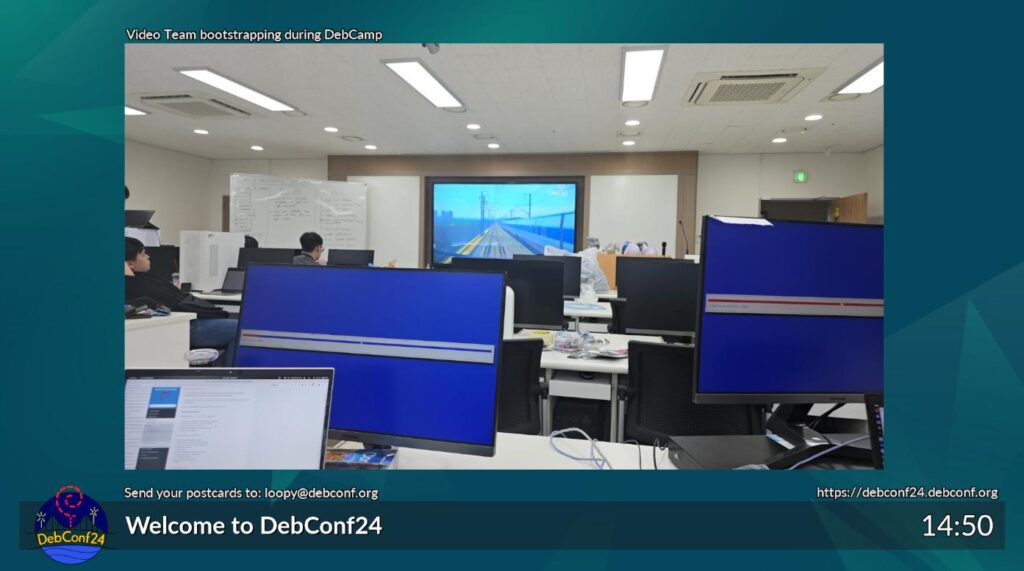
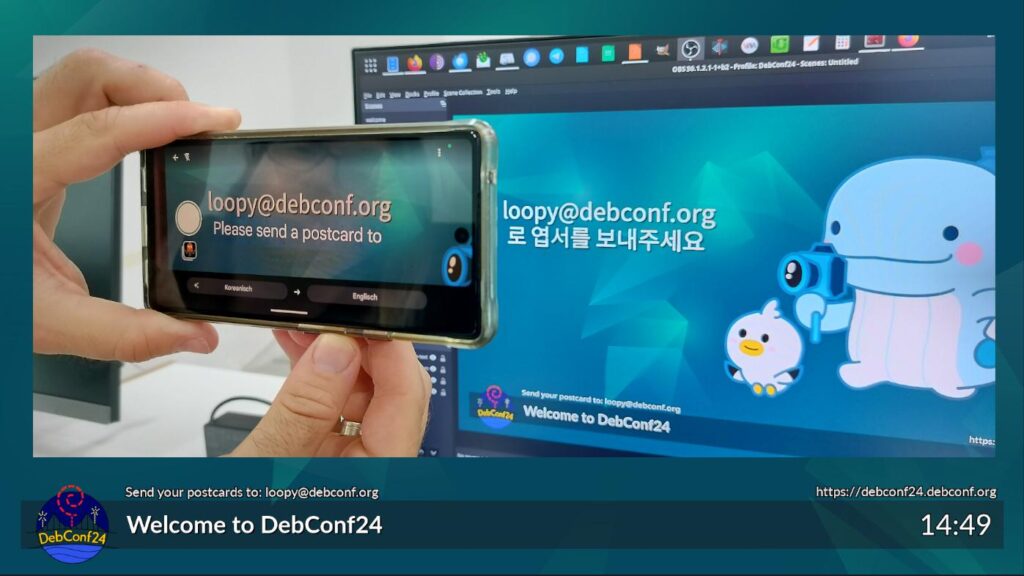
Video team I set up the standby loop for the video streaming setup. We call it loopy, it s a bunch of OBS scenes that provide announcements, shows sponsors, the schedule and some social content. I wrote about it back in 2020, but it s evolved quite a bit since then, so I m probably due to write another blog post with a bunch of updates on it. I hope to organise a video team sprint in Cape Town in the first half of next year, so I ll summarize everything before then.

It would ve been great if we could have some displays in social areas that could show talks, the loop and other content, but we were just too pressed for time for that. This year s DebConf had a very compressed timeline, and there was just too much that had to be done and that had to be figured out on the last minute. This put quite a lot of strain on the organisers, but I was glad to see how, for the most part, most attendees were very sympathetic to some rough edges (but I digress ). I added more of the OBS machine setup to the videoteam s ansible repository, so as of now it just needs an ansible setup and the OBS data and it s good to go. The loopy data is already in the videoteam git repository, so I could probably just add a git pull and create some symlinks in ansible and then that machine can be installed from 0% to 100% by just installing via debian-installer with our ansible hooks. This DebConf I volunteered quite a bit for actual video roles during the conference, something I didn t have much time for in recent DebConfs, and it s been fun, especially in a session or two where nearly none of the other volunteers showed up. Sometimes chaos is just fun :-)
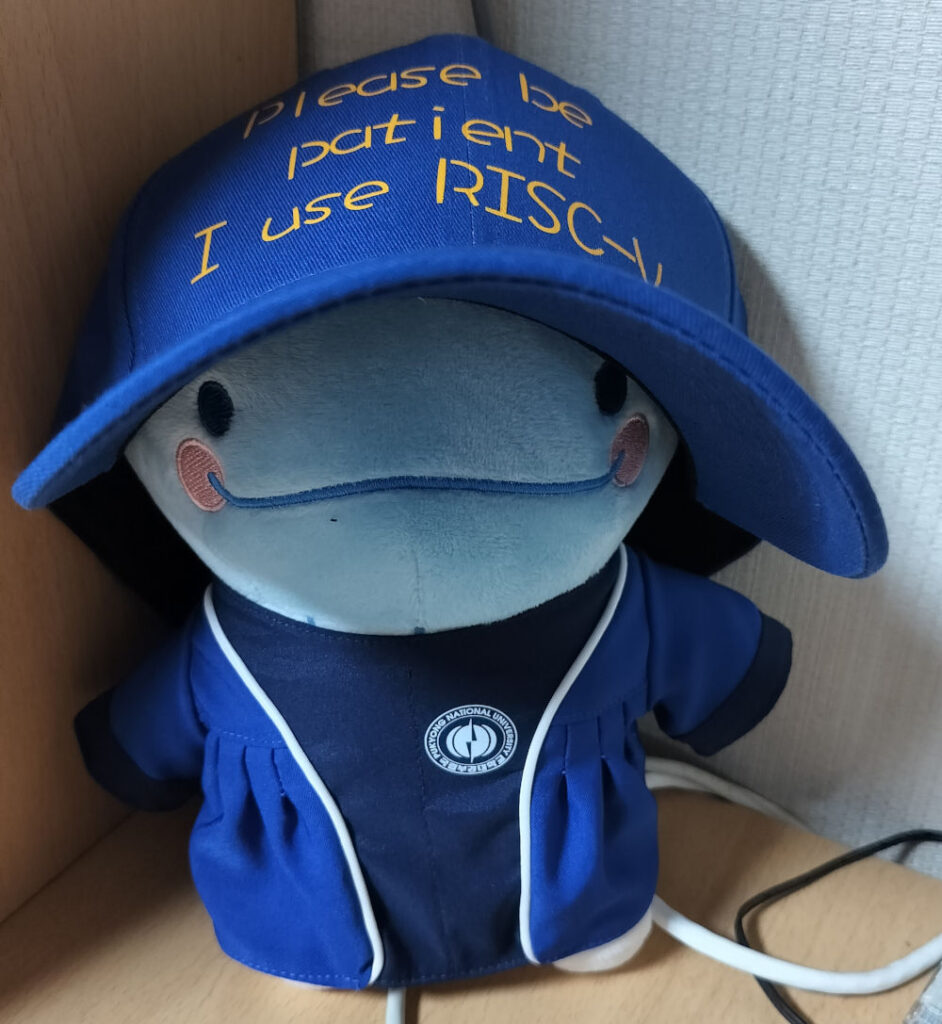
Baekyongee is the university mascot, who s visible throughout the university. So of course we included this four legged whale creature on the loop too!

Packaging I was hoping to do more packaging during DebCamp, but at least it was a non-zero amount:
  • Uploaded gdisk 1.0.10-2 to unstable (previously tested effects of adding dh-sequence-movetousr) (Closes: #1073679).
  • Worked a bit on bcachefs-tools (updating git to 1.9.4), but has a build failure that I need to look into (we might need a newer bindgen) update: I m probably going to ROM this package soon, it doesn t seem suitable for packaging in Debian.
  • Calamares: Tested a fix for encrypted installs, and uploaded it.
  • Calamares: Uploaded (3.3.8-1) to backports (at the time of writing it s still in backports-NEW).
  • Backport obs-gradient-source for bookworm.
  • Did some initial packaging on Cambalache, I ll upload to unstable once wlroots (0.18) hits unstable.
  • Pixelorama 1.0 I did some initial packaging for Pixelorama back when we did the MiniDebConf Gaming Edition, but it had a few stoppers back then. Version 1.0 seems to fix all of that, but it depends on Godot 4.2 and we re still on the 3 series in Debian, so I ll upload this once Godot 4.2 hits at least experimental. Godot software/games is otherwise quite easy to run, it s basically just source code / data that is installed and then run via godot-runner (godot3-runner package in Debian).

BoFs Python Team BoF Link to the etherpad / pad archive link and video can be found on the talk page: https://debconf24.debconf.org/talks/31-python-bof/ The session ended up being extended to a second part, since all the issues didn t fit into the first session. I was distracted by too many thing during the Python 3.12 transition (to the point where I thought that 3.11 was still new in Debian), so it was very useful listening to the retrospective of that transition. There was a discussion whether Python 3.13 could still make it to testing in time for freeze, and it seems that there is consensus that it can, although, likely with new experimental features like disabling the global interpreter lock and the just in time compiler disabled. I learned for the first time about the dead batteries project, PEP-0594, which removes ancient modules that have mostly been superseded, from the Python standard library. There was some talk about the process for changing team policy, and a policy discussion on whether we should require autopkgtests as a SHOULD or a MUST for migration to testing. As with many things, the devil is in the details and in my opinion you could go either way and achieve a similar result (the original MUST proposal allowed exceptions which imho made it the same as the SHOULD proposal). There s an idea to do some ongoing remote sprints, like having co-ordinated days for bug squashing / working on stuff together. This is a nice idea and probably a good way to energise the team and also to gain some interest from potential newcomers. Louis-Philipe V ronneau was added as a new team admin and there was some discussion on various Sphinx issues and which Lintian tags might be needed for Python 3.13. If you want to know more, you probably have to watch the videos / read the notes :)
    Debian.net BoF Link to the etherpad / pad archive link can be found on the talk page: https://debconf24.debconf.org/talks/37-debiannet-team-bof Debian Developers can set up services on subdomains on debian.net, but a big problem we ve had before was that developers were on their own for hosting those services. This meant that they either hosted it on their DSL/fiber connection at home, paid for the hosting themselves, or hosted it at different services which became an accounting nightmare to claim back the used funds. So, a few of us started the debian.net hosting project (sometimes we just call it debian.net, this is probably a bit of a bug) so that Debian has accounts with cloud providers, and as admins we can create instances there that gets billed directly to Debian. We had an initial rush of services, but requests have slowed down since (not really a bad thing, we don t want lots of spurious requests). Last year we did a census, to check which of the instances were still used, whether they received system updates and to ask whether they are performing backups. It went well and some issues were found along the way, so we ll be doing that again. We also gained two potential volunteers to help run things, which is great. Debian Social BoF Link to the etherpad / pad archive link can be found on the talk page: https://debconf24.debconf.org/talks/34-debiansocial-bof We discussed the services we run, you can view the current state of things at: https://wiki.debian.org/Teams/DebianSocial Pleroma has shown some cracks over the last year or so, and there are some forks that seem promising. At the same time, it might be worth while considering Mastodon too. So we ll do some comparison of features and maintenance and find a way forward. At the time when Pleroma was installed, it was way ahead in terms of moderation features. Pixelfed is doing well and chugging along nicely, we should probably promote it more. Peertube is working well, although we learned that we still don t have all the recent DebConf videos on there. A bunch of other issues should be fixed once we move it to a new machine that we plan to set up. We re removing writefreely and plume. Nice concepts, but it didn t get much traction yet, and no one who signed up for these actually used it, which is fine, some experimentation with services is good and sometimes they prove to be very popular and other times not. The WordPress multisite instance has some mild use, otherwise haven t had any issues. Matrix ended up to be much, much bigger than we thought, both in usage and in its requirements. It s very stateful and remembers discussions for as long as you let it, so it s Postgres database is continuously expanding, this will also be a lot easier to manage once we have this on the new host. Jitsi is also quite popular, but it could probably be on jitsi.debian.net instead (we created this on debian.social during the initial height of COVID-19 where we didn t have the debian.net hosting yet), although in practice it doesn t really matter where it lives. Most of our current challenges will be solved by moving everything to a new big machine that has a few public IPs available for some VMs, so we ll be doing that shortly. Debian Foundation Discussion BoF This was some brainstorming about the future structure of Debian, and what steps might be needed to get there. It s way too big a problem to take on in a BoF, but we made some progress in figuring out some smaller pieces of the larger puzzle. The DPL is going to get in touch with some legal advisors and our trusted organisations so that we can aim to formalise our relationships a bit more by the time it s DebConf again. I also introduced my intention to join the Debian Partners delegation. When I was DPL, I enjoyed talking with external organisations who wanted to help Debian, but helping external organisations help Debian turned out to be too much additional load on the usual DPL roles, so I m pursuing this with the Debian Partners team, more on that some other time. This session wasn t recorded, but if you feel like you missed something, don t worry, all intentions will be communicated and discussed with project members before anything moves forward. There was a strong agreement in the room though that we should push forward on this, and not reach another DebConf where we didn t make progress on formalising Debian s structure more.

    Social Conference Dinner
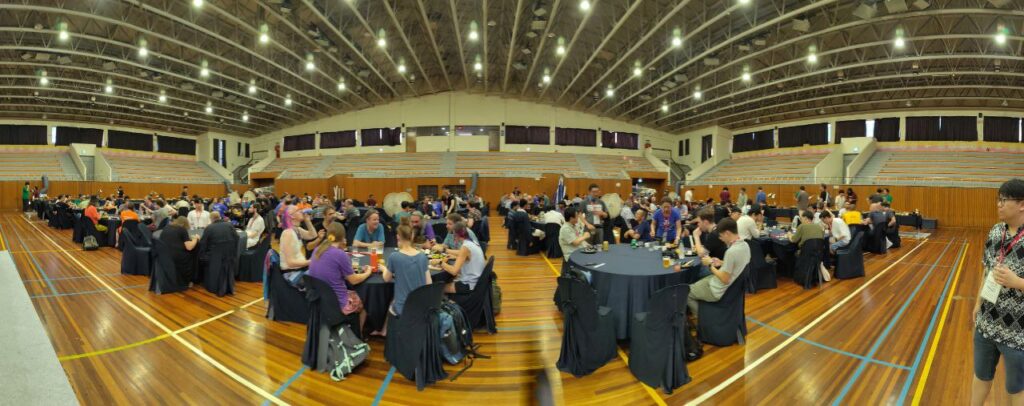
    Conference Dinner Photo from Santiago
    The conference dinner took place in the university gymnasium. I hope not many people do sports there in the summer, because it got HOT. There was also some interesting observations on the thermodynamics of the attempted cooling solutions, which was amusing. On the plus side, the food was great, the company was good, and the speeches were kept to a minimum, so it was a great conference dinner, even though it was probably cut a bit short due to the heat. Cheese and Wine Cheese and Wine happened on 1 August, which happens to be the date I became a DD at DebConf17 in Montr al seven years before, so this was a nice accidental celebration of my Debiversary :) Since I m running out of time, I ll add some more photos to this post some time after publishing it :P Group Photo As per DebConf tradition, Aigars took the group photo. You can find the high resolution version on Debian s GitLab instance.
    Debian annual conference Debconf 24, Busan, South Korea
    Photography: Aigars Mahinovs aigarius@debian.org
    License: CC-BYv3+ or GPLv2+
    Talking Ah yes, talking to people is a big part of DebConf, but I didn t keep track of it very well.
    • I mostly listened to Alper a bit about his ideas for his talk about debian installer.
    • I talked to Rhonda a bit about ActivityPub and MQTT and whether they could be useful for publicising Debian activity.
    • Listened to Gunnar and Julian have a discussion about GPG and APT which was interesting.
    • I learned that you can learn Hangul, the Korean alphabet, in about an hour or so (I wish I knew that in all my years of playing StarCraft II).
    • We had the usual continuous keysigning party. Besides it s intended function, this is always a good ice breaker and a way to for shy people to meet other shy people.
    • and many other fly-by discussions.

    Stuff that didn t happen this DebConf
    • loo.py A simple Python script that could eventually replace the obs-advanced-scene-switcher sequencer in OBS. It would also be extremely useful if we d ever replace OBS for loopy. I was hoping to have some time to hack on this, and try to recreate the current loopy in loo.py, but didn t have the time.
    • toetally This year videoteam had to scramble to get a bunch of resistors to assemble some tally light. Even when assembled, they were a bit troublesome. It would ve been nice to hack on toetally and get something ready for testing, but it mostly relies on having something like a rasbperry pi zero with an attached screen in order to work on further. I ll try to have something ready for the next mini conf though.
    • extrepo on debian live I think we should have extrepo installed by default on desktop systems, I meant to start a discussion on this, but perhaps it s just time I go ahead and do it and announce it.
    • Live stream to peertube server It would ve been nice to live stream DebConf to PeerTube, but the dependency tree to get this going got a bit too huge. Following our plans discussed in the Debian Social BoF, we should have this safely ready before the next MiniDebConf and should be able to test it there.
    • Desktop Egg there was this idea to get a stand-in theme for Debian testing/unstable until the artwork for the next release is finalized (Debian bug: #1038660), I have an idea that I meant to implement months ago, but too many things got in the way. It s based on Juliette Taka s Homeworld theme, and basically transforms the homeworld into an egg. Get it? Something that hasn t hatched yet? I also only recently noticed that we never used the actual homeworld graphics (featuring the world image) in the final bullseye release. lol.
    So, another DebConf and another new plush animal. Last but not least, thanks to PKNU for being such a generous and fantastic host to us! See you again at DebConf25 in Brest, France next year!

      Louis-Philippe V ronneau: A Selection of DebConf24 Talks

      DebConf24 is now over! I'm very happy I was able to attend this year. If you haven't had time to look at the schedule yet, here is a selection of talks I liked.
      What happens if I delete setup.py?: a live demo of upgrading to PEP-518 Python packaging A great talk by Weezel showcasing how easy it is to migrate to PEP-518 for existing Python projects. This is the kind of thing I've been doing a lot when packaging upstream projects that still use setup.py. I encourage you to send this kind of patch upstream, as it makes everyone's life much easier.
      Debian on Chromebooks: What's New and What's Next? A talk by Alper Nebi Yasak, who has done great work on running Debian and the Debian Installer on Chromebooks. With Chromebooks being very popular machines in schools, it's nice to see people working on a path to liberate them.
      Sequoia PGP, sq, gpg-from-sq, v6 OpenPGP, and Debian I had the chance to see Justus' talk on Sequoia an OpenPGP implementation in Rust at DebConf22 in Kosovo. Back then, the conclusion was that sq wasn't ready for production yet. Well it seems it now is! This in-depth talk goes through the history of the project and its goals. There is also a very good section on the current OpenPGP/LibrePGP schism.
      Chameleon - the easy way to try out Sequoia - OpenPGP written in Rust A very short talk by Holger on Chameleon, a tool to make migration to Sequoia easier. TL;DW: apt install gpg-from-sq
      Protecting OpenPGP keyservers from certificate flooding Although I used to enjoy signing people's OpenPGP keys, I completely gave up on this practice around 2019 when dkg's key was flooded with bogus certifications and have been refusing to do so since. In this talk, Gunnar talks about his PhD work on fixing this issue and making sure we can eventually restore this important function on keyservers.
      Bits from the DPL Bits from the DPL! A DebConf classic.
      Linux live patching in Debian Having to reboot servers after kernel upgrades is a hassle, especially with machines that have encrypted disk drives. Although kernel live patching in Debian is still a work in progress, it is encouraging to see people trying to fix this issue.
      "I use Debian BTW": fzf, tmux, zoxide and friends A fun talk by Samuel Henrique on little changes and tricks one can make to their setup to make life easier.
      Ideas to Move Debian Installer Forward Another in-depth talk by Alper, this time on the Debian Installer and his ideas to try to make it better. I learned a lot about the d-i internals!
      Lightning Talks Lighting talks are always fun to watch! This year, the following talks happened:
      1. Customizing your Linux icons
      2. A Free Speech tracker by SFLC.IN
      3. Desktop computing is irrelevant
      4. An introduction to wcurl
      5. Aliasing in dpkg
      6. A DebConf art space
      7. Tiny Tapeout, Fomu, PiCI
      8. Data processing and visualisation in the shell

      Is there a role for Debian in the post-open source era? As an economist, I've been interested in Copyright and business models in the Free Software ecosystem for a while. In this talk, Hatta-san and Bruce Perens discuss the idea of alternative licences that are not DFSG-free, like Post-Open.

      4 August 2024

      Matthias Klumpp: Freedesktop Specs Website Update

      The Freedesktop.org Specifications directory contains a list of common specifications that have accumulated over the decades and define how common desktop environment functionality works. The specifications are designed to increase interoperability between desktops. Common specifications make the life of both desktop-environment developers and especially application developers (who will almost always want to maximize the amount of Linux DEs their app can run on and behave as expected, to increase their apps target audience) a lot easier. Unfortunately, building the HTML specifications and maintaining the directory of available specs has become a bit of a difficult chore, as the pipeline for building the site has become fairly old and unmaintained (parts of it still depended on Python 2). In order to make my life of maintaining this part of Freedesktop easier, I aimed to carefully modernize the website. I do have bigger plans to maybe eventually restructure the site to make it easier to navigate and not just a plain alphabetical list of specifications, and to integrate it with the Wiki, but in the interest of backwards compatibility and to get anything done in time (rather than taking on a mega-project that can t be finished), I decided to just do the minimum modernization first to get a viable website, and do the rest later. So, long story short: Most Freedesktop specs are written in DocBook XML. Some were plain HTML documents, some were DocBook SGML, a few were plaintext files. To make things easier to maintain, almost every specification is written in DocBook now. This also simplifies the review process and we may be able to switch to something else like AsciiDoc later if we want to. Of course, one could have switched to something else than DocBook, but that would have been a much bigger chore with a lot more broken links, and I did not want this to become an even bigger project than it already was and keep its scope somewhat narrow. DocBook is a markup language for documentation which has been around for a very long time, and therefore has older tooling around it. But fortunately our friends at openSUSE created DAPS (DocBook Authoring and Publishing Suite) as a modern way to render DocBook documents to HTML and other file formats. DAPS is now used to generate all Freedesktop specifications on our website. The website index and the specification revisions are also now defined in structured TOML files, to make them easier to read and to extend. A bunch of specifications that had been missing from the original website are also added to the index and rendered on the website now. Originally, I wanted to put the website live in a temporary location and solicit feedback, especially since some links have changed and not everything may have redirects. However, due to how GitLab Pages worked (and due to me not knowing GitLab CI well enough ) the changes went live before their MR was actually merged. Rather than reverting the change, I decided to keep it (as the old website did not build properly anymore) and to see if anything breaks. So far, no dead links or bad side effects have been observed, but: If you notice any broken link to specifications.fd.o or anything else weird, please file a bug so that we can fix it! Thank you, and I hope you enjoy reading the specifications in better rendering and more coherent look!

      Scarlett Gately Moore: KDE, Kubuntu, Debian: Weekly progress report Qt6 updates.

      Thankfully no tragedies to report this week! I thank each and everyone of you that has donated to my car fund. I still have a ways to go and could use some more help so that we can go to the funeral. https://gofund.me/033eb25d I am between contracts and work packages, so all of my work is currently for free. Thanks for your consideration. Another very busy week getting qt6 updates in Debian, Kubuntu, and KDE snaps. Kubuntu: Debian: KDE Snaps: Updated QT to 6.7.2 which required a rebuild of all our snaps. Also found an issue with mismatched ffmpeg libraries, we have to bundle them for now until versioning issues are resolved. Made new theme snaps for KDE breeze: gtk-theme-breeze, icon-theme-breeze so if you use the plasma theme breeze please install these and run
      for PLUG in $(snap connections   grep gtk-common-themes:icon-themes   awk ' print $2 '); do sudo snap connect $ PLUG  icon-theme-breeze:icon-themes; done
      for PLUG in $(snap connections   grep gtk-common-themes:gtk-3-themes   awk ' print $2 '); do sudo snap connect $ PLUG  gtk-theme-breeze:gtk-3-themes; done
      for PLUG in $(snap connections   grep gtk-common-themes:gtk-2-themes   awk ' print $2 '); do sudo snap connect $ PLUG  gtk-theme-breeze:gtk-2-themes; done
      This should resolve most theming issues. We are still waiting for kdeglobals to be merged in snapd to fix colorscheme issues, it is set for next release. I am still working on qt6 themes and working out how to implement them in snaps as they are more complex than gtk themes with shared libraries and file structures. Please note: Please help test the edge snaps so I can promote them to stable. WIP Snaps or MR s made

      2 August 2024

      Bits from Debian: Bits from the DPL

      Dear Debian community, this are my bits from DPL written at my last day at another great DebConf. DebConf attendance At the beginning of July, there was some discussion with the bursary and content team about sponsoring attendees. The discussion continued at DebConf. I do not have much experience with these discussions. My summary is that while there is an honest attempt to be fair to everyone, it did not seem to work for all, and some critical points for future discussion remained. In any case, I'm thankful to the bursary team for doing such a time-draining and tedious job. Popular packages not yet on Salsa at all Otto Kek l inen did some interesting investigation about Popular packages not yet on Salsa at all. I think I might provide some more up to date list soon by some UDD query which considers more recent uploads than the trends data soon. For instance wget was meanwhile moved to Salsa (thanks to No l K the for this). Keep on contacting more teams I kept on contacting teams in July. Despite I managed to contact way less teams than I was hoping I was able to present some conclusions in the Debian Teams exchange BoF and Slide 16/23 of my Bits from the DPL talk. I intend to do further contacts next months. Nominating Jeremy B cha for GNOME Advisory Board I've nominated Jeremy B cha to GNOME Advisory Board. Jeremy has volunteered to represent Debian at GUADEC in Denver. DebCamp / DebConf I attended DebCamp starting from 22 July evening and had a lot of fun with other attendees. As always DebConf is some important event nearly every year for me. I enjoyed Korean food, Korean bath, nature at the costline and other things. I had a small event without video coverage Creating web galleries including maps from a geo-tagged photo collection. At least two attendees of this workshop confirmed success in creating their own web galleries. I used DebCamp and DebConf for several discussions. My main focus was on discussions with FTP master team members Luke Faraone, Sean Whitton, and Utkarsh Gupta. I'm really happy that the four of us absolutely agree on some proposed changes to the structure of the FTP master team, as well as changes that might be fruitful for the work of the FTP master team itself and for Debian developers regarding the processing of new packages. My explicit thanks go to Luke Faraone, who gave a great introduction to FTP master work in their BoF. It was very instructive for the attending developers to understand how the FTP master team checks licenses and copyright and what workflow is used for accepting new packages. In the first days of DebConf, I talked to representatives of DebConf platinum sponsor WindRiver, who announced the derivative eLxr. I warmly welcome this new derivative and look forward to some great cooperation. I also talked to the representative of our gold sponsor, Microsoft. My first own event was the Debian Med BoF. I'd like to repeat that it might not only be interesting for people working in medicine and microbiology but always contains some hints how to work together in a team. As said above I was trying to summarise some first results of my team contacts and got some further input from other teams in the Debian Teams exchange BoF. Finally, I had my Bits from DPL talk. I received positive responses from attendees as well as from remote participants, which makes me quite happy. For those who were not able to join the events on-site or remotely, the videos of all events will be available on the DebConf site soon. I'd like to repeat the explicit need for some volunteers to join the Lintian team. I'd also like to point out the "Tiny tasks" initiative I'd like to start (see below). BTW, if someone might happen to solve my quiz for the background images there is a summary page in my slides which might help to assign every slide to some DebConf. I could assume that if you pool your knowledge you can solve more than just the simple ones. Just let me know if you have some solution. You can add numbers to the rows and letters to the columns and send me:
       2000/2001:  Uv + Wx
       2002: not attended
       2003: Yz
       2004: not attended
       2005:
       2006: not attended
       2007:
       ...
       2024: A1
      
      This list provides some additional information for DebConfs I did not attend and when no video stream was available. It also reminds you about the one I uncovered this year and that I used two images from 2001 since I did not have one from 2000. Have fun reassembling good memories. Tiny tasks: Bug of the day As I mentioned in my Bits from DPL talk, I'd like to start a "Tiny tasks" effort within Debian. The first type of tasks will be the Bug of the day initiative. For those who would like to join, please join the corresponding Matrix channel. I'm curious to see how this might work out and am eager to gain some initial experiences with newcomers. I won't be available until next Monday, as I'll start traveling soon and have a family event (which is why I need to leave DebConf today after the formal dinner). Kind regards from DebConf in Busan Andreas.

      1 August 2024

      Guido G nther: Free Software Activities July 2024

      A short status update on what happened on my side last month. Looking at unified push support for Chatty prompted some libcmatrix fixes and Chatty improvements (benefiting other protocols like SMS/MMS as well). The Bluetooth status page in Phosh was a slightly larger change code wise as we also enhanced our common widgets for building status pages, simplifying the Wi-Fi status page and making future status pages simpler. But as usual investigating bugs, reviewing patches (thanks!) and keeping up with the changing world around us is what ate most of the time. Phosh A Wayland Shell for mobile devices Phoc A Wayland compositor for mobile devices libphosh-rs Phosh Rust bindings phosh-osk-stub A on screen keyboard for Phosh phosh-mobile-settings phosh-wallpapers Wallpapers, Sounds and other artwork git-buildpackage Suite to help with Debian packages in Git repositories Whatmaps Tool to find processes mapping shared objects Debian The universal operating system Mobian A Debian derivative for mobile devices Calls PSTN and SIP calls for GNOME Livi Minimalistic video player targeting mobile devices libcall-ui Common user interface parts for call handling in GNOME and Phosh. feedbackd DBus service for haptic/visual/audio feedback Chatty Messaging application for mobile and desktop libcmatrix A matrix client client library Eigenvalue A libcmatrix test client Help Development If you want to support my work see donations. This includes list of hardware we want to improve support for.

      Dirk Eddelbuettel: RQuantLib 0.4.24 on CRAN: Robustification

      A new minor release 0.4.24 of RQuantLib arrived on CRAN this afternoon (just before the CRAN summer break starting tomorrow), and has been uploaded to Debian too. QuantLib is a rather comprehensice free/open-source library for quantitative finance. RQuantLib connects (some parts of) it to the R environment and language, and has been part of CRAN for more than twenty-one years (!!) as it was one of the first packages I uploaded. This release of RQuantLib follows the recent release from last week which updated to QuantLib version 1.35 released that week, and solidifies conditional code for older QuantLib versions in one source file. We also updated and extended the configure source file, and increased the mininum version of QuantLib to 1.25.

      Changes in RQuantLib version 0.4.24 (2024-07-31)
      • Updated detection of QuantLib libraries in configure
      • The minimum version has been increased to QuantLib 1.25, and DESCRIPTION has been updated to state it too
      • The dividend case for vanilla options still accommodates deprecated older QuantLib versions if needed (up to QuantLib 1.25)
      • The configure script now uses PKG_CXXFLAGS and PKG_LIBS internally, and shows the values it sets

      Courtesy of my CRANberries, there is also a diffstat report for the this release. As always, more detailed information is on the RQuantLib page. Questions, comments etc should go to the rquantlib-devel mailing list. Issue tickets can be filed at the GitHub repo. If you like this or other open-source work I do, you can now sponsor me at GitHub.

      This post by Dirk Eddelbuettel originated on his Thinking inside the box blog. Please report excessive re-aggregation in third-party for-profit settings.

      31 July 2024

      Russ Allbery: Review: The Book That Wouldn't Burn

      Review: The Book That Wouldn't Burn, by Mark Lawrence
      Series: Library Trilogy #1
      Publisher: Ace
      Copyright: 2023
      ISBN: 0-593-43793-4
      Format: Kindle
      Pages: 561
      The Book That Wouldn't Burn is apparently high fantasy, but of the crunchy sort that could easily instead be science fiction. It is the first of a trilogy. Livira is a young girl, named after a weed, who lives in a tiny settlement in the Dust. She is the sort of endlessly curious and irrepressible girl who can be more annoying than delightful to adults who are barely keeping everyone alive. Her settlement is not the sort of place that's large enough to have a name; only their well keeps them alive in the desert and the ever-present dust. There is a city somewhere relatively near, which Livira dreams of seeing, but people from the settlement don't go there. When someone is spotted on the horizon approaching the settlement, it's the first time Livira has ever seen a stranger. It's also not a good sign. There's only one reason for someone to seek them out in the Dust: to take. Livira and the other children are, in short order, prisoners of the humanoid dog-like sabbers, being dragged off to an unknown fate. Evar lives in the library and has for his entire life. Specifically, he lives in a square room two miles to a side, with a ceiling so high that it may as well be a stone sky. He lived there with his family before he was lost in the Mechanism. Years later, the Mechanism spit him out alongside four other similarly-lost kids, all from the same library in different times. None of them had apparently aged, but everyone else was dead. Now, years later, they live a strange and claustrophobic life with way too much social contact between way too few people. Evar's siblings, as he considers them, were each in the Mechanism with a book. During their years in the Mechanism they absorbed that book until it became their focus and to some extent their personality. His brothers are an assassin, a psychologist, and a historian. His sister, the last to enter the Mechanism and a refugee from the sabber attack that killed everyone else, is a warrior. Evar... well, presumably he had a book, since that's how the Mechanism works. But he can't remember anything about it except the feeling that there was a woman. Evar lives in a library in the sense that it's a room full of books, but those books are not on shelves. They're stacked in piles and massive columns, with no organizational system that any of them could discern. There are four doors, all of which are closed and apparently impenetrable. In front of one of them is a hundred yards of char and burned book remnants, but that door is just as impenetrable as the others. There is a pool in the center of the room, crops surrounding it, and two creatures they call the Soldier and the Assistant. That is the entirety of Evar's world. As you might guess from the title, this book is about a library. Evar's perspective of the library is quite odd and unexplained until well into the book, and Livira's discovery of the library and subsequent explorations are central to her story, so I'm going to avoid going into too many details about its exact nature. What I will say is that I have read a lot of fantasy novels that are based around a library, but I don't think I've ever read one that was this satisfying. I think the world of The Book That Wouldn't Burn is fantasy, in that there are fundamental aspects of this world that don't seem amenable to an explanation consistent with our laws of physics. It is, however, the type of fantasy with discoverable rules. Even better, it's the type of fantasy where discovering the rules is central to the story, for both the characters and the readers, and the rules are worth the effort. This is a world-building tour de force: one of the most engrossing and deeply satisfying slow revelations that I have read in a long time. This book is well over 500 pages, the plot never flags, new bits of understanding were still slotting into place in the last chapter, and there are lots of things I am desperately curious about that Lawrence left for the rest of the series. If you like puzzling out the history and rules of an invented world and you have anything close to my taste in characters and setting, you are going to love this book. (Also, there is at least one C.S. Lewis homage that I will not spoil but that I thought was beautifully done and delightfully elaborated, and I am fairly sure there is a conversation happening between this book and Philip Pullman's His Dark Materials series that I didn't quite untangle but that I am intrigued by.) I do need to offer a disclaimer: Livira is precisely the type of character I love reading about. She's stubborn, curious, courageous, persistent, egalitarian, insatiable, and extremely sharp. I have a particular soft spot for exactly this protagonist, so adjust the weight of my opinion accordingly. But Lawrence also makes excellent use of her as a spotlight to illuminate the world-building. More than anything else in the world, Livira wants to understand, and there is so much here to understand. There is an explanation for nearly everything in this book, and those explanations usually both make sense and prompt more questions. This is such a tricky balance for the writer to pull off! A lot of world-building of this sort fails either by having the explanations not live up to the mysteries or by tying everything together so neatly that the stakes of the world collapse into a puzzle box. Lawrence avoids both failures. This world made sense to me but remained sufficiently messy to feel like humans were living in it. I also thought the pacing and timing were impeccable: I figured things out at roughly the same pace as the characters, and several twists and turns caught me entirely by surprise. I do have one minor complaint and one caveat. The minor complaint is that I thought one critical aspect of the ending was a little bit too neat and closed. It was the one time in the book where I thought Lawrence simplified his plot structure rather than complicated it, and I didn't like the effect it had on the character dynamics. There is, thankfully, the promise of significant new complications in the next book. The caveat is a bit harder to put my finger on, but a comparison to Alaya Dawn Johnson's The Library of Broken Worlds might help. That book was also about a library, featured a protagonist thrown into the deep end of complex world-building, and put discovery of the history and rules at the center of the story. I found the rules structure of The Book That Wouldn't Burn more satisfyingly complicated and layered, in a way that made puzzle pieces fit together in my head in a thoroughly enjoyable way. But Johnson's book is about very large questions of identity, history, sacrifice, and pain, and it's full of murky ambiguity and emotions that are only approached via metaphor and symbolism. Lawrence's book is far more accessible, but the emotional themes are shallower and more straightforward. There is a satisfying emotional through-line, and there are some larger issues at stake, but it won't challenge your sense of morality and justice the way that The Library of Broken Worlds might. I think which of those books one finds better will depend on what mood you're in and what reading experience you're looking for. Personally, I was looking for a scrappy, indomitable character who would channel her anger into overcoming every obstacle in the way of thoroughly understanding her world, and that's exactly what I got. This was my most enjoyable reading experience of the year to date and the best book I've read since Some Desperate Glory. Fantastic stuff, highly recommended. Followed by The Book That Broke the World, and the ending is a bit of a cliffhanger so you may want to have that on hand. Be warned that the third book in the series won't be published until 2025. Rating: 9 out of 10

      Matthew Palmer: Health Industry Company Sues to Prevent Certificate Revocation

      It s not often that a company is willing to make a sworn statement to a court about how its IT practices are incompatible with the needs of the Internet, but when they do it s popcorn time.
      The Combatants In the red corner, weighing in at nah, I m not going to do that schtick. The plaintiff in the case is Alegeus Technologies, LLC, a Delaware Corporation that, according to their filings, is a leading provider of a business-tobusiness, white-label funding and payment platform for healthcare carriers and third-party administrators to administer consumer-directed employee benefit programs . Not being subject to the US bonkers health care system, I have only a passing familiarity with the sorts of things they do, but presumably it involves moving a lot of money around, which is sometimes important. The defendant is DigiCert, a CA which, based on analysis I ve done previously, is the second-largest issuer of WebPKI certificates by volume.

      The History According to a recently opened Mozilla CA bug, DigiCert found an issue in their domain control validation workflow, that meant it may have been possible for a miscreant to have certificates issued to them that they weren t legitimately entitled to. Given that validating domain names is basically the YOU HAD ONE JOB! of a CA, this is a big deal. The CA/Browser Forum Baseline Requirements (BRs) (which all CAs are required to adhere to, by virtue of their being included in various browser and OS trust stores), say that revocation is required within 24 hours when [t]he CA obtains evidence that the validation of domain authorization or control for any Fully Qualified Domain Name or IP address in the Certificate should not be relied upon (section 4.9.1.1, point 5). DigiCert appears to have at least tried to do the right thing, by opening the above Mozilla bug giving some details of the problem, and notifying their customers that their certificates were going to be revoked. One may quibble about how fast they re doing it, but they re giving it a decent shot, at least. A complicating factor in all this is that, only a touch over a month ago, Google Chrome announced the removal of another CA, Entrust, from its own trust store program, citing a pattern of compliance failures, unmet improvement commitments, and the absence of tangible, measurable progress in response to publicly disclosed incident reports . Many of these compliance failures were failures to revoke certificates in a timely manner. One imagines that DigiCert would not like to gain a reputation for tardy revocation, particularly at the moment.

      The Legal Action Now we come to Alegeus Technologies. They ve opened a civil case whose first action is to request the issuance of a Temporary Restraining Order (TRO) that prevents DigiCert from revoking certificates issued to Alegeus (which the court has issued). This is a big deal, because TROs are legal instruments that, if not obeyed, constitute contempt of court (or something similar) and courts do not like people who disregard their instructions. That means that, in the short term, those certificates aren t getting revoked, despite the requirement imposed by root stores on DigiCert that the certificates must be revoked. DigiCert is in a real rock / hard place situation here: revoke and get punished by the courts, or don t revoke and potentially (though almost certainly not, in the circumstances) face removal from trust stores (which would kill, or at least massively hurt, their business). The reasons that Alegeus gives for requesting the restraining order is that [t]o Reissue and Reinstall the Security Certificates, Alegeus must work with and coordinate with its Clients, who are required to take steps to rectify the certificates. Alegeus has hundreds of such Clients. Alegeus is generally required by contract to give its clients much longer than 24 hours notice before executing such a change regarding certification. In the filing, Alegeus does acknowledge that DigiCert is a voluntary member of the Certification Authority Browser Forum (CABF), which has bylaws stating that certificates with an issue in their domain validation must be revoked within 24 hours. This is a misstatement of the facts, though. It is the BRs, not the CABF bylaws, that require revocation, and the BRs apply to all CAs that wish to be included in browser and OS trust stores, not just those that are members of the CABF. In any event, given that Alegeus was aware that DigiCert is required to revoke certificates within 24 hours, one wonders why Alegeus went ahead and signed agreements with their customers that required a lengthy notice period before changing certificates. What complicates the situation is that there is apparently a Master Services Agreement (MSA) that states that it constitutes the entire agreement between the parties and that MSA doesn t mention certificate revocation anywhere relevant. That means that it s not quite so cut-and-dried that DigiCert does, in fact, have the right to revoke those certificates. I d expect a lot of update to your Master Services Agreement emails to be going out from DigiCert (and other CAs) in the near future to clarify this point. Not being a lawyer, I can t imagine which way this case might go, but there s one thing we can be sure of: some lawyers are going to able to afford that trip to a tropical paradise this year.

      The Security Issues The requirement for revocation within 24 hours is an important security control in the WebPKI ecosystem. If a certificate is misissued to a malicious party, or is otherwise compromised, it needs to be marked as untrustworthy as soon as possible. While revocation is far from perfect, it is the best tool we have. In this court filing, Alegeus has claimed that they are unable to switch certificates with less than 24 hours notice (due to contractual SLAs ). This is a pretty big problem, because there are lots of reasons why a certificate might need to be switched out Very Quickly. As a practical example, someone with access to the private key for your SSL certificate might decide to use it in a blog post. Letting that sort of problem linger for an extended period of time might end up being a Pretty Big Problem of its own. An organisation that cannot respond within hours to a compromised certificate is playing chicken with their security.

      The Takeaways Contractual obligations that require you to notify anyone else of a certificate (or private key) changing are bonkers, and completely antithetical to the needs of the WebPKI. If you have to have them, you re going to want to start transitioning to a private PKI, wherein you can do whatever you darn well please with revocation (or not). As these sorts of problems keep happening, trust stores (and hence CAs) are going to crack down on this sort of thing, so you may as well move sooner rather than later. If you are an organisation that uses WebPKI certificates, you ve got to be able to deal with any kind of certificate revocation event within hours, not days. This basically boils down to automated issuance and lifecycle management, because having someone manually request and install certificates is terrible on many levels. There isn t currently a completed standard for notifying subscribers if their certificates need premature renewal (say, due to needing to be revoked), but the ACME Renewal Information Extension is currently being developed to fill that need. Ask your CA if they re tracking this standards development, and when they intend to have the extension available for use. (Pro-tip: if they say we ll start doing development when the RFC is published , run for the hills; that s not how responsible organisations work on the Internet).

      The Givings If you ve found this helpful, consider shouting me a refreshing beverage. Reading through legal filings is thirsty work!

      30 July 2024

      Russell Coker: Links July 2024

      Interesting Scientific American article about the way that language shapes thought processes and how it was demonstrated in eye tracking experiments with people who have Aboriginal languages as their first language [1]. David Brin wrote an interesting article Do We Really Want Immortality [2]. I disagree with his conclusions about the politics though. Better manufacturing technology should allow decreasing the retirement age while funding schools well. Scientific American has a surprising article about the differences between Chimp and Bonobo parenting [3]. I d never have expected Chimp moms to be protective. Sam Varghese wrote an insightful and informative article about the corruption in Indian politics and the attempts to silence Australian journalist Avani Dias [4]. WorksInProgress has an insightful article about the world s first around the world solo yacht race [5]. It has some interesting ideas about engineering. Htwo has an interesting video about adverts for fake games [6]. It s surprising how they apparently make money from advertising games that don t exist. Elena Hashman wrote an insightful blog post about Chronic Fatigue Syndrome [7]. I hope they make some progress on curing it soon. The fact that it seems similar to long Covid which is quite common suggests that a lot of research will be applied to that sort of thing. Bruce Schneier wrote an insightful blog post about the risks of MS Copilot [8]. Krebs has an interesting article about how Apple does Wifi AP based geo-location and how that can be abused for tracking APs in warzones etc. Bad Apple! [9]. Bruce Schneier wrote an insightful blog post on How AI Will Change Democracy [10]. Charles Stross wrote an amusing and insightful post about MS Recall titled Is Microsoft Trying to Commit Suicide [11]. Bruce Schneier wrote an insightful blog post about seeing the world as a data structure [12]. Luke Miani has an informative YouTube video about eBay scammers selling overprices MacBooks [13]. The Yorkshire Ranter has an insightful article about Ronald Coase and the problems with outsourcing big development contracts as an array of contracts without any overall control [14].

      29 July 2024

      Sahil Dhiman: Ola Maps and OpenStreetMap Data

      Recently, Ola started rolling out Ola Maps in their main mobile app, replacing Google Maps, while also offering maps as a service to other organizations. The interesting part for me was the usage of OpenStreetMap data as base map with Ola s proprietary data sources. I ll mostly about talk about map data part here. RTI 1
      Screenshot of Ola App.
      OpenStreetMap attribution is shown after clicking the Ola Map icon.
      OpenStreetMap (OSM) for starters, is a community owned and edited map data resource which gives freedom to use map data for any purpose. This includes the condition that attribution is given back to OSM which in turn ideally would encourage other users to contribute, correct and edit, helping everyone in turn. Due to this, OSM is also regarded as Wikipedia of maps. OSM data is not just used by Ola. Many others use it for various purposes like Wikipedia Maps, Strava Maps, Snapchat Map, bus tracking in GoIbibo/Redbus. OSM India community has been following Ola map endeavor to use and contribute to OSM since they went public. As required by OSM for organized mapping efforts, Ola created wiki entry with information regarding their editors, usage, policy and mentions following as their data usage case:
      OSM data is used for the road network, traffic signs and signals, buildings, natural features, landuse polygons and some POIs.
      Creating a map product is a task in itself, an engineering hurdle creating the tech stack for collection, validation, import and serving the map and the map data part. Ola has done a good job describing the development of tech stack in their blog post. Ola holds an enormous corpus of live and constantly updated GPS trace data. Their drivers, users, and delivery partners generate those, which they harness to validate, correct and add missing map data. Ola employees now regularly contribute new or missing roads (including adding dual carriageway to existing ones), fix road geometry, classification, road access type and restrictions pan India. They have been active and engaging in OSM India community channels, though community members have raised some concerns on their OSM edit practices. Ola s venture into the map industry isn t something out of the ordinary. Grab, a South East Asian company which has business interests in food deliveries, ride hailing and a bunch of other services too switched to their in-house map based on OpenStreetMap, followed by launching of their map product. Grab too contributed back data like Ola. Both Ola and Grab heavily rely on map for their business operations and seem to chose to go independent for it, bootstrapping the products on OSM. In India too, a bunch of organizations contribute to OSM like Swiggy, Stackbox, Amazon, Apple. Microsoft, Meta/Facebook and many others. Everyone wants a better map (data), so everyone works together. Ola could have gone their own route, bootstrapping map data from scratch, which would have been a gargantuan task when you re competing against the likes of Google Maps and Bing Maps, which have been into this since many years. Deciding to use OSM and actively giving back to make data better for everyone deserves accolades. Now I m waiting to for their second blog post, which they mention would be on map data. If you re an Ola map user through Ola Electric or Ola app, and find some road unmapped, you can always edit them in OSM. What I have heard from their employee, they import new OSM data weekly, which means your changes should start reflecting for you (and everyone else) by next week. If you re new, follow Beginners guide and join OSM India community community.osm.be/resources/asia/india/ for any doubts and participating in various mapping events. PS You can see live OSM edits in India subcontinent here.

      Next.

      Previous.