Search Results: "ah"

25 December 2021

Russ Allbery: Review: Shattered Pillars

Review: Shattered Pillars, by Elizabeth Bear
Series: Eternal Sky #2
Publisher: Tor
Copyright: March 2013
ISBN: 0-7653-2755-4
Format: Hardcover
Pages: 333
Shattered Pillars is the second book in the Eternal Sky series, which begins with Range of Ghosts. You should read them in order, and ideally close together, since they (along with the next book) form a single continuous story. I made the horrible mistake of reading the first book of an Elizabeth Bear series and then letting four years go by before reading the second one. Bear's trademark style is to underexplain things to the point that it can be hard to follow the plot when you remember it, let alone after more than sufficient time to forget even the general shape of the plot. I therefore spent most of this book (and a bit of Internet searching) trying to dig up pieces of my memory and reconstruct the story. Learn from my error and read the trilogy as one novel if you're going to read it. Please, authors and publishers, put a short plot synopsis at the start of series books. No, your hints about what happened previously that you weave into the first two chapters are not as good as a one-page plot synopsis. No, I don't want to have to re-read the first book; do you have any idea how many books I own but haven't read? No, the Internet doesn't provide plot synopses for every book. Give me a couple of paragraphs and help me enjoy your fiction! Argh. Possible spoiler warnings for the first book are in order because I don't remember the first book well enough to remember what plot details might be a spoiler. As Shattered Pillars opens, Temur, Samarkar, and their companions have reached the western city of Asitaneh, seeking help from Temur's grandfather to rescue Edene from the Nameless. This will require breaching the Nameless fortress of Ala-Din. That, in turn, will entangle Temur and Samarkar in the politics of the western caliphate, where al-Sepehr of the Nameless is also meddling. Far to the east, from where Samarkar came, a deadly plague breaks out in the city of Tsarepheth, one that follows an eerily reliable progression and is even more sinister than it may first appear. Al-Sepehr's plans to sow chaos and war using ancient evil magic and bend the results to his favor continue apace. But one of the chess pieces he thought he controlled has partly escaped his grasp. Behind all of this lurks the powers of Erem and its scorching, blinding, multi-sunned sky. Al-Sepehr believes he understands those powers well enough to use them. He may be wrong. This is entirely the middle book of a trilogy, in that essentially nothing is resolved here. All the pieces in motion at the start of this book are still in motion at the end of this book. We learn a lot more about the characters, get some tantalizing and obscure glances at Erem, and end the book with a firmer idea of the potential sides and powers in play, but there is barely any plot resolution and no proper intermediate climax. This is a book to read as part of a series, not on its own. That said, I enjoyed this book considerably more than I would have expected given how little is resolved. Bear's writing is vivid and engrossing and made me feel like I was present in this world even when nothing apparently significant was happening. And, as usual, her world-building is excellent if you like puzzles, stray hints, and complicated, multi-faceted mythology. This is a world in which the sky literally changes depending on which magical or mythological system reigns supreme in a given area, which in the Erem sections give it a science fiction flavor. If someone told me Bear could merge Silk Road historical fantasy with some of the feel of planetary romance (but far more sophisticated writing), I would have been dubious, but it works. Perhaps the best thing about this book is that all of the characters feel like adults. They make complex, nuanced decisions in pursuit of their goals, thoughtfully adjust to events, rarely make obviously stupid decisions, and generally act like the intelligent and experienced people that they are. This is refreshing in epic fantasy, where the plot tends to steamroll the characters and where often there's a young chosen one at the center of the plot whose courage and raw power overcomes repeated emotional stupidity. Shattered Pillars is careful, precise, and understated where epic fantasy is often brash, reckless, and over-explained. That plus the subtle and deep world-building makes this world feel older and more complex than most series of this sort. There's also a magical horse, who is delightfully uninterested in revealing anything about where it came from or why it's magical, and who was probably my favorite character of the book. Hrahima, the giant tiger-woman, is a close second. I was intrigued to learn more about her complicated relationship with her entirely separate mythology, and hope there's more about that the third book. The villain is still hissable, but a bit less blatantly so on camera. It helps that the scenes from the villains' perspective primarily focus on his more interesting servants. One of the problems with this book, and I think one of the reasons why it feels so transitional and intermediate, is that there are a lot of viewpoint characters and a lot of scene-switching. We're kept up-to-date with four separate threads of events, generally with more than one viewpoint character in each of those threads, and at times (particularly with the wizards of Tsarepheth) I had trouble keeping all the supporting characters straight. Hopefully the third book will quickly merge plot lines and bring some of this complexity together. I wish I'd read this more closely to Range of Ghosts. Either that or a plot synopsis would have helped me enjoy it more. But this is solid epic fantasy by one of SFF's better writers, and now I'm invested in the series again. Some unfortunate logistics are currently between me and the third book, but it won't be four years before I finish the series. Followed by Steles of the Sky. Rating: 7 out of 10

20 December 2021

Dirk Eddelbuettel: RcppSMC 0.2.6 on CRAN: Compiler Update

A new maintenance RcppSMC release 0.2.6 arrived at CRAN yesterday. It chiefly updates the code to comply with g++-11 which default to C++17 which brings us std::data(). And if one is not careful, as we weren t in three files, this can clash with other uses of data as I tweeted a good week ago. Otherwise some JSS URLs now sport the preferred shorter doi form. RcppSMC provides Rcpp-based bindings to R for the Sequential Monte Carlo Template Classes (SMCTC) by Adam Johansen described in his JSS article. Sequential Monte Carlo is also referred to as Particle Filter in some contexts. The package features the Google Summer of Code work by Leah South in 2017, and by Ilya Zarubin in 2021. This release is summarized below.

Changes in RcppSMC version 0.2.6 (2021-12-17)
  • Updated URLs to JSS for the new DOI scheme upon their request
  • Adjusted three source files for C++17 compilation under g++-11

Courtesy of my CRANberries, there is a diffstat report for this release. More information is on the RcppSMC page. Issues and bugreports should go to the GitHub issue tracker. If you like this or other open-source work I do, you can now sponsor me at GitHub.

This post by Dirk Eddelbuettel originated on his Thinking inside the box blog. Please report excessive re-aggregation in third-party for-profit settings.

17 December 2021

Jonathan Dowland: ereader

Kobo Libra H2O e-reader Kobo Libra H2O e-reader
This year I finally bought an e-reader: a "Kobo Libra H2O": a 7" 300ppi screen with an adjustable colour temperature front light, waterproof, physical buttons on a "margin"/spine which pushes the case dimensions up to 8", which is sadly a little too big for most jeans pockets. In fact this is the second time I've bought one. Sarah and I bought a pair of Amazon Kindle Paperwhite (2nd generation) readers as Honeymoon gifts for each other in 2013. Sarah took to hers, but after giving mine a try and reading a couple of books on it I ended up giving it to my Father-in-law. The main problem I had with it was the colour temperature of the backlight: it was too blue and "clinical". It's interesting to me to realise how the environment that I read in can become indelibly linked to the memory of that book. One book in particular that I read on the Kindle was James Smythe's "The Machine", a modern twist on a classic horror story. This was perfectly complemented by the somewhat pallid, sick colour of the backlight, especially on its lowest brightness settings. It didn't go so well with other stories.
Broken Libra H2O e-reader Broken Libra H2O e-reader
I got on much better with the Libra H2O. For me, e-books and e-reading has not replaced traditional paper books, but complemented them, giving me an opportunity to read in contexts and situations where I couldn't manage with a real book (such as in the pitch black, lying on my back with a toddler on my chest). I feel that being able to read more often thanks to the e-reader has spurred me on to read even paper books more frequently as well. Unfortunately the screen broke, about 10 months after I bought it! After a bit of soul-searching on what to do about replacing it, and briefly considering the latest Amazon Paperwhite (which now has a 300ppi display and adjustable-colour temperature front-light). This looks like a very nice e-reader: no physical buttons which is a bit of a shame but narrower without the margin/spine of the Kobo, so possibly more pocket-friendly. On the other hand, I really felt that I wanted to avoid giving Amazon the money, for a whole variety of reasons.
Libra 2 e-reader. Spot the difference? Libra 2 e-reader. Spot the difference?
So I instead settled on the "Kobo Libra 2", which is a slight refresh of the Libra H2O, but almost identical. I'm going to pair it with a nice cover for when its not in use and hopefully it will last longer than its predecessor. My current favourite feature on the Libra 2, that I don't remember on the H2O and I'm fairly sure doesn't exist on Kindles is it supports a "night mode", which is effectively a reverse video, white-on-black mode. This is fantastic for keeping the light levels down at night. I was already using the backlight at about 2% brightness and occasionally found even that too bright.

16 December 2021

Raphaël Hertzog: Freexian s report about Debian Long Term Support, November 2021

A Debian LTS logo
Every month we review the work funded by Freexian s Debian LTS offering. Please find the report for November below. Debian project funding We continue to looking forward to hearing about Debian project proposals from various Debian stakeholders. This month has seen work on a survey that will go out to Debian Developers to gather feedback on what they think should be the priorities for funding in the project. Learn more about the rationale behind this initiative in this article. Debian LTS contributors In November 13 contributors were paid to work on Debian LTS, their reports are available below. If you re interested in participating in the LTS or ELTS teams, we welcome participation from the Debian community. Simply get in touch with Jeremiah if you are interested in participating. Evolution of the situation In November we released 31 DLAs. The security tracker currently lists 23 packages with a known CVE and the dla-needed.txt file has 16 packages needing an update. Thanks to our sponsors Sponsors that joined recently are in bold.

11 December 2021

Molly de Blanc: Applications

The first time I applied for grad school it was a bit of a lark. I was serious about it, I wanted to go, I had goals, and I am happy to be here now. However, it was a little fun. I took a white paper and crisped it up with the help of some friends who read it and provided comments. I wrote a personal statement, got some letters of recommendation, and generally felt pretty good about the process. It wasn t stressful. The second time I applied to grad school it was a slog. For several weeks I gave up most of my free time to application writing and when I wasn t working on applications I thought about how I ought to be doing something about it. Applications are due while you re coming up on the end of your semester or end of the year push at work or both! There just isn t enough time for everything. I think even applying for grad school qualifies you to attend. Here are some things I learned in the application process. Note, I haven t gotten in anywhere (yet), so we ll see how it pans out. You have to do a lot of research. This changes by field, school, and even individual faculty preference. Some possible mentors / advisors like to talk with prospective students ahead of time. On two of my applications I was explicitly asked who I spoke with in the department. On others I was asked to list faculty (in order of preference even!) that I would be interested in working with. Some schools requested in essays to list faculty. In general, it s considered important to explain why a particular school: what about that school attracts you? What resources do they have that you want to take advantage of? What research that they are doing interests you? Faculty profiles and department websites are useful for this, but far from complete. A co-worker suggested I contact someone who, based on their profile, I shared no research interests with. However, we talked and it turns out we had things in common! In general, colleagues, peers, other academics, and friends were the best resource I had for investigating schools and potential faculty. I also went to some Q&A sessions / office hours run by schools / departments / labs. Some really cool people wrote blog posts and / or Tweets soliciting grad students. These are great. Sometimes the people you want to work with aren t taking grad students. Most schools I looked at did not maintain lists of who is taking on grad students starting in the fall, but I think two did. Sometimes I contacted people and got back Sorry, not taking on anyone this year. Try $OtherProfessor. This was actually really helpful! But, it s a downer to learn you re not going to get to work with one of your academic heroes because the timing is wrong. It s expensive and waivers might not help. Most applications in the US cost about $100 (USD). In some fields it s recommended you apply to 8-10 schools. That s a lot of money. I think everywhere I applied had a waiver you could apply for, but I generally didn t qualify. Some waivers require you to submit days to weeks ahead of the deadline. Others require that you participate in certain professional organizations, student organizations, or live locally to the school. These might be less useful than you were hoping. Everyone says your writing sample matters, but only five people will read it. This is what I was told anyway. I was told that my writing sample (which was 20 pages!) will probably only be read by faculty who are thinking of taking me on as an advisee. Someone else might pick it up and read it out of curiosity. I was told stories about how the right writing sample turned eh, maybe candidates into enthusiastic yeses. Everyone says letters of recommendation matter and it s extremely frustrating. My recommenders are all amazing people I have so much respect and admiration for it s wild. They re people I want to be like in my academic career. They also all got their letters in the day they were due. I had a moment where I genuinely thought I was just not going to go to grad school because of how close the deadline was. I ve been told that a great letter matters a lot, but meh letters don t hold you back as much as it sounds like they will. I ve been told that where a recommender is affiliated matters a lot. My personal statement radically changed based on school / program. Two of the schools I applied to had very specific requirements for their personal statements. Other schools wanted me to mostly talk about my research interests. One school had a 350 word personal statement, but a 1,000 word research statement. I wrote a research statement and a personal statement and then used them as the basis for what I submitted to different schools. Each application ended up with something pretty different, and not just because I talked about why each program was exciting to me in different ways. I also applied to different kinds of programs, and presented myself a differently depending on the program s focus and the faculty. For the more social science heavy programs I emphasized the empirical research I did, while for others I leaned more heavily on my philosophical background and theoretical interests. Oh, also, I was told to not use contractions. Getting rid of them in all my materials was super tedious. Diversity Statements are becoming more common. A few of my schools had diversity statements either required or optional. The purpose of these, I was told, is not to play some sort of marginalization Olympics, but to show that you can talk about diversity (and equity and inclusion, etc) without being offensive. It s just as valid to write about your own disability as the disability of a parent (though, ask their permission first). Triple check what s required. I made spreadsheets about what each school required. For example, some people wanted official transcripts, some unofficial. Some places required essays rather than generic personal statements, and I needed to build in enough time to manage that. Ask your friends to help. I hate asking for help, but applying for grad school made me shameless. I asked anyone I could to read over materials, proofread, or just talk with me about what I was writing. People picked up on things like you used the word technology five times in this one sentence and it looks real weird. Some schools have projects where current grad students will even look over materials!

7 December 2021

Evgeni Golov: The Mocking will continue, until CI improves

One might think, this blog is exclusively about weird language behavior and yelling at computers Well, welcome to another episode of Jackass! Today's opponent is Ruby, or maybe minitest , or maybe Mocha. I'm not exactly sure, but it was a rather amusing exercise and I like to share my nightmares ;) It all started with the classical "you're using old and unmaintained software, please switch to something new". The first attempt was to switch from the ci_reporter_minitest plugin to the minitest-ci plugin. While the change worked great for Foreman itself, it broke the reporting in Katello - the tests would run but no junit.xml was generated and Jenkins rightfully complained that it got no test results. While investigating what the hell was wrong, we realized that Katello was already using a minitest reporting plugin: minitest-reporters. Loading two different reporting plugins seemed like a good source for problems, so I tried using the same plugin for Foreman too. Guess what? After a bit of massaging (mostly to disable the second minitest-reporters initialization in Katello) reporting of test results from Katello started to work like a charm. But now the Foreman tests started to fail. Not fail to report, fail to actually run. WTH The failure was quite interesting too:
test/unit/parameter_filter_test.rb:5:in  block in <class:ParameterFilterTest>':
  Mocha methods cannot be used outside the context of a test (Mocha::NotInitializedError)
Yes, this is a single test file failing, all others were fine. The failing code doesn't look problematic on first glance:
require 'test_helper'
class ParameterFilterTest < ActiveSupport::TestCase
  let(:klass) do
    mock('Example').tap do  k 
      k.stubs(:name).returns('Example')
    end
  end
  test 'something' do
    something
  end
end
The failing line (5) is mock('Example').tap and for some reason Mocha thinks it's not initialized here. This certainly has something to do with how the various reporting plugins inject themselves, but I really didn't want to debug how to run two reporting plugins in parallel (which, as you remember, didn't expose this behavior). So the only real path forward was to debug what's happening here. Calling the test on its own, with one of the working reporter was the first step:
$ bundle exec rake test TEST=test/unit/parameter_filter_test.rb TESTOPTS=-v
 
#<Mocha::Mock:0x0000557bf1f22e30>#test_0001_permits plugin-added attribute = 0.04 s = .
#<Mocha::Mock:0x0000557bf12cf750>#test_0002_permits plugin-added attributes from blocks = 0.49 s = .
 
Wait, what? #<Mocha::Mock: >? Shouldn't this read more like ParameterFilterTest:: as it happens for every single other test in our test suite? It definitely should! That's actually great, as it tells us that there is really something wrong with the test and the change of the reporting plugin just makes it worse. What comes next is sheer luck. Well, that, and years of experience in yelling at computers. We use let(:klass) to define an object called klass and this object is a Mocha::Mock that we'll use in our tests later. Now klass is a very common term in Ruby when talking about classes and needing to store them mostly because one can't use class which is a keyword. Is something else in the stack using klass and our let is overriding that, making this whole thing explode? It was! The moment we replaced klass with klass1 (silly, I know, but there also was a klass2 in that code, so it did fit), things started to work nicely. I really liked Tomer's comment in the PR: "no idea why, but I am not going to dig into mocha to figure that out." Turns out, I couldn't let (HAH!) the code rest and really wanted to understand what happened there. What I didn't want to do is to debug the whole Foreman test stack, because it is massive. So I started to write a minimal reproducer for the issue. All starts with a Gemfile, as we need a few dependencies:
gem 'rake'
gem 'mocha'
gem 'minitest', '~> 5.1', '< 5.11'
Then a Rakefile:
require 'rake/testtask'
Rake::TestTask.new(:test) do  t 
  t.libs << 'test'
  t.test_files = FileList["test/**/*_test.rb"]
end
task :default => :test
And a test! I took the liberty to replace ActiveSupport::TestCase with Minitest::Test, as the test won't be using any Rails features and I wanted to keep my environment minimal.
require 'minitest/autorun'
require 'minitest/spec'
require 'mocha/minitest'
class ParameterFilterTest < Minitest::Test
  extend Minitest::Spec::DSL
  let(:klass) do
    mock('Example').tap do  k 
      k.stubs(:name).returns('Example')
    end
  end
  def test_lol
    assert klass
  end
end
Well, damn, this passed! Is it Rails after all that breaks stuff? Let's add it to the Gemfile!
$ vim Gemfile
$ bundle install
$ bundle exec rake test TESTOPTS=-v
 
#<Mocha::Mock:0x0000564bbfe17e98>#test_lol = 0.00 s = .
Wait, I didn't change anything and it's already failing?! Fuck! I mean, cool! But the test isn't minimal yet. What can we reduce? let is just a fancy, lazy def, right? So instead of let(:klass) we should be able to write def class and achieve a similar outcome and drop that Minitest::Spec.
require 'minitest/autorun'
require 'mocha/minitest'
class ParameterFilterTest < Minitest::Test
  def klass
    mock
  end
  def test_lol
    assert klass
  end
end
$ bundle exec rake test TESTOPTS=-v
 
/home/evgeni/Devel/minitest-wtf/test/parameter_filter_test.rb:5:in  klass': Mocha methods cannot be used outside the context of a test (Mocha::NotInitializedError)
    from /home/evgeni/Devel/minitest-wtf/vendor/bundle/ruby/3.0.0/gems/railties-6.1.4.1/lib/rails/test_unit/reporter.rb:68:in  format_line'
    from /home/evgeni/Devel/minitest-wtf/vendor/bundle/ruby/3.0.0/gems/railties-6.1.4.1/lib/rails/test_unit/reporter.rb:15:in  record'
    from /home/evgeni/Devel/minitest-wtf/vendor/bundle/ruby/3.0.0/gems/minitest-5.10.3/lib/minitest.rb:682:in  block in record'
    from /home/evgeni/Devel/minitest-wtf/vendor/bundle/ruby/3.0.0/gems/minitest-5.10.3/lib/minitest.rb:681:in  each'
    from /home/evgeni/Devel/minitest-wtf/vendor/bundle/ruby/3.0.0/gems/minitest-5.10.3/lib/minitest.rb:681:in  record'
    from /home/evgeni/Devel/minitest-wtf/vendor/bundle/ruby/3.0.0/gems/minitest-5.10.3/lib/minitest.rb:324:in  run_one_method'
    from /home/evgeni/Devel/minitest-wtf/vendor/bundle/ruby/3.0.0/gems/minitest-5.10.3/lib/minitest.rb:311:in  block (2 levels) in run'
    from /home/evgeni/Devel/minitest-wtf/vendor/bundle/ruby/3.0.0/gems/minitest-5.10.3/lib/minitest.rb:310:in  each'
    from /home/evgeni/Devel/minitest-wtf/vendor/bundle/ruby/3.0.0/gems/minitest-5.10.3/lib/minitest.rb:310:in  block in run'
    from /home/evgeni/Devel/minitest-wtf/vendor/bundle/ruby/3.0.0/gems/minitest-5.10.3/lib/minitest.rb:350:in  on_signal'
    from /home/evgeni/Devel/minitest-wtf/vendor/bundle/ruby/3.0.0/gems/minitest-5.10.3/lib/minitest.rb:337:in  with_info_handler'
    from /home/evgeni/Devel/minitest-wtf/vendor/bundle/ruby/3.0.0/gems/minitest-5.10.3/lib/minitest.rb:309:in  run'
    from /home/evgeni/Devel/minitest-wtf/vendor/bundle/ruby/3.0.0/gems/minitest-5.10.3/lib/minitest.rb:159:in  block in __run'
    from /home/evgeni/Devel/minitest-wtf/vendor/bundle/ruby/3.0.0/gems/minitest-5.10.3/lib/minitest.rb:159:in  map'
    from /home/evgeni/Devel/minitest-wtf/vendor/bundle/ruby/3.0.0/gems/minitest-5.10.3/lib/minitest.rb:159:in  __run'
    from /home/evgeni/Devel/minitest-wtf/vendor/bundle/ruby/3.0.0/gems/minitest-5.10.3/lib/minitest.rb:136:in  run'
    from /home/evgeni/Devel/minitest-wtf/vendor/bundle/ruby/3.0.0/gems/minitest-5.10.3/lib/minitest.rb:63:in  block in autorun'
rake aborted!
Oh nice, this is even better! Instead of the mangled class name, we now get the very same error the Foreman tests aborted with, plus a nice stack trace! But wait, why is it pointing at railties? We're not loading that! Anyways, lets look at railties-6.1.4.1/lib/rails/test_unit/reporter.rb, line 68
def format_line(result)
  klass = result.respond_to?(:klass) ? result.klass : result.class
  "%s#%s = %.2f s = %s" % [klass, result.name, result.time, result.result_code]
end
Heh, this is touching result.klass, which we just messed up. Nice! But quickly back to railties What if we only add that to the Gemfile, not full blown Rails?
gem 'railties'
gem 'rake'
gem 'mocha'
gem 'minitest', '~> 5.1', '< 5.11'
Yepp, same failure. Also happens with require => false added to the line, so it seems railties somehow injects itself into rake even if nothing is using it?! "Cool"! By the way, why are we still pinning minitest to < 5.11? Oh right, this was the original reason to look into that whole topic. And, uh, it's pointing at klass there already! 4 years ago! So lets remove that boundary and funny enough, now tests are passing again, even if we use klass! Minitest 5.11 changed how Minitest::Test is structured, and seems not to rely on klass at that point anymore. And I guess Rails also changed a bit since the original pin was put in place four years ago. I didn't want to go another rabbit hole, finding out what changed in Rails, but I did try with 5.0 (well, 5.0.7.2) to be precise, and the output with newer (>= 5.11) Minitest was interesting:
$ bundle exec rake test TESTOPTS=-v
 
Minitest::Result#test_lol = 0.00 s = .
It's leaking Minitest::Result as klass now, instead of Mocha::Mock. So probably something along these lines was broken 4 years ago and triggered this pin. What do we learn from that?
  • klass is cursed and shouldn't be used in places where inheritance and tooling might decide to use it for some reason
  • inheritance is cursed - why the heck are implementation details of Minitest leaking inside my tests?!
  • tooling is cursed - why is railties injecting stuff when I didn't ask it to?!
  • dependency pinning is cursed - at least if you pin to avoid an issue and then forget about said issue for four years
  • I like cursed things!

6 December 2021

Paul Tagliamonte: Proxying Ethernet Frames to PACKRAT (Part 5/5)

This post is part of a series called "PACKRAT". If this is the first post you've found, it'd be worth reading the intro post first and then looking over all posts in the series.
In the last post, we left off at being able to send and recieve PACKRAT frames to and from devices. Since we can transport IPv4 packets over the network, let s go ahead and see if we can read/write Ethernet frames from a Linux network interface, and on the backend, read and write PACKRAT frames over the air. This has the benifit of continuing to allow Linux userspace tools to work (like cURL, as we ll try!), which means we don t have to do a lot of work to implement higher level protocols or tactics to get a connection established over the link. Given that this post is less RF and more Linuxy, I m going to include more code snippits than in prior posts, and those snippits are closer to runable Go, but still not complete examples. There s also a lot of different ways to do this, I ve just picked the easiest one for me to implement and debug given my existing tooling for you, you may find another approach easier to implement! Again, deviation here is very welcome, and since this segment is the least RF centric post in the series, the pace and tone is going to feel different. If you feel lost here, that s OK. This isn t the most important part of the series, and is mostly here to give a concrete ending to the story arc. Any way you want to finish your own journy is the best way for you to finish it!

Implement Ethernet conversion code This assumes an importable package with a Frame struct, which we can use to convert a Frame to/from Ethernet. Given that the PACKRAT frame has a field that Ethernet doesn t (namely, Callsign), that will need to be explicitly passed in when turning an Ethernet frame into a PACKRAT Frame.
...
// ToPackrat will create a packrat frame from an Ethernet frame.
func ToPackrat(callsign [8]byte, frame *ethernet.Frame) (*packrat.Frame, error)  
var frameType packrat.FrameType
switch frame.EtherType  
case ethernet.EtherTypeIPv4:
frameType = packrat.FrameTypeIPv4
default:
return nil, fmt.Errorf("ethernet: unsupported ethernet type %x", frame.EtherType)
 
return &packrat.Frame 
Destination: frame.Destination,
Source: frame.Source,
Type: frameType,
Callsign: callsign,
Payload: frame.Payload,
 , nil
 
// FromPackrat will create an Ethernet frame from a Packrat frame.
func FromPackrat(frame *packrat.Frame) (*ethernet.Frame, error)  
var etherType ethernet.EtherType
switch frame.Type  
case packrat.FrameTypeRaw:
return nil, fmt.Errorf("ethernet: unsupported packrat type 'raw'")
case packrat.FrameTypeIPv4:
etherType = ethernet.EtherTypeIPv4
default:
return nil, fmt.Errorf("ethernet: unknown packrat type %x", frame.Type)
 
// We lose the Callsign here, which is sad.
 return &ethernet.Frame 
Destination: frame.Destination,
Source: frame.Source,
EtherType: etherType,
Payload: frame.Payload,
 , nil
 
Our helpers, ToPackrat and FromPackrat can now be used to transmorgify PACKRAT into Ethernet, or Ethernet into PACKRAT. Let s put them into use!

Implement a TAP interface On Linux, the networking stack can be exposed to userland using TUN or TAP interfaces. TUN devices allow a userspace program to read and write data at the Layer 3 / IP layer. TAP devices allow a userspace program to read and write data at the Layer 2 Data Link / Ethernet layer. Writing data at Layer 2 is what we want to do, since we re looking to transform our Layer 2 into Ethernet s Layer 2 Frames. Our first job here is to create the actual TAP interface, set the MAC address, and set the IP range to our pre-coordinated IP range.
...
import (
"net"
"github.com/mdlayher/ethernet"
"github.com/songgao/water"
"github.com/vishvananda/netlink"
)
...
config := water.Config DeviceType: water.TAP 
config.Name = "rat0"
iface, err := water.New(config)
...
netIface, err := netlink.LinkByName("rat0")
...
// Pick a range here that works for you!
 //
 // For my local network, I'm using some IPs
 // that AMPR (ampr.org) was nice enough to
 // allocate to me for ham radio use. Thanks,
 // AMPR!
 //
 // Let's just use 10.* here, though.
 //
 ip, cidr, err := net.ParseCIDR("10.0.0.1/24")
...
cidr.IP = ip
err = netlink.AddrAdd(netIface, &netlink.Addr 
IPNet: cidr,
Peer: cidr,
 )
...
// Add all our neighbors to the ARP table
 for _, neighbor := range neighbors  
netlink.NeighAdd(&netlink.Neigh 
LinkIndex: netIface.Attrs().Index,
Type: netlink.FAMILY_V4,
State: netlink.NUD_PERMANENT,
IP: neighbor.IP,
HardwareAddr: neighbor.MAC,
 )
 
// Pick a MAC that is globally unique here, this is
 // just used as an example!
 addr, err := net.ParseMAC("FA:DE:DC:AB:LE:01")
...
netlink.LinkSetHardwareAddr(netIface, addr)
...
err = netlink.LinkSetUp(netIface)
var frame = &ethernet.Frame 
var buf = make([]byte, 1500)
for  
n, err := iface.Read(buf)
...
err = frame.UnmarshalBinary(buf[:n])
...
// process frame here (to come)
  
...
Now that our network stack can resolve an IP to a MAC Address (via ip neigh according to our pre-defined neighbors), and send that IP packet to our daemon, it s now on us to send IPv4 data over the airwaves. Here, we re going to take packets coming in from our TAP interface, and marshal the Ethernet frame into a PACKRAT Frame and transmit it. As with the rest of the RF code, we ll leave that up to the implementer, of course, using what was built during Part 2: Transmitting BPSK symbols and Part 4: Framing data.
...
for  
// continued from above

n, err := iface.Read(buf)
...
err = frame.UnmarshalBinary(buf[:n])
...
switch frame.EtherType  
case 0x0800:
// ipv4 packet
 pack, err := ToPackrat(
// Add my callsign to all Frames, for now
 [8]byte 'K', '3', 'X', 'E', 'C' ,
frame,
)
...
err = transmitPacket(pack)
...
 
 
...
Now that we have transmitting covered, let s go ahead and handle the recieve path here. We re going to listen on frequency using the code built in Part 3: Receiving BPSK symbols and Part 4: Framing data. The Frames we decode from the airwaves are expected to come back from the call packratReader.Next in the code below, and the exact way that works is up to the implementer.
...
for  
// pull the next packrat frame from
 // the symbol stream as we did in the
 // last post
 packet, err := packratReader.Next()
...
// check for CRC errors and drop invalid
 // packets
 err = packet.Check()
...
if bytes.Equal(packet.Source, addr)  
// if we've heard ourself transmitting
 // let's avoid looping back
 continue
 
// create an ethernet frame
 frame, err := FromPackrat(packet)
...
buf, err := frame.MarshalBinary()
...
// and inject it into the tap
 err = iface.Write(buf)
...
 
...
Phew. Right. Now we should be able to listen for PACKRAT frames on the air and inject them into our TAP interface.

Putting it all Together After all this work weeks of work! we can finally get around to putting some real packets over the air. For me, this was an incredibly satisfying milestone, and tied together months of learning! I was able to start up a UDP server on a remote machine with an RTL-SDR dongle attached to it, listening on the TAP interface s host IP with my defined MAC address, and send UDP packets to that server via PACKRAT using my laptop, /dev/udp and an Ettus B210, sending packets into the TAP interface. Now that UDP was working, I was able to get TCP to work using two PlutoSDRs, which allowed me to run the cURL command I pasted in the first post (both simultaneously listen and transmit on behalf of my TAP interface). It s my hope that someone out there will be inspired to implement their own Layer 1 and Layer 2 as a learning exercise, and gets the same sense of gratification that I did! If you re reading this, and at a point where you ve been able to send IP traffic over your own Layer 1 / Layer 2, please get in touch! I d be thrilled to hear all about it. I d love to link to any posts or examples you publish here!

5 December 2021

Reproducible Builds: Reproducible Builds in November 2021

Welcome to the November 2021 report from the Reproducible Builds project. As a quick recap, whilst anyone may inspect the source code of free software for malicious flaws, almost all software is distributed to end users as pre-compiled binaries. The motivation behind the reproducible builds effort is therefore to ensure no flaws have been introduced during this compilation process by promising identical results are always generated from a given source, thus allowing multiple third-parties to come to a consensus on whether a build was compromised. If you are interested in contributing to our project, please visit our Contribute page on our website.
On November 6th, Vagrant Cascadian presented at this year s edition of the SeaGL conference, giving a talk titled Debugging Reproducible Builds One Day at a Time:
I ll explore how I go about identifying issues to work on, learn more about the specific issues, recreate the problem locally, isolate the potential causes, dissect the problem into identifiable parts, and adapt the packaging and/or source code to fix the issues.
A video recording of the talk is available on archive.org.
Fedora Magazine published a post written by Zbigniew J drzejewski-Szmek about how to Use Diffoscope in packager workflows, specifically around ensuring that new versions of a package do not introduce breaking changes:
In the role of a packager, updating packages is a recurring task. For some projects, a packager is involved in upstream maintenance, or well written release notes make it easy to figure out what changed between the releases. This isn t always the case, for instance with some small project maintained by one or two people somewhere on GitHub, and it can be useful to verify what exactly changed. Diffoscope can help determine the changes between package releases. [ ]

kpcyrd announced the release of rebuilderd version 0.16.3 on our mailing list this month, adding support for builds to generate multiple artifacts at once.
Lastly, we held another IRC meeting on November 30th. As mentioned in previous reports, due to the global events throughout 2020 etc. there will be no in-person summit event this year.

diffoscope diffoscope is our in-depth and content-aware diff utility. Not only can it locate and diagnose reproducibility issues, it can provide human-readable diffs from many kinds of binary formats. This month, Chris Lamb made the following changes, including preparing and uploading versions 190, 191, 192, 193 and 194 to Debian:
  • New features:
    • Continue loading a .changes file even if the referenced files do not exist, but include a comment in the returned diff. [ ]
    • Log the reason if we cannot load a Debian .changes file. [ ]
  • Bug fixes:
    • Detect XML files as XML files if file(1) claims if they are XML files or if they are named .xml. (#999438)
    • Don t duplicate file lists at each directory level. (#989192)
    • Don t raise a traceback when comparing nested directories with non-directories. [ ]
    • Re-enable test_android_manifest. [ ]
    • Don t reject Debian .changes files if they contain non-printable characters. [ ]
  • Codebase improvements:
    • Avoid aliasing variables if we aren t going to use them. [ ]
    • Use isinstance over type. [ ]
    • Drop a number of unused imports. [ ]
    • Update a bunch of %-style string interpolations into f-strings or str.format. [ ]
    • When pretty-printing JSON, mark the difference as being reformatted, additionally avoiding including the full path. [ ]
    • Import itertools top-level module directly. [ ]
Chris Lamb also made an update to the command-line client to trydiffoscope, a web-based version of the diffoscope in-depth and content-aware diff utility, specifically only waiting for 2 minutes for try.diffoscope.org to respond in tests. (#998360) In addition Brandon Maier corrected an issue where parts of large diffs were missing from the output [ ], Zbigniew J drzejewski-Szmek fixed some logic in the assert_diff_startswith method [ ] and Mattia Rizzolo updated the packaging metadata to denote that we support both Python 3.9 and 3.10 [ ] as well as a number of warning-related changes[ ][ ]. Vagrant Cascadian also updated the diffoscope package in GNU Guix [ ][ ].

Distribution work In Debian, Roland Clobus updated the wiki page documenting Debian reproducible Live images to mention some new bug reports and also posted an in-depth status update to our mailing list. In addition, 90 reviews of Debian packages were added, 18 were updated and 23 were removed this month adding to our knowledge about identified issues. Chris Lamb identified a new toolchain issue, absolute_path_in_cmake_file_generated_by_meson.
Work has begun on classifying reproducibility issues in packages within the Arch Linux distribution. Similar to the analogous effort within Debian (outlined above), package information is listed in a human-readable packages.yml YAML file and a sibling README.md file shows how to classify packages too. Finally, Bernhard M. Wiedemann posted his monthly reproducible builds status report for openSUSE and Vagrant Cascadian updated a link on our website to link to the GNU Guix reproducibility testing overview [ ].

Software development The Reproducible Builds project detects, dissects and attempts to fix as many currently-unreproducible packages as possible. We endeavour to send all of our patches upstream where appropriate. This month, we wrote a large number of such patches, including: Elsewhere, in software development, Jonas Witschel updated strip-nondeterminism, our tool to remove specific non-deterministic results from a completed build so that it did not fail on JAR archives containing invalid members with a .jar extension [ ]. This change was later uploaded to Debian by Chris Lamb. reprotest is the Reproducible Build s project end-user tool to build the same source code twice in widely different environments and checking whether the binaries produced by the builds have any differences. This month, Mattia Rizzolo overhauled the Debian packaging [ ][ ][ ] and fixed a bug surrounding suffixes in the Debian package version [ ], whilst Stefano Rivera fixed an issue where the package tests were broken after the removal of diffoscope from the package s strict dependencies [ ].

Testing framework The Reproducible Builds project runs a testing framework at tests.reproducible-builds.org, to check packages and other artifacts for reproducibility. This month, the following changes were made:
  • Holger Levsen:
    • Document the progress in setting up snapshot.reproducible-builds.org. [ ]
    • Add the packages required for debian-snapshot. [ ]
    • Make the dstat package available on all Debian based systems. [ ]
    • Mark virt32b-armhf and virt64b-armhf as down. [ ]
  • Jochen Sprickerhof:
    • Add SSH authentication key and enable access to the osuosl168-amd64 node. [ ][ ]
  • Mattia Rizzolo:
    • Revert reproducible Debian: mark virt(32 64)b-armhf as down - restored. [ ]
  • Roland Clobus (Debian live image generation):
    • Rename sid internally to unstable until an issue in the snapshot system is resolved. [ ]
    • Extend testing to include Debian bookworm too.. [ ]
    • Automatically create the Jenkins view to display jobs related to building the Live images. [ ]
  • Vagrant Cascadian:
    • Add a Debian package set group for the packages and tools maintained by the Reproducible Builds maintainers themselves. [ ]


If you are interested in contributing to the Reproducible Builds project, please visit our Contribute page on our website. However, you can get in touch with us via:

4 December 2021

Paul Tagliamonte: Receiving BPSK symbols (Part 3/5)

This post is part of a series called "PACKRAT". If this is the first post you've found, it'd be worth reading the intro post first and then looking over all posts in the series.
In the last post, we worked through how to generate a BPSK signal, and hopefully transmit it using one of our SDRs. Let s take that and move on to Receiving BPSK and turning that back into symbols! Demodulating BPSK data is a bit more tricky than transmitting BPSK data, mostly due to tedious facts of life such as space, time, and hardware built with compromises because not doing that makes the problem impossible. Unfortunately, it s now our job to work within our imperfect world to recover perfect data. We need to handle the addition of noise, differences in frequency, clock synchronization and interference in order to recover our information. This makes life a lot harder than when we transmit information, and as a result, a lot more complex.

Coarse Sync Our starting point for this section will be working from a capture of a number of generated PACKRAT packets as heard by a PlutoSDR at (xz compressed interleaved int16, 2,621,440 samples per second) Every SDR has its own oscillator, which eventually controls a number of different components of an SDR, such as the IF (if it s a superheterodyne architecture) and the sampling rate. Drift in oscillators lead to drifts in frequency such that what one SDR may think is 100MHz may be 100.01MHz for another radio. Even if the radios were perfectly in sync, other artifacts such as doppler time dilation due to motion can cause the frequency to appear higher or lower in frequency than it was transmitted. All this is a long way of saying, we need to determine when we see a strong signal that s close-ish to our tuned frequency, and take steps to roughly correct it to our center frequency (in the order of 100s of Hz to kHz) in order to acquire a phase lock on the signal to attempt to decode information contained within. The easiest way of detecting the loudest signal of interest is to use an FFT. Getting into how FFTs work is out of scope of this post, so if this is the first time you re seeing mention of an FFT, it may be a good place to take a quick break to learn a bit about the time domain (which is what the IQ data we ve been working with so far is), frequency domain, and how the FFT and iFFT operations can convert between them. Lastly, because FFTs average power over the window, swapping phases such that the transmitted wave has the same number of in-phase and inverted-phase symbols the power would wind up averaging to zero. This is not helpful, so I took a tip from Dr. Marc Lichtman s PySDR project and used complex squaring to drive our BPSK signal into a single detectable carrier by squaring the IQ data. Because points are on the unit circle and at tau/2 (specifically, tau/(2^1) for BPSK, 2^2 for QPSK) angles, and given that squaring has the effect of doubling the angle, and angles are all mod tau, this will drive our wave comprised of two opposite phases back into a continuous wave effectively removing our BPSK modulation, making it much easier to detect in the frequency domain. Thanks to Tom Bereknyei for helping me with that!
...
var iq []complex 
var freq []complex 
for i := range iq  
iq[i] = iq[i] * iq[i]
 
// perform an fft, computing the frequency
 // domain vector in  freq  given the iq data
 // contained in  iq .
 fft(iq, freq)
// get the array index of the max value in the
 // freq array given the magnitude value of the
 // complex numbers.
 var binIdx = max(abs(freq))
...
Now, most FFT operations will lay the frequency domain data out a bit differently than you may expect (as a human), which is that the 0th element of the FFT is 0Hz, not the most negative number (like in a waterfall). Generally speaking, zero first is the most common frequency domain layout (and generally speaking the most safe assumption if there s no other documentation on fft layout). Negative first is usually used when the FFT is being rendered for human consumption such as a waterfall plot. Given that we now know which FFT bin (which is to say, which index into the FFT array) contains the strongest signal, we ll go ahead and figure out what frequency that bin relates to. In the time domain, each complex number is the next time instant. In the frequency domain, each bin is a discrete frequency or more specifically a frequency range. The bandwidth of the bin is a function of the sampling rate and number of time domain samples used to do the FFT operation. As you increase the amount of time used to preform the FFT, the more precise the FFT measurement of frequency can be, but it will cover the same bandwidth, as defined by the sampling rate.
...
var sampleRate = 2,621,440
// bandwidth is the range of frequencies
 // contained inside a single FFT bin,
 // measured in Hz.
 var bandwidth = sampleRate/len(freq)
...
Now that we know we have a zero-first layout and the bin bandwidth, we can compute what our frequency offset is in Hz.
...
// binIdx is the index into the freq slice
 // containing the frequency domain data.
 var binIdx = 0
// binFreq is the frequency of the bin
 // denoted by binIdx
 var binFreq = 0
if binIdx > len(freq)/2  
// This branch covers the case where the bin
 // is past the middle point - which is to say,
 // if this is a negative frequency.
 binFreq = bandwidth * (binIdx - len(freq))
  else  
// This branch covers the case where the bin
 // is in the first half of the frequency array,
 // which is to say - if this frequency is
 // a positive frequency.
 binFreq = bandwidth * binIdx
 
...
However, sice we squared the IQ data, we re off in frequency by twice the actual frequency if we are reading 12kHz, the bin is actually 6kHz. We need to adjust for that before continuing with processing.
...
var binFreq = 0
...
// [compute the binFreq as above]
 ...
// Adjust for the squaring of our IQ data
 binFreq = binFreq / 2
...
Finally, we need to shift the frequency by the inverse of the binFreq by generating a carrier wave at a specific frequency and rotating every sample by our carrier wave so that a wave at the same frequency will slow down (or stand still!) as it approaches 0Hz relative to the carrier wave.
 var tau = pi * 2
// ts tracks where in time we are (basically: phase)
 var ts float
// inc is the amount we step forward in time (seconds)
 // each sample.
 var inc float = (1 / sampleRate)
// amount to shift frequencies, in Hz,
 // in this case, shift +12 kHz to 0Hz
 var shift = -12,000
for i := range iq  
ts += inc
if ts > tau  
// not actually needed, but keeps ts within
 // 0 to 2*pi (since it is modulus 2*pi anyway)
 ts -= tau
 
// Here, we're going to create a carrier wave
 // at the provided frequency (in this case,
 // -12kHz)
 cwIq = complex(cos(tau*shift*ts), sin(tau*shift*ts))
iq[i] = iq[i] * cwIq
 
Now we ve got the strong signal we ve observed (which may or may not be our BPSK modulated signal!) close enough to 0Hz that we ought to be able to Phase Lock the signal in order to begin demodulating the signal.

Filter After we re roughly in the neighborhood of a few kHz, we can now take some steps to cut out any high frequency components (both positive high frequencies and negative high frequencies). The normal way to do this would be to do an FFT, apply the filter in the frequency domain, and then do an iFFT to turn it back into time series data. This will work in loads of cases, but I ve found it to be incredibly tricky to get right when doing PSK. As such, I ve opted to do this the old fashioned way in the time domain. I ve again opted to go simple rather than correct, and haven t used nearly any of the advanced level trickery I ve come across for fear of using it wrong. As a result, our process here is going to be generating a sinc filter by computing a number of taps, and applying that in the time domain directly on the IQ stream.
// Generate sinc taps

func sinc(x float) float  
if x == 0  
return 1
 
var v = pi * x
return sin(v) / v
 
...
var dst []float
var length = float(len(dst))
if int(length)%2 == 0  
length++
 
for j := range dst  
i := float(j)
dst[j] = sinc(2 * cutoff * (i - (length-1)/2))
 
...
then we apply it in the time domain
...
// Apply sinc taps to an IQ stream

var iq []complex
// taps as created in  dst  above
 var taps []float
var delay = make([]complex, len(taps))
for i := range iq  
// let's shift the next sample into
 // the delay buffer
 copy(delay[1:], delay)
delay[0] = iq[i]
var phasor complex
for j := range delay  
// for each sample in the buffer, let's
 // weight them by the tap values, and
 // create a new complex number based on
 // filtering the real and imag values.
 phasor += complex(
taps[j] * real(delay[j]),
taps[j] * imag(delay[j]),
)
 
// now that we've run this sample
 // through the filter, we can go ahead
 // and scale it back (since we multiply
 // above) and drop it back into the iq
 // buffer.
 iq[i] = complex(
real(phasor) / len(taps),
imag(phasor) / len(taps),
)
 
...
After running IQ samples through the taps and back out, we ll have a signal that s been filtered to the shape of our designed Sinc filter which will cut out captured high frequency components (both positive and negative). Astute observers will note that we re using the real (float) valued taps on both the real and imaginary values independently. I m sure there s a way to apply taps using complex numbers, but it was a bit confusing to work through without being positive of the outcome. I may revisit this in the future!

Downsample Now, post-filter, we ve got a lot of extra RF bandwidth being represented in our IQ stream at our high sample rate All the high frequency values are now filtered out, which means we can reduce our sampling rate without losing much information at all. We can either do nothing about it and process at the fairly high sample rate we re capturing at, or we can drop the sample rate down and help reduce the volume of numbers coming our way. There s two big ways of doing this; either you can take every Nth sample (e.g., take every other sample to half the sample rate, or take every 10th to decimate the sample stream to a 10th of what it originally was) which is the easiest to implement (and easy on the CPU too), or to average a number of samples to create a new sample. A nice bonus to averaging samples is that you can trade-off some CPU time for a higher effective number of bits (ENOB) in your IQ stream, which helps reduce noise, among other things. Some hardware does exactly this (called Oversampling ), and like many things, it has some pros and some cons. I ve opted to treat our IQ stream like an oversampled IQ stream and average samples to get a marginal bump in ENOB. Taking a group of 4 samples and averaging them results in a bit of added precision. That means that a stream of IQ data at 8 ENOB can be bumped to 9 ENOB of precision after the process of oversampling and averaging. That resulting stream will be at 1/4 of the sample rate, and this process can be repeated 4 samples can again be taken for a bit of added precision; which is going to be 1/4 of the sample rate (again), or 1/16 of the original sample rate. If we again take a group of 4 samples, we ll wind up with another bit and a sample rate that s 1/64 of the original sample rate.

Phase Lock Our starting point for this section is the same capture as above, but post-coarse sync, filtering downsampling (xz compressed interleaved float32, 163,840 samples per second) The PLL in PACKRAT was one of the parts I spent the most time stuck on. There s no shortage of discussions of how hardware PLLs work, or even a few software PLLs, but very little by way of how to apply them and/or troubleshoot them. After getting frustrated trying to follow the well worn path, I decided to cut my own way through the bush using what I had learned about the concept, and hope that it works well enough to continue on. PLLs, in concept are fairly simple you generate a carrier wave at a frequency, compare the real-world SDR IQ sample to where your carrier wave is in phase, and use the difference between the local wave and the observed wave to adjust the frequency and phase of your carrier wave. Eventually, if all goes well, that delta is driven as small as possible, and your carrier wave can be used as a reference clock to determine if the observed signal changes in frequency or phase. In reality, tuning PLLs is a total pain, and basically no one outlines how to apply them to BPSK signals in a descriptive way. I ve had to steal an approach I ve seen in hardware to implement my software PLL, with any hope it s close enough that this isn t a hazard to learners. The concept is to generate the carrier wave (as above) and store some rolling averages to tune the carrier wave over time. I use two constants, alpha and beta (which appear to be traditional PLL variable names for this function) which control how quickly the frequency and phase is changed according to observed mismatches. Alpha is set fairly high, which means discrepancies between our carrier and observed data are quickly applied to the phase, and a lower constant for Beta, which will take long-term errors and attempt to use that to match frequency. This is all well and good. Getting to this point isn t all that obscure, but the trouble comes when processing a BPSK signal. Phase changes kick the PLL out of alignment and it tends to require some time to get back into phase lock, when we really shouldn t even be loosing it in the first place. My attempt is to generate two predicted samples, one for each phase of our BPSK signal. The delta is compared, and the lower error of the two is used to adjust the PLL, but the carrier wave itself is used to rotate the sample.
 var alpha = 0.1
var beta = (alpha * alpha) / 2
var phase = 0.0
var frequency = 0.0
...
for i := range iq  
predicted = complex(cos(phase), sin(phase))
sample = iq[i] * conj(predicted)
delta = phase(sample)
predicted2 = complex(cos(phase+pi), sin(phase+pi))
sample2 = iq[i] * conj(predicted2)
delta2 = phase(sample2)
if abs(delta2) < abs(delta)  
// note that we do not update 'sample'.
 delta = delta2
 
phase += alpha * delta
frequency += beta * delta
// adjust the iq sample to the PLL rotated
 // sample.
 iq[i] = sample
 
...
If all goes well, this loop has the effect of driving a BPSK signal s imaginary values to 0, and the real value between +1 and -1.

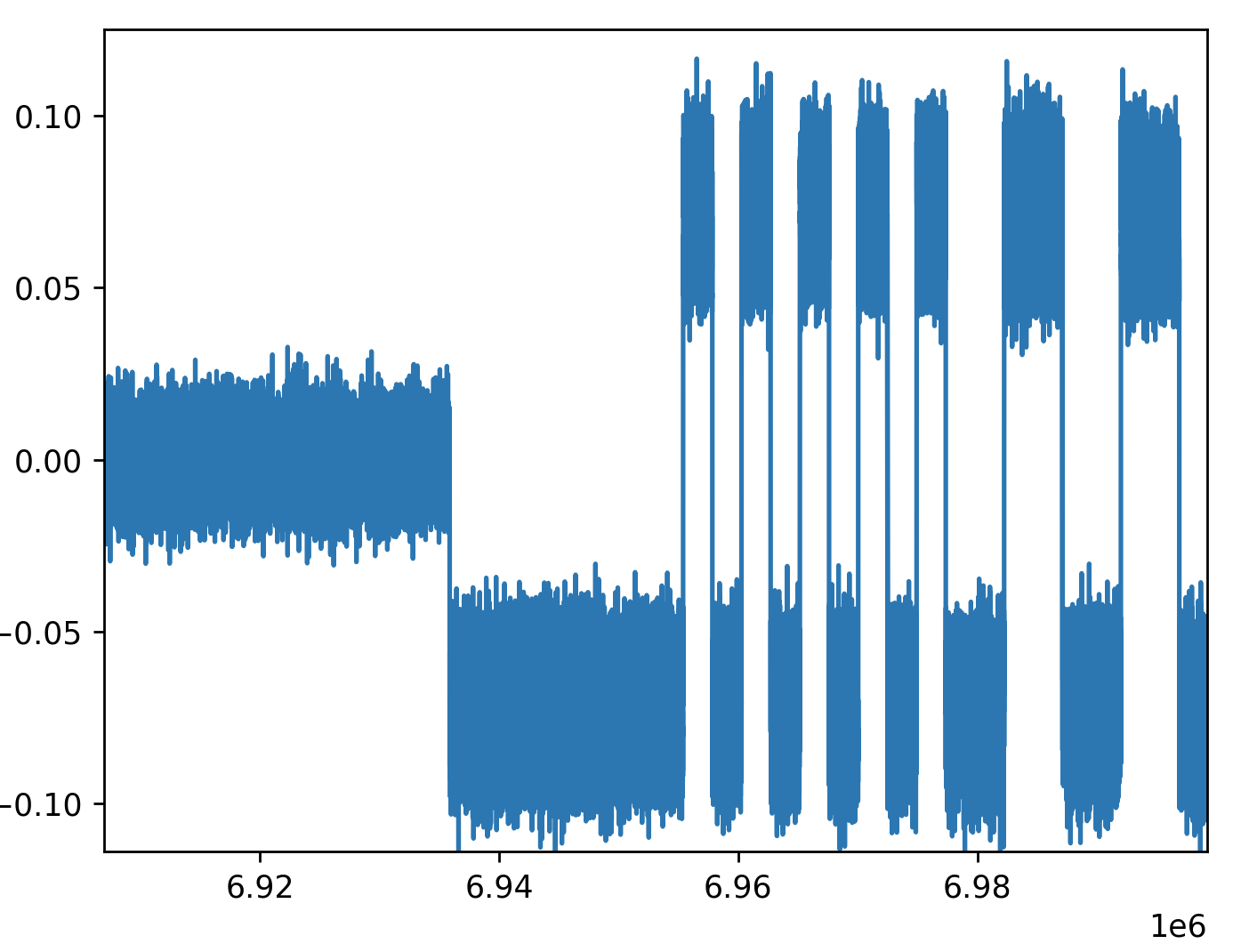
Average Idle / Carrier Detect Our starting point for this section is the same capture as above, but post-PLL (xz compressed interleaved float32, 163,840 samples per second) When we start out, we have IQ samples that have been mostly driven to an imaginary component of 0 and real value range between +1 and -1 for each symbol period. Our goal now is to determine if we re receiving a signal, and if so, determine if it s +1 or -1. This is a deceptively hard problem given it spans a lot of other similarly entertaining hard problems. I ve opted to not solve the hard problems involved and hope that in practice my very haphazard implementation works well enough. This turns out to be both good (not solving a problem is a great way to not spend time on it) and bad (turns out it does materially impact performance). This segment is the one I plan on revisiting, first. Expect more here at some point! Given that I want to be able to encapsulate three states in the output from this section (our Symbols are no carrier detected ( 0 ), real value 1 ( 1 ) or real value -1 ("-1")), which means spending cycles to determine what the baseline noise is to try and identify when a signal breaks through the noise becomes incredibly important.
var idleThreshold
var thresholdFactor = 10
...
// sigThreshold is used to determine if the symbol
 // is -1, +1 or 0. It's 1.3 times the idle signal
 // threshold.
 var sigThreshold = (idleThreshold * 0.3) + idleThreshold
// iq contains a single symbol's worth of IQ samples.
 // clock alignment isn't really considered; so we'll
 // get a bad packet if we have a symbol transition
 // in the middle of this buffer. No attempt is made
 // to correct for this yet.
 var iq []complex
// avg is used to average a chunk of samples in the
 // symbol buffer.
 var avg float
var mid = len(iq) / 2
// midNum is used to determine how many symbols to
 // average at the middle of the symbol.
 var midNum = len(iq) / 50
for j := mid; j < mid+midNum; j++  
avg += real(iq[j])
 
avg /= midNum
var symbol float
switch  
case avg > sigThreshold:
symbol = 1
case avg < -sigThreshold:
symbol = -1
default:
symbol = 0
// update the idleThreshold using the thresholdFactor
 // to average the idleThreshold over more samples to
 // get a better idea of average noise.
 idleThreshold = (
(idleThreshold*(thresholdFactor-1) + symbol) \
/ thresholdFactor
)
 
// write symbol to output somewhere
...

Next Steps Now that we have a stream of values that are either +1, -1 or 0, we can frame / unframe the data contained in the stream, and decode Packets contained inside, coming next in Part 4!

1 December 2021

Utkarsh Gupta: FOSS Activites in December 2021

Here s my (twenty-sixth) monthly but brief update about the activities I ve done in the F/L/OSS world.

Debian
This was my 35th month of actively contributing to Debian. I became a DM in late March 2019 and a DD on Christmas 19! \o/ Just churning through the backlog again this month. Ugh. Anyway, I did the following stuff in Debian:

Uploads and bug fixes:
  • rails (2:6.1.4.1+dfsg-3) - No-change rebuild for unstable.

Other $things:
  • Mentoring for newcomers.
  • Moderation of -project mailing list.

Ubuntu
This was my 10th month of actively contributing to Ubuntu. Now that I ve joined Canonical to work on Ubuntu full-time, there s a bunch of things I do! \o/ I mostly worked on different things, I guess. I was too lazy to maintain a list of things I worked on so there s no concrete list atm. Maybe I ll get back to this section later or will start to list stuff from next year onward, as I was doing before. :D

Debian (E)LTS
Debian Long Term Support (LTS) is a project to extend the lifetime of all Debian stable releases to (at least) 5 years. Debian LTS is not handled by the Debian security team, but by a separate group of volunteers and companies interested in making it a success. And Debian Extended LTS (ELTS) is its sister project, extending support to the Jessie release (+2 years after LTS support). This was my twenty-sixth month as a Debian LTS and seventeenth month as a Debian ELTS paid contributor.
I was assigned 30.00 hours for LTS and 45.00 hours for ELTS and worked on the following things:

LTS CVE Fixes and Announcements:
  • Issued DLA 2813-1, fixing CVE-2021-33829 and CVE-2021-37695, for ckeditor.
    For Debian 9 stretch, these problems have been fixed in version 4.5.7+dfsg-2+deb9u1.
  • Issued DLA 2817-1, fixing CVE-2021-23214 and CVE-2021-23222, for postgresql-9.6.
    For Debian 9 stretch, these problems have been fixed in version 9.6.24-0+deb9u1.
  • Issued DLA 2836-1, fixing CVE-2021-43527, for nss.
    For Debian 9 stretch, these problems have been fixed in version 2:3.26.2-1.1+deb9u3.
  • Started working on src:samba for CVE-2020-25717 to CVE-2020-25722 and CVE-2021-23192 for jessie and stretch, both.
    The version difference b/w the suites are a bit too much for the patch(es) to be easily backported. I ve talked to Anton to work something out. \o/
  • Found the problem w/ libjdom1-java. Will have to roll the regression upload.
    I ve prepared the patch but needs some testing to be finally rolled out. Same for jessie.
  • Started working on libgit2.

ELTS CVE Fixes and Announcements:

Other (E)LTS Work:
  • Front-desk duty from 29-11 to 05-12 for both LTS and ELTS.
  • Triaged udisk2, wordpress, samba, gmp, nss, ntfs-3g, and openssh.
  • Auto EOL ed dwarfutils, radare2, mongodb, linux for jessie.
  • As FD, did a deep dive into the no-pu-update issue. Will write to list shortly.
  • Attended monthly Debian LTS meeting.
  • Answered questions (& discussions) on IRC (#debian-lts and #debian-elts).
  • General and other discussions on LTS private and public mailing list.

Debian LTS Survey I ve spent 3 hours on the LTS survey on the following bits:
  • Talking to Laura to revive the old a/c on survey.d.net.
  • Setting up stuff there.
  • Discussing the survey questions and other bits w/ Jeremiah.
  • Partly reviewing the questions of the survey.
  • Doing a walkthru of the LimeSurvey instance we have to make sure there are no changes .

Until next time.
:wq for today.

30 November 2021

Russell Coker: Links November 2021

The Guardian has an amusing article by Sophie Elmhirst about Libertarians buying a cruise ship to make a seasteading project off the coast of Panama [1]. It turns out that you need permits etc to do this and maintaining a ship is expensive. Also you wouldn t want to mine cryptocurrency in a ship cabin as most cabins are small and don t have enough airconditioning to remain pleasant if you dump 1kW or more into the air. NPR has an interesting article about the reaction of the NRA to the Columbine shootings [2]. Seems that some NRA person isn t a total asshole and is sharing their private information, maybe they are dying and are worried about going to hell. David Brin wrote an insightful blog post about the singleton hypothesis where he covers some of the evidence of autocratic societies failing [3]. I think he makes a convincing point about a single centralised government for human society not being viable. But something like the EU on a world wide scale could work well. Ken Shirriff wrote an interesting blog post about reverse engineering the Yamaha DX7 synthesiser [4]. The New York Times has an interesting article about a Baboon troop that became less aggressive after the alpha males all died at once from tuberculosis [5]. They established a new more peaceful culture that has outlived the beta males who avoided tuberculosis. The Guardian has an interesting article about how sequencing the genomes of the entire population can save healthcare costs while improving the health of the population [6]. This is somthing wealthy countries should offer for free to the world population. At a bit under $1000 per test that s only about $7 trillion to test everyone, and of course the price should drop significantly if there were billions of tests being done. The Strategy Bridge has an interesting article about SciFi books that have useful portrayals of military strategy [7]. The co-author is Major General Mick Ryan of the Australian Army which is noteworthy as Major General is the second highest rank in use by the Australian Army at this time. Vice has an interesting article about the co-evolution of penises and vaginas and how a lot of that evolution is based on avoiding impregnation from rape [8]. Cory Doctorow wrote an insightful Medium article about the way that governments could force interoperability through purchasing power [9]. Cory Doctorow wrote an insightful article for Locus Magazine about imagining life after capitalism and how capitalism might be replaced [10]. We need a Star Trek future! Arstechnica has an informative article about new developmenet in the rowhammer category of security attacks on DRAM [11]. It seems that DDR4 with ECC is the best current mitigation technique and that DDR3 with ECC is harder to attack than non-ECC RAM. So the thing to do is use ECC on all workstations and avoid doing security critical things on laptops because they can t juse ECC RAM.

21 November 2021

Antoine Beaupr : mbsync vs OfflineIMAP

After recovering from my latest email crash (previously, previously), I had to figure out which tool I should be using. I had many options but I figured I would start with a popular one (mbsync). But I also evaluated OfflineIMAP which was resurrected from the Python 2 apocalypse, and because I had used it before, for a long time. Read on for the details.

Benchmark setup All programs were tested against a Dovecot 1:2.3.13+dfsg1-2 server, running Debian bullseye. The client is a Purism 13v4 laptop with a Samsung SSD 970 EVO 1TB NVMe drive. The server is a custom build with a AMD Ryzen 5 2600 CPU, and a RAID-1 array made of two NVMe drives (Intel SSDPEKNW010T8 and WDC WDS100T2B0C). The mail spool I am testing against has almost 400k messages and takes 13GB of disk space:
$ notmuch count --exclude=false
372758
$ du -sh --exclude xapian Maildir
13G Maildir
The baseline we are comparing against is SMD (syncmaildir) which performs the sync in about 7-8 seconds locally (3.5 seconds for each push/pull command) and about 10-12 seconds remotely. Anything close to that or better is good enough. I do not have recent numbers for a SMD full sync baseline, but the setup documentation mentions 20 minutes for a full sync. That was a few years ago, and the spool has obviously grown since then, so that is not a reliable baseline. A baseline for a full sync might be also set with rsync, which copies files at nearly 40MB/s, or 317Mb/s!
anarcat@angela:tmp(main)$ time rsync -a --info=progress2 --exclude xapian  shell.anarc.at:Maildir/ Maildir/
 12,647,814,731 100%   37.85MB/s    0:05:18 (xfr#394981, to-chk=0/395815)    
72.38user 106.10system 5:19.59elapsed 55%CPU (0avgtext+0avgdata 15988maxresident)k
8816inputs+26305112outputs (0major+50953minor)pagefaults 0swaps
That is 5 minutes to transfer the entire spool. Incremental syncs are obviously pretty fast too:
anarcat@angela:tmp(main)$ time rsync -a --info=progress2 --exclude xapian  shell.anarc.at:Maildir/ Maildir/
              0   0%    0.00kB/s    0:00:00 (xfr#0, to-chk=0/395815)    
1.42user 0.81system 0:03.31elapsed 67%CPU (0avgtext+0avgdata 14100maxresident)k
120inputs+0outputs (3major+12709minor)pagefaults 0swaps
As an extra curiosity, here's the performance with tar, pretty similar with rsync, minus incremental which I cannot be bothered to figure out right now:
anarcat@angela:tmp(main)$ time ssh shell.anarc.at tar --exclude xapian -cf - Maildir/   pv -s 13G   tar xf - 
56.68user 58.86system 5:17.08elapsed 36%CPU (0avgtext+0avgdata 8764maxresident)k
0inputs+0outputs (0major+7266minor)pagefaults 0swaps
12,1GiO 0:05:17 [39,0MiB/s] [===================================================================> ] 92%
Interesting that rsync manages to almost beat a plain tar on file transfer, I'm actually surprised by how well it performs here, considering there are many little files to transfer. (But then again, this maybe is exactly where rsync shines: while tar needs to glue all those little files together, rsync can just directly talk to the other side and tell it to do live changes. Something to look at in another article maybe?) Since both ends are NVMe drives, those should easily saturate a gigabit link. And in fact, a backup of the server mail spool achieves much faster transfer rate on disks:
anarcat@marcos:~$ tar fc - Maildir   pv -s 13G > Maildir.tar
15,0GiO 0:01:57 [ 131MiB/s] [===================================] 115%
That's 131Mibyyte per second, vastly faster than the gigabit link. The client has similar performance:
anarcat@angela:~(main)$ tar fc - Maildir   pv -s 17G > Maildir.tar
16,2GiO 0:02:22 [ 116MiB/s] [==================================] 95%
So those disks should be able to saturate a gigabit link, and they are not the bottleneck on fast links. Which begs the question of what is blocking performance of a similar transfer over the gigabit link, but that's another question altogether, because no sync program ever reaches the above performance anyways. Finally, note that when I migrated to SMD, I wrote a small performance comparison that could be interesting here. It show SMD to be faster than OfflineIMAP, but not as much as we see here. In fact, it looks like OfflineIMAP slowed down significantly since then (May 2018), but this could be due to my larger mail spool as well.

mbsync The isync (AKA mbsync) project is written in C and supports syncing Maildir and IMAP folders, with possibly multiple replicas. I haven't tested this but I suspect it might be possible to sync between two IMAP servers as well. It supports partial mirorrs, message flags, full folder support, and "trash" functionality.

Complex configuration file I started with this .mbsyncrc configuration file:
SyncState *
Sync New ReNew Flags
IMAPAccount anarcat
Host imap.anarc.at
User anarcat
PassCmd "pass imap.anarc.at"
SSLType IMAPS
CertificateFile /etc/ssl/certs/ca-certificates.crt
IMAPStore anarcat-remote
Account anarcat
MaildirStore anarcat-local
# Maildir/top/sub/sub
#SubFolders Verbatim
# Maildir/.top.sub.sub
SubFolders Maildir++
# Maildir/top/.sub/.sub
# SubFolders legacy
# The trailing "/" is important
#Path ~/Maildir-mbsync/
Inbox ~/Maildir-mbsync/
Channel anarcat
# AKA Far, convert when all clients are 1.4+
Master :anarcat-remote:
# AKA Near
Slave :anarcat-local:
# Exclude everything under the internal [Gmail] folder, except the interesting folders
#Patterns * ![Gmail]* "[Gmail]/Sent Mail" "[Gmail]/Starred" "[Gmail]/All Mail"
# Or include everything
Patterns *
# Automatically create missing mailboxes, both locally and on the server
#Create Both
Create slave
# Sync the movement of messages between folders and deletions, add after making sure the sync works
#Expunge Both
Long gone are the days where I would spend a long time reading a manual page to figure out the meaning of every option. If that's your thing, you might like this one. But I'm more of a "EXAMPLES section" kind of person now, and I somehow couldn't find a sample file on the website. I started from the Arch wiki one but it's actually not great because it's made for Gmail (which is not a usual Dovecot server). So a sample config file in the manpage would be a great addition. Thankfully, the Debian packages ships one in /usr/share/doc/isync/examples/mbsyncrc.sample but I only found that after I wrote my configuration. It was still useful and I recommend people take a look if they want to understand the syntax. Also, that syntax is a little overly complicated. For example, Far needs colons, like:
Far :anarcat-remote:
Why? That seems just too complicated. I also found that sections are not clearly identified: IMAPAccount and Channel mark section beginnings, for example, which is not at all obvious until you learn about mbsync's internals. There are also weird ordering issues: the SyncState option needs to be before IMAPAccount, presumably because it's global. Using a more standard format like .INI or TOML could improve that situation.

Stellar performance A transfer of the entire mail spool takes 56 minutes and 6 seconds, which is impressive. It's not quite "line rate": the resulting mail spool was 12GB (which is a problem, see below), which turns out to be about 29Mbit/s and therefore not maxing the gigabit link, and an order of magnitude slower than rsync. The incremental runs are roughly 2 seconds, which is even more impressive, as that's actually faster than rsync:
===> multitime results
1: mbsync -a
            Mean        Std.Dev.    Min         Median      Max
real        2.015       0.052       1.930       2.029       2.105       
user        0.660       0.040       0.592       0.661       0.722       
sys         0.338       0.033       0.268       0.341       0.387    
Those tests were performed with isync 1.3.0-2.2 on Debian bullseye. Tests with a newer isync release originally failed because of a corrupted message that triggered bug 999804 (see below). Running 1.4.3 under valgrind works around the bug, but adds a 50% performance cost, the full sync running in 1h35m. Once the upstream patch is applied, performance with 1.4.3 is fairly similar, considering that the new sync included the register folder with 4000 messages:
120.74user 213.19system 59:47.69elapsed 9%CPU (0avgtext+0avgdata 105420maxresident)k
29128inputs+28284376outputs (0major+45711minor)pagefaults 0swaps
That is ~13GB in ~60 minutes, which gives us 28.3Mbps. Incrementals are also pretty similar to 1.3.x, again considering the double-connect cost:
===> multitime results
1: mbsync -a
            Mean        Std.Dev.    Min         Median      Max
real        2.500       0.087       2.340       2.491       2.629       
user        0.718       0.037       0.679       0.711       0.793       
sys         0.322       0.024       0.284       0.320       0.365
Those tests were all done on a Gigabit link, but what happens on a slower link? My server uplink is slow: 25 Mbps down, 6 Mbps up. There mbsync is worse than the SMD baseline:
===> multitime results
1: mbsync -a
Mean        Std.Dev.    Min         Median      Max
real        31.531      0.724       30.764      31.271      33.100      
user        1.858       0.125       1.721       1.818       2.131       
sys         0.610       0.063       0.506       0.600       0.695       
That's 30 seconds for a sync, which is an order of magnitude slower than SMD.

Great user interface Compared to OfflineIMAP and (ahem) SMD, the mbsync UI is kind of neat:
anarcat@angela:~(main)$ mbsync -a
Notice: Master/Slave are deprecated; use Far/Near instead.
C: 1/2  B: 204/205  F: +0/0 *0/0 #0/0  N: +1/200 *0/0 #0/0
(Note that nice switch away from slavery-related terms too.) The display is minimal, and yet informative. It's not obvious what does mean at first glance, but the manpage is useful at least for clarifying that:
This represents the cumulative progress over channels, boxes, and messages affected on the far and near side, respectively. The message counts represent added messages, messages with updated flags, and trashed messages, respectively. No attempt is made to calculate the totals in advance, so they grow over time as more information is gathered. (Emphasis mine).
In other words:
  • C 2/2: channels done/total (2 done out of 2)
  • B 204/205: mailboxes done/total (204 out of 205)
  • F: changes on the far side
  • N: +10/200 *0/0 #0/0: changes on the "near" side:
    • +10/200: 10 out of 200 messages downloaded
    • *0/0: no flag changed
    • #0/0: no message deleted
You get used to it, in a good way. It does not, unfortunately, show up when you run it in systemd, which is a bit annoying as I like to see a summary mail traffic in the logs.

Interoperability issue In my notmuch setup, I have bound key S to "mark spam", which basically assigns the tag spam to the message and removes a bunch of others. Then I have a notmuch-purge script which moves that message to the spam folder, for training purposes. It basically does this:
notmuch search --output=files --format=text0 "$search_spam" \
      xargs -r -0 mv -t "$HOME/Maildir/$ PREFIX junk/cur/"
This method, which worked fine in SMD (and also OfflineIMAP) created this error on sync:
Maildir error: duplicate UID 37578.
And indeed, there are now two messages with that UID in the mailbox:
anarcat@angela:~(main)$ find Maildir/.junk/ -name '*U=37578*'
Maildir/.junk/cur/1637427889.134334_2.angela,U=37578:2,S
Maildir/.junk/cur/1637348602.2492889_221804.angela,U=37578:2,S
This is actually a known limitation or, as mbsync(1) calls it, a "RECOMMENDATION":
When using the more efficient default UID mapping scheme, it is important that the MUA renames files when moving them between Maildir fold ers. Mutt always does that, while mu4e needs to be configured to do it:
(setq mu4e-change-filenames-when-moving t)
So it seems I would need to fix my script. It's unclear how the paths should be renamed, which is unfortunate, because I would need to change my script to adapt to mbsync, but I can't tell how just from reading the above. (A manual fix is actually to rename the file to remove the U= field: mbsync will generate a new one and then sync correctly.) Fortunately, someone else already fixed that issue: afew, a notmuch tagging script (much puns, such hurt), has a move mode that can rename files correctly, specifically designed to deal with mbsync. I had already been told about afew, but it's one more reason to standardize my notmuch hooks on that project, it looks like. Update: I have tried to use afew and found it has significant performance issues. It also has a completely different paradigm to what I am used to: it assumes all incoming mail has a new and lays its own tags on top of that (inbox, sent, etc). It can only move files from one folder at a time (see this bug) which breaks my spam training workflow. In general, I sync my tags into folders (e.g. ham, spam, sent) and message flags (e.g. inbox is F, unread is "not S", etc), and afew is not well suited for this (although there are hacks that try to fix this). I have worked hard to make my tagging scripts idempotent, and it's something afew doesn't currently have. Still, it would be better to have that code in Python than bash, so maybe I should consider my options here.

Stability issues The newer release in Debian bookworm (currently at 1.4.3) has stability issues on full sync. I filed bug 999804 in Debian about this, which lead to a thread on the upstream mailing list. I have found at least three distinct crashes that could be double-free bugs "which might be exploitable in the worst case", not a reassuring prospect. The thing is: mbsync is really fast, but the downside of that is that it's written in C, and with that comes a whole set of security issues. The Debian security tracker has only three CVEs on isync, but the above issues show there could be many more. Reading the source code certainly did not make me very comfortable with trusting it with untrusted data. I considered sandboxing it with systemd (below) but having systemd run as a --user process makes that difficult. I also considered using an apparmor profile but that is not trivial because we need to allow SSH and only some parts of it... Thankfully, upstream has been diligent at addressing the issues I have found. They provided a patch within a few days which did fix the sync issues. Update: upstream actually took the issue very seriously. They not only got CVE-2021-44143 assigned for my bug report, they also audited the code and found several more issues collectively identified as CVE-2021-3657, which actually also affect 1.3 (ie. Debian 11/bullseye/stable). Somehow my corpus doesn't trigger that issue, but it was still considered serious enough to warrant a CVE. So one the one hand: excellent response from upstream; but on the other hand: how many more of those could there be in there?

Automation with systemd The Arch wiki has instructions on how to setup mbsync as a systemd service. It suggests using the --verbose (-V) flag which is a little intense here, as it outputs 1444 lines of messages. I have used the following .service file:
[Unit]
Description=Mailbox synchronization service
ConditionHost=!marcos
Wants=network-online.target
After=network-online.target
Before=notmuch-new.service
[Service]
Type=oneshot
ExecStart=/usr/bin/mbsync -a
Nice=10
IOSchedulingClass=idle
NoNewPrivileges=true
[Install]
WantedBy=default.target
And the following .timer:
[Unit]
Description=Mailbox synchronization timer
ConditionHost=!marcos
[Timer]
OnBootSec=2m
OnUnitActiveSec=5m
Unit=mbsync.service
[Install]
WantedBy=timers.target
Note that we trigger notmuch through systemd, with the Before and also by adding mbsync.service to the notmuch-new.service file:
[Unit]
Description=notmuch new
After=mbsync.service
[Service]
Type=oneshot
Nice=10
ExecStart=/usr/bin/notmuch new
[Install]
WantedBy=mbsync.service
An improvement over polling repeatedly with a .timer would be to wake up only on IMAP notify, but neither imapnotify nor goimapnotify seem to be packaged in Debian. It would also not cover for the "sent folder" use case, where we need to wake up on local changes.

Password-less setup The sample file suggests this should work:
IMAPStore remote
Tunnel "ssh -q host.remote.com /usr/sbin/imapd"
Add BatchMode, restrict to IdentitiesOnly, provide a password-less key just for this, add compression (-C), find the Dovecot imap binary, and you get this:
IMAPAccount anarcat-tunnel
Tunnel "ssh -o BatchMode=yes -o IdentitiesOnly=yes -i ~/.ssh/id_ed25519_mbsync -o HostKeyAlias=shell.anarc.at -C anarcat@imap.anarc.at /usr/lib/dovecot/imap"
And it actually seems to work:
$ mbsync -a
Notice: Master/Slave are deprecated; use Far/Near instead.
C: 0/2  B: 0/1  F: +0/0 *0/0 #0/0  N: +0/0 *0/0 #0/0imap(anarcat): Error: net_connect_unix(/run/dovecot/stats-writer) failed: Permission denied
C: 2/2  B: 205/205  F: +0/0 *0/0 #0/0  N: +1/1 *3/3 #0/0imap(anarcat)<1611280><90uUOuyElmEQlhgAFjQyWQ>: Info: Logged out in=10808 out=15396642 deleted=0 expunged=0 trashed=0 hdr_count=0 hdr_bytes=0 body_count=1 body_bytes=8087
It's a bit noisy, however. dovecot/imap doesn't have a "usage" to speak of, but even the source code doesn't hint at a way to disable that Error message, so that's unfortunate. That socket is owned by root:dovecot so presumably Dovecot runs the imap process as $user:dovecot, which we can't do here. Oh well? Interestingly, the SSH setup is not faster than IMAP. With IMAP:
===> multitime results
1: mbsync -a
            Mean        Std.Dev.    Min         Median      Max
real        2.367       0.065       2.220       2.376       2.458       
user        0.793       0.047       0.731       0.776       0.871       
sys         0.426       0.040       0.364       0.434       0.476
With SSH:
===> multitime results
1: mbsync -a
            Mean        Std.Dev.    Min         Median      Max
real        2.515       0.088       2.274       2.532       2.594       
user        0.753       0.043       0.645       0.766       0.804       
sys         0.328       0.045       0.212       0.340       0.393
Basically: 200ms slower. Tolerable.

Migrating from SMD The above was how I migrated to mbsync on my first workstation. The work on the second one was more streamlined, especially since the corruption on mailboxes was fixed:
  1. install isync, with the patch:
    dpkg -i isync_1.4.3-1.1~_amd64.deb
    
  2. copy all files over from previous workstation to avoid a full resync (optional):
    rsync -a --info=progress2 angela:Maildir/ Maildir-mbsync/
    
  3. rename all files to match new hostname (optional):
    find Maildir-mbsync/ -type f -name '*.angela,*' -print0    rename -0 's/\.angela,/\.curie,/'
    
  4. trash the notmuch database (optional):
    rm -rf Maildir-mbsync/.notmuch/xapian/
    
  5. disable all smd and notmuch services:
    systemctl --user --now disable smd-pull.service smd-pull.timer smd-push.service smd-push.timer notmuch-new.service notmuch-new.timer
    
  6. do one last sync with smd:
    smd-pull --show-tags ; smd-push --show-tags ; notmuch new ; notmuch-sync-flagged -v
    
  7. backup notmuch on the client and server:
    notmuch dump   pv > notmuch.dump
    
  8. backup the maildir on the client and server:
    cp -al Maildir Maildir-bak
    
  9. create the SSH key:
    ssh-keygen -t ed25519 -f .ssh/id_ed25519_mbsync
    cat .ssh/id_ed25519_mbsync.pub
    
  10. add to .ssh/authorized_keys on the server, like this: command="/usr/lib/dovecot/imap",restrict ssh-ed25519 AAAAC...
  11. move old files aside, if present:
    mv Maildir Maildir-smd
    
  12. move new files in place (CRITICAL SECTION BEGINS!):
    mv Maildir-mbsync Maildir
    
  13. run a test sync, only pulling changes: mbsync --create-near --remove-none --expunge-none --noop anarcat-register
  14. if that works well, try with all mailboxes: mbsync --create-near --remove-none --expunge-none --noop -a
  15. if that works well, try again with a full sync: mbsync register mbsync -a
  16. reindex and restore the notmuch database, this should take ~25 minutes:
    notmuch new
    pv notmuch.dump   notmuch restore
    
  17. enable the systemd services and retire the smd-* services: systemctl --user enable mbsync.timer notmuch-new.service systemctl --user start mbsync.timer rm ~/.config/systemd/user/smd* systemctl daemon-reload
During the migration, notmuch helpfully told me the full list of those lost messages:
[...]
Warning: cannot apply tags to missing message: CAN6gO7_QgCaiDFvpG3AXHi6fW12qaN286+2a7ERQ2CQtzjSEPw@mail.gmail.com
Warning: cannot apply tags to missing message: CAPTU9Wmp0yAmaxO+qo8CegzRQZhCP853TWQ_Ne-YF94MDUZ+Dw@mail.gmail.com
Warning: cannot apply tags to missing message: F5086003-2917-4659-B7D2-66C62FCD4128@gmail.com
[...]
Warning: cannot apply tags to missing message: mailman.2.1316793601.53477.sage-members@mailman.sage.org
Warning: cannot apply tags to missing message: mailman.7.1317646801.26891.outages-discussion@outages.org
Warning: cannot apply tags to missing message: notmuch-sha1-000458df6e48d4857187a000d643ac971deeef47
Warning: cannot apply tags to missing message: notmuch-sha1-0079d8e0c3340e6f88c66f4c49fca758ea71d06d
Warning: cannot apply tags to missing message: notmuch-sha1-0194baa4cfb6d39bc9e4d8c049adaccaa777467d
Warning: cannot apply tags to missing message: notmuch-sha1-02aede494fc3f9e9f060cfd7c044d6d724ad287c
Warning: cannot apply tags to missing message: notmuch-sha1-06606c625d3b3445420e737afd9a245ae66e5562
Warning: cannot apply tags to missing message: notmuch-sha1-0747b020f7551415b9bf5059c58e0a637ba53b13
[...]
As detailed in the crash report, all of those were actually innocuous and could be ignored. Also note that we completely trash the notmuch database because it's actually faster to reindex from scratch than let notmuch slowly figure out that all mails are new and all the old mails are gone. The fresh indexing took:
nov 19 15:08:54 angela notmuch[2521117]: Processed 384679 total files in 23m 41s (270 files/sec.).
nov 19 15:08:54 angela notmuch[2521117]: Added 372610 new messages to the database.
While a reindexing on top of an existing database was going twice as slow, at about 120 files/sec.

Current config file Putting it all together, I ended up with the following configuration file:
SyncState *
Sync All
# IMAP side, AKA "Far"
IMAPAccount anarcat-imap
Host imap.anarc.at
User anarcat
PassCmd "pass imap.anarc.at"
SSLType IMAPS
CertificateFile /etc/ssl/certs/ca-certificates.crt
IMAPAccount anarcat-tunnel
Tunnel "ssh -o BatchMode=yes -o IdentitiesOnly=yes -i ~/.ssh/id_ed25519_mbsync -o HostKeyAlias=shell.anarc.at -C anarcat@imap.anarc.at /usr/lib/dovecot/imap"
IMAPStore anarcat-remote
Account anarcat-tunnel
# Maildir side, AKA "Near"
MaildirStore anarcat-local
# Maildir/top/sub/sub
#SubFolders Verbatim
# Maildir/.top.sub.sub
SubFolders Maildir++
# Maildir/top/.sub/.sub
# SubFolders legacy
# The trailing "/" is important
#Path ~/Maildir-mbsync/
Inbox ~/Maildir/
# what binds Maildir and IMAP
Channel anarcat
Far :anarcat-remote:
Near :anarcat-local:
# Exclude everything under the internal [Gmail] folder, except the interesting folders
#Patterns * ![Gmail]* "[Gmail]/Sent Mail" "[Gmail]/Starred" "[Gmail]/All Mail"
# Or include everything
#Patterns *
Patterns * !register  !.register
# Automatically create missing mailboxes, both locally and on the server
Create Both
#Create Near
# Sync the movement of messages between folders and deletions, add after making sure the sync works
Expunge Both
# Propagate mailbox deletion
Remove both
IMAPAccount anarcat-register-imap
Host imap.anarc.at
User register
PassCmd "pass imap.anarc.at-register"
SSLType IMAPS
CertificateFile /etc/ssl/certs/ca-certificates.crt
IMAPAccount anarcat-register-tunnel
Tunnel "ssh -o BatchMode=yes -o IdentitiesOnly=yes -i ~/.ssh/id_ed25519_mbsync -o HostKeyAlias=shell.anarc.at -C register@imap.anarc.at /usr/lib/dovecot/imap"
IMAPStore anarcat-register-remote
Account anarcat-register-tunnel
MaildirStore anarcat-register-local
SubFolders Maildir++
Inbox ~/Maildir/.register/
Channel anarcat-register
Far :anarcat-register-remote:
Near :anarcat-register-local:
Create Both
Expunge Both
Remove both
Note that it may be out of sync with my live (and private) configuration file, as I do not publish my "dotfiles" repository publicly for security reasons.

OfflineIMAP I've used OfflineIMAP for a long time before switching to SMD. I don't exactly remember why or when I started using it, but I do remember it became painfully slow as I started using notmuch, and would sometimes crash mysteriously. It's been a while, so my memory is hazy on that. It also kind of died in a fire when Python 2 stop being maintained. The main author moved on to a different project, imapfw which could serve as a framework to build IMAP clients, but never seemed to implement all of the OfflineIMAP features and certainly not configuration file compatibility. Thankfully, a new team of volunteers ported OfflineIMAP to Python 3 and we can now test that new version to see if it is an improvement over mbsync.

Crash on full sync The first thing that happened on a full sync is this crash:
Copy message from RemoteAnarcat:junk:
 ERROR: Copying message 30624 [acc: Anarcat]
  decoding with 'X-EUC-TW' codec failed (AttributeError: 'memoryview' object has no attribute 'decode')
Thread 'Copy message from RemoteAnarcat:junk' terminated with exception:
Traceback (most recent call last):
  File "/usr/share/offlineimap3/offlineimap/imaputil.py", line 406, in utf7m_decode
    for c in binary.decode():
AttributeError: 'memoryview' object has no attribute 'decode'
The above exception was the direct cause of the following exception:
Traceback (most recent call last):
  File "/usr/share/offlineimap3/offlineimap/threadutil.py", line 146, in run
    Thread.run(self)
  File "/usr/lib/python3.9/threading.py", line 892, in run
    self._target(*self._args, **self._kwargs)
  File "/usr/share/offlineimap3/offlineimap/folder/Base.py", line 802, in copymessageto
    message = self.getmessage(uid)
  File "/usr/share/offlineimap3/offlineimap/folder/IMAP.py", line 342, in getmessage
    data = self._fetch_from_imap(str(uid), self.retrycount)
  File "/usr/share/offlineimap3/offlineimap/folder/IMAP.py", line 908, in _fetch_from_imap
    ndata1 = self.parser['8bit-RFC'].parsebytes(data[0][1])
  File "/usr/lib/python3.9/email/parser.py", line 123, in parsebytes
    return self.parser.parsestr(text, headersonly)
  File "/usr/lib/python3.9/email/parser.py", line 67, in parsestr
    return self.parse(StringIO(text), headersonly=headersonly)
  File "/usr/lib/python3.9/email/parser.py", line 56, in parse
    feedparser.feed(data)
  File "/usr/lib/python3.9/email/feedparser.py", line 176, in feed
    self._call_parse()
  File "/usr/lib/python3.9/email/feedparser.py", line 180, in _call_parse
    self._parse()
  File "/usr/lib/python3.9/email/feedparser.py", line 385, in _parsegen
    for retval in self._parsegen():
  File "/usr/lib/python3.9/email/feedparser.py", line 298, in _parsegen
    for retval in self._parsegen():
  File "/usr/lib/python3.9/email/feedparser.py", line 385, in _parsegen
    for retval in self._parsegen():
  File "/usr/lib/python3.9/email/feedparser.py", line 256, in _parsegen
    if self._cur.get_content_type() == 'message/delivery-status':
  File "/usr/lib/python3.9/email/message.py", line 578, in get_content_type
    value = self.get('content-type', missing)
  File "/usr/lib/python3.9/email/message.py", line 471, in get
    return self.policy.header_fetch_parse(k, v)
  File "/usr/lib/python3.9/email/policy.py", line 163, in header_fetch_parse
    return self.header_factory(name, value)
  File "/usr/lib/python3.9/email/headerregistry.py", line 601, in __call__
    return self[name](name, value)
  File "/usr/lib/python3.9/email/headerregistry.py", line 196, in __new__
    cls.parse(value, kwds)
  File "/usr/lib/python3.9/email/headerregistry.py", line 445, in parse
    kwds['parse_tree'] = parse_tree = cls.value_parser(value)
  File "/usr/lib/python3.9/email/_header_value_parser.py", line 2675, in parse_content_type_header
    ctype.append(parse_mime_parameters(value[1:]))
  File "/usr/lib/python3.9/email/_header_value_parser.py", line 2569, in parse_mime_parameters
    token, value = get_parameter(value)
  File "/usr/lib/python3.9/email/_header_value_parser.py", line 2492, in get_parameter
    token, value = get_value(value)
  File "/usr/lib/python3.9/email/_header_value_parser.py", line 2403, in get_value
    token, value = get_quoted_string(value)
  File "/usr/lib/python3.9/email/_header_value_parser.py", line 1294, in get_quoted_string
    token, value = get_bare_quoted_string(value)
  File "/usr/lib/python3.9/email/_header_value_parser.py", line 1223, in get_bare_quoted_string
    token, value = get_encoded_word(value)
  File "/usr/lib/python3.9/email/_header_value_parser.py", line 1064, in get_encoded_word
    text, charset, lang, defects = _ew.decode('=?' + tok + '?=')
  File "/usr/lib/python3.9/email/_encoded_words.py", line 181, in decode
    string = bstring.decode(charset)
AttributeError: decoding with 'X-EUC-TW' codec failed (AttributeError: 'memoryview' object has no attribute 'decode')
Last 1 debug messages logged for Copy message from RemoteAnarcat:junk prior to exception:
thread: Register new thread 'Copy message from RemoteAnarcat:junk' (account 'Anarcat')
ERROR: Exceptions occurred during the run!
ERROR: Copying message 30624 [acc: Anarcat]
  decoding with 'X-EUC-TW' codec failed (AttributeError: 'memoryview' object has no attribute 'decode')
Traceback:
  File "/usr/share/offlineimap3/offlineimap/folder/Base.py", line 802, in copymessageto
    message = self.getmessage(uid)
  File "/usr/share/offlineimap3/offlineimap/folder/IMAP.py", line 342, in getmessage
    data = self._fetch_from_imap(str(uid), self.retrycount)
  File "/usr/share/offlineimap3/offlineimap/folder/IMAP.py", line 908, in _fetch_from_imap
    ndata1 = self.parser['8bit-RFC'].parsebytes(data[0][1])
  File "/usr/lib/python3.9/email/parser.py", line 123, in parsebytes
    return self.parser.parsestr(text, headersonly)
  File "/usr/lib/python3.9/email/parser.py", line 67, in parsestr
    return self.parse(StringIO(text), headersonly=headersonly)
  File "/usr/lib/python3.9/email/parser.py", line 56, in parse
    feedparser.feed(data)
  File "/usr/lib/python3.9/email/feedparser.py", line 176, in feed
    self._call_parse()
  File "/usr/lib/python3.9/email/feedparser.py", line 180, in _call_parse
    self._parse()
  File "/usr/lib/python3.9/email/feedparser.py", line 385, in _parsegen
    for retval in self._parsegen():
  File "/usr/lib/python3.9/email/feedparser.py", line 298, in _parsegen
    for retval in self._parsegen():
  File "/usr/lib/python3.9/email/feedparser.py", line 385, in _parsegen
    for retval in self._parsegen():
  File "/usr/lib/python3.9/email/feedparser.py", line 256, in _parsegen
    if self._cur.get_content_type() == 'message/delivery-status':
  File "/usr/lib/python3.9/email/message.py", line 578, in get_content_type
    value = self.get('content-type', missing)
  File "/usr/lib/python3.9/email/message.py", line 471, in get
    return self.policy.header_fetch_parse(k, v)
  File "/usr/lib/python3.9/email/policy.py", line 163, in header_fetch_parse
    return self.header_factory(name, value)
  File "/usr/lib/python3.9/email/headerregistry.py", line 601, in __call__
    return self[name](name, value)
  File "/usr/lib/python3.9/email/headerregistry.py", line 196, in __new__
    cls.parse(value, kwds)
  File "/usr/lib/python3.9/email/headerregistry.py", line 445, in parse
    kwds['parse_tree'] = parse_tree = cls.value_parser(value)
  File "/usr/lib/python3.9/email/_header_value_parser.py", line 2675, in parse_content_type_header
    ctype.append(parse_mime_parameters(value[1:]))
  File "/usr/lib/python3.9/email/_header_value_parser.py", line 2569, in parse_mime_parameters
    token, value = get_parameter(value)
  File "/usr/lib/python3.9/email/_header_value_parser.py", line 2492, in get_parameter
    token, value = get_value(value)
  File "/usr/lib/python3.9/email/_header_value_parser.py", line 2403, in get_value
    token, value = get_quoted_string(value)
  File "/usr/lib/python3.9/email/_header_value_parser.py", line 1294, in get_quoted_string
    token, value = get_bare_quoted_string(value)
  File "/usr/lib/python3.9/email/_header_value_parser.py", line 1223, in get_bare_quoted_string
    token, value = get_encoded_word(value)
  File "/usr/lib/python3.9/email/_header_value_parser.py", line 1064, in get_encoded_word
    text, charset, lang, defects = _ew.decode('=?' + tok + '?=')
  File "/usr/lib/python3.9/email/_encoded_words.py", line 181, in decode
    string = bstring.decode(charset)
Folder junk [acc: Anarcat]:
 Copy message UID 30626 (29008/49310) RemoteAnarcat:junk -> LocalAnarcat:junk
Command exited with non-zero status 100
5252.91user 535.86system 3:21:00elapsed 47%CPU (0avgtext+0avgdata 846304maxresident)k
96344inputs+26563792outputs (1189major+2155815minor)pagefaults 0swaps
That only transferred about 8GB of mail, which gives us a transfer rate of 5.3Mbit/s, more than 5 times slower than mbsync. This bug is possibly limited to the bullseye version of offlineimap3 (the lovely 0.0~git20210225.1e7ef9e+dfsg-4), while the current sid version (the equally gorgeous 0.0~git20211018.e64c254+dfsg-1) seems unaffected.

Tolerable performance The new release still crashes, except it does so at the very end, which is an improvement, since the mails do get transferred:
 *** Finished account 'Anarcat' in 511:12
ERROR: Exceptions occurred during the run!
ERROR: Exception parsing message with ID (<20190619152034.BFB8810E07A@marcos.anarc.at>) from imaplib (response type: bytes).
 AttributeError: decoding with 'X-EUC-TW' codec failed (AttributeError: 'memoryview' object has no attribute 'decode')
Traceback:
  File "/usr/share/offlineimap3/offlineimap/folder/Base.py", line 810, in copymessageto
    message = self.getmessage(uid)
  File "/usr/share/offlineimap3/offlineimap/folder/IMAP.py", line 343, in getmessage
    data = self._fetch_from_imap(str(uid), self.retrycount)
  File "/usr/share/offlineimap3/offlineimap/folder/IMAP.py", line 910, in _fetch_from_imap
    raise OfflineImapError(
ERROR: Exception parsing message with ID (<40A270DB.9090609@alternatives.ca>) from imaplib (response type: bytes).
 AttributeError: decoding with 'x-mac-roman' codec failed (AttributeError: 'memoryview' object has no attribute 'decode')
Traceback:
  File "/usr/share/offlineimap3/offlineimap/folder/Base.py", line 810, in copymessageto
    message = self.getmessage(uid)
  File "/usr/share/offlineimap3/offlineimap/folder/IMAP.py", line 343, in getmessage
    data = self._fetch_from_imap(str(uid), self.retrycount)
  File "/usr/share/offlineimap3/offlineimap/folder/IMAP.py", line 910, in _fetch_from_imap
    raise OfflineImapError(
ERROR: IMAP server 'RemoteAnarcat' does not have a message with UID '32686'
Traceback:
  File "/usr/share/offlineimap3/offlineimap/folder/Base.py", line 810, in copymessageto
    message = self.getmessage(uid)
  File "/usr/share/offlineimap3/offlineimap/folder/IMAP.py", line 343, in getmessage
    data = self._fetch_from_imap(str(uid), self.retrycount)
  File "/usr/share/offlineimap3/offlineimap/folder/IMAP.py", line 889, in _fetch_from_imap
    raise OfflineImapError(reason, severity)
Command exited with non-zero status 1
8273.52user 983.80system 8:31:12elapsed 30%CPU (0avgtext+0avgdata 841936maxresident)k
56376inputs+43247608outputs (811major+4972914minor)pagefaults 0swaps
"offlineimap  -o " took 8 hours 31 mins 15 secs
This is 8h31m for transferring 12G, which is around 3.1Mbit/s. That is nine times slower than mbsync, almost an order of magnitude! Now that we have a full sync, we can test incremental synchronization. That is also much slower:
===> multitime results
1: sh -c "offlineimap -o   true"
            Mean        Std.Dev.    Min         Median      Max
real        24.639      0.513       23.946      24.526      25.708      
user        23.912      0.473       23.404      23.795      24.947      
sys         1.743       0.105       1.607       1.729       2.002
That is also an order of magnitude slower than mbsync, and significantly slower than what you'd expect from a sync process. ~30 seconds is long enough to make me impatient and distracted; 3 seconds, less so: I can wait and see the results almost immediately.

Integrity check That said: this is still on a gigabit link. It's technically possible that OfflineIMAP performs better than mbsync over a slow link, but I Haven't tested that theory. The OfflineIMAP mail spool is missing quite a few messages as well:
anarcat@angela:~(main)$ find Maildir-offlineimap -type f -type f -a \! -name '.*'   wc -l 
381463
anarcat@angela:~(main)$ find Maildir -type f -type f -a \! -name '.*'   wc -l 
385247
... although that's probably all either new messages or the register folder, so OfflineIMAP might actually be in a better position there. But digging in more, it seems like the actual per-folder diff is fairly similar to mbsync: a few messages missing here and there. Considering OfflineIMAP's instability and poor performance, I have not looked any deeper in those discrepancies.

Other projects to evaluate Those are all the options I have considered, in alphabetical order
  • doveadm-sync: requires dovecot on both ends, can tunnel over SSH, may have performance issues in incremental sync, written in C
  • fdm: fetchmail replacement, IMAP/POP3/stdin/Maildir/mbox,NNTP support, SOCKS support (for Tor), complex rules for delivering to specific mailboxes, adding headers, piping to commands, etc. discarded because no (real) support for keeping mail on the server, and written in C
  • getmail: fetchmail replacement, IMAP/POP3 support, supports incremental runs, classification rules, Python
  • interimap: syncs two IMAP servers, apparently faster than doveadm and offlineimap, but requires running an IMAP server locally, Perl
  • isync/mbsync: TLS client certs and SSH tunnels, fast, incremental, IMAP/POP/Maildir support, multiple mailbox, trash and recursion support, and generally has good words from multiple Debian and notmuch people (Arch tutorial), written in C, review above
  • mail-sync: notify support, happens over any piped transport (e.g. ssh), diff/patch system, requires binary on both ends, mentions UUCP in the manpage, mentions rsmtp which is a nice name for rsendmail. not evaluated because it seems awfully complex to setup, Haskell
  • nncp: treat the local spool as another mail server, not really compatible with my "multiple clients" setup, Golang
  • offlineimap3: requires IMAP, used the py2 version in the past, might just still work, first sync painful (IIRC), ways to tunnel over SSH, review above, Python
Most projects were not evaluated due to lack of time.

Conclusion I'm now using mbsync to sync my mail. I'm a little disappointed by the synchronisation times over the slow link, but I guess that's on par for the course if we use IMAP. We are bound by the network speed much more than with custom protocols. I'm also worried about the C implementation and the crashes I have witnessed, but I am encouraged by the fast upstream response. Time will tell if I will stick with that setup. I'm certainly curious about the promises of interimap and mail-sync, but I have ran out of time on this project.

Antoine Beaupr : The last syncmaildir crash

My syncmaildir (SMD) setup failed me one too many times (previously, previously). In an attempt to migrate to an alternative mail synchronization tool, I looked into using my IMAP server again, and found out my mail spool was in a pretty bad shape. I'm comparing mbsync and offlineimap in the next post but this post talks about how I recovered the mail spool so that tools like those could correctly synchronise the mail spool again.

The latest crash On Monday, SMD just started failing with this error:
nov 15 16:12:19 angela systemd[2305]: Starting pull emails with syncmaildir...
nov 15 16:12:22 angela systemd[2305]: smd-pull.service: Succeeded.
nov 15 16:12:22 angela systemd[2305]: Finished pull emails with syncmaildir.
nov 15 16:14:08 angela systemd[2305]: Starting pull emails with syncmaildir...
nov 15 16:14:11 angela systemd[2305]: smd-pull.service: Main process exited, code=exited, status=1/FAILURE
nov 15 16:14:11 angela systemd[2305]: smd-pull.service: Failed with result 'exit-code'.
nov 15 16:14:11 angela systemd[2305]: Failed to start pull emails with syncmaildir.
nov 15 16:16:14 angela systemd[2305]: Starting pull emails with syncmaildir...
nov 15 16:16:17 angela smd-pull[27178]: smd-client: ERROR: Network error.
nov 15 16:16:17 angela smd-pull[27178]: smd-client: ERROR: Unable to get any data from the other endpoint.
nov 15 16:16:17 angela smd-pull[27178]: smd-client: ERROR: This problem may be transient, please retry.
nov 15 16:16:17 angela smd-pull[27178]: smd-client: ERROR: Hint: did you correctly setup the SERVERNAME variable
nov 15 16:16:17 angela smd-pull[27178]: smd-client: ERROR: on your client? Did you add an entry for it in your ssh
nov 15 16:16:17 angela smd-pull[27178]: smd-client: ERROR: configuration file?
nov 15 16:16:17 angela smd-pull[27178]: smd-client: ERROR: Network error
nov 15 16:16:17 angela smd-pull[27188]: register: smd-client@localhost: TAGS: error::context(handshake) probable-cause(network) human-intervention(avoidable) suggested-actions(retry)
nov 15 16:16:17 angela systemd[2305]: smd-pull.service: Main process exited, code=exited, status=1/FAILURE
nov 15 16:16:17 angela systemd[2305]: smd-pull.service: Failed with result 'exit-code'.
nov 15 16:16:17 angela systemd[2305]: Failed to start pull emails with syncmaildir.
What is frustrating is that there's actually no network error here. Running the command by hand I did see a different message, but now I have lost it in my backlog. It had something to do with a filename being too long, and I gave up debugging after a while. This happened suddenly too, which added to the confusion. In a fit of rage I started this blog post and experimenting with alternatives, which led me down a lot of rabbit holes. Reviewing my previous mail crash documentation, it seems most solutions involve talking to an IMAP server, so I figured I would just do that. Wanting to try something new, i gave isync (AKA mbsync) a try. Oh dear, I did not expect how much trouble just talking to my IMAP server would be, which wasn't not isync's fault, for what that's worth. It was the primary tool I used to debug things, and served me well in that regard.

Mailbox corruption The first thing I found out is that certain messages in the IMAP spool were corrupted. mbsync would stop on a FETCH command and Dovecot would give me those errors on the server side.

"wrong W value"
nov 16 15:31:27 marcos dovecot[3621800]: imap(anarcat)<3630489><wAmSzO3QZtfAqAB1>: Error: Mailbox junk: Maildir filename has wrong W value, renamed the file from /home/anarcat/Maildir/.junk/cur/1454623938.M101164P22216.marcos,S=2495,W=2578:2,S to /home/anarcat/Maildir/.junk/cur/1454623938.M101164P22216.marcos,S=2495:2,S
nov 16 15:31:27 marcos dovecot[3621800]: imap(anarcat)<3630489><wAmSzO3QZtfAqAB1>: Error: Mailbox junk: Deleting corrupted cache record uid=1582: UID 1582: Broken virtual size in mailbox junk: read(/home/anarcat/Maildir/.junk/cur/1454623938.M101164P22216.marcos,S=2495,W=2578:2,S): FETCH BODY[] got too little data: 2540 vs 2578
At least this first error was automatically healed by Dovecot (by renaming the file without the W= flag). The problem is that the FETCH command fails and mbsync exits noisily. So you need to constantly restart mbsync with a silly command like:
while ! mbsync -a; do sleep 1; done

"cached message size larger than expected"
nov 16 13:53:08 marcos dovecot[3520770]: imap(anarcat)<3594402><M5JHb+zQ3NLAqAB1>: Error: Mailbox Sent: UID=19288: read(/home/anarcat/Maildir/.Sent/cur/1224790447.M898726P9811V000000000000FE06I00794FB1_0.marvin,S=2588:2,S) failed: Cached message size larger than expected (2588 > 2482, box=Sent, UID=19288) (read reason=mail stream)
nov 16 13:53:08 marcos dovecot[3520770]: imap(anarcat)<3594402><M5JHb+zQ3NLAqAB1>: Error: Mailbox Sent: Deleting corrupted cache record uid=19288: UID 19288: Broken physical size in mailbox Sent: read(/home/anarcat/Maildir/.Sent/cur/1224790447.M898726P9811V000000000000FE06I00794FB1_0.marvin,S=2588:2,S) failed: Cached message size larger than expected (2588 > 2482, box=Sent, UID=19288)
nov 16 13:53:08 marcos dovecot[3520770]: imap(anarcat)<3594402><M5JHb+zQ3NLAqAB1>: Error: Mailbox Sent: UID=19288: read(/home/anarcat/Maildir/.Sent/cur/1224790447.M898726P9811V000000000000FE06I00794FB1_0.marvin,S=2588:2,S) failed: Cached message size larger than expected (2588 > 2482, box=Sent, UID=19288) (read reason=)
nov 16 13:53:08 marcos dovecot[3520770]: imap-login: Panic: epoll_ctl(del, 7) failed: Bad file descriptor
This second problem is much harder to fix, because dovecot does not recover automatically. This is Dovecot complaining that the cached size (the S= field, but also present in Dovecot's metadata files) doesn't match the file size. I wonder if at least some of those messages were corrupted in the OfflineIMAP to syncmaildir migration because part of that procedure is to run the strip_header script to remove content from the emails. That could easily have broken things since the files do not also get renamed.

Workaround So I read a lot of the Dovecot documentation on the maildir format, and wrote an extensive fix script for those two errors. The script worked and mbsync was able to sync the entire mail spool. And no, rebuilding the index files didn't work. Also tried doveadm force-resync -u anarcat which didn't do anything. In the end I also had to do this, because the wrong cache values were also stored elsewhere.
service dovecot stop ; find -name 'dovecot*' -delete; service dovecot start
This would have totally broken any existing clients, but thankfully I'm starting from scratch (except maybe webmail, but I'm hoping it will self-heal as well, assuming it only has a cache and not a full replica of the mail spool).

Incoherence between Maildir and IMAP Unfortunately, the first mbsync was incomplete as it was missing about 15,000 mails:
anarcat@angela:~(main)$ find Maildir -type f -type f -a \! -name '.*'   wc -l 
384836
anarcat@angela:~(main)$ find Maildir-mbsync/ -type f -a \! -name '.*'   wc -l 
369221
As it turns out, mbsync was not at fault here either: this was yet more mail spool corruption. It's actually 26 folders (out of 205) with inconsistent sizes, which can be found with:
for folder in * .[^.]* ; do 
  printf "%s\t%d\n" $folder $(find "$folder" -type f -a \! -name '.*'   wc -l );
done
The special \! -name '.*' bit is to ignore the mbsync metadata, which creates .uidvalidity and .mbsyncstate in every folder. That ignores about 200 files but since they are spread around all folders, which was making it impossible to review where the problem was. Here is what the diff looks like:
--- Maildir-list    2021-11-17 20:42:36.504246752 -0500
+++ Maildir-mbsync-list 2021-11-17 20:18:07.731806601 -0500
@@ -6,16 +6,15 @@
[...]
 .Archives  1
 .Archives.2010 3553
-.Archives.2011 3583
-.Archives.2012 12593
+.Archives.2011 3582
+.Archives.2012 620
 .Archives.2013 8576
 .Archives.2014 11057
-.Archives.2015 8173
+.Archives.2015 8165
 .Archives.2016 54
 .band  34
 .bitbuck   1
@@ -38,13 +37,12 @@
 .couchsurfers  2
-cur    11285
+cur    11280
 .current   130
 .cv    2
 .debbug    262
-.debian    37544
-drafts 1
-.Drafts    4
+.debian    37533
+.Drafts    2
 .drone 241
 .drupal    188
 .drupal-devel  303
[...]

Misfiled messages It's a bit all over the place, but we can already notice some huge differences between mailboxes, for example in the Archives folders. As it turns out, at least 12,000 of those missing mails were actually misfiled: instead of being in the Maildir/.Archives.2012/cur/ folder, they were directly in Maildir/.Archives.2012/. This is something that doesn't matter for SMD (and possibly for notmuch? it does matter, notmuch suddenly found 12,000 new mails) but that definitely matters to Dovecot and therefore mbsync... After moving those files around, we still have 4,000 message missing:
anarcat@angela:~(main)$ find Maildir-mbsync/  -type f -a \! -name '.*'   wc -l 
381196
anarcat@angela:~(main)$ find Maildir/  -type f -a \! -name '.*'   wc -l 
385053
The problem is that those 4,000 missing mails are harder to track. Take, for example, .Archives.2011, which has a single message missing, out of 3,582. And the files are not identical: the checksums don't match after going through the IMAP transport, so we can't use a tool like hashdeep to compare the trees and find why any single file is missing.

"register" folder One big chunk of the 4,000, however, is a special folder called register in my spool, which I am syncing separately (see Securing registration email for details on that setup). That actually covers 3,700 of those messages, so I actually have a more modest 300 messages to figure out, after (easily!) configuring mbsync to sync that folder separately:
 @@ -30,9 +33,29 @@ Slave :anarcat-local:
  # Exclude everything under the internal [Gmail] folder, except the interesting folders
  #Patterns * ![Gmail]* "[Gmail]/Sent Mail" "[Gmail]/Starred" "[Gmail]/All Mail"
  # Or include everything
 -Patterns *
 +#Patterns *
 +Patterns * !register  !.register
  # Automatically create missing mailboxes, both locally and on the server
  #Create Both
  Create slave
  # Sync the movement of messages between folders and deletions, add after making sure the sync works
  #Expunge Both
 +
 +IMAPAccount anarcat-register
 +Host imap.anarc.at
 +User register
 +PassCmd "pass imap.anarc.at-register"
 +SSLType IMAPS
 +CertificateFile /etc/ssl/certs/ca-certificates.crt
 +
 +IMAPStore anarcat-register-remote
 +Account anarcat-register
 +
 +MaildirStore anarcat-register-local
 +SubFolders Maildir++
 +Inbox ~/Maildir-mbsync/.register/
 +
 +Channel anarcat-register
 +Master :anarcat-register-remote:
 +Slave :anarcat-register-local:
 +Create slave

"tmp" folders and empty messages After syncing the "register" messages, I end up with the measly little 160 emails out of sync:
anarcat@angela:~(main)$ find Maildir-mbsync/  -type f -a \! -name '.*'   wc -l 
384900
anarcat@angela:~(main)$ find Maildir/  -type f -a \! -name '.*'   wc -l 
385059
Argh. After more digging, I have found 131 mails in the tmp/ directories of the client's mail spool. Mysterious! On the server side, it's even more files, and not the same ones. Possible that those were mails that were left there during a failed delivery of some sort, during a power failure or some sort of crash? Who knows. It could be another race condition in SMD if it runs while mail is being delivered in tmp/... The first thing to do with those is to cleanup a bunch of empty files (21 on angela):
find .[^.]*/tmp -type f -empty -delete
As it turns out, they are all duplicates, in the sense that notmuch can easily find a copy of files with the same message ID in its database. In other words, this hairy command returns nothing
find .[^.]*/tmp -type f   while read path; do
  msgid=$(grep -m 1  -i ^message-id "$path"   sed 's/Message-ID: //i;s/[<>]//g');
  if notmuch count --exclude=false  "id:$msgid"   grep -q 0; then
    echo "$path <$msgid> not in notmuch" ;
  fi;
done
... which is good. Or, to put it another way, this is safe:
find .[^.]*/tmp -type f -delete
Poof! 314 mails cleaned on the server side. Interestingly, SMD doesn't pick up on those changes at all and still sees files in tmp/ directories on the client side, so we need to operate the same twisted logic there.

notmuch to the rescue again After cleaning that on the client, we get:
anarcat@angela:~(main)$ find Maildir/  -type f -a \! -name '.*'   wc -l 
384928
anarcat@angela:~(main)$ find Maildir-mbsync/  -type f -a \! -name '.*'   wc -l 
384901
Ha! 27 mails difference. Those are the really sticky, unclear ones. I was hoping a full sync might clear that up, but after deleting the entire directory and starting from scratch, I end up with:
anarcat@angela:~(main)$ find Maildir -type f -type f -a \! -name '.*'   wc -l 
385034
anarcat@angela:~(main)$ find Maildir-mbsync -type f -type f -a \! -name '.*'   wc -l 
384993
That is: even more messages missing (now 37). Sigh. Thankfully, this is something notmuch can help with: it can index all files by Message-ID (which I learned is case-insensitive, yay) and tell us which messages don't make it through. Considering the corruption I found in the mail spool, I wouldn't be the least surprised those messages are just skipped by the IMAP server. Unfortunately, there's nothing on the Dovecot server logs that would explain the discrepancy. Here again, notmuch comes to the rescue. We can list all message IDs to figure out that discrepancy:
notmuch search --exclude=false --output=messages '*'   pv -s 18M   sort > Maildir-msgids
notmuch --config=.notmuch-config-mbsync search --exclude=false --output=messages '*'   pv -s 18M   sort > Maildir-mbsync-msgids
And then we can see how many messages notmuch thinks are missing:
$ wc -l *msgids
372723 Maildir-mbsync-msgids
372752 Maildir-msgids
That's 29 messages. Oddly, it doesn't exactly match the find output:
anarcat@angela:~(main)$ find Maildir-mbsync -type f -type f -a \! -name '.*'   wc -l 
385204
anarcat@angela:~(main)$ find Maildir -type f -type f -a \! -name '.*'   wc -l 
385241
That is 10 more messages. Ugh. But actually, I know what those are: more misfiled messages (in a .folder/draft/ directory, bizarrely, so the totals actually match. In the notmuch output, there's a lot of stuff like this:
id:notmuch-sha1-fb880d673e24f5dae71b6b4d825d4a0d5d01cde4
Those are messages without a valid Message-ID. Notmuch (presumably) constructs one based on the file's checksum. Because the files differ between the IMAP server and the local mail spool (which is unfortunate, but possibly inevitable), those do not match. There are exactly the same number of those on both sides, so I'll go ahead and assume those are all accounted for. What remains is:
anarcat@angela:~(main)$ diff -u Maildir-mbsync-msgids Maildir-msgids    grep '^\-[^-]'   grep -v sha1   wc -l 
2
anarcat@angela:~(main)$ diff -u Maildir-mbsync-msgids Maildir-msgids    grep '^\+[^+]'   grep -v sha1   wc -l 
21
anarcat@angela:~(main)$ 
ie. 21 missing from mbsync, and, surprisingly, 2 missing from the original mail spool. Further inspection also showed they were all messages with some sort of "corruption": no body and only headers. I am not sure that is a legal email format in the first place. Since they were mostly spam or administrative emails ("You have been unsubscribed from mailing list..."), it seems fairly harmless to ignore those.

Conclusion As we'll see in the next article, SMD has stellar performance. But that comes at a huge cost: it accesses the mail storage directly. This can (and has) created significant problems on the mail server. It's unclear exactly why those things happen, but Dovecot expects a particular storage format on its file, and it seems unwise to bypass that. In the future, I'll try to remember to avoid that, especially since mechanisms like SMD require special server access (SSH) which, in the long term, I am not sure I want to maintain or expect. In other words, just talking with an IMAP server opens up a lot more possibilities of hosting than setting up a custom synchronisation protocol over SSH. It's also safer and more reliable, as we have seen. Thankfully, I've been able to recover from all the errors I could find, but it could have gone differently and it would have been possible for SMD to permanently corrupt significant part of my mail archives. In the end, however, the last drop was just another weird bug which, ironically, SMD mysteriously recovered from on its own while I was writing this documentation and migrating away from it. In any case, I recommend SMD users start looking for alternatives. The project has been archived upstream, and the Debian package has been orphaned. I have seen significant mail box corruption, including entire mail spool destruction, mostly due to incorrect locking code. I have filed a release-critical bug in Debian to make sure it doesn't ship with Debian bookworm. Alternatives like mbsync provide fast and reliable transport, including over SSH. See the next article for further discussion of the alternatives.

19 November 2021

Evgeni Golov: A String is not a String, and that's Groovy!

Halloween is over, but I still have some nightmares to share with you, so sit down, take some hot chocolate and enjoy :) When working with Jenkins, there is almost no way to avoid writing Groovy. Well, unless you only do old style jobs with shell scripts, but y'all know what I think about shell scripts Anyways, Eric have been rewriting the jobs responsible for building Debian packages for Foreman to pipelines (and thus Groovy). Our build process for pull requests is rather simple:
  1. Setup sources - get the orig tarball and adjust changelog to have an unique version for pull requests
  2. Call pbuilder
  3. Upload the built package to a staging archive for testing
For merges, it's identical, minus the changelog adjustment. And if there are multiple packages changed in one go, it runs each step in parallel for each package. Now I've been doing mass changes to our plugin packages, to move them to a shared postinst helper instead of having the same code over and over in every package. This required changes to many packages and sometimes I'd end up building multiple at once. That should be fine, right? Well, yeah, it did build fine, but the upload only happened for the last package. This felt super weird, especially as I was absolutely sure we did test this scenario (multiple packages in one PR) and it worked just fine So I went on a ride though the internals of the job, trying to understand why it didn't work. This requires a tad more information about the way we handle packages for Foreman:
  • the archive is handled by freight
  • it has suites like buster, focal and plugins (that one is a tad special)
  • each suite has components that match Foreman releases, so 2.5, 3.0, 3.1, nightly etc
  • core packages (Foreman etc) are built for all supported distributions (right now: buster and focal)
  • plugin packages are built only once and can be used on every distribution
As generating the package index isn't exactly fast in freight, we tried not not run it too often. The idea was that when we build two packages for the same target (suite/version combination), we upload both at once and run import only once for both. That means that when we build Foreman for buster and focal, this results in two parallel builds and then two parallel uploads (as they end up in different suites). But if we build Foreman and Foreman Installer, we have four parallel builds, but only two parallel uploads, as we can batch upload Foreman and Installer per suite. Well, or so was the theory. The Groovy code, that was supposed to do this looked roughly like this:
def packages_to_build = find_changed_packages()
def repos = [:]
packages_to_build.each   pkg ->
    suite = 'buster'
    component = '3.0'
    target = "$ suite -$ component "
    if (!repos.containsKey(target))  
        repos[target] = []
     
    repos[target].add(pkg)
 
do_the_build(packages_to_build)
do_the_upload(repos)
That's pretty straight forward, no? We create an empty Map, loop over a list of packages and add them to an entry in the map which we pre-create as empty if it doesn't exist. Well, no, the resulting map always ended with only having one element in each target list. And this is also why our original tests always worked: we tested with a PR containing changes to Foreman and a plugin, and plugins go to this special target we have So I started playing with the code (https://groovyide.com/playground is really great for that!), trying to understand why the heck it erases previous data. The first finding was that it just always ended up jumping into the "if map entry not found" branch, even though the map very clearly had the correct entry after the first package was added. The second one was weird. I was trying to minimize the reproducer code (IMHO always a good idea) and switched target = "$ suite -$ component " to target = "lol". Two entries in the list, only one jump into the "map entry not found" branch. What?! So this is clearly related to the fact that we're using String interpolation here. But hey, that's a totally normal thing to do, isn't it?! Admittedly, at this point, I was lost. I knew what breaks, but not why. Luckily, I knew exactly who to ask: Jens. After a brief "well, that's interesting", Jens quickly found the source of our griefs: Double-quoted strings are plain java.lang.String if there s no interpolated expression, but are groovy.lang.GString instances if interpolation is present.. And when we do repos[target] the GString target gets converted to a String, but when we use repos.containsKey() it remains a GString. This is because GStrings get converted to Strings, if the method wants one, but containsKey takes any Object while the repos[target] notation for some reason converts it. Maybe this is because using GString as Map keys should be avoided. We can reproduce this with simpler code:
def map = [:]
def something = "something"
def key = "$ something "
map[key] = 1
println key.getClass()
map.keySet().each  println it.getClass()  
map.keySet().each  println it.equals(key) 
map.keySet().each  println it.equals(key as String) 
Which results in the following output:
class org.codehaus.groovy.runtime.GStringImpl
class java.lang.String
false
true
With that knowledge, the fix was to just use the same repos[target] notation also for checking for existence Groovy helpfully returns null which is false-y when it can't find an entry in a Map absent. So yeah, a String is not always a String, and it'll bite you!

17 November 2021

Rapha&#235;l Hertzog: Freexian s report about Debian Long Term Support, October 2021

A Debian LTS logo
Every month we review the work funded by Freexian s Debian LTS offering. Please find the report for October below. Debian project funding We re looking forward to receiving more projects from various Debian teams! Learn more about the rationale behind this initiative in this article. Debian LTS contributors In October 12 contributors were paid to work on Debian LTS, their reports are available below. Evolution of the situation In October we released 34 DLAs.

Also, we would like to remark once again that we are constantly looking for new contributors. Please contact Jeremiah if you are interested! The security tracker currently lists 37 packages with a known CVE and the dla-needed.txt file has 22 packages needing an update. Thanks to our sponsors Sponsors that joined recently are in bold.

13 November 2021

Ruby Team: Ruby Team Sprint 2020 in Paris - Day Four

On day four the transition to Ruby 2.7 and Rails 6 went on. Minor transitions took place too, for example the upload of ruby-faraday 1.0 or the upload of bundler 2.1 featuring the (first) contributions by bundler s upstream Deivid (yeah!). Further Red Hat s (and Debian s) Marc Dequ nes (Duck) joined us. We are proud to report, that updating and/or uploading the Kali packages is almost done. Most are in NEW or have already been accepted. The Release team was contacted to start the Ruby 2.7 transition and we already have a transition page. However, the Python 3.8 one is ongoing (almost finished) and the Release team does not want overlaps. So hopefully we can upload ruby-defaults to Debian Unstable soon. In the evening we got together for a well earned collective drink at Brewberry Bar and dinner, joined by local Debian colleague Nicolas Dandrimont (olasd).
Group photo of the Ruby Team in Brewbarry Bar, Paris Group photo of the Ruby Team in Brewberry Bar (Paris 2020)
The evening ended at Paris famous (but heavily damaged) Notre-Dame cathedral.

10 November 2021

Neil Williams: LetsEncrypt with Apache, Gunicorn and Debian Bullseye

This took me far too long to identify and debug, so I'm going to write it up here for my own reference and to possibly help others.

Background Upgrading an old codebase from Python2 on Buster to Python3 ready for Bullseye and from Django1 to Django2 (prepared for Django3). Everything is fine at this stage - the Django test server is happy with HTTP and it gives enough support to do the actual code changes to get to Python3. All well and good so far. The main purpose of this particular code was to support payments, so a chunk of the testing cannot be done without HTTPS, which is where things got awkward. This particular service needs HTTPS using LetsEncrypt and Apache2. To support Django, I typically use Gunicorn. All of this works with HTTP. Moving to HTTPS was easy to test using the default-ssl virtual host that comes with Apache2 in Debian. It's a static page and it worked well with https. The problems all start when trying to use this known-working HTTPS config with the other Apache virtual host to add support for the gunicorn proxy.
Apache reverse proxy AH00898 Error during SSL Handshake with remote server
Investigating Now that I know why this happened, it's easier to see what was happening. At the time, I was swamped in a plethora of options and permutations between the Django HTTPS options and the Apache VirtualHost SSL and proxy commands. Going through all of those took up huge amounts of time, all in the wrong area. In previous configurations using packages in Buster, gunicorn could simply run on http://localhost:8000 and Apache would proxy that as https. In versions in Bullseye, this no longer works and it is that handover from https in Apache to http in the proxy is where it is failing. Apache is using HTTPS because the LetsEncrypt certificates, created using dehydrated, are specified in the VirtualHost configuration. To fix the handshake error, the proxy server needs to know about the certificates created by dehydrated as well.
Gunicorn needs the certificates The clue is in the gunicorn help:
--keyfile FILE        SSL key file [None]
--certfile FILE       SSL certificate file [None]
The final part of the puzzle is that the certificates created by dehydrated are in a private location:
drwx------ 2 root root /var/lib/dehydrated/certs/
To test gunicorn, this will mean using sudo but that's just a step towards running gunicorn as a systemd service (when access to the certs will not be a problem). Starting gunicorn using these options shows the proxy now being available at https://localhost:8000 which is a subtle but very important change.
Environment=LOGLEVEL=DEBUG WORKERS=4 LOGFILE=/var/log/gunicorn/site.log
ExecStart=/usr/bin/gunicorn3 site.wsgi --log-level $LOGLEVEL --log-file $LOGFILE --workers $WORKERS \
--certfile /var/lib/dehydrated/certs/site/cert.pem \
--keyfile /var/lib/dehydrated/certs/site/privkey.pem
The specified locations are symbolic links created by dehydrated to cope with regular updates of the certificates using cron.

6 November 2021

Evgeni Golov: I just want to run this one Python script

So I couldn't sleep the other night, and my brain wanted to think about odd problems Ever had a script that's compatible with both, Python 2 and 3, but you didn't want to bother the user to know which interpreter to call? Maybe because the script is often used in environments where only one Python is available (as either /usr/bin/python OR /usr/bin/python3) and users just expect things to work? And it's only that one script file, no package, no additional wrapper script, nothing. Yes, this is a rather odd scenario. And yes, using Python doesn't make it easier, but trust me, you wouldn't want to implement the same in bash. Nothing that you will read from here on should ever be actually implemented, it will summon dragons and kill kittens. But it was a fun midnight thought, and I like to share nightmares! The nice thing about Python is it supports docstrings, essentially strings you can put inside your code which are kind of comments, but without being hidden inside commnent blocks. These are often used for documentation that you can reach using Python's help() function. (Did I mention I love help()?) Bash on the other hand, does not support docstrings. Even better, it doesn't give a damn whether you quote commands or not. You can call "ls" and you'll get your directory listing the same way as with ls. Now, nobody would under normal circumstances quote ls. Parameters to it, sure, those can contain special characters, but ls?! Another nice thing about Python: it doesn't do any weird string interpolation by default (ssssh, f-strings are cool, but not default). So "$(ls)" is exactly that, a string containing a Dollar sign, an open parenthesis, the characters "l" and "s" and a closing parenthesis. Bash, well, Bash will run ls, right? If you don't yet know where this is going, you have a clean mind, enjoy it while it lasts! So another thing that Bash has is exec: "replace[s] the shell without creating a new process". That means that if you write exec python in your script, the process will be replaced with Python, and when the Python process ends, your script ends, as Bash isn't running anymore. Well, technically, your script ended the moment exec was called, as at that point there was no more Bash process to execute the script further. Using exec is a pretty common technique if you want to setup the environment for a program and then call it, without Bash hanging around any longer as it's not needed. So we could have a script like this:
#!/bin/bash
exec python myscript.py "$@"
Here "$@" essentially means "pass all parameters that were passed to this Bash script to the Python call" (see parameter expansion). We could also write it like this:
#!/bin/bash
"exec" "python" "myscript.py" "$@"
As far as Bash is concerned, this is the same script. But it just became valid Python, as for Python those are just docstrings. So, given this is a valid Bash script and a valid Python script now, can we make it do something useful in the Python part? Sure!
#!/bin/bash
"exec" "python" "myscript.py" "$@"
print("lol")
If we call this using Bash, it never gets further than the exec line, and when called using Python it will print lol as that's the only effective Python statement in that file. Okay, but what if this script would be called myscript.py? Exactly, calling it with Python would print lol and calling it with Bash would end up printing lol too (because it gets re-executed with Python). We can even make it name-agnostic, as Bash knows the name of the script we called:
#!/bin/bash
"exec" "python" "$0" "$@"
print("lol")
But this is still calling python, and it could be python3 on the target (or even something worse, but we're not writing a Halloween story here!). Enter another Bash command: command (SCNR!), especially "The -v option causes a single word indicating the command or file name used to invoke command to be displayed". It will also exit non-zero if the command is not found, so we can do things like $(command -v python3 command -v python) to find a Python on the system.
#!/bin/bash
"exec" "$(command -v python3   command -v python)" "$0" "$@"
print("lol")
Not well readable, huh? Variables help!
#!/bin/bash
__PYTHON="$(command -v python3   command -v python)"
"exec" "$ __PYTHON " "$0" "$@"
print("lol")
For Python the variable assignment is just a var with a weird string, for Bash it gets executed and we store the result. Nice! Now we have a Bash header that will find a working Python and then re-execute itself using said Python, allowing us to use some proper scripting language. If you're worried that $0 won't point at the right file, just wrap it with some readlink -f .

Reproducible Builds: Reproducible Builds in October 2021

Welcome to the October 2021 report from the Reproducible Builds project!
This month Samanta Navarro posted to the oss-security security mailing on a novel category of exploit in the .tar archive format, where a single .tar file contains different contents depending on the tar utility being used. Naturally, this has consequences for reproducible builds as Samanta goes onto reply:

Arch Linux uses libarchive (bsdtar) in its build environment. The default tar program installed is GNU tar. It is possible to create a source distribution which leads to different files seen by the build environment than compared to a careful reviewer and other Linux distributions.
Samanta notes that addressing the tar utilities themselves will not be a sufficient fix:
I have submitted bug reports and patches to some projects but eventually I had to conclude that the problem itself cannot be fixed by these implementations alone. The best choice for these tools would be to only allow archives which are fully compatible to standards but this in turn would render a lot of archives broken.
Reproducible builds, with its twin ideas of reaching consensus on the build outputs as well as precisely recording and describing the build environment, would help address this problem at a higher level.
Codethink announced that they had achieved ISO-26262 ASIL D Tool Certification, a way of determining specific safety standards for software. Codethink used open source tooling to achieve this, but they also leverage:
Reproducibility, repeatability and traceability of builds, drawing heavily on best-practices championed by the Reproducible Builds project.

Elsewhere on the internet, according to a comment on Hacker News, Microsoft are now comparing NPM Javascript packages with their original source repositories:
I got a PR in my repository a few days ago leading back to a team trying to make it easier for packages to be reproducible from source.

Lastly, Martin Monperrus started an interesting thread on our mailing list about Github, specifically that their autogenerated release tarballs are not deterministic . The thread generated a significant number of replies that are worth reading.

Events and presentations

Community news On our mailing list this month:
There were quite a few changes to the Reproducible Builds website and documentation this month as well, including Feng Chai updating some links on our publications page [ ] and marco updated our project metadata around the Bitcoin Core building guide [ ].
Lastly, we ran another productive meeting on IRC during October. A full set of notes from the meeting is available to view.

Distribution work Qubes was heavily featured in the latest edition of Linux Weekly News, and a significant section was dedicated to discussing reproducibility. For example, it was mentioned that the Qubes project has been working on incorporating reproducible builds into its continuous integration (CI) infrastructure . But the LWN article goes on to describe that:
The current goal is to be able to build the Qubes OS Debian templates solely from packages that can be built reproducibly. Templates in Qubes OS are VM images that can be used to start an application qube quickly based on the template. The qube will have read-only access to the root filesystem of the template, so that the same root filesystem can be shared with multiple application qubes. There are official templates for several variants of both Fedora and Debian, as well as community maintained templates for several other distributions.
You can view the whole article on LWN, and Fr d ric also published a lengthy summary about their work on reproducible builds in Qubes as well for those wishing to learn more.
In Debian this month, 133 reviews of Debian packages were added, 81 were updated and 24 were removed this month, adding to Debian s ever-growing knowledge about identified issues. A number of issues were categorised and added by Chris Lamb and Vagrant Cascadian too [ ][ ][ ]. In addition, work on alternative snapshot service has made progress by Fr d ric Pierret and Holger Levsen this month, including moving from the existing host (snapshot.notset.fr) to snapshot.reproducible-builds.org (more info) thanks to OSUOSL for the machine and hosting and Debian for the disks.
Finally, Bernhard M. Wiedemann posted his monthly reproducible builds status report.

diffoscope diffoscope is our in-depth and content-aware diff utility. Not only can it locate and diagnose reproducibility issues, it can provide human-readable diffs from many kinds of binary formats. This month, Chris Lamb made the following changes, including preparing and uploading versions 186, 187, 188 and 189 to Debian
  • New features:
    • Add support for Python Sphinx inventory files (usually named objects.inv on-disk). [ ]
    • Add support for comparing .pyc files. Thanks to Sergei Trofimovich for the inspiration. [ ]
    • Try some alternative suffixes (e.g. .py) to support distributions that strip or retain them. [ ][ ]
  • Bug fixes:
    • Fix Python decompilation tests under Python 3.10+ [ ] and for Python 3.7 [ ].
    • Don t raise a traceback if we cannot unmarshal Python bytecode. This is in order to support Python 3.7 failing to load .pyc files generated with newer versions of Python. [ ]
    • Skip Python bytecode testing where we do not have an expected diff. [ ]
  • Codebase improvements:
    • Use our file_version_is_lt utility instead of accepting both versions of uImage expected diff. [ ]
    • Split out a custom call to assert_diff for a .startswith equivalent. [ ]
    • Use skipif instead of manual conditionals in some tests. [ ]
In addition, Jelle van der Waa added external tool references for Arch Linux for ocamlobjinfo, openssl and ffmpeg [ ][ ][ ] and added Arch Linux as a Continuous Integration (CI) test target. [ ] and Vagrant Cascadian updated the testsuite to skip Python bytecode comparisons when file(1) is older than 5.39. [ ] as well as added external tool references for the Guix distribution for dumppdf and ppudump. [ ][ ]. Vagrant Cascadian also updated the diffoscope package in GNU Guix [ ][ ]. Lastly, Guangyuan Yang updated the FreeBSD package name on the website [ ], Mattia Rizzolo made a change to override a new Lintian warning due to the new test files [ ], Roland Clobus added support to detect and log if the GNU_BUILD_ID field in an ELF binary been modified [ ], Sandro J ckel updated a number of helpful links on the website [ ] and Sergei Trofimovich made the uImage test output support file() version 5.41 [ ].

reprotest reprotest is the Reproducible Build s project end-user tool to build same source code twice in widely differing environments, checking the binaries produced by the builds for any differences. This month, reprotest version 0.7.18 was uploaded to Debian unstable by Holger Levsen, which also included a change by Holger to clarify that Python 3.9 is used nowadays [ ], but it also included two changes by Vasyl Gello to implement realistic CPU architecture shuffling [ ] and to log the selected variations when the verbosity is configured at a sufficiently high level [ ]. Finally, Vagrant Cascadian updated reprotest to version 0.7.18 in GNU Guix.

Upstream patches The Reproducible Builds project detects, dissects and attempts to fix unreproducible packages. We try to send all of our patches upstream where appropriate. We authored a large number of such patches this month, including:

Testing framework The Reproducible Builds project runs a testing framework at tests.reproducible-builds.org, to check packages and other artifacts for reproducibility. This month, the following changes were made:
  • Holger Levsen:
    • Debian-related changes:
      • Incorporate a fix from bremner into builtin-pho related to binary-NMUs. [ ]
      • Keep bullseye environments around longer, in an attempt to fix a Jenkins issue. [ ]
      • Improve the documentation of buildinfos.debian.net. [ ]
      • Improve documentation for the builtin-pho setup. [ ][ ]
    • OpenWrt-related changes:
      • Also use -j1 for better debugging. [ ]
      • Document that that Python 3.x is now used. [ ]
      • Enable further debugging for the toolchain build. [ ]
    • New snapshot.reproducible-builds.org service:
      • Actually add new node. [ ][ ]
      • Install xfsprogs on snapshot.reproducible-builds.org. [ ]
      • Create account for fpierret on new node. [ ]
      • Run node_health_check job on new node too. [ ]
  • Mattia Rizzolo:
    • Debian-related changes:
      • Handle schroot errors when invoking diffoscope instead of masking them. [ ][ ]
      • Declare and define some variables separately to avoid masking the subshell return code. [ ]
      • Fix variable name. [ ]
      • Improve log reporting. [ ]
      • Execute apt-get update with the -q argument to get more decent logs. [ ]
      • Set the Debian HTTP mirror and proxy for snapshot.reproducible-builds.org. [ ]
      • Install the libarchive-tools package (instead of bsdtar) when updating Jenkins nodes. [ ]
    • Be stricter about errors when starting the node agent [ ] and don t overwrite NODE_NAME so that we can expect Jenkins to properly set for us [ ].
    • Explicitly warn if the NODE_NAME is not a fully-qualified domain name (FQDN). [ ]
    • Document whether a node runs in the future. [ ]
    • Disable postgresql_autodoc as it not available in bullseye. [ ]
    • Don t be so eager when deleting schroot internals, call to schroot -e to terminate the schroots instead. [ ]
    • Only consider schroot underlays for deletion that are over a month old. [ ][ ]
    • Only try to unmount /proc if it s actually mounted. [ ]
    • Move the db_backup task to its own Jenkins job. [ ]
Lastly, Vasyl Gello added usage information to the reproducible_build.sh script [ ].

Contributing If you are interested in contributing to the Reproducible Builds project, please visit our Contribute page on our website. However, you can get in touch with us via:

5 November 2021

Molly de Blanc: Tea(GL) Sandwiches

For SeaGL 2021 I m making some tea sandwiches. I know nothing about tea sandwiches, but read a Wikipedia article. If you want to make them along with me, I recommend getting the ingredients ahead of time. Smoked Not-salmon Sandwiches I guess you could make these with smoked salmon, though I think it s cleverer this way. Ingredients Procedure Apple and Brie Sandwiches This sounded good to me. Let s see how it goes. Ingredients Procedure

Next.

Previous.